CrewAI Review 2026: The Fast-Prototype Agent Framework, Now Running a Renamed Enterprise Platform
CrewAI is still the framework people reach for when they want a working multi-agent prototype in under an hour, and the core Python library is still free and MIT-licensed. What's changed since most people last checked: the enterprise platform launched in October 2025 as "CrewAI AOP" has quietly been rebranded "CrewAI AMP," a $25/month mid-tier plan has been discontinued, and four critical vulnerabilities disclosed in March 2026 were fixed by removing a feature outright rather than patching it. This review covers what's actually true today, verified live against CrewAI's own site, GitHub, PyPI, and changelog.
| Core framework still free? | Yes — MIT-licensed |
| Enterprise platform name | CrewAI AMP (was "AOP" in 2025) |
| Paid solo/mid tier | None — discontinued |
| March 2026 critical CVEs | Fixed in v1.14.0 (tool removed) |
| Confirmed funding | $18M, Insight Partners-led (2024) |
CrewAI didn't get worse. It got a name change, a smaller price sheet, and a genuine security scare it actually fixed properly.
"If your mental model of CrewAI is 'the Python library where you describe agents like job roles,' that's still accurate. What's new sits on top of it: a rebranded enterprise control plane, a pricing page with one fewer tier than it had a year ago, and a March 2026 vulnerability disclosure serious enough that CrewAI's own fix was to delete the risky feature rather than try to patch around it."
None of that makes CrewAI worse at what it's actually good for — getting a multi-agent idea from zero to a running prototype faster than almost anything else in this category. It does mean the "quick open-source framework" mental model needs an update before you put it in front of a security or platform review.
One Python library, two ways to build, one enterprise layer on top.
CrewAI ships as a single pip-installable framework (pip install crewai) built around two complementary paradigms: Crews, where you describe agents by role, goal, and backstory and let them collaborate autonomously, and Flows, event-driven and stateful, for when you need precise, deterministic control over what runs when. CrewAI Studio adds a no-code/low-code layer over both, and CrewAI AMP is the commercial control plane for deploying, observing, and governing whatever you build.
The one asterisk worth flagging early: the product name on the commercial layer changed within about a year (AOP → AMP). The underlying framework and its Crews/Flows model did not.
CrewAI's real story in 2026 is the biggest community, not the most downloads.
crewAIInc/crewAI, verified on GitHub, Sep 22, 2026.
pepy.tech, live, Sep 22, 2026.
Seed + Series A, Insight Partners-led, Oct 2024.
PyPI, published Sep 16, 2026 — 447th release.
| Era | What CrewAI was | What changed it |
|---|---|---|
| Dec 2023 | New PyPI package from founder Joao Moura — a role-based agent orchestration library | MIT-licensed, model-agnostic core released |
| Oct 2024 | Popular open-source framework, ~150 beta enterprise customers | $18M seed+Series A, led by Insight Partners, investors incl. Andrew Ng |
| Oct 2025 | Framework plus a new commercial control plane | Launched as "CrewAI AOP" (Agent Operations Platform) |
| Mar–Apr 2026 | Enterprise platform under active scrutiny | 4 critical CVEs disclosed and fixed by removing the Code Interpreter tool (v1.14.0) |
| Sep 2026 (checked) | Two-tier pricing, renamed platform | Commercial layer now branded "CrewAI AMP"; $25/mo mid-tier discontinued |
The praise is about speed to prototype; the complaint is about what happens after.
Reviewers consistently credit the role-based Agent/Task/Crew abstractions with cutting boilerplate compared to LangGraph or raw AutoGen, calling the design "intuitive" for building readable multi-agent architectures — while also flagging a steep learning curve once workflows get advanced.
"A working crew can be running in under an hour with minimal configuration, while LangGraph typically requires 2-4x more upfront code" — the consistent framing across multiple independent 2026 writeups.
A named, recurring pattern: teams prototype in CrewAI, then hit a state-management wall once a workflow needs to be regulated or long-running, and rebuild the same system in LangGraph.
Two tiers now, not three — the free one is still real, the middle one is gone.
Basic
50 workflow executions/month.
- Studio visual editor + AI copilot
- GitHub integration, standard tools/triggers
- Community support
Enterprise
Executions sized to workflow, flexible overage.
- SSO (MS Entra, Okta), RBAC, PII redaction
- CrewAI cloud, VPC, or on-prem; SAM certified; FedRAMP High available
- 45-day onboarding, forward-deployed engineering a la carte
Source: crewai.com/pricing, verified Sep 22, 2026.
Your answer depends on whether you're prototyping or already regulated.
Basic tier, free — a working Crew in under an hour is a documented, repeated claim across independent sources.
Enterprise (CrewAI AMP), custom pricing — SSO/RBAC/FedRAMP High.
Read the LangGraph review next — that's the documented destination for this exact need.
Update to v1.14.0 or later first — that tool was removed for a critical security reason, not deprecated for convenience.
It's gone. Current pricing is Basic (free) or Enterprise (custom) only, as of this check.
The thing CrewAI is actually known for: describing agents like a team, not a state machine.
A Crew is defined by giving each agent a role, goal, and backstory in YAML or code, attaching tasks, and letting the crew figure out collaboration. A Flow is the opposite instinct — explicit, event-driven, stateful orchestration for when you need to know exactly what runs, in what order, with what state, every time. Official docs describe a Planning agent that lets crews "plan through long-running, complex tasks and recover automatically when errors get in the way," plus checkpointing so runs can be replayed from a specific step or forked with different inputs.
| Crews | Flows | |
|---|---|---|
| Control style | Autonomous, role-based collaboration | Explicit, event-driven, deterministic |
| Best for | Open-ended research/writing/analysis tasks | Precise pipelines needing guaranteed order/state |
| Time to first result | Fastest — minutes to an hour | Slower to author, more predictable to operate |
| State handling | Looser, agent-negotiated | Explicit state passed between steps |
- Planning + auto-recovery on long tasks is a real, documented feature, not marketing language — confirmed in official docs.
- Checkpointing (replay from a step, fork a run) is a genuine production-readiness feature many lightweight frameworks skip.
- Native async/await and streaming mean Crews/Flows/tools/memory/LLM calls can all run concurrently, not just sequentially.
- Sourced reviewer feedback (G2) says local dev can still be slow for sequential multi-agent runs — async support doesn't automatically parallelize a Crew you wrote sequentially.
- Model quality still depends entirely on which LLM you point agents at; CrewAI doesn't fix a weak model's judgment.
Define the crew, run the task, review the output — with Flows for anything that needs a guarantee.
Official CrewAI video walking through installing the framework and running a first Crew.
Published by the official "CrewAI" YouTube channel (youtube.com/@crewAIInc). Two other CrewAI-tutorial videos found during research (from "Techlatest dot net" and "Galileo"/@rungalileo) were checked the same way and rejected as not official.
The no-code layer is real, and it exports back to code.
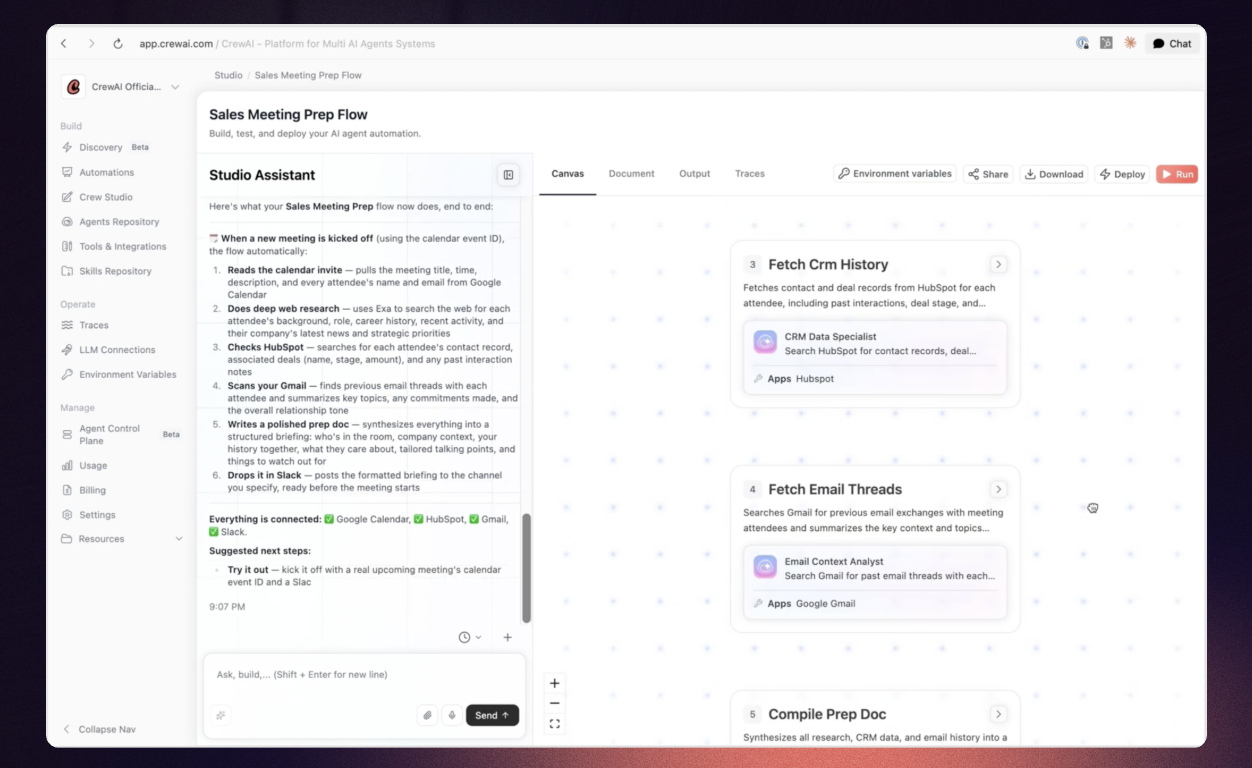
CrewAI Studio is a visual, AI-assisted workspace: describe the automation in natural language and it generates agents, tasks, and tools, or build it by hand on a canvas. Published crews can be chatted with, exported as a React component, or exported as an MCP server — a genuinely unusual bridge between "no-code prototype" and "reusable engineering artifact." Deployment from there runs via the CLI, a GitHub-connected pipeline, or directly from Studio.
MCP and agent-to-agent protocols are first-class, not bolted on.
CrewAI agents can connect to MCP servers (stdio or HTTP) as tool sources directly, per official documentation, and the framework ships hundreds of built-in tools out of the box — web search, website interaction, vector database queries, and code execution via sandboxed E2B/Daytona environments (the successor to the removed, insecure Docker-based path). CrewAI also supports the A2A (agent-to-agent) protocol, letting separate Crews discover and collaborate with each other rather than only with tools.
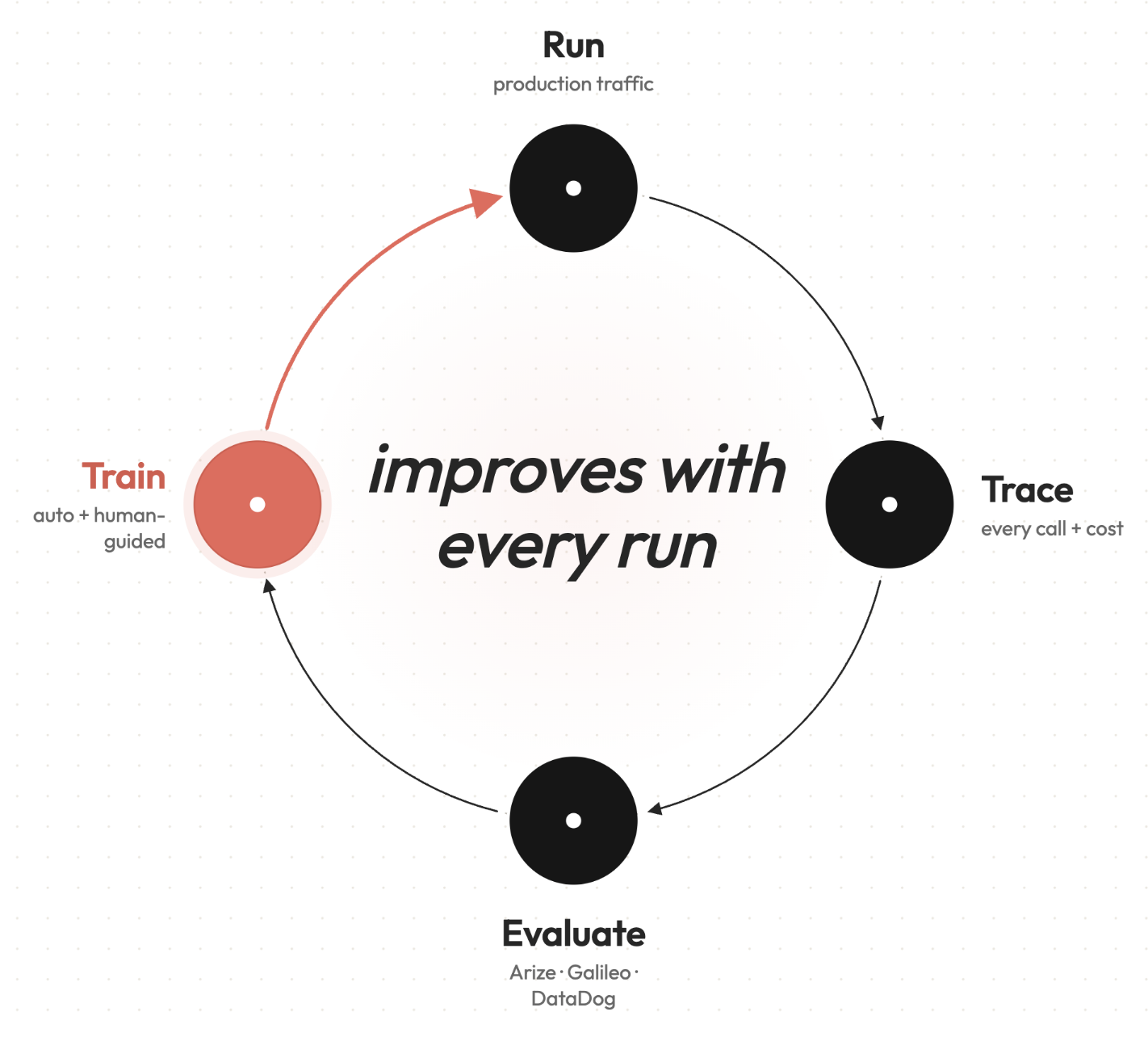
Your real bill is your model bill and, if you scale, your AMP contract.
| What you're doing | What you pay |
|---|---|
| Framework only, self-hosted, bring your own LLM key | $0 to CrewAI; your model provider's own per-token rate |
| Basic tier | $0, capped at 50 workflow executions/month on CrewAI's own hosted Studio |
| Enterprise (CrewAI AMP) | Custom — "sized to workflow," flexible overage; includes governance + deployment options |
| Previously: Professional tier (now discontinued) | Was $25/mo for 100 executions, $0.50 per additional — no longer offered as of this check |
A real critical-severity disclosure in 2026, fixed by removing the feature, not patching it.
| CVE | Issue | Severity |
|---|---|---|
| CVE-2026-2287 | Docker runtime-check failure, insecure sandbox fallback → remote code execution | Critical (CVSS 9.8) |
| CVE-2026-2275 | Fallback to insecure SandboxPython allowing arbitrary C function calls | Critical |
| CVE-2026-2286 | Server-side request forgery (SSRF) | High |
| CVE-2026-2285 | Arbitrary local file read via JSON loader | High |
People who want to move fast now and can accept a possible rebuild later.
| Situation | Why CrewAI fits | Likely plan |
|---|---|---|
| Solo developer/team validating a multi-agent idea | Fastest documented path to a working prototype | Basic, free |
| Team that thinks in roles, not state graphs | Crews' role/goal/backstory model matches how teams already describe work | Basic or Enterprise |
| Org standardizing on one agent platform at Fortune-500 scale | CrewAI AMP: SSO, RBAC, FedRAMP High, dedicated onboarding | Enterprise (AMP), custom |
| Regulated, long-running, or audit-heavy workflow | Not CrewAI's strength by its own users' documented pattern — see Alternatives | Consider LangGraph instead |
| Already using CrewAI's Code Interpreter tool | Must update past v1.14.0 — the vulnerable tool is gone, not fixed-in-place | Any tier, update first |
Four real gaps, not manufactured ones.
CVSS 9.8 remote code execution, chainable via prompt injection, is a serious finding regardless of how well it was ultimately fixed. Anyone who deployed the Code Interpreter tool before Apr 7, 2026 was exposed.
Going from 3 tiers to 2 by cutting the self-serve mid-tier ($25/mo Professional) suggests that segment didn't work commercially — worth knowing if you were hoping to grow into a mid-tier plan rather than jump straight to "Enterprise, custom."
AOP at launch (Oct 2025), AMP now (checked Sep 2026) — a rename within about a year is a minor thing individually, but it's the kind of churn worth factoring into how much you trust the product roadmap to hold still.
CrewAI's own homepage says "65% of the Fortune 500," its own open-source page says "63%" — checked the same day. Neither figure is independently audited.
If CrewAI's speed-first tradeoff isn't what you need, here's how to think about it.
| If you mostly need... | Compare CrewAI with... |
|---|---|
| Explicit graph-based state control for regulated/long-running production workflows | LangGraph — read our review |
| A Gemini-native, Google Cloud-integrated framework across Python/Java/Go/TypeScript | Google ADK — read our review |
| Tight Azure integration and Microsoft-backed enterprise support | Microsoft Agent Framework (formerly AutoGen, merged w/ Semantic Kernel, Apr 2026) |
| The smallest possible orchestration layer, tightly coupled to one model vendor | OpenAI Agents SDK |
| A terminal-first coding agent bundled with a general Claude subscription | Claude Code — see our Claude Code setup guide |
No affiliate relationship shapes this review.
JAVIS has not established a publisher affiliate program with CrewAI Inc. Every CTA here points to the official product.
Go to the official page.
Open CrewAIRead the alternative that matches your real question.
Choose the next articleCrewAI makes the most sense next to the frameworks it's directly competing with.
Questions people are actually searching right now
Is CrewAI still free?
Yes. The core Python framework is MIT-licensed and free, and the hosted Basic tier (50 workflow executions/month, Studio, AI copilot) also costs $0. What's gone is the $25/month Professional tier that used to sit between Basic and Enterprise.
What is CrewAI AMP?
CrewAI's enterprise control plane for deploying, monitoring, and governing crews/agents in production — SSO, RBAC, PII redaction, VPC/on-prem deployment, FedRAMP High availability. It launched in October 2025 under the name "CrewAI AOP" (Agent Operations Platform) and is now officially branded "CrewAI AMP" (Agent Management Platform).
Is CrewAI secure?
As of this check, the specific critical vulnerabilities disclosed in March 2026 (CVE-2026-2275, -2285, -2286, -2287, one rated CVSS 9.8) were fixed in v1.14.0 (Apr 7, 2026) by removing the vulnerable Code Interpreter tool and its Docker-sandbox fallback entirely, confirmed on CrewAI's own changelog. If you're running an older version or still using that tool, update first.
What's the difference between Crews and Flows?
Crews are autonomous, role-based agent teams — fast to build, looser on control. Flows are event-driven and stateful, for when you need explicit, deterministic control over exactly what runs and when. Most real CrewAI projects combine both.
Who funds CrewAI?
A confirmed $18M seed + Series A, led by Insight Partners with Boldstart Ventures leading the seed, announced October 2024; investors include Andrew Ng and HubSpot co-founder Dharmesh Shah. Third-party trackers report a further ~$20.5M Series B around April 2026, but no official CrewAI announcement of that round was found as of this check.
Is CrewAI better than LangGraph?
Different tradeoffs: CrewAI gets you to a working prototype faster (often under an hour); LangGraph gives explicit state control and checkpointing better suited to regulated or long-running production workflows. A documented pattern across independent reviewers is prototyping in CrewAI, then rebuilding in LangGraph once those production demands show up. See our LangGraph review for the direct comparison.
Does CrewAI support MCP?
Yes — first-class, per official docs at docs.crewai.com/en/mcp/overview. Agents can connect to MCP servers (stdio or HTTP) as tool sources, and CrewAI also supports the A2A protocol for cross-crew agent collaboration.
Can I still use the Code Interpreter tool for code execution?
Not the old one — it was removed in v1.14.0 following the March 2026 CVE disclosures. Sandboxed code execution now runs through E2B or Daytona instead.
Where this came from, and when it was checked.
GitHub stats (stars/forks/license): GitHub data for github.com/crewAIInc/crewAI, Sep 22, 2026.
PyPI version/downloads: pypi.org/project/crewai and pepy.tech download stats, Sep 22, 2026.
Pricing (Basic, Enterprise/AMP): crewai.com/pricing, Sep 22, 2026.
Enterprise platform rename (AOP → AMP): crewai.com/blog/crewai-amp---the-agent-management-platform and docs-platform.crewai.com/platform/en/introduction, both official, cross-checked against the Oct 2025 AOP launch coverage.
March 2026 CVEs and their fix: CERT/CC VU#221883 (official coordination-center advisory) plus independent reporting (SecurityWeek, GBHackers, OpenCVE); the v1.14.0 removal of CodeInterpreterTool was independently confirmed directly on CrewAI's own official changelog at docs.crewai.com/en/changelog.
Funding ($18M confirmed; ~$20.5M Series B unconfirmed): Wikipedia/Crunchbase for the confirmed Oct 2024 round; PitchBook/Forge/Premier Alternatives for the disputed, not-officially-announced Series B figures.
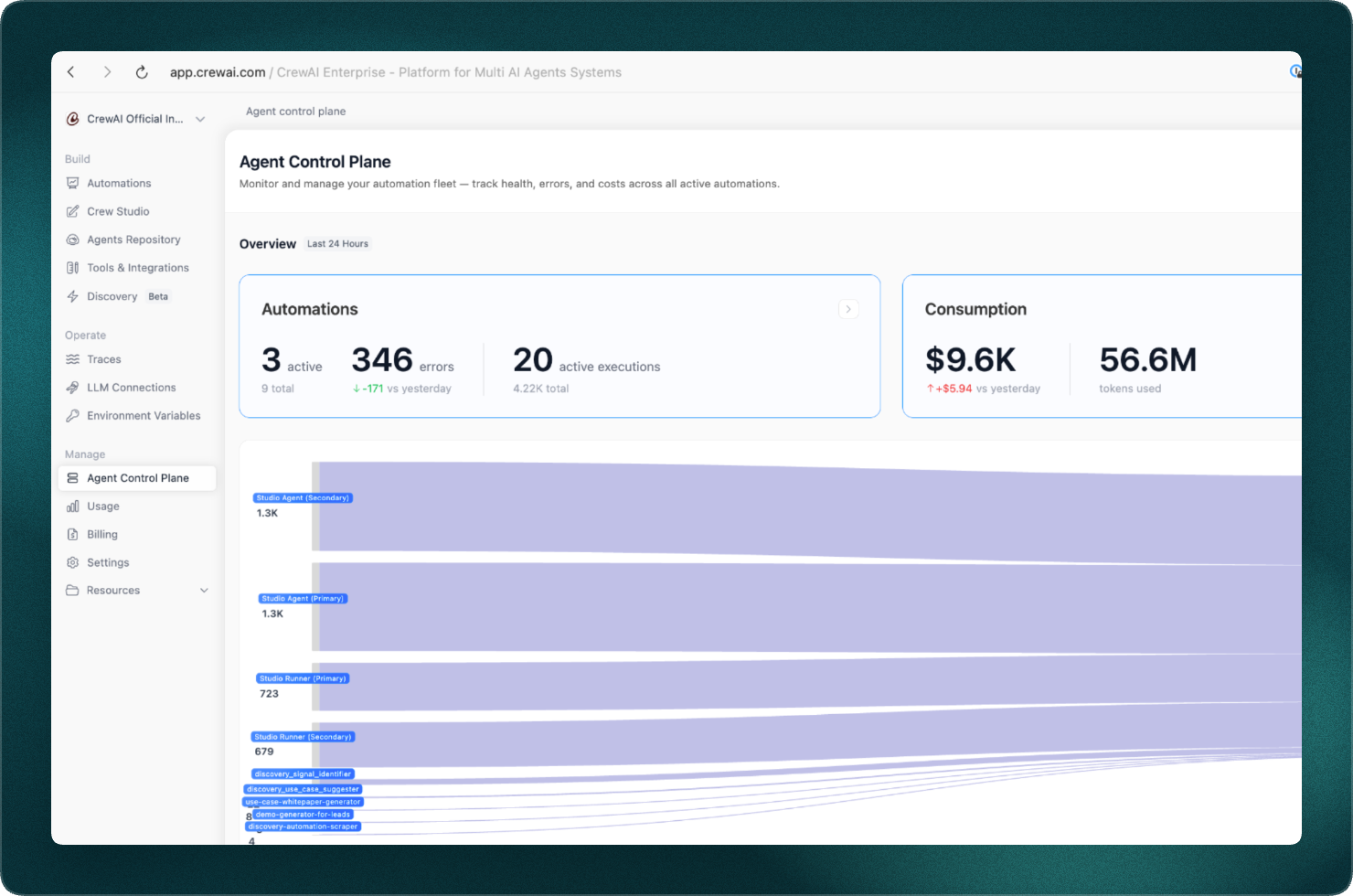
Real screenshots/media: og-image, GitHub repo/org cards, Studio_flows_screen.png, control_plane.png, and Optimize_flywheel.png.
Official video: youtube.com/watch?v=-kSOTtYzgEw, authorship confirmed on YouTube (author "CrewAI", channel @crewAIInc); two other candidate videos were checked the same way and rejected as non-official.
User sentiment: G2 rating/review pattern (via search aggregation — G2 could not be read directly, so this is a lower-confidence read); independent 2026 framework-comparison articles for the prototyping-speed and migration-to-LangGraph patterns.