
Ollama Review 2026: Local LLMs, Real Cloud Pricing, and a Vulnerability Worth Knowing About
Ollama is still the fastest way to `ollama run` a model on your own machine, free and offline. What's new in 2026 is everything built around that core: a $65M Series B (total funding $88M), a native desktop app, a metered Ollama Cloud with five tiers, and a critical CVE — codenamed "Bleeding Llama" — that could leak process memory from unpatched, internet-exposed instances. This review covers what Free/Pro/Max/Team/Enterprise actually cost, what the vulnerability means for you, and whether Ollama still earns its "just run it locally" reputation.

| Local use | Free and unlimited, always |
| License | MIT |
| Cheapest paid Cloud tier | Pro, $20/mo |
| Funding | $65M Series B, Jul 2026 ($88M total) |
| Known critical CVE | CVE-2026-7482, patched in v0.17.1 |
Ollama is still the easiest on-ramp to local AI. It's also had its first real security scare.
"Running a model locally with `ollama pull` and `ollama run` is exactly as free and simple as it's always been — that part hasn't changed, and it's the reason 8.9 million developers reportedly use it. What's new is Ollama Cloud (five metered tiers for when your laptop can't run the model you want), a native desktop GUI, $88M in total funding, and a disclosed critical vulnerability that every self-hoster running Ollama on an exposed network needs to know about."
If you tried Ollama in 2023 as a single-command way to run Llama locally, the honest 2026 update is: the local path is unchanged and still genuinely free, but Ollama is now also a funded company selling hosted inference credits, and a real CVE means the old habit of leaving `OLLAMA_HOST=0.0.0.0` open to a network needs a second look.
One runtime, a growing set of ways to use it.
Ollama is an MIT-licensed runtime for pulling and serving open-weight language models — locally on your own GPU/CPU, or via Ollama Cloud when a model is too large for your hardware. Its own GitHub description no longer even leads with Llama: it now reads "Get up and running with Kimi, GLM, MiniMax, DeepSeek, gpt-oss, Qwen, Gemma and other models" — a real signal of how far the supported model catalog has grown beyond its Meta-Llama origins.
The one asterisk worth flagging early: Ollama's own privacy FAQ says prompt/response data is never logged or trained on for Cloud requests, but Cloud inference itself runs on partner infrastructure (NVIDIA Cloud Providers), not on your own machine — a materially different trust model than the fully local CLI path.
Ollama's 2026 story is developer reach, not revenue disclosure.
ollama/ollama, verified on GitHub, Sep 22, 2026.
Company-disclosed, TechCrunch coverage, Jul 2026.
$15M Series A + $65M Series B (Jul 9, 2026).
Company-disclosed, not independently audited.
| Round | Amount | Lead / date |
|---|---|---|
| Series A | $15M | Benchmark (Peter Fenton) |
| Series B | $65M | Theory Ventures, w/ Benchmark, 8VC, Y Combinator, Pace Capital, 49 Palms, GTMFund — Jul 9, 2026 |
| Total to date | $88M | Angels include Docker founder Solomon Hykes and ClickHouse CEO Aaron Katz |
The praise is about simplicity. The honest caveat is accuracy versus frontier cloud models.
Reviewers consistently praise how "one command to pull and run a model" removes API keys and cloud dependency entirely, with a REST API described as "clean enough to integrate into any project without friction."
The honest counterpoint recurs just as often: local models run through Ollama can be "slow, inaccurate, and unpredictable" compared with commercial cloud models like GPT-4 or Claude-class systems — a hardware and model-size trade-off, not a bug.
At single-user chat, Ollama, LM Studio, and vLLM land in a similar 130-180 tokens/sec band. Add concurrent users and the gap opens fast: one widely cited benchmark measured vLLM holding ~793 tok/s at 128 concurrent requests versus Ollama flattening near ~41 tok/s on the same GPU and model.
Local is always free. Cloud is metered across five tiers.
Free
Local unlimited; starter Cloud credits.
- 1 concurrent Cloud request
- No service fees
Pro
$200/yr billed annually.
- $60 Cloud credits/mo
- 3 concurrent requests
Max
Multiple simultaneous agents.
- $300 Cloud credits/mo
- 10 concurrent requests
Team
Early access. Unlimited users.
- $1,000 shared Cloud credits/mo
- Centralized billing/admin
Enterprise
Volume usage pricing.
- Model access controls, cost budgets
- Dedicated Slack support
Source: ollama.com/pricing, verified Sep 22, 2026. Concurrency: Free=1, Pro=3, Max/Team=10.
Your answer depends on whether your hardware can run the model you want.
Free tier — local use is unlimited and always free, on every plan.
Pro at $20/mo, $60 in monthly Cloud credits.
Max at $100/mo, $300 in credits, 10 concurrent requests.
Team at $500/mo, unlimited users, shared $1,000 credit pool.
Enterprise, custom pricing.
A native desktop app replaced the terminal-only identity in 2025.
Ollama shipped its first native desktop app (v0.10.0, July 2025) for macOS 12+ and Windows — a genuine departure from the "terminal tool" reputation that defined its first two years. The app adds a chat interface with a model dropdown, drag-and-drop support for text, Markdown, PDF, and code files, and multimodal image support for models that accept it.
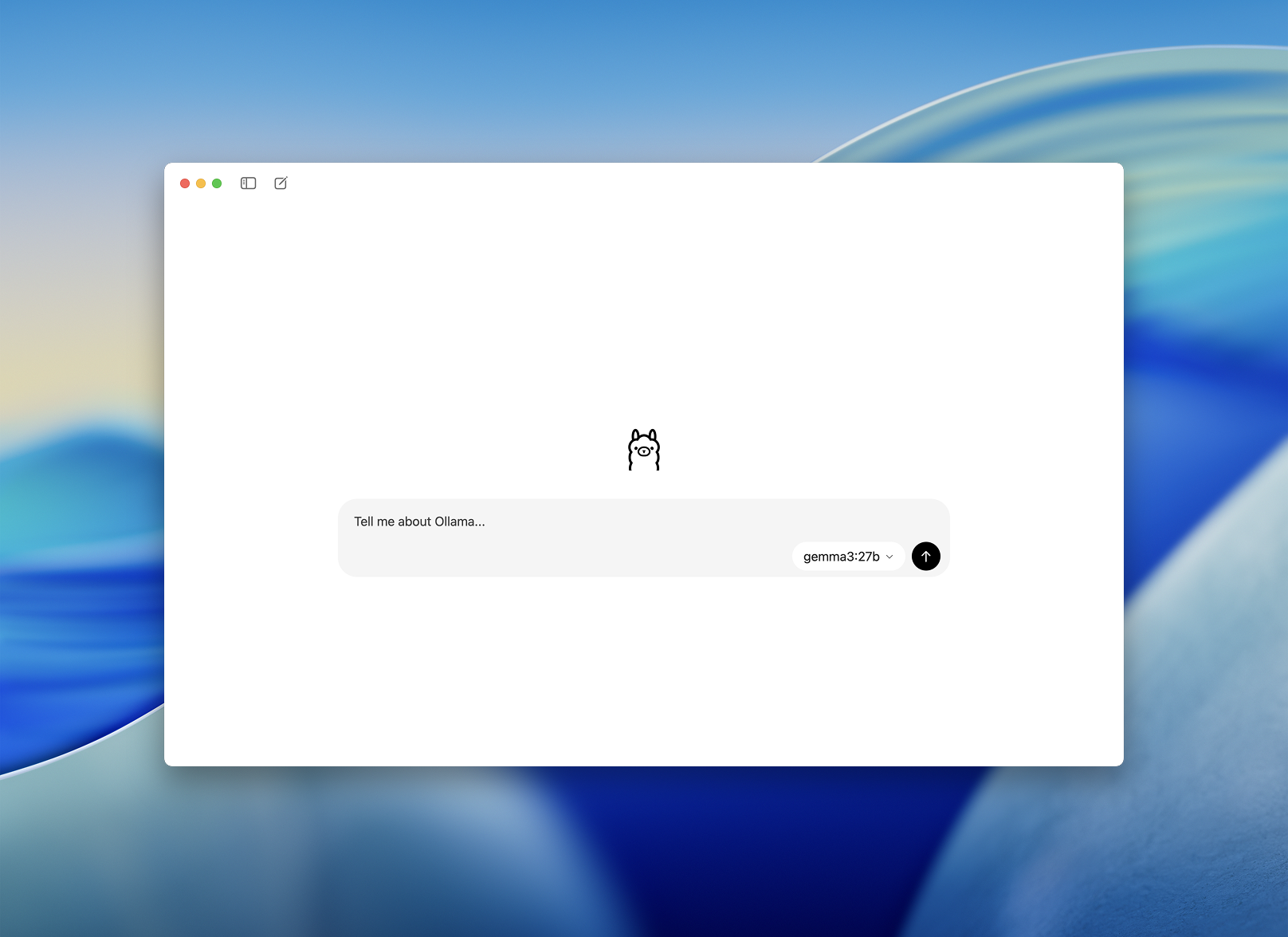
- Model switching is genuinely one dropdown, no config file editing.
- Drag-and-drop file context (PDF, code, Markdown) works without a separate RAG setup.
- The same models power the CLI, app, and REST API — nothing is app-exclusive.
- The app is a thin client over the same local server — it doesn't make a small model smarter.
- Multimodal support depends entirely on whether the model you picked was trained for it.
Pull once, run anywhere, control the context window yourself.
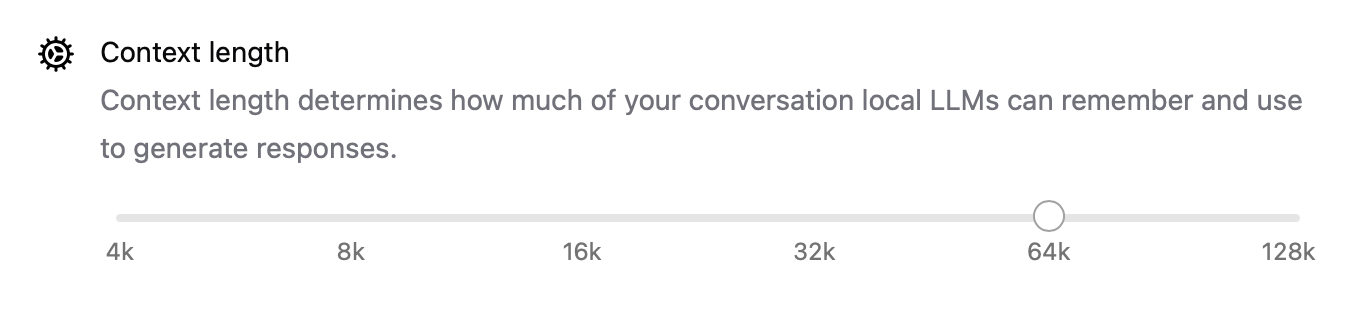
Coding-agent and tool-calling support turned Ollama into an agent backend, not just a chatbot.
Recent releases added web search support, coding-agent integrations, and tool-calling for models trained to support it — every Cloud model that claims tool support is tested against real agent workflows before release, per Ollama's own FAQ. On Apple Silicon, an MLX backend moved from preview to stable in 2026, replacing the llama.cpp Metal path on M-series Macs for better performance.

The OpenAI-compatible API is why Ollama shows up inside everything else.
Ollama's REST API is OpenAI-compatible, which is why it's the default local backend for tools like Open WebUI, and why automation platforms like n8n can point an AI node at a local Ollama endpoint instead of a paid model API. Ollama also collaborates with NVIDIA Cloud Providers to host Cloud-tier open models, under no-logging/no-training/zero-retention terms.
Local inference is free. Cloud inference is priced per model, per million tokens.
| Cloud model (example) | Input / M tok | Output / M tok |
|---|---|---|
| gpt-oss:20b | $0.07 | $0.30 |
| gpt-oss:120b | $0.15 | $0.60 |
| deepseek-v4.1-flash | $0.15 | $0.60 |
| qwen3.5:397b | $0.60 | $3.60 |
| kimi-k3 | $3.00 | $15.00 |
A real, disclosed CVE — and a good case study in why default network exposure matters.
Sources: Cyera research ("Bleeding Llama"), ThaiCERT, SecurityWeek, The Hacker News, Help Net Security — cross-checked 2026-09-22.
People whose hardware can do the work, and who value privacy over raw throughput.
| Situation | Why Ollama fits | Likely plan |
|---|---|---|
| Developer with a capable local GPU, privacy-first workflow | Free, local, offline, no data leaves the machine | Free (local only) |
| Occasional need for a model too large to run locally | Ollama Cloud on demand, no separate provider account | Pro, $20/mo |
| Power user running multiple agents in parallel | Higher concurrency, more credits | Max, $100/mo |
| Team standardizing shared Cloud usage and billing | Unlimited users, centralized admin | Team, $500/mo |
| Production service needing high concurrent throughput | Ollama isn't built for this — see vLLM instead | N/A — different tool |
Four real gaps, not manufactured ones.
CVE-2026-7482 was patched without the release notes flagging it as a security fix, which delayed broader awareness even after a fix shipped.
Independent benchmarks put vLLM roughly 16-20x ahead of Ollama at high concurrent load on identical hardware — Ollama is not a production multi-user serving system.
Reviewers are consistent: local models via Ollama can be noticeably less accurate than GPT-4/Claude-class systems, especially on complex reasoning.
The "85% of Fortune 500" and "8.9M developers" figures come from Ollama's own funding announcement and press coverage; JAVIS did not independently audit them.
If Ollama's trade-offs aren't right for your use case, here's how to think about it.
| If you mostly need... | Compare Ollama with... |
|---|---|
| A GUI-first, most-accessible way to browse and run local models on Mac/Windows | LM Studio — similar simplicity, different UI philosophy |
| Production-grade serving for many concurrent users on NVIDIA/AMD GPUs | vLLM — ~16-20x Ollama's concurrent throughput via PagedAttention |
| A polished self-hosted chat interface on top of Ollama's local models | Open WebUI — read our review |
| Wiring local models into no-code automations | n8n — read our review |
No affiliate relationship shapes this review.
JAVIS found no evidence of a public Ollama Inc. affiliate or referral program as of this check. Every CTA here points to the official product, unmodified.
Go to the official page.
Open OllamaRead the alternative that matches your real question.
Choose the next articleOllama is the backend most of this local-AI stack is built on.

Questions people are actually searching right now
Is Ollama free?
Yes for local use, always and on every plan — running models on your own hardware has no service fee. Ollama Cloud (Free/Pro/Max/Team/Enterprise) is a separate, metered option for models too large to run locally.
Is Ollama open source?
Yes, MIT-licensed, confirmed directly on GitHub and in the repository license file.
What is CVE-2026-7482?
A critical (CVSS 9.1) unauthenticated heap out-of-bounds read in Ollama's GGUF model loader, nicknamed "Bleeding Llama," that could leak process memory including prompts and secrets from internet-exposed instances. It was patched in v0.17.1 (Feb 25, 2026), though the release notes didn't originally flag it as a security fix.
How much does Ollama Cloud cost?
Pro is $20/month ($200/year billed annually) with $60 in monthly Cloud credits; Max is $100/month with $300 in credits; Team is $500/month with a shared $1,000 credit pool; Enterprise is custom.
Is Ollama better than LM Studio or vLLM?
Different trade-offs: LM Studio is more GUI-first/accessible, vLLM serves far more concurrent users on the same hardware (roughly 16-20x Ollama's throughput per independent benchmarks), and Ollama optimizes for the fastest single-user local setup. A common 2026 pattern is starting developers on Ollama and deploying vLLM for shared/production serving.
Does my prompt data get used to train models?
Per Ollama's own privacy FAQ, prompt and response data is never logged or trained on, for both local and Cloud requests; Cloud inference runs on NVIDIA Cloud Provider infrastructure under no-logging/no-training/zero-retention terms.
Can Ollama run tool-calling AI agents?
Yes, for models trained to support it. Ollama tests tool-calling Cloud models against real agent workflows before release, and the same tool-calling works with self-hosted local models that support it.
What changed on Apple Silicon in 2026?
Ollama added an MLX backend in preview, then promoted it to stable in 2026, replacing the previous llama.cpp Metal path as the default on M-series Macs.
Where this came from, and when it was checked.
GitHub stats (stars/forks/license): GitHub data for github.com/ollama/ollama, Sep 22, 2026.
Pricing (Free/Pro/Max/Team/Enterprise, model token rates): ollama.com/pricing, official, read directly, Sep 22, 2026.
Funding ($65M Series B, $88M total): BusinessWire/TechCrunch coverage of Ollama's official announcement, Jul 9, 2026.
CVE-2026-7482 ("Bleeding Llama"): Cyera security research, corroborated by ThaiCERT, SecurityWeek, The Hacker News, and Help Net Security — cross-checked 2026-09-22.
Desktop app (v0.10.0, Jul 2025): ollama.com/blog/new-app, official.
Real screenshots/media: ollama.com official OG image, opengraph.githubassets.com repo card, and three screenshots from Ollama's own blog (files.ollama.com: ollama-app-screenshot.png, context_length.png, new.png).
Privacy/hosting model: ollama.com/pricing FAQ section, official, on data logging/training and NVIDIA Cloud Provider hosting.
User sentiment: G2/community aggregate patterns; independent Ollama-vs-LM-Studio-vs-vLLM benchmarks and comparisons.