
Radox AI Review 2026: One OpenAI-Compatible Endpoint for 33 Models, Sold by the Token
Radox AI is an API gateway: you point an OpenAI-style client at https://radoxai.com/v1, pick a model name, and pay for tokens through a monthly plan from $0 to $50. This overview explains how the plans and overage billing work, what it connects to, and what to check before you build on it. This article focuses on chat/text.

| Models | 33, one endpoint |
| Free plan | 10M tokens/mo, 60 req/min |
| Entry paid plan | Starter, $4.50/mo for 100M |
| Top plan | Unlimited, $50/mo |
| Out of allowance | Bills balance; empty balance returns HTTP 402 |
A simple idea with a clear price list, and a few rules worth reading before you commit.
Radox AI sells tokens, not seats: every plan reaches the same 33 models, and the only difference is how many tokens and requests per minute you get.
That is a genuinely easy pitch to evaluate. If your code already speaks to an OpenAI-style API, the change is a base URL and a key. The decision is then about arithmetic (how many tokens you burn in a month) and about how comfortable you are with a middleman sitting between you and the model makers. Radox's own Terms describe it plainly as a gateway, and this review takes that framing seriously.
One base URL in, many model providers out.
Per the Radox homepage, you use the official OpenAI SDKs (Python, Node, Go, .NET) or any tool that accepts a custom endpoint, and switching models is a one-string change. The plans differ in token allowance and per-minute limits, not in model access.
 Claude
 ChatGPT
 Gemini
 DeepSeek
 Kimi
 Llama
 Mistral
 Qwen
 ByteDance
 Z AI
How Radox describes itself
The Terms of Service (effective 23 August 2026) put it in one paragraph: "Radox AI is an API gateway. We provide a single OpenAI-compatible endpoint that routes your requests to third-party AI model providers, meters your usage, and bills you for it. We do not build or host the underlying models."
An OpenAI-compatible gateway, positioned on price per token and breadth of models.
The public pages show how the product positions itself:
Models page and pricing page, Oct 15, 2026.
Starter, Basic, Pro, Scale, Unlimited. Pricing page.
Starter: $4.50 for 100M tokens. Pricing page.
Kilo Code, Cline, Cursor, opencode, Claude Code, Continue, Aider. Docs.
| Signal | What it tells you | What it does not tell you |
|---|---|---|
| Catalog of 33 models, same on every plan | You can switch models without changing plan | How each upstream model performs for your task |
| Published rate limits per plan | Planning ceiling for requests and tokens per minute | Whether your own workload fits inside them |
| Named coding-agent setups in docs | Vendor has documented a path for these tools | How many developers use them |
What the vendor itself says in writing.
This article cites no independent customer reviews. The cards below quote the vendor's own FAQ and Terms, clearly labeled as vendor statements, so you can see which promises are made in writing.
"Plans differ only in monthly token volume and per-minute rate limits."
"When your allowance and balance are both exhausted, requests are refused with HTTP 402 before reaching a model."
"We do not use your prompts or outputs to train models."
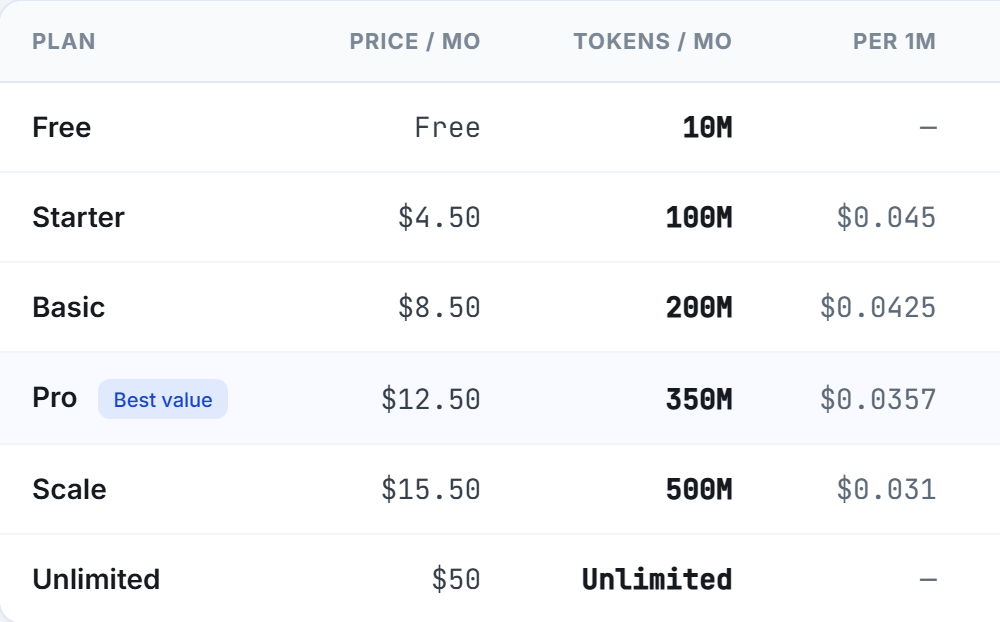
Six plans, one rule: bigger package, lower price per million tokens.
Free
10M tokens / month, 60 requests / min. No card required.
Starter
100M tokens / month · $0.045 per 1M · 120 req/min. Yearly: $45.
Basic
200M tokens / month · $0.0425 per 1M · 300 req/min. Yearly: $85.
Pro
350M tokens / month · $0.0357 per 1M · 600 req/min. Yearly: $125.
Scale
500M tokens / month · $0.031 per 1M · 1,200 req/min. Yearly: $155.
Unlimited
Unlimited tokens, 3,000 req/min, custom rate limits on request. Yearly: $500.
Source: radoxai.com/pricing, Oct 15, 2026. Yearly billing is advertised as "2 months free". Tokens count prompt and completion combined.
Swipe sideways to see every column.
| Plan | Price / mo | Tokens / mo | Per 1M | Requests / min | Tokens / min |
|---|---|---|---|---|---|
| Free | Free | 10M | n/a | 60 | 100,000 |
| Starter | $4.50 | 100M | $0.045 | 120 | 200,000 |
| Basic | $8.50 | 200M | $0.0425 | 300 | 500,000 |
| Pro | $12.50 | 350M | $0.0357 | 600 | 1,000,000 |
| Scale | $15.50 | 500M | $0.031 | 1,200 | 2,000,000 |
| Unlimited | $50 | No cap | n/a | 3,000 | 5,000,000 |
Swipe sideways to see every column.
| Plan | Support | Usage analytics | Early access to models | Custom limits |
|---|---|---|---|---|
| Free | Community | Not listed | Not listed | Not listed |
| Starter | Not listed | Not listed | Not listed | |
| Basic | Listed | Not listed | Not listed | |
| Pro | Priority | Listed | Not listed | Not listed |
| Scale | Priority | Listed | Listed | Not listed |
| Unlimited | Dedicated | Listed | Listed | On request |
Swipe sideways to see every column.
| Plan | 12 x monthly | Yearly price | Saving | Shown per month |
|---|---|---|---|---|
| Starter | $54.00 | $45 | $9.00 | $3.75 |
| Basic | $102.00 | $85 | $17.00 | $7.08 |
| Pro | $150.00 | $125 | $25.00 | $10.42 |
| Scale | $186.00 | $155 | $31.00 | $12.92 |
| Unlimited | $600.00 | $500 | $100.00 | $41.67 |
Swipe sideways to see every column.
| Workload (JAVIS assumption) | Tokens / mo | Free 10M | Starter 100M | Basic 200M | Pro 350M | Scale 500M | Unlimited |
|---|---|---|---|---|---|---|---|
| Personal chat helper 40 req/day x 1,500 tokens | 1.8M | 18% of pool | 2% of pool | 1% of pool | 1% of pool | 0% of pool | No cap |
| Side-project bot 400 req/day x 3,000 tokens | 36M | 26M over | 36% of pool | 18% of pool | 10% of pool | 7% of pool | No cap |
| Daily coding-agent use 300 req/day x 15,000 tokens | 135M | 125M over | 35M over | 68% of pool | 39% of pool | 27% of pool | No cap |
| Small-team app 3,000 req/day x 4,000 tokens | 360M | 350M over | 260M over | 160M over | 10M over | 72% of pool | No cap |
| Always-on agent workload 20,000 req/day x 8,000 tokens | 4,800M | 4,790M over | 4,700M over | 4,600M over | 4,450M over | 4,300M over | No cap |
Billing rules in the official words. Pricing page: "Requests fall back to your account balance and are billed per token at each model's published rate. If the balance is empty, requests return HTTP 402 with a clear error instead of failing silently." Downgrades "apply from the next billing period"; upgrades "take effect immediately". Accepted payment: Paddle (cards, Apple Pay, Google Pay, iDEAL), Binance Pay and cryptocurrency (USDT/BTC).
Pick a starting point by how much you will actually send.
Free: 10M tokens a month, no card. Enough to see how your client behaves against the endpoint.
Starter ($4.50) or Basic ($8.50). Check the 120 and 300 requests-per-minute ceilings first.
Pro ($12.50, 600 req/min) is the plan Radox itself flags as best value.
Scale ($15.50, 1,200 req/min) or Unlimited ($50, no token cap, 3,000 req/min).
Swap the base URL, keep your code.
This is the whole product in a sentence. Radox publishes a three-language quickstart on its homepage: the client is the standard OpenAI SDK, the base_url is Radox's, and the model string picks the provider. The same page lists streaming over server-sent events, tool calling including parallel calls, vision input and reasoning models as supported features.
| Capability | What Radox says |
|---|---|
| Streaming | Server-sent events with keep-alive pings and connections that stay open for up to an hour |
| Tool calling | Full round trips, parallel calls and streamed argument deltas |
| Vision input | Images as base64 or URLs to any vision-capable model |
| Reasoning models | Chain-of-thought output arrives in a separate field |
| Capability discovery | Returned by GET /v1/models, so code can check at runtime |
A sample of the catalog
| Model ID and listed capabilities | Context | In / 1M | Out / 1M |
|---|---|---|---|
| gemma-2-2bStreaming, JSON | 8K | $0.115 | $0.23 |
| deepseek-v4-flash-0731Reasoning, tools, streaming, JSON | 1049K | $0.115 | $0.115 |
| gpt-5.6-lunaReasoning, vision, tools, streaming, JSON | 1050K | $0.357 | $0.357 |
| deepseek-v4-pro-0813Reasoning, tools, streaming, JSON | 1049K | $0.552 | $0.552 |
| qwen3.8-27bReasoning, tools, streaming, JSON | 262K | $0.575 | $0.575 |
| seed-2.1-turboReasoning, vision, tools, streaming, JSON | 262K | $0.92 | $0.92 |
- 1gemma-2-2b: 8K context, $0.23 out / 1M
- 2deepseek-v4-flash-0731: 1049K context, $0.115 out / 1M
- 3gpt-5.6-luna: 1050K context, $0.357 out / 1M
- 4deepseek-v4-pro-0813: 1049K context, $0.552 out / 1M
- 5qwen3.8-27b: 262K context, $0.575 out / 1M
- 6seed-2.1-turbo: 262K context, $0.92 out / 1M
From signup to first request in three steps.
Sign up and generate an API key from the dashboard. Radox says you can scope it to inference, models or embeddings.
Set base URL to https://radoxai.com/v1 and paste the key. Everything else stays the same.
The dashboard tracks requests, tokens and spend. Swap models by changing one string.
Radox documents setup for seven coding tools.
The docs section "Using Coding Agents" lists step-by-step setup for Kilo Code, Cline, Cursor, opencode, Claude Code, Continue and Aider. The homepage states the general recipe: set the provider to "OpenAI Compatible", paste the base URL and key, and pick a model. Note that a long agent session is where token allowances get used up quickly, which is why the Unlimited plan is aimed at "heavy agent workloads".
 Kilo Code
 Cline
 Cursor
 opencode
 Claude Code
Compatibility is the integration.
Radox does not describe a connector marketplace or its own plugin system. Its integration story is the OpenAI request and response shape: "Request and response shapes match the OpenAI spec, including streaming chunks, tool calls, and error envelopes." Anything that lets you override the endpoint is a candidate. Embeddings are also listed in the docs for search, RAG and clustering.
Your real cost has two layers, and the second one is per model.
Per the Terms, billing works on two layers: a plan allowance that "resets each billing period and unused tokens do not carry over", and a prepaid account balance that is "charged at each model's published per-token rate once your plan allowance is exhausted". Balance "does not expire while your account is open".
- 1 - Sign upFree plan: 10M tokens a month, 60 requests per minute, no card required (pricing page).
- 2 - UseRequests draw from the plan allowance first, so you are not billed per call until it runs out (pricing FAQ).
- 3 - Allowance usedRequests bill against your prepaid balance at each model's per-token rate (Terms, section 4).
- 4 - Balance empty"requests are refused with HTTP 402 before reaching a model" (Terms, section 4).
- 5 - Top up or upgradePer the pricing FAQ, requests resume immediately. Upgrades take effect immediately and the allowance is refreshed; downgrades apply from the next billing period.
- 6 - New periodThe allowance resets; "unused tokens do not carry over". Balance "does not expire while your account is open" (Terms, section 4).
| Scenario | Arithmetic from listed rates |
|---|---|
| Starter allowance covers 100M tokens for $4.50 | $4.50 / 100 = $0.045 per 1M |
| The same 100M tokens billed from balance on gpt-5.6-luna ($0.357 per 1M) | 100 x $0.357 = $35.70 |
| Free plan's 10M tokens at that same model rate | 10 x $0.357 = $3.57 |
| 100M tokens billed from balance on deepseek-v4-flash-0731 | 100 x $0.115 = $11.50 |
| 100M tokens billed from balance on deepseek-v4-pro-0813 | 100 x $0.552 = $55.20 |
| 100M tokens billed from balance on qwen3.8-27b | 100 x $0.575 = $57.50 |
| 100M tokens billed from balance on seed-2.1-turbo | 100 x $0.92 = $92.00 |
- AStarter ($4.50) then balance at gpt-5.6-luna, $0.357 per 1M
- BStarter ($4.50) then balance at deepseek-v4-flash-0731, $0.115 per 1M
- CThe plan whose pool covers the volume: Free to 10M, Starter to 100M, Basic to 200M, Pro to 350M
| Question | Documented answer | Source |
|---|---|---|
| Do unused plan tokens roll over? | No: "unused tokens do not carry over" | Terms, section 4 |
| Does the prepaid balance expire? | "Balance does not expire while your account is open" | Terms, section 4 |
| What is returned when both are empty? | HTTP 402 | Pricing page and Terms |
| Do upgrades apply immediately? | "Upgrades take effect immediately and your allowance is refreshed" | Pricing page FAQ |
| When do downgrades apply? | "Downgrades apply from the next billing period" | Pricing page FAQ |
| Can rates change? | Yes, with advance announcement and no retroactive effect | Terms, section 4 |
An intermediary sees your prompts. Plan for that.
Radox's Privacy Policy (effective 23 August 2026) states: "We do not store the content of your prompts or the models' replies", and adds that prompts "are transmitted to the upstream provider serving the model you selected, and that provider's own retention policy then applies to them." It also notes that a truncated provider error message "can occasionally include a fragment of the request."
Swipe sideways to see every column.
| Data | Kept by Radox? | Where it goes |
|---|---|---|
| Prompt and reply text | "not written to our database" | Forwarded to the upstream provider serving the model you chose; "that provider's own retention policy then applies" |
| Failed-request error text | A truncated provider error "may be recorded in our logs" | Can "occasionally include a fragment of the request" |
| Usage records | Yes: timestamp, model requested, token counts, response latency, HTTP status, which API key was used | Basis for your dashboard and billing |
| IP address | Yes, with API requests and sign-in attempts | Security, abuse investigation and rate limiting |
| Card details | Only a token or reference and the last four digits | Handled by Paddle; "Card numbers never reach our servers" |
- Keep keys server-side; never in browser code, public repos or shared notebooks.
- Scope and rotate keys; revoke any you suspect leaked.
- Do not paste API keys, passwords or sensitive personal data into prompts.
- Usage on a leaked key is the account holder's responsibility.
- Radox can revoke keys immediately but "cannot reverse charges already spent upstream".
- You are responsible for reviewing AI output before relying on it.
People who already speak OpenAI and want model choice on one bill.
| Situation | Why it fits | Likely plan |
|---|---|---|
| Developer testing several models from one codebase | One key, one-string model switch | Free, then Starter |
| Solo user of a coding agent with a custom endpoint | Setup guides for seven tools | Starter to Pro |
| Small app with steady daily traffic | Monthly pool plus 300-600 req/min | Basic or Pro |
| Agent-heavy or multi-service workload | High limits, or no monthly token cap | Scale or Unlimited |
Real constraints, all taken from Radox's own pages.
The Terms say models "may be added, renamed, repriced, deprecated, or withdrawn", sometimes at the provider's initiative and with little notice. Model names can differ from the upstream provider's naming.
Unused monthly tokens "do not carry over", and paid plans are charged in advance.
The pricing page advertises a 7-day money-back guarantee on paid plans. The Refund Policy narrows it: the 7 days apply only to your first subscription and not to renewals or plan changes. The Terms and Refund Policy describe a separate 14-day window for unused prepaid balance, and consumed tokens are not refundable. Read both before paying.
Even Unlimited is capped at 3,000 requests and 5M tokens per minute.
This article cites no third-party customer reviews, so real-world experience beyond the vendor's pages is unverified.
Swipe sideways to see every column.
| Topic | Pricing page FAQ | Refund Policy | Terms of Service, section 6 |
|---|---|---|---|
| Money-back on a paid plan | "a 7-day money-back guarantee on all paid plans" | 7 days, "only to your first subscription"; "does not apply to renewals or plan changes" unless a technical failure on the platform prevented use | Plan fees "refundable pro rata only if we materially fail to deliver the service and cannot remedy it" |
| Unused prepaid balance | Not stated | "within 14 days of the top-up transaction" | "within 14 days of the top-up", less transaction fees |
| Tokens already consumed | Not stated | "strictly non-refundable" | "not refundable" |
| Billing error | Not stated | Report within 30 days; a confirmed error "will be refunded in full" | "we refund it in full" |
| Crypto payments | Not stated | "non-refundable in fiat currency" | Not stated |
Match the need before comparing prices.
| If you mostly need... | Look at |
|---|---|
| A direct contract and terms with the model maker | The model maker's own API, such as Anthropic, OpenAI or Google |
| Another hosted multi-model gateway | OpenRouter |
| A gateway you host and control yourself | LiteLLM proxy (open source) |
| A first look at Claude before choosing an API | Our Claude review |
How this review was made.
Links labelled as Radox AI calls to action on this page use JAVIS's referral link; if you sign up through them, JAVIS may receive a referral reward at no extra cost to you. The facts, limitations and alternatives above do not depend on it.
This is an evidence-backed editorial review of Radox AI's official pages (home, pricing, models, docs, Terms, Privacy), dated Oct 15, 2026. JAVIS has not run a hands-on test of the service. This article focuses on chat/text.
Start on the free plan; no card required per the pricing page.
Create a free accountRead the related guides below first.
Choose the next articleIf you are weighing models and tools before picking a gateway.
Questions people ask before signing up
What is Radox AI?
An API gateway with one OpenAI-compatible endpoint, https://radoxai.com/v1, that routes requests to third-party model providers and bills for token usage.
How many models can I use on the free plan?
All 33. Radox states every plan, including Free, reaches all models; plans differ in token volume and per-minute limits.
What does the free plan include?
10M tokens per month, 60 requests per minute and no card required, per the pricing page.
What happens when my allowance runs out?
Requests bill against your account balance at each model's per-token rate. If the balance is empty, you get HTTP 402.
Is yearly billing cheaper?
Radox advertises "2 months free" on yearly: for example Starter is $45 billed yearly versus $4.50 monthly.
Which coding tools does it work with?
Radox's docs name Kilo Code, Cline, Cursor, opencode, Claude Code, Continue and Aider.
Does Radox train on my prompts?
Its Terms say "We do not use your prompts or outputs to train models", and its Privacy Policy says prompt text is not stored. Upstream providers' own policies still apply.
Which payment methods are accepted?
Paddle (cards, Apple Pay, Google Pay, iDEAL), Binance Pay and cryptocurrency, per the pricing page.
Where this came from, and the date it applies to.
Pricing, plans, limits, payment methods, billing FAQ: radoxai.com/pricing, Oct 15, 2026.
Models, endpoint, quickstart, coding tools: radoxai.com (home), radoxai.com/models and radoxai.com/docs, Oct 15, 2026.
Gateway description, billing layers, key handling, refunds: Radox Terms of Service, effective 23 August 2026.
Data handling and retention: Radox Privacy Policy, effective 23 August 2026.
User sentiment: no independent customer reviews are cited; vendor statements are labeled as such.
Images: logos saved from radoxai.com (branding, model labs, coding tools), and a screenshot of its pricing table.
Official video: none identified for this product.