Apify Review 2026: 81,000 Ready-Made Scrapers, an MCP Server for AI Agents, and a Pricing Model That Just Changed
Apify is a cloud platform where you run "Actors": small serverless programs that collect web data or automate a browser. Most people never write one. They pick one of roughly 81,000 Actors in Apify Store, pay per event or per unit of compute, and get a clean dataset back. In 2026 Apify also turned the whole store into a toolbox for AI agents through its MCP server, and on Oct 1, 2026 it retired monthly Actor rentals. This review explains what you actually pay as of Oct 4, 2026, who Apify suits, where it frustrates people, and when Crawlee, Firecrawl, ScrapingBee, Browse AI or Bright Data are the better call.
| Made by | Apify, Prague, founded 2015 |
| What it is | Marketplace and cloud runtime for web data and automation tools |
| Free | $5 of usage a month, no card |
| Cheapest paid | $19/mo Starter, includes $19 of usage |
| Store pricing | Pay per event or pay per usage; rentals ended Oct 1, 2026 |
Apify is the fastest way to get web data without becoming a scraping engineer. The catch is a layered bill and a store whose quality depends on who built each tool.
"If someone has already built the scraper you need, Apify turns a week of proxy and browser plumbing into an afternoon and a few dollars. If nobody has, you are paying for a very good runtime, and you should compare it with running Crawlee yourself."
Here is how I read it. Apify is really two products sharing one bill. The first is Apify Store, a marketplace of about 81,000 Actors built by Apify and by independent developers, covering Google Maps, Instagram, TikTok, Amazon, search results, job boards and generic website crawling. The second is the platform those Actors run on: containers, storage, proxies, scheduling, an API and, since 2025, an MCP server that lets Claude, ChatGPT, Cursor and other agents search the store and run Actors on their own. Your plan is a monthly prepaid balance that every Actor, proxy gigabyte and storage operation draws from. The big 2026 change is simpler pricing in the store: monthly rentals were retired on Oct 1, 2026, leaving pay per event and pay per usage. This is an editorial review built on Apify's pricing page, documentation and changelog as of Oct 4, 2026, public Store listings, Trustpilot, Hacker News and GitHub. No controlled hands-on test was run for this article.
Pick an Actor, give it JSON input, get a dataset. Everything else on the platform supports that loop.
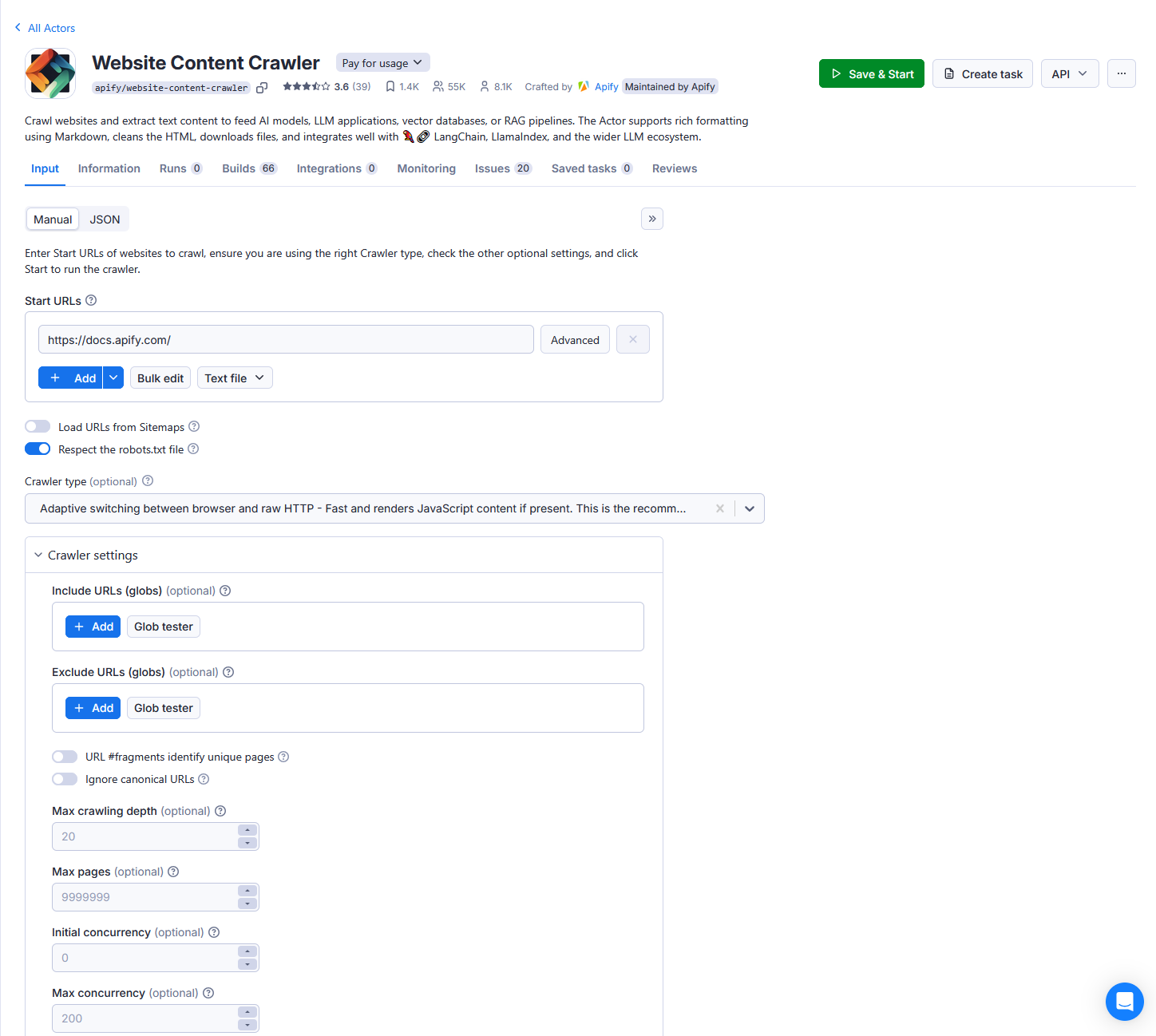
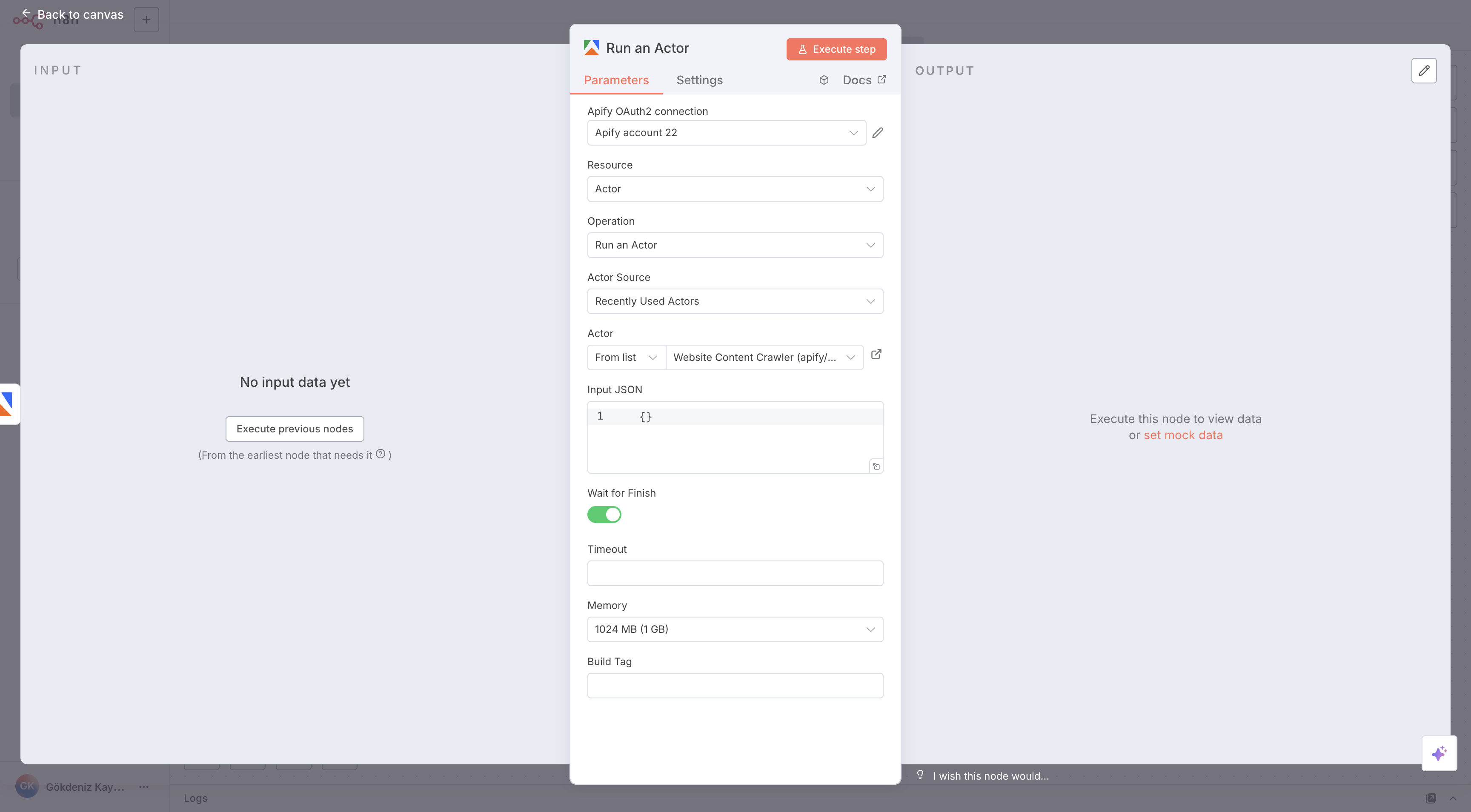
An Actor is a program packaged as a Docker container with a defined input form and output. You start it from Apify Console, the API, a schedule, an integration such as n8n or Zapier, or an AI agent through MCP. Each run writes results to a dataset you can export as JSON, CSV, Excel, XML or RSS, plus a key-value store and a request queue for state. Apify's open source library Crawlee is what most Actors are built on, and you can use it without Apify at all.
Map built from Apify's pricing page and documentation (Actors, storage, proxy, MCP and agent onboarding pages), Oct 4, 2026.
A ten-year-old Prague company that has become the biggest open marketplace for scrapers, now pitched as a tool store for AI.
Apify's About page, Oct 4, 2026. A count of listed tools, not of maintained or popular ones.
Apify's About page. Apify does not define "customer" there; treat it as a company claim, not paying accounts.
Apify site banner, Oct 4, 2026. In Nov 2025 Apify's founder wrote on Hacker News that the prior month's payout was "more than $500k".
apify/crawlee (JS) and apify/crawlee-python, Oct 4, 2026. Stars measure developer interest, not users.
What the biggest Store listings show
Store listings publish their own usage counters. They are Apify's numbers, but they are per tool and consistently defined, which makes them more useful than the headline totals.
Swipe the table sideways to see every column.
| Actor | Maker | Total users | Monthly active | Rating | Pricing |
|---|---|---|---|---|---|
| Google Maps Scraper | Compass (maintained by Apify) | 633K | 39K | 4.7 (1,817) | Pay per event |
| Instagram Scraper | Apify | 417K | 47K | 4.7 (602) | Pay per event |
| Google Search Results Scraper | Apify | 197K | 21K | 4.6 (218) | Pay per event |
| RAG Web Browser | Apify | 187K | 32K | 4.7 (36) | Pay per event |
| Website Content Crawler | Apify | 163K | 12K | 4.6 (234) | Pay per usage |
Swipe the table sideways to see every column.
| When | What changed |
|---|---|
| 2015 | Jan Čurn and Jakub Balada launch Apify from the Y Combinator Fellowship; the team moves back to Prague in 2016. |
| Jul 2024 | Crawlee for Python announced; v1.0 shipped in Sep 2025. |
| Jun 2025 | Apify publishes its MCP server tutorial for Claude on its official channel. |
| Apr 1, 2026 | No new rental Actors can be published, and existing rentals cannot change price. |
| Jun 26, 2026 | Agents can pay for Actor runs with x402 (USDC on Base), no Apify account needed. |
| Jul 21, 2026 | Apify AI (beta): describe what you need in plain English and it finds and runs an Actor. |
| Sep 3, 2026 | Create an Actor straight from a GitHub, GitLab or Bitbucket repository. |
| Oct 1, 2026 | Rental Actors fully retired; remaining ones moved to pay per usage. |
People love skipping the scraping work. The complaints are about community Actor quality, surprise charges and support.
Got a LinkedIn research job running "the same afternoon" because someone had already published the Actor, and spent about three dollars of free credit. Took a star off because "quality follows whoever published them": one Actor returned 48% duplicate posts and billed for the duplicates.
One user reported about $4 of charges for runs of 9 to 25 seconds and no reply from in-app chat (Feb 14). A Twitter scraper user said item limits were not respected and runs overspent (Mar 11). Another wrote that many Actors were "just not working" and developers ignored issues (Jun 20). One objected that unused prepaid credit simply expired (Aug 22).
A team using Website Content Crawler said it "works most of the time" but "the long-tail is difficult" (May 2024). A Node.js developer said Crawlee "worked better than all the others I've tried" (Jul 2024). Others note how crowded the store is, citing "more than 12,000 job scrapers" (Aug 2026).
Every plan is a monthly prepaid balance. Actors, compute, proxies and storage all draw from it, and overage bills at plan rates.
Free
$5 of usage a month, no credit card.
- $0.20 per compute unit
- Community support
- Hard stop when the $5 runs out, until next cycle
Starter
$19 of usage included, then pay as you go.
- $0.20 per CU, Bronze Store discount
- 32 concurrent runs, 64 GB total RAM
- Chat support; 30 datacenter IPs
Scale
$199 of usage included.
- $0.16 per CU, Silver Store discount
- 128 concurrent runs, 256 GB RAM
- Priority chat; 200 datacenter IPs
Business
$999 of usage included.
- $0.13 per CU, Gold Store discount
- 256 concurrent runs, 512 GB RAM
- Account manager; 500 datacenter IPs
Swipe the table sideways to see every column.
| Usage rate | Free / Starter | Scale | Business |
|---|---|---|---|
| Compute unit (1 GB RAM for 1 hour) | $0.20 | $0.16 | $0.13 |
| Residential proxy | $8 / GB | $7.50 / GB | $7 / GB |
| Google SERP proxy | $2.50 / 1,000 | $2 / 1,000 | $1.70 / 1,000 |
| Unblocker | $1.50 / 1,000 requests | $1.25 / 1,000 | $1 / 1,000 |
| Datacenter IPs included | 5 (Free) / 30, then $1 each | 200, then $0.80 | 500, then $0.60 |
| Dataset writes | $0.005 / 1,000 | $0.0045 / 1,000 | $0.004 / 1,000 |
| Request queue storage | $4 / 1,000 GB-hours | $3.60 | $3.20 |
| External data transfer | $0.20 / GB | $0.19 / GB | $0.18 / GB |
How Store Actors charge you now
This is where most older reviews and tutorials are out of date. Apify's pricing FAQ now says every Store Actor uses one of two models, and its documentation records the end of the third.
Swipe the table sideways to see every column.
| Model | What you pay | Status, Oct 4, 2026 |
|---|---|---|
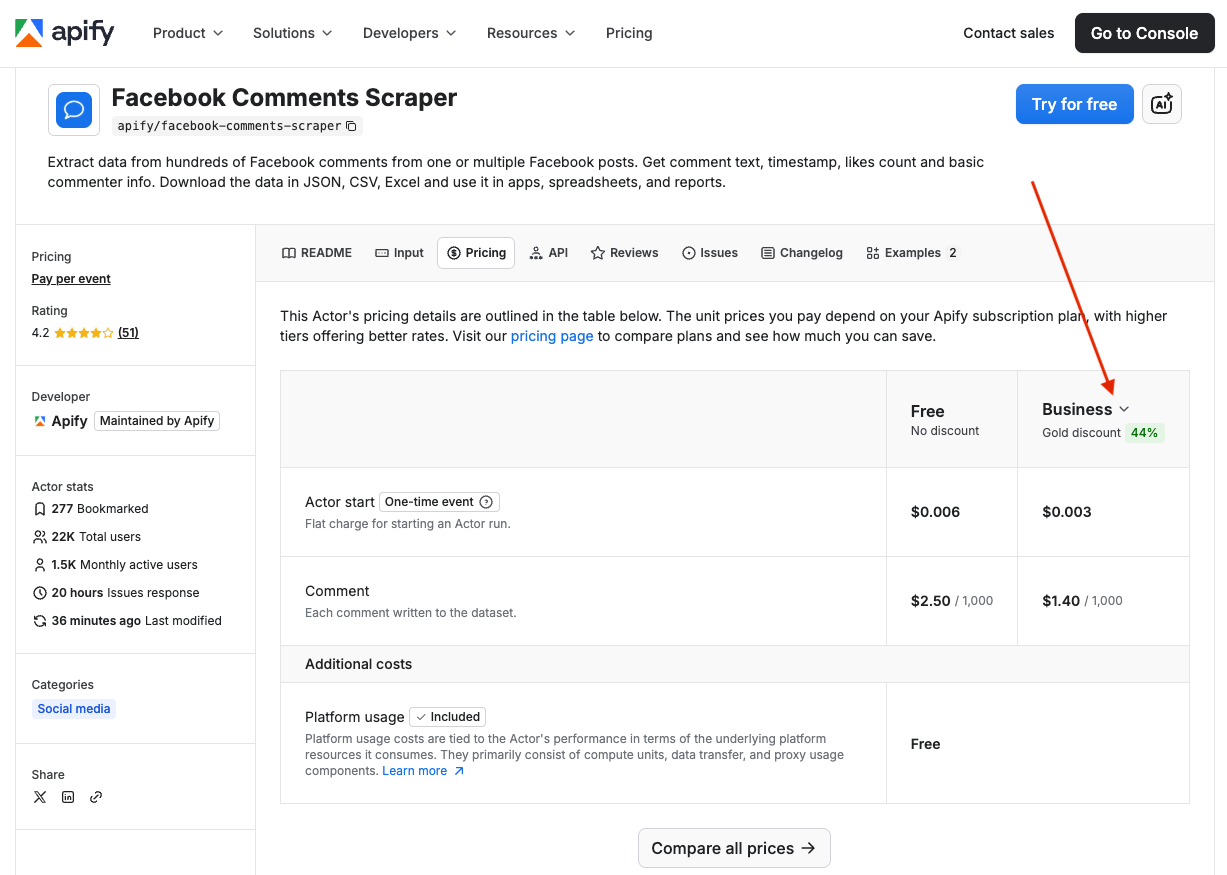
| Pay per event | Fixed prices for events the developer defines, such as an Actor start or each result. Most include platform usage; some charge it separately. You can set a maximum charge per run. | Current. Covers what used to be called pay per result. |
| Pay per usage | Only the compute, storage, proxy and transfer the run consumes. The developer adds nothing. | Current. Hard to estimate before a test run, Apify's docs admit. |
| A flat monthly fee to the developer after a trial, plus platform usage. | Retired Oct 1, 2026. Remaining rental Actors became pay per usage. |
Swipe the table sideways to see every column.
| Example job | Rate used | Cost (JAVIS arithmetic) |
|---|---|---|
| 1,250 Google Maps places, Free plan | $4 / 1,000 places | $5, exactly the free monthly credit (the listing itself says "up to 1,250") |
| 10,000 places, Starter | $3 / 1,000 | $30: $19 prepaid plus $11 overage |
| 100,000 places, Scale | $2 / 1,000 | $200: $199 prepaid plus $1 overage |
| A 4 GB pay-per-usage crawler, 15 minutes every hour for 30 days | 720 CU (Apify's own example) | $144 Starter, $115.20 Scale, $93.60 Business, before proxy and storage |
| 10 GB of residential proxy traffic | Per GB | $80 Starter, $75 Scale, $70 Business |
Decide by whether a good Actor already exists, how often you run it, and who writes the code.
Search Apify Store first. Prefer Apify-maintained Actors with many monthly users, and test on the Free plan's $5.
Connect the Apify MCP server or use Website Content Crawler and RAG Web Browser. Compare with Firecrawl if you only need pages turned into Markdown.
Build with Crawlee. Run it yourself for free, or deploy it as an Actor when you want scheduling, storage and proxies handled.
Apify works through ready Actors and Apify AI, but Browse AI is built for that job.
Compare Apify Proxy with Bright Data or ScrapingBee's unblocking APIs before committing.
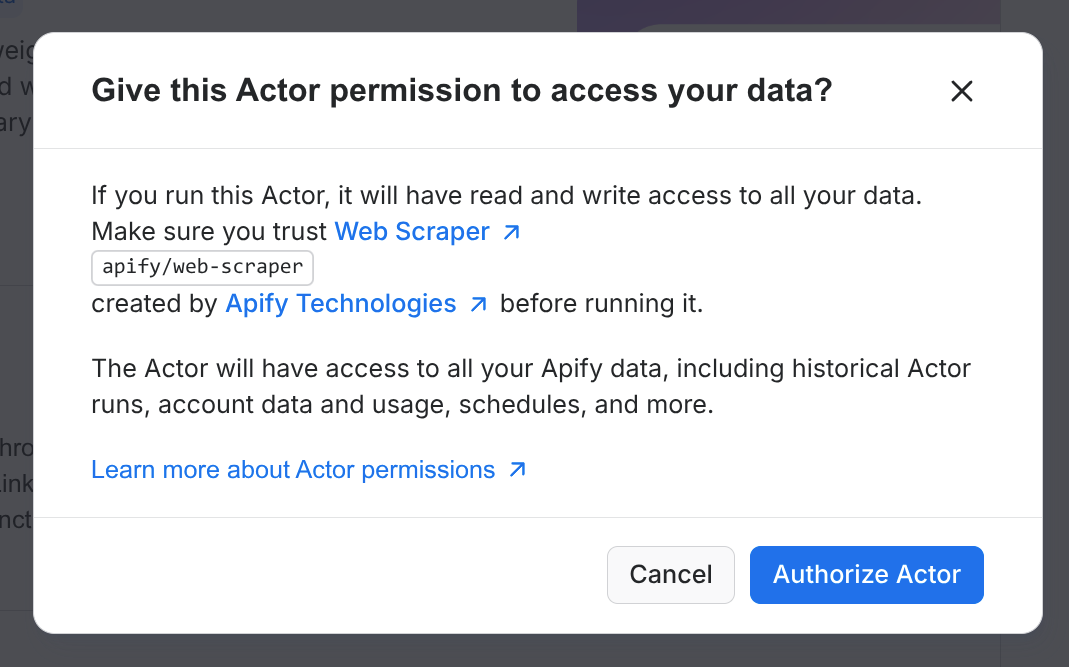
Stop and check the law and the site's terms. Apify's own security docs put the legality of your use case on you.
The real product is not a scraper. It is a marketplace where someone else maintains the scraper for you.
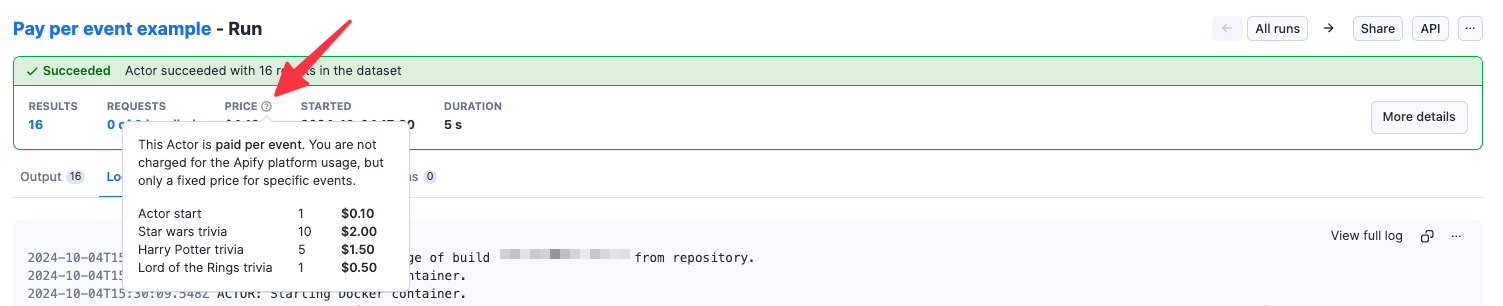
Building a reliable scraper for a site like Google Maps means a headless browser, rotating proxies, retries, pagination and constant fixes when the page changes. In Apify Store you skip all of that: open the Actor, fill the input form, click Start, and read the dataset. Developers earn 80% of the event revenue their Actors generate (minus the platform costs they cover), which is why popular sites have several competing Actors and why the store keeps growing.
Swipe the table sideways to see every column.
| Google Maps Scraper event | Free | Starter | Scale | Business |
|---|---|---|---|---|
| Place result (primary) | $4.00 | $3.00 | $2.00 | $1.50 |
| Filter applied (add-on) | $1.00 | $1.00 | $0.75 | $0.53 |
| Additional place details | $2.00 | $2.00 | $1.50 | $1.05 |
| Company contacts enrichment | $2.00 | $2.00 | $1.50 | $1.05 |
| Review returned | $0.50 | $0.50 | $0.37 | $0.26 |
| Business leads enrichment | $100.00 | $5.00 | $5.00 | $4.00 |
- Popular Actors are mature, with published user counts, ratings and issue response times.
- Pay-per-event prices make simple jobs easy to budget, and you can cap the charge per run.
- Higher plans lower both platform rates and per-event prices on Actors that join the discount program.
- Community Actors vary: check last-modified date, issue response time and monthly users before relying on one.
- Some pay-per-event Actors charge platform usage on top; the listing says which.
- Pay-per-usage Actors can surprise you; test on a small input first, as Apify recommends.
From question to dataset: choose, test small, schedule, then hand the output to a tool or an agent.
If you build your own Actors, Apify's templates start you on Crawlee with Cheerio, Playwright, Puppeteer or BeautifulSoup, and since Sep 3, 2026 you can point a new Actor at a Git repository and let Apify build it on every push. Your own Actors run under the same pay-per-usage meters as everything else.
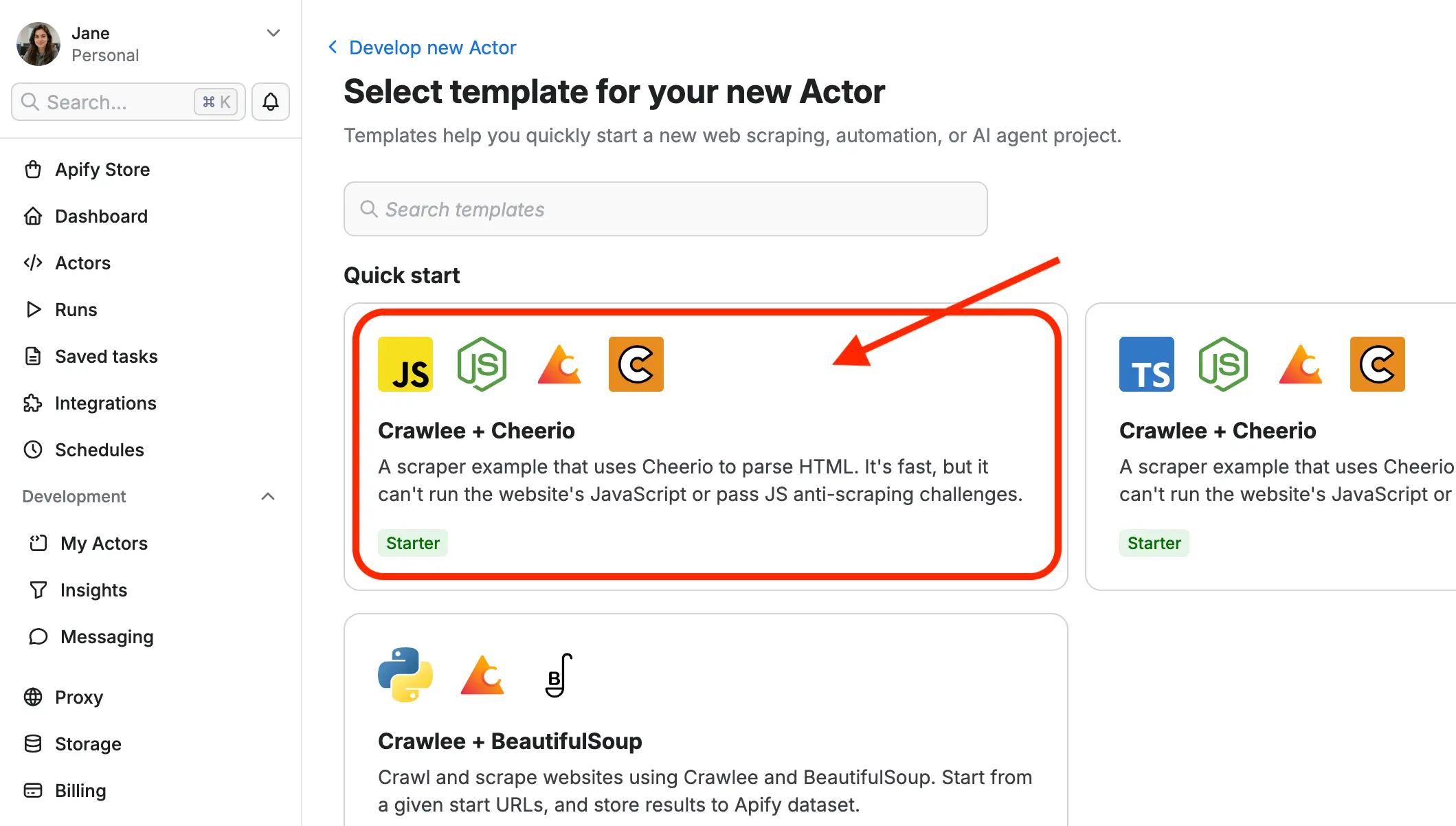
Apify is betting that agents, not people, will be its biggest customers.
Three 2026 additions point the same way. Apify AI (beta since Jul 21, 2026) is a chat inside Console that finds an Actor, fills its input from your description and runs it after you confirm. Plugins and Agent Skills for Claude Code, Codex, Cursor and GitHub Copilot bundle the MCP server with ready instructions. And agentic payments let an agent with a crypto wallet buy a prepaid, spend-capped Apify token through x402 or MPP at agi.apify.com, with no account or human sign-up.
Swipe the table sideways to see every column.
| Feature | What it does | Limits Apify states |
|---|---|---|
| Apify AI (beta) | Natural-language Actor search and runs in Console | Asks before running; no tasks, schedules, history or billing access; skips full-permission Actors |
| MCP server | Agents search, inspect and run Actors and read results | Skips full-permission Actors; 30 requests per second per user |
| Agent plugins and skills | One-step setup for Claude Code, Codex, Cursor, Copilot CLI, Kimi Code | Claude Code on the web must allow *.apify.com in its network settings |
| x402 / MPP via Apify AGI | Agent pays in USDC on Base for a prepaid token | Experimental; $1 minimum; unused balance expires with the token |
| Direct x402 / Skyfire | Per-request payment for eligible Actors | Pay-per-event Actors only, limited permissions, verified developers |
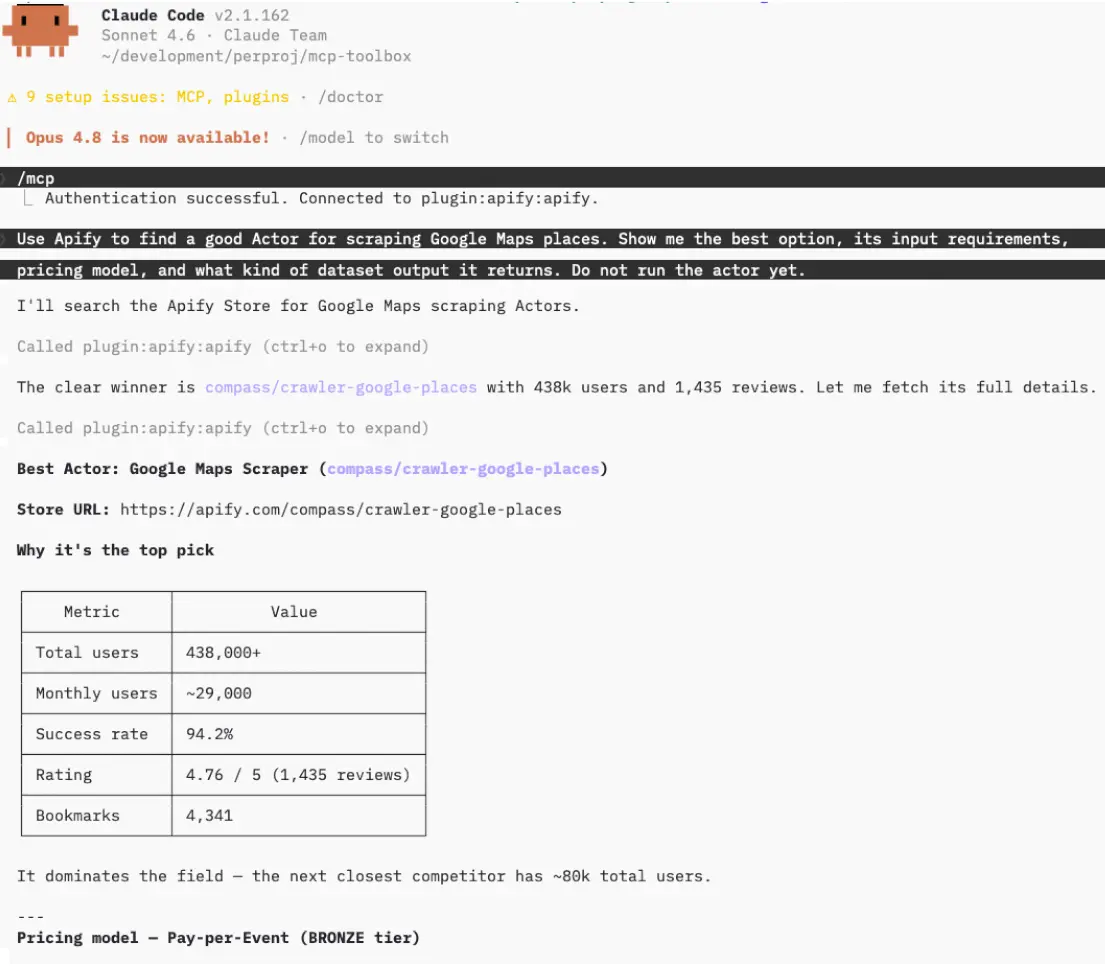
Apify's walkthrough of wiring live web data into an AI agent. Published Sep 3, 2026; about 16 minutes.
From the official "Apify" YouTube channel (youtube.com/@Apify). Vendor video, so it shows the best case.
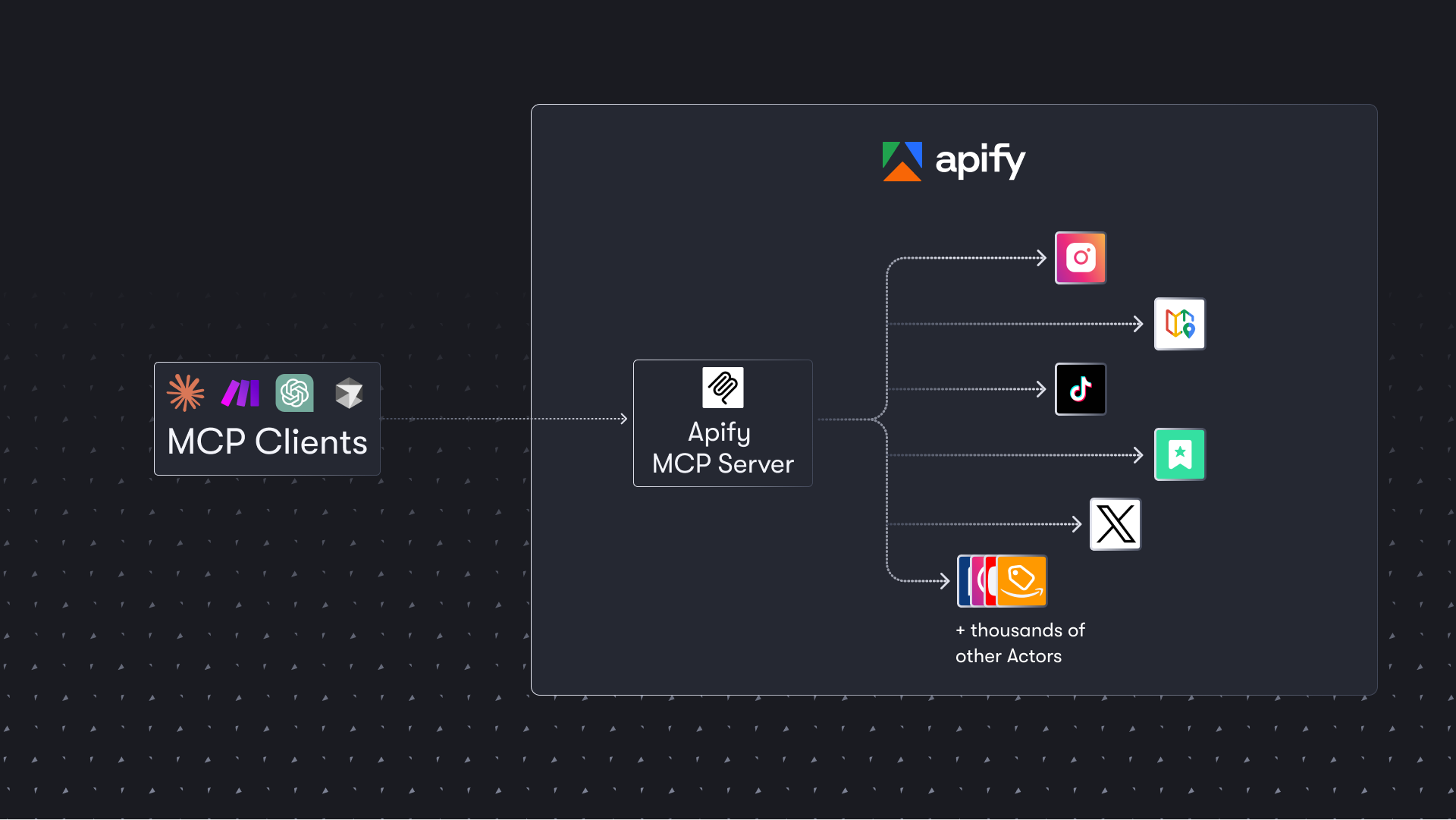
One MCP endpoint turns thousands of Actors into tools any agent can call.
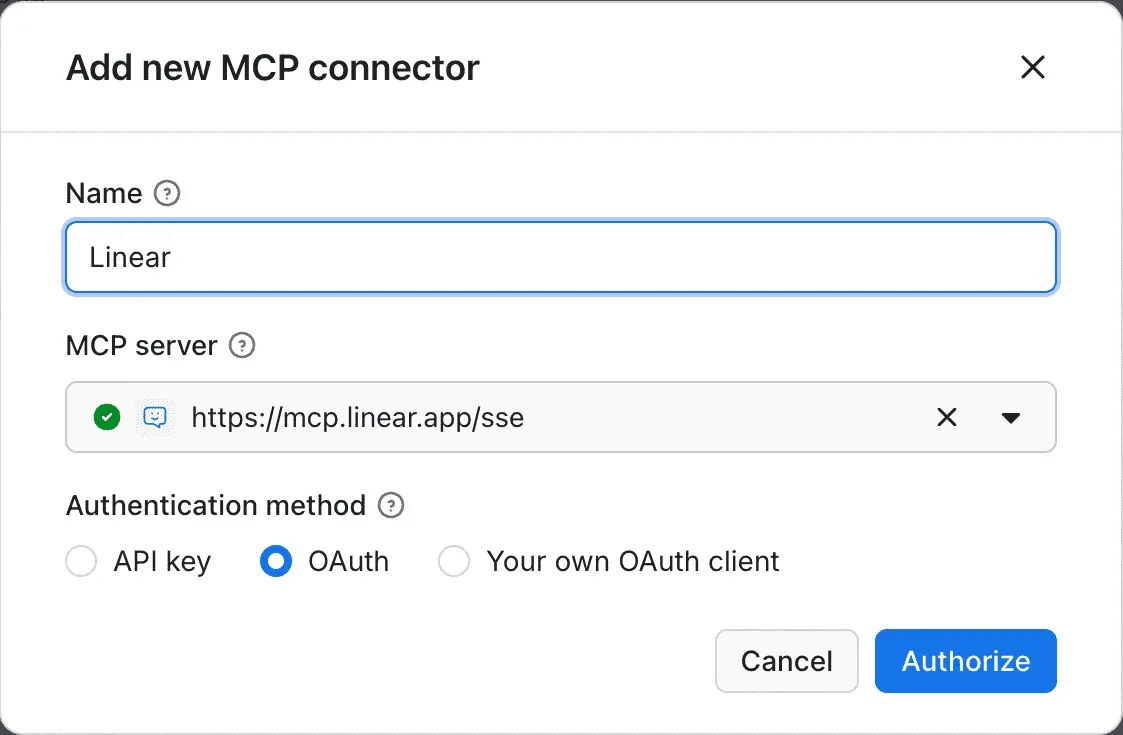
Add https://mcp.apify.com to an MCP client, sign in with OAuth, and the agent gets search, details, run and documentation tools, plus two default Actors for browsing and page retrieval. You can pin the exact Actors you want with a tools parameter, which Apify recommends for production so behavior does not change when defaults do. If MCP itself is new to you, start with our Claude MCP and Connectors guide.
Swipe the table sideways to see every column.
| MCP tool | On by default | What it does |
|---|---|---|
| search-actors / fetch-actor-details | Yes | Find Actors; read input schema, README and pricing |
| call-actor | Yes | Run an Actor, wait up to 45 seconds, return run status and storage IDs |
| apify/rag-web-browser, apify/web-fetch | Yes | Search and browse the web; retrieve one URL with JavaScript rendering |
| search-apify-docs / fetch-apify-docs | Yes | Documentation lookup (works without a token) |
| get-dataset-items and other storage tools | Added with call-actor | Read results with limits, offsets and field filters |
| Task and schedule tools | No | Create, publish and schedule saved Actor tasks |
Apify's step-by-step setup of its MCP server in Claude. Published Jun 2, 2025, so some setup screens may differ from today's.
From the official "Apify" YouTube channel (youtube.com/@Apify), linked from Apify's own MCP documentation.
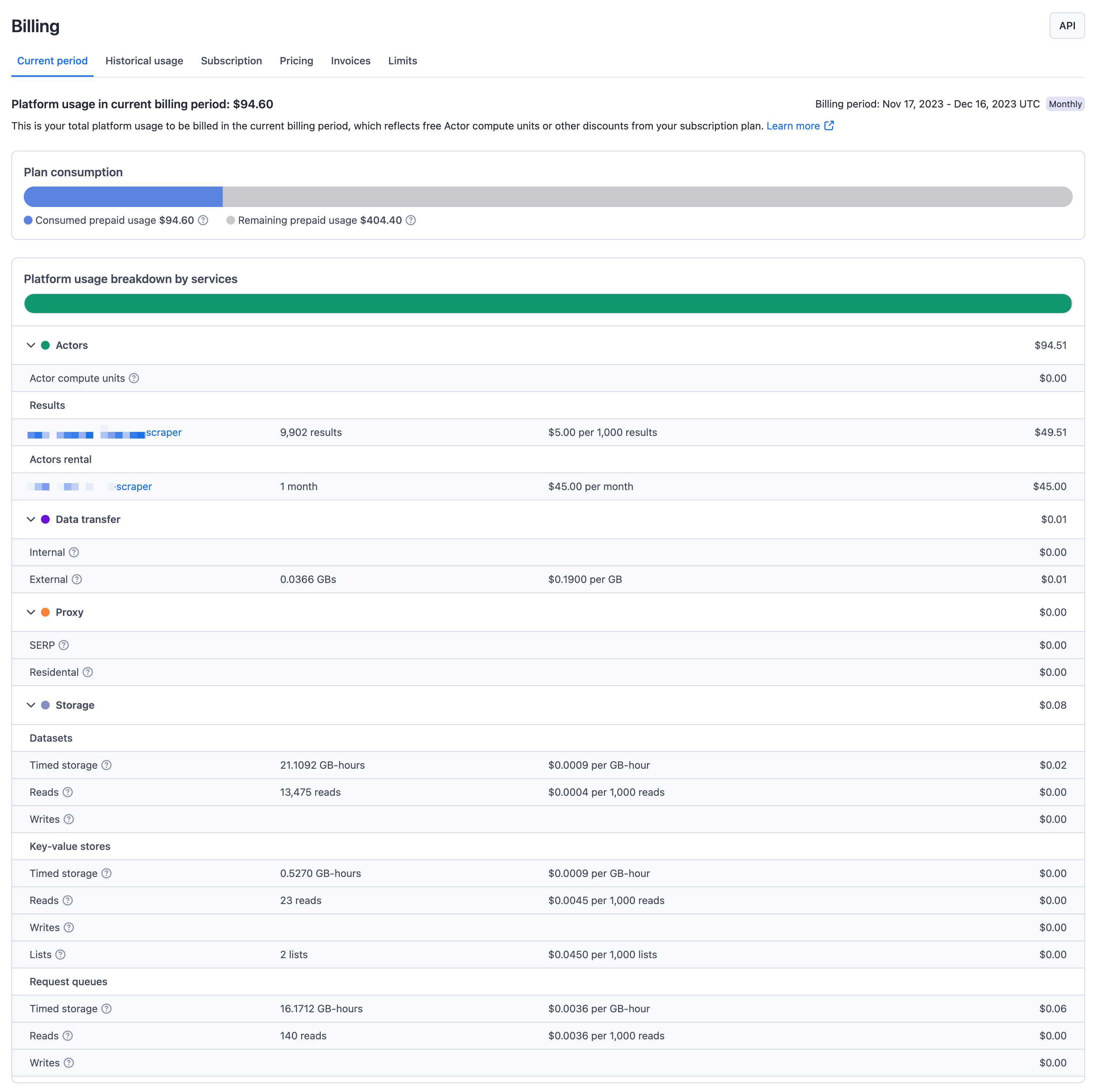
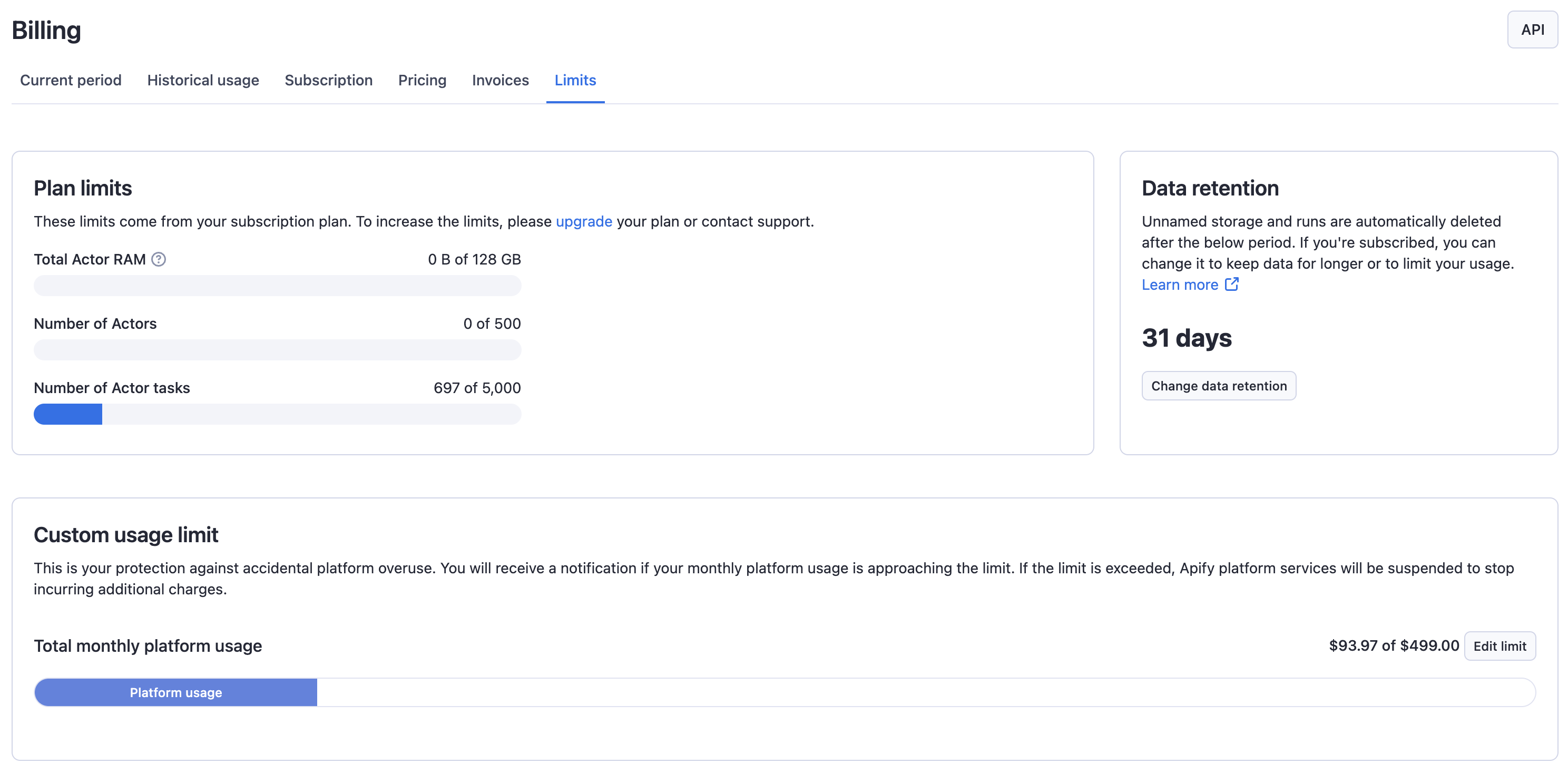
The bill is easy to read after the fact and hard to predict before. Set the usage limit on day one.
Swipe the table sideways to see every column.
| Cost driver | What happens |
|---|---|
| Browser vs plain HTTP | Browser-based crawling is far heavier; Apify says Cheerio can be "up to 20 times faster" |
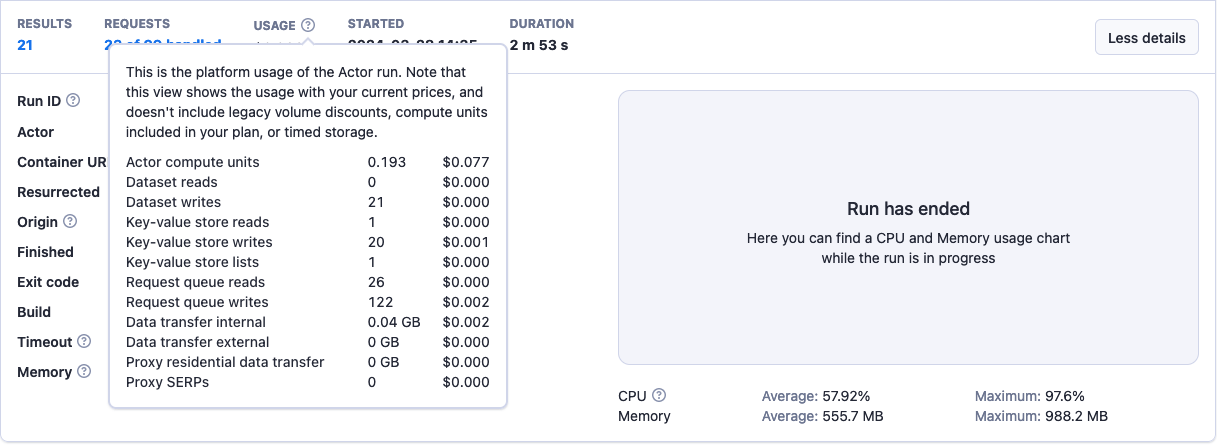
| Memory setting | CU = GB of RAM × hours; browser Actors need at least 1 GB; 4 GB = one CPU core |
| Retries and blocked pages | Failed requests retried still burn compute and proxy traffic |
| Running out of prepaid usage | Free: blocked until next cycle. Paid: services suspend at your usage limit unless you raise it |
| Usage limit ceilings | Maximum usage limit of $100 on Starter, $1,000 on Scale and $5,000 on Business, per Apify's subscription docs |
| Mid-cycle overage invoices | Billed immediately once overage passes $20 (Starter) or $200 (higher plans) |
| Unused prepaid usage | Expires at the end of each cycle; on downgrade it rolls into the new plan |
Apify secures the platform and holds SOC 2 Type II. What you collect, and whether you may collect it, is on you.
Swipe the table sideways to see every column.
| Area | Who is responsible, per Apify | Detail |
|---|---|---|
| Infrastructure, runtime isolation, platform services | Apify | Runs on AWS us-east-1; isolated runs; encryption in transit and at rest |
| Apify-maintained Actors | Apify | Actors under the apify account are treated as part of the platform |
| Community Actors | Shared | Third-party code; check permissions and maintainer |
| Accounts, API tokens, secrets | You | Scoped tokens available; MCP can use OAuth instead of a pasted token |
| Data collected and stored | You | Retention follows your plan; named storage is kept indefinitely |
| Legal compliance of the use case | You | Terms of the target site, privacy law, copyright |
| Certification | Apify | SOC 2 Type II; report available through trust.apify.com |
Best for people who need data from popular sites regularly and would rather rent a maintained scraper than build one.
Swipe the table sideways to see every column.
| Who | Why Apify fits or not | Likely plan |
|---|---|---|
| Growth, sales and research teams | Maps, social and search Actors with per-result pricing; exports to Sheets and CRMs | Starter, then Scale |
| AI agent builders | MCP server, agent plugins, RAG Web Browser, agent payments | Starter; agents can also prepay via x402 |
| Data engineers with their own scrapers | Crawlee code deployed as Actors with storage, proxies, schedules | Scale or Business |
| Developers who want to sell tools | 80% of event revenue on pay-per-event Actors | Any; earnings start on paid users |
| Non-technical monitoring of a few pages | Usable, but the interface still assumes JSON, datasets and runs | Consider Browse AI |
| One-off scrape of a simple site by a developer | Crawlee or a script on your own machine costs nothing | Free, or skip |
Seven real drawbacks, not manufactured ones.
Plan, compute, proxy, storage, transfer and per-event prices all meet on one bill. Apify's own docs say pay-per-usage costs are "quite difficult to estimate beforehand".
Trustpilot reviewers in 2026 describe duplicates billed as results, limits ignored and developers not answering issues.
Unused prepaid usage disappears at the end of each cycle, which one reviewer called a scam. It is documented, but easy to miss.
Since Oct 1, 2026, former rental Actors run as pay per usage. Developers who did not move to pay per event no longer earn from them, so some may stop maintaining them. That last part is our inference, not an Apify statement.
Free plans get community support only; several low-star reviews mention no chat reply, and Trustpilot notes Apify has not replied to negative reviews there.
The pricing page lists 5 concurrent runs on Free; the Limits documentation lists 25. Plan around 5.
Apify's shared responsibility model puts the legality of your use case on the customer, and many popular Actors target sites whose terms forbid scraping.
Apify wins on breadth of ready tools. Others win on simplicity, raw unblocking, or zero platform cost.
Swipe the table sideways to see every column.
| If you mostly need... | Compare Apify with... | Why |
|---|---|---|
| Pages turned into clean Markdown for LLMs | Firecrawl | One API for crawl, scrape and search, priced in page credits |
| A simple scraping API with JS rendering and proxies | ScrapingBee | Flat credit plans; you write the parsing |
| Point-and-click monitoring without code | Browse AI | Train a robot on a page; built for non-developers |
| Heavy anti-bot unblocking and proxy scale | Bright Data | Large proxy network, unblocker and ready datasets |
| Full control at no platform cost | Crawlee, self-hosted | Apify's own open source library; you run servers and buy proxies |
| Browser automation driven by an AI agent | Browser Use or Playwright MCP | Agent controls a browser directly instead of calling prebuilt Actors |
Swipe the table sideways to see every column.
| Entry pricing (checked Oct 4, 2026) | Free tier | First paid step |
|---|---|---|
| Apify | $5 usage a month | $19/mo Starter ($19 usage included) |
| Firecrawl | 1,000 credits a month | Hobby $16/mo billed yearly, 5,000 credits |
| ScrapingBee | 1,000 free API credits to try | Hobby $19/mo, 75,000 API credits |
| Browse AI | 50 credits a month | Personal $19/mo billed yearly, 12,000 credits a year |
| Bright Data | Free tiers on some APIs | Unlocker from $1 per 1,000 requests; residential from $2.50/GB on promotion ($5 list) |
| Crawlee | Free, Apache-2.0 | Your own hosting and proxies |
This review contains no affiliate links.
JAVIS has no affiliate arrangement with Apify, and every link to Apify in this article is a plain link to its official site. The score, drawbacks and alternatives here were written from Apify's own documentation and public user evidence, not from any deal with the company.
Open a free account, run one Apify-maintained Actor on a tiny input, and read the usage line before scaling.
Open ApifyRead the guide that matches your real question.
Choose the next articleApify sits between AI agents, automation tools and browser automation.
Every card below links to a published JAVIS article.



Card images are official product images.
Questions people are actually asking
Is Apify free?
There is a free plan with $5 of platform usage a month and no credit card. When the $5 runs out, runs stop until the next cycle. Paid plans start at $19 a month.
How much does Apify cost in October 2026?
Starter is $19 a month, Scale $199 and Business $999, each including the same amount of prepaid usage, with overage billed at plan rates. Annual billing saves 10%. Enterprise is custom.
What is a compute unit?
One compute unit is 1 GB of memory used for one hour. It costs $0.20 on Free and Starter, $0.16 on Scale and $0.13 on Business.
Can I still rent Actors on Apify?
No. Apify stopped new rentals on Apr 1, 2026 and retired rental Actors on Oct 1, 2026. Store Actors now use pay per event or pay per usage.
Is pay per result gone?
As a separate model, yes: Apify's pricing FAQ lists only pay per event and pay per usage. Charging for each result is now an event inside pay per event.
Does Apify work with Claude, ChatGPT and Cursor?
Yes, through the Apify MCP server at mcp.apify.com and plugins for Claude Code, Codex, Cursor and GitHub Copilot. Agents cannot run full-permission Actors through it.
Is Crawlee the same as Apify?
No. Crawlee is Apify's free open source library for JavaScript and Python. You can run it anywhere; Apify is the paid cloud platform where Crawlee code can run as an Actor.
Is web scraping with Apify legal?
It depends on what you collect, where and how. Apify's shared responsibility model makes the legality of your use case your responsibility, so check the target site's terms and privacy law first.
Where this came from, and when it was checked.
Pricing and plans: apify.com/pricing (plans, comparison table, add-ons and FAQ) and Apify documentation on subscription plans, limits, usage and resources, and Actor pricing and costs, as of Oct 4, 2026.
Store pricing models: Apify documentation, Actors in Store (including the rental sunset notice) and Monetize Actors; the Google Maps Scraper and Website Content Crawler Store pricing tabs, Oct 4, 2026.
Product and features: Apify documentation on Actors, storage and data retention, the MCP server, MCP connectors, Apify AI, agent onboarding and x402 payments; the Apify changelog entries of Jun 24 to Sep 3, 2026.
Security: Apify documentation, Security overview, Shared responsibility model and Actor permissions (vendor statements).
Market: Apify About page and site banner (Oct 4, 2026); Store listings for the Actors named; GitHub repositories apify/crawlee, apify/crawlee-python and apify/apify-mcp-server (Oct 4, 2026); Hacker News posts by Apify staff (Jul 9, 2024; Sep 30, 2025; Nov 3, 2025).
Users: Trustpilot page for apify.com (4.8, 769 reviews, Oct 4, 2026) and reviews dated Feb 14 to Sep 29, 2026, including one dated Sep 20, 2026 that discloses a review incentive; Hacker News comments 40293210, 40915166 and 49312129.
Alternatives: pricing pages of Firecrawl, ScrapingBee, Browse AI and Bright Data, Oct 4, 2026.
Official videos: youtube.com/watch?v=W-5GagvbThI and BKu8H91uCTg, both from the official Apify channel.
JAVIS Fit Score (80/100): editorial composite of breadth and maturity of ready-made tools (strong), AI agent and MCP support (strong), developer platform and open source (strong), pricing transparency and predictability (mixed: layered meters, expiring credits, a model change three days before this check), community Actor quality and support (mixed), security controls (good, with legal risk left to the user). Weighted by editorial judgement.