
Moosend Review 2026: Email Automation From $9 a Month, Now Owned by Constant Contact
Moosend is an email marketing and automation platform with a drag-and-drop editor, a visual workflow builder, landing pages and forms. As of Oct 27, 2026, its Pro plan costs $9 a month for 500 contacts, or $7 a month if you pay for a year up front, with unlimited sends and a 30-day free trial that needs no credit card. Two things the pricing page does not lead with: Moosend has belonged to Constant Contact since June 2025, and its Terms are stricter than its marketing on refunds, renewals and what happens to trial data.

Every Moosend link in this review goes straight to moosend.com or its documentation.
| Made by | Moosend Ltd., London; a Constant Contact company since the deal announced Jun 6, 2025 (owned by Sitecore from May 2021) |
| What it is | Email campaigns, automation workflows, landing pages, forms, an AI writer and transactional email |
| Plans | Pro from $9 a month (500 contacts) or $7 a month billed yearly; Moosend+ and Enterprise by quote; credits from $350 for 350,000 emails |
| Trial | 30 days, no credit card; no free plan |
| Best for | Small senders who want automation and unlimited sends at a low monthly price, and who can live without two-factor login |
Moosend sells real automation at a small-business price. Read its Terms before you pay for a year.
$9 a month buys 500 contacts, unlimited sends and the full workflow builder.
That Pro line is why Moosend keeps showing up on shortlists. Many email tools put automation behind a higher tier or cap how many emails you can send. Moosend’s Pro plan includes unlimited campaigns and sends, the visual workflow builder with ready-made recipes, landing pages, subscription forms, A/B testing, an AI writer and an SMTP server, and it lets five team members in. Pay for a year and the same plan is $7 a month at 500 contacts, $13 at 1,000 and $70 at 10,000. The list price has not moved since February 2022: the Internet Archive copies we compared, from Feb 5, 2022 to Oct 5, 2026, all show $9, $16 and $88 for those three list sizes on monthly billing.
What changed is the company around it. Sitecore bought Moosend in 2021, and on Jun 6, 2025 Constant Contact announced it had bought Moosend from Sitecore. The pricing page footer now reads “Moosend is now a Constant Contact company.”, the home page promotes Constant Contact’s own SMS, social and event tools, and the documentation site carries Constant Contact branding and release notes. Moosend still has its own plans, its own Terms and its own London entity, but the roadmap now belongs to a bigger email company with a competing product.
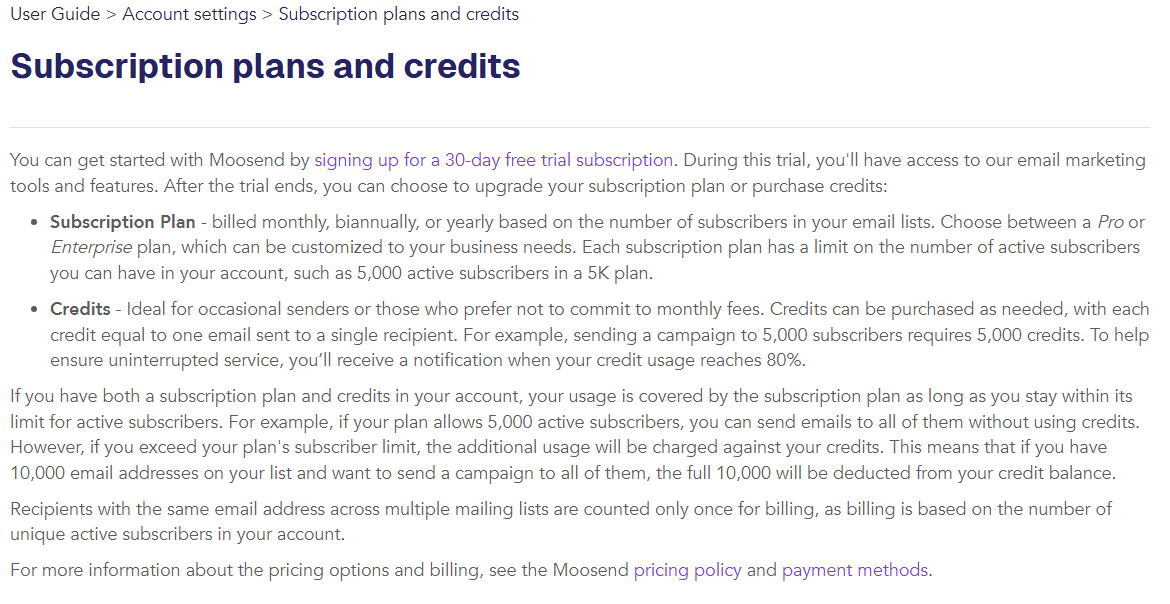
The bigger caution is the paperwork. The pricing page promises “pay monthly, cancel anytime” and says that after the trial “Your account and all your data stay intact.” The Terms of Service (June 2025) say fees are non-refundable, subscriptions renew automatically unless notice is given “at least 60 days before the end of the relevant subscription term”, and data entered during the trial “WILL BE PERMANENTLY LOST UNLESS CUSTOMER PURCHASES A SUBSCRIPTION”. Moosend’s own FAQ also says it does not offer two-factor authentication. None of that makes Moosend a bad tool. It makes it a tool you should start on monthly billing, export from regularly, and protect with a strong unique password.
Lists in the middle, campaigns and workflows around them, and most extras sold as add-ons above Pro.
Moosend is organised around email lists and subscribers. You import or capture contacts with forms and landing pages, tag and segment them, then reach them two ways: campaigns you send to a list or segment, and automation workflows that start from a trigger (a subscription, an opened email, a purchase, a date) and run conditions and actions. Website tracking feeds browsing and purchase events into those workflows. Billing follows the same shape: you pay by the number of unique subscribers, not by emails sent, unless you choose credits.
Swipe sideways to see the whole diagram.
Moosend’s public site does not show the inside of a live account, and this review is based on public pages only. The closest view is Moosend’s own marketing art on its home page, shown below with the stock photo of a person covered.

Two owners in four years, the end of the free plan, and a price list that has not moved since 2022 while Pro lost transactional email.
Moosend was founded in Greece and is headquartered in London. Its Terms name the contracting company as Moosend Ltd. of 5 New Street Square, London. Since 2021 it has changed hands twice.
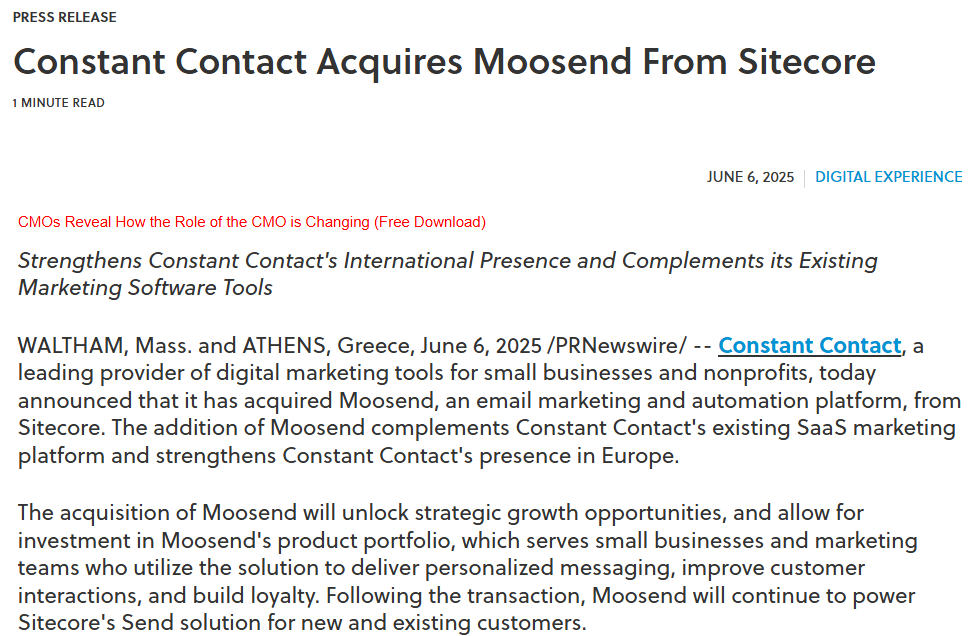
On May 26, 2021 Sitecore said it had completed its acquisition of “London headquartered Moosend, a SaaS-based marketing automation platform provider”. Moosend became the engine behind Sitecore Send, which Sitecore still markets on sitecore.com. Then, on Jun 6, 2025, Constant Contact announced “that it has acquired Moosend, an email marketing and automation platform, from Sitecore”, adding that “Moosend will continue to power Sitecore’s Send solution for new and existing customers” and that “Terms of the transaction were not disclosed.” Moosend’s Terms, Privacy Policy and Acceptable Use Policy were all reissued that same month, dated June 2025.
In between, Moosend dropped its free plan. An ahoi.dev news post of Jan 17, 2022 relayed Moosend’s announcement: “They will shut down all Forever Free accounts and instead offer a no-obligation 30-day free trial”, with free accounts kept open for 30 days to download their data. The same post says the new Pro plan started “at $9 per month”. That is still the entry price on Oct 27, 2026.


The monthly prices did not change; what Pro includes did. Every archived copy we compared shows the same monthly Pro prices: $9 at 500 contacts, $16 at 1,000, $88 at 10,000 and $315 at 50,000. But the February 2022 compare table ticked transactional email for Pro, and the Oct 27, 2026 table does not: transactional email is now an add-on for Moosend+ or part of Enterprise. A June 5, 2024 copy lists “Transactional Emails (soon)” under Moosend+ and shows a 15% “Offer” card ($7.65 at 500 contacts). By May 3, 2025 the page had the Monthly, Biannual and Annual switch it still has, worth 15% and 20% off. The trial has narrowed too: in the May 3, 2025 copy it allowed one published form and one published landing page; on Oct 27, 2026 both are listed as “1 (Unpublished)”.
| Date | Change | Source |
|---|---|---|
| May 26, 2021 | Sitecore completes its acquisition of Moosend | Sitecore press release |
| Jan 20, 2022 | Free Forever accounts shut down; 30-day trial and Pro from $9 a month | ahoi.dev, Jan 17, 2022; Hacker News, Jan 21, 2022 |
| Feb 5, 2022 | Pro $9 / $16 / $88 a month at 500 / 1,000 / 10,000 contacts; transactional email ticked for Pro | Internet Archive copy of the pricing page |
| Jun 5, 2024 | Temporary 15% “Offer” card next to Pro | Internet Archive copy |
| May 3, 2025 | Biannual (15% off) and Annual (20% off) billing; transactional email no longer in Pro; trial allows one published form and landing page | Internet Archive copy |
| Jun 6, 2025 | Constant Contact announces it has acquired Moosend from Sitecore | PR Newswire release |
| June 2025 | New Terms, Privacy Policy and Acceptable Use Policy | moosend.com legal documents |
| Mar 30 to Jun 29, 2026 | A “Social AI” product line (ctct.social) appears on the pricing page | PricingSaaS tracker |
| Oct 5, 2026 | Footer reads “Moosend is now a Constant Contact company.” (not in the May 22, 2026 copy) | Internet Archive copies |
| Oct 27, 2026 | Same monthly Pro prices as in February 2022; trial forms and landing pages unpublished | moosend.com/pricing |

One smaller sign of the new owner: in the May 3, 2025 archived copy, Moosend’s footer still listed a “Moosend vs Constant Contact” comparison page and “ConstantContact Alternatives”. On Oct 27, 2026 the footer compares Moosend only with Mailchimp, Kit and MailerLite.
A budget automation tool with a large claimed customer base. Almost every number about it comes from Moosend.
Moosend sells to small businesses, agencies, publishers, online shops and nonprofits, and it competes on price against Mailchimp, MailerLite and Brevo. It publishes no audited customer count, revenue or market share. What it does publish are marketing figures, and each measures something different, so here they are with what they do and do not tell you.
| Signal | Value (as stated) | What it measures, and what it does not |
|---|---|---|
| Customers | “Join 100,000+ empowered customers” (pricing and product pages) | A vendor claim; no definition of customer and no date |
| Earlier claim | “trusted by more than 150,000 marketing professionals” (relayed by ahoi.dev, Jan 17, 2022) | Professionals, not customers, four years earlier; not comparable with the 100,000+ figure |
| Review badges | G2 Top 100 badge for 2026 and a Capterra 4.7 badge in the footer; “multiple Winter 2025 G2 badges” (FAQ) | Badges chosen and displayed by Moosend; no G2 or Capterra figures are cited beyond them |
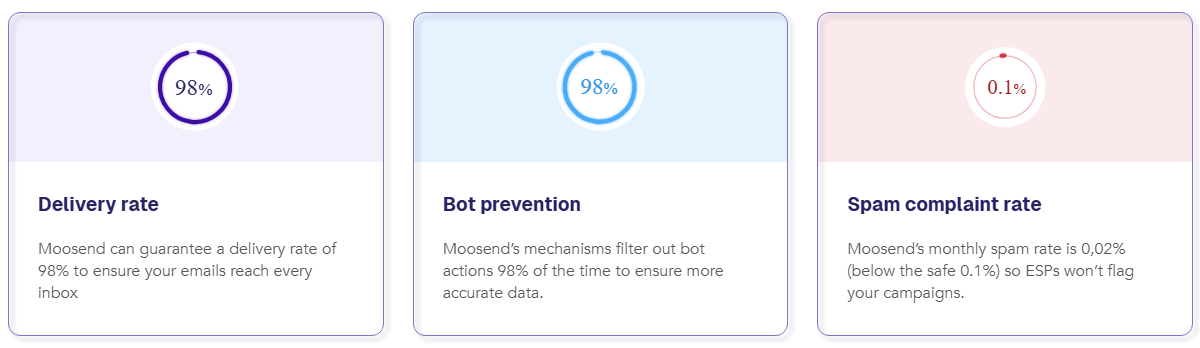
| Delivery | “guarantee a delivery rate of 98%”; monthly spam rate “0,02%” | Vendor claims without a published method; delivery is not inbox placement |
| Uptime | 99% uptime on a Trust Center banner; 99.9% system up-time on the support page | Two different vendor figures; the Pro plan has no SLA |
| Price stability | Same Pro prices in archived copies from Feb 5, 2022 to Oct 5, 2026 | List prices only; not what customers pay after discounts |
Sources: moosend.com pricing, FAQ, deliverability, Trust Center and support pages, Oct 27, 2026; ahoi.dev, Jan 17, 2022; Internet Archive copies of moosend.com/pricing. G2 and Capterra figures appear only as Moosend displays them.


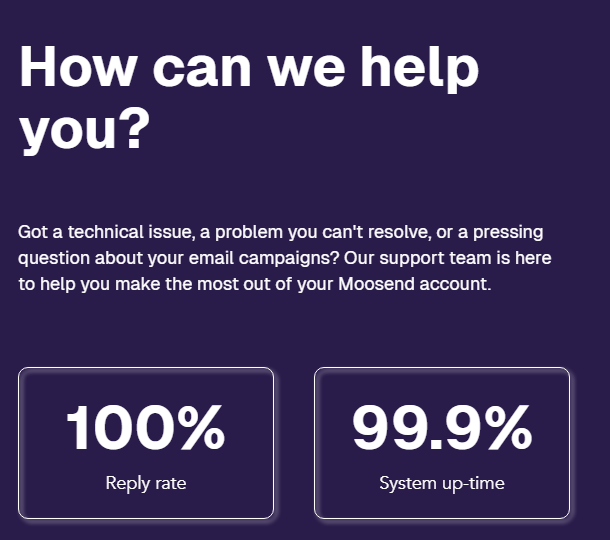
The two uptime figures are the kind of small mismatch you only notice by reading several pages on the same day. They do not matter much on their own, because neither is a contract: the compare-plans table gives an SLA only to Enterprise. If uptime matters to your business, ask for it in writing.
Independent evidence is thin, and the loudest public discussion is about the free plan Moosend ended in 2022.
For a tool that claims 100,000+ customers, surprisingly little independent discussion is open to read without an account. This review cites no G2, Capterra or TrustRadius figures beyond the badges Moosend shows. Moosend has no mobile app in the US App Store or Google Play, so there are no store ratings either. That leaves Hacker News and the news coverage around the 2022 change.
| Source | Date | What it shows |
|---|---|---|
| Hacker News story 30026840 | Jan 21, 2022 | Story on the end of the Free Forever plan: 36 points, 41 comments |
| ahoi.dev news post | Jan 17, 2022 | Free Forever accounts shut down after Jan 20, 2022, with 30 days to download data |
| Hacker News comment 31693039 | Jun 10, 2022 | Positive: Moosend stayed good after being bought |
| Hacker News comment 47789847 | Apr 16, 2026 | Mixed: a fit for larger newsletters, but costly at scale |
| US App Store and Google Play | Oct 27, 2026 | No Moosend app listed |
“customers are being warned right now that Moosend doesn’t honor its contracts”
“shout out to MooSend and Archbee as they’re remained great after being bought out/got investment”
“Above that threshold you should use tools like moosend, benchmarkemail, or similar. And they ask a pretty penny when you reach that scale.”
Read together, the pattern is simple. People who use Moosend tend to like the price for what it does, and the testimonials on its own pages say the same about support. The criticism is about trust after changes: the 2022 shutdown of free accounts with 30 days’ notice still comes up, and it is worth remembering now that the company has a new owner again. One 2026 comment is a reminder that “cheap” is relative: at 50,000 contacts, Pro is $315 a month on monthly billing.
One public plan priced by list size, two quote-only tiers above it, and credits for occasional senders.
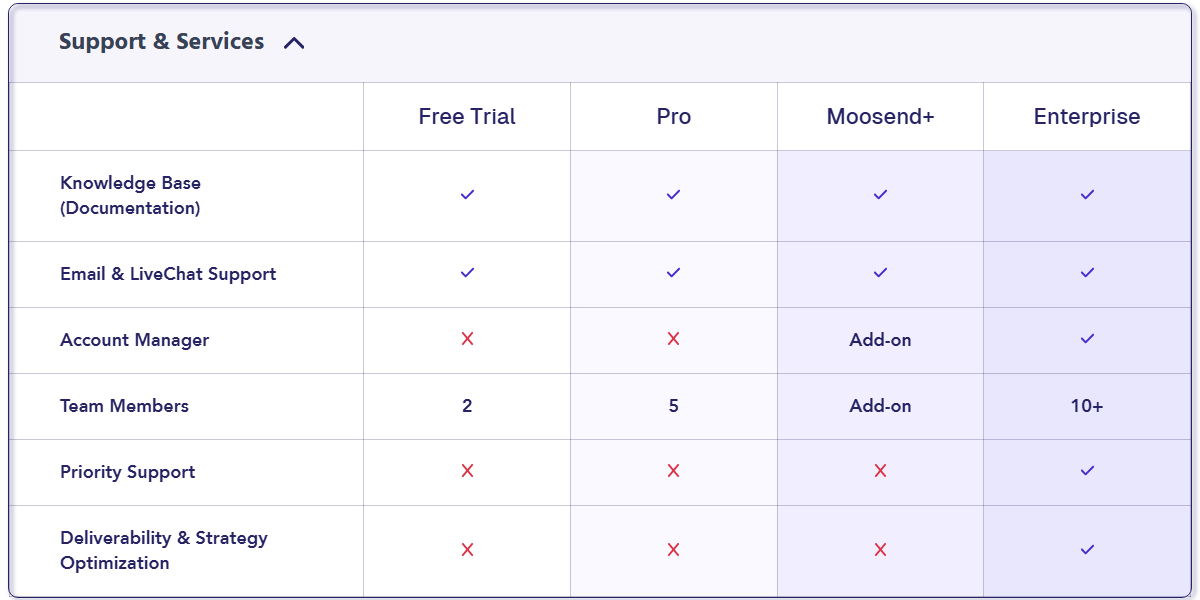
Moosend publishes a price for one plan, Pro, at 21 list sizes from 500 to 1,000,000 contacts. Moosend+ (Pro plus the Enterprise add-ons you pick) and Enterprise (everything, plus an account manager, priority support and an SLA) are sold by quote. All prices below are in US dollars, as moosend.com/pricing showed them on Oct 27, 2026.
Pro
a month at 500 contacts, billed monthly; $8 biannual, $7 annual
- Unlimited campaigns and sends
- Workflows, recipes, A/B tests
- Landing pages, forms, SMTP
- 5 team members
Moosend+
Pro plus add-ons you choose
- Transactional email
- Page-browse and product-view triggers
- Dedicated IP, SSO, extra seats
- Audience Discovery, custom reports
Enterprise
all features in one plan
- Account manager
- Priority support
- SLA, SSO and SAML
- 10+ team members
Credits
for 350,000 emails; up to 1,000,000 for $1,000
- 1 credit = 1 email to 1 recipient
- Credits never expire
- Unlimited subscribers
- Automation, forms, landing pages listed
Source: moosend.com/pricing, Oct 27, 2026, including the Credits panel and the compare-plans table. Moosend+ and Enterprise show no price.


The table gives every band up to 250,000 contacts. The biannual and annual columns are per month, but you pay the whole term up front: six months or twelve.
Swipe sideways to see the whole table.
| Contacts | Monthly | Biannual (per month) | Annual (per month) | Year on monthly | Year on annual |
|---|---|---|---|---|---|
| 500 | $9 | $8 | $7 | $108 | $84 |
| 1,000 | $16 | $14 | $13 | $192 | $156 |
| 2,000 | $24 | $20 | $19 | $288 | $228 |
| 3,000 | $32 | $27 | $26 | $384 | $312 |
| 5,000 | $48 | $41 | $38 | $576 | $456 |
| 8,000 | $64 | $54 | $51 | $768 | $612 |
| 10,000 | $88 | $75 | $70 | $1,056 | $840 |
| 25,000 | $160 | $136 | $128 | $1,920 | $1,536 |
| 50,000 | $315 | $268 | $252 | $3,780 | $3,024 |
| 100,000 | $624 | $530 | $499 | $7,488 | $5,988 |
| 250,000 | $1,520 | $1,292 | $1,216 | $18,240 | $14,592 |
Source: moosend.com/pricing, Oct 27, 2026 (Pro plan, USD). Yearly totals: the per-month price times 12. Bands not shown: 75,000 ($416 monthly), 150,000 ($936), 200,000 ($1,216), then up to 1,000,000 ($5,840 monthly, $4,672 a month annual).



Pro gets cheaper per contact as you grow, annual billing saves about a fifth, and credits win only if you send rarely.
Moosend charges by list size, so the useful question is what a year costs at your size. Three things stand out in the price table.
The per-contact price falls fast. On monthly billing, Pro costs $18 per 1,000 contacts at the 500 band, $8.80 per 1,000 at 10,000 contacts and $6.30 per 1,000 at 50,000. Small lists pay the highest rate, which is normal for this market.
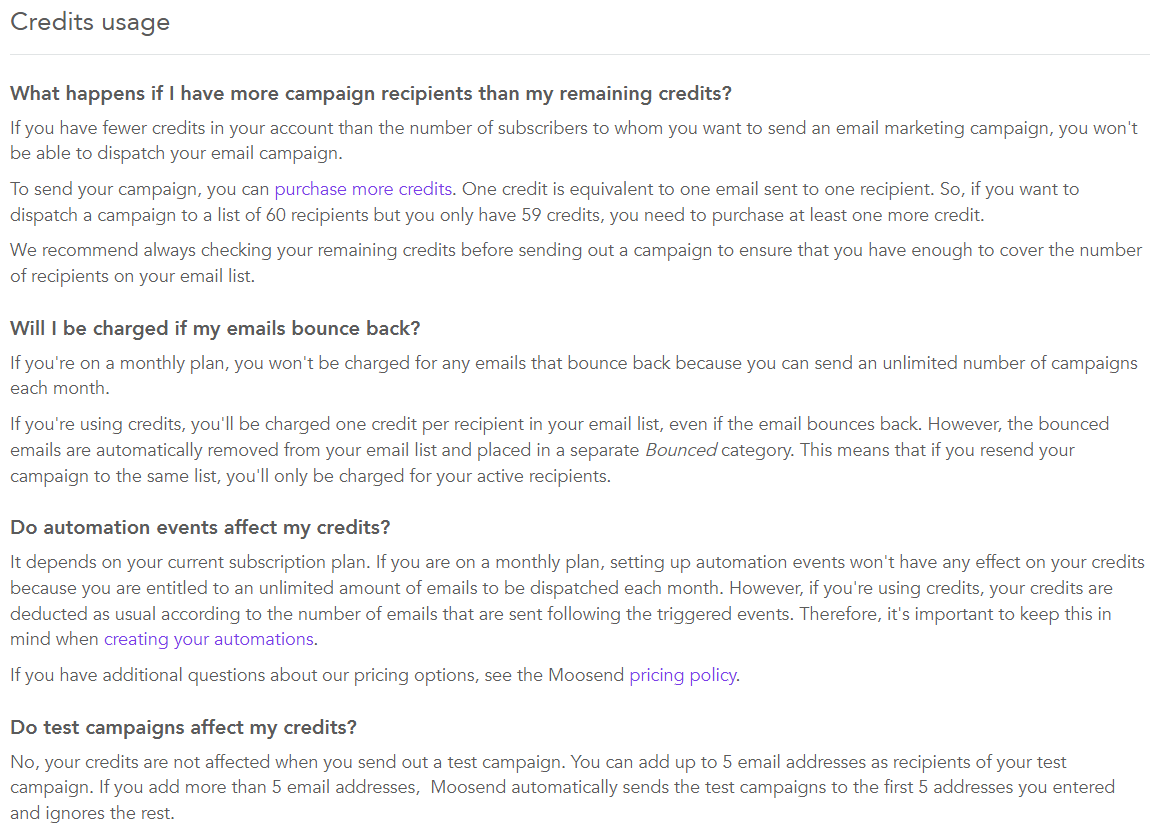
Annual billing saves 19% to 22% at the small bands and 20% above 10,000 contacts, because Moosend rounds to whole dollars. At 1,000 contacts that is $156 a year instead of $192. The catch is that you pay $156 on day one, and the Terms say fees paid are non-refundable (more in the fine print).
Credits are a different product. Each credit sends one email to one recipient, at $1 per 1,000 emails in every pack on the pricing page, and credits never expire. For a business that mails a 5,000-person list twice a month, that is about $10 a month in credits against $48 on monthly Pro. The smallest pack shown on the pricing page is $350 up front, which at 10,000 emails a month covers about 35 months. Credits have their own costs: Moosend’s billing FAQ says a credit is used “even if the email bounces back”, automation emails use credits as they send, and a campaign will not go out if you have fewer credits than recipients.
| Who | Setup | First-year cost | What to watch |
|---|---|---|---|
| Solo blogger, 800 subscribers, weekly newsletter | Pro, 1,000 band, monthly | $192 ($16 x 12) | Annual saves $36 but is paid up front and is non-refundable |
| Online shop, 4,200 contacts, welcome and cart flows | Pro, 5,000 band, annual | $456 paid on day one | Product-view and page-browse triggers need Moosend+; Pro has purchase and cart tracking |
| Course seller, 12,000 contacts growing to 20,000 | Pro, 25,000 band, monthly | $1,920 | Upgrades are prorated; downgrades take effect next cycle with no proration |
| Seasonal sender, 6,000 contacts, 6 campaigns a year | Credits, 350,000 pack | $350, then nothing for years | 36,000 emails a year uses about 10% of the pack; bounces still use credits |
JAVIS worked examples using moosend.com/pricing and Moosend’s billing documentation, Oct 27, 2026. Taxes are added where they apply.

The Terms are stricter than the pricing page: no refunds, a 60-day renewal notice, and trial data at risk.
Moosend’s Terms of Service are a PDF dated June 2025, linked from every page footer. Six clauses matter to a small buyer, and some of them read differently from the friendly copy on the pricing page.

1. Trial data can be lost
Section 5 says the 30-day trial ends early if Moosend chooses (“termination by Moosend at its sole discretion”) and, in capitals, that data entered during the trial will be permanently lost unless you buy a subscription to the same services. The pricing page FAQ says the opposite in plain words: “Your account and all your data stay intact.” Until Moosend reconciles the two, treat the Terms as the binding version and export anything you build during the trial.

2. Fees are non-refundable
Section 6(b): “Your payment obligations are non-cancelable, fees paid are non-refundable, and quantities purchased cannot be decreased during a relevant subscription term.” Section 17(c) adds that no refund is given if Moosend suspends or terminates an account. There is no money-back promise anywhere on the pricing page either, so an annual plan is a commitment for the year.

3. Renewal needs notice, on paper
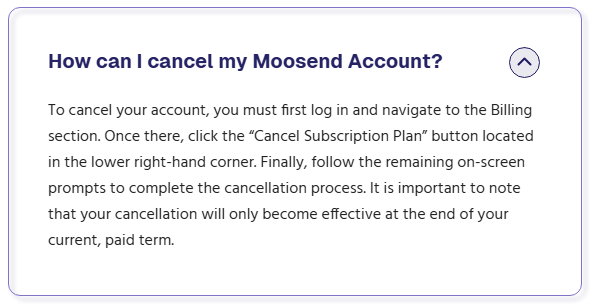
Section 17(b): subscriptions “will automatically renew for additional periods equal to the expiring subscription term or one year (whichever is shorter), unless either party gives the other written notice (email acceptable) at least 60 days before the end of the relevant subscription term.” Read literally, that is awkward for a monthly plan, and it does not match the pricing page (“pay monthly, cancel anytime”) or the FAQ, which tells you to click “Cancel Subscription Plan” in Billing and says the cancellation takes effect at the end of the paid term. For an annual plan, the safe reading is: put your cancellation in writing at least 60 days before the renewal date, and keep the email.

4. Support is promised within two business days
Section 16 commits Moosend to “use its best efforts to respond to such queries within two business days.” Marketing pages are more generous: the features page offers “24/5 Email Support”, and the Mailchimp comparison page promises “quick solutions in minutes” via live chat or email. Plan around the contract, enjoy anything faster.
5. Inactive accounts are deleted
The Terms say an account not logged into for more than 365 days may be marked inactive and terminated if you do not reactivate within 30 days. The help center is stricter: accounts are deactivated after 300 days without a login, you then have 30 days to reactivate, after which “your account and any archived data will be permanently deleted.” If you pause your email marketing, log in now and then.


6. Your campaigns must stay under hard limits
The Acceptable Use Policy (June 2025) sets “Acceptable levels of campaign statistics” and says Moosend may suspend or terminate accounts that miss them: at most 1% unsubscribes, 3% hard bounces, 0.1% spam complaints, one complaint from a mailbox provider and one spam-trap hit. Bought, borrowed or third-party lists are banned outright. Section 2.20 also bars mail whose main purpose is promoting unrelated third-party products, with an exception for occasional related links, which matters if your newsletter earns money that way.


Seven places where two Moosend pages give different answers.
None of these is a scandal. Together they say the marketing pages, the help center and the legal documents were written at different times by different teams, which is common after an acquisition. When money or data is involved, rely on the stricter version.
| Topic | Page A says | Page B says | Safer reading |
|---|---|---|---|
| Trial data | Pricing FAQ: “Your account and all your data stay intact.” | Terms 5: trial data permanently lost unless you buy a subscription | Export what you build during the trial |
| Cancelling | Pricing page: “pay monthly, cancel anytime” | Terms 17(b): written notice 60 days before the term ends | Cancel in Billing and by email, early |
| Inactive accounts | Terms 17(e): more than 365 days, then 30 days | Help center: 300 days, then 30 days, then permanent deletion | Log in at least every few months |
| Uptime | Trust Center banner: 99% uptime | Support page: 99.9% system up-time | Only Enterprise has an SLA |
| Support speed | Mailchimp comparison page: “quick solutions in minutes” | Terms 16: best efforts within two business days | Plan on two business days |
| Who is counted | Pricing FAQ: “Moosend counts unique email addresses.” | Help center: billing is based on “unique active subscribers” | Ask support how unsubscribed contacts count |
| Extra charges | Mailchimp comparison page: no “overage fees” | Help center: above your plan limit, usage is charged against credits if you hold any | Keep your plan above your list size |
Sources: moosend.com pricing, Trust Center, support and Moosend vs Mailchimp pages; Moosend Terms and Conditions (June 2025); Moosend help center articles on plans and credits and on accounts; all as of Oct 27, 2026.
Answer four questions and you will know whether Moosend fits.
A visual builder with triggers, conditions and actions, and ready-made recipes. The browsing triggers are not on Pro.
Automation is the main reason to choose Moosend over a plain newsletter tool. Its workflow builder works like most visual builders: a workflow starts from one or more triggers, passes through conditions that split or filter contacts, and ends in actions such as sending an email, waiting, tagging or updating a custom field. Moosend’s product page lists multiple triggers per workflow, “And” and “Or” expressions, merging paths back into an earlier step, email loops, split flows, notes on any step, built-in reporting and saving a workflow as a reusable recipe.
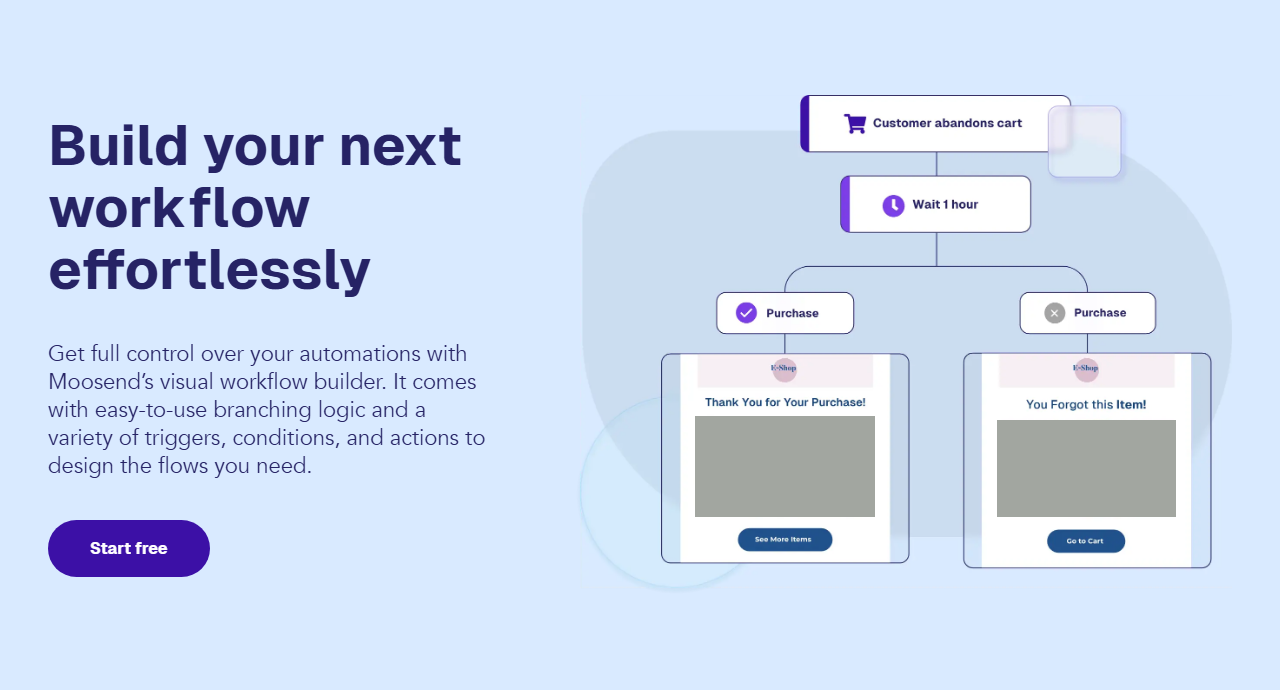
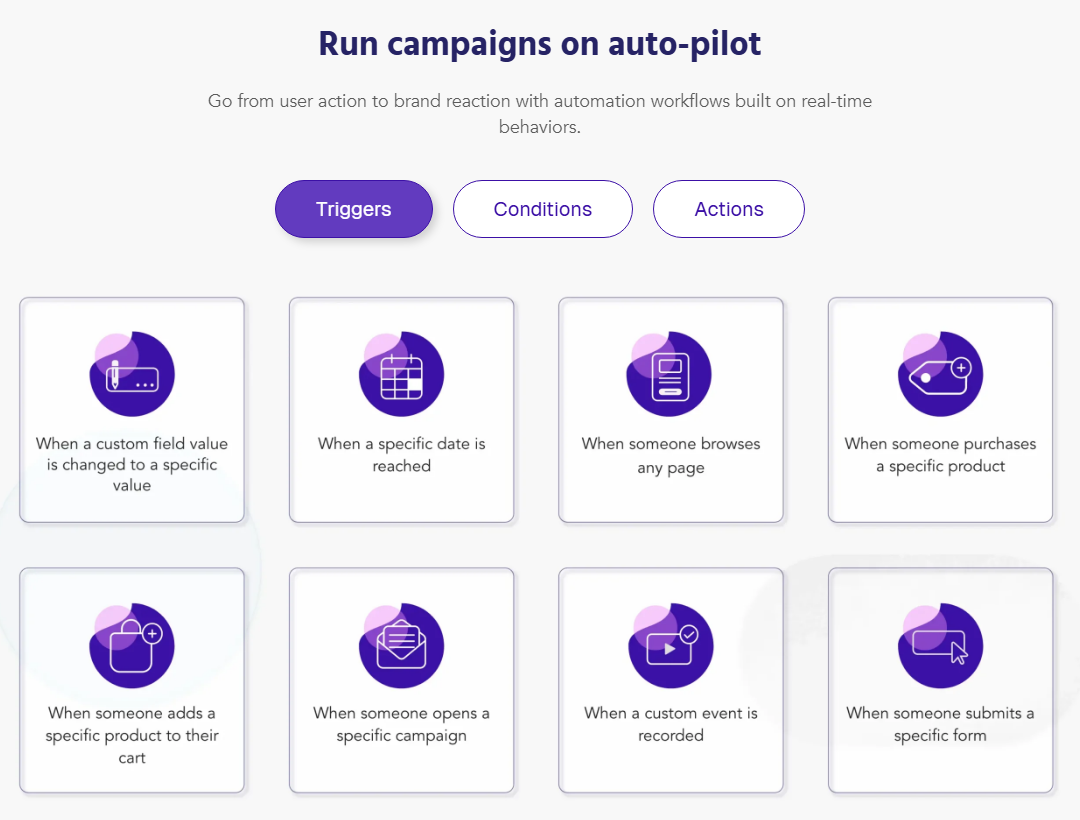
Recipes are the fast start. Moosend’s recipe gallery has ready-made workflows for cart abandonment, onboarding, upsell and cross-sell, thank-you emails and more, which you copy into the account and edit. For a small shop, the cart abandonment and welcome series are the two that usually pay for the plan.

Here is the gate you should know about before buying. The compare-plans table shows the “When someone browses any page” and “When someone views any product” triggers as not included in Pro or in the trial; they are ticked only for Moosend+ and Enterprise. Pro still has website tracking of product views, carts and purchases in its reports, and multi-step workflows, but the browse-based triggers behind follow-up emails about viewed products are on the quote-only tiers. Audience Discovery, Moosend’s AI segmentation, is an add-on for Moosend+.


From a new subscriber to a sale, the way a small shop would set it up on Pro.
Here is the path a typical small online shop would build in Moosend, using only what the Pro plan includes. It is drawn from Moosend’s product pages and documentation, not from an account of our own.
Swipe sideways to see the whole diagram.
A capable editor and a modest AI layer. Transactional email costs extra.
Moosend’s email side covers what a small sender needs: a drag-and-drop editor, templates, personalization, conditional content, A/B tests, heatmaps and real-time reports. Its AI is narrower than the 2026 marketing language around AI suggests. Moosend describes three parts: an AI Writer for subject lines, email copy, landing pages and forms; AI-driven product recommendations; and Audience Discovery, which builds AI-based segments. The AI Writer works inside the editors and lets you pick a content type, tone and word limit.

Two contract points come with the AI. The Terms’ generative AI appendix says AI inputs and outputs count as your Customer Data, that some features run on third-party models, and that Moosend “contractually restricts their use for training or improving AI models beyond what is necessary to provide and maintain the Gen AI Functionality.” It names Microsoft’s Azure terms as the vendor terms you must follow. It also disclaims any warranty on AI output. Read anything the AI Writer writes before it goes out.
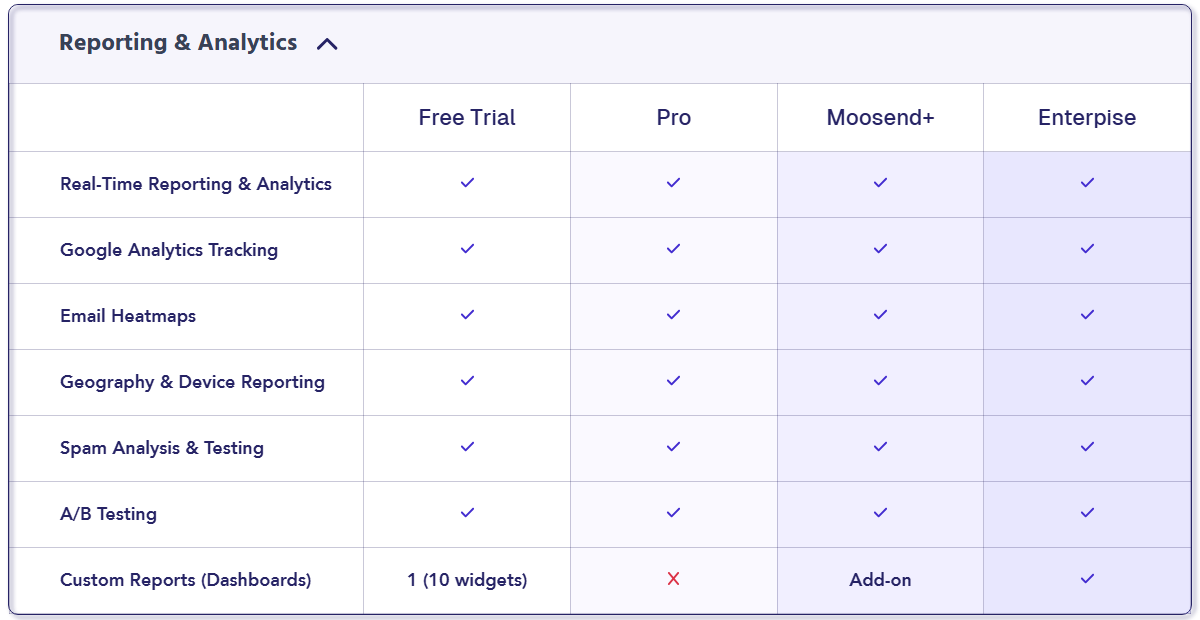
Transactional email, the receipts and password resets your shop or app triggers, is sold separately. Moosend sends it through an API and SMTP with templates and dynamic templating, but the compare-plans table shows it as not included in Pro, an add-on for Moosend+ and included in Enterprise. If you need receipts and marketing from one vendor, budget for a quote.
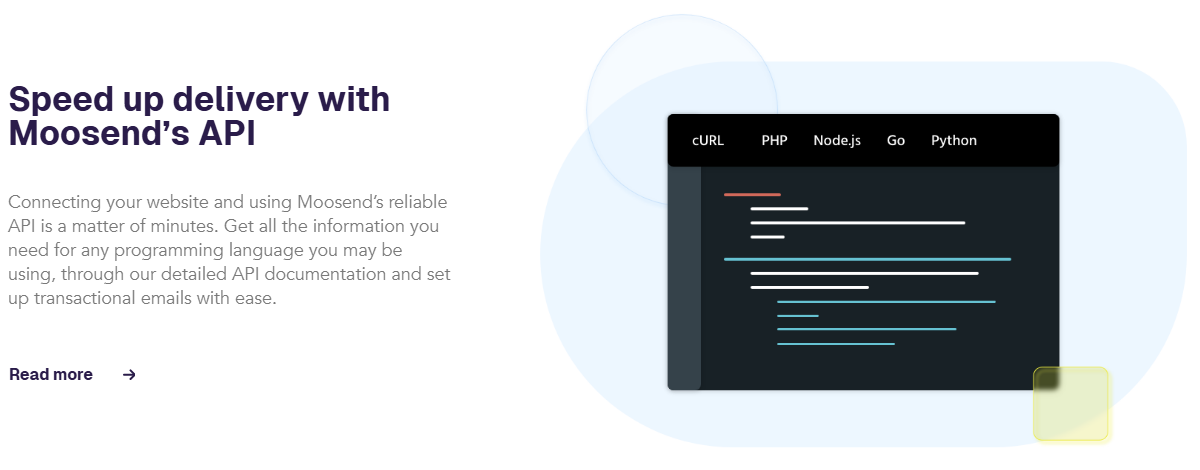
82 listed integrations, an API and SMTP, but no native Shopify connector on the list.
Moosend’s integrations page lists 82 entries on Oct 27, 2026, split into native and “via Zapier”. Shop platforms on the list are WooCommerce, Magento, OpenCart and ZenCart; Shopify is not on it. Shopify stores would connect through a general connector such as Zapier, Make or Pabbly, which are listed. CRM connections include Salesforce, HubSpot, Pipedrive, Zoho CRM and Microsoft Dynamics, and there is a WordPress plugin for publishing Moosend landing pages.
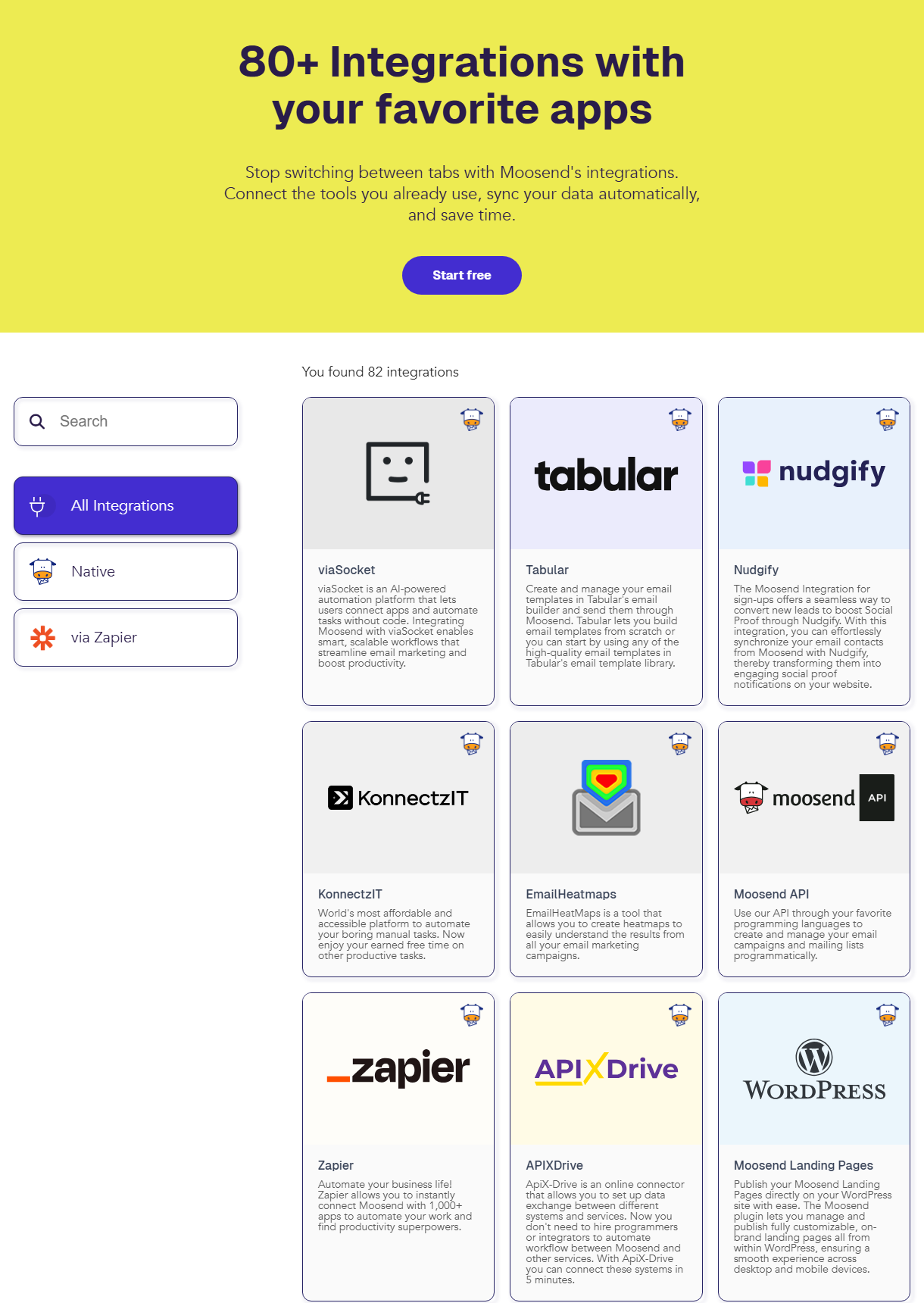
For developers, Moosend offers an API to create and manage campaigns and mailing lists, a transactional API and an SMTP server (not available during the trial). Moosend does not list an MCP server or a connector for AI assistants such as Claude or ChatGPT. If you want an assistant to work with your email data, you would route it through the API or a connector service yourself; our Claude MCP connectors guide explains how that kind of connection works.
Moving from Mailchimp is well covered. It offers a Mailchimp Synchronizer to import campaigns, lists and subscribers, and its official YouTube channel has a short walkthrough.
EU hosting on AWS and Azure, encryption and a short subprocessor list. No two-factor login.
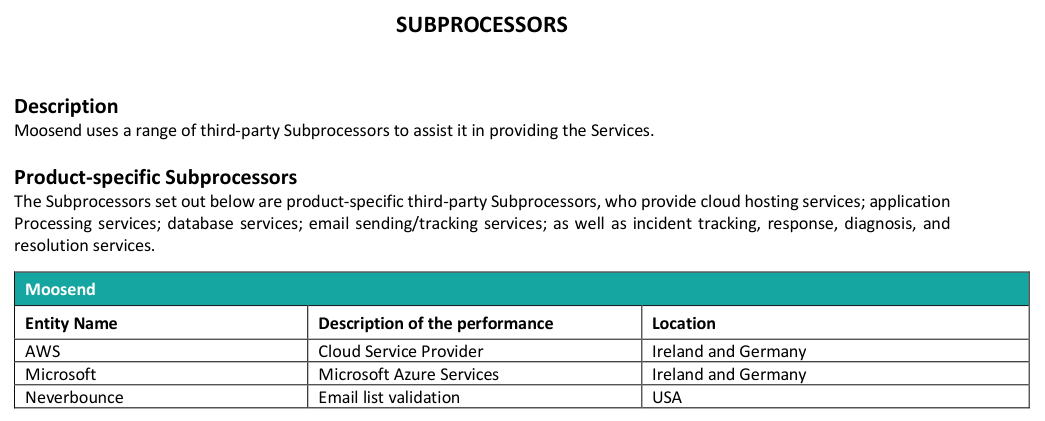
Moosend’s Trust Center says contact data is hosted in the EU with Amazon Web Services, that databases and data in transit are encrypted, that encrypted backups are stored off-site and that staff sign NDAs and take security training. It lists ISO 27001 under Certifications, while its own Data Center Security text attributes ISO 27001 and SOC 2 to AWS data centers; we found no Moosend certificate published on its site.

The subprocessor list linked from the Data Processing Addendum names three companies: AWS for cloud hosting and Microsoft for Azure services, both in Ireland and Germany, and Neverbounce for email list validation in the USA. The file sits in a January 2025 upload folder, before the Constant Contact deal, and names no Constant Contact company. The DPA itself (June 2025) is broader than the Trust Center’s EU message: it says Moosend “transfers Customer Personal Data to its servers in the United States” and to anywhere else its group companies and sub-processors operate, under Standard Contractual Clauses.

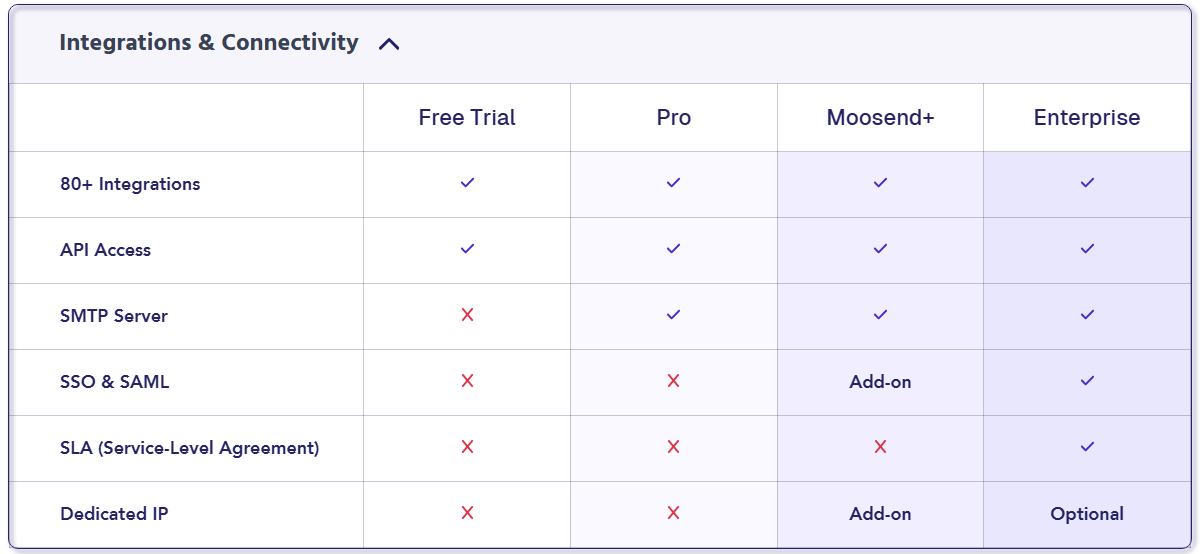
Account security is the weak spot. Moosend’s FAQ says: “Currently, Moosend does not offer two-factor authentication (2FA).” SSO and SAML exist, but only as a Moosend+ add-on or on Enterprise. Your email list is personal data, and the Terms make you responsible for all use of your account “whether authorized or unauthorized by you”, so on Pro your password manager is the only second line of defence.

| Control | Pro | Moosend+ / Enterprise | Source |
|---|---|---|---|
| Two-factor login | No | No | FAQ |
| SSO and SAML | No | Add-on / included | Compare table |
| Team members | 5 | Add-on / 10+ | Compare table |
| Uptime SLA | No | No / included | Compare table |
| Dedicated IP | No | Add-on / optional | Compare table |
| Data you must not upload | Financial records, card data, health data and special-category data, without prior written consent | Terms 10(c) | |
Small senders who want automation without paying per email.
| You are | Fit | Likely plan |
|---|---|---|
| Blogger or creator with a weekly newsletter under 2,000 subscribers | Good: unlimited sends, forms, landing pages and a welcome workflow for $16 to $24 a month | Pro, monthly at first |
| Small WooCommerce or Magento shop | Good: native integration, cart abandonment recipe, purchase tracking | Pro; Moosend+ if you want browse triggers or receipts |
| Shopify shop | Fair: no native Shopify entry on the integrations list; connect through Zapier, Make or Pabbly | Pro plus a connector |
| Course seller or coach with a funnel | Good for email sequences and landing pages; no checkout or course hosting | Pro |
| Seasonal sender (events, holidays) | Good: credits never expire | Credits |
| Agency | Fair: client accounts and white labelling are offered; check Appendix 1 of the Terms | Moosend+ or Enterprise by quote |
| Team that needs two-factor login, SOC 2 reports or an SLA on a small budget | Poor | Look elsewhere |
JAVIS assessment from Moosend’s pricing, integrations, FAQ and Terms pages, Oct 27, 2026.
Eight things to accept before you buy.
What works
- Unlimited sends on every paid band, priced by unique contacts
- Full workflow builder and recipes on the entry plan
- Prices published for 21 list sizes and unchanged since February 2022
- Monthly, six-month and yearly billing, plus credits that never expire
- EU hosting on AWS and Azure, short subprocessor list
- Five team members on Pro
What does not
- No free plan, and no two-factor login on any plan
- Page-browse and product-view triggers, transactional email and SSO sit above Pro
- Terms: fees non-refundable; 60-day written notice for renewal; trial data can be lost
- No native Shopify entry on the integrations list
- Support promise is two business days
- Pages disagree on trial data, cancelling, inactivity and uptime
- No two-factor authentication. Moosend says so in its FAQ. For a tool that holds your whole customer list, that is the biggest practical risk.
- Key automation triggers are not on Pro. “When someone browses any page” and “When someone views any product” are Moosend+ and Enterprise only.
- Transactional email costs extra. Not included in Pro; add-on or Enterprise.
- The Terms are strict. Non-refundable fees, auto-renewal with 60 days’ written notice, and trial data that “WILL BE PERMANENTLY LOST” without a purchase.
- The trial is narrower than it sounds. One published workflow, and forms and landing pages you can design but not publish.
- New owner, open roadmap. Constant Contact has its own email product and now promotes it on Moosend’s home page. Moosend’s prices and plans have not changed since the deal, but nothing public commits to how long that lasts.
- Thin independent evidence. No app-store ratings, and no review-site scores are cited here; most numbers are Moosend’s.
- Upkeep shows in places. The deliverability page’s FAQ answer on inbox placement ends with placeholder text (“um dolor sit amet, consectetur adipiscing elit”), and the compare table spells Enterprise as “Enterpise” in one header. Small things, but they fit the picture of a product whose pages are not all maintained together.
Who to compare Moosend with, by what you need.
Prices below were read on each vendor’s own pricing page on Oct 27, 2026. They are entry points, not like-for-like plans: some tools limit sends, users or automation steps that Moosend does not, and the reverse.
Swipe sideways to see the whole table.
| Tool | Free plan | Entry paid plan (default view) | What the entry plan limits | Pick it if |
|---|---|---|---|---|
| Moosend | No (30-day trial) | Pro $9 a month monthly, $7 yearly, 500 contacts | Unlimited sends; full workflows; no transactional email | You want automation and unlimited sends on a small budget |
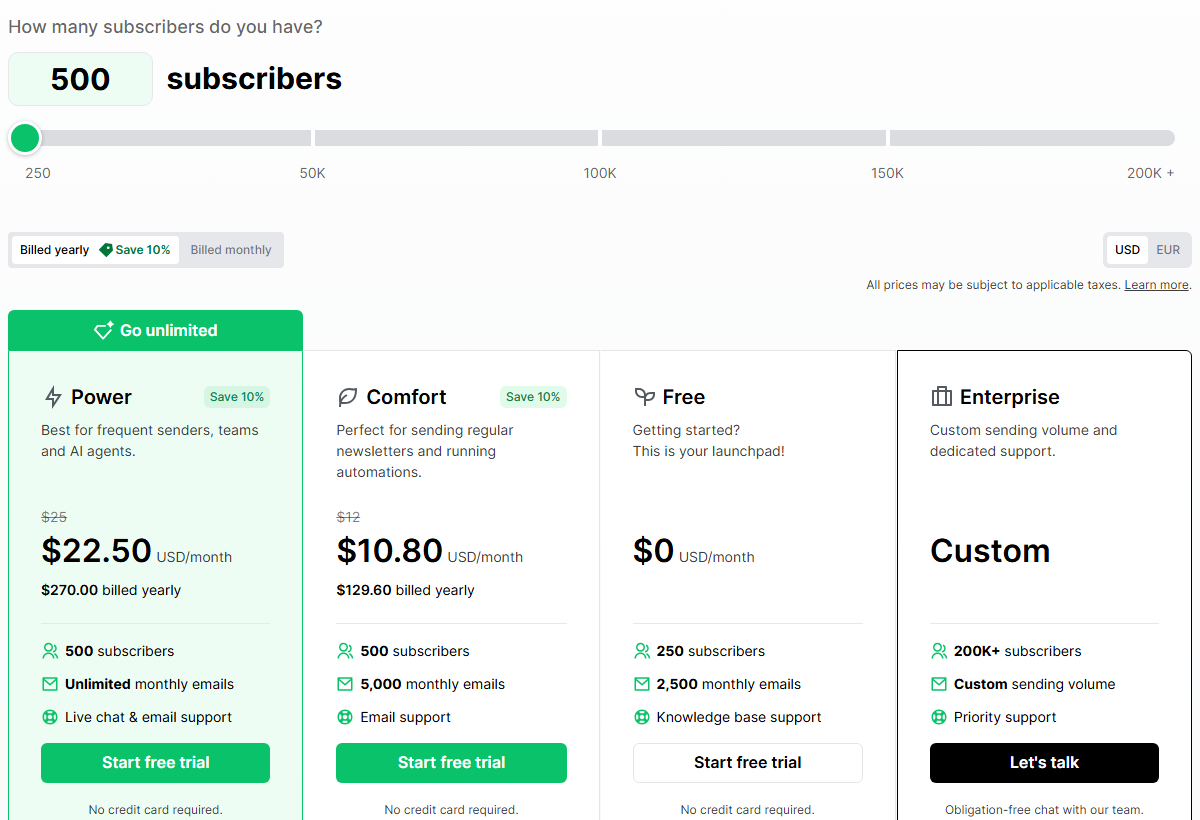
| MailerLite | Yes: 250 subscribers, 2,500 emails a month | Comfort $12 a month monthly, $10.80 yearly, 500 subscribers | 5,000 emails a month, 50 automations; Power ($25) for unlimited emails | You want a free start and a polished editor |
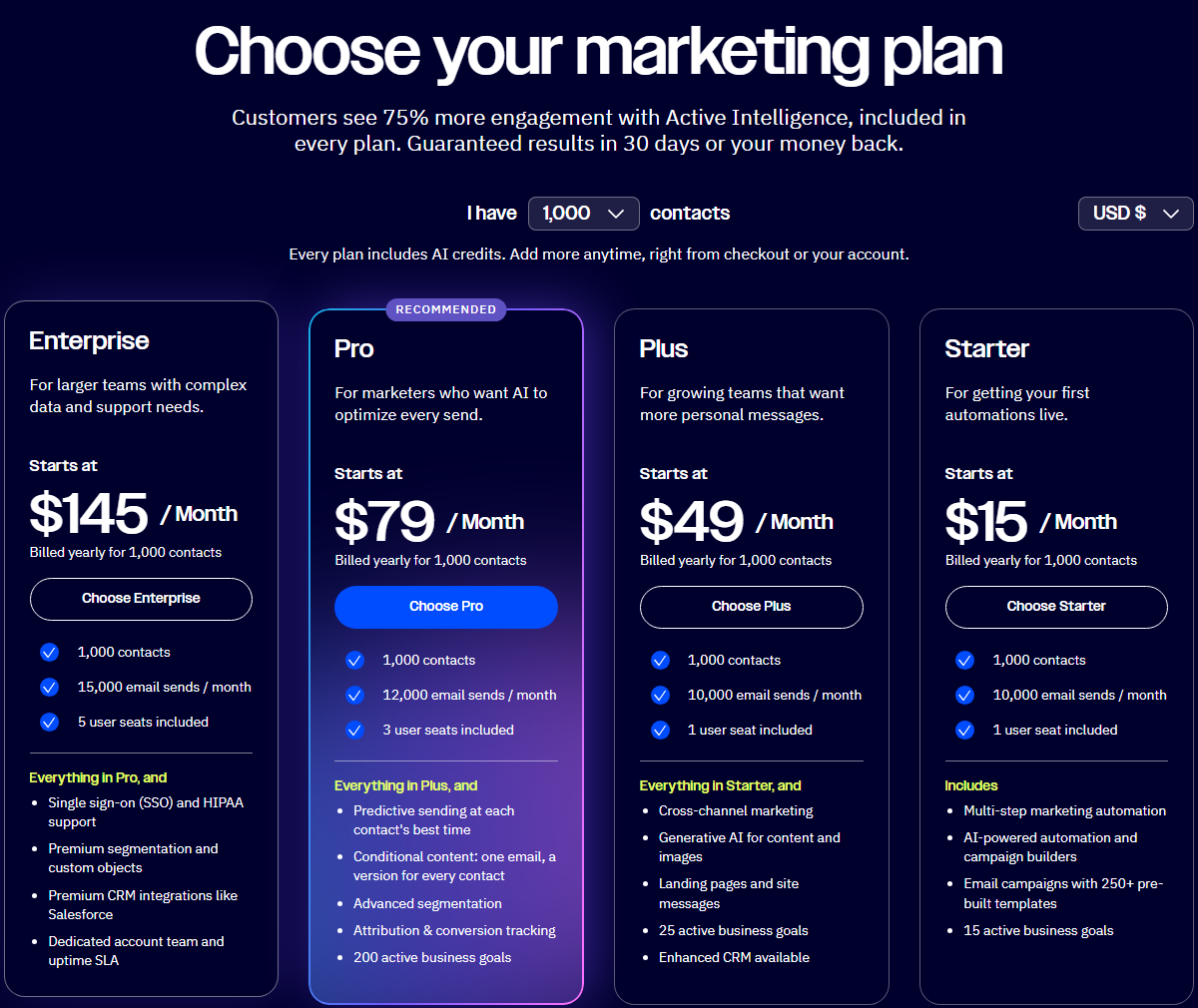
| Brevo | Yes: up to 300 emails a day | Starter $9 a month monthly, $8.08 yearly | Priced by emails (from 5,000 a month); marketing automation starts on Standard ($18) | You send rarely to a large list, or want SMS and an MCP connector |
| Mailchimp | Yes: under 250 contacts | Essentials from $13 a month; Standard from $20, 0 to 500 contacts | Essentials: up to 4 flow steps; Standard: 6,000 emails a month | You want the biggest integration ecosystem |
| ActiveCampaign | No | Starter $15 a month billed yearly, 1,000 contacts | 10,000 sends a month, 1 user | You need a CRM and deeper automation and can pay more |
Sources: each vendor’s pricing page on Oct 27, 2026, in US dollars at the default contact setting; Brevo’s free-plan limit is from its pricing FAQ. Entry plans differ in what they meter, so compare the limits, not only the price.
At around 500 contacts, Moosend’s $9 buys something the others charge more for: unlimited sends and the full workflow builder. MailerLite’s comparable unlimited-email plan is $25 a month on monthly billing, Brevo puts automation on its $18 plan, and Mailchimp’s $13 Essentials stops at four steps per flow. Where Moosend loses is the free start, two-factor login, and the size of the ecosystem around it.

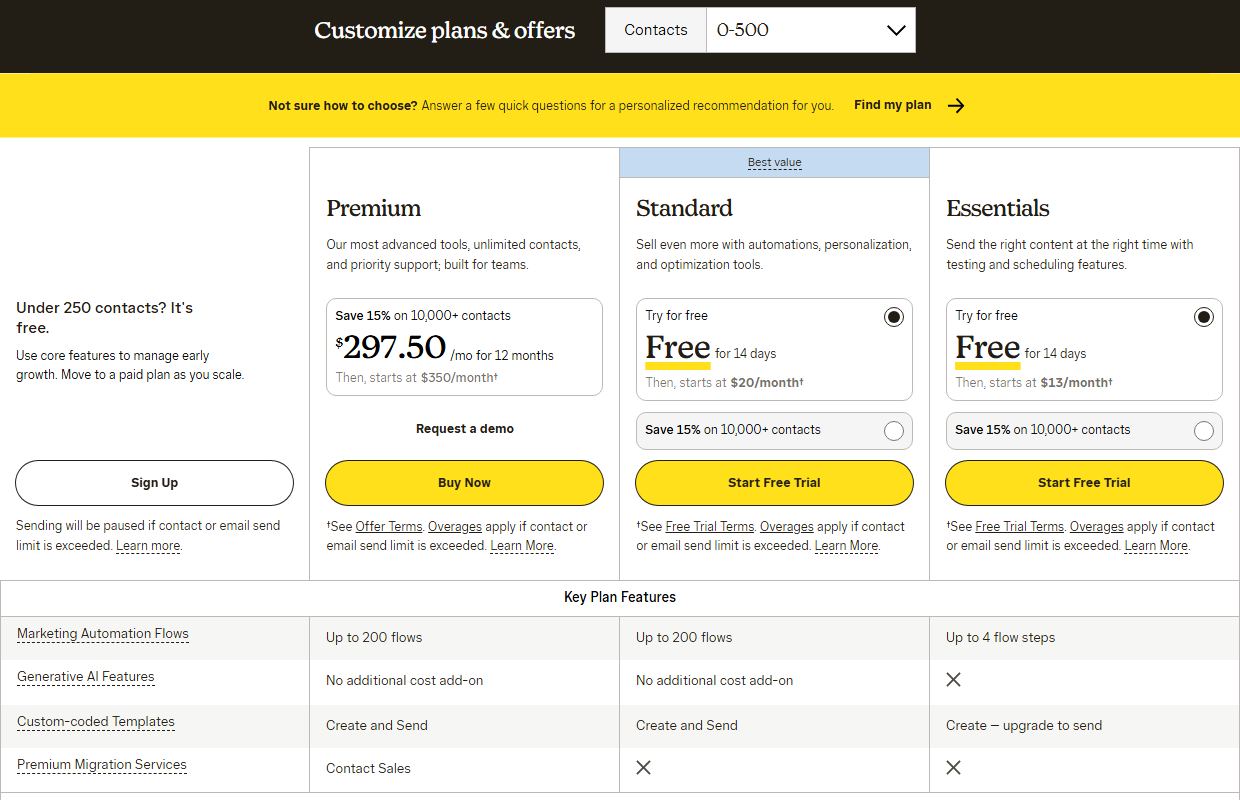
Moosend’s own Mailchimp comparison page makes the price case for it, with a savings calculator that shows “Save up to $132 / yearly” at 500 contacts. That figure matches Mailchimp Standard at $20 a month against Moosend Pro on monthly billing at $9 ($240 minus $108). Against Mailchimp Essentials at $13 a month the gap is $48 a year. The same page shows a Capterra rating of 4.6 in its header, while Moosend’s footer badge shows 4.7.

Constant Contact, Moosend’s parent, is the other obvious comparison, and GetResponse is another common one; neither is priced in this review. If your list is a newsletter rather than a funnel, also read our beehiiv review.
This review has no affiliate links.
Every Moosend link here goes straight to moosend.com, its pricing page, its Terms or its documentation, without tracking parameters. The score, the drawbacks and the alternatives would be the same either way.
How this review was put together: Moosend’s pricing page at every list size, with its billing options, Credits panel, compare-plans table and FAQ; its FAQ, features, automation, AI, transactional, integrations, deliverability, support, Trust Center and Mailchimp comparison pages; its help center articles on plans and credits, billing and accounts; its Terms and Conditions, Acceptable Use Policy, Privacy Policy and Data Processing Addendum (all dated June 2025) and its subprocessor list; one official Moosend video; Internet Archive copies of the pricing page from Feb 5, 2022 to Oct 5, 2026; the 2021 Sitecore and 2025 Constant Contact acquisition releases; the PricingSaaS tracker; Hacker News; and the MailerLite, Brevo, Mailchimp and ActiveCampaign pricing pages, as of Oct 27, 2026. This review is not hands-on tested: no Moosend account, no trial, no campaign, no deliverability measurement and no support contact, so nothing here describes Moosend’s performance or support from our own use. Screenshots show public pages only.
Other ways to reach your list, build your site and work with AI.
Each card opens a published JAVIS review, routed by where you are.


Questions people ask before choosing Moosend
Does Moosend have a free plan?
No. Moosend ended its Free Forever plan in January 2022. As of Oct 27, 2026 it offers a 30-day free trial with no credit card, covering up to 1,000 contacts, with one published workflow and forms and landing pages you cannot publish until you pay.
How much does Moosend cost?
Pro costs $9 a month for 500 contacts on monthly billing, $16 for 1,000, $48 for 5,000 and $88 for 10,000. Annual billing brings those to $7, $13, $38 and $70 a month, paid for the year up front. Moosend+ and Enterprise are by quote. Credits cost $350 for 350,000 emails and never expire.
Who owns Moosend?
Constant Contact. It announced the purchase from Sitecore on Jun 6, 2025, without disclosing terms. Sitecore had owned Moosend since May 2021. The contracting company in the Terms is Moosend Ltd. in London, under English law.
Can I get a refund?
The Terms say fees paid are non-refundable, and no refund is given if Moosend suspends or terminates an account. The pricing page offers no money-back guarantee. Start on monthly billing if you are unsure.
How do I cancel?
The FAQ says to click “Cancel Subscription Plan” in Billing; the cancellation takes effect at the end of the paid term. The Terms also ask for written notice (email is acceptable) at least 60 days before the end of a subscription term, so for an annual plan, email support well before renewal and keep a copy.
Does Moosend have two-factor authentication?
No. Its FAQ says Moosend does not offer 2FA. SSO and SAML are available as a Moosend+ add-on or on Enterprise.
Does Moosend work with Shopify?
Shopify is not among the 82 entries on Moosend’s integrations page as of Oct 27, 2026. WooCommerce, Magento, OpenCart and ZenCart are. A Shopify store can connect through Zapier, Make or Pabbly, which are listed.
Where this came from, and when.
Every price, limit, rule and claim in this review comes from the pages below, as of Oct 27, 2026 unless another date is given. Help center statements are as read on Oct 27, 2026. Expand for the full list, the scoring method and what the review does not cover.
Show sources, scoring method and scope
Pricing: moosend.com/pricing at all 21 list sizes and three billing options, with the Moosend+, Enterprise and Credits panels, the compare-plans table and the pricing FAQ (US dollars); Internet Archive copies of moosend.com/pricing from Feb 5, 2022; Jun 1, 2023; Jun 5 and Dec 12, 2024; May 3 and Sep 6, 2025; Jan 28, May 22 and Oct 5, 2026.
Help center (docs.moosend.com), as read on Oct 27, 2026: Subscription plans and credits; Manage your subscription plans and credits; Subscriptions and billing FAQ; Create an account; Manage your payment methods.
Legal: Terms and Conditions (June 2025), including Appendix 3 on generative AI; Acceptable Use Policy (June 2025); Privacy Policy (June 2025); Data Processing Addendum (June 2025); subprocessor list linked from the DPA.
Product and company: moosend.com home, features, marketing automation, workflow builder, automation recipes, Moosend AI, transactional emails, integrations, deliverability, FAQ, support, Trust Center and Moosend vs Mailchimp pages; Sitecore press release of May 26, 2021; Moosend blog post of May 8, 2021; Constant Contact release of Jun 6, 2025 on PR Newswire and CMSWire; sitecore.com/platform/send.
Video: one official video from Moosend’s YouTube channel (linked from moosend.com in December 2024): XpaO1nw4aPU, Switch from Mailchimp to Moosend in Minutes!, Mar 6, 2025.
Independent evidence: Hacker News story 30026840 and comments 30028033, 31693039 and 47789847; ahoi.dev post of Jan 17, 2022; PricingSaaS pages on Moosend (change recorded Mar 30 to Jun 29, 2026). US App Store and Google Play searches found no Moosend app. G2 and Capterra figures appear only as Moosend displays them.
Competitors: mailerlite.com/pricing, brevo.com/pricing, mailchimp.com/pricing/marketing and activecampaign.com/pricing, Oct 27, 2026, at their default settings.
Fit score, 60 out of 100: five criteria worth 20 points each. Price clarity 15 (every Pro band and billing option public, credits public; Moosend+ and Enterprise by quote); capability 13 (unlimited sends and full workflows on Pro, but browse triggers, transactional email and SSO gated, no native Shopify, no 2FA); independent evidence 7 (a handful of public posts, no store ratings); terms, data and security 9 (non-refundable fees, 60-day renewal notice, trial data clause, no 2FA, against EU hosting and a short subprocessor list); cost and fit 16 (low entry price, unlimited sends, credits for rare senders). Editorial judgment from published facts, not a hands-on test.
Not covered: deliverability, support quality, editor speed, AI output quality and the in-app experience, none of which can be judged without an account. Moosend+ and Enterprise prices, which Moosend gives only on request. Constant Contact’s and GetResponse’s plans.