
WP Engine Review 2026: Managed WordPress Hosting From $35 a Month, a New Plan Lineup and a Contract Worth Reading First
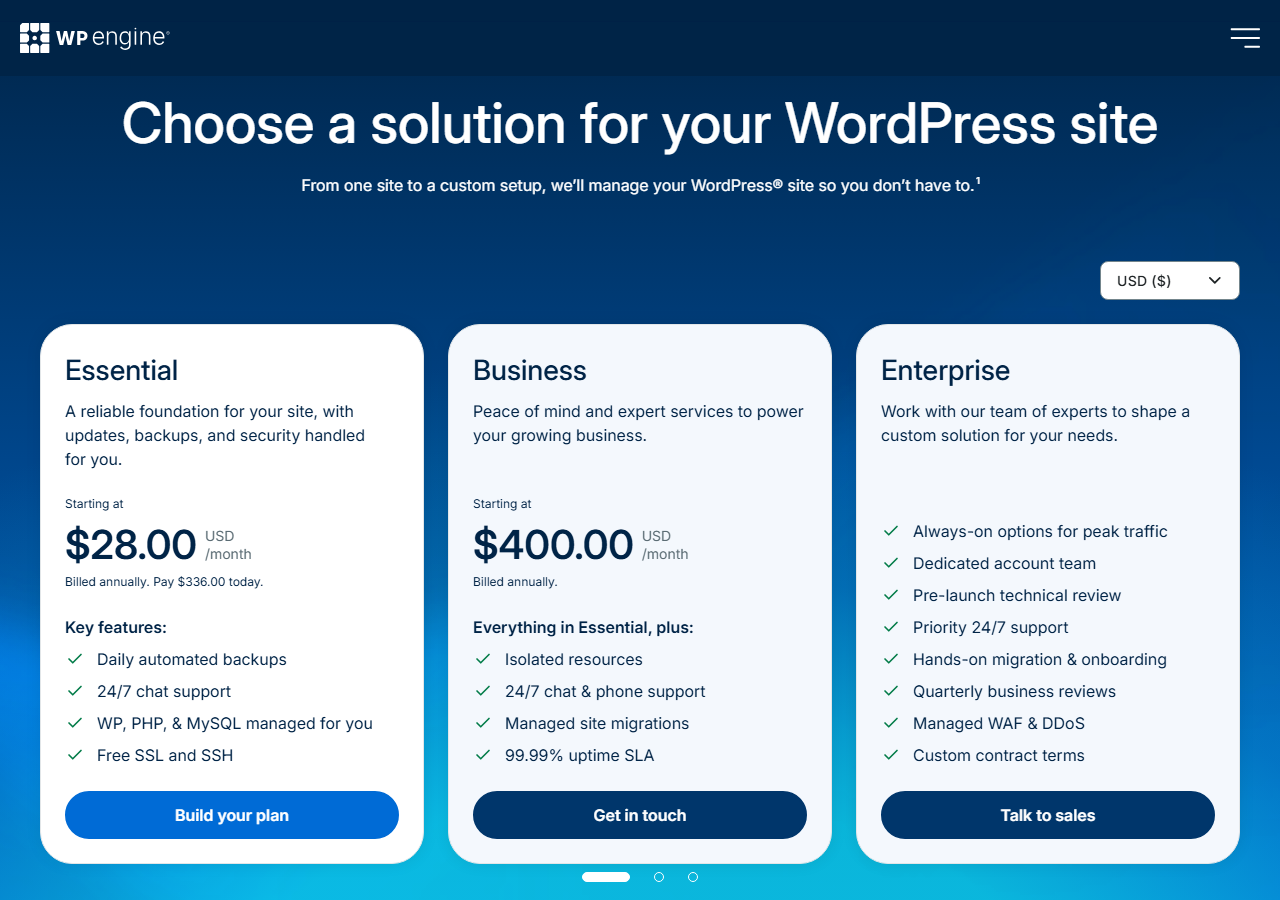
WP Engine runs WordPress sites for you: servers, caching, backups, updates and 24/7 support, plus developer tools such as Local, Advanced Custom Fields and the Genesis framework. On wpengine.com as of Oct 27, 2026, the Essential plan costs $35 a month for one site on monthly billing, or $336 for the first year on annual billing. That annual price already includes a 20% first-year coupon the page applies on its own; the regular annual price for the same site is $420. Essential goes up to 30 sites at $330 a month, Business starts at $400 a month and Enterprise is quoted. The catches are in the paperwork: the 60-day money-back guarantee the plans page carried through Jan 13, 2026 is no longer there, the Terms make all remaining fees due if you leave a contract early, a managed firewall and automatic plugin updates cost extra on Essential, and WP Engine is still in court with Automattic, the company behind WordPress.com, with a jury trial set for Oct 19, 2027, according to reports of the Sep 24, 2026 order.
Every WP Engine link in this review goes straight to wpengine.com, its help center or its legal pages.
| Made by | WPEngine, Inc., founded in 2010 in Austin, Texas; it also owns Flywheel, Local, ACF, NitroPack and StudioPress |
| What it is | Managed WordPress hosting, a decoupled-site platform, a newsroom platform and paid add-ons |
| Plans | Essential from $35 a month (1 site) or $336 the first year; Business from $400 a month; Enterprise quoted |
| Limits | 1 site, 25,000 visits, 10 GB and 75 GB bandwidth on the smallest tier; $2 per 1,000 extra visits |
| Best for | Businesses and agencies that want WordPress run for them and are comfortable with a contract |
A capable managed WordPress platform that now asks you to read the contract as closely as the feature list.
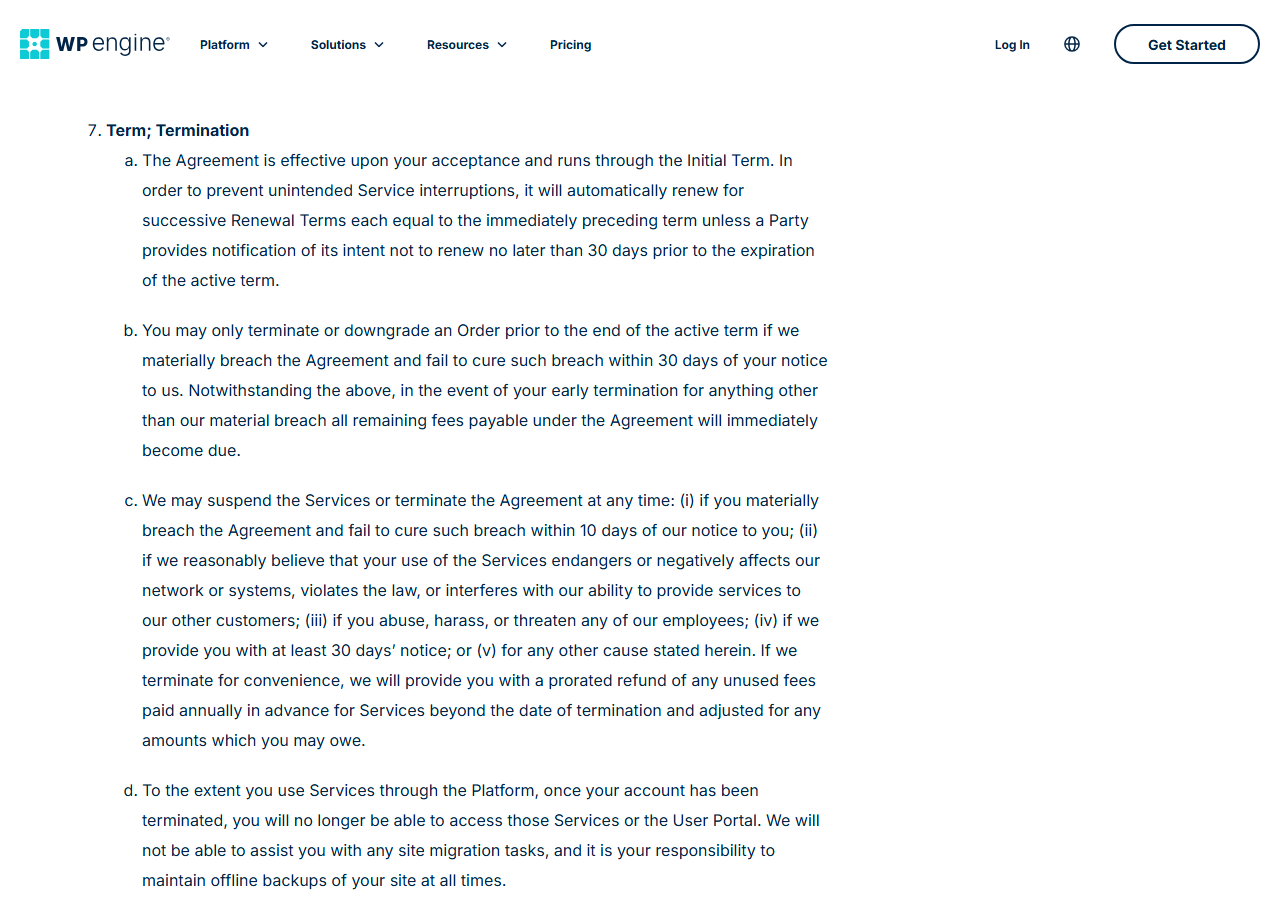
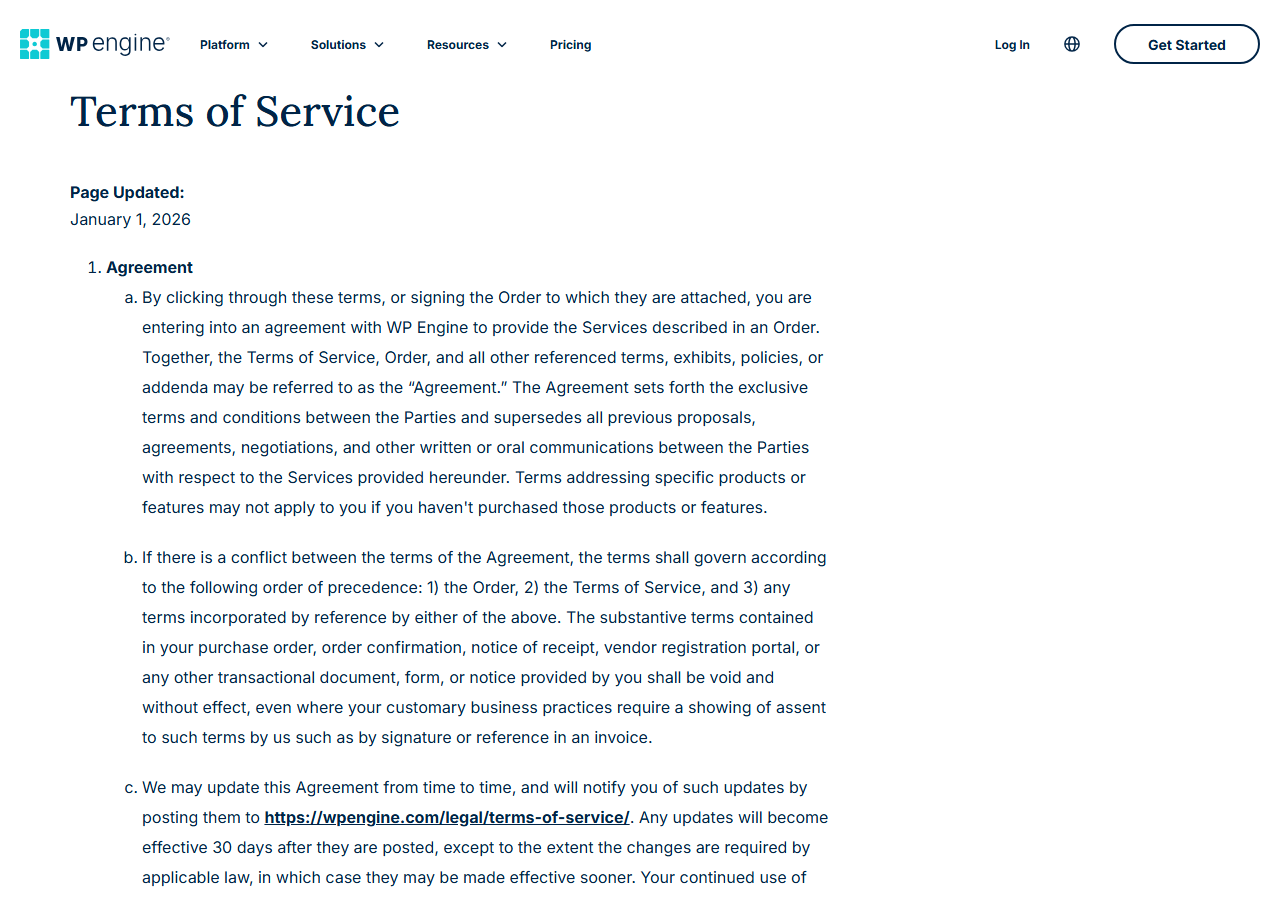
“in the event of your early termination for anything other than our material breach all remaining fees payable under the Agreement will immediately become due”
That line is section 7(b) of WP Engine's Terms of Service, updated Jan 1, 2026. It matters more in 2026 than it used to, because the plans page no longer offers the 60-day money-back guarantee it showed through January, and because the headline price of $28 a month is an annual, first-year price with a coupon already baked in. If you sign for a year and change your mind in month three, the Terms say the rest of the year is still owed.
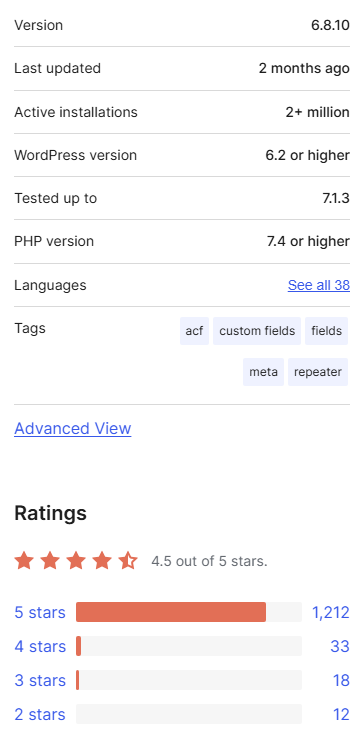
What you buy is solid on paper. Every Essential tier includes daily and on-demand backups that WP Engine keeps for 30 to 60 days, one-click staging and development copies, managed WordPress and PHP updates, EverCache page caching, a Cloudflare-powered CDN, free SSL, SSH access and 24/7 chat support. Around the hosting sits a set of tools many WordPress developers already use: Local for building sites on your own computer, Advanced Custom Fields (2+ million active installations on WordPress.org), the Genesis framework and StudioPress themes, and, since early 2026, the WPackagist Composer repository. Business adds isolated resources, phone support and a 99.99% uptime target.
Three things keep the score in the middle. First, price presentation: the annual price shown by default is a first-year offer, the regular annual price for one site is $420, and the fine print says renewal pricing is “subject to change”. Second, exit terms: no refund guarantee that we could find on the plans page, Terms or FAQ, 30 days' notice to stop a renewal, and all remaining fees due on early termination. Third, add-ons: a managed firewall, automatic plugin updates with visual testing, uptime monitoring and Git-based deployments are extra or missing on Essential, so one site with the firewall and plugin auto-updates added costs $73 a month in the first year on annual billing, not $28. The long dispute with Automattic matters less day to day than it did in late 2024, because a court order restored WP Engine's access to WordPress.org in December 2024, but the case is heading to a jury in October 2027.
A hosting account for WordPress sites, three environments per site, and a shelf of paid extras.
A WP Engine plan is an account that holds a number of WordPress sites. Each site can have three environments: production, staging and development, so you can test a plugin update on a copy before it touches the live site. WP Engine runs the servers, caching and backups, keeps WordPress and PHP updated, and answers support chats around the clock. Security beyond the basics, automatic plugin updates and front-end speed tools are sold as add-ons. Around the hosting, WP Engine owns a family of brands it lists in its site footer: Flywheel (a second hosting brand), Local, ACF, NitroPack, StudioPress, Delicious Brains and Torque.

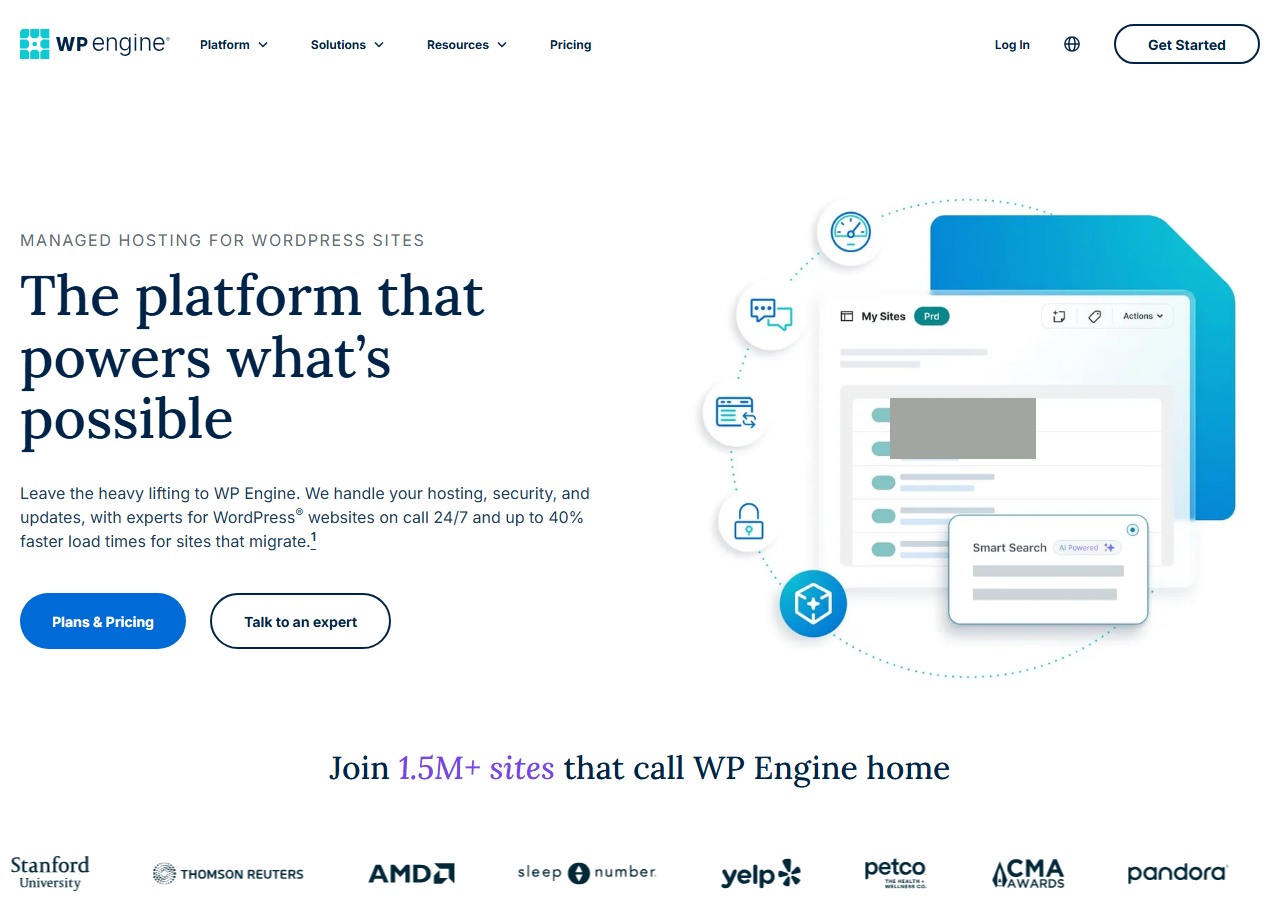
Higher headline prices, a new plan lineup, and the money-back guarantee gone.
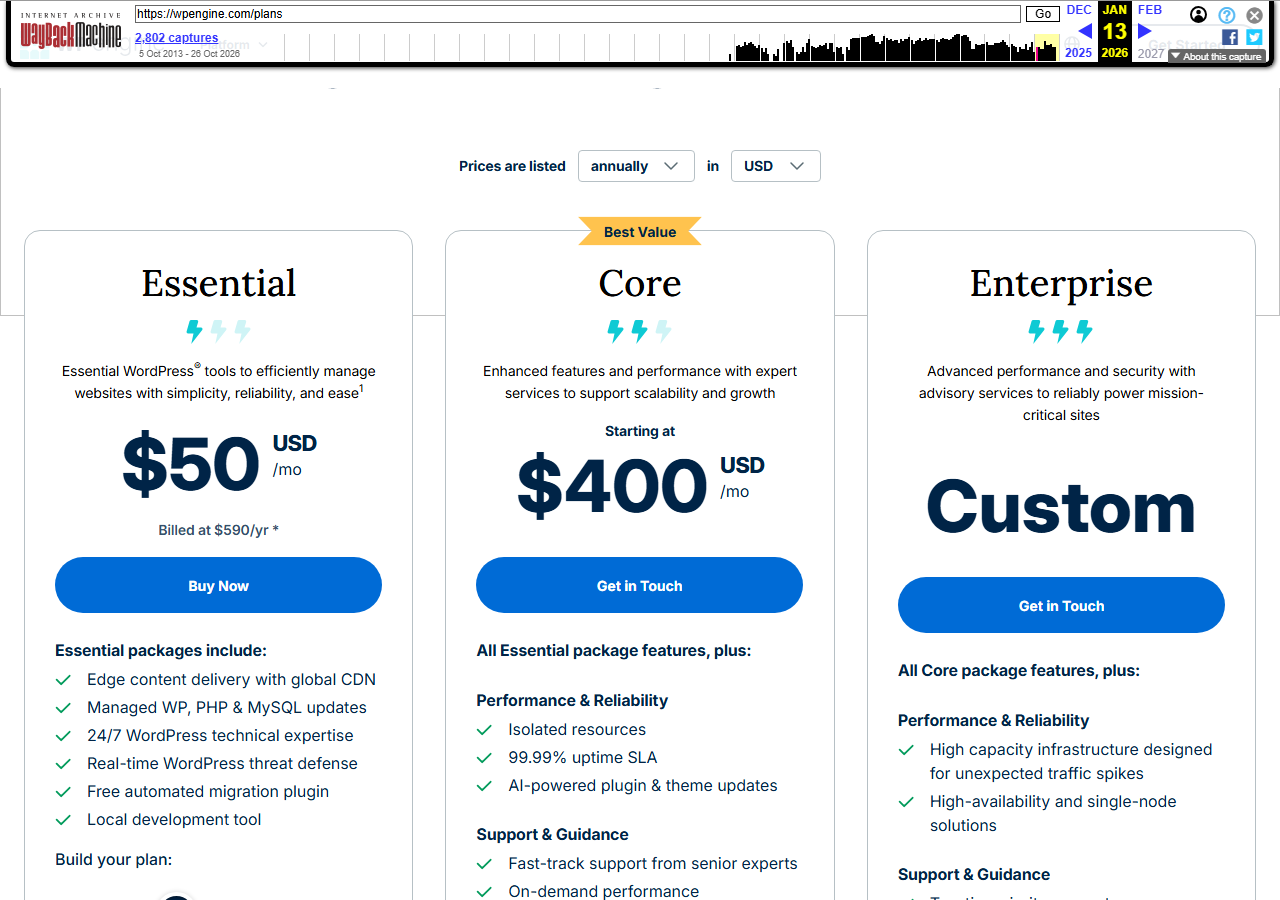
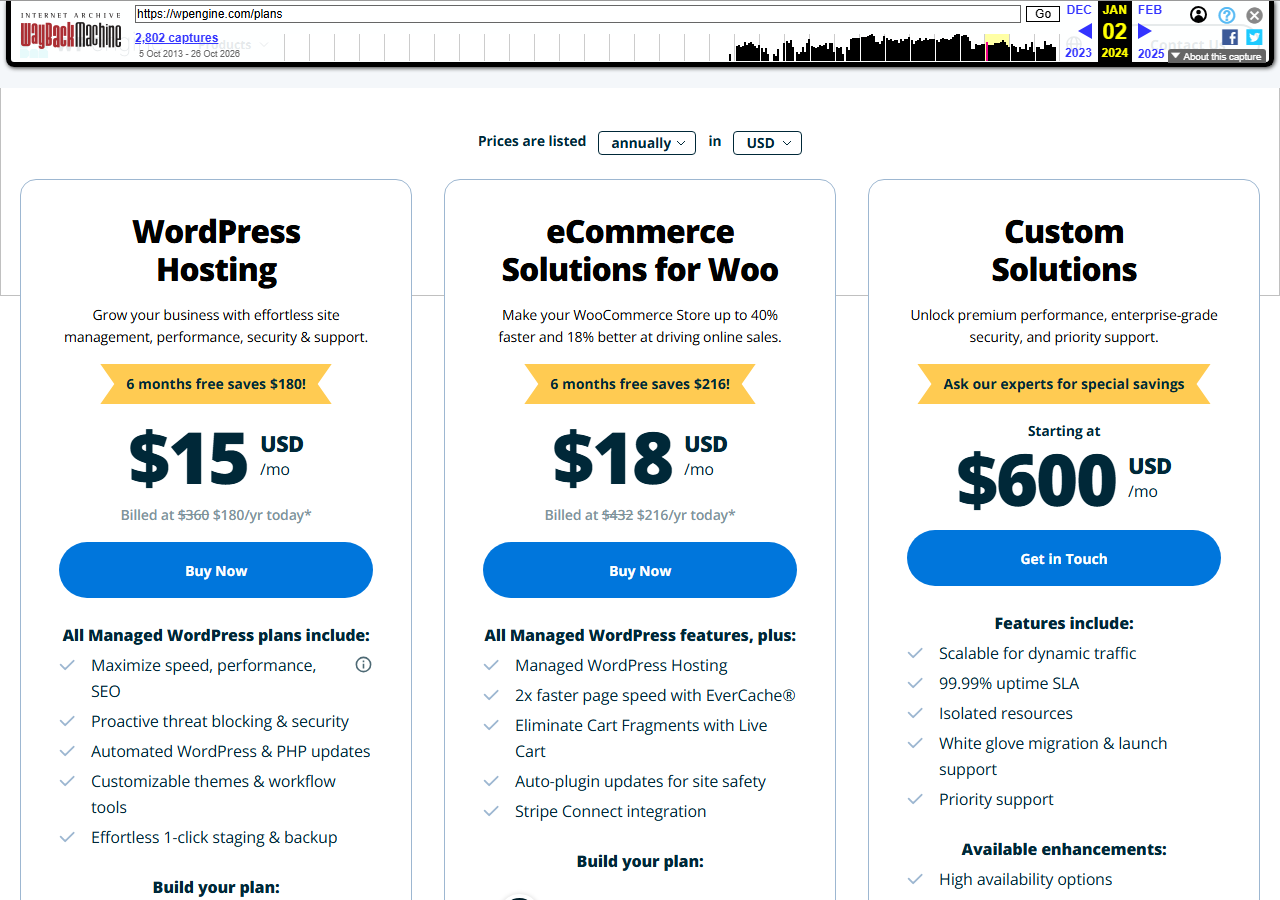
WP Engine does not publish a pricing change log, so the record below comes from Internet Archive copies of wpengine.com/plans. The headline figure is the “Starting at” price for the smallest tier, which is always an annual-billing price and often a first-year one, so treat it as a trend, not a renewal price.
| Date (plans page) | Smallest tier, headline price | What else the page showed |
|---|---|---|
| Jan 2, 2024 | Startup “Starting at $20 /mo” | Plan cards offered 6 months free on the first year; 60-day money-back guarantee |
| Dec 31, 2024 | Startup $25 | Plans grouped as Essential, Core and Enterprise; guarantee still shown |
| Jan 13, 2026 | Startup $25 | Last copy we found with the 60-day guarantee |
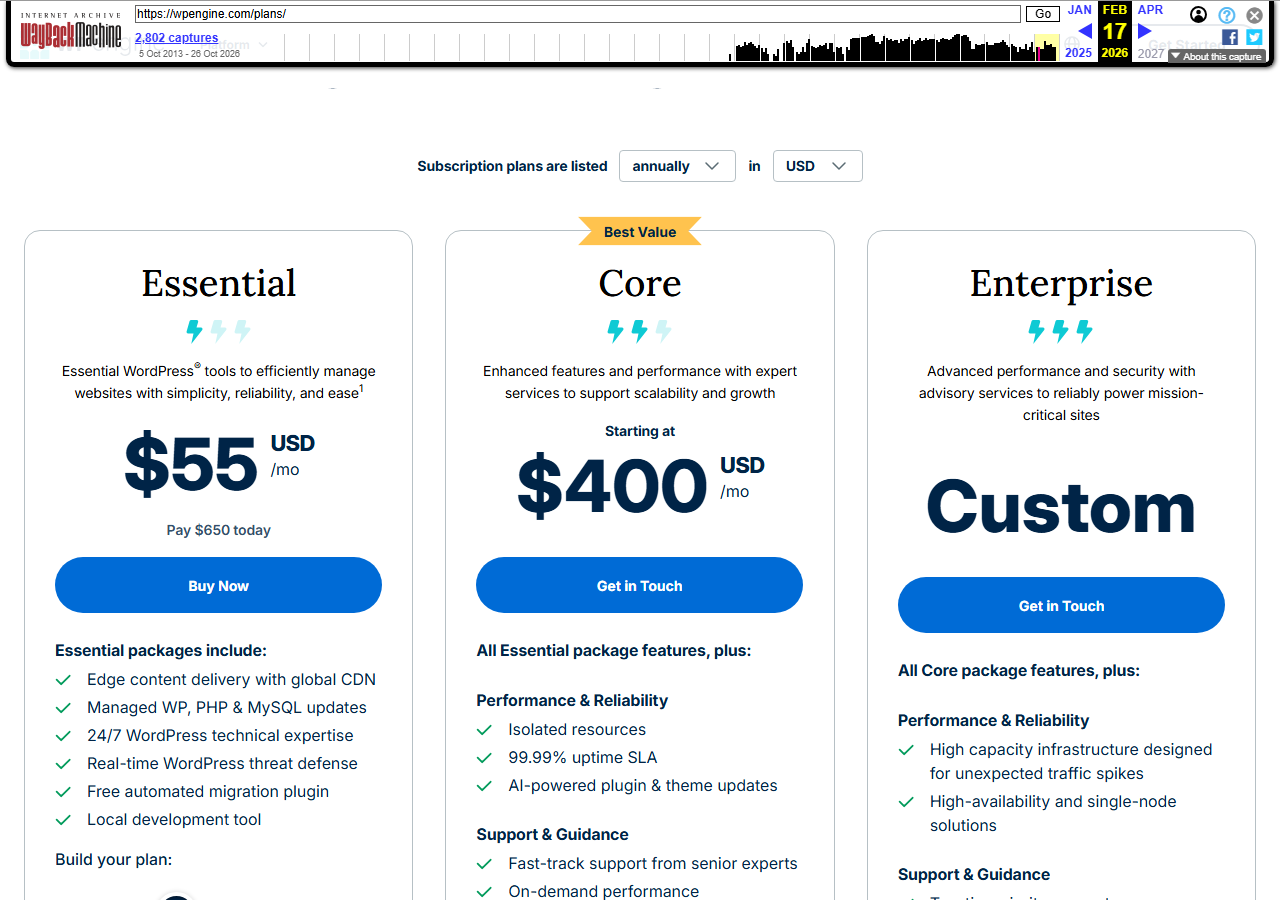
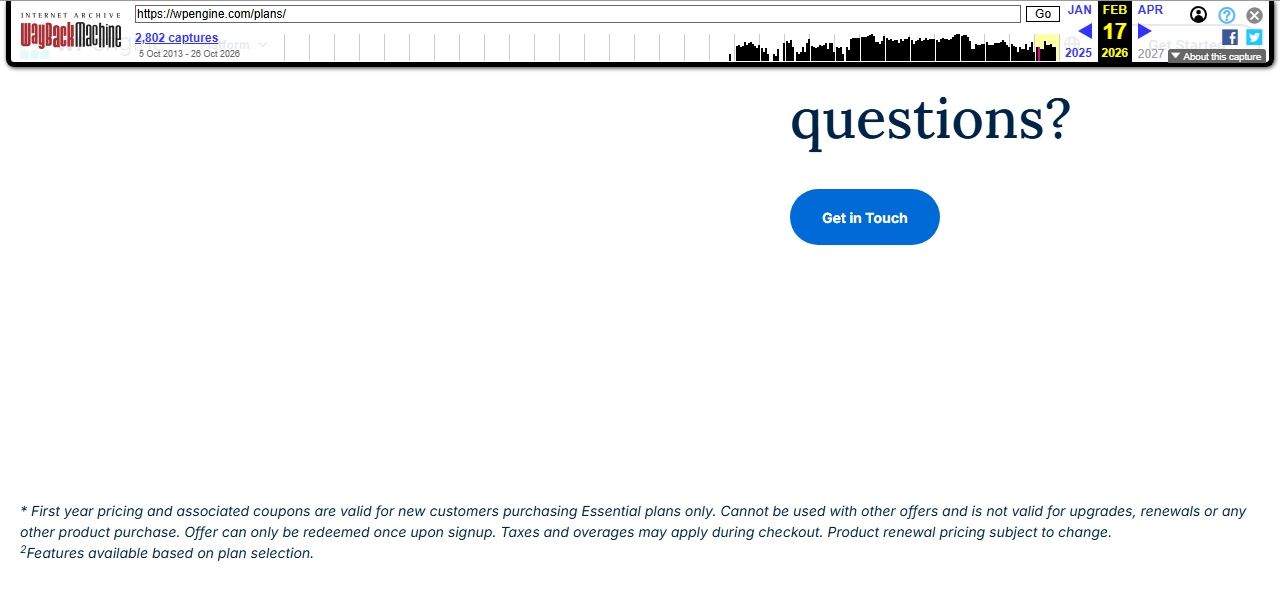
| Feb 17, 2026 | Startup $30* | Guarantee gone; asterisk points to first-year pricing; Professional and above list chat and phone support |
| Jul 2, 2026 | Startup $30* | Same layout |
| Sep 1, 2026 | Essential, 1 site: $28 a month billed annually ($336) | New Essential, Business and Enterprise lineup with a capacity picker; $35 a month on monthly billing |
| Oct 27, 2026 | Same: $336 first year, $420 regular annual, $35 monthly | Phone support listed from Business ($400 a month) |
The biggest change for buyers is not a number. Through Jan 13, 2026 the plans page promised that “you can request a refund anytime within the first 60 days and we’ll refund your plan fees paid” on new Startup, Professional, Growth and Scale plans. The Feb 17, 2026 copy and every later copy we found, including the live page on Oct 27, 2026, have no guarantee, and the Terms say fees “are not refundable except as expressly stated herein”. Flywheel, which WP Engine also owns, still offers a 60-day money-back guarantee on its own pricing page.
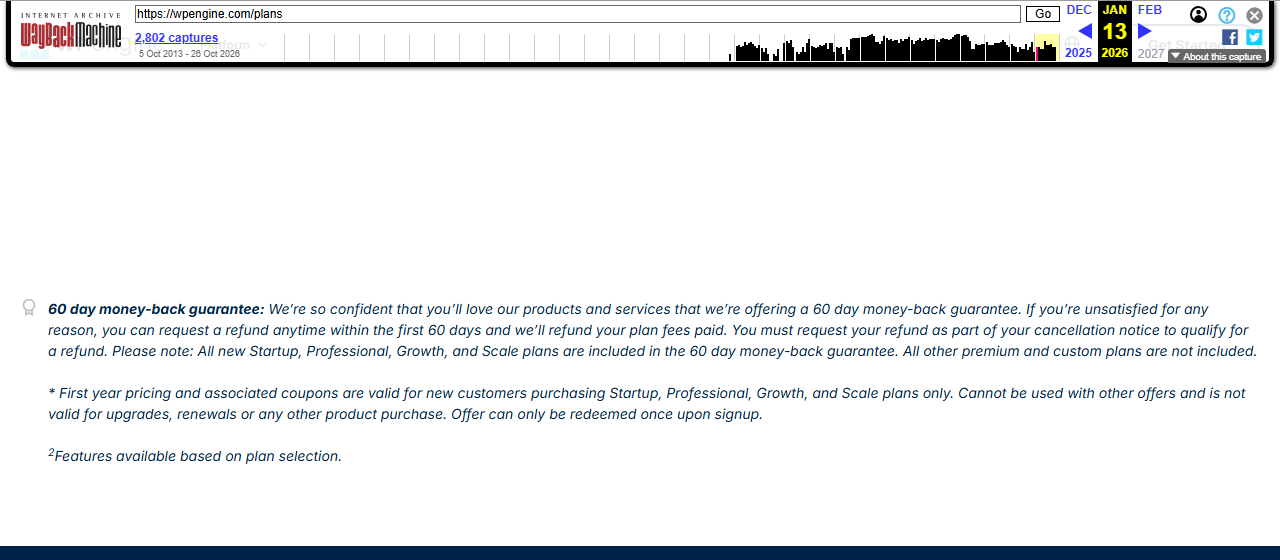
About 1.3% of all websites, a large specialist next to much bigger general hosts.
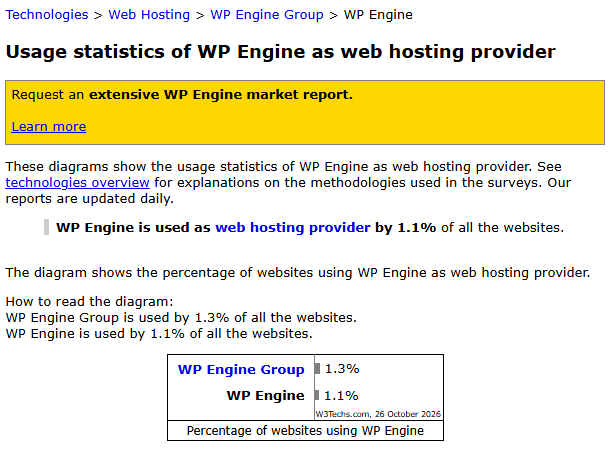
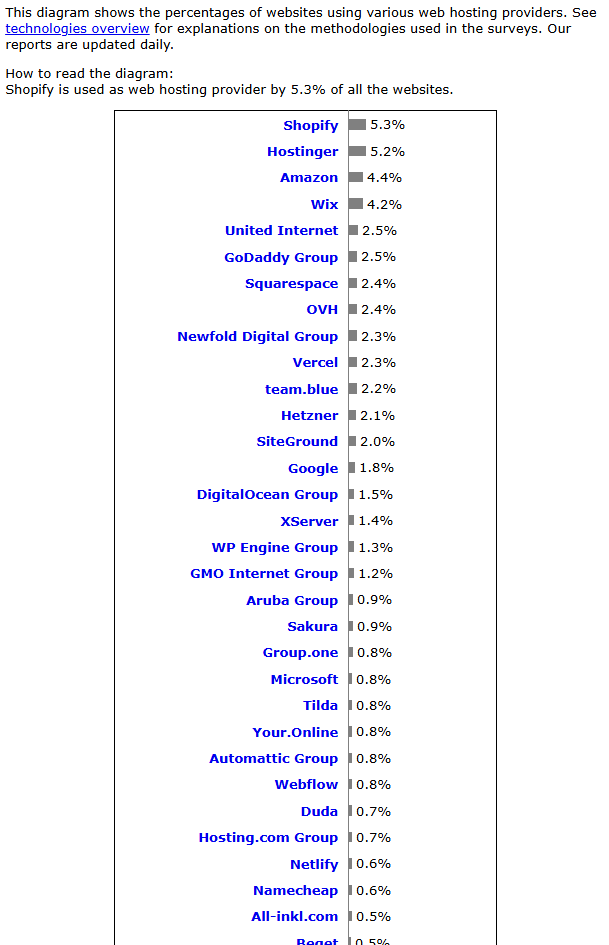
Hosting market share is usually measured by counting websites, not customers or revenue. W3Techs put the WP Engine Group at 1.3% of all websites on Oct 26, 2026, seventeenth in its list. That is below general hosts such as Hostinger (5.2%) and SiteGround (2.0%), and above Automattic's group (0.8%) and Kinsta (0.3%). WP Engine's own figures sound larger because they count different things.
| Signal | Figure | What it counts |
|---|---|---|
| W3Techs hosting share | WP Engine Group 1.3% of all websites (WP Engine brand 1.1%), 17th in the list | Websites hosted, from a daily web survey, dated Oct 26, 2026; not customers or revenue |
| Sites on the platform | “Join 1.5M+ sites that call WP Engine home” | WP Engine's own claim on its managed hosting page |
| Company reach | “serves and powers more than 5 million sites” | Company boilerplate in the Jan 7, 2026 press release; includes tools such as ACF, NitroPack and Local, so not the same as hosted sites |
| Visitor reach | “roughly 8% of people online visit a site powered by WP Engine” | Vendor claim on the About page about visitors, not market share |
| ACF plugin | 2+ million active installations, 4.5 out of 5 on WordPress.org | Installs of a free plugin WP Engine owns, not hosting customers |
| Team | over 1,000 people | About page, founded 2010 in Austin, Texas |
Where the lawsuit stands on Oct 27, 2026, and what it means for a customer.
In September 2024 Automattic, the company behind WordPress.com, pressed WP Engine to pay for a WordPress trademark license; TechCrunch reports that Automattic's chief executive demanded “8% of its monthly gross revenues”. When WP Engine refused, WordPress.org cut WP Engine off from its plugin and theme servers and later took over the listing of WP Engine's ACF plugin. WP Engine sued in October 2024. Two years on, the case is still open, and both sides have won and lost rounds.
| Date | What happened | Source |
|---|---|---|
| Sep 25, 2024 | WordPress.org blocks WP Engine from its servers; WP Engine later ships its own update path for plugins and themes on its platform | WP Engine blog timeline |
| Oct 2, 2024 | WP Engine sues Automattic and its CEO in federal court in California | WP Engine blog timeline |
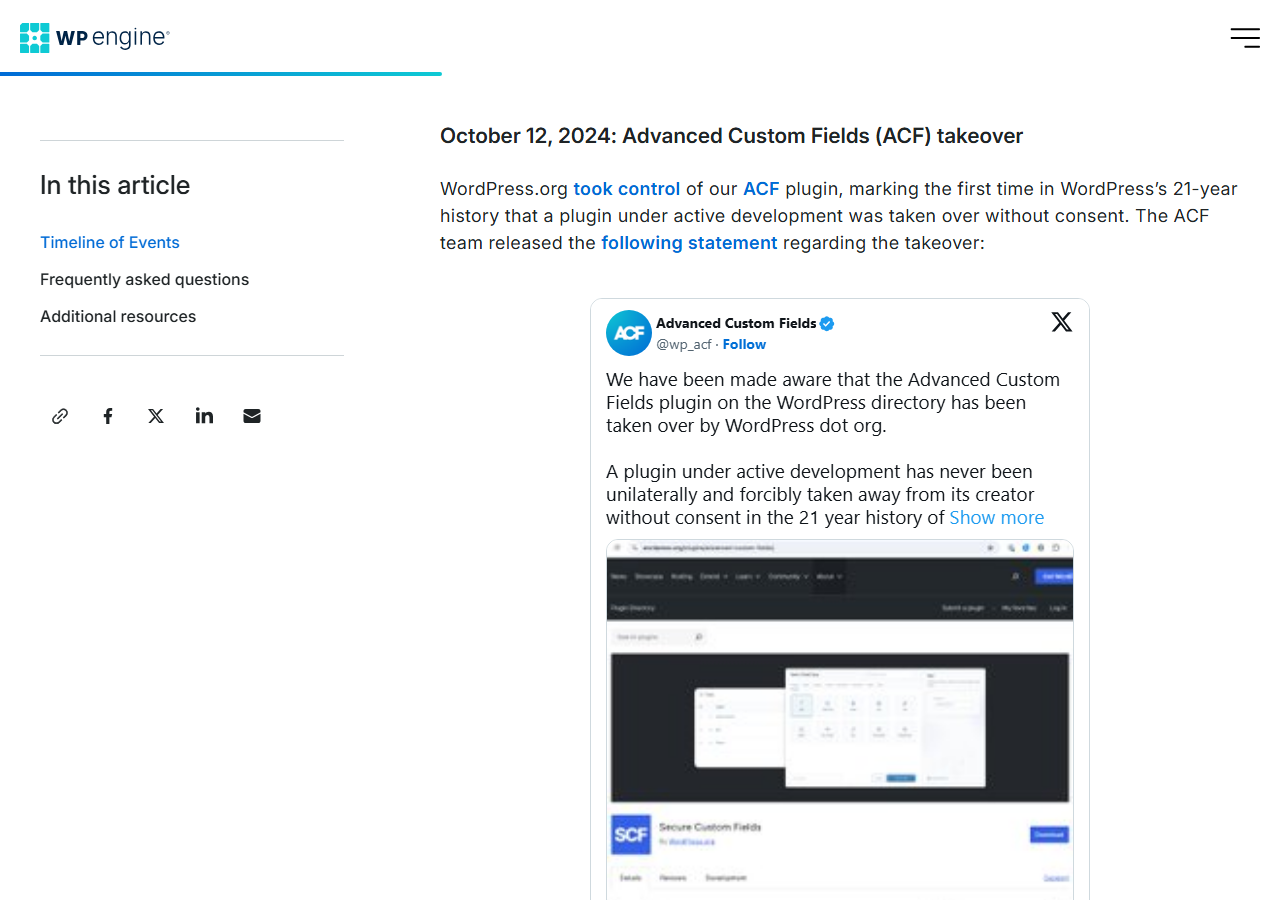
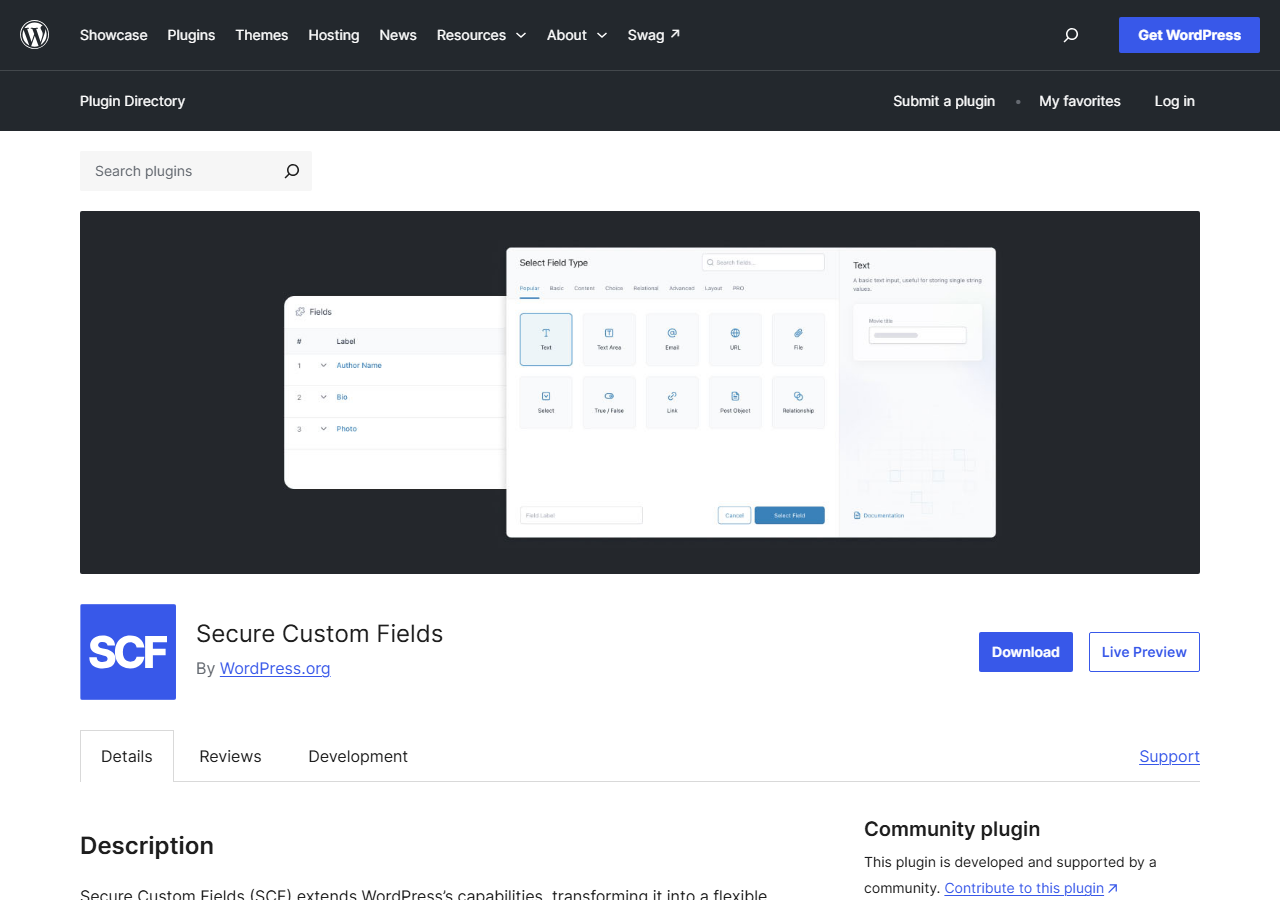
| Oct 12, 2024 | WordPress.org takes over the ACF plugin listing and offers a fork, Secure Custom Fields | WP Engine blog timeline; WordPress.org |
| Dec 10, 2024 | Preliminary injunction restores WP Engine's access to WordPress.org; ACF returns to WP Engine; the order runs until judgment | WP Engine blog; webhosting.today |
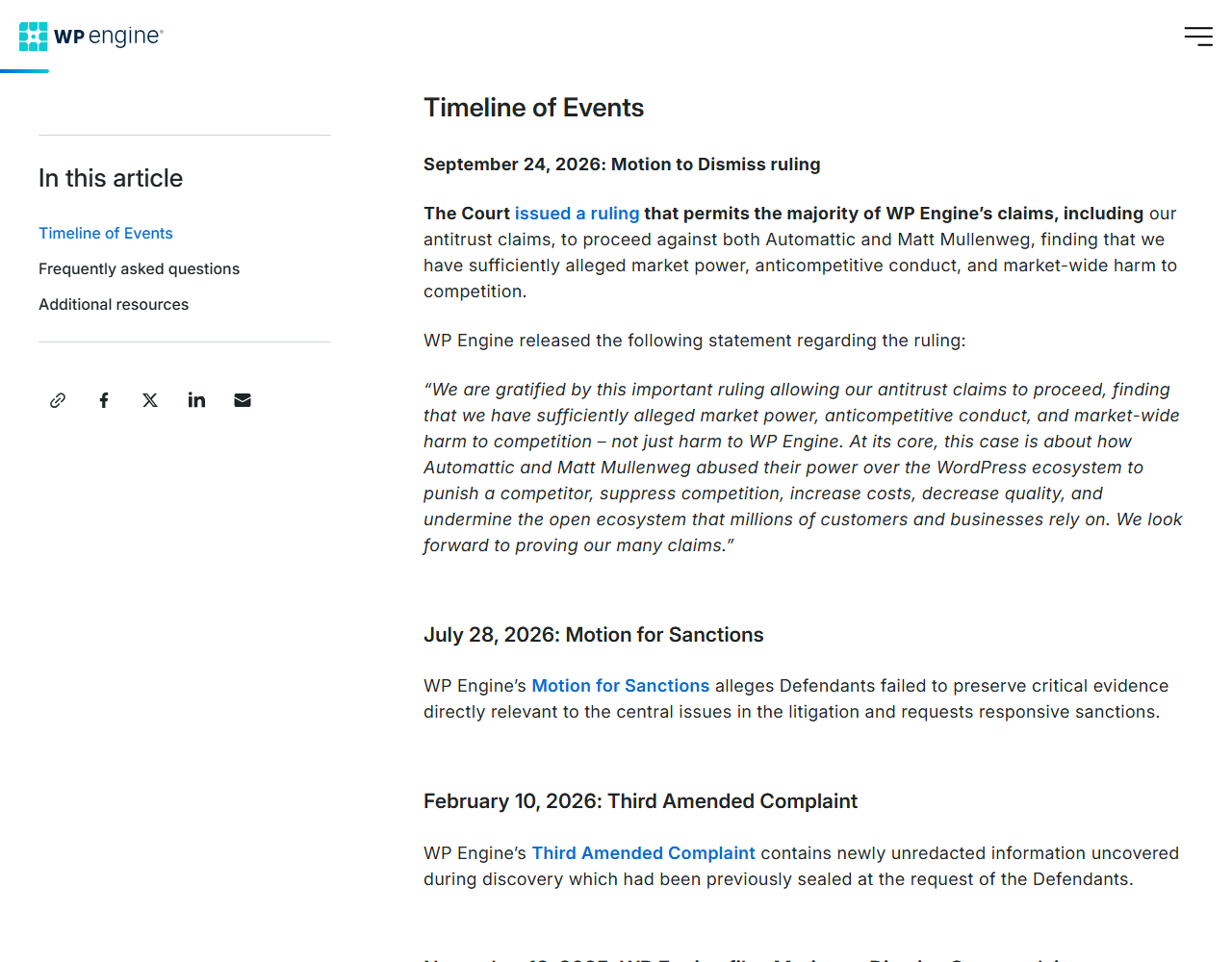
| Sep 12, 2025 | Court lets most of WP Engine's claims proceed, including interference, unfair competition and defamation | WP Engine blog; webhosting.today |
| Oct 2025 | Automattic, its CEO, WooCommerce and the WordPress Foundation file seven trademark counterclaims | webhosting.today; TechCrunch |
| Dec 2025 to Jan 2026 | A separate class action by two WP Engine customers against Automattic is dismissed in December 2025 and refiled in January 2026 | The Repository |
| Feb 10, 2026 | Third amended complaint, with newly unredacted material | WP Engine blog; TechCrunch |
| Jul 28, 2026 | WP Engine asks for sanctions over lost messages | WP Engine blog; webhosting.today |
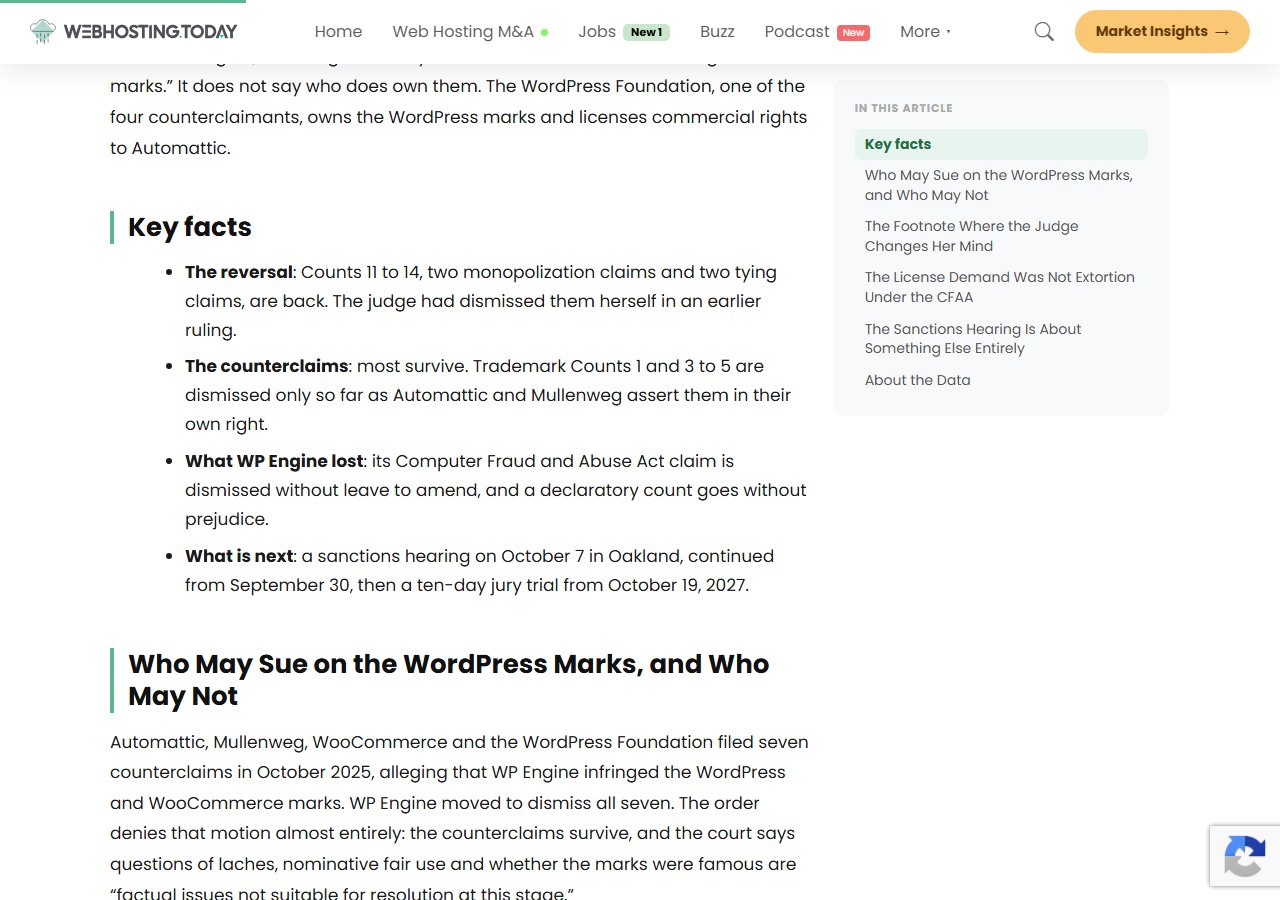
| Sep 24, 2026 | Court revives WP Engine's four antitrust claims, which it had dismissed in an earlier order, dismisses its computer-fraud claim for good, and lets most counterclaims continue | webhosting.today, from the court order; Search Engine Journal |
| Oct 7, 2026 | Sanctions hearing; the magistrate judge says he is inclined to deny; written order to follow | webhosting.today, Oct 13, 2026 |
| Oct 19, 2027 | Ten-day jury trial scheduled (according to reports of the Sep 24, 2026 order) | webhosting.today |
The latest ruling, on Sep 24, 2026, cut both ways. According to webhosting.today, which read the order, the court reversed itself on antitrust in a footnote: “The Court previously dismissed WPEngine’s antitrust claims and departs from its prior order, now finding WPEngine’s antitrust claims viable.” But it also dismissed WP Engine's claim that the royalty demand amounted to computer extortion, and most of Automattic's trademark counterclaims survive. WP Engine's own statement called it a win: “We are gratified by this important ruling allowing our antitrust claims to proceed”. A sanctions motion WP Engine filed over lost messages looks weaker: at the Oct 7 hearing the magistrate judge said he was inclined to deny it, and the court record reads “Matter submitted; written order to follow”.
What it means if you host with WP Engine
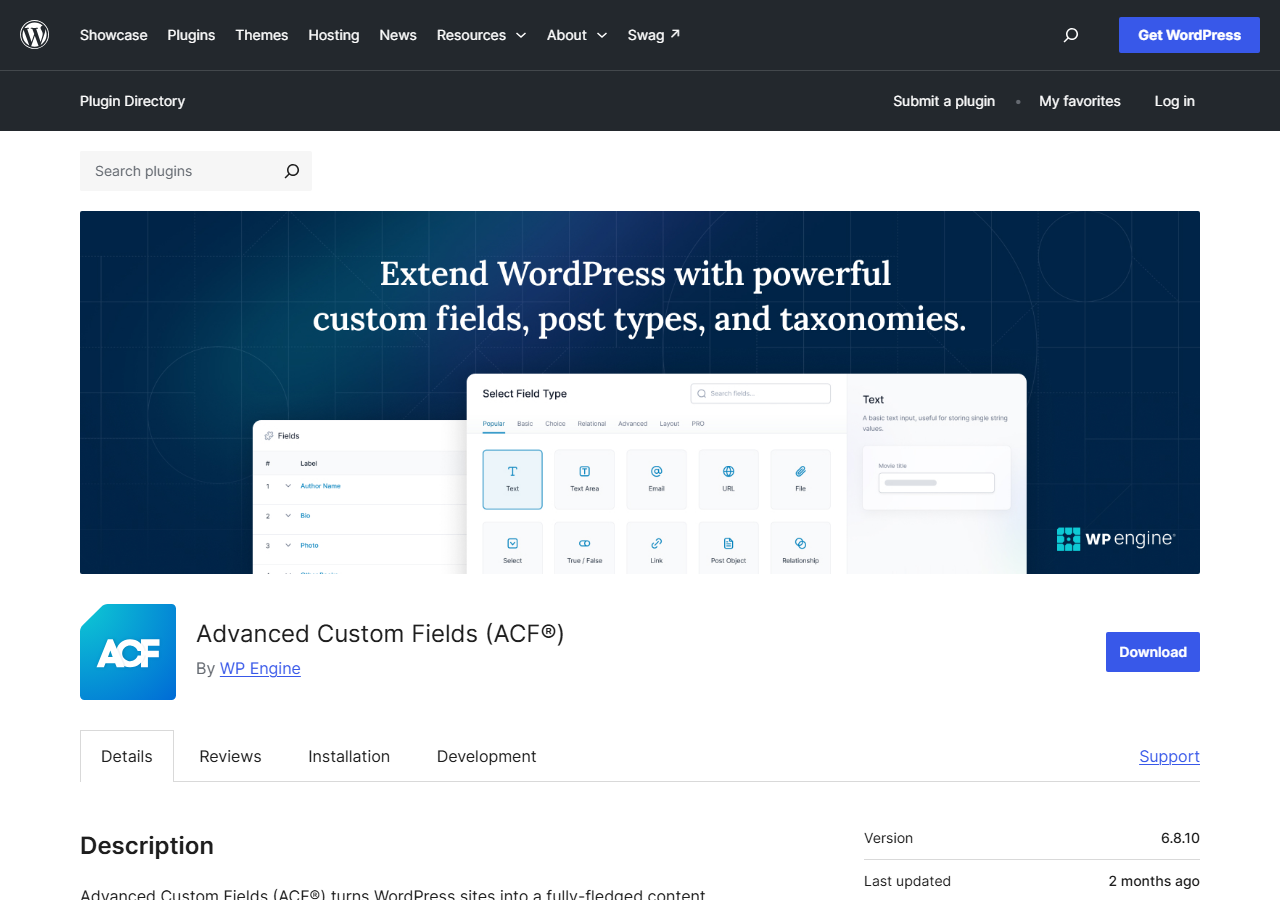
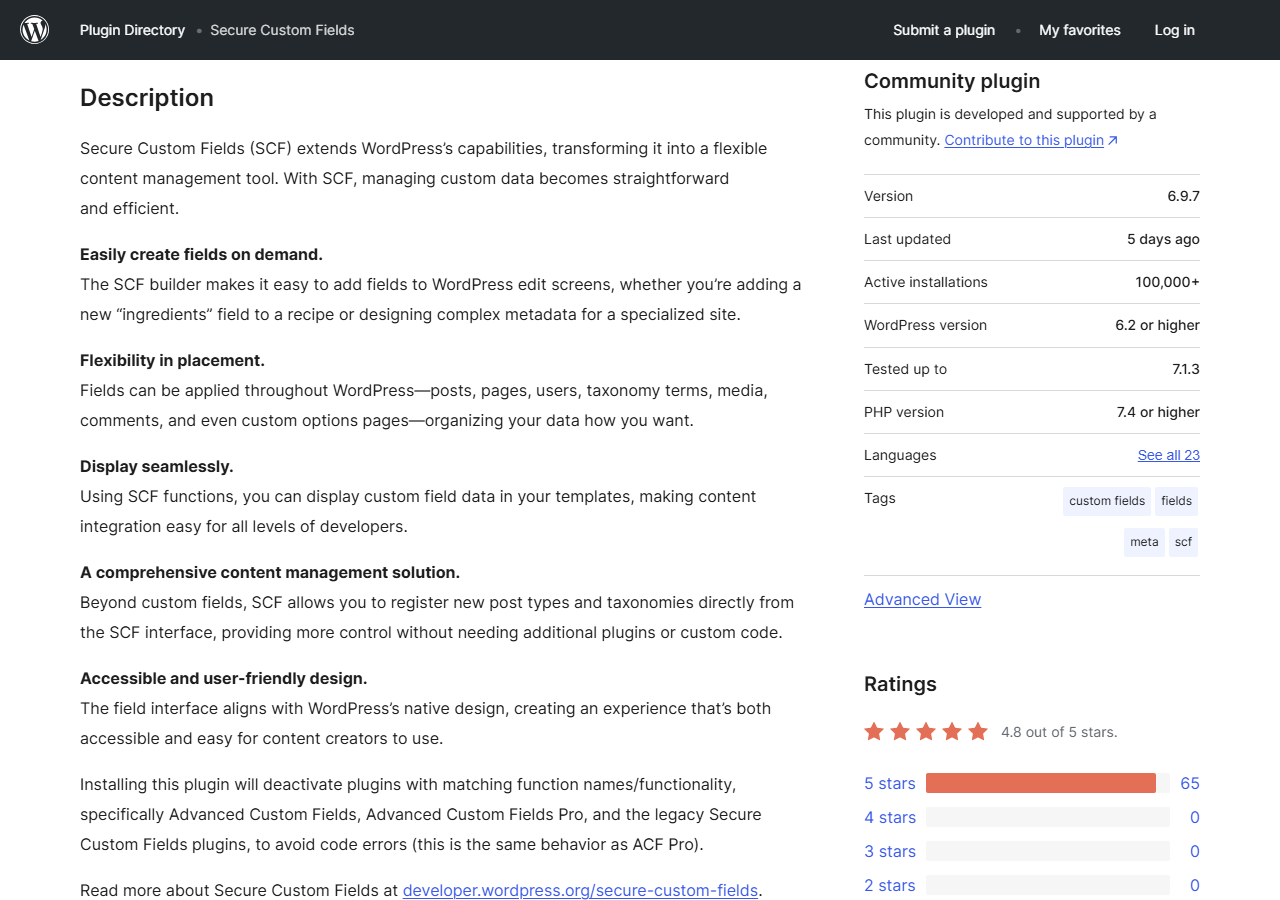
Day to day, less than it did in late 2024. The Dec 10, 2024 preliminary injunction restored access to WordPress.org and returned ACF to WP Engine, and webhosting.today reports it runs until judgment. WP Engine also built its own update channel during the block, and ACF's changelog on WordPress.org notes that “ACF Free now uses its own update mechanism from WP Engine servers”. The open risks are the trial in October 2027, the trademark counterclaims over how WP Engine uses the WordPress name, and the plain fact that the platform you pay for depends on an open-source project whose leaders are its opponents in court. If you use ACF, check which plugin you actually have: the WordPress.org fork, Secure Custom Fields, says that installing it “will deactivate plugins with matching function names/functionality, specifically Advanced Custom Fields, Advanced Custom Fields Pro”.
Little hosting talk, lots of lawsuit talk, and a European outage in October.
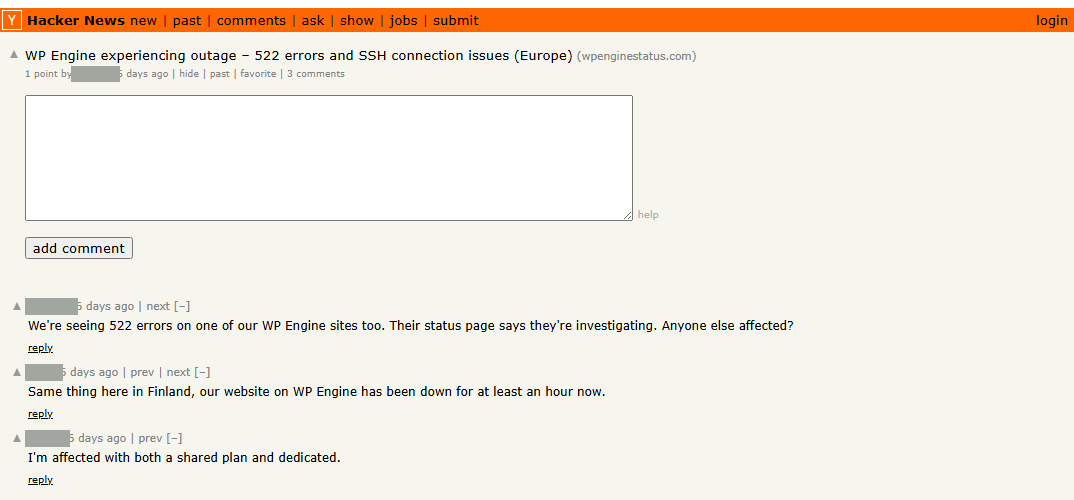
Most public discussion of WP Engine since 2025 is about the Automattic dispute and open-source ethics, not about hosting quality. On Hacker News, 20 stories and 160 comments mentioned “WP Engine” between Jan 1, 2025 and Oct 27, 2026. The handful that talk about the service itself point the same few ways: outages are noticed quickly, costs climb with traffic, and some customers dislike changes WP Engine makes to stock WordPress. We do not use scores from review platforms such as G2 or Capterra in this review. WP Engine's own reviews page shows three hand-picked quotes and notes that “Some reviews have been adjusted to improve their readability.”
“We're seeing 522 errors on one of our WP Engine sites too”
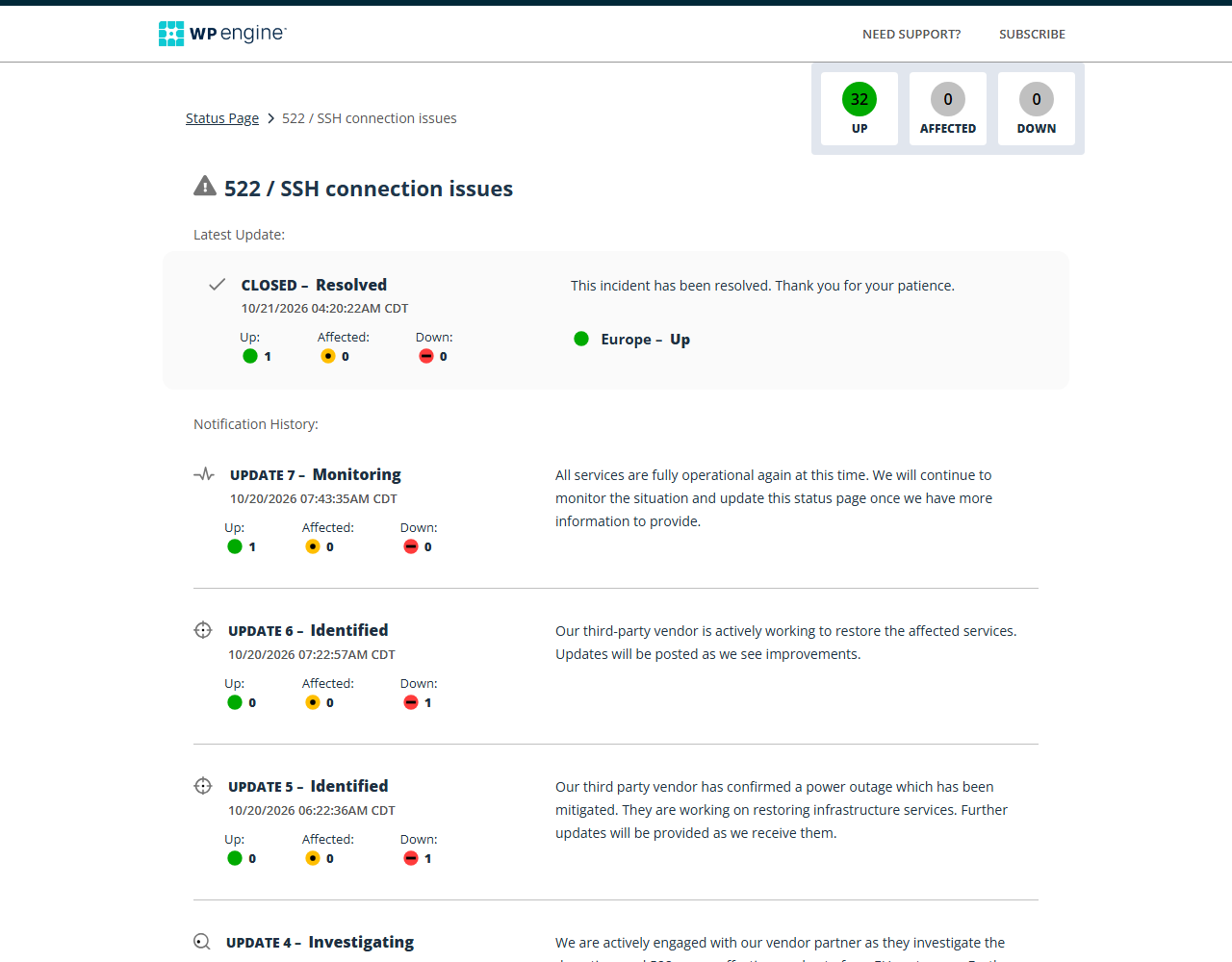
During the Oct 20 outage in Europe. A second comment from Finland reported the site down “for at least an hour now” (item 50162703).
“is still on PHP 8.4.26 a full 2.5 hours after the patch is publicly available”
On the day of two critical PHP fixes. Another commenter relayed WP Engine's reply that it had “enabled WAF rules for all customers using GES and AN” (item 50178027).
“WP Engine etc. cost a fortune - tens of thousands per year when you get a lot of traffic”
A cost complaint about managed hosts at high traffic, in a thread on static sites.
“As someone who's personally been bitten by this particular WP Engine misfeature”
About WP Engine turning off WordPress post revisions by default. Another commenter wrote of “repeated and ongoing issues with WP Engine as a hosting platform” (item 49635675).
“Especially if you're using something like WP Engine or Pantheon for hosting”
Arguing that WordPress plugin security is a solved problem on managed hosts.
“60-75% cheaper than WP Engine/Kinsta”
The author of a self-hosted WordPress setup on Google Cloud Run, comparing his own costs; a claim, not a measurement.
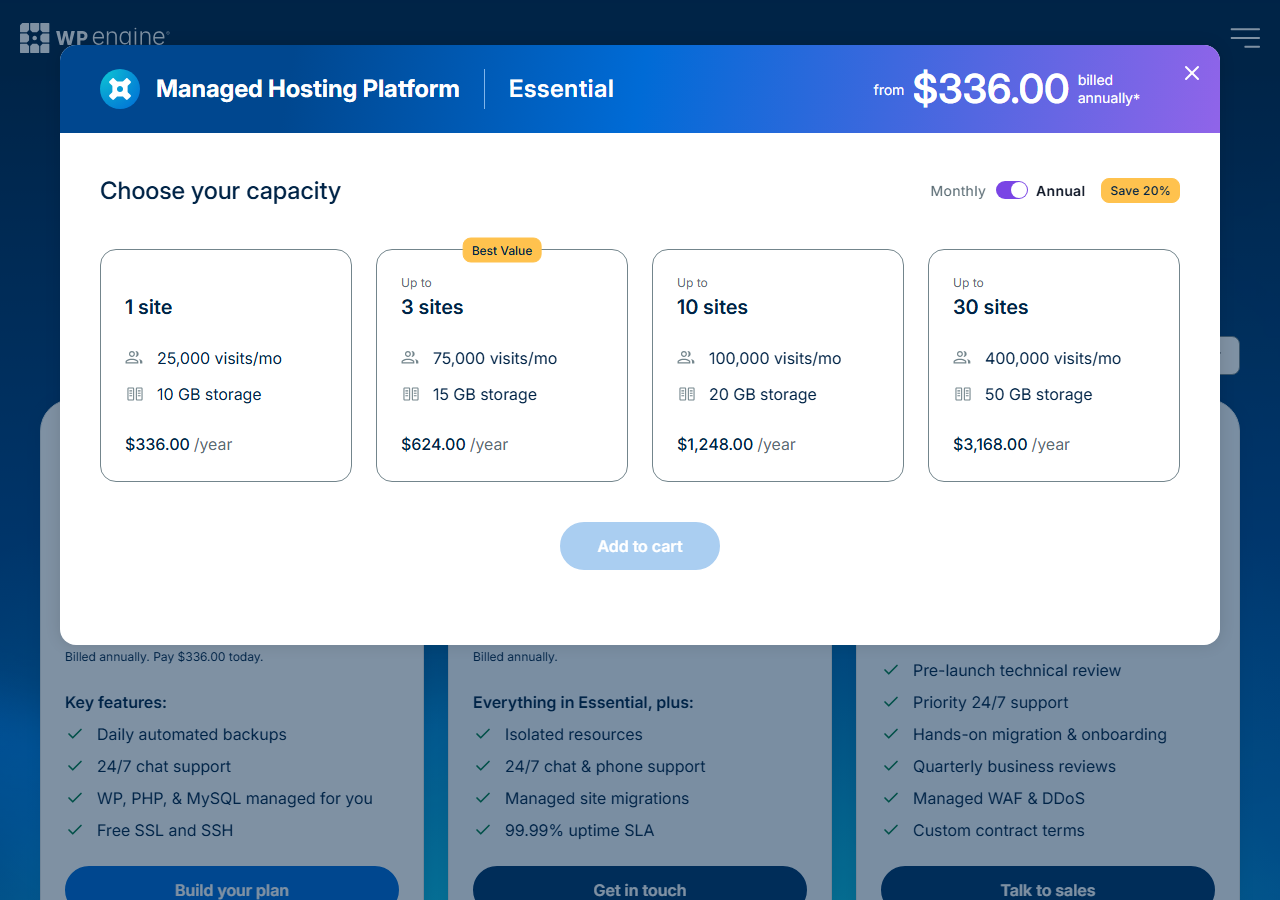
Essential from $35 a month, or $336 for the first year if you pay annually.
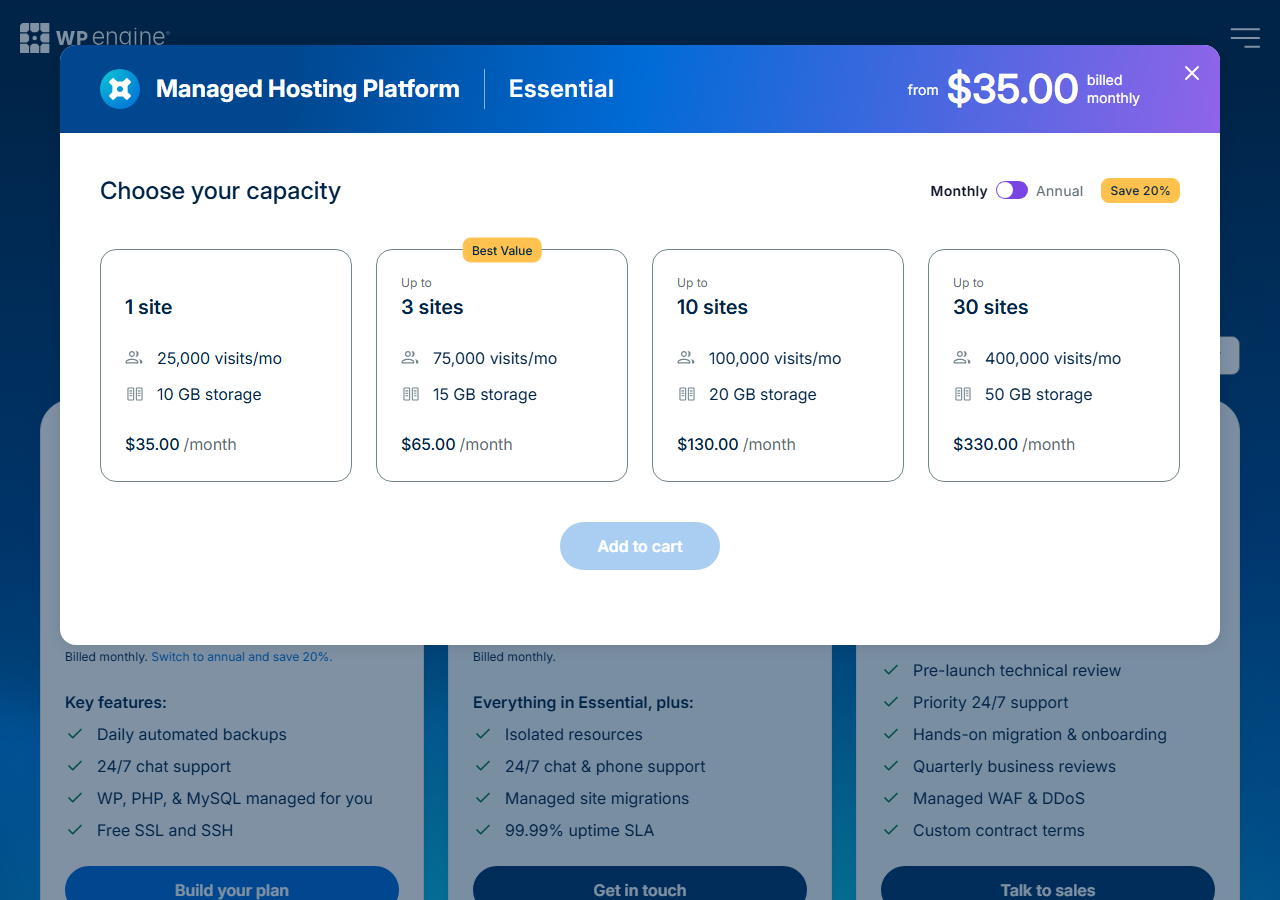
Since at least Sep 1, 2026, the date of the first archive copy that shows it, WP Engine has sold three plans. Essential is the self-serve plan, sold in four capacity tiers from 1 to 30 sites on shared resources. Business starts at $400 a month and adds isolated resources, phone support, managed migrations and the 99.99% uptime target. Enterprise is quoted. There is no free hosting plan; the free things are separate tools (Local, the free ACF plugin) and a free sandbox for its decoupled WordPress platform. Prices below are from wpengine.com/plans on Oct 27, 2026, in US dollars before tax.
a month, monthly billing; or $336 for the first year on annual billing, then $420 a year at the regular price
- 25,000 visits, 10 GB, 75 GB bandwidth
- Daily backups, staging, 24/7 chat
a month; or $624 the first year, $780 a year regular. WP Engine marks this tier Best Value
- 75,000 visits, 15 GB, 150 GB
- Chat support only
a month, billed annually ($4,800 a year)
- 400,000 to 800,000 visits, 50 GB to 2 TB
- Isolated resources, phone support, 99.99% SLA
custom contract terms
- 800,000+ visits, 2 TB+
- Dedicated account team, managed WAF and DDoS
Swipe sideways to see the whole table.
| Essential tier | Visits / storage / bandwidth | Monthly billing | Annual, first year | Annual, regular |
|---|---|---|---|---|
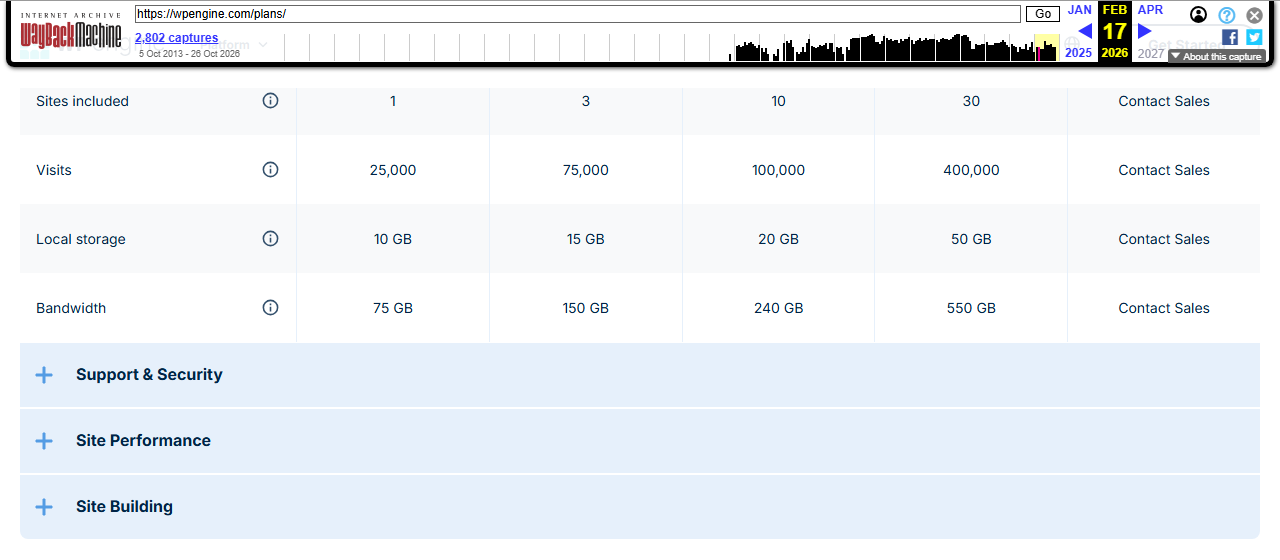
| 1 site | 25,000 / 10 GB / 75 GB | $35 a month | $336 ($28 a month) | $420 |
| Up to 3 sites | 75,000 / 15 GB / 150 GB | $65 a month | $624 ($52 a month) | $780 |
| Up to 10 sites | 100,000 / 20 GB / 240 GB | $130 a month | $1,248 ($104 a month) | $1,560 |
| Up to 30 sites | 400,000 / 50 GB / 550 GB | $330 a month | $3,168 ($264 a month) | $3,960 |
Source: wpengine.com/plans, Oct 27, 2026. The first-year column includes the 20% coupon the page applies automatically to annual Essential plans; the regular annual price is twelve times the monthly price, so after year one annual billing saves nothing over monthly billing at today's list prices.
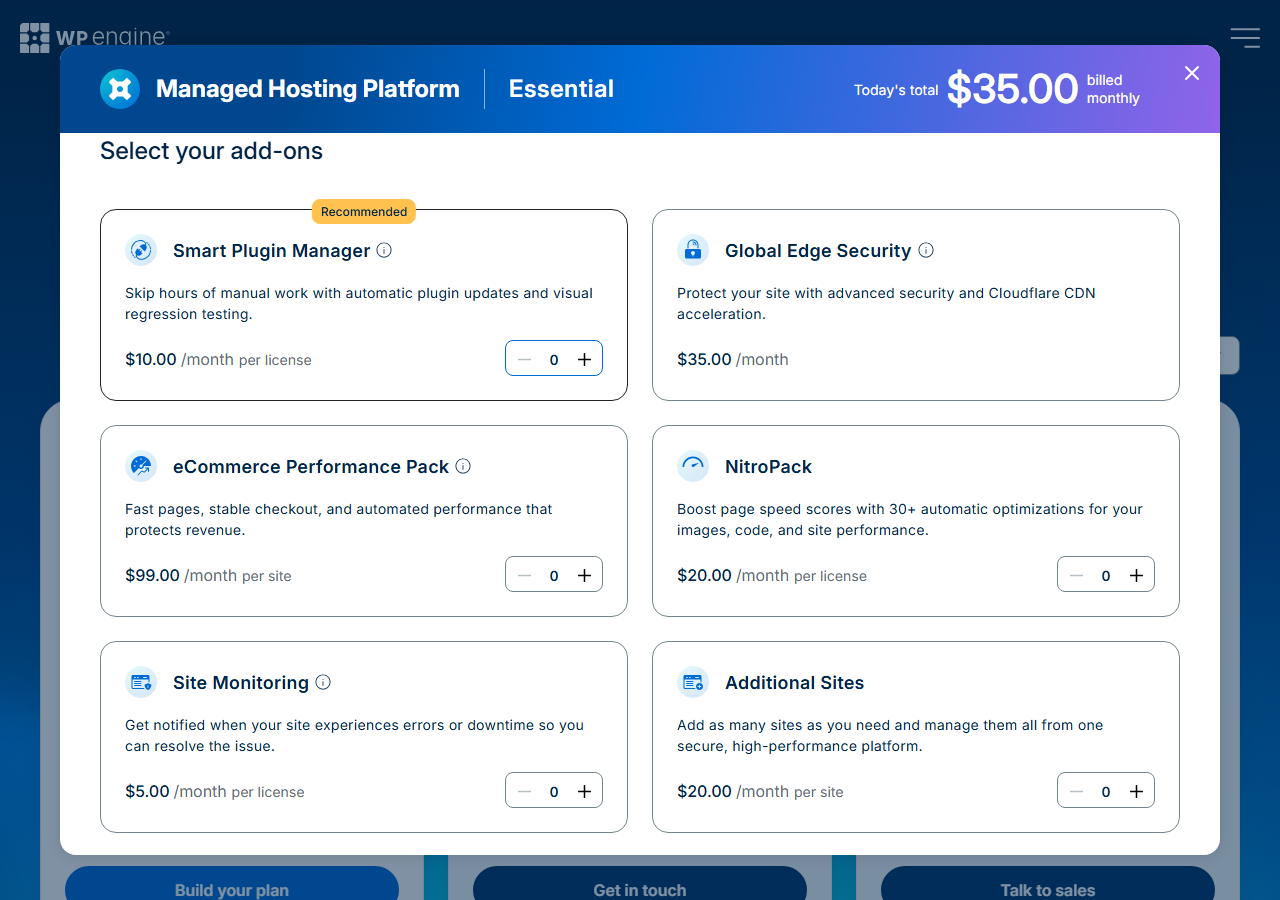
| Add-on | Price | Included on Business? |
|---|---|---|
| Smart Plugin Manager (automatic plugin updates with visual regression testing) | $10 a month per license | 1 license |
| Global Edge Security (managed WAF, advanced DDoS, Cloudflare CDN and SSL) | $35 a month on 1 site; $50, $65 or $110 on 3, 10 or 30 sites | Add-on for all plans |
| NitroPack (front-end code and image optimization) | $20 a month per license | 1 license |
| Site Monitoring | $5 a month per license | 1 license |
| eCommerce Performance Pack | $99 a month per site | Not stated |
| Additional site | $20 a month per site | Not stated |
What one site really costs over three years, and where the add-ons take you.
Two things shape a WP Engine bill. The 20% first-year coupon disappears at renewal, and the extras many owners want (a managed firewall, automatic plugin updates, uptime alerts) are add-ons on Essential. The Terms add a third: renewals are at “then-current rates”, as long as WP Engine tells you about an increase before your opt-out date, so the year-two figures below assume today's list prices hold.
| Setup (annual billing) | Year one | Year two at today's list prices |
|---|---|---|
| 1 site, Essential only | $336 | $420 |
| 1 site + Global Edge Security + Smart Plugin Manager | $336 + $420 + $120 = $876 | $420 + $420 + $120 = $960 |
| 3 client sites + Smart Plugin Manager on each | $624 + $360 = $984 | $780 + $360 = $1,140 |
| 1 WooCommerce store + eCommerce Performance Pack | $336 + $1,188 = $1,524 | $420 + $1,188 = $1,608 |
| Business plan | $4,800 | $4,800 (at then-current rates) |
Annual means annual: the Terms on renewals, cancellations and backups.
WP Engine's Terms of Service were last updated on Jan 1, 2026, and changes take effect 30 days after they are posted. They read like a business contract, not a consumer plan, and several rules matter more than any feature on the plans page.
| Rule | Exact wording | What it means |
|---|---|---|
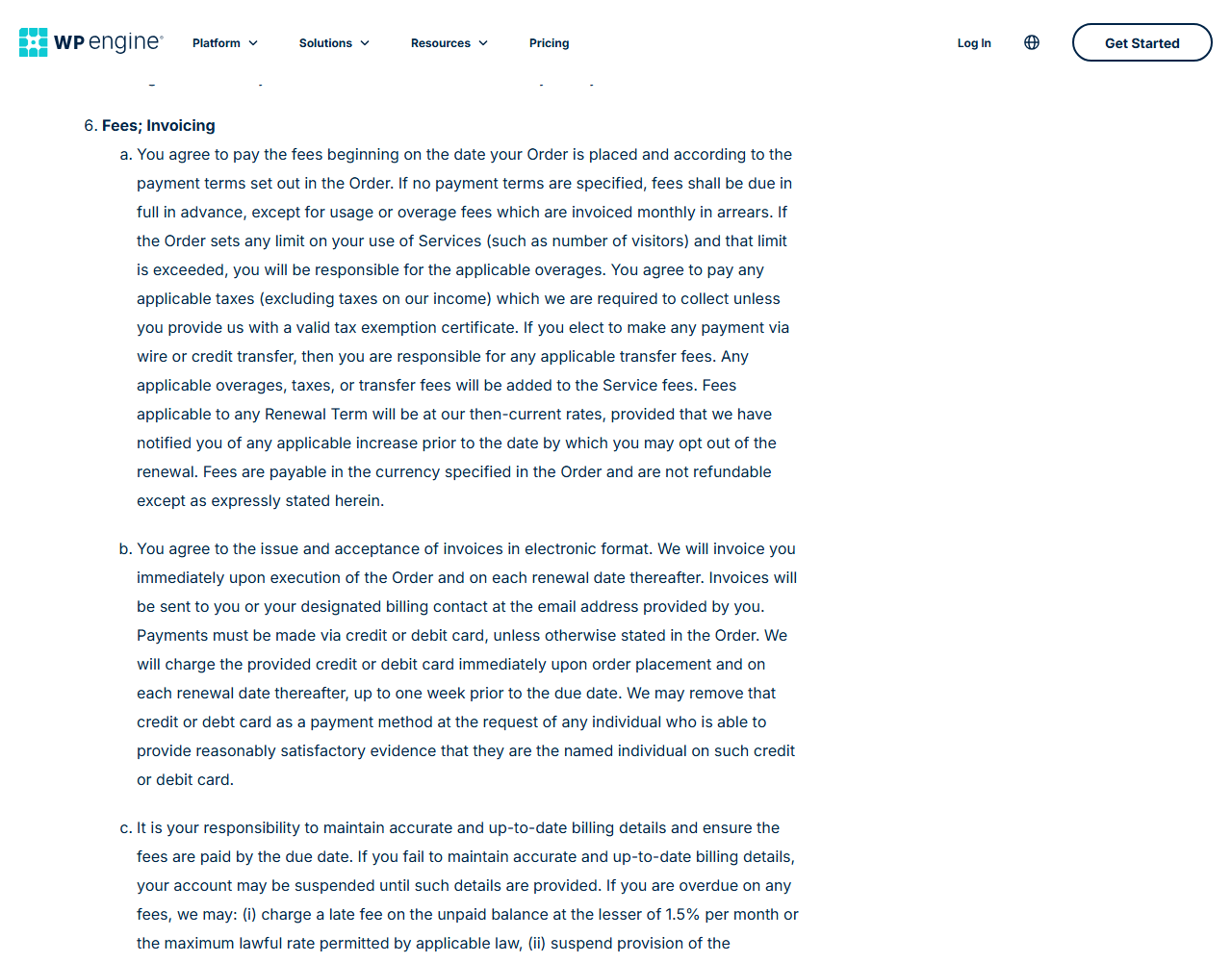
| Renewal price Terms 6(a) | “Fees applicable to any Renewal Term will be at our then-current rates, provided that we have notified you of any applicable increase prior to the date by which you may opt out of the renewal” | The $336 first year is not locked in; watch for a price notice before your opt-out date |
| Refunds Terms 6(a) | “are not refundable except as expressly stated herein” | No general refund right; the 60-day guarantee left the plans page in early 2026 |
| Auto-renewal Terms 7(a) | “unless a Party provides notification of its intent not to renew no later than 30 days prior to the expiration of the active term” | Diary the date 30 days before renewal; the FAQ adds that cancellations go through a cancellation form |
| Leaving early Terms 7(b) | “all remaining fees payable under the Agreement will immediately become due” | On an annual plan, leaving in month three still costs the full year |
| Late payment Terms 6(c) | “the lesser of 1.5% per month or the maximum lawful rate permitted by applicable law” | Plus possible suspension; cards are charged up to a week before the due date |
| If WP Engine ends it Terms 7(c) | “If we terminate for convenience, we will provide you with a prorated refund of any unused fees paid annually in advance” | WP Engine may end the contract on 30 days' notice |
| After termination Terms 7(d) | “it is your responsibility to maintain offline backups of your site at all times” | No migration help once the account is closed |
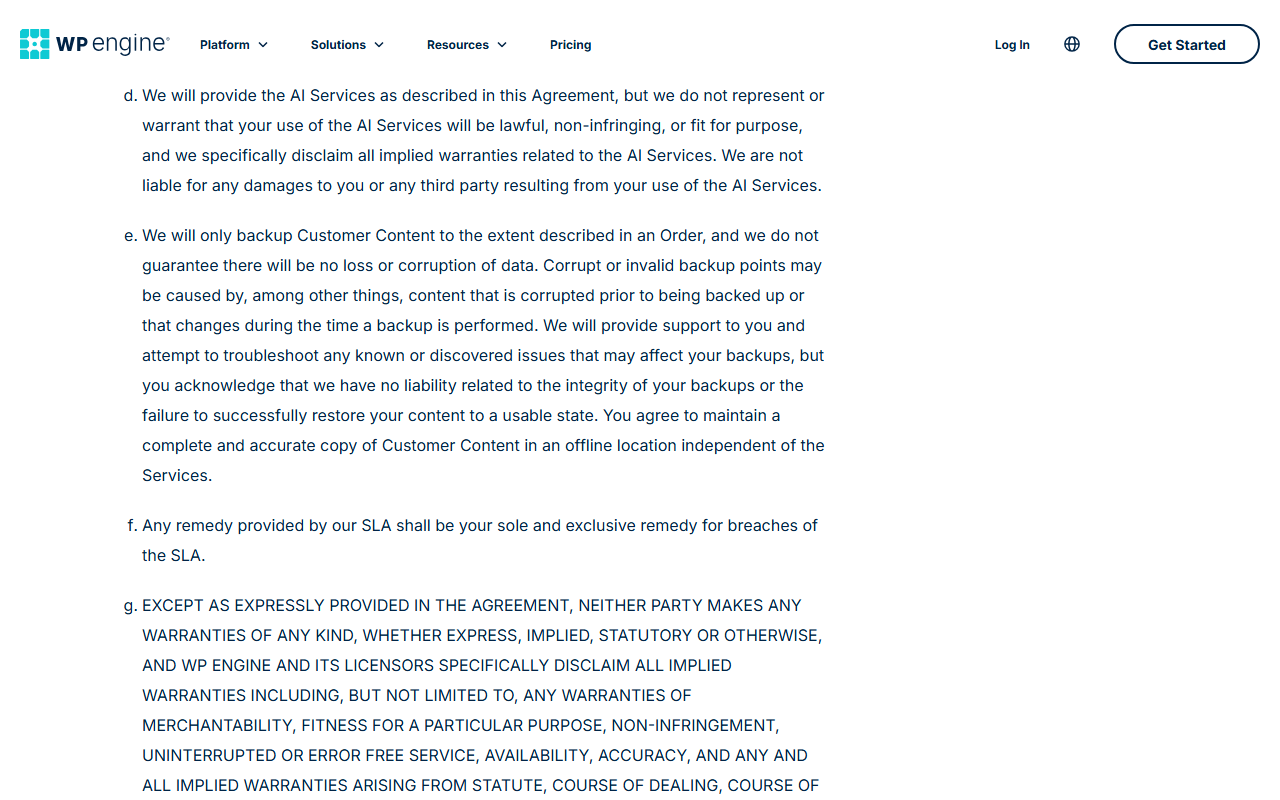
| Backups Terms 11(e) | “You agree to maintain a complete and accurate copy of Customer Content in an offline location independent of the Services” | Keep your own copy even though WP Engine backs up daily |
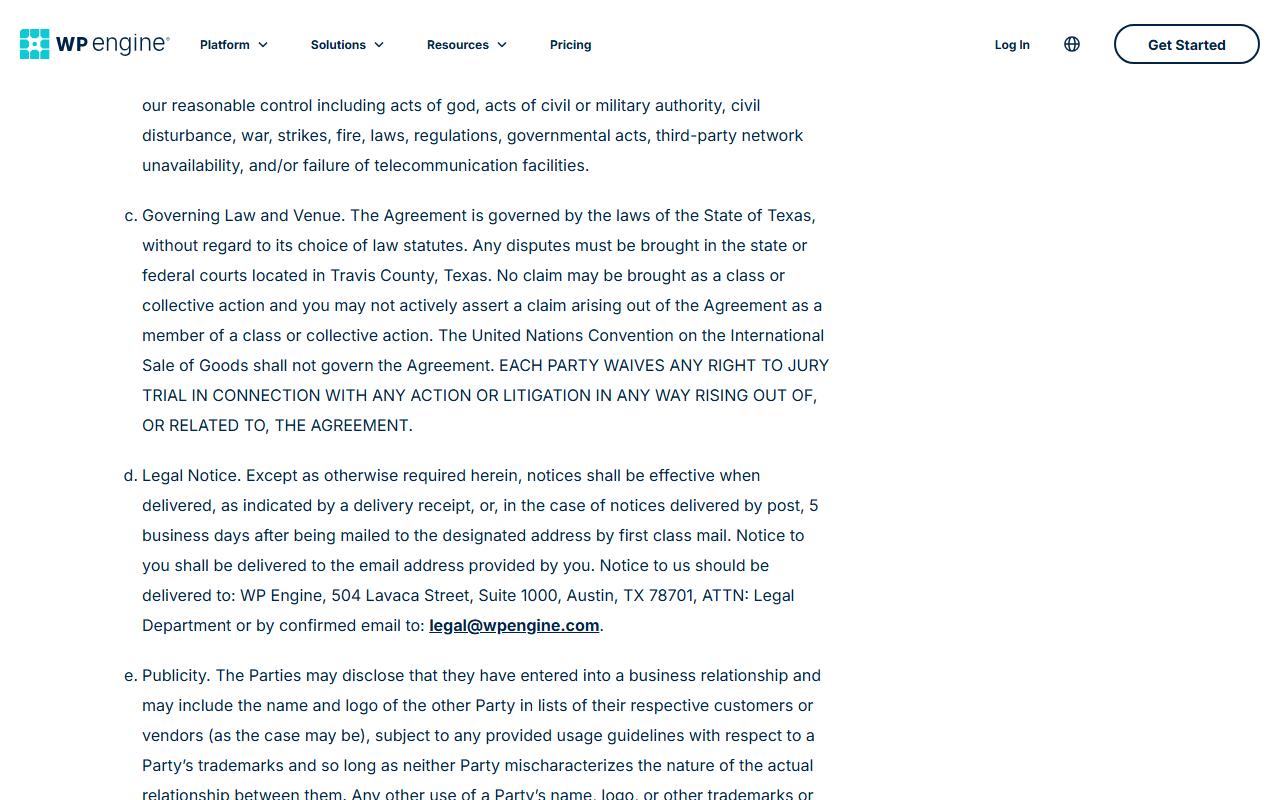
| Disputes Terms 14(c) | “No claim may be brought as a class or collective action” | Texas law, courts in Travis County, jury trial waived |
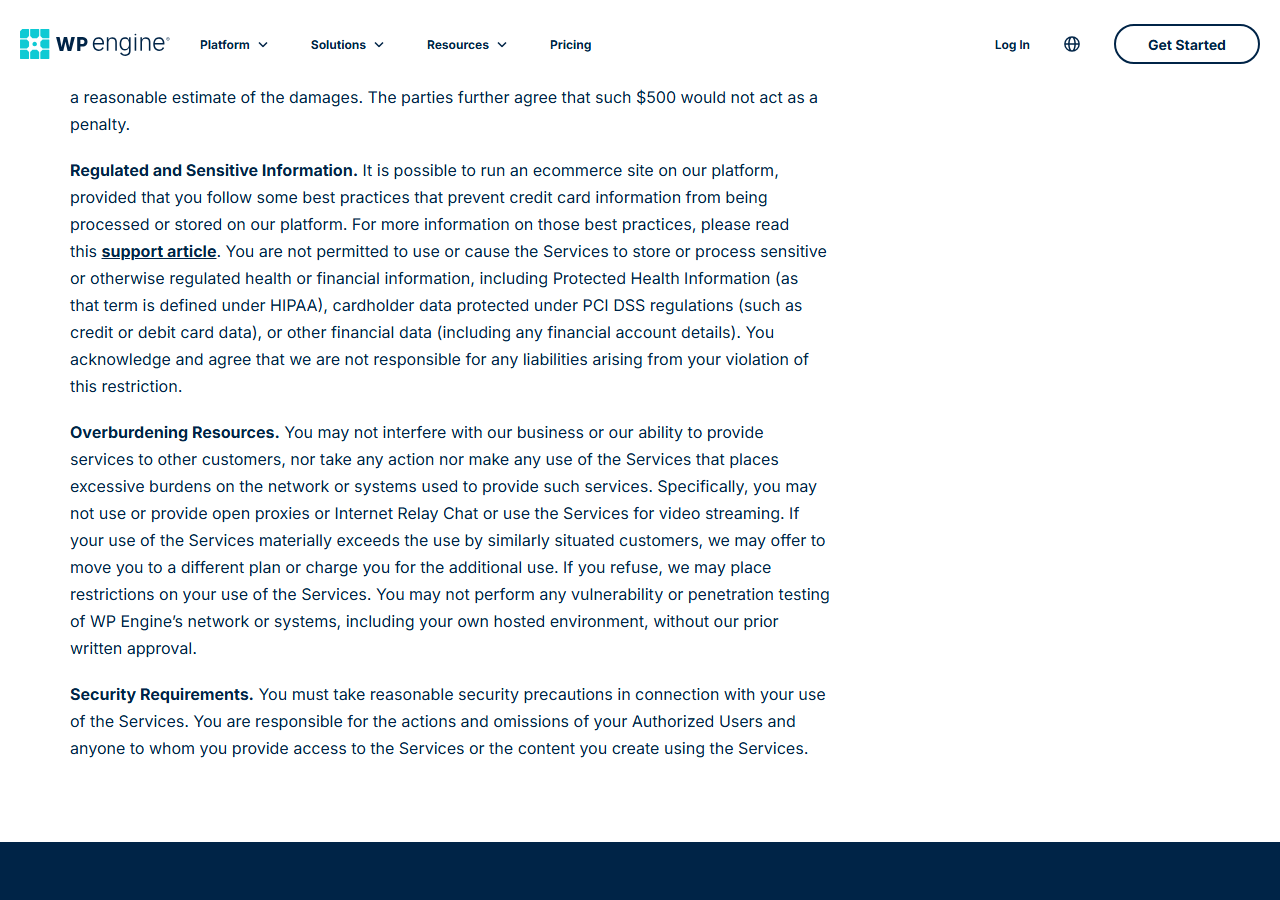
| Card data and health data Acceptable Use Policy | “You are not permitted to use or cause the Services to store or process sensitive or otherwise regulated health or financial information” | Stores must keep card data off WP Engine (use an off-site payment gateway); no HIPAA data |
| Spam Acceptable Use Policy | “a $500 charge per violation will be assessed as a reasonable estimate of the damages” | Do not send bulk mail from your site |
Quoted from wpengine.com/legal/terms-of-service (updated Jan 1, 2026) and wpengine.com/legal/aup (updated Feb 5, 2019), read on Oct 27, 2026. Section numbers follow the numbered list on the Terms page.
Six places where WP Engine's own pages tell different stories.
Marketing pages describe the best case across all plans; the comparison table and legal pages describe what a given plan includes. When they differ, trust the comparison table, the Terms and the SLA, and ask sales to confirm in writing.
| Topic | One WP Engine page says | Another says |
|---|---|---|
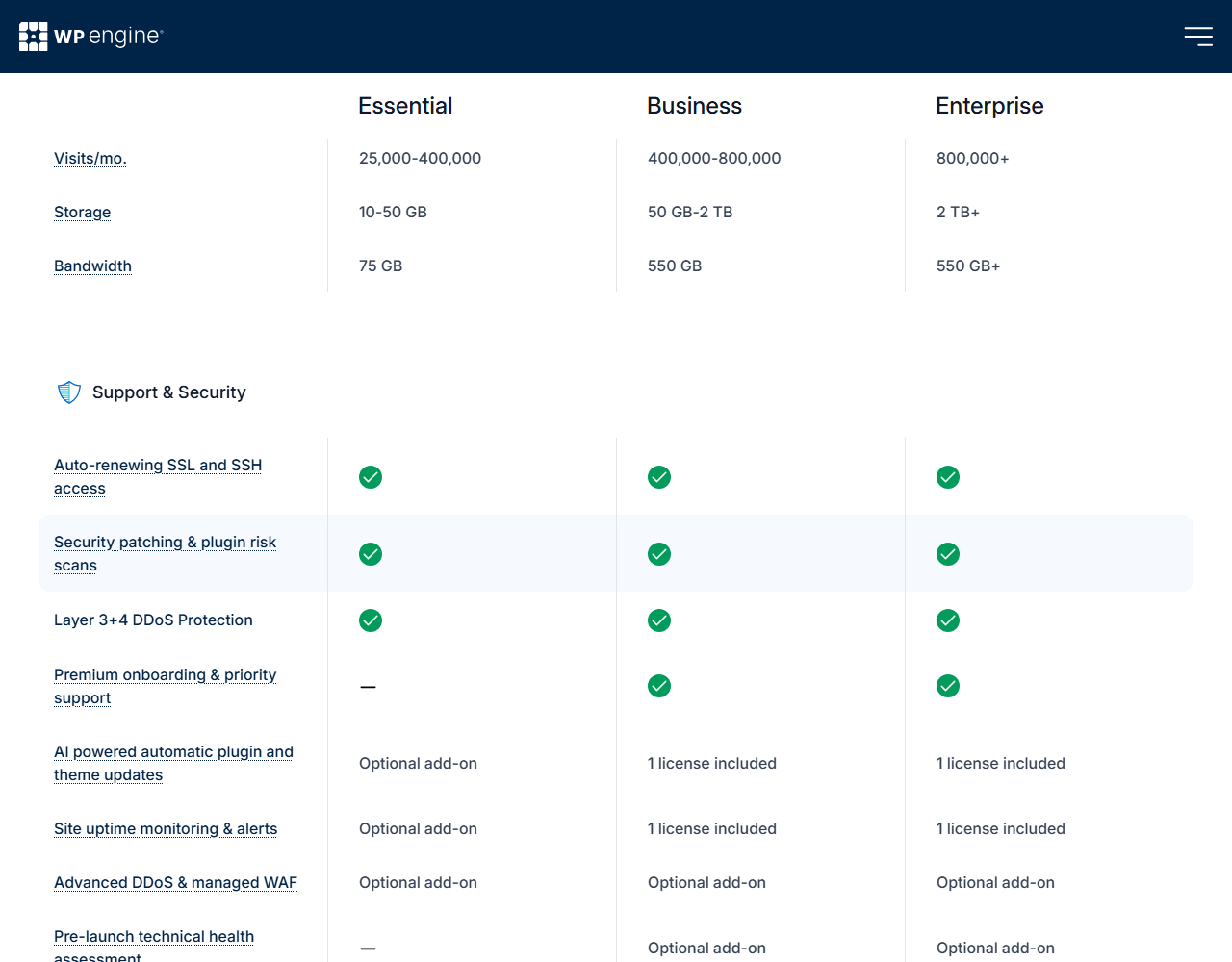
| Firewall | Managed hosting page: “Managed WAF, DDoS protection, SOC 2 Type II, and ISO 27001 come standard.” | Plans comparison: Advanced DDoS and managed WAF is an optional add-on for Essential, Business and Enterprise; Layer 3+4 DDoS is included |
| Uptime target | Managed hosting page: “up to an 99.99% enhanced uptime SLA” | Plans comparison: 99.99% SLA not included on Essential; the SLA page sets 99.95% as the standard target |
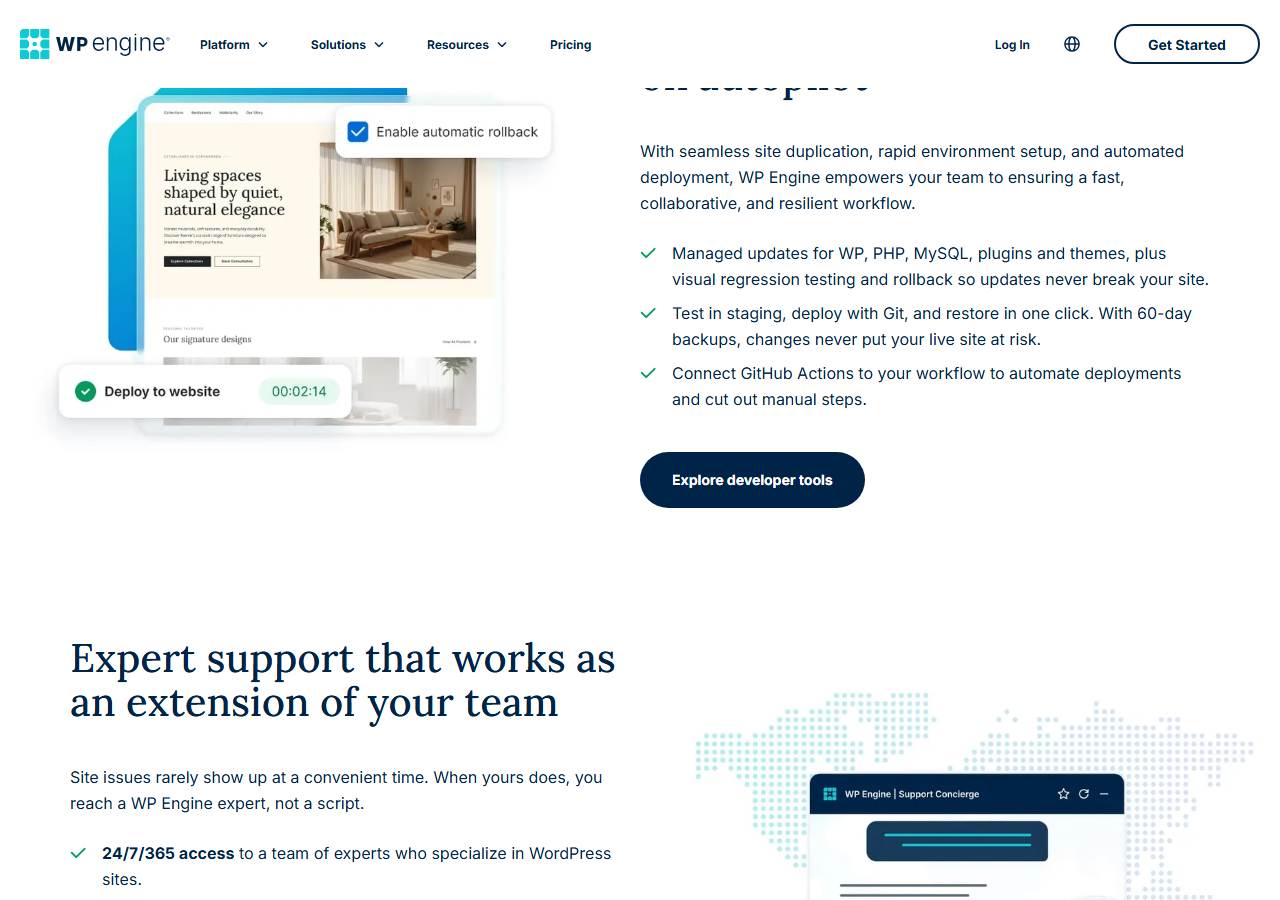
| Backup retention | Managed hosting page: “With 60-day backups, changes never put your live site at risk.” | Plans comparison: “no less than 30 days and no longer than 60 days”; help center: “WP Engine stores 30 days worth of checkpoints” |
| Git deployments | Managed hosting page: “Test in staging, deploy with Git, and restore in one click.” | Plans comparison: Git-based CI/CD workflows not included on Essential |
| Size of the platform | “Join 1.5M+ sites that call WP Engine home” | Press boilerplate, Jan 7, 2026: “serves and powers more than 5 million sites” |
| Plan names | Plans page: Essential tiers of 1, 3, 10 and 30 sites | FAQ overage answer: Startup, Professional, Growth and Scale |
Is WP Engine right for you?
What Essential actually includes, row by row.
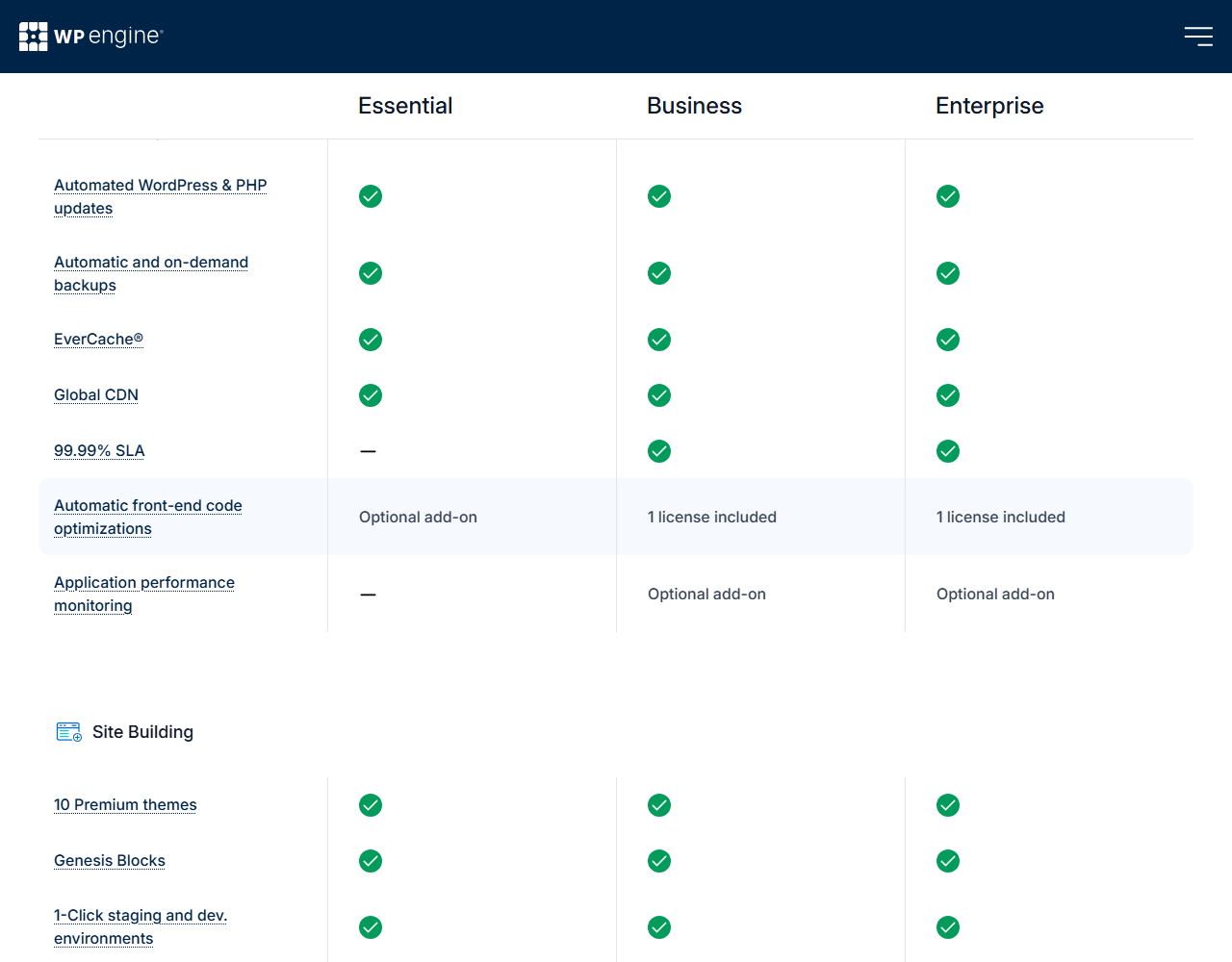
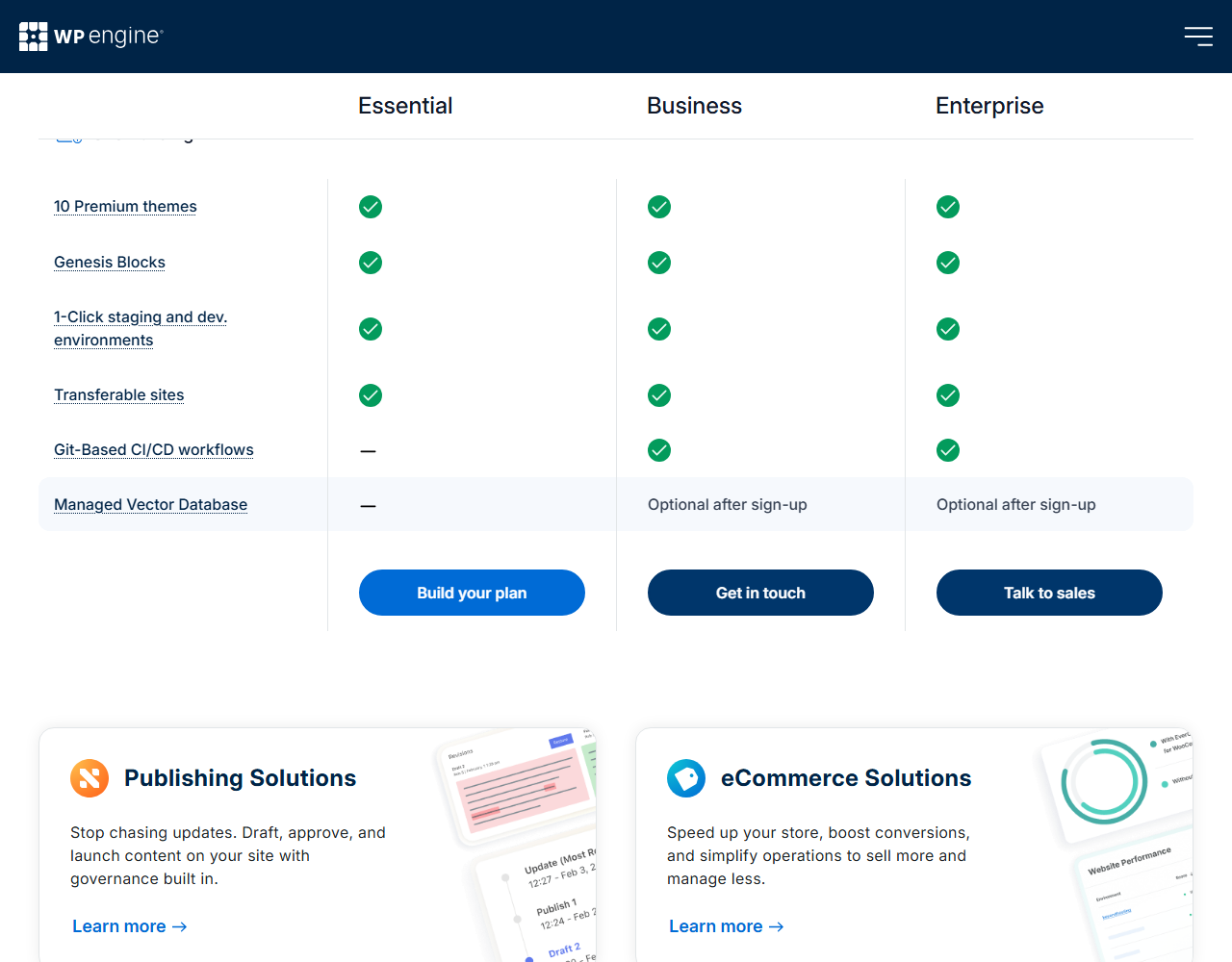
The comparison table on the plans page is the most precise description of the product. On Essential you get the managed basics: SSL that renews itself, SSH, security patching and plugin risk scans, Layer 3 and 4 DDoS protection, automated WordPress and PHP updates, automatic and on-demand backups, EverCache, the global CDN, ten premium themes, Genesis Blocks, one-click staging and development environments, and transferable sites. You do not get isolated resources (Essential is shared), the 99.99% uptime target, premium onboarding or Git-based CI/CD; plugin auto-updates, uptime monitoring, front-end optimization and the managed firewall are add-ons.
Backups and restores
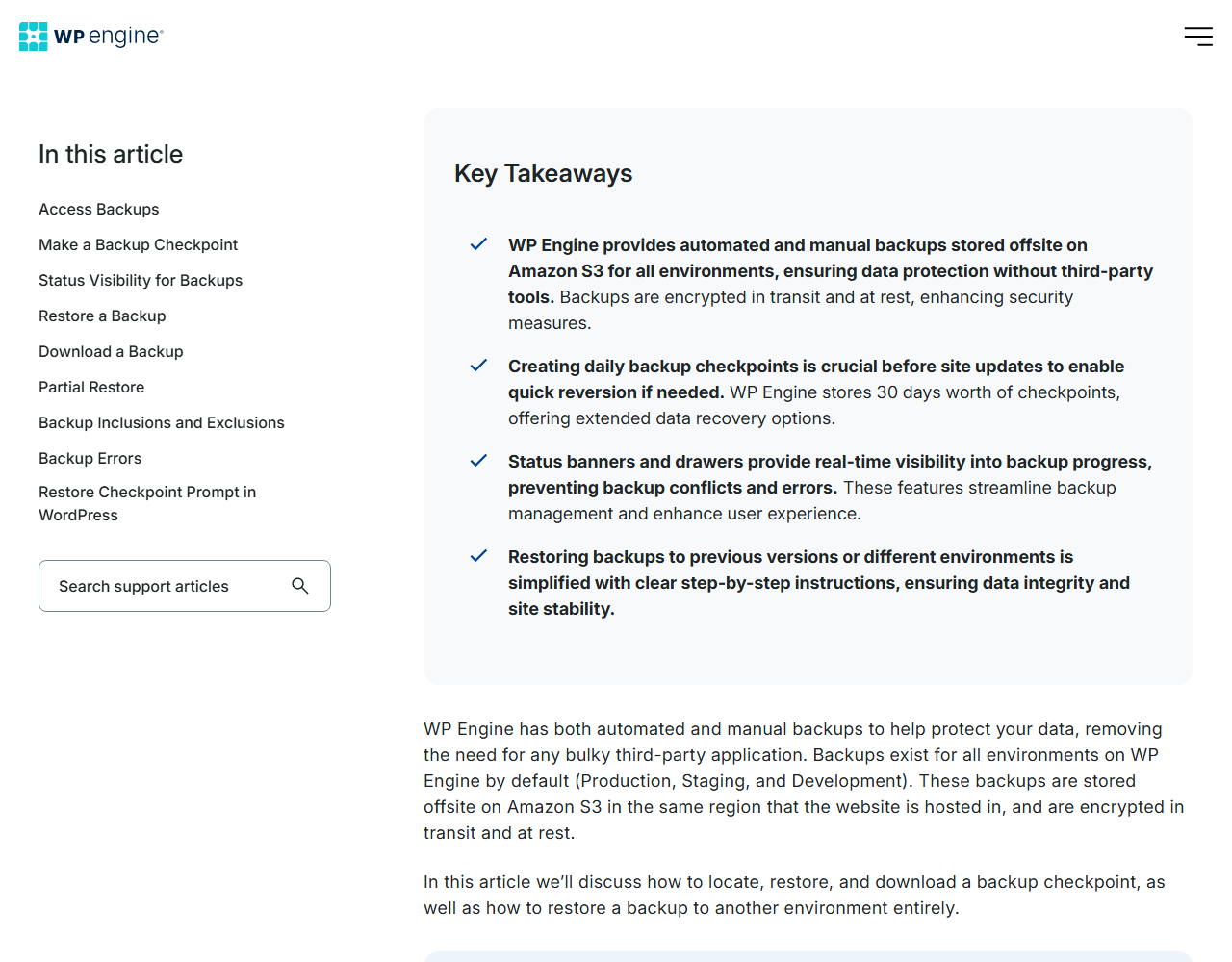
WP Engine's help center says backups exist for every environment and are “stored offsite on Amazon S3 in the same region that the website is hosted in, and are encrypted in transit and at rest”, and that “WP Engine stores 30 days worth of checkpoints”. You can make a checkpoint before an update, restore a whole site or part of it, restore into another environment, or download a copy. The plans comparison promises retention of “no less than 30 days and no longer than 60 days”. Keep your own copy anyway; the Terms require it.
From your laptop to the live site without breaking it.
The workflow WP Engine is built around is simple: change things on a copy, check them, then promote the copy. Local handles the laptop end, each site's development and staging environments handle the middle, and backup checkpoints are the safety net. The human step that matters is number 4: on Essential nobody checks your staging copy for you unless you pay for Smart Plugin Manager's visual regression tests.
The part of WP Engine many developers use without hosting there.
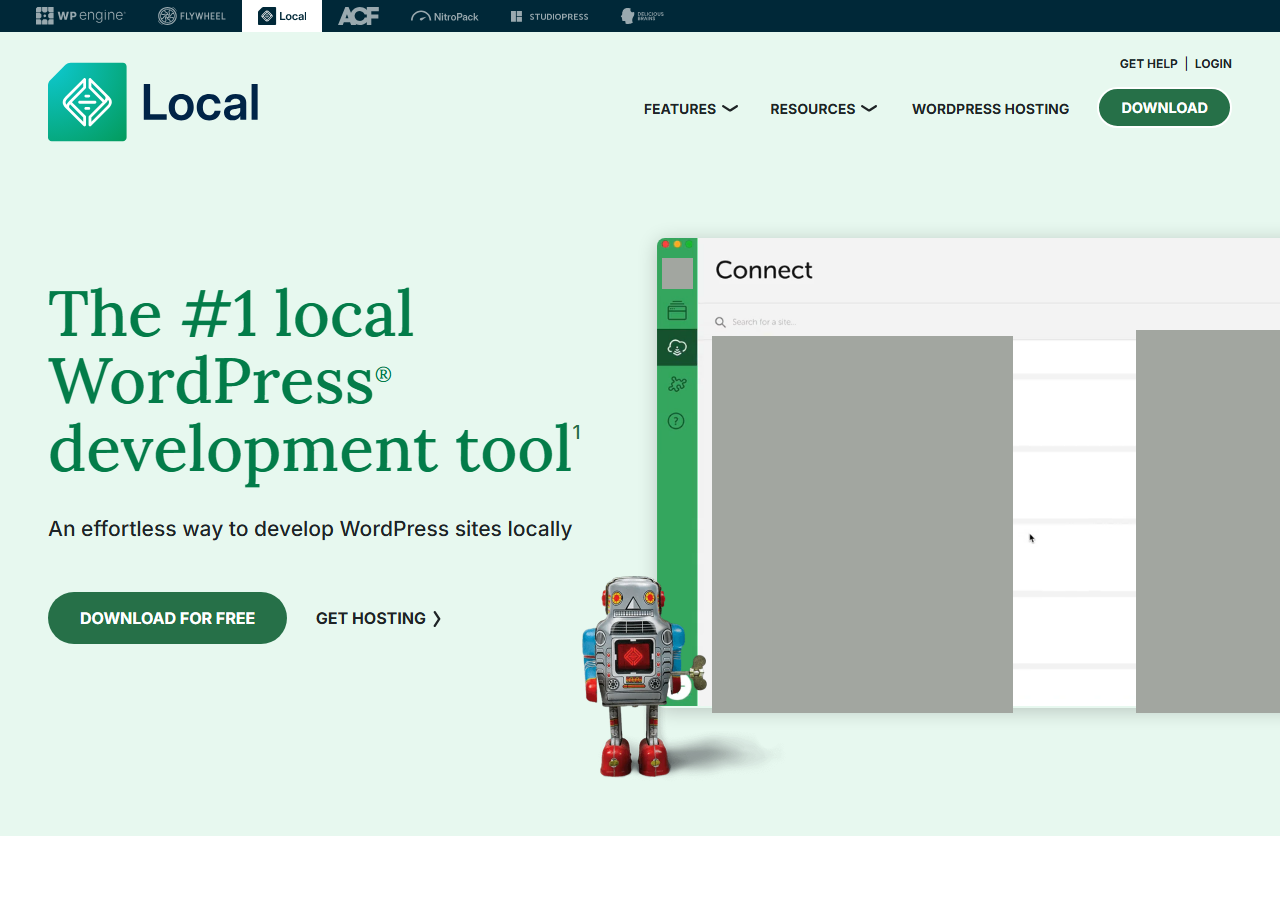
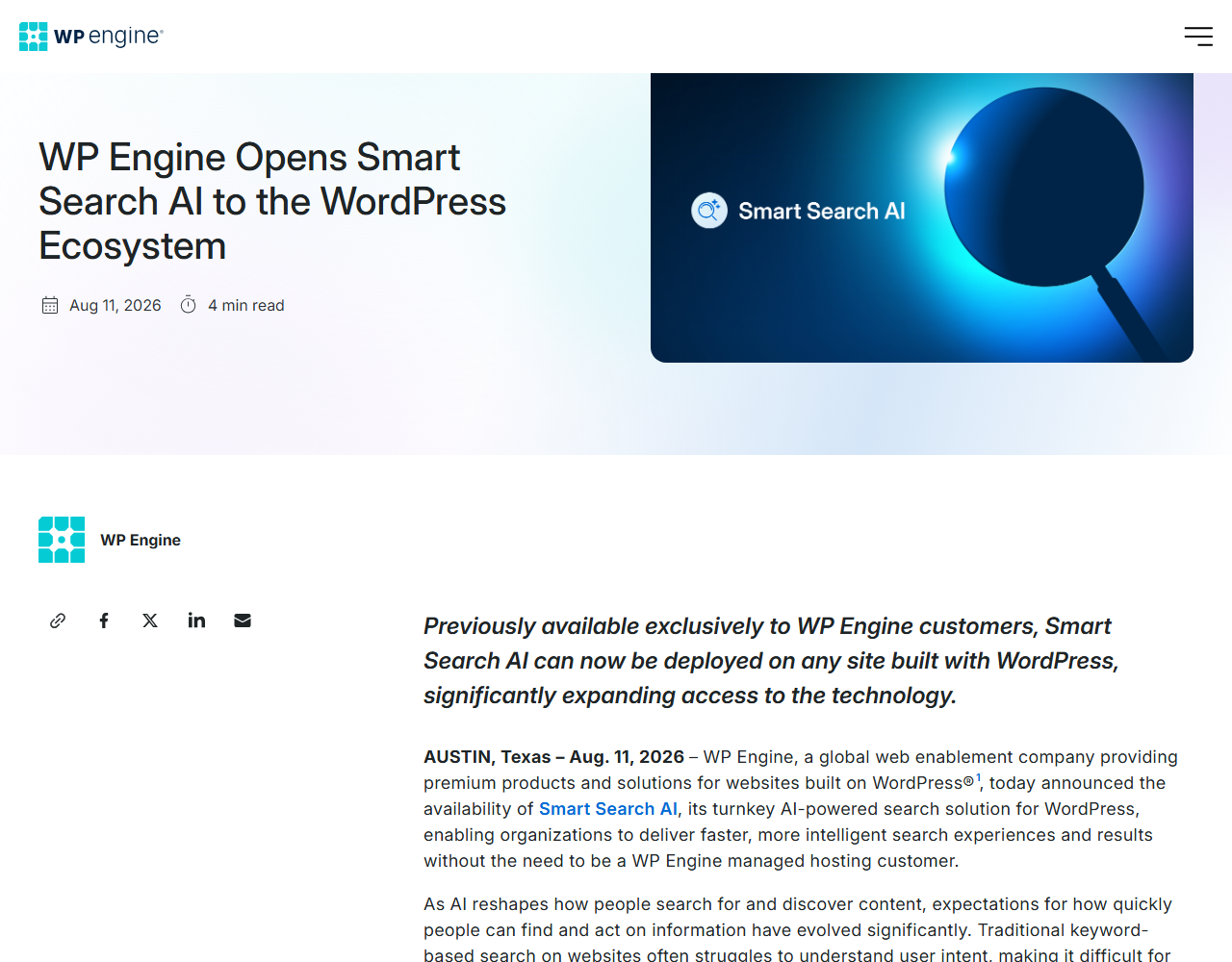
WP Engine's developer tools are a big part of its pull, and several are free or work on any host. Local is a desktop app for building WordPress sites on your own machine. ACF, which WP Engine owns, shows 2+ million active installations on WordPress.org. The Genesis framework and StudioPress themes come with every hosting plan, according to WP Engine's help center. In 2026 WP Engine added WPackagist, the Composer repository for WordPress.org plugins, and opened Smart Search AI to any WordPress site.
| Tool | What it does | Price on Oct 27, 2026 |
|---|---|---|
| Local any host | Desktop app that runs WordPress on your computer, with push and pull to WP Engine and Flywheel | Free (“It’s free and always will be”) |
| Advanced Custom Fields any host | Custom fields, post types and taxonomies; PRO adds repeaters, blocks and options pages | Free plugin; PRO $49, $149 or $249 a year for 1, 10 or unlimited sites |
| Genesis Framework and StudioPress themes with WP Engine hosting | Parent theme and child themes | Included with all WP Engine hosting; Genesis Pro by request through support |
| Decoupled WordPress platform (formerly Atlas) WP Engine hosting | WordPress backend plus Node.js front-end hosting (Next.js, React), WPGraphQL, Faust.js | Free sandbox; production plans by quote |
| WPackagist any host | Composer repository for WordPress.org plugins and themes | Free |
| Smart Search AI any WordPress site | AI semantic search for WordPress sites | Sold separately; opened to non-customers Aug 11, 2026 |
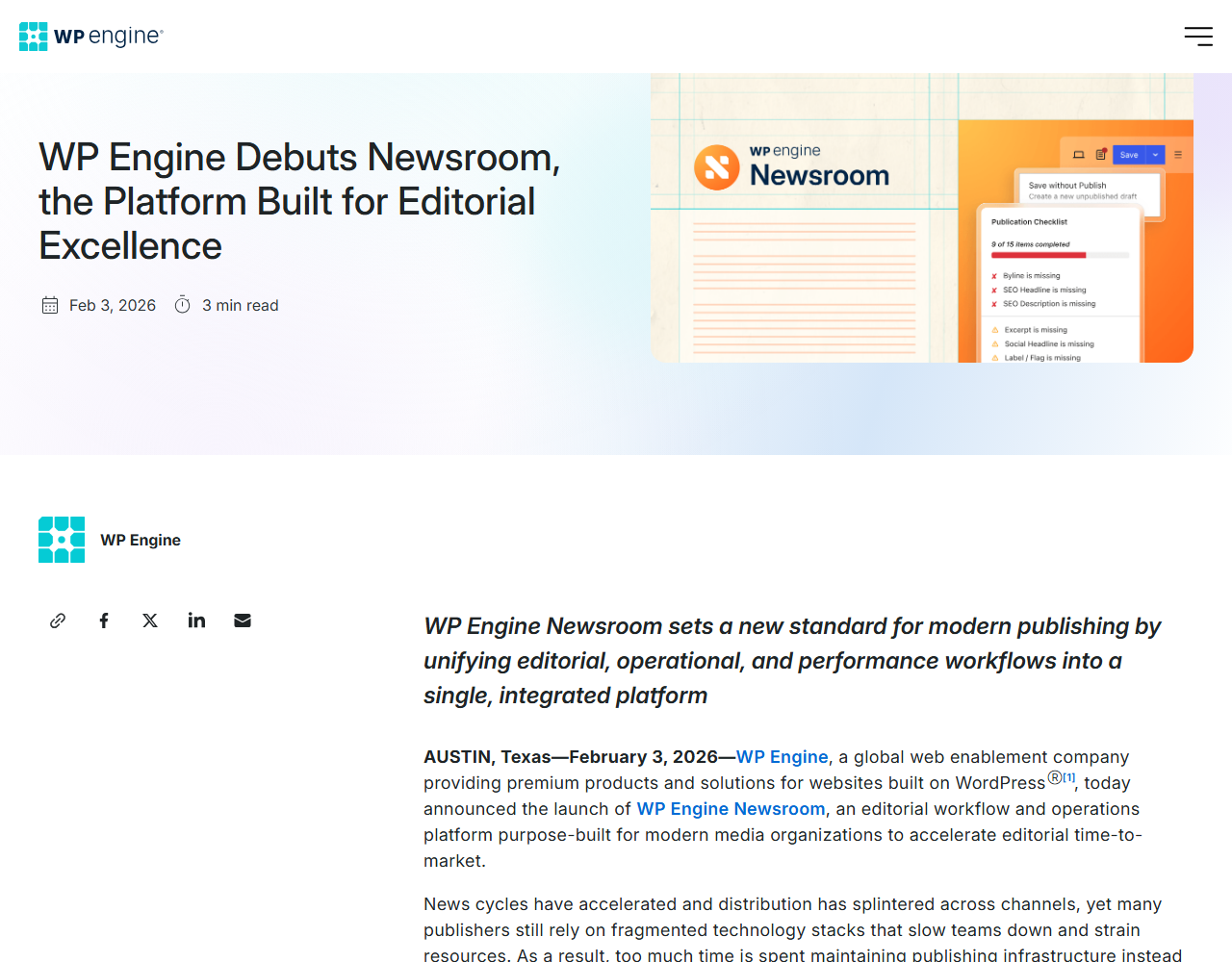
| Newsroom WP Engine hosting | Editorial workflow platform for publishers, launched Feb 3, 2026 | Not published |
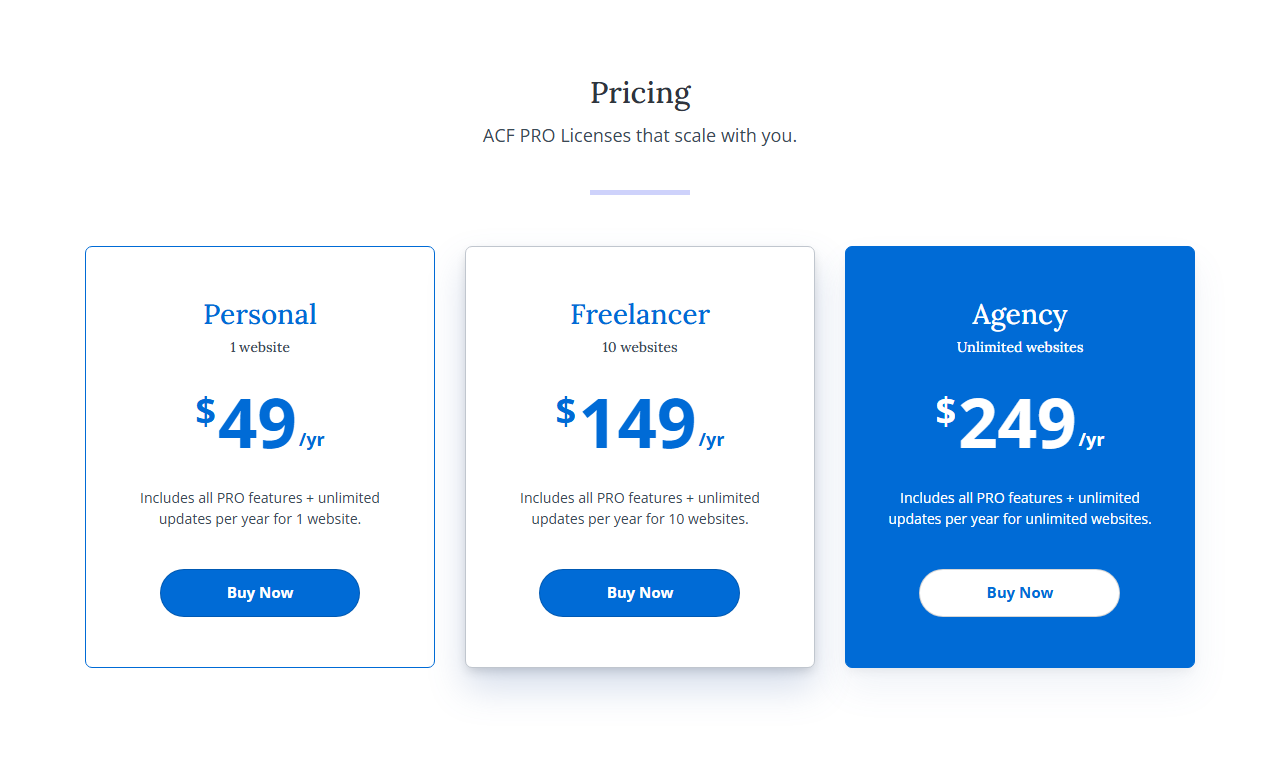
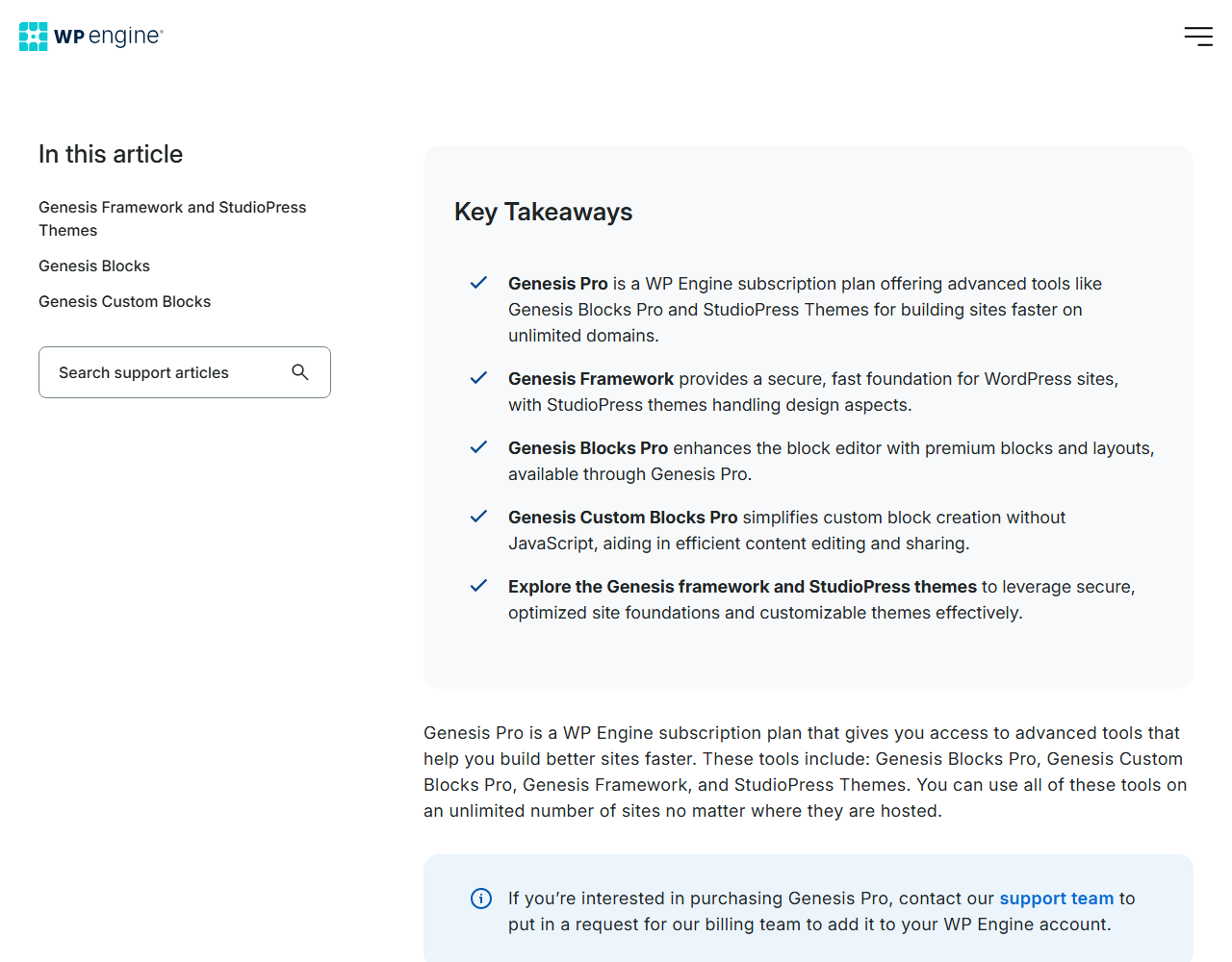
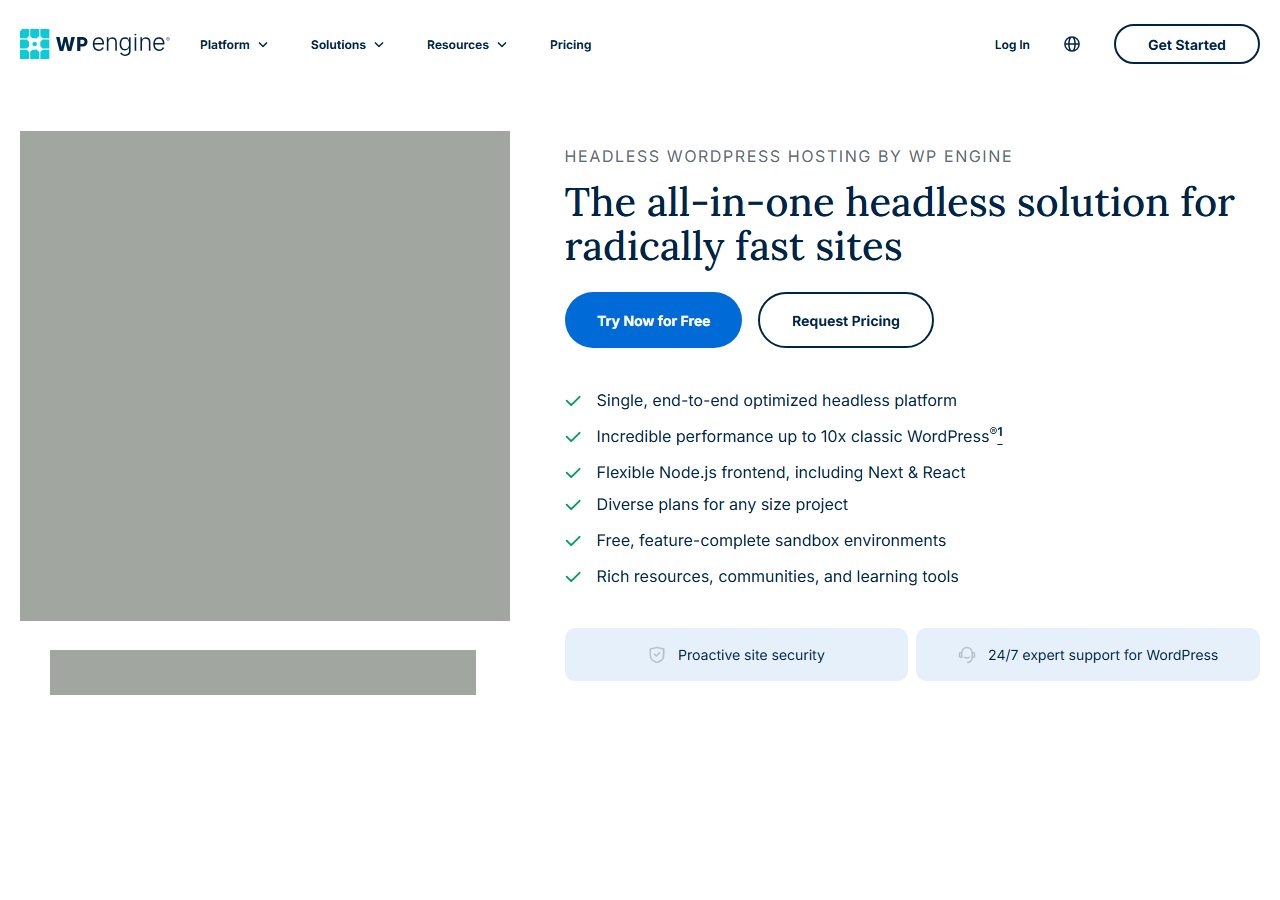
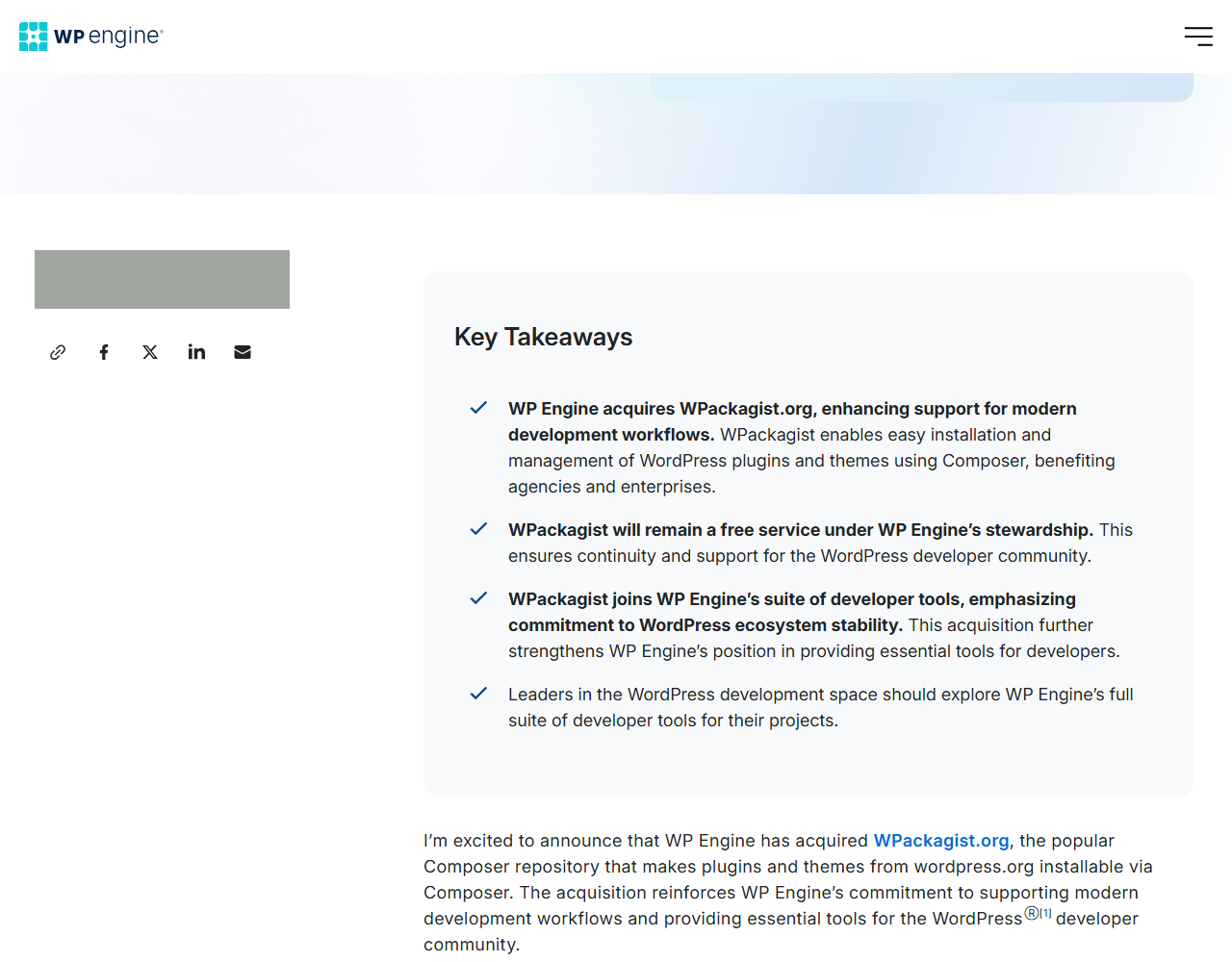
For automation, WP Engine links to an API and developer docs from its site footer, offers SSH access through its SSH gateway, and supports Git push. Git-based CI/CD, the automated deploy pipeline, is listed for Business and Enterprise only.
Visits, storage, plugins and email: the limits behind the plan cards.
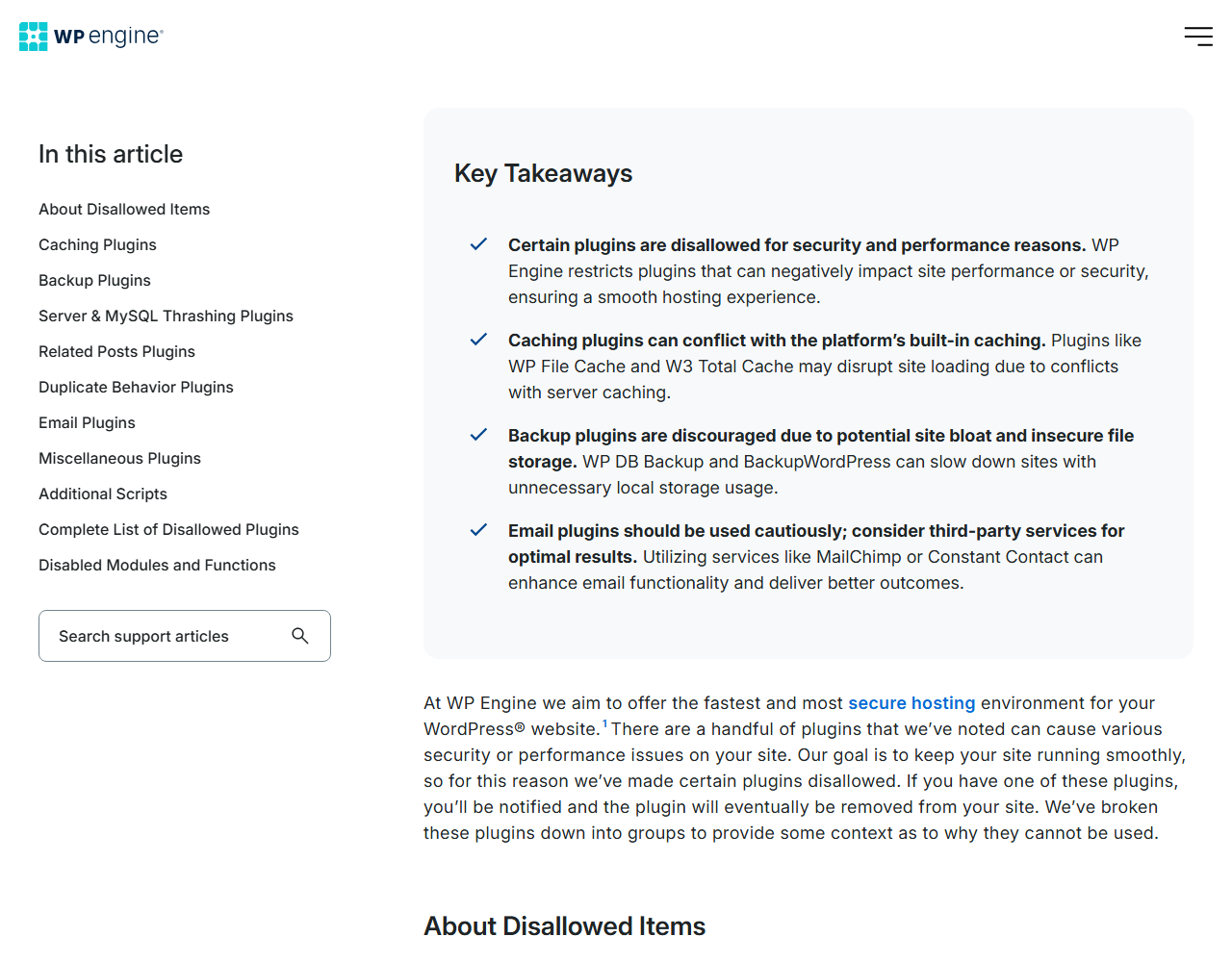
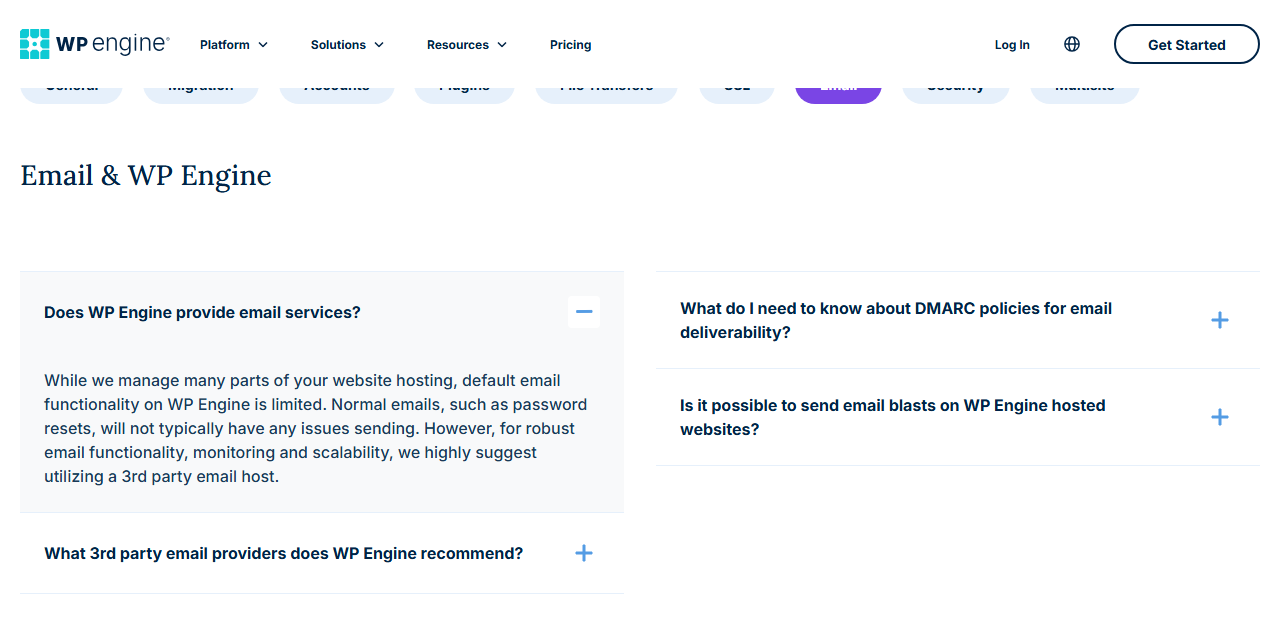
WP Engine prices by monthly visits and storage, and both are counted. Its help center says the usage page tracks storage, sites, bandwidth and billable visits, and that storage does not include WP Engine's own backups. Two other rules catch people moving from cheaper hosts: WP Engine has no email hosting, and it removes plugins it has put on its disallowed list.
| Limit | Essential, smallest tier | Source |
|---|---|---|
| Sites | 1 (extra sites $20 a month each) | Plan builder |
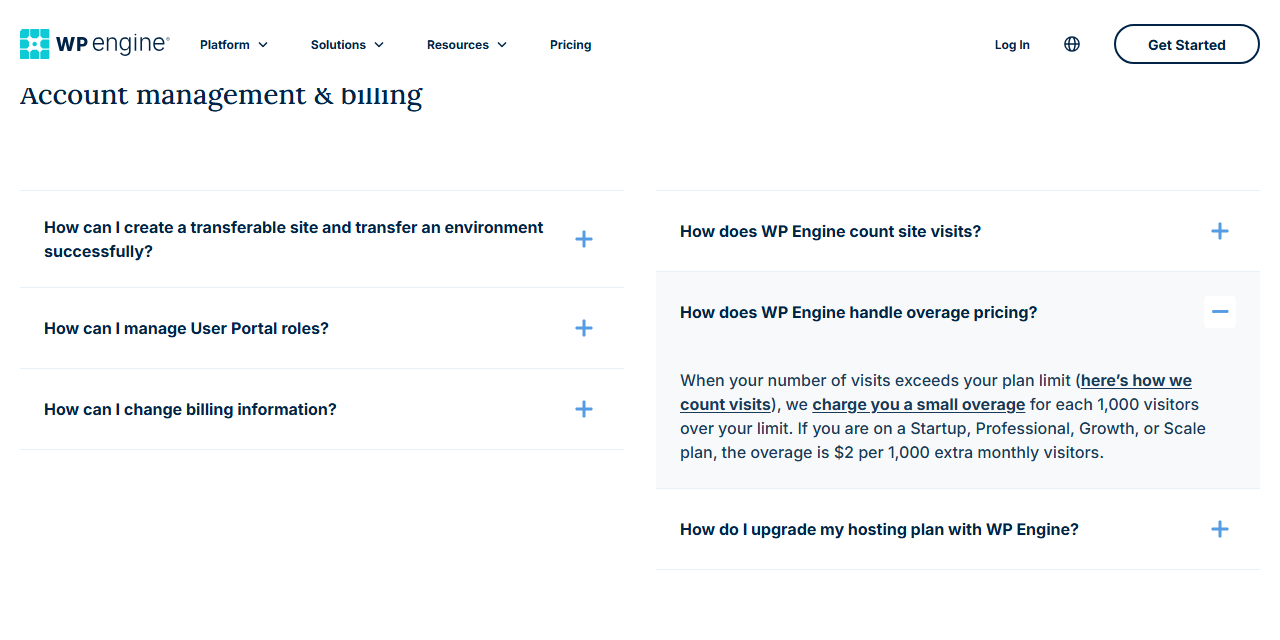
| Visits | 25,000 a month, then $2 per 1,000 extra | Plan builder; FAQ |
| Storage | 10 GB (backups not counted) | Plan builder; help center usage article |
| Bandwidth | 75 GB a month | Plans comparison |
| Environment | Shared resources | Plans comparison |
| No mailbox hosting; default email “is limited” | FAQ | |
| Plugins | Some caching, backup and other plugins are disallowed and will be removed | Help center |
| Security testing | No penetration testing of your own site without written approval | Acceptable Use Policy |
Strong basics, a paid firewall, and an uptime promise that depends on the plan.
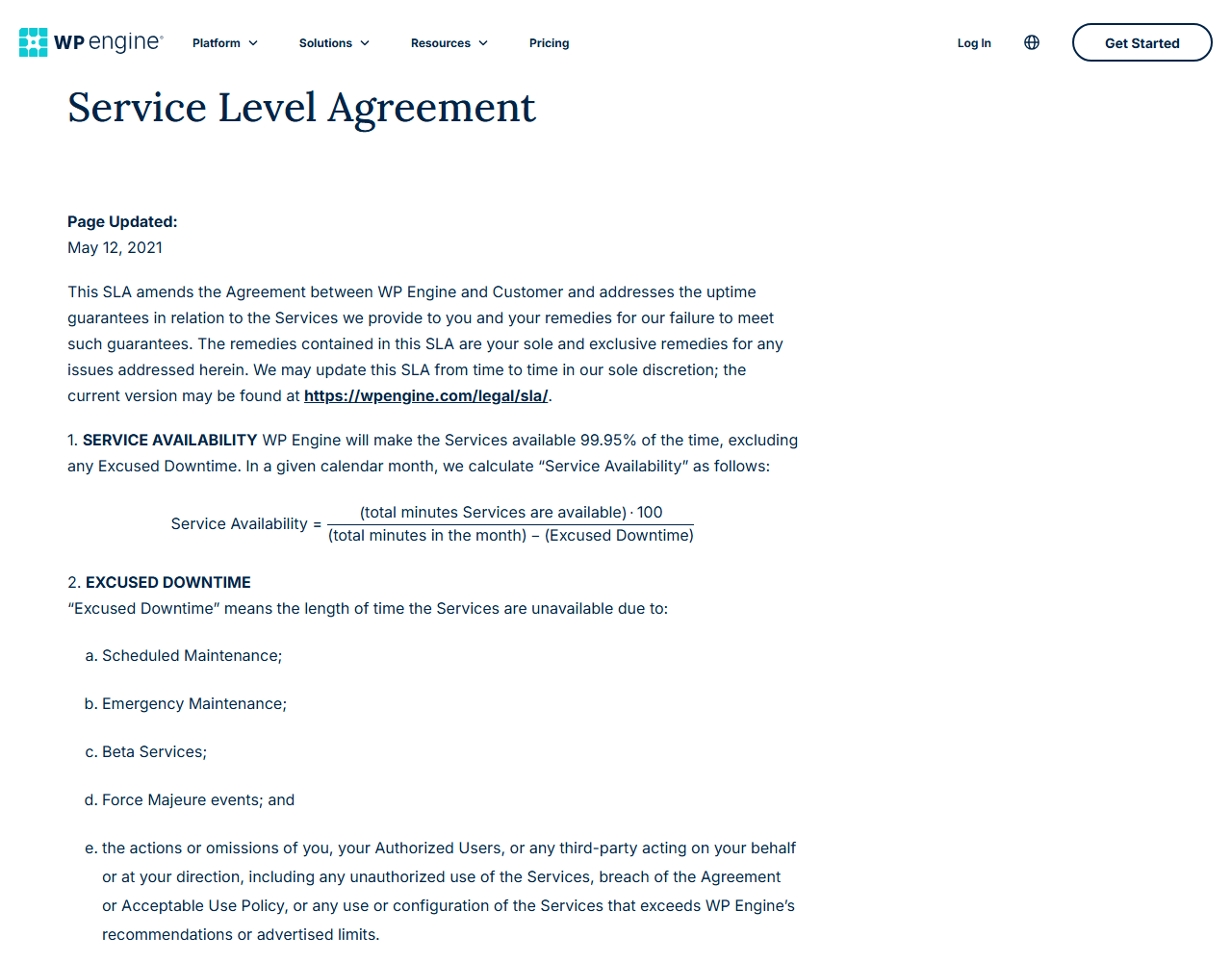
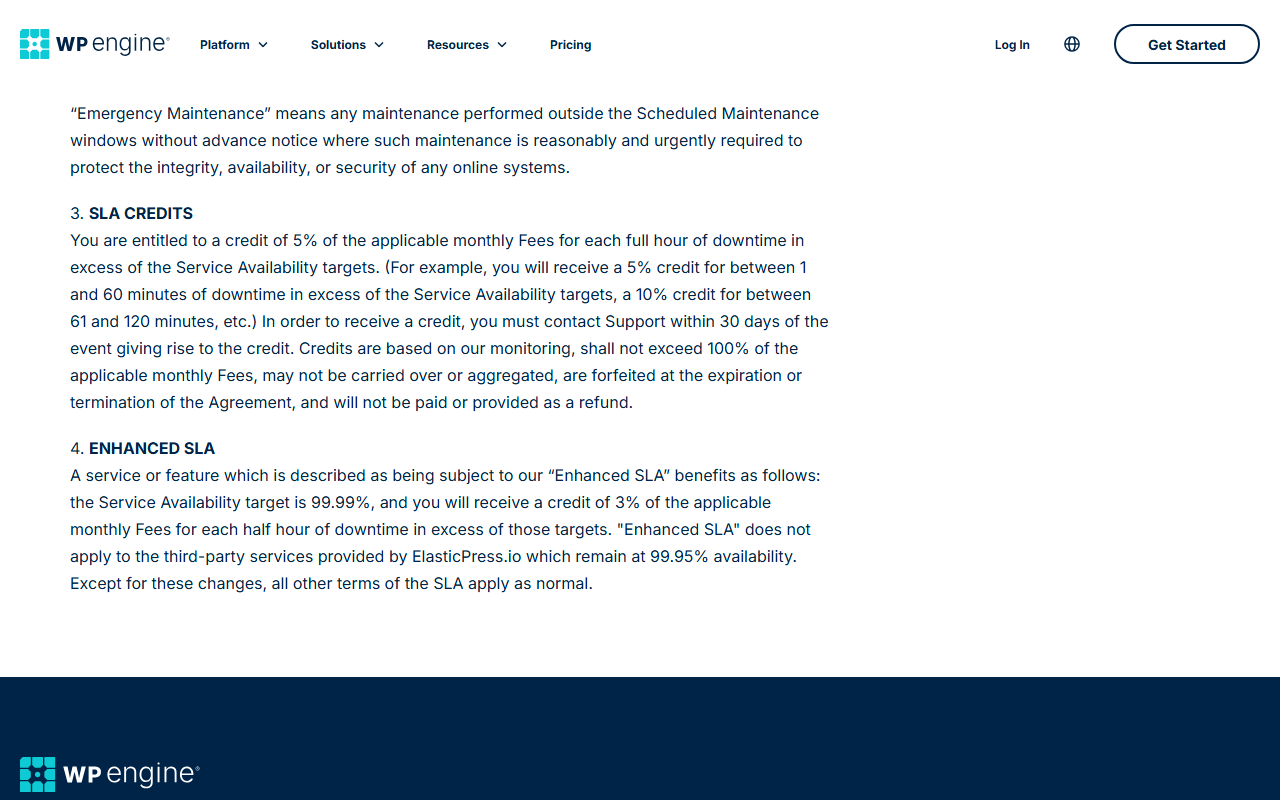
Security is the main reason people pay WP Engine's premium. Every plan includes security patching, plugin risk scans, network-level DDoS protection, automatic SSL and offsite, encrypted backups, and WP Engine holds SOC 2 Type II and ISO 27001 certifications. The managed web application firewall, bot controls and advanced DDoS protection are the Global Edge Security add-on, built on Cloudflare. The standard SLA promises 99.95% availability with credits of 5% of the monthly fee per full hour of extra downtime; the 99.99% target is a Business and Enterprise feature.
| Layer | On Essential | Notes |
|---|---|---|
| Certifications | SOC 2 Type II, ISO 27001:2022 | ISO 27001:2022 announced Aug 26, 2025; SOC 2 Type 2 since 2020 |
| Network DDoS (Layer 3 and 4) | Included | Plans comparison |
| Managed WAF and advanced DDoS | Add-on (Global Edge Security, from $35 a month) | Bot management controls added Jun 3, 2026 |
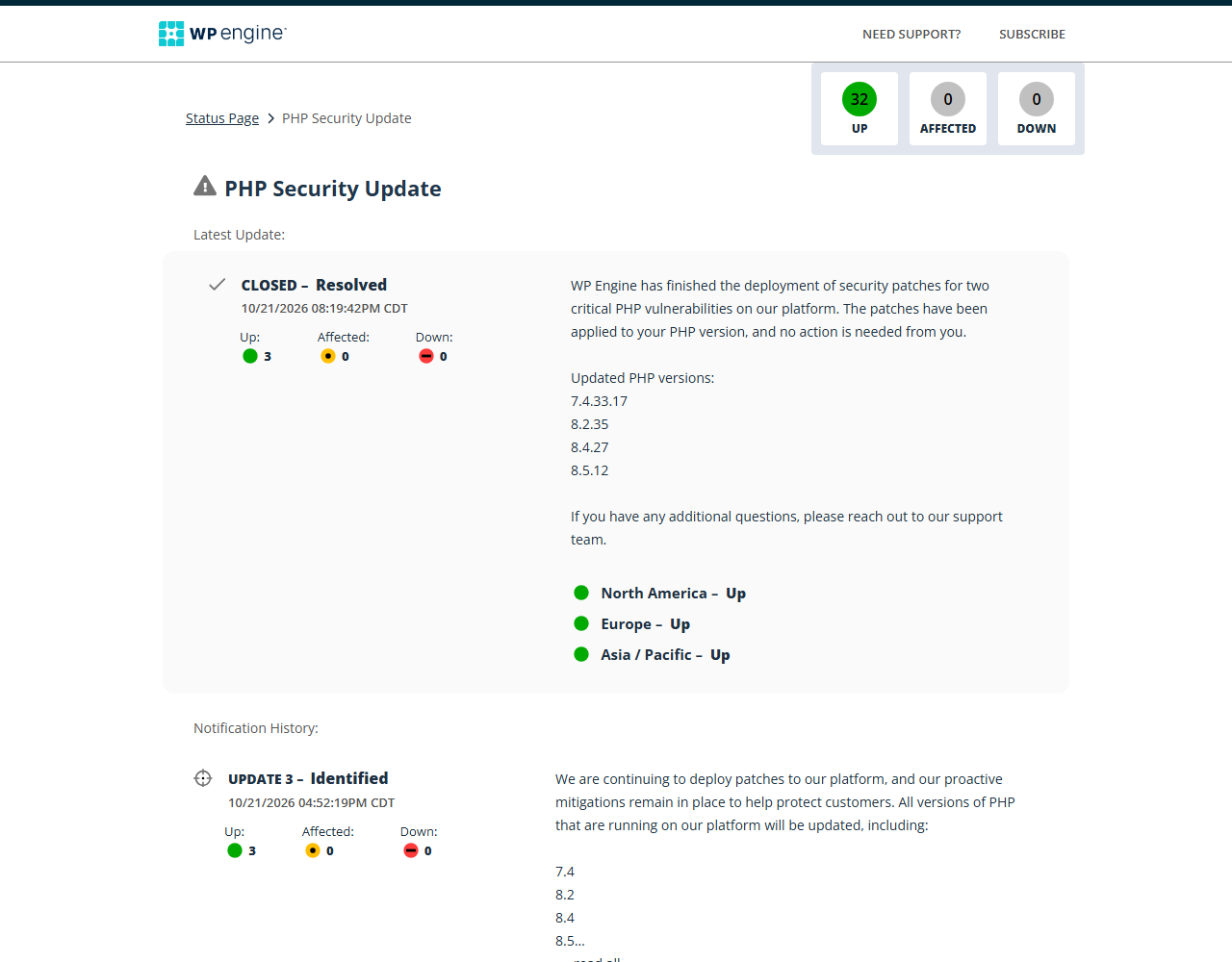
| Patching | Security patching and plugin risk scans included | PHP fixes for two critical flaws deployed Oct 21, 2026 (status page) |
| Backups | Daily and on-demand, offsite on Amazon S3, encrypted | Retention 30 to 60 days |
| Uptime promise | 99.95% (SLA); 99.99% only on Business and up | Credits of 5% of monthly fees per full hour over target; claim within 30 days |
| Regulated data | Not allowed: no HIPAA data, no stored card data | Acceptable Use Policy |
| AI features | Your choice to enable | Terms 4: enablement “is under your sole control” |
A takedown episode worth knowing about
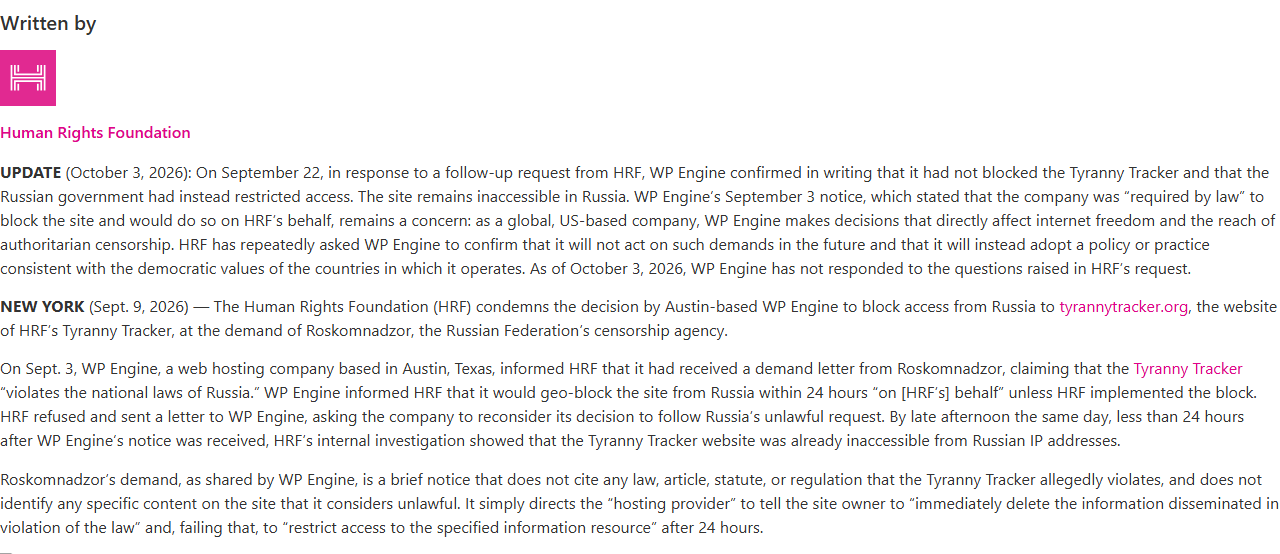
In September 2026 the Human Rights Foundation (HRF), based in New York, said WP Engine had told it on Sep 3 that Russia's censorship agency demanded the removal of HRF's Tyranny Tracker site and that WP Engine would geo-block it from Russia within 24 hours. HRF's Oct 3, 2026 update says WP Engine later “confirmed in writing that it had not blocked the Tyranny Tracker and that the Russian government had instead restricted access”, while HRF still objects to the Sep 3 notice saying WP Engine was “required by law” to block it. HRF says that, as of Oct 3, 2026, WP Engine had not answered its further questions. For site owners the lesson is general: a US host can forward foreign government demands and set short deadlines, so read the Acceptable Use Policy and know who you would call.
Businesses and agencies whose sites earn money, and who have no one to run servers.
WP Engine makes sense when an hour of downtime or a hacked plugin costs more than the difference between its price and a budget host's. It makes less sense for hobby sites, and for teams with strong developers who could run WordPress cheaply on their own servers.
| Work pattern | Fit | Likely plan |
|---|---|---|
| Small business with one marketing site | Good, if you value support and backups over price | Essential 1 site, plus Global Edge Security |
| Freelancer handing sites to clients | Good: transferable sites, staging, Local | Essential 3 or 10 sites |
| Agency with many client sites | Good, but compare per-site cost with Flywheel and Kinsta | Essential 30 sites or Business |
| WooCommerce store | Fair: card data must stay off the platform; store pack is $99 a month per site | Essential plus eCommerce Performance Pack, or Business |
| Publisher or newsroom | Good at the high end: Newsroom, Enterprise | Business or Enterprise |
| Decoupled site or Next.js team | Good: one vendor for WordPress and the front end | Decoupled platform (quoted) |
| Hobby blog or first site | Poor value | A cheaper shared host |
| Needs email hosting or HIPAA data | Not a fit | Elsewhere |
Seven things to weigh before you sign.
- Managed updates, staging and development copies on every plan
- Offsite, encrypted daily backups kept 30 to 60 days
- 24/7 chat support; phone on Business
- SOC 2 Type II and ISO 27001
- Local, Genesis and ACF in the same family
- Monthly billing available at the same regular price as annual
- No money-back guarantee on the plans page since Feb 2026
- All remaining fees due if you leave a term early
- First-year coupon hides a 25% higher regular price
- Firewall, plugin auto-updates and monitoring are add-ons
- Essential is shared and chat-only, with a 99.95% SLA
- No email hosting; some plugins disallowed
- Two-year legal fight with WordPress's leadership
- No refund safety net. The 60-day guarantee left the plans page between Jan 13 and Feb 17, 2026. The Terms allow refunds only “as expressly stated herein”, and none is. Pay monthly until you are sure.
- Hard exits. Annual plans renew unless you give notice 30 days before the end, and leaving early makes all remaining fees due.
- Price presentation. The plans page leads with $28 a month, an annual first-year price that already includes a 20% coupon. The regular annual price is $35 a month equivalent, and renewal pricing is “subject to change”.
- Add-on creep. On Essential, the managed firewall ($35 a month for one site) and Smart Plugin Manager ($10 a month per license) are extra, which more than doubles the first-year price of one site.
- Traffic is metered. 25,000 visits on the 1-site tier; above that the FAQ lists $2 per 1,000 extra visits.
- Changes to stock WordPress. Disallowed plugins are removed, and some users dislike defaults such as revisions being turned off.
- The dispute. A court order protects access to WordPress.org until judgment, but trademark counterclaims and a 2027 trial remain.
Kinsta for the same model, Flywheel for less, SiteGround or Hostinger for far less.
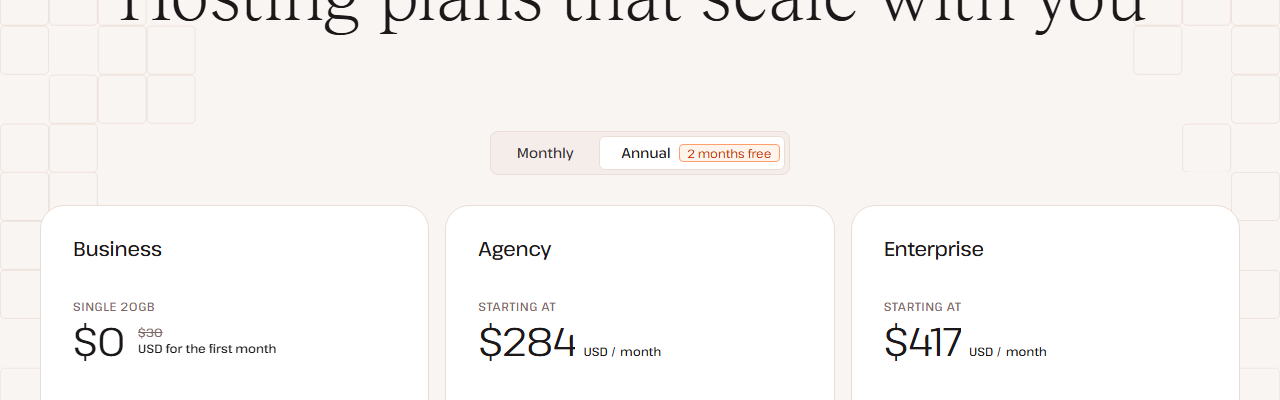
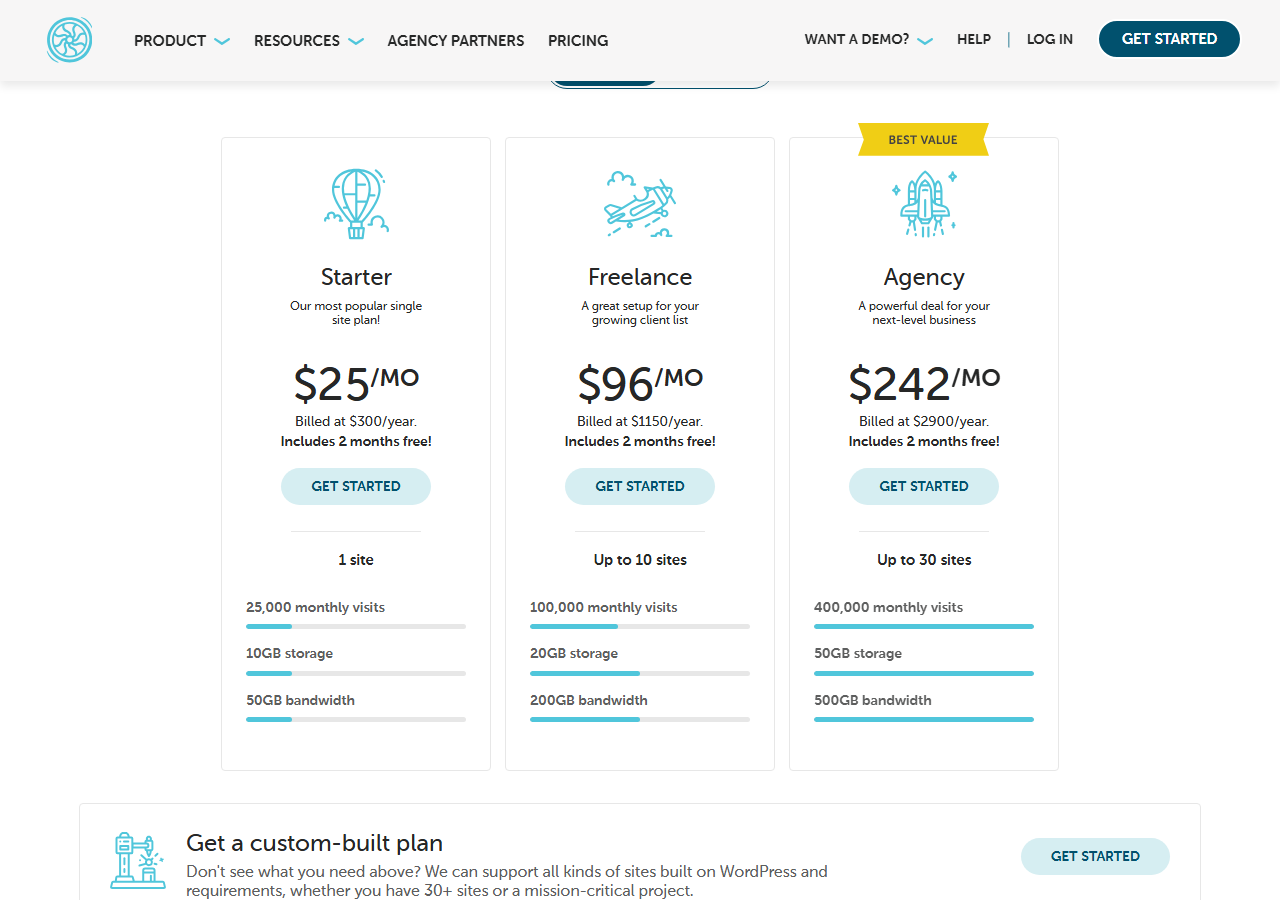
The most direct comparison is Kinsta, which also sells managed WordPress hosting at $35 a month for one site. The surprising one is Flywheel: WP Engine owns it, its Starter plan has the same 25,000 visits and 10 GB as Essential's 1-site tier, it costs $300 a year, and it still offers a 60-day money-back guarantee. Prices below are from each host's own page on Oct 27, 2026; plans are not like-for-like.
Swipe sideways to see the whole table.
| Need | Product | Entry price on Oct 27, 2026 | Why look | JAVIS review |
|---|---|---|---|---|
| Same managed model, one site | Kinsta | Single 20GB $35 a month, or $350 a year; first month $0 | 30-day money-back guarantee; 14-day backup retention on the entry plan | Not yet |
| Cheaper, from the same owner | Flywheel | Starter $25 a month, billed $300 a year | Owned by WP Engine; same 25,000 visits and 10 GB as Essential 1 site; 60-day money-back guarantee | Not yet |
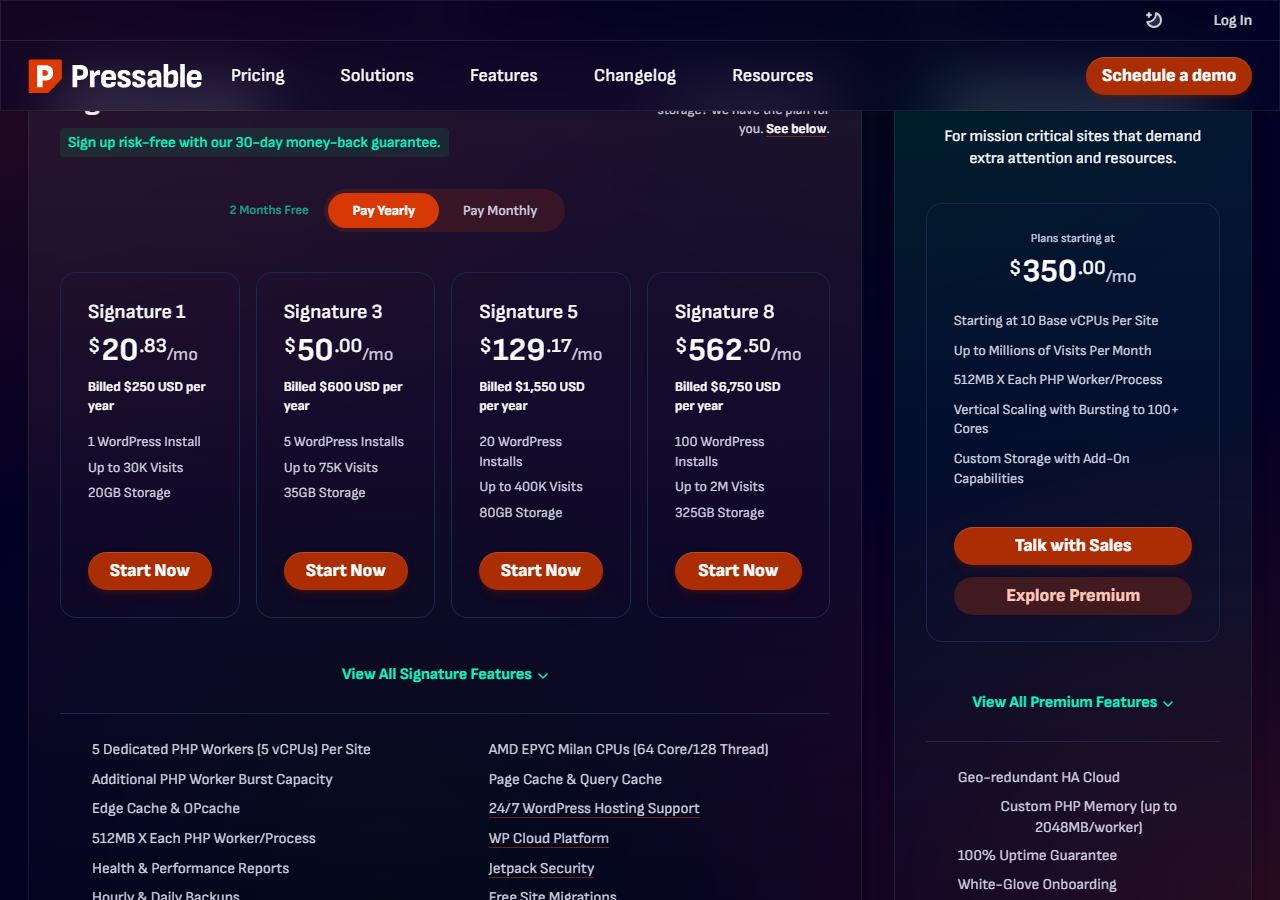
| Built on Automattic's cloud | Pressable | Signature 1 $20.83 a month, billed $250 a year | 30-day money-back guarantee; 30K visits, 20 GB | Not yet |
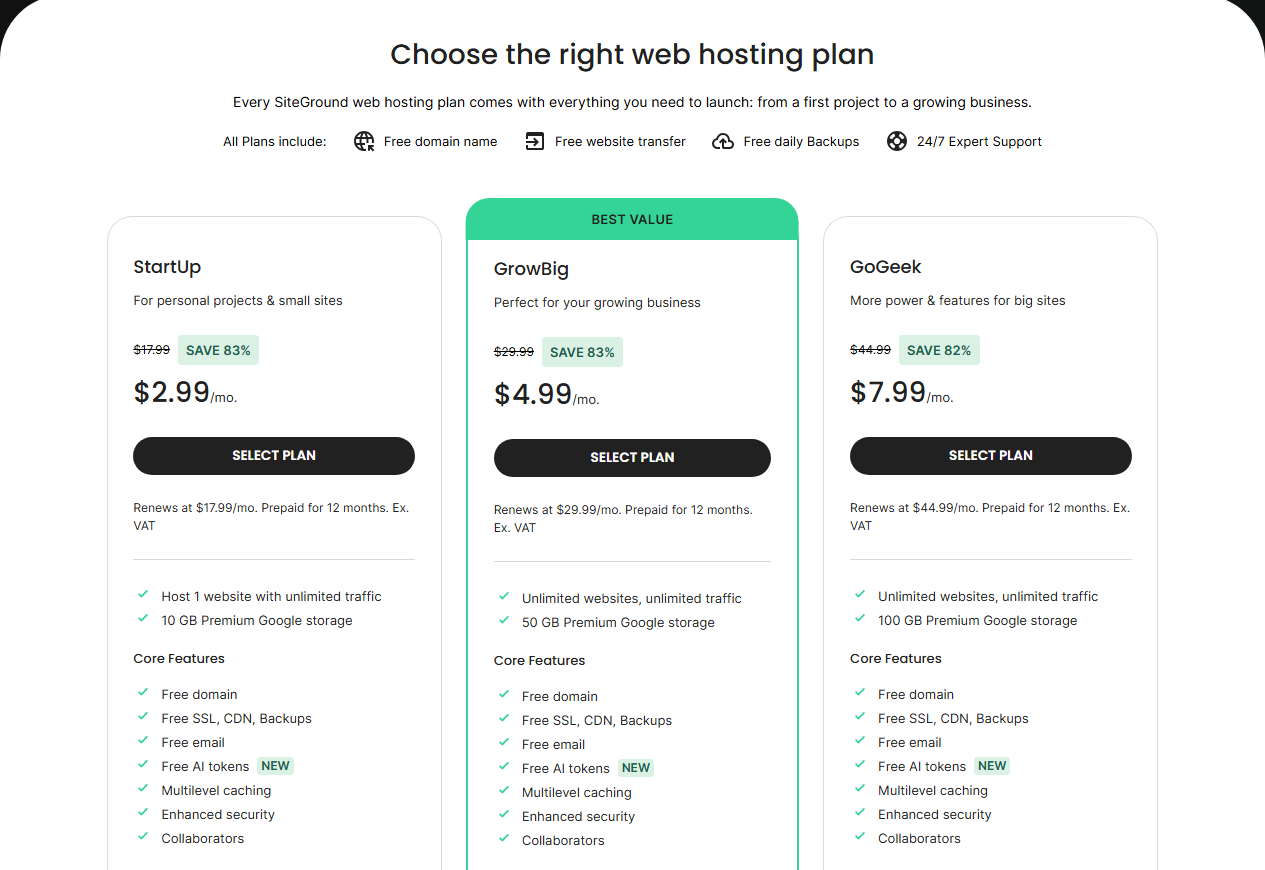
| Budget managed WordPress | SiteGround | StartUp $2.99 a month for year one, then $17.99 | Far cheaper start; renews at about six times the intro price | Not yet |
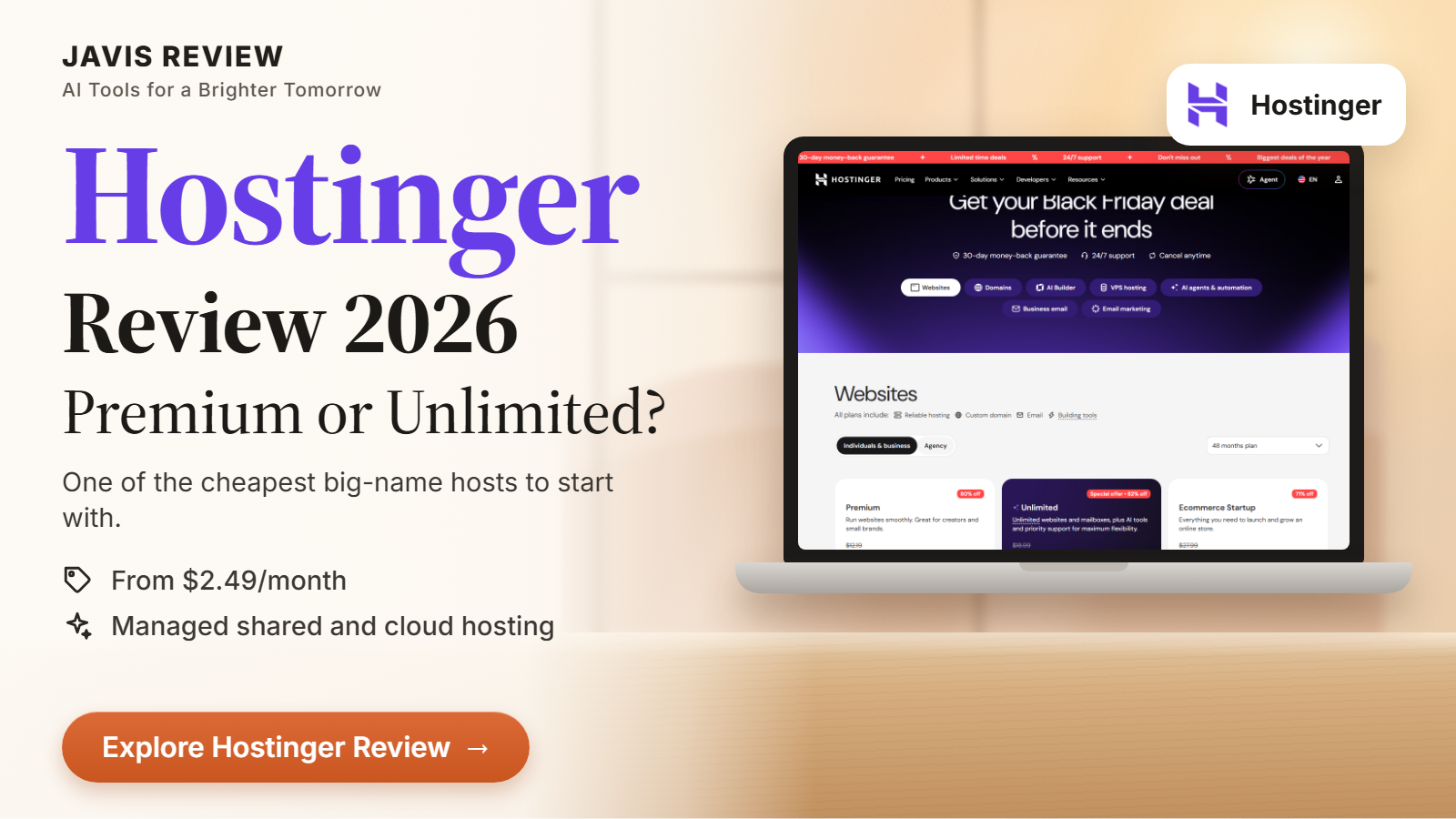
| Cheapest shared hosting | Hostinger | From $2.49 a month on a 48-month prepay, renewing at $10.99 | Lowest entry price of this group | Hostinger review |
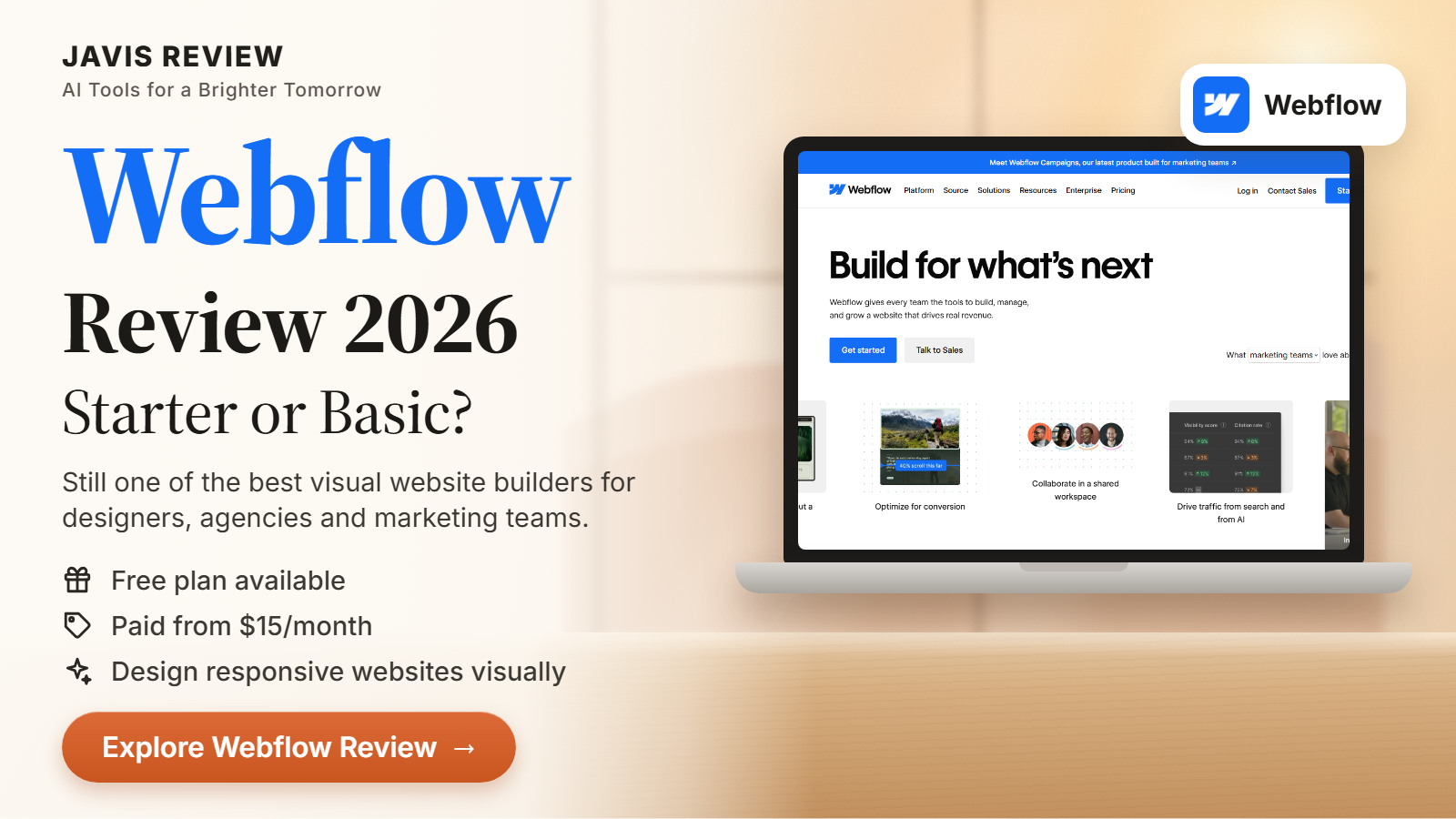
| No WordPress at all | Webflow | See review | Visual builder with hosting included | Webflow review |
This review has no affiliate links.
Every WP Engine link here goes straight to wpengine.com, its plans page, its help center or its Terms of Service, without tracking parameters. The score, the drawbacks and the alternatives would be the same either way.
How this review was put together: WP Engine's plans page and plan builder, managed hosting, decoupled WordPress and About pages, FAQ, help center articles on backups, usage, disallowed plugins, Genesis Pro, Local and decoupled sites, the Terms of Service, SLA and Acceptable Use Policy, blog posts and press releases from 2025 and 2026, its status page, three official WP Engine videos, Internet Archive copies of the plans page from Jan 2, 2024 to Oct 14, 2026, WordPress.org plugin pages for ACF and Secure Custom Fields, Hacker News, W3Techs, reporting by webhosting.today, Search Engine Journal, TechCrunch and The Repository, a Human Rights Foundation statement, and the Kinsta, Flywheel, Pressable, SiteGround and Hostinger pricing pages, as of Oct 27, 2026. This is not a hands-on test: no account, no purchase, no migration, no speed or uptime measurement and no support contact, so nothing here describes WP Engine's speed, uptime or support from our own use. Screenshots show public pages only.
Other hosts and site builders, and the AI tools developers now use on WordPress sites.
Each card opens a published JAVIS review, routed by where you are.

Questions people ask before buying
How much does WP Engine cost in 2026?
Per wpengine.com on Oct 27, 2026: Essential costs $35, $65, $130 or $330 a month for 1, 3, 10 or 30 sites on monthly billing. On annual billing the first year is $336, $624, $1,248 or $3,168, including an automatic 20% coupon; the regular annual prices are $420, $780, $1,560 and $3,960. Business starts at $400 a month, billed annually. Prices are before tax and overages.
Is there a free plan, free trial or money-back guarantee?
There is no free hosting plan, and we found no money-back guarantee on the current plans page, Terms or FAQ; the 60-day guarantee shown through Jan 13, 2026 is gone. The decoupled WordPress platform has a free sandbox, and Local and the basic ACF plugin are free.
Can I cancel anytime?
Monthly plans renew month to month. For any plan, the Terms require notice 30 days before the end of the term to stop a renewal, and the FAQ says cancellations go through a cancellation form. Ending an annual term early makes all remaining fees due.
What happens if my site gets more visits than my plan allows?
The FAQ lists an overage of $2 per 1,000 extra monthly visitors on the Essential tiers, billed monthly in arrears. Upgrading to the next tier may be cheaper if it happens every month.
Does WP Engine back up my site?
Yes, daily and on demand, offsite on Amazon S3 and encrypted, kept between 30 and 60 days. You can restore whole or partial backups and download copies. The Terms still ask you to keep your own offline copy.
Is WP Engine still in a lawsuit with WordPress?
Yes, with Automattic and its CEO. A Dec 10, 2024 preliminary injunction restored WP Engine's access to WordPress.org and runs until judgment. On Sep 24, 2026 the court revived WP Engine's antitrust claims and let most of Automattic's trademark counterclaims continue. A jury trial is set for Oct 19, 2027, according to reports of that order.
Does WP Engine include email?
No mailbox hosting. Its FAQ says default email functionality is limited and recommends a third-party email provider.
Where this came from, and when.
Every price, limit, rule and rating in this review comes from the pages below, as of Oct 27, 2026 unless another date is given. Expand for the full list, the scoring method and what the review does not cover.
Show sources, scoring method and scope
Pricing: wpengine.com/plans and its plan builder and comparison table (US dollars before tax), Oct 27, 2026; Internet Archive copies of wpengine.com/plans dated Jan 2 and Jun 29, 2024, Dec 31, 2024, Jul 2 and Oct 1, 2025, Jan 13, Feb 17, Mar 9, May 4, Jun 1, Jul 2, Sep 1 and Oct 14, 2026.
Legal: Terms of Service (updated Jan 1, 2026), Service Level Agreement (updated May 12, 2021), Acceptable Use Policy (updated Feb 5, 2019) and the legal index at wpengine.com/legal.
Help center and FAQ (as read on Oct 27, 2026): wpengine.com/faq; support articles on backups and restores, usage, counting visits, disallowed plugins, Genesis Pro (updated Oct 14, 2026), Local and decoupled sites.
Product and company: wpengine.com home, managed hosting platform, decoupled WordPress and About pages; press releases of Aug 26, 2025 (ISO 27001), Jan 7, 2026 (Big Bite), Feb 3, 2026 (Newsroom), Jun 3, 2026 (Global Edge Security bot management), Jul 29, 2026 (BigCommerce partnership) and Aug 11, 2026 (Smart Search AI); blog posts on the legal actions (updated Sep 25, 2026) and WPackagist (updated Apr 10, 2026); wpenginestatus.com incidents 968541 and 969801; localwp.com; advancedcustomfields.com/pro.
Video: three official videos on the @WPEngine YouTube channel, linked from wpengine.com: yf6S-IPW_9s (testing updates with the copy tool), GXU7xVPxODY (adding sites and environments) and kWalrdcUpBw (Global Edge Security bot management).
Independent evidence: W3Techs web hosting survey (Oct 26, 2026); WordPress.org plugin pages for ACF and Secure Custom Fields; Hacker News items 50162495, 50162703, 50183702, 50178027, 47753930, 49635706, 49635675, 47736176 and 45803804; webhosting.today (Sep 29 and Oct 13, 2026); Search Engine Journal; TechCrunch (Feb 12, 2026); The Repository (Jan 19, 2026); Human Rights Foundation statement (Sep 9, 2026, updated Oct 3, 2026). Scores from review platforms such as G2 and Capterra are not used.
Competitors: kinsta.com/pricing, getflywheel.com/pricing, pressable.com/pricing, world.siteground.com/web-hosting.htm and hostinger.com/wordpress-hosting, Oct 27, 2026.
Images: screenshots of public pages taken on Oct 27, 2026 at 1280 pixels wide; archived pages show the Internet Archive's toolbar. Photos of people, an avatar, usernames, author names, sample customer names in illustrations and review-site rating rows are covered with grey boxes or cropped out. JAVIS charts and diagrams are labelled as such and computed from the figures above. Related cards use JAVIS's own featured images.
JAVIS Fit Score (66/100): an editorial composite scored out of 20 on five criteria. Price clarity 11: monthly and annual prices are public and the plan builder shows every tier, but the default annual price is a first-year coupon price shown without the regular price beside it, renewal pricing is “subject to change”, the FAQ still uses old plan names, and the money-back guarantee disappeared without a note. Capability 17: managed updates, staging and development environments, offsite backups, EverCache and CDN, 24/7 support and a strong developer toolset, against add-ons for the firewall and plugin auto-updates and no Git CI/CD or email on Essential. Independent evidence 11: W3Techs, WordPress.org ratings for ACF, a few Hacker News comments, WP Engine's own status page and court reporting, but no independent speed or uptime data and no large review platform in this review. Terms, data and security 13: SOC 2 and ISO 27001, encrypted offsite backups and fast PHP patching, against all remaining fees due on early exit, no refund right, a 99.95% SLA on Essential, Texas venue with a class-action waiver, and the open dispute. Cost and fit 14: in line with Kinsta for one site and good value for teams that use the tools, but above Flywheel, Pressable and budget hosts. It is judgment, not a measurement.
What this review does not cover: WP Engine's real-world speed, uptime and support quality, the checkout flow and taxes, renewal offers made inside the User Portal, decoupled-platform and Newsroom prices, Enterprise contracts, and prices in other currencies.