Roo Code Review 2026: The Open-Source VS Code AI Agent Hit 3 Million Installs -- Then Its Own Team Shut It Down
If a tutorial, GitHub README, or 2025 blog post just told you to install Roo Code, stop and read this first: the extension no longer exists. Roo Code -- a free, open-source fork of Cline that grew into one of the most capable multi-mode AI coding agents for VS Code -- shut down its extension, its Cloud service, and its Router on May 15, 2026. The team, led by co-founder and CEO Matt Rubens, didn't run out of money or lose to a competitor in the usual sense: they walked away from the IDE entirely, betting the whole company on a new cloud-based agent called Roomote instead. This review covers what Roo Code actually was, why it really ended, verified historical pricing, real user and developer sentiment, and exactly where its former users -- and its code -- went next.
| Status | Discontinued -- May 15, 2026 |
| Successor | Roomote (cloud agent, not an IDE extension) |
| Peak scale | 3M+ installs (company-reported, all channels) |
| GitHub repo | Archived, read-only, 24.3k★ |
| Best live alternative | Cline -- the project it forked from |
Roo Code didn't fail. Its team just stopped believing in the thing that made it good.
"What made Roo Code genuinely stand out from Cline, the project it forked, wasn't marketing -- it was a structured multi-mode system (Code, Architect, Ask, Debug, and an Orchestrator mode that delegates whole subtasks to other modes) plus some of the most granular auto-approve permission controls of any coding agent in this category. That's real engineering, and it's why the extension crossed 3 million installs and held a 4.7-out-of-5 rating across 350 marketplace reviews right up to the day it was archived. What actually ended it wasn't a competitor or a funding crunch -- it was the team's own internal shift. By fall 2025 they were running Roo Code headlessly, in cloud containers, with auto-approve fully on -- effectively not using it as an editor extension at all. CEO Matt Rubens said it plainly: 'we are not shutting down Roo Code because we failed... we are doing so because the world that Roo Code served no longer exists' to them. On May 15, 2026, the extension, Roo Code Cloud, and Roo Code Router all went dark, the GitHub repo was archived read-only, and the team moved entirely to Roomote, a Slack-and-GitHub-native cloud agent with no IDE at all."
None of that erases what Roo Code actually built, or what its former users are owed: an honest account of a genuinely well-regarded tool that a for-profit team chose to discontinue, not because users left, but because the people building it stopped wanting to build an IDE extension. If you're evaluating Roo Code today, the real decision isn't "should I install it" -- you technically still can, but nobody is fixing bugs or reading your GitHub issues anymore. The real decision is which of its heirs -- Cline, the community-run Zoo Code fork, or the well-funded Kilo Code -- fits how you actually work.
A free, Apache-2.0 fork of Cline that grew a genuinely different permission model and mode system.
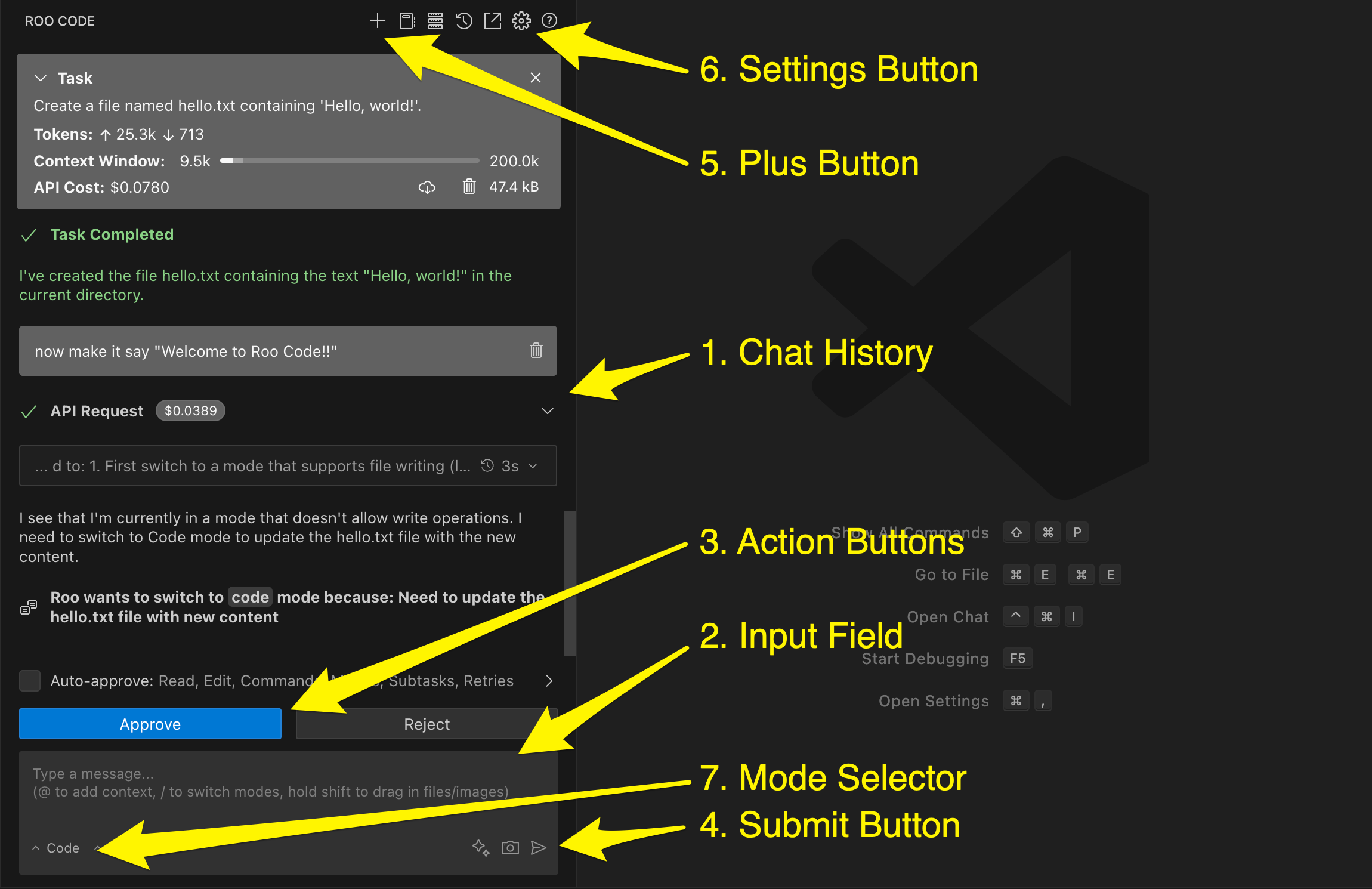
Roo Code began in late 2024 as an internal fork of Cline, built inside Roo (formally Roo Veterinary, Inc.), a veterinary relief-staffing technology company whose engineering team wanted AI-coding features the Cline maintainers had declined to merge upstream. It shipped first as "Roo Cline," then renamed to "Roo Code" in early 2025 after crossing 50,000 installs. The pitch, confirmed directly in the archived GitHub README, was simple: "Roo Code gives you a whole dev team of AI agents in your code editor" -- a chat-driven VS Code extension that could read/write files, run terminal commands, use a browser, and call external tools via MCP servers, all gated behind a mode system and a permission layer you configured yourself, not a vendor's cloud policy.
Worth being precise about up front: Roo Code was never "owned" by a big platform the way some AI tools are -- it was an independent, VC-backed startup (Roo Code, Inc., a $5M seed round closed July 14, 2025) built entirely on top of an open-source codebase it didn't originate. That structure is exactly what one Hacker News commenter flagged the day the shutdown was announced: competing commercially on top of someone else's open-source repo is a genuinely hard business, "business moats are weak/nonexistent" in this category -- and it's a large part of why the team eventually looked for a different business entirely.
From a 50,000-install side fork to 3 million installs to a fully archived repository, in about 18 months.
Company-reported, all channels, at shutdown announcement (Apr 21, 2026).
VS Code Marketplace listing alone, independently observed live, Sep 29, 2026.
Archived, read-only repository, RooCodeInc/Roo-Code.
One round, closed Jul 14, 2025, per Tracxn company data.
| Date | Event | Result |
|---|---|---|
| Late 2024 | Forked from Cline inside Roo (vet-staffing tech co.) as "Roo Cline" | Internal tool for faster, more configurable AI coding than upstream Cline allowed |
| Early 2025 | Renamed "Roo Code" after passing 50,000 installs | Public identity separate from Cline established |
| 2025-07-14 | Roo Code, Inc. closes a $5M seed round | Spins out as an independent, VC-backed company |
| 2025-08-09 | "Roo Code Cloud is coming" waitlist opens | First move toward a paid, cloud-hosted layer |
| Fall 2025 | Internal team shifts default workflow to headless cloud containers, full auto-approve | The pattern that eventually became Roomote's whole premise |
| 2026-04-21 | Matt Rubens publicly announces the shutdown | Extension, Cloud, and Router all set to end May 15 |
| 2026-05-15 | Shutdown takes effect; GitHub repo archived read-only | Unused Cloud balances refunded; team fully moves to Roomote |
| Same week, May 2026 | Cline publicly welcomes returning users; Kilo Code ships a Roo->Kilo migration guide; community launches Zoo Code fork | Roo Code's user base redistributes across three living projects |
The rating held up. So did a real, documented pattern of rough edges -- and the reaction to the shutdown was surprisingly calm.
4.7 out of 5 stars across 350 reviews, frozen at the extension's final shipped version (3.54.0). 288 of the 321 written reviews are five-star (Corrected Oct 3, 2026: an earlier version showed 4.5/5 and a "331 five-star" figure; the marketplace data shows 4.7/5 from 350 ratings.) -- a strong, broad-based satisfaction signal for a tool built almost entirely on developer word of mouth rather than paid marketing.
Real, documented friction while the product was active: one issue reports the used-context-window token counter showing implausible values (including 0) after a VS Code restart; another reports Roo Code ignoring a manually configured Context Window Size setting on OpenAI-compatible/vLLM backends. Per-provider token-limit bugs also shipped and got patched over time -- v3.26.7's release notes specifically fixed a Moonshot provider cap stuck at 1,024 tokens.
One commenter (KronisLV) called Roo Code "genuinely great," specifically citing its agent modes as distinctive, and noted surprise at the shutdown given Kilo Code -- a further fork -- was "succeeding at the project level." Another (minimaxir) pointed to the structural problem: competing commercially on top of an open-source project you don't own has weak business moats -- a pivot to a cloud product doesn't obviously fix that either.
The extension itself was always free. The Cloud layer that eventually tried to monetize it is gone too.
Roo Code (core)
Apache 2.0, open source, bring-your-own API key.
- No Roo Code markup on model costs
- You paid your model provider directly
- 30+ supported providers, incl. local (Ollama, LM Studio)
Roo Code Cloud Free
Token-usage tracking, task sharing, early access to free models.
- Follow tasks from anywhere
- Community support (Discord, Reddit)
Roo Code Cloud Pro
Plus $5/hr for cloud-run tasks.
- Cloud agents incl. a PR Reviewer
- Roomote Control (remote task control)
- Paid support
Roo Code Cloud Team
Plus $5/hr for cloud-run tasks.
- Unlimited members, no per-seat fee
- Shared settings and rules
- Centralized billing
Historical Cloud pricing sourced from Roo Code's own documentation and corroborated by independent pricing trackers active while the product was live; the original live pricing page is no longer reachable as a first-party source following the shutdown, so this is disclosed as a secondary/archival read, not a fresh first-party read. The core extension's BYOK/Apache-2.0 model is independently confirmed via the current archived GitHub README and docs mirror, checked Sep 29, 2026.
| If you want a Roo-Code-shaped tool today | What it actually costs |
|---|---|
| Zoo Code (direct community fork) | $0 -- Apache 2.0, BYOK, free forever per its own site; optional paid "Zoo Gateway" unified-model credits |
| Cline (the original parent project) | $0 core extension, BYOK; Cline also offers its own optional hosted plans separately |
| Kilo Code (well-funded rival fork) | Own free tier + paid credit plans; not independently re-verified in this review -- see its own site |
| Roomote (the Roo Code team's new product) | Free self-hosted for up to 10 users; Cloud from $49/mo (≤10 users) up to $499/mo (51-100), custom above that |
You almost certainly shouldn't install the real Roo Code. Here's what to do instead.
Go to Cline -- the original project, still actively developed, 5M+ marketplace installs, and the team Roo Code publicly told its users to go "home" to.
Zoo Code is the direct community continuation -- same Apache 2.0 license, same settings structure, near-identical feature set.
Kilo Code -- a separately funded ($8M seed, Dec 2025) further fork that has kept building on both Cline's and Roo Code's ideas.
Roomote, from $49/mo cloud or free self-hosted for up to 10 users -- but understand this is a genuinely different product category, not "Roo Code as a service."
Don't install RooVeterinaryInc.roo-cline from the Marketplace expecting support -- it's a frozen, unmaintained listing. Start with Cline or Zoo Code instead.
The thing that actually made Roo Code different from Cline: it could delegate work to itself.
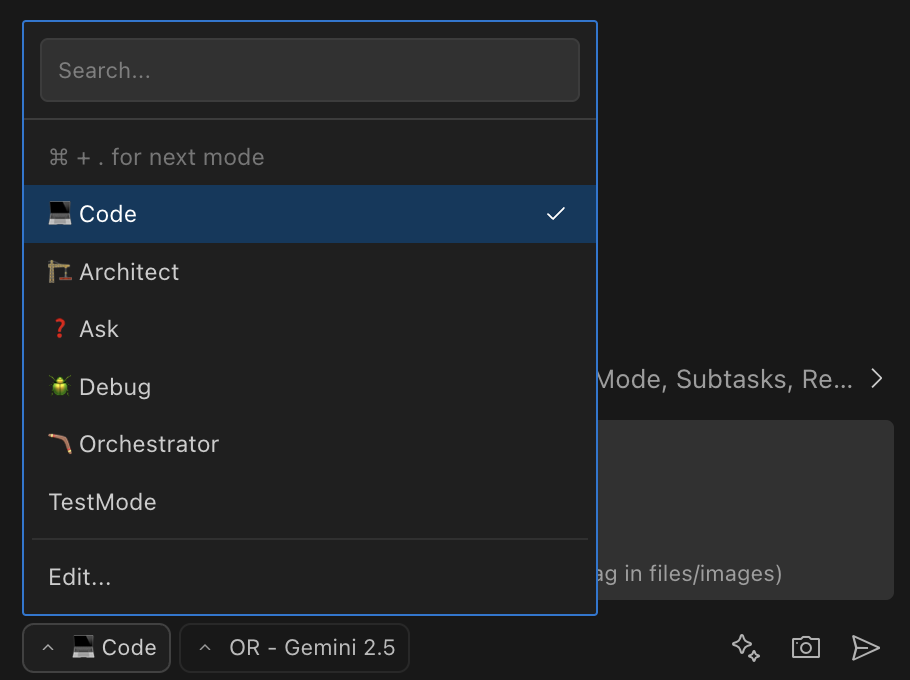
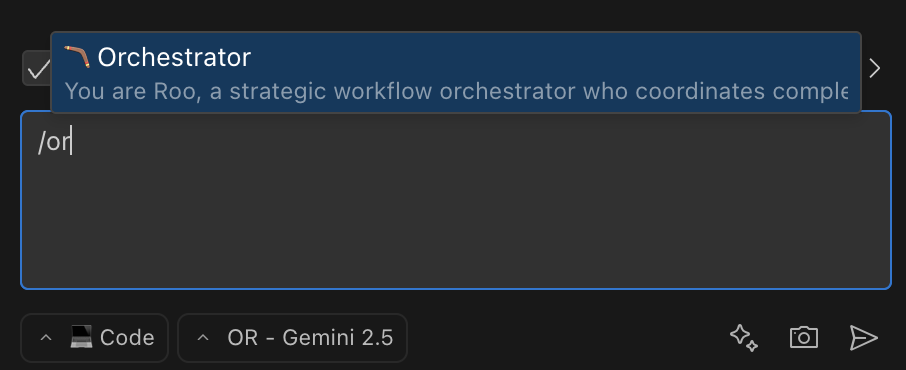
Cline's whole design philosophy is one continuous conversation where every file edit, command, and browser action needs your explicit approval -- transparent, but linear. Roo Code's real innovation, confirmed across its own official documentation, was a structured mode system: Code for general implementation, Architect for planning and technical decisions, Ask for question-answering without making changes, Debug for systematic problem diagnosis, and fully Custom modes with their own system prompts and tool permissions. On top of that sat Orchestrator mode (internally called Boomerang Tasks): it breaks a large, multi-step project into subtasks, hands each one to the mode best suited for it, and keeps every subtask in its own isolated conversation context so the parent task doesn't get cluttered with implementation noise. Tellingly, Orchestrator itself was deliberately stripped of file read/write, MCP, and command-execution permissions -- it could only plan and delegate, never touch code directly.
| Mode | Job | Notable restriction |
|---|---|---|
| Code | General-purpose implementation and editing | Full tool access, gated by your auto-approve settings |
| Architect | Planning, technical decisions, system design | Biased toward reasoning and proposals over direct edits |
| Ask | Answering questions about the codebase | Doesn't make changes |
| Debug | Systematic root-cause diagnosis | Tuned prompting for reproducing and isolating bugs |
| Orchestrator (Boomerang) | Breaks a big task into subtasks, delegates to other modes | No file read/write, MCP, or command execution of its own |
| Custom | User-defined persona, prompt, and tool permissions | As permissive or restrictive as you configure it |
- The mode system plus Orchestrator's context isolation was a real, independently confirmed differentiator versus Cline's single-thread model -- not just marketing language.
- 30+ named model providers (Anthropic, OpenAI, Gemini, Bedrock, Vertex, OpenRouter, DeepSeek, Groq, Mistral, xAI, local Ollama/LM Studio) made it genuinely model-agnostic.
- A 4.7/5 rating across 350 reviews, held all the way to the shutdown, is a real signal this wasn't a half-built product.
- None of this is being patched anymore. The GitHub repo is archived read-only as of May 15, 2026.
- Zoo Code inherited this exact mode system at the fork point -- if the modes/Orchestrator design is what you actually want, that's now the living version.
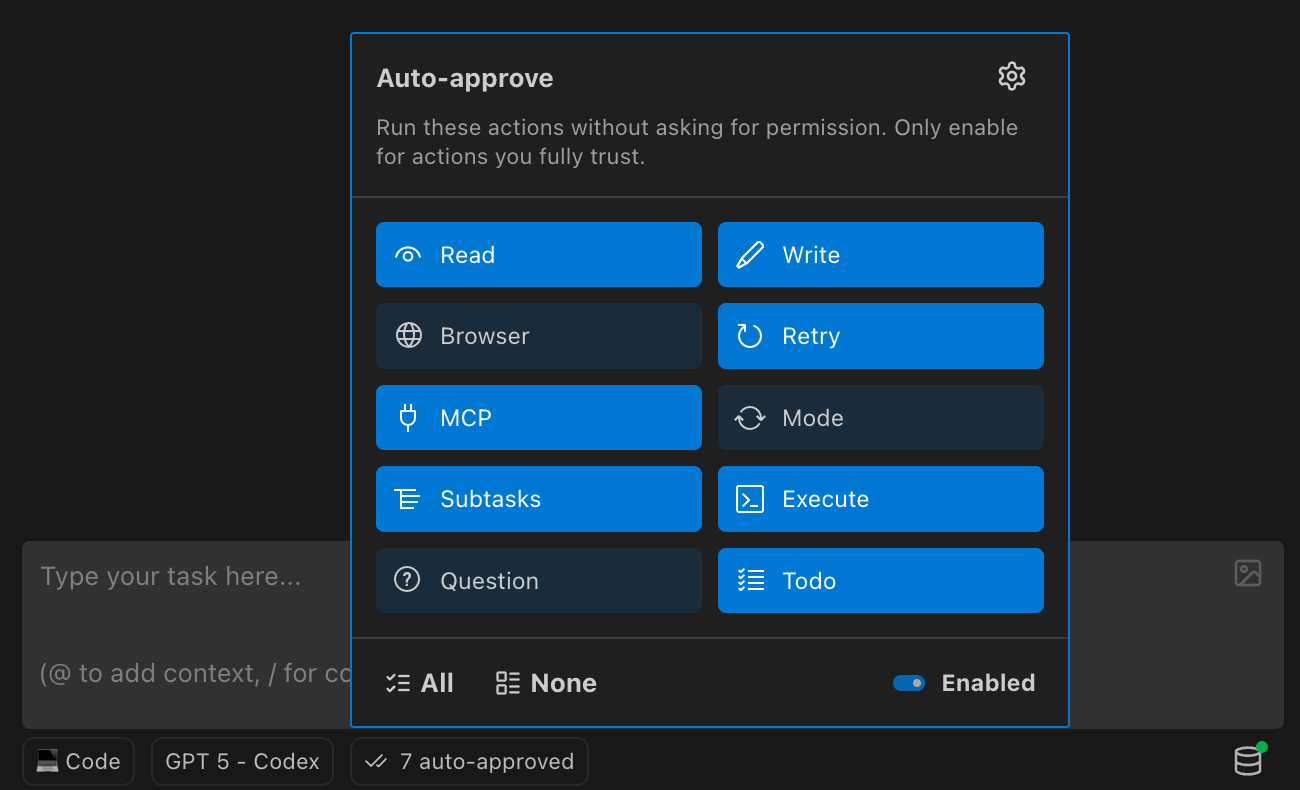
Prompt in, tool calls out -- and you decided, tool by tool, how much you trusted it.
The design intent was clearly "autonomy you dial in yourself," not "autonomy by default." That's the opposite instinct from where the team's own later thinking went with Roomote -- an agent that runs unattended in the cloud and hands you a finished PR to review after the fact. Both are legitimate philosophies; they're just not the same product, and conflating them is the single easiest mistake to make when reading Roo Code coverage written after April 2026.
Real automation, with a real undo button -- Checkpoints were the safety net auto-approve needed.
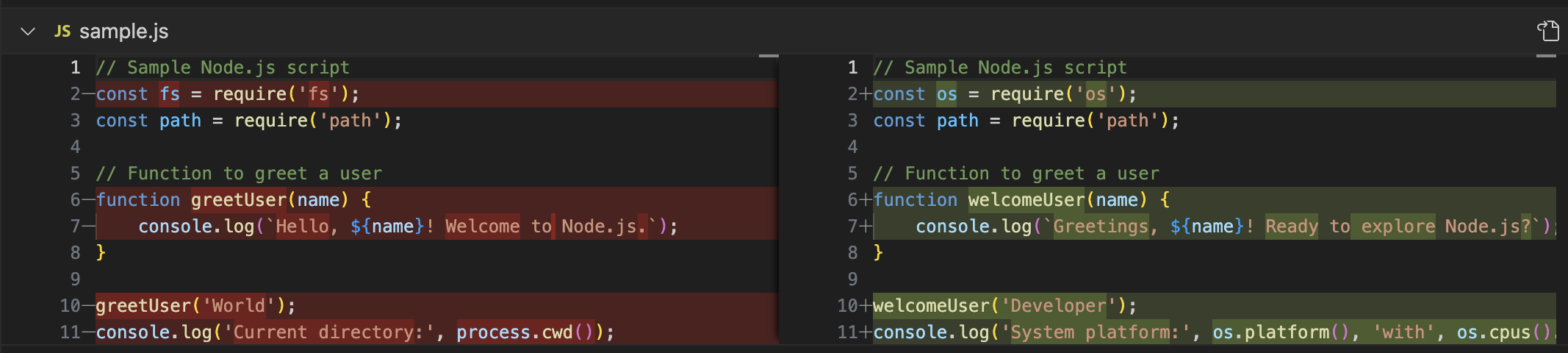
Beyond file editing, Roo Code's documented tool set included terminal command execution, a browser-automation tool (for tasks like loading a rendered page, clicking through a UI, or checking console output while debugging a front end), and MCP tool/resource calls. Because any of those can go wrong unattended, Roo Code paired them with Checkpoints: automatic, versioned snapshots of your workspace taken during a task, stored in a shadow Git repository completely separate from your project's real version control. You could view a diff against any checkpoint or restore your files (and even the task's own chat history) back to that point -- a meaningfully different safety model than just hoping Ctrl+Z covers you.
Model-agnostic by design, and an early, genuine MCP client -- not a single-vendor lock-in tool.
Roo Code implemented the Model Context Protocol as a client, supporting both local STDIO connections and remote Streamable HTTP/SSE transports, per its own documentation -- meaning any MCP server (databases, custom internal APIs, specialized tooling) could be wired in and exposed to the agent as additional tools, on top of its built-in capabilities. Provider support was unusually broad for the category: named integrations included Anthropic, OpenAI, Google Gemini/Vertex, AWS Bedrock, OpenRouter (100+ models through one key), DeepSeek, Groq, Mistral, xAI, Moonshot, Qwen, and fully local inference via Ollama or LM Studio for offline/air-gapped use.
| Category | What it enabled |
|---|---|
| MCP (Model Context Protocol) | Connect Roo to databases, internal APIs, or any custom tool a server exposes -- extending it past its built-in tool set |
| Codebase Indexing | Semantic, embeddings-based search across large projects -- required your own OpenAI API key plus a Qdrant vector database, a real setup cost the docs didn't hide |
| In-editor Marketplace | Browse and install community MCP servers and custom-mode configurations without leaving VS Code |
| .rooignore | Explicitly block Roo from ever reading specified files or paths -- the equivalent of a .gitignore for the agent's own context |
There was never a Roo Code markup -- your real bill was always whatever your model provider charged.
| What you were doing | What you actually paid |
|---|---|
| Running the core extension | $0 to Roo Code -- Apache 2.0, bring-your-own API key, no markup on tokens |
| Calling a first-party model | Whatever Anthropic/OpenAI/Google/etc. charged you directly for input + output tokens |
| Running fully local via Ollama/LM Studio | $0 in API fees -- only your own hardware cost |
| Codebase Indexing on a large repo | Your own OpenAI embeddings-API usage, plus hosting a Qdrant vector database yourself |
| Opting into Roo Code Cloud (historical) | $20-$99/mo plus $5/hr for cloud-run tasks -- the only layer Roo Code itself ever charged for, and it's gone |
No SOC 2 badge here -- the real security story was a genuinely granular, locally-controlled permission model.
Roo Code wasn't a hosted SaaS handling your data on someone else's servers by default -- it was a client-side VS Code extension that read and wrote to your real filesystem and ran real shell commands, using whichever model provider you configured. That makes the actual risk surface different from a cloud tool: the question isn't "do I trust Roo Code's infrastructure," it's "how much unattended authority did I grant the agent itself." Its own documentation was unusually direct about this. Auto-approve settings covered eight separate permission categories -- file reading, file writing, command execution, browser use, MCP tool use, mode switching, subtask creation, and follow-up questions -- each independently toggleable, with extra controls like command allowlists/denylists and a write-operation delay slider that gave you a moment to catch a bad edit before it landed.
Roo Code, Inc. also carried the standard open-source-tool disclaimer worth knowing about verbatim: the GitHub README states the software is provided "AS IS" and "AS AVAILABLE," with no warranties regarding code, models, or other tools, and that users assume all risks including potential intellectual-property issues and security vulnerabilities. That's boilerplate in this category, but it's a real, meaningful contrast with any tool that carries its own SOC 2/ISO 27001 certifications and formal liability -- Roo Code never claimed either, and its actual security model was entirely about how carefully you configured your own permissions.
Not a buying guide anymore -- a decision guide for people who still land on this name.
| Why you're here | What's actually true now | What to do |
|---|---|---|
| An old tutorial/blog told you to install "Roo Code" | It still technically installs from the Marketplace, but is unmaintained and carries its own shutdown notice | Install Cline or Zoo Code instead |
| You were an active Roo Code Cloud subscriber | Cloud and Router shut down May 15, 2026; unused balances were refunded | Contact billing@roocode.com for account questions, per the official notice |
| You loved the mode system and Orchestrator specifically | Zoo Code forked at that exact point and kept the same settings structure | Migrate to Zoo Code -- config compatibility is the whole point |
| You want the most actively funded, fastest-moving heir | Kilo Code raised $8M (Dec 2025), added inline autocomplete and multi-surface support | Evaluate Kilo Code directly |
| You're curious what Roo Code's own team believes in now | Roomote -- a genuinely different, no-IDE, Slack/GitHub-native cloud agent | Only choose this if you actually want that category, not an IDE extension |
Four real limitations -- one of them bigger than any bug ever was.
No security patches, no bug fixes, no new model support, ever again. Whatever Roo Code does today is permanently frozen at v3.54.0.
Context-window token-count inaccuracies and a backend that sometimes ignored your configured context-size setting were open, acknowledged GitHub issues -- not resolved cleanly before the shutdown made them moot.
The product's own docs flagged command execution and file writes as highest-risk; a misconfigured allowlist plus full auto-approve is a real way to lose work or leak data, and there's now nobody maintaining guardrails against new failure modes.
As one Hacker News commenter noted the day of the announcement, competing on top of a repo you don't originate has weak moats -- a real, disclosed part of why the team ultimately looked elsewhere entirely.
Three of Roo Code's heirs are alive and actively developed. A fourth is the team's own new bet.
| If you mostly need... | Compare with... |
|---|---|
| The original, most-actively-developed parent project, largest community | Cline -- see our Cline review (57.9k+ GitHub stars, 5M+ installs) |
| Roo Code's exact modes, Orchestrator, and settings, kept alive | Zoo Code -- direct community fork at zoocode.dev, Apache 2.0, config-compatible |
| Inline autocomplete plus VS Code, JetBrains, and CLI from one team | Kilo Code -- separately funded ($8M seed), ~1.5M users as of mid-2026 |
| A polished, proprietary, fully-managed AI IDE instead of an extension | Cursor -- see our Cursor review |
| The mainstream, IDE-agnostic default most teams already pay for | GitHub Copilot -- see our GitHub Copilot review |
| A no-IDE, cloud-native agent that hands back a finished PR (what Roo Code's own team now believes in) | Roomote -- roomote.dev, from the original Roo Code team |
No affiliate relationship shapes this review -- and there's no live product to be paid to promote.
JAVIS has no publisher affiliate program with Roo Code, Inc., Roomote, Zoo Code, or Kilo Code. Every CTA in this article points to a real official source -- roocode.com's own current redirect, the archived GitHub repo, or the specific successor product being discussed.
See exactly what the team itself said.
Read the archived repoGo straight to the decision guide.
See alternativesRoo Code's story only makes sense next to the project it forked from and the mainstream tools people compare it against.
If you're deciding what to actually install this week, these are the six reviews most worth reading alongside this one.


Kiro (AWS's AI IDE) is mentioned by name only in the Alternatives table above.
Questions people are actually searching right now
Is Roo Code still available to install?
The VS Code Marketplace listing (RooVeterinaryInc.roo-cline) is technically still there and installable, but it's frozen and unmaintained -- the official listing itself displays a notice that "The Roo Code Extension was shut down on May 15th," directing users to Zoo Code or Cline instead. There will be no more updates, bug fixes, or new model support.
Why did Roo Code shut down?
Co-founder and CEO Matt Rubens announced on April 21, 2026 that the team no longer believes IDE-based coding is the future, and that by fall 2025 they were already running Roo Code themselves headlessly, in cloud containers with full auto-approve -- effectively not using it as an editor extension. Rather than continue supporting the IDE product, the team shut it down on May 15, 2026 to focus entirely on Roomote, a cloud-native coding agent.
What happened to Roo Code Cloud and Roo Code Router?
Both shut down alongside the extension on May 15, 2026. Any unused Cloud balance was refunded. The docs page that used to cover Cloud billing now redirects to a general BYOK cost/rate-limits page, consistent with the Cloud service no longer existing.
Was Roo Code really a fork of Cline?
Yes, confirmed directly by both projects. Roo Code began in late 2024 as an internal fork of Cline (initially named "Roo Cline"), built inside the veterinary-staffing tech company Roo. When Roo Code shut down, Cline publicly stated the two projects were "glad to be home for their users."
What should I use instead of Roo Code?
Cline (the original project), Zoo Code (a direct, config-compatible community fork of Roo Code), and Kilo Code (a separately funded, further fork with inline autocomplete and multi-surface support) are the three most directly comparable, actively maintained options as of this review.
Is Zoo Code the same company as Roo Code?
No. Zoo Code is an independent community project, started by former contributors after Roo Code's team archived the repository. It reuses the same Apache 2.0 codebase and settings structure but is not operated by Roo Code, Inc. or the Roomote team.
What is Roomote, and is it a replacement for Roo Code?
Roomote is the Roo Code team's new product: a source-available, self-hostable cloud coding agent that runs tasks end-to-end (via Slack, GitHub, and Linear) and hands back a reviewable pull request, rather than living inside your editor. It's built by the same team and company, but it is a genuinely different product category, not a like-for-like replacement for the VS Code extension.
How much did Roo Code cost when it was active?
The core extension was always free and open source (Apache 2.0, bring-your-own API key, no Roo Code markup on model costs). The optional Roo Code Cloud layer, discontinued May 15, 2026, historically ran Free/$20-Pro/$99-Team per month plus $5/hour for cloud-run tasks.
Where this came from, and when it was checked.
Current repo/archive status, README, shutdown notice, license, star/fork counts: github.com/RooCodeInc/Roo-Code, official, read directly, Sep 29, 2026.
Domain redirect (roocode.com → roomote.dev): direct check of roocode.com, confirmed 301 Moved Permanently to roomote.dev, Sep 29, 2026.
Archived documentation (installation steps, FAQ, features, modes, checkpoints, auto-approve, MCP, rate-limits/costs, all screenshots used): roocodeinc.github.io/Roo-Code (official archived docs mirror, redirect target of docs.roocode.com), multiple pages read directly, Sep 29, 2026.
VS Code Marketplace listing (install count, rating, review count, version): marketplace.visualstudio.com/items?itemName=RooVeterinaryInc.roo-cline, Sep 29, 2026.
Roomote product description, features, pricing: roomote.dev and roomote.dev pricing section, official, Sep 29, 2026.
Zoo Code description, license, pricing model: zoocode.dev, official, Sep 29, 2026.
Cline comparison stats (GitHub stars, installs/developers): cline.bot official site plus independent 2026 comparison coverage (wetheflywheel.com, tech-insider.org), cross-checked for consistency.
Kilo Code funding, user count, feature claims: kilo.ai official blog/compare pages and independent coverage (blog.kilo.ai "The AI Coding Shakeout Is Here" by Brendan O'Leary), cross-checked.
Shutdown announcement, timeline, and direct Matt Rubens quotes ("we are not shutting down Roo Code because we failed...", "we don't believe IDEs are the future of coding"): x.com/mattrubens/status/2046636598859559114 (primary), corroborated by thenewstack.io reporting and multiple independent 2026 tech-press writeups, cross-checked for wording consistency.
Community/developer reaction to the shutdown: news.ycombinator.com/item?id=47851734, read directly, Sep 29, 2026 (comments from users "minimaxir" and "KronisLV"); Cline's own public response quoted via corroborating secondary coverage, since the original social post could not be read directly.
Real, documented product bugs (context-window token count, ignored context-size setting, Moonshot token-limit fix): github.com/RooCodeInc/Roo-Code/issues #6004 and #4475, and the v3.26.7 release notes, searched directly.
Founding company (Roo, veterinary relief staffing), rename from Roo Cline to Roo Code, 50,000-install milestone, Matt Rubens' role as co-founder/CEO: archived GitHub README/about pages, cross-checked against independent 2026 coverage (Hacker News item 42931786 from the project's early days, and multiple 2026 comparison writeups).
$5M seed round, closed Jul 14, 2025: Tracxn company-funding data (tracxn.com), a third-party financial aggregator, not an official Roo Code disclosure -- flagged as such.
Historical Roo Code Cloud pricing (Free/Pro $20+$5/hr/Team $99+$5/hr): cross-referenced across multiple secondary sources describing the product's own former docs.roocode.com pricing/team-plan pages; the original first-party pages are no longer reachable post-shutdown (they now redirect to a general BYOK cost page), so this is disclosed as an archival/secondary read rather than a fresh first-party read.