
Mintlify Review 2026: Polished Docs-as-Code, a Free Tier Without AI, and a $450 Step Up
Mintlify turns a Git folder of Markdown into a hosted documentation site that people and AI agents can read. As of Oct 30, 2026 the free Starter plan covers hosting, a custom domain and the web editor, while every AI feature sits behind Pro at $450 a month billed annually. This review works out what the credits really cost, what changed in 2026 and how much weight to give two security incidents.

There are no affiliate links in this review. Every Mintlify link goes straight to mintlify.com or its documentation.
| Made by | Mintlify (San Francisco, founded 2022, YC W22) |
| What it is | Hosted docs-as-code platform with AI assistant and agents |
| Pricing | Starter free; Pro $450/mo annual or $540 monthly; Enterprise by quote |
| Catch | Steep jump to Pro; security history; pricing changed three times in a year |
| Evidence | Official docs and pricing; 2 Trustpilot reviews; Hacker News |
Mintlify is the slickest way to publish developer docs from a Git repo, but the free plan stops exactly where the AI starts, and Pro costs $5,400 a year.
“Starter is free. Try Pro for 14 days with 5,000 credits.” That line on Mintlify's pricing page, as of Oct 30, 2026, is the whole buying decision in miniature.
Mintlify hosts documentation written as Markdown (MDX) files in a Git repository, with a web editor for people who do not want to touch Git, an API playground built from OpenAPI files, and a search MCP server so AI tools such as Claude, Cursor and ChatGPT can query the docs. The free Starter plan includes all of that for up to 5 editor seats. The AI layer (the reader-facing assistant, the writing agent, automations and the new Autopilot agent) is Pro only, at $450 a month billed annually or $540 billed monthly, with 10,000 AI credits a month and unlimited editor seats.
Three things deserve a decision before you commit. First, there is no middle tier: you go from $0 to $5,400 a year the moment you want the assistant or a sixth editor. Second, pricing has been rebuilt three times in ten months: an archived copy of the pricing page from Dec 28, 2025 shows a Pro plan at $300 a month, a Jun 13, 2026 copy shows a free Starter plan whose card listed the assistant and the writing agent, with 5,000 credits to try them, and by Sep 4, 2026 AI had moved to the new $450 Pro plan. Third, security history matters for a platform that sits on your domain: GitHub tokens were exposed in a Mar 2024 incident, and in Nov 2025 researchers found a cross-site scripting flaw that could run code on customers' own domains, which Mintlify fixed within 45 minutes and wrote up openly.
Not a hands-on test: JAVIS has not created a Mintlify account or published a site. This review is built from Mintlify's pricing page, documentation, changelog, blog, trust center and status page, archived copies of its pricing page, competitors' pricing pages, Trustpilot and Hacker News, all dated Oct 30, 2026 unless stated.
Markdown in Git goes in; a hosted site, a search MCP server and an AI assistant come out.
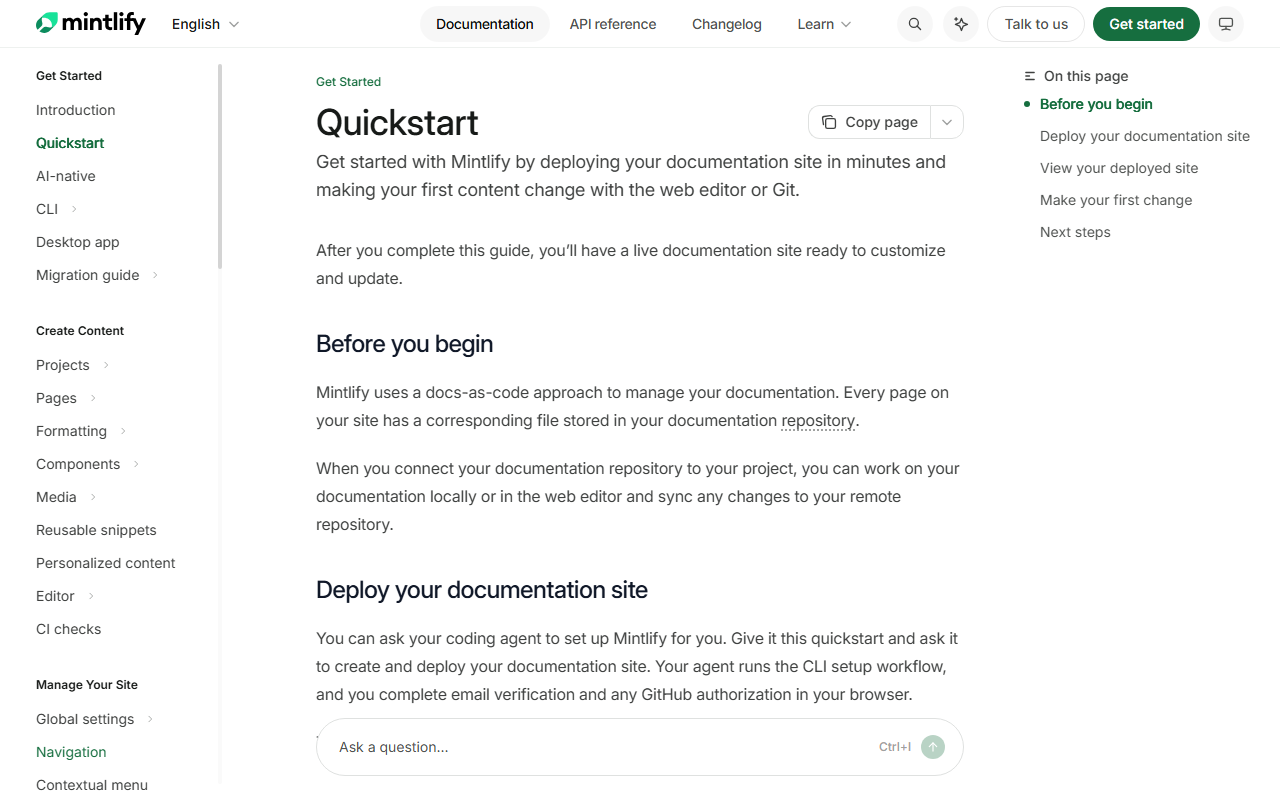
Every page is an .mdx or .md file and site settings live in docs.json, per the pricing FAQ. You connect your own GitHub or GitLab repository (or let Mintlify host one), and each push rebuilds the site. Readers get the website; AI agents get a generated search MCP server and a Markdown version of each page. On Pro, the writing agent edits pages from the web editor or Slack, automations run scheduled or triggered jobs, and Autopilot opens pull requests when your code changes.
A $500M company that now sells docs as “knowledge infrastructure” for AI agents.
Mintlify was started in 2022 by co-founders including Han Wang, and it went through Y Combinator's W22 batch. On Apr 14, 2026 it announced a $45 million Series B at a $500 million valuation, led by Andreessen Horowitz and Salesforce Ventures, bringing total funding to $67 million. The same post says Mintlify powers documentation for more than 20,000 companies and reaches more than 100 million people a year. Those are company counts and reader counts the vendor reports, not paying customers.
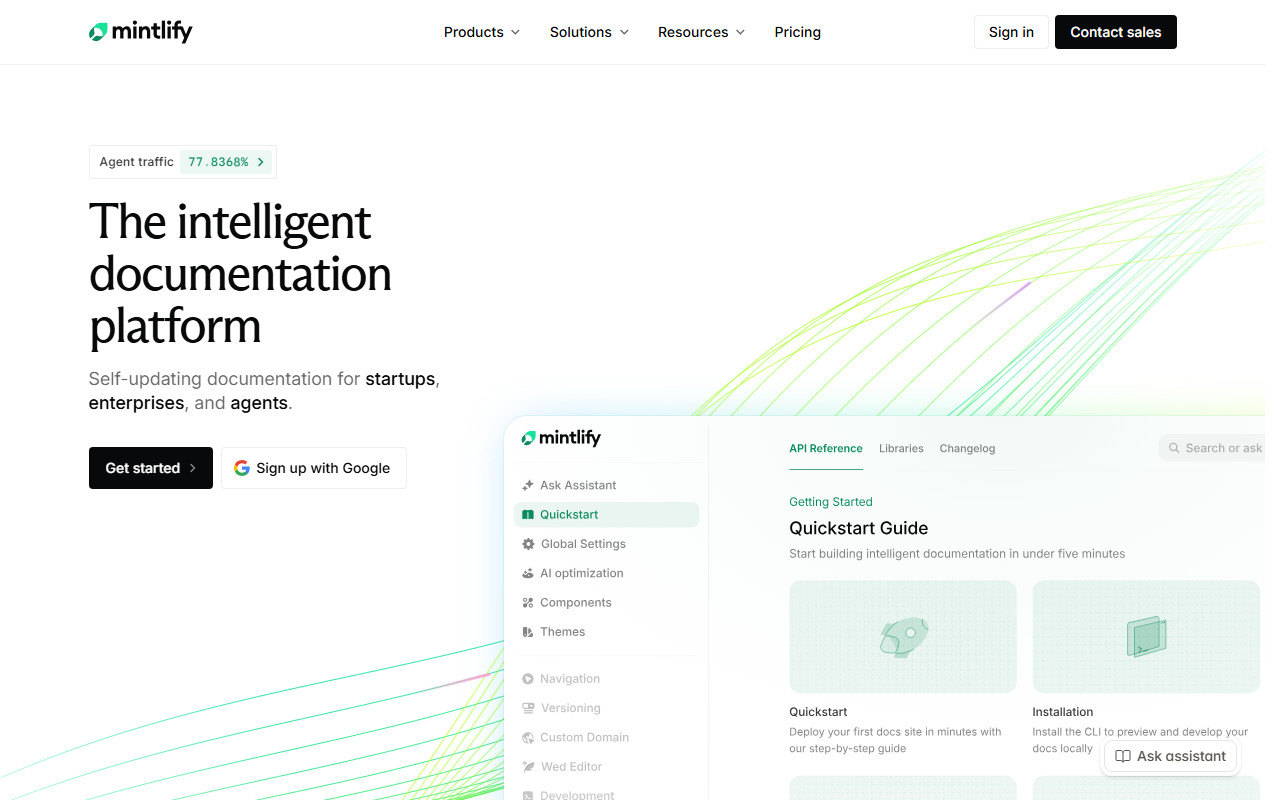
The pitch has shifted from “beautiful docs” to docs for AI agents. In April Mintlify said “nearly 50%” of documentation traffic came from AI agents; its Oct 29, 2026 Base announcement says agents now account for “more than three-quarters” of traffic to the docs it hosts, and the homepage counter read 77.8% on Oct 30. These are Mintlify's own measurements. Two of its marketing claims also disagree with each other: the pricing page says it powers “40% of the Forbes AI 50”, while the startups page says “the majority of the Forbes AI 50”.

Mintlify has also been buying. It acquired Trieve, a retrieval (RAG) search company, on Jul 24, 2025, and announced on Mar 3, 2026 that it was acquiring Helicone, an open-source LLM observability platform, with Helicone moving to maintenance mode. On Oct 30, 2026, helicone.ai carries a banner saying “Helicone is no longer part of Mintlify. Details to come soon.” Neither company has published an explanation, so treat it as unresolved; it does not affect Mintlify's docs product directly, but it is worth knowing if you used Helicone.

Praised for how docs look and how little upkeep they need; the loudest public discussion is about security, and the rating samples are tiny.
Mintlify's Trustpilot profile is unclaimed and has 2 reviews, both 5-star, with a TrustScore of 3.8 as of Oct 30, 2026; that is far too few to rate anything. We have not used G2. The richer public record is Hacker News, where the two biggest Mintlify threads are about security incidents, and smaller comments touch on price. Claims below are individual accounts we cannot verify.
“Great website with large free features”, followed by: “It is sometimes really complicated for simple things and I'm lost.”
Under a launch of a cheaper hosted docs tool: “yes, mintlify is too expensive for me. i'll try it!”
“Im on their free plan and it gets the job done”
On the Nov 2025 flaw: “This is a pretty scary exploit, considering how easily it could be abused.”
A more sceptical reader: saying every customer was vulnerable to account takeover “strikes me as specious to say the least.”
A former customer: the GitHub app “asked for permissions to access all my repos”. An open-source maintainer: “I've honestly been pretty happy with it overall”.


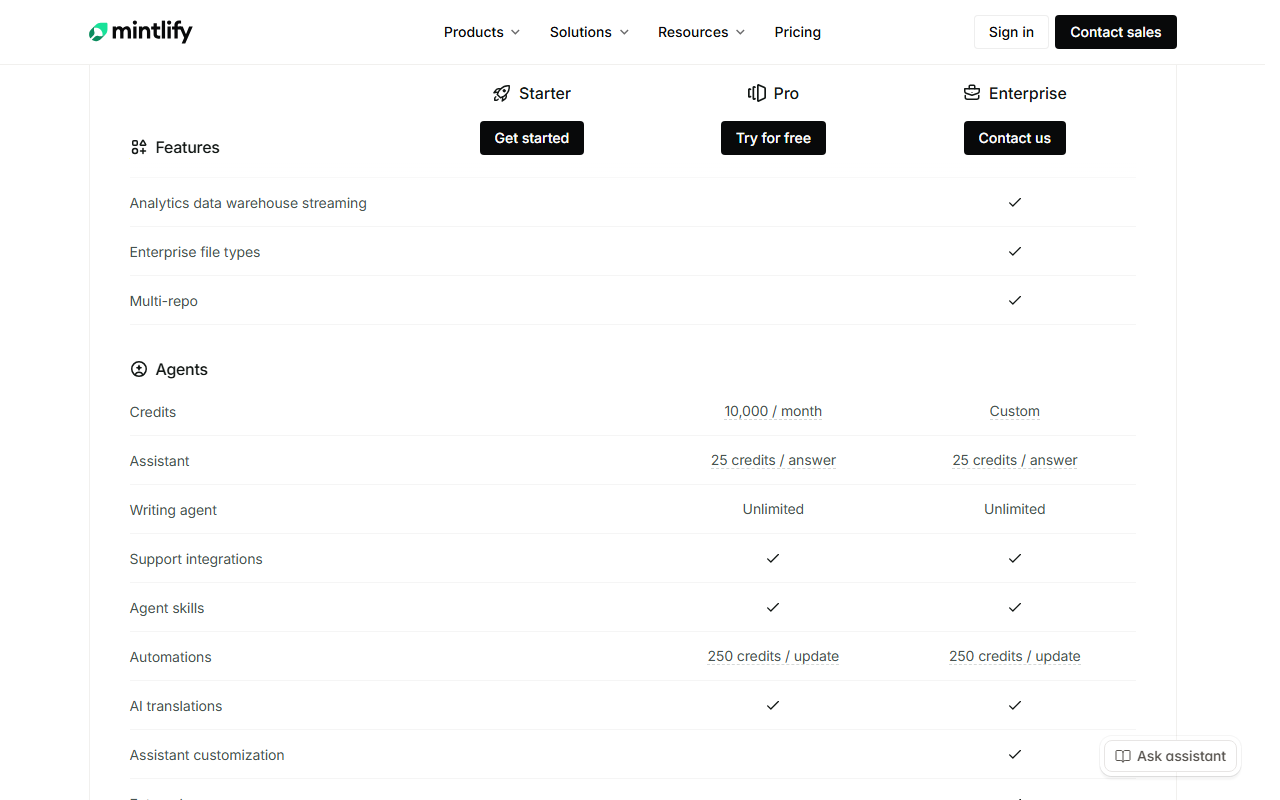
Starter is free, Pro is $450 a month on an annual plan, Enterprise is by quote, and AI runs on credits.
As of Oct 30, 2026, mintlify.com/pricing lists three plans for documentation projects:
- 5 editor seats
- Hosting, custom domain, web editor, Git sync
- Search MCP server, API playground
- Mintlify auth only
- No AI features; credits cannot be bought
- Billed annually; $540/mo billed monthly
- Unlimited editor seats
- Assistant, writing agent, automations, Autopilot (beta)
- 10,000 credits a month, $0.01 per extra credit
- Preview deployments, analytics, webhooks, password auth
- SSO, SCIM, role-based permissions, audit logs
- OAuth or JWT reader login, BYOK
- Self-hosting and EU hosting “available”
- Custom SLAs, migration services

How the AI credits work
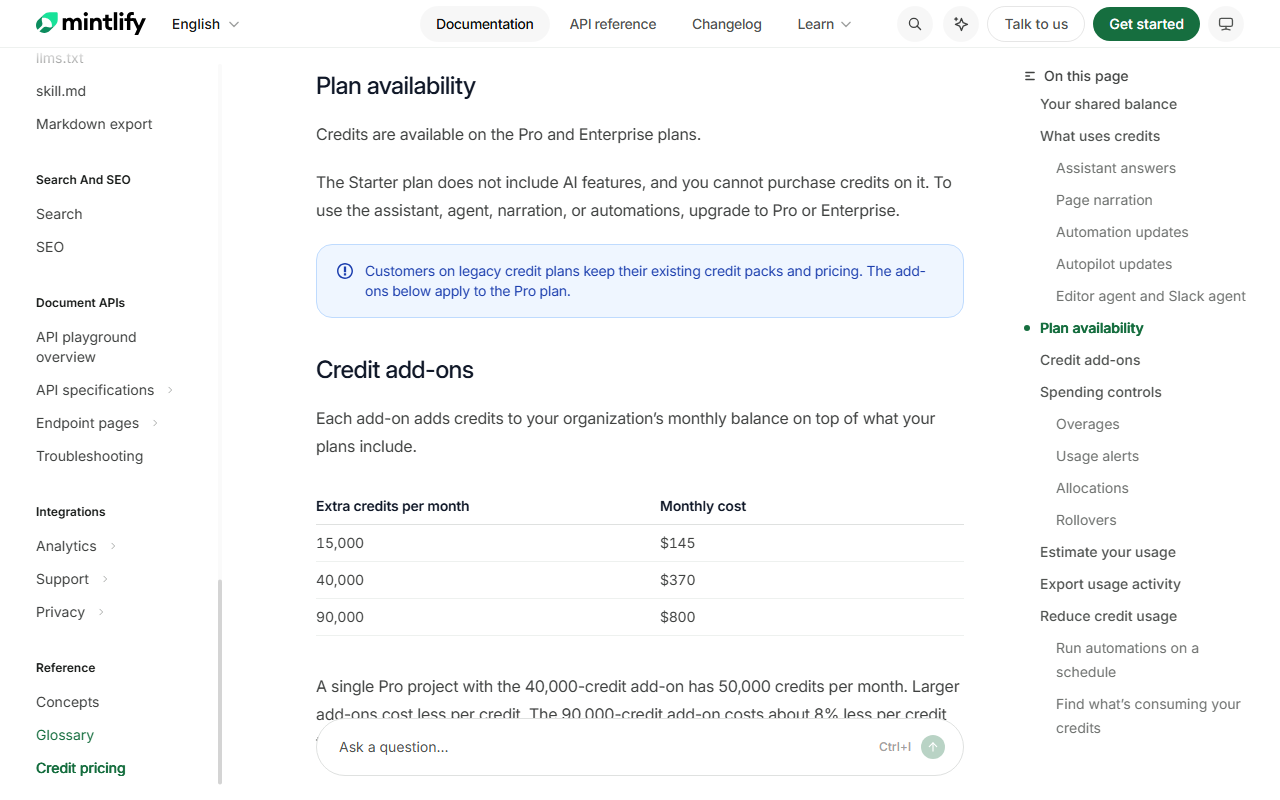
Since Sep 8, 2026 every AI action has a fixed credit price, per Mintlify's credits documentation (before that date, cost varied with the tokens each run used). The writing agent in the editor and in Slack is free on Pro. You pay only when an action produces a result:
| Action | Credits | At the $0.01 overage rate |
|---|---|---|
| Assistant answers a question | 25 | $0.25 |
| Assistant cannot answer | 0 | $0 |
| Narration generates a page's audio | 50 | $0.50 |
| Automation or Autopilot updates your docs | 250 | $2.50 |
| Run finds nothing to update | 0 | $0 |
From mintlify.com/docs/credits, Oct 30, 2026.

Credits pool across your organization. Overages are off by default and set per project; with them off, AI features pause until the next cycle, and with them on you can cap the spend in dollars. Up to half of unused credits roll over, to a maximum of 1.5 times your monthly balance, but rollovers reset when you change add-ons. Add-ons cost $145 for 15,000 extra credits a month, $370 for 40,000 and $800 for 90,000, the largest you can buy yourself.
Trial and discounts
New accounts get Pro free for 14 days with 5,000 credits and no card; the trial ends at 14 days or when the credits run out, whichever comes first, and the site then stays live on Starter. Non-commercial open-source projects that are not venture-backed or company-maintained can apply for Pro free; venture-backed startups founded in the last 2 years that have raised under $2 million and never paid Mintlify can apply for 50% off Pro for 12 months, which works out to $225 a month on the annual price.
One caution on plans and projects
Mintlify's credits page describes an organization “with two Pro projects” starting each month with 20,000 credits, which suggests a Pro plan attaches to each docs project rather than to the whole account. If you run more than one public docs site, confirm with sales whether each needs its own Pro plan. The new Base knowledge-base product also has “its own Starter, Pro, and Enterprise plans, separate from the plans for your docs projects”, and its Pro price is not published.
Three pricing structures in ten months: plan for the next change.
Archived copies of the pricing page show how fast the model has moved. On Dec 28, 2025 there was a free Hobby plan for individuals and a Pro plan at $300 a month with 5 dashboard members and $20 a month per extra member. By Jun 13, 2026 there were only two plans: a free Starter plan whose card listed the assistant, the writing agent and workflows, with 5,000 credits to try them, and Enterprise. By Sep 4, 2026 the AI features had moved to a new Pro plan at $450 a month, and on Sep 8 credits switched to fixed prices. Customers on legacy credit plans keep their packs and pricing, per the credits page.
For a team that was on the Dec 2025 Pro plan, the monthly list price for AI features has gone from $300 to $540 on monthly billing (80% higher), though seats are now unlimited. Lock in annual terms if you are happy with the product, and read the renewal clause.
Worked examples: the seat price is flat, so Mintlify gets cheaper per editor as a team grows; credits rarely bite.
These are invented workloads with the arithmetic shown, using list prices on Oct 30, 2026.
A five-person startup that only wants a docs site
Starter covers 5 editor seats, a custom domain and the search MCP server for $0. The sixth editor, the assistant or preview deployments each force Pro: $450 a month on an annual plan ($5,400 a year) or $540 on monthly billing ($6,480 a year), a $1,080 difference. If the startup qualifies for the Startup Program, Pro is $225 a month for the first 12 months.
A product team with an assistant on its docs
Pro's 10,000 monthly credits buy 400 assistant answers, or 40 automation or Autopilot updates, or a mix. Mintlify's own example, 200 answers and 12 updates, uses 8,000 credits and fits. A busier month of 1,000 answers and 20 Autopilot pull requests uses 25,000 + 5,000 = 30,000 credits, 20,000 over the plan: $200 in overages at $0.01, or $195 with the 15,000-credit add-on ($145) plus $50 of overage, or $370 with the 40,000 add-on, which leaves room to spare. Answers the assistant cannot give are free.
Against GitBook's Ultimate plan, which charges per site plus $12 per user, Mintlify's flat Pro price is higher for small teams and lower from about 17 editors (249 + 12 × 17 = $453). For a 5-person team on a budget, GitBook's Essential plan ($65 plus $12 per user, so $125) or ReadMe's free Starter are much cheaper ways to get a branded site.
The takeaway: the credit system is predictable and cheap relative to the plan fee (an assistant answer costs 22 to 25 cents at the margin). The real cost decision is the $450 floor, not the credits.
Match your situation to one line.
A docs site builder, an AI layer and an agent-facing interface in one product.
MDX pages with built-in components, OpenAPI-driven API reference and playground, custom domain, search, versions and languages, preview deployments (Pro), changelogs, and a desktop app. Migration tooling for ReadMe and Docusaurus.
The Pro assistant searches your published docs and OpenAPI specs, cites pages, reads images on pages, generates code examples, and says when it cannot answer (free). It can be embedded as a widget or called through an API.
A generated search MCP server per site, a Markdown version of every page, an admin MCP server that lets trusted agents edit content, and AI-readable site index files.
The assistant answers only from your docs; Mintlify's pricing FAQ says it uses third-party model providers and that none of them train on your data. It does not index draft branches or preview deployments.

From empty folder to live docs, the docs-as-code way.
On Oct 28, 2026 Mintlify went further: mint deploy lets an agent such as Claude Code, Cursor or Codex publish a live site at a mintlify.site address from the terminal, with no account or GitHub repository. You then have 24 hours to claim it; an unclaimed site and its hosted repository are deleted. Deploying is free, and claiming a first site starts a Pro trial.

The headline feature of late 2026: an agent that watches your code and proposes doc updates.
Autopilot entered beta on Oct 20, 2026 for Pro and Enterprise. It reads your repositories (GitHub, gitlab.com or self-hosted GitLab) and, on Pro, Slack; Enterprise can connect more sources such as project trackers, support tickets and feature flags. When merged code changes, it drafts a documentation update, opens a pull request, tags reviewers and emails them; by default it also runs a daily quality check. Each pull request it opens or updates costs 250 credits, and runs that find nothing cost nothing. It does not publish on its own.

Automations are the older, manual version: you write the instructions and choose a schedule, a webhook or an event trigger, and each run that changes docs costs 250 credits. Mintlify's own advice is to run checks such as broken-link or style audits on a schedule so several changes land in one paid update. The credit math is benign (Pro's allowance covers 40 updates a month); the open question is quality, which only a trial on your own repository will answer. Mintlify cites its own “2026 State of Knowledge Report” claim that only 24% of teams update docs the same day; that is a vendor survey.
Built to be read by agents, and now a second product for internal knowledge.
Every plan, including Starter, gets a hosted search MCP server so readers can plug your docs into Claude, Cursor, ChatGPT and other MCP clients. The admin MCP lets trusted agents edit, restructure and publish; its tool names changed on Oct 16, 2026 (for example, save became publish), so scripts built on it need maintenance. The same Oct 16 changelog discontinued the Mintlify Index product and removed its CLI command. On Pro you also get webhooks, websockets, a developer API and analytics; Enterprise adds multi-repo projects, analytics streaming and, since Oct 21, React components from npm.
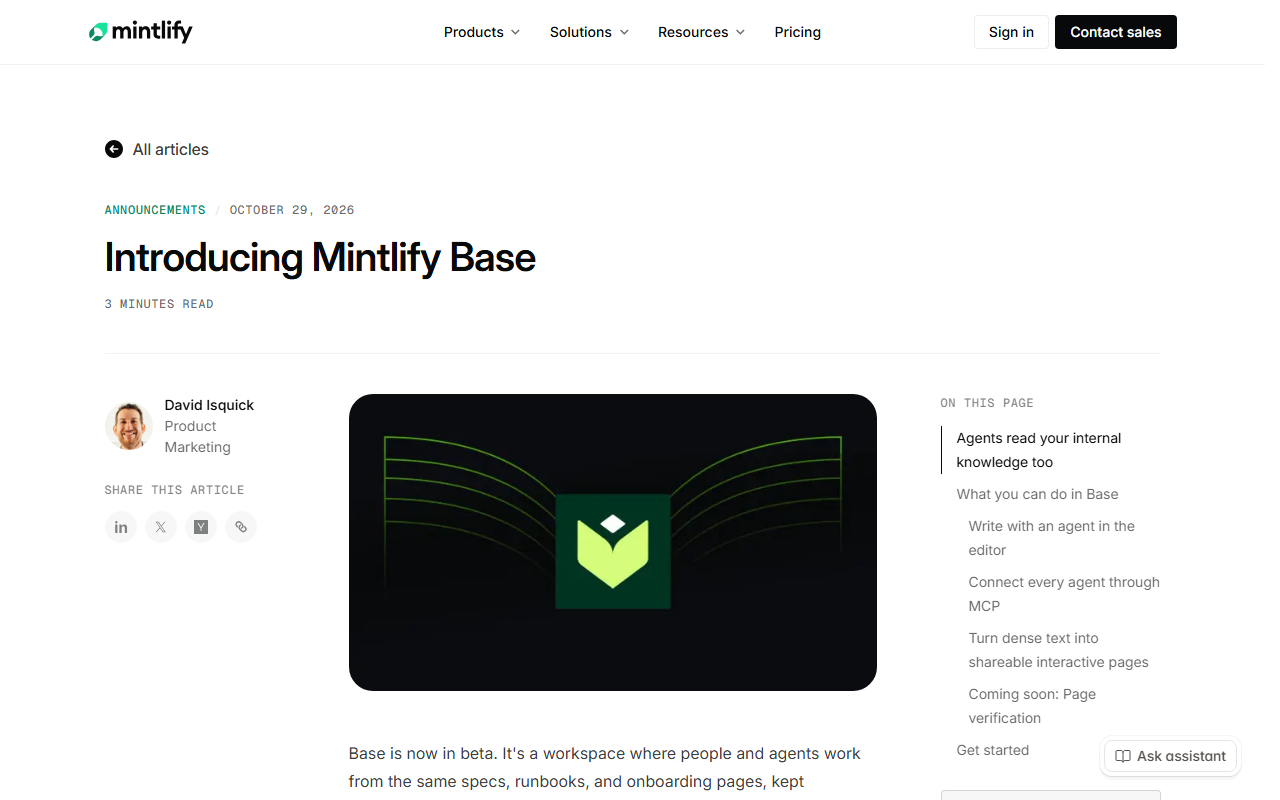
Base (beta since Oct 29, 2026) applies the same editor, agent and MCP server to an internal knowledge base: specs, runbooks and onboarding pages stored as Markdown in Git, with edits that merge without pull requests. It is a separate project type with separate plans: Starter allows 5 seats, under 1,000 pages and 100 admin MCP requests a week; Pro includes 15 seats and up to 10,000 pages, at a price you get from sales. Bases have no assistant, analytics, Autopilot or automations, and the page-verification feature is listed as coming soon.

APIs exist for the assistant, previews, automations and analytics; most are Pro features.
Mintlify's REST API can trigger preview deployments, trigger automations, embed the assistant in your own app, search docs, and export analytics such as page views split between human and AI traffic. Assistant answers through the API cost the same 25 credits as answers on the site. A static export of the whole site exists but, per the docs, is available only on Enterprise plans, which matters for lock-in: on Starter and Pro your exit path is the MDX source in your Git repository, which you own, plus rebuilding the site elsewhere.
Good paperwork and a candid incident write-up, after two serious incidents in 20 months.
Mar 2024: Mintlify's own incident report says an attacker obtained internal admin tokens, 91 GitHub tokens were compromised, and at least one customer repository was accessed. It revoked all GitHub tokens and rotated credentials. On Hacker News the same week, a former customer complained that the GitHub app asked for access to all repositories.
Nov 2025: researchers found that the static-asset path /_mintlify/static/ was not scoped per customer, so a malicious SVG uploaded by one customer could run JavaScript on another customer's domain. Mintlify was notified at 12:07 PT on Nov 12 and deployed a fix at 12:52 PT; follow-up reports over the next days found a path-traversal bypass, cross-subdomain data endpoints, server-side code execution through MDX, a downgrade attack and a dashboard IDOR, all fixed. Mintlify paid about $10,000 in bounties and says it found no evidence of exploitation. Customers most at risk were those serving docs on the same domain as their app (for example yourdomain.com/docs) with credentials in localStorage or wildcard cookies; sites on *.mintlify.app or a separate docs subdomain with scoped cookies were not at risk.

The paperwork is solid. The trust center lists a SOC 2 Type 2 report, an ISO 27001 certificate, a Data Processing Agreement dated Nov 26, 2025 and penetration-test summaries, and names AWS in Northern Virginia among subprocessors. One inconsistency: the pricing FAQ still says Mintlify is “currently in the process of being ISO 27001 compliant” while the trust center lists a certificate; ask for the certificate. We have not reviewed the SOC 2 report or the full terms.

Controls are tiered. Starter readers can only be gated with Mintlify's own login; Pro adds password protection; OAuth, JWT and SSO for readers, plus dashboard SSO, SCIM, role-based permissions, audit logs, IP allowlists and BYOK, are Enterprise only, as are self-hosting and EU hosting.

Reliability: the homepage claims “99.99% uptime across all services”; the public status page for Aug to Oct 2026 shows 99.91% for documentation sites, 99.77% for updates and 99.91% for the dashboard, with incidents on several days in October. The windows may differ, but the status page is the number to plan on.

Developer-facing companies that treat docs as code and want agents to read them.
API and developer-tool companies with engineers who like Git workflows; teams that want an assistant and agent-readable docs without building them; organizations with many contributors, where unlimited seats beat per-user pricing; open-source projects that qualify for free Pro.
Small teams that need AI but cannot justify $5,400 a year; non-technical writers who want a simple page builder (one Trustpilot reviewer found simple things complicated); buyers who need SSO, EU hosting or self-hosting without an Enterprise contract; anyone who must serve docs from the main app domain without careful cookie scoping.
Seven things to weigh before you rely on it.
$0 to $450 a month, with nothing between.
Three structures since Dec 2025; legacy terms vary.
Token leak in 2024, cross-domain XSS in 2025.
SSO, audit logs, EU hosting, static export.
Autopilot and Base in beta; Index shut; admin MCP renamed.
Forbes AI 50 share, ISO 27001 status and uptime differ by page.
JAVIS did not publish a site or run Autopilot.
Priced from each vendor's own page on Oct 30, 2026; the products differ, so the plans are not like-for-like.
| Option and when to pick it | What its own page says | JAVIS review |
|---|---|---|
| Mintlify Docs-as-code with AI agents | Starter $0 (5 seats, no AI); Pro $450/mo annual or $540 monthly, unlimited seats, 10,000 credits | This article |
| GitBook Block editor, per-site pricing | Free; Essential $65 per site plus $12 per user; Ultimate $249 per site plus $12 per user with $100 of AI credits (annual) | No live review yet |
| ReadMe API hubs with a cheaper paid tier | Starter $0; Pro $250/month billed annually; Ask AI add-on $150/mo | No live review yet |
| Fern Docs plus SDK generation | Free $0 with 10 team members, 1,000 pages and 250 AI credits a month; Enterprise custom. Postman acquired Fern (announced Jan 2026) | No live review yet |
| Docusaurus Free, self-hosted | Open-source site generator; you host and add any AI yourself | No live review yet |

For an internal knowledge base, Mintlify Base competes with tools such as Notion AI. If what you really want is for coding agents to read up-to-date library docs, an MCP server such as Context7 may solve that without hosting anything.
Five steps that keep cost, risk and lock-in under control.
This review has no affiliate links, and Mintlify did not see it.
JAVIS has no affiliate arrangement with Mintlify, so every link goes straight to mintlify.com, its pricing page or its documentation, without tracking parameters.
Hands-on status: JAVIS has not created a Mintlify account, published a site or run the assistant or Autopilot. Cost examples use invented workloads with the arithmetic shown, and independent review evidence is thin, as section 04 says.
Plans, credits and the full feature table.
Open Mintlify pricingQuickstart, credits and Autopilot pages.
Open Mintlify docsConnecting docs to AI agents? These reviews cover the nearest ground.
Each card opens a published JAVIS review.

Questions people ask before committing
Is Mintlify free?
Yes, the Starter plan is free with hosting, a custom domain, the web editor, a search MCP server, the API playground and up to 5 editor seats. AI features (assistant, writing agent, automations, Autopilot) need Pro.
How much does Mintlify Pro cost?
$450 a month billed annually ($5,400 a year) or $540 billed monthly, as of Oct 30, 2026, with unlimited editor seats and 10,000 AI credits a month. Extra credits cost $0.01 each or come in add-ons from $145 for 15,000.
What does the AI assistant cost per answer?
25 credits per answer, and nothing when it cannot answer. Inside the 10,000-credit allowance that is 400 answers a month; beyond it, about 22 to 25 cents an answer.
Is there a free trial?
Every new account gets Pro for 14 days with 5,000 credits and no card. The trial ends at 14 days or when the credits run out, and the site stays live on Starter.
Is Mintlify secure?
It has SOC 2 Type 2 and lists an ISO 27001 certificate, but it had a GitHub token incident in Mar 2024 and a cross-domain scripting flaw in Nov 2025, both disclosed and fixed. Host docs on a separate subdomain and limit the GitHub app to your docs repository.
Can I self-host Mintlify?
Self-hosting and EU hosting are listed as available on Enterprise only. On other plans your content stays portable as MDX in your own Git repository.
What is Mintlify Base?
A beta, launched Oct 29, 2026, for internal knowledge bases using the same editor, agent and MCP server, with separate plans; the Pro price is by quote.
What are the alternatives?
GitBook and ReadMe for hosted docs with cheaper entry plans, Fern (now part of Postman) for docs plus SDKs with a free plan, and Docusaurus if you want to host it yourself; see section 17.
Where this came from, and when.
Pricing and product: mintlify.com/pricing (cards, comparison table and FAQ); Mintlify docs on credits, assistant, search MCP, Autopilot, automations, Base, projects, quickstart and the changelog; blog posts on Autopilot (Oct 20), mint deploy (Oct 28) and Base (Oct 29, 2026); the OSS and startup program pages, all Oct 30, 2026.
Pricing history: Internet Archive copies of mintlify.com/pricing dated Dec 28, 2025, Jun 13, 2026 and Sep 4, 2026.
Company: Mintlify blog posts on the Series B (Apr 14, 2026), Trieve (Jul 24, 2025) and Helicone (Mar 3, 2026) acquisitions; helicone.ai banner, Oct 30, 2026.
Security and reliability: Mintlify incident reports of Mar 13, 2024 and Dec 18, 2025; security.mintlify.com; status.mintlify.com. We have not reviewed the SOC 2 report, the ISO certificate or the full terms of service.
Independent evidence: Trustpilot (2 reviews, 3.8); Hacker News story 46317098 and comments 46319454, 46318397, 46317789; story 39730255 and comments 39730929, 39730997; comments 48936767 and 48101535.
Competitors: gitbook.com/pricing, readme.com/pricing, buildwithfern.com/pricing and docusaurus.io, Oct 30, 2026. Cost examples are arithmetic on those prices with invented workloads.
Images: screenshots of public pages taken Oct 30, 2026, Mintlify's social card, and an official clip served from mintlify.com.
JAVIS Fit Score (68/100): editorial composite, 20 points each. Price clarity 14: a clear public price list and fixed credit prices, but three restructurings in a year and per-project plan rules to confirm. Capability 17: full docs platform, assistant, MCP and agents, with Autopilot and Base still in beta. Independent evidence 10: 2 Trustpilot reviews and a Hacker News record dominated by incidents. Security and data control 12: SOC 2, ISO listing and candid write-ups, against two serious incidents and Enterprise-only SSO and audit logs. Cost control and fit 15: hard credit caps, alerts and a generous free tier, offset by the $450 floor. It is judgment, not a measurement.
What this review does not cover: our own build, search or assistant quality tests; Enterprise and Base Pro prices; the outcome of the Helicone separation.