
Manus Review 2026: A Capable General Agent, Independent Again, With a Credit System You Should Read Before You Pay
Manus takes a goal (research a market, build a site, cut a video) and works on it in its own cloud computer until it hands back a finished file. As of Oct 30, 2026 Pro starts at $20 a month for 4,000 credits, there is a small free tier, and the company is independent again after China ordered Meta's $2 billion acquisition withdrawn. This review explains what credits buy, where users get burned and who should still sign up.

There are no affiliate links in this review. Every Manus link goes straight to manus.im or its help center.
| Made by | Butterfly Effect Pte. Ltd., Singapore |
| What it is | Autonomous agent for research, slides, websites, video and apps |
| Pricing | Free; Pro from $20/mo (4,000 credits); Team $20/seat |
| Catch | No cost estimate per task; credits reset monthly; thin support |
| Evidence | App Store US 4.7; Trustpilot 1.2 (209); Hacker News |
Manus is one of the most complete “give it a goal and walk away” agents you can buy, but you pay in credits you cannot estimate in advance, and its support record is the weakest part of the product.
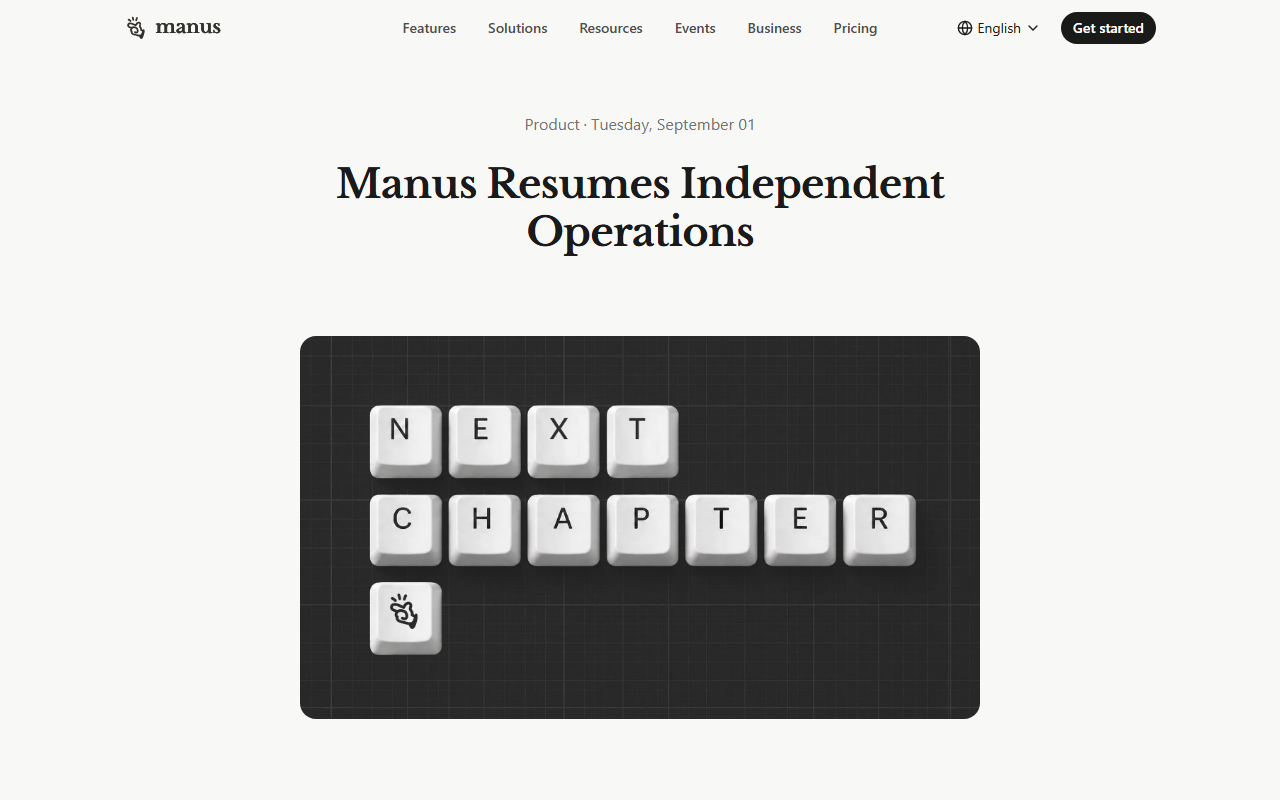
“Manus has formally resumed independent operations. Our founding team will continue to lead the company.” That Sep 1, 2026 post closed eight months in which Manus was bought by Meta, blocked by Beijing and split off again, with some users' data deleted on the way out.
Manus is a general-purpose AI agent from Butterfly Effect, a Singapore company founded by a Chinese team. You describe an outcome; Manus plans it, opens a cloud computer with a browser, terminal and files, and works until it delivers a report, a slide deck, a hosted website, a video or a small game. Manus 2.0, launched Sep 28, 2026, added a new agent harness called Cascade, event-triggered Automations, a paid Cloud Computer that stays on, a desktop Studio with a timeline Video Editor and Game Dev, and Computer Use on your own machine. Users rate the mobile app 4.7 on the US App Store (39,832 ratings) and 4.6 on Google Play in the US.
Three things deserve a decision before you pay. First, credits are the product: Pro starts at $20 for 4,000 credits a month, and Manus's own help center says it cannot yet tell you how many credits a task will use, while unused monthly credits are cleared at each renewal. Second, the company changed hands twice in a year: Meta announced it was acquiring Manus on Dec 29, 2025; on Apr 27, 2026 China's National Development and Reform Commission ordered the deal withdrawn, according to Reuters and CNBC; Manus deleted data some users created after Dec 29, 2025 on Aug 23 to 24, 2026 “to comply with regulatory requirements in specific jurisdictions”, and raised more than $500 million on its own in Oct 2026. Third, support is the most common complaint: Trustpilot shows 1.2 from 209 reviews, nearly all about billing, refunds and unhelpful automated support.
Not a hands-on test: JAVIS has not created a Manus account or run a task. This review is built from Manus's pricing page, help center, blog, Team page and trust center, US app store listings, Trustpilot, Hacker News and press coverage of the Meta deal, all as of Oct 30, 2026 unless a date is given.
Give it a goal, it works in its own computer, and every step spends credits.
Manus runs tasks asynchronously in the cloud, so you can close the app and get a notification when the work is done. Each task gets a virtual machine with a browser and code execution; Wide Research fans a job out to many sub-agents at once; connectors reach Gmail, Google Calendar, Notion, Airtable, Zoom, Shopify, Supabase and others. On the desktop app, “My Computer” lets it work with your local files and apps. Since Sep 29, 2026 Manus Flex lets you plug in your own API key from a supported provider (OpenRouter, Fireworks and Modal at launch); the model bill then goes to that provider, but tools and infrastructure still use Manus credits.

Bought by Meta, blocked by Beijing, independent again: the company behind Manus in 2026.
Manus moved its staff from China to Singapore in mid-2025, according to TechCrunch. On Dec 29, 2025 its blog announced “Manus is joining Meta”, saying the agent had processed more than 147 trillion tokens and created over 80 million virtual computers; the price was reported at more than $2 billion, and annual recurring revenue at over $100 million. China then reviewed the deal. In March 2026 the Financial Times reported, as cited by Bloomberg, that co-founders Xiao Hong and Ji Yichao had been barred from leaving China during the review; we have not found a report on whether that restriction still applies. On Apr 27, 2026 the foreign-investment security review office of China's National Development and Reform Commission said it would prohibit the foreign investment in Manus and require the parties to withdraw the deal, as reported by Reuters and CNBC. Meta told TechCrunch that “the transaction complied fully with applicable law.”
Manus told users on Aug 11, 2026 that it would return to independent operations and, “to comply with regulatory requirements in specific jurisdictions”, delete data that certain users generated on or after Dec 29, 2025, with a backup window, two days without access and a restore portal from Aug 25 (Singapore time). It said this was not a security incident and that its data is stored in the US and Singapore. The Sep 1 post confirmed independence under the founding team. On Oct 8, 2026 Butterfly Effect said it had raised more than $500 million, led by Boyu Capital and IDG Capital with Tencent, HSG (formerly Sequoia China) and ZhenFund, without disclosing a valuation (TechCrunch).

For a buyer, the practical risk is not who owns Manus today but how a regulatory dispute reached users: for a subset of accounts, months of work had to be exported and restored on a deadline. Keep your own copies of anything important.
App-store users rate it highly; people who write reviews elsewhere mostly complain about credits, refunds and support.
The two pictures disagree sharply. On the US App Store Manus averages 4.73 from 39,832 ratings and on Google Play in the US 4.6 from 518K reviews (10M+ downloads). On Trustpilot, an unclaimed profile, it scores 1.2 from 209 reviews, 94% of them one-star, all as of Oct 30, 2026. In-app prompts tend to collect quick ratings from satisfied users, while Trustpilot gathers people with a billing grievance, so neither is the whole truth; the complaints are consistent enough to take seriously. Claims below are individual accounts we cannot verify.

“I found there Deep Research quite good in terms of browsing the web, better than Gemini's. Though it blew through ~40$ in one task so it was very expensive”
“Too expensive & unpredictable credit system.”
A regular user says Manus finishes work on its own, “whereas I have to constantly babysit other tools.”
“On September 19, 2026, I paid $194.15 and received 44,073 credits. When the next billing cycle started, 31,132 unused credits expired.”
“when something goes wrong, there does not appear to be reliable human support to actually take ownership and resolve it.”
“I generally found the quality decent (say, similar to other competitors), but the speed of task completion was very slow.”
Free, Pro (priced by credit tier) and Team; the price is really the number of credits.
As of Oct 30, 2026 the pricing page shows three Pro cards without names; the help center calls them Pro and lists a Free plan that the page does not show. Every paid card has the same features (20 concurrent tasks, 20 scheduled tasks, Wide Research, early access to beta features); only the credits change.
- 300 refresh credits a day
- Capped at 1,500 of those a month
- Daily credits only for Manus 2.0 lite
- 1 concurrent task, 2 scheduled
- 4,000 credits a month + 300 a day
- $40 (8,000) to $100 (20,000) on the middle card
- $40 tier has a 7-day free trial
- $17/mo billed yearly
- 40,000 credits a month
- Tiers up to 5,000,000 credits for $20,000
- $167/mo billed yearly
- Same features as $20
- 4,000 pooled credits per seat
- $200 per seat a year
- SSO: free at 30+ seats, else US$150 add-on
- Admin, analytics, audit logs

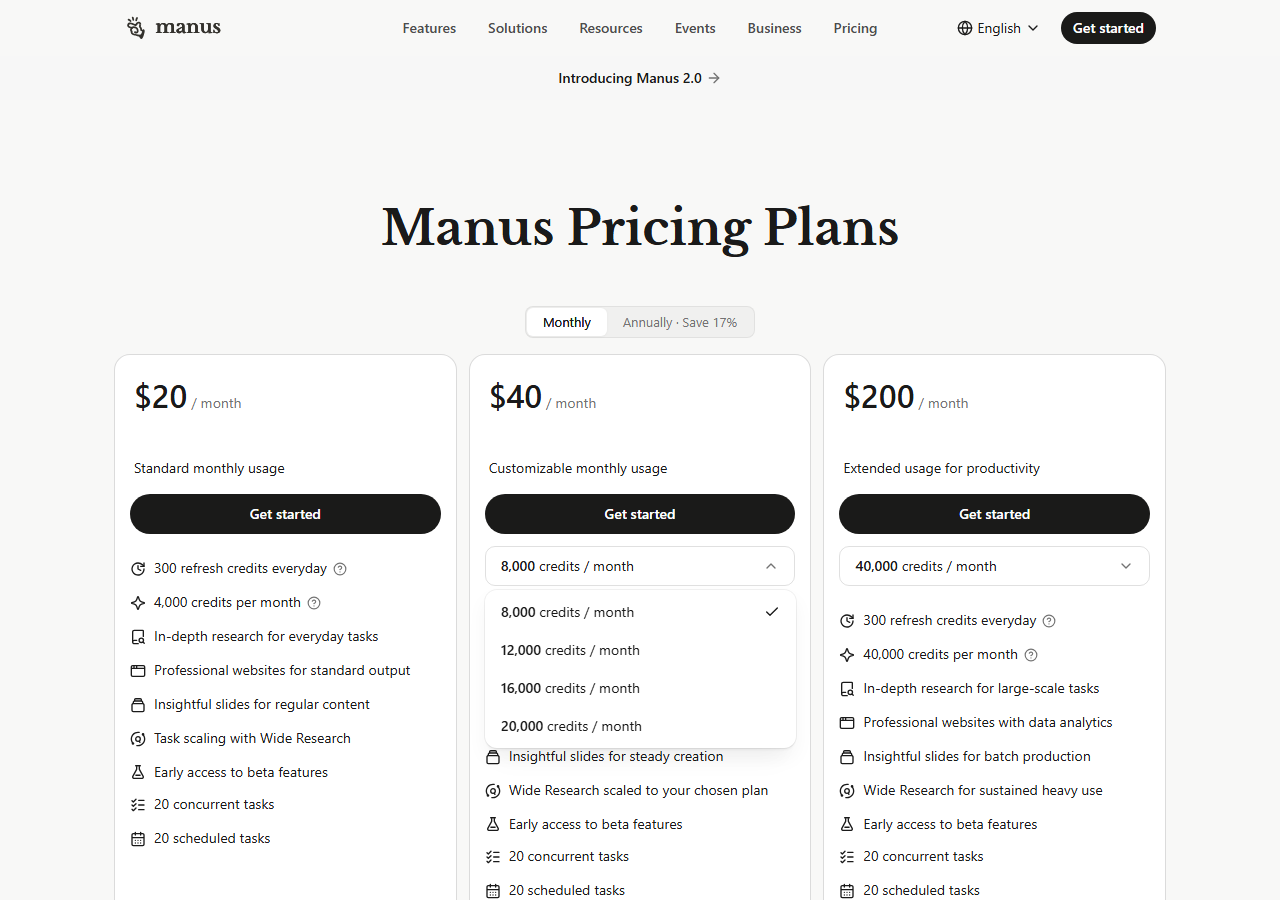
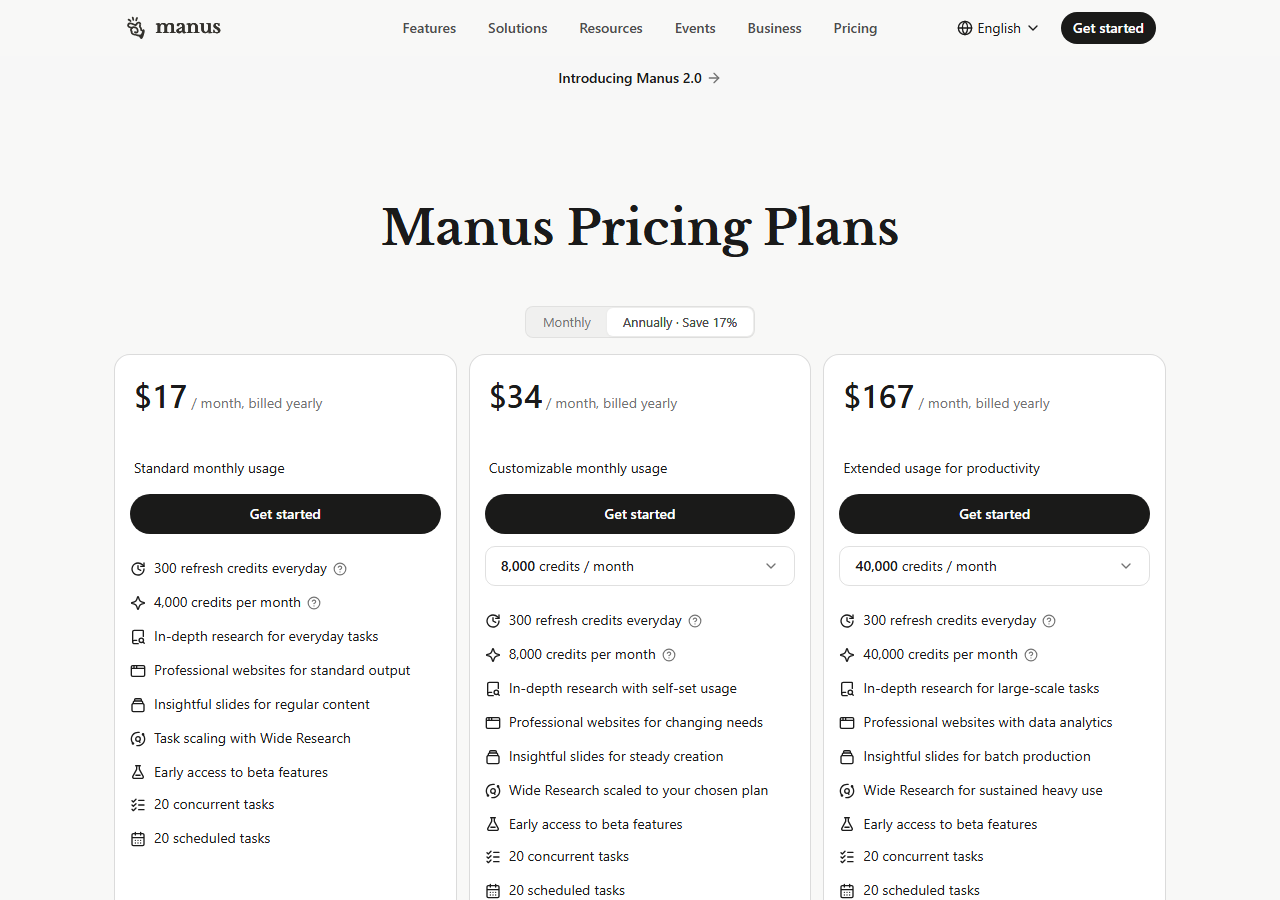

Prices are before tax; the help center says VAT or GST is added by Stripe, Apple or Google depending on where you pay. Cloud Computer is a separate subscription: $30 a month for 2 vCPUs, 4 GB of RAM and 70 GB of storage, or $50 for 8 GB and 120 GB, and its files and databases are deleted if you stop paying.
Five rules from the help center that decide what you really pay.


Worked examples: $5 per 1,000 credits at every monthly tier up to $200, and you will not know a task's price until it ends.
Arithmetic on Manus's own prices, Oct 30, 2026. Because Manus publishes no credits-per-task figures, we cannot price a typical task; the anecdotes below are users' own.
What a credit costs
Monthly billing is a flat $5 per 1,000 credits from $20 (4,000) through $200 (40,000). Discounts start above that: $500 buys 110,000 ($4.55 per 1,000), $2,000 buys 480,000 ($4.17) and $20,000 buys 5 million ($4). Paying yearly for the entry plan is $17 a month, $204 a year instead of $240, about $4.25 per 1,000 credits.
A solo user who also hosts something
Pro at $20 plus a Standard Cloud Computer at $30 is $50 a month, $600 a year. The 300 daily credits on top of the 4,000 help, but they reset every midnight UTC and cannot be saved.
One expensive task
The Hacker News user who said a deep-research task “blew through ~40$” spent the equivalent of about 8,000 credits at $5 per 1,000, two months of the entry plan. If your work is long, multi-step research or app building, budget for the $40 to $100 tiers and watch the usage page.
The mid-cycle upgrade trap
A Trustpilot reviewer says he paid $194.15 on Sep 19, 2026 for 44,073 credits and lost 31,132 of them, about 71%, when the cycle renewed. That matches the published rule: an upgrade keeps your original renewal date and monthly credits are cleared on it. If you need more credits late in a cycle, add-on credits, which roll over while you stay subscribed, are the safer buy.
A five-person team
Five seats cost $100 a month or $1,000 a year for 20,000 pooled credits a month, plus a flat US$150 SSO add-on if you want single sign-on under 30 seats. Manus's own example of 20 seats is 80,000 credits for $4,000 a year.
Five questions before you buy credits.
Manus 2.0: a new harness, Studio tools, Automations and a computer of your own.
Wide Research runs many sub-agents in parallel; outputs include reports, PDFs, spreadsheets and PowerPoint slides. Branch (Jul 9, 2026) forks a session from any message.
Websites with hosting modes and auto-publish, Supabase and Shopify connectors, a timeline Video Editor, Game Dev with multiplayer on a Cloud Computer, images and music.
Automations triggered by email, calendar, Slack or Notion events; Computer Use on your own desktop; Cue, a separate invite-only app for personal agents with their own email and phone number.
Manus says its new Cascade harness, in one tested configuration, used 23.2% fewer tokens, finished 28.2% faster and cost 32% less to run than its previous system. That is a vendor test, but if it holds it means fewer credits per task. The launch video below shows the new Studio and agent workflow.


Start free, set expectations, keep copies.

SOC 2 Type II and ISO 27001, US and Singapore storage, and pages that disagree on training.
Manus's trust center lists SOC 2 Type I and Type II, ISO 27001 and ISO 27701, with the SOC 2 Type II report on request, and names Google Cloud, Microsoft Azure AI Foundry and AWS in the US among subprocessors. The privacy policy (last updated Dec 27, 2025) names Butterfly Effect in Singapore as data controller and allows transfers to the US; Manus's Aug 11 post says data is stored in the US and Singapore. Browser sandbox data is kept up to 7 days after last activity on free plans and 14 days on paid ones.

On model training the pages do not line up. The Team page says “We never allow model training on your data” and that Manus has agreements with all LLM providers that no data is used for training; the help center's plan list names “Data Training Opt-Out” as a Team feature; and the privacy policy lists prompts and user content among data used for service improvement. If you are on an individual plan and this matters, ask Manus in writing. We have not reviewed the SOC 2 report or the terms of service in full.
The other risk is operational, not technical: the Aug 2026 deletion shows that legal or regulatory events can reach user data. Team admins get audit logs and SSO; Enterprise adds legal hold, SIEM feeds and agent network controls.
People who want deliverables without supervising every step.
Founders, marketers, analysts and students who want research reports, decks, simple sites, short videos or prototypes from one brief; mobile users (the app is well rated); small teams who can pool credits.
Anyone who needs a predictable cost per task; developers building production apps they will maintain; regulated data without an Enterprise contract; users who depend on fast human support.
Seven things to check before you rely on it.
Manus says it cannot predict a task's credits.
Monthly credits clear at renewal; upgrades keep the old date.
Only verifiable bugs; failed fixes on your app usually do not count.
Trustpilot 1.2 from 209 reviews, mostly billing and support.
Meta deal blocked, data deleted for some users in Aug 2026.
Team page, help center and privacy policy differ.
JAVIS did not run a task.
Checked on each vendor's own page on Oct 30, 2026; products differ, so plans are not like-for-like.
| Option and when to pick it | What its own page says | JAVIS review |
|---|---|---|
| Manus Autonomous deliverables | Free (300 credits a day); Pro from $20/mo for 4,000 credits; Team $20/seat | This article |
| Claude Assistant plus agentic work in one plan | Free; Pro $20 billed monthly ($17 yearly); Max from $100/mo; “Claude Cowork is now just Claude” | Claude review |
| ChatGPT Assistant with ChatGPT Work | Free, Go, Plus and Pro; Plus includes expanded ChatGPT Work access (prices vary by region) | ChatGPT review |
| Lovable Building web apps | Free; Pro $25/mo with 100 monthly credits; Business $50/mo | Lovable review |
| Perplexity Research with citations | See our review | Perplexity review |
| Genspark Another general agent | Pricing page requires sign-in | No live review yet |
If you would rather build your own agents, Browser Use automates a browser from code, and Lindy runs business automations with fixed workflows.
Five steps that keep cost and data under control.
This review has no affiliate links, and Manus did not see it.
JAVIS has no approved Manus affiliate link, so every link goes straight to manus.im, its pricing page or its help center, without tracking parameters.
Hands-on status: JAVIS has not created a Manus account or run a task. Cost examples are arithmetic on Manus's published prices; credits per task are not published, so task costs come from users' own accounts. Ownership events come from Manus's blog and named press reports.
Credit tiers, monthly and yearly.
Open Manus pricingExpiry, refunds and upgrades.
Open the help centerComparing AI agents and assistants? These reviews cover the nearest ground.
Each card opens a published JAVIS review.






Questions people ask before paying
Is Manus free?
Yes, with limits: 300 credits a day (up to 1,500 a month), one task at a time and two scheduled automations; daily credits only run Manus 2.0 lite.
How much does Manus cost?
Pro starts at $20 a month for 4,000 credits ($17 a month billed yearly), with tiers of $40 to $100 and $200 up to $20,000 a month. Team is $20 per seat a month. Cloud Computer is $30 or $50 a month extra.
Does Meta own Manus?
No longer. Meta announced the acquisition in Dec 2025; China's NDRC ordered the deal withdrawn on Apr 27, 2026, according to Reuters and CNBC, and Manus says it resumed independent operations on Sep 1, 2026 under its founding team.
Was my data deleted?
Only for certain users, for data created on or after Dec 29, 2025, deleted Aug 23 to 24, 2026 (Singapore time) after a backup window. Manus says restoration has no deadline and that it was not a security incident.
Do unused credits roll over?
Monthly credits do not; they clear at each renewal. Add-on credits roll over while you keep a paid plan; free credits never expire.
Can I get credits back for a failed task?
Only when a platform bug or malfunction caused the failure, after review by an AI agent and the support team.
Is Manus safe for company data?
It holds SOC 2 Type II and ISO 27001; Team adds SSO and audit logs. Statements about model training differ between its pages, so get terms in writing.
What are the alternatives?
Claude or ChatGPT for agentic work in a flat plan, Perplexity for research, Lovable for app building; see section 14.
Where this came from, and when.
Pricing and product: manus.im/pricing (monthly, annual and every credit option), manus.im/team, manus.im/updates; help.manus.im articles on plans, credit rules, daily credits, cancellation, refunds, credit estimates, extra charges and Cloud Computer, all Oct 30, 2026.
Company: Manus blog posts of Dec 29, 2025 and Aug 11, Sep 1, Sep 28 and Sep 29, 2026; Bloomberg (Mar 25, 2026) citing the Financial Times; Reuters, CNBC and Trivium China on the Apr 27, 2026 NDRC order; TechCrunch (Jun 13 and Oct 8, 2026).
Data and security: trust.manus.im and the privacy policy (last updated Dec 27, 2025). We have not reviewed the SOC 2 report or the terms of service in full.
Independent evidence: US App Store (4.73, 39,832 ratings) and US Google Play (4.6, 518K reviews) listings; Trustpilot (209 reviews, 1.2); Hacker News story 49258764 and comments 49261507, 49261011, 49268746, 49260854, 49260781 and 49268738; story 47920315.
Competitors: claude.com/pricing, chatgpt.com/pricing and lovable.dev/pricing, Oct 30, 2026.
Images: screenshots of public pages taken Oct 30, 2026, Manus's social card and Manus's own YouTube video.
JAVIS Fit Score (59/100): editorial composite, 20 points each. Price clarity 9: public credit tiers, but no per-task estimate and credits that reset. Capability breadth 17: research, documents, sites, video, games, automations and computer use. Independent evidence 12: strong app ratings against a very poor Trustpilot record. Security and data control 12: SOC 2 and ISO certifications, offset by the 2026 deletion and inconsistent training statements. Cost control and fit 9: plan caps and add-ons, but expiring credits and narrow refunds. It is judgment, not a measurement.
What this review does not cover: our own task results, credits used per task, Enterprise prices, and whether any travel restriction on the founders still applies.