Lovable Review 2026: What the Credits Really Buy, From the Free Plan to a Paused Backend, and the Terms Behind Them
Lovable turns a plain-English description into a working web app, then hosts it, gives it a database and logins, and lets you keep editing by chat. On Lovable's pricing page as of Oct 26, 2026, the Free plan costs nothing, Pro starts at $25 a month and Business at $50 a month, each with 100 monthly credits, or $21 and $42 a month billed yearly. The subscription is only the entry ticket. One credit balance now pays for building, chatting, hosting and the AI features inside your app; you only learn what a prompt cost after it runs; a Business credit costs twice a Pro credit; credits are not refunded even when the AI gets it wrong; and when the balance hits zero, apps that use Lovable's built-in backend pause. This review also covers the April 2026 incident in which public projects' chat history and code were readable by other users for 76 days.

There are no affiliate links in this review. Every Lovable link goes straight to lovable.dev or its documentation.
| Made by | Lovable Labs Incorporated; main establishment in Stockholm, Sweden |
| What it is | Chat-based builder for web apps and sites, with hosting, a built-in backend, AI features and an MCP server |
| Plans | Free $0; Pro from $25; Business from $50 a month (100 credits), or $21 and $42 billed yearly; Enterprise custom |
| Credit price | $0.25 on Pro, $0.50 on Business at the entry tier; top-ups $0.30 and $0.60 |
| Best for | Founders, marketers and teams who want a working app quickly and will watch the credit meter |
Lovable gets you from an idea to a hosted, working app quickly, but you pay per action at a price you only see afterwards, and its terms put the risk of a bad prompt on you.
“Credits are consumed by each AI action based on the effort and resources used, regardless of the outcome, and are non-refundable and non-restorable even where the AI Output is erroneous, incomplete, or must be regenerated, except where applicable law requires otherwise.”
That sentence from Lovable's Terms of Service, last updated Aug 28, 2026, is the one to read before you subscribe. Lovable is genuinely broad: you describe an app, it writes React code, provisions a database, logins and file storage on its built-in backend (Lovable Cloud), hosts the result on a lovable.app address or your own domain, and keeps editing it by chat. Since 2026 it can also plan your growth, launch Google and Meta ad campaigns from the same chat, publish into a company's Microsoft tenant, and be driven from Claude, Cursor or VS Code through its MCP server.
The price of all that is a single credit balance. A Pro credit costs $0.25 at the entry tier and a Business credit $0.50. Lovable's own examples put a small styling change at 0.50 credits (about 13 cents on Pro) and a landing page with generated images at 1.70 or 2.00 credits depending on which Lovable page you read. A long agent run checks in with you every 20 credits by default ($5 on Pro), and a single message can run for up to 10 hours. If you misjudge a prompt, the credits are gone.
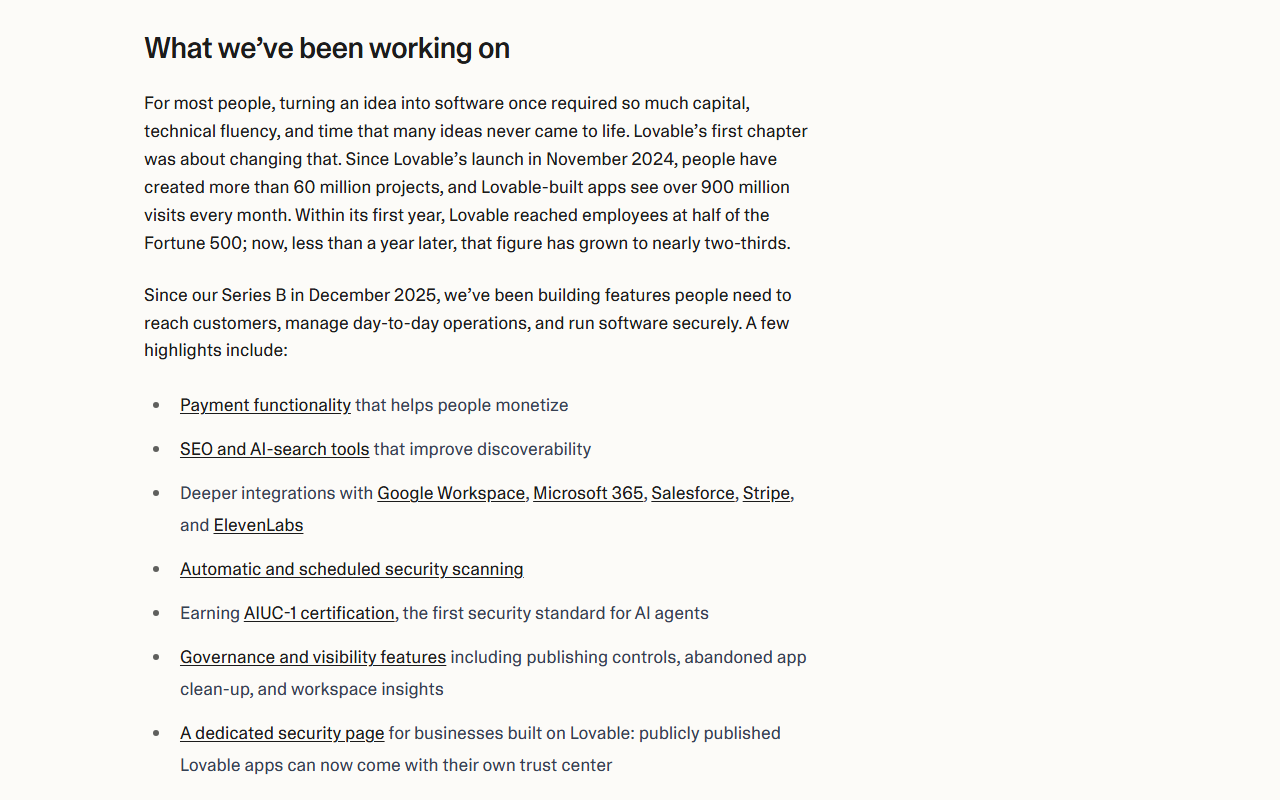
The company is not a small bet any more. Lovable raised $400 million at a $13.3 billion valuation on Aug 12, 2026, says people have created more than 60 million projects, and plans to grow to about 450 people during 2026. That money shows in the product cadence. It also showed in April 2026, when Lovable admitted that a February backend regression had let any logged-in user read the chat history and source code of public projects, and that researchers' reports about it had been closed without escalation.
One chat box, one workspace, one credit balance that pays for everything.
Everything in Lovable lives in a workspace. You pick a plan for the workspace, invite as many people as you like (there are no seat fees), and everyone draws on the same credits. Inside a project you talk to Lovable in three modes: Plan mode thinks and writes a plan without touching code, Build mode changes the app, and Chat mode answers questions. When the app needs data, Lovable Cloud gives it a Postgres database, user logins, storage and server functions, built on Supabase's open-source foundation. You publish to a lovable.app address or your own domain, and you can sync the code to GitHub, GitLab or Bitbucket at any time.


A security incident, one unified credit balance, a $13.3 billion round, and a push from building to running a business.
Lovable changes quickly; a review written in spring 2026 is already out of date. These are the changes that affect what you pay, what you can do and what you risk, each from Lovable's own blog or documentation.
| Date | Change | Why it matters |
|---|---|---|
| Feb 3 to Apr 20 | Backend regression made public projects' chat history and code readable by any logged-in user | Fixed Apr 20; Lovable made historically public projects private |
| Mar 24 | Aikido pentesting offered inside Lovable | Dynamic security tests for your own app |
| Apr 27 | iOS and Android app | Prompt and review builds from a phone |
| Jun 1 | Automatic security scan before every publish | About 10 to 15 seconds; deep scan on demand |
| Jun 13 | One credit balance for building, Cloud and AI | Hosting and AI in your app now draw on the same credits |
| Aug 12 | $400M Series C at $13.3B | Valuation about doubled from $6.6B in December 2025 |
| Sep 7 | Drafts | Try front-end changes without touching the live app |
| Sep 24 | Free daily chat allowance | Current chat pricing applies through Oct 31, 2026 |
| Sep 28 | Microsoft partnership | Publish apps into a company's Microsoft tenant (preview) |
| Sep 30 | TanStack Start vulnerability (CVE-2026-102989) found by Lovable | Firewall rules for hosted apps; fix applied on your next edit |
| Oct 14 | Growth tools | Plans, SEO help and Google and Meta ads from the chat |
| Oct 20 | Enterprise roundup | Deploy on AWS or Azure (private preview), EU inference, policies |
All dates 2026, from posts on lovable.dev/blog and docs.lovable.dev, Oct 26, 2026.


A Stockholm company valued at $13.3 billion, whose usage numbers come with careful definitions.
Lovable is private, so there are no audited accounts. The figures below are what Lovable itself publishes. Read each one with its definition: projects are not customers, and visits to apps built with Lovable are not visits to Lovable.
| Signal | Value | What it measures |
|---|---|---|
| Valuation | $13.3B (Aug 12, 2026) | Series C price; $400M led by Menlo Ventures, co-led by EQT's Scaleup Europe Fund |
| Previous round | $6.6B (Dec 18, 2025) | Series B, $330M led by CapitalG and Menlo Ventures |
| Projects created | 60 million+ (Aug 12) / 70 million+ (Sep 28) | Projects started, not paying customers or live apps |
| New projects | 1.2 million a week | Home page counter, Oct 26, 2026 |
| Traffic to built apps | 900 million+ visits a month | Visits to apps made with Lovable, not to lovable.dev |
| Enterprise reach | Nearly two-thirds of the Fortune 500 | Companies with employees using Lovable, per Lovable |
| Team | About 450 planned in 2026 | Hiring target in the Series C post |
Sources: lovable.dev/blog/series-c (Aug 12, 2026), lovable.dev/blog/series-b (Dec 18, 2025), lovable.dev/blog/microsoft-partnership (Sep 28, 2026) and the lovable.dev home page, Oct 26, 2026.


Two things follow for a buyer. First, Lovable has the money and the hiring plan to keep shipping and to keep the platform running; the risk of it disappearing in 2027 is low. Second, the product is changing fast, and so are its prices and rules: the unified credit balance arrived in June, the free chat allowance in September with an end date of Oct 31, 2026, and the Terms in August. Plan to re-read the pricing page before every renewal.
Store ratings are high; the reviews Google Play shows first are about credits.
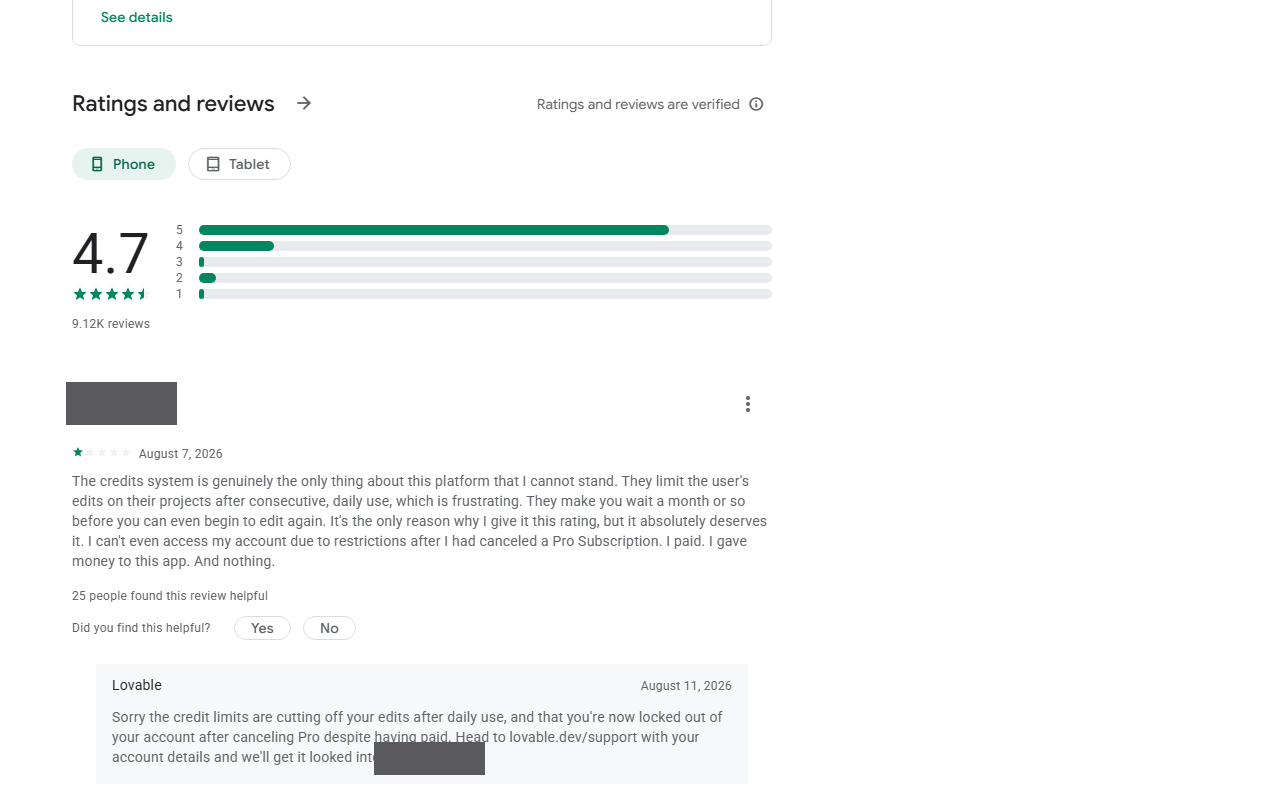
Lovable's own mobile app is the easiest place to see a large, public rating. Both US storefronts rate it highly. But the reviews Google Play shows first on the US listing, each marked helpful by 12 to 25 people, tell a narrower story: people like what Lovable builds and resent how fast the credits go.
App Store figures from the US storefront lookup for app id 6757471107 and Google Play from the US listing (gl=US, hl=en), Oct 26, 2026. Both are for the official app by Lovable Labs Incorporated. The US App Store also lists unrelated apps with Lovable in the name from other developers; check the developer name before you download.


“The credits system is genuinely the only thing about this platform that I cannot stand.”
The first review shown on the US listing. Lovable replied and asked the user to contact support.
“The credits burn so fast.”
The reviewer says a subscription still left them buying extra credits for a standard website.
“I'd ask for right left column spacing, it gave me top bottom layout.”
Prompts not followed, then charged again for the fix: the cost of the Terms clause quoted at the top.
“Every critique I've seen of Lovable has been that while it is very easy to get started, once you cross a certain point with your app-building, it simply becomes too expensive, and complex to continue build on manually.”
In the thread on the Series C announcement.
“It replaced Figma for us.”
The commenter's product and design team builds interactive mockups in Lovable, sometimes with customers.
“I have a client that prototypes things in Lovable and hands them off to me to get them working and deployed.”
A common pattern: Lovable for the first version, a developer for production.
What makes people buy, from Lovable's pages and these reviews: a usable app in an afternoon, a backend that sets itself up, and publishing in one step. What makes people leave: a credit meter that moves faster than expected, prompts that need several attempts, and the moment an app outgrows what chat-based editing handles well. One Hacker News commenter also described the built-in backend as hard to reach outside Lovable's interface; Lovable's documentation answers that with a database export and a supported move to your own Supabase, covered in export and leaving.
Free, then Pro and Business in eleven credit tiers each, and Enterprise by contract.
All prices are in US dollars, from lovable.dev/pricing on Oct 26, 2026. The page was viewed from Vietnam; Lovable's documentation lists the same tiers and labels them “Prices in USD”, so the figures match what Lovable publishes for every region. Yearly billing gives two months free (about 16.7% off).
Free
no credit card needed
- 5 build credits a day, up to 30 a month
- 20 Cloud and 4 AI credits a month
- Daily chat allowance
- 5 lovable.app domains
- GitHub sync; no code download
Pro
a month for 100 credits, or $21 a month billed yearly
- 5 daily build credits with no monthly cap
- Credit rollover and top-ups
- Custom domains, remove the badge
- Edit and download code
- Email support
Business
a month for 100 credits, or $42 a month billed yearly
- SSO, role-based access
- Security center, design templates
- Workspace publish, Lovable API
- Data excluded from training by default
- Priority support
Enterprise
platform fee and volume-based credits
- SCIM, audit logs
- Publishing policies and approvals
- EU inference, data exports
- Deploy on AWS or Azure (preview)
- No free daily grants
Swipe sideways to see all columns.
| Monthly credits | Pro monthly | Pro yearly | Business monthly | Business yearly |
|---|---|---|---|---|
| 100 | $25 | $250 ($21/mo) | $50 | $500 ($42/mo) |
| 200 | $50 | $500 ($42/mo) | $100 | $1,000 ($84/mo) |
| 400 | $100 | $1,000 ($84/mo) | $200 | $2,000 ($167/mo) |
| 800 | $200 | $2,000 ($167/mo) | $400 | $4,000 ($334/mo) |
| 1,200 | $294 | $2,940 ($245/mo) | $588 | $5,880 ($490/mo) |
| 2,000 | $480 | $4,800 ($400/mo) | $960 | $9,600 ($800/mo) |
| 3,000 | $705 | $7,050 ($588/mo) | $1,410 | $14,100 ($1,175/mo) |
| 4,000 | $920 | $9,200 ($767/mo) | $1,840 | $18,400 ($1,534/mo) |
| 5,000 | $1,125 | $11,250 ($938/mo) | $2,250 | $22,500 ($1,875/mo) |
| 7,500 | $1,688 | $16,880 ($1,407/mo) | $3,300 | $33,000 ($2,750/mo) |
| 10,000 | $2,250 | $22,500 ($1,875/mo) | $4,300 | $43,000 ($3,584/mo) |
From the credit-tier menus on lovable.dev/pricing (monthly and yearly) and the Pro and Business tier tables in Lovable's Subscription plans documentation, Oct 26, 2026.


Discounts. Students and teachers with an academic email get 50% off Pro with 100 credits, billed monthly, for up to 12 months ($12.50 instead of $25); higher tiers, yearly billing and top-ups are excluded. Volume discounts start at 1,200 credits: the 10,000-credit Pro tier works out at $0.225 a credit, 10% below the entry tier, and at $0.1875 on yearly billing.


One balance, five kinds of usage, a price you see only after the work is done.
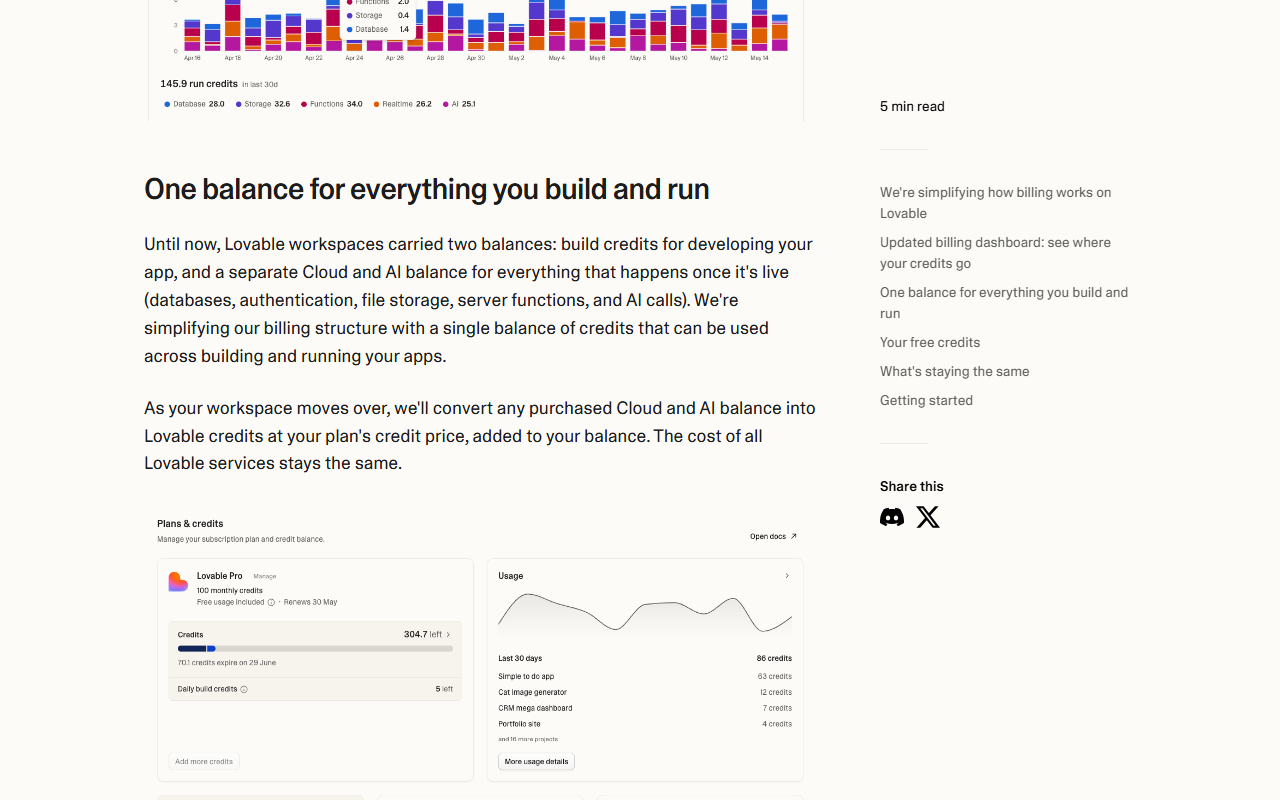
Since June 2026, every workspace has one credit balance that pays for build messages, chat, hosting and the built-in backend (Cloud), AI calls made by your published app, and some paid connectors. Free grants are spent first: 5 build credits a day, 20 Cloud credits and 4 AI credits a month, and a daily chat allowance. Lovable's documentation calls the monthly grants and the chat pricing “Temporary offering, subject to change.”
| Lovable's example | Credits | On Pro ($0.25) | On Business ($0.50) |
|---|---|---|---|
| Make the button gray | 0.50 | $0.13 | $0.25 |
| Remove the footer | 0.90 | $0.23 | $0.45 |
| Add authentication | 1.20 | $0.30 | $0.60 |
| Landing page with images | 1.70 or 2.00 | $0.43 or $0.50 | $0.85 or $1.00 |
| Plan mode message | 1 plus research | $0.25 and up | $0.50 and up |
| Default check-in on a long run | 20 | $5.00 | $10.00 |
Credit amounts from the pricing page FAQ and the Credits and usage documentation, Oct 26, 2026; dollar values are JAVIS calculations at the entry-tier credit price. The pricing page gives 1.70 credits for the landing page, the documentation 2.00.


Why a Business credit costs double. Lovable says a Business credit is worth more on hosting and AI usage, not on building. Its FAQ explains: “This does not mean Cloud or AI gateway usage is cheaper on Business.” In practice a Business workspace is charged half as many credits for the same Cloud or AI usage, while a build message costs the same number of credits on both plans, so building costs twice as much in dollars on Business.


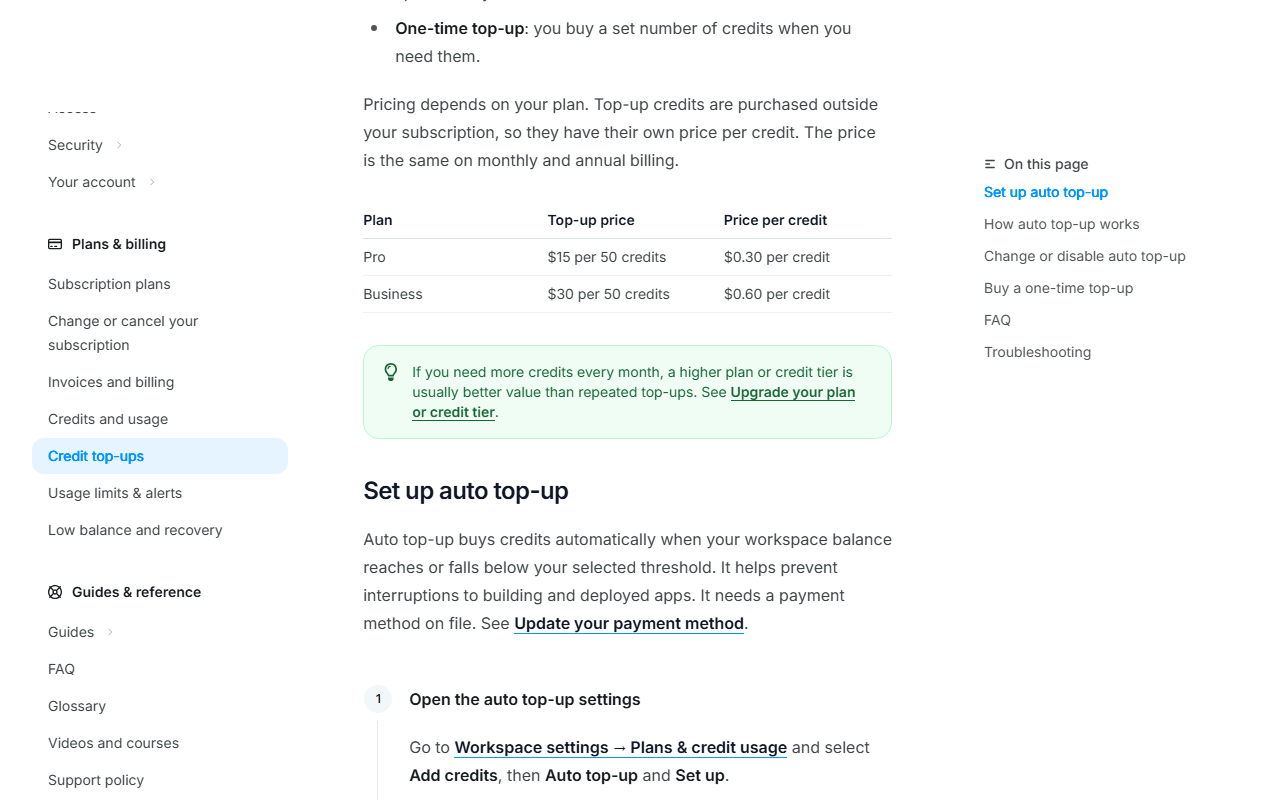
Expiry and top-ups. Monthly plan credits roll over but expire two months after they are issued; on yearly plans they expire one month after the yearly period ends. Daily grants expire at midnight UTC. Top-ups cost $15 per 50 credits on Pro and $30 on Business, 20% above the entry-tier rate, and last 12 months. Long Build mode runs pause at a check-in level, 20 credits by default, which Lovable describes as “a notification threshold, not a hard cap”. Setting a task as a goal with the /goal command costs more, and the documentation warns that “A goal can take hours to finish and use a large number of credits”.



Five setups, from free to a team of builders, and where the money actually goes.
Monthly cost in US dollars on Lovable's published prices. These are planning examples, not measurements: how many credits an app needs depends entirely on how you prompt and how much your app runs.
| Setup | Credits a month | Monthly billing | Yearly billing (per month) |
|---|---|---|---|
| A. Trying an idea on Free | 30 daily build credits | $0 | $0 |
| B. Solo builder, Pro entry | 100 plus 5 a day | $25 | $20.83 |
| C. Busy solo builder | 400 on the 400 tier | $100 | $83.33 |
| C2. Same 400, but 100 tier plus top-ups | 100 plus 300 top-up | $115 | not offered |
| D. Team of five, 800 credits, Business | 800 shared | $400 | $333.33 |
| D2. Same team on Pro | 800 shared | $200 | $166.67 |
| E. Agency on 2,000 Pro credits | 2,000 | $480 | $400 |
JAVIS calculation from lovable.dev/pricing and the Credit top-ups documentation, Oct 26, 2026. Yearly figures divide the annual charge by 12; the pricing page rounds them ($21, $84, $334, $167). Daily build credits (up to 150 in a 30-day month on Pro and Business) and the Cloud and AI grants come on top.
What the numbers say. On Lovable, a team pays for credits, not people: five members on 800 credits cost the same as one member on 800 credits. The real decision is Pro or Business, and on these prices Business costs $200 more a month for the same 800 build credits. That buys SSO, role-based access, the security center and data excluded from training by default. If you do not need those, the same 800 credits on Pro cost half as much. For a single builder who regularly needs more than the plan, moving up a tier is cheaper than top-ups: 400 credits cost $100 on the tier and $115 as 100 plus three top-ups.
Costs outside Lovable. Custom domains are bought separately, ad spend from the new growth tools is billed by Google and Meta directly (Lovable says it adds no service fee), and connectors you link with your own accounts bill on their own plans. Apps with heavy traffic or storage draw extra Cloud credits once the 20-credit monthly grant is gone.
Refunds, wrong output, cancellation, your data and the domain: the exact rules.
These come from Lovable's Terms of Service (last updated Aug 28, 2026, effective Aug 15, 2026), its Privacy Policy (Sep 15, 2026) and its documentation, quoted word for word.
| Topic | Exact wording | What it means for you |
|---|---|---|
| Refunds | “Except where required by applicable law, all fees are non-refundable.” | Start on Free or a monthly plan; do not count on getting money back. |
| Credits | “No. Credits aren't refundable or redeemable for cash or any other value.” | Unused credits have no cash value. |
| Cancelling | Unused monthly and rollover credits “are frozen. You cannot use them on Free, and Lovable does not refund them.” | They come back only if you subscribe again before they expire. |
| Your data for training | “You grant us a worldwide, perpetual, royalty-free license to use, copy, modify, process, analyze, and otherwise exploit your Customer Data for our business purposes” | Turn off training in account settings on Free and Pro; it is free. |
| Opting out later | “It does not retract content from training datasets assembled, or models trained, before you opted out.” | Opt out before you paste anything confidential. |
| Subdomains | “Lovable retains all ownership rights in the lovable.app domain and all subdomains.” | Use your own domain for anything that matters; Lovable says it generally gives 7 days' notice before reclaiming a subdomain. |
| Sensitive data | No HIPAA data, payment card data, government identifiers or biometrics unless your plan or a written agreement allows it | Do not build a health or payments system of record on a standard plan. |
| Disputes | Delaware law and Delaware courts; no class actions; liability capped at what you paid in the previous 12 months | Your recourse is limited, and it is in the United States. |


One more clause matters if you plan to move a project by script: the Terms forbid using bots, scrapers or crawlers on the Services without Lovable's written permission. Use Lovable's own export routes instead (Git sync, code download, database export, the Lovable API on Business), described in export and leaving.

Eight places where two Lovable pages give different answers.
None of these changes the verdict alone, but together they are a reason to confirm anything important in writing before you commit a team or a budget.
| Topic | One page says | Another page says |
|---|---|---|
| Landing page example | Pricing FAQ: 1.70 credits | Documentation: 2.00 credits |
| Daily build credit cap | Pricing FAQ: some regional plans cap paid daily credits at 30 a month | Documentation: Pro and Business have no monthly cap |
| Projects created | Home page and Series C post: 60 million | Microsoft post: 70 million; both store listings: 25 million |
| Visits to built apps | Home page and Series C post: 900 million a month | Google Play listing: 200+ million a month |
| Compliance | Security FAQ: “Lovable supports SOC 2 and GDPR requirements and provides security documentation and data protection agreements for enterprise review.” | Compliance post of Oct 21, 2026: SOC 2 Type II and ISO 27001:2022 certification |
| Sub-processors | Security FAQ: “A current list of subprocessors is available upon request.” | A public subprocessors page on lovable.dev |
| Training | Security page: Business and Enterprise data is not used to train models | Terms: a perpetual license to train on Customer Data unless you opt out, on any plan |
| Legal change log | Terms of Service: new version dated Aug 28, 2026 | Legal change log: no Terms of Service entry for 2026 |
From lovable.dev/pricing, /security, /terms, /legal-change-log, the home page, three blog posts and the US App Store and Google Play listings, Oct 26, 2026.


Answer five questions.
Yes: stay on Free. 30 build credits a month and the daily chat allowance are enough to find out.
Yes: not on a standard plan. The Terms forbid it without a written agreement; talk to Enterprise sales or use another stack.
Yes: Business at $50 a month for 100 credits. No: Pro, and buy a bigger Pro tier instead.
Yes: move up a tier rather than buying top-ups, and set usage limits for members.
Yes: connect GitHub from day one so the code lives in your own repository.
Plan, build, check, publish: the loop Lovable runs for you, and what it costs at each step.
Lovable's core is an agent that reads your project, plans, edits several files, checks its own work in a browser and rebuilds the preview. Plan mode drafts the approach without touching code at 1 credit a message plus any research. Build mode is billed by the work done, and stopping a run is charged for the work completed so far. Drafts let you try front-end changes in a copy of the project, and the free daily chat allowance covers questions about your app until Oct 31, 2026. Lovable picks a model for each task, and you can name one in the prompt; it added Opus 5.5 on Sep 22, 2026 and reports that it finishes tasks in a third to half fewer steps than Opus 5 on its internal benchmark.

How Vibecoding Actually Works: official video from the Lovable YouTube channel (@lovable), published Mar 29, 2026, 42 minutes 18 seconds.
From building to selling: SEO help, ads and campaign changes from the same chat.
Since Oct 14, 2026, Lovable can draft a growth plan from your app's context, check SEO basics, suggest content with Semrush data, generate ad creatives, and create Google Ads and Meta campaigns. Lovable summarizes the budget, locations and tracking before anything goes live, and says it “will not change a campaign on its own”. On cost, its post says: “Lovable does not bill you directly or add a service fee to your ad spend.” Planning and generating assets uses ordinary credits. The tools are on Free, Pro and Business; Enterprise admins must switch the connectors on.

Announcing Lovable Growth Tools!: official Lovable video, published Oct 15, 2026, 51 seconds.
How to SEO Optimize Your Lovable App (New Update): official Lovable video, published Jun 3, 2026, 36 minutes 6 seconds.
Drive Lovable from Claude or Cursor, and connect apps to the tools a company already runs.
| Integration | Plans | Notes |
|---|---|---|
| Lovable MCP server | All | Create projects, chat, read files, run SQL and deploy from Claude, Claude Code, Cursor or VS Code; OAuth sign-in |
| GitHub, GitLab, Bitbucket sync | All | Two-way sync; GitHub Enterprise on Enterprise |
| Microsoft 365, Fabric, Entra sign-in for apps | All | Publishing into a Microsoft tenant is in public preview |
| AI models inside your app | All | OpenAI, Anthropic and Google models, Perplexity, Firecrawl, Parallel; billed in credits |
| Lovable API | Business and Enterprise | Workspace analytics, security scans, publish and delete projects |
| Deploy on AWS or Azure | Enterprise | Private preview; apps and data in your own cloud account |
From lovable.dev/mcp, the Subscription plans documentation and Lovable blog posts of Sep 28, Oct 15 and Oct 20, 2026.
Of the integrations above, the MCP server matters most to technical readers: an agent in Claude Code can create a Lovable project, iterate on it and deploy it without opening the editor. Every action still spends your workspace's credits. Our Claude MCP connectors guide explains how such connections and their permissions work, and the Claude Code setup guide covers the client side.
Turn Any Lovable App Into an MCP Server in 14 Min: official Lovable video, published Jul 16, 2026, 14 minutes 43 seconds.
Real certifications and automatic scans, after an incident that exposed public projects for 76 days.
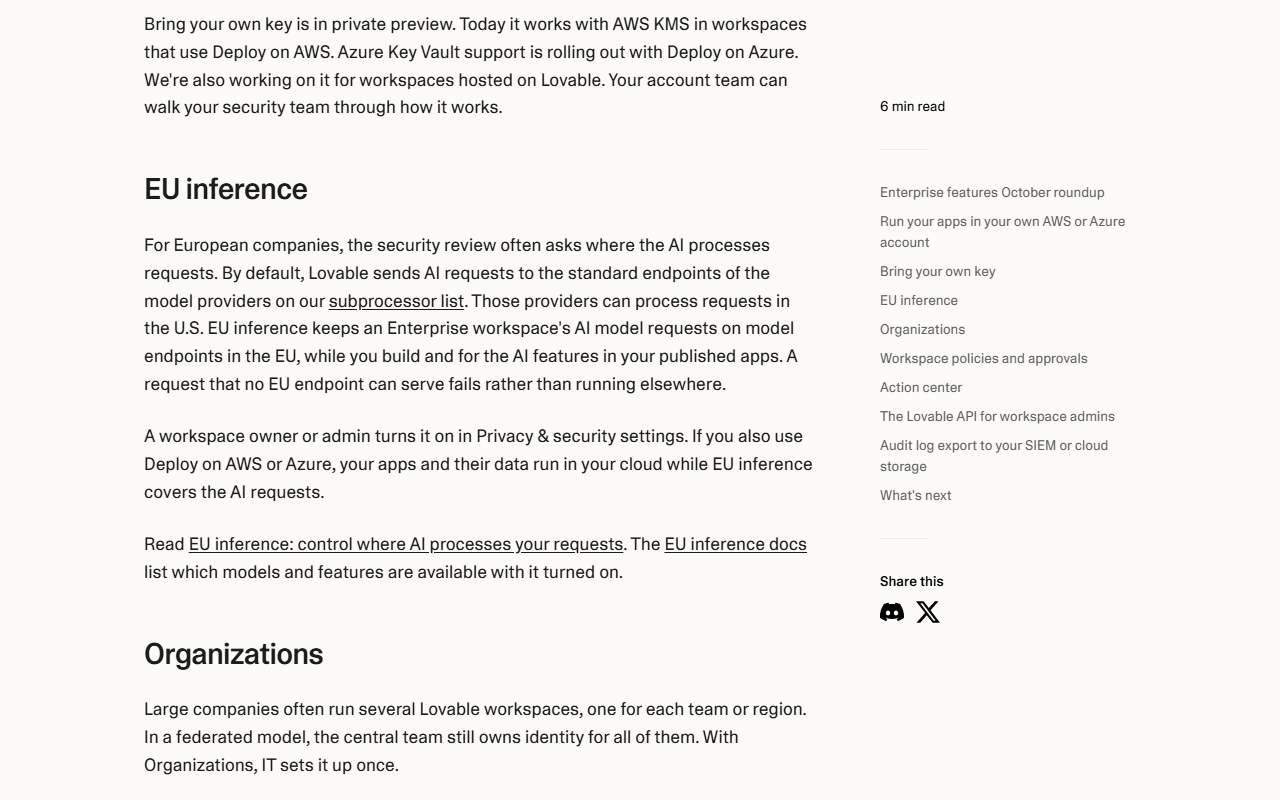
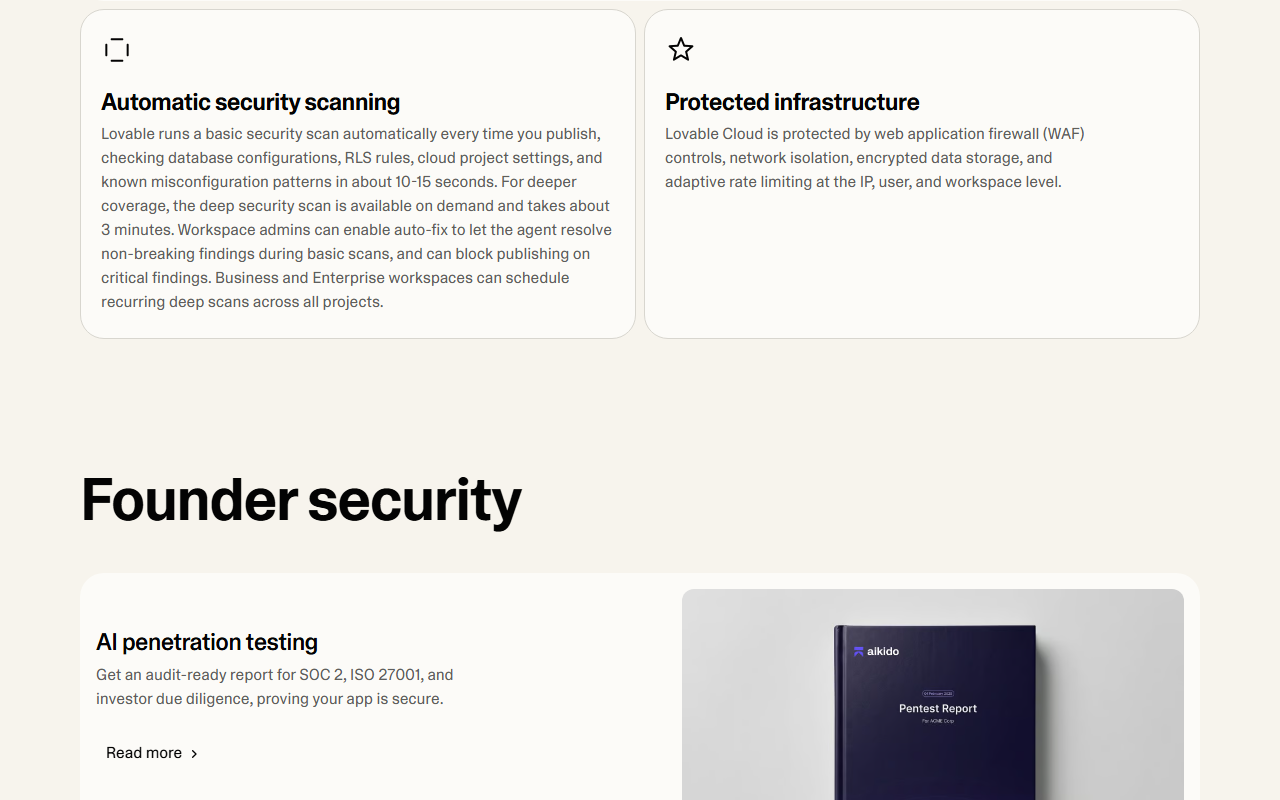
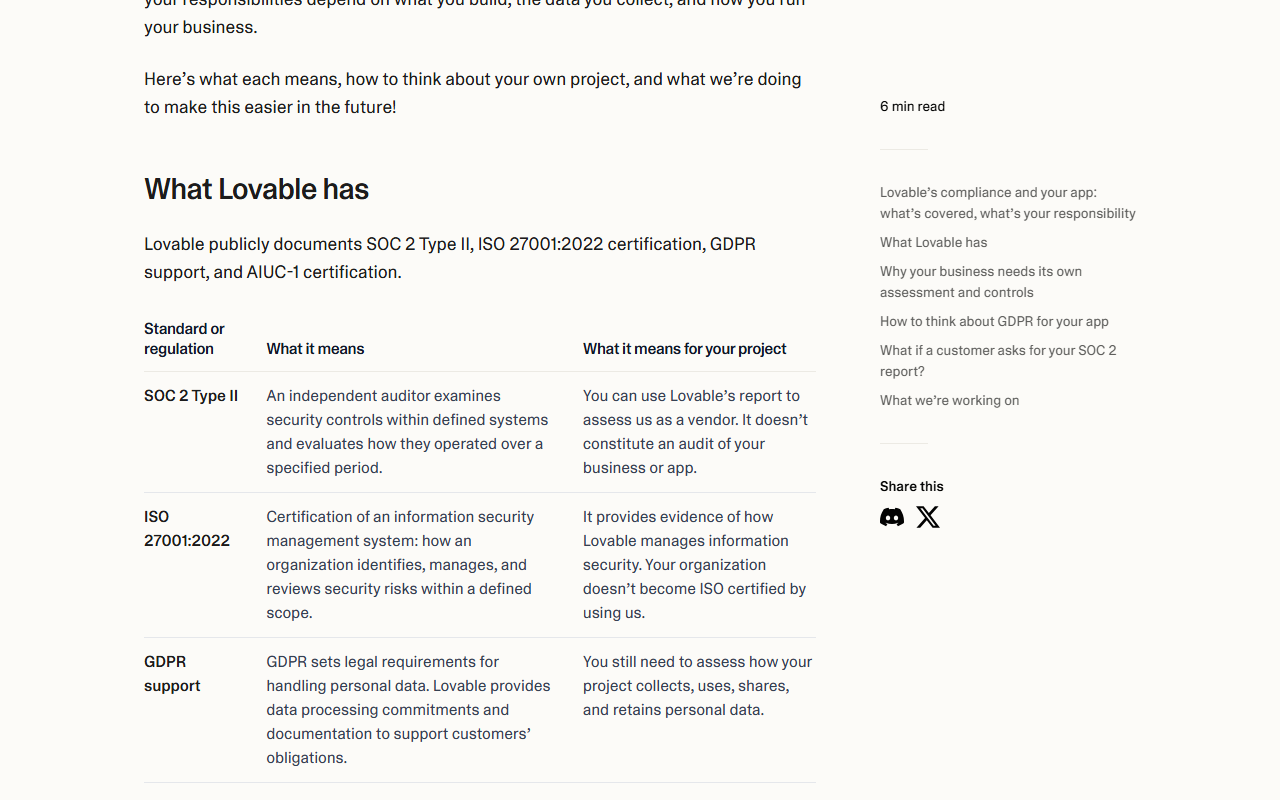
Lovable's security story in 2026 has two halves. On the platform side it now documents SOC 2 Type II, ISO 27001:2022 and AIUC-1 (Lovable says it was the first coding agent platform to earn it), runs a basic scan on every publish, offers a deeper AI scan and Aikido pentests, and found and mitigated a framework vulnerability itself in September. On the other side, its April 2026 incident report is unusually candid about what went wrong.


| Area | What Lovable states | Watch out for |
|---|---|---|
| Certifications | SOC 2 Type II, ISO 27001:2022, GDPR support, AIUC-1 | Your app does not inherit them; Lovable's own post says so |
| Scanning | Basic scan on every publish (about 10 to 15 seconds); deep scan on demand (about 3 minutes) | Critical findings block publishing only if an admin turns that on |
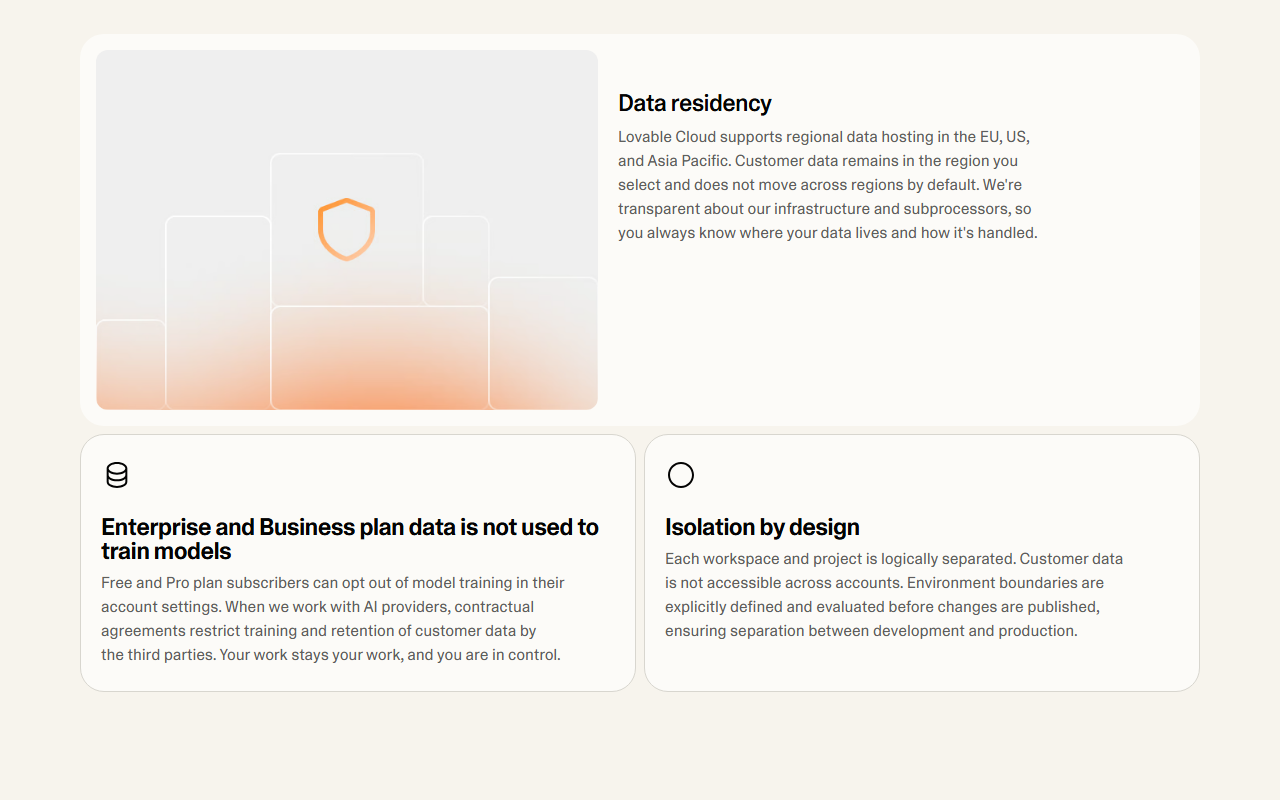
| Data location | Cloud regions in the Americas, Europe and Asia Pacific | AI requests can be processed in the US unless you have Enterprise EU inference |
| Training | Not on Business and Enterprise; opt-out free on Free and Pro | Free and Pro are opted in until you switch it off |
| Isolation | Multi-tenant with logical separation between workspaces | Project visibility and published-site access are two separate settings |
| App security | Templates and scans help, but the app is yours | A researcher reported 18,697 exposed user records in one Lovable-hosted app in February 2026 |
That last row comes from The Register on Feb 27, 2026, which reported a researcher's findings in an app showcased on Lovable's Discover page. Lovable's CISO told the publication that the app owner had not applied the scan's recommendations and that the vulnerable database was not hosted by Lovable: “Ultimately, it is at the discretion of the user to implement these recommendations.” Both statements can be true at once, and that is the point: Lovable makes a working app easy, not a secure one automatic.

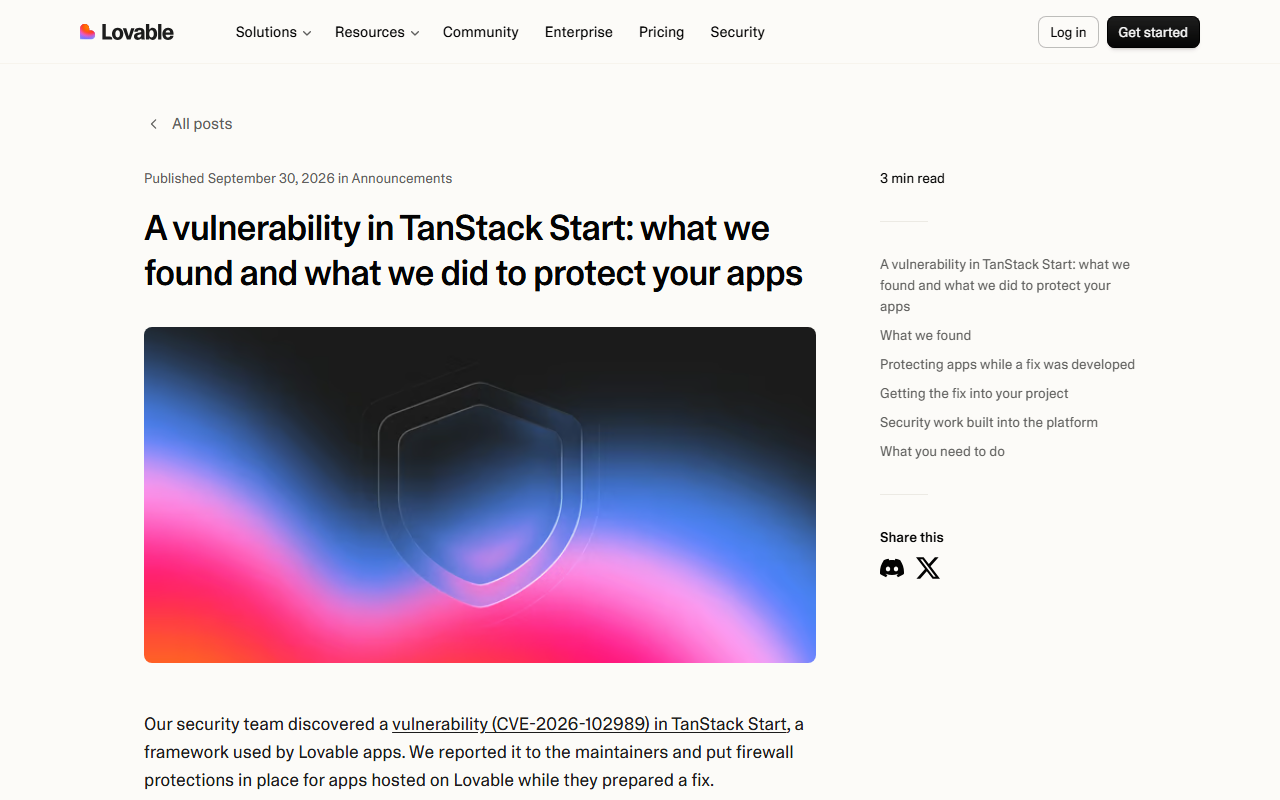

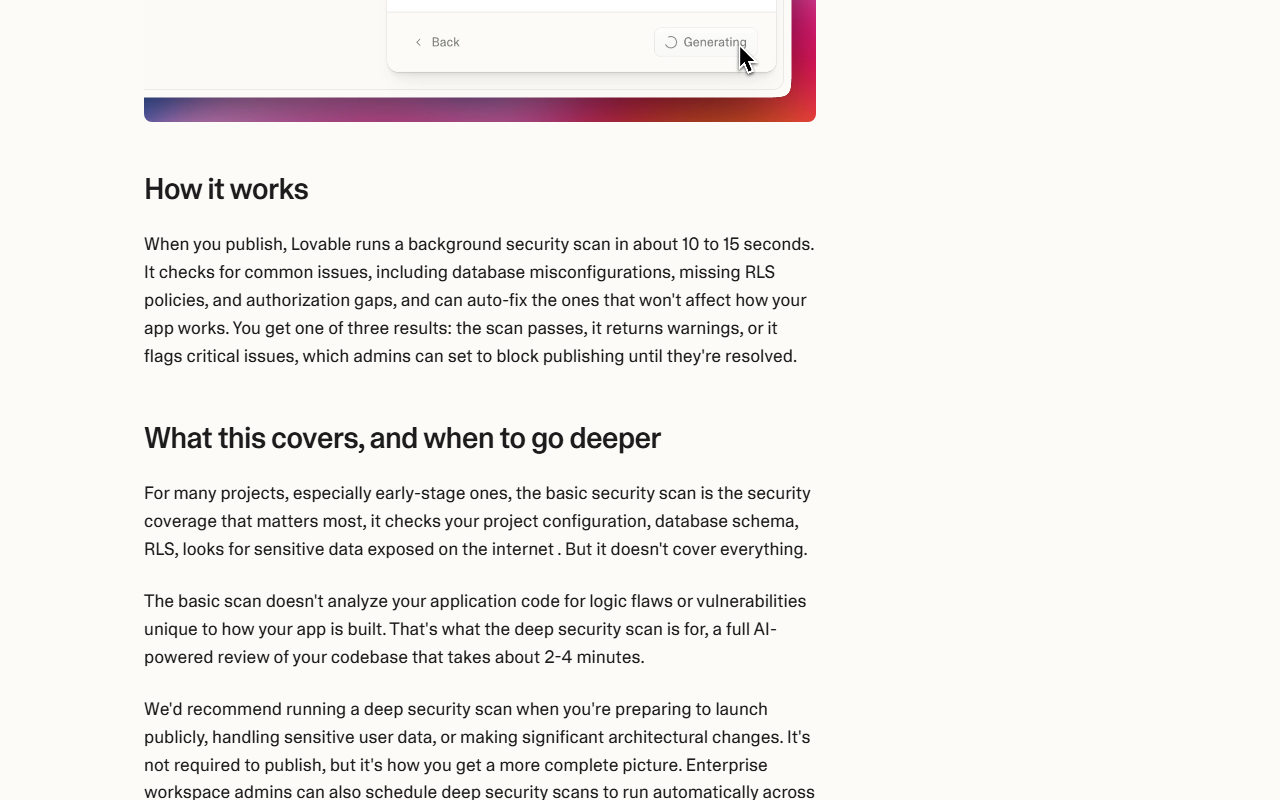


The code is yours and can leave; the backend pauses if the credits run out.
Lovable's documentation states the intent plainly: “Lovable is intentionally built so that you are never locked in.” In practice, Git sync works on every plan, the codebase download as a zip file needs a paid plan, and you can export the whole database as an SQL file once every 24 hours. The built-in backend can move to managed or self-hosted Supabase; moving to another database means changing the app's integration code. The editor and agent themselves cannot be self-hosted.

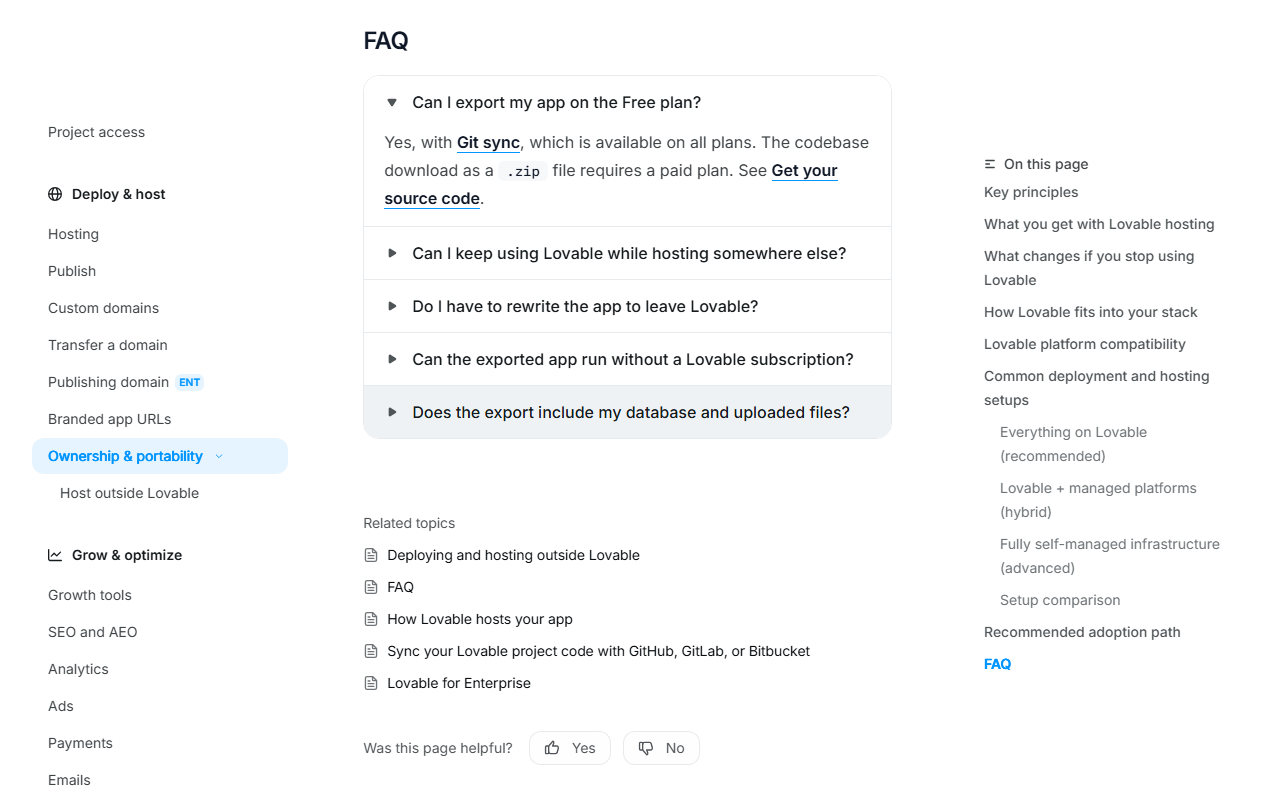
What happens at zero credits. This is the rule that is easiest to miss. When the monthly Cloud grant and your general credits are both gone, Lovable pauses your app's database, storage and logins. The documentation is explicit: “Lovable keeps the data, but you cannot access or export it until the services run again.” The pages themselves keep serving, “Your published site stays live.”, but anything that needs the backend or AI stops responding. Daily build credits cannot pay for Cloud. Auto top-up, low-balance alerts and usage limits exist to prevent this; turn at least one of them on before you launch.

Support and inactivity. Paid plans get email support with a first reply within 24 hours, mainly on weekdays, and Business is prioritized; Free users get community help only. Lovable may unpublish a Free project after 12 months without visits or owner logins, and pauses its backend, without deleting the project.

Work pattern, fit and likely plan.
Good fit. Free, then Pro at $25; a working demo beats a slide deck.
Good fit. Pro for one person; Business when IT asks for SSO.
Good fit. No seat fees; drafts and shared credits suit groups.
Weak fit on standard plans; the Terms forbid it without a written agreement.
Mixed. Costs and complexity climb; plan a developer and GitHub sync early.
Mixed. Usage limits help, but the cost of a prompt is known only afterwards.
Eight real drawbacks.
Build mode is priced by the work done; Lovable's own examples disagree (1.70 or 2.00 credits).
The Terms say credits are consumed regardless of the outcome.
$0.50 a credit against $0.25 on Pro, for governance features.
Database, logins and storage stop until you top up, and data cannot be exported meanwhile.
Public projects' chat and code were readable from Feb 3 to Apr 20, 2026, and early reports were closed.
Free and Pro must opt out; opting out does not remove past training data.
Unified credits in June; current chat pricing ends Oct 31, 2026; grants are labelled temporary.
Scans help, but recommendations are optional, as a reported 18,697-record exposure showed.
Bolt, v0, Replit and Base44, priced on the same day.
All prices from each vendor's own pricing page on Oct 26, 2026, viewed from Vietnam; v0 states its prices in USD, and Internet Archive copies of the Bolt and Replit pages served to the US between Oct 23 and Oct 25, 2026 show the same amounts. Usage units differ (credits, tokens, dollar allowances), so compare entry prices, not capacity.
Swipe sideways to see all columns.
| Need | Product | Entry paid plan | What the entry plan includes | Choose it when |
|---|---|---|---|---|
| Prompt to hosted full-stack app | Lovable Pro | $25 a month; $21 yearly | 100 credits plus 5 a day, custom domain | You want backend, hosting and growth tools in one place |
| Same idea, token-based | Bolt Pro | $300 a year if paid monthly; $18 a month yearly | 10M tokens a month with rollover, own domain | You prefer a token allowance and a choice of database provider |
| Front-end and Vercel deployment | v0 Plus | $30 per user a month | $30 of monthly credits plus $2 a day per user | Your team already deploys on Vercel |
| Full cloud workspace with an agent | Replit Core | $20 a month; $18 yearly | $20 toward models, Free Mode chat, Plan mode | You want a real development environment as well |
| Lowest yearly entry in this table | Base44 Starter | $16 a month billed yearly | 100 message and 2,000 integration credits | You want the simplest builder and are happy on Wix's platform |
From bolt.new/pricing, v0.app/pricing, replit.com/pricing and base44.com/pricing, Oct 26, 2026. Bolt shows $216 a year on yearly billing against $300 paid monthly, which is $25 a month. Bolt Teams costs $27 per member a month on yearly billing and v0 Business $100 per user; Lovable charges no seat fee at all.


JAVIS has published reviews of each of these: Bolt.new, v0, Replit and Base44. If you would rather write code with AI help than describe an app, see the Cursor review; if you want a visual builder without code export, the Bubble review.
This review has no affiliate links.
Every Lovable link here goes straight to lovable.dev, its pricing page, its Terms of Service or its documentation, without tracking parameters. The score, the drawbacks and the alternatives would be the same either way.
How this review was put together: Lovable's pricing page (both billing views and every credit tier), its pricing FAQ, the Subscription plans, Credits and usage, Credit top-ups, Low balance and recovery, Change or cancel, Support policy, Ownership and portability, GitHub and Cloud documentation, the Terms of Service of Aug 28, 2026, the Privacy Policy of Sep 15, 2026, the security, enterprise, MCP, Cloud, students and legal pages, blog posts from Dec 18, 2025 to Oct 21, 2026, four official Lovable videos, the Bolt, v0, Replit and Base44 pricing pages, the US App Store and US Google Play, Hacker News and The Register, as of Oct 26, 2026. This review involved no account of our own, no app built and no support contact, so nothing here describes build quality, speed or support from our own use. Screenshots show public pages only.
Other ways to build, and the tools to connect Lovable to.
Each card opens a published JAVIS review, routed by where you are.


Questions people ask before committing
How much does Lovable cost in 2026?
Per lovable.dev/pricing on Oct 26, 2026: Free is $0; Pro starts at $25 a month and Business at $50 a month for 100 credits, or $21 and $42 a month billed yearly. Both scale to 10,000 credits ($2,250 and $4,300 a month). Enterprise is priced by contract.
What does one credit buy?
It depends on the work. Lovable's examples range from 0.50 credits for a small styling change to 1.70 or 2.00 credits for a landing page with images; a Plan mode message costs 1 credit plus any research. On Pro's entry tier a credit costs $0.25.
Is Lovable free?
Yes, with limits: 5 build credits a day up to 30 a month, 20 Cloud and 4 AI credits a month, a daily chat allowance and 5 lovable.app domains. Code download and custom domains need Pro.
Can I get a refund?
No, except where the law requires it. The Terms say all fees and credits are non-refundable, including credits spent on output that turned out wrong. When you cancel, unused plan credits are frozen, not refunded.
Does Lovable train on my projects?
On Free and Pro, by default yes, unless you opt out in account settings, which is free on any plan. Business and Enterprise data is excluded. Opting out does not remove content already used.
Can I take my app elsewhere?
Yes. Git sync is on every plan, code download on paid plans, and the database can be exported as an SQL file once a day. The built-in backend can move to your own Supabase.
Was Lovable hacked in 2026?
Lovable reported that a backend regression let logged-in users read the chat history and source code of public projects between Feb 3 and Apr 20, 2026. It says private projects and Lovable Cloud were not affected, fixed the issue on Apr 20 and made historically public projects private.
Where this came from, and when.
Every price, rule and rating in this review comes from the pages below, as of Oct 26, 2026 unless another date is given. Expand for the full list, the scoring method and what the review does not cover.
Show sources, scoring method and scope
Pricing: lovable.dev/pricing, monthly and yearly views and every Pro and Business credit tier, viewed from Vietnam with prices in US dollars; the pricing page FAQ; docs.lovable.dev Subscription plans (Pro and Business tier tables labelled in USD), Credits and usage, Credit top-ups, Low balance and recovery, Change or cancel your subscription and Support policy. An Internet Archive copy of the pricing page served to the US on Oct 22, 2026 did not display the plan cards, so the US view was confirmed through the documentation's USD tables.
Legal: Terms of Service, last updated Aug 28, 2026, effective Aug 15, 2026 (Credits, No Refunds, AI Output, Rights in Customer Data, No Sensitive Data, License Restrictions, Governing Law); Privacy Policy of Sep 15, 2026 (sections 5 and 12); legal change log; security page and its FAQ; subprocessors page.
Product and company: Lovable blog posts of Dec 18, 2025 (Series B), Mar 24, Apr 22, Apr 27, Jun 1, Jun 13, Jul 22, Aug 12 (Series C), Sep 7, Sep 22, Sep 24, Sep 28, Sep 30, Oct 14, Oct 15, Oct 20 and Oct 21, 2026; home, Cloud, MCP, students and enterprise pages; documentation on Cloud, GitHub, goals, publishing and ownership.
Video: four videos from the official Lovable YouTube channel (@lovable): V-Mp3y41WBw (How Vibecoding Actually Works, Mar 29, 2026), EOxxULOG8SI (Announcing Lovable Growth Tools!, Oct 15, 2026), 32eFfV01R5s (How to SEO Optimize Your Lovable App, Jun 3, 2026) and iknD5PRmym4 (Turn Any Lovable App Into an MCP Server in 14 Min, Jul 16, 2026).
Independent evidence: US App Store lookup and listing for app id 6757471107 (4.8 average from 2,594 ratings); US Google Play listing for dev.lovable.build (gl=US, hl=en; 4.7, 9.33K reviews, 1M+ downloads) and the reviews it shows first; Hacker News comments 49280015, 49282291 and 49282797 in the Series C thread; The Register, Feb 27, 2026. Reviewer names are not used.
Competitors: bolt.new/pricing, v0.app/pricing, replit.com/pricing and base44.com/pricing, Oct 26, 2026; Internet Archive copies of the Bolt (Oct 23, 2026) and Replit (Oct 25, 2026) pricing pages served to the US.
Images: screenshots of public pages taken on Oct 26, 2026 at 1280 by 800 pixels; personal names and faces in three screenshots are masked with solid boxes. JAVIS charts and diagrams are labelled as such and computed from the figures above. Related cards use JAVIS's own featured images.
JAVIS Fit Score (66/100): an editorial composite scored out of 20 on five criteria. Price clarity 12: every tier is published in US dollars and matches between the pricing page and the documentation, but the cost of a prompt is known only afterwards, Lovable's own examples disagree, and the chat pricing and monthly grants are labelled temporary. Capability 18: chat-to-app building, a built-in backend, hosting, an MCP server, mobile apps, growth tools and enterprise deployment options. Independent evidence 12: 4.8 and 4.7 stars on the US stores, against the first-shown Google Play reviews, which complain about credits, and a skeptical Hacker News discussion. Terms, data and security 10: SOC 2 Type II, ISO 27001:2022 and a free training opt-out, against no refunds even for wrong output, training on by default below Business, a broad perpetual data license, a 76-day exposure of public projects and Delaware courts. Cost and fit 14: Pro at $25 matches Bolt's monthly price and there are no seat fees, but Business doubles the build price and the backend pauses at zero credits. It is judgment, not a measurement.
What this review does not cover: the quality, speed and reliability of apps Lovable builds, actual credit use on real projects, support response in practice, Enterprise contract prices, regional pricing outside the US-dollar price list, and the mobile app in use.