HeyGen Review 2026: Avatar V Is the Draw, Credits Are the Catch
HeyGen turns a script into a video of a talking AI avatar, which can be a stock presenter or a digital twin of you, and dubs existing video into 175+ languages and dialects. Since May 15, 2026 every new paid plan runs on credits: Creator is $29 a month for 600 credits, Pro starts at $49 for 1,000, Business is $149 for 1,500 plus $20 per extra seat. A minute of its newest avatar model, Avatar V, costs 48 credits, so Creator buys about 12.5 minutes of it a month. Payments are non-refundable except where the law requires, videos made on the Free plan are licensed for non-commercial use only, and avatar minutes cost about three times more through the API (Video Agent about 1.5 times).

There are no affiliate links in this review. Every HeyGen link goes straight to heygen.com, its help center or its developer docs.
| Made by | HeyGen Technology Inc., Los Angeles; investors include Benchmark, Conviction, Thrive Capital and Bond |
| What it is | AI avatar video, video translation, a prompt-driven Video Agent, an API, an MCP server and a separate real-time avatar product, LiveAvatar |
| Plans | Free; Creator $29; Pro from $49; Business $149 plus $20 per seat, monthly billing |
| Priced by | Credits per minute of output: Avatar III video 4, Avatar IV video 31, Avatar V 48, Video Agent 80 |
| Best for | Creators, trainers and marketing teams who want a presenter on screen without filming every video, and who budget by the minute |
HeyGen is a capable avatar studio for people who want to appear on video without filming each time, as long as you price it by the minute of the avatar model you plan to use, keep Free-plan videos out of commercial work, and decide up front whose face you are allowed to clone.
“People don't want more AI slop.”
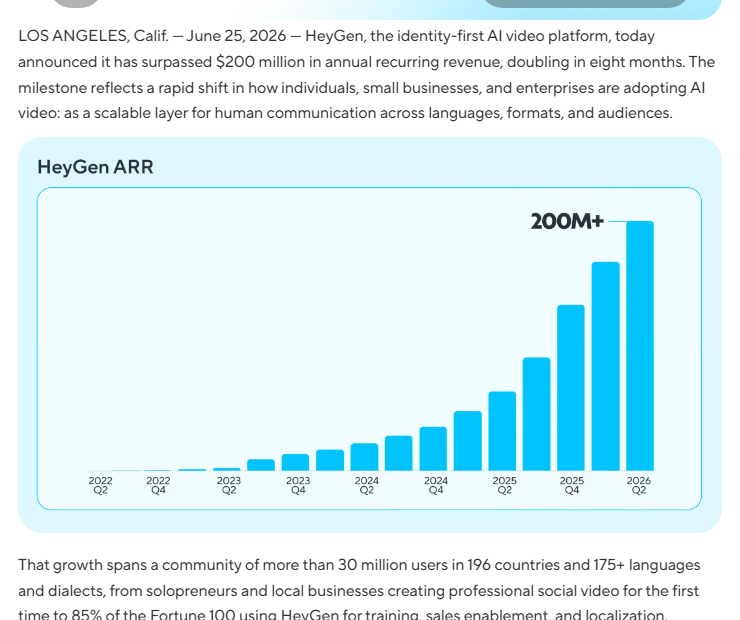
That line comes from HeyGen's CEO in the company's June 25, 2026 announcement that annual recurring revenue had passed $200 million, doubling in eight months. It is a fair summary of HeyGen's pitch: an avatar of you, built from a short recording, that can deliver new scripts in your voice and in other languages, so the person stays at the centre rather than a generic stock clip. Its plan pages list three avatar engines, lip-synced translation, a prompt-to-video agent, a public API with an MCP server, and a separate real-time avatar product, which is a broad toolkit for one subscription.
The catch is the meter. Since May 15, 2026 the old unlimited plans are gone for new buyers, and everything runs on credits that cost very different amounts per minute. On the $29 Creator plan, 600 credits buy about 150 minutes of the older Avatar III video look, about 19 minutes of Avatar IV, about 12.5 minutes of Avatar V, or 7.5 minutes of Video Agent output. Reviewers on Trustpilot say revisions eat into that, and HeyGen's own refund article warns that refunds “may not be granted if a significant amount of credits has already been created”. Add Terms that make payments non-refundable except where the law requires, a licence that lets HeyGen train its models on non-enterprise customers' content unless they opt out by email, and Free-plan videos licensed only for personal, non-commercial use, and HeyGen becomes a tool to budget and read carefully, not one to buy on the demo alone.
One web studio and one credit balance for avatars, translation and generated video, with the API and LiveAvatar billed separately.
Inside the web app at app.heygen.com you pick an avatar (a stock presenter, a photo avatar or a digital twin trained from footage of a real person), give it a script or a prompt, and HeyGen renders the video with one of three avatar engines. Everything you make in the web app, including translations and generated B-roll, draws on one monthly credit balance. Two things sit outside that balance: the developer API, which has its own pay-as-you-go credits, and LiveAvatar, a real-time conversational avatar product that now lives at liveavatar.com with its own plans.


Unlimited plans gave way to credits, a new avatar model arrived, free API credits ended, and the old API versions retire on Oct 31, 2026.
If you last looked at HeyGen in 2025, the plan names are familiar but the economics are not. The help center says the legacy unlimited plans, which included unlimited Avatar III videos plus a small pool of Premium Credits, “were decommissioned and are no longer offered past May 15th, 2026.” Existing subscribers can keep them while they stay paid up, but cancelling or switching is permanent. In the same stretch HeyGen launched Avatar V (announced Apr 8, 2026), stopped giving free monthly API credits (from February 2026), added a general-purpose video model, and set Oct 31, 2026 as the sunset date for its v1 and v2 API endpoints.


The practical effect: on the old Creator plan, Avatar III videos were unlimited. On the current Creator plan, an Avatar III video look costs 4 credits a minute, which still makes it the cheapest way to fill a long training video, while Avatar IV and Avatar V cost 31 and 48. People who mostly used Avatar III have the most to lose by switching; HeyGen's own legacy article recommends the new plans to those who mainly use Avatar IV and V.
A fast-growing vendor whose scale figures are its own, with large app-store samples that are friendlier than its Trustpilot page.
HeyGen's June 25, 2026 release says it passed $200 million in annual recurring revenue, has “more than 30 million users in 196 countries” and generates “roughly $2.70 in annual recurring revenue for every dollar of equity capital it has raised”, which implies about $74 million raised. Its about page, as shown on Oct 26, 2026, goes further: “Used by over 40 million people and 85% of the Fortune 100.” These are vendor figures. A user is a sign-up, not a paying customer; ARR is the company's own measure, not audited revenue; and the pricing page uses a third yardstick, more than 100,000 businesses.

Independent signals are mixed in a useful way. The US App Store listing for “AI Avatar Generator - HeyGen” averaged 4.8 (4.78) from 29,413 ratings on Oct 26, 2026, and the US Google Play listing showed 4.8 from 73K reviews with 1M+ downloads. App ratings mostly reflect quick mobile use rather than long training projects. Trustpilot, covered next, has a smaller sample but more detail on billing. One more marketplace signal: the US App Store search also returned an app called “HeyGen erator - Synthesia” from a different developer (3.2 from 17 ratings); HeyGen's official apps are published by HeyGen Technology Inc.


Most reviewers praise how easy it is to get a lifelike video; the unhappy minority writes about credits spent on revisions, support and cancelling.
On Oct 26, 2026 the Trustpilot profile for heygen.com showed a TrustScore of 4.2, labelled Great, from 4,827 reviews, with a star bar chart led by five-star reviews and a visible one-star bar. Two labels matter when reading that number. Trustpilot marks HeyGen as a company that “Asks customers to review” and the profile as a “Paid Trustpilot subscription”; most recent reviews carry an Invited tag, and invited reviews tend to be kinder. HeyGen had “Replied to 35% of negative reviews”. G2 and Reddit are not quoted here.

“Extremely easy to create an avatar!” The reviewer says a lifelike promo video for their business took minutes.
“The platform allowed me to create training videos in several different languages. Huge advantage.”
Several revisions “of 1 min-long vid burned for me 350 credits out of 600 monthly limit”.
On Video Agent: “It may take up to circa. 8 renders to get a 70 second video right”.
“They charge credits to setup and render videos and when those videos come out subpar, they charge you again to fix it.”
“No way to cancel my plan while on a paused sub?”
Tried the Free plan and could not generate a video: “Their support told me they have excluded some regions.”
In an update to an earlier complaint: “They credited back my account even more than the charged”.
“I was fed up paying $30/month to heygen, and made this instead”
The patterns. Praise centres on ease of use, avatar quality and multilingual training videos, and many five-star reviews are short and invited. Complaints centre on credits: revisions and Video Agent re-renders consume them, and several reviewers say credits went on renders that came out wrong. A second cluster is about support (an AI helper that gives wrong answers, email support that does not resolve issues) and about cancelling or pausing. A long-time subscriber also describes being moved off the old unlimited Avatar III plan, which matches the May 15, 2026 change. The Free-plan region complaint matches HeyGen's own help text, which says Free users get “free videos, depending on your region”.
Free for a taste, then Creator at $29, Pro from $49 with tiers up to 100,000 credits, and Business at $149 plus seats, all spending the same credits.
Free
Up to 3 watermarked videos a month, 1 minute each
- Avatar IV and Video Agent trial access
- 1 custom video avatar, 500+ stock presenters
- 720p sharing link, 30+ languages
- Personal, non-commercial use only
Creator
a month for 600 credits; $24 a month billed yearly ($288)
- 1080p export, no HeyGen branding
- Videos up to 30 minutes
- Avatar V with limited use
- No extra credit packs: upgrade instead
Pro
a month for 1,000 credits; $41 billed yearly. Tiers up to 100,000 credits for $4,300
- 4K export, faster processing
- Seedance video model, Cinematic Avatars
- Edit and proofread translation scripts
- Credits roll over when you raise the tier
Business
a month for the first seat and 1,500 shared credits, plus $20 per extra seat; $119 billed yearly
- Videos up to 60 minutes
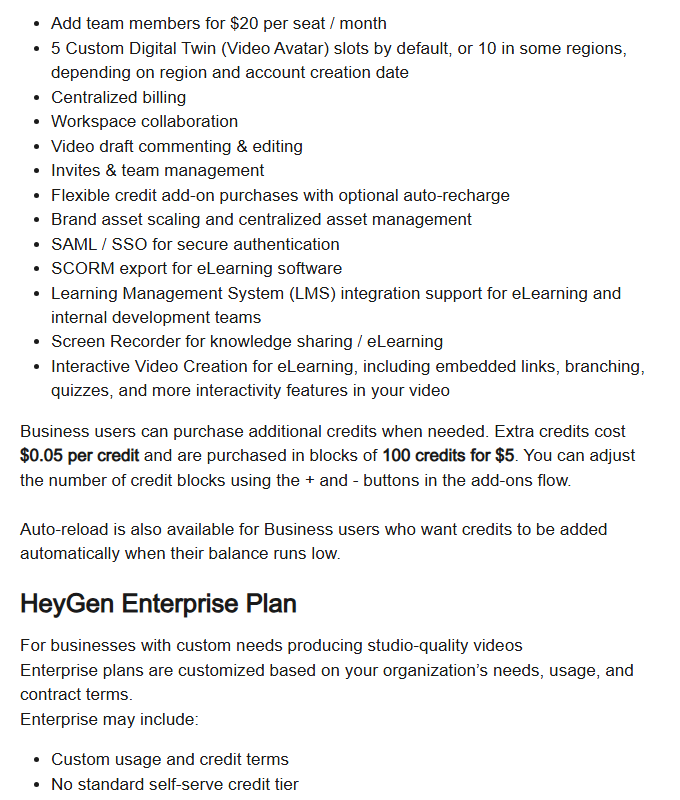
- SAML/SSO, SCORM export, LMS support
- Extra credits at $0.05 each, auto-reload
- 5 custom video avatars (10 in some regions)

Pro is really ten plans in one. The entry tier is 1,000 credits for $49, and a dropdown on the card raises it in steps up to 100,000 credits a month. The pricing FAQ says “All Pro tiers include the same features: only the monthly credit allocation changes.” That makes Pro the plan to watch if your usage grows, because Creator cannot buy extra credits at all; the help center is explicit that “Creator does not support one-time credit purchases.”


Swipe sideways to see every column.
| Pro credits a month | Monthly | Yearly, per month | Yearly total | Cents per credit (monthly) |
|---|---|---|---|---|
| 1,000 | $49 | $41 | $488 | 4.9 |
| 1,500 | $74 | $62 | $738 | 4.9 |
| 2,000 | $99 | $82 | $988 | 5.0 |
| 3,000 | $149 | $124 | $1,488 | 5.0 |
| 5,000 | $240 | $200 | $2,400 | 4.8 |
| 7,500 | $360 | $300 | $3,600 | 4.8 |
| 10,000 | $460 | $384 | $4,612 | 4.6 |
| 20,000 | $900 | $752 | $9,018 | 4.5 |
| 50,000 | $2,250 | $1,877 | $22,518 | 4.5 |
| 100,000 | $4,300 | $3,586 | $43,030 | 4.3 |
From the credit tiers published on heygen.com/pricing, Oct 26, 2026. Cents per credit rounded to one decimal. Creator is 600 credits for $29 (4.8 cents) or $288 a year (4.0 cents).
Going from 1,000 to 100,000 Pro credits cuts the unit price by only about 12%, from 4.9 to 4.3 cents. Yearly billing is a bigger lever: Creator billed yearly works out to 4.0 cents a credit. The bad news for yearly buyers is that credits still arrive monthly; the help center says an annual plan “does not provide all the annual credits at once”, though unused credits accumulate until renewal.

The Free plan: a sample with strings attached
Free needs no card and gives up to 3 watermarked videos a month, each up to 1 minute, with trial access to Avatar IV and Video Agent. Two limits matter more than the watermark. First, the help center says Free users get between one and three videos “depending on your region”, which explains the Trustpilot complaint above. Second, the Terms license Free-plan output “solely for personal, non-commercial, and internal evaluation purposes”: no client work, ads or monetised channels. Free accounts left unused for six months may also be deleted after notice.


The same 600 credits buy 150 minutes of Avatar III or 12.5 minutes of Avatar V, so the avatar engine, not the plan, decides your real price.
Every paid plan spends one balance. HeyGen's help center publishes the rate card: per minute of finished output, an Avatar III video look costs 4 credits, Avatar IV costs 16 (photo look) or 31 (video look), Avatar V costs 48, Video Agent costs 80 in standard mode and 240 in Seedance mode, and lip-synced translation costs 6 (Speed) or 10 (Precision). HeyGen says the in-product number is the one that counts: “The credit cost shown in HeyGen before you generate is always the cost that will be charged for that generation”.

Swipe sideways to see every column.
| Output | Credits a minute | Minutes from 600 credits | Cost a minute on Creator | API price a minute |
|---|---|---|---|---|
| Avatar III, video look (digital twin) | 4 | 150 | $0.19 | $0.60 |
| Avatar III, photo look | 7 | 85.7 | $0.34 | $0.99 |
| Avatar IV, photo look | 16 | 37.5 | $0.77 | $2.31 |
| Avatar IV, video look (digital twin) | 31 | 19.4 | $1.50 | $4.83 |
| Avatar V | 48 | 12.5 | $2.32 | $7.20 |
| Video Agent, standard | 80 | 7.5 | $3.87 | $5.82 |
| Video Agent, Seedance mode | 240 | 2.5 | $11.60 | not listed |
| Translation, Speed with lip sync | 6 | 100 | $0.29 | $0.81 |
| Translation, Precision with lip sync | 10 | 60 | $0.48 | $1.50 |
Creator cost per minute = credits × ($29 ÷ 600). API prices are HeyGen's self-serve rates per minute, charged by the second. Monthly billing, USD, Oct 26, 2026.
Two practical lessons follow. If your videos are long and simple, such as training modules read by your own twin, Avatar III keeps a $29 plan useful. If you want Avatar V's realism, budget roughly $2.32 a finished minute on Creator, before any retries. That retry caveat is the heart of the Trustpilot complaints, and HeyGen's own official tutorial on saving credits is worth the seven minutes before you start:
“Stop Wasting Credits... Master HeyGen in 7 Minutes”, official HeyGen YouTube channel (@heygen_official), embedded in the help article on credit-based plans.
Rollover, pausing and cancelling
Monthly subscribers' unused credits roll over for one extra cycle, so in practice a credit lives up to about 60 days; annual subscribers' credits accumulate until the renewal date. Two moves wipe the balance. Cancelling: “Credits do not carry over after cancellation”. Pausing, which looks harmless, is worse: “Pausing your plan expires your credit balance entirely.” A pause also only postpones the next charge by one cycle, after which the plan restarts and bills automatically.


One more caution: HeyGen's help article on usage limits still carries a table from the older plan structure, listing Avatar IV allowances of “600 seconds” on Creator and 6,000 seconds on Pro. Under the current rate card, 600 Creator credits buy about 1,160 seconds of Avatar IV video. Treat the in-product credit estimate as the authority, as HeyGen says.

Five setups priced line by line: a few short Avatar V videos fit the $29 plan, weekly training pushes you to Pro, and avatar minutes cost roughly three times the web rate through the API.
These are worked examples on HeyGen's published prices as of Oct 26, 2026, for invented but typical buyers, on monthly billing unless noted, with taxes excluded. They assume each video renders correctly the first time; reviewers report that revisions and re-renders spend credits, so leave headroom.
Swipe sideways to see every column.
| Setup | Credits a month | Cheapest fit | Per month | Watch out for |
|---|---|---|---|---|
| A. Coach posting four 2-minute Avatar V videos | 8 min × 48 = 384 | Creator (600) | $29 ($288 a year billed yearly) | 216 spare credits cover about 4 minutes of retries; unused credits last one extra month |
| B. Course creator: 20 minutes of Avatar IV digital-twin video | 20 × 31 = 620 | Pro 1,000 | $49 ($488 a year) | 20 credits over Creator, and Creator cannot buy top-ups. The same 20 minutes on Avatar III would be 80 credits |
| C. Marketer: ten 1-minute Video Agent videos | 10 × 80 = 800 | Pro 1,000 | $49 | Two extra renders each triples it to 2,400 (Pro 3,000, $149); Seedance mode is 2,400 before any retry |
| D. L&D team of three: 60 minutes of Precision translation plus 15 minutes of Avatar V | 600 + 720 = 1,320 | Business, 3 seats | $149 + 2 × $20 = $189 | Seats share the 1,500 credits; extra credits are $0.05 each |
| E. Developer: 100 minutes of Avatar IV digital-twin video | 3,100 on the web | Pro 5,000 on the web, or the API | $240 web, $483 API | The API is pay-as-you-go with no subscription, but each avatar minute costs about three times the web rate |
Credit rates from HeyGen's help center; plan and tier prices from heygen.com/pricing; API rates from “HeyGen API Pricing Explained”, updated Oct 19, 2026.
What the numbers say. HeyGen is affordable when you match the engine to the job: long, plain talking-head content on Avatar III, short showpieces on Avatar V. It gets expensive in two places: Video Agent, where one minute costs 80 credits and reviewers describe needing several renders, and the API, where Avatar V is $7.20 a minute against about $2.32 of Creator credits. HeyGen's MCP connector for Claude, ChatGPT and other agents bills the web plan's credits instead, but HeyGen's developer docs describe that path as sized for trial use rather than production.
No refunds by contract, a discretionary 15-day window in practice, automatic renewal, a $100 liability floor, and several HeyGen pages that disagree.
Refunds. The Terms (last updated Oct 15, 2026) are short: “Payments are non-refundable, except where required by law.” The help center is softer. If the product did not suit you, “HeyGen and Google Play purchases may be refunded within 15 days”, Apple purchases go through Apple's 14-day process, and web refunds are case by case and “may not be granted if a significant amount of credits has already been created”. If you cancel an annual plan, “unused months are not prorated or automatically refunded upon cancellation.” The one firm refund promise in the Terms runs the other way: if HeyGen ends the agreement for its own convenience, it refunds prepaid, unearned fees.


Renewal and price changes. Subscriptions renew automatically for the same term at the then-current price. HeyGen may change prices “at any time by posting updated pricing on the Pricing Page” with prior written notice, but the price you paid holds until the end of that period. If you exceed your plan's volume, the Terms allow overage charges at HeyGen's a la carte rates. Cancelling your own plan also cancels any add-ons; to drop only an add-on, the help center says to contact support.
Liability, content and disputes. HeyGen's total liability is capped at “the greater of the amount you paid for the service that gave rise to the claim during the 12 months before the liability arose or one hundred dollars ($100)”. It may “remove, screen, edit, or delete any of Your Content at any time, for any reason, and without notice.” Disputes go to individual arbitration with the American Arbitration Association under California law, with a class-action waiver; you can opt out in writing within 30 days of first using the service. We are not lawyers; read the full Terms before relying on a summary.


Where HeyGen's own pages disagree
Several HeyGen pages give different answers to the same question. None of these is a scandal, but each can change what you pay or what you can use, so confirm the point that matters to you in the product or with support before you buy.
| Question | One HeyGen page says | Another says |
|---|---|---|
| Free videos a month | Pricing card: “3 videos per month, watermarked” | Help center: one to three “free videos, depending on your region” |
| Refunds | Terms: “Payments are non-refundable, except where required by law.” | Help center: web and Google Play purchases “may be refunded within 15 days”, case by case |
| Training on your data | Trust & Safety FAQ opens with “No.” | Same answer: “Non-enterprise customers may be used to train and enhance the models that power our Services.” |
| Avatar V on photo looks | Credit table: “Avatar V (Photo Look & Video Look)”, 48 credits | Avatar V article: “not available for photo-based looks” |
| Seedance version on Pro | Pricing card: “Access to Seedance 2.5” | Help center: “Access to Seedance 2.0 engine” |
| Where HeyGen Video comes from | Help center: “built in-house” | Developer docs: “built on MiniMax H3 and post-trained by HeyGen” |
| HeyGen Video launch price, 768p | Help center: $0.015 a second | API pricing article: $0.018 a second (text or image to video) |
| Consent clip length | Help center: “Keep the video under 30 seconds.” | Developer docs: “Under 35 seconds.” |
All pages as shown on Oct 26, 2026: heygen.com/pricing, Terms of Service, Trust & Safety, the help center and developers.heygen.com.
Match your situation to one line.
Avatar V learns how you move from a short recording, then animates any look of you; it costs 48 credits a minute and works best for real people.
HeyGen's headline feature is the digital twin: an avatar trained from footage of a real person that can speak any script in a cloned voice. Avatar V, announced on Apr 8, 2026, is the newest engine. Per HeyGen's help center it needs a 15-second video of you to capture gestures and expressiveness, then uses a clear photo of you as the identity reference for every outfit and setting you generate. HeyGen positions it as “the most authentic way to represent yourself at scale”; the realism claim is the vendor's, and JAVIS has not compared outputs.

| Engine | Credits a minute | Best for, per HeyGen |
|---|---|---|
| Avatar III | 4 (video look), 7 (photo look) | Long, plain videos; the only route to a true 4K avatar via the API, from 4K footage |
| Avatar IV | 16 (photo), 31 (video) | Default engine; virtual, 2D, 3D and non-human characters; photo-to-video |
| Avatar V | 48 | Real human avatars; up to 3 minutes inside Video Agent |
From HeyGen's credit rate card, the Avatar V help article and the API pricing article, Oct 26, 2026.
HeyGen's official overview walks through Avatar V's features, and it is embedded in the Avatar V announcement on HeyGen's blog:
“HeyGen Avatar V: Every Feature Explained”, official HeyGen YouTube channel (@heygen_official), embedded in the post “Announcing Avatar V” on heygen.com/blog.
Before any video-based twin is trained, the person in the footage must record a consent video. The help center says this applies to every video-based Digital Twin, that someone you are cloning must record their own consent (they can do it by phone via a QR code), and that the consent clip must match the person in the footage. What that consent step does not cover, notably photo avatars, is in the consent and data section.

Record once with consent, pick the cheapest engine that looks good enough, check the preview, then translate.
An illustrative sequence built from HeyGen's help center and pricing page, Oct 26, 2026, not a record of a JAVIS project.
One prompt to a finished video costs 80 credits a minute in Video Agent; HeyGen Video generates short clips with sound, at launch prices that double from November 2026.
Video Agent is HeyGen's prompt-to-video tool: describe the video, attach files, and it writes the script, picks scenes and B-roll, and renders with your avatar. It is also the most credit-hungry way to use HeyGen: 80 credits a minute in standard mode and 240 in Seedance mode. HeyGen's official tutorial shows the workflow end to end and is embedded in its Video Agent help article:
“NEVER EDIT VIDEOS AGAIN! | HeyGen's AI Video Agent (Full Tutorial)”, official HeyGen YouTube channel (@heygen_official), embedded in “How to Get Started with Video Agent”.
HeyGen Video (model heygen-video-1) is newer and different: a general-purpose model that turns text, an image or a reference video into a short cinematic clip with its own soundtrack, no avatar required. The help center prices it per second of output with a 50% launch discount through the end of October 2026: text or image to video at $0.01 a second at 480p, rising to $0.02 from November. HeyGen's help article says the model was “built in-house”; its developer documentation says it is “built on MiniMax H3 and post-trained by HeyGen”.


For buyers this matters less as a technical detail than as a reminder to read the right page: the developer docs were more specific and more current on several points we checked, including clip lengths of 5 to 30 seconds and the MiniMax base model.
An MCP connector that spends your plan's credits, a pay-as-you-go API that charges roughly three times the web rate for avatar minutes (about 1.5 times for Video Agent), and a v1/v2 retirement on Oct 31, 2026.
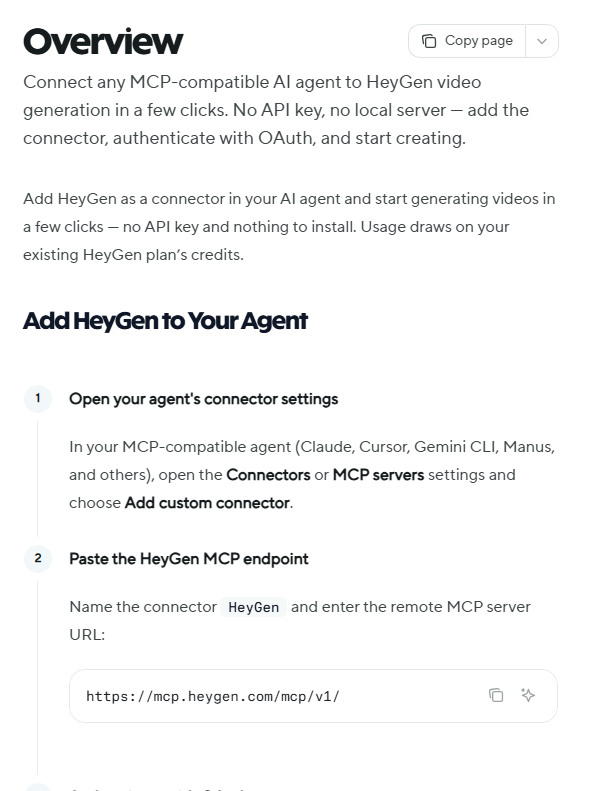
HeyGen now meets AI assistants where they are. Its MCP page offers “Add to ChatGPT” and “Add to Claude”, and the developer overview lists setups for Claude Code, Cursor, Codex CLI, Gemini CLI, Lovable and Manus. The connector signs in with OAuth and, per HeyGen, “Usage draws on your existing HeyGen plan's credits.” If you use Claude, our guide to Claude MCP connectors explains how connector permissions work, and the Claude Code setup guide covers adding a remote MCP server. The Business plan card also lists integrations with n8n, Make, HubSpot and Zapier.

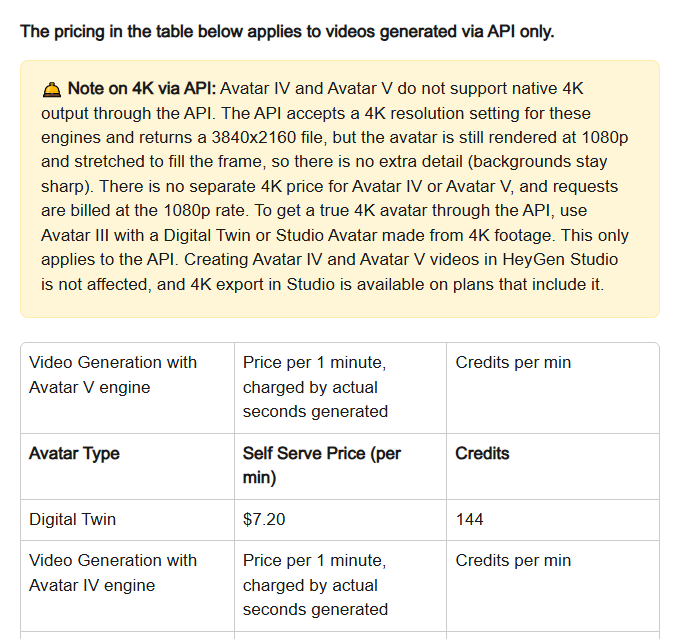
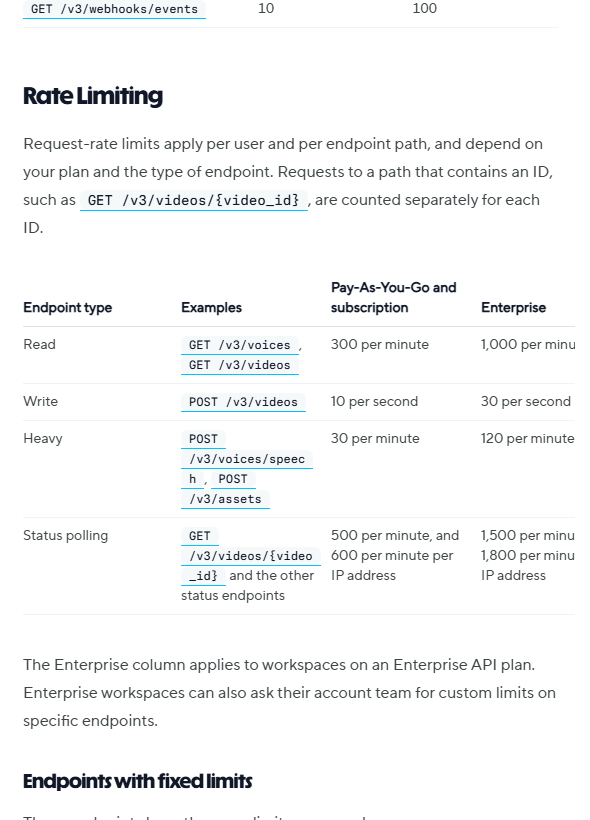
The developer API is a separate purchase, and its FAQ is blunt: “HeyGen does not offer free API credits starting Feb 2026.” Instead anyone, including Free users, can buy pay-as-you-go API credits, which expire after 12 months. Self-serve rates per minute, charged by the second: Avatar V $7.20, Avatar IV $4.83 for a digital twin or studio avatar and $2.31 for a photo avatar, Avatar III $0.60 to $0.99, Video Agent $5.82, lip-synced translation $0.81 (Speed) or $1.50 (Precision). Creating a digital twin costs $2.13 and a photo avatar $1.32. Concurrency is 10 jobs on pay-as-you-go and 20 on Enterprise.

Two details are easy to miss. HeyGen says API requests for 4K with Avatar IV or Avatar V return a 3840 by 2160 file in which “the avatar is still rendered at 1080p and stretched to fill the frame”; only Avatar III from 4K footage gives a true 4K avatar through the API. And the old API versions are ending: the changelog says v1 and v2 endpoints “remain fully operational through October 31, 2026, after which they will be retired.” Anyone with an older integration has until Oct 31, 2026 to move to v3.

LiveAvatar: the real-time product has moved out
HeyGen's real-time conversational avatars, once a beta called Interactive Avatar, are now LiveAvatar at liveavatar.com, with their own credits and plans. HeyGen's help center says you can sign in with a HeyGen account, but “Avatars created in HeyGen are not cross-compatible with LiveAvatar.” Plans on Oct 26, 2026: Free with 10 credits a month and 2-minute sessions, Essential at $99 for 1,100 credits, Business at $475 for 6,000 credits, and custom Enterprise. A credit is 10 US cents and buys 30 seconds of streaming in Full mode (HeyGen's voice stack included) or a minute in Lite mode (bring your own).


HeyGen's official walkthrough of deploying a real-time avatar assistant is embedded in the same help article:
“The FASTEST Way to Deploy a Real-Time AI Avatar Assistant in 2026 (Step-by-Step)”, official HeyGen YouTube channel (@heygen_official), embedded in “Introducing LiveAvatar”.
Video twins require the subject's recorded consent, photo avatars do not, Enterprise can waive consent with an indemnity, and non-enterprise content can train HeyGen's models unless you opt out.
A tool that clones faces and voices needs a clear answer to two questions: whose likeness can you use, and what happens to the footage you upload. HeyGen's own documents answer both, and the answers are more layered than the marketing suggests.
Consent depends on the avatar type. HeyGen's developer documentation describes three levels of consent access for digital twins: recording via webcam (all customers), uploading a pre-recorded consent video (Enterprise only), and skipping the flow, where “Consent collection is waived entirely for accounts that have signed an indemnity agreement.” Photo avatars sit outside that system entirely. The same page says “HeyGen runs no consent check and keeps no consent record for a photo avatar”, and makes getting and recording the subject's agreement your responsibility.


HeyGen's rules still forbid misuse. Its Content Moderation Policy says that without explicit consent “creating avatars of other individuals is strictly prohibited”, bans avatars of real people including celebrities without consent and of anyone who appears under 18, and lets a person depicted ask for removal. The Terms separately ban using the service for “political campaigning or lobbying purposes”, and the moderation policy lists political content among non-permissible content. HeyGen says it scans uploads and outputs with machine-learning moderation and uses human moderators; appeals go to moderation@heygen.com, and the policy notes that an appeal “does not guarantee that you will receive a response.”

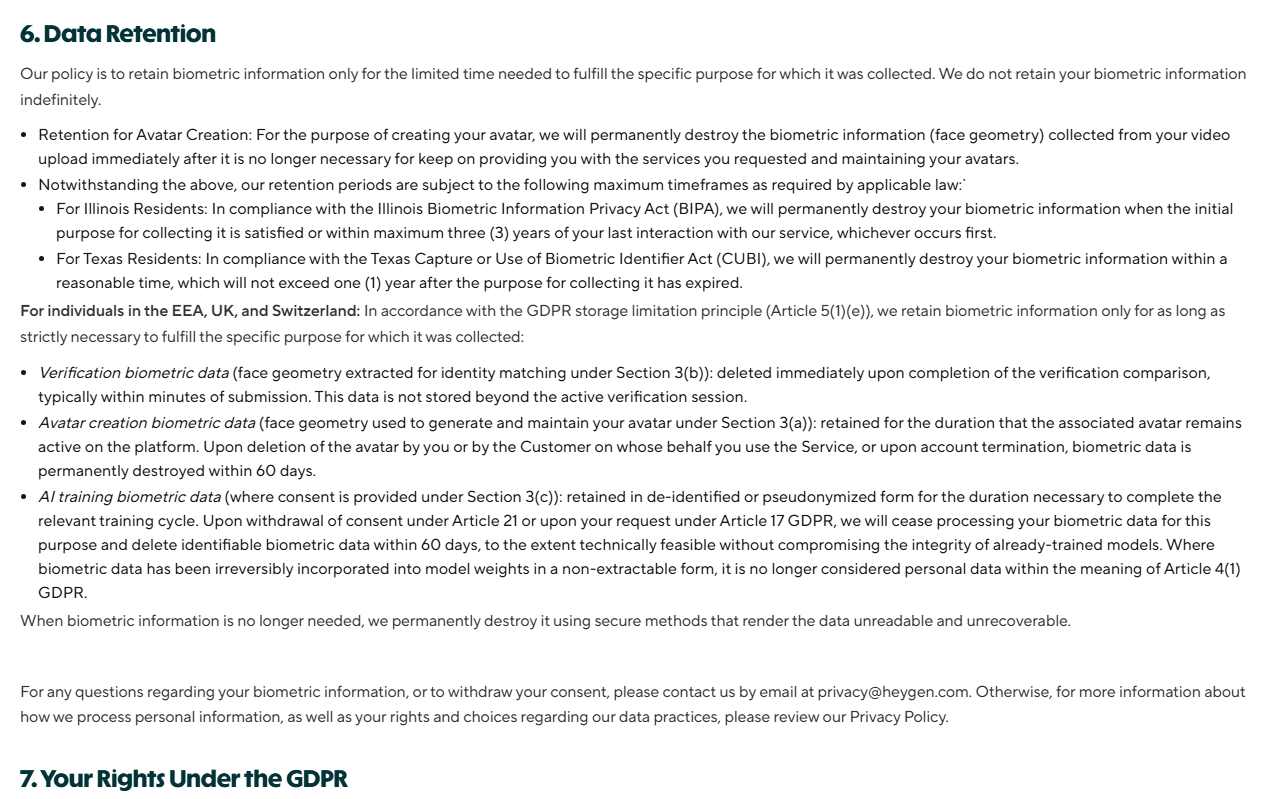
Training on your content. The Terms grant HeyGen a licence over your content to operate and improve the service, “including to train or otherwise improve or modify our artificial intelligence and machine learning models”, and call it “royalty-free, transferable, sublicensable, worldwide and irrevocable”. The security page adds that “Enterprise customers' data is excluded from AI model training by default.” and that “Non-enterprise customers may opt out at any time by contacting privacy@heygen.com.” There is no settings toggle mentioned on those pages; the opt-out is by email. For biometric data from custom avatars, HeyGen's biometric notice says training happens only with consent, except for enterprise customers, whose data is not used.


Where data lives and how long. HeyGen says “HeyGen's services are hosted on Amazon Web Services (AWS) in the United States.” and that all customer data is stored there, with EU-US Data Privacy Framework certification and Standard Contractual Clauses for European transfers. It lists SOC 2 Type II, GDPR, CCPA and EU AI Act compliance, TLS 1.2+ in transit and AES-256 at rest; text-to-speech subprocessors include Microsoft Azure and ElevenLabs. For biometric data, the notice says verification data is deleted within minutes and avatar-creation data is “permanently destroyed within 60 days” after you delete the avatar or the account (for people in the EEA, UK and Switzerland), with separate maximums for Illinois and Texas residents.

| Question | HeyGen's answer | What to do |
|---|---|---|
| Can I clone a colleague? | Only with their consent; video twins need their own consent clip | Have them record consent; keep written permission for photo avatars |
| Will my footage train models? | Non-enterprise: yes unless you opt out; Enterprise: excluded by default | Email privacy@heygen.com to opt out before uploading |
| Where is data stored? | AWS in the United States | Check your data-transfer rules (DPF, SCCs) |
| Who can sign in? | SAML/SSO on Business, SCIM on Enterprise | Use SSO for teams; protect API keys |
| Can Free videos go in ads? | No, personal and non-commercial only | Upgrade before any commercial use |
From HeyGen's Terms, security, trust and biometric pages and pricing, Oct 26, 2026.
Solo creators and trainers who reuse one twin, teams localising training, and developers who can live with API pricing.
- Coaches and creators who want to appear on video without filming each one
- L&D teams turning one recording into many languages
- Marketers who need presenter-led product and social videos
- Teams that need SSO, SCORM and shared brand kits
- Claude or ChatGPT users who want avatar video from chat
- Developers building personalised video at moderate volume
- Anyone planning commercial use on the Free plan
- Heavy Video Agent users on a fixed budget
- Buyers who need refunds or easy exits from annual plans
- High-volume API products sensitive to per-minute cost
- Organisations that cannot store data in the US
- Users who rely on old v1 or v2 API integrations past Oct 31, 2026
Likely plan by work pattern: a few short twin videos a month fit Creator; regular course or social output fits Pro 1,000 to 3,000; a training team fits Business; a product with avatars inside it fits the API or, for live conversation, LiveAvatar.
Nine things to check before you rely on it.
600 credits are 150 minutes of Avatar III or 12.5 of Avatar V; retries cost the same.
Terms say non-refundable; the 15-day help-center window is discretionary.
Free-plan output may not be used for ads, client work or monetised channels.
A pause expires the whole balance and restarts billing after one cycle.
Non-enterprise content can train HeyGen's models unless you opt out by email.
HeyGen keeps no consent record for photo avatars; Enterprise can waive consent with an indemnity.
Avatar V is $7.20 a minute via the API against about $2.32 of Creator credits; Video Agent is about 1.5x.
Run out mid-month and the only route is upgrading to Pro.
Free quotas, Seedance version, Avatar V on photos and consent clip length differ between pages.
Priced from each vendor's page on Oct 26, 2026; each counts minutes or credits differently, so compare directionally.
Swipe sideways to see every column.
| If you need | Tool | Entry paid plan | What it includes | What stands out |
|---|---|---|---|---|
| Your own twin, translation, an agent and an API in one place | HeyGen | $29 a month, $24 yearly (Creator) | 600 credits a month: about 19 minutes of Avatar IV or 12.5 of Avatar V | Three engines, Video Agent, MCP; LiveAvatar sold separately |
| Corporate training with a large stock-avatar library | Synthesia | $29 a month, $18 yearly (Starter) | 15,000 credits a year, up to about 150 minutes of video at 100 credits a minute | Pro at $64 a month yearly adds 5 personal avatars and about 720 minutes a year |
| Course building with SCORM on a mid-priced plan | Colossyan | $59 a month on an annual plan (Professional) | 30 minutes a month on NEO plus 10 on NEO2; unused minutes do not roll over | Free Starter with 20 NEO minutes a month; 5 SCORM exports a month on Professional |
| The lowest entry price for talking photos and agents | D-ID | $16 a month billed yearly (Pro, $191) | 15 minutes a month across videos, agents, translation and API | Commercial-use licence from Pro; Lite from $4.7 a month yearly carries a watermark |
From heygen.com/pricing, synthesia.io/pricing, colossyan.com/pricing and d-id.com/pricing/studio, Oct 26, 2026. JAVIS has a published Synthesia review; Colossyan and D-ID are not yet reviewed.


HeyGen or Synthesia for a first paid plan?
This is the comparison most buyers make. On yearly billing, HeyGen Creator is $288 for 7,200 credits, about 232 minutes of Avatar IV video or 150 minutes of Avatar V; Synthesia Starter is $216 for up to about 150 minutes. Per minute that is roughly $1.24 (HeyGen Avatar IV), $1.92 (HeyGen Avatar V) and $1.44 (Synthesia Starter). Synthesia's monthly price is the same $29. If you want a digital twin of yourself, Video Agent or an API on a small plan, HeyGen offers more of that; if you want a stock presenter for training at a predictable per-minute rate, Synthesia's Starter is simpler to budget.
| Question | HeyGen Creator | Synthesia Starter |
|---|---|---|
| Price, yearly billing | $288 a year | $216 a year |
| Video a year | About 232 min (Avatar IV) or 150 min (Avatar V) | Up to about 150 min, plus the free allowance |
| Cost per minute | About $1.24 to $1.92 | About $1.44 |
| Your own avatar | Custom video avatar included | Personal avatars start on Pro |
USD, Oct 26, 2026. Minutes assume no retries and no other credit spending.
This review has no affiliate links.
Every HeyGen link here goes straight to heygen.com, its pricing page, its Terms of Service, its help center or its developer docs, without tracking parameters. The score, the drawbacks and the alternatives would be the same either way.
How this review was put together: HeyGen's public pricing page (both tabs, monthly and yearly billing, every Pro tier), its Terms of Service, Privacy Policy, Biometric Information Privacy Notice, security, trust and moderation pages, about page and blog, help center articles on plans, credits, refunds, cancelling, consent, Avatar V, HeyGen Video, LiveAvatar and the API, developer documentation and changelog, official HeyGen videos, the LiveAvatar site, the Synthesia, Colossyan and D-ID pricing pages, Trustpilot, the US App Store and Google Play listings, and Hacker News, all as of Oct 26, 2026. JAVIS did not create a HeyGen account, train an avatar or render a video, so nothing here describes output quality, rendering speed or support response times from our own use. Screenshots show public pages only.
Comparing avatar tools, adding a voice, editing the result or connecting HeyGen to an AI assistant? These reviews cover the tools next to it.
Each card opens a published JAVIS review, routed by where you are.



Questions people ask before committing
Is HeyGen free?
There is a Free plan with up to 3 watermarked videos a month, each up to 1 minute, without a card. The help center says the number of free videos ranges from one to three by region, and the Terms limit Free-plan videos to personal, non-commercial use. Free accounts unused for six months may be deleted after notice.
How much does a minute of HeyGen video cost?
It depends on the engine. On Creator ($29 for 600 credits), a minute costs about $0.19 with Avatar III, $1.50 with Avatar IV (video look), $2.32 with Avatar V and $3.87 with Video Agent, before any retries. Through the API the same minutes cost $0.60, $4.83, $7.20 and $5.82, as of Oct 26, 2026.
Can I use HeyGen videos commercially?
On paid plans, yes: the Terms say you own your input and output and may use output commercially. On the Free plan, no: output may not be sold, monetised or used for advertising or client work.
Can I get a refund?
The Terms say payments are non-refundable except where the law requires. HeyGen's help center describes a discretionary 15-day window for web and Google Play purchases, judged case by case and less likely if you have used a lot of credits; Apple purchases follow Apple's 14-day process.
Does HeyGen train its AI on my videos?
For non-enterprise customers, it can: the Terms grant a licence that includes training, and the security page says you may opt out by emailing privacy@heygen.com. Enterprise customers' data is excluded by default. Biometric data from custom avatars is used for training only with consent.
Can I make an avatar of someone else?
Only with their explicit consent. For a video-based digital twin, that person must record their own consent video. HeyGen does not check consent for photo avatars, so you must get and keep their permission yourself; avatars of celebrities or minors are prohibited.
What happened to HeyGen's unlimited plans?
They were withdrawn for new buyers after May 15, 2026. Existing subscribers can keep them while payments continue, but cancelling or switching to a credit-based plan is permanent, and the old Team plan has not been sold since January 2026.
Where this came from, and when.
Every price, limit, rule and rating in this review comes from the pages below, all as of Oct 26, 2026 unless another date is given. Expand for the full list, the scoring method and what the review does not cover.
Show sources, scoring method and scope
Pricing: heygen.com/pricing (For Individuals and For Businesses tabs, monthly and yearly billing, every Pro credit tier and the pricing FAQ), Oct 26, 2026. Prices are in US dollars as stated in the page FAQ.
Terms and policies: HeyGen Terms of Service (effective Mar 6, 2025, last updated Oct 15, 2026): sections 3, 4, 5, 7, 8, the arbitration provisions and section 23; Privacy Policy (last updated Oct 15, 2026); Biometric Information Privacy Notice (last updated May 5, 2026); Content Moderation Policy (effective Jul 25, 2024); heygen.com/security; heygen.com/trust-and-safety.
Help center: “HeyGen Credit-Based Pricing Plans & Subscriptions Explained”, “How to Use Credits on HeyGen”, “HeyGen Legacy Unlimited plans”, “How Dynamic &. Non-Dynamic Limits work at HeyGen”, “Refund Process and Policy”, “How to Cancel or Pause your HeyGen Subscription”, “HeyGen API Pricing Explained” (updated Oct 19, 2026), “Recording your Consent Video”, “Avatar V is now available on HeyGen!”, “Introducing HeyGen Video”, “Introducing LiveAvatar” and related articles.
Developer docs: developers.heygen.com pages “Avatar Consent”, “Photo to Avatar”, “Usage Limits”, “MCP Overview”, “HeyGen Video”, the endpoint version comparison and the API changelog (v1/v2 sunset on Oct 31, 2026).
Company: heygen.com/about (counters and investor list), HeyGen's Jun 25, 2026 release on passing $200 million ARR (last updated Oct 12, 2026), the Avatar V announcement of Apr 8, 2026, and the LiveAvatar site and plans at liveavatar.com.
Video: four videos from the official HeyGen YouTube channel (@heygen_official), each embedded on a HeyGen page: yG2Ur-MjJb8 (saving credits), OGbsSuHLuMc (Avatar V), C2bFuSVX2c4 (Video Agent) and QO-ri-NeqLY (LiveAvatar).
Independent evidence: Trustpilot profile for heygen.com (TrustScore 4.2, 4,827 reviews, invitation, subscription and reply labels, recent reviews; screenshot taken Oct 26, 2026), Oct 26, 2026; US App Store listings for “AI Avatar Generator - HeyGen” (4.8 from 29,413 ratings) and “HeyGen: Translate Video” (4.8 from 287); US Google Play listing (4.8, 73K reviews, 1M+ downloads); Hacker News items 49216223 and 47533610. G2 and Reddit are not quoted.
Competitors: synthesia.io/pricing (yearly billing), colossyan.com/pricing and d-id.com/pricing/studio, Oct 26, 2026.
Images: screenshots of public pages taken on Oct 26, 2026 at a 1,280-pixel-wide window, some cropped to the article text; avatar imagery inside them is the vendors' own. JAVIS charts and diagrams are labelled as such and computed from the prices above. Related cards use JAVIS's own featured images.
JAVIS Fit Score (68/100): an editorial composite scored out of 20 on five criteria. Price clarity 12: every plan and Pro tier is public and the credit rate card is published, but real cost depends on the engine and on retries, rates can vary by account region and creation date, and several help pages disagree with the pricing page. Capability 18: three avatar engines, lip-synced translation in 175+ languages, Video Agent, a public API, an MCP server, SCORM and SSO on Business, plus LiveAvatar as a separate product. Independent evidence 15: 4.8 from 29,413 US App Store ratings and 73K Google Play reviews, Trustpilot 4.2 from 4,827 with review invitations, and low-star reviews centred on credits, support and cancelling. Terms, data and consent 9: non-refundable payments, an irrevocable training licence for non-enterprise users with an email opt-out, non-commercial Free output, a $100 liability floor, US-only data storage, no consent check on photo avatars and an Enterprise consent waiver; offset by recorded consent for video twins, SOC 2 Type II and a detailed biometric notice. Cost and fit 14: $29 buys useful Avatar III or short Avatar V output, but Video Agent and the API get expensive fast and Creator cannot top up. It is judgment, not a measurement.
What this review does not cover: output quality, lip-sync accuracy and rendering speed in practice, support response times, Enterprise contract terms, prices in currencies other than USD, the HeyGen mobile apps in depth, LiveAvatar latency, and the Trustpilot review texts beyond those quoted.