
LlamaIndex Review 2026: It's Not a RAG Framework Anymore
Most people still describe LlamaIndex as "the data framework you use for RAG." That's no longer how the company describes itself. Its own GitHub README now opens with a notice that "the current focus of LlamaIndex is to build the best AI-powered engine for document parsing and extraction" — and that "our primary focus has shifted towards LlamaParse." The open-source framework that made LlamaIndex famous is still there, still MIT-licensed, still getting commits. But it is no longer the product the company is betting its business on. This review covers what actually changed, what LlamaParse costs today, and whether the pivot is a strength or a warning sign.
| OSS framework license | MIT, still free |
| 2026 primary product | LlamaParse (paid document processing) |
| Free LlamaParse tier | 10,000 credits/mo |
| Cheapest paid plan | Starter, $50/mo |
| Disclosed funding | ~$28.5M + undisclosed Databricks/KPMG round |
LlamaIndex didn't stay the librarian for your RAG stack. It became a document-parsing vendor with a free framework attached.
"If you built something on LlamaIndex in 2023 or 2024 and haven't looked since, the honest update is bigger than a version bump. The company itself says the open-source framework — the thing most people know it for — is no longer where its engineering effort or its revenue is concentrated. That's now LlamaParse: an agentic document-parsing platform that turns messy PDFs, scanned filings, and spreadsheets into structured, AI-ready output, sold on a credit meter. The framework still works. It's just not the plan anymore."
That's not a hostile read — it's what LlamaIndex's own GitHub README says, in a pinned notice at the top of the file. Founder Jerry Liu has been public about why: agent reasoning got good enough that a lot of the framework's original orchestration value became less differentiated, while document understanding — tables, scanned layouts, multi-column filings — stayed genuinely unsolved. So the company followed the harder, more monetizable problem.
One open-source framework, one commercial parsing platform, and a shared belief that documents are the bottleneck.
LlamaIndex today is really two things wearing one name. The OSS framework (still called llama_index, MIT-licensed) is a Python/TypeScript toolkit for building RAG and agent applications — indexing, retrieval, query engines, and the newer event-driven Workflows system. LlamaParse is the commercial platform: agentic OCR and layout-aware parsing that turns PDFs, scans, spreadsheets, and 50+ file types into Markdown, JSON, or HTML with confidence scores, plus adjacent tools for extraction (LlamaExtract), classification, and splitting. A third piece, LiteParse, is a free, local, VLM-free parser aimed at teams that don't want to send documents to a hosted API at all.
The one-sentence version: if your problem is "how do I orchestrate an LLM app," the OSS framework is still there and still free. If your problem is "I have a pile of ugly documents," LlamaParse is now the actual product LlamaIndex wants to sell you.
LlamaIndex's 2026 story is a repositioning, not a collapse — the numbers back that up.
run-llama/llama_index, verified on GitHub, Sep 22, 2026.
Company-stated, combined PyPI/npm, Sep 2026.
Company-stated cumulative platform figure.
Seed + Series A, plus an undisclosed Databricks/KPMG round.
| Date | Event | Result |
|---|---|---|
| 2023 | $8.5M seed, led by Greylock | Company incorporated April 2023, project renamed from GPT Tree Index |
| Mar 4, 2025 | $19M Series A, led by Norwest Venture Partners | Total disclosed capital reaches $27.5M; LlamaCloud reaches general availability |
| May 1, 2025 | Strategic investment from Databricks and KPMG LLP (amount undisclosed) | Signals enterprise-AI-stack validation; both become named platform partners |
| Mar 3, 2026 | Official repositioning post: "more than a RAG Framework" | Company publicly reframes itself as an agentic document-processing infrastructure business |
Enterprise customers praise the parsing quality. Developers on Hacker News still remember the breaking changes.
"LlamaParse stands out as the premier solution for integrating complex documents into our advanced analytics pipeline. Its exceptional handling of nested tables, complex layouts, and image extraction has been instrumental in our data-driven investment strategies."
"LlamaCloud completely changed our velocity. Our small team of data scientists have spun up 10 production-grade use-cases in a couple of months... because LlamaCloud takes care of the heavy-lifting."
A named thread literally asks whether others "have a problem with LangChain and LlamaIndex due to their changing codebase" — developers report needing to re-pin versions or rewrite integration code after framework upgrades.
A real free tier, a credit meter, and a $1,000 signup bonus that says "we want you on Pro."
Free
10,000 credits/mo included.
- Up to 100 users
- Basic community support
Starter
40,000 credits/mo, pay-as-you-go to 400K.
- Up to 100 users
- Basic email support
Pro
400,000 credits/mo + a one-time 800K-credit signup bonus.
- Pay-as-you-go up to $5,000/mo
- Priority Slack support
Enterprise
Volume-discounted credits, 5x rate limits.
- Enterprise SSO, SaaS or hybrid cloud
- Dedicated account manager
Your answer depends on whether your problem is orchestration or documents.
Use the free OSS framework, or look at LangChain instead.
LlamaParse Free tier (10K credits/mo) is enough to test it properly.
Starter ($50/mo) or Pro ($500/mo) depending on page volume.
Enterprise, custom pricing.
The thing LlamaIndex is actually betting the company on: turning ugly documents into usable data.
LlamaParse is a multi-agent document-processing pipeline: OCR, layout detection, table reconstruction, and chart interpretation, with four selectable parse tiers that trade cost for accuracy. You pick a tier per document (or let the platform auto-select), and the output comes back as Markdown, JSON, or HTML with per-field confidence scores you can act on.
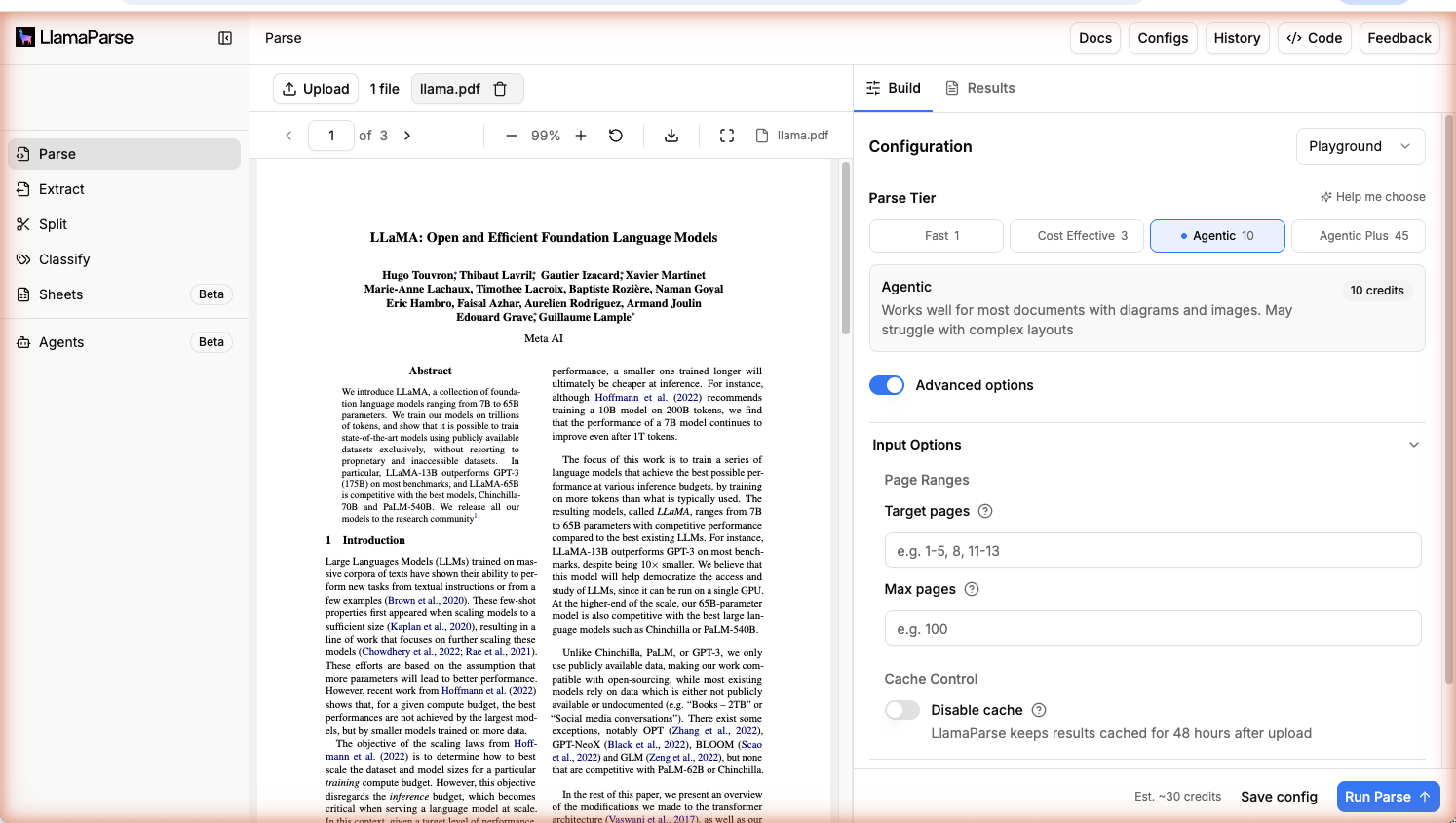
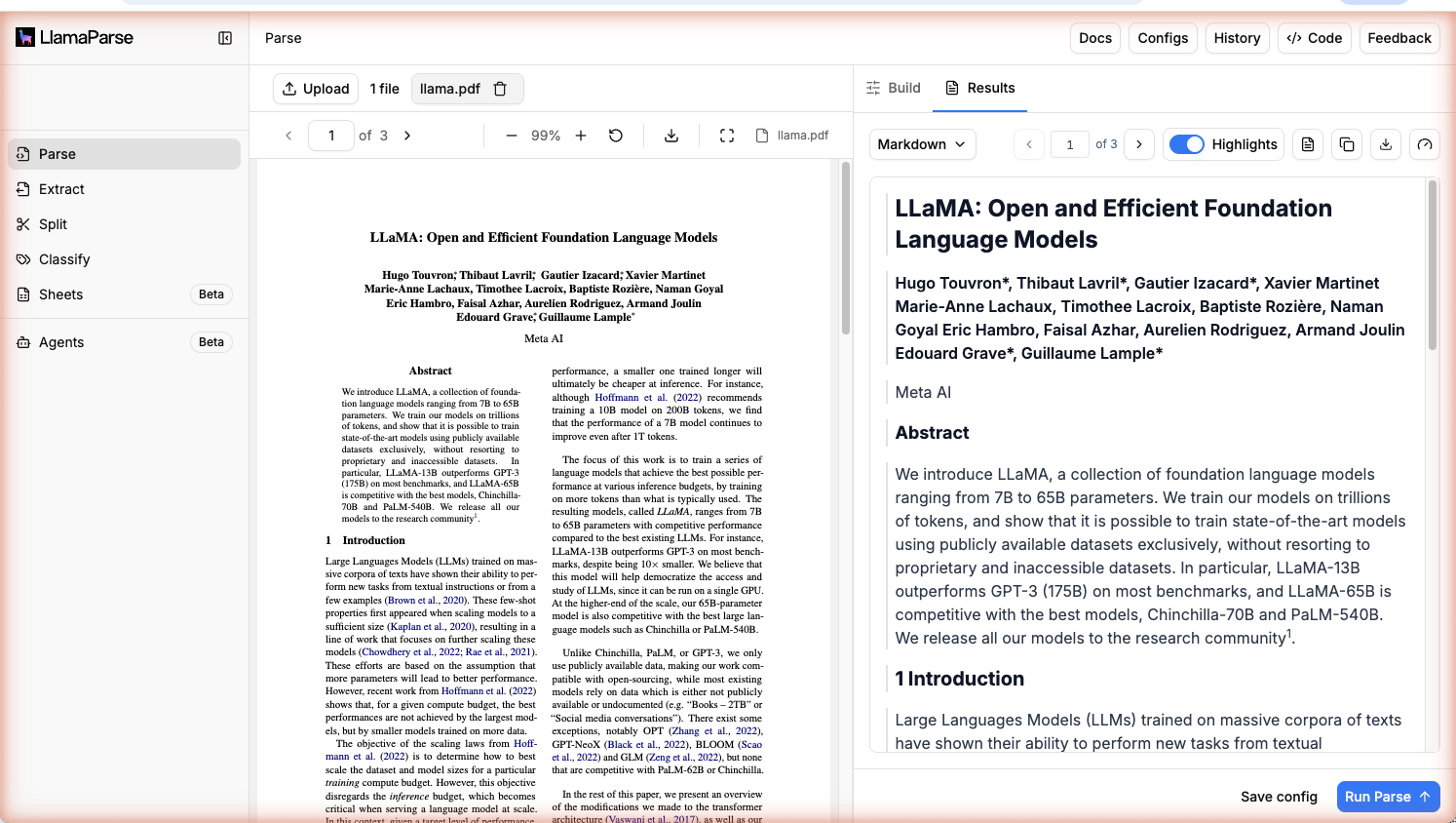
- Four real parse tiers let you deliberately trade cost for accuracy per document, instead of one-size-fits-all OCR.
- Confidence scoring on output makes it possible to route low-confidence pages to human review automatically.
- Cached results for 48 hours after upload avoid re-paying credits while you iterate on downstream logic.
- The Agentic and Agentic Plus tiers (10 and 45 credits/page) can get expensive fast on large, image-heavy document sets.
- Accuracy claims ("5x more accurate than other APIs") are the vendor's own benchmark framing — cross-check against your actual document types before committing budget.
Pick a tier, parse, review the confidence scores, ship the output.
Official LlamaIndex video: parsing your first document with LlamaParse in under 60 seconds.
Published by the official "LlamaIndex" YouTube channel (youtube.com/@LlamaIndex). Published Feb 10, 2026.
LlamaExtract turns a document into a form you can actually validate.
Where LlamaParse converts a document into clean Markdown/JSON, LlamaExtract goes a step further: define a schema (or let it infer one) and it pulls structured fields directly out of the document, each tagged with a confidence score you can threshold against.
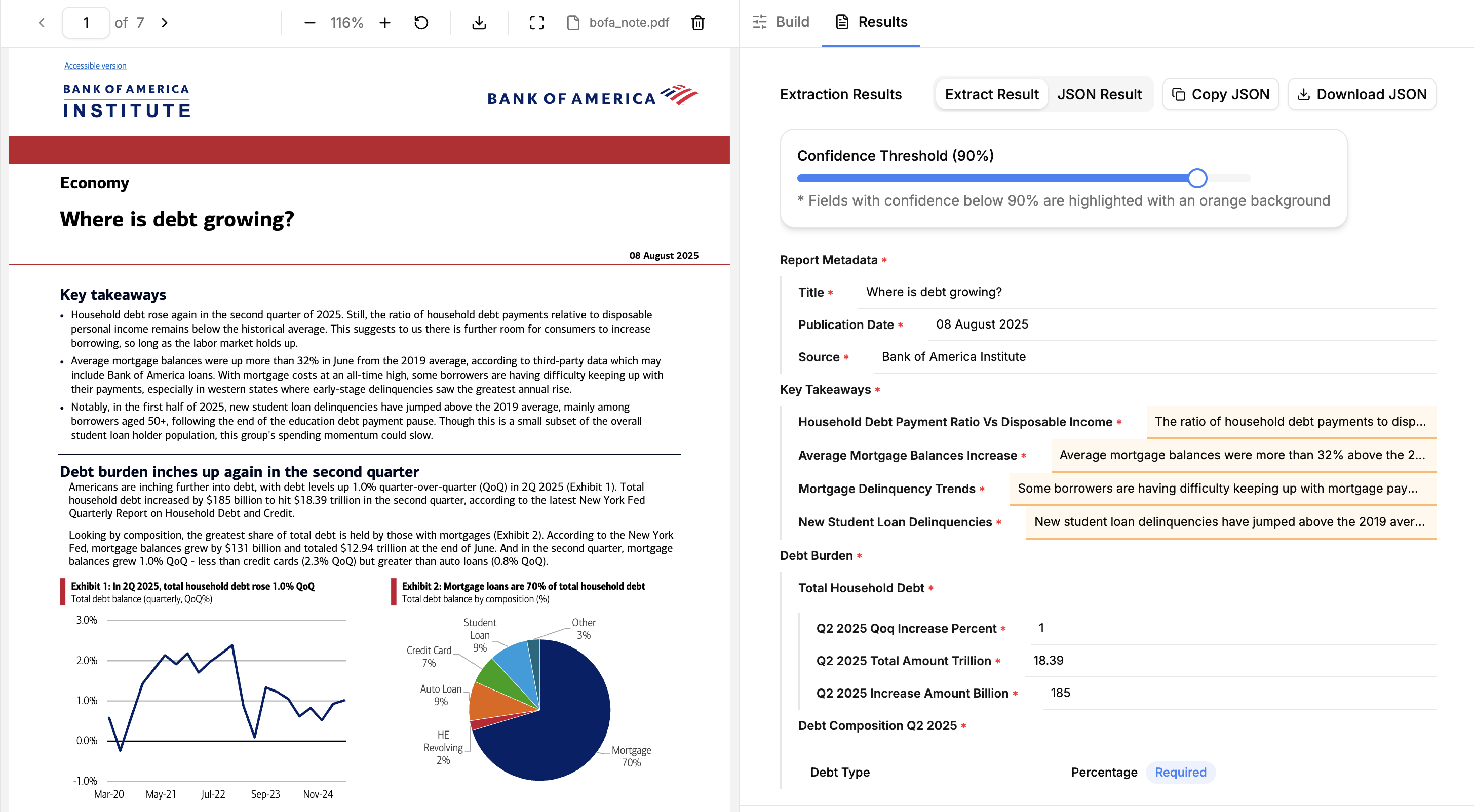
This is the piece that turns "we parsed the document" into "we can put this number in a database." For finance, insurance, and due-diligence workflows — the sectors LlamaIndex's own case studies keep naming — that distinction is the entire point.
LlamaParse can be called by an agent — and can call one back.
LlamaIndex ships MCP support in both directions. The OSS framework can consume tools from any external MCP server (llama-index-tools-mcp), and LlamaParse itself can run as an MCP server, exposing Parse, Classify, Extract, and Split as callable tools to any MCP-compatible agent client. LlamaAgents (beta) sits on top of this: a way to build multi-step document workflows either in code or by describing them in plain English.
You're really paying per page, tiered by how hard the page is to read.
| Parse tier | Credits/page | Approx. cost/page | Best for |
|---|---|---|---|
| Fast | 1 credit | ~$0.00125 | Clean, simple text documents |
| Cost Effective | 3 credits | ~$0.00375 | Most everyday business documents |
| Agentic | 10 credits | ~$0.0125 | Diagrams, images, moderately complex layout |
| Agentic Plus | 45 credits | ~$0.05625 | Nested tables, dense financial filings |
Compliance certifications exist. Where your documents actually sit is a plan decision.
The best fit is defined by your document problem, not your job title.
| Situation | Why LlamaIndex fits | Likely plan |
|---|---|---|
| Building a general RAG/agent app, documents aren't the hard part | Free OSS framework, MIT-licensed | OSS framework only |
| Team drowning in scanned PDFs, filings, or invoices | Parse Tier selector trades cost for accuracy per document | Free or Starter |
| Production pipeline processing real volume monthly | Confidence-scored output, cached results, priority support | Pro |
| Finance/insurance/due-diligence with compliance requirements | SOC2/GDPR/HIPAA, hybrid-cloud deployment, SSO | Enterprise |
| Want the simplest possible orchestration framework, not a parsing bill | LlamaIndex's own current focus has moved elsewhere | Consider LangChain or Haystack instead |
Four real gaps, not manufactured ones.
Teams who adopted the OSS framework for RAG in 2023-2024 may not have noticed the company's center of gravity moved to a paid parsing product they never signed up for.
Recurring Hacker News complaints describe re-pinning versions and rewriting integration code after framework upgrades — a real cost for teams that adopted early and stayed on the framework track.
45 credits/page on Agentic Plus adds up quickly across large, image-heavy, table-dense document sets — model the cost before committing a workflow to the top tier.
LlamaIndex publishes ParseBench and ExtractBench itself; useful transparency, but it is still the company grading its own homework. Verify against your own document types.
If LlamaIndex's current focus doesn't match your problem, here's how to think about it.
| If you mostly need... | Compare LlamaIndex with... |
|---|---|
| General-purpose agent orchestration, not document-parsing-first | LangChain (langchain.com) — 146,807 GitHub stars, "the agent engineering platform" |
| A lighter open-source RAG/NLP framework without a parsing upsell | Haystack (haystack.deepset.ai) by deepset |
| Document-parsing as the entire product, evaluated head-to-head | Unstructured (unstructured.io) or Reducto (reducto.ai) |
| Vision-model-centric structured extraction from complex documents | LandingAI Agentic Document Extraction (landing.ai) |
I have not verified a standard public affiliate program for LlamaIndex.
At the time of this review, LlamaIndex does not appear to run a public creator/affiliate referral program the way some infrastructure vendors do. Every CTA in this article points to LlamaIndex's official site, unmodified — no tracking parameters, no invented commission link.
Go to the official product.
Open LlamaIndexRead the comparison that matches your real question.
Choose the next articleLlamaIndex sits at the intersection of vector search and model access — both covered in related JAVIS reviews.


Questions people are actually searching right now
Is LlamaIndex still open source?
Yes. The llama_index framework is MIT-licensed and still actively maintained (pushed to as recently as Sep 21, 2026). What changed is that it's no longer the company's primary product focus — that's now LlamaParse.
What happened to LlamaCloud?
It was renamed to LlamaParse across LlamaIndex's docs and site, reflecting the platform's evolution into agentic document processing as its own product line rather than a "cloud" add-on to the framework.
Is LlamaParse free?
There's a genuine free tier: 10,000 credits/month, no card required for testing. Paid plans start at Starter, $50/month for 40,000 credits.
Is LlamaIndex still good for RAG?
The framework still works for RAG and agent orchestration and remains free. But if your workload is document-parsing-heavy, LlamaParse (built on the same company's more current engineering focus) is where the recent investment has gone.
LlamaIndex vs LangChain — which should I pick?
They've diverged: LangChain now positions itself as a general "agent engineering platform" (146,807 GitHub stars), while LlamaIndex has concentrated on document parsing and extraction as a paid service. Many teams still use the LlamaIndex OSS framework and LangChain together.
Does LlamaIndex support MCP?
Yes, in both directions: the OSS framework can consume tools from external MCP servers, and LlamaParse itself can run as an MCP server exposing Parse/Classify/Extract/Split to any MCP-compatible client.
Who is actually paying for LlamaParse?
Named enterprise customers include Carlyle, KPMG, Cemex, Rakuten, and Salesforce, per LlamaIndex's own published case studies and funding announcements — vendor-selected examples, not an independent audit.
Did LlamaIndex raise more funding recently?
The company disclosed an $8.5M seed (2023) and a $19M Series A (March 2025, ~$27.5M total), then a strategic investment from Databricks and KPMG LLP (May 2025) whose amount was not disclosed.
Where this came from, and when it was checked.
GitHub stats (stars/forks/license/description): GitHub data for github.com/run-llama/llama_index, Sep 22, 2026.
The pivot itself: raw README.md of run-llama/llama_index (official, first-party pinned notice) and llamaindex.ai/blog/llamaindex-is-more-than-a-rag-framework, published 2026-03-03.
Pricing (Free/Starter/Pro/Enterprise, credit conversion, parse-tier costs): llamaindex.ai/pricing, official, read directly, plus live verification inside the LlamaParse Playground UI screenshot, Sep 22, 2026.
Funding timeline: llamaindex.ai/blog (Series A announcement, Databricks/KPMG announcement), corroborated by PR Newswire and Crunchbase.
Customer quotes (Carlyle, Cemex, KPMG): llamaindex.ai/customers, official, attributed.
MCP support (both directions): developers.llamaindex.ai/llamaparse/for-agents/mcp/ and developers.llamaindex.ai/python/framework/module_guides/mcp/, official.
Real screenshots/media: llamaindex.ai official OG image, opengraph.githubassets.com repo card, and three real screenshots from LlamaIndex's own developer documentation site (LlamaParse Playground upload/build view, LlamaParse Playground results view, LlamaExtract structured-extraction view).
Official video: youtube.com/watch?v=5-LHEevDG7k, authorship confirmed on YouTube (author "LlamaIndex", @LlamaIndex), published Feb 10, 2026.
User sentiment: Hacker News threads (item 40044848, item 41177701) for independent community pattern; G2's review page could not be read directly and was not used as a rating source.