Qdrant Review 2026: $87.8M In, Now Running on Edge Devices Too
Qdrant is still the same Rust-built, Apache-2.0 vector database that made its name on raw speed. What's changed since you last looked: a $50M Series B in March 2026 (total disclosed capital now $87.8M), a genuinely new quantization method built with roots in Google Research (TurboQuant, shipping since v1.18), and — the real surprise — a beta product called Qdrant Edge that runs vector search without a server at all, in-process, on robots and mobile devices. This review covers what Qdrant Cloud actually costs today, what TurboQuant really saves you, and whether the edge push changes who should use it.
| License model | Apache License 2.0, free |
| Free Cloud tier | 0.5 vCPU / 1GB RAM, permanent |
| Latest funding | $50M Series B, Mar 2026 |
| Total disclosed capital | $87.8M |
| New in 2026 | Qdrant Edge (beta), TurboQuant |
Qdrant kept doing the boring thing well — fast, self-hostable vector search — and used the money it raised to expand where that engine can run.
"There's no dramatic pivot here, unlike some of its neighbors in the AI infrastructure stack. Qdrant is still primarily a vector database, still Rust, still Apache-2.0. What changed is the edges of the map: a real new quantization method that cuts memory further without a recall hit, and a genuinely different beta product — Qdrant Edge — that removes the server from the equation entirely for robots, wearables, and offline devices. If you picked Qdrant for its speed in 2024, the 2026 version of that same bet just got more capital behind it and a couple of real new places to run."
That stability is itself a data point. Many of the neighbouring JAVIS reviews are about companies that changed what they are. Qdrant didn't change what it is — it changed how far that thing reaches, funded by a $50M Series B that brought its disclosed total capital to $87.8M.
One Rust engine, three ways to run it: self-hosted, managed Cloud, or now — no server at all.
Qdrant is a vector database and vector search engine written in Rust, distributed under Apache-2.0. You store vectors plus arbitrary JSON payloads, then query by similarity with real-time payload filtering, hybrid dense+sparse search, and multivector support. The same core engine ships three ways: self-hosted (free, your infra), Qdrant Cloud (managed, usage-based billing), and the newer beta Qdrant Edge — an in-process library with no background service at all, built for devices that can't run a server.
The one-sentence version: whatever the deployment target, it's the same underlying search engine — you're choosing who operates it (you, Qdrant, or nobody at all) rather than picking between different products.
A $50M round, real customers, and a star count that undercounts the story.
qdrant/qdrant, verified on GitHub, Sep 27, 2026.
Company-stated, at Series B announcement, Mar 2026.
Seed + $28M Series A (2024) + $50M Series B (Mar 2026).
Plus Bazaarvoice, OpenTable, per official announcement.
| Vector database | GitHub stars (live) | Forks (live) |
|---|---|---|
| Milvus | 46,260 | 4,271 |
| Qdrant | 34,840 | 2,702 |
| Weaviate | 16,851 | 1,410 |
The praise is speed and simplicity. The complaint is "give me more than a basic dashboard."
"Qdrant's technical architecture and performance capabilities have proven to be exactly what we need as we scale our AI-powered features" across a platform serving millions of users.
Users consistently cite speed, scalability, ease of setup, and payload filtering as reasons to adopt Qdrant — with the recurring gap being a lack of built-in visualization/analytics tooling beyond the basic dashboard.
Developers comparing embedded-first alternatives (like LanceDB) have historically noted Qdrant's server-first architecture as a gap for on-device use cases — a gap the new Qdrant Edge beta directly targets.
A real free tier, usage-based Cloud billing, and no published flat-rate list price.
Free
0.5 vCPU / 1GB RAM / 4GB disk.
- Single-node cluster
- Free Cloud Inference (selected models)
Standard
Billed hourly on actual resource usage.
- Dedicated resources, HA setups
- Backup & disaster recovery, 99.5% SLA
Premium
For teams with added security needs.
- SSO, Private VPC Links
- 99.9% SLA, extra support
Hybrid / Private Cloud
Qdrant-managed on your infra, or fully isolated.
- Custom SLAs
- Sales-negotiated
Your answer depends on who operates the server — or whether there is one.
Self-host the free, Apache-2.0 engine.
Qdrant Cloud Free tier to test, Standard for production.
Premium, minimum spend required.
Hybrid Cloud, custom pricing.
Qdrant Edge (beta) — no server at all.
The thing that actually moved in 2026: how much memory a vector index needs.
TurboQuant, shipped in Qdrant 1.18 (May 11, 2026), is a rotation-based quantization method with roots in Google Research. It applies a random orthogonal rotation to every vector so each coordinate ends up with roughly the same variance, then quantizes each coordinate independently against a fixed lookup table — no per-dataset training, no calibration set, no codebooks to persist. The practical result: similar recall to Scalar Quantization at 2x less memory. Qdrant 1.19 pushed further with a TurboQuant Datatype that compresses to 4 bits without keeping the original full-precision vectors — up to 9x storage reduction versus the earlier TurboQuant quantization.
- No per-dataset training or calibration step — TurboQuant works out of the box on real production embeddings.
- 2x memory reduction vs Scalar Quantization at similar recall is a real, published, reproducible number, not a marketing round-up.
- The follow-up TurboQuant Datatype (v1.19) claims up to 9x storage reduction at 4-bit compression.
- Qdrant's own benchmark methodology explicitly discloses its own bias ("we build Qdrant and know the most about it") — a rare honesty, but still self-reported.
- Quantization always trades some recall for memory; validate against your own embeddings and query patterns before committing production capacity.
Create a collection, upsert vectors with a payload, query with filters.
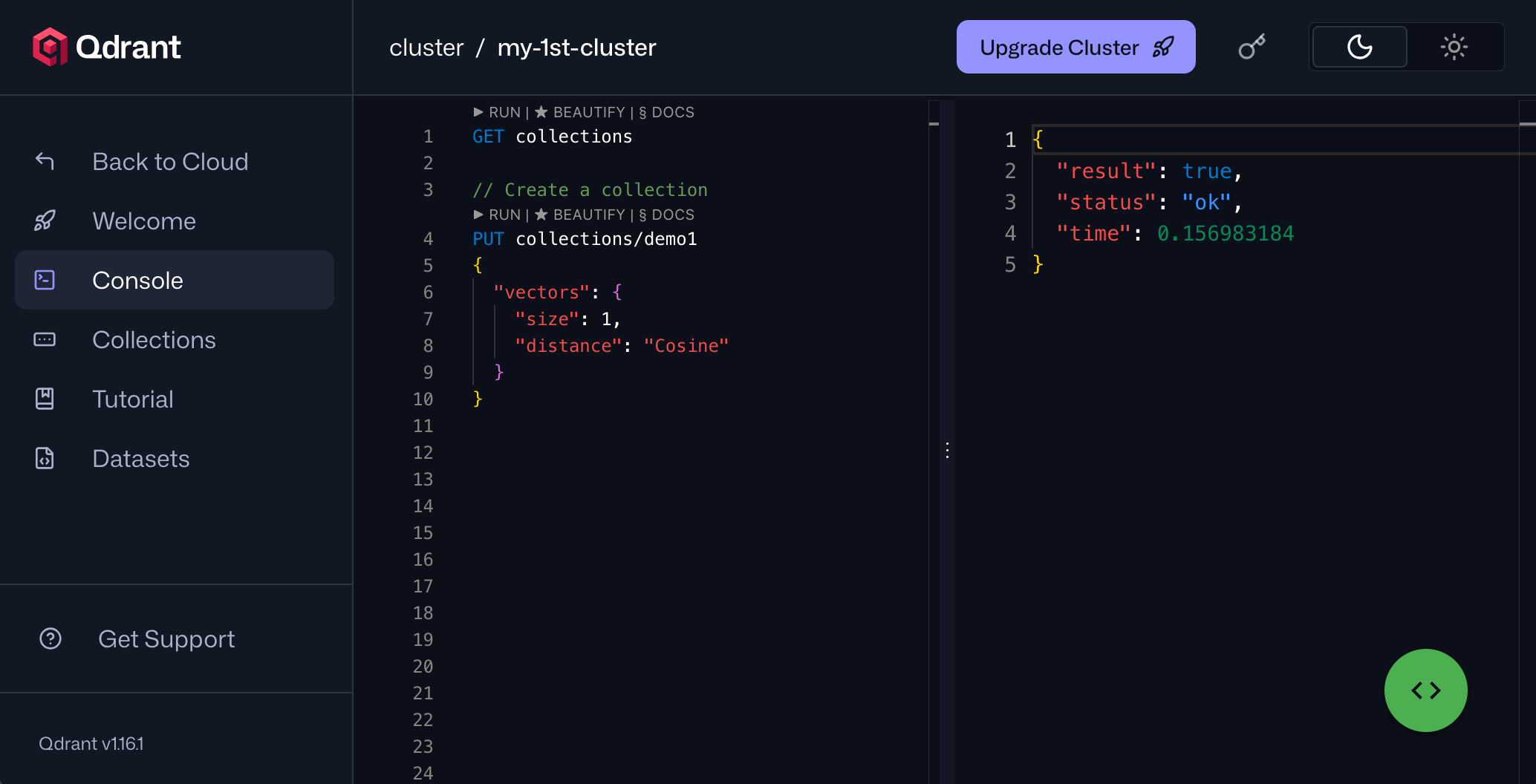
Official Qdrant video: building simple vector search from scratch, covering core concepts and the built-in web dashboard.
Published by the official "Qdrant Vector Search" YouTube channel (youtube.com/@qdrant).
The real surprise this year: Qdrant without a server, running on a robot.
Announced June 24, 2026, Qdrant Edge is a beta, in-process vector search library for embedded devices, autonomous systems, and mobile agents — not a hosted service, not even a background daemon. It runs as a library linked directly into your application: no background optimizer threads, no update service, every operation synchronous and under your application's control, with optional sync back to Qdrant Cloud when connectivity is available.
- Robotics & autonomy — real-time object recognition and navigation decisions
- Offline voice assistants — private, internet-independent search on wearables/smart speakers
- Smart retail & kiosks — on-device product recommendation without a round-trip
- Industrial IoT — anomaly detection and predictive maintenance on sensor data at the edge
- Still in beta — not yet the mature, fully-supported production path the Cloud/self-hosted engine is.
- A genuinely different architecture from the server-based engine; migrating between Edge and Cloud isn't a config flag, it's a design decision made up front.
Real compliance certifications exist — and where your data sits is still a deployment choice.


The best fit is defined by your deployment constraint, not your team size.
| Situation | Why Qdrant fits | Likely path |
|---|---|---|
| Solo developer / small project, testing an idea | Genuinely free forever tier, or self-host for $0 | Cloud Free or self-hosted |
| Production RAG/search at real scale, cost-per-query matters | TurboQuant memory savings directly cut hosting cost | Standard (usage-based) |
| Regulated org needing SSO/VPC isolation | Premium tier, or Hybrid/Private Cloud | Premium / Hybrid / Private |
| Robotics, wearables, or offline mobile AI | Qdrant Edge runs without any server at all | Qdrant Edge (beta) |
| Want vector search inside an existing Postgres deployment | Qdrant is a dedicated engine, not a Postgres extension | Consider pgvector instead |
Four real gaps, not manufactured ones.
Standard and Premium are usage-based with no public per-hour rate card — you need the live pricing calculator or a sales conversation to know your real bill in advance.
A recurring, sourced complaint: the dashboard covers collections/points/console well, but doesn't replace a dedicated analytics or observability tool.
Genuinely useful direction, but not yet the mature, fully-supported production path the server-based engine is — plan accordingly if you're building on it today.
Qdrant's own benchmark page is unusually transparent about its bias, but a single neutral, third-party, apples-to-apples benchmark across Qdrant/Pinecone/Weaviate under matched conditions was not found during this research pass.
If Qdrant's shape doesn't match your problem, here's how to think about it.
| If you mostly need... | Compare Qdrant with... |
|---|---|
| Fully-managed, zero infrastructure, closed-source | Pinecone (pinecone.io) |
| Native multi-modal search, broader out-of-the-box feature set | Weaviate (weaviate.io) — 16,851 GitHub stars |
| The largest-scale deployments, fastest indexing | Milvus (milvus.io) — 46,260 GitHub stars |
| Vector search inside an existing Postgres database | pgvector (github.com/pgvector) |
| The simplest possible developer experience for a small RAG prototype | Chroma (trychroma.com) |
| An embedded-first design Qdrant only recently entered with Edge | LanceDB (lancedb.com) |
I have not verified a standard public affiliate program for Qdrant.
At the time of this review, Qdrant does not appear to run a public creator/affiliate referral program the way some infrastructure vendors do. Every CTA in this article points to Qdrant's official site, unmodified — no tracking parameters, no invented commission link.
Go to the official product.
Open QdrantRead the comparison that matches your real question.
Choose the next articleQdrant is the storage layer under a lot of the retrieval and model stack covered in related JAVIS reviews.

Questions people are actually searching right now
Is Qdrant free?
Yes, two ways: self-host the Apache-2.0 engine at zero cost on your own infrastructure, or use Qdrant Cloud's permanent Free tier (0.5 vCPU / 1GB RAM / 4GB disk, single node).
Is Qdrant open source?
Yes — the core engine is Apache License 2.0, a genuine OSI-approved open-source license (unlike some vector-database peers that use more restrictive source-available terms).
How much did Qdrant raise?
A $50M Series B in March 2026, led by AVP with Bosch Ventures, Unusual Ventures, Spark Capital, and 42CAP participating, bringing total disclosed capital to $87.8M (after a $28M Series A in early 2024).
What is Qdrant Edge?
A beta, in-process vector search library (not a server) for embedded devices, robotics, and mobile agents, announced June 24, 2026 — it runs synchronously inside your application with no background service, and can optionally sync with Qdrant Cloud.
What is TurboQuant?
A rotation-based vector quantization method shipped in Qdrant 1.18 (May 2026), built with roots in Google Research. It needs no per-dataset training and delivers similar recall to Scalar Quantization at roughly 2x less memory; a v1.19 follow-up claims up to 9x storage reduction at 4-bit compression.
Is Qdrant better than Pinecone or Weaviate?
Different trade-offs: Pinecone wins on zero-ops managed simplicity; Weaviate offers broader native multi-modal features; Qdrant's own (self-disclosed, potentially biased) benchmarks claim the highest RPS and lowest latency in most tested scenarios, with the real advantage being self-hosting flexibility plus Apache-2.0 licensing.
Does Qdrant support hybrid search?
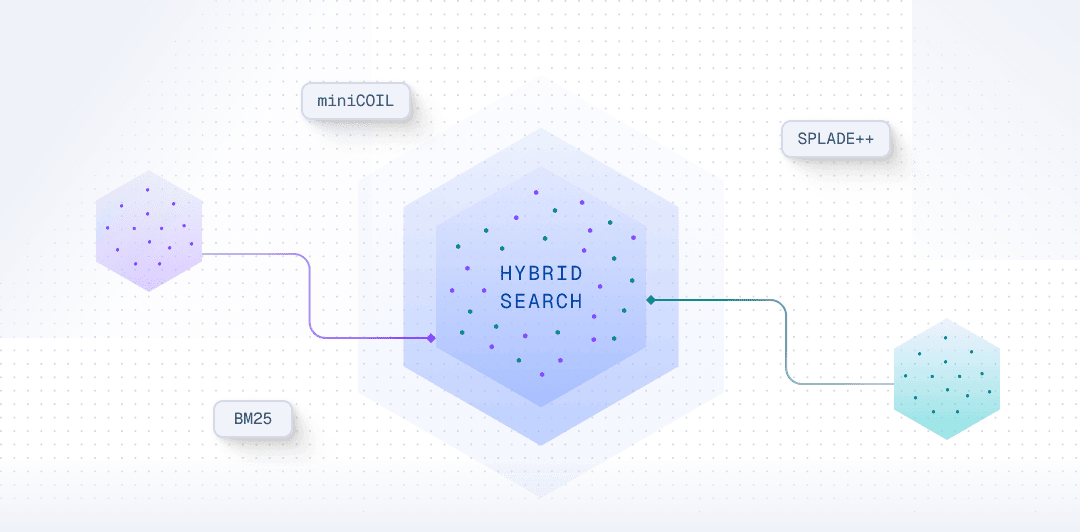
Yes — native hybrid dense+sparse search combining methods like BM25, miniCOIL, and SPLADE++, plus multivector support and one-stage filtered search.
Who actually uses Qdrant in production?
Named customers per Qdrant's own Series B announcement include Canva, Bazaarvoice, HubSpot, Roche, Bosch, and OpenTable — vendor-disclosed examples, not an independent audit.
Where this came from, and when it was checked.
GitHub stats (Qdrant/Weaviate/Milvus stars, forks, license): GitHub data for github.com/{qdrant/qdrant, weaviate/weaviate, milvus-io/milvus}, Sep 27, 2026.
Pricing (Free/Standard/Premium/Hybrid/Private): qdrant.tech/pricing, official, read directly, Sep 27, 2026.
Funding ($50M Series B, Mar 12 2026, $87.8M total): qdrant.tech/blog/series-b-announcement/, official, corroborated by BusinessWire and Seedtable.
TurboQuant: qdrant.tech/articles/turboquant-quantization/, qdrant.tech/blog/qdrant-1.18.x/, qdrant.tech/blog/qdrant-1.19.x/, official.
Qdrant Edge: qdrant.tech/edge/ and qdrant.tech/blog/qdrant-edge-on-device-vector-search/, official, announced June 24, 2026.
Benchmark claims: qdrant.tech/benchmarks/, official, including Qdrant's own self-disclosed bias caveat.
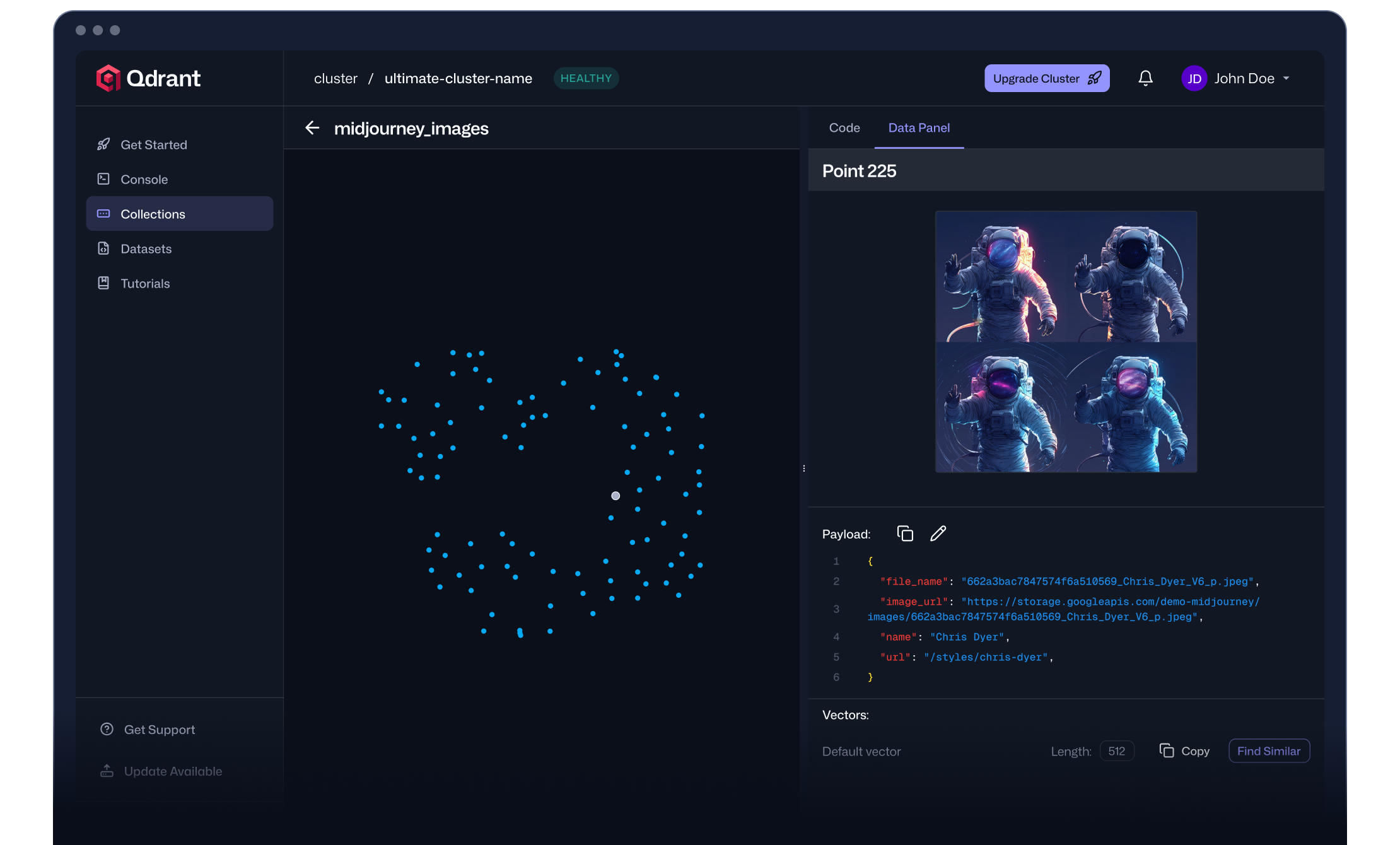
Real screenshots/media: qdrant.tech official OG image, opengraph.githubassets.com repo card, two real screenshots from qdrant.tech (homepage Web UI Collections/Data Panel view, and the documentation site's Console query-editor view), one official hybrid-search illustration, and three official compliance badge images (SOC2, GDPR, HIPAA).
Official video: youtube.com/watch?v=_83L9ZIoOjM, authorship confirmed on YouTube (author "Qdrant Vector Search", @qdrant).
User sentiment: G2 aggregate rating via search snippet (treated as lower-confidence, not directly re-checked); Hacker News threads for independent community pattern; Canva quote from Qdrant's own Series B announcement.