
Shopify Review 2026: What a Store Really Costs, From the $1 Trial to Card Fees, and the Terms Behind It
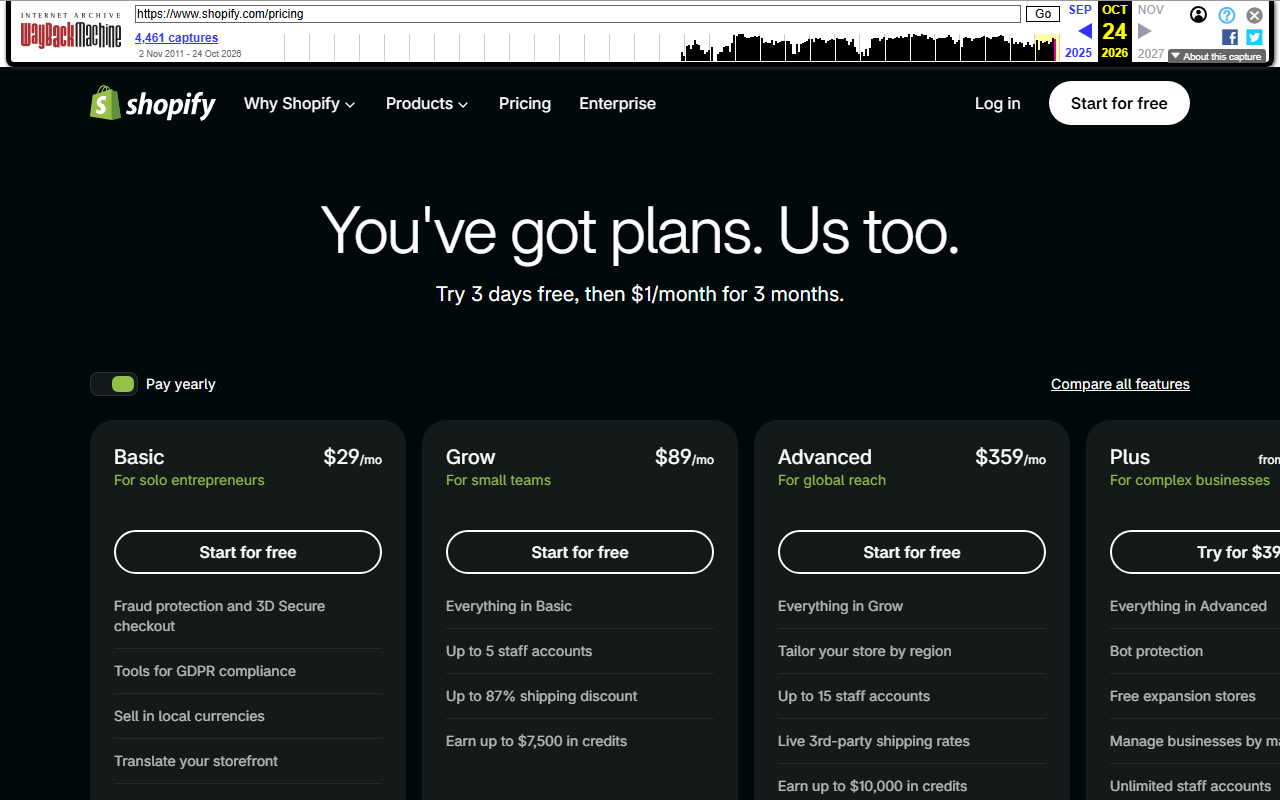
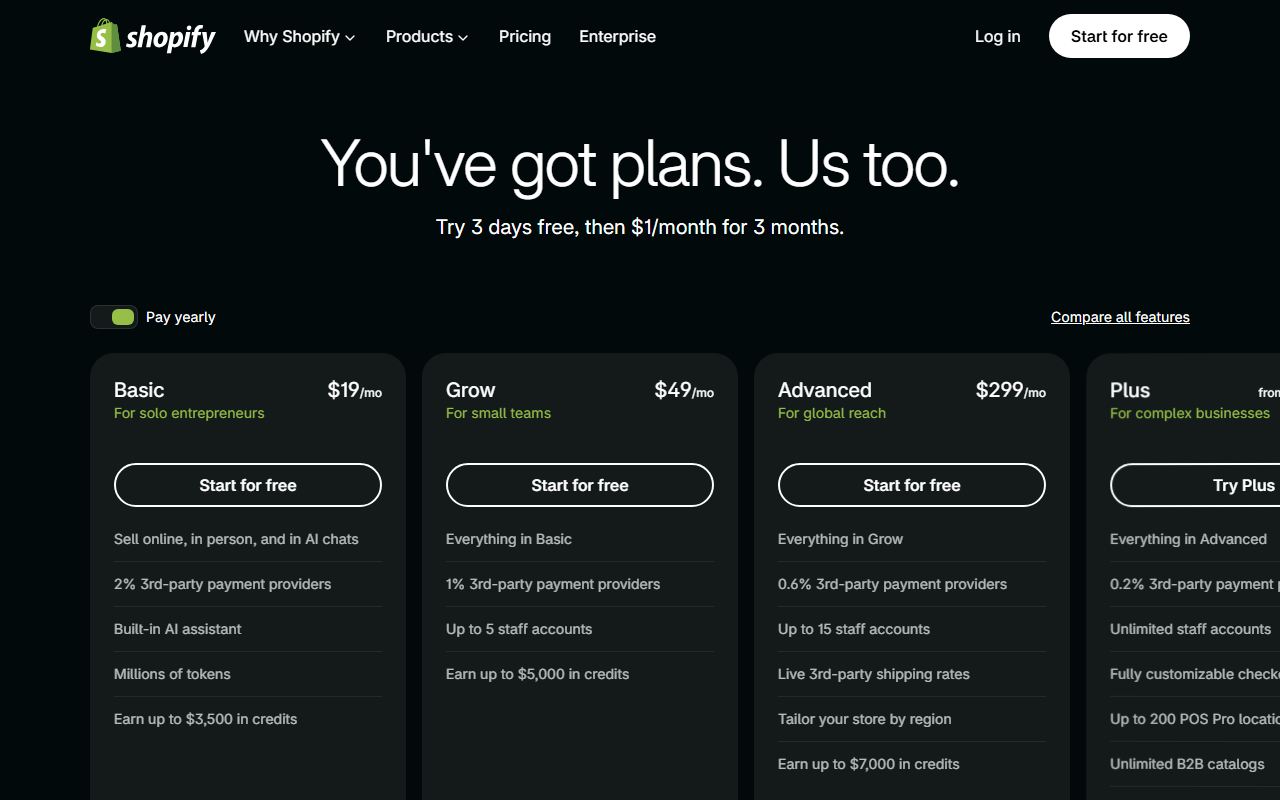
Shopify lets you build an online store, take payments, sell in person and list products in AI chat apps from one admin. On Shopify's US pricing page as archived on Oct 24, 2026, Basic costs $39 a month, or $29 a month billed yearly; Grow is $105 or $89; Advanced is $399 or $359; Plus starts at $2,300. New stores get 3 days free, then $1 a month for 3 months. The subscription is only part of the bill: Shopify Payments charges from 2.9% + 30¢ per online card sale on Basic, stores that use another payment provider pay Shopify an extra 2% to 0.2% per sale, yearly prices for Grow and Advanced rose between Oct 13 and Oct 14, 2026, and the Terms of Service updated on Oct 20, 2026 say plainly that Shopify does not provide refunds.
There are no affiliate links in this review. Every Shopify link goes straight to shopify.com, its legal pages or its developer docs.
| Made by | Shopify Inc., Ottawa, Canada; listed on NASDAQ and TSX as SHOP |
| What it is | Hosted e-commerce platform: online store, checkout, point of sale, payments, marketing, AI assistant and AI-channel selling |
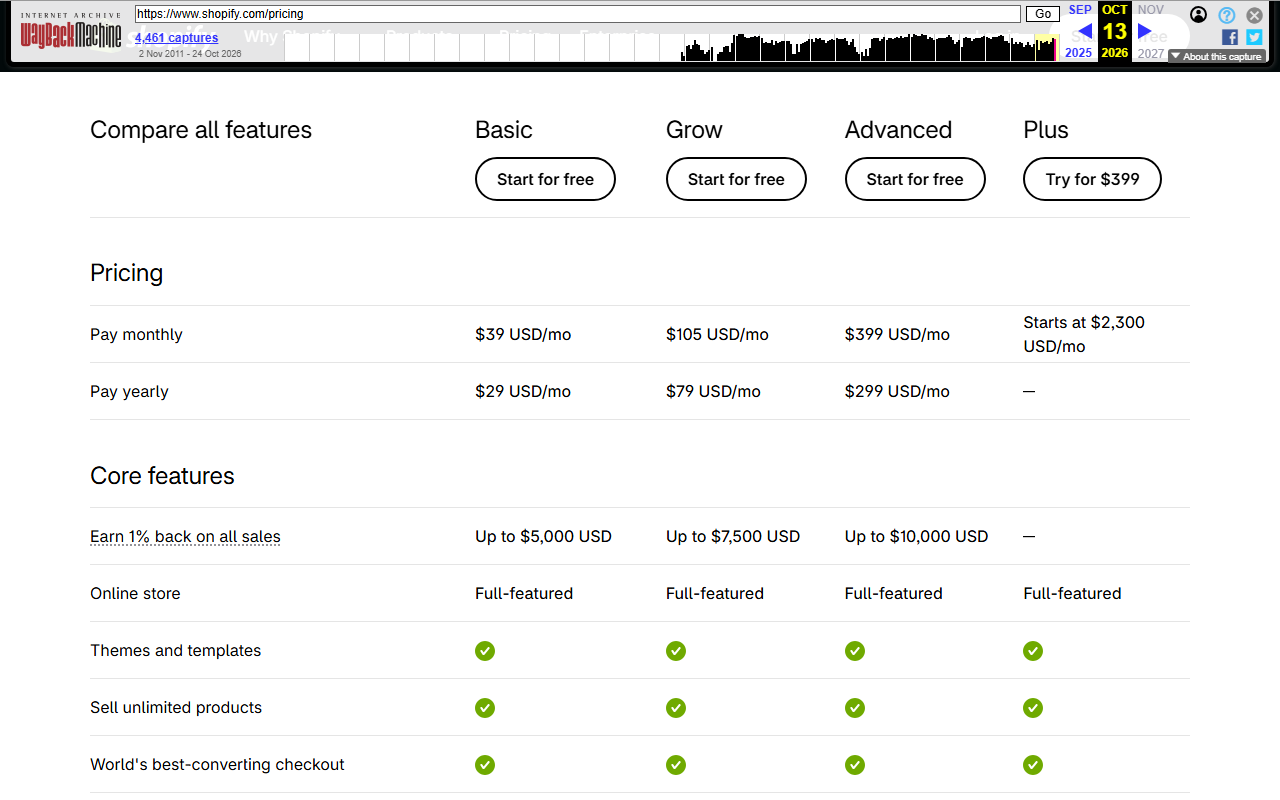
| US plans | Basic $39; Grow $105; Advanced $399 a month, or $29, $89 and $359 billed yearly; Plus from $2,300 |
| Fees | Online cards 2.9% to 2.25% + 30¢; other payment providers add 2% to 0.2% |
| Best for | Sellers who want one admin for web, in-person and AI-channel sales and will do the fee math first |
Shopify bundles more selling channels than any of the other four store builders we priced, but the real price is the subscription plus the payment fees, and it changed in October.
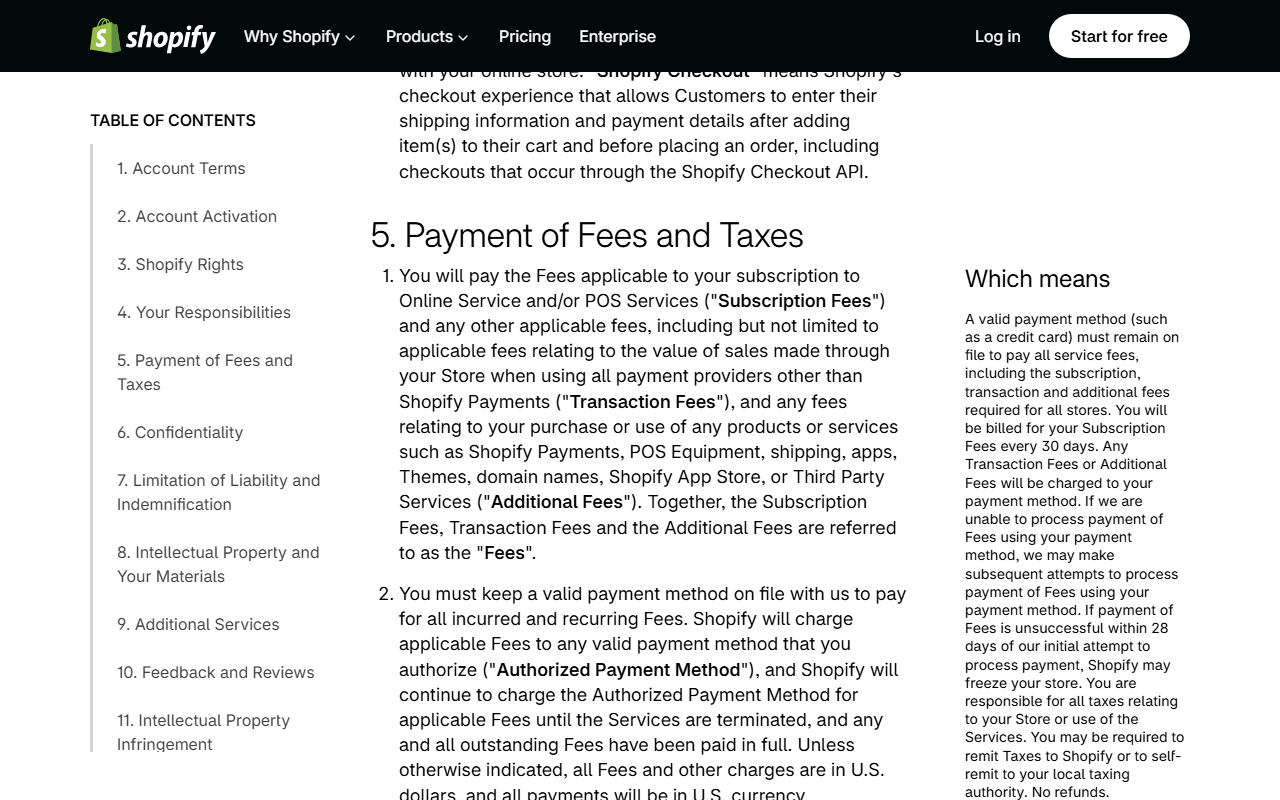
“Shopify does not provide refunds.”
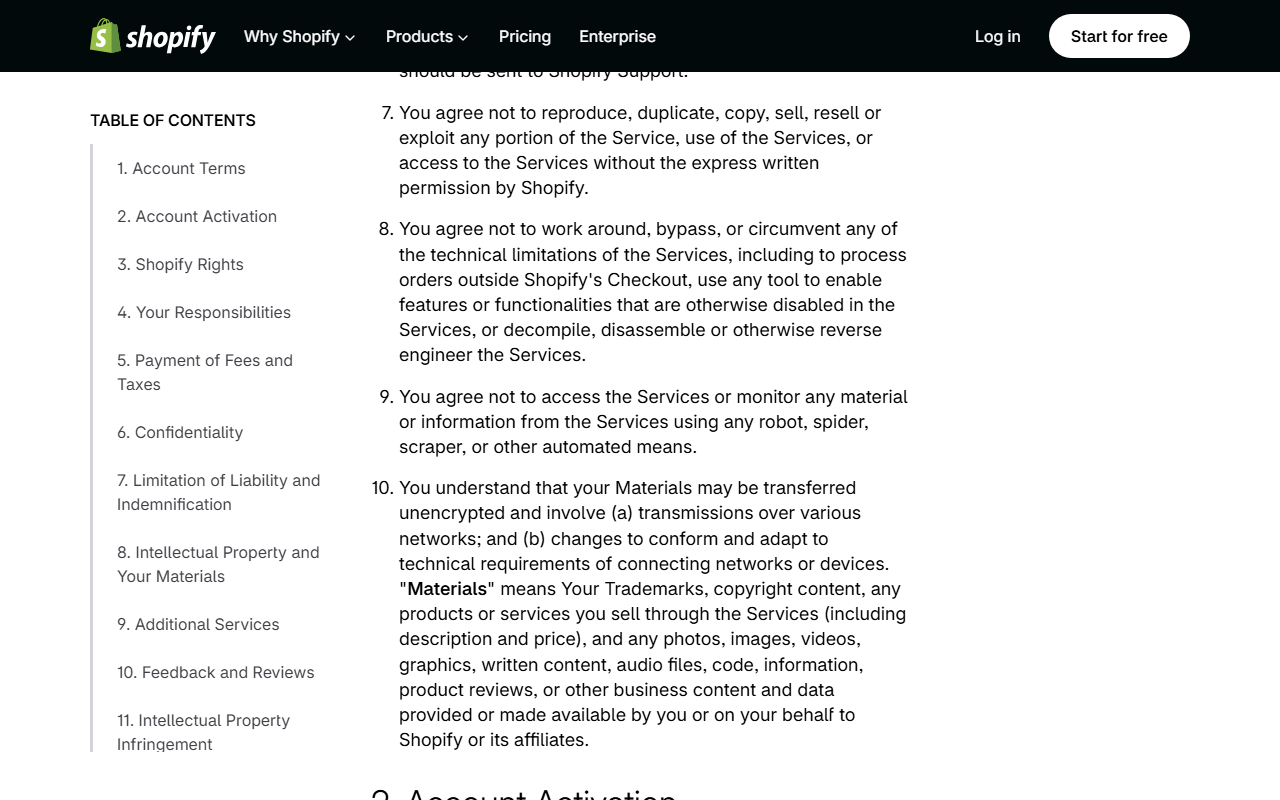
That sentence sits in section 5 of Shopify's Terms of Service, last updated on October 20, 2026. It is worth reading before you look at anything else, because almost every surprise people report about Shopify is about money: a $1 trial that turns into a full monthly charge, subscription bills that continue after a store is closed, payouts held for days, and paid apps that turn a cheap plan into an expensive one. None of that means Shopify is a bad product. It means you should buy it the way you would sign a lease: know the monthly rent, know the extras, and know how to leave.
The product itself is hard to fault on breadth. One Shopify store gives you a hosted website with unlimited products and bandwidth, a checkout Shopify says converts 15% better on average than other platforms (its own claim), a point-of-sale app, the Shop consumer app, sales channels for social media and marketplaces, and, since 2026, a route into AI chat apps such as ChatGPT and Gemini through what Shopify calls Agentic Storefronts. Sidekick, the built-in AI assistant, now writes product copy, edits images and customizes checkout settings. Among the platforms we compared (Shopify, BigCommerce, WooCommerce, Webflow and Squarespace), no other one bundles all of that in a single subscription.
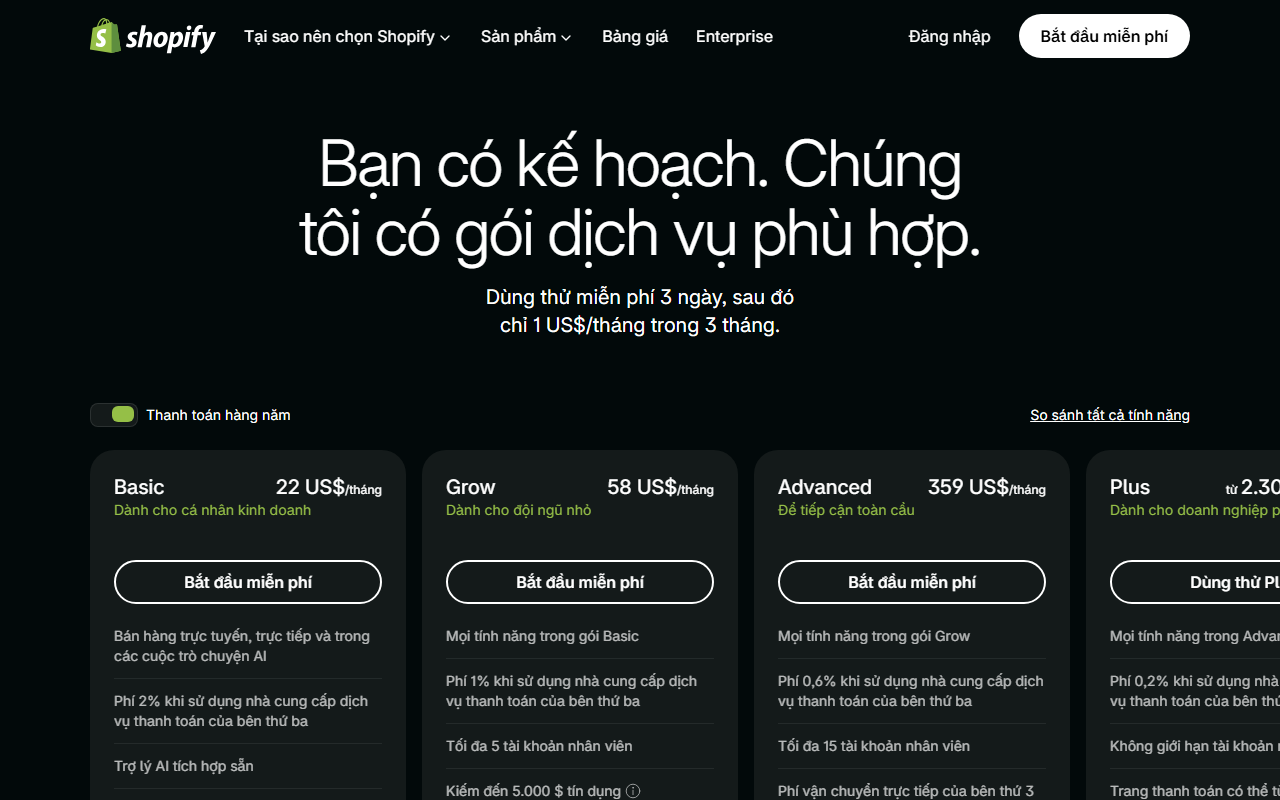
The money side needs attention. In the US, Basic costs $29 a month billed yearly and Grow $89. But a store with $3,000 of online card sales a month pays about $105 in Shopify Payments fees on top, which is more than three times the Basic subscription, and if you sell from a country where Shopify Payments is not offered, Shopify adds its own 2% fee on every sale on Basic. Yearly prices for Grow and Advanced went up by $10 and $60 a month between October 13 and 14, 2026, so guides written before then are out of date. And the price you see depends on where you are: viewed from Vietnam, the same pricing address showed Basic at $19 a month billed yearly.
One subscription, one admin, many places to sell, and a payment fee on every sale whichever way you get paid.
Shopify is built around a single store. You pick a plan, and that plan sets your staff accounts, reports, card rates and the fee Shopify charges if you use a payment provider other than its own. From the same admin you sell on your website, in person through Shopify POS, in the Shop app, on social networks and marketplaces, and in AI chat apps. Money comes in through Shopify Payments where it is offered, or through a third-party provider, in which case Shopify adds a transaction fee. Around the core sit Sidekick, the Shopify App Store, Flow automations, Shopify Messaging for email and SMS, and developer tools.

A push into AI shopping, a mid-October price rise on yearly plans, new Terms, a refreshed mobile app and two notable deals.
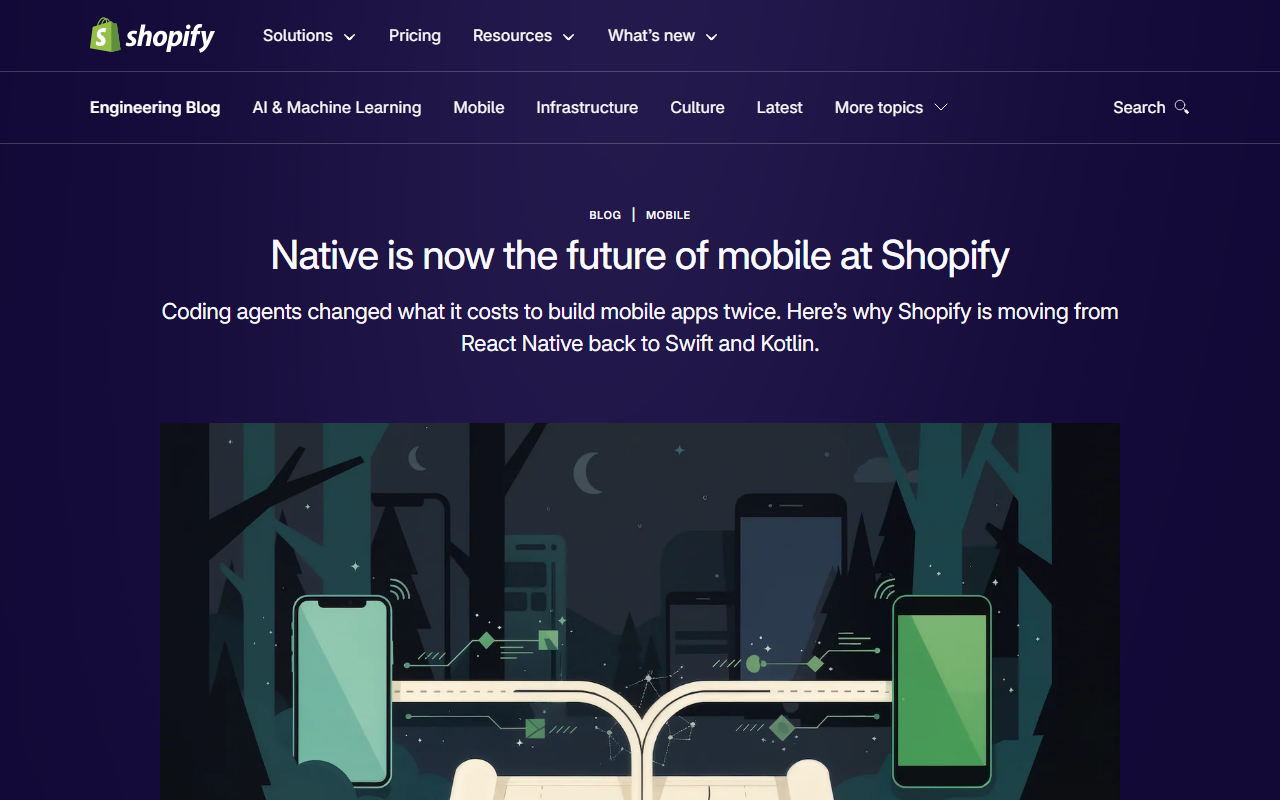
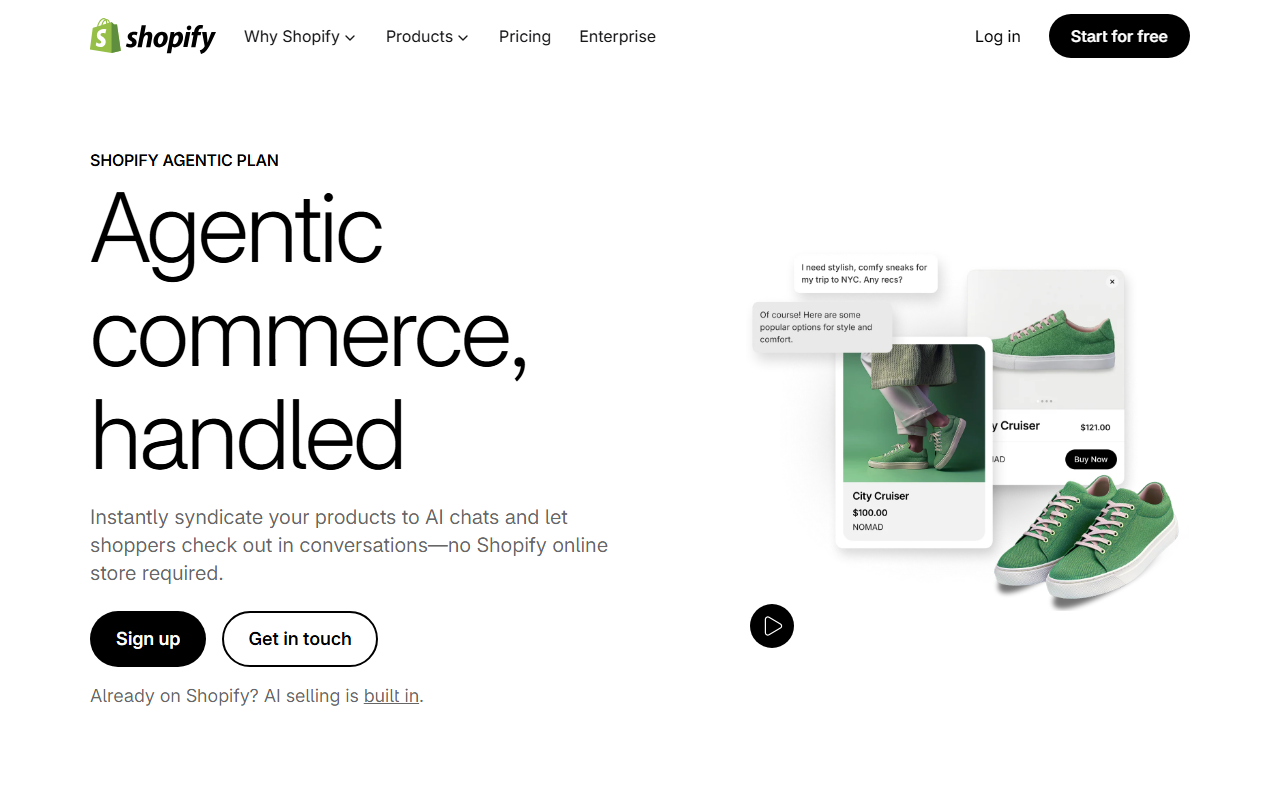
If you last looked at Shopify in 2025, five things are new. Selling moved into AI chats: Agentic Storefronts put eligible stores' products into ChatGPT, Gemini, Copilot and Perplexity, and a separate Agentic plan lets brands that do not run a Shopify store sell there with no monthly fee. Yearly prices changed: between the archived US pricing pages of October 13 and October 14, 2026, Grow went from $79 to $89 a month billed yearly and Advanced from $299 to $359, while monthly prices stayed at $105 and $399. The rules changed: the Terms of Service were updated on October 20, 2026 and the Privacy Policy on July 7, 2026. The mobile app changed: Shopify announced a faster app with a refreshed look on October 13, 2026, and its engineering blog said on September 10, 2026 that the apps are moving from React Native back to Swift and Kotlin. And Shopify kept buying: Tailwind Labs, the company behind the Tailwind CSS framework, announced on September 9, 2026 that it is joining Shopify.


Shopify is a public company growing more than 30% a year, and most of its revenue now comes from payments and other merchant services, not subscriptions.
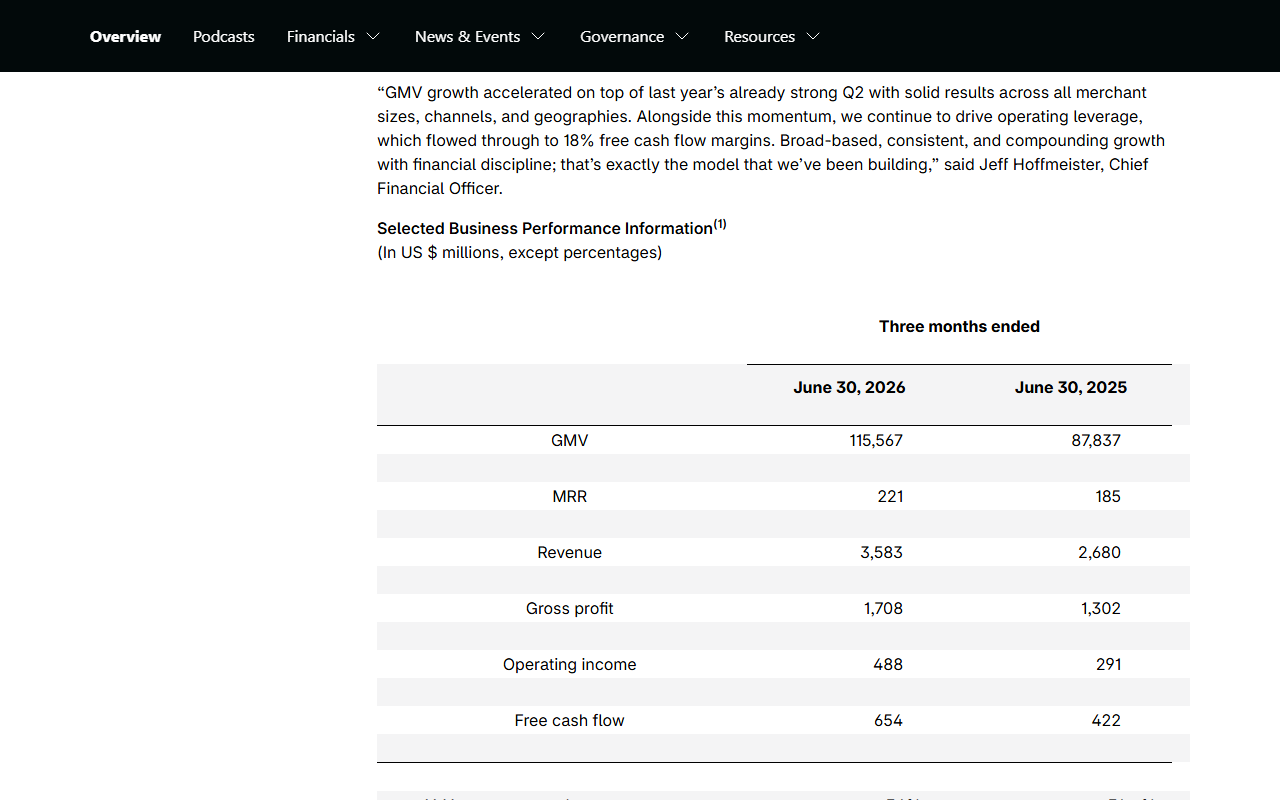
Because Shopify is listed in New York and Toronto, its numbers come from audited filings rather than marketing claims, which is rare in this category. In the quarter to June 30, 2026, merchants on Shopify processed $115.6 billion of gross merchandise volume (GMV), 31.6% more than a year earlier, and Shopify's revenue grew 34% to $3.58 billion. The split is the useful part for a merchant: merchant solutions, mainly payment processing, brought in $2.78 billion, or 77.6% of revenue, while subscriptions brought in $802 million, or 22.4%. In other words, Shopify earns most of its money when you sell, which is why its pricing nudges you toward Shopify Payments.
up 31.6% year on year; merchant sales, not Shopify income
up 34%; 77.6% from merchant solutions
subscriptions on Jun 30, 2026, up 19.5%
of e-commerce systems W3Techs detects, Oct 26, 2026
| Signal | Figure | What it does and does not measure |
|---|---|---|
| Merchants | “Millions of merchants in 175+ countries” | Shopify publishes no exact merchant count; this is not a customer number you can compare. |
| Cumulative sales | $1.6T (investor site), $1.1 trillion (pricing page), $1 trillion+ (about page) | All-time merchant sales; three Shopify pages give three figures on the same day. |
| US e-commerce share | Over 14% (investor site, 2025 data); 10% (about page) | Shopify merchants' US online sales against US Census e-commerce, not a share of platforms. The about page figure sits next to 2023 shopper data. |
| Websites | 5.3% of all websites; 32.4% of e-commerce systems detected (W3Techs) | Counts sites, not merchants or sales. |
| Subscriptions | $221M monthly recurring revenue on Jun 30, 2026 | Plan revenue only, excluding variable fees; it grew 19.5%, slower than GMV. |
| Consumers | 250M+ Shop Pay buyers (payments page); Shop app 4.8 from 7,217,921 US App Store ratings | Shoppers, not merchants. A large logged-in buyer base is one of Shopify's real advantages at checkout. |


Merchants rate the app highly overall, but the newest reviews are dominated by billing disputes, payout holds and an unpopular October redesign.
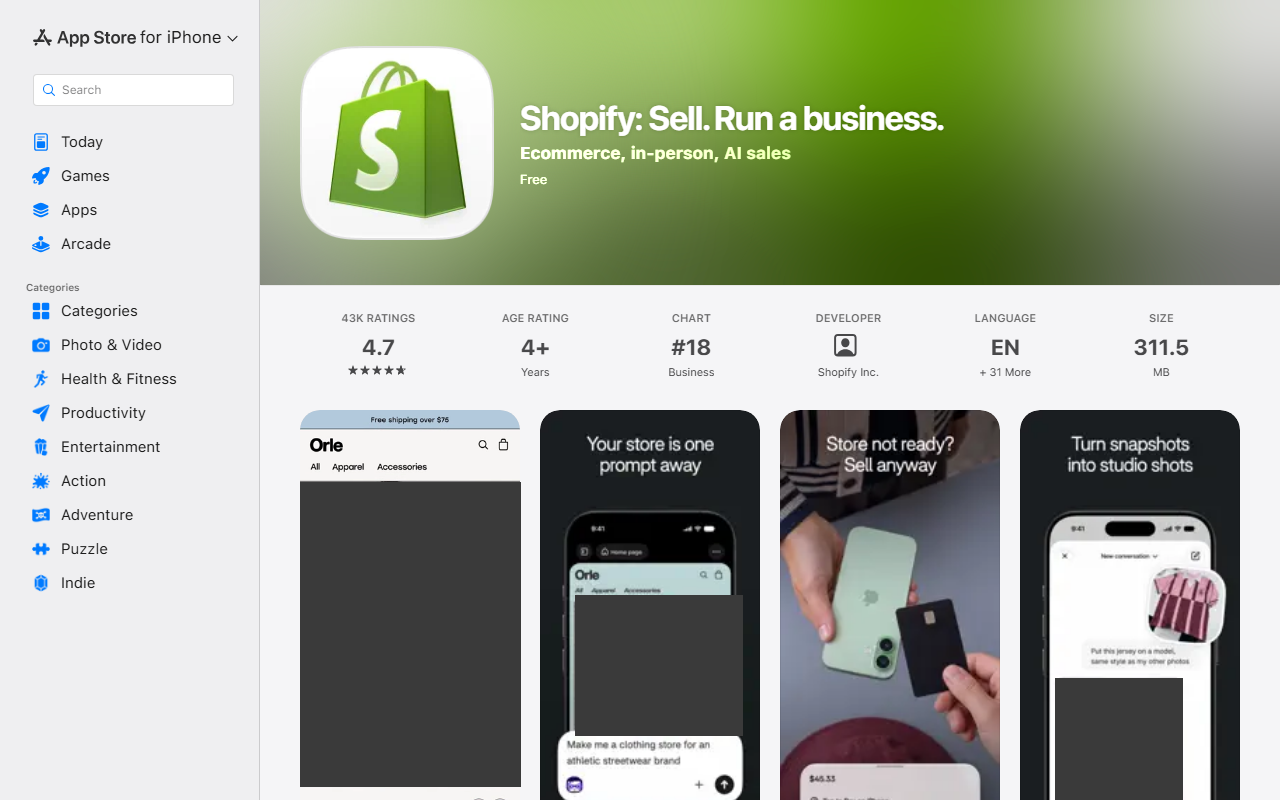
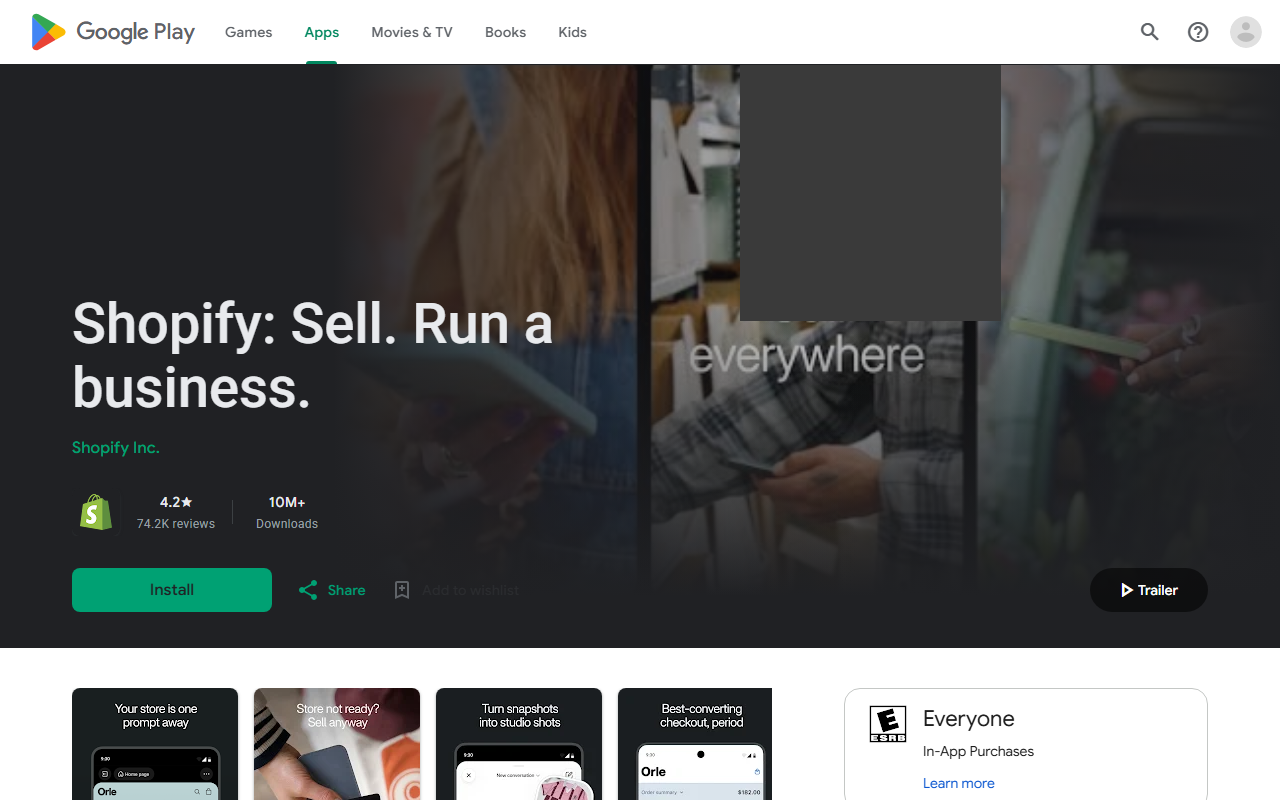
Two kinds of people review Shopify, and it matters which one you read. Merchants review the Shopify app in the app stores, where the averages are high: 4.7 out of 5 from 43,009 ratings on the US App Store and 4.2 from 74.2K reviews on US Google Play on Oct 26, 2026. Shoppers, by contrast, often review Shopify on Trustpilot after a bad order from a store that happens to run on Shopify, which is why its Trustpilot page showed a TrustScore of 1.3 from 5,248 reviews with the labels “No recent history of asking for reviews” and “Hasn’t replied to negative reviews”. Trustpilot’s AI summary, based on 1,028 reviews, says “most reviewers were let down by their experience overall” and mentions missing orders and unverified third-party sellers. Under the Terms, the merchant, not Shopify, is the seller of record, so many of those Trustpilot complaints are about other businesses.
The averages hide a recent turn. We read the 150 most recent US App Store reviews of the Shopify app, written between Jun 8 and Oct 22, 2026: 72 gave one star (48.0%) and 46 gave five stars (30.7%). A simple keyword tally puts billing and cancellation charges in 31 of them (20.7%), with payouts and holds, support, and app updates in 17 each. Several October reviews blame a redesign that shipped after Shopify announced “A faster Shopify app with a refreshed look” on its changelog on Oct 13, 2026. The five-star reviews, meanwhile, are mostly about how quickly a beginner can get a store live.
“Shopify has allowed me without any experience whatsoever create a store online to sell my current products at an amazing growth rate”, from a first year at $2,000 to more than 500 orders a year in year six.
“Kudos to the software engineers that developed the ai assistant”. The reviewer says Sidekick did most of the work on their site over three days.
The app is great, but “only easy if you spend the money sooo many add ones make your monthly bill go way up”.
“When I tried to pay for the $1/month plan, I didn’t know it was the one where it’s $39”.
“Shopify holds our sales revenue for 5 business days”, even though the account is in good standing, the reviewer says.
“Payout expectations were not made clear up front”: a daily payout schedule did not mean next-day funds for a new account.
Shopify chose to “update the app by removing a lot of basic functionality while completely redesigning its entire look and feel”.
“I was still needing to pay $105/monthly when I had canceled it before my due date”.
During the June 3 storefront outage, “it was the webhook/sync that was down which really messed with a lot of external systems” such as email and logistics tools.
The pattern: people praise how fast a beginner can launch and how much sits in one admin, and Sidekick is starting to earn its own five-star reviews. They leave over the total bill once apps are added, payouts held for new accounts, charges that continue after a store is closed or a trial ends, and support that starts with a chat assistant. None of those reviews prove a policy on their own, but they line up with the fine print below.

Four plans in the US, from $29 to $359 a month billed yearly, and Plus from $2,300; the plan mostly buys staff accounts, lower fees and more reports.
Every paid plan includes the online store, unlimited products, hosting, the checkout, in-person selling with a phone or card reader, Sidekick, email marketing tools and 24/7 support. What changes as you move up is staff accounts (none extra on Basic, 5 on Grow, 15 on Advanced, unlimited on Plus), the card rates and third-party fee in the next section, support level, API limits and checkout customization. Prices below are the US figures on Shopify's pricing page as archived on Oct 24, 2026, in US dollars before tax.
Basic
a month; $29 a month billed yearly ($348 a year)
- Online store, unlimited products
- Online cards 2.9% + 30¢
- Other providers: 2% Shopify fee
- Up to $5,000 in sales credits at 1%
Grow
a month; $89 a month billed yearly ($1,068 a year), up from $79 before Oct 14, 2026
- Up to 5 staff accounts
- Online cards 2.7% + 30¢
- Other providers: 1% fee
- Full data access for custom apps
Advanced
a month; $359 a month billed yearly ($4,308 a year), up from $299
- Up to 15 staff accounts
- Online cards 2.5% + 30¢
- Other providers: 0.6% fee
- Live third-party shipping rates, enhanced chat
Plus
a month and up, on a 1- or 3-year term (the $2,300 price is the 3-year rate on the POS pricing page)
- Fully customizable checkout
- Online cards 2.25% + 30¢; other providers 0.2%
- Up to 9 free expansion stores
- Priority support, unlimited staff
| US plan | Monthly billing, a year | Yearly billing, a year | Yearly discount |
|---|---|---|---|
| Basic | $468 | $348 | 25.6% ($120) |
| Grow | $1,260 | $1,068 | 15.2% ($192) |
| Advanced | $4,788 | $4,308 | 10.0% ($480) |
Computed from $39/$29, $105/$89 and $399/$359 on the US pricing page as archived Oct 24, 2026. Shopify's own POS cost guide (updated Apr 23, 2026) still describes a 25% yearly discount on all three plans, which is now true only for Basic.
| Yearly price | Until Oct 13, 2026 | From Oct 14, 2026 | Change |
|---|---|---|---|
| Basic | $29 | $29 | none |
| Grow | $79 | $89 | +$10 a month, +$120 a year, +12.7% |
| Advanced | $299 | $359 | +$60 a month, +$720 a year, +20.1% |
From the US pricing page as archived by the Internet Archive on Oct 13, 2026 (20:09 UTC) and Oct 14, 2026 (20:12 UTC). We found no Shopify announcement of the change; the Terms promise 30 days' notice of fee changes to existing customers.
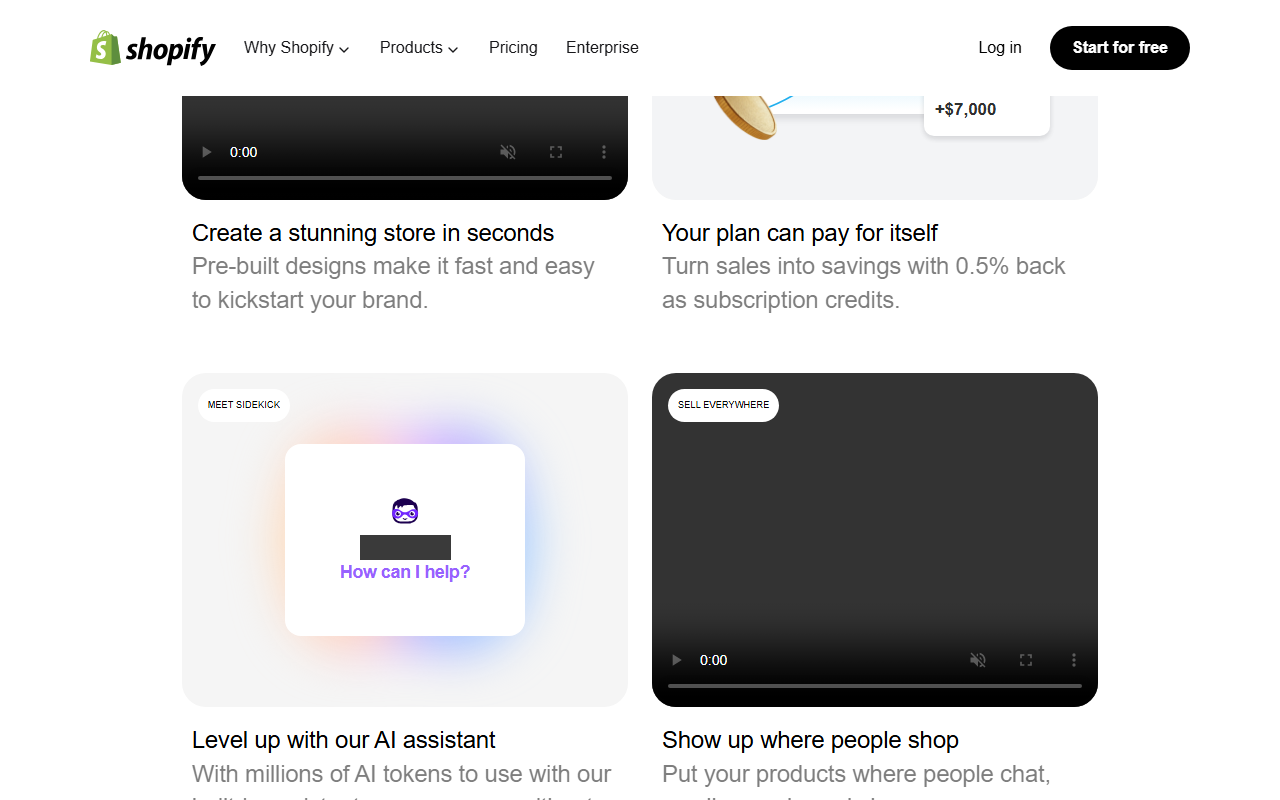
The free start is generous but short. New stores get 3 days free, then pay $1 a month for 3 months, according to the US pricing page; the pricing FAQ adds that the trial needs no credit card and that “most plans start at just $1 per month for the first 3 months”. After that the plan you picked bills at its full price, which is the moment several App Store reviewers say caught them out. Shopify also pays back 1% of sales as subscription credits, capped at $5,000, $7,500 and $10,000 by plan, so a Basic store would need $500,000 in sales to reach its cap.
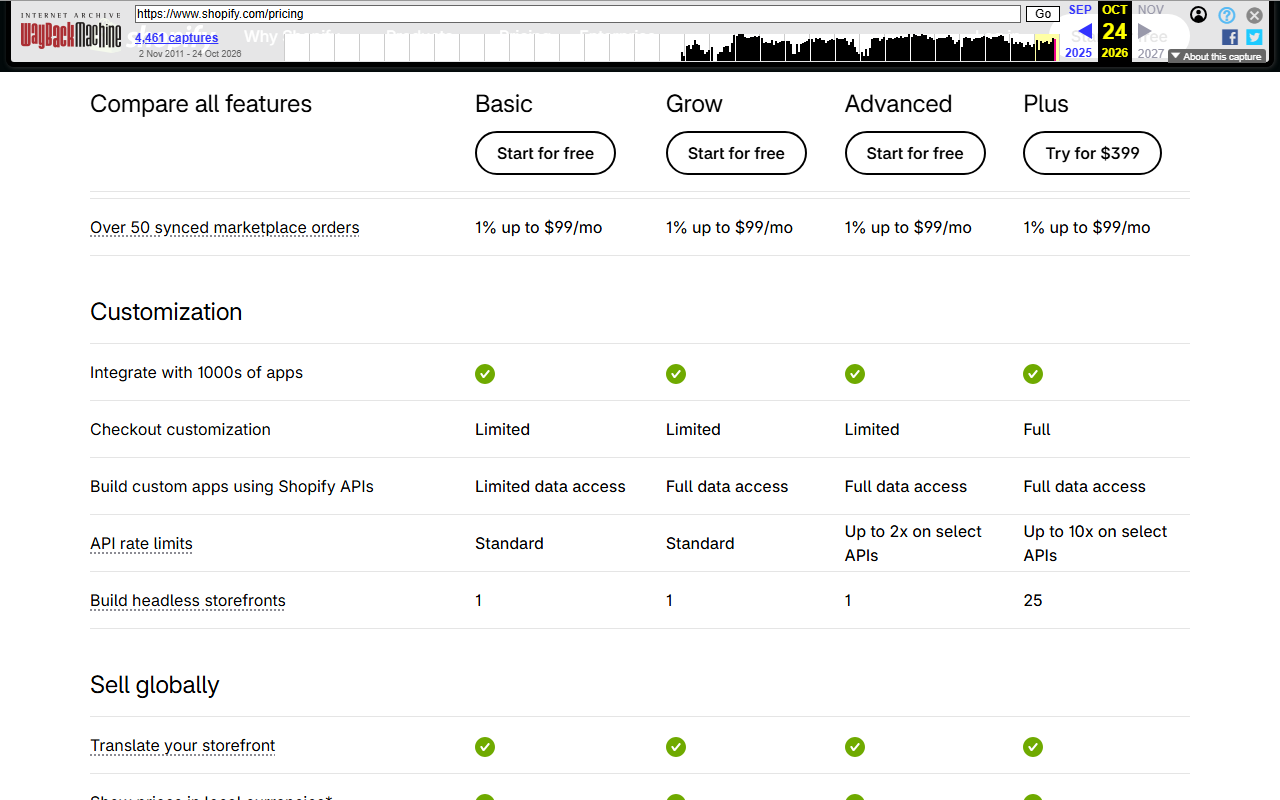
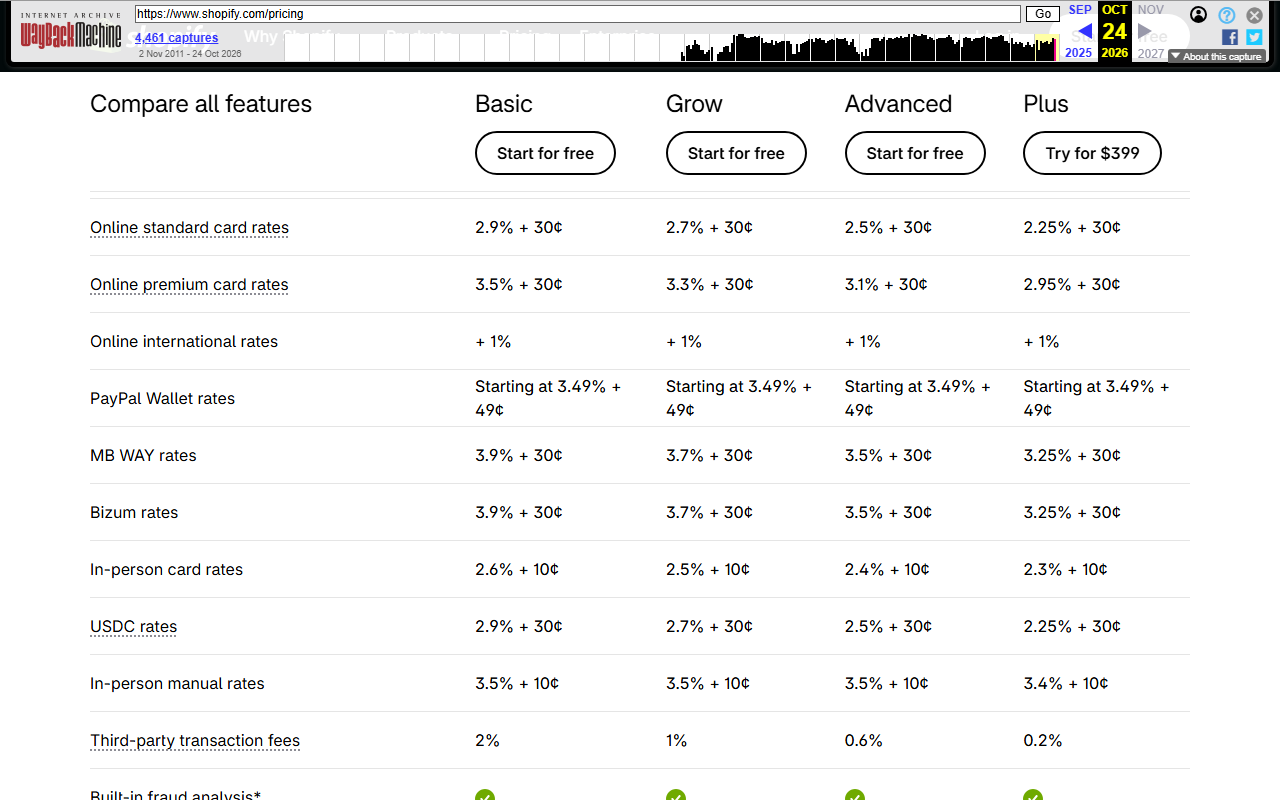
The card rate is the biggest cost for most stores, and using any payment provider other than Shopify Payments adds a Shopify fee on top.
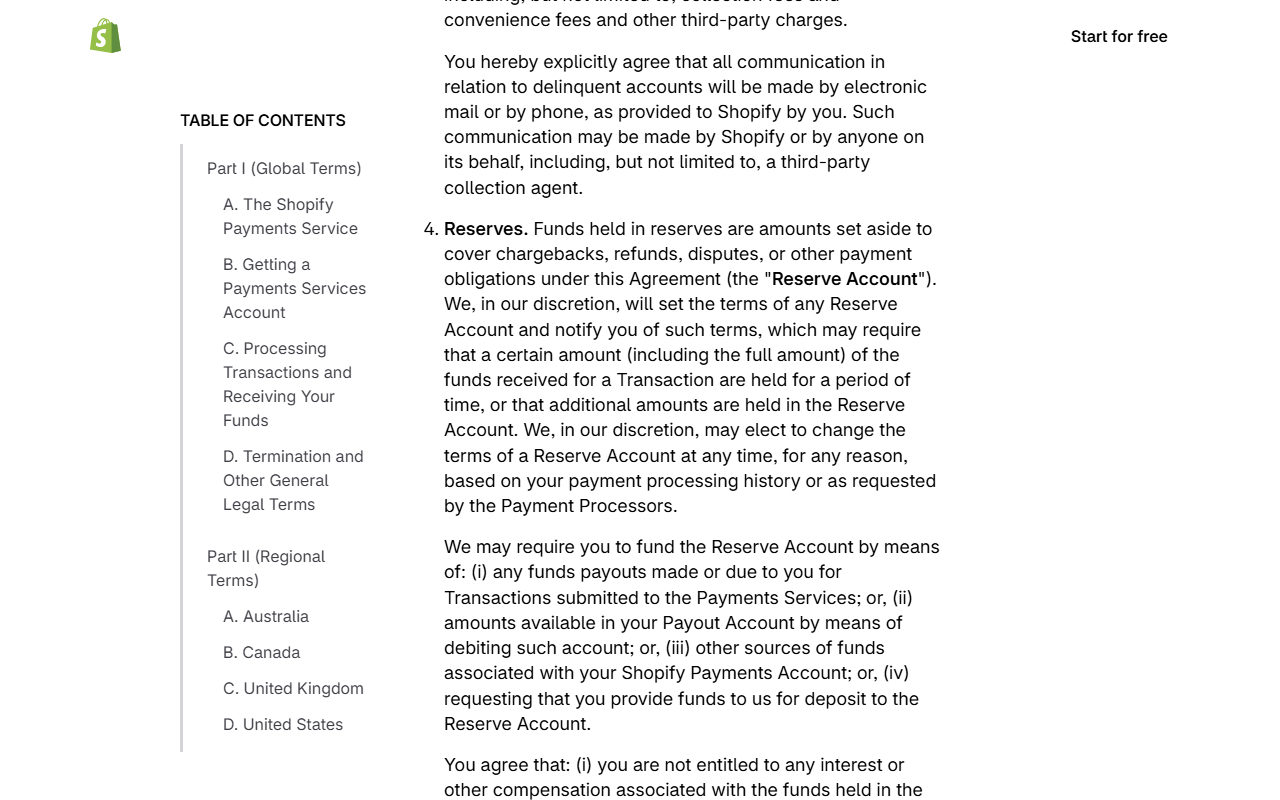
Shopify Payments is Shopify's own processor. Where it is available, it is the cheapest way to get paid on Shopify because no extra Shopify fee applies; you pay only the card rate for your plan. If you use a different provider, or if Shopify Payments is not offered where your business is based, you pay that provider's fee plus a Shopify transaction fee of 2% on Basic, 1% on Grow, 0.6% on Advanced or 0.2% on Plus. The Shopify Payments Terms list 41 designated countries, from the United States, Canada, the United Kingdom and most of the European Union to Australia, Japan, Singapore and Mexico. Vietnam, India and most of Southeast Asia, Africa and South America are not on that list.
Swipe sideways to see every column.
| US rate | Basic | Grow | Advanced | Plus |
|---|---|---|---|---|
| Online standard cards | 2.9% + 30¢ | 2.7% + 30¢ | 2.5% + 30¢ | 2.25% + 30¢ |
| Online premium cards | 3.5% + 30¢ | 3.3% + 30¢ | 3.1% + 30¢ | 2.95% + 30¢ |
| International cards | + 1% | + 1% | + 1% | + 1% |
| In-person cards | 2.6% + 10¢ | 2.5% + 10¢ | 2.4% + 10¢ | 2.3% + 10¢ |
| In-person keyed manually | 3.5% + 10¢ | 3.5% + 10¢ | 3.5% + 10¢ | 3.4% + 10¢ |
| PayPal Wallet | starting at 3.49% + 49¢ on every plan | |||
| Shopify fee with another provider | 2% | 1% | 0.6% | 0.2% |
| Marketplace orders synced, over 50 a month | 1% up to $99 a month on every plan | |||
From the comparison table on Shopify's US pricing page as archived Oct 24, 2026. Rates outside the US differ; see the country section below.

Five example stores: the subscription is the small part, and moving up a plan only pays off at much higher sales than most beginners reach.
Here is what Shopify would charge a month in five situations, using US list prices and yearly billing unless stated, and leaving out apps, themes, shipping labels, taxes and your own processor's fees. Online sales assume Shopify Payments with standard domestic cards.
Swipe sideways to see every column.
| Store | Plan | Subscription | Fees | Monthly total | Share of sales |
|---|---|---|---|---|---|
| A. Side business: $3,000 online, 60 orders | Basic, yearly | $29 | $105 | $134 | 4.5% |
| A. Same store, billed monthly | Basic, monthly | $39 | $105 | $144 | 4.8% |
| B. $5,000 online through another provider | Basic | $29 | $100 Shopify fee + provider's fee | $129 + provider | 2.6% + provider |
| C. Growing store: $30,000 online, 500 orders | Basic | $29 | $1,020 | $1,049 | 3.5% |
| C. Same store | Grow | $89 | $960 | $1,049 | 3.5% |
| D. Established: $150,000 online, 2,500 orders | Grow | $89 | $4,800 | $4,889 | 3.3% |
| D. Same store | Advanced | $359 | $4,500 | $4,859 | 3.2% |
| E. Shop counter: $10,000 in person, 250 sales, POS Pro | Basic + POS Pro | $29 + $89 | $285 | $403 | 4.0% |
Fees = sales × card rate + orders × 30¢ (online) or 10¢ (in person), at the US rates above. Store B pays Shopify 2% on top of whatever its provider charges. Archived US prices of Oct 24, 2026.
Three conclusions follow. First, on Shopify Payments, Basic is the right plan for most new stores; Grow only pays for itself on fees above about $30,000 a month in online card sales, so buy it for the staff accounts or reports, not the rate. Second, the mid-October rise moved both break-even points up, by $5,000 for Grow and $25,000 for Advanced. Third, if you cannot use Shopify Payments, the math flips: the 2% fee on Basic is large enough that Grow becomes cheaper from about $6,000 a month in sales.
Shopify prices by location, and the same pricing address can show a different price depending on where you open it.
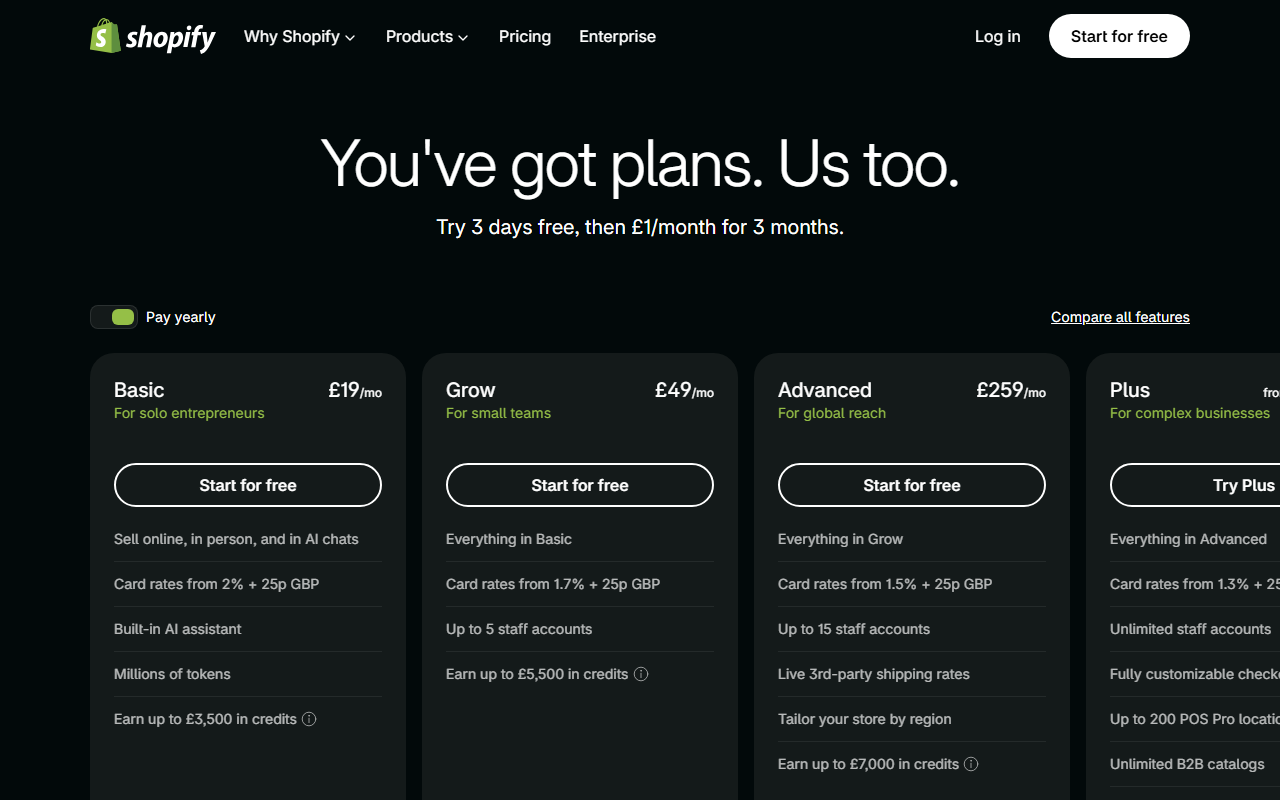
Shopify runs separate pricing pages per country, and the differences are large. Basic billed yearly is $29 in the US, £19 in the UK, C$37 in Canada and S$29 in Singapore. The US-labelled page itself adjusts to the visitor: its page data showed geo-pricing switched on, and viewed from Vietnam on Oct 26, 2026 it listed Basic at $19, Grow at $49 and Advanced at $299 a month billed yearly, while Shopify's Vietnam page, also in US dollars, listed $22, $58 and $359, and a second visit to the US address showed the Vietnamese version with those same figures. Card rates are not shown on either version, because Shopify Payments is not offered in Vietnam. The practical rule: the price you are quoted depends on where Shopify thinks you are, so check the page from the country your business is registered in, and remember that the Terms state fees are in US dollars unless otherwise indicated.
Swipe sideways to see every column.
| Pricing page | Basic | Grow | Advanced | Plus from | Basic online card rate |
|---|---|---|---|---|---|
| US (archived Oct 24) | $39 / $29 | $105 / $89 | $399 / $359 | $2,300 | 2.9% + 30¢ |
| UK | £25 / £19 | £65 / £49 | £344 / £259 | £1,800 | 2% + 25p |
| Canada | C$49 / C$37 | C$132 / C$99 | C$517 / C$389 | C$3,400 | 2.8% + 30¢ |
| Singapore | S$39 / S$29 | S$132 / S$99 | S$531 / S$399 | US$2,300 | 3.2% + S$0.50 |
| India | ₹1,994 / ₹1,499 | ₹7,447 / ₹5,599 | ₹30,164 / ₹22,680 | ₹175,000 | not shown |
| Vietnam page (US$) | $25 / $22 | $65 / $58 | $399 / $359 | $2,300 | not offered |
| US address, viewed from Vietnam | $25 / $19 | $65 / $49 | $399 / $299 | $2,300 | not shown |
Monthly / yearly-billed price per month, from each Shopify pricing edition on Oct 26, 2026 (US from the Internet Archive capture of Oct 24, 2026). Taxes extra.
No refunds, billing every 30 days, a store that goes offline when you leave, and pages that do not agree with each other.
Shopify's Terms of Service were updated on October 20, 2026. They are readable, with a plain-language summary beside each section, and seven points matter most to a new merchant.
| Rule | What the Terms say | What it means for you |
|---|---|---|
| Refunds | “Shopify does not provide refunds.” | A yearly plan is a yearly commitment. On termination, no refunds “pro rata or otherwise”. |
| Billing cycle | “Subscription Fees are paid in advance and will be billed in 30 day intervals” | Transaction and app fees are charged separately “from time to time”. |
| Failed payment | After 28 days Shopify may suspend the account; after 60 more days unpaid it may terminate it. | Your storefront can go dark during a suspension. |
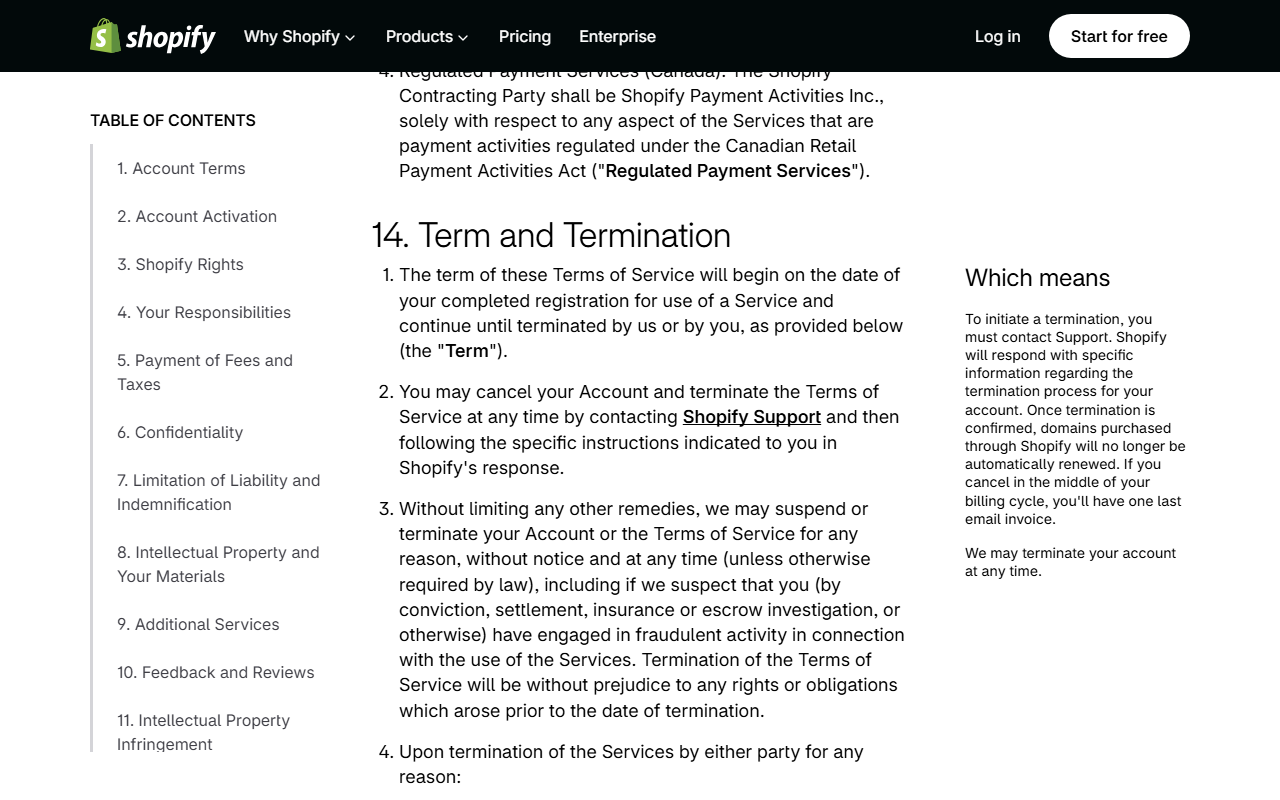
| Cancelling | Cancel “by contacting Shopify Support”; on termination “your Shopify Store will be taken offline.” | Export products, customers and orders first. Domains bought through Shopify stop auto-renewing. |
| Price changes | “We will provide you with 30 days advanced notice prior to any changes in Fees” | Watch the email address on your account; the October yearly rise is an example. |
| Account termination | Shopify may suspend or terminate an account “for any reason, without notice and at any time (unless otherwise required by law)” | Keep your own backups; do not run a business on one platform without a plan B. |
| Payout reserves | Shopify Payments may hold “a certain amount (including the full amount) of the funds received for a Transaction” for a period of time | New and high-risk stores should expect holds; you earn no interest on reserved funds. |
Quoted from Shopify's Terms of Service (Oct 20, 2026) and Shopify Payments Terms, Oct 26, 2026. The Terms are governed by the laws of Ontario, Canada.
| Question | One Shopify page says | Another says |
|---|---|---|
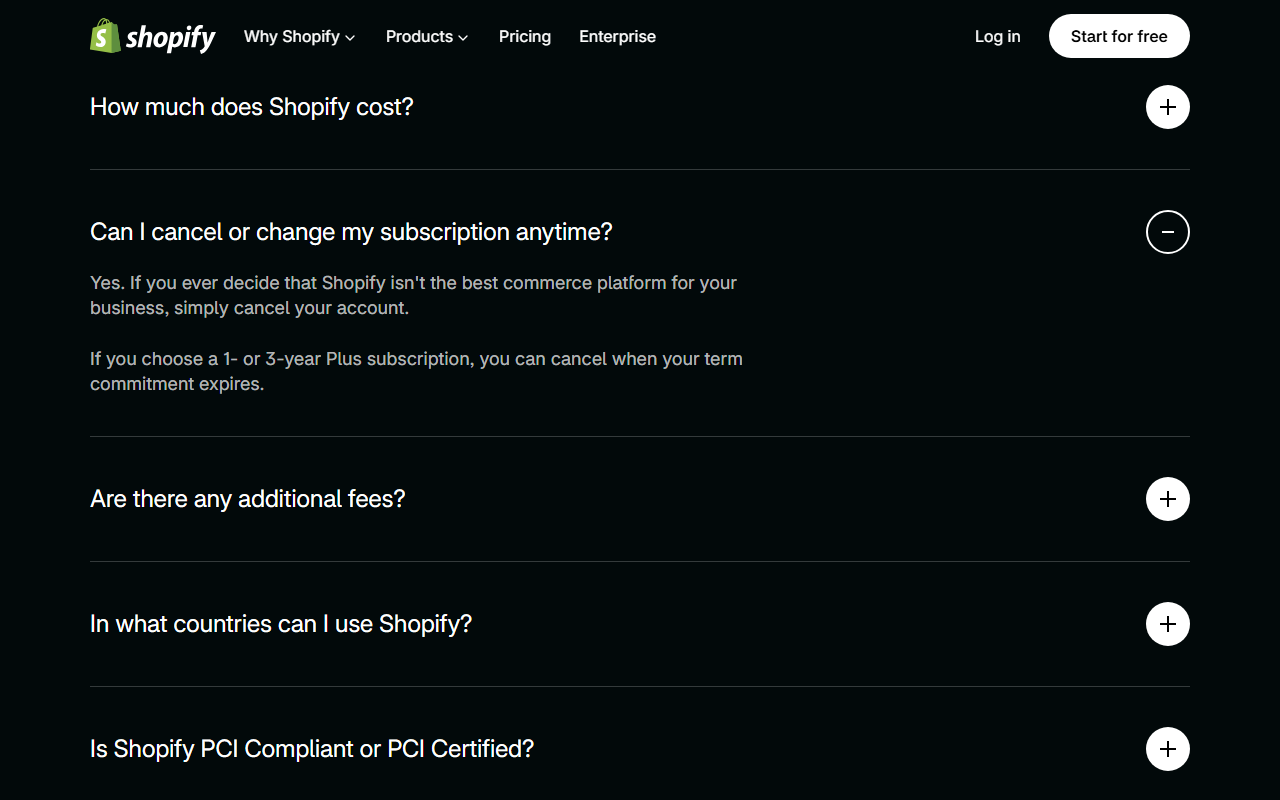
| How to cancel | Pricing FAQ: “simply cancel your account.” | Terms: cancel “by contacting Shopify Support” |
| Sales credits | Pricing page: “Earn 1% back on all sales” | Free-trial page: “0.5% back as subscription credits”, next to a graphic showing $7,000 back on $700,000 (1%) |
| Yearly discount | POS cost guide (Apr 23, 2026): 25% off when billed annually | US pricing page (Oct 24, 2026): 25.6%, 15.2% and 10.0% |
| US market share | Investor site: over 14% | About page: 10% |
| Price of Basic, yearly | US page from the US: $29 | Same address from Vietnam: $19; Vietnam page: $22 |
All pages as of Oct 26, 2026, except the US pricing page (archived Oct 24, 2026).



Pick by how you sell and where you are based, not by the longest feature list.
Shopify's real product is one checkout and one order list behind every channel; in 2026 that list grew to include ChatGPT, Gemini, Copilot and Perplexity.
The reason businesses stay on Shopify is not the theme editor; it is that every sale, wherever it happens, lands in the same admin and goes through the same checkout. Shoppers who already have a Shop account (Shopify claims 250M+ Shop Pay buyers) can pay without typing card details, inventory is shared across the website and the shop counter, and the same customer record follows them. Shopify says on its pricing page that its checkout “converts 15% better on average than other platforms”; that is its own claim, not an independent measurement.
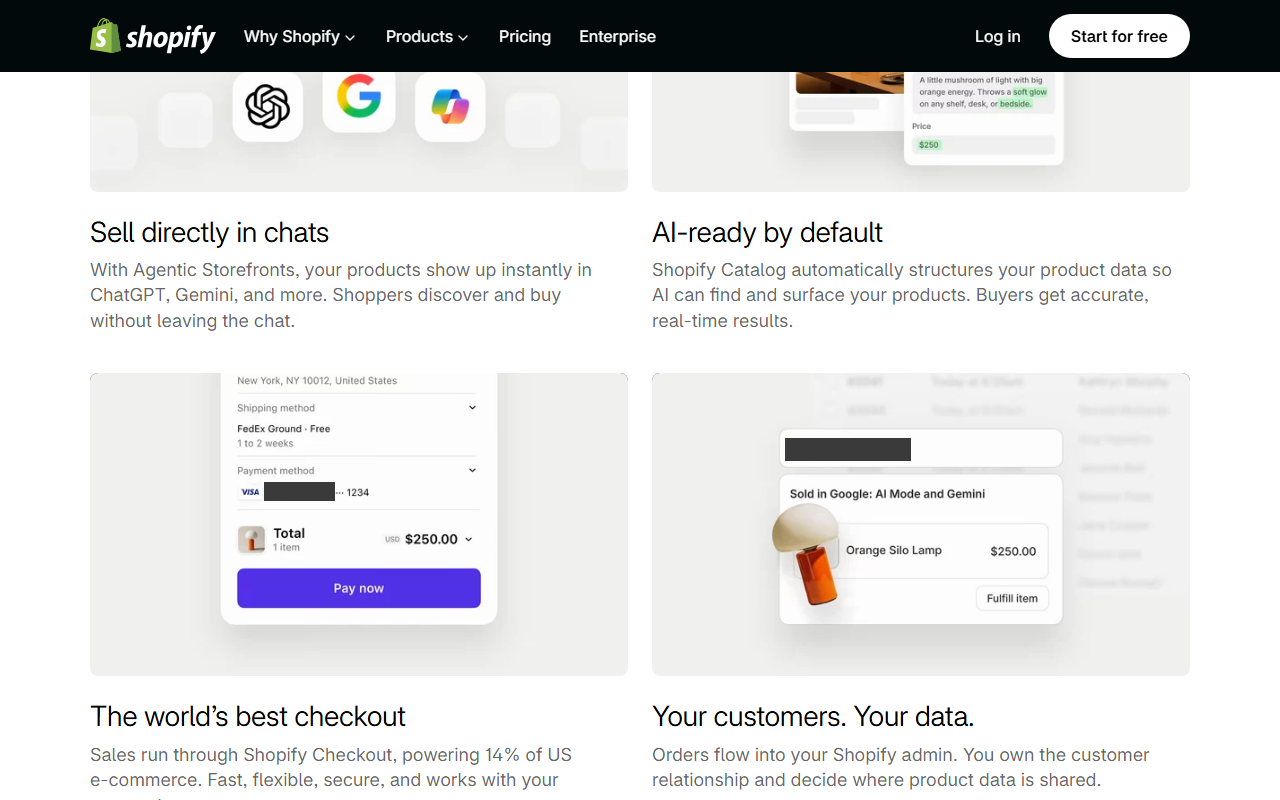
The 2026 addition is AI shopping. According to Shopify, “With Agentic Storefronts, your products show up instantly in ChatGPT, Gemini, and more.” Behind it, Shopify Catalog structures your product data so AI agents can read it, and orders placed in those chats flow into your Shopify admin like any other order. The feature is “enabled automatically for eligible stores. Terms apply.” For brands that do not run a Shopify store at all, the separate Agentic plan promises “No monthly fee” and charges only when products sell, with card rates from 2.9% + 30¢ online on the US page. Shopify's Spring '26 Edition says data syndicated by Shopify “drives 2x more conversion in AI chats”, another vendor claim. In a holiday report published on Oct 6, 2026, Shopify said “65% of shoppers say they'll use AI for at least one shopping task this season.”
What to keep in mind: you do not control how an AI assistant describes or ranks your products, AI channels are new enough that the rules can change quickly, and the Agentic plan's own page does not list what each AI partner may charge in future. A Hacker News commenter pointed out on Oct 19, 2026 that Meta has described taking a cut of transactions in its shopping agent while Shopify tells merchants there is no fee for now. Treat AI chats as an extra channel, not a replacement for your own store and email list.
Official Shopify video on Agentic Storefronts, published on the Shopify YouTube channel on Dec 10, 2025.

Sidekick is included on every plan and now does real admin work, from product copy to checkout settings; it is the feature reviewers increasingly praise and complain about.
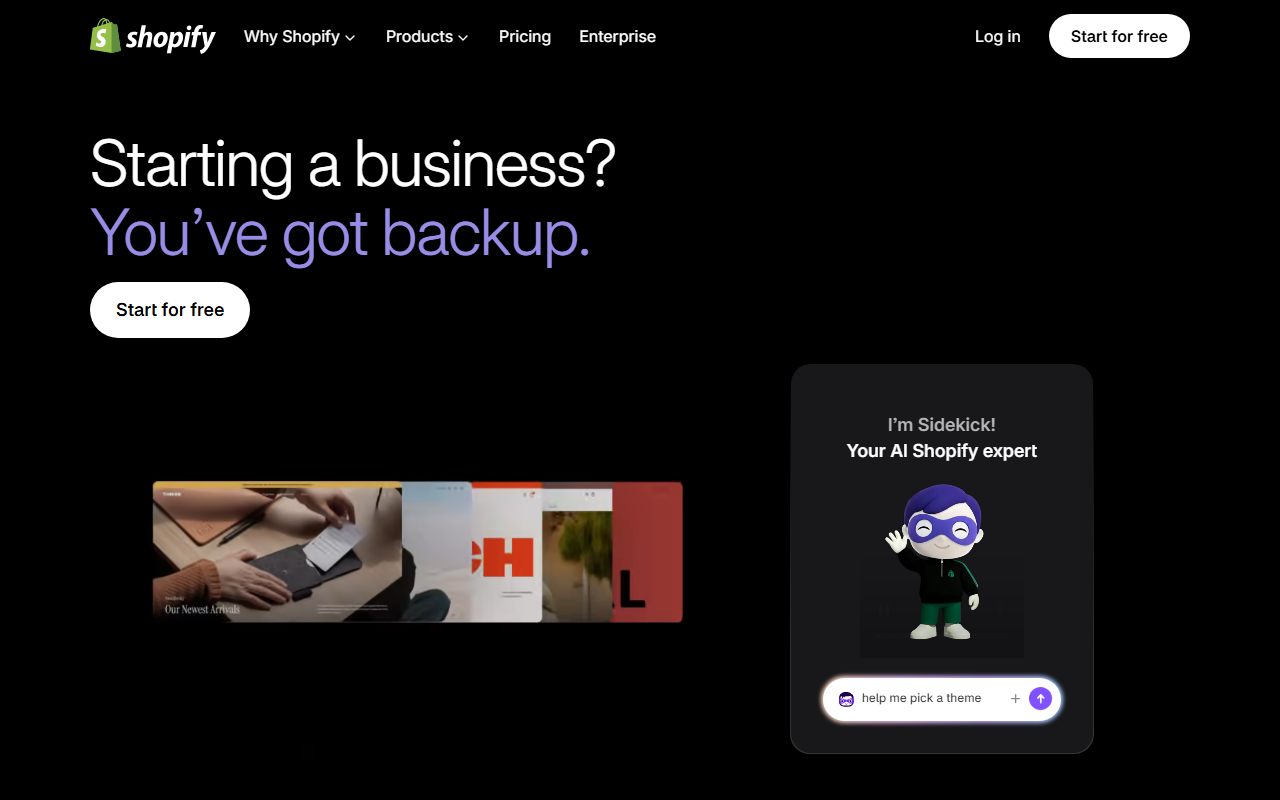
Sidekick is Shopify's AI assistant inside the admin and the mobile app. Shopify's Sidekick page pitches it as five roles in one: designer, photo editor, writer, tech support and marketer, with prompts such as “Write me product descriptions for SEO” and “Analyze my pricing and find ways to boost sales”. The pricing page says every plan includes “Millions of tokens”, without a hard number. The changelog shows how fast it is moving: on Oct 13, 2026 Sidekick gained the ability to help customize checkout and customer accounts, and on Oct 23, 2026 it started generating images with transparent backgrounds. The Spring '26 Edition added actions inside partner apps “Starting with Judge.me, Klaviyo, Loop, Smile, and more”.
The reviews split. One five-star reviewer credits Sidekick with most of the work on a new site; a two-star reviewer complains that on mobile “some buttons are blocked by the sidekick bar and you can't move it”. As with any assistant that can change settings, check what it did before you publish, especially on checkout, taxes and shipping.
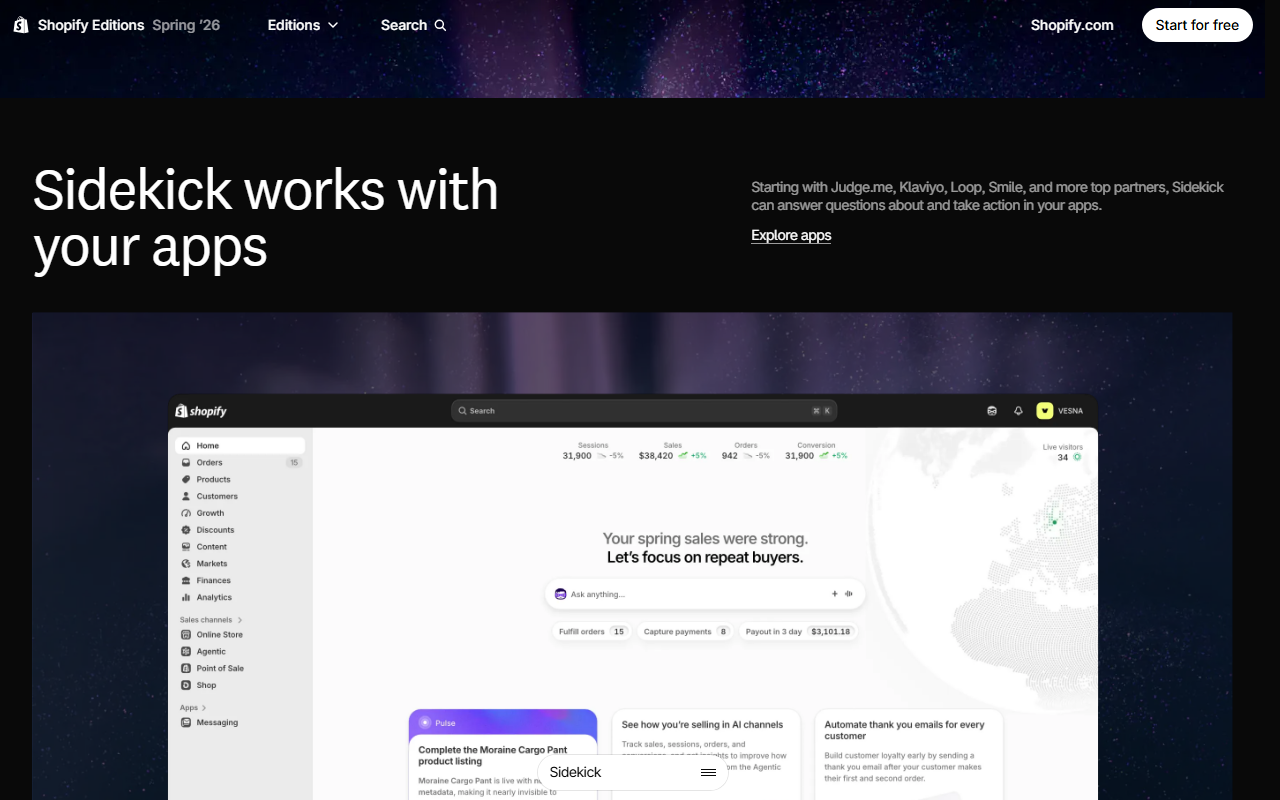
Official Shopify video on the Sidekick upgrades in the Winter '26 Edition, published Dec 10, 2025.
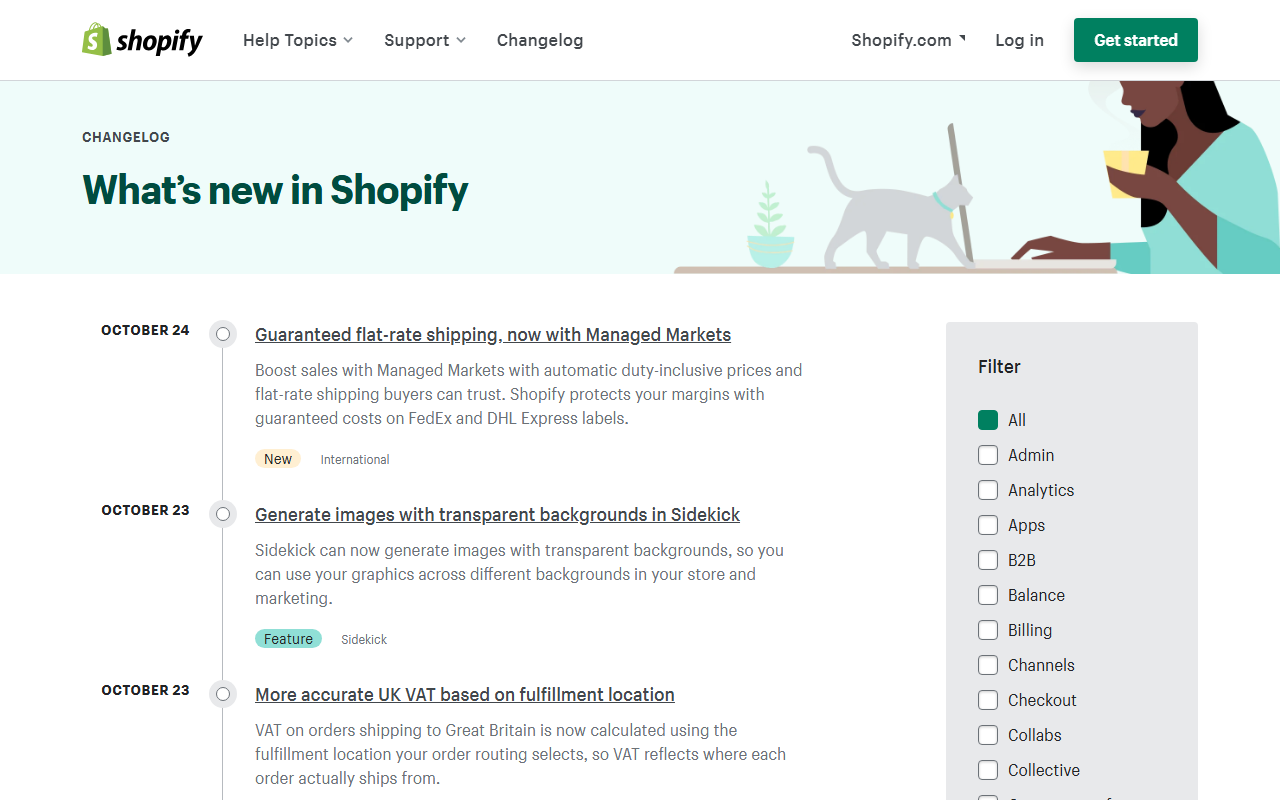
A realistic first month on Shopify, from the free trial to the first payout, with the checks that avoid the common complaints.
An illustrative sequence built from Shopify's pricing page, Terms of Service and Shopify Payments Terms, Oct 26, 2026, not a record of a JAVIS store.
Flow, Shopify Messaging and the new Campaign Autopilot cover the routine work; paid apps fill the gaps.
Shopify Flow automates store tasks with triggers and actions; in October 2026 it gained an action to buy shipping labels automatically (changelog, Oct 15, 2026). Shopify Messaging handles email, SMS and, since the Spring '26 Edition, WhatsApp campaigns, with SMS on a pay-per-send basis according to the pricing page. Campaign Autopilot, introduced in the same Edition, runs campaigns across channels with “AI-powered marketing that learns, optimizes, and drives performance”, with guardrails you set. Beyond that, the Shopify App Store is where most stores add reviews, subscriptions, loyalty and advanced email tools, and where the “add ones” that one reviewer complains about come from. If you connect Shopify to other business software, automation tools such as Zapier and Make are the usual bridge.

Official Shopify rundown of the Spring '26 Edition, published on the Shopify YouTube channel on Jun 17, 2026.
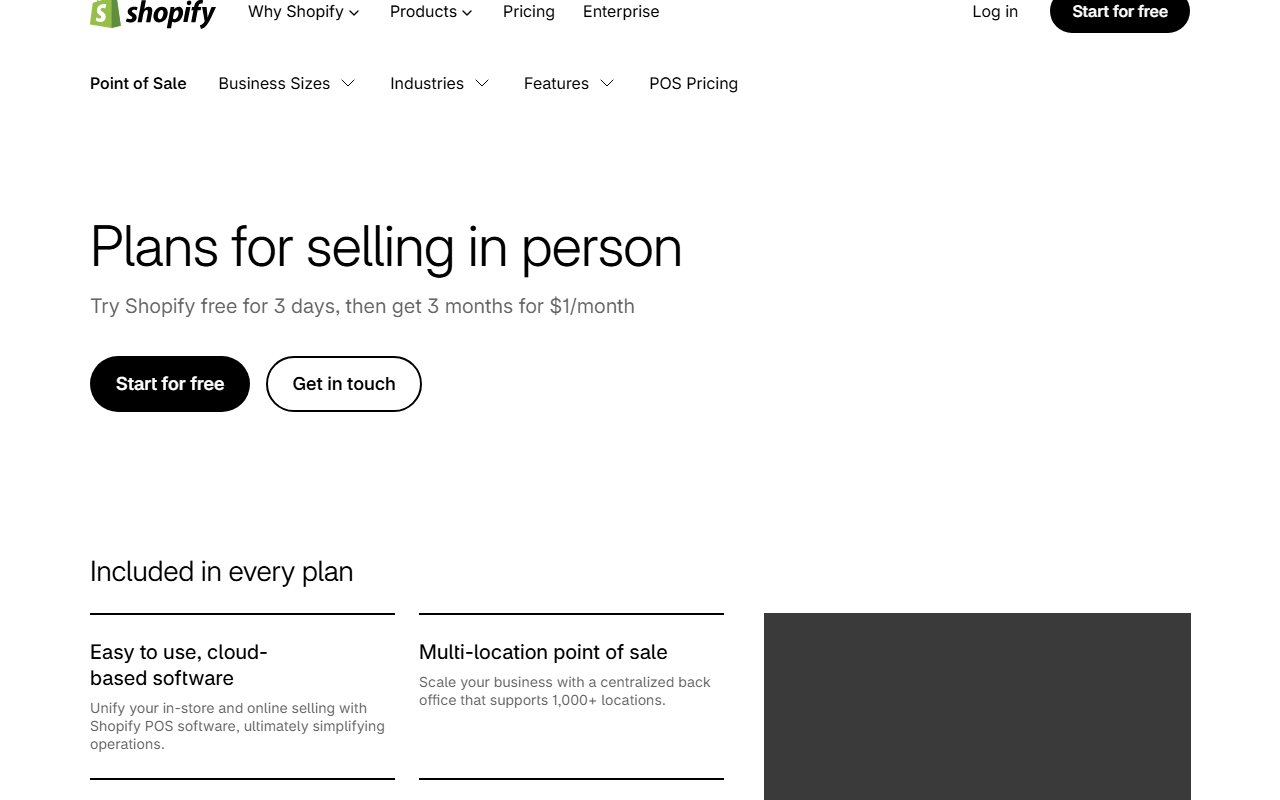
Every plan can take in-person payments; POS Pro at $89 a month per location adds the tools a real shop needs.
Casual in-person selling is included on all plans: a phone or card reader, simple customer profiles and returns at the original location. POS Pro, an add-on at $89 a month per location (Plus includes 20 locations), adds unlimited staff with roles and permissions, in-store inventory, purchase orders, pickup and delivery, and returns at any location. In-person card rates in the US run from 2.6% + 10¢ on Basic to 2.3% + 10¢ on Plus. Shopify's Spring '26 Edition described a rebuilt POS checkout that saves “over a minute” when creating customers, adding products and checking out, and on Sep 28, 2026 the changelog added local delivery orders and stock counts in POS. Hardware is bought, not leased, under the Terms.
Official Shopify video on the rebuilt POS checkout, published Jun 17, 2026.
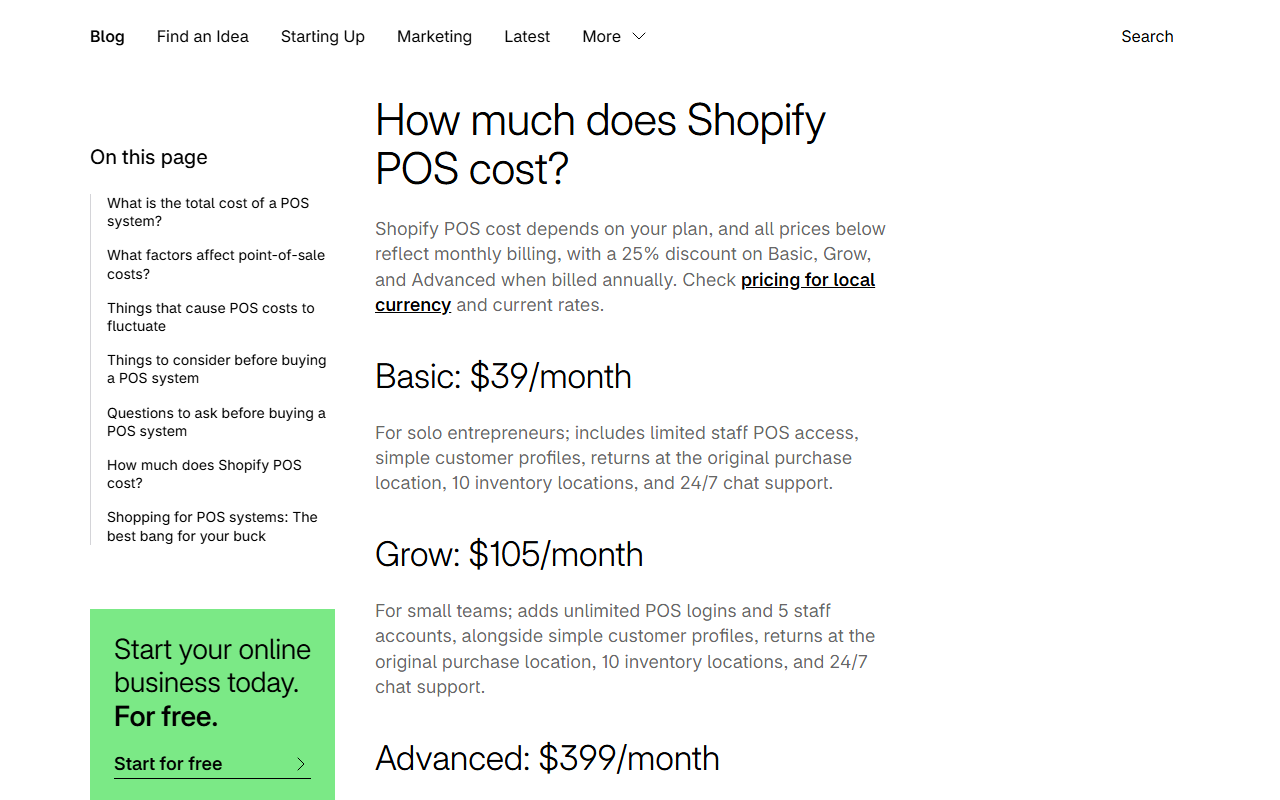
Shopify gives developers APIs on every plan, and in 2026 it rebuilt its AI-agent tools around the Universal Commerce Protocol.
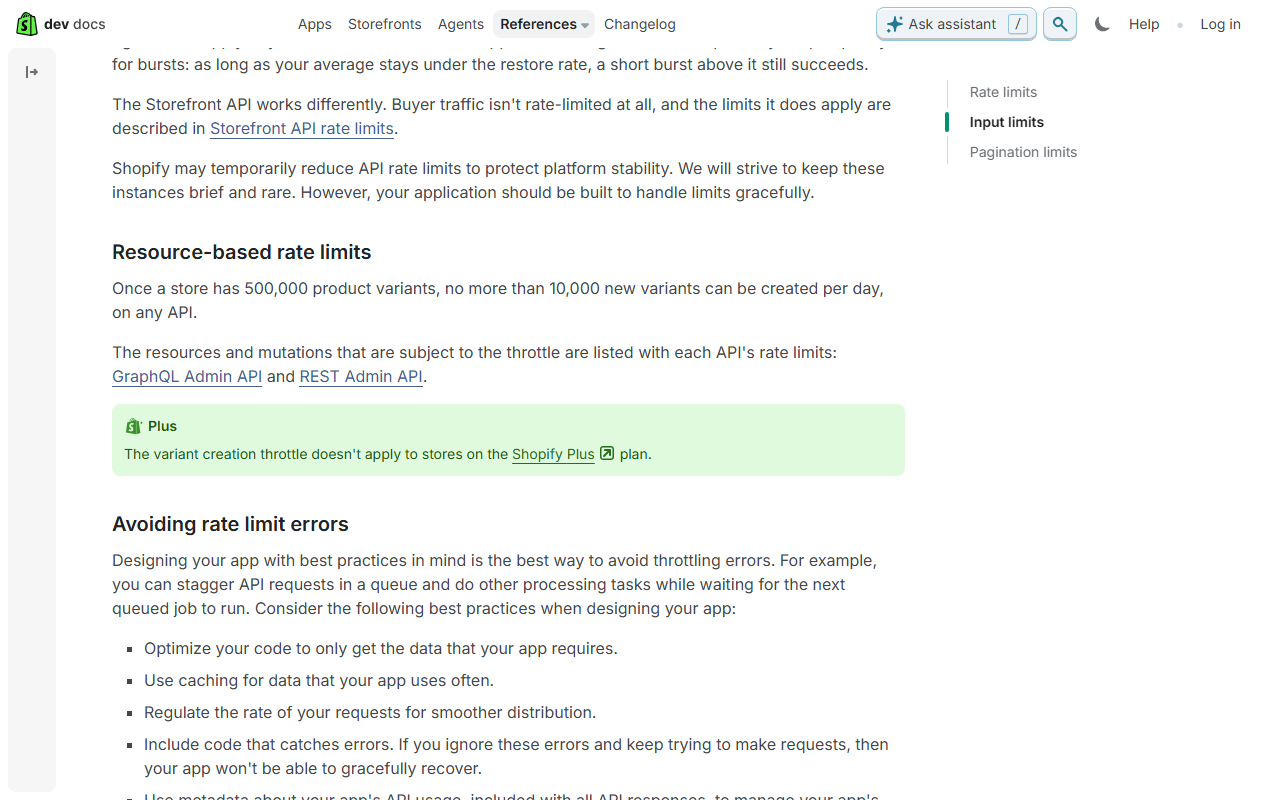
Developers get GraphQL and REST Admin APIs, a Storefront API for custom front ends (one such storefront on Basic to Advanced, 25 on Plus) and rate limits that scale by plan: standard on Basic and Grow, up to 2x on select APIs on Advanced and up to 10x on Plus. The developer docs note practical limits: once a store has 500,000 product variants, “no more than 10,000 new variants can be created per day, on any API”, and pagination caps at 25,000 objects. Basic stores building custom apps get “Limited data access”, per the pricing table.
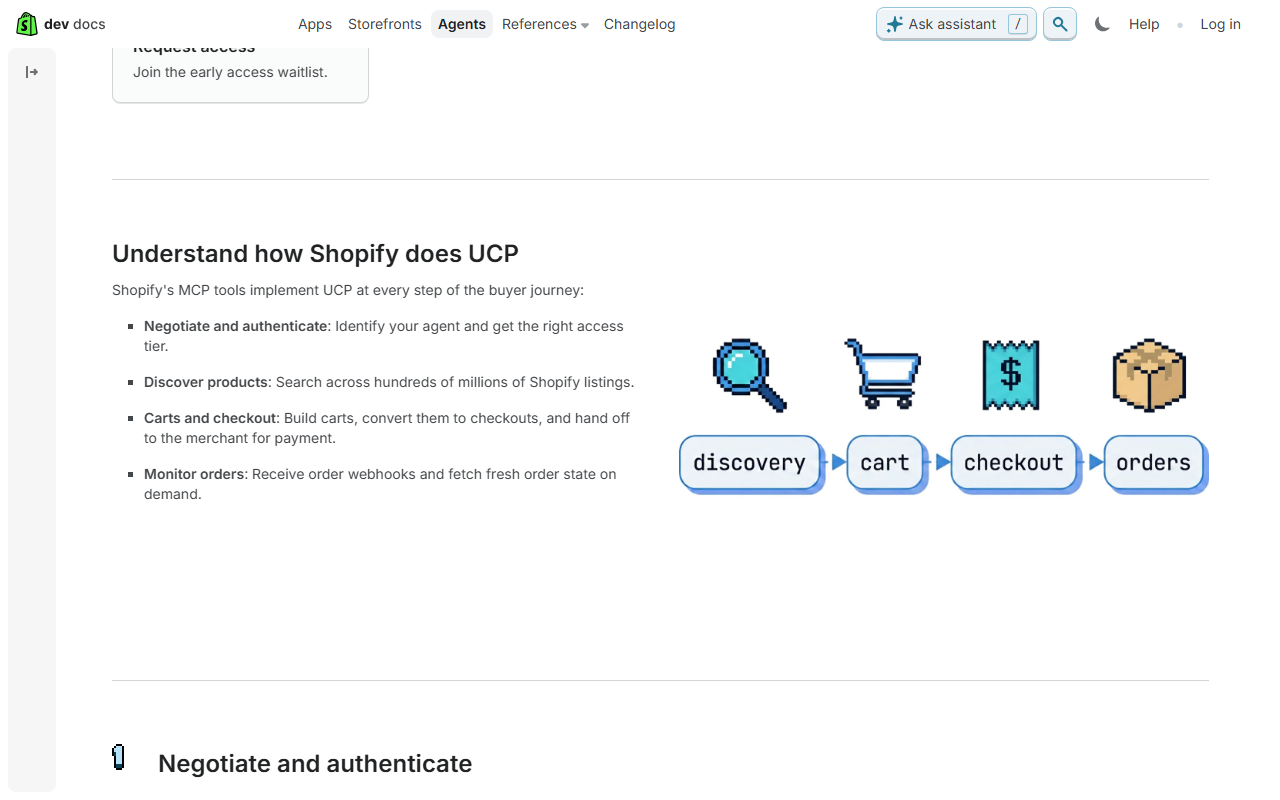
For AI coding tools, the Shopify AI Toolkit connects agents such as Claude Code, Codex, Cursor and VS Code to Shopify's docs, schemas and validation; it installs as a Claude Code plugin or through a local Dev MCP server that, per the docs, “runs locally and doesn't require authentication”. If you set that up, our Claude Code setup guide and guide to Claude MCP connectors explain what such connections can do. For shopping agents, Shopify now implements the Universal Commerce Protocol (UCP) with Catalog, Cart and Checkout MCP servers. One change matters if you built on the older tools: “The catalog and cart tools on https://{shop}/api/mcp were removed. Use the Universal Commerce Protocol (UCP) instead.”
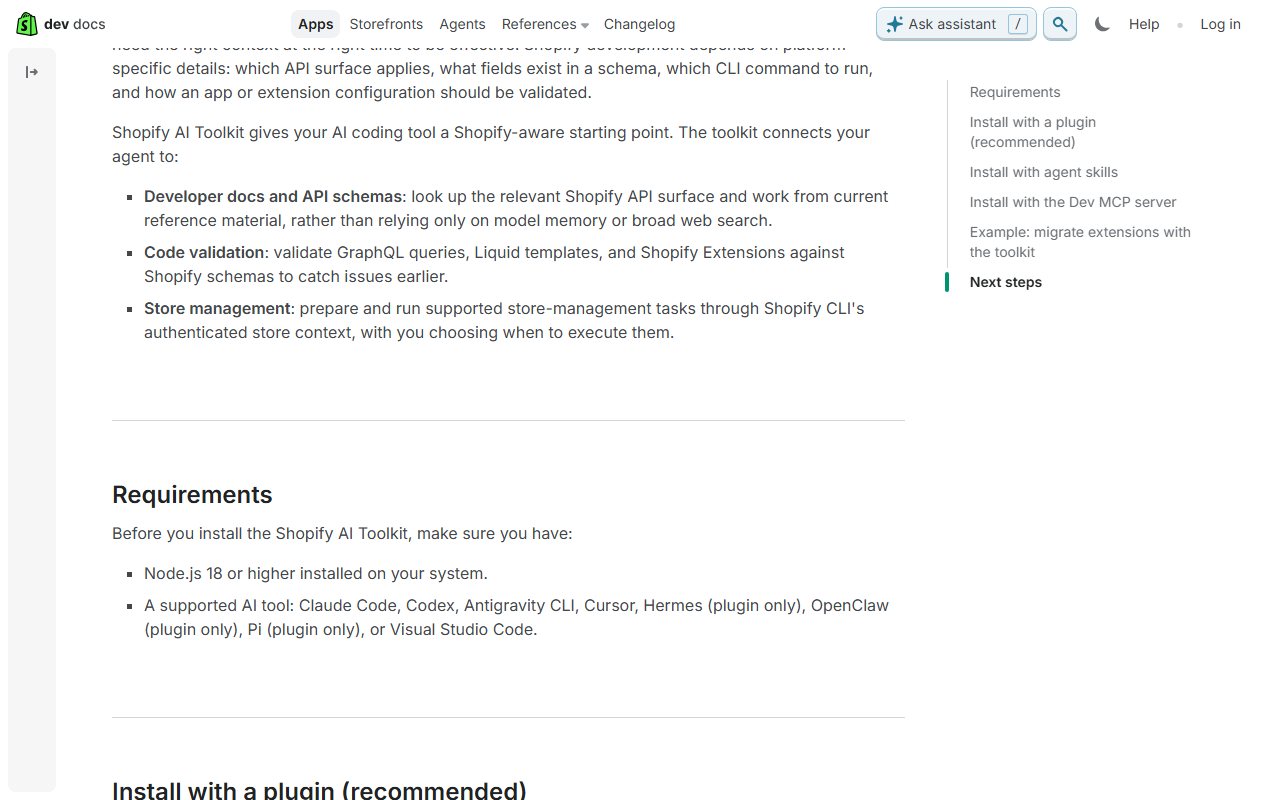

Shopify carries the payment-security burden well; legal responsibility for your store, your customers and your taxes stays with you.
On security, Shopify states that it “is certified Level 1 PCI DSS compliant” and that it “has been issued SOC 2 Type II and SOC 3 reports”. The pricing FAQ adds that stores are PCI compliant by default and get a free TLS/SSL certificate. That removes a real cost and risk for small sellers who would otherwise handle card data themselves.
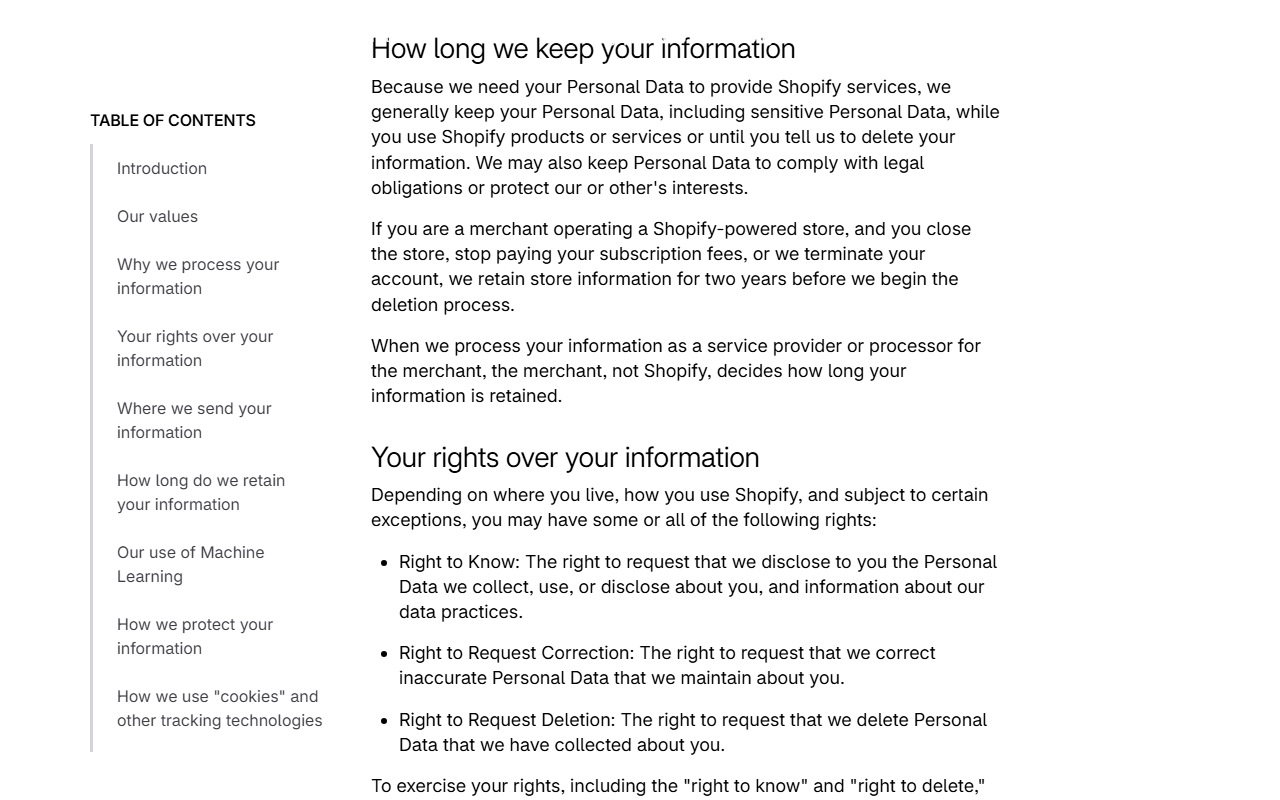
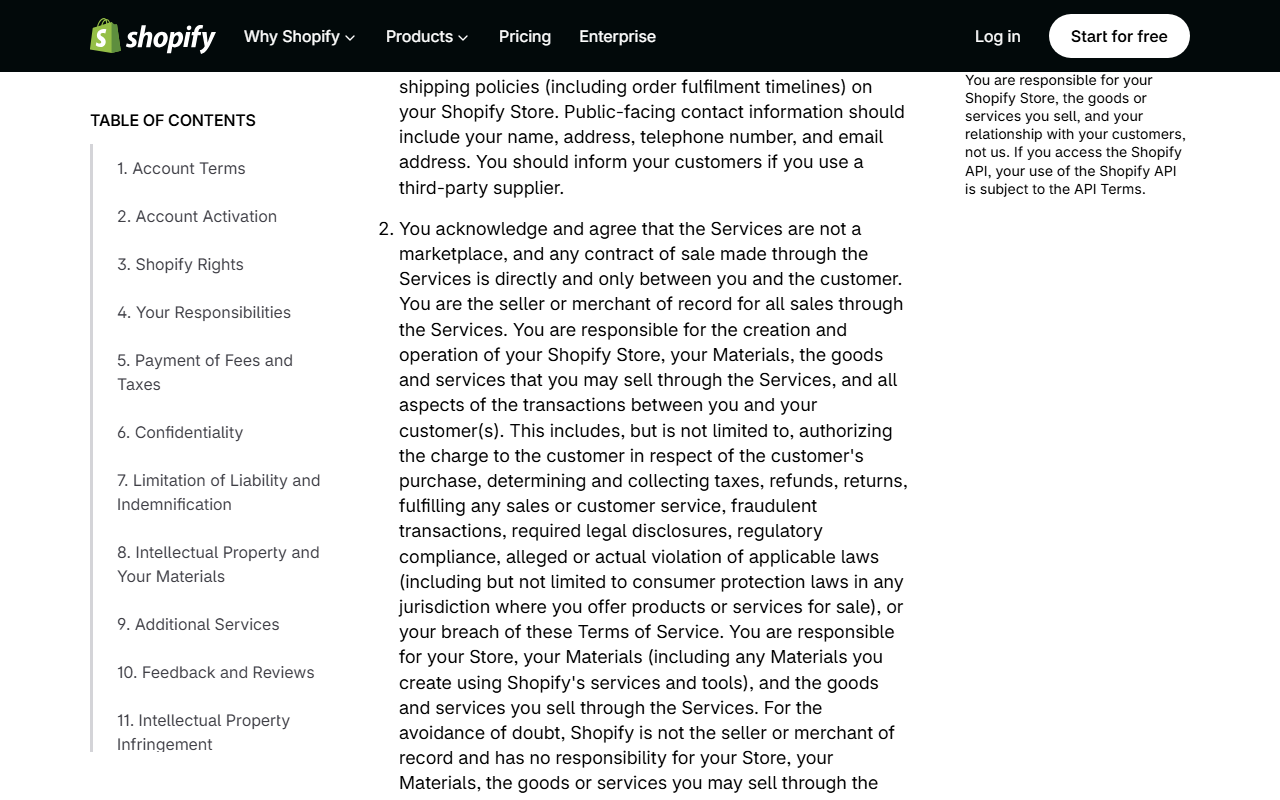
Responsibility is another matter. The Terms say “You are the seller or merchant of record for all sales through the Services.” Customer complaints, refunds to shoppers, taxes and consumer law are yours. The Privacy Policy, updated July 7, 2026, says that if you close your store or stop paying, Shopify will “retain store information for two years before we begin the deletion process.” The Terms also forbid processing orders outside Shopify's Checkout or working around technical limits, and you agree not to access the services “using any robot, spider, scraper, or other automated means”, which matters if you plan to bulk-export data with unofficial tools; use the official APIs instead.
| Area | What Shopify publishes | Your job |
|---|---|---|
| Card data | Level 1 PCI DSS; stores PCI compliant by default | Do not collect card numbers outside checkout |
| Audits | SOC 2 Type II and SOC 3 reports issued | Ask for the reports if your customers require them |
| Privacy law | GDPR and CCPA guidance; tools for GDPR compliance on Basic | Your own privacy policy and consent banner |
| Data after leaving | Store information kept two years after closure, then deleted | Export what you need before you cancel |
| Payouts | Reserves possible, up to the full amount, no interest | Keep cash reserves; expect holds as a new store |
| Staff access | Staff accounts from Grow; roles and permissions with POS Pro or Plus | Do not share the owner login on Basic |
From shopify.com/security, the Privacy Policy (Jul 7, 2026), the Terms (Oct 20, 2026), the Shopify Payments Terms and the US pricing page, Oct 26, 2026.

Shopify suits sellers who want many channels in one place and can use Shopify Payments; it suits less well anyone who needs every dollar of margin or lives outside the 41 Shopify Payments countries.
| Work pattern | Fit | Likely plan |
|---|---|---|
| First online shop, selling alone, US, UK, EU, Canada or Australia | Strong: fast launch, Sidekick, Shopify Payments | Basic, $29 billed yearly in the US |
| Small brand with two to five staff and steady sales | Strong: staff accounts, lower card rate | Grow, $89 billed yearly |
| Shop counter plus website | Strong: one inventory, POS app and hardware | Basic or Grow plus POS Pro, $89 per location |
| Brand selling in several countries | Good: Markets, local currencies, duties | Advanced, $359 billed yearly |
| Seller based where Shopify Payments is not offered | Mixed: 2% Shopify fee on Basic on top of the processor | Basic under $6,000 a month in sales, Grow above |
| Hobby seller with a handful of orders a year | Weak: the fixed monthly fee dominates | Marketplaces or the Agentic plan |
| Developer building a custom storefront | Good: APIs, AI Toolkit, UCP | Grow or above for full data access |
Who should not buy: anyone who needs a refund guarantee before committing to a year, sellers who cannot tolerate payout holds in the first months, very low-volume sellers for whom $29 to $39 a month outweighs sales, and businesses that must control their own hosting and code.
Nine things to weigh before you commit.
If you need less than everything, or want to own the stack, these are the platforms to price against Shopify.
Prices are list prices in US dollars from each vendor's page on Oct 26, 2026. We compared prices and published features only, not ease of use or reliability. Wix is not priced here because its plans page shows prices in local currency for our location; check it from your own country.
Swipe sideways to see every column.
| If you need | Look at | Published price | What you give up versus Shopify | JAVIS review |
|---|---|---|---|---|
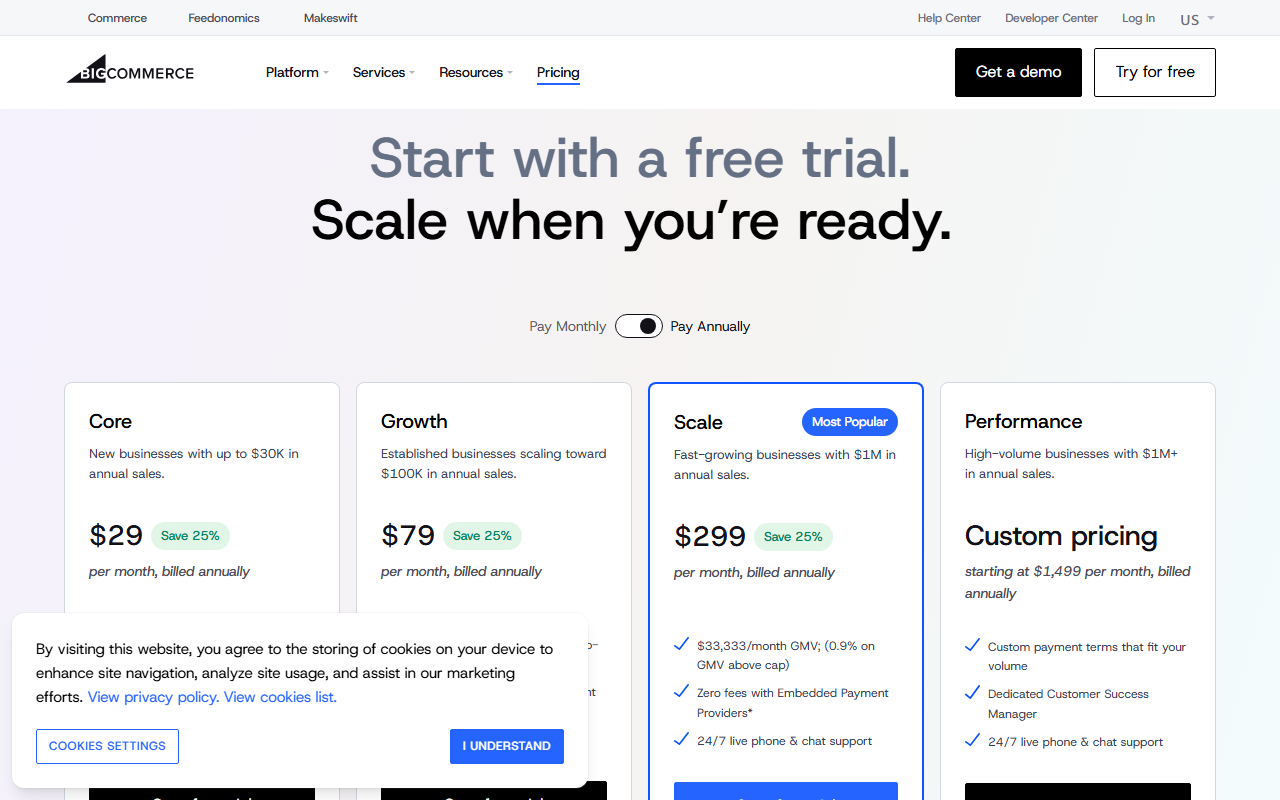
| A hosted platform with the same price points | BigCommerce | Core $39 or $29 yearly, Growth $105 or $79, Scale $399 or $299; cards from 2.89% + 29¢ | Plans auto-upgrade above trailing sales caps ($30K and $100K a year); Scale adds 0.9% above $33,333 a month | Not reviewed yet |
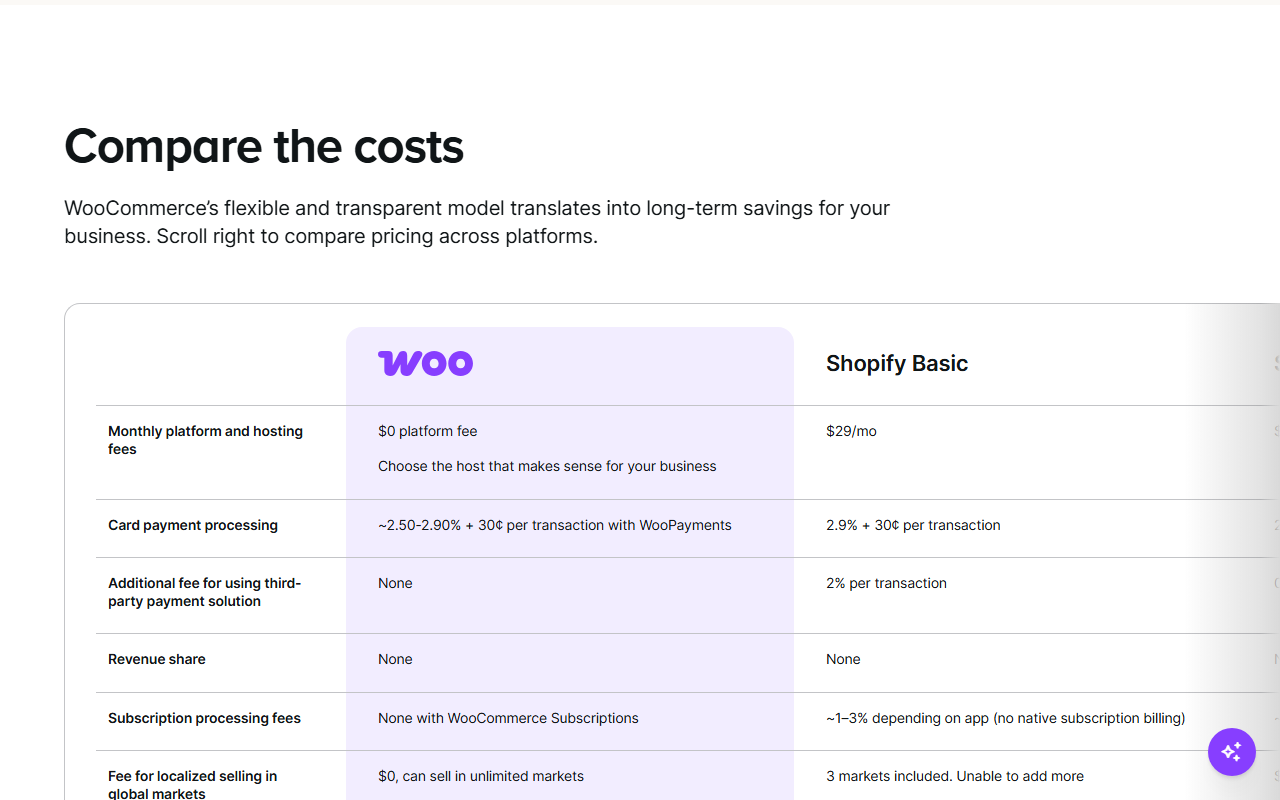
| To own your store and hosting | WooCommerce | Free plugin; hosting $25 to $350 a month; extensions $29 to $299 a year; WooPayments about 2.5% to 2.9% + 30¢ | You run hosting, updates and security yourself | See our FastComet hosting review |
| A design-led site with a small catalog | Webflow Ecommerce | Standard $29 billed yearly or $42 monthly, 500 items, 2% transaction fee | No built-in point of sale or Shop network on its pricing page | Not reviewed yet |
| A simple site that also sells | Squarespace | Basic adds a 2% online store fee; Core and above 0%; prices shown in local currency for our location | Check US prices from the US; no point of sale or AI-chat selling compared here | Not reviewed yet |
| Selling inside chat apps first | Chatfuel | See our review | A chatbot tool, not a store or checkout | Chatfuel review |
The BigCommerce comparison is the most direct. Its monthly prices ($39, $105, $399) match Shopify's exactly, and since Oct 14, 2026 its yearly prices for the middle and upper plans are lower ($79 against Shopify's $89, and $299 against $359). The catch is that BigCommerce moves you up a plan when your trailing 12-month sales pass each cap, so a growing store may not stay on the cheaper plan for long.

This review has no affiliate links.
Every Shopify link here goes straight to shopify.com, its pricing page, its Terms of Service or its Shopify Payments Terms, without tracking parameters. The score, the drawbacks and the alternatives would be the same either way.
How this review was put together: Shopify's US pricing page as archived by the Internet Archive on Oct 13, Oct 14 and Oct 24, 2026, its UK, Canada, Singapore, India and Vietnam pricing pages, the POS pricing page and POS cost guide, the Terms of Service (Oct 20, 2026), Shopify Payments Terms, Privacy Policy (Jul 7, 2026), Acceptable Use Policy and security page, the changelog, Spring '26 Edition, Sidekick, Agentic Storefronts and Agentic plan pages, shopify.dev documentation, the investor site and second-quarter 2026 results, official Shopify videos, the Tailwind Labs and Shopify Engineering blogs, the BigCommerce, WooCommerce, Webflow and Squarespace pricing pages, W3Techs, the US App Store and Google Play, Trustpilot and Hacker News, as of Oct 26, 2026. This review involved no store of our own, no payments and no support contact, so nothing here describes speed, theme quality or support from our own use. Screenshots show public pages only.
Building traffic, automating the back office, or selling in chat? These reviews cover the tools around a Shopify store.
Each card opens a published JAVIS review, routed by where you are.





Questions people ask before committing
How much does Shopify cost a month in 2026?
In the US, per the pricing page as archived on Oct 24, 2026: Basic $39, Grow $105 and Advanced $399 a month on monthly billing, or $29, $89 and $359 a month billed yearly. Plus starts at $2,300 a month. The trial is 3 days free, followed by 3 months at $1 a month. Prices differ in other countries.
Did Shopify raise its prices?
Yes, on yearly billing. Archived copies of the US pricing page show Grow at $79 and Advanced at $299 a month billed yearly on Oct 13, 2026, and $89 and $359 on Oct 14, 2026. Monthly prices and yearly Basic did not change.
What fees does Shopify charge per sale?
With Shopify Payments in the US, online card sales cost 2.9% + 30¢ on Basic, 2.7% on Grow, 2.5% on Advanced and 2.25% on Plus, plus 1% for international cards. With another payment provider, Shopify adds 2%, 1%, 0.6% or 0.2% by plan, on top of that provider's fee.
Can I get a refund from Shopify?
The Terms of Service say Shopify does not provide refunds, and on termination there are no refunds of fees, pro rata or otherwise. Start on monthly billing until you are sure.
Can I use Shopify Payments in Vietnam?
No. Vietnam is not among the 41 designated countries in the Shopify Payments Terms on Oct 26, 2026. Stores based there use another provider and pay Shopify's third-party fee, 2% on Basic.
How do I cancel Shopify?
The pricing FAQ says you can simply cancel your account; the Terms say you cancel by contacting Shopify Support and following its instructions. Either way your store goes offline, so export your data first. Shopify keeps store information for two years before deletion begins, per its Privacy Policy.
Can Shopify sell my products in ChatGPT?
Shopify says Agentic Storefronts show eligible stores' products in ChatGPT, Gemini and other AI chats, with orders arriving in your admin. Brands without a Shopify store can use the Agentic plan, which has no monthly fee and charges per sale.
Where this came from, and when.
Every price, fee, rule and rating in this review comes from the pages below, as of Oct 26, 2026 unless another date is given. Expand for the full list, the scoring method and what the review does not cover.
Show sources, scoring method and scope
Pricing: Shopify's US pricing page (shopify.com/pricing) as archived by the Internet Archive on Oct 13, 2026 (20:09 UTC), Oct 14, 2026 (20:12 UTC) and Oct 24, 2026 (12:05 UTC), including plan cards, comparison table and Shopify Payments rates; the same address viewed from Vietnam and Shopify's Vietnam, UK, Canada, Singapore and India pricing pages, Oct 26, 2026; shopify.com/pos/pricing; the Shopify blog guide How much does a POS system cost (updated Apr 23, 2026); shopify.com/starter and shopify.com/agentic-plan.
Legal: Shopify Terms of Service, last updated Oct 20, 2026, sections 1, 4, 5, 14, 15 and 16; Shopify Payments Terms of Service, Part I sections A1 and C (reserves, fees); Privacy Policy, updated Jul 7, 2026; Acceptable Use Policy; shopify.com/security.
Product and company: Shopify changelog entries of Sep 25 to Oct 24, 2026; Spring '26 Edition page; Sidekick, Agentic Storefronts and payments pages; shopify.dev pages on the AI Toolkit, agentic commerce and UCP, Storefront MCP migration and API limits; the investor site; the second-quarter 2026 results release of Aug 5, 2026; the Oct 6, 2026 newsroom article on agentic holiday shopping; Tailwind Labs blog post of Sep 9, 2026; Shopify Engineering post of Sep 10, 2026.
Video: four videos from the official Shopify YouTube channel (@shopify, linked from the shopify.com footer): 22NqvJyppt8 (Agentic Storefronts, Dec 10, 2025), LU4tghjdnG8 (Sidekick, Winter '26 Edition, Dec 10, 2025), sf7zUi_8bhs (Spring '26 Edition rundown, Jun 17, 2026) and 37zOjqRl-3Q (POS checkout, Jun 17, 2026).
Independent evidence: US App Store listings for the Shopify, Shopify POS, Shop, Shopify Inbox and Shopify Balance apps (country=us) and the 150 most recent US reviews of the Shopify app (Jun 8 to Oct 22, 2026); US Google Play listings for Shopify, Shopify POS and Shop (gl=US, hl=en); the Trustpilot page for Shopify (TrustScore, review count, profile labels and AI summary), with a desktop screenshot of Oct 26, 2026; Hacker News items 48384221, 49626190, 49643982 and 50158294; W3Techs content management statistics. G2, Capterra and Reddit are not quoted.
Competitors: bigcommerce.com/pricing, woocommerce.com/pricing and woocommerce.com/payments, webflow.com/pricing and squarespace.com/pricing, Oct 26, 2026.
Images: screenshots of public pages taken on Oct 26, 2026 at 1280 by 800 pixels; pricing screenshots marked as archived show the Internet Archive's copy of Shopify's US page, with its toolbar. The Trustpilot screenshot is a desktop capture of Oct 26, 2026 at 1568 by 778 pixels. Illustrations inside them are the vendors' own. JAVIS charts and diagrams are labelled as such and computed from the figures above. Related cards use JAVIS's own featured images.
JAVIS Fit Score (69/100): an editorial composite scored out of 20 on five criteria. Price clarity 11: every US plan and card rate is published, but prices change by visitor location, the yearly discount varies by plan and changed in October without an announcement we could find, and some pages contradict each other. Capability 19: the broadest commerce suite among the platforms we priced, from hosted store and checkout to POS, Shop, AI-chat selling, Sidekick and developer tools. Independent evidence 13: audited public-company figures and a 4.7 App Store average, offset by a sharply negative recent review sample on billing and payouts and a Trustpilot page dominated by shopper complaints. Terms, data and security 11: Level 1 PCI DSS and SOC 2 Type II, against no refunds, termination for any reason, reserves of up to the full amount and two-year data retention. Cost and fit 15: good value on Basic with Shopify Payments, expensive outside Shopify Payments countries or with many apps. It is judgment, not a measurement.
What this review does not cover: theme quality, site speed, checkout conversion, support response times, Shopify Plus contract terms, Shopify Capital, Balance and Credit in depth, Help Center articles, and prices in countries other than those listed.