
Zebracat Review 2026: Fast AI Marketing Videos From $23 a Month, With Refund and Plan Pages That Disagree
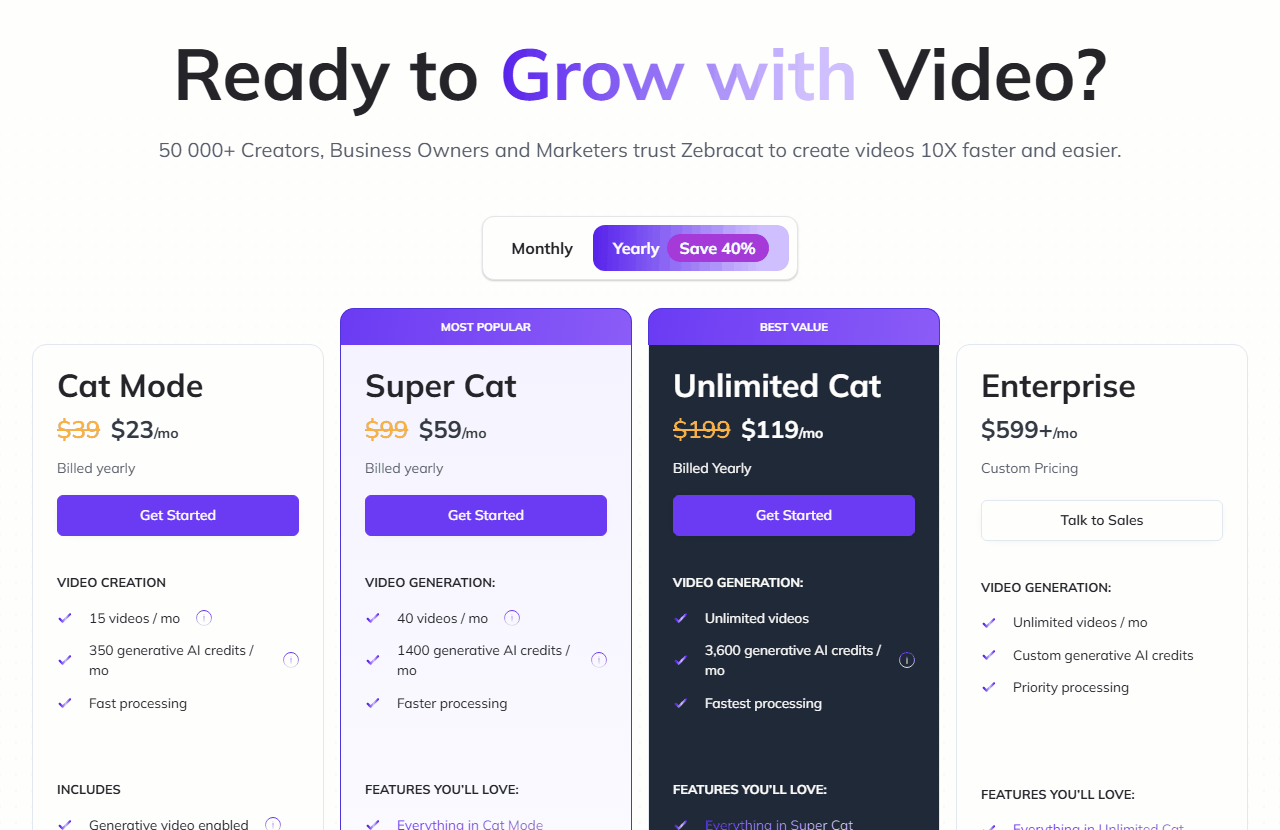
Zebracat is a Berlin-made AI video tool that turns a prompt, a script, a blog or product URL, or an audio file into a short, edited video with voiceover, captions, stock or AI-generated visuals and music, and can post the result to social accounts. As of Oct 27, 2026, its pricing page lists Cat Mode at $39 a month or $23 a month billed yearly, Super Cat at $99 or $59, Unlimited Cat at $199 or $119, and Enterprise from $599 a month. The yearly rates were $19, $49 and $99 as late as an Aug 7, 2026 archive copy, so yearly buyers now pay about 20% more. The bigger catch is the paperwork: the pricing page promises a full refund within 7 days if you have not downloaded a video, while the Terms say no refunds for paid periods.
Every Zebracat link in this review goes straight to zebracat.ai or its developer pages.
| Made by | Zebracat AI UG (haftungsbeschränkt), Berlin, Germany, per its Imprint |
| What it is | Prompt, script, URL or audio to short marketing video, with AI avatars, voice cloning, scheduling, MCP and API |
| Plans | Cat Mode $23 a month yearly or $39 monthly; Super Cat $59 or $99; Unlimited Cat $119 or $199; Enterprise $599+ |
| Free plan | Described in the FAQ as 5 videos, 720p, 30 seconds each; not shown among the plan cards |
| Best for | Small businesses and social media marketers who need many short videos and accept that payments may be final |
Zebracat is a quick way to turn text into short marketing videos; treat every payment as final and watch the credit meter.
$276 a year buys 15 videos a month of up to 2 minutes each. A plan named Unlimited still has a fixed pool of 3,600 AI credits.
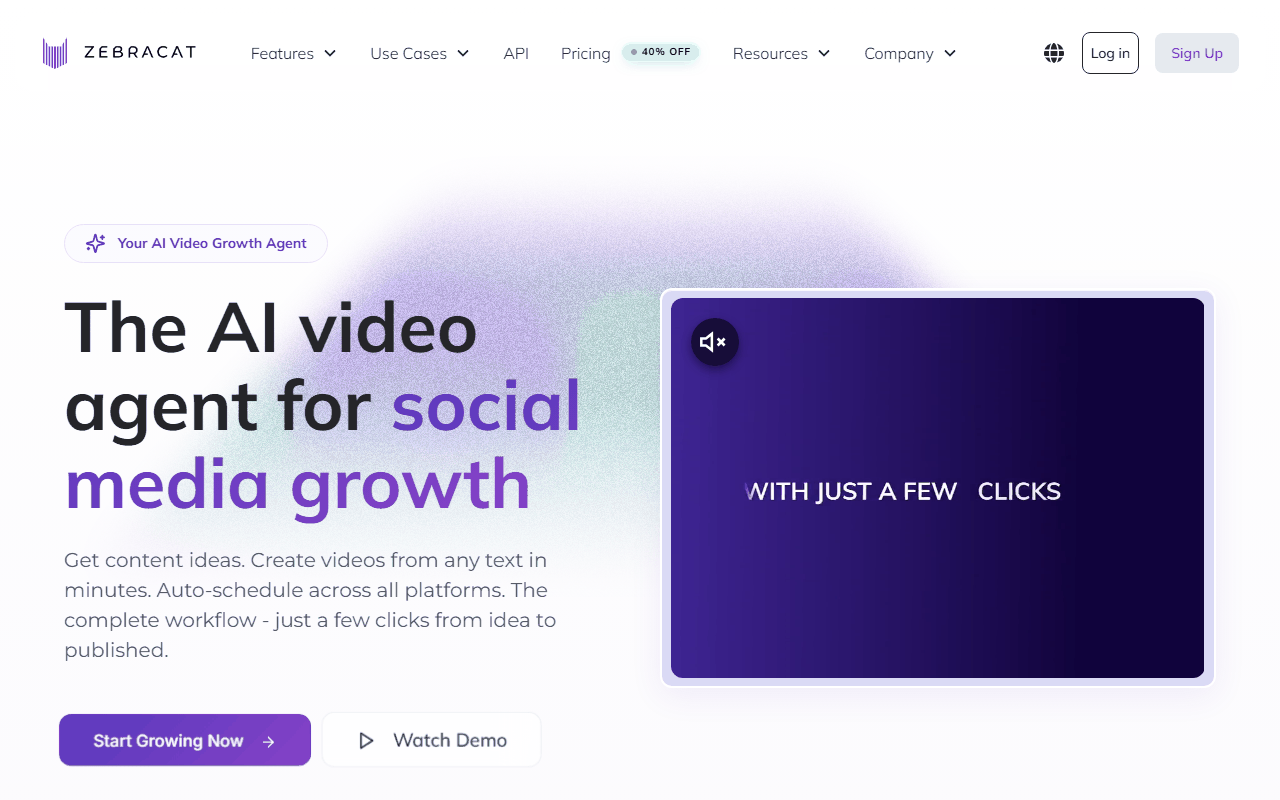
Zebracat’s appeal is speed for one job: short social and ad videos built from words you already have. You can start from an idea, a finished script, a blog post or product URL, or a voice recording, and Zebracat writes or keeps the script, picks visuals, adds an AI voice, captions and music, and hands back an edited video you can still change. Paid plans add AI avatars, voice cloning, translation into other languages, brand kits and scheduling to social accounts. In 2026 it also added an MCP server, a command-line tool and installable agent skills, so Claude, ChatGPT or Cursor can request videos on your plan, plus a pay-as-you-go API for developers.
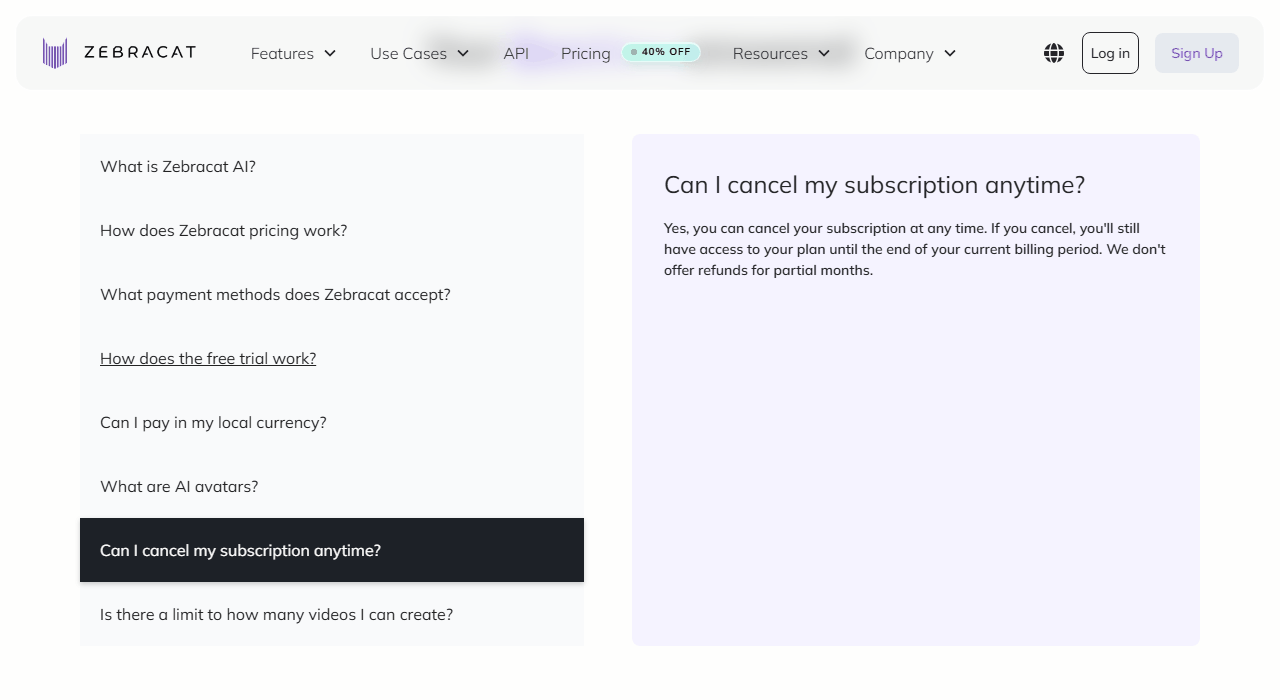
The weak points are around the purchase. The pricing page shows “7-day money-back guarantee” with “Didn’t download any video? Get a full refund within 7 days”, but the Terms say “No refunds will be provided for already paid subscription periods.” and the FAQ says “We don’t offer refunds for partial months.” An independent audit by Future Stack Reviews in June 2026 reports a refund request on an account with zero downloads refused three times. The plan pages also contradict each other on the free plan, video length and voice cloning, and the yearly prices rose about 20% between Aug 7 and Oct 3, 2026 while the monthly prices stayed the same. AppSumo buyers of an earlier lifetime deal rate it 3.96 out of 5 from 135 ratings, with complaints about credit changes and output quality.
Four ways in, one edited video in the middle, and two meters on every paid plan.
Every Zebracat project starts from one of four inputs and ends as an edited video with script, voice, visuals, captions and music. On the way, two separate allowances are used: the number of videos per month and a pool of generative AI credits for AI-made scenes and images. The same engine is reachable from the web studio, from AI agents through MCP or the CLI, and from your own code through the API.
Swipe sideways to see the whole diagram.
Monthly prices settled at $39, $99 and $199; the yearly discount shrank from 50% to 40%.
Internet Archive copies of zebracat.ai/pricing show a product that has re-priced often. On Feb 23, 2024 there were three plans: Free, Cat Mode at $38 a month and Super Cat at $112. By Jan 14, 2025, Cat Mode was $39 a month and Super Cat came in three credit sizes at $98, $198 and $398. On Jul 27, 2025, during a 50%-off-yearly promotion, the plans were Cat Mode at $35 a month, Super Cat at $99 and a new Unlimited Cat at $175, with a link to a Free Plan above the toggle.
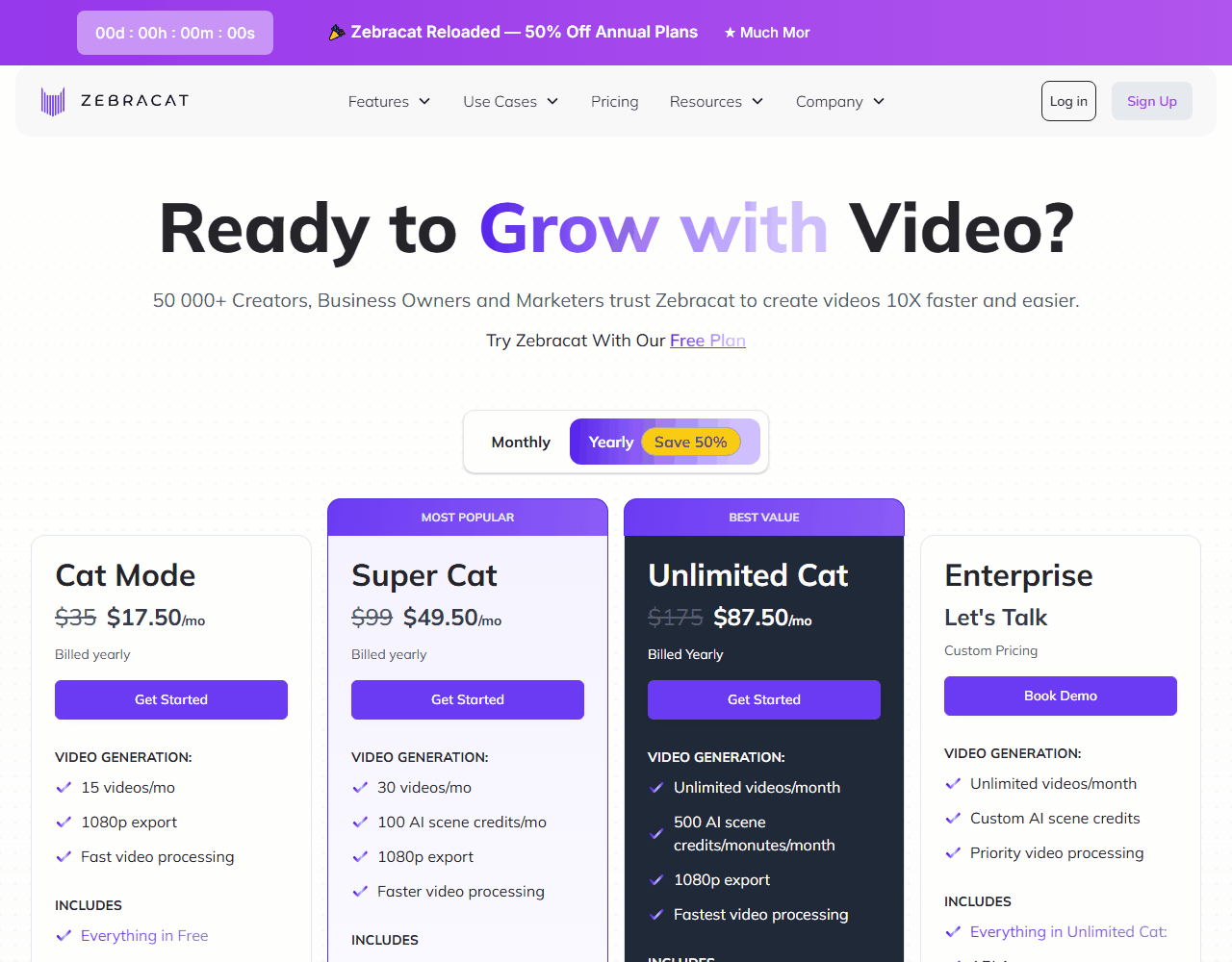
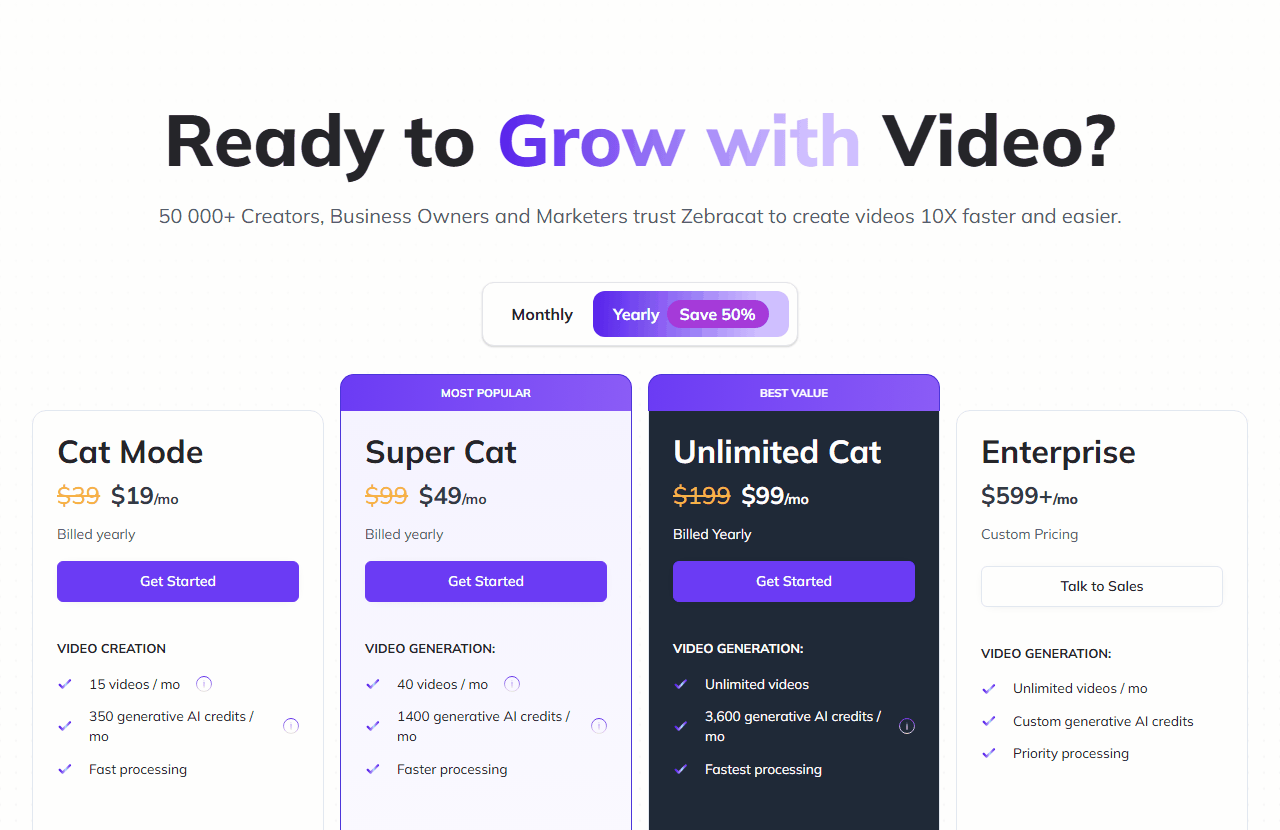
From Jan 13, 2026 the page has shown today’s structure: Cat Mode $39, Super Cat $99, Unlimited Cat $199 and Enterprise from $599 a month. In the Jan 13, May 16 and Aug 7, 2026 copies, the yearly toggle said “Save 50%” and showed $19, $49 and $99 a month. By the Oct 3, 2026 copy, and on the live page on Oct 27, 2026, the toggle says “Save 40%” and the yearly rates are $23, $59 and $119.
| Date | Change | Source |
|---|---|---|
| Feb 23, 2024 | Free, Cat Mode $38 a month, Super Cat $112 a month | Internet Archive copy |
| Apr 19, 2024 | Credit costs per minute posted for lifetime-deal buyers | AppSumo product page |
| Jan 14, 2025 | Free plan card; Cat Mode $39; Super Cat $98, $198 or $398 by credit size | Internet Archive copy |
| Jul 27, 2025 | 50%-off-yearly promotion; Unlimited Cat appears at $175 a month | Internet Archive copy |
| Nov 4, 2025 | AppSumo review reports a new credit system and lost older projects | AppSumo review |
| Jan 13, 2026 | Today’s plans: $39, $99, $199, Enterprise $599+; yearly $19, $49, $99 | Internet Archive copy |
| Jun 11, 2026 | Independent audit of refunds and credit packs published | Future Stack Reviews |
| Jul 6, 2026 | Zebracat CLI 0.1.6 published | npm registry |
| Aug 7, 2026 | Yearly rates still $19, $49, $99 with “Save 50%” | Internet Archive copy |
| Oct 3, 2026 | Yearly rates $23, $59, $119 with “Save 40%” | Internet Archive copy |
| Oct 27, 2026 | Same prices; FAQ still describes a free plan and yearly minute limits | Live pricing page |
A small Berlin company with large self-reported numbers that do not line up.
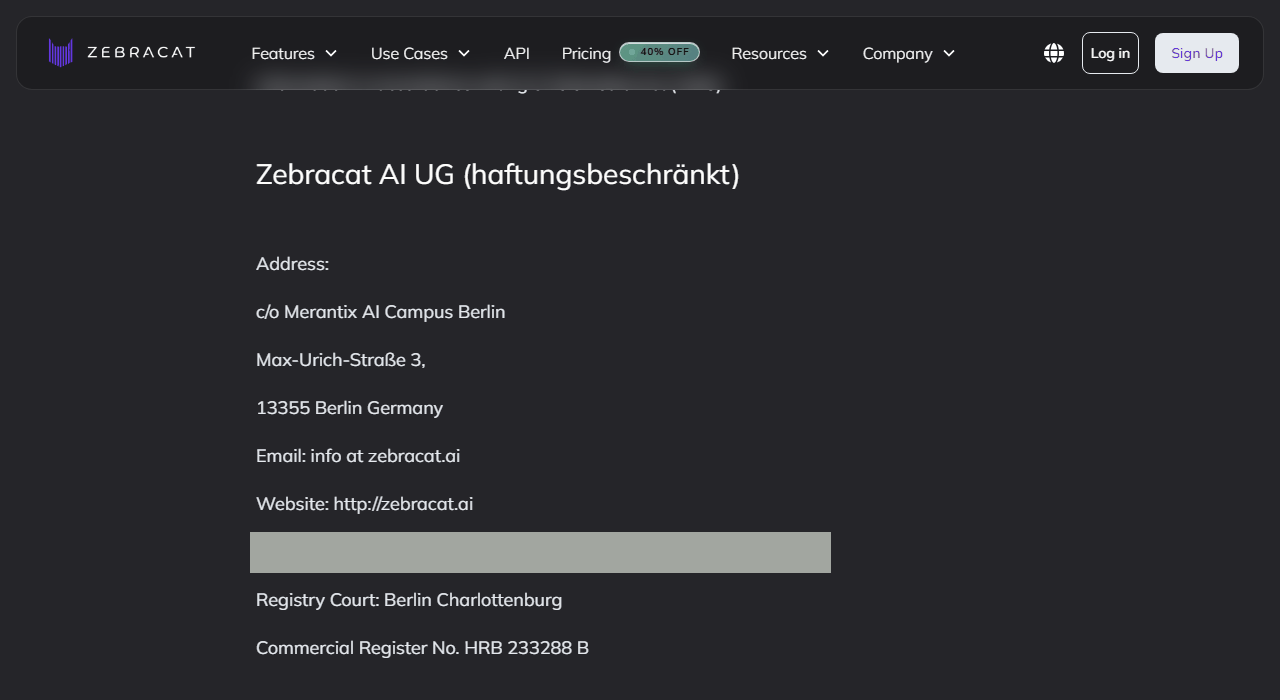
Zebracat is operated by Zebracat AI UG (haftungsbeschränkt), registered at the Berlin Charlottenburg court under HRB 233288 B, with an address c/o Merantix AI Campus Berlin, per its Imprint. A UG is the German small-capital form of a limited company. Its Terms are governed by German law. It sells to the same buyers as HeyGen, InVideo, Creatify and Fliki: marketers, small businesses and faceless social channels that want video without filming.
The usage numbers on Zebracat’s own pages are claims, not audited figures, and they disagree with each other. The About page says “50k” users and “+1 Million” videos created by users. The API page says “3M+” videos generated through the API alone, which would be three times the About page’s total. The pricing page says “Trusted by over 50,000 companies of all sizes” and shows “+1,000 5-star reviews”.
| Claim | Where Zebracat says it | Status |
|---|---|---|
| 50k users creating with Zebracat | About page | Vendor-stated |
| +1 Million videos created by users | About page | Vendor-stated; conflicts with the next row |
| 3M+ videos generated via API | API page | Vendor-stated |
| 99.9% API uptime | API page | Vendor-stated; no status page cited |
| Member of the Content Authenticity Initiative | Ethics page | Vendor-stated; not confirmed in the initiative’s public member list |
| Rating badges 4.9, 4.8 and 4.7 | Site footer | Vendor-stated; review platforms not cited here |
| 3.96 out of 5 from 135 ratings | AppSumo product page | Third-party, lifetime-deal buyers |
Two smaller signals point to an early developer ecosystem: the Zebracat CLI on npm is at version 0.1.6, published Jul 6, 2026, and the GitHub repository for its agent skills showed 0 stars and 7 commits on Oct 27, 2026. We found no Hacker News discussion of Zebracat.
Lifetime-deal buyers are split; the sharpest complaints are about credits and changed terms.
The largest open sample of buyer ratings we could read is on AppSumo, where Zebracat sold a lifetime deal in 2024. The deal is now sold out, and its 135 ratings average 3.96 out of 5. That is a skewed group: people who paid once and then saw the credit system change. Zebracat’s own site shows rating badges from three review platforms; we do not quote those platforms here.
The written complaints cluster around the move from minutes-based credits to a video cap plus separate AI credits. An AppSumo buyer of two Tier 2 licences wrote on Nov 4, 2025 that Zebracat was “changing the credit system without notice”, that short-form videos now cost more than before, and that “most older creations cannot be edited”. A question posted on Aug 7, 2026 says “advanced AI-powered scenes now require separate generative AI credits, which must be purchased independently”. Other posts on the same page complain about distorted AI images and shorter maximum video length than at launch.
“support is unwilling to refund credits for the period when the system was unusable”
“This significantly reduces the value of the original lifetime deal for creators who rely on AI-generated visuals.”
“Usable, but only if you treat every dollar in as spent for good.”
The independent audit matters more than any single post. Future Stack Reviews, which did not rate video quality, bought a $9.90 pack of 340 credits on a free account, created no videos and downloaded nothing, then asked for a refund. It reports three refusals, with support saying the guarantee covers subscriptions rather than credit packs, and two contradictory answers about whether the credits could be used at all. It also reports an in-app program that pays credits for posting reviews on review platforms, without a disclosure instruction in the flow it saw, which is a reason to weigh star badges lightly. These are one reviewer’s findings from June 2026, and we could not see the in-app screens ourselves.
Three self-serve plans, an Enterprise tier, and a free plan that lives only in the FAQ.
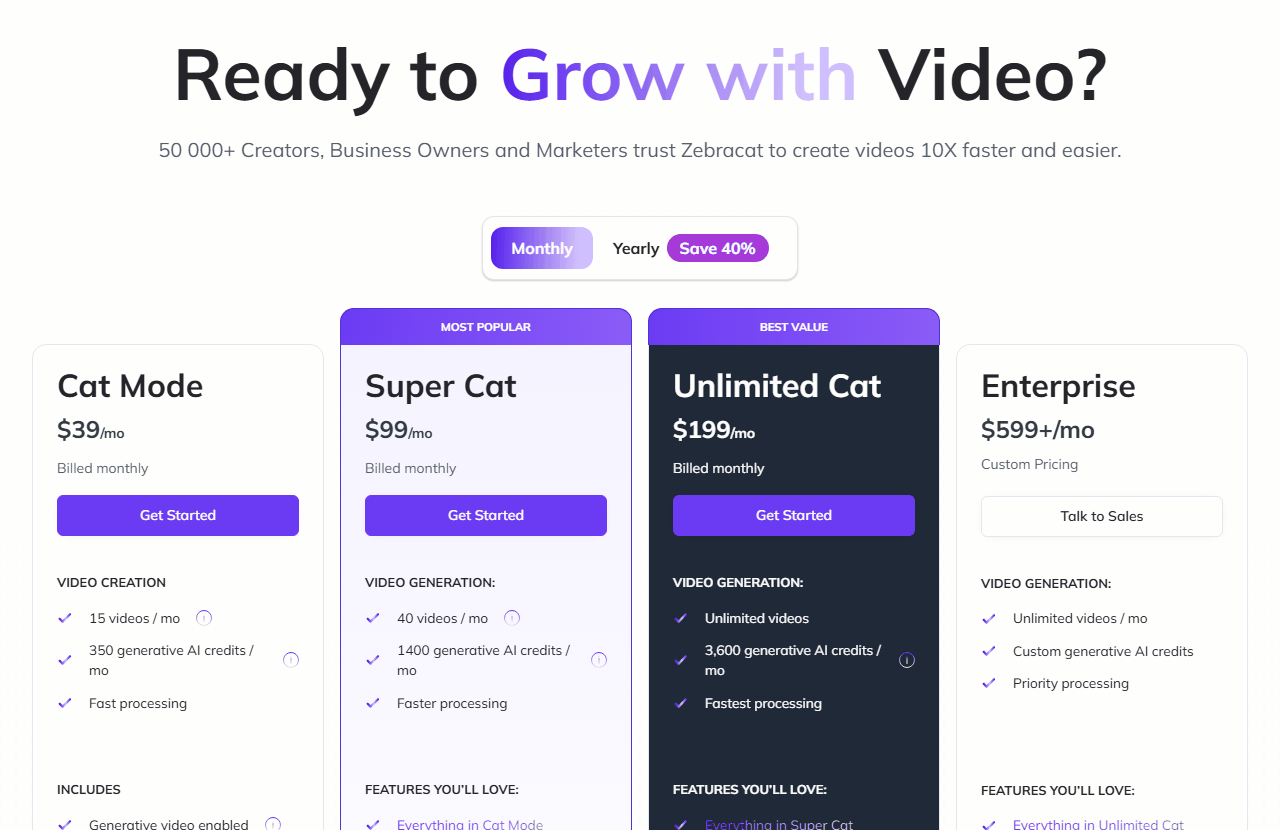
As of Oct 27, 2026, zebracat.ai/pricing opens in the yearly view. The monthly view shows the same allowances at $39, $99 and $199. The FAQ says annual billing “saves 40% on every paid plan ($23, $59 and $119 per month)”. The page also says prices can display in USD, EUR, GBP, AUD or CAD by location; the figures here are the US dollar prices.
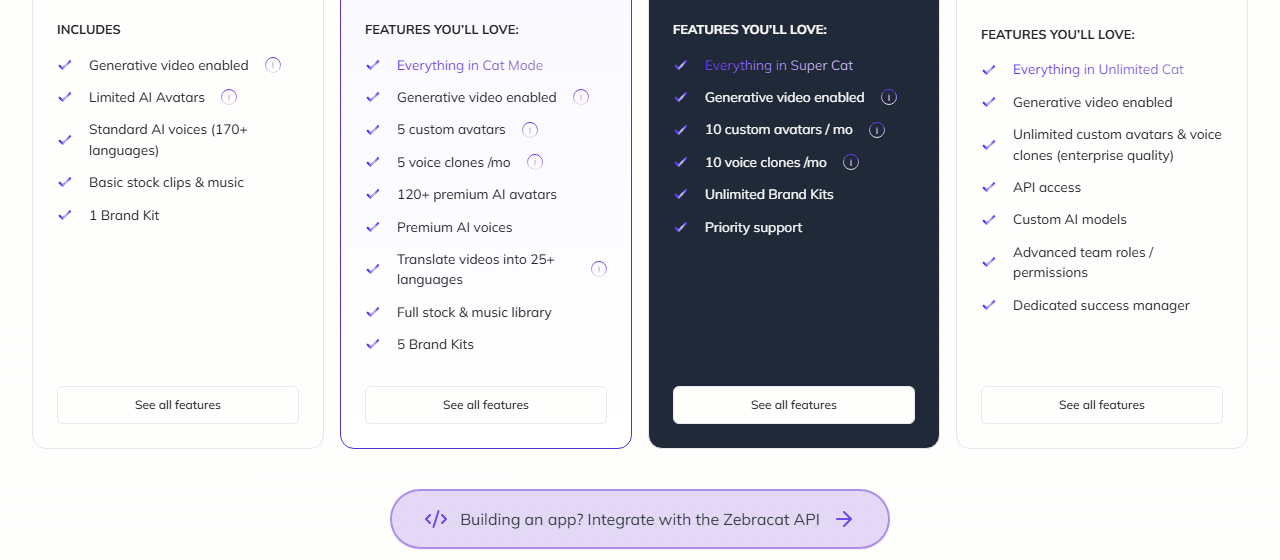
Cat Mode
$39 monthly
- 15 videos a month, up to 2 minutes
- 350 generative AI credits a month
- Public avatar library only
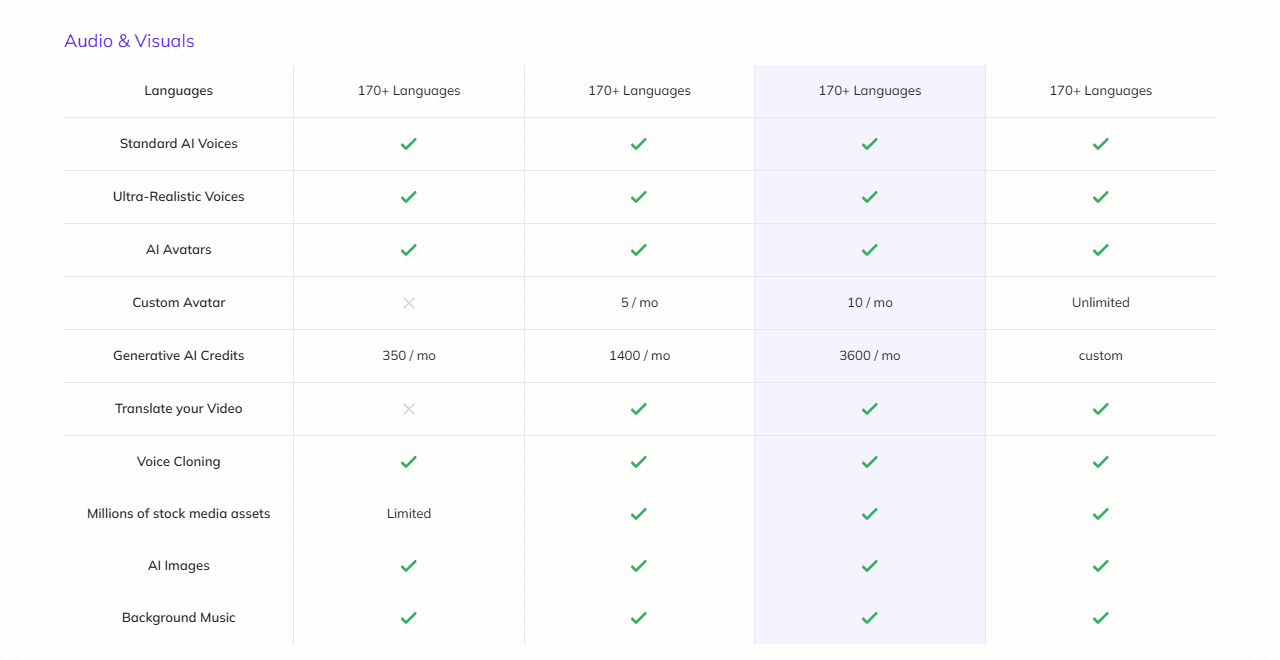
- Standard AI voices, 170+ languages
- 1 brand kit; AI chat support
Super Cat
$99 monthly
- 40 videos a month, up to 5 minutes
- 1,400 generative AI credits a month
- 5 custom avatars and 5 voice clones a month
- Video translation into 25+ languages
- 5 brand kits; standard support
Unlimited Cat
$199 monthly
- Unlimited videos, up to 5 minutes
- 3,600 generative AI credits a month
- 10 custom avatars and 10 voice clones a month
- Unlimited brand kits
- Priority support
Enterprise
Custom pricing
- Unlimited videos, custom credits
- Unlimited custom avatars and voice clones
- API access, custom AI models
- Team roles and permissions
- Dedicated success manager
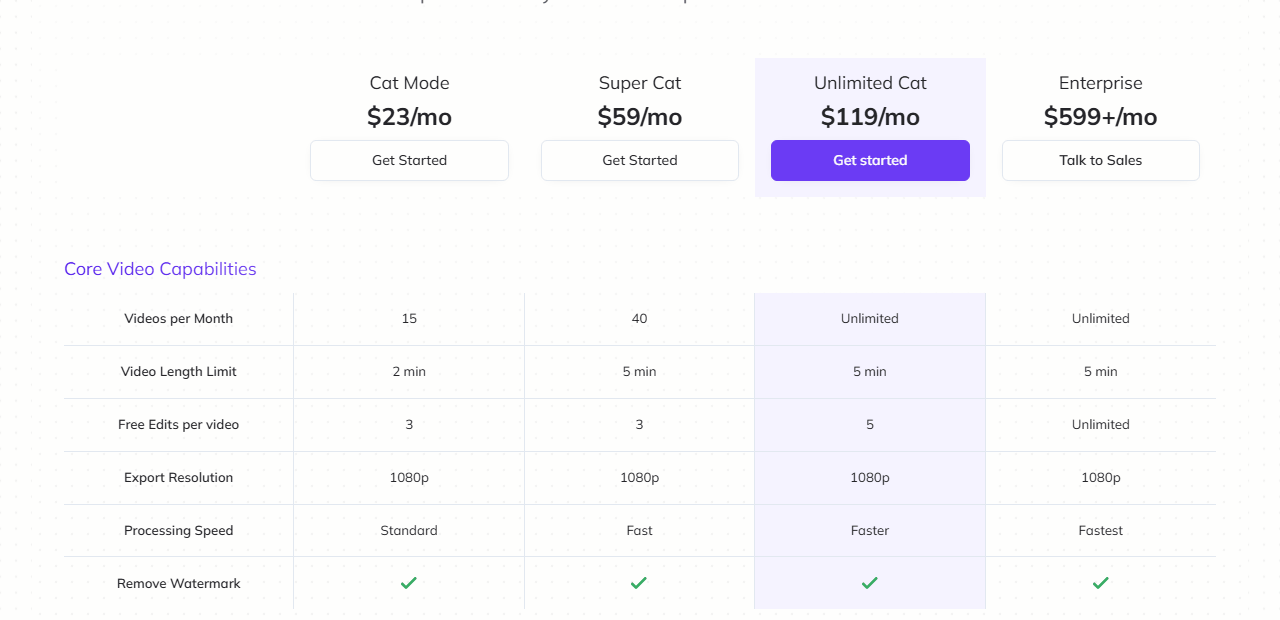
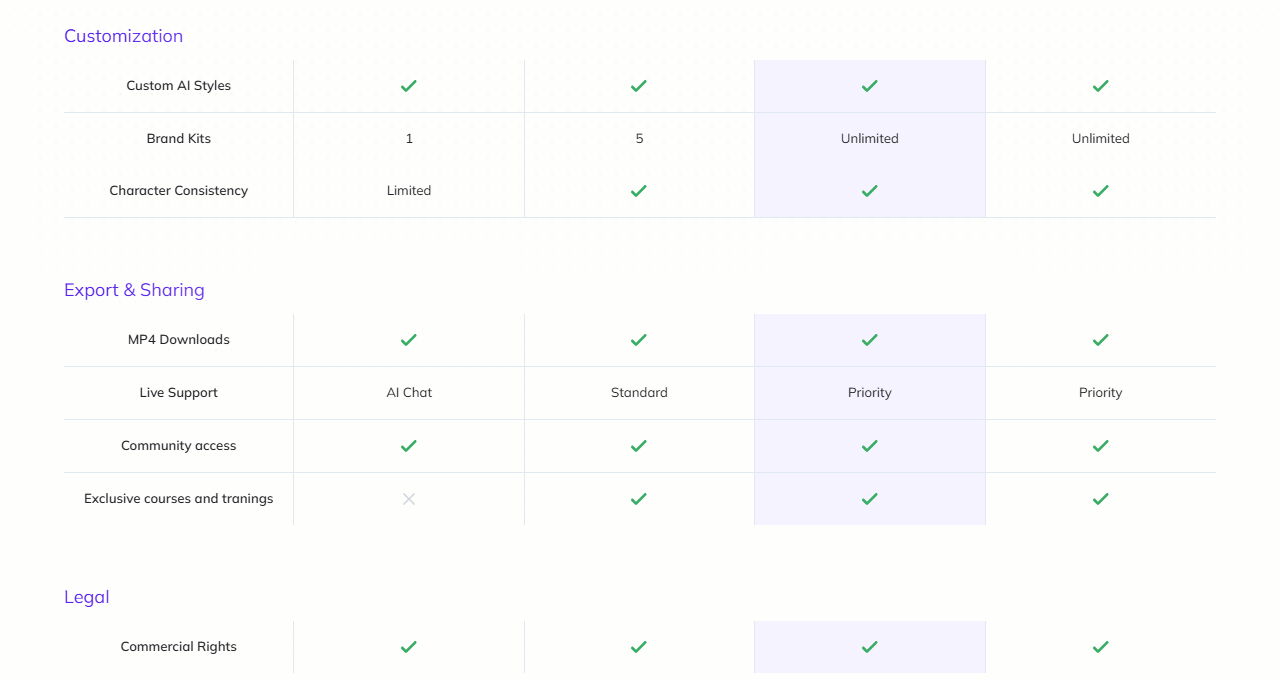
Free edits deserve a note: the table lists 3 free edits per video on Cat Mode and Super Cat and 5 on Unlimited Cat. Zebracat does not say on the pricing page what an edit beyond that costs.
Yearly billing saves about 40%, and the AI credit pool, not the video count, is the real ceiling.
The yearly cards show a monthly equivalent and the words “Billed yearly”. Multiplying by 12 gives the yearly totals below; Zebracat does not print the yearly total on the card, and taxes are not included.
Swipe sideways to see all columns.
| Plan | 12 months monthly | Billed yearly | You save | Per video, yearly | Per video, monthly |
|---|---|---|---|---|---|
| Cat Mode | $468 | $276 | $192 (41%) | $1.53 | $2.60 |
| Super Cat | $1,188 | $708 | $480 (40%) | $1.48 | $2.48 |
| Unlimited Cat | $2,388 | $1,428 | $960 (40%) | No video cap | No video cap |
The second meter matters more for AI-generated footage. Every paid plan has a monthly pool of generative AI credits: 350, 1,400 or 3,600. Zebracat’s pricing page does not publish what a scene costs in credits. Future Stack Reviews reported from the in-app credit menu in June 2026 that a Google Veo 3 clip of 8 seconds costs 60 credits, and cheaper models 10 to 30 credits per 5 seconds. At that reported rate, the pools stretch as follows.
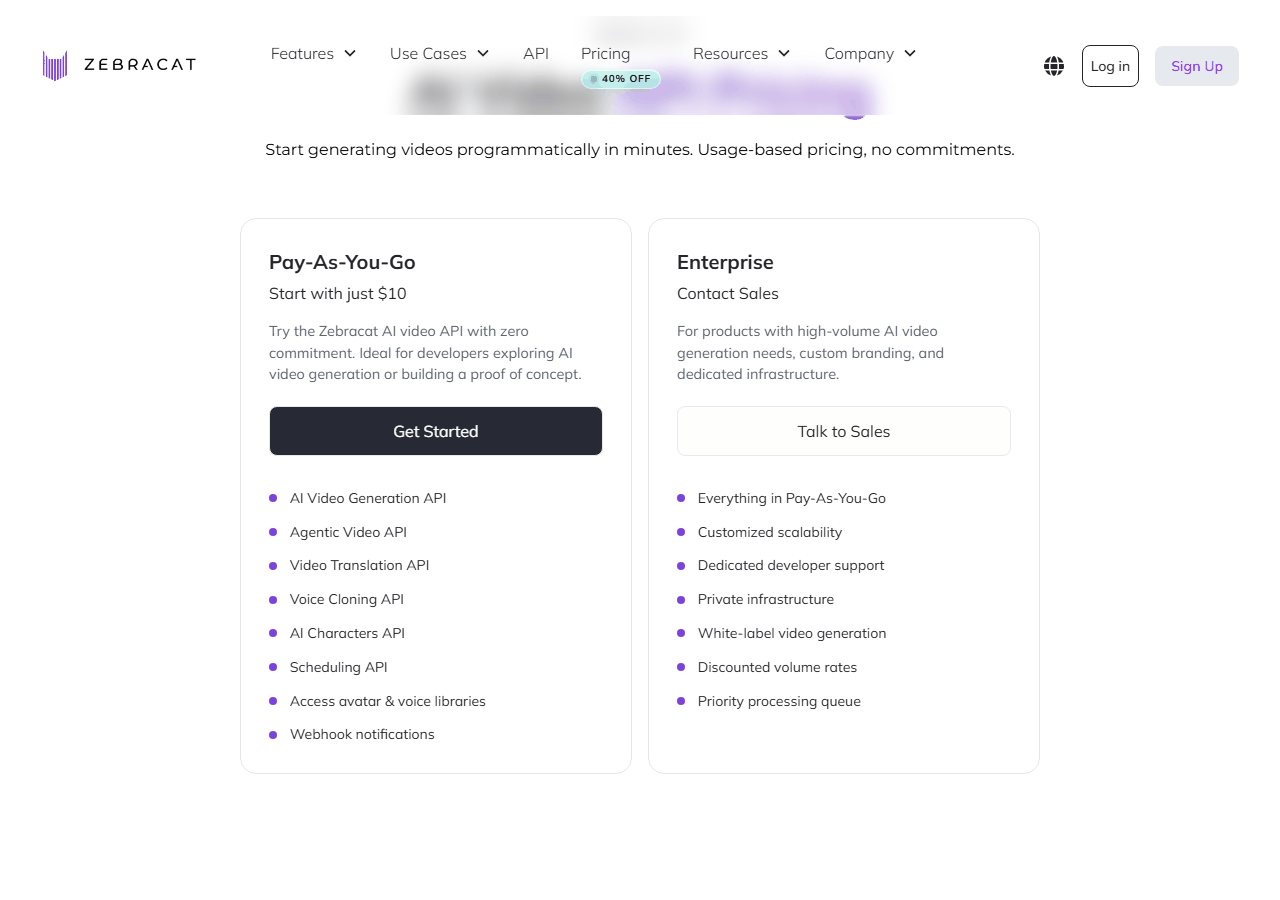
The API is billed separately. Its page says pay-as-you-go “Start with just $10”; the API reference says a credit top-up must be between $5 and $1,000. Neither page lists a per-video price. MCP use from an agent, by contrast, “Runs on your existing Zebracat plan. No separate billing.”
Answer four questions.
If you answered no, yes, no, any: Cat Mode monthly is the cheapest honest test. If you need avatars or many AI scenes: Super Cat monthly first, yearly only after a month of real use.
Short, edited videos from words you already have.
Zebracat is built around four starting points. An idea or prompt becomes a script that Zebracat writes. A finished script is kept line by line, with visuals, voiceover and captions built around it. A blog post, landing page or product URL is read and summarised into a video. An audio file such as a voiceover or podcast clip is transcribed first, then visuals are added on top. Zebracat’s home page calls the product an “AI video agent for social media growth”, and its pages lean on short formats for TikTok, Instagram Reels, YouTube Shorts and LinkedIn.
| Start from | What Zebracat does | Good for |
|---|---|---|
| Idea or prompt | Writes the script, then builds the video | Hooks, explainers, faceless channels |
| Your script | Keeps every line; adds visuals, voice, captions | Ads with approved copy |
| Blog or product URL | Reads the page and summarises it | Repurposing posts, product promos |
| Audio file | Transcribes, then adds visuals | Podcast clips, recorded voiceovers |
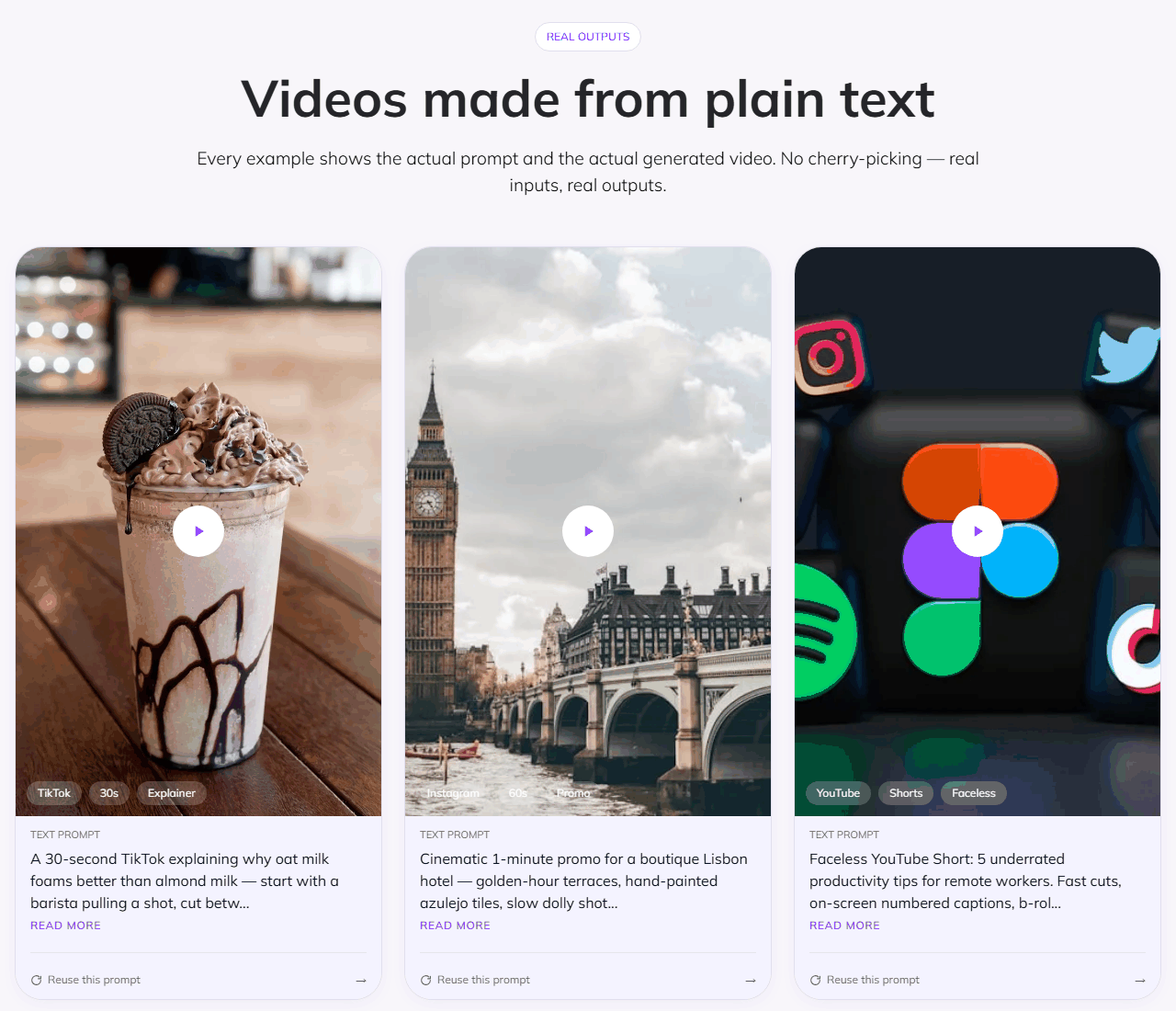
Around that core sit the paid extras: AI avatars that present on screen, voice clones made from your own recording, translation of a finished video with re-voiced audio, brand kits with your logo, colours and fonts, and a scheduler that posts to connected social accounts. The result can be edited after generation, though the comparison table limits free edits per video. What Zebracat does not offer, by its own plan table, is anything longer than 5 minutes per video or export above 1080p in the self-serve plans.
Five steps from a sentence to a scheduled post.
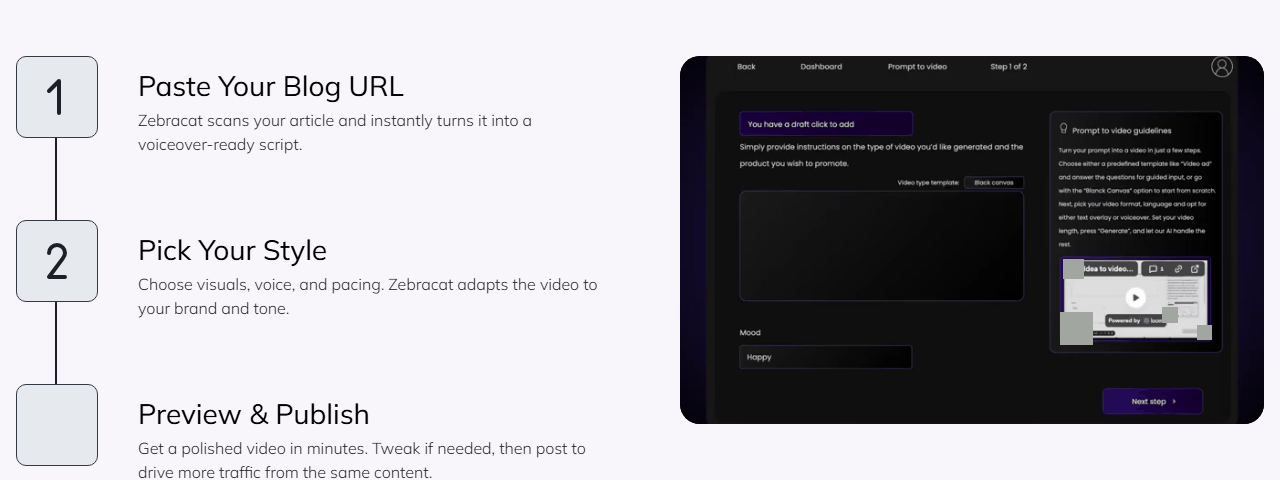
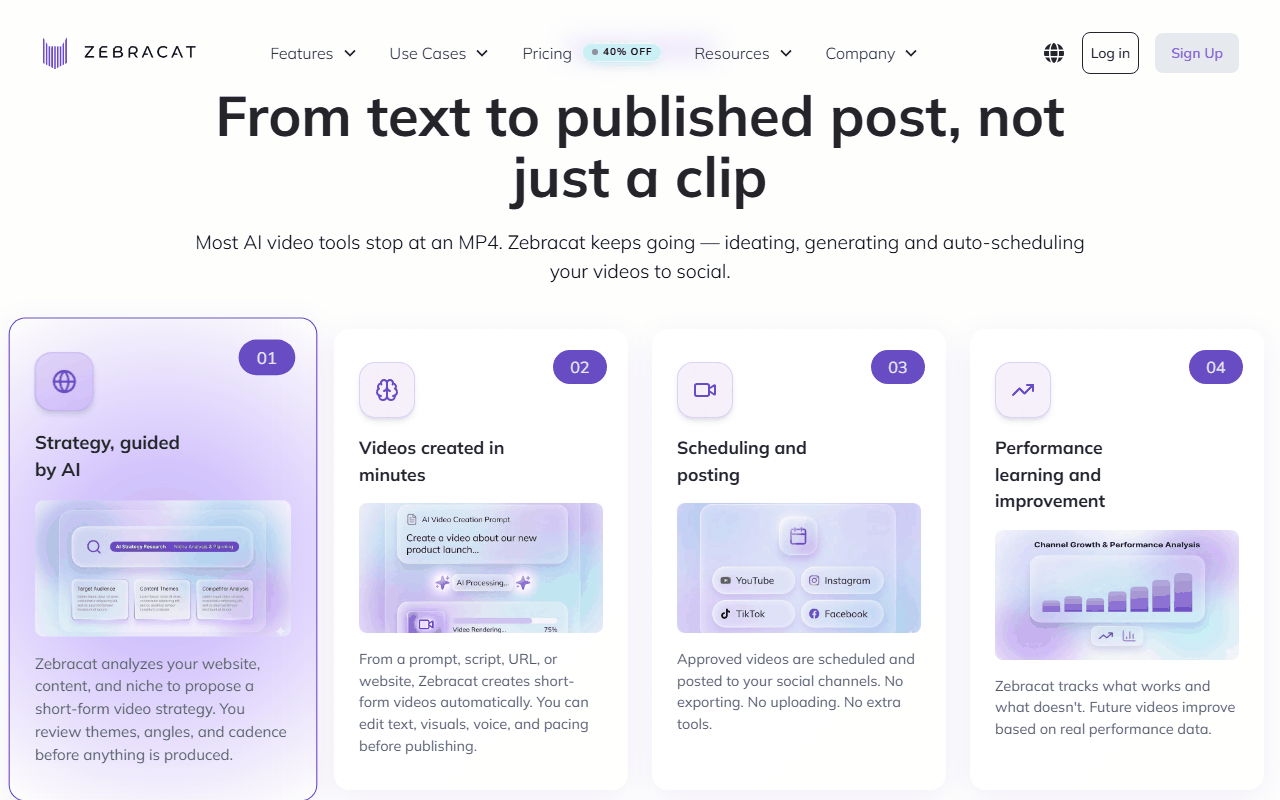
Zebracat describes a loop that goes beyond producing a file: it proposes what to post, makes the video, schedules it, and adjusts later videos to what performed. The steps below follow Zebracat’s own description; we did not run them.
Zebracat rents leading video models and picks one per scene.
Zebracat does not ask you to choose a model. Its pages say it routes each scene to a model it thinks fits, from a list that includes Google Veo, Kling, Seedance and Nano Banana; the pricing cards also name Pixverse. Its MCP page lists Seedance 2.5, Google Veo and Kling 3.0 for video, Nano Banana 2 and other image generators for scenes, and voices in 170+ languages with cloning from a 30-second sample. Zebracat’s research page speaks of its own multimodal system; the independent audit found no public evidence that Zebracat trains a video model of its own.
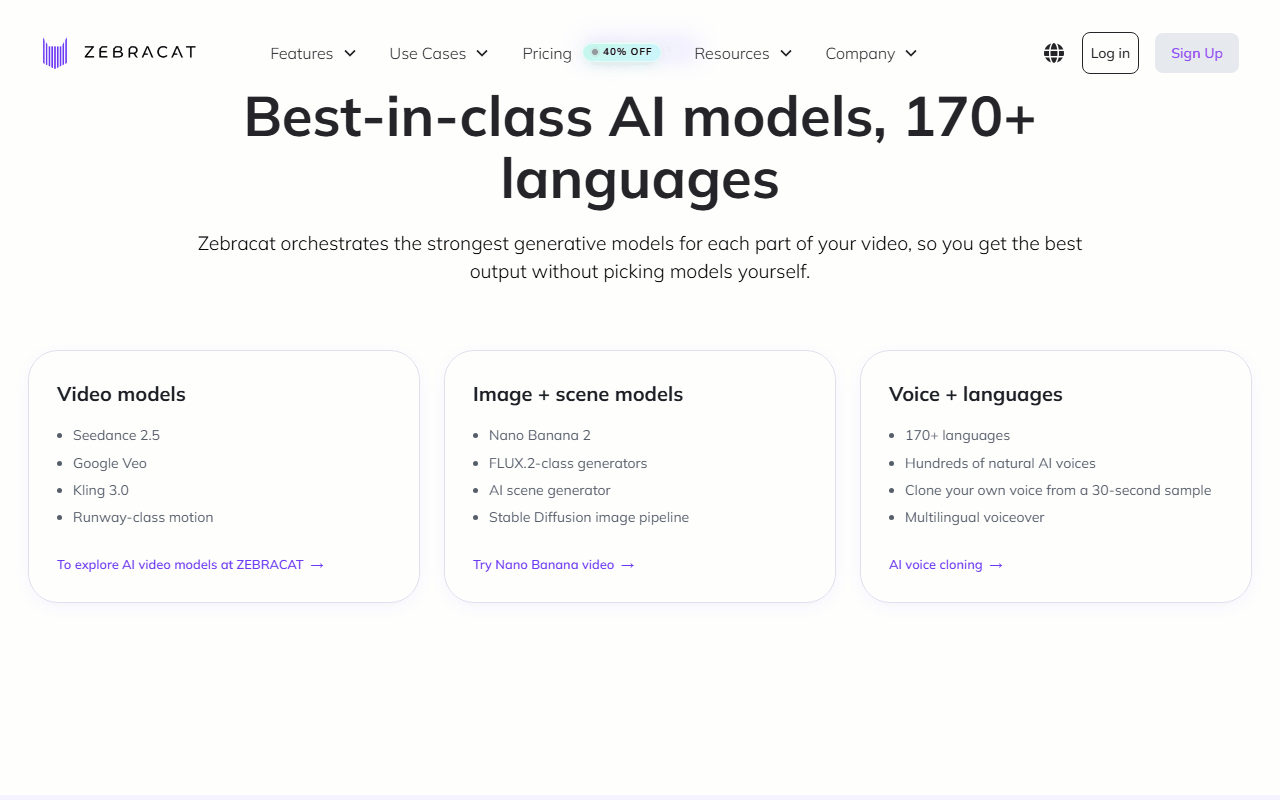
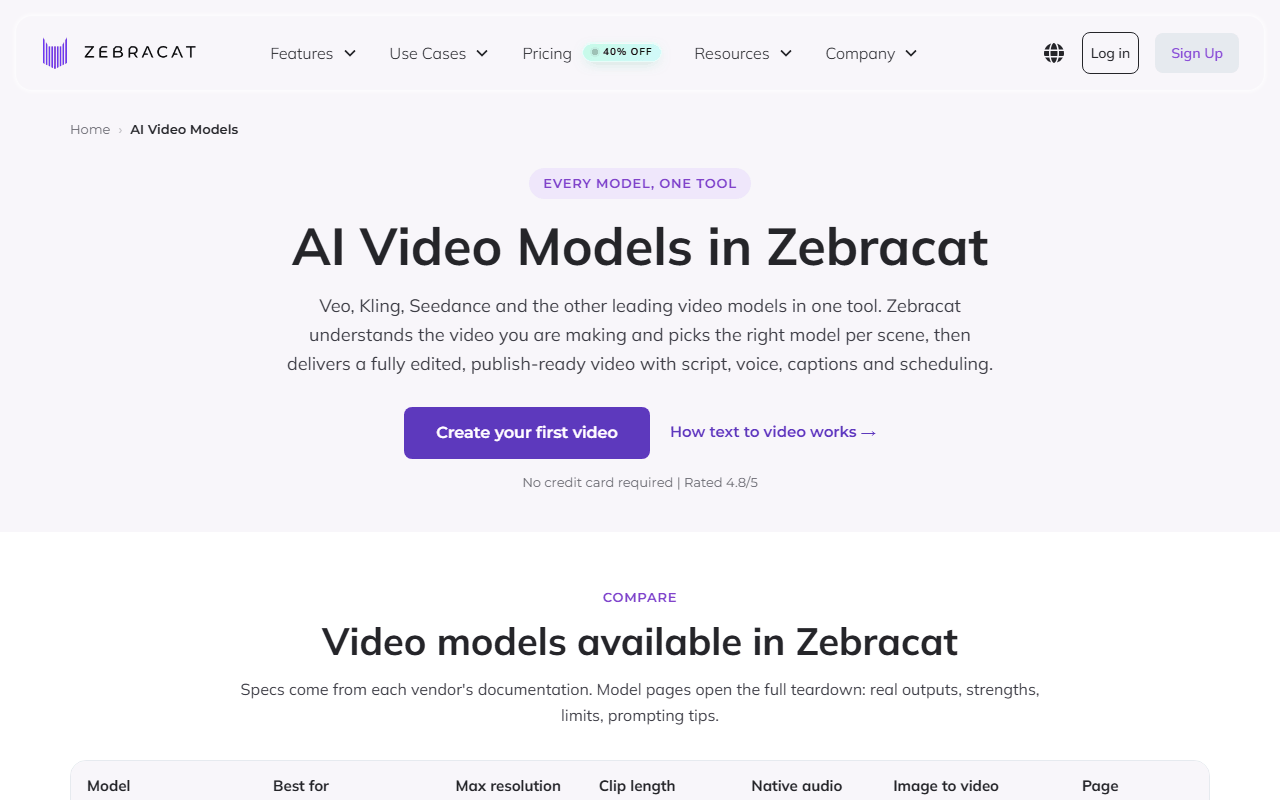
Two practical consequences follow. First, output quality depends on whichever third-party model Zebracat routes to, and AppSumo posts from 2025 and 2026 complain of distorted AI images, so judge results on your own first project. Second, premium models are what burn credits fastest, as the plan math shows. The comparison table also gives every plan standard and ultra-realistic voices and AI avatars, while custom avatars and video translation start on Super Cat.
Your AI agent can order videos on your plan; developers pay as they go.
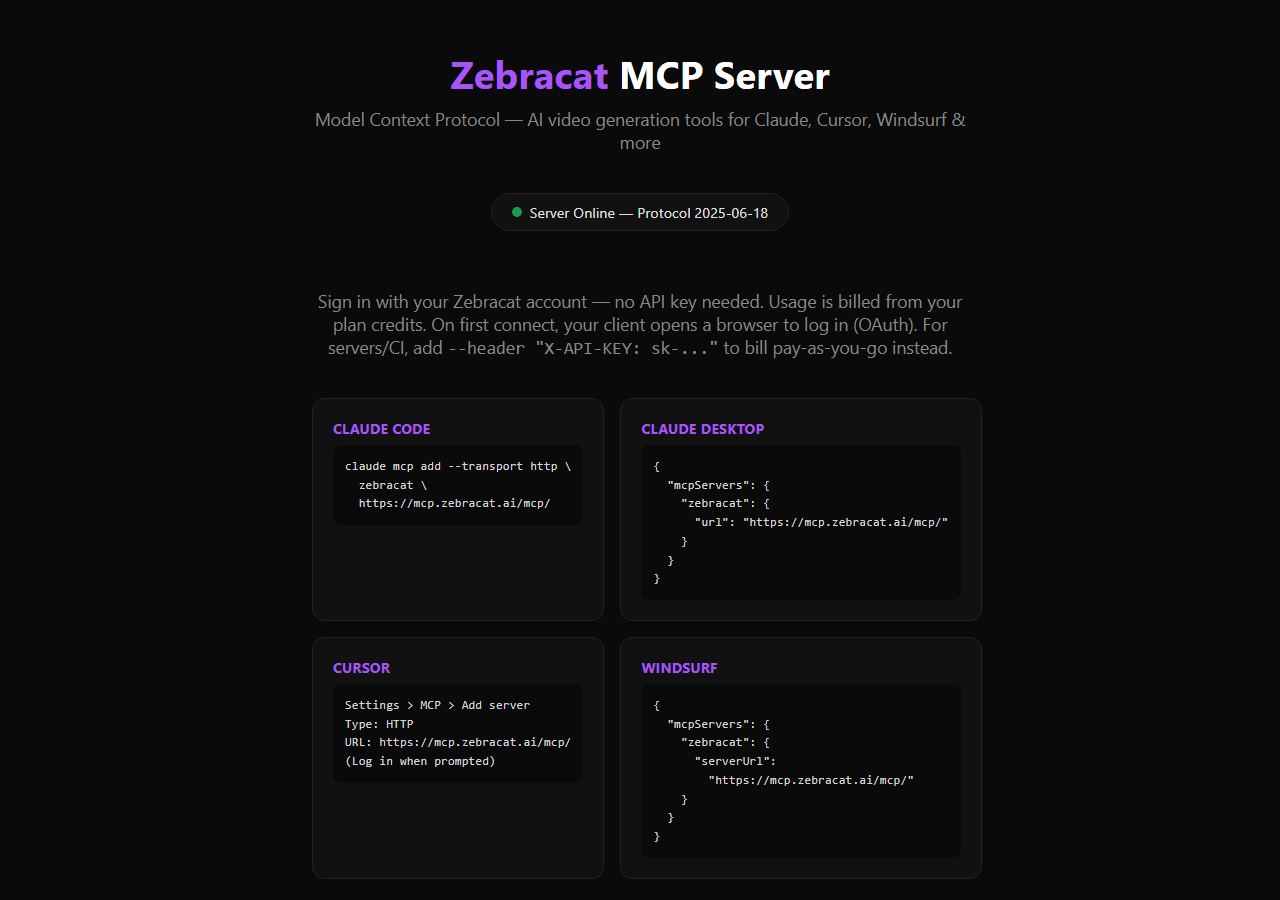
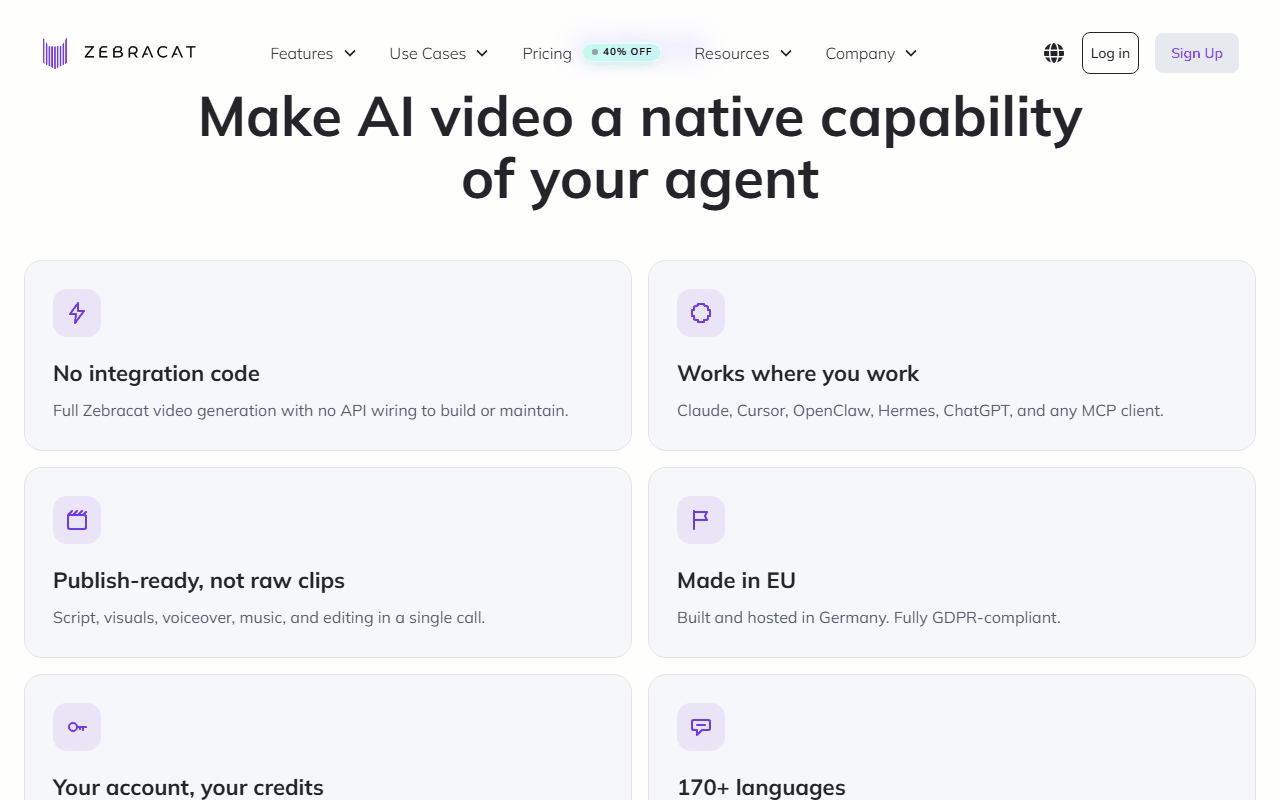
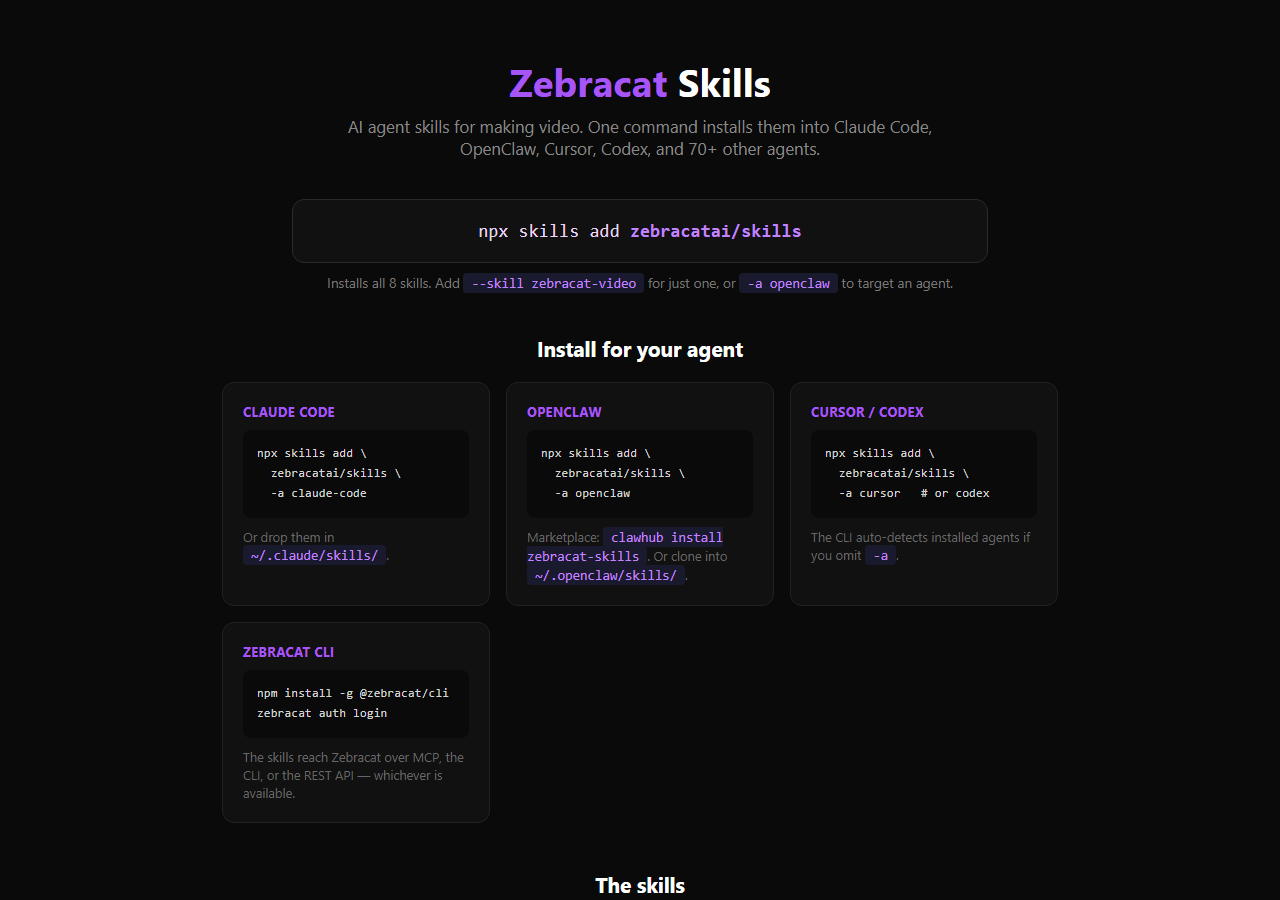
Zebracat now offers three ways to automate video. The MCP server at mcp.zebracat.ai connects Claude, ChatGPT, Cursor, Windsurf and other MCP clients; you sign in with your Zebracat account through a browser and “Usage is billed from your plan credits.” Agent skills install into Claude Code, Cursor, Codex and OpenClaw with one command, and a CLI is published on npm as @zebracat/cli. For your own product there is a REST API at api.zebracat.ai with an API key per request.
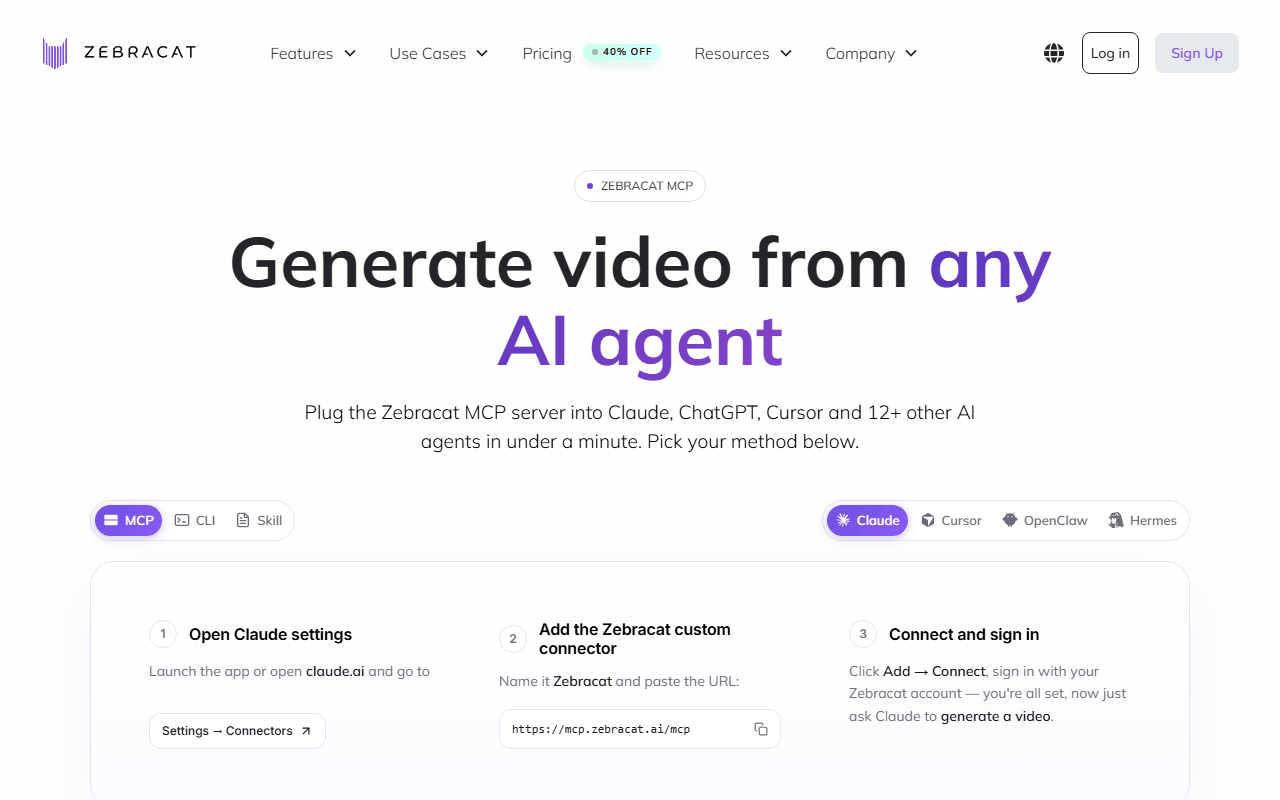
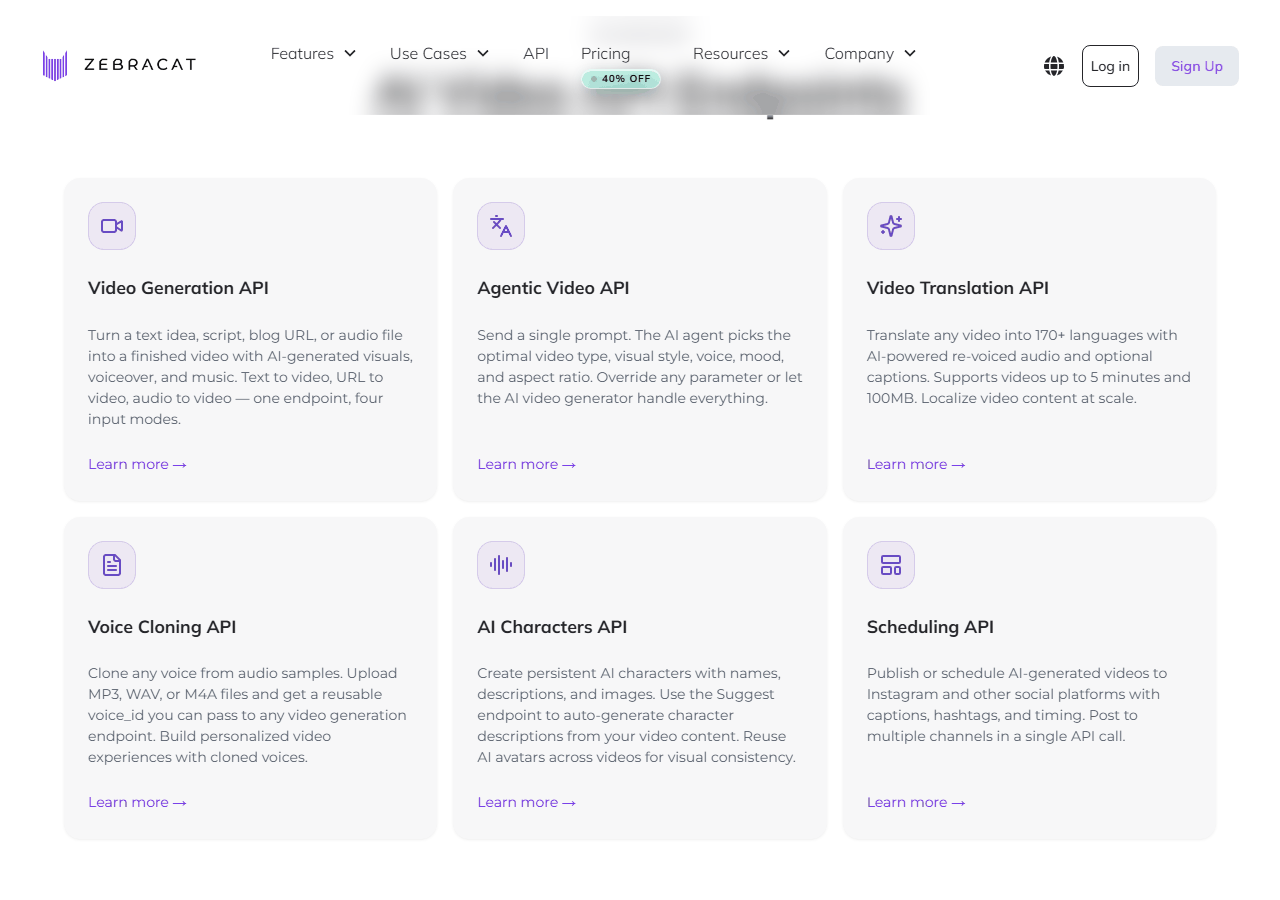
The API reference lists endpoints for idea, script, blog, audio and agentic video, video translation, voice cloning, AI characters, brand kits, music search, templates, webhooks and social scheduling. Renders finish in the background; you poll a status endpoint or receive a webhook signed with an HMAC-SHA256 secret. The translation endpoint is limited to videos of up to 5 minutes and 100 MB, and the voice-clone endpoint requires a Super Cat plan.
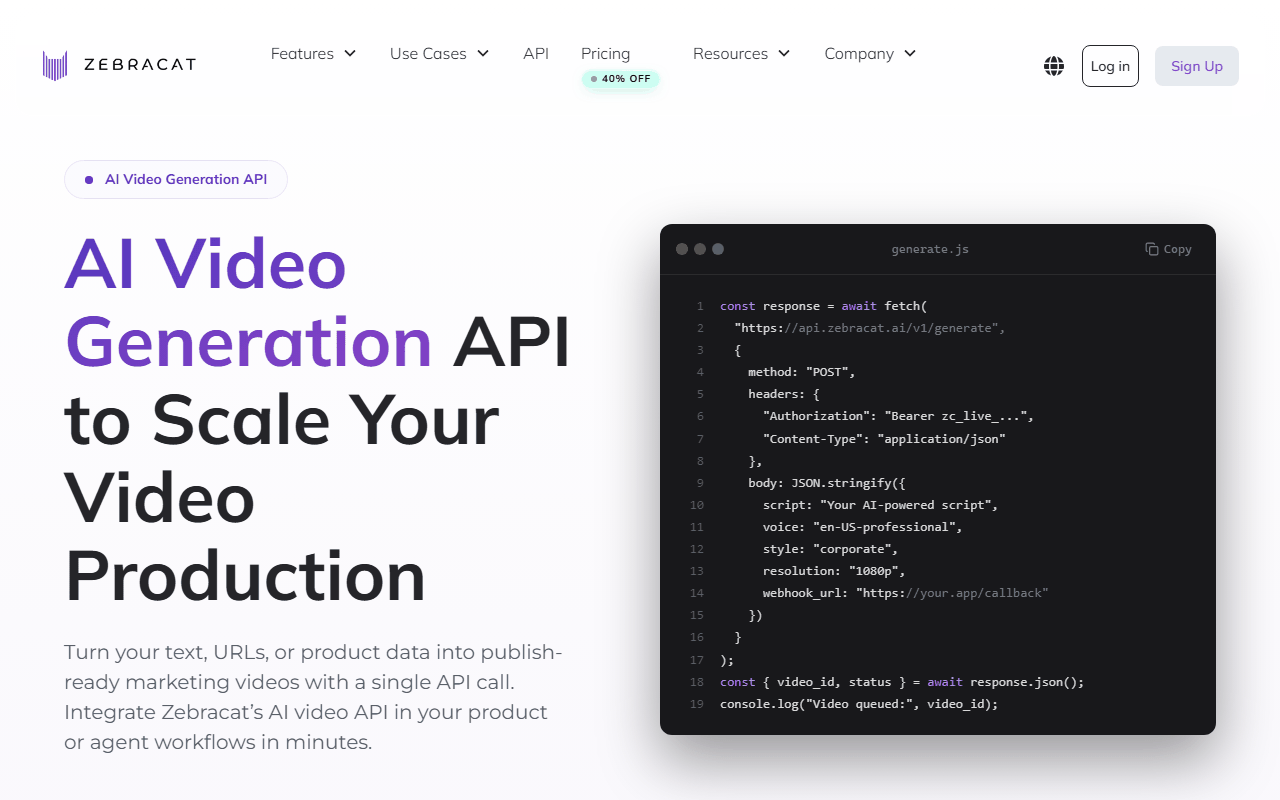
The developer pages are less tidy than the product pages. The code sample at the top of the API page calls an endpoint, /v1/generate, with a Bearer token, while the API reference lists no such path and authenticates with an X-API-KEY header. The skills page says its command “Installs all 8 skills.” while the GitHub repository held 10 skill folders on Oct 27, 2026, including a character-swap skill. If you are building on the API, work from the reference, not the marketing page.
For background on how custom connectors work in Claude, see our Claude MCP connectors guide.
A website-only privacy policy, a broad licence to your content, and a GDPR claim without the paperwork.
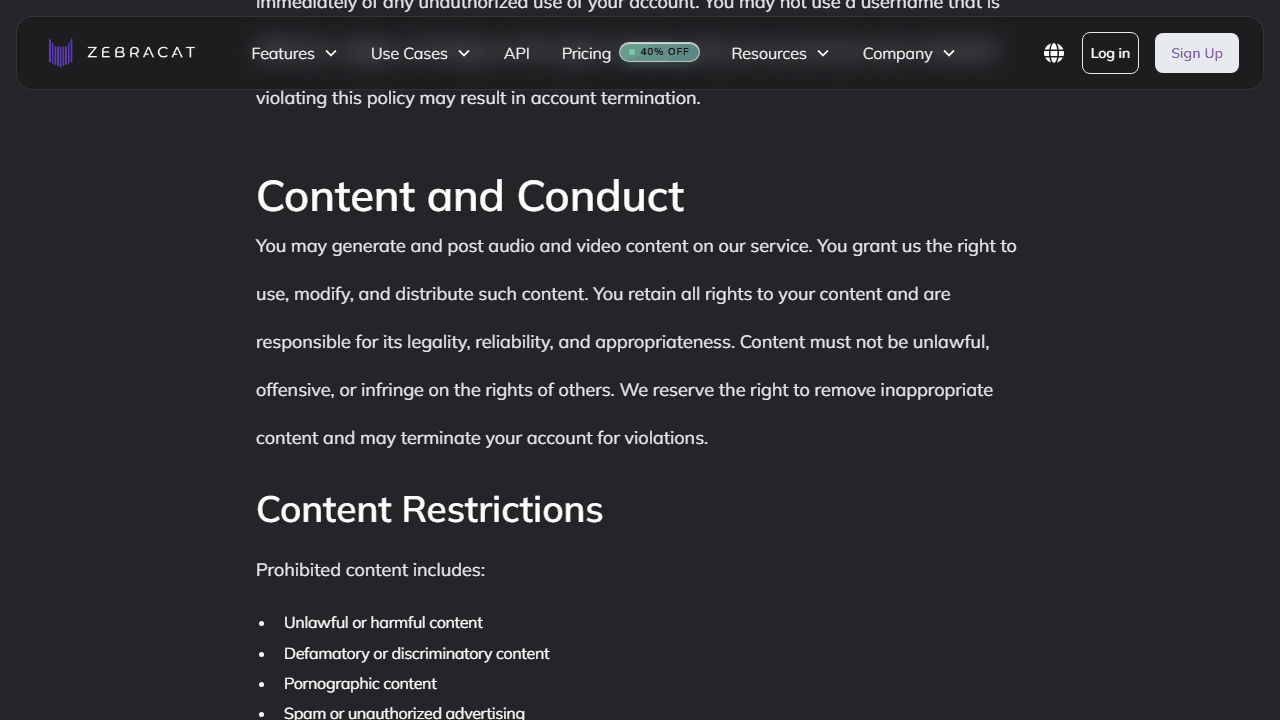
Zebracat’s privacy policy, as of Oct 27, 2026, names Zebracat AI UG as controller and lists GDPR rights, but it describes only two kinds of processing: server logs from visiting the website, which it says are deleted within seven days, and messages sent through email or the contact form. It does not describe what happens to uploaded scripts, audio, voice samples for cloning, images for avatars, or the finished videos, and it names no AI providers that receive them. We found no data processing agreement or subprocessor list on Zebracat’s public pages, and the independent audit reports the same.
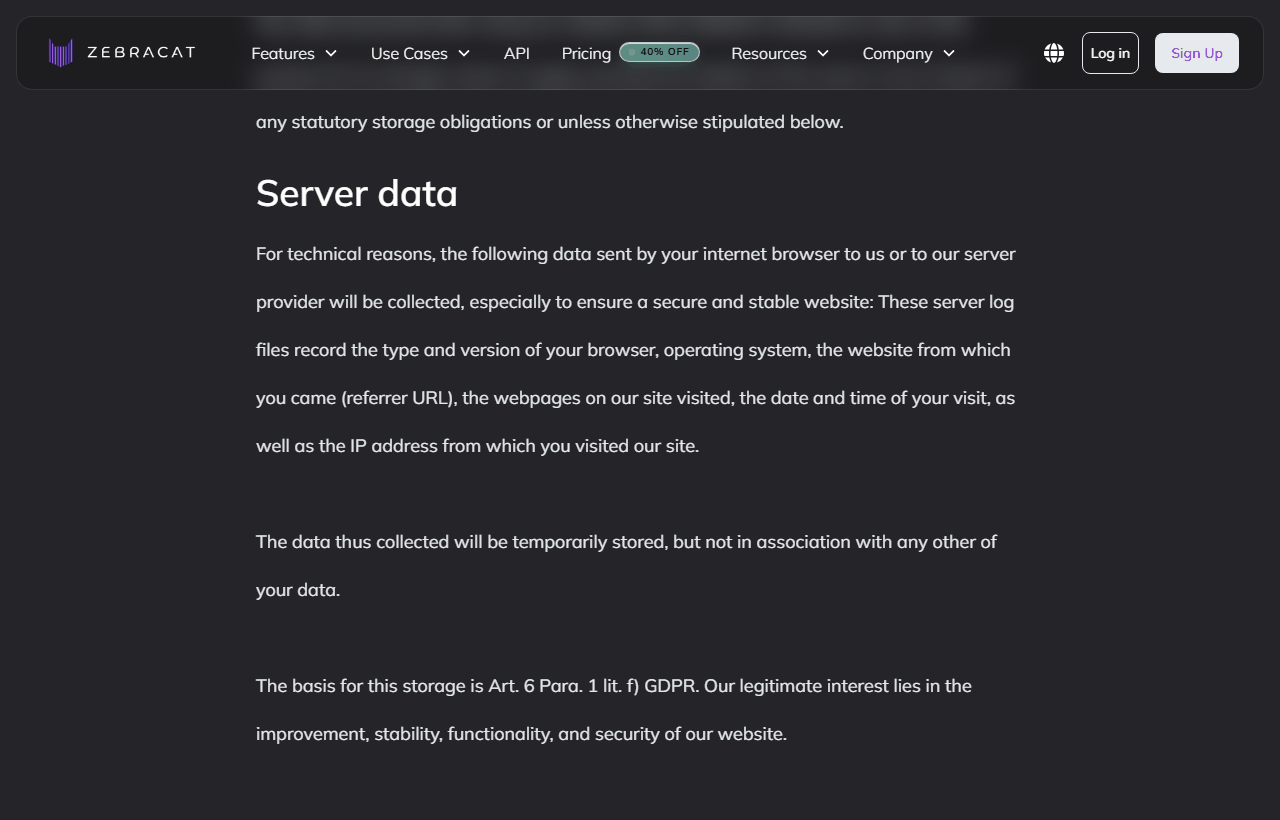
The Terms grant Zebracat a broad right over what you make: “You grant us the right to use, modify, and distribute such content.” They add that “You retain all rights to your content”, and the home page says videos made on a paid plan come with full commercial rights. The Terms do not limit the licence to running the service, so a brand that cares where its footage ends up should ask Zebracat in writing. The Terms also say “We perform regular backups but do not guarantee data integrity.” Keep your own copies.
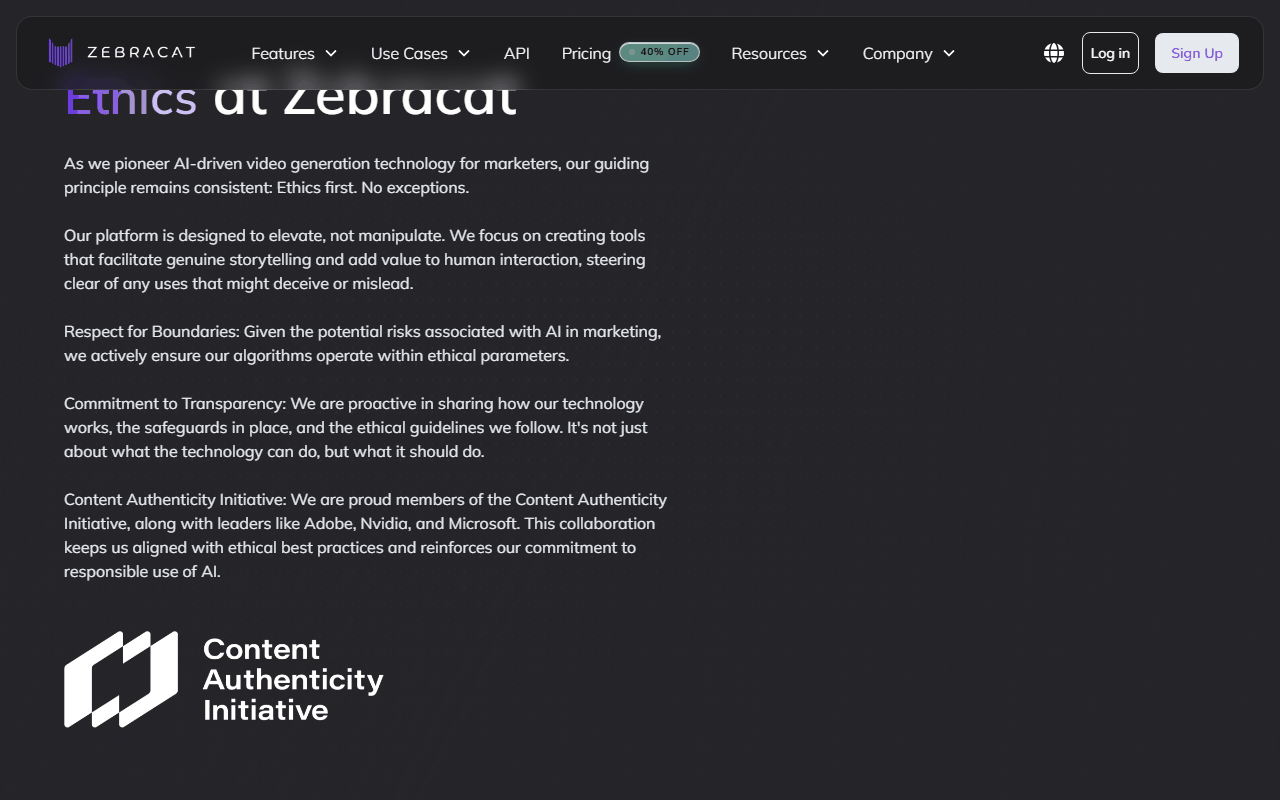
German company and German law; GDPR rights listed; MCP sign-in through OAuth instead of a shared key; signed webhooks; MCP and API pages say “Built and hosted in Germany. Fully GDPR-compliant.”; Terms ban impersonating others; an ethics page claims Content Authenticity Initiative membership.
No public statement on how long uploads and voice samples are kept, whether they train any model, or which AI providers process them; no DPA or subprocessor list found; hosting claim not independently confirmed; backups not guaranteed; account can be terminated “without notice for any reason”.
Voice cloning and avatars of real people carry their own risk: the Terms list “Impersonating others” among prohibited content, which puts the burden of consent on you. Clone only your own voice or voices you have written permission to use.
Auto-renewal, no refunds for paid periods, and a $100 liability cap.
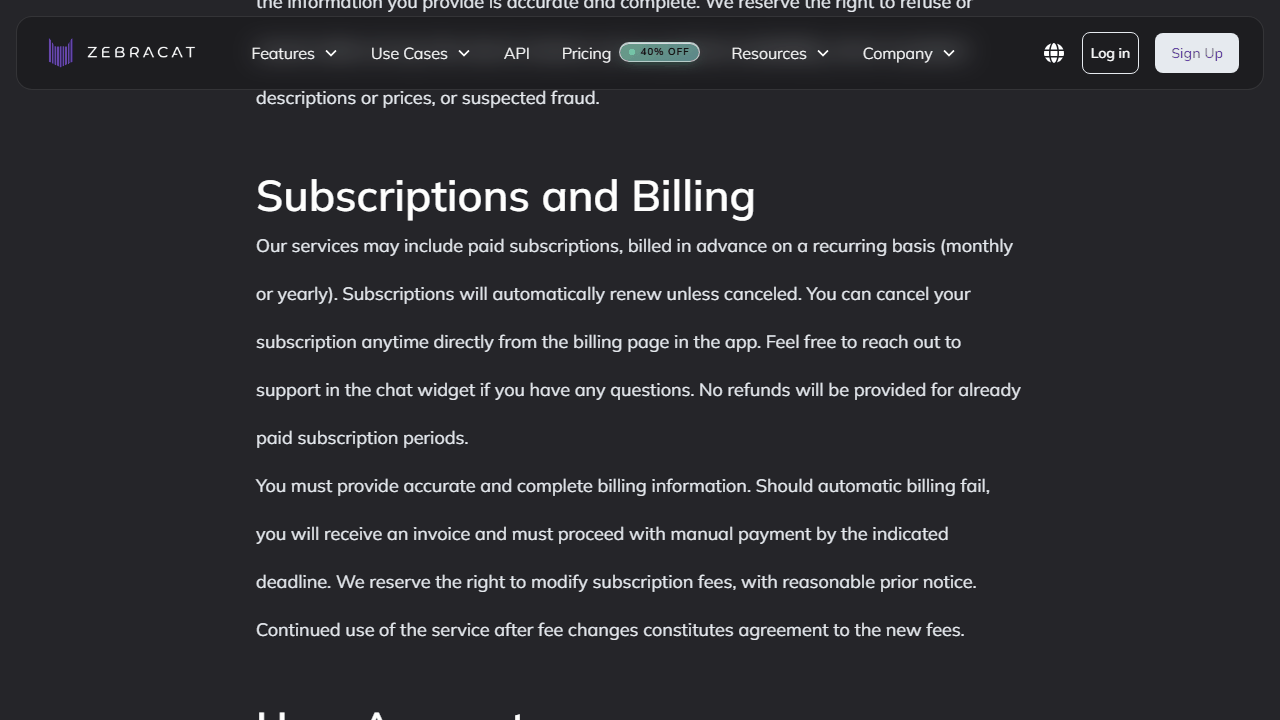
The Terms set the billing rules plainly: subscriptions are “billed in advance on a recurring basis (monthly or yearly)” and “will automatically renew unless canceled.” You cancel from the billing page in the app. Then comes the line that matters most: “No refunds will be provided for already paid subscription periods.”
The pricing page says something different in its payment box, and the FAQ adds a third version. A buyer reading only the pricing page would expect money back within 7 days if no video was downloaded.

| Rule | What it says | Where |
|---|---|---|
| Refunds | “No refunds will be provided for already paid subscription periods.” | Terms |
| Refund promise | “Get a full refund within 7 days” if no video was downloaded | Pricing page |
| Fee changes | Fees can change “with reasonable prior notice”; continued use means acceptance | Terms |
| Terms changes | “If changes are material, we will provide 30 days’ notice.” | Terms |
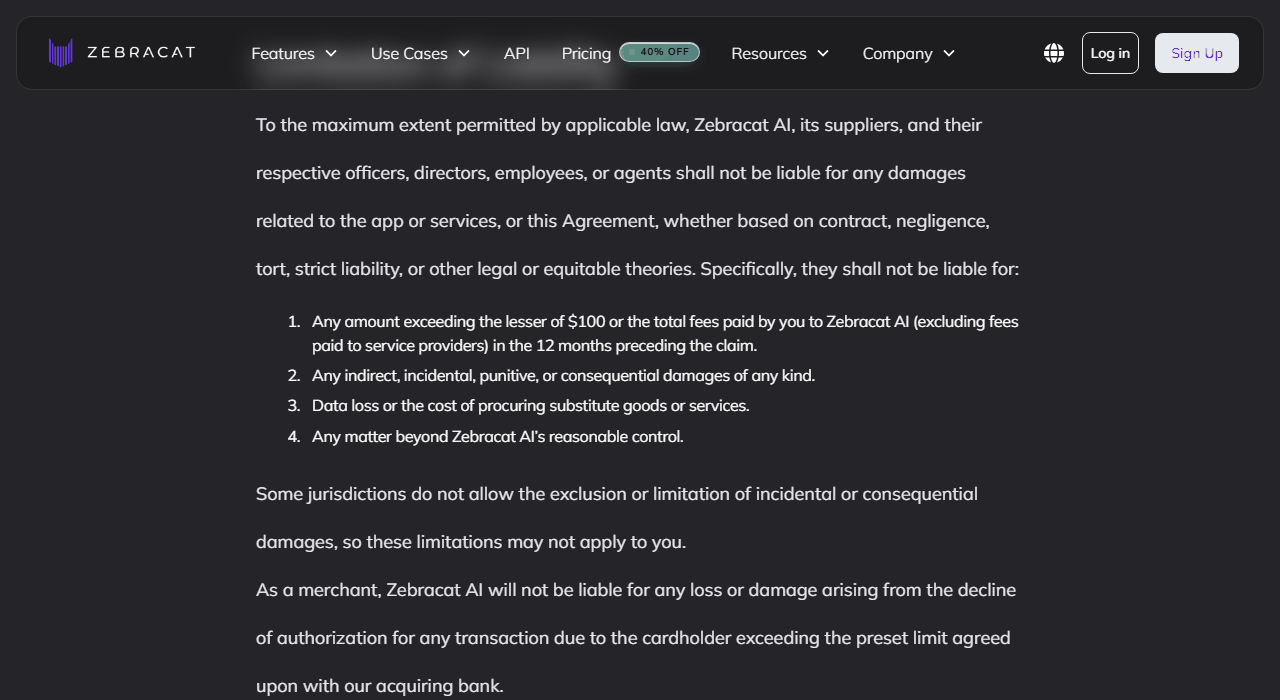
| Liability | Capped at the lesser of $100 or what you paid in the 12 months before the claim | Terms |
| Accounts | “Only one account per user is allowed”; termination “without notice for any reason” | Terms |
| Law | German law; disputes first raised informally with the company | Terms |
Our reading: if you are a consumer in the EU or UK, statutory rights may apply regardless of these Terms; we do not give legal advice. For everyone else, the safe assumption is the one the independent audit reached: a payment to Zebracat may be final.
Nine places where two official pages say different things.
Every row below is between two of Zebracat’s own pages, as of Oct 27, 2026. Several look like older text left behind after the 2026 re-pricing; the FAQ still repeats limits from the 2025 plans.
Swipe sideways to see all columns.
| Topic | One page says | Another page says | What to trust | Risk |
|---|---|---|---|---|
| Refunds | Full refund within 7 days if nothing downloaded (pricing) | No refunds for paid periods (Terms); none for partial months (FAQ) | The Terms | High |
| Free plan | 5 videos, 720p, 30 seconds each, no card (pricing FAQ) | No Free card among the plans; home page offers a “free 7-day trial” | Check on sign-up | Medium |
| Limits | 15 or 40 videos a month, “Any length” (plan cards) | 2 or 5 minutes per video (table); 120 or 360 minutes a year (FAQ) | The table | Medium |
| Voice cloning | Ticked for Cat Mode (comparison table) | Cloning needs a Super Cat plan (API reference) | Assume Super Cat | Medium |
| Resolution | 1080p on every plan (comparison table) | 720p, 1080p and 4K output (API FAQ) | 1080p for plans | Low |
| Volume | +1 Million videos by users (About) | 3M+ videos via the API (API page) | Neither | Low |
| API path | /v1/generate with a Bearer token (API page) | No such path; X-API-KEY header (API reference) | The reference | Low |
| API minimum | “Start with just $10” (API page) | Top-ups between $5 and $1000 (API reference) | The reference | Low |
| Skills | “Installs all 8 skills.” (skills page) | 10 skill folders in the GitHub repository | The repository | Low |
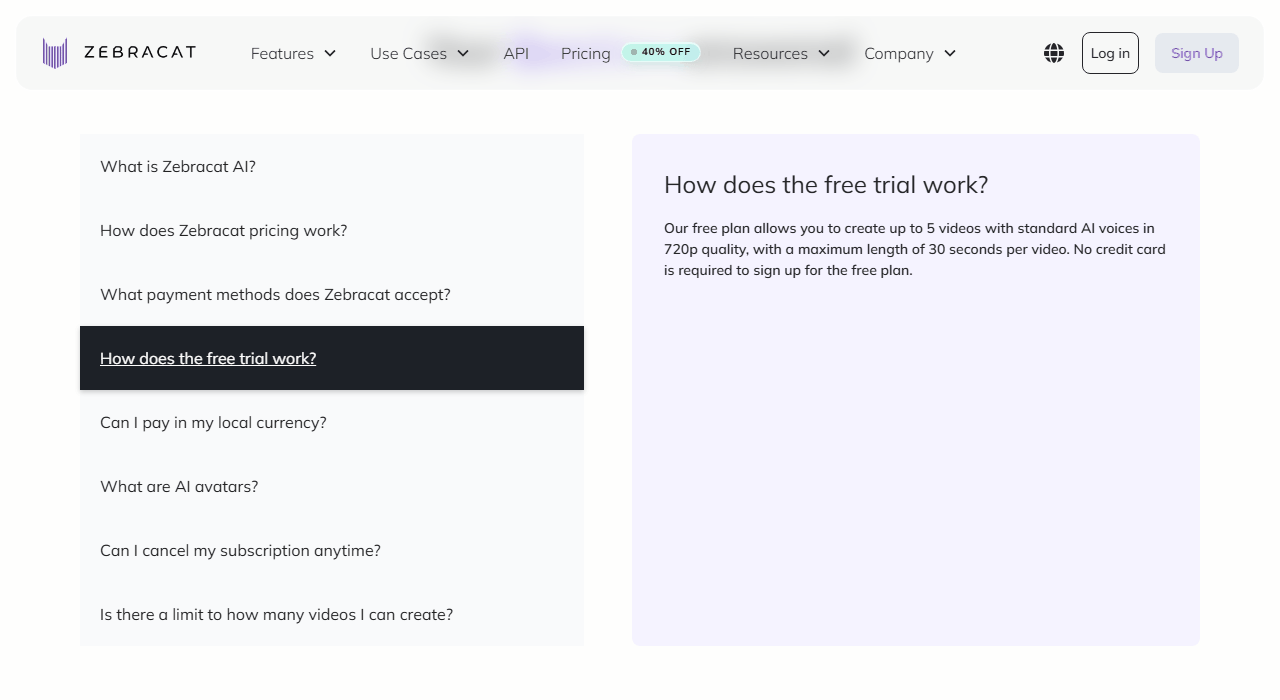
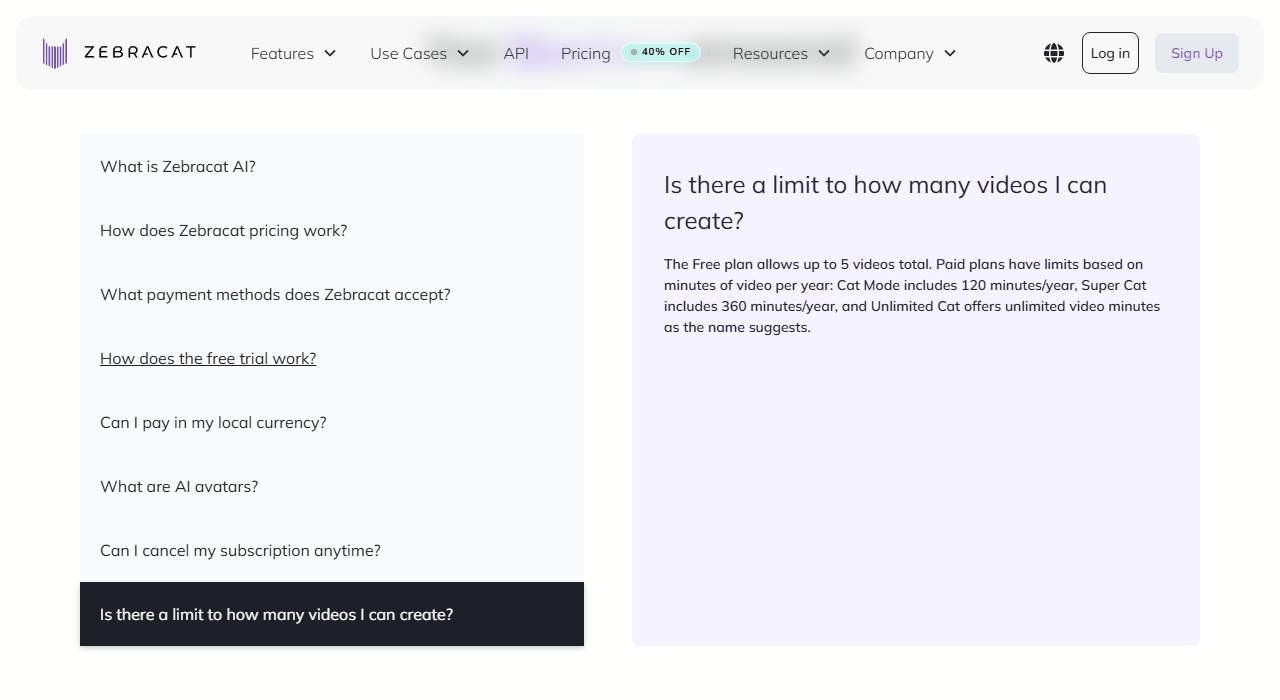
The independent audit adds one more gap we could not see ourselves: in June 2026, the in-app free plan showed 1 video and 10 generative credits a month, not the 5 videos the public FAQ describes. Treat the free plan as a short look, and check its limits on your own account before relying on it.
Marketers who post short videos often; not buyers who need long videos or refund safety.
Small businesses and shop owners who turn product pages and blog posts into short promos and want them posted on a schedule.
Social media marketers and faceless channels publishing several Shorts, Reels or TikToks a week from scripts or prompts.
Teams already working in Claude, ChatGPT or Cursor who would rather ask an agent for a video than open an editor.
Developers who want a video endpoint billed by use, starting from a small top-up.
Anyone who needs videos longer than 5 minutes or exports above 1080p on a self-serve plan.
Buyers for whom a refund matters, given the Terms and the audit.
Companies that need a DPA, subprocessor list or clear data retention before uploading brand or customer material.
Lifetime-deal hunters, after the complaints from earlier AppSumo buyers.
If your videos rely on a presenter’s face, compare the avatar depth of HeyGen or Synthesia first: Zebracat’s avatars are one feature among many, while those tools are built around them.
Seven things to weigh before you pay.
HeyGen, InVideo, Creatify and Fliki, priced on the same day.
All prices are from each vendor’s own pricing page on Oct 27, 2026, in US dollars before tax. Plans are not like for like: each vendor meters credits differently, so compare the job you need, not the headline number.
Swipe sideways to see all columns.
| Tool | Entry paid plan | Free plan | Built around | Pick it if |
|---|---|---|---|---|
| Zebracat | Cat Mode $39 a month, or $23 a month billed yearly | Per FAQ: 5 videos, 720p, 30 seconds | Prompt, URL or audio to short marketing video; MCP and API | You want many short promos with little editing |
| HeyGen | Creator $29 a month; Pro $49 with 1,000 credits | 3 videos a month, up to 1 minute, watermark | AI avatars and presenters | A realistic presenter is the point of the video |
| InVideo | Pro $30 per seat a month, or $15 per seat billed yearly | None listed on the pricing page | Editing timeline plus AI agents and video models | You want a full editor and longer projects |
| Creatify | Standard $15 a month, or $10 a month yearly | 10 credits a month | AI video ads with AI actors and ad templates | You mainly test ad creatives |
| Fliki | See our Fliki review for current prices | 3 credits a month, 720p, watermark | Text to video with many voices; videos up to 15 or 40 minutes on paid plans | You need longer narrated videos |
For deeper looks, read our reviews of HeyGen, Synthesia and Fliki. If you already have long videos and want short clips from them, a clipping tool such as Submagic fits better than a generator. And because Zebracat routes scenes to models such as Kling, our Kling review shows what using one of those models directly costs.
This review has no affiliate links.
Every Zebracat link here goes straight to zebracat.ai, its pricing page, its Terms and Conditions or its developer pages, without tracking parameters. The score, the drawbacks and the alternatives would be the same either way.
How this review was put together: Zebracat’s pricing page with plan cards, comparison table and FAQ; its Terms and Conditions, privacy policy and Imprint; the home, about, ethics, research, features, AI video models, MCP and API pages; the API reference at docs.zebracat.ai; the MCP server, skills and no-code pages at mcp.zebracat.ai; Internet Archive copies of the pricing page from Feb 23, 2024 to Oct 3, 2026; the npm entry for @zebracat/cli and the GitHub repository for its skills; AppSumo’s product page, one review and one question; an independent audit by Future Stack Reviews (Jun 11, 2026); and the pricing pages of HeyGen, InVideo, Creatify and Fliki, as of Oct 27, 2026. This review is not hands-on tested: no Zebracat account, no generated video, no trial and no support contact. Screenshots show public pages only.
Other AI video tools, and the agent setup Zebracat plugs into.
Each card opens a published JAVIS review, grouped by what you might need next.

Questions people ask before choosing Zebracat
Is Zebracat free?
Zebracat’s pricing FAQ describes a free plan with up to 5 videos, standard AI voices, 720p and 30 seconds per video, with no credit card. The plan cards show no Free tier, the home page speaks of a 7-day free trial, and an independent audit found smaller in-app limits in June 2026. Zebracat’s text-to-video page adds that the starter tier carries a small watermark. Expect a short look, not a working plan.
How much does Zebracat cost?
As of Oct 27, 2026: Cat Mode $39 a month or $23 a month billed yearly ($276 a year), Super Cat $99 or $59 ($708), Unlimited Cat $199 or $119 ($1,428), and Enterprise from $599 a month. Prices exclude tax. The API is separate and pay-as-you-go.
Can I get a refund?
The Terms say no refunds for already paid subscription periods, and the FAQ says none for partial months. The pricing page promises a full refund within 7 days if you downloaded no video, but an independent audit reports a refund request refused three times. Plan as if the payment is final.
What are generative AI credits?
A monthly pool, separate from the video count, used by AI-generated scenes and images: 350 on Cat Mode, 1,400 on Super Cat and 3,600 on Unlimited Cat. Zebracat does not publish the full credit cost per model on its public pages; an independent audit reported 60 credits for an 8-second Veo 3 clip in June 2026.
Can I use Zebracat videos commercially?
The comparison table ticks commercial rights on every paid plan, and the home page says videos made on a paid subscription come with full commercial rights. The Terms also give Zebracat the right to use, modify and distribute your content, so ask in writing if that matters to your brand.
Does Zebracat work with Claude or ChatGPT?
Yes. Zebracat runs a remote MCP server for Claude, ChatGPT, Cursor, Windsurf and other MCP clients, with sign-in through your Zebracat account and usage billed to your plan’s credits. It also publishes agent skills and a CLI.
Where is Zebracat based?
In Berlin. The operator is Zebracat AI UG (haftungsbeschränkt), registered under HRB 233288 B at the Berlin Charlottenburg court, and its Terms are governed by German law. Its MCP and API pages say the service is built and hosted in Germany.
Where this came from, and when.
Every price, limit, rule and rating in this review comes from the pages below, as of Oct 27, 2026 unless another date is given. Expand for the full list, the scoring method and what the review does not cover.
Show sources, scoring method and scope
Pricing: zebracat.ai/pricing (plan cards in monthly and yearly view, comparison table, payment box and FAQ); Internet Archive copies of zebracat.ai/pricing from Feb 23, 2024; Aug 27, 2024; Jan 14, 2025; Jul 27, 2025; Jan 13, May 16, Aug 7 and Oct 3, 2026.
Legal: zebracat.ai/terms-and-conditions (no section numbers; sections Subscriptions and Billing, User Accounts, Content and Conduct, Content Backups, Termination, Limitation of Liability, Governing Law, Changes to These Terms); zebracat.ai/privacy-policy; zebracat.ai/imprint.
Product and company: zebracat.ai home, about, ethics, research, features, AI video models, text-to-video, MCP and API pages; docs.zebracat.ai (Zebracat Public API reference, version 1.0.0); mcp.zebracat.ai home, skills and no-code pages; npm registry entry for @zebracat/cli (version 0.1.6, Jul 6, 2026); github.com/zebracatai/skills.
Independent evidence: appsumo.com/products/zebracat (3.96 from 135 ratings; deal sold out; updates dated Apr 19 and May 17, 2024), one AppSumo review (Nov 4, 2025) and one AppSumo question (Aug 7, 2026); Future Stack Reviews, “Zebracat Review: What Happens If You Buy Credits Before You Subscribe” (Jun 11, 2026); Hacker News search, with no discussion of Zebracat found. Zebracat’s help center and third-party review platforms are not quoted.
Competitors: heygen.com/pricing, invideo.io/pricing, creatify.ai/pricing and fliki.ai/pricing (Oct 27, 2026).
Fit score, 55 out of 100: five criteria worth 20 points each. Price clarity 9 (clear monthly and yearly cards, but a FAQ with outdated limits, a free plan that appears only in text, and a 20% yearly rise); capability 16 (four input types, many third-party models, avatars, voice cloning, translation, scheduling, MCP, skills and API; 5-minute cap); independent evidence 9 (one skewed AppSumo sample averaging 3.96, one critical independent audit, no wider discussion found); terms, data and security 8 (no refunds in the Terms against a refund promise, broad content licence, website-only privacy policy, no DPA found, $100 liability cap); cost and fit 13 (competitive yearly entry price for short marketing videos, but small AI credit pools). Editorial judgment from published facts, not a hands-on test.
Not covered: video quality, voice quality, avatar realism, editing speed, how many credits real projects use, support response times and the in-app free plan, none of which can be judged without an account.