
Augment Code Review 2026: A Best-in-Class Context Engine, a Pricing Model in Flux, and a Pivot to "Cosmos"
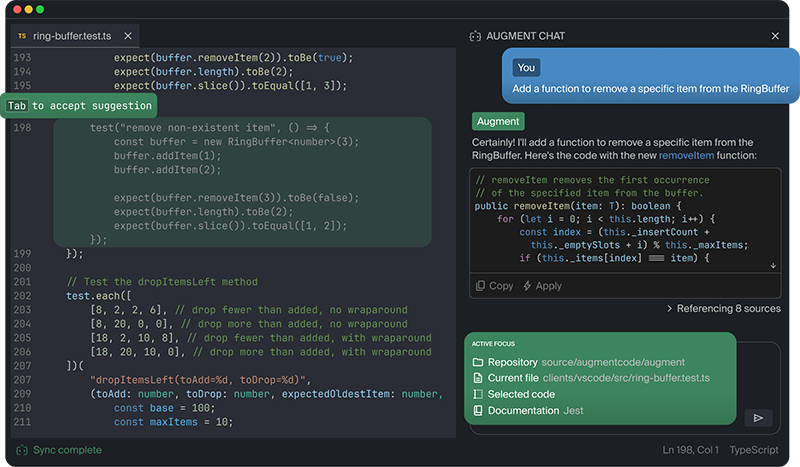
Augment Code is the AI coding platform for VS Code, JetBrains and Vim/Neovim that built its name on one specific claim: a "Context Engine" that actually understands large, complex, legacy codebases better than the competition. Independent user reviews still back that claim up in 2026. What's changed is almost everything around it. Augment emerged from stealth in April 2024 with a $227M Series B at a $977M valuation, then spent 2025-2026 pouring its energy into Cosmos, an enterprise "software factory" for automating PR review, tickets and incident response -- while deprecating inline autocomplete for everyone except Enterprise customers (March 31, 2026), rewriting its pricing model at least twice, and watching its own VS Code Marketplace rating settle at a mixed 3.59-of-5. The twist: Augment's Context Engine is now respected enough that it ships as an MCP server rival tools can plug straight into -- Cursor, Claude Code, GitHub Copilot, Kiro, Kilo Code, Roo Code and OpenAI Codex all officially support it. This review covers what's verified true today.
| Context Engine (large codebases) | Still genuinely respected |
| Free tier | None -- $20/mo flat team plan is the floor |
| Product-direction signal | Mixed -- Cosmos up, IDE extension declining |
| VS Code Marketplace | 3.59/5 (340 reviews), 779K+ installs |
| JetBrains Marketplace | 3.37/5 (209 votes, averaged from the raw vote counts) -- love-it-or-leave-it split |
The technology still holds up. The question is whether Augment still wants to sell it to you directly.
"Augment Code's Context Engine was, by a wide margin of independent user testimony, one of the best pieces of AI-coding technology built for genuinely large and messy codebases -- not toy repos. Reviewers who've also used Claude Code, Cursor and Kiro keep saying the same thing in their own words on the VS Code Marketplace: nothing else manages context across a sprawling, multi-service monorepo quite as well. Augment's own benchmark posts back this up with real numbers, not just vibes -- Terminal-Bench 2.0 and SWE-Bench Pro runs against Claude Code on the same Opus 4.7 model, at a meaningfully lower cost per task. None of that is in serious dispute. What is in serious dispute -- in Augment's own comment section, from its own paying customers -- is where the company is taking the product. Since 2025 Augment has poured its visible energy into Cosmos, an "always-on software delivery system" aimed at enterprise engineering orgs: automated PR review, ticket-to-PR pipelines, incident investigation, all running as background agents rather than something you sit and chat with. That's a real, well-built, and reasonably ambitious platform. It has also come at a cost to the individual-developer product Augment built its reputation on: inline autocomplete was deprecated for every plan except Enterprise on March 31, 2026, the pricing model has been rewritten twice in twelve months, and the VS Code Marketplace is full of reviews from long-time users saying some version of "this used to be the best tool I owned, and now I don't recognize it.""
None of that erases the real strength underneath: Augment's Context Engine is now respected enough that Augment licenses it out, via MCP, to the very tools some of its own users are defecting to -- Cursor, Claude Code, GitHub Copilot, Kiro, Kilo Code, Roo Code and OpenAI Codex can all plug into it directly. If you run a large, legacy-heavy codebase and want the strongest context-retrieval technology available, wrapped in either the IDE extension or Cosmos, Augment remains a serious option. If you're an individual developer who wants a free tier, a flat monthly price, and confidence that the feature set won't shrink under you again, that's a legitimate reason for caution right now.
One Context Engine, three developer surfaces, and a fourth enterprise surface (Cosmos) that is now getting most of the attention.
Augment Code is built by Augment Computing, Inc. (doing business as Augment Code), founded in 2022 and headquartered in Palo Alto, California. The product reaches developers through a VS Code extension (779,281 installs on the Microsoft Marketplace, live-checked), a JetBrains plugin (709,588 downloads), and a Vim/Neovim integration -- all three built on the same proprietary Context Engine, which indexes an entire codebase's architecture, dependencies and history rather than just the open file. On top of that sits the Auggie CLI for terminal and CI/CD use, and Cosmos, a separate cloud platform (cosmos.augmentcode.com) for running "expert" agents that review pull requests, triage tickets, and investigate incidents largely unattended. The product's own JetBrains listing still describes it plainly: "Augment: Coding Agent Built for Large, Complex Codebases."

Worth being precise up front: the product a lot of developers still associate with "Augment" -- a VS Code sidebar that chats, edits and understands your repo -- is now the smaller half of the company's public roadmap. Of the 22 most recent Augment blog posts (April-September 2026), the large majority are about Cosmos, "loop engineering," and enterprise AI-native transformation; only a handful cover the IDE extension directly. That's not automatically a bad sign for the technology, but it is a real, checkable shift in where Augment is investing, and it shows up directly in what paying IDE-extension users say in their own reviews below.
From a $227M stealth debut to becoming the context layer other AI coding tools plug into.
Series A + $227M Series B, Apr 2024, $977M post-money valuation.
Live via Marketplace gallery API, Sep 29, 2026. 3.59/5, 340 reviews.
Live on JetBrains Marketplace, Sep 29, 2026. Average of the 209 raw votes: 3.37/5. (Corrected Oct 3, 2026: an earlier version showed 4.06, taken from the API's meanRating field, which returns the same value for unrelated plugins.)
augment-swebench-agent repo, live GitHub check, Sep 29, 2026.
| Date | Event | Result |
|---|---|---|
| 2022 | Augment Computing founded, Palo Alto, CA | Igor Ostrovsky and Guy Gur-Ari co-found; Scott Dietzen (ex-Pure Storage/WANdisco CEO) becomes CEO |
| 2023-11-21 | VS Code extension published | Publisher "Augment Computing," domain-verified against augmentcode.com |
| 2024-04 | Emerges from stealth with $227M Series B | $977M post-money valuation; $252M total raised; Sutter Hill Ventures leads |
| 2025-04-02 | "Meet Augment Agent" launch post, shared on Hacker News as "the #1 SWE-Bench AI Coding Assistant for VSCode and JetBrains" | Open-sourced augment-swebench-agent scores 65.4% on SWE-bench Verified (using Claude Sonnet 3.7 -- now a dated model) |
| 2025-07-31 | Auggie CLI brings the agent to the terminal | Covered independently by The New Stack |
| 2025-10-20 | Pricing rebuilt from per-message to task-complexity-weighted credits | Triggered a Hacker News thread ("22.5% of our users are consuming 20x what they're currently paying") and visible Reddit backlash over broken grandfathering promises |
| 2026-03-31 | Completions (inline autocomplete) deprecated for all non-Enterprise plans | Directly cited in more than a dozen 1-star Marketplace reviews through mid-2026 |
| 2026-05-02 | Augment Prism model router launches | Auto-routes between Claude and Gemini, or between GPT-5.6 tiers, for cost/quality balance |
| 2026-05-15 | "Auggie beats Claude Code on cost and quality" benchmark post | Terminal-Bench 2.0 and SWE-Bench Pro results on matched Opus 4.7, both models -- Auggie edges ahead at 23-33% lower cost |
| 2026-08-06 | Official "Incident Management with Augment Cosmos" video published | Confirmed on Augment's own YouTube channel, @Augment-Code |
| 2026-09-29 | This review, live-checked | v0.901.1 live on VS Code; pricing page shows Standard/Business/Enterprise with no free tier |
A love-it-or-leave-it pattern: the Context Engine still wins converts, and the strategy shift still loses them.
"When Augment first launched, it was hands down the best AI coding agent for VS Code that I had ever used... Then... something changed... I can no longer recommend it with the same confidence." -- Mohammad Al Rousan, 1★, v0.890.3, Jul 20, 2026. Separately: "How can you retire Augment code extension from visual studio... You have replaced it with your so-called cosmos but where is my code that I generated in the past? That was my money." -- Marvin Enwereji, 1★, v0.890.3, Jul 13, 2026.
"This is my favorite coding tool and, in my opinion, far better than Claude Code. The killer feature is the ability to switch between models from different providers... It also does an excellent job managing context in large, monolithic codebases." -- Nate Bayles, 5★, v0.754.3, Jan 26, 2026. Also: "the only plugin I've found that deals so well with large, complex code bases, and even multiple code bases." -- Nathan Allan, 5★, v0.736.1, Jan 10, 2026.
Responding to a user complaining about token cost, Augment's own support account wrote: "We also released the MCP version of our context engine, so you can use the power of Augment inside another AI coding tool that is currently cheaper. This is not as effective as using Augment directly, but it can improve your experience with other AI coding tools." Augment is, in its own words, pointing frustrated users toward using its technology inside a rival, cheaper tool.
No free tier anymore -- a flat team price shared by up to 50 seats, plus a three-part usage meter underneath.
Augment's pricing has changed twice in the twelve months before this review: a per-message model gave way to task-complexity-weighted credits on October 20, 2025, and that credit system has since given way to the simpler dollar-denominated structure below, verified live at augmentcode.com/pricing on 2026-09-29. There is no longer a free or trial plan -- Standard, at $20/month, is the entry point.
Standard
One flat price for your whole team, up to 50 seats, with $20 of usage included across LLM, Context Engine & compute every month. Includes Cosmos, CLI access, MCP & native tools.
Business
Same flat structure, up to 50 seats, with $100 of usage included every month. Pay-as-you-go top-ups, SOC 2 Type II, "no AI training" commitment.
Enterprise
Unlimited seats, bespoke usage limits and top-up pricing, volume-based annual discounts, multi-region compute, unlimited concurrent sessions, CMEK & ISO 42001, dedicated support -- and the only tier that keeps inline Completions.
How the shared usage pool actually spends
| What you're doing | Approx. cost (incl. Augment's fee) | What $20 (Standard) buys, shared across the team |
|---|---|---|
| Simple debugging task on Claude Sonnet 5 | ~$0.25 | ~80 similar tasks per month |
| Complex multi-tenant billing-system design on Claude Opus 5 | ~$0.85 | ~23 similar tasks per month |
| Cosmos compute while an agent runs unattended | $0.19/hour, billed in 5-minute increments | Draws from the same $20/$100 pool |
| A genuinely heavy user under the old (pre-Oct 2025) per-message plan | Documented case: 335 requests/hour for 30 days ≈ $15,000/mo in Augment's own cost | The exact pattern the Oct 2025 repricing was built to stop |
Pricing verified live at augmentcode.com/pricing and docs.augmentcode.com/models/token-based-pricing, Sep 29, 2026. Pricing-change history verified against augmentcode.com/blog/augment-codes-pricing-is-changing (Oct 7, 2025) and the resulting Hacker News thread (Oct 14, 2025).
Where Augment Code actually fits in 2026.
Augment's Context Engine is still one of the strongest options reviewers directly compare favorably to Claude Code, Cursor and Kiro.
That feature was deprecated for you on March 31, 2026 -- look at Cursor, GitHub Copilot or Kilo Code instead if autocomplete matters.
Cosmos is Augment's real current focus and a legitimate fit -- compare it against Devin's more autonomous, end-to-end approach.
Augment has no free plan and bills usage across three separate meters (tokens, Context Engine, Cosmos compute) -- Kilo Code or GitHub Copilot are simpler to budget.
Augment now offers Context Engine MCP -- you can use it inside Cursor, Claude Code, GitHub Copilot, Kiro, Kilo Code, Roo Code or Codex directly. See our Claude Code setup guide for one path in.
"Every AI uses the same models. Context is the difference." -- and that's Augment's real, defensible claim.
Augment's central technology is the Context Engine: a proprietary indexing system that builds and maintains a live, semantic understanding of an entire codebase -- architecture, cross-file dependencies, commit history and documentation -- rather than just whatever file is open. On top of it, the IDE extensions expose four working modes, confirmed directly against Augment's own documentation: Chat (read-only, for questions and planning), Agent (can create, edit or delete code, run terminal commands, and call MCP tools, but pauses for your approval before terminal commands or external actions), Agent Auto (the same capabilities, but executes without pausing), and a Quick Ask toggle that restricts any mode to read-only tools. A separate Tasklist feature lets Agent break a larger request into tracked subtasks with status indicators, closer to a lightweight project-management view than a single chat thread.

| Mode | Job | Autonomy |
|---|---|---|
| Chat | Questions, planning, explaining the codebase | Read-only |
| Agent | General implementation, editing, terminal use | Pauses for approval on terminal commands / external tools |
| Agent Auto | Same as Agent, for trusted/routine work | No pausing -- executes automatically |
| Quick Ask (toggle) | Restricts any mode to information-gathering only | Read-only tools only |
| Tasklist (layer on top) | Breaks a large request into tracked subtasks | Inherits the mode it runs under |
- Context Engine quality on large/legacy/multi-repo codebases is the single most repeated praise point across independent Marketplace reviews, including from users who directly compare it to Claude Code and Cursor.
- Augment's own Terminal-Bench 2.0 and SWE-Bench Pro results against Claude Code, on the matched Opus 4.7 model, show a slight quality edge (67.4% vs 66.3%; 61.8% vs 59.9%) at 23-33% lower cost -- though Augment itself discloses the quality gap "sits inside the variance we see across runs."
- 23 individual models plus two proprietary routing options (Prism) as of this review, spanning Anthropic, OpenAI, Google, xAI, Zhipu AI and Moonshot AI.
- The open-source augment-swebench-agent's headline "65.4% on SWE-bench Verified" claim was built on Claude Sonnet 3.7 -- a model multiple generations behind the Opus 5 / Sonnet 5 lineup Augment sells today, and not refreshed with a newer public benchmark run as of this review.
- Inline Completions (autocomplete) were deprecated for every plan except Enterprise on March 31, 2026 -- confirmed directly in Augment's own documentation, and the single most common complaint in recent 1-star Marketplace reviews.
Where Augment's actual product energy is going: agentic loops that run without you in the room.
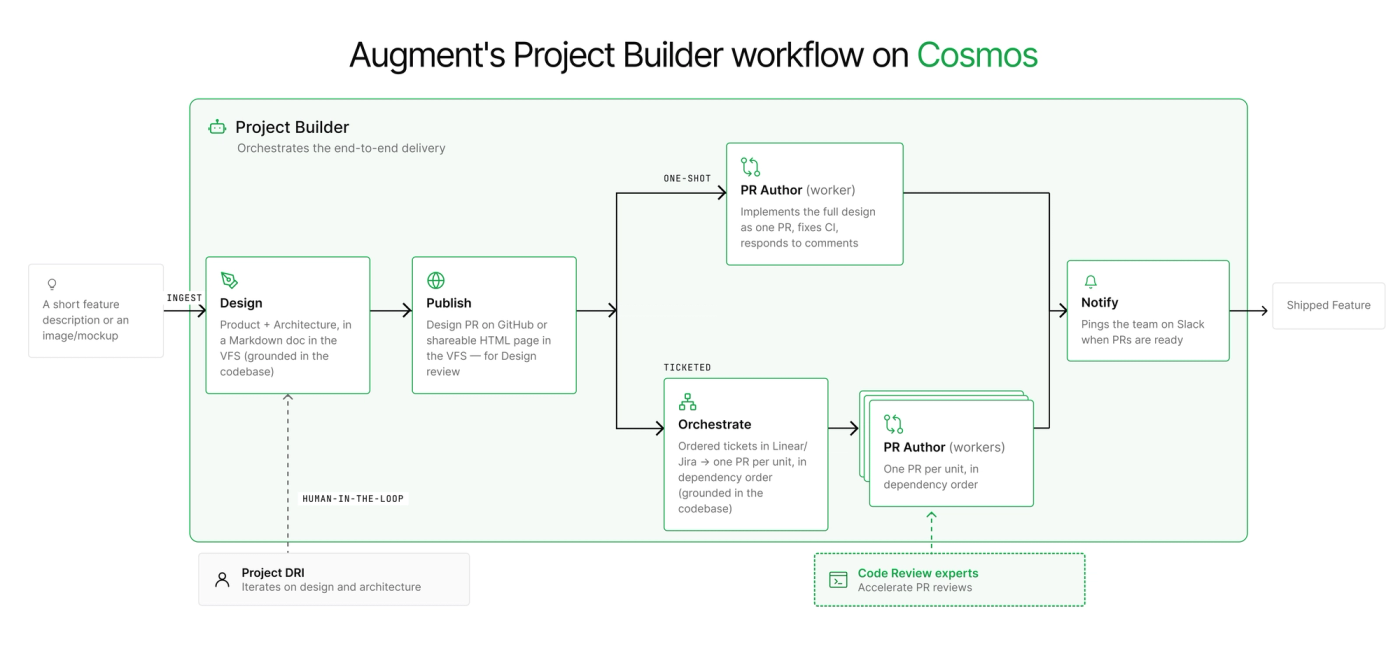
Augment calls its underlying philosophy "loop engineering" -- in its own words, "designing agentic loops: systems that take work from a trigger through execution and verification to a finished outcome, with agents doing the middle and humans at the checkpoints where judgment matters." Cosmos is where that philosophy ships as a product: a cloud platform (cosmos.augmentcode.com) running named "Experts" -- PR Author, PR Fixer, Risk Analyzer, Deep Reviewer, Pair Reviewer, Verifier, Project Builder, Feedback Triager, Incident Investigator, Ticket Manager, Ticket Dispatcher, Data Analyst and a Cosmos ROI Analyst -- triggered by GitHub/GitLab events, Slack messages, schedules or webhooks, running in managed cloud sandboxes or customer-managed daemons.

See it in Augment's own words
Official video, published by Augment's own verified YouTube channel (@Augment-Code), Aug 6, 2026 -- a software engineer demonstrates Cosmos correlating logs, metrics, deploys, Kubernetes state, Slack context and past incidents to surface a probable root cause before the on-call engineer opens their laptop.
A free-standing GitHub PR reviewer, plus a terminal agent built for CI/CD.
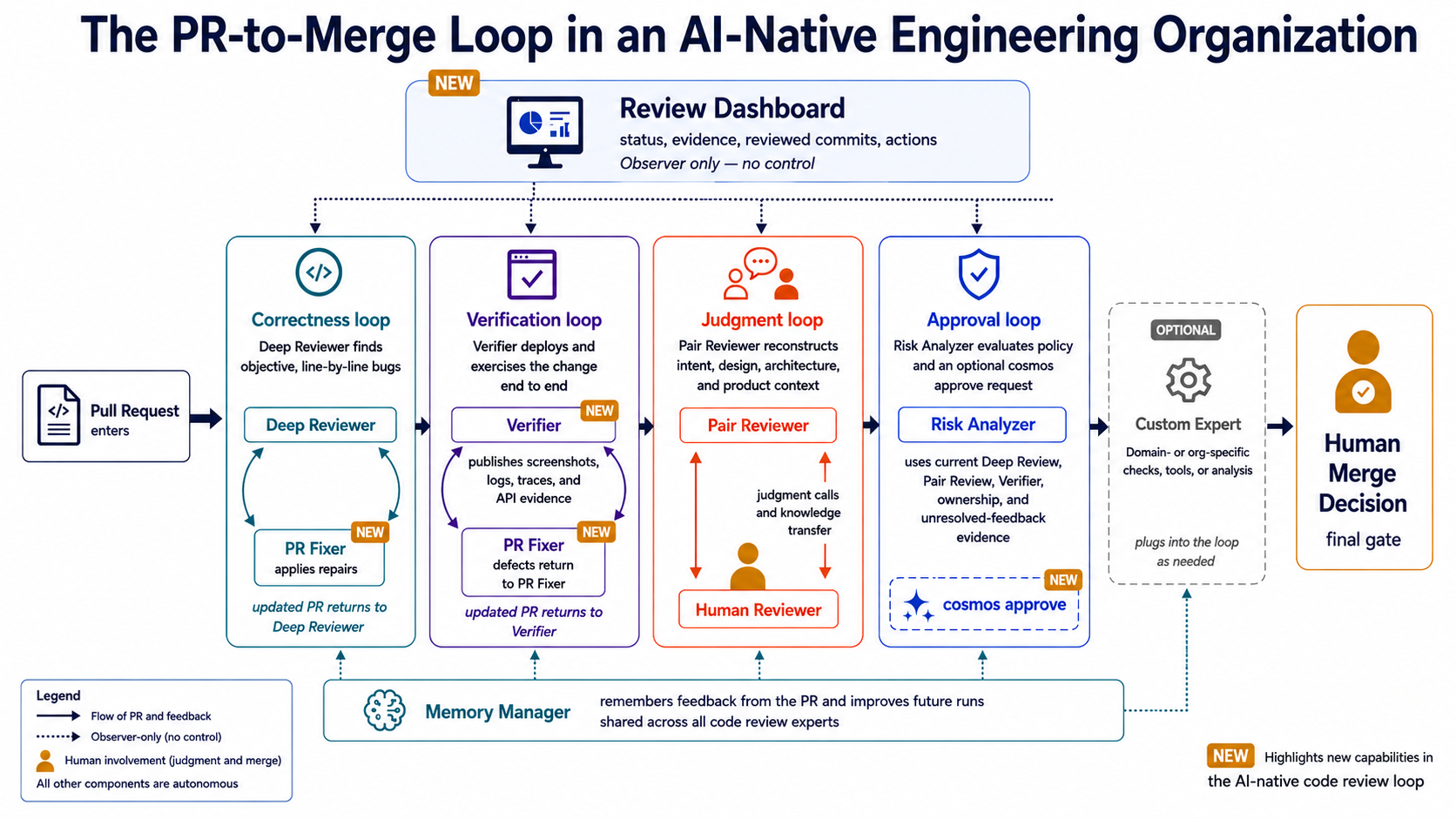
Separately from Cosmos's broader automations, Augment Code Review is a focused product: it watches for new pull requests on GitHub (GitLab and Bitbucket are not yet supported for this specific feature), reviews the diff with full read access to the surrounding codebase for cross-system impact, and posts inline comments flagging logic errors, security issues, null-handling bugs and API-compatibility problems. A "Fix with Augment" button sends flagged issues straight back into the IDE for a one-click fix. Two review styles are offered: "Thorough," which Augment's own documentation says catches "50% more bugs" than "Precise," a leaner mode tuned to avoid low-value style nitpicks.
| Review style | Behavior | Best for |
|---|---|---|
| Thorough (more comments) | Catches roughly 50% more bugs per Augment's own documentation | Security-sensitive or high-change-velocity repos |
| Precise (fewer comments) | Prioritizes high-confidence, critical issues only | Teams that want to avoid review-fatigue and style nagging |
The Auggie CLI (npm install -g @augmentcode/auggie, Node 20+) brings the same agent and Context Engine to the terminal in three modes: an interactive full-screen UI for exploratory work, a --print mode built for CI/CD pipelines, and a --quiet mode for structured, script-friendly output. Augment says it rebuilt the CLI's execution harness in August 2026 to run tasks roughly 53% cheaper than Claude Code on comparable work -- a claim from the same benchmark family as the Terminal-Bench/SWE-Bench Pro results above, not independently re-verified by JAVIS in this cycle.
Augment's context technology now plugs into the very tools it competes with.
Beyond native connectors to GitHub, Linear, Notion, Confluence, Jira, Supabase, Stripe and Sentry inside the IDE extension, and Cosmos-side triggers for GitLab, Azure DevOps, Slack, Microsoft Teams, ClickUp, Datadog and Twingate, Augment's most strategically notable integration is Context Engine MCP: the same codebase-understanding technology exposed as a Model Context Protocol server. Augment's own positioning is blunt about why this exists: "Every AI uses the same models. Context is the difference." Officially documented quickstarts exist for Claude Code, Cursor, GitHub Copilot, Kiro, Kilo Code, Roo Code, OpenAI Codex, Gemini CLI, Zed, Google AntiGravity, Factory's Droid, and OpenCode.


For a deeper look at how Claude specifically handles MCP connectors, see JAVIS's own Claude MCP & Connectors guide -- Claude is also one of the 23 models Augment supports directly.
Three meters, one balance -- and Augment's margin is disclosed, not hidden.
| Cost component | How it's billed |
|---|---|
| LLM tokens | Provider's own published rate (e.g. Claude Sonnet 5: $2/$10 per million input/output tokens) |
| Augment's service fee | 40%, applied only to the LLM token portion -- disclosed directly in Augment's own pricing docs |
| Context Engine | Draws from the same usage balance as tokens and compute; no separate line item disclosed |
| Cosmos compute | $0.19/hour, billed in 5-minute increments, while an agent runs unattended |
| Top-up credits | Purchased at the same rates as included usage; valid 12 months from purchase |
A real compliance stack -- SOC 2, ISO 42001, HIPAA -- with clear approval gates on risky actions.
Augment's security posture, confirmed directly against its own security and compliance documentation, includes SOC 2 Type II attestation, ISO/IEC 42001 (AI management system) certification, and stated GDPR, CCPA and HIPAA compliance with a Business Associate Agreement available on request. Augment states plainly: "We never train on our customer's proprietary data." A "Proof-of-Possession API" is described as ensuring completions only operate on code the requesting client actually holds locally, and Enterprise plans add customer-managed encryption keys (CMEK). A public Trust Center is available at trust.augmentcode.com, and security issues are handled via security@augmentcode.com or GitHub Security Advisories rather than public issue trackers.

A strong fit for large-codebase teams and enterprise SDLC automation; a harder sell for solo devs who want a free tier.
| Your situation | Fit | Likely plan |
|---|---|---|
| Team working in a large, legacy, or multi-repo codebase | Strong -- the Context Engine's core, repeatedly-verified strength | Standard or Business |
| Engineering org wanting automated PR review, ticket triage, incident response at scale | Strong -- Cosmos is built specifically for this | Business or Enterprise |
| Solo developer who wants a free tier before paying anything | Weak -- no free plan exists as of this review | Consider Kilo Code or GitHub Copilot's free tier instead |
| Developer who relies heavily on inline autocomplete | Weak on non-Enterprise plans -- deprecated Mar 31, 2026 | Enterprise only, or look elsewhere |
| Team already using Cursor/Claude Code/Copilot but wants better context | Worth testing -- Context Engine MCP works inside your existing tool | Standard, MCP-only usage |
| Enterprise wanting audit logs, SSO/SCIM and dedicated support | Strong -- SOC 2 Type II, ISO 42001, CMEK all live | Enterprise, custom pricing |
Four real, current limitations -- documented by Augment itself or its own paying users.
Standard at $20/mo (shared across up to 50 seats) is the entry point. The Oct 2025 move from per-message to credit billing, followed by the current dollar-usage model, drew a real Hacker News thread and Reddit backlash over broken grandfathering promises.
Confirmed directly in Augment's own documentation as of March 31, 2026. It is the single most common complaint in 2026 Marketplace reviews -- several reviewers say it makes the tool a non-starter for their workflow.
Multiple detailed, highly-rated (by other users) Marketplace reviews describe the extension as feeling abandoned in favor of Cosmos and the now-redirected "Intent" product -- strong enough sentiment that Augment's own support account replies directly and repeatedly to these complaints in public.
The widely-cited "65.4% on SWE-bench Verified" figure was measured on Claude Sonnet 3.7, several model generations old; the "beats Claude Code" cost/quality claims come from Augment's own blog, with Augment itself disclosing that the quality gap "sits inside the variance we see across runs."
Six different reasons to look elsewhere, mapped to what you actually need.
| If you mostly need... | Compare with... |
|---|---|
| A fully-managed, proprietary AI IDE instead of an editor extension | Cursor -- see our Cursor review |
| The mainstream, IDE-agnostic default most teams already have access to | GitHub Copilot -- see our GitHub Copilot review |
| The CLI-first agent Augment directly benchmarks itself against | Claude Code -- see our Claude review and Claude Code setup guide |
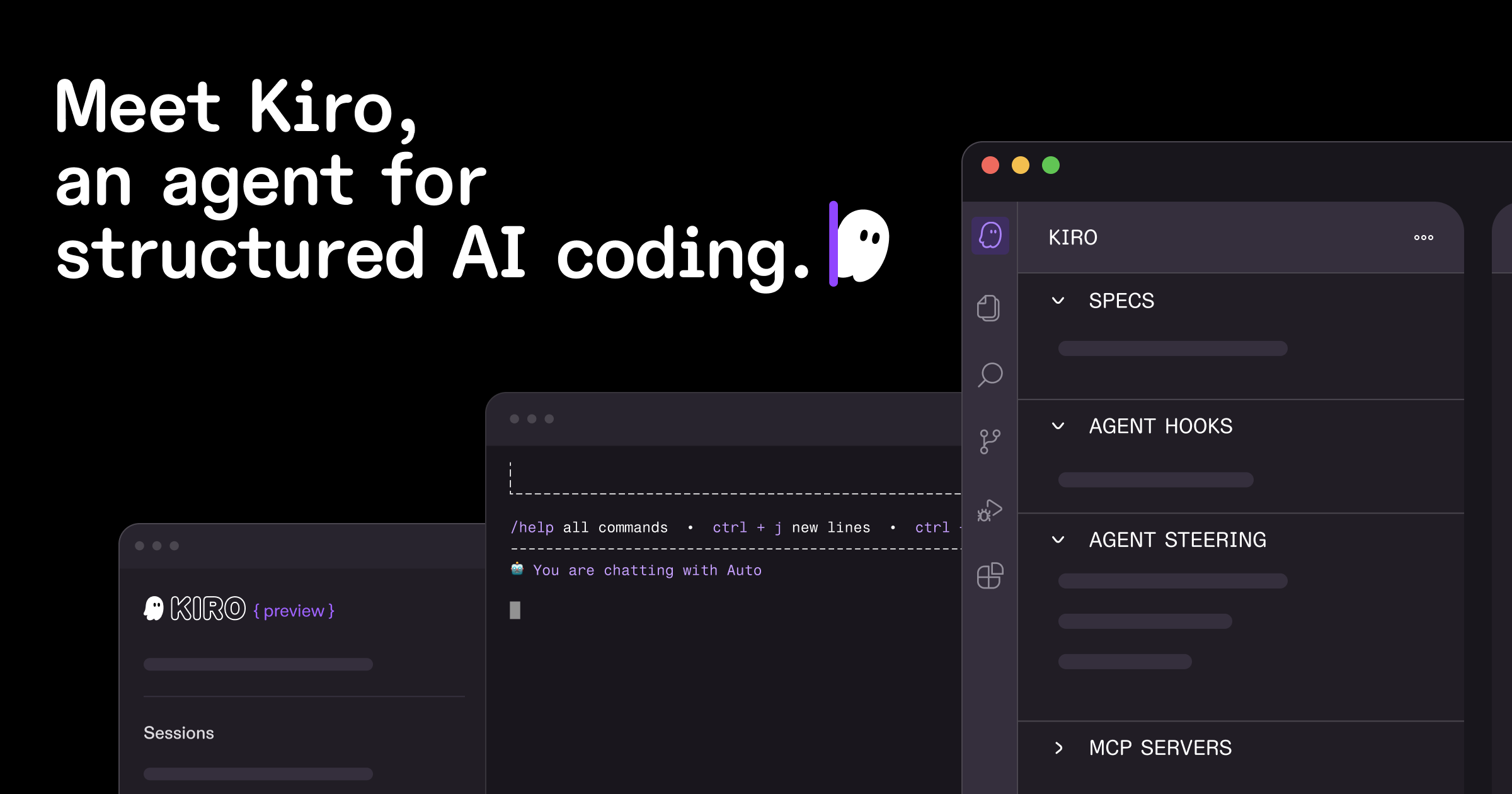
| AWS-native, spec-first planning before any code is written | Kiro -- see our Kiro review (also supports Context Engine MCP) |
| A free, open-source, multi-surface agent instead of a paid flat-team price | Kilo Code -- see our Kilo Code review (also supports Context Engine MCP) |
| A more autonomous, end-to-end agent comparable in ambition to Cosmos | Devin -- see our Devin review |
| A terminal-first agent from a major model lab | OpenAI Codex -- see our OpenAI Codex review (also supports Context Engine MCP) |
| The open-source Cline-family fork most similar to Augment's original IDE-first approach | Roo Code -- see our Roo Code review (per JAVIS's own reporting, shut down May 15, 2026; also listed as a Context Engine MCP integration) |
No affiliate relationship shapes this review.
JAVIS has no publisher affiliate program with Augment Computing, Inc. Every CTA in this article points to a real official source: augmentcode.com or its own documentation.
Standard plan, $20/mo flat for up to 50 seats -- no free tier as of this review.
Go to augmentcode.comRead Augment's own pricing and security pages directly.
See official pricing →Augment Code only makes sense next to the tools it benchmarks itself against and the tools its own Context Engine now powers.
If you're deciding what to actually install this week, these are the six reviews most worth reading alongside this one.


Questions people are actually searching right now
Is Augment Code still free?
No. As of this review, augmentcode.com/pricing lists no free or trial plan. Standard, at $20/month for a whole team of up to 50 seats sharing $20 of usage, is the entry point. Augment briefly offered a $0 Trial tier as part of its October 2025 credit-system overhaul; it does not appear on the current pricing page.
What happened to Augment's autocomplete?
Inline Completions (ghost-text autocomplete) were deprecated for every plan except Enterprise on March 31, 2026, confirmed directly in Augment's own documentation. It remains the most common complaint in 2026 Marketplace reviews.
What is Cosmos, and is it different from the Augment IDE extension?
Cosmos is Augment's separate, enterprise-focused cloud platform for automating pull-request review, ticket-to-PR work and incident response using background "Expert" agents, distinct from the interactive VS Code/JetBrains/Vim extensions. Both run on the same Context Engine and model layer.
Can I use Augment's Context Engine inside Cursor or Claude Code instead of the full Augment product?
Yes. Augment offers Context Engine MCP, a Model Context Protocol server exposing the same codebase-understanding technology to other tools. Official quickstarts exist for Claude Code, Cursor, GitHub Copilot, Kiro, Kilo Code, Roo Code, OpenAI Codex, Gemini CLI, Zed, Google AntiGravity, Droid and OpenCode.
How does Augment Code's pricing actually work?
Every plan pays from one shared usage balance across three meters: LLM tokens at the provider's own rate plus a disclosed 40% service fee, Context Engine usage, and Cosmos compute at $0.19/hour. Standard and Business are flat team prices (not per seat) shared across up to 50 people.
Who owns Augment Code, and has it raised money recently?
Augment Computing, Inc. remains independently operated as of this review. It emerged from stealth in April 2024 with a $227M Series B at a $977M post-money valuation ($252M total raised), led by Sutter Hill Ventures. JAVIS found no officially confirmed funding round since then as of Sep 29, 2026.
Is Augment Code better than Claude Code?
On Augment's own Terminal-Bench 2.0 and SWE-Bench Pro runs (both on Claude Opus 4.7), Auggie edged ahead on pass rate (67.4% vs 66.3%; 61.8% vs 59.9%) at 23-33% lower cost -- though Augment itself notes the quality gap "sits inside the variance we see across runs." Independent Marketplace reviewers are split, with several saying Augment's context handling wins on large codebases and others saying they moved to Claude Code after Augment's 2026 product changes.
What is Augment Code's current Marketplace rating?
3.59 out of 5 across 340 reviews on the VS Code Marketplace, and 3.37 out of 5 across 209 votes on the JetBrains Marketplace (a notably bimodal split: 87 five-star votes and 53 one-star votes), both independently observed live via each marketplace's own API on Sep 29, 2026.
Where this came from, and when it was checked.
Product description, features, docs structure, agent modes, models, screenshots used: augmentcode.com and docs.augmentcode.com (official, multiple pages read directly), checked Sep 29, 2026.
Pricing (Standard/Business/Enterprise, token-based pricing, service fee, Cosmos compute rate): augmentcode.com/pricing and docs.augmentcode.com/models/token-based-pricing, official, checked Sep 29, 2026.
Pricing-change history (Oct 2025 credit overhaul, reasoning, old/new tiers): augmentcode.com/blog/augment-codes-pricing-is-changing (official, Oct 7, 2025), corroborated via news.ycombinator.com/item?id=45586110 (read directly, comments from users "Dylan16807," "Havoc," "aitchnyu," "mosdl").
VS Code Marketplace (install count, rating, review count, version, individual review text and dates): marketplace.visualstudio.com listing and reviews (augment.vscode-augment), Sep 29, 2026.
JetBrains Marketplace (download count, rating distribution): plugins.jetbrains.com (plugin 24072), Sep 29, 2026.
GitHub repositories (stars, forks, license, SWE-bench claim): github.com/augmentcode, official, Sep 29, 2026.
Funding history (amount, valuation, investors, founding date, founders, CEO): aventure.vc funding-data aggregator, cross-checked against Augment's own April 2024 stealth-exit announcement text (retrieved via search snippet directly quoting augmentcode.com/blog), Sep 29, 2026.
Company size, HQ, mission language: augmentcode.com/careers, official, checked Sep 29, 2026.
Completions deprecation date (Mar 31, 2026, Enterprise-only going forward): docs.augmentcode.com/using-augment/completions, official, checked Sep 29, 2026.
Auggie-vs-Claude-Code benchmark claims (Terminal-Bench 2.0, SWE-Bench Pro, private codebase test): augmentcode.com/blog/auggie-beats-claude-code-on-cost-and-quality, official, checked Sep 29, 2026 -- not independently re-run by JAVIS.
"Loop engineering" definition and Cosmos Experts list: augmentcode.com/blog/what-is-loop-engineering-and-how-are-leading-software-engineering-teams-using-it and docs.augmentcode.com documentation index, official, checked Sep 29, 2026.
219 engineering leaders survey: augmentcode.com/blog/ai-native-survey-2026, official, checked Sep 29, 2026 -- self-reported survey, sample skews toward AI-forward organizations per Augment's own methodology note.
Security/compliance (SOC 2, ISO 42001, HIPAA, Proof-of-Possession API, Trust Center): augmentcode.com/security and augmentcode.com/pricing, official, checked Sep 29, 2026.
"Intent" product redirect: augmentcode.com/product/intent, direct check, confirmed 308 redirect to intentapp.dev, Sep 29, 2026; intentapp.dev itself checked the same day and shows no acknowledged Augment relationship on its current site.
Official video search: Augment's own YouTube channel confirmed via channel metadata (@Augment-Code, UC0OAswXJ91F1GSFGe3p2HeQ) and its public RSS feed; "Incident Management with Augment Cosmos" (Aug 6, 2026) confirmed as an official upload (channel "Augment Code"), Sep 29, 2026.