
Make Review 2026: A $9 Visual Builder, a Credits Meter, and an AI Co-Worker Called Maia
Make, the tool formerly known as Integromat and now part of Celonis, is what many people move to when Zapier's per-task meter starts to hurt. This review checks what is true today against Make's own pricing page and help center: Core lists at $9 for 10,000 credits, operations became credits in August 2025, AI Agents arrived on paid plans in January, and in August Make launched Maia, an assistant that builds and debugs scenarios inside the editor. It also catches a few things missing from older reviews, such as the Make plugin for ChatGPT going unlisted in September, and adds what real users say.
| Ownership | Celonis (since 2020) |
| Free tier | Real -- 1,000 credits / month |
| Cheapest paid plan | $9/mo (Core, 10,000 credits) |
| Integrations (Make-stated) | 3,000+ |
| Trustpilot record | 2.8/5, 172 reviews |
The best-value visual automation tool I checked, now with an AI co-worker built in. Just budget for credits, and expect a steeper first week than Zapier.
"Make is what you reach for when Zapier's meter starts to sting. A 10,000-credit Core plan costs $9 on Make's own pricing page, branching and routers are part of the canvas, and in 2026 Make added AI Agents, an MCP server and Maia, an assistant that builds and debugs scenarios inside the editor. The trade is that you have to learn a real builder, and since the move from operations to credits, AI steps no longer cost a predictable one unit."
My honest read: for freelancers, agencies and small teams building 5 to 15 step workflows with branching, Make is the first thing to try. It is weaker if nobody on the team will invest a few hours learning routers and iterators, or if you need white-glove support on a small plan. This is a VERIFIED EDITORIAL REVIEW: official pricing, help-center and release pages checked on Oct 3, 2026, plus published user sentiment. I did not run a controlled hands-on test.
A visual scenario builder, plus AI Agents, Maia, Grid and an MCP server, owned by Celonis.
Make (formerly Integromat) describes itself as "the visual AI automation platform". As of this check the product is a Scenario Builder where you drag modules onto a canvas and watch data flow between them; AI Agents that live inside scenarios; Maia by Make, an AI co-worker in the builder; Make Grid, a map of your automation landscape; and a Make MCP Server that lets Claude or ChatGPT run scenarios. The homepage says it is "now part of Celonis", which bought Integromat in 2020 (TechCrunch, Oct 14, 2020, reporting a price above $100 million per Celonis's CEO). I found no ownership change since.
Smaller catalogue than Zapier, a much cheaper entry price, and a parent company with a process-mining business behind it.
Make homepage: "over 400,000 organizations across 200+ countries". Accounts, not paying customers.
Make homepage. Zapier states 9,000+; Make argues its modules per app go deeper.
Make homepage, "global team of 350+".
Make does not publish revenue; it is part of Celonis. I found no reliable current figure and use none.
| Date | Event | Source |
|---|---|---|
| 2020-10 | Celonis acquires Integromat; deal reported above $100M | TechCrunch, Oct 14, 2020 |
| 2025-08-27 | Operations become credits; "your current plan and price stay exactly the same"; AI usage becomes token-based | Make Community announcement |
| 2026-01-19 | Make AI Agents available on all paid plans (release notes) | Make Help Center |
| 2026-02-11 | Make blog: "Make AI Agents: Trust through transparency" | Make blog |
| 2026-08 | Maia by Make launches in public beta; custom roles for Enterprise; subfolders and labels | Make Community, release notes Aug 2026 |
| 2026-09-16 | Make plugin for ChatGPT announced; unavailable from ~Sep 22; beta access restored for existing installs Sep 29 | Make blog, Make Community |
| 2026-10-19 | Make Waves '26 conference, Prague (Oct 19-20) | Make blog |

Reviewers love the builder and the price. They warn about the learning curve, support limits and AI credit costs.
2.8 out of 5, a split profile: 50% five-star and 35% one-star. Praise: "Make is an excellent automation platform. It's powerful, flexible, and allows you to build workflows for almost any use case." Complaint: "What a complex rubbish automation to set up. Even with the assistance of AI we were going around in circles." Make replies to most negative reviews (about 89%).
Scores Make 4.2/5 (community 4.0 from 15 reviews, 80% recommend). Praises the visual builder and routers, iterators and error handlers "unavailable in competitors like Zapier". Flags that "costs escalate with high-volume automations", that advanced features need 3 to 4 hours to learn, that live chat is Enterprise-only, and that built-in AI feels basic.
On the credits switch: "this could end up costing most of us way more", with AI modules at 3 to 5+ credits instead of one operation. Make's reply: most modules stay at 1 credit, AI uses token-based pricing, and with your own API key "we charge only 1 credit per run".
Free, Core, Pro, Teams and Enterprise, all priced at the 10,000-credit level and scaling up on a credit selector.
Free
1,000 credits a month.
- 2 active scenarios
- 15-minute minimum interval
- 5 min execution, 5 MB files
Core
10,000 credits a month.
- Unlimited active scenarios
- Scheduling to the minute
- Make API access; 40 min execution
Pro
Core plus priority execution.
- Custom variables
- Full-text execution log search
- 250 MB files
Teams
Pro plus team features.
- Team roles
- Scenario template sharing
- 500 MB files
| Plan | Price at 10,000 credits | Active scenarios | Notable limits and features |
|---|---|---|---|
| Free | $0 | 2 | 1,000 credits; 15-min interval; 5 min execution; 5 MB files |
| Core | $9 / mo | Unlimited | Per-minute scheduling; Make API; 40 min execution; 100 MB files |
| Pro | $16 / mo | Unlimited | Priority execution; custom variables; full-text log search; 250 MB |
| Teams | $29 / mo | Unlimited | Team roles; template sharing; 500 MB |
| Enterprise | Custom | Unlimited | Custom functions; enterprise app integrations; 24/7 support; overage protection; advanced security; 1,000 MB |
| Extra credits | +25% premium | -- | Paid plans only; auto-purchase in 10,000-credit blocks up to your monthly credits; scenarios pause if payment fails |
Pick by how complex the workflow is and whether anyone will learn the builder.
Free: 1,000 credits and 2 active scenarios is enough to learn the canvas.
Core at $9: unlimited scenarios, per-minute scheduling.
Make is built for it; routers and iterators are part of the canvas.
Pro or Teams for priority execution, log search, roles and template sharing.
Look at Zapier, which is simpler but costs more per step.
Compare n8n.
A canvas where each module run costs one credit, unless it is AI.
The Scenario Builder is Make's centre of gravity. You place modules for apps, then add routers (branches), iterators, aggregators and error handlers, and watch data pass between them. Make's comparison page claims "unlimited modules per scenario" and "unlimited routes" and says Zapier caps a Zap at 100 steps; that is Make's marketing, not something I checked in Zapier's docs. What Make's help center does say about billing is clear: for non-AI apps "1 operation = 1 credit", fixed regardless of file size; for third-party AI apps it is 1 credit plus whatever your AI provider charges for tokens; for Make's built-in AI apps credits vary with tokens, operations and usage.
| Credit use | Credits | Source |
|---|---|---|
| Most app modules (non-AI) | 1 per run, regardless of file size | help.make.com/credits |
| Third-party AI app with your own key | 1 per run, plus provider tokens billed by the provider | help.make.com/credits |
| Built-in AI (Make AI Provider) | Variable, token-based | help.make.com/credits |
| Maia messages (paid plans) | First 70 free for 30 days, then credits by complexity | help.make.com Maia intro |
| Extra credits | Base rate x 1.25 | help.make.com/extra-credits |
- The builder shows data moving through each module, which Hack'celeration and Make both highlight as the debugging advantage.
- Using your own AI key keeps AI steps at 1 credit per run.
- Plain-text editing of mapped values and subfolders with labels arrived in the August release.
- Credit cost of built-in AI is variable; a community user feared 3 to 5+ credits per AI module and Make did not give a flat number.
- Third-party guides report polling triggers consume credits even when they find nothing; I did not confirm this on Make's own pages.
- Make's "six times cheaper than Zapier" framing compares its credits to Zapier's tasks and add-ons; the units differ.
Describe or draw it, run it once, read the data at every module, then switch it on.

Two newer pieces change the workflow. Maia sits inside the builder: it builds scenarios and AI agents from a description, edits existing ones, troubleshoots using run history and logs, and takes up to three images per session. Per Make's help center it cannot see other scenarios, so it cannot start from an existing one, and it does not use your data for model training. Make AI Agents are reusable agents with global system prompts and per-scenario adjustments, available on paid plans.
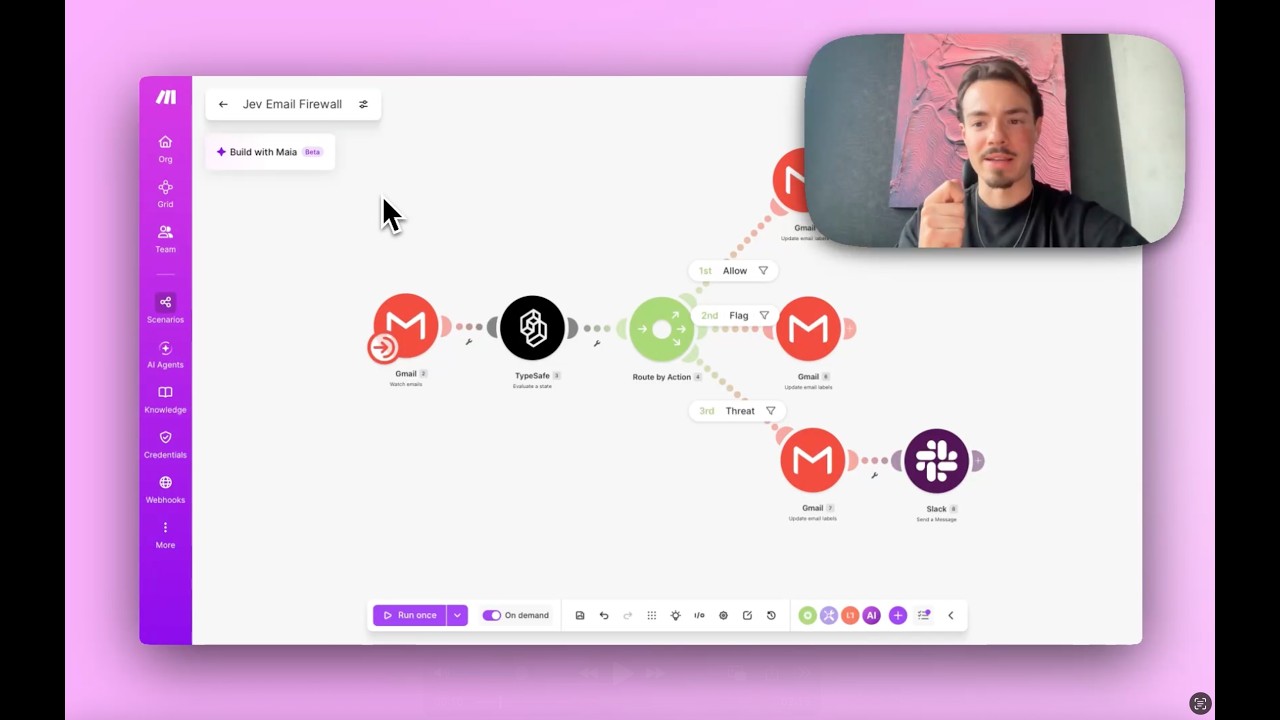
An official Make video showing Maia debugging and building a scenario, which is the clearest demonstration of the beta feature discussed in this section.
Published by the official "Make" YouTube channel (youtube.com/@itsmake) (the channel linked from help.make.com). The presenter is a community partner, so this is a vendor-published demo, not a neutral test.
Make's AI story is agents inside scenarios plus Maia, both billed through the same credit pool.
Make AI Agents are goal-driven automations: an LLM picks from attached tools and acts, built and debugged in the same Scenario Builder. Per the help center they are "available now for all paid Make plans" (release notes dated Jan 19, 2026). Maia launched in public beta in August. Paid plans get unlimited access and credits apply after the first 70 messages in 30 days; the Free plan gets a 30-day trial with 45 free messages. Maia memories, which store your preferences, are private to your organisation and limited to 50 per team.
- Debugging a scenario using run history instead of reading logs by hand.
- Agents with visible tool calls, which is Make's "glass-box" pitch.
- Maia is a beta and every message draws credits after the promo.
- Agents are autonomous within the tools you attach; scope those tools narrowly.
Make's MCP server turns scenarios into tools, and the ChatGPT plugin just went missing.
The Make MCP server lets MCP clients such as Claude and ChatGPT run scenarios, check data stores or manage organisation members. Connection is by OAuth (which can be limited to specific organisations) or an MCP token. For a scenario to be a tool it must be active with on-demand scheduling and have defined inputs and outputs. Scenario-run scopes are available on all plans; management scopes need a paid plan.
A recent surprise: Make announced a plugin for ChatGPT on Sept 16, but users reported it vanished from the directory around Sept 22. Make said it was "temporarily unavailable" and working with OpenAI; on Sept 29 beta access was restored for people who had installed it, and it remains unlisted. The MCP route still works, but Make's community notes ChatGPT Plus users can only use MCP in Work chats. My ChatGPT review covers why.
| Integration | What it does | Status / limit |
|---|---|---|
| Make MCP Server | Claude, ChatGPT and other clients run scenarios as tools | OAuth or token; run scopes on all plans, management scopes on paid plans |
| Make plugin for ChatGPT | Build and run Make from ChatGPT | Unlisted since ~Sep 22; beta restored for existing installs Sep 29 |
| 3,000+ app modules | Pre-built modules for apps and AI providers | Make-stated; 16 verified apps added in Aug 2026 alone |
| HTTP and API modules | Reach apps without a native module | Cited by Hack'celeration |
| Make Grid | Map and navigate your automations | All paid plans per Make |
For the direct route from an AI assistant to your apps, see JAVIS's Claude MCP and Connectors guide and the ChatGPT review.
Credits are cheap for plain automation and unpredictable for built-in AI.
| What you are doing | What you pay |
|---|---|
| Learning the builder | $0; 1,000 credits and 2 active scenarios |
| A 5-module scenario, 2,000 runs a month | 10,000 credits, the whole Core allowance (JAVIS arithmetic, assuming 1 credit per module run) |
| The same scenario at 3,000 runs | 15,000 credits; buy a higher tier or extra credits at +25% |
| Zapier comparison (JAVIS arithmetic) | A 5-step Zap has 4 counted actions, so Zapier's 750-task entry tier covers about 187 runs a month; different units, plans and features, so not like-for-like |
| AI step with your own API key | 1 credit per run; your AI provider bills tokens |
| AI step with Make's AI Provider | Variable, token-based credits |
| Credits run out on a paid plan | Extra credits at 1.25x base rate, auto-bought in 10,000 blocks to your monthly ceiling; payment failure pauses scenarios |
SOC 2 Type II, ISO 27001 and encryption claims, with enterprise roles and longer log retention on the top plan only.
| Control | What's in place (Make's own claims) |
|---|---|
| Compliance | SOC 2 Type II and SOC 3 audits completed; ISO 27001-certified information-security program; GDPR (make.com/en/security) |
| Encryption | AES-256 full-disk encryption at rest; TLS 1.2 and 1.3 in transit |
| Infrastructure | AWS EC2 private instances in a VPC across two zones; enterprise customers on a separately managed environment |
| Log retention | 30 days by default; extended retention on Enterprise |
| Sign-in | SSO with Google, Facebook and GitHub; custom SSO for Enterprise |
| Roles | Team roles on Teams; custom roles with org-level permissions on Enterprise (Aug 2026) |
| Maia | Never uses your data for model training; uploaded images processed once then discarded |
Best for builders who want branching and low per-step cost; weaker for teams that need hand-holding.
| Situation | Why Make fits | Likely plan |
|---|---|---|
| Freelancer or solo builder | $9 entry, unlimited scenarios, per-minute scheduling | Core |
| Agency building for clients | Routers, template sharing, roles, subfolders and labels | Teams |
| Ops team with 5 to 15 step workflows | Visual branching and error handling | Pro |
| AI-curious builder | AI Agents, Maia, MCP server; bring your own AI key to control cost | Core or Pro |
| Enterprise governance | Custom roles, SSO, 24/7 support, overage protection | Enterprise |
| Someone who wants it working in an hour with no learning | Simpler tools exist; compare Zapier | Free to test first |
Five real gaps, not manufactured ones.
Hack'celeration says advanced features need 3 to 4 hours, and Trustpilot reviewers describe the builder as complex even with AI help.
Since the August 2025 credits switch, built-in AI usage is token-based. A community user estimated 3 to 5+ credits per AI module; Make staff did not give a fixed number.
Hack'celeration reports live chat is Enterprise-only and that some urgent issues went unresolved. Make does reply to most negative Trustpilot reviews.
Maia is a beta, the ChatGPT plugin went unlisted in September, and Maia cannot see other scenarios.
Fifth gap, smaller: a pricing ambiguity. I could not confirm from Make's own page whether the headline $9 is the annual or monthly price, so check at checkout.
Make is the best-value visual builder. Others win on ease, hosting or code.
| If you mostly need... | Compare Make with... |
|---|---|
| The easiest setup and the biggest app catalogue | Zapier (JAVIS review) |
| Self-hosting, code nodes and execution-based pricing | n8n |
| Developer infrastructure for agent integrations | Pipedream (Workflows is shutting down, read the review) |
| An AI assistant that acts on your apps directly | Claude MCP & Connectors guide, ChatGPT review |
| A browser agent for sites with no API | Browser Use |
| Entry point (verified Oct 3, 2026) | Make | Zapier | Pipedream |
|---|---|---|---|
| Free | 1,000 credits / mo, 2 active scenarios | 100 tasks / mo | Development only |
| Cheapest paid | $9/mo for 10,000 credits (billing cycle not confirmed) | $19.99/mo annual (750 tasks); $29.99 monthly | $99/mo annual; $150 monthly (Connect, not Workflows) |
| Unit of billing | Credits (1 per non-AI module run) | Tasks (successful actions) | Credits (30 s of compute) + external users |
Some links to Make on this page are affiliate links.
If you sign up or buy through them, JAVIS may earn a commission at no extra cost to you. It does not affect the score, the limitations we list or the alternatives we recommend; the review was written and scored before the link was added.
Go to the official page.
Open MakeRead the alternative that matches your real question.
Choose the next articleMake sits in the middle of the automation cluster.

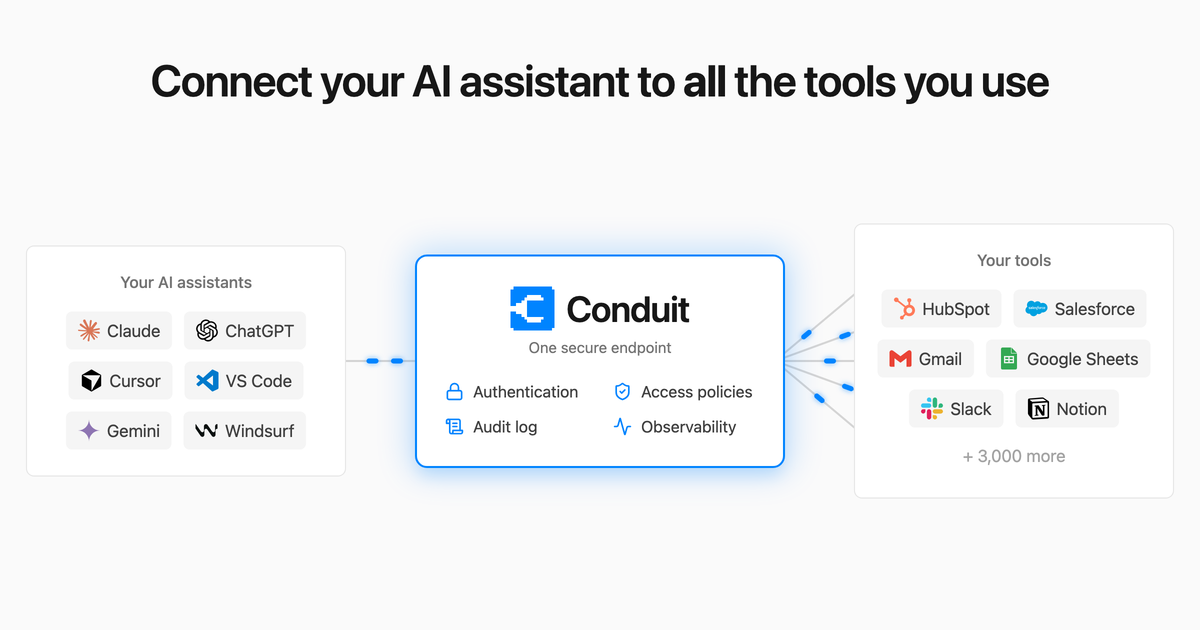
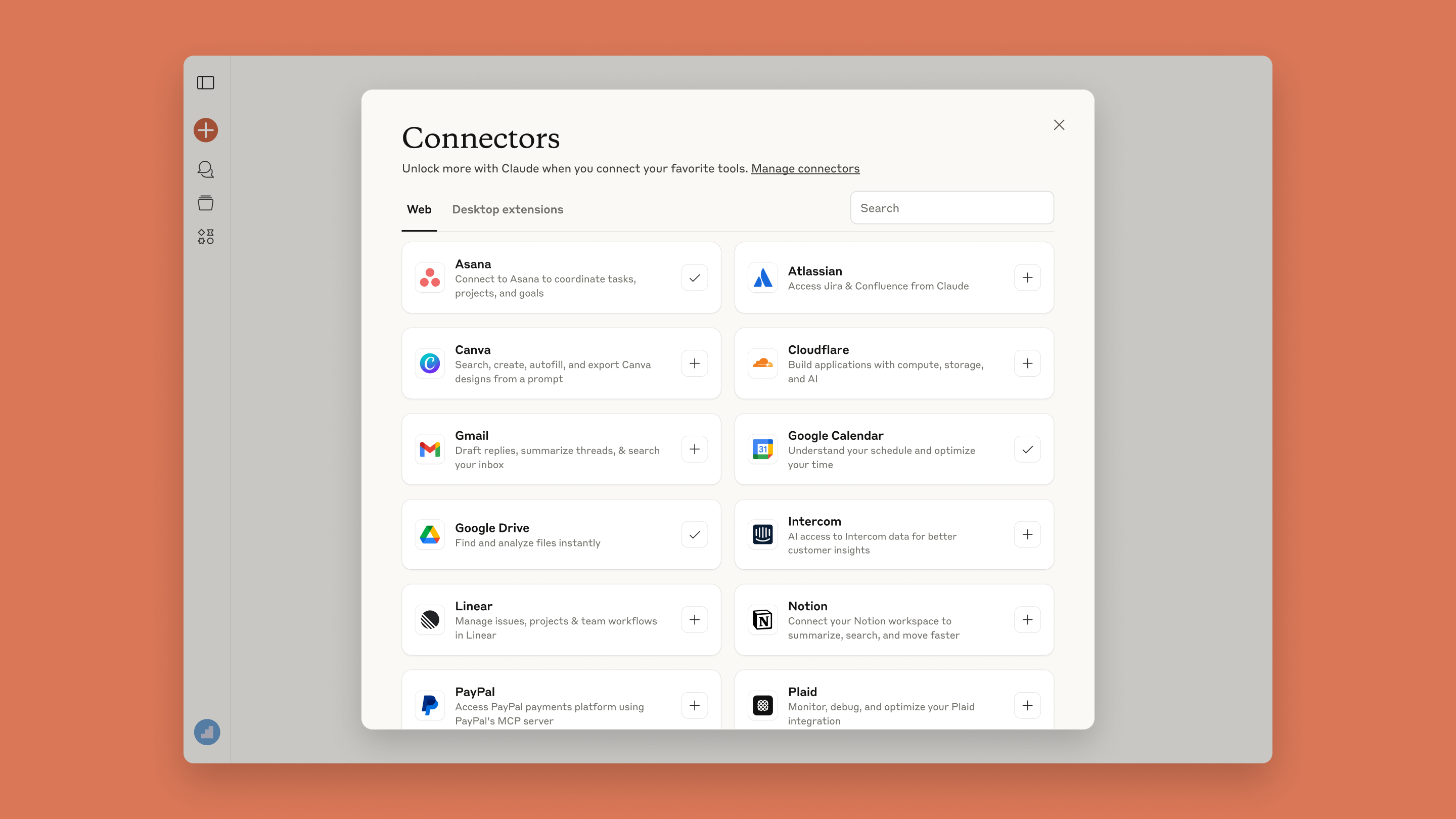


Card images are official assets from each product's own site or the target JAVIS page.
Questions people are actually searching right now
How much does Make cost in October 2026?
Free is $0 with 1,000 credits. Core is listed at $9 a month for 10,000 credits, Pro $16 and Teams $29 at the same credit level, Enterprise custom. Make offers a discount of 15% or more for annual billing, and I could not confirm whether the headline $9 is the annual or monthly price. Verified Oct 3, 2026.
Is Make free?
Yes. The Free plan has 1,000 credits a month, 2 active scenarios and a 15-minute minimum interval.
What is a credit in Make?
The billing unit that replaced operations on Aug 27, 2025. Most non-AI module runs cost 1 credit; built-in AI steps use a variable, token-based number.
What is Maia by Make?
An AI co-worker inside the scenario builder that builds, edits and debugs scenarios from your description. It launched in public beta in August 2026; paid plans get the first 70 messages free for 30 days, then credits apply.
Does Make work with Claude and ChatGPT?
Through the Make MCP server, yes. The Make plugin for ChatGPT has been unlisted since about Sept 22, with beta access restored for existing installs on Sept 29.
Is Make cheaper than Zapier?
At the entry level Make lists $9 for 10,000 credits and Zapier $19.99 for 750 tasks, but the units differ. Make lists a lower entry price per unit, but credits and tasks are counted differently, so run your own numbers.
Who owns Make?
Celonis. It acquired Integromat in 2020 and the product is now called Make; Make's homepage says it is part of Celonis.
What are the best alternatives?
Zapier for ease, n8n for self-hosting, Pipedream for developer infrastructure. See Alternatives above.
Where this came from, and when it was checked.
Pricing and plans: make.com/en/pricing; help.make.com/credits, /extra-credits, /change-your-subscription. Read Oct 3, 2026.
Product: help.make.com Maia intro and AI Agents article; help.make.com/make-mcp-server; community.make.com "Introducing Credits" (Aug 2025), August 2026 releases, and the ChatGPT-plugin thread; Make blog (Aug-Oct 2026 posts); Make homepage.
Security: make.com/en/security.
Ownership and market: Make homepage ("now part of Celonis"; 400,000 organisations; 3,000+ integrations; 350+ team); TechCrunch, Oct 14, 2020 for the Celonis acquisition. No current revenue or valuation was found from a reliable source, so none is stated.
Real users: Trustpilot (2.8/5, 172 reviews) read directly; Hack'celeration review (4.2/5); Make Community credits thread (Aug 2025); G2 (~4.6) and Capterra (~4.8) are search-aggregated because they could not be read directly. Gartner Peer Insights could not be read either. The Celonis acquisition details come from a TechCrunch result seen in search, not a full read of the article.
Competitor claims: Make's "Make vs Zapier" page is Make's own marketing; used only for the quoted step limits and Grid inclusion, labelled as Make's claims.
Official video and images: youtube.com/watch?v=ZQb1Z1vZD24 (YouTube author "Make", youtube.com/@itsmake, the channel linked from help.make.com); images from Make's Contentful CDN and thumbnails from the same official channel.
JAVIS Fit Score (84/100): editorial composite of value for money, builder power, AI and MCP capability, learning curve, cost predictability for AI, support and user sentiment; not a benchmark. Deductions are learning curve, variable AI credit costs and plan-dependent support.