Zed Review 2026: The Fast Editor That Became an Agent Host — and Started a Second Product
Zed is the Rust-built, GPU-accelerated code editor from the creators of Atom and Tree-sitter. In 2026 it hit 1.0, added parallel agents and terminal threads, opened an Agent Client Protocol registry so Claude, Codex, Gemini CLI and others run inside it, put its own agent in a default sandbox, and launched Delta, a public-beta product meant to replace pull requests. Pricing is $0, $10 or $30 and external agents cost nothing extra. This review checks all of that against official sources and sets it next to what Hacker News users say, including the part where fans ask the company not to neglect the editor.
| Free plan | Yes -- $0, BYOK unlimited |
| Paid | $10 Pro / $30 Business seat |
| Latest stable | 1.22.0 (Sep 30, 2026) |
| GitHub stars | 91,235 |
| HN Zed 1.0 | 2,153 points, 690 comments |
Zed is the fastest-feeling editor to put agents in — if you can live without a full IDE’s refactoring and debugging depth.
“Zed went 1.0 on April 29, 2026 and has shipped a stable release almost every week since, up to 1.22.0 on September 30. The AI story isn’t one model: it’s an editor that hosts its own agent, hosts other people’s agents over the Agent Client Protocol, runs several in parallel, and lets you bring your own keys for free. The price is low ($0, $10, $30). The price in attention is that the company is now building a second product, Delta, to replace pull requests — and the loudest feedback I found, from users who clearly like the editor, is ‘please don’t neglect the editor.’”
This is a verified editorial review: Zed’s own docs, blog, release notes, pricing page, GitHub, and two Hacker News threads, all read on October 3, 2026. I did not run a hands-on benchmark of speed or agent quality, so I’ll quote what the company and its users say rather than invent numbers.
If you want a fast, native, open-source editor and already pay for an agent (Claude, Codex, Copilot, Gemini), Zed’s free tier plus external agents is hard to beat. If you want the deepest refactoring and debugging, one HN commenter who tried to leave JetBrains said it best: he went back after missing refactorings. If you want a team-wide collaboration story, that’s Delta, which is in public beta and, by Zed’s own account, not feature-complete.
A Rust editor with three kinds of agent: its own, other vendors’, and terminal ones.
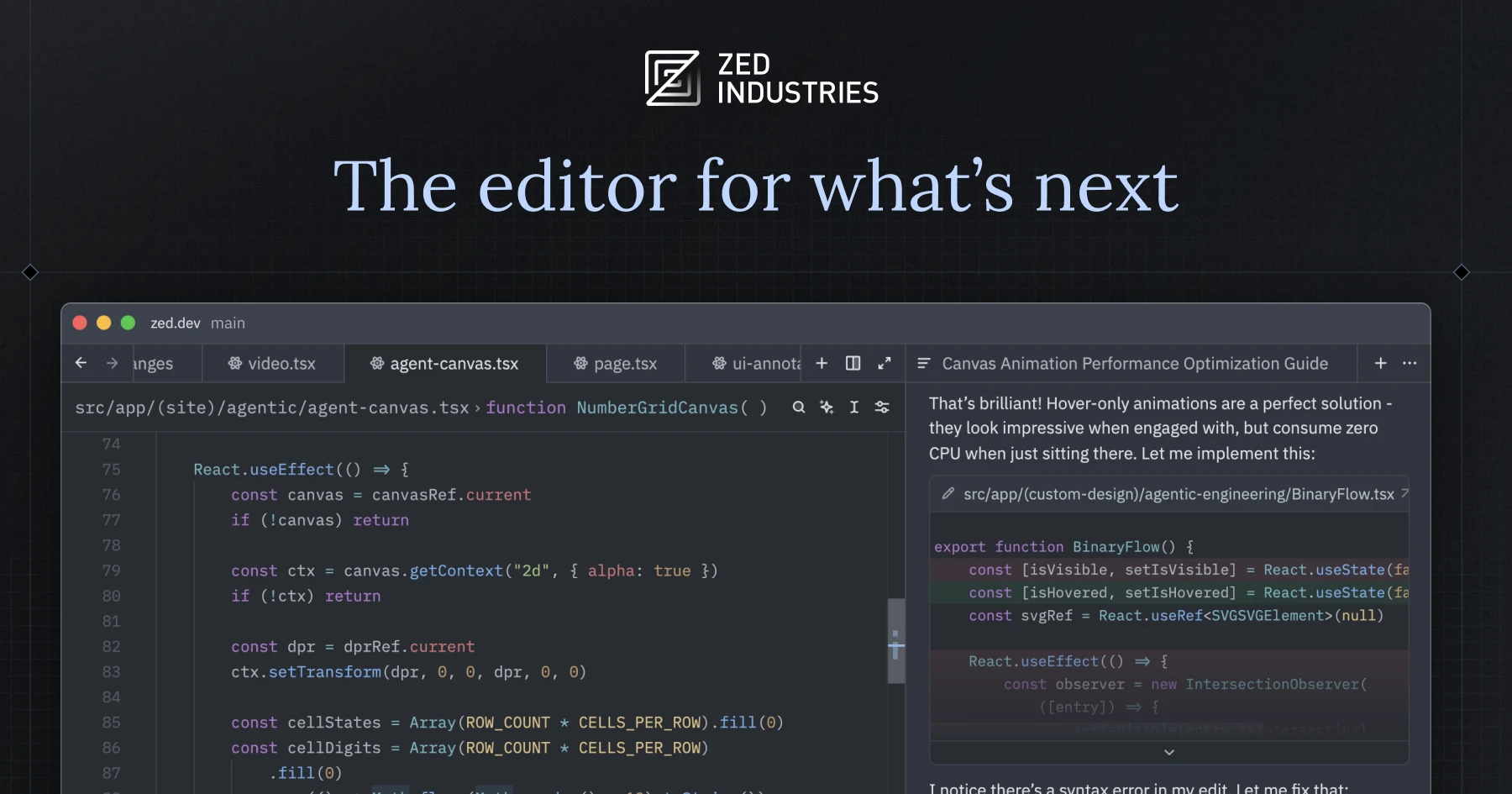
Zed markets itself as “Your last next editor,” written from scratch in Rust to use multiple CPU cores and the GPU, available on macOS, Linux and Windows. Its docs describe three agent types: the Zed Agent (native, using whichever language models you configure), External Agents (self-contained agents connected over ACP) and Terminal Threads (CLI/TUI agents run in a thread). Around them: edit predictions (Zed says they’re powered by an open-weight model, Zeta2), an inline assistant, Git, a debugger over DAP, remote development, and a Vim mode.
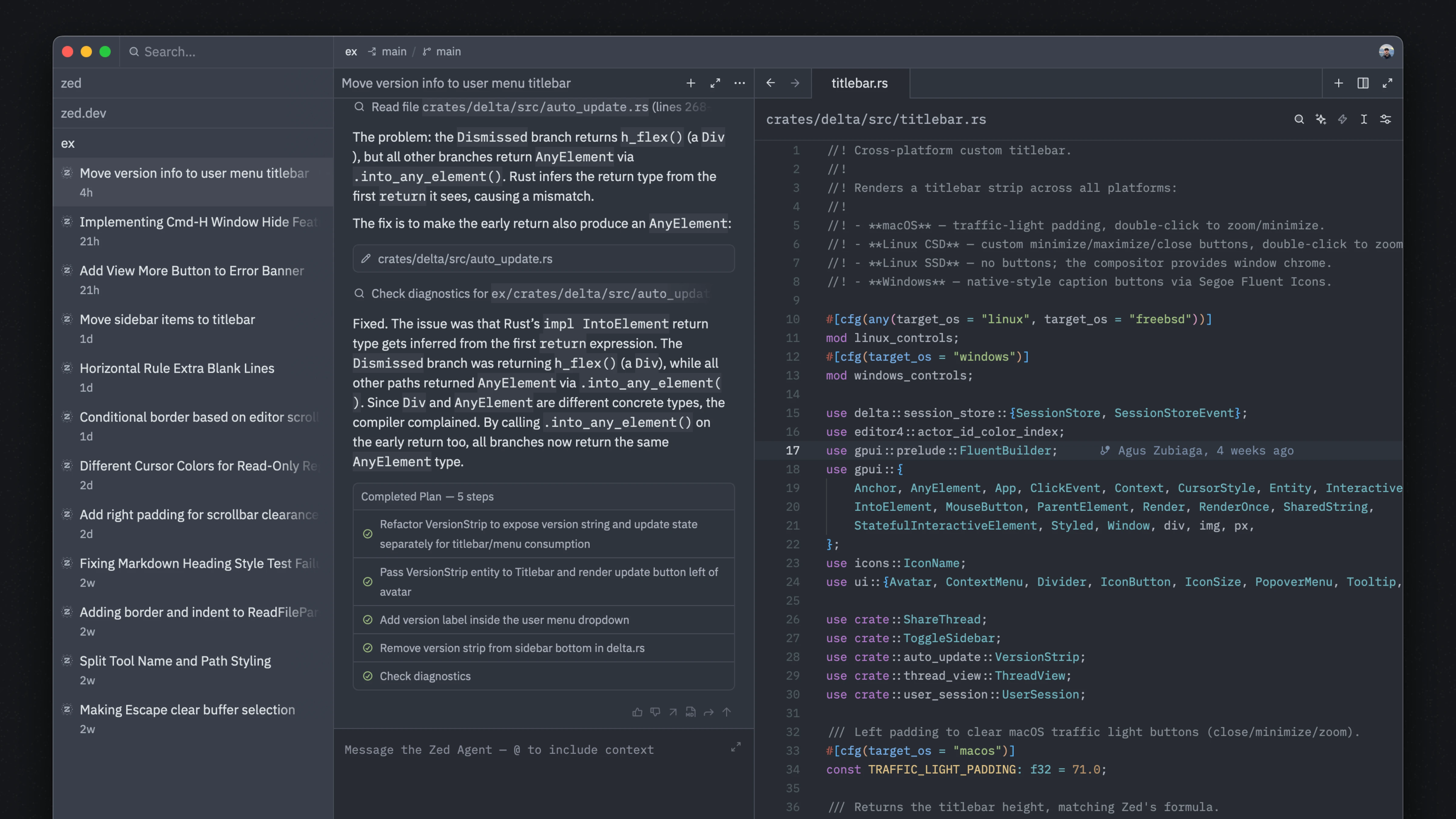
Notice the GPL-3.0-or-later line: Zed’s README says its source is licensed primarily under GPL-3.0-or-later with Apache-2.0 components where marked. The editor is open source; Zed’s hosted AI service and Delta are services with their own terms.
91,000 GitHub stars, a Series B, and a 2,153-point Hacker News launch.
zed-industries/zed, live API, Oct 3, 2026; repo created Feb 2021. Stars are interest, not users.
690 comments, Apr 29, 2026 (Hacker News). Points are votes on a post, not adoption.
From Zed’s 1.0 post; unaudited and self-reported.
Led by Sequoia (Aug 2025), total funding above $42M per the Business Wire announcement coverage.
| Date | Event | Source |
|---|---|---|
| Sep 24, 2025 | Pricing moves from prompts to tokens: Pro $20 with 500 prompts becomes $10 with $5 of tokens | Zed blog |
| Mar 2, 2026 | Terms of service update: 18+ for AI SaaS, arbitration, Delaware law, open-source clarification | Zed blog |
| Mar 2026 | Gram, a fork of Zed with AI, telemetry and accounts removed, is released citing the AI features and terms | LWN and others |
| Apr 22, 2026 | Parallel Agents and the Threads Sidebar | Zed blog |
| Apr 29, 2026 | Zed 1.0 | Zed blog |
| May 20, 2026 | Terminal Threads | Zed blog |
| Aug 5, 2026 | Agent sandboxing for terminal and fetch tools (default since Zed 1.14) | Zed blog |
| Aug 12 / Sep 16, 2026 | Delta announced, then public beta | Zed blog |
| Sep 30, 2026 | Stable 1.22.0: BYOK for newer models, subagent model selection | Zed releases |
Passionate fans, honest gaps in IDE depth and Linux, and visible anxiety about Delta and AI.
“Congrats to the Zed team for building the best modern editor I have ever used. I subscribe to the monthly plan just to give you guys the funding you need… since Zed I haven’t really opened any of those [JetBrains] IDEs in a long time, other than maybe Rider.” — giancarlostoro. Another: “My daily driver is Zed developing on SSH remote servers… File editor, terminal, agents, SSH remotes. And it’s fast and intuitive.” — nzoschke.
“I’ve tried switching from JetBrains IDEs just a few days ago. The speed and memory footprint are very impressive. I ended up badly missing refactorings and some other features and configuring a debugging session looked like something that needs more time than I had… So went back for now.” — entropyneur. And: “Multiple issues on Linux and high memory usage makes it a worse alternative to vscode and jetbrains.” — throwa356262.
“Another Zed post, another plea to focus on basics… best luck to Delta but please do not neglect the text editor!” — NoDodgeQuestion. And: “I see Zed abandoned their principles regarding AI. Shame, I really do like the editor.” — slopinthebag. A more positive reading: “every time they publish a new product release, it’s always very compelling.” — quux0r.
$0, $10 or $30 — and the editor plus external agents are free either way.
Verified live at zed.dev/pricing on October 3, 2026. The key design choice is that Zed doesn’t charge for External Agents (the docs say billing, terms and retention for those are between you and the agent provider), and the free plan allows unlimited use with your own API keys.
Personal
The editor, 2,000 accepted edit predictions, and unlimited use with your own API keys or external agents.
Pro
Unlimited edit predictions and $5 of tokens each month; beyond that, usage at API list price plus 10%, charged at month end or every additional $10, whichever comes first. 14-day trial with no card, per the page.
Business
Unlimited edit predictions, org-wide AI model policies and data-governance controls, unified spend visibility and role-based access. No bundled LLM credits; usage-based or bring your own keys. No minimum seats; order forms at 25+ seats.
| If you are... | What verified pricing means | Cheapest sensible path |
|---|---|---|
| Already paying for Claude, Codex, Copilot or Gemini | External agents cost nothing extra in Zed | Personal ($0) with the agent you have |
| A light user who wants hosted models | $5 of tokens included in Pro | Pro at $10; watch overage at list +10% |
| A heavy agent user with your own keys | BYOK is unlimited on the free plan | Personal ($0); you pay the provider directly |
| A team needing governance | Business adds model policies and RBAC; no bundled credits | Business at $30 per seat plus usage or BYOK |
Pricing verified Oct 3, 2026. No affiliate link or discount is implied.
Where Zed fits in 2026.
Zed Personal plus an external agent is the cheapest strong setup on this list.
Reports from switchers say you may miss them. Compare Cursor or stay in your IDE.
The Threads Sidebar and terminal threads are the reason to try Zed.
Zed documents a
disable_ai setting (blog, Jul 2025), and the Gram fork exists; it is a legitimate reason to look elsewhere.One window, many agents, each in its own thread and, if you want, its own worktree.
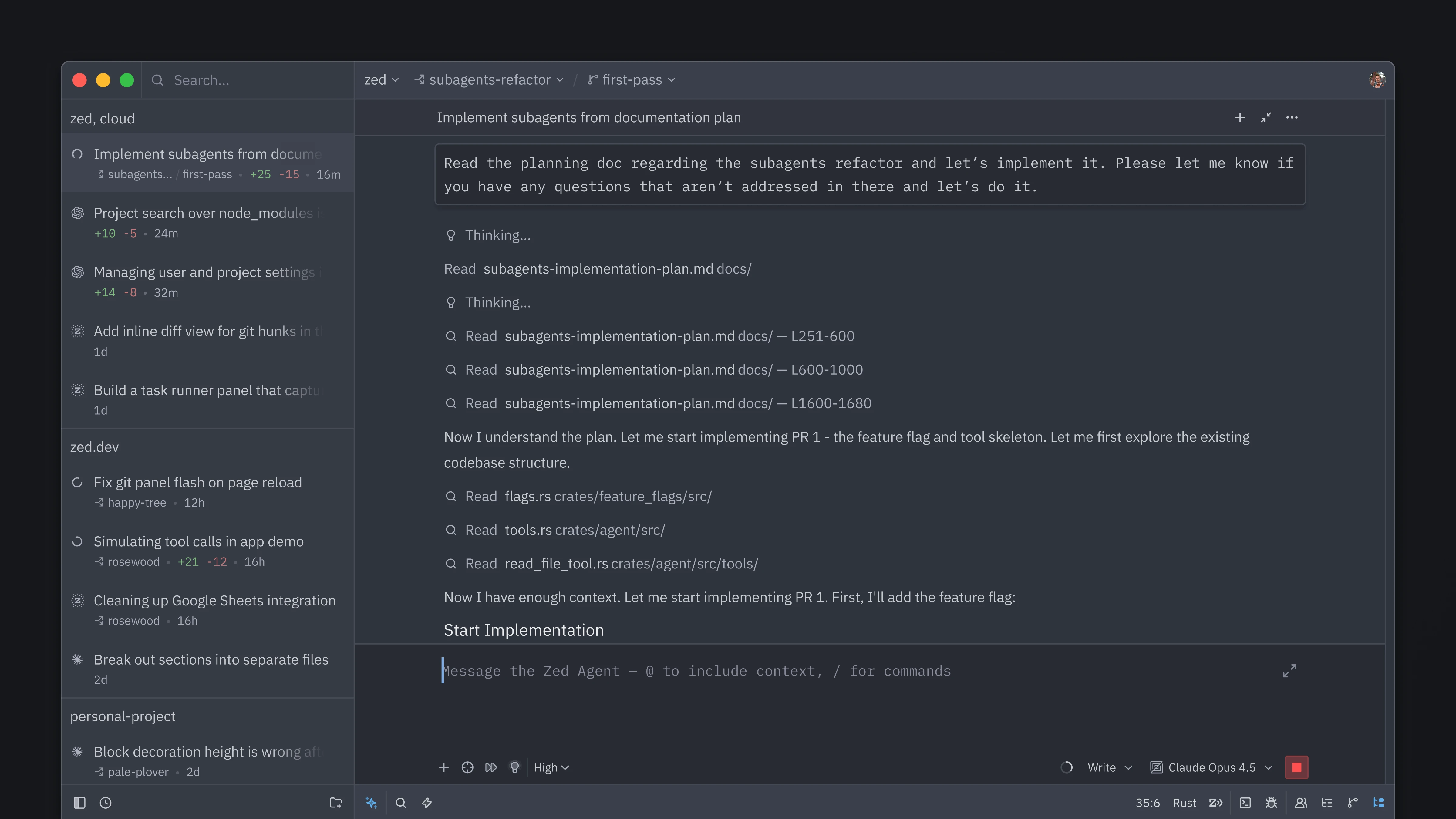
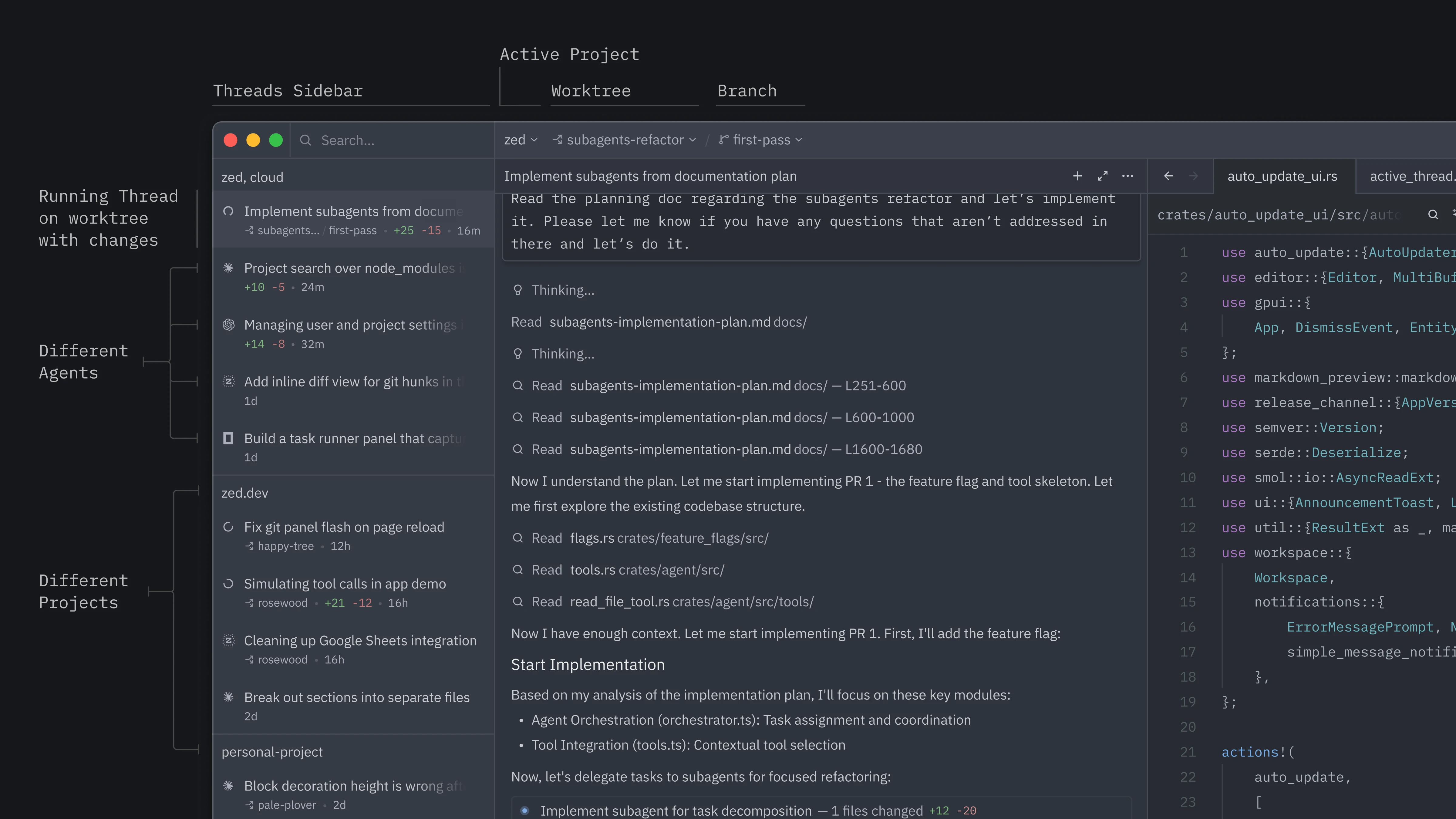
Introduced on April 22, 2026, the Threads Sidebar lets you run multiple agents in parallel inside a single Zed window: mix agents per thread, control folder and repository access per thread, watch activity in real time, work across multiple projects, and isolate worktrees when needed. It docks on the left beside the Agent Panel; the shortcut is option-cmd-j on macOS and ctrl-option-j on Linux and Windows. Zed pitches it as “agentic engineering”: craft plus agents, not full automation and not AI avoidance.
| Agent type | Who owns runtime, auth and billing | Examples (docs, curated list) |
|---|---|---|
| Zed Agent | Zed hosts the loop; models via Zed-hosted plans, your keys, local models or gateways | Any configured model |
| External Agent (ACP) | The agent owns its runtime, auth, model choice and tools; Zed hosts the thread UI | Claude Agent, Codex, Gemini CLI, OpenCode, Copilot, Cursor, Pi, Poolside |
| Terminal Thread | A CLI/TUI agent runs in a thread; billing is with that agent | Amp (in Zed’s own post), others |
- Open protocol: ACP has 4,363 GitHub stars (Apache-2.0) and a registry opened inside Zed.
- No Zed fee for external agents; free BYOK.
- Weekly stable releases (1.19.2 on Sep 9 to 1.22.0 on Sep 30).
- An external agent’s privacy and retention are the agent provider’s, not Zed’s.
- Parallel agents multiply review work: you are the bottleneck.
- Zed’s own sandbox does not cover ACP agents (see Security).
Start a thread, pick an agent, review the diff in the same window.
The documented loop is short: open a thread from the sidebar, choose the Zed Agent, an external agent or a terminal, give it a task and folder access, then review the changes as multibuffer diffs inside the editor. Zed’s homepage cites a user praising “multibuffers, inlay hints, collaboration” — the review half of that loop is where an editor-first approach pays off.
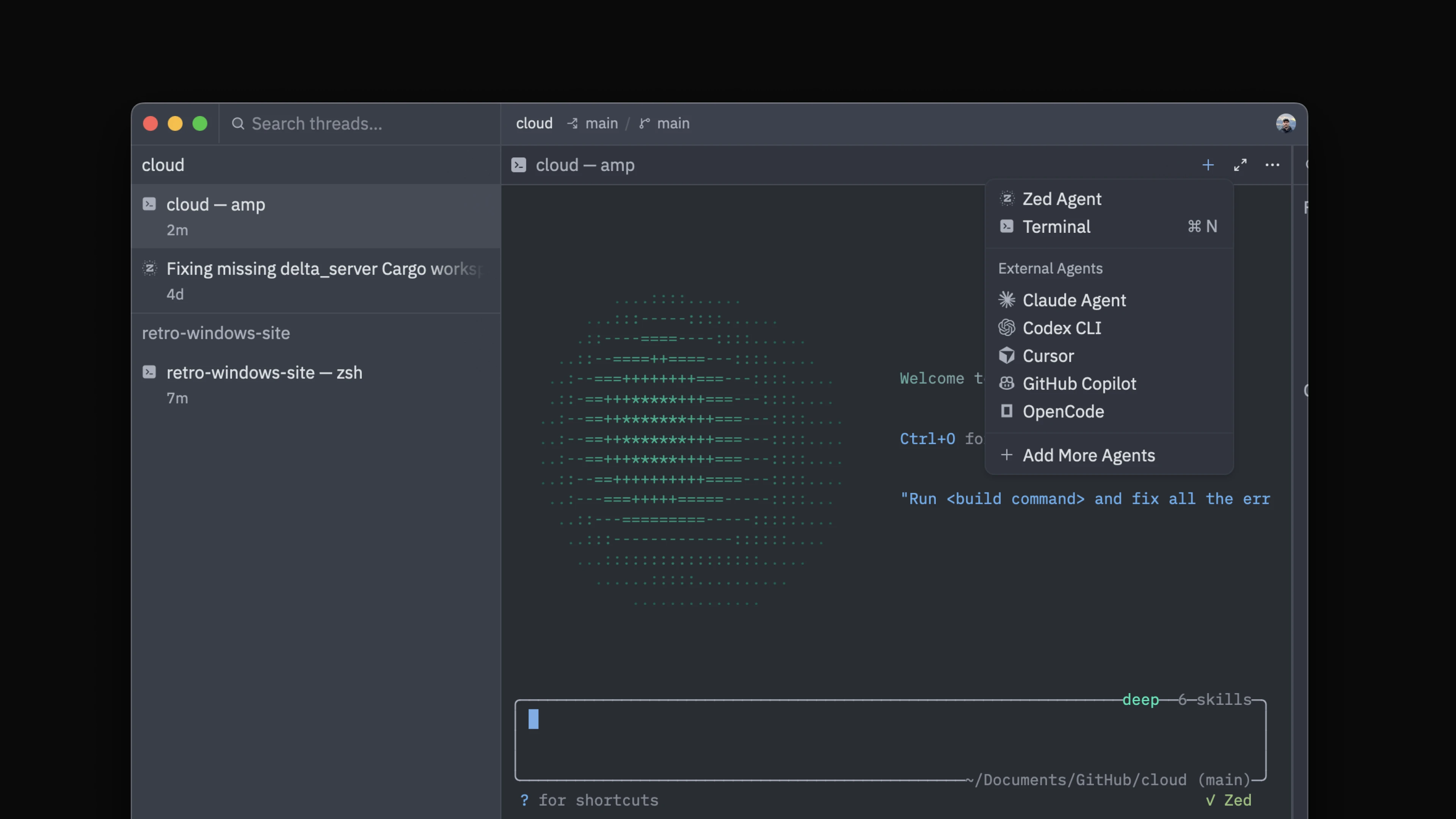
See it in Zed’s own words
Official video from Zed’s own YouTube channel (channel UCXYwRX_RB_qQ7sij1sgW-Cg, channel name “Zed Industries”), about seven minutes, published Apr 23, 2026. It demonstrates the Threads Sidebar described above.
Zed’s second product tries to replace the pull request. Its own team already has.
Delta was announced August 12 and entered public beta on September 16, 2026. Zed describes it as a multiplayer environment for coding with agents: a thread replaces the pull request, holding edits, the agent’s reasoning and teammates’ comments as one linked record; review happens in subthreads with isolated worktrees. It’s built on DeltaDB, a Git-compatible store that records deltas between commits. It runs on macOS, Linux, Windows and the web, is free during the beta with paid plans to follow (“a free version will always exist”), and Zed says its own 33 developers have merged 570 changes after switching off pull requests on Delta’s repository.
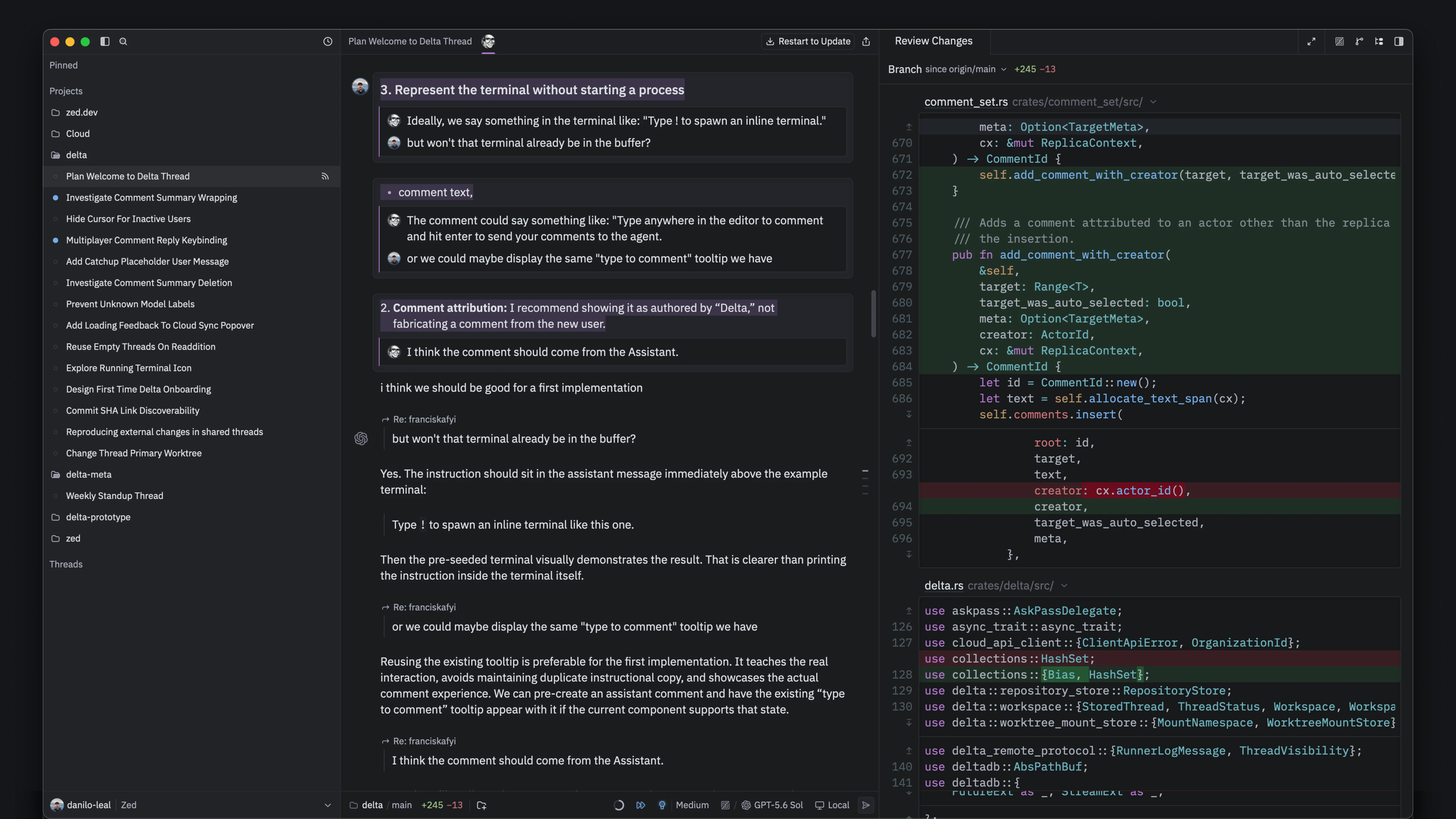
Zed’s own caveats are worth repeating: Delta is a separate product from the editor, not feature-complete, and its CI/CD integration currently means triggering existing external CI. The Hacker News reaction was mixed: skeptics asked who it is for and whether reading AI summaries beats reading code; admirers liked the ambition. I treat Delta as a bet on where Zed’s attention is going, not as a reason to choose the editor.
MCP servers, an open agent protocol, and a registry.
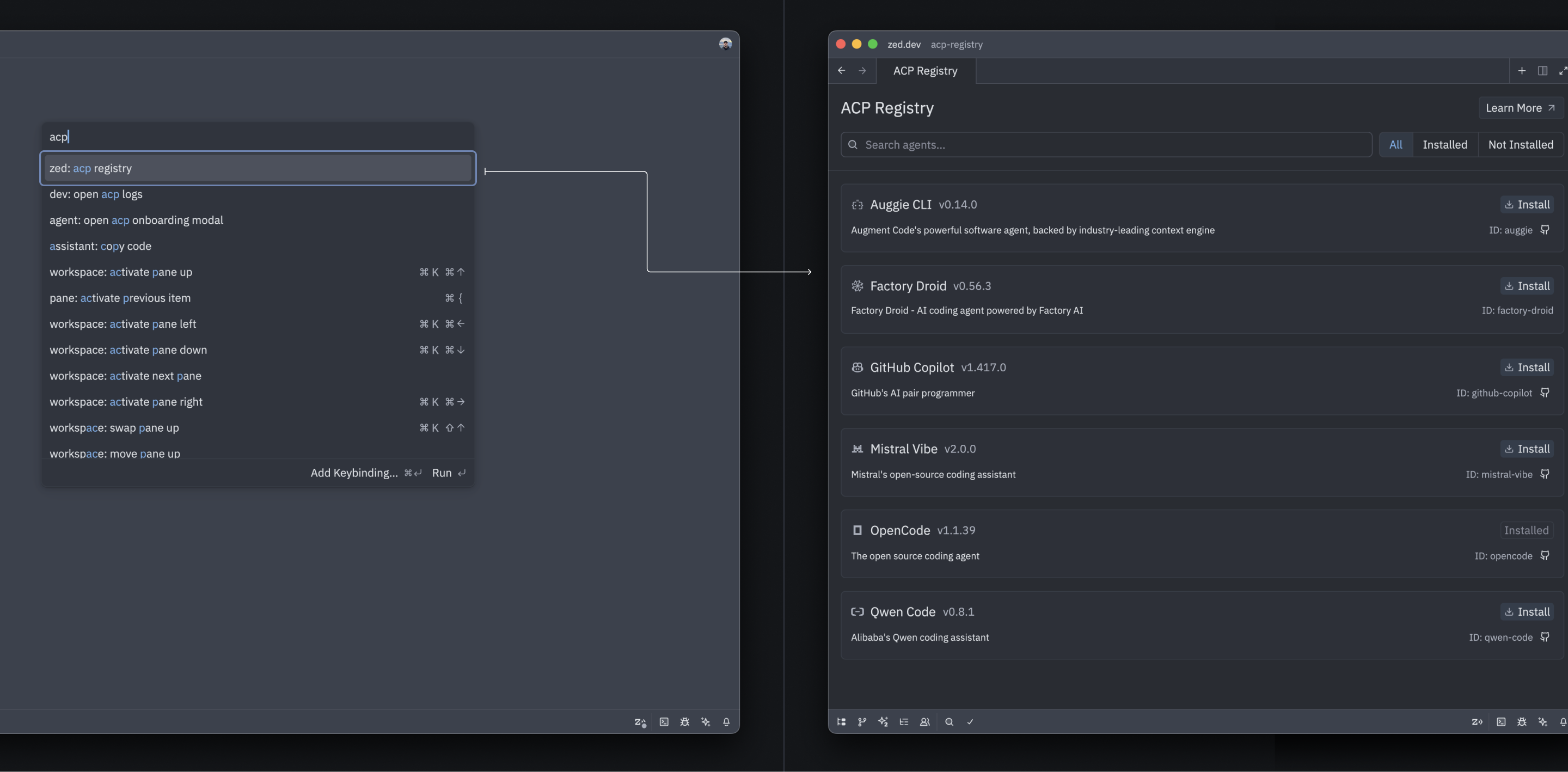
Zed supports MCP servers, built-in tools, profiles and skills, and exposes models through multiple paths: hosted, API keys, subscriptions, gateways and local models. The Agent Client Protocol is the integration that stands out: agents run as separate processes and talk to Zed over ACP, and an ACP Registry (opened with a command-palette action) lists installable agents such as Auggie CLI, Factory Droid, GitHub Copilot, Mistral Vibe, OpenCode and Qwen Code in Zed’s own screenshot.
| Integration | Detail | Source |
|---|---|---|
| ACP agents | Claude Agent, Codex, Gemini CLI, OpenCode, Copilot, Cursor, Pi, Poolside (curated list) | Zed docs |
| MCP | Servers supported alongside built-in tools | Zed docs |
| GitHub Copilot Chat | Billing moved to token-based GitHub AI Credits on Jun 1, 2026; heavy agent use may cost more; completions unaffected | Zed blog, Jun 1, 2026 |
| Context for any editor | Augment’s Context Engine MCP documents a Zed quickstart | Our Augment Code review |
For how MCP connectors work in practice, see our Claude MCP & Connectors guide.
Zed’s pricing logic: be cheap, pass through model cost, take 10%.
Zed has no public API for the editor, but the economics are unusually legible. In its September 2025 pricing post the company wrote that “LLM bills have become our biggest expense,” and moved from prompt-counting to token billing at API list price plus 10%. That honesty cuts both ways: it explains why free BYOK is unlimited (Zed doesn’t pay the bill) and why hosted usage past $5 isn’t subsidized.
| Meter | Personal | Pro | Business |
|---|---|---|---|
| Price | $0 | $10 / month | $30 / seat / month |
| Edit predictions | 2,000 accepted | Unlimited | Unlimited |
| Hosted tokens | None included | $5 included, then list +10% | No bundled credits; usage-based |
| Bring your own keys / external agents | Unlimited | Yes | Yes, with org policies |
Sandboxed by default for Zed’s own agent — with limits Zed spells out itself.
Zed doesn’t keep prompts or code by default; for Zed-hosted models its provider agreements require zero data retention for inference (with provider-designated safety-retention exceptions), and data is kept only if you opt in — for example with response ratings or by contributing open-source edit-prediction training data. The March 2026 terms update restated: “We don’t sell your data and we don’t allow AI providers to train on it.” Business adds org-level privacy enforcement and admin controls.
The sandbox is newer: enabled by default since Zed 1.14, it constrains the agent’s terminal and fetch tools — no writing outside project directories, no touching .git, no network without permission — using Seatbelt on macOS, bubblewrap on Linux, and WSL only on Windows. When the agent needs more, you are prompted: allow once, for this thread, always, or deny.
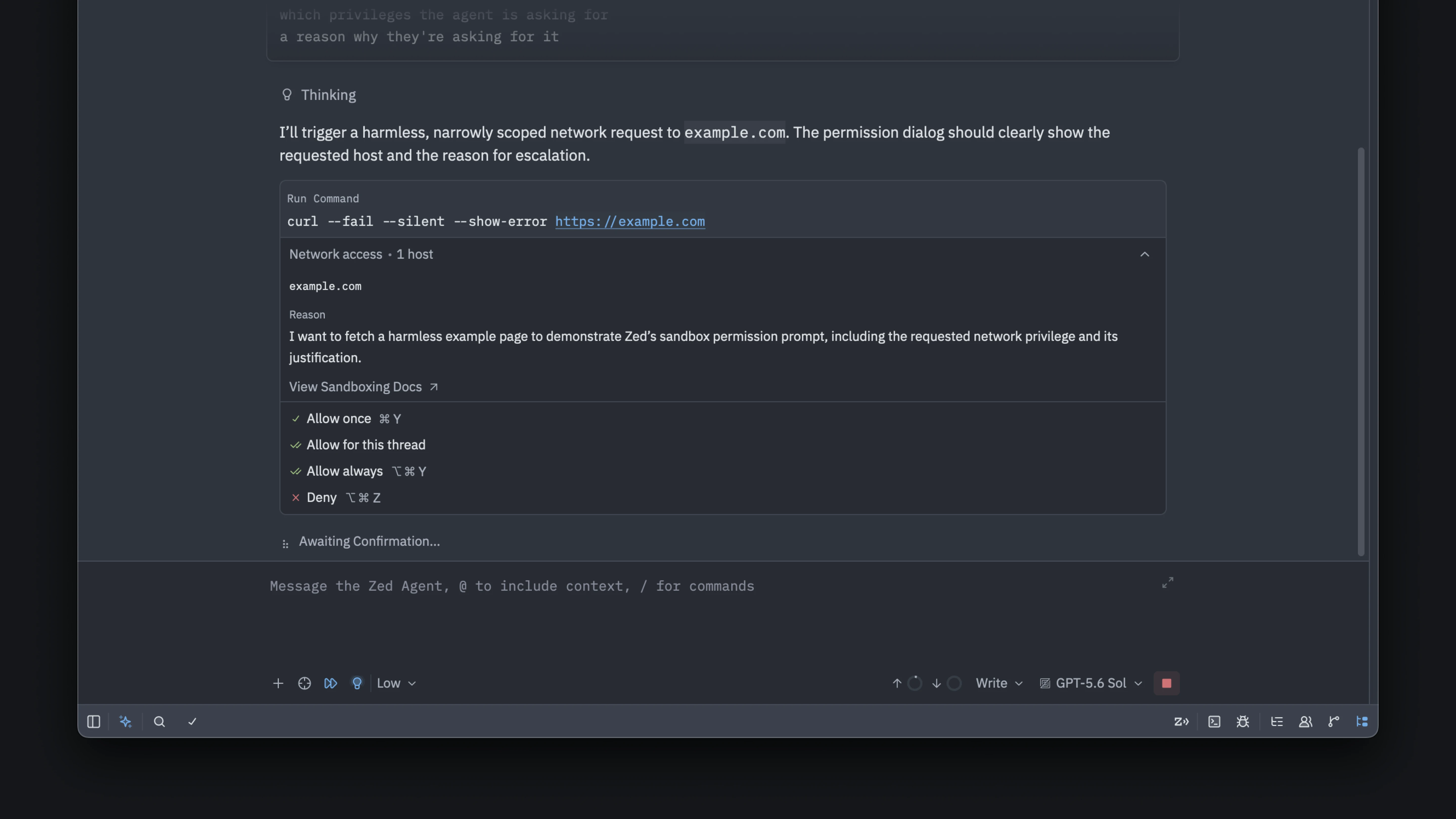
Developers who value speed and want to choose their own agents.
| Your situation | Fit | Likely plan |
|---|---|---|
| Rust, Go, TypeScript or Python dev who wants a fast editor | Strong | Personal |
| Already has Claude, Codex or Copilot access | Strong — external agents at no extra Zed cost | Personal |
| Wants hosted models without keys | Good | Pro ($10) |
| Needs deep JetBrains-class refactoring and debugging | Weaker, per switchers’ reports | Keep the IDE; use Zed as a second editor |
| Engineering team needing policy and spend visibility | Good | Business ($30 per seat) |
| Strongly anti-AI | Possible — AI can be disabled; Gram fork exists | Personal, AI off |
Six real, current limitations.
Switchers report missing refactorings and a heavier debugging setup; a pure editor, as one commenter notes, has less to offer over Emacs than a full IDE.
Some HN users report Linux issues and high memory use; I did not benchmark this.
Delta (pull-request replacement), DeltaDB and agent features compete with editor basics; users said so in public.
The March 2026 ToS added 18+ for AI SaaS, binding arbitration with a 30-day opt-out and Delaware law; a fork (Gram) was created partly over terms.
Zed’s sandbox doesn’t cover the edit tool, ACP agents, LSP or MCP servers, and on Windows it needs WSL.
Pro changed from $20 and 500 prompts to $10 and $5 of tokens in Sep 2025, with a migration deadline of Dec 17, 2025; token billing makes heavy use less predictable.
Map your reason for looking elsewhere to a tool.
| If you mostly need... | Compare with... |
|---|---|
| A VS Code-based AI editor with its own agent | Cursor — Cursor review |
| An open-source agent inside VS Code | Cline — Cline review |
| The mainstream all-IDE default | GitHub Copilot — GitHub Copilot review |
| A terminal agent that also runs inside Zed | Claude Code — setup guide; Gemini CLI — review |
| A context layer for large codebases | Augment Code — Augment Code review |
| Air-gapped, governed enterprise AI | Tabnine — tabnine.com (official site; now redirects to Tricentis) |
| AWS-aligned assistant (being retired) | Amazon Q Developer — AWS product page (official) |
No affiliate relationship shapes this review.
JAVIS has no affiliate arrangement with Zed Industries. Every CTA points to zed.dev or a live JAVIS review. This is a VERIFIED EDITORIAL REVIEW: I read official docs, release notes and community threads; I did not run a controlled hands-on test.
Free download for macOS, Linux and Windows.
Download ZedZed’s own pricing page.
zed.dev/pricingZed makes most sense next to the agents it hosts and the editors it competes with.
If you’re building a setup rather than picking one tool, these are the six reviews I’d read next.


Questions people are actually searching right now
Is Zed free?
Yes. The Personal plan is $0 forever, with 2,000 accepted edit predictions and unlimited use with your own API keys or external agents.
How much is Zed Pro?
$10 per month with unlimited edit predictions and $5 of tokens included; extra usage is billed at API list price plus 10%. A 14-day trial is offered without a card.
Is Zed open source?
The editor is. Zed’s README says the source is licensed primarily under GPL-3.0-or-later, with Apache-2.0 components where marked. Hosted AI and Delta are services with separate terms.
Which AI agents work in Zed?
The Zed Agent plus external agents over ACP — the docs list Claude Agent, Codex, Gemini CLI, OpenCode, Copilot, Cursor, Pi and Poolside, and say the list is curated, not exhaustive.
Does Zed train on my code?
Per its docs, no by default: Zed doesn’t retain prompts or code unless you opt in, and its hosted-provider agreements require zero data retention for inference with noted exceptions.
What is Delta?
A separate multiplayer product from the same company that replaces pull requests with agent threads. It entered public beta on September 16, 2026, is free during beta, and Zed says it is not feature-complete.
Does Zed run on Windows and Linux?
Yes: macOS, Linux and Windows are supported. Sandboxing on Windows works only through WSL.
What is Gram?
A fork of Zed with AI, collaboration, telemetry and accounts removed, released in March 2026 by Kristoffer Grönlund.
Where this came from, and when it was checked.
Pricing and plans: zed.dev/pricing, official, checked Oct 3, 2026; history from zed.dev/blog/pricing-change-llm-usage-is-now-token-based (Sep 24, 2025).
Releases: zed.dev/releases/stable and the GitHub releases API (v1.22.0, Sep 30, 2026).
Features, agents, privacy: zed.dev/docs/ai/overview, /external-agents, /privacy-and-security; blog posts on Zed 1.0 (Apr 29, 2026), Parallel Agents (Apr 22), Terminal Threads (May 20), Sandboxing (Aug 5), ACP Registry, Delta (Aug 12, Sep 16), Terms update (Mar 2, 2026), Copilot billing (Jun 1).
Open source and stats: GitHub data for zed-industries/zed (91,235 stars; README licensing text), agentclientprotocol/agent-client-protocol (4,363 stars), live Oct 3, 2026.
Community: Hacker News threads 47949027 (Zed 1.0), 49276574 (Delta), 49727245 (Delta public beta), on Hacker News; The New Stack coverage of Delta; LWN and others on Gram.
Funding: Business Wire coverage of the Aug 2025 Series B; not independently audited.
Official video: Zed Industries channel, video OLit5C1XE0k (published Apr 23, 2026).
Fit score method: JAVIS editorial composite of five 20-point criteria — editor speed and craft 18, agent openness and flexibility 17, price and value 16, IDE depth and ecosystem 11, trust and controls 12 = 74. It is an opinion, not a benchmark.