
Pydantic AI Review 2026: A Free, Typed Python Agent Framework That Ships Every Two Days, Now on a v2 Line With a Paid Logfire Companion
Pydantic AI is the agent framework from the team behind Pydantic, the validation library most Python AI code already imports. It is MIT-licensed and free: you pay your model provider for tokens, and nothing else unless you add Pydantic Logfire, the team's hosted observability product. The v2 line became stable on Jun 23, 2026, and the maintainers published 15 releases in the 30 days to Oct 27 (v2.63.0 is the latest). GitHub lists 19 published security advisories for 2026, three of them dated Oct 20 and Oct 21. This review covers what the framework does well (typed outputs, many providers, durable execution, evals), what it costs at four team sizes, how the v1 to v2 move works, what the issue tracker and advisory list show, and what developers say.
There are no affiliate links in this review. Every Pydantic link goes straight to the official docs, the pricing page or the GitHub repository.
| Made by | Pydantic Services Inc., the team behind Pydantic |
| What it is | Open-source Python framework for typed LLM agents, with evals and graph packages |
| Framework | Free, MIT; latest v2.63.0 (PyPI, Oct 28, 2026); Python 3.11+ |
| Logfire | Personal $0; Team $49 a month; Growth $249; Enterprise custom |
| Usage | 10M records included, then $2 per million on Team and Growth |
Pydantic AI is the strongest pick for Python teams that want typed, testable agents without a platform bill. Budget for upgrades, because it moves fast.
“Pydantic AI is the Python AI SDK: a typed, extensible agent loop with every model a string swap away.” That is the docs' own line, and the evidence below mostly supports it.
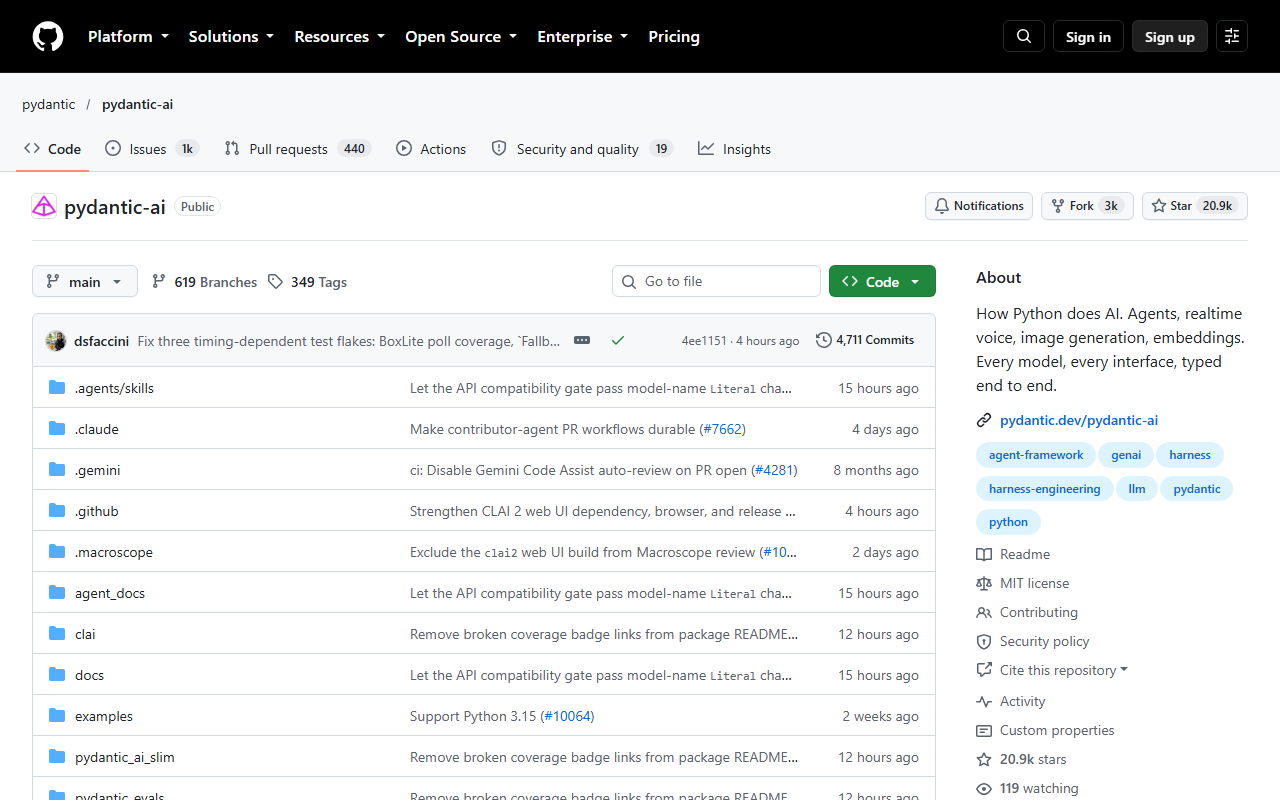
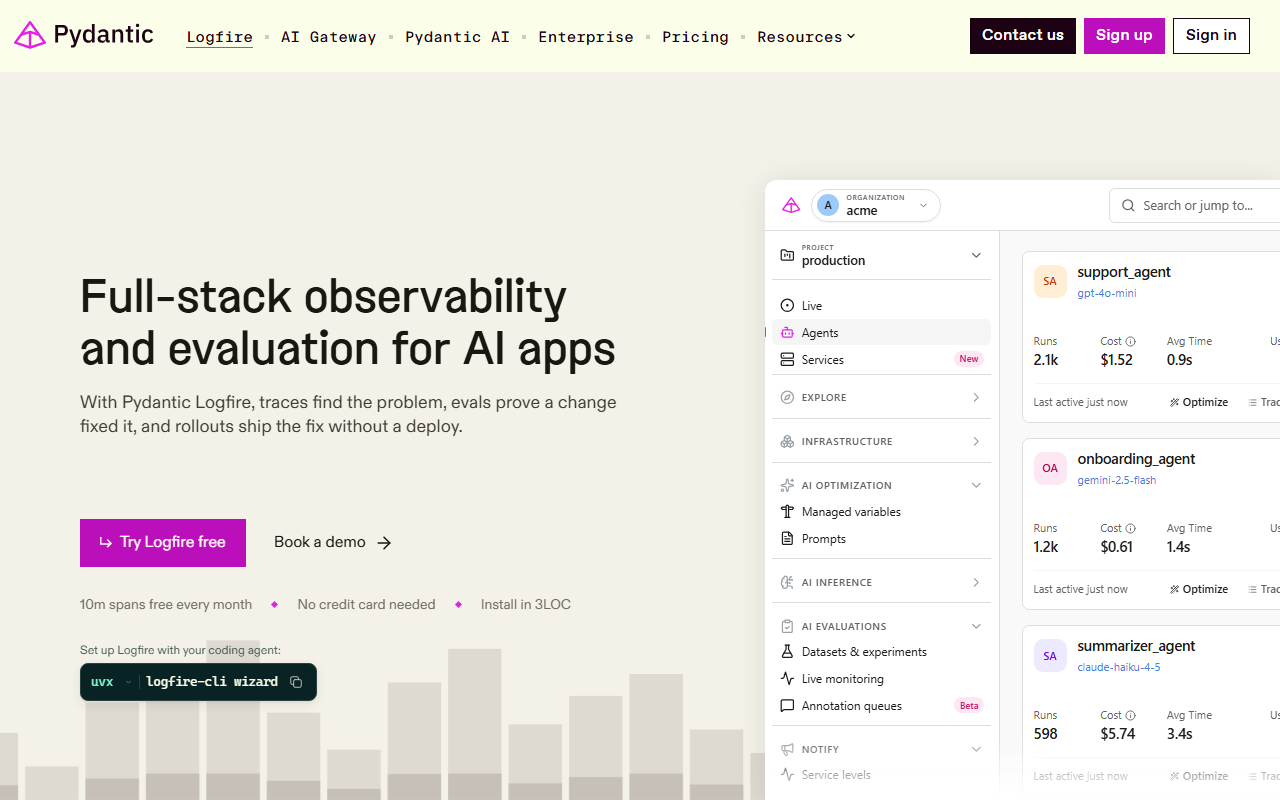
The framework itself costs nothing: 20,926 GitHub stars, an MIT licence, and 30.0M PyPI installs of pydantic-ai-slim in the 30 days to Oct 27, 2026. The only paid product around it is Logfire, and it is optional: Pydantic AI emits plain OpenTelemetry and the docs show it running against other backends. Logfire's Personal plan is free and hard-capped, so a solo developer cannot be billed. A five-person team sending 3 million spans a month pays $49 flat; at 20 million spans and 8 seats the Team plan costs $144 and Growth costs $269.
The catches are real and they are mostly about pace. The v2 line has been stable only since Jun 23, 2026, and 81 non-prerelease versions have shipped since. GitHub lists 19 published security advisories for the repository, all dated 2026 and all with a patched version, four of them published in October. In January the lead maintainer wrote on GitHub that the team is “dropping the expectation that every single issue/PR will get human attention”, and today 1,110 issues and 469 pull requests are open. A bare install also ships the Logfire client library, and the first run prints a banner that points to Logfire until you configure instrumentation (it can be switched off).
Developers who write about it are mostly positive, usually about typed outputs and provider abstractions, with one early complaint that structured output worked better for the commenter with a hand-built prompt. There is no independent star rating to quote.
Not a hands-on test: JAVIS has not built an agent with Pydantic AI, opened a Logfire account or paid for a plan for this review. It is built from the official documentation, upgrade guide and version policy, the Logfire pricing page, the GitHub repository, releases and advisory list, PyPI metadata and download counters, Hacker News and the official YouTube channel, all as of Oct 28, 2026. We have not reviewed Logfire's terms or privacy policy; read them before sending production prompts to a hosted service.
One typed Agent object, any model by name, and separate packages for evals, graphs and ready-made capabilities.
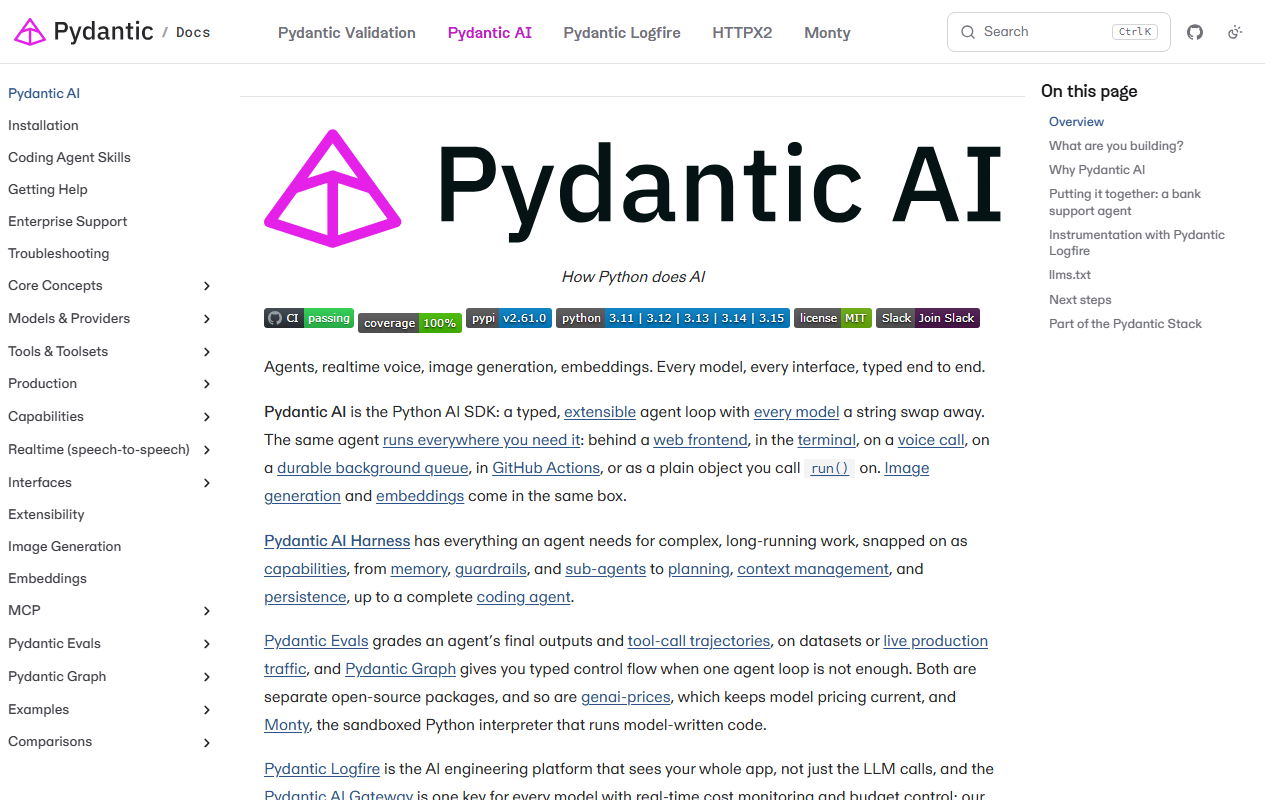
Pydantic AI is a library, not a hosted service. You install it with pip install pydantic-ai (Python 3.11 or newer), create an Agent with a model string such as 'anthropic:...', give it tools and an output type, and call run(). The docs say the same agent can sit behind a web frontend, in a terminal, on a voice call, on a durable background queue or in GitHub Actions.
Two version facts that confuse newcomers. The pydantic-ai package is a thin bundle that pins pydantic-ai-slim to the same version and adds the OpenAI, Anthropic and Google clients plus the CLI, MCP, Evals, Web UI and Logfire integrations; pydantic-ai-slim is the engine. And the docs have moved: ai.pydantic.dev now redirects to pydantic.dev/docs/ai/.
Third on installs in this set of agent frameworks, with a fraction of LangChain's stars and a very active repository.
pydantic/pydantic-ai, Oct 28, 2026; 3,045 forks
pydantic-ai-slim, Sep 28 to Oct 27, 2026
12 on v2, 3 on v1, since Sep 28, 2026
228 issues carry the bug label
The repository was created on Jun 21, 2024, and Pydantic AI reached v1 in September 2025. GitHub's counters show 4,942 commits and 643 contributors (counting anonymous ones). In the 30 days to Oct 28, 1,394 pull requests were merged, 822 issues were opened and 605 were closed, so on those numbers the backlog grows by about 217 issues a month.
Downloads are the hardest adoption number available, with the usual warning that CI servers and dependency installs inflate them. PyPI's counts (mirrors excluded) for Sep 28 to Oct 27, 2026: pydantic-ai-slim 30,031,974, the bundle pydantic-ai 6,345,332, pydantic-evals 9,734,415, against 161,912,296 for langchain, 53,803,864 for langgraph and 15,290,971 for openai-agents. The slim package is a dependency of the bundle, Evals and Harness, so its figure includes installs made through those packages and through projects that build on it.
No review-site rating exists. Hacker News mostly likes the typed approach, with an early complaint and a worry about VC backing.
This review quotes no review-site star rating for Pydantic AI, because the evidence is limited to GitHub, Hacker News, one blog write-up and the vendor's own pages. Hacker News comment search for “pydantic ai” since Jan 1, 2026 shows 292 results on Oct 28, 2026, and most are job posts and tool lists. The biggest thread centred on the framework is Martin Fowler's article on building a CLI coding agent with Pydantic-AI, which reached 197 points and 40 comments (Aug 28, 2025). The opinions below are the ones with substance, each one person's account with its comment id and date.
What people like
After maintaining their own agents library, switched to Pydantic AI, has “minor nits” but says it has been working great, especially combined with Langfuse.
In a thread about DSPy, says its agent loop was poor and that using pydantic-ai is “night and day”; wishes it were more popular.
Says LangChain is hopelessly spaghettied and that their current go-to is Pydantic AI, which is “doing pretty well” for their use cases.
Finds Pydantic AI has a great set of abstractions over LLM providers, nice even on their own, apart from the agent loop the docs focus on.
Replaced OpenCode with a thin wrapper around Pydantic-AI for non-interactive use, and values the tiny surface area it keeps.
Thinks the framework is right to encourage agent delegation and sequential workflows first and steer people away from graphs.
What people question
Wanted to love it, but says structured output worked better with a hand-built prompt than through Pydantic AI “regardless of the number of retries”; kept the dependency hoping it improves. One person's experience in 2025.
Calls pydantic-ai a superb addition to the AI engineering toolkit, but wonders about Pydantic being a VC-backed company and how load-bearing it is for the Python ecosystem.
A balanced reading: the praise is about design (typed outputs, small surface area, provider abstractions). The one detailed complaint is more than a year old and about one setup; newer releases may differ, and we did not test it. One outside write-up exists beyond Hacker News: a blog review on alatirok.com by Surya Koritala, last updated May 31, 2026 and based on v1.104.0, rates the framework 5 out of 5 and advises pinning versions because releases are frequent. It describes itself as hands-on but draws most of its figures from public sources, so treat it as one more opinion, not an independent benchmark.
The framework is free. Logfire is $0 on Personal, $49 a month on Team and $249 on Growth, with the same $2 per million records on both paid plans.
Personal
Free, forever, no card
- 10M records a month, hard-capped at $0
- 3 projects, 30-day retention
- 1 seat and 2 read-only guests
Team
5 seats included
- 10M records, then $2 per million
- $25 per extra seat; 10 guests
- AI output evaluations and human review
- 30-day retention
Growth
Unlimited seats
- Everything in Team
- Up to 90-day retention
- Priority support, boilerplate BAA
- Public API, self-service data deletion
Enterprise
Cloud, Dedicated or Self-hosted
- SSO, SCIM, custom roles
- Custom retention and SLA
- Self-hosted Helm chart option
Swipe sideways to see all plan columns.
| Limit | Personal | Team | Growth | Enterprise Cloud |
|---|---|---|---|---|
| Seats | 1 | 5, then $25 each (up to 12) | Unlimited | Unlimited |
| Projects | 3 | 5 | Unlimited | Unlimited |
| Extra usage | Not allowed | $2 per M | $2 per M | Custom |
| Retention | 30 days | 30 days | Up to 90 days | Custom |
| Query requests a day | 500 or fewer | 500 or fewer | 5,000 or fewer | Custom |
| Gateway, built-in providers | 5% markup | 5% markup | 3% markup | 3%, add-on |
| Gateway, your own keys | Up to 3, 0% | Up to 3, 0% | Unlimited, 0% | Unlimited, 0% |
| SSO and SCIM | No | No | No | Yes |
| BAA (HIPAA) | No | No | Boilerplate | Custom |
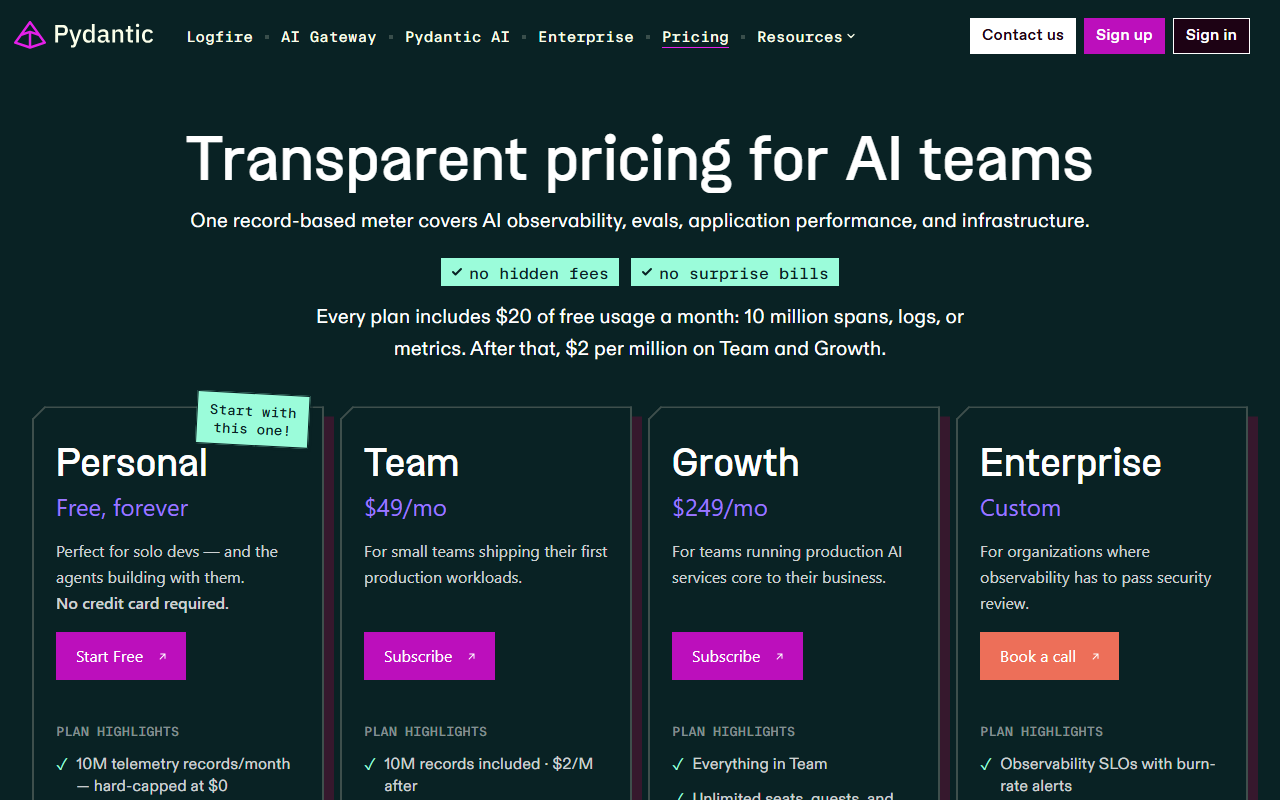
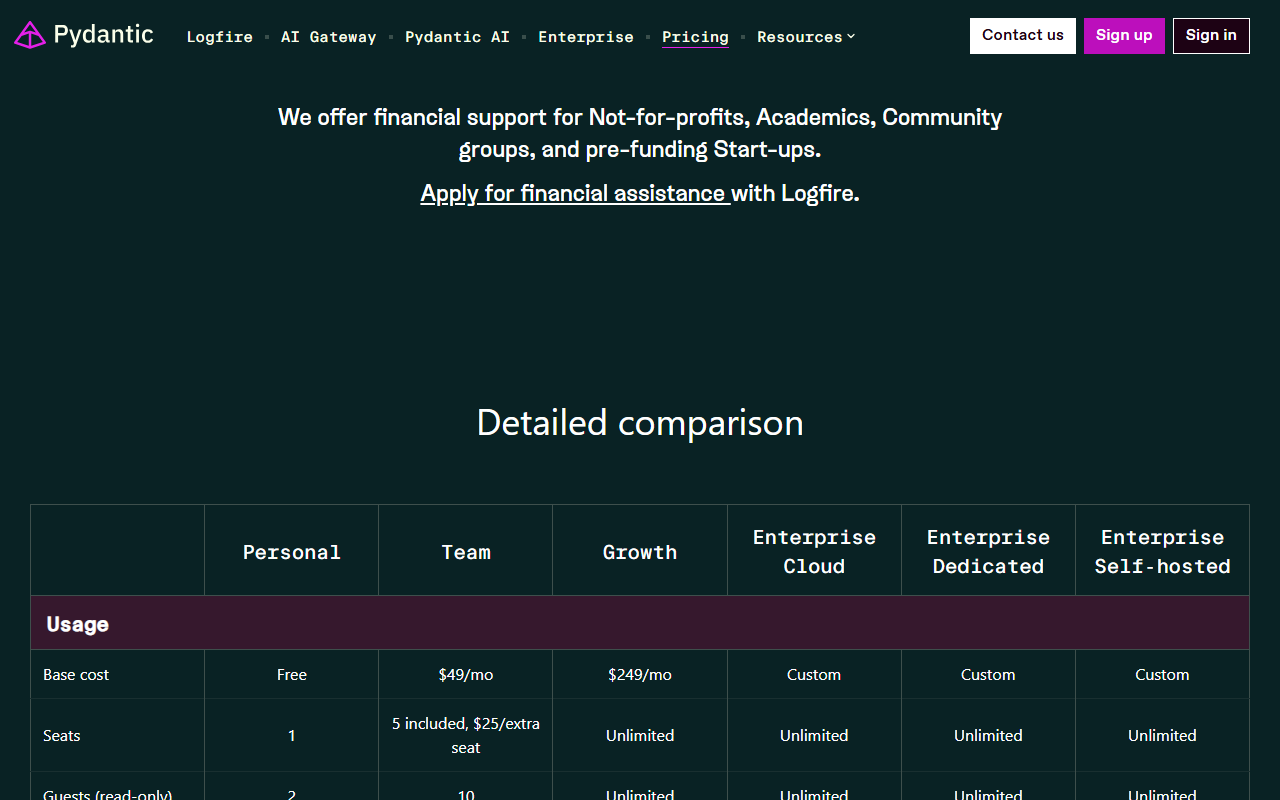
Rules worth quoting. On Personal, “if you go well over the free allowance, we’ll eventually stop ingesting new data”, and ad-hoc payment for extra records is not available there; you must upgrade. The FAQ also says free-tier accounts with extra users or more than 3 projects will be asked to upgrade, and that ingestion will eventually be suspended otherwise.
Four invented workloads on the published prices: a solo developer pays $0, and a heavy 10-person team still pays less on Team than on Growth.
Everything below is arithmetic on the prices above. The workloads are invented to show the sums, and we assume 10 spans per agent run (one run span plus model and tool spans), which varies widely with how you instrument. Logs and metrics are ignored. The model bill from your provider is on top and is the larger cost for most agents.
| Workload | Spans | Team | Growth |
|---|---|---|---|
| A Solo developer: 20,000 runs, 1 seat | 0.2M | $0 on Personal | $249 |
| B 5-person team: 300,000 runs, 5 seats | 3M | $49 | $249 |
| C 8-person team in production: 2,000,000 runs, 8 seats | 20M | $144 | $269 |
| D 10-person team, heavy traffic: 10,000,000 runs, 10 seats | 100M | $354 | $429 |
One comparison point: Langfuse
Langfuse is the best-known open-source rival for tracing and works with Pydantic AI. Its pricing page lists Core at $29 a month with 100k units included and $8 per 100k after that, and says the rate is lower with volume. If you treat one span as one unit (an approximation, since the two products meter differently), workload B's 3 million spans would cost at most 29 + (3,000,000 - 100,000) / 100,000 x 8 = $261 on Core, against $49 on Logfire Team. Langfuse offers 90 days of data access on Core where Logfire Team keeps 30. The plans are not like-for-like; see our Langfuse review.
Pydantic AI Gateway
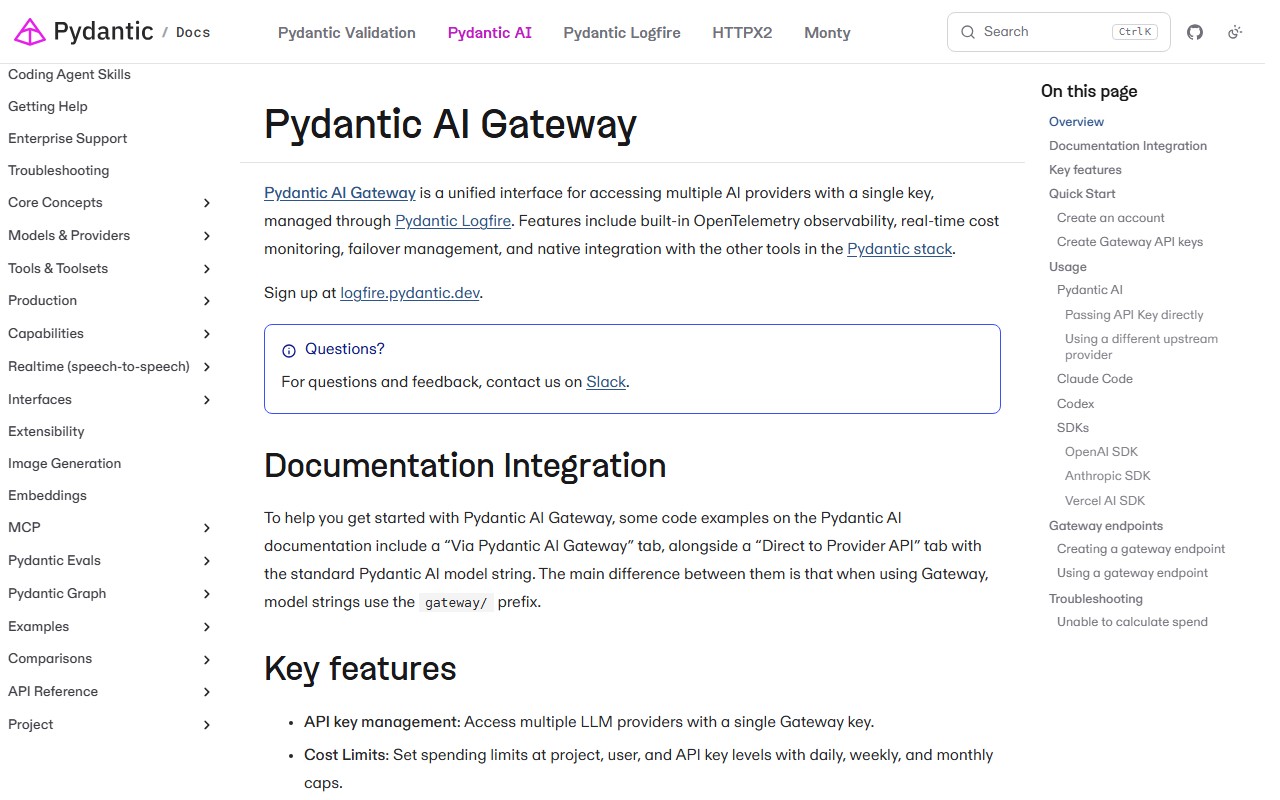
The Gateway is one key for several model providers with spend limits, billed through Logfire. Per the pricing page, bringing your own provider keys carries a 0% markup, and the built-in providers carry 5% on Personal and Team and 3% on Growth. On $1,000 of monthly model spend through built-in providers that is $50 on Team or $30 on Growth. The Gateway docs say it supports OpenAI, Anthropic, Google Cloud, Groq and AWS Bedrock.
Match your situation to one line.
An agent is a typed object with tools and an output type; evals, graphs and durability are separate, optional packages.
Typed agents and outputs. Pydantic AI builds on Pydantic validation: you declare the output type and the framework asks the model for it. V2 changed the default type parameters, so an un-parameterised Agent(...) now infers Agent[object, str] rather than Agent[None, str], a type-checking change only, per the upgrade guide.
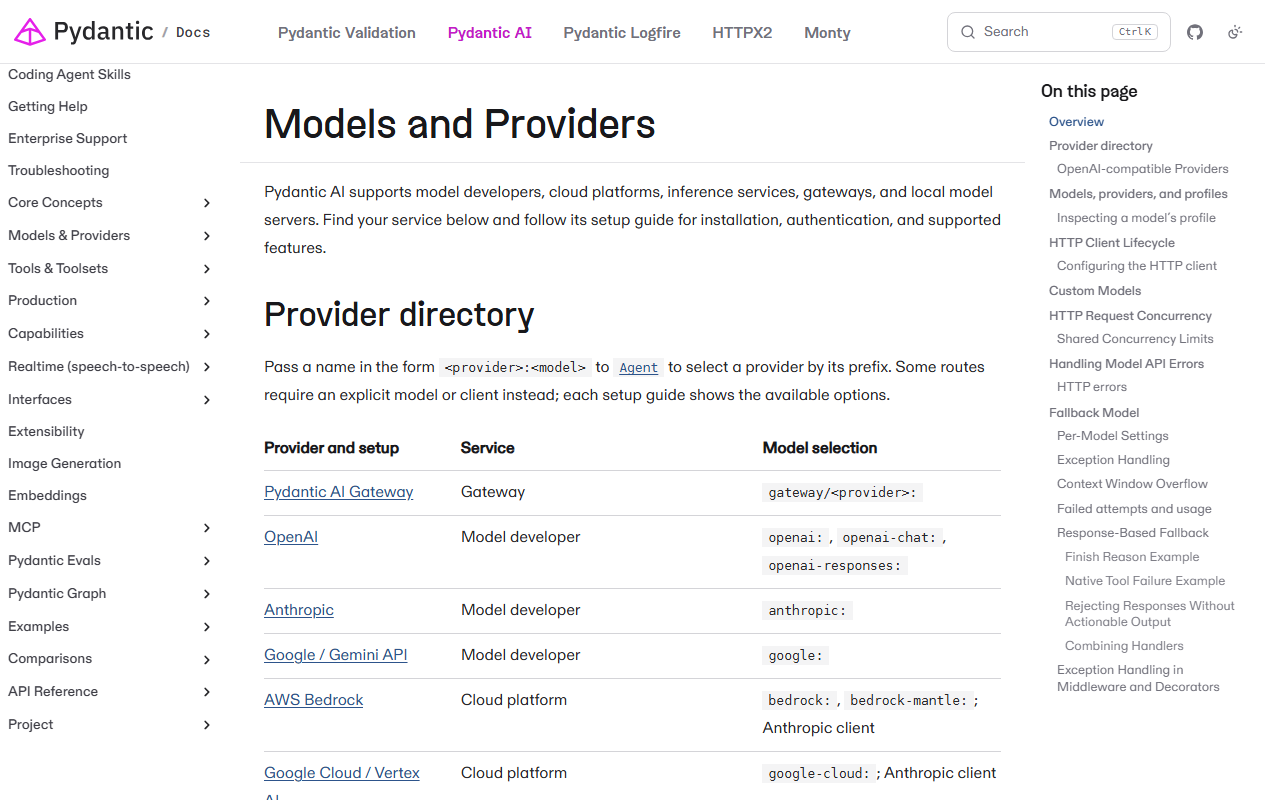
Many models. The docs' provider directory lists dozens of services selected by a prefix such as openai:, anthropic:, google:, bedrock:, ollama: or openrouter:, plus the Pydantic AI Gateway. A built-in fallback model handles provider errors.
Capabilities and the Harness. V2 “leans into a harness-first design with capabilities as a core primitive”: one unit that bundles tools, hooks, instructions and model settings. Ready-made capabilities (memory, guardrails, sub-agents, planning, context management, persistence, a coding agent) live in the Pydantic AI Harness package, which now ships from the main repository; its old standalone repository is archived and, per its README, keeps history only up to v0.36.0.
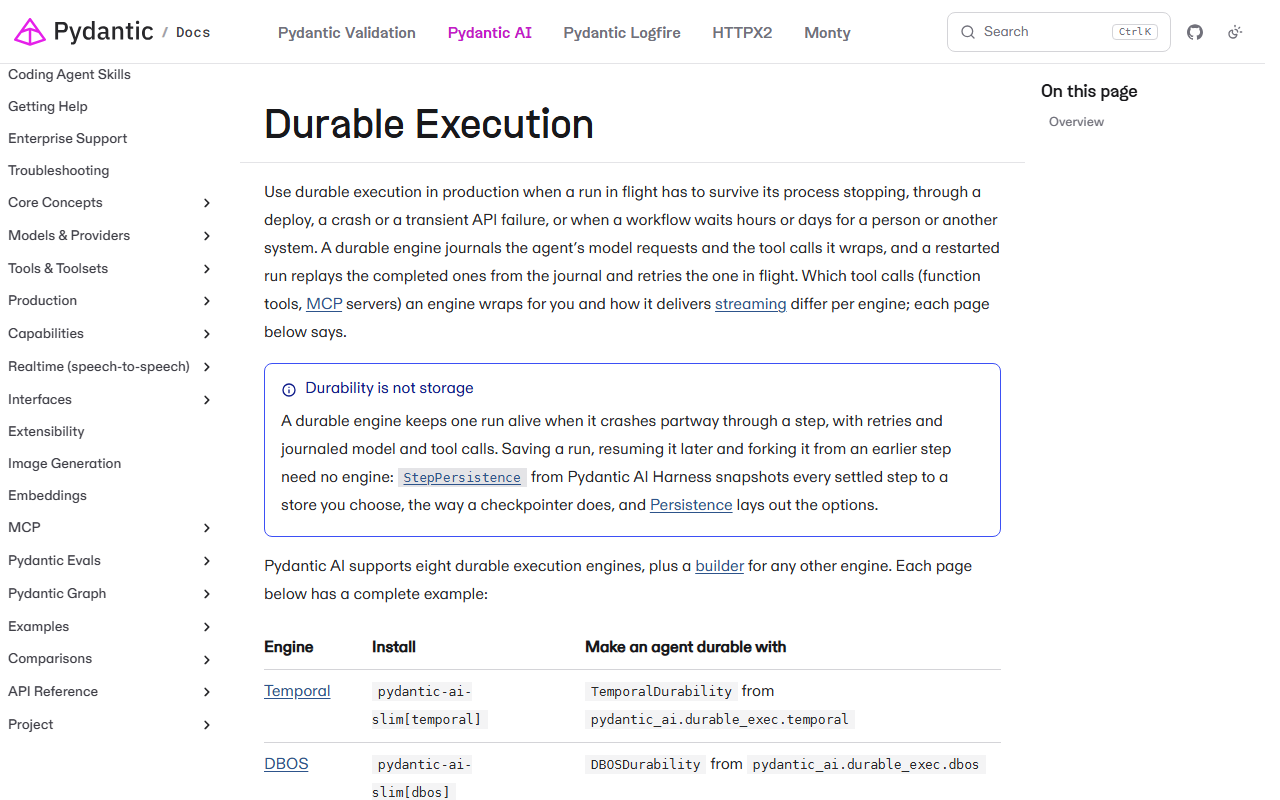
Durable execution. The docs list eight durable engines: Temporal, DBOS, Prefect, Restate, AWS Lambda, Absurd, pgtask and Apache Airflow, and say Temporal, DBOS, Prefect, Restate and AWS Lambda are co-maintained with the vendor teams. Only one engine can be attached to an agent at a time.
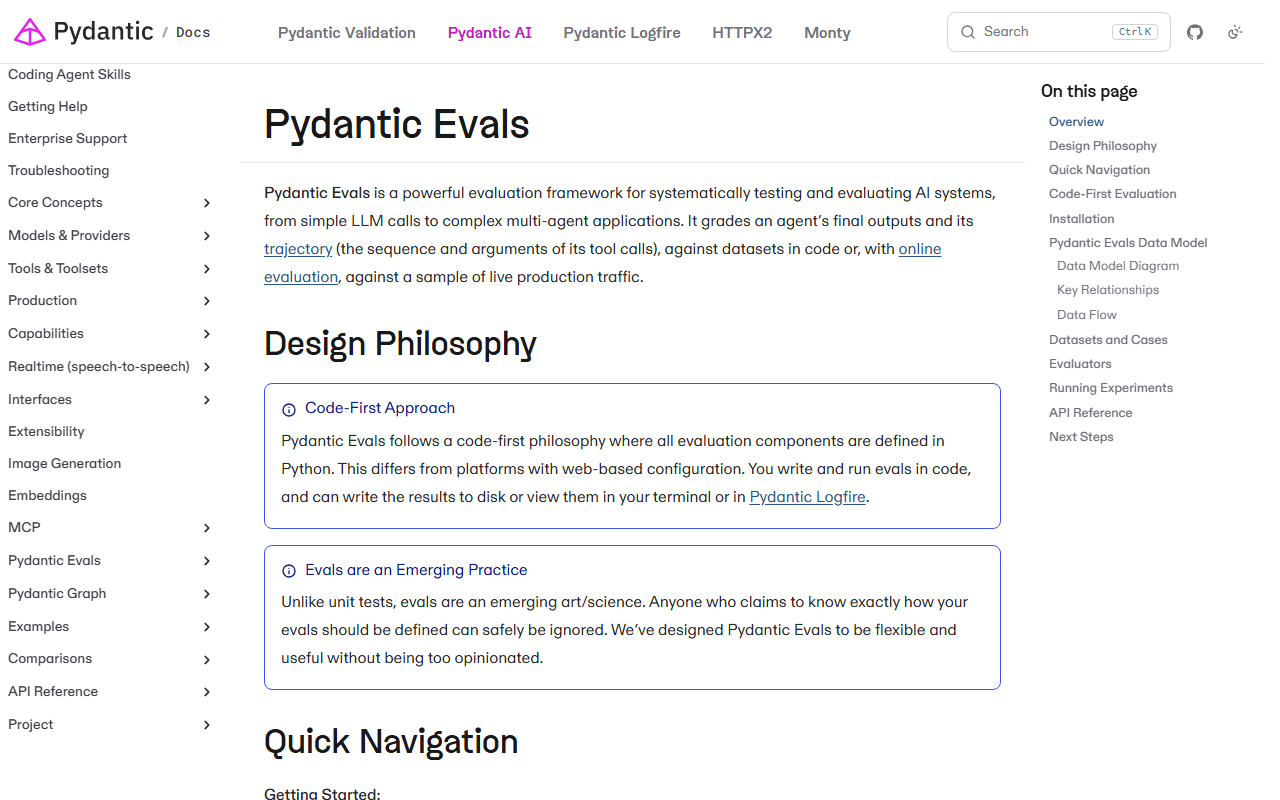
Evals. Pydantic Evals is code-first: datasets, cases and evaluators written in Python, with LLM-as-judge, span-based and trajectory evaluators and an online mode that grades sampled production traffic. Results can print in the terminal or appear in Logfire.
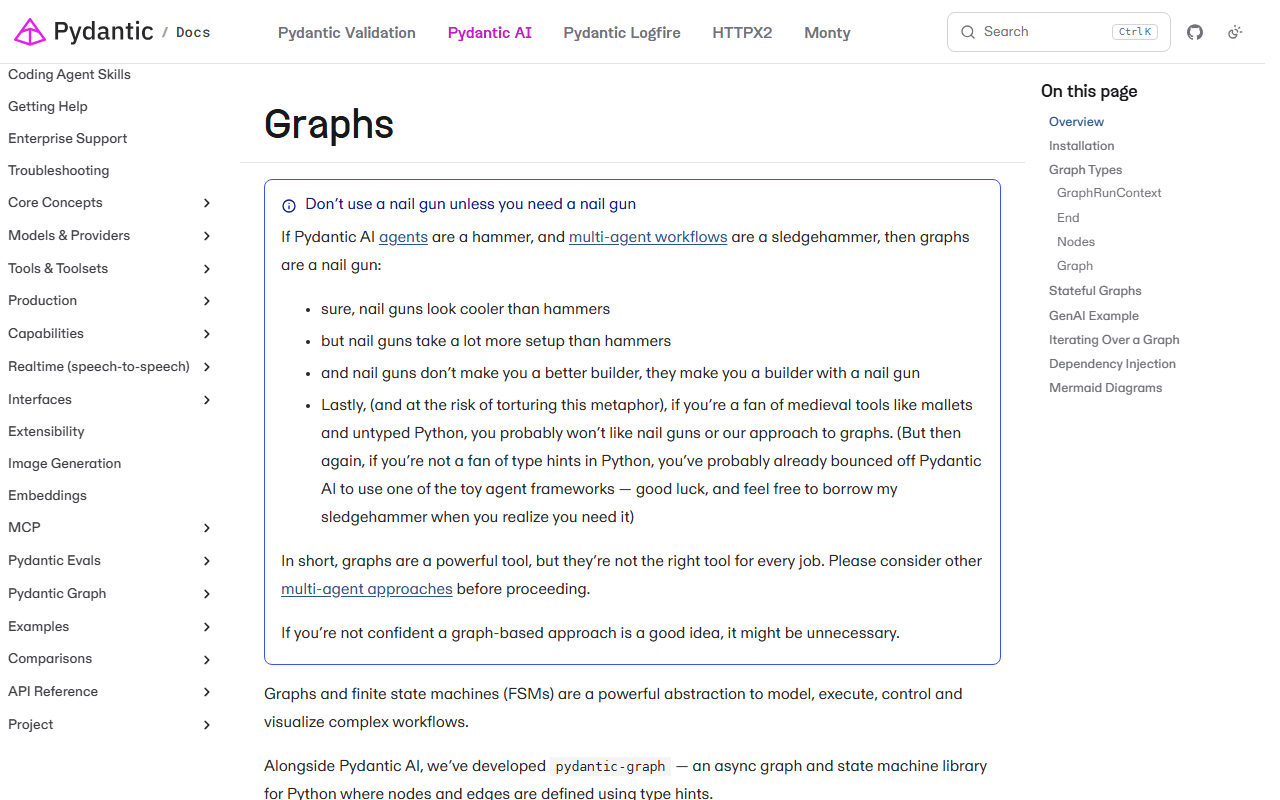
Graphs, with a warning from the authors. pydantic-graph is a typed state-machine library. Its own docs call graphs a nail gun and say “Please consider other multi-agent approaches before proceeding”. That candour is useful: plain Python and sub-agents are the default; graphs are for real state machines.
Install, define an agent, instrument it, test it with evals, then add durability only if runs must survive crashes.
pip install pydantic-ai on Python 3.11 or newer; add extras such as pydantic-ai[bedrock] for providers outside the default set.logfire.instrument_pydantic_ai(), or point the OpenTelemetry exporter at any backend. Set include_content=False if prompts are sensitive.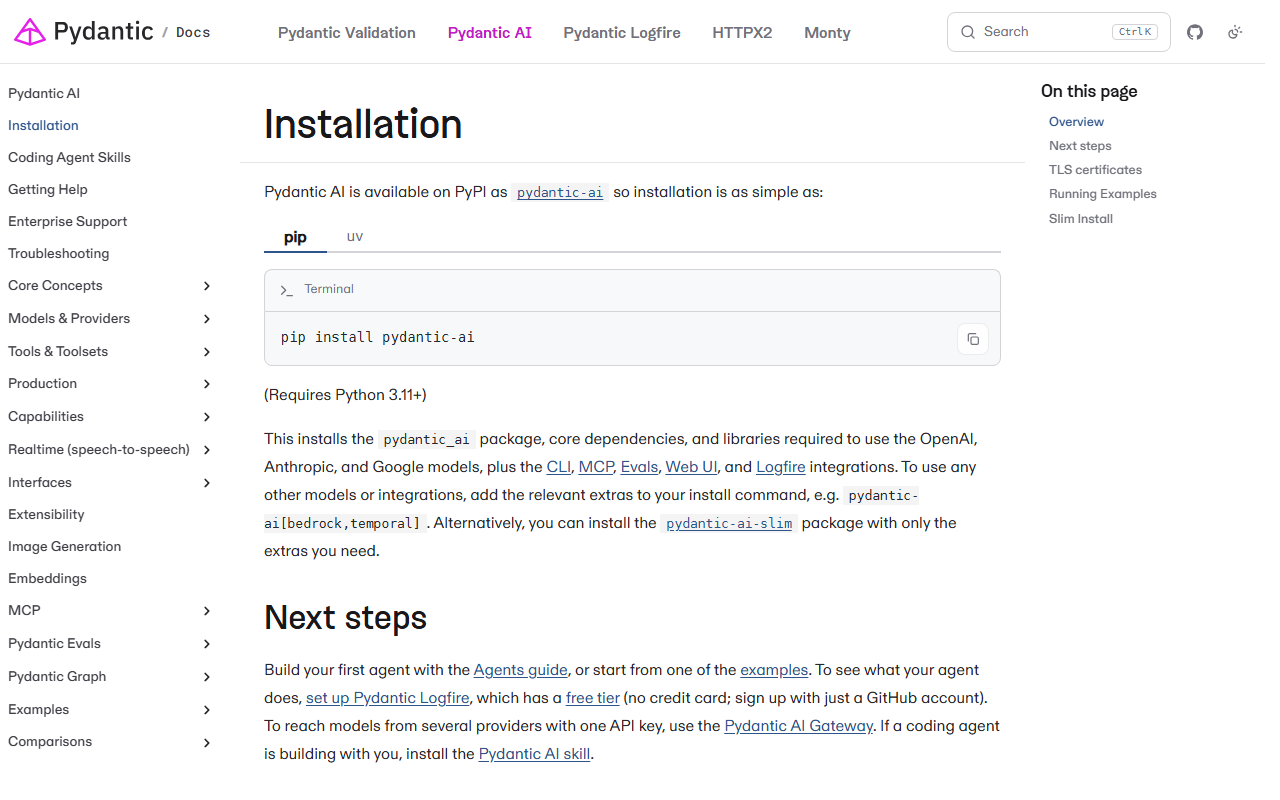
The v1 to v2 move, a release every two days, slimmer default installs, and a maintainer team that no longer promises a reply to every issue.
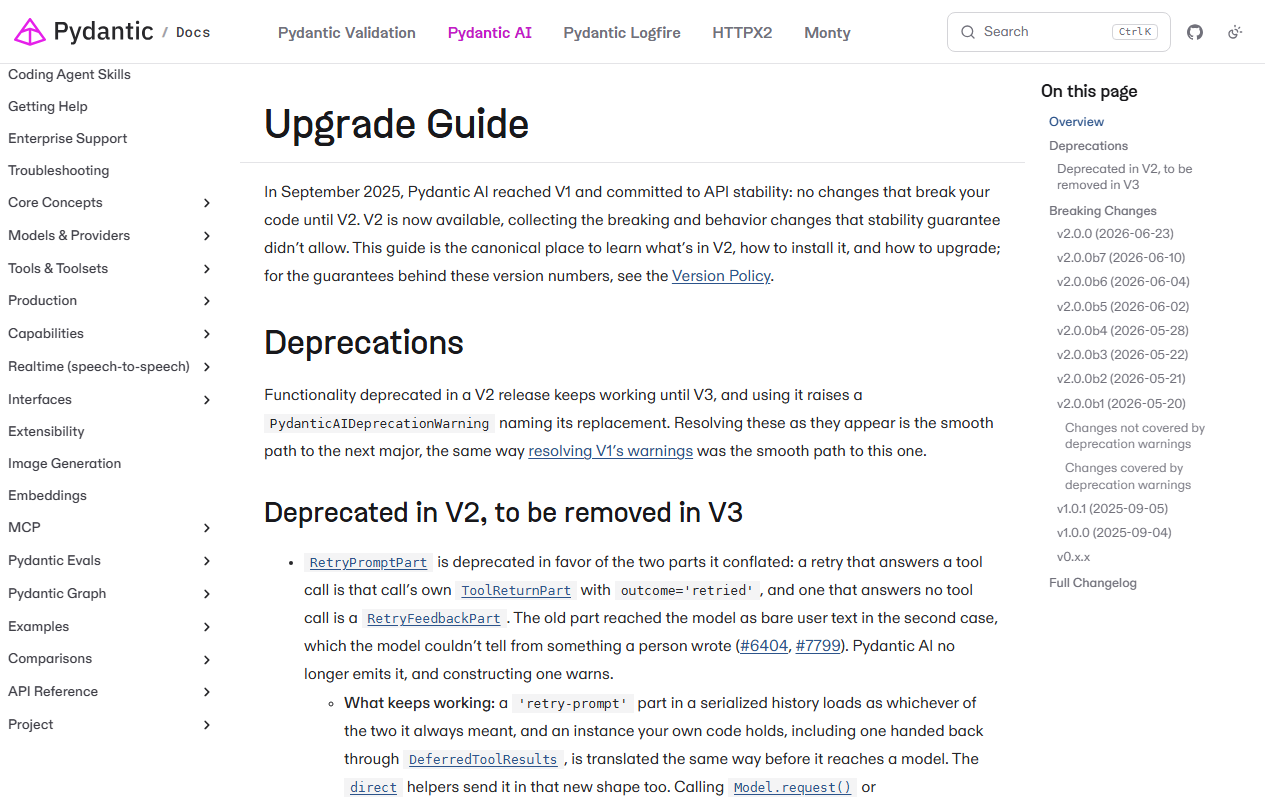
V1 shipped on Sep 4, 2025 with a stability promise. V2 became stable on Jun 23, 2026 after seven betas. The upgrade guide lists changes that no V1 warning could announce, including a new default end_strategy (‘graceful’ instead of ‘early’, so function tools called alongside a successful output now run), a new default telemetry format, ModelProfile turned into a TypedDict, and removal of pydantic_graph.persistence.
A bare install no longer includes providers such as Bedrock, Groq and Mistral; you add the extras you use, for example pydantic-ai[bedrock].
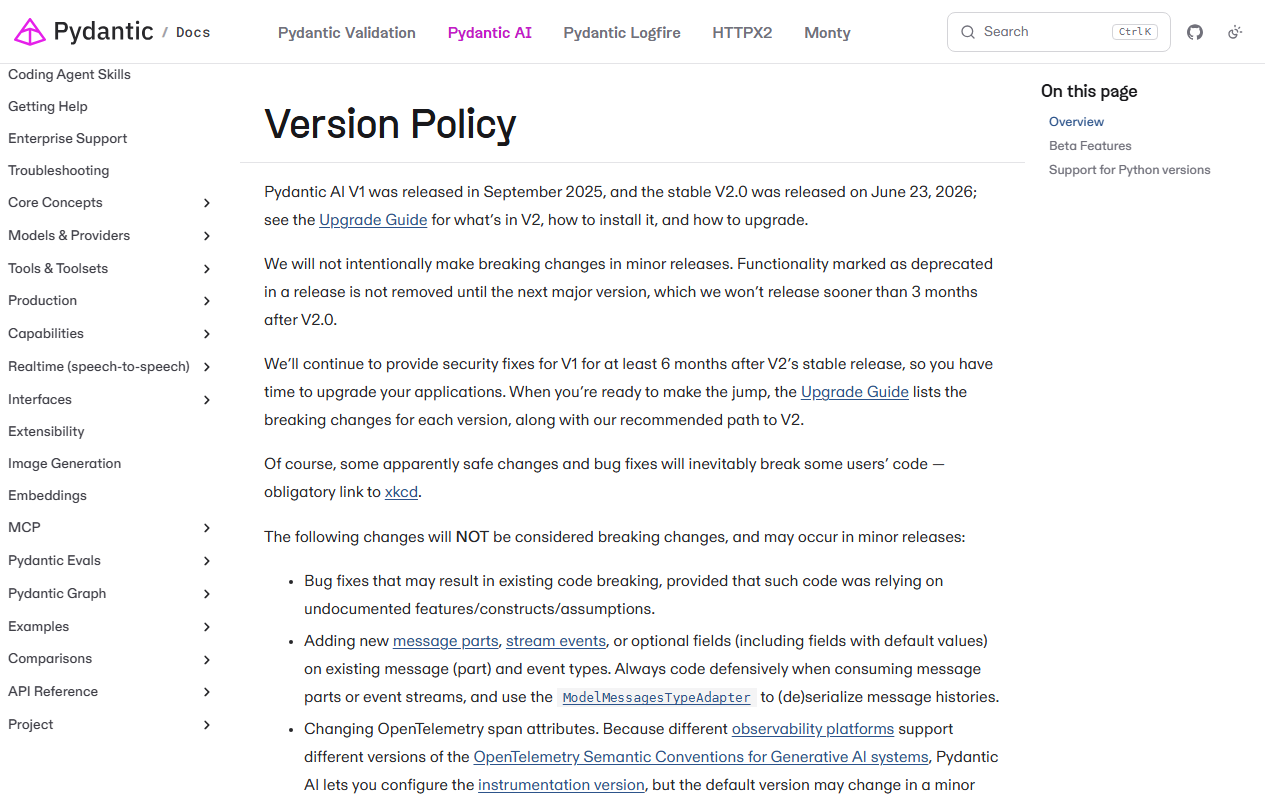
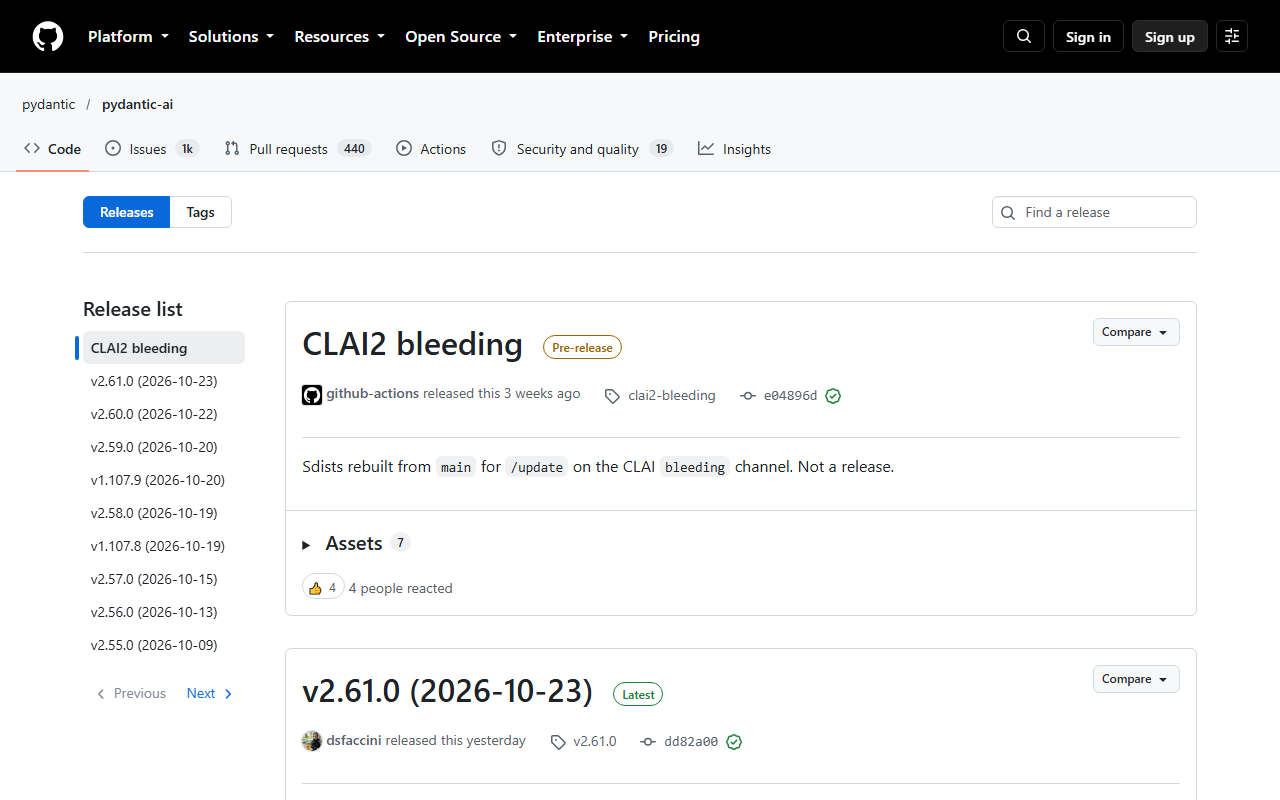
15 releases in 30 days, 81 since Jun 23. The version policy says minor releases will not intentionally break code, but it lists exceptions: bug fixes that break code relying on undocumented behaviour, new message parts and stream events, changed OpenTelemetry span attributes and changed __repr__. Beta modules may change at any time.
The V1 clock. Per the version policy, deprecated features are not removed until the next major, which will not ship sooner than 3 months after V2.0, and V1 gets security fixes for at least 6 months after V2's stable release. That puts the earliest end of V1 security fixes at Dec 23, 2026. No V3 has been released as of Oct 28, and V1 is still being patched (v1.107.9 on Oct 21, 2026).
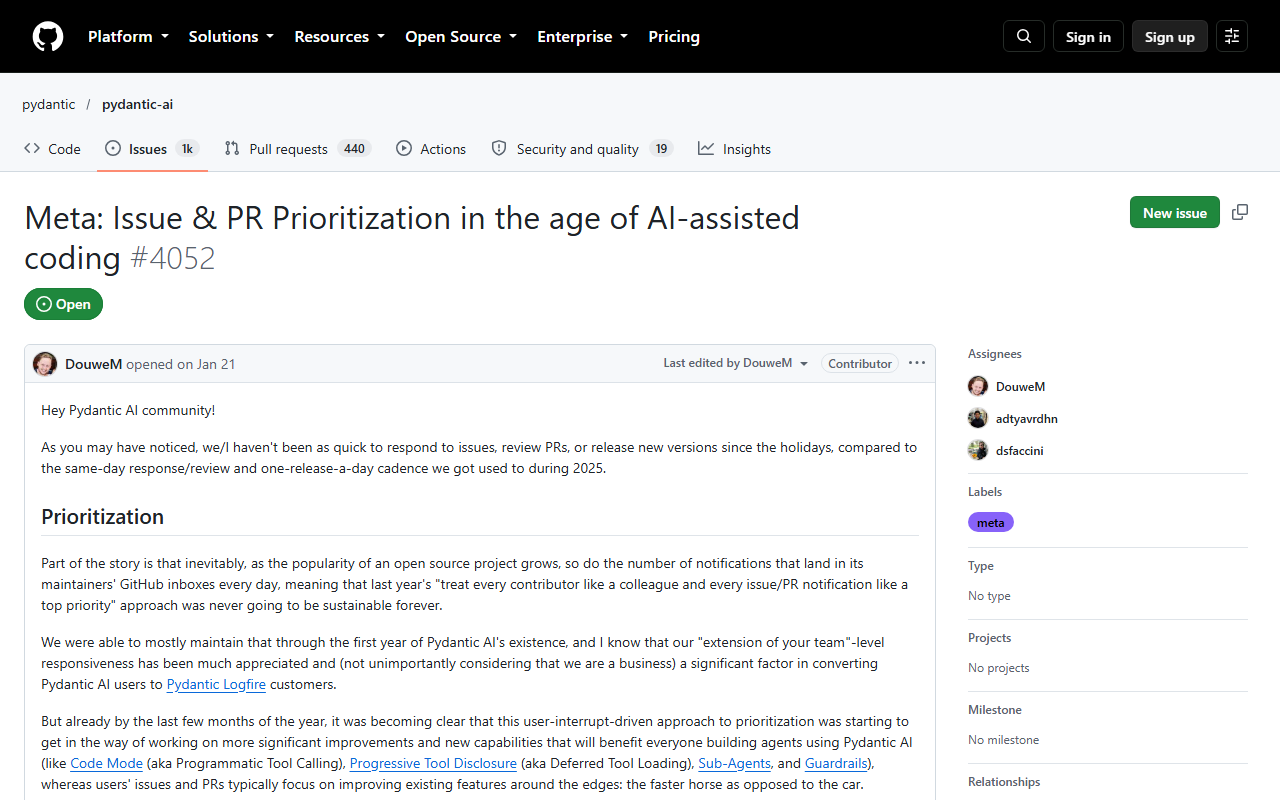
The maintainers' stated priorities. In issue #4052 (Jan 21, 2026) the lead maintainer writes that the team has not been as quick as in 2025, when it managed “same-day response/review and one-release-a-day cadence”, and that it is dropping the expectation that every issue or PR gets human attention. He says the earlier responsiveness was a significant factor in converting users to Logfire. As of Oct 28, 258 open issues have no comments at all.
MCP in both directions, OpenTelemetry out, and several user-interface adapters.
The docs say agents can connect to MCP servers and can also run inside MCP servers. The recommended way to attach a server is the MCP capability, which runs the server locally by default and can opt into a model provider's native MCP support. Interface adapters cover a web chat UI, AG-UI, Vercel AI, a CLI, GitHub Agentic Workflows and ACP. Realtime voice and image generation are in the same package.
Observability goes out as plain OpenTelemetry, so Logfire is not required: the docs show raw OTel export and a local viewer, and our Langfuse review lists Pydantic AI among its integrations. The model directory includes LiteLLM as a self-hosted gateway, OpenRouter and Vercel AI Gateway.
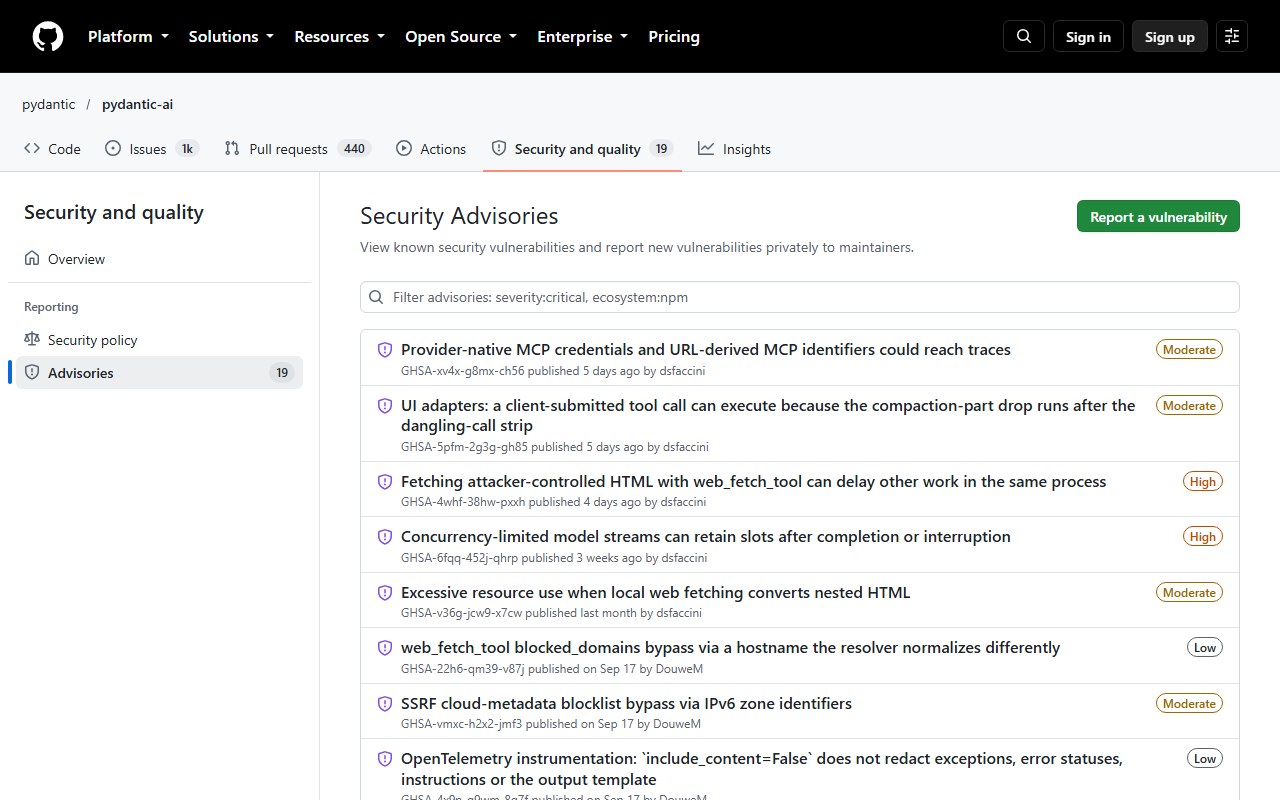
19 published advisories in 2026, 5 rated high, all with a patched version; most concern web fetching, SSRF and the optional chat UI and adapters.
GitHub lists 19 published advisories for pydantic/pydantic-ai on Oct 28, 2026: 5 high, 11 medium and 3 low, the oldest dated Feb 6, 2026. 4 were published in October and 5 in the 30 days to Oct 28. Every entry names a patched version. The eight most recent:
| Published | Severity | Summary |
|---|---|---|
| 2026-10-21 | High | Fetching attacker-controlled HTML with web_fetch_tool can delay other work in the same process |
| 2026-10-20 | Medium | Provider-native MCP credentials and URL-derived MCP identifiers could reach traces |
| 2026-10-20 | Medium | UI adapters: a client-submitted tool call can execute because the compaction-part drop runs aft... |
| 2026-10-02 | High | Concurrency-limited model streams can retain slots after completion or interruption |
| 2026-09-30 | Medium | Excessive resource use when local web fetching converts nested HTML |
| 2026-09-17 | Low | OpenTelemetry instrumentation: `include_content=False` does not redact exceptions, error status... |
| 2026-09-17 | Medium | Event loop blocked by quadratic response processing in `web_fetch` |
| 2026-09-17 | Low | web_fetch_tool blocked_domains bypass via a hostname the resolver normalizes differently |
clai web, Agent.to_web()), or UI adapters that accept client-submitted tool calls: those areas recur. Pin to a patched version and subscribe to advisories.Data you send. Pydantic AI runs in your process and sends prompts to the model provider you choose. Telemetry goes nowhere until you configure it. A bare install includes the Logfire client library, and until instrumentation is configured the first agent run prints a banner to stderr pointing to the instrumentation docs; it is never shown under pytest or when CI is set, and PYDANTIC_AI_NO_BANNER turns it off. To keep prompts out of traces, set include_content=False; one advisory (Sep 17, 2026) concerned exceptions and error statuses not being redacted under that setting, and was fixed in v2.44.0.
MIT for the framework, commercial support on request, and a company that earns from Logfire.
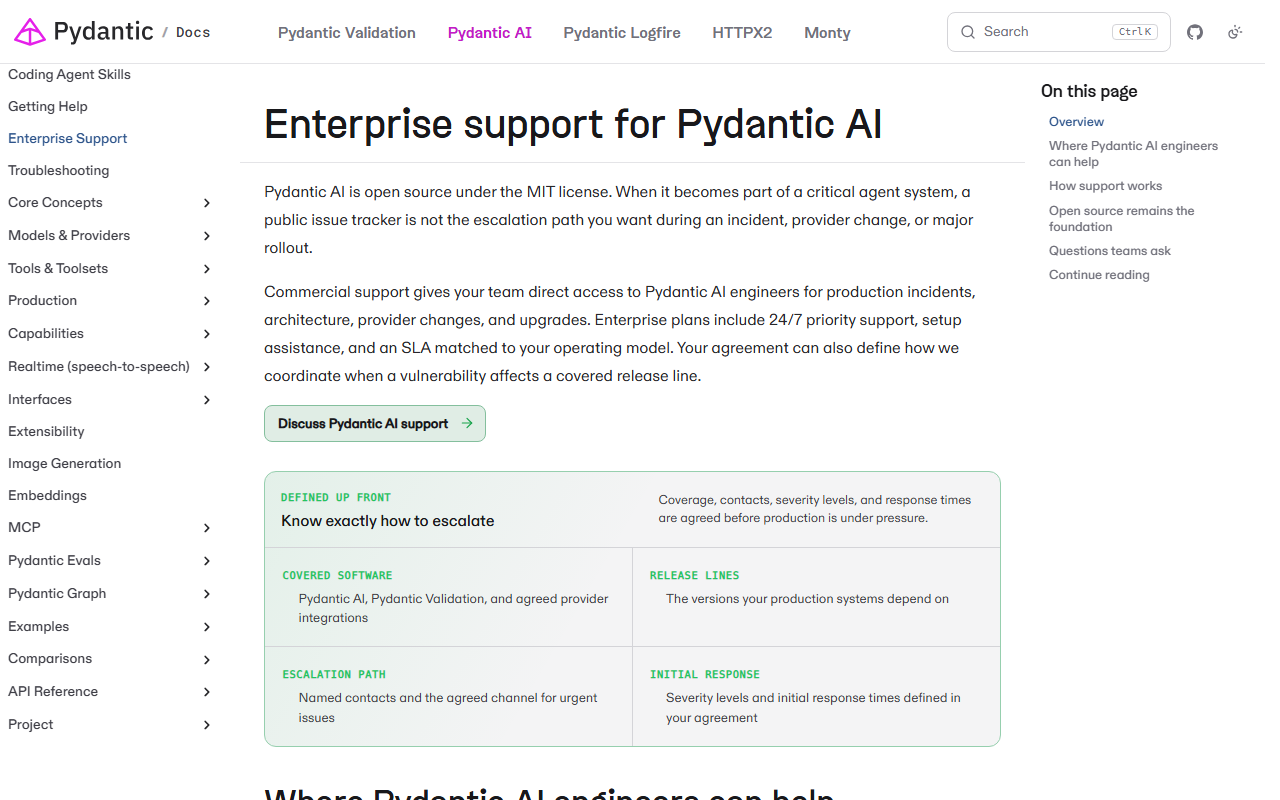
The repository carries the MIT licence (“Copyright (c) Pydantic Services Inc. 2024 to present”). Pydantic Services Inc. sells Logfire and, per the docs, enterprise support for the framework: 24/7 priority support, setup assistance and an SLA, with covered versions and response targets defined in the contract, and no Logfire requirement. No support price is published. On funding, TechCrunch reported on Oct 1, 2024 that Pydantic raised a $12.5 million Series A led by Sequoia, which the CEO said would go mainly to salaries and hiring developers; we found no newer round in October 2026 searches, so treat that as the last round we can source. We have not reviewed the Logfire terms of service or privacy policy.
Python teams that want typed, testable agents and are comfortable reading upgrade notes.
Backend developers who already use Pydantic and FastAPI, teams that want structured outputs and provider portability, and teams that want evals in code beside the agent. Projects that need durable agents get eight engine choices.
Teams without Python, people who want a visual builder, teams that cannot pin and test dependencies often, and anyone who needs a guaranteed reply on every bug report without paying for support.
Eight things to check before you rely on it.
15 releases in 30 days and a major version four months old.
19 advisories in 2026, 5 high.
The maintainers dropped the promise of human attention on every issue; 1,110 issues are open.
V1 security fixes are promised for at least 6 months after Jun 23, 2026.
The Logfire client ships by default and a banner points to it.
Older Python versions are not supported.
Independent evidence is thin and mostly Hacker News.
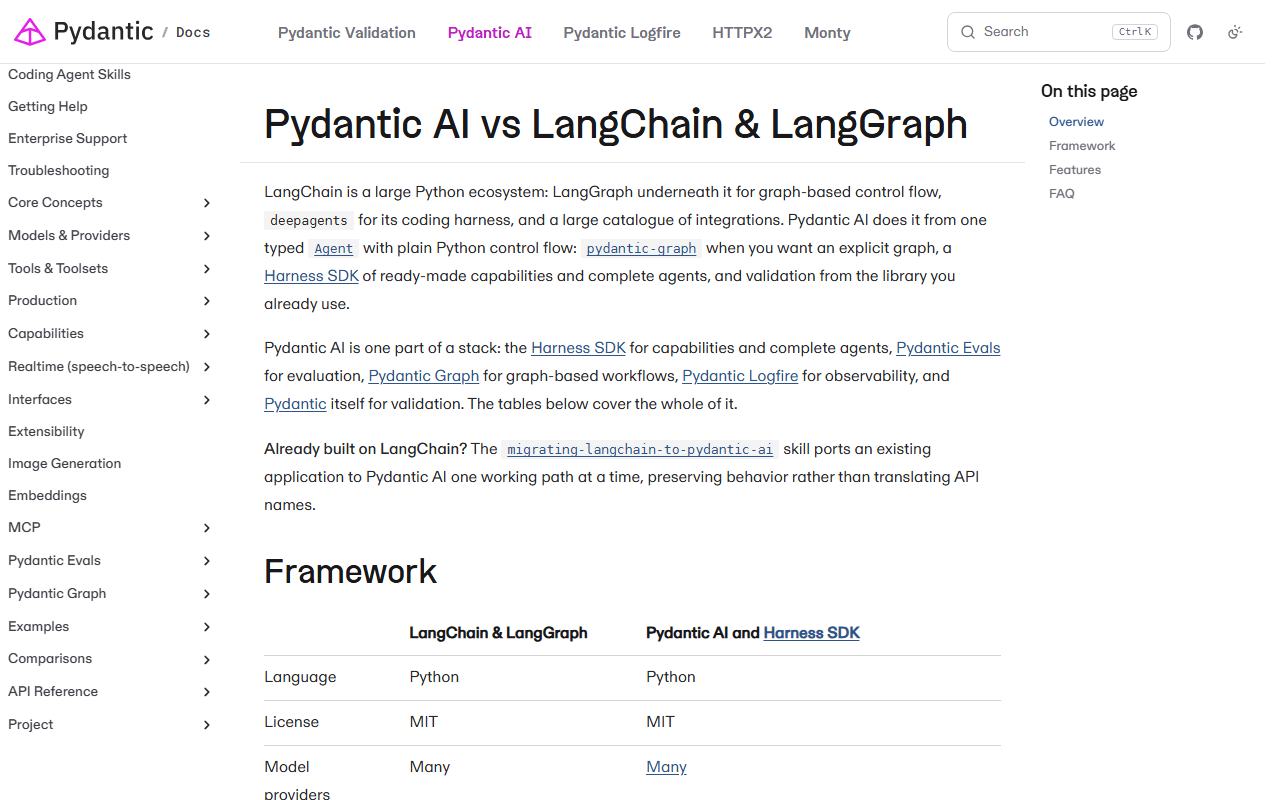
The docs' own vs-LangChain table is written by Pydantic and is not independent.
Compared on public counters as of Oct 28, 2026; the products do different jobs, so this is a map, not a ranking.
| Tool | What it is | Stars | PyPI 30 days |
|---|---|---|---|
| Pydantic AI | Typed Python agent framework | 20,926 | 30.0M |
| LangChain | Largest agent and LLM ecosystem; LangGraph for graphs | 148,609 | 161.9M |
| Haystack | Explicit-pipeline framework for RAG and agents | 26,867 | 0.59M |
| Langflow | Visual flow builder | 156,097 | 38,800 (pip only) |
| Dify | Self-hosted or cloud LLM app platform | 159,804 | Not on PyPI |
| Langfuse | Tracing and evals; a Logfire alternative | 36,640 | 29.1M |
This review has no affiliate links, and Pydantic did not see it.
JAVIS has no approved Pydantic affiliate link, so every Pydantic link here goes straight to ai.pydantic.dev, the Logfire pricing page or the GitHub repository, without tracking parameters.
Hands-on status: JAVIS has not built an agent with Pydantic AI, opened a Logfire account or paid for a plan for this review. Facts come from the official documentation, the pricing page, GitHub, PyPI, Hacker News and the official YouTube channel, as of Oct 28, 2026. Independent review evidence is limited, as described above.
The framework is free; start from the install page and the first agent example.
Open the Pydantic AI docsCheck the plan table and the price-cap rule before adding a card.
Open the pricing pageBuilding with agents? These reviews cover the nearest ground.
Each card opens a published JAVIS review.


Questions people ask before committing
Is Pydantic AI free?
Yes. The framework is MIT-licensed and free to install; you pay your model provider. Logfire has a free Personal plan with 10 million records a month that is hard-capped at $0.
Do I need Logfire?
No. Pydantic AI emits OpenTelemetry and the docs show other backends. Enterprise support does not require Logfire either.
What changed from v1 to v2?
V2 became stable on Jun 23, 2026. It makes capabilities a core idea, changes some defaults (the default end strategy, telemetry format and slimmer install extras) and removes a few modules. The upgrade guide recommends moving to the latest V1, fixing deprecation warnings, then upgrading.
How long does v1 get fixes?
Security fixes for at least 6 months after Jun 23, 2026, per the version policy.
Which Python versions work?
3.11 or newer; the docs badge lists 3.11 to 3.15.
Is it safe?
GitHub lists 19 advisories in 2026, all with a patched version. Pin to a patched release and avoid exposing the web chat UI or fetch tool to untrusted input.
Pydantic AI or LangChain?
LangChain is much larger by stars and downloads. Pydantic AI is smaller and typed. Pydantic's own comparison favours itself, so test both on your task.
Where this came from, and when.
Framework facts: the official docs (home, installation, models, durable execution, MCP, evals, graphs, Gateway, enterprise support, troubleshooting, Logfire guide, upgrade guide and version policy), Oct 25 to Oct 28, 2026.
Pricing: pydantic.dev/pricing (plan cards, detailed comparison and FAQ) and langfuse.com/pricing, Oct 28, 2026.
Repository: GitHub counters for stars, forks, open and closed issues, pull requests, releases and 19 published advisories, plus issue #4052, Oct 28, 2026. PyPI metadata and pypistats daily counts for Sep 28 to Oct 27, 2026.
Users: Hacker News comments cited by id; the official Pydantic YouTube channel that pydantic.dev links to.
Score: price clarity 19: free framework, public Logfire prices and a hard cap on the free plan, but a price cap on paid plans only by email and no support price. Capability breadth 18: typed agents, many providers, MCP, evals, graphs, durability and interfaces. Independent evidence 13: strong adoption signals but no star rating and thin independent write-ups. Security and data control 14: patched advisories and a content-redaction switch, offset by the volume of advisories. Stability and fit 13: a four-month-old v2, a release every two days and a stated reduction in issue triage. It is judgment, not a measurement.
What this review does not cover: real performance, structured-output reliability on your model, token costs, the Logfire terms and privacy policy, a technical security review, or any behaviour the docs do not describe.