
Dify Review 2026: The Workspace Fee Buys Seats and Storage, Not Much Model Use
Dify is an open-source platform for building AI apps and agents on a visual canvas, with knowledge bases, plugins and one-click publishing as a web app, API or MCP server. Self-hosting the Community Edition is free; Dify Cloud costs $59 or $159 a month per workspace. We priced what those plans actually buy per model, what a self-hosted server costs, and what the license and the security record mean for you.
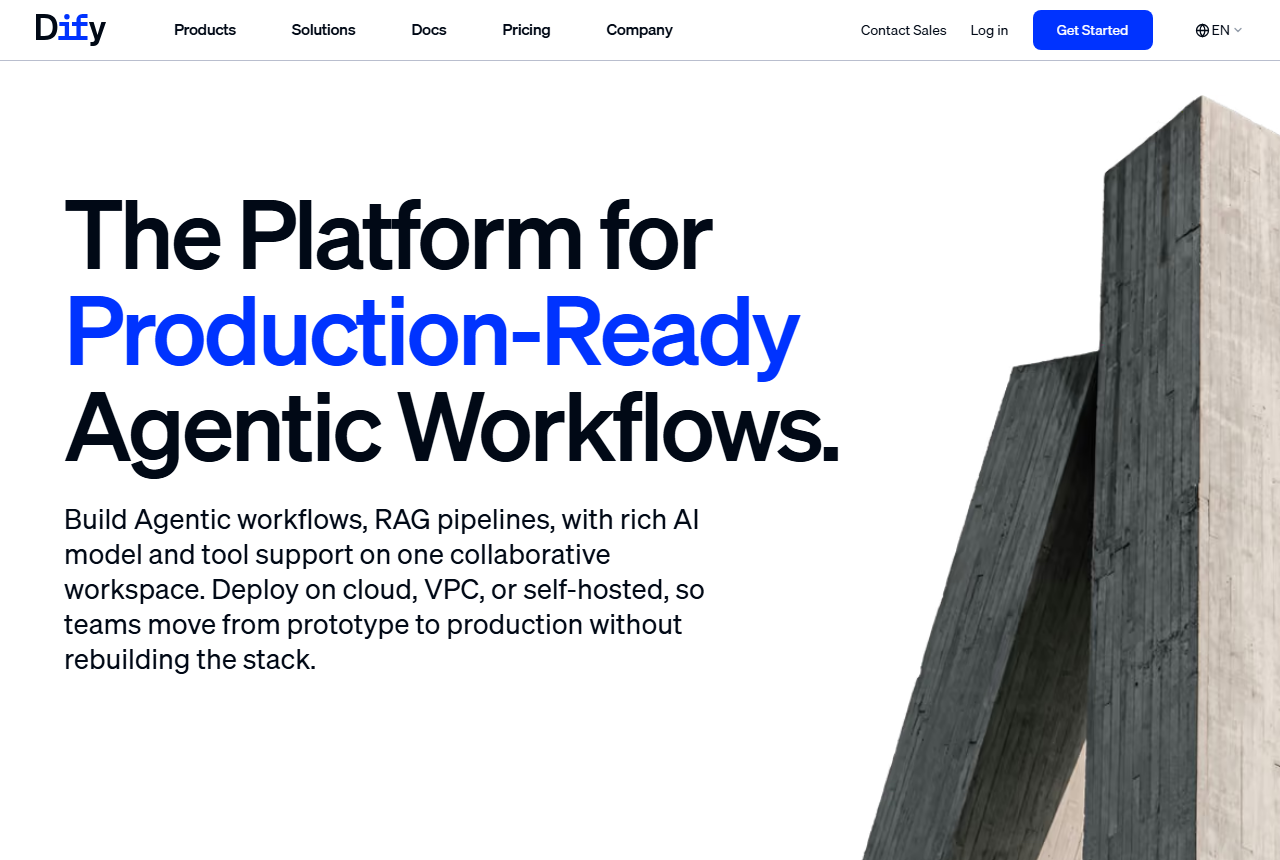
There are no affiliate links in this review. Every Dify link goes straight to dify.ai or its docs.
| Made by | LangGenius, Inc. (repository created 12 Apr 2023) |
| What it is | Open-source builder for AI apps: workflows, RAG, agents, plugins |
| Cloud plans | Professional $59/mo; Team $159/mo (per workspace) |
| Self-host | Community free; Enterprise custom |
| Free cloud | Sandbox, $0, 200 message credits |
Worth it for builders who will bring their own model keys and either self-host or need seats; weak value if you hoped the cloud fee covers your model bill.
Who it is for: developers and technical teams who want to ship knowledge-base chatbots, document workflows and agents without writing the backend, and who can either run Docker themselves or pay per workspace. What it costs: $0 to self-host the Community Edition on your own server, or Dify Cloud at $59 a month (Professional, 3 members) or $159 a month (Team, 50 members), with 17% off for annual billing, per dify.ai/pricing on 21 Oct 2026.
= 500 Claude Sonnet 4.6 answers
at Anthropic list price, 3,000 in / 400 out tokens
8 GiB DigitalOcean droplet plus daily backups
12 advisories from 2026 that name a fixed release
The three catches. First, the cloud credits buy little model use: at list prices, Professional’s 5,000 monthly credits are worth $2.50 to $7.50 of the same answers on your own API key, so the $59 mostly pays for seats, apps, storage and hosting, and real volume runs on your own key anyway. Second, the license is a modified Apache 2.0: hosting separate workspaces for customers needs Dify’s written permission, and you may not remove the logo from the web interface. Third, GitHub lists 21 security advisories, 8 rated high, and they are usually published months after the fix ships, so self-hosters who only watch advisories are behind; you have to upgrade on releases, and the latest one (1.17.1) needs a 12-step vector-database upgrade if you use the bundled Weaviate.
Not a hands-on test: JAVIS has not installed Dify, signed up for Dify Cloud or built an app in it. This review is built from Dify’s pricing page, docs, license, release notes and blog, GitHub’s public repository, issue and advisory records, Docker Hub, Trustpilot, Hacker News and the model and server vendors’ own price pages, all dated 21 Oct 2026 unless another date is given. The workloads in the cost examples are invented and labelled.
One builder, four ways to run it: Cloud, Community Edition, Premium on AWS and Enterprise.
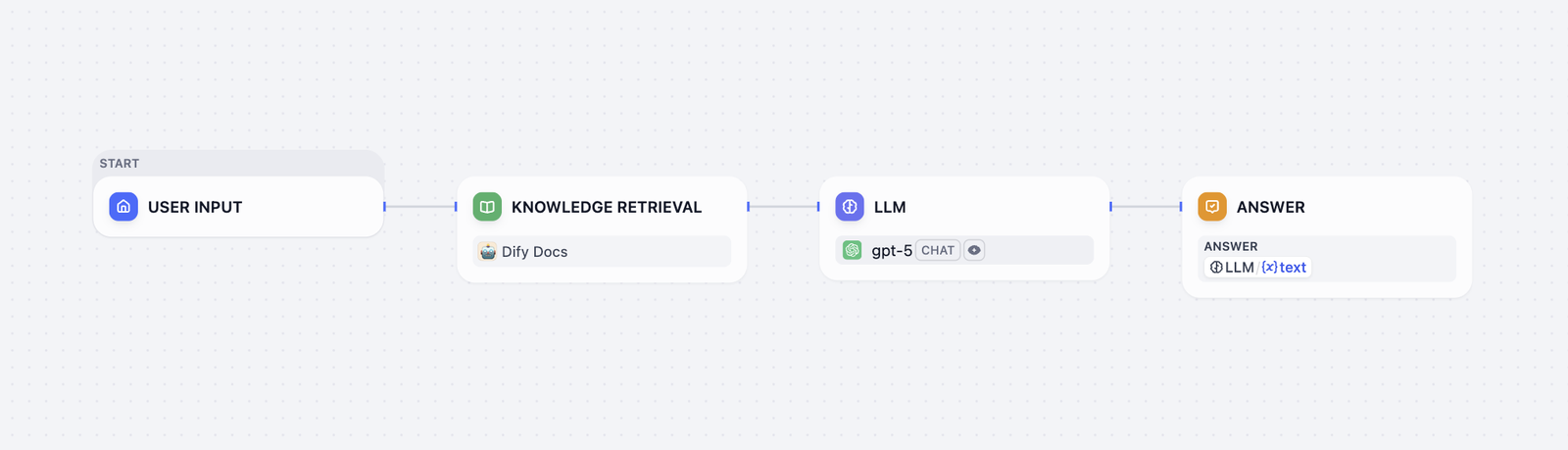
You design an app on a canvas: a trigger or user input, a knowledge retrieval step over your documents, a model step, tools, conditions and an output. You test it, then publish it as a chat web app, a REST API or an MCP server. Dify does not supply a model of its own: the cloud includes message credits for a list of providers, and everything else runs on your own provider keys.
One of the most-starred AI app projects on GitHub, newly funded, shipping a release every few weeks.
25,152 forks; 21 Oct 2026
langgenius/dify-api on Docker Hub; 21 Oct 2026
latest 1.17.1, 10 Sep 2026
led by HSG; Dify blog, 10 Mar 2026
The repository was created on 12 Apr 2023 by LangGenius, Inc. and shows 14,362 commits and 1,150 open issues and pull requests on 21 Oct 2026. In its funding post of 10 Mar 2026, CEO Luyu Zhang says Dify runs on “more than 1.4 million machines” in over 175 countries and regions and that “over 2,000 teams and 280 enterprises” build on it, with quotes from Maersk and ETS. Those are the vendor’s own figures. The independent counts that can be checked are the 25.0 million pulls of the API image and 16.5 million of the web image on Docker Hub; pulls count downloads, including every automated redeploy, not installations.
| When | What happened | Source |
|---|---|---|
| 12 Apr 2023 | GitHub repository created | GitHub |
| 22 Apr 2024 | Hacker News thread, 185 points and 38 comments; a team member promises to relax the license | Hacker News |
| 28 Feb 2025 | Dify 1.0: plugins and a marketplace | GitHub releases |
| 5 Dec 2025 | 1.10.1-fix.1 patches the React2Shell flaw in the web image | GitHub releases |
| 10 Mar 2026 | $30M Series Pre-A announced | Dify blog |
| 19 May 2026 | 1.14.2, security fixes | GitHub releases |
| 25 Aug 2026 | 1.17.0; the new Agent launches on 27 Aug | GitHub releases, Dify blog |
| 10 Sep 2026 | 1.17.1, with a staged Weaviate upgrade for self-hosters | GitHub releases |
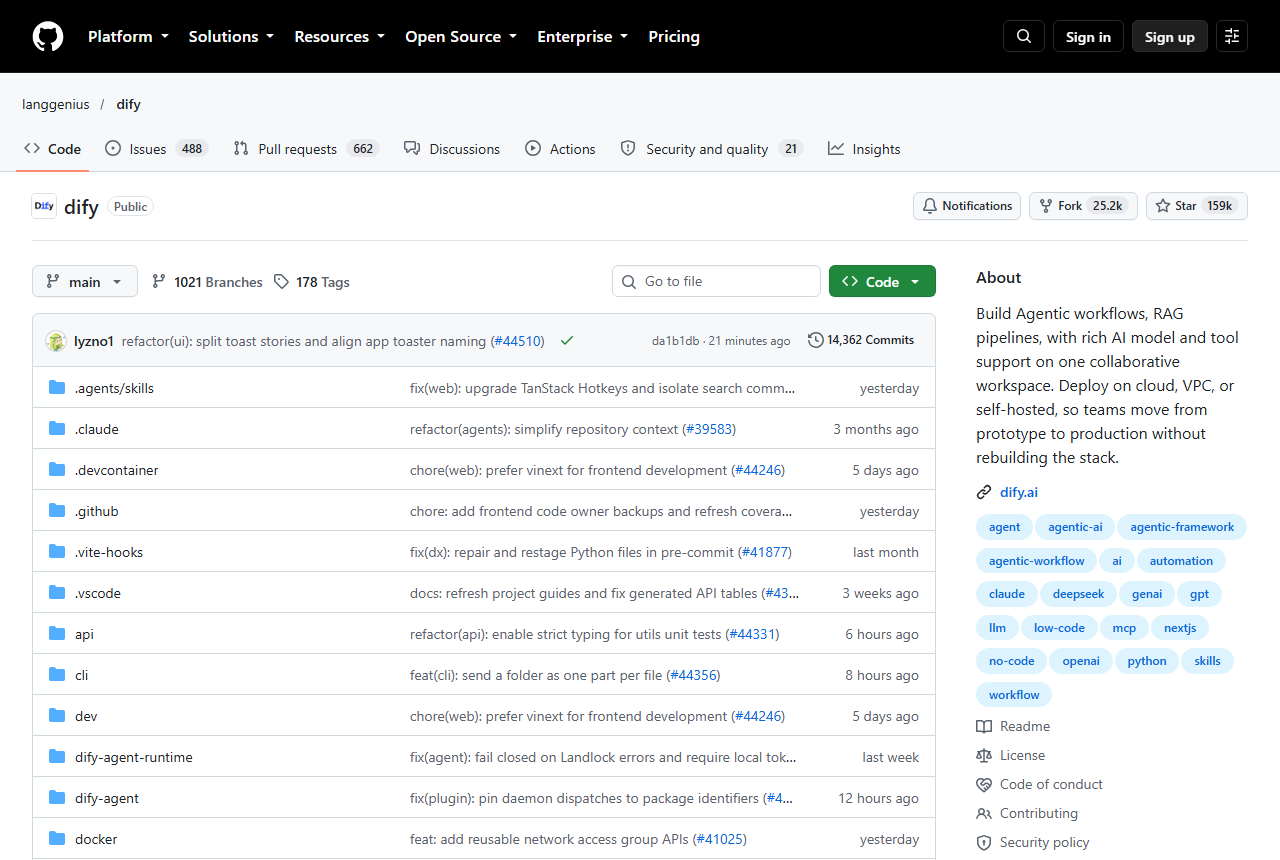
Stars measure attention, not production use. In the April 2024 thread one commenter suspected inflated stars after seeing many new accounts, and another, who disclosed that he makes a repository-analytics tool, replied that contributor activity matched the star growth. Treat the star count as popularity only.
No star rating exists: Trustpilot shows 0 reviews, and the written opinion is a thin, mostly favourable trail on Hacker News plus a very busy issue tracker.
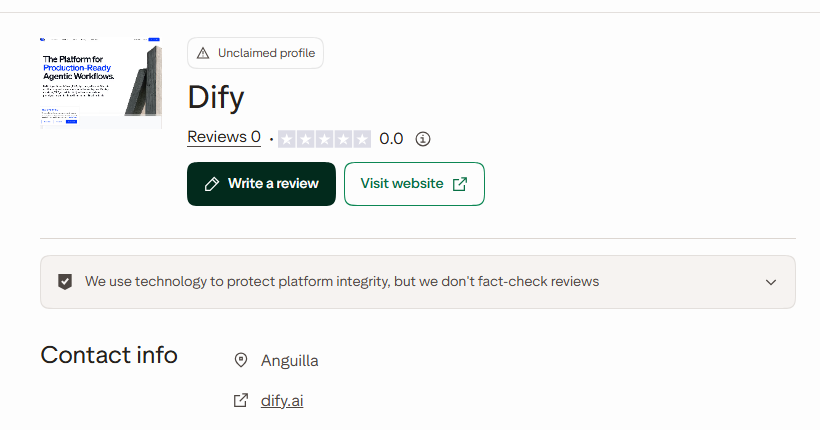
No G2 or Capterra score is cited here. The vendor’s own pages carry chosen testimonials (Volvo Cars on the home page; Maersk and ETS in the funding post), which are not independent. That leaves two public records you can check yourself.
How big is this evidence?
unclaimed profile
Dify in the title or link; none above 3 points
mention Dify; 6 give a view on using it
opened 10 Sep to 21 Oct 2026; 209 open on 22 Oct
Small. A Hacker News search on 21 Oct 2026 returns 10 stories since 1 Jan 2025 with Dify in the title or link, none with more than 3 points, and 19 comments that mention Dify. Six of those comments say something about using it, all favourable or neutral; the rest are passing mentions in lists. The critical voices are older, from mid-2024. The issue tracker is the larger and more current sample, but issues are bug reports, not satisfaction scores.
Has tried most of the alternatives and tends to go back to Dify: open source, connects to remote endpoints, tests up to four models at once, and builds workflows that use several models.
Argues most so-called agent use cases are really workflows, and calls Dify great for those.
Helped several writer friends set up AI tooling with low-code platforms such as Dify and says they took to Dify rather well.
In a regulated finance setting, the version they tried would not work until a Cohere reranking API key was configured, for a feature they did not plan to use; they built their own instead.
Impressed by the breadth of tools from LangChain to Dify, but found them unstable, with always-outdated documentation. A comment about several tools, not Dify alone.
Tried Dify and Coze to manage LLM flows and found both too complicated, with bugs.
What users report on the current release (Sep to Oct 2026)
Three open issues show what self-hosters run into now; each is one report, not a confirmed defect in every setup. Issue 44188 (16 Oct 2026): on 1.17.1 with an external Redis, a worker stopped picking up background tasks after a broker connection reset, and the reporter saw it again on 21 Oct; a community contributor has reproduced the error path but not the stall. Issue 42277 (14 Sep 2026): on 1.16.1, image attachments retrieved from a knowledge base reach the model in Studio preview but are silently missing for end users of the published app; contributors traced the cause and proposed a fix, and it is open on 22 Oct. Issue 44507 was opened and closed on 21 Oct 2026 after a pull request (44508) to bump the bundled Weaviate from 1.39.2 to 1.39.13, a Weaviate security release, was merged into the main branch; no release containing it had shipped by 22 Oct, so check the release notes for the 1.39.13 bump before you upgrade.
The license drew its own debate in the April 2024 thread. One commenter called the custom wording “Apache, except totally not Apache”, another asked for an established source-available license instead, and a Dify team member answered on 23 Apr 2024 (comment 40127910): “we’ll be relaxing this soon.” On 21 Oct 2026 the LICENSE file still carries both conditions, and a March 2025 submission of the license file drew a one-line reply: “Not open source.”
For a tool your company’s documents will pass through, the lack of independent ratings is a real gap. Read the open issues for the features you need, ask Dify for references if you buy Enterprise, and pilot with non-sensitive data first.
Free to self-host; in the cloud, $59 or $159 a month per workspace, or $590 and $1,590 a year.
Sandbox
For trying the core features
- 200 message credits
- 1 member, 5 apps
- 50 documents, 50 MB
- 30 days of logs
Professional
$590 billed yearly ($49.17 a month)
- 5,000 message credits a month
- 3 members, 50 apps
- 500 documents, 5 GB
- 20,000 trigger events a month
Team
$1,590 billed yearly ($132.50 a month)
- 10,000 message credits a month
- 50 members, 200 apps
- 1,000 documents, 20 GB
- Unlimited trigger events
Enterprise
Contact sales
- Self-host or VPC
- SSO, multiple workspaces
- Commercial license
- Negotiated SLAs
| Limit | Sandbox | Pro | Team |
|---|---|---|---|
| Message credits a month | 200 once | 5,000 | 10,000 |
| Members | 1 | 3 | 50 |
| Apps | 5 | 50 | 200 |
| Documents | 50 | 500 | 1,000 |
| Knowledge storage | 50 MB | 5 GB | 20 GB |
| Knowledge requests a minute | 10 | 100 | 1,000 |
| Trigger events | 3,000 | 20,000 a month | No limit |
| Log history | 30 days | No limit | No limit |
| Dify API limit | 5,000 a month | None | None |
| Support | Community, docs | Priority email | Priority email |
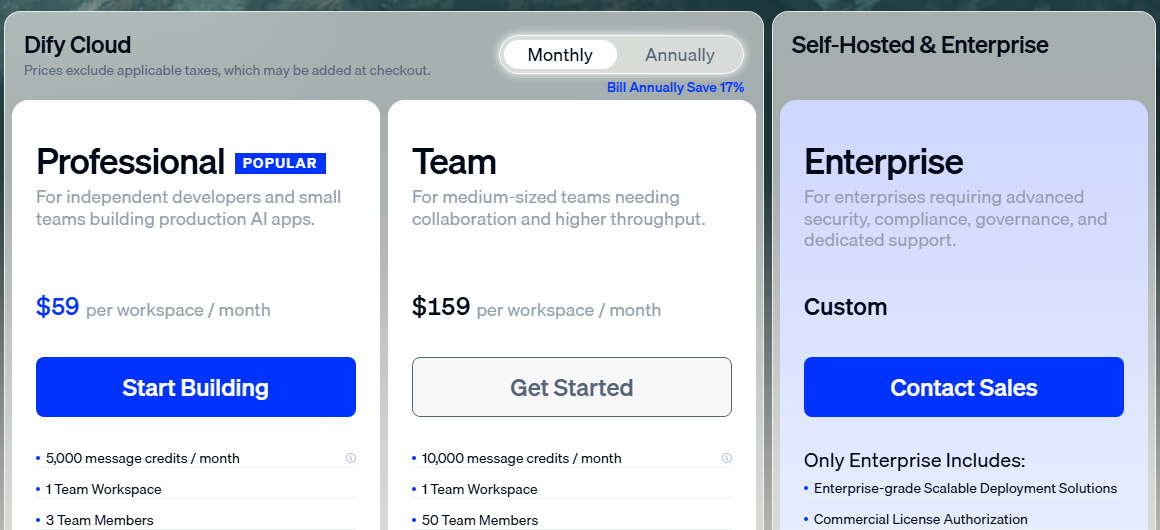
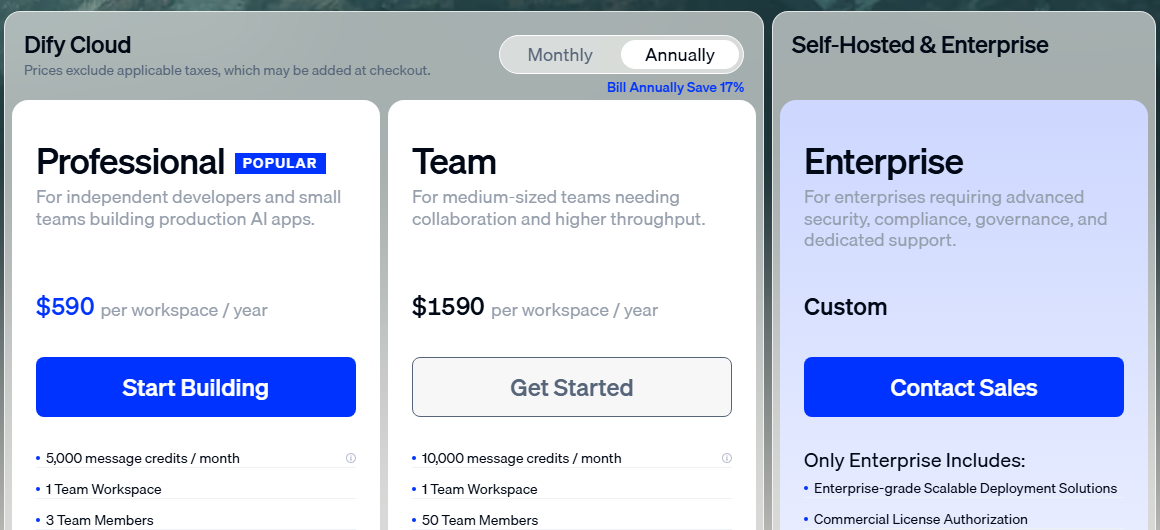
Plan mechanics, per the billing docs and the pricing FAQ: upgrades take effect at once and you pay the difference for the rest of the period; downgrades start at the next billing cycle; a cancelled workspace keeps its plan to the end of the paid period, then returns to Sandbox. You cannot buy extra seats or storage on their own: the FAQ says to upgrade, and to email support if Team is not enough. Refund terms are not stated on the pricing page. Verified students and teachers get the yearly Professional plan free, but with Sandbox-level credits: “200 one-time credits for built-in model usage, with no monthly refill.”
Not an affiliate link. It opens Dify’s official website.
One credit to 25 credits per answer, depending on the model: Professional’s 5,000 credits are 5,000 cheap answers or 200 premium ones.
Per the docs, an AI response is one model call and costs the same number of credits however many tokens it uses. The pricing page FAQ lists the rate for each model. When credits run out you continue on your own API key, and you can set which one Dify uses first. Some models cannot be used with credits at all.
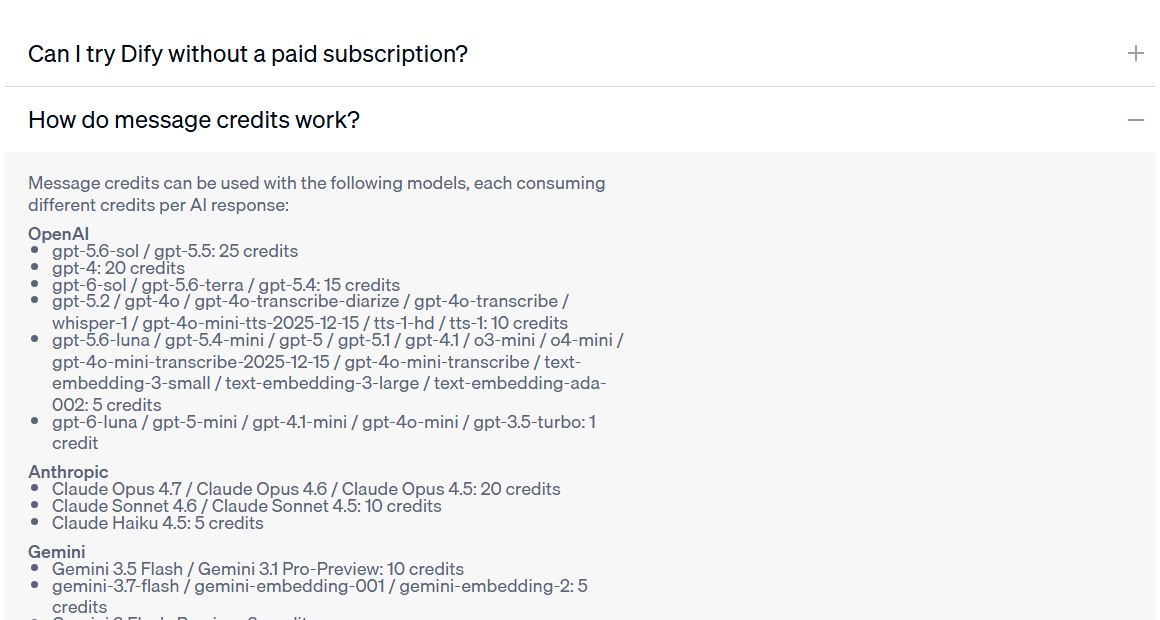
| Model | Credits | Answers | Own key |
|---|---|---|---|
| gpt-6-luna | 1 | 5,000 | $0.0005 |
| Claude Haiku 4.5 | 5 | 1,000 | $0.005 |
| Claude Sonnet 4.6 | 10 | 500 | $0.015 |
| Claude Opus 4.7 | 20 | 250 | $0.025 |
| gpt-5.5 | 25 | 200 | $0.027 |
Two traps in the rate list. Embedding models are on it too (text-embedding-3-small and -large at 5 credits), so check how much indexing draws from your credits before you load a large library. And the rates are per answer, so a long-context model on credits is relatively cheap while a short, cheap call is relatively dear.
Knowledge storage is metered separately. Per the docs, only documents indexed with the High Quality method count; usage depends on the number of vectors, not file size, and OpenAI’s text-embedding-3-large uses “nearly twice the storage per chunk” of text-embedding-3-small. An upload that would exceed the limit stays in the list but is not indexed. When storage is full, uploads, chunk edits and re-indexing are blocked, even for Economical indexing; after a downgrade nothing is deleted and apps keep retrieving.
Four workloads, cloud against self-hosted: model choice moves the bill more than the plan does.
Prices are from Dify, OpenAI, Anthropic and DigitalOcean on 21 Oct 2026. Team sizes, answer counts and the 3,000-in, 400-out answer size are invented. All sums are shown below.
A. One person trying it
Sandbox is $0 with 200 credits that do not refill: 20 Claude Sonnet 4.6 answers or 200 gpt-6-luna answers, plus 50 MB of knowledge storage and 5 apps. After that you add your own key. Cost: $0 plus whatever your key spends.
B. Three people, a support bot answering 3,000 questions a month on Claude Sonnet 4.6
Professional fits (3 members). 3,000 answers × 10 credits = 30,000 credits needed; the plan’s 5,000 cover 500 answers. With credits set to go first, the other 2,500 run on your Anthropic key: 2,500 × $0.015 = $37.50. Monthly billing: $59 + $37.50 = $96.50. Annual billing: $590 + 12 × $37.50 = $1,040 a year, $86.67 a month. Switch the bot to gpt-6-luna and the 3,000 answers fit inside the credits: $59 flat.
C. Eight people, 10,000 answers a month
Eight members rule out Professional, so Team: $159 a month or $132.50 on annual billing. On gpt-6-luna, 10,000 answers use exactly the 10,000 credits; the same answers on your own OpenAI key would cost 10,000 × $0.0005 = $5.00. On Claude Sonnet 4.6 the credits cover 1,000 answers and 9,000 go to your key: 9,000 × $0.015 = $135, so $159 + $135 = $294 a month, or $267.50 on annual billing.
D. The same eight people, self-hosted
The Community Edition is free for a single workspace used internally. The docs’ minimum is 2 CPU cores and 4 GiB of RAM, which DigitalOcean sells as a Basic droplet at $24.00 a month; but the default Docker Compose stack starts 15 long-running containers, so we priced the next size up: a Basic droplet with 8 GiB, 4 vCPUs and 160 GiB of disk at $48.00, plus daily backups at 30% of the droplet price ($14.40). Server: $62.40 a month. With gpt-6-luna on your key ($5.00): $67.40, which is $65.10 a month or $781.20 a year less than Team on annual billing. With Sonnet 4.6 for all 10,000 answers ($150): $212.40 against $267.50, $55.10 less.
Example D saves $65.10 a month. At $50 an hour, that saving is gone after 1.3 hours of upkeep a month. The 1.17.1 upgrade alone asks bundled-Weaviate users to step through 12 minor versions with a backup and a check at each one, and the advisory record below means upgrades are not optional. Self-host if someone already runs Docker in production; otherwise the cloud fee is mostly buying that person’s time.
Dify Premium, an AMI you launch in your own AWS account from AWS Marketplace, sits between the two: per the docs it allows removing the “Powered by Dify” branding and suits data-residency needs. Its price is set on the AWS Marketplace listing and is not included in these examples.
The Community Edition is free, under a modified Apache 2.0 license with two conditions that decide who can use it.
The LICENSE file says Dify “may be utilized commercially, including as a backend service for other applications or as an application development platform for enterprises”, but a commercial license is needed if either condition below applies.
| Condition | What the license says | Who it affects |
|---|---|---|
| Multi-tenant service | No multi-tenant environment without Dify’s written authorization; one tenant is one workspace. | Anyone giving customers or teams separate workspaces |
| Logo and copyright | No removing or changing the logo or copyright in the console or apps; does not apply if you skip the frontend (the web image). | Anyone wanting a white-label interface |
| Contributions | The producer may make the license stricter or more relaxed; contributed code may be used in its cloud business. | Contributors |
| Everything else | Apache License 2.0. | Most internal users |
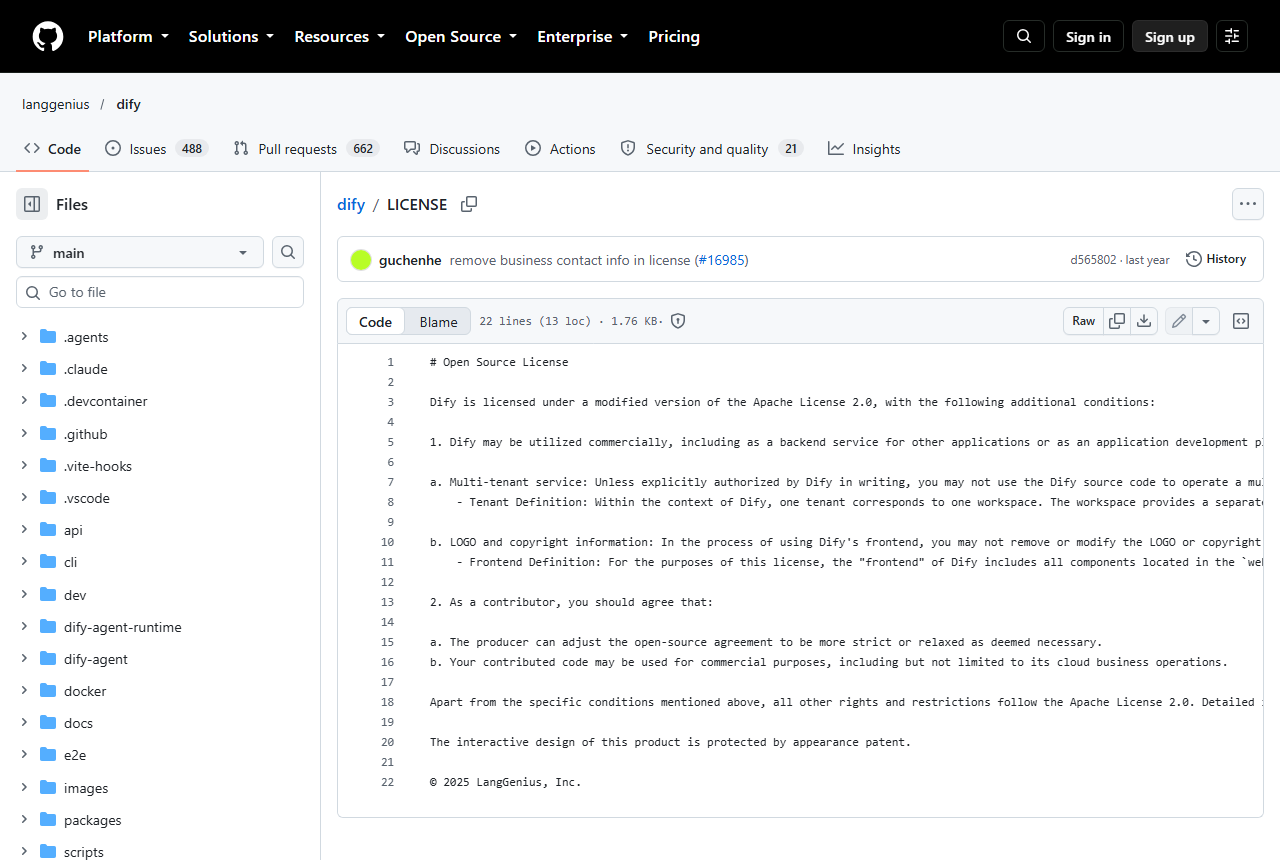
Two of Dify’s own pages disagree in tone. The pricing page describes the free Community edition as “for open-source enthusiasts, individual developers, and non-commercial projects”, while the LICENSE file explicitly allows commercial use. The license is the legal text; read the pricing line as positioning, and if your use is commercial, check the two conditions above with Dify in writing. The file also states that “the interactive design of this product is protected by appearance patent”, which matters if you plan to fork and restyle it. And the 2024 promise to relax the terms has not shown up in the file.
In practice: one company running Dify for its own staff in one workspace is the clear case. An agency hosting it for several clients, or a SaaS putting each customer in a workspace, needs a commercial license. Dify Premium on AWS and Enterprise are the paid routes that allow branding changes.
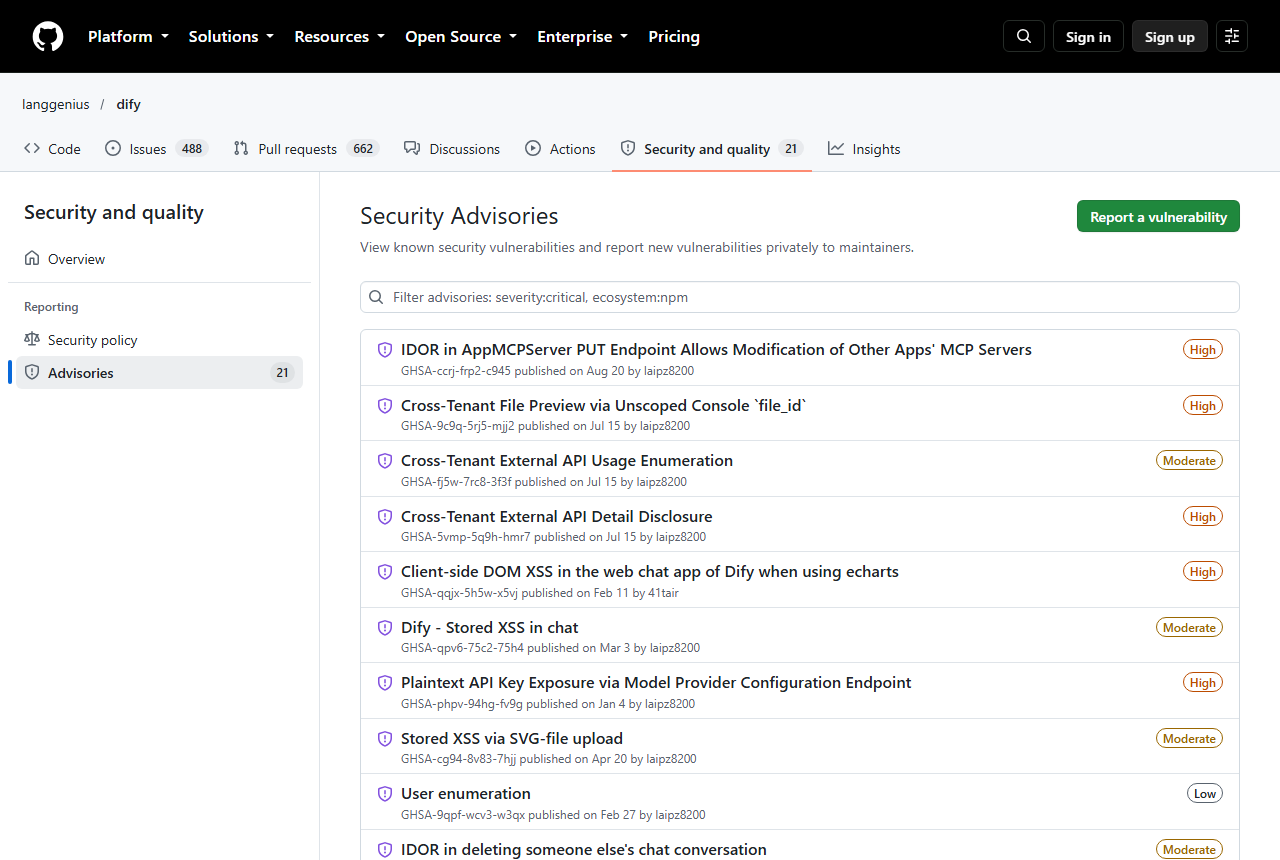
21 published advisories, 8 high, and the advisory usually appears about two months after the fix.
GitHub lists 21 security advisories for langgenius/dify on 21 Oct 2026: 8 high, 10 moderate and 3 low, 13 of them published in 2026. Each names the affected and fixed versions. Comparing each fixed version’s release date with the advisory’s publication date gives the lag below: for the 12 advisories from 2026 that name a fixed release, the median is 72.5 days, and 7 of 12 came more than 60 days after the fix. That is responsible disclosure working as intended (users get time to upgrade before details are public), but it means a self-hoster who waits for advisories is months behind.
| Published | Issue (advisory) | Fixed in |
|---|---|---|
| 19 Aug 2026 High | IDOR in the AppMCPServer update endpoint lets a user change other apps’ MCP servers GHSA-ccrj-frp2-c945 | 1.16.0 33 days |
| 15 Jul 2026 High | Cross-tenant file preview via an unscoped console file_id GHSA-9c9q-5rj5-mjj2 | 1.14.2 57 days |
| 15 Jul 2026 High | Cross-tenant external API detail disclosure GHSA-5vmp-5q9h-hmr7 | 1.14.0 77 days |
| 15 Jul 2026 Moderate | Cross-tenant external API usage enumeration GHSA-fj5w-7rc8-3f3f | 1.14.0 77 days |
| 19 May 2026 High | Unauthenticated server-side request forgery in the console remote-files upload GHSA-8235-vv5j-mmvg | 1.13.0 97 days |
| 19 May 2026 Low | SSRF in the API Extension GHSA-cg9f-q34p-p9h3 | 0.6.8 736 days |
| 20 Apr 2026 Moderate | IDOR: deleting someone else’s chat conversation GHSA-fxq3-hh7x-c63p | 1.13.1 34 days |
| 20 Apr 2026 Moderate | Stored XSS via SVG upload GHSA-cg94-8v83-7hjj | 1.13.1 34 days |
| 3 Mar 2026 Moderate | Stored XSS in chat GHSA-qpv6-75c2-75h4 | 1.11.2 68 days |
| 27 Feb 2026 Low | User enumeration GHSA-9qpf-wcv3-w3qx | 1.9.0 158 days |
| 11 Feb 2026 High | Client-side DOM XSS in the web chat app with echarts GHSA-qqjx-5h5w-x5vj | None listed affects up to 1.11.4 |
| 11 Feb 2026 Moderate | Weak random generator for API keys GHSA-fw4f-cghv-2v33 | 1.4.2 245 days |
| 4 Jan 2026 High | Plaintext API key exposure via the model provider configuration endpoint GHSA-phpv-94hg-fv9g | 1.11.0 24 days |
React2Shell, December 2025: users reported compromised servers
On 5 Dec 2025 a user opened a GitHub issue (29167) saying the components Dify uses contained the React remote code execution flaw tracked as CVE-2025-55182 (React2Shell). The same day Dify published 1.10.1-fix.1, which bumps React to 19.2.1 and Next.js to 15.5.7. On 7 Dec, in issue 29244, a self-hoster running a 2.0 beta reported finding cryptomining malware on their server and wrote that it was “likely exploited through this vulnerability”; two users replied that they had the same problem, and on 9 Dec another said a process kept using up their CPU. A maintainer replied on 8 Dec by pointing to the fix release; Dify did not say whether these servers were compromised through this flaw, and JAVIS cannot either. The release notes add one condition worth quoting exactly: “For users who upgraded to version 1.10.1-fix.1 before 2025-12-09 03:00:00 UTC, please verify your docker compose configuration to ensure the web service is using the correct image version langgenius/dify-web:1.10.1-fix.1.”
Plugins: the vendor’s own numbers
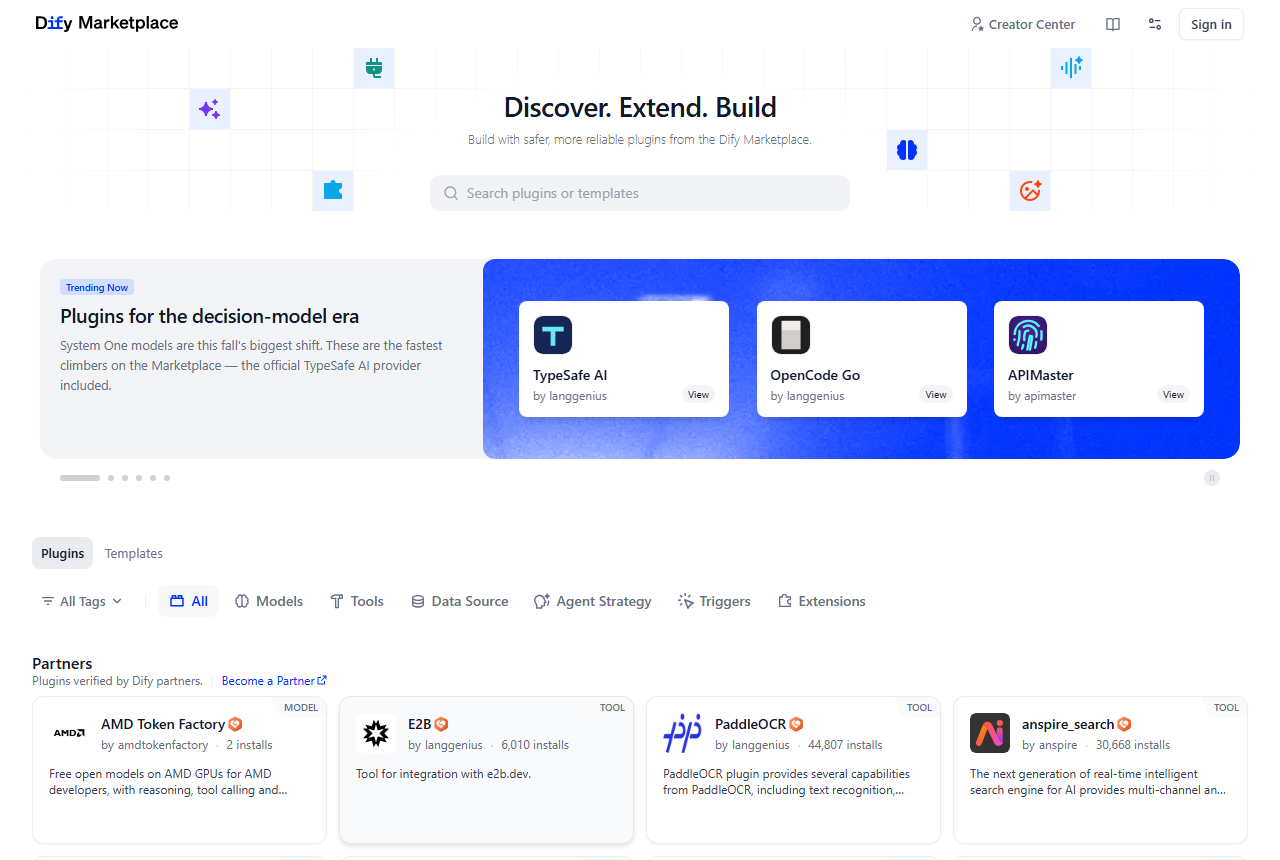
In a 9 Sep 2026 post on governing the plugin marketplace, Dify’s developer relations team gives a 31 Jul 2026 snapshot: 928 listed plugins, 263 carrying the Official label, and an “actively maintained baseline” of 99 that reviewers reported as maintained, which the post says is a different measure from the Official label. The same post says plugin packages have been seen containing .env files, .git metadata “that may expose credentials” and whole virtual environments, and describes the checks now run before publication. Treat each plugin as third-party code with access to your workspace, and prefer ones that are actively maintained.
Subscribe to the repository’s releases, not just its advisories; keep the console off the public internet; rotate model keys when an advisory touches them; and if you run several workspaces on one install, treat the July 2026 cross-tenant fixes (1.14.0 and 1.14.2) and the August MCP fix (1.16.0) as the minimum version. Release 1.17.1 also adds knowledge-base API keys bound to a single knowledge base; existing keys stay workspace-wide “so nothing changes when you upgrade”, so replace them. On the cloud side, a Dify blog post of 13 Mar 2026 says it completed SOC 2 Type II (audited by Sensiba) and ISO 27001:2022 (audited by Johanson) for the second year, plus GDPR compliance; the home page repeats the claim and the comparison page has a SOC Type II Report row. These are Dify’s own statements; ask for the reports. The pricing FAQ says only that data is stored “in our managed cloud region”, without naming it.
Docker Compose on 2 cores and 4 GiB at minimum, 15 services running, and upgrades that need a plan.
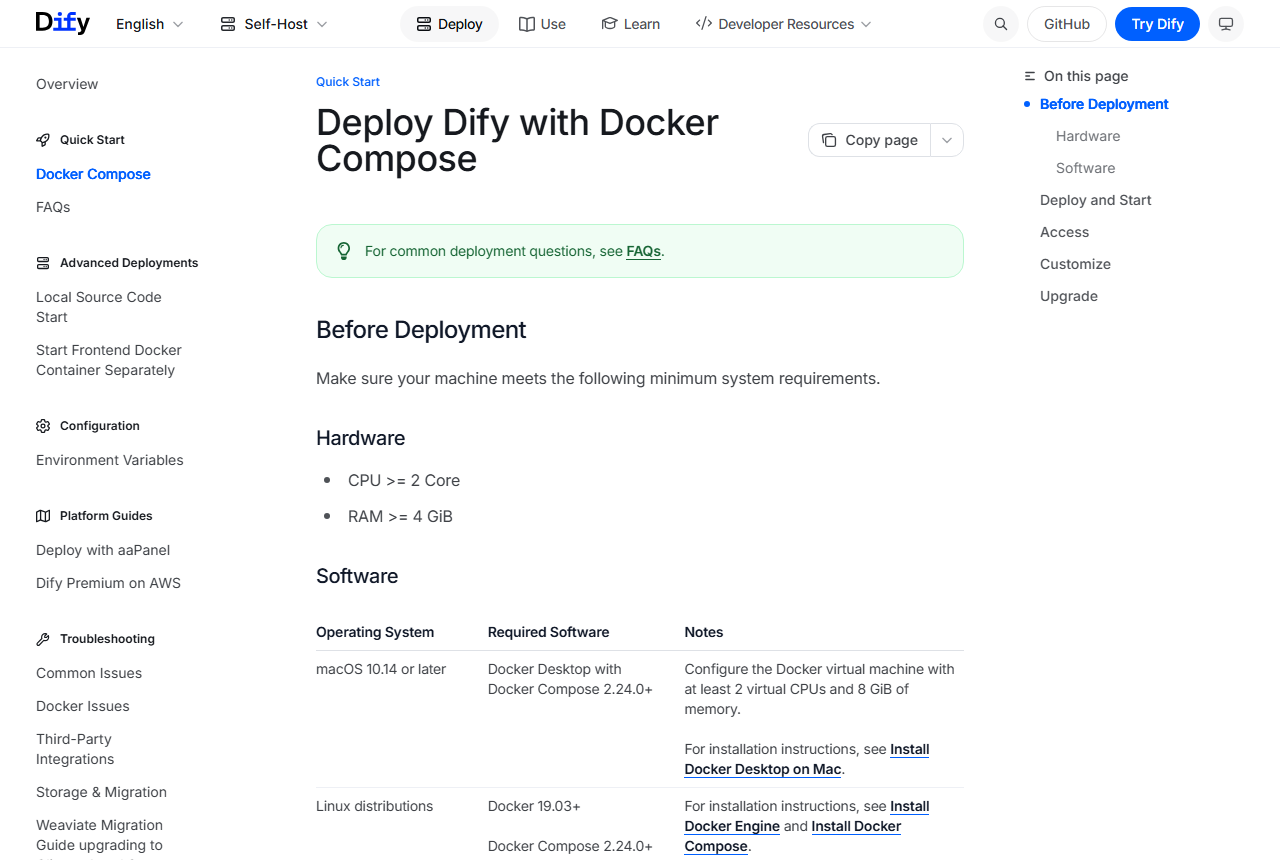
The docs list a minimum of 2 CPU cores and 4 GiB of RAM with Docker Compose 2.24.0 or later; on macOS they ask for a Docker VM with at least 2 virtual CPUs and 8 GiB, and on Windows for WSL 2 with data kept in the Linux file system. docker compose up -d starts 7 core services (api, api_websocket, worker, worker_beat, web, plugin_daemon, agent_backend), 8 dependencies (Weaviate, Postgres, Redis, Nginx, two SSRF proxies and two sandboxes) and a one-time permissions task. Then you open /install to create the admin account.
“Self-hosted deployments using the bundled Weaviate must complete a manual, staged upgrade before starting 1.17.1.” The bundled server moves from 1.27.0 to 1.39.2, 12 minor versions, skipping minors is unsupported, and “pulling and restarting can silently and permanently break vector search.” The upgrade guide has you stop the API and workers, copy the volume, then step through each minor release and verify object counts. Fresh installs, external Weaviate and other vector stores are unaffected.
Issue and release states as of 22 Oct 2026, from the langgenius/dify repository.
A canvas for workflows, agents with their own sandbox, knowledge bases, plugins and five ways to publish.
| Piece | What the docs say |
|---|---|
| Workflow and Chatflow | Nodes for LLM, knowledge retrieval, agent, question classifier, if-else, iteration, loop, code and human input; snippets to reuse groups of nodes |
| Agent | Build by hand or by chatting; a sandbox with 20 GB of storage where it runs commands and handles files; skills uploaded as .zip or .skill packages up to 50 MB; usable alone or as a workflow step |
| Knowledge | Upload, chunk and index documents; High Quality (vectors) or Economical (keywords) indexing; multimodal knowledge bases |
| Triggers | Schedule, webhook and integration triggers |
| Publish | Web app, embed, REST API, MCP server, Marketplace, and the difyctl command line |
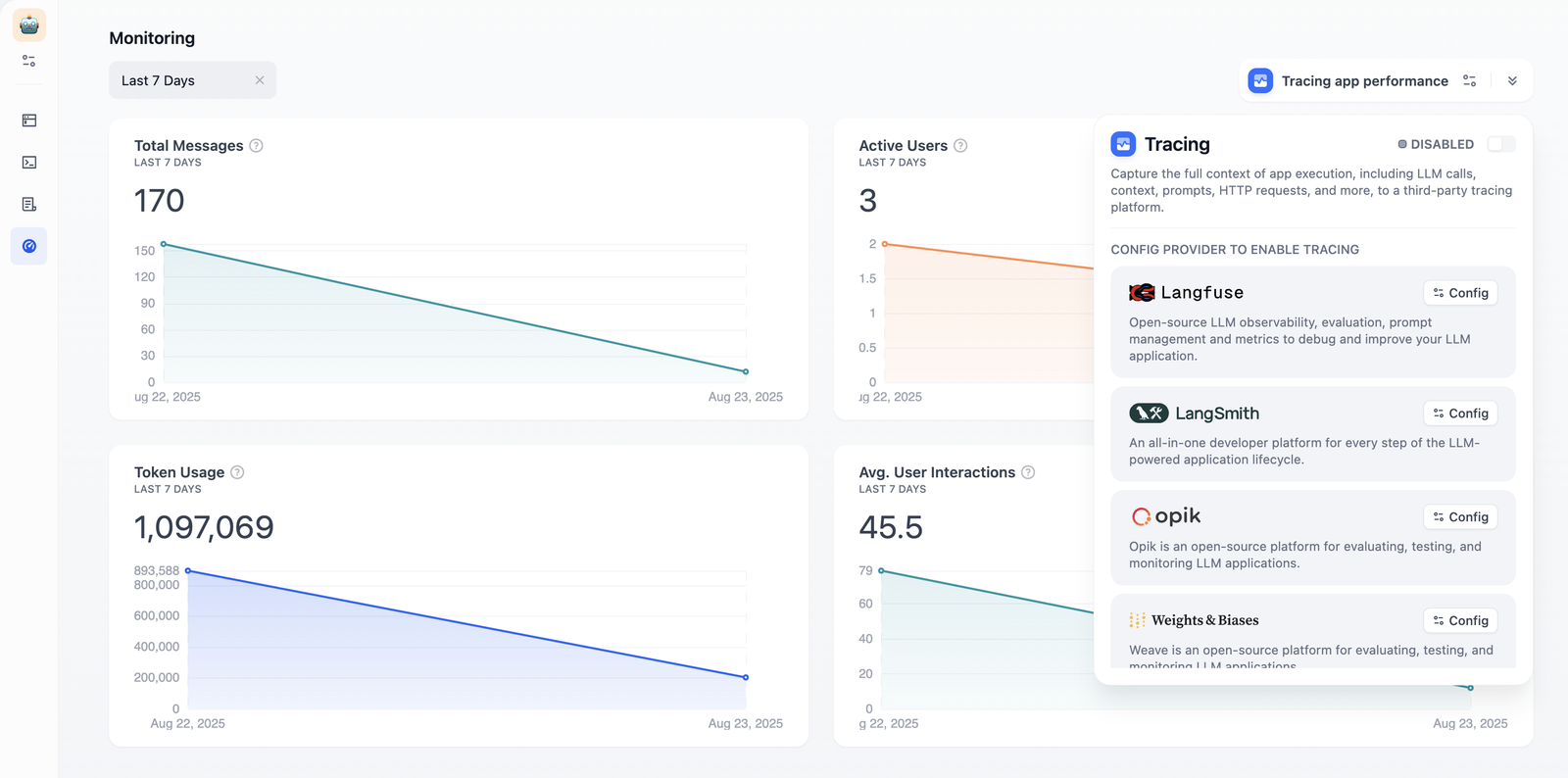
| Monitor | Run history, logs, a dashboard of messages, users and tokens, and tracing to Langfuse, LangSmith, Opik and others |
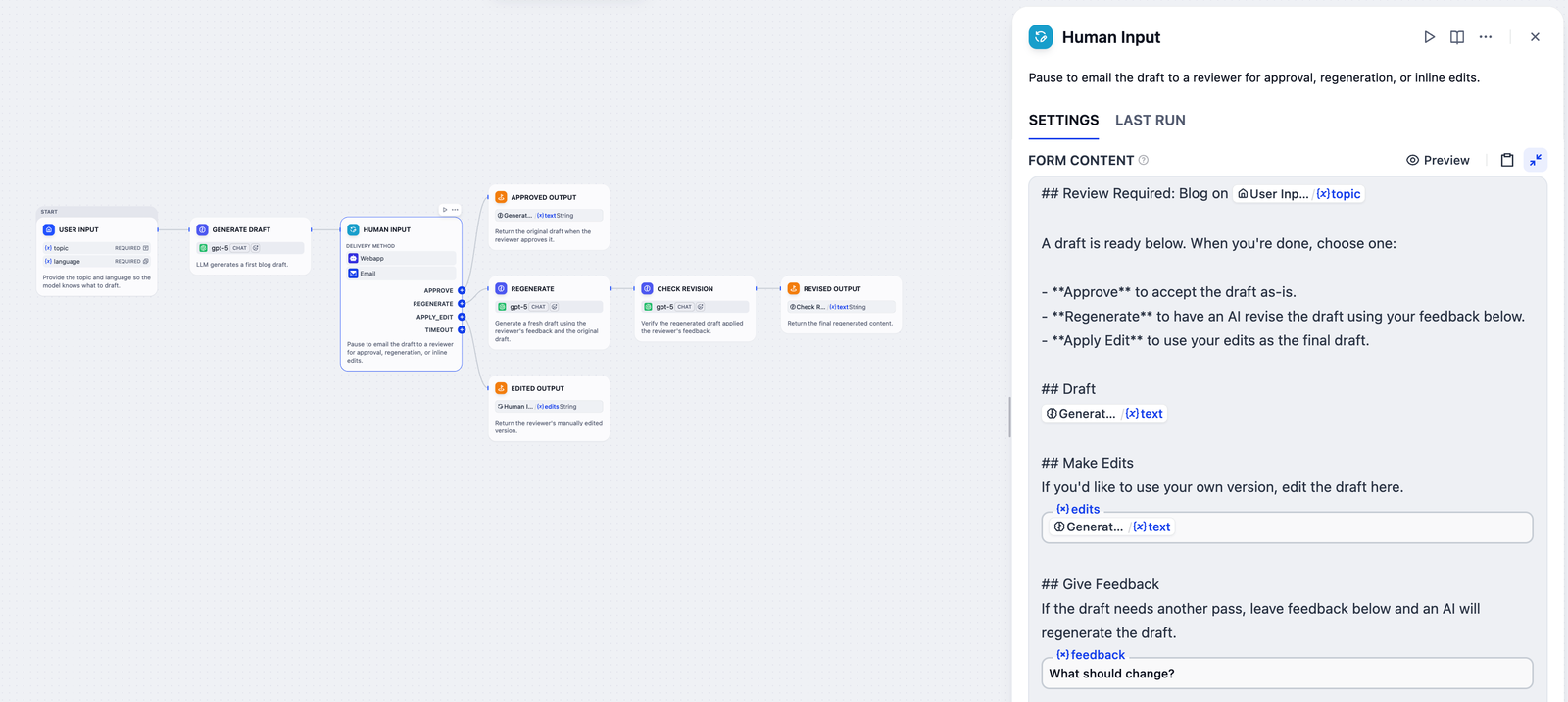
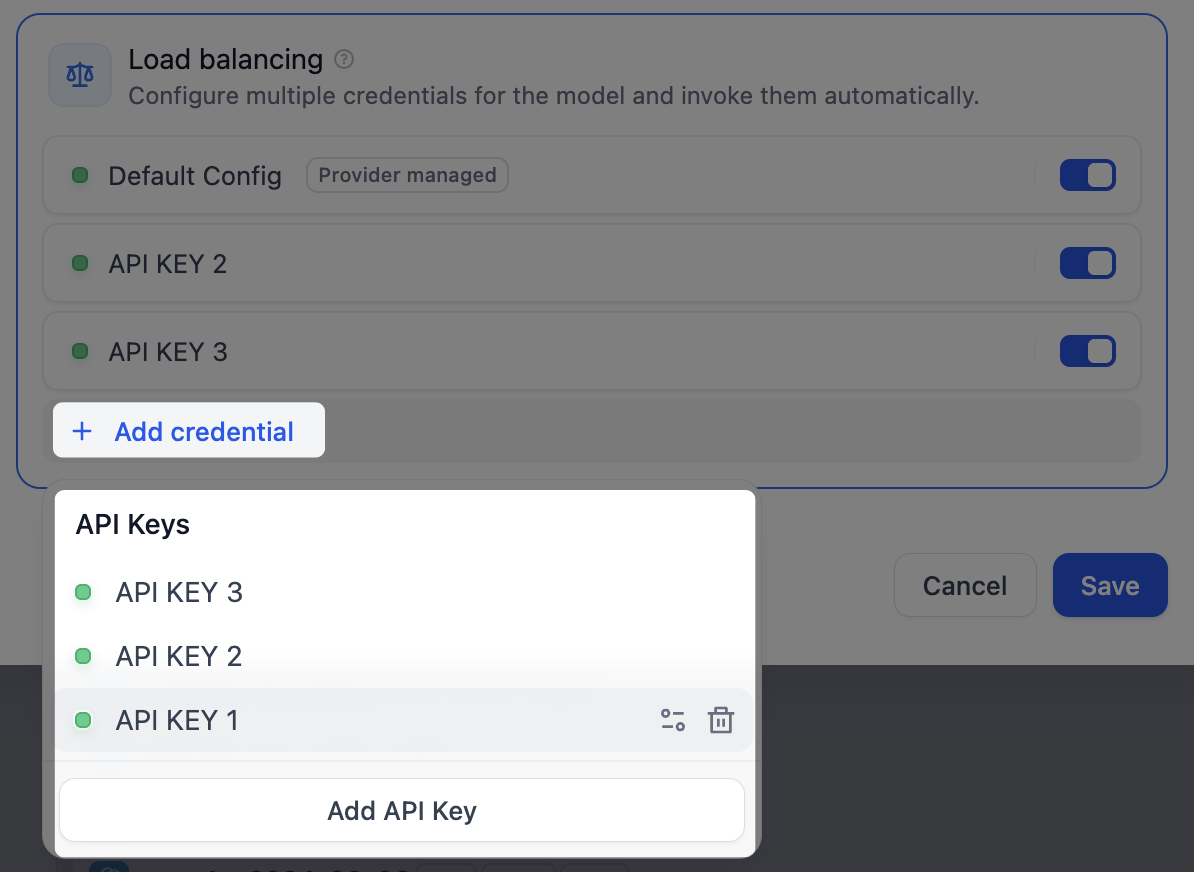
Load balancing matters for example B and C above: once real volume runs on your own keys, a single key hits the provider’s rate limit, and Dify can rotate across several keys, resting any key that hits its limit for a minute. It is listed for Professional and Team, not Sandbox.
Pick the model path first, then the knowledge base, then the canvas.
An illustrative sequence built from the documented features, not a record of a JAVIS build.
Match your situation to one line.
Builders and small teams who want to ship AI apps without writing a backend.
- Technical teams prototyping RAG and agent apps on a canvas
- Teams that will bring their own model keys
- Anyone who already runs Docker and patches on a schedule
- People who want to swap models without rebuilding the app
- Buyers who expect the plan fee to cover model usage
- Agencies or SaaS products offering a workspace per customer, without a commercial license
- Teams that cannot maintain servers
- Anyone who needs an independently rated product before buying
Ten things to check before you rely on it.
5,000 credits are worth $2.50 to $7.50 at API list prices for a 3,000-in, 400-out answer.
No extra seats or storage on their own; you upgrade the plan.
No multi-tenant use and no logo removal without a commercial license.
Pricing calls Community “non-commercial”; the LICENSE allows commercial use.
21 advisories, 8 high; median 72.5 days from fix to advisory in 2026.
1.17.1 needs a 12-step Weaviate upgrade for bundled installs.
Of 263 Official-labelled plugins, 99 were reported as actively maintained.
The cloud stores data “in our managed cloud region”; SOC 2 and ISO 27001 are vendor statements.
Trustpilot 0 reviews; Hacker News opinion is thin.
And the tenth: JAVIS did not install or run Dify for this review.
Priced on the same day from each vendor’s page; the units differ, so the plans are not like-for-like.
| Product | Price, 21 Oct 2026 | JAVIS review |
|---|---|---|
| Dify | Cloud $59 or $159 a month per workspace; Community free (modified Apache 2.0) | This article |
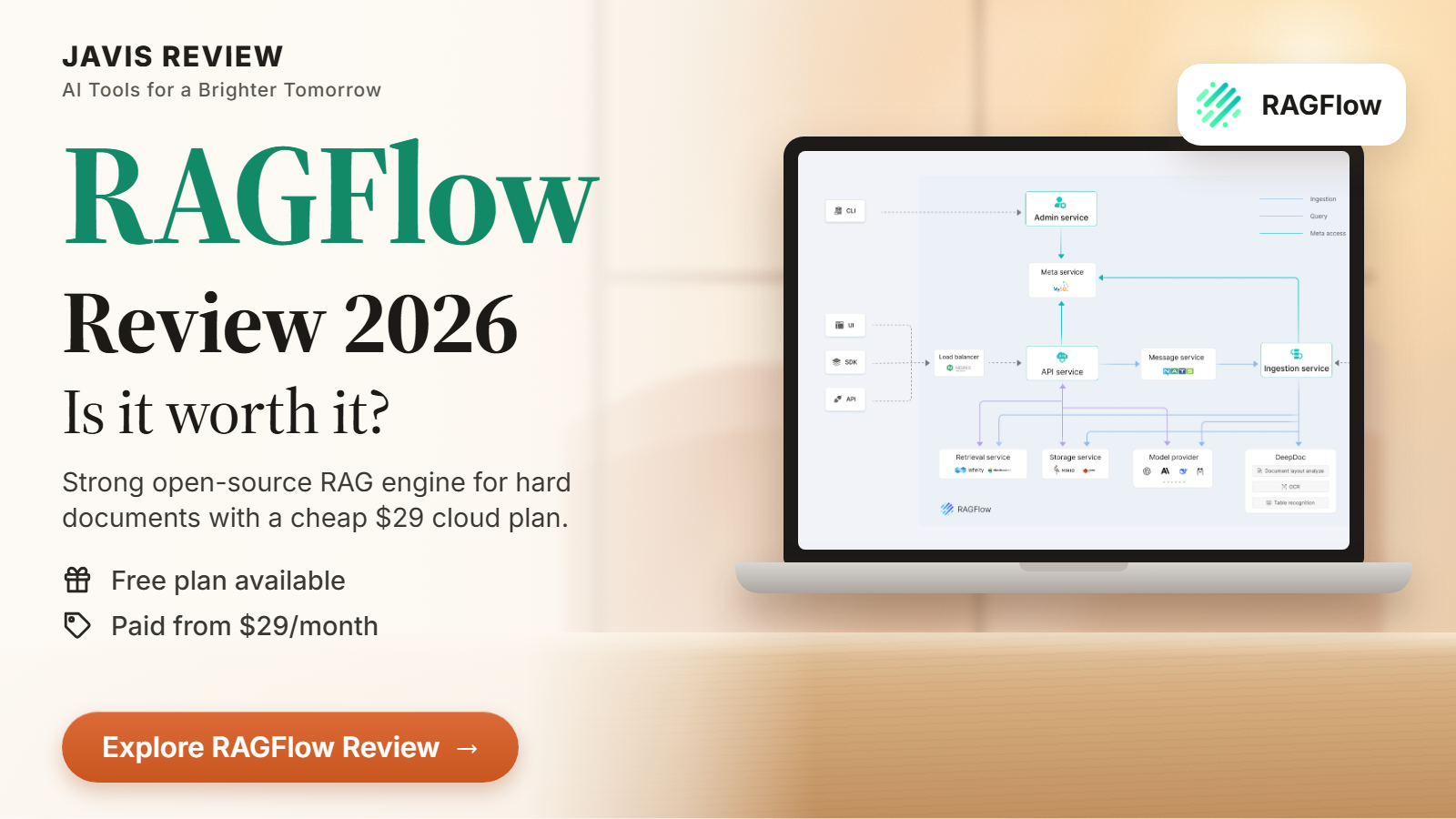
| RAGFlow | Free; Starter $29 and Pro $129 a month, shown beside crossed-out $59 and $259; Apache 2.0 | RAGFlow review |
| n8n | Starter 20 euros and Pro 50 euros a month billed annually (2.5k and 10k executions); Business 667 euros, self-hosted only | n8n review |
| Activepieces | Free with 1,000 credits a month; Plus $20 and Team $200 a month, flat | Activepieces review |
| LangChain | Framework MIT-licensed; LangSmith Developer $0 (1 seat), Plus $39 per seat a month | LangChain review |
| Langflow | MIT-licensed; the site offers “Get Started for Free” and lists no plan prices | Not reviewed yet |
| Flowise | Wound down: code freeze 29 Jul 2026, repository archived; the site still shows Free, $35 and $65 cloud plans | Not reviewed |
How they differ. RAGFlow is the closest rival for document-heavy question answering and is cheaper in the cloud today (Starter $29 against Professional $59 for similar headline limits), but its 1.0 rewrite is still a release candidate; see the RAGFlow review. n8n and Activepieces are automation tools first, better at wiring business apps together than at knowledge bases and agents. LangChain is a code framework, not a canvas. Langflow, with 155,887 GitHub stars, is the nearest visual builder that is still active.
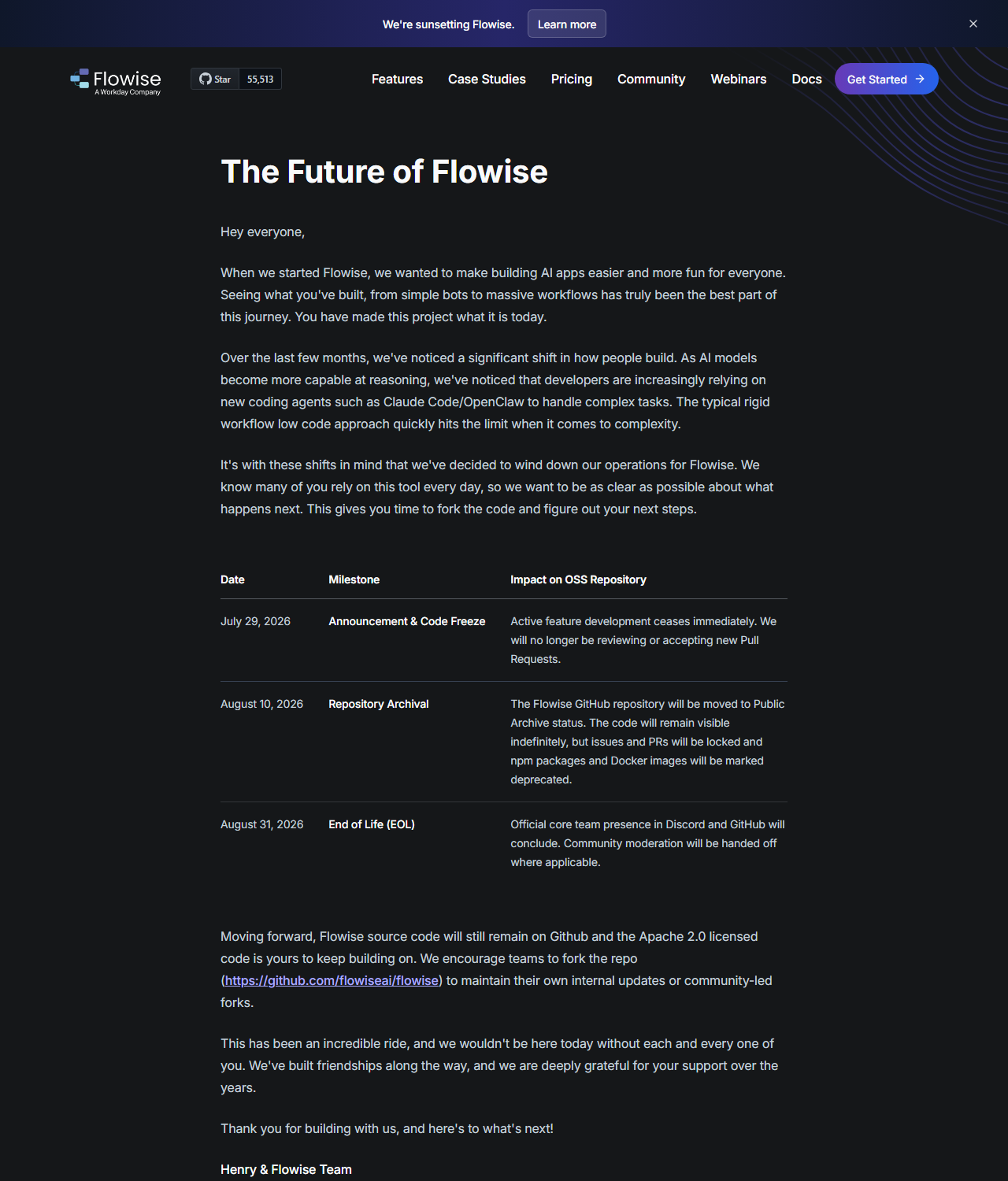
Flowise, a popular open-source visual builder, announced on 29 Jul 2026 that it would wind down, citing developers moving to coding agents: “The typical rigid workflow low code approach quickly hits the limit when it comes to complexity.” Its Apache 2.0 code remains for forks. Dify’s position is different (fresh funding, a release every few weeks), but the episode is a reason to keep your prompts, documents and app definitions exportable. Per the docs, Dify apps can be exported as DSL files with their configuration and workflow, though not everything travels with them.
This review has no affiliate links, and Dify did not see it.
JAVIS has no approved Dify affiliate link, so every Dify link in this article goes straight to dify.ai or its docs, with no tracking parameters.
Hands-on status: JAVIS has not installed Dify, signed up for Dify Cloud or paid for it. Facts come from Dify’s own pages, docs, license, release notes and blog; GitHub’s public repository, issue and advisory records; Docker Hub; Trustpilot; Hacker News; and the OpenAI, Anthropic and DigitalOcean price pages, as of 21 Oct 2026. Vendor screenshots are labelled as such.
Start on Sandbox or a local Docker install with non-sensitive documents.
Open dify.aiThe plan and credit tables above come from the pricing page and its FAQ.
Open the pricing pageBuilding AI apps or agents? These reviews cover the nearest ground.
Each card opens a published JAVIS review.



Questions people ask before building
How much does Dify cost in October 2026?
Per dify.ai/pricing on 21 Oct 2026: Sandbox $0; Professional $59 a month or $590 a year; Team $159 a month or $1,590 a year; Enterprise custom; Community Edition free to self-host. Prices exclude tax and are per workspace.
Do the cloud plans include model usage?
Some. Professional includes 5,000 message credits a month and Team 10,000; an answer costs 1 to 25 credits depending on the model. At list prices that is a few dollars of model use; real volume runs on your own API key.
Is self-hosting cheaper?
On server cost, yes: about $62.40 a month for an 8 GiB DigitalOcean droplet with daily backups against $132.50 for Team on annual billing. The difference disappears if upkeep takes more than about 1.3 hours a month at $50 an hour.
Is Dify really open source?
The code is public under a modified Apache 2.0 license that restricts multi-tenant hosting and logo removal, so it is better described as source-available.
Can I host Dify for my customers?
Not as separate workspaces without Dify’s written authorization, per the license. Ask about a commercial license.
What do I need to self-host it?
At least 2 CPU cores, 4 GiB of RAM and Docker Compose 2.24.0 or later, per the docs; the default stack runs 15 services, so more memory is safer.
Is Dify secure?
GitHub lists 21 advisories, 8 high; in 2026 the median advisory appeared 72.5 days after its fix. Upgrade on releases, not on advisories.
What do users say?
There is no star rating: Trustpilot shows 0 reviews. Hacker News comments since 2025 are few and mostly favourable; the 2024 criticism was about complexity, stability and setup friction.
Is Dify an affiliate product here?
No. This review has no affiliate links.
Where this came from, and when.
Pricing and plans: dify.ai/pricing (monthly and annual views), the Dify Cloud comparison page and its FAQ (credit rates per model, add-ons, cancellation, taxes, data storage), and the docs pages on billing, model providers, knowledge storage and knowledge request limits, 21 Oct 2026.
Model and server prices: OpenAI API pricing (developers.openai.com), Anthropic pricing (platform.claude.com) and DigitalOcean Droplet pricing, 21 Oct 2026. All sums are shown in the sections above.
Product: dify.ai home page; docs pages on Docker Compose deployment, the Weaviate upgrade path, Dify Premium on AWS, agents, workflow nodes, knowledge retrieval, monitoring and publishing; the README and LICENSE; the 1.17.1 and 1.10.1-fix.1 release notes; Dify blog posts of 10 Mar 2026 (funding), 13 Mar 2026 (SOC 2, ISO 27001 and GDPR) and 9 Sep 2026 (plugin governance), read 21 and 22 Oct 2026.
Independent evidence: GitHub repository data (159,139 stars, 25,152 forks, 170 releases), the 21 security advisories with their fixed versions, issue searches for 10 Sep to 21 Oct 2026 (558 issues opened 10 Sep to 21 Oct, 209 of them open on 22 Oct), issues 29167, 29244, 42277, 44188 and 44507 and pull request 44508 (states as of 22 Oct 2026); Docker Hub pull counts for langgenius/dify-api and dify-web; the Trustpilot profile for dify.ai (0 reviews); Hacker News story 40121318 (22 Apr 2024) with comments 40125176, 40127127, 40127229, 40127910 and 40128724, story 43482644 (26 Mar 2025) with comment 43482695, and comments 41179623 (7 Aug 2024), 41198361 (9 Aug 2024), 41389149 (29 Aug 2024), 43338196 (11 Mar 2025), 44694207 (26 Jul 2025) and 44741840 (31 Jul 2025); a Hacker News search for items since 1 Jan 2025, run on 21 Oct 2026.
Competitors: ragflow.io, n8n.io/pricing, activepieces.com/pricing, langchain.com/pricing, langflow.org, flowiseai.com and flowiseai.com/sunset, and each project’s GitHub repository, 21 Oct 2026.
Images: eleven screenshots of public pages taken on 21 Oct 2026 (Dify home, pricing monthly and annual, pricing FAQ, GitHub repository, LICENSE and advisories, Docker Compose docs, Marketplace, Trustpilot and the Flowise sunset page); four vendor product screenshots from Dify’s docs, labelled as such; one video from Dify’s official YouTube channel; JAVIS charts and the architecture diagram computed from the cited figures. Related cards use JAVIS’s own featured images.
Store ratings: none included; Dify is a web platform without a mobile app listing.
JAVIS Fit Score (70/100): five criteria scored out of 20. Price clarity 15: a clear plan ladder and a published credit table, but credits buy little and Enterprise is custom. Capability breadth 18: workflows, agents with a sandbox, RAG, plugins, triggers, API, MCP and CLI. Independent evidence 11: strong repository and Docker data, but 0 Trustpilot reviews and thin, mostly old written opinion. Security and data control 12: self-hosting and Enterprise options and stated SOC 2 and ISO 27001 audits, but 21 advisories, disclosure lag and an unnamed cloud region. Cost control and fit 14: a real free tier and flat workspace prices, offset by no add-ons and the license limits. It is judgment, not a measurement.
What this review does not cover: build quality, answer accuracy, performance under load, a technical security review, the price of Dify Premium on AWS and Enterprise, and every plugin in the marketplace.