
OpenRouter Review 2026: 500+ Models Behind One Key, a 5.5% Credit Fee, and a Stripe Deal Still Pending
OpenRouter is a unified API and credit balance that routes requests to 80+ providers and 500+ AI models. As of Oct 28, 2026 inference is billed at provider list prices, the platform fee is 5.5% (Standard) or 8% (Business) when you buy credits, and OpenRouter has announced it is joining Stripe. This review works out what that costs at $1,000 and $10,000 a month, what the terms and data rules say, and where Hacker News users report trouble.

There are no affiliate links in this review. Every OpenRouter link goes straight to openrouter.ai or its documentation.
| Made by | OpenRouter, Inc.; joining Stripe (announced Aug 19, 2026) |
| What it is | Unified API and credits for 500+ AI models |
| Pricing | Provider list price; 5.5% or 8% fee on credit purchases |
| Catch | Pending deal; ZDR caveats; provider drift |
| Evidence | Large Hacker News threads; no star rating |
OpenRouter is the easiest way to reach 500+ models with one key, and the fee is 5.5% when you buy credits; the new risks are a pending Stripe deal and data-policy questions.
“OpenRouter will continue to operate as it is: same mission, same name, same product, same roadmap.” That is OpenRouter's own Aug 19, 2026 announcement that it is joining Stripe, with the deal “subject to customary closing conditions” and expected to close “in the coming weeks”.
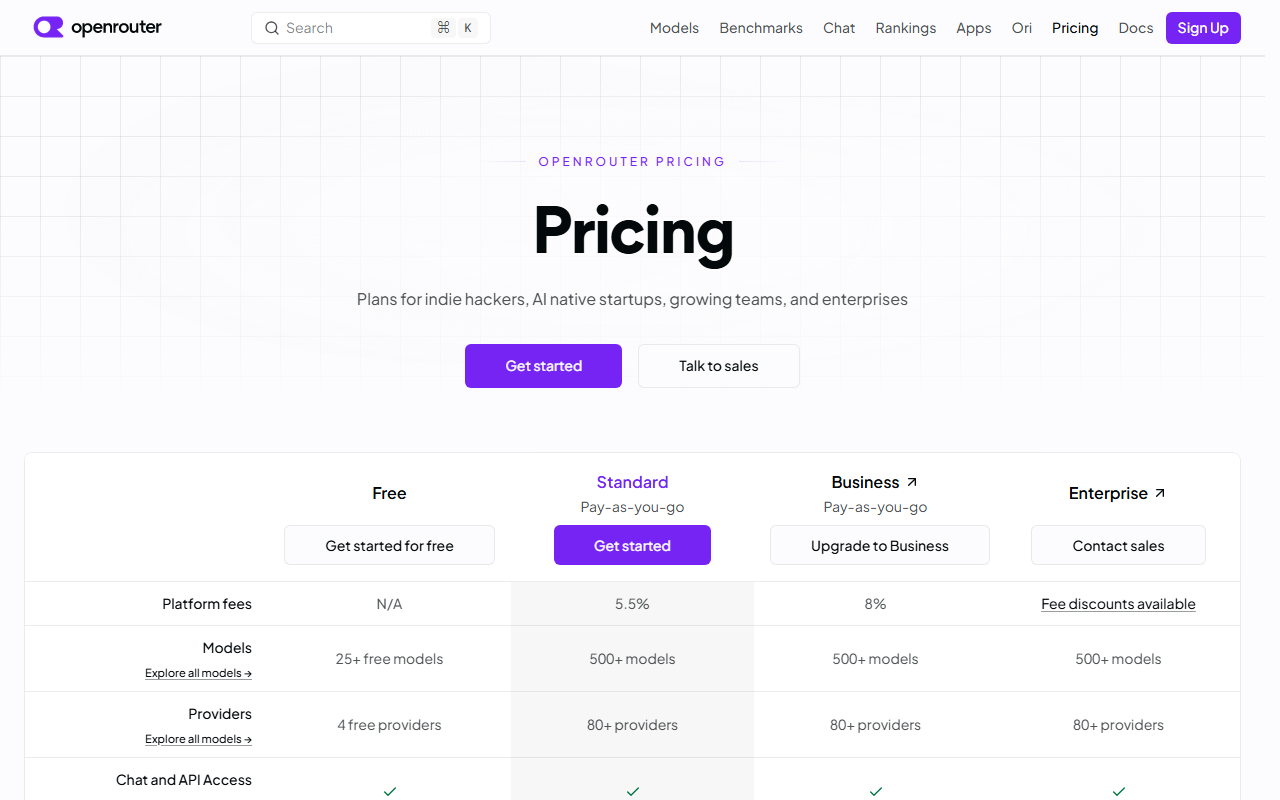
OpenRouter is a single OpenAI-compatible API and credit balance that routes requests to 80+ providers and 500+ models, with fallbacks, spend controls and a free tier of 25+ models. Per its pricing page, inference is billed at the provider's list price on every plan, and the platform fee is charged when you buy credits: 5.5% on Standard, 8% on Business, with discounts only on Enterprise. If you bring your own provider keys, the first $25,000 of list-price inference a month carries no fee and 5% applies above that. On $10,000 of monthly spend the fee is $550 (Standard) or $800 (Business); Vercel's AI Gateway docs say it charges “no markup and no platform fee on tokens”.
Three things deserve a decision before you commit. First, ownership: Bloomberg reported on Aug 16, 2026 that Stripe would pay more than $7 billion, OpenRouter confirmed it is joining Stripe on Aug 19, 2026, and its Terms (updated Aug 31, 2026) say “We may assign these Terms at any time without notice or consent”. OpenRouter's own blog shows no closing announcement as of Oct 28, 2026. Second, data: OpenRouter does not log prompts by default and offers Zero Data Retention routing, but its Oct 27, 2026 notice says all requests, including ZDR traffic, will be screened for child-abuse material and flagged content may be retained for human review (reported material must be preserved for one year under US law, per the notice), and two Hacker News posts report that Google models stopped satisfying a ZDR setting. Third, quality: a widely read Sep 2026 study found the same model scoring very differently across hosts, so the cheapest route is not always the same answer.
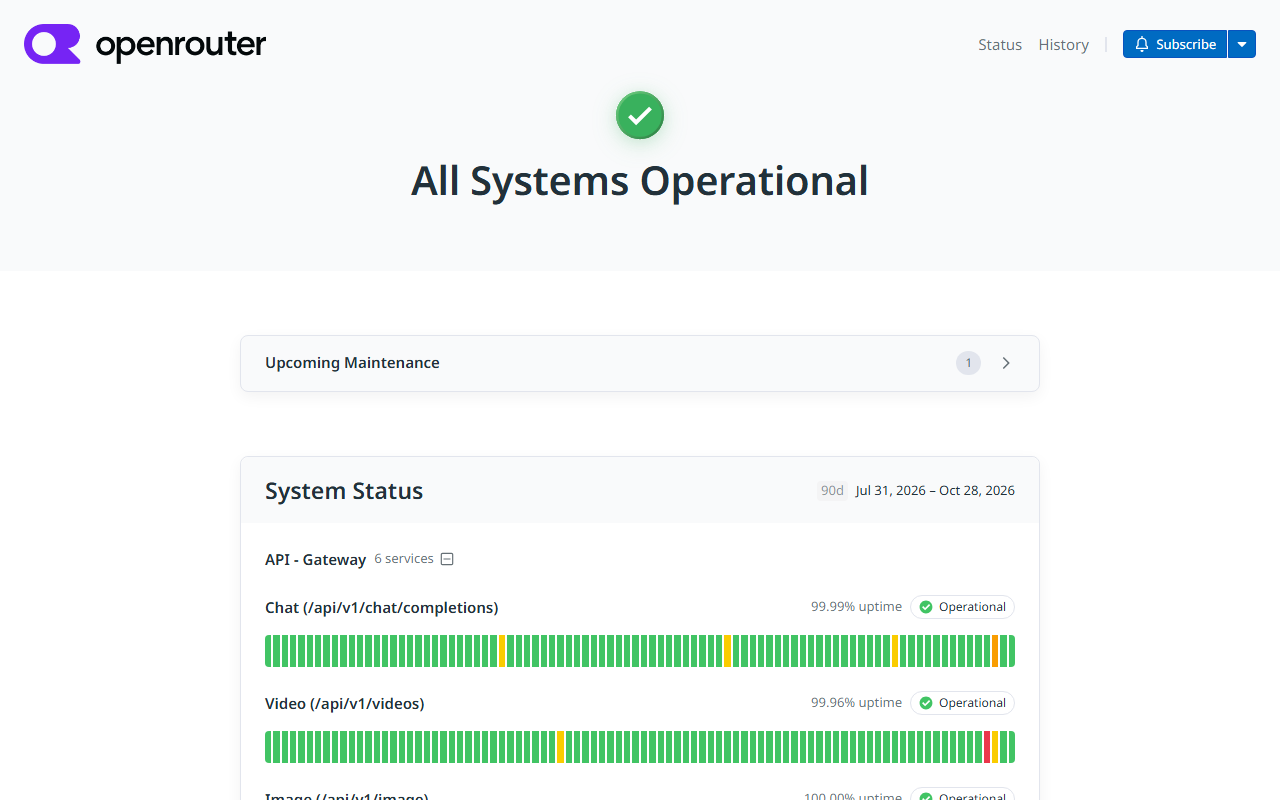
Not a hands-on test: JAVIS has not created an OpenRouter account, bought credits or sent a request. This review is built from OpenRouter's pricing page, documentation, terms, blog, status page and GitHub organization, TechCrunch, Hacker News and competitors' pricing pages, all dated Oct 28, 2026 unless stated. Latency, uptime in practice and output quality are not measured here.
One key, one balance, many providers; the fee is taken when you top up.
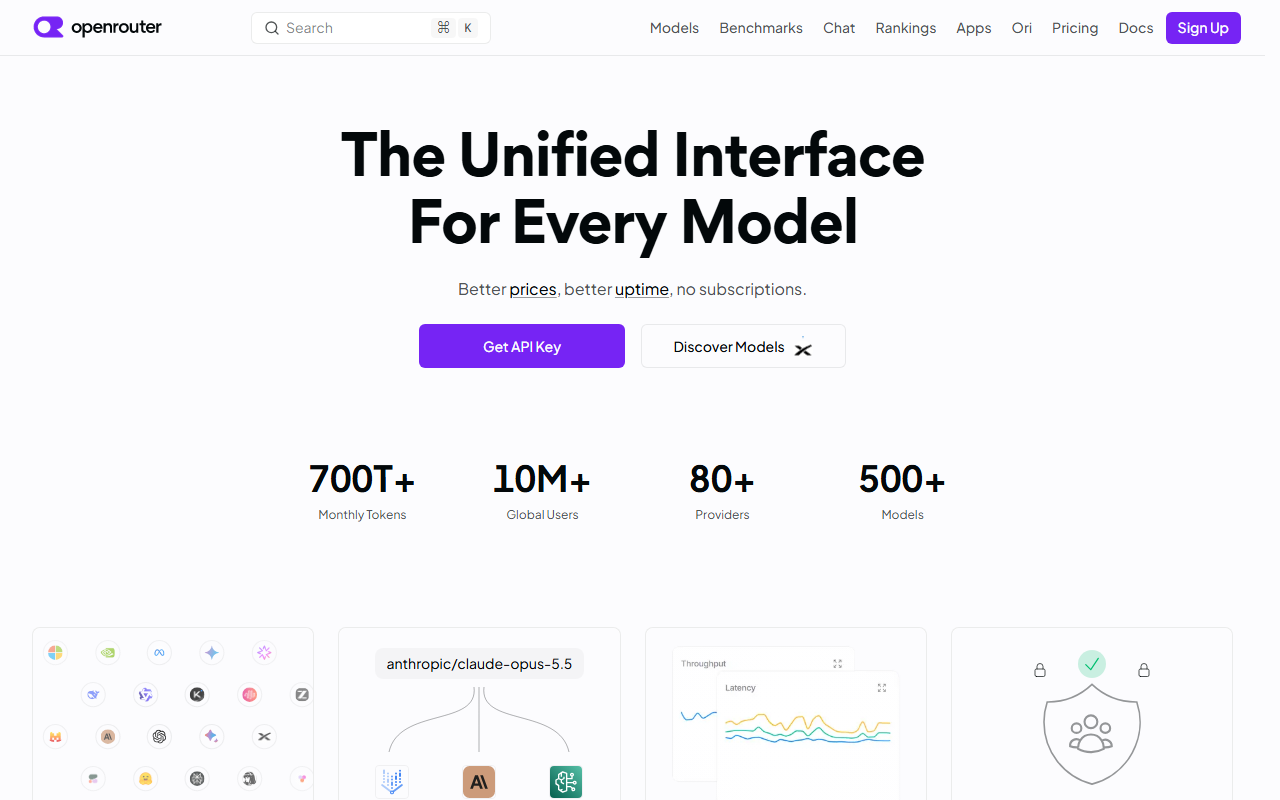
You point an OpenAI-style client at OpenRouter, pick a model (or a router such as openrouter/auto), and OpenRouter forwards the request to a provider endpoint, falls back to another if it fails, and deducts the provider's list price from your credits. The docs list integrations with Langfuse, LangChain, PydanticAI, the Vercel AI SDK and others, and OpenRouter's home page features Cline, Replit and Hermes Agent as apps built on it.
A $1.3B round in May 2026, then an announced sale to Stripe three months later.
TechCrunch reported on May 26, 2026 that OpenRouter raised a $113M Series B led by CapitalG, at about a $1.3B valuation per a New York Times report (OpenRouter did not disclose it), up from an estimated $547M after a $40M Series A in June 2025. It cited about 100 trillion tokens a month and 8 million users. On Aug 16, 2026 TechCrunch relayed a Bloomberg report that Stripe would acquire OpenRouter for more than $7 billion, with Stripe declining to comment. On Aug 19, 2026 OpenRouter itself announced it is joining Stripe, citing 10+ trillion tokens a day from 400+ models, more than 10 million developers and a team of roughly 90 people. The post gives no price and no closing date.
Scale figures differ by page: the home page says 700T+ monthly tokens and 10M+ users, the GitHub profile says 685T tokens a month, and the Stripe post says 10+ trillion a day (about 300 trillion over 30 days). They are vendor figures from different dates and we cannot reconcile them. As of Oct 28, 2026 OpenRouter's blog index lists posts to Oct 28 and none announces a closing, and the Terms still name OpenRouter, Inc. Secondary outlets disagree on whether the deal has closed.

No star rating to quote. Hacker News is large and mixed: loved as an idea, doubted on provider consistency and data promises.
We quote no Trustpilot or G2 rating for OpenRouter. These Hacker News items are the checkable public evidence; claims by individual commenters are unverified.
“So you want to use OpenRouter?”: 766 points, 207 comments. The linked Sep 7, 2026 post reports DeepSeek V4 Flash scoring 81% on TAU-Bench Airline from the first-party host and 58% from DigitalOcean, and some hosts returning an empty answer with a success code.
“the only sane way I've found to use it is to tightly pin providers to the point I wonder if I should just use the providers directly”, though the same commenter says they “love the _idea_ of OpenRouter”.
A user says a key with a $10 daily limit was used from Singapore to spend $100 and that there are no restrictions “by country, IP, etc”. One unverified account; OpenRouter's docs describe per-key credit limits.
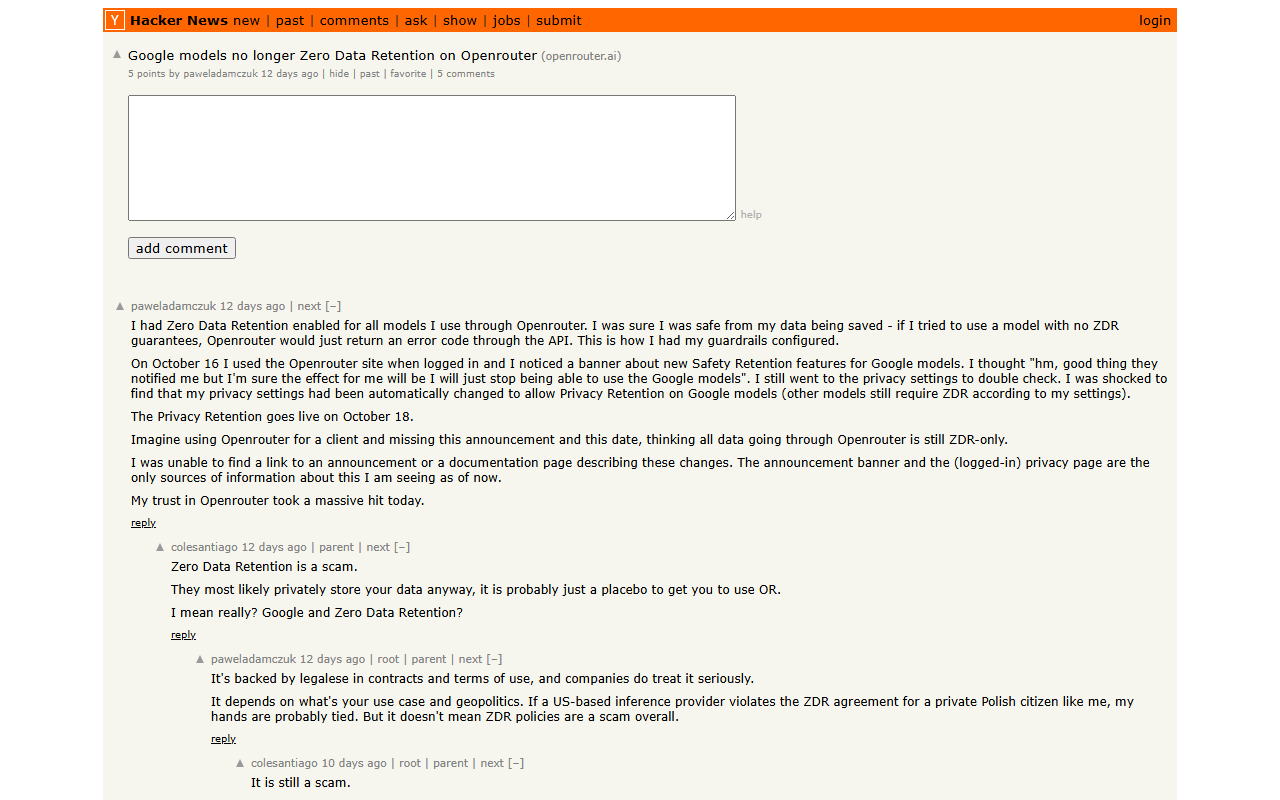
“Google models no longer Zero Data Retention on Openrouter” (5 points, 5 comments): a user says their ZDR-only setting was changed for Google models and “My trust in Openrouter took a massive hit today”. A Sep 19, 2026 item (49768401) carries a similar headline.
“OpenRouter is joining Stripe”: 964 points, 500 comments, a sign of how many developers depend on it.
“Reallocating $100/Month Claude Code Spend to Zed and OpenRouter”: 349 points, an example of cost-driven adoption.
Free, Standard 5.5%, Business 8%, Enterprise by quote: you pay a fee when you buy credits.
As of Oct 28, 2026, openrouter.ai/pricing lists four plans:
- 25+ free models, 4 free providers
- 50 requests a day, 20 a minute
- 1,000 a day after $10 of credits
- Community support
- 500+ models, 80+ providers
- Auto-routing, budgets, prompt caching
- Management API keys, ZDR routing
- Email support; no minimum, no lock-in
- Everything in Standard
- EU and US in-region routing
- Advanced notifications, 1,000 workspaces
- Signed DPA on request
- Fee discounts available
- SSO/SAML, SLAs, invoicing
- Managed policy enforcement
- Private endpoints add-on, dedicated support
The rules behind the percentages
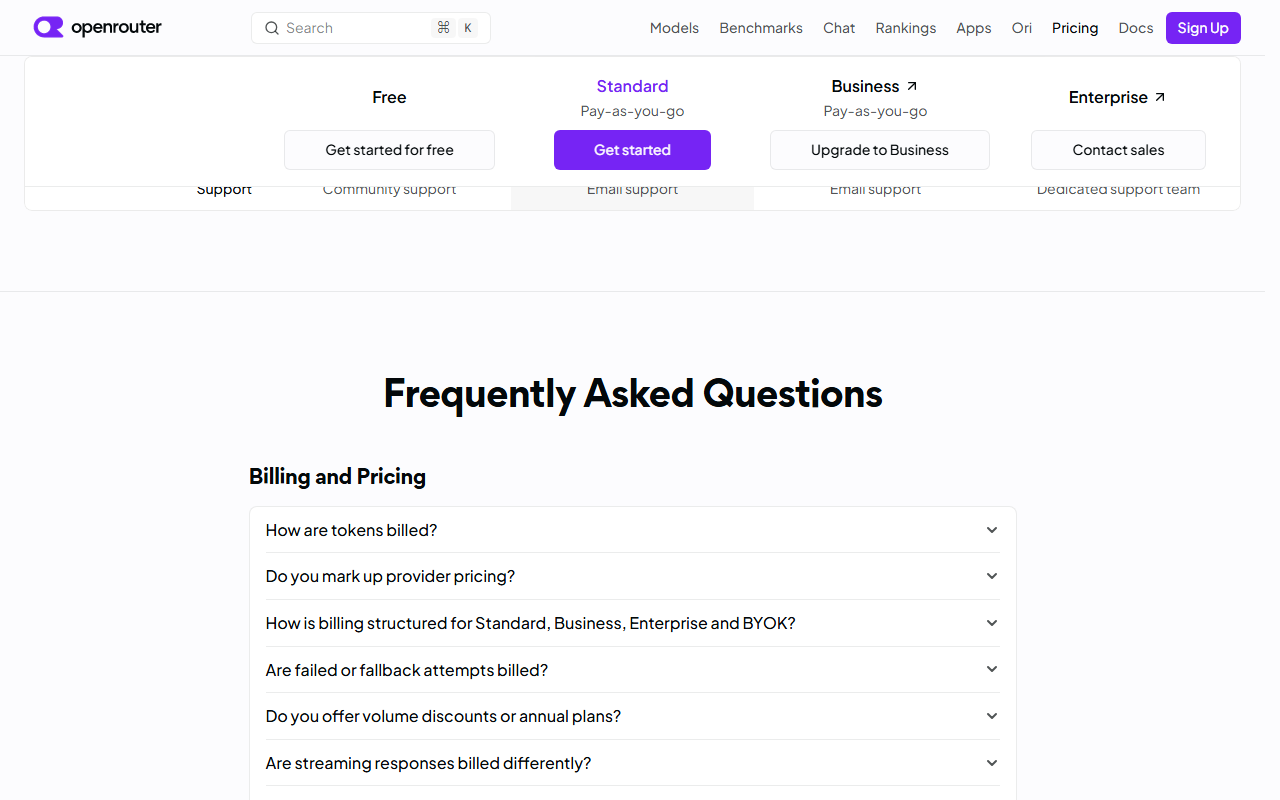
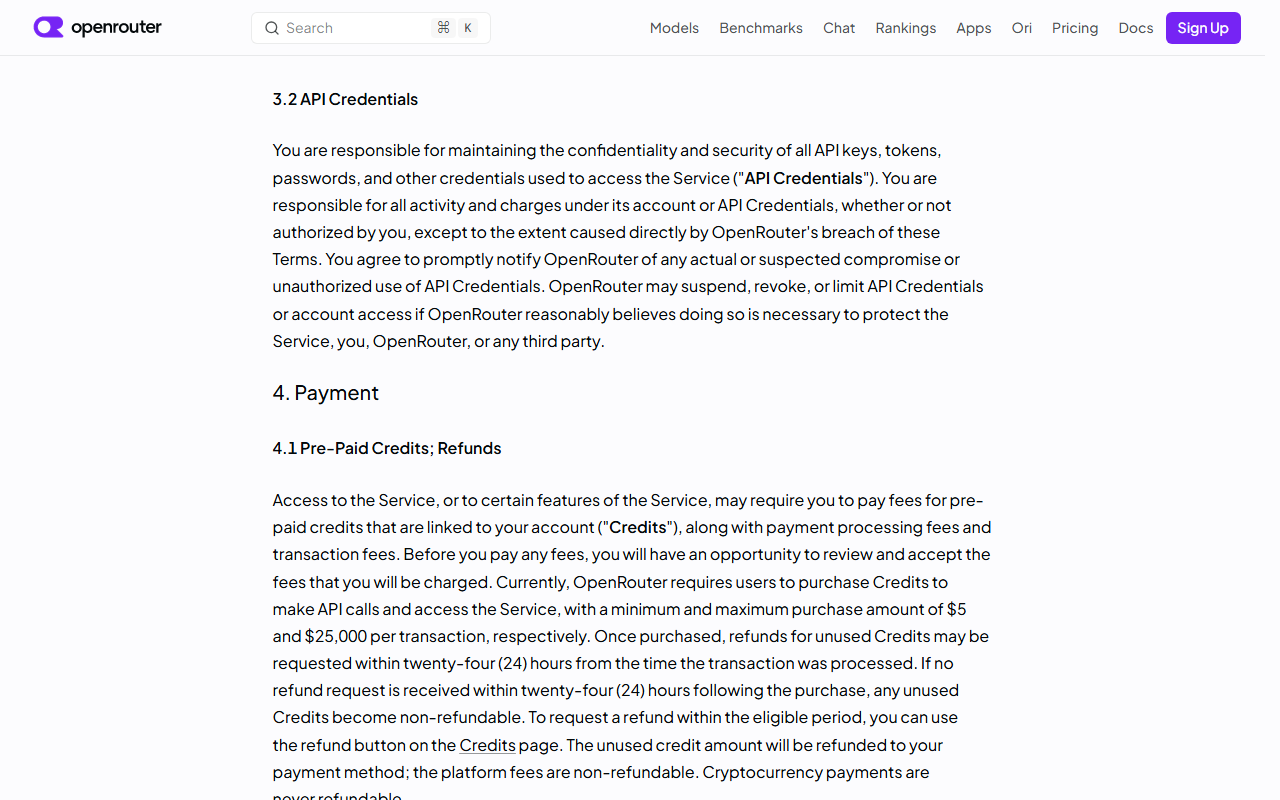
The pricing FAQ answers “Do you mark up provider pricing?” with “No. Inference is billed at the provider's list price on every plan. OpenRouter's fee is charged when you buy credits, 5.5% on Standard and 8% on Business, never on individual requests.” Terms section 4.1 sets purchases at $5 minimum and $25,000 maximum per transaction, allows refunds of unused credits within 24 hours (platform fees are not refunded and crypto is never refundable), and section 4.2 lets OpenRouter expire unused credits 365 days after purchase. The terms also mention “payment processing fees and transaction fees” without a figure, and the docs FAQ's fee answer shows unfilled template text, so check the checkout total before a large purchase. Failed attempts are not billed for tokens; an opt-in to let OpenRouter use your prompts gives a 1% discount.
Worked examples: the fee is predictable, and bring-your-own-key changes the math.
These are invented workloads with the arithmetic shown. We read the fee as added to the credit amount you buy, as the FAQ words it; the pricing page does not show a checkout example.
A solo developer buying $10 of credits to unlock free models
The fee is $10 × 5.5% = $0.55. That raises free-model limits from 50 to 1,000 requests a day per the FAQ. The $5 minimum purchase carries a fee of about $0.28.
A startup spending $1,000 a month
Standard: $55 a month, $660 a year. Business: $80 a month; the extra $25 buys EU or US in-region routing, advanced notifications and a signed DPA.
A product spending $10,000 a month
Standard $550, Business $800. Opting in to prompt use for the 1% discount would return $100, about 18% of the Standard fee, in exchange for letting OpenRouter use inputs and outputs. Vercel's AI Gateway docs say it charges no markup and no platform fee on tokens (payment processing fees may apply), so the same spend carries $0 platform fee there; that comparison is on fees only, not on models, routing or support.
Bring your own key at scale
BYOK inference up to $25,000 a month of list price carries no OpenRouter fee. At $30,000 the extra $5,000 costs 5% = $250; at $100,000, $75,000 × 5% = $3,750 (Enterprise allowances are custom). The provider bills you directly, so you manage its rate limits and invoices.
Credits you do not use
Credits can expire after 365 days and are refundable only in the first 24 hours, so buy for the next month or two, not the year. Deleting an account loses unused credits.
Terms updated Aug 31, 2026: OpenRouter may assign them freely, expire credits and end your access without notice.
OpenRouter's Terms of Service say “Last Updated: August 31, 2026” and name OpenRouter, Inc. (169 Madison Avenue, New York) for notices. Key clauses as of Oct 28, 2026:
Credits are pre-paid, $5 to $25,000 a purchase, refundable only within 24 hours, and may be expired after 365 days. OpenRouter will give “advance notice” of fee changes and, if you do not accept them, “may discontinue providing the Service to you”. Payments run through Stripe and Coinbase.
“We may assign these Terms at any time without notice or consent.” OpenRouter may end your account “at any time for any reason or no reason, with or without notice”. Liability is capped at the greater of fees paid in the prior 12 months or $100, and disputes go to AAA arbitration in New York with a class waiver. Material changes get 30 days' notice.
Model providers have their own terms: the Terms say you agree to them, that they may change, and that OpenRouter “does not guarantee availability of any Model”. With a Stripe deal pending, the assignment clause means a new owner could take the contract without asking you; Enterprise customers can negotiate custom terms.
Match your situation to one line.
Unified API, routing and fallbacks, spend controls, presets, ZDR routing and a model comparison catalog.
One OpenAI-compatible API for text, image, video, speech and embedding models, model fallbacks, provider selection, auto-routing, presets and response caching.
Budgets and spend controls, management API keys, workspaces, guardrails, per-key limits, BYOK, activity logs and export, and data-policy-based routing.
Zero Data Retention routing on every plan, Zero Completion Insurance for empty responses, in-region routing on Business and private endpoints for Enterprise.
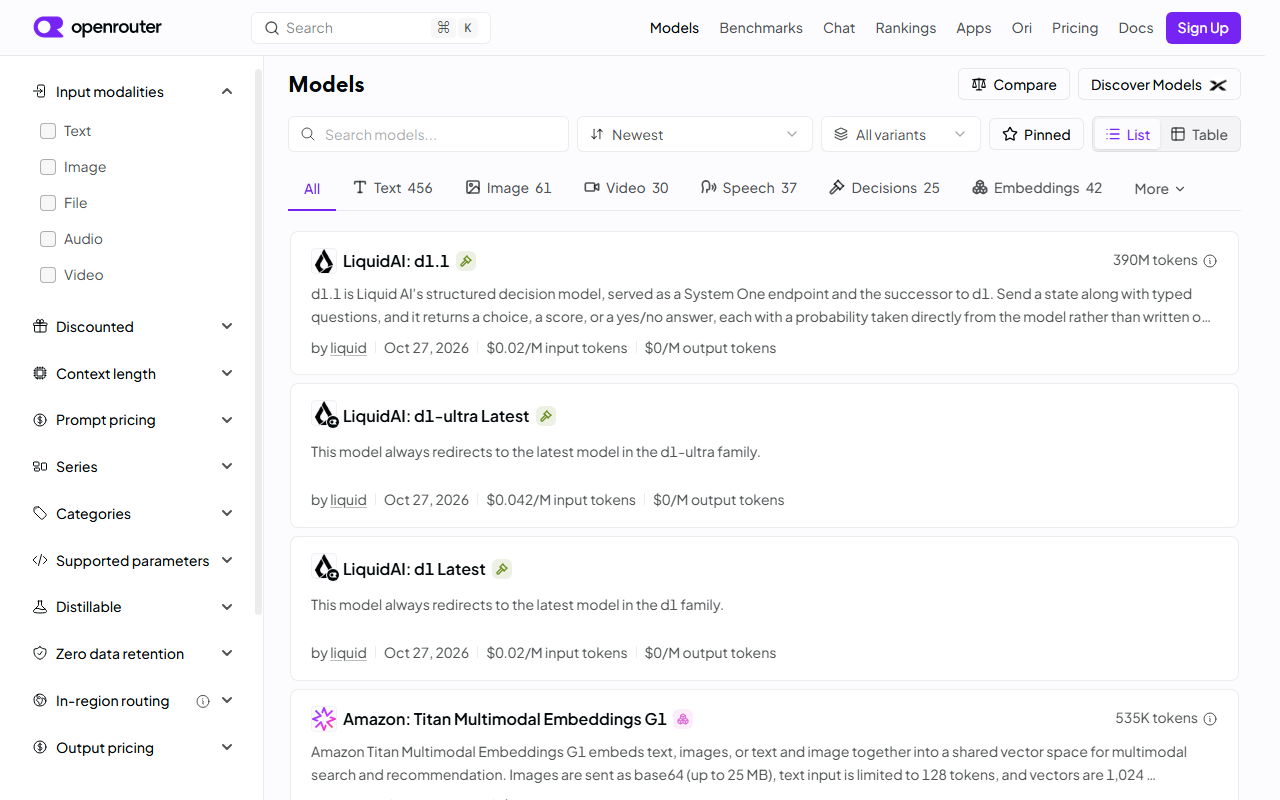
The models page lists 456 text models alongside image, video, speech and embedding models, with per-million-token prices, so you can compare providers before routing. OpenRouter's SDKs and provider packages for the Vercel AI SDK are open source on GitHub (Apache-2.0); the routing service itself is closed.
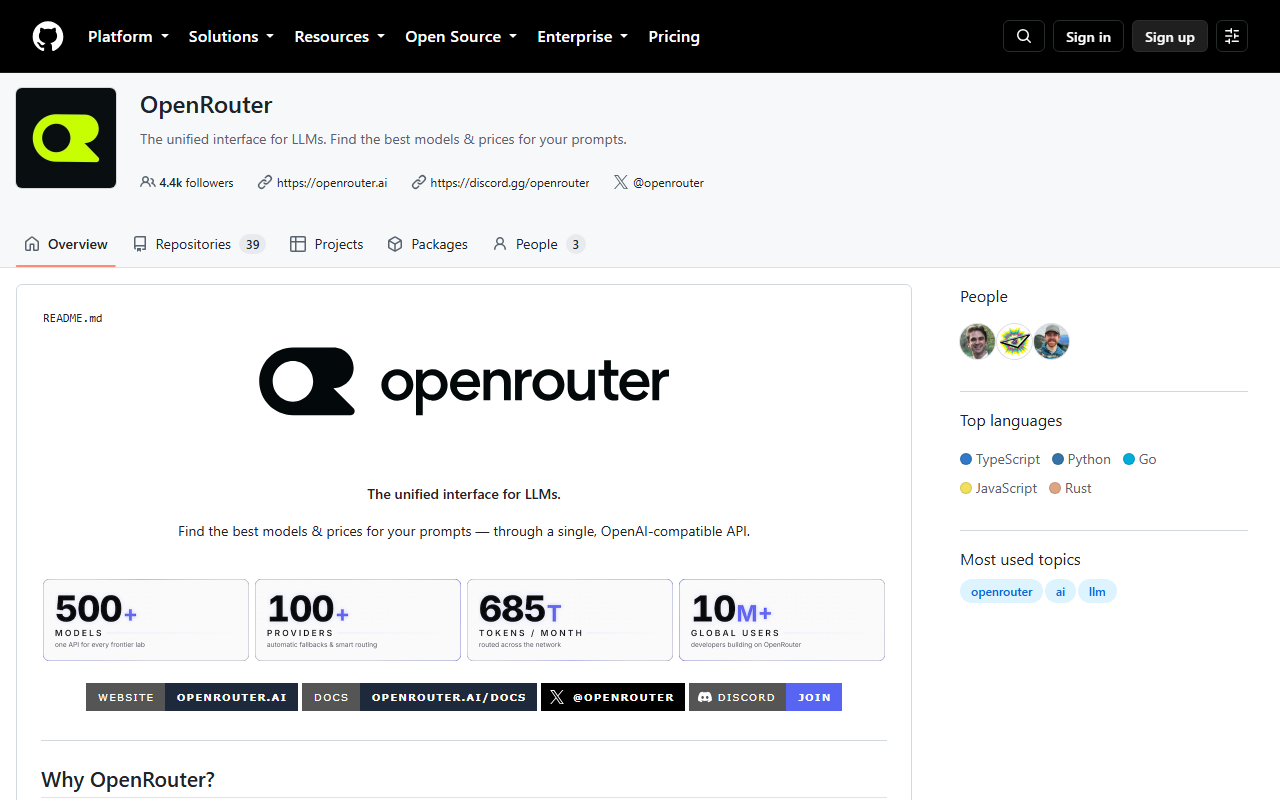
Sign up, buy credits, change the base URL.
Per the home page: sign up, buy credits that work with any model or provider, and call the API. Existing OpenAI client code works by changing the base URL and key; the FAQ lists support for tools and function calling and for text, image and PDF inputs. Free models need no purchase but are capped at 50 requests a day (20 a minute).
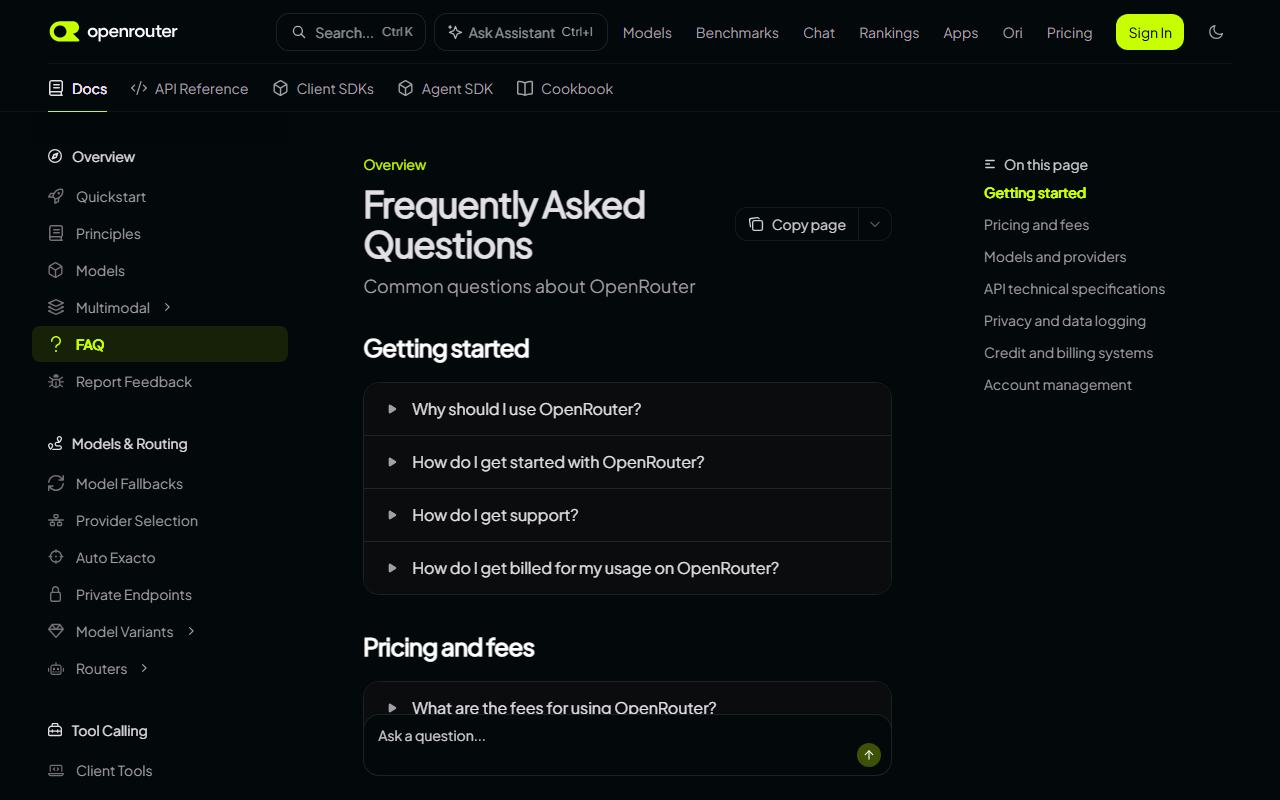
Free-tier caps, provider-specific limits and what only Business or Enterprise gets.
- Free models: 20 requests a minute and 50 a day, 1,000 a day after $10 of purchased credits; failed attempts count toward the cap, and a negative balance blocks them.
- Paid models: no plan-based rate limit; limits come from providers, and very high bursts can be rejected with a 429.
- Business-only: EU and US in-region routing, advanced notifications, signed DPA on request. Enterprise-only: SSO/SAML, SLAs, managed policy enforcement, invoicing.
- Credit rules: 365-day expiry right, 24-hour refund window.
- Provider drift: the same model name can map to endpoints with different quality, which is why pinning is common advice.
Prompts are not logged by default, but ZDR has caveats and a new screening notice.
OpenRouter's docs say it does not store prompts or responses unless you opt in to logging (or content is flagged), stores request metadata such as token counts and latency, and has “never sold or licensed prompt data”. Providers have their own retention and training policies; where OpenRouter cannot establish a clear policy it assumes the endpoint “both retains and trains on data”. ZDR can be enforced per model group; the docs say enforcing it for Google “removes AI Studio endpoints (Vertex remains available)”. We have not reviewed a SOC 2 report or the trust center.
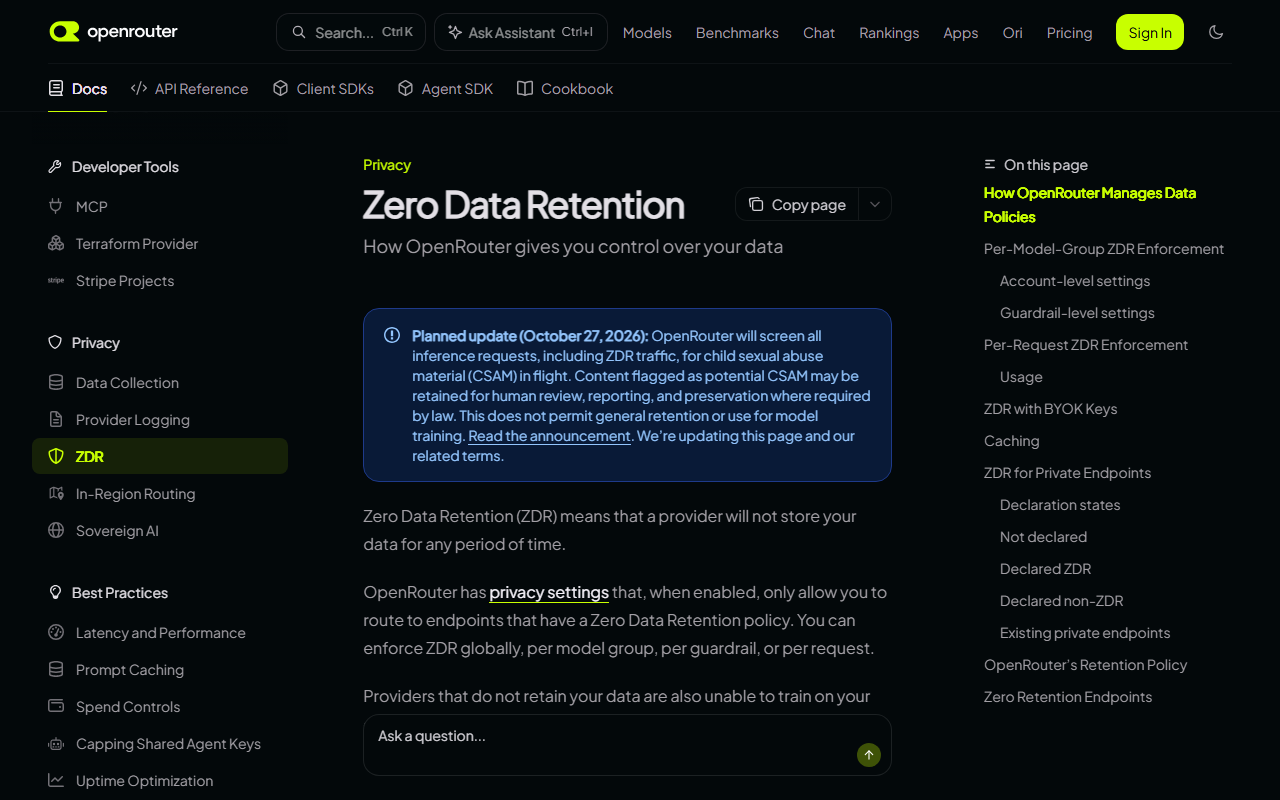
The Oct 27, 2026 notice. OpenRouter's blog says it “will screen all inference requests” for child sexual abuse material in flight, that screening “will also apply to requests covered by” ZDR, and that flagged content “may be retained for human review”. It says reported contents and certain related material “must be preserved for one year after submission” under US law, applying to reported material “rather than every item flagged for review”, and gives no effective date. It also says “These CSAM provisions do not authorize general retention of ZDR inference content for unrelated purposes” and that OpenRouter’s “commitment not to use inputs or outputs for model training continues”. Separately, a user reported on Oct 16, 2026 that a banner announced new retention features for Google models from Oct 18 and that their ZDR-only setting changed; no OpenRouter documentation page describes that change, so check settings/privacy yourself.
Developers who want breadth, quick switching and one invoice.
Developers and startups testing or mixing many models; apps that want fallbacks; teams spending below the BYOK allowance who accept a 5.5% fee for convenience.
Teams that need strict, auditable data residency without a contract; buyers who need a settled owner and terms right now; high-spend teams that can use direct provider billing or a self-hosted gateway.
Seven things to check before you rely on it.
Announced Aug 19, 2026; no closing notice on its blog.
The Terms allow assignment without notice or consent.
Google endpoints and the Oct 27 screening notice.
Same model, different results across hosts.
24-hour refunds; 365-day expiry right.
Docs FAQ shows template text instead of the fee.
JAVIS did not send a request.
Priced from each vendor's own page on Oct 28, 2026; the products differ, so the plans are not like-for-like.
| Option and when to pick it | What its own page says | JAVIS review |
|---|---|---|
| OpenRouter Widest catalog, one key | Free; Standard 5.5% and Business 8% credit fee; BYOK $25,000/month free then 5%; Enterprise discounts | This article |
| Vercel AI Gateway Lowest stated gateway fee | No markup and no platform fee on tokens; $5 a month free credit; BYOK with no fee; processing fees may apply | No live review yet |
| LiteLLM Self-hosted open-source proxy | Open source, self-hosted; Enterprise tier on request; 62.2k GitHub stars shown on its site | No live review yet |
| Portkey Gateway with logs and guardrails | Developer free (10k logs); Production $49/month (100k logs, +$9 per 100k); Enterprise custom | No live review yet |
| Helicone Existing users only | Its sign-up page said “Sign ups are disabled” on Oct 28, 2026 | No live review yet |
Observability tools such as Langfuse and Braintrust sit beside a gateway rather than replace one; OpenRouter's docs list a Langfuse integration.
Five steps that keep cost and data risk in check.
This review has no affiliate links, and OpenRouter did not see it.
JAVIS has no approved OpenRouter affiliate link, so every link goes straight to openrouter.ai, its documentation, its pricing page or its terms, without tracking parameters.
Hands-on status: JAVIS has not created an OpenRouter account, bought credits or sent a request. Cost examples use invented workloads with the arithmetic shown, and independent review evidence is limited, as section 04 says.
Compare Free, Standard and Business.
Open OpenRouter pricingZDR, logging and provider policies.
Open the ZDR docsRouting models? These reviews cover the nearest ground.
Each card opens a published JAVIS review.


Questions people ask before committing
Is OpenRouter free?
There is a free plan with 25+ free models, capped at 50 requests a day (1,000 after buying $10 of credits). Paid models need credits.
Does OpenRouter mark up model prices?
No, per its pricing FAQ: inference is billed at the provider's list price. It charges 5.5% (Standard) or 8% (Business) when you buy credits.
How much does OpenRouter cost on $1,000 a month?
$55 on Standard or $80 on Business, on our reading of the fee as added to the credit purchase.
Can I use my own API keys?
Yes. BYOK includes $25,000 a month of list-price inference with no fee, then 5%.
Is Stripe buying OpenRouter?
OpenRouter announced on Aug 19, 2026 that it is joining Stripe, subject to closing conditions. Bloomberg reported a price above $7 billion. OpenRouter's blog shows no closing notice as of Oct 28, 2026.
Does OpenRouter log my prompts?
Not by default per its docs; logging is opt-in, with a 1% discount for letting OpenRouter use inputs and outputs. All requests, including ZDR traffic, will be screened for child-abuse material under an Oct 27, 2026 notice; flagged content may be retained for human review, and reported material must be preserved for one year under US law. The notice says this does not authorize general retention of ZDR content and that the commitment not to train on inputs or outputs continues.
Is the same model the same everywhere?
Not necessarily. A Sep 2026 study found different hosts of the same model scoring differently; pin providers for important workloads.
What are the alternatives?
Vercel AI Gateway, LiteLLM and Portkey; see section 15.
Where this came from, and when.
Pricing and product: openrouter.ai/pricing (plan table and opened FAQ answers), openrouter.ai home and models pages, openrouter.ai/docs (FAQ, data collection, provider logging, ZDR, limits), status.openrouter.ai and the GitHub organization, all Oct 28, 2026.
Legal: OpenRouter Terms of Service, last updated Aug 31, 2026, sections on credits, fees, termination, liability, assignment and disputes. We have not reviewed the privacy policy in detail or any audit report.
Company: TechCrunch (May 26 and Aug 16, 2026); OpenRouter's Aug 19, 2026 announcement; OpenRouter blog index to Oct 28, 2026.
Independent evidence: Hacker News items 49621546, 49364559, 50117290, 49768401, 47700972 and comments 49656333 and 49656246; the Sep 7, 2026 post linked from item 49621546. No Trustpilot or G2 rating is quoted.
Competitors: vercel.com/docs/ai-gateway/pricing, litellm.ai, portkey.ai/pricing and us.helicone.ai/signup, Oct 28, 2026. Cost examples are arithmetic on those prices with invented spend.
Images: screenshots of public pages taken Oct 28, 2026 and OpenRouter's social card. No video is embedded.
JAVIS Fit Score (75/100): editorial composite, 20 points each. Price clarity 16: simple fee, small gaps in the docs. Capability breadth 18: catalog, routing, controls. Independent evidence 14: large threads, unverified claims. Security and data control 12: ZDR and no default logging, offset by screening, Google questions and free assignment. Cost control and fit 15: fee is modest, BYOK helps. It is judgment, not a measurement.
What this review does not cover: real latency and uptime, output quality by provider, the checkout total for fees, audit reports, and whether the Stripe deal has closed.