Groq Review 2026: Very Fast GPT-OSS, a Free Tier, and a Model List That Keeps Shrinking
GroqCloud runs open models on Groq's own LPU chips behind an OpenAI-compatible API. As of Oct 29, 2026 the self-serve menu is GPT-OSS 120B and 20B, Qwen 3.8 27B, Whisper and Orpheus, Llama is Enterprise-only, and the company has new management after its Nvidia deal. This review works out what speed costs, what changed and who should still build on it.
There are no affiliate links in this review. Every Groq link goes straight to groq.com, the GroqCloud console or its documentation.
| Made by | Groq LLC (founded 2016); founder joined Nvidia Dec 2025 |
| What it is | Fast OpenAI-compatible API for open models |
| Pricing | Free plan; per token from $0.075 per 1M input |
| Catch | Narrow catalog; fast deprecations; company change |
| Evidence | OpenRouter speed data; 6 Trustpilot reviews; HN |
Groq is still one of the fastest places to run a small set of open models, but the self-serve menu has shrunk to GPT-OSS, one Qwen model and Whisper, and the company behind it changed in 2026.
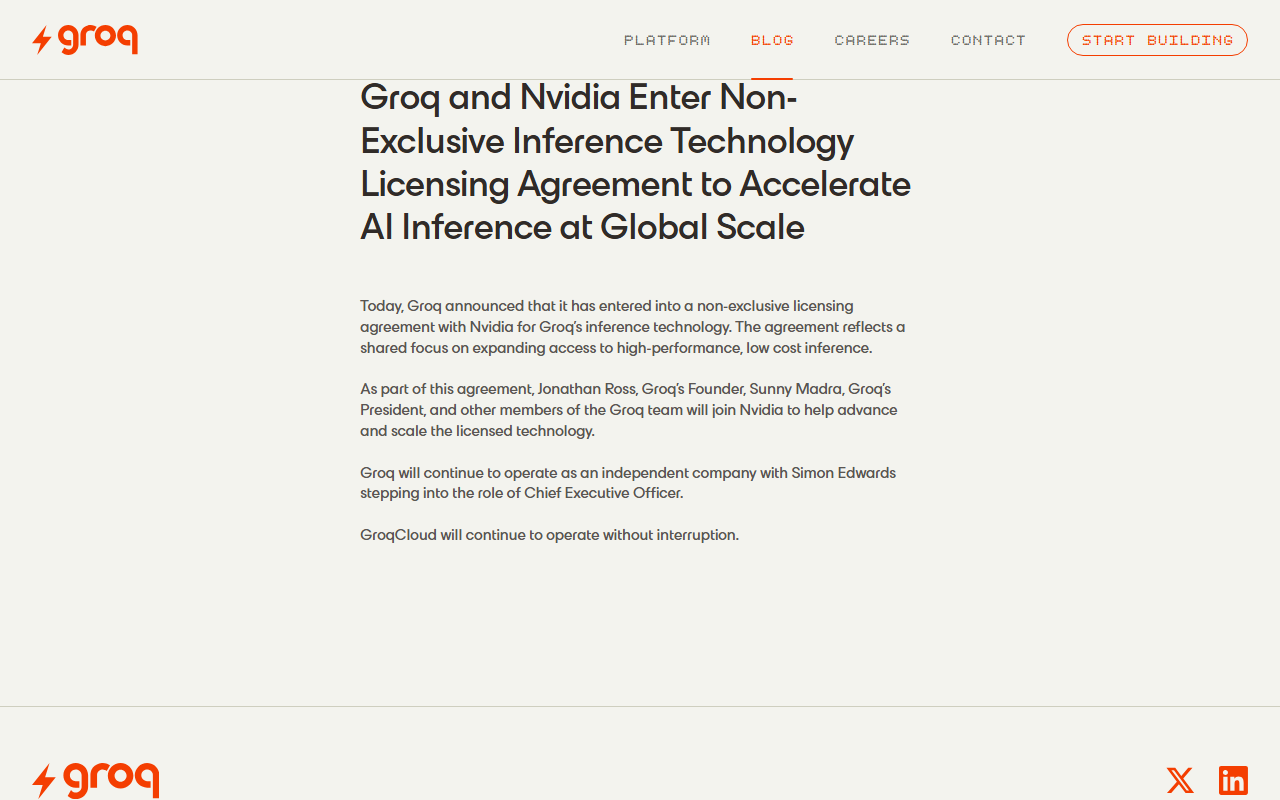
“GroqCloud will continue to operate without interruption.” That was Groq's one-line promise on Dec 24, 2025, the day it announced a non-exclusive licensing deal with Nvidia under which founder Jonathan Ross, president Sunny Madra and other team members joined Nvidia.
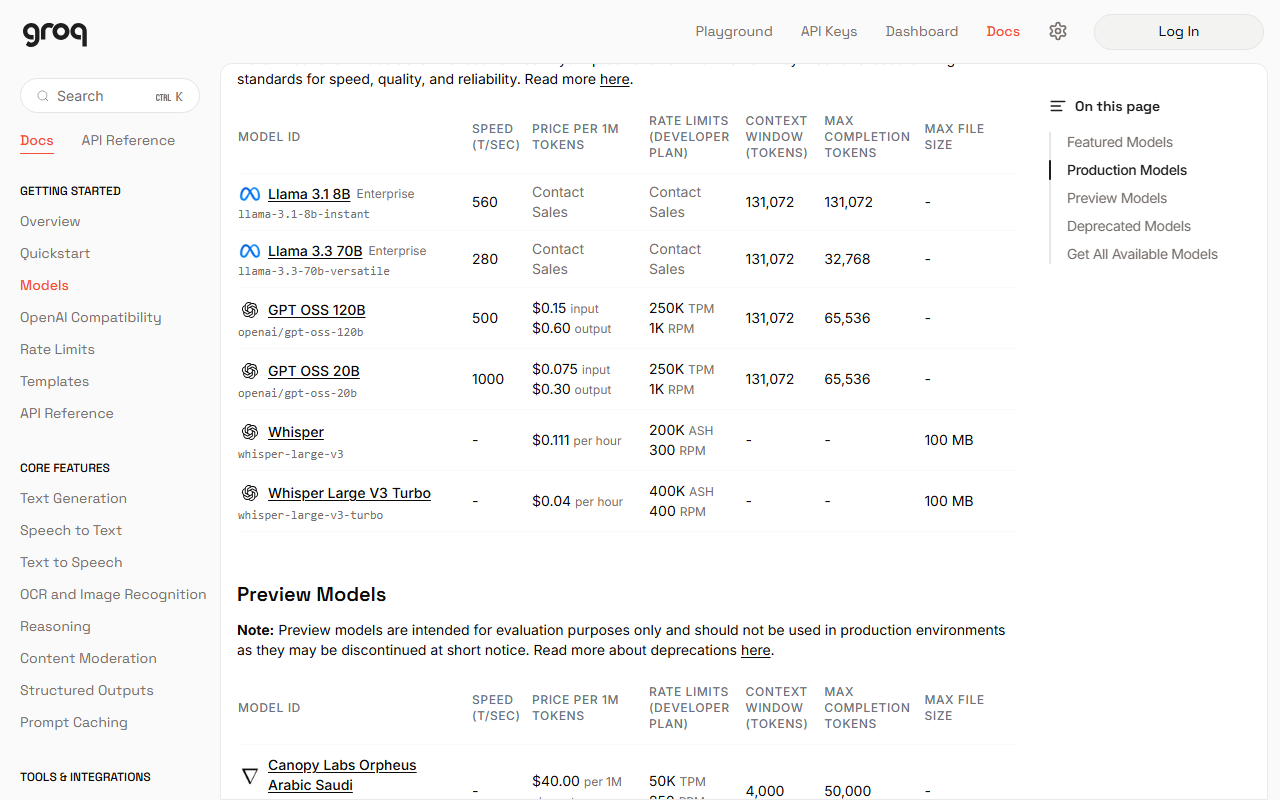
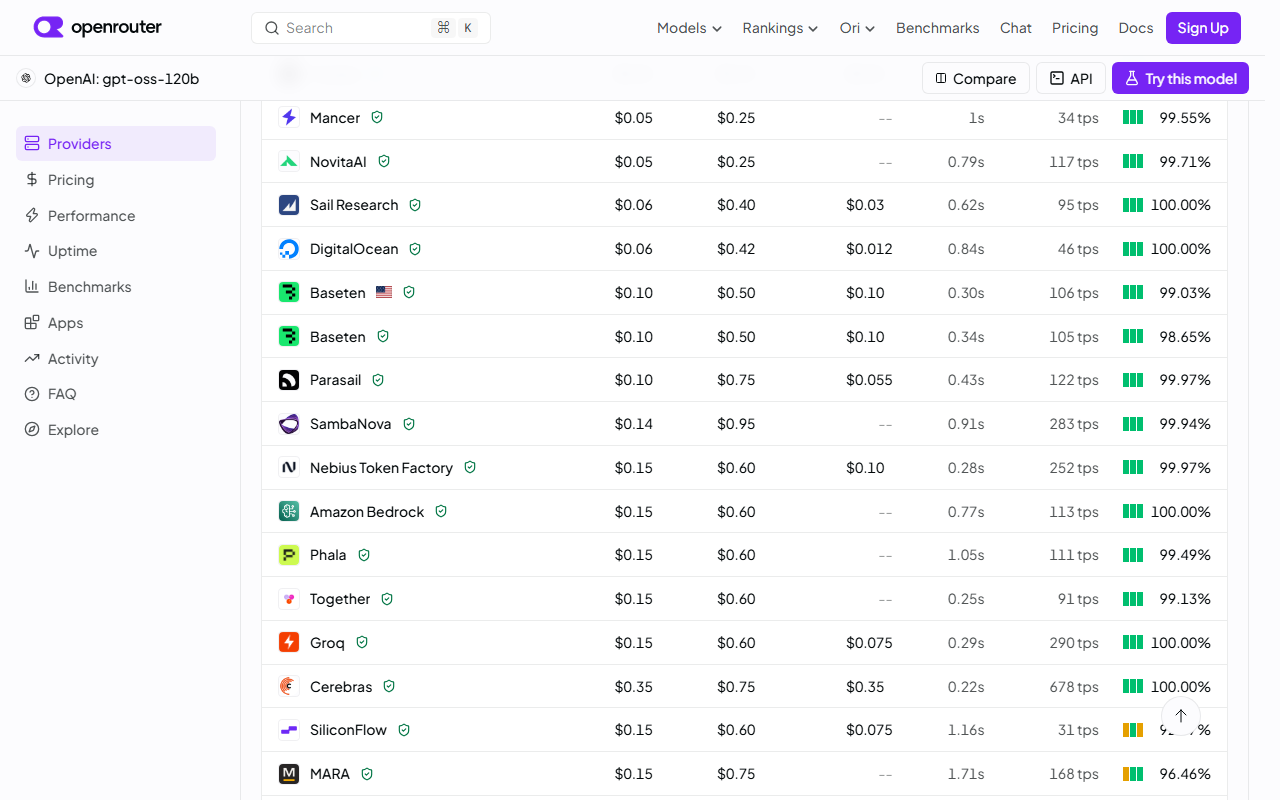
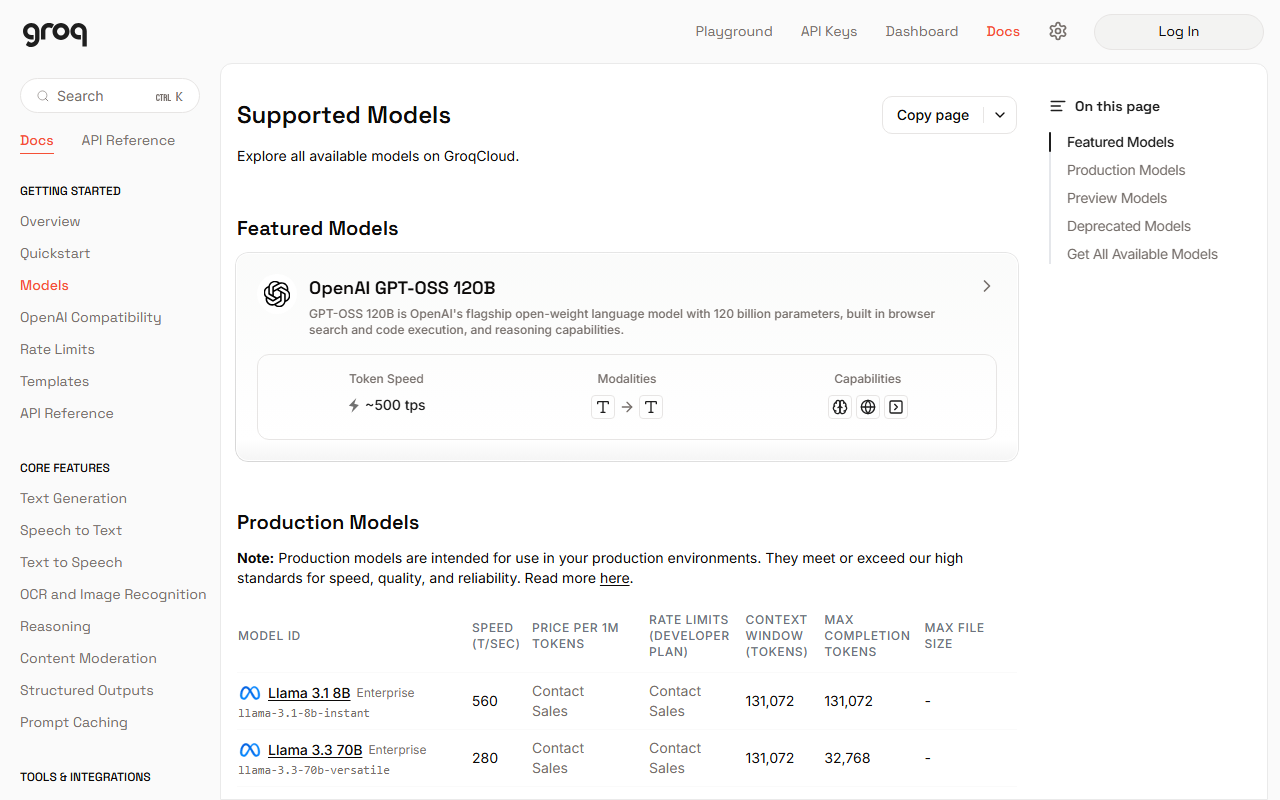
GroqCloud is an OpenAI-compatible API that runs open-weight models on Groq's own LPU hardware. As of Oct 29, 2026, a developer account can pay as you go for GPT-OSS 120B at $0.15 per million input tokens and $0.60 per million output tokens, GPT-OSS 20B at $0.075 and $0.30, Qwen 3.8 27B at $0.80 and $4.00, Whisper transcription from $0.04 an hour, and Orpheus text-to-speech in preview. There is a free plan with tight limits (30 requests a minute and 8,000 tokens a minute on GPT-OSS 120B). The headline is speed: OpenRouter's live provider table on Oct 29, 2026 showed Groq serving GPT-OSS 120B at a median 290 tokens a second, about three times Together's 91, at the same list price.
Three things deserve a decision before you build on it. First, the catalog is narrow and moves fast: Llama 3.1 8B and Llama 3.3 70B were shut down for free and developer accounts on Aug 16, 2026 and are now Enterprise-only, Kimi K2 went on Apr 15, 2026, and the Compound agent systems went on Sep 21, 2026 with no replacement named. Second, the company is not the one you may remember: after the Nvidia deal (reported by CNBC at about $20 billion; neither company disclosed a figure), Groq LLC raised $650 million in June 2026 and a $350 million Series A at a $3.5 billion valuation in August, against $6.9 billion in September 2025, and two former engineers sued the board, in a case reported on Oct 2, 2026. Third, speed is not the cheapest route: the same GPT-OSS 120B is listed at $0.03 and $0.15 by the cheapest hosts on OpenRouter, slower but about a fifth to a quarter of the price.
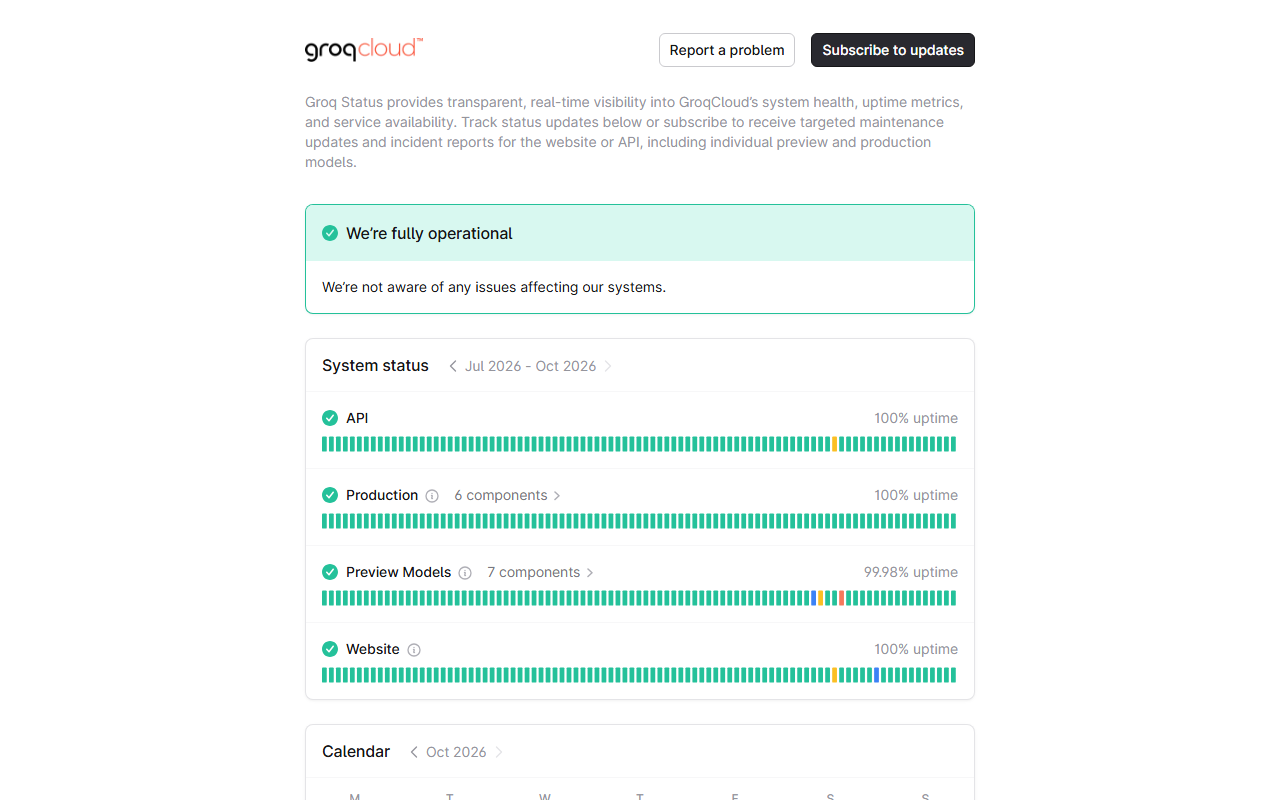
Not a hands-on test: JAVIS has not created a GroqCloud account or sent a request. This review is built from Groq's docs, newsroom, trust center and status page, OpenRouter's public provider table, competitors' pricing pages, Trustpilot and Hacker News, all dated Oct 29, 2026 unless stated. Latency figures are OpenRouter medians for traffic it routes, not our measurement.
Change the base URL, pick one of a handful of models, pay per token at the end of the month.
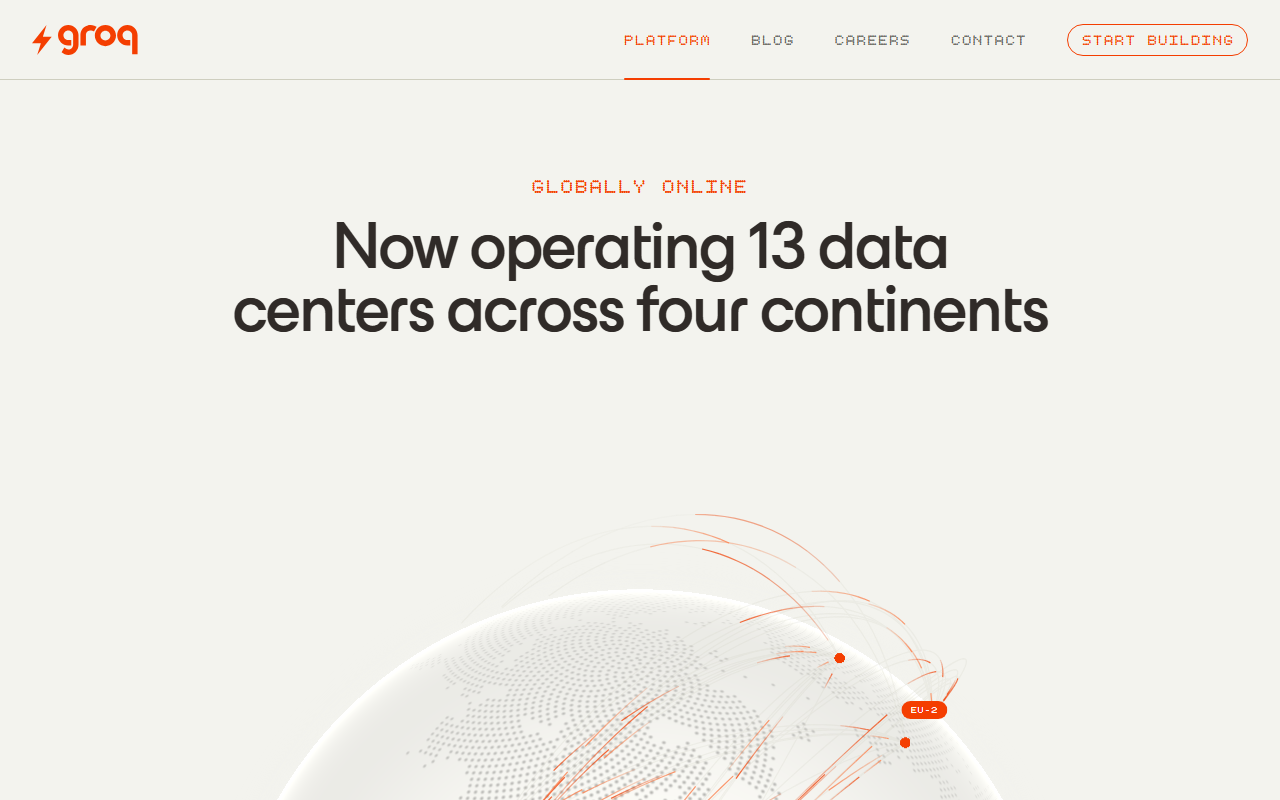
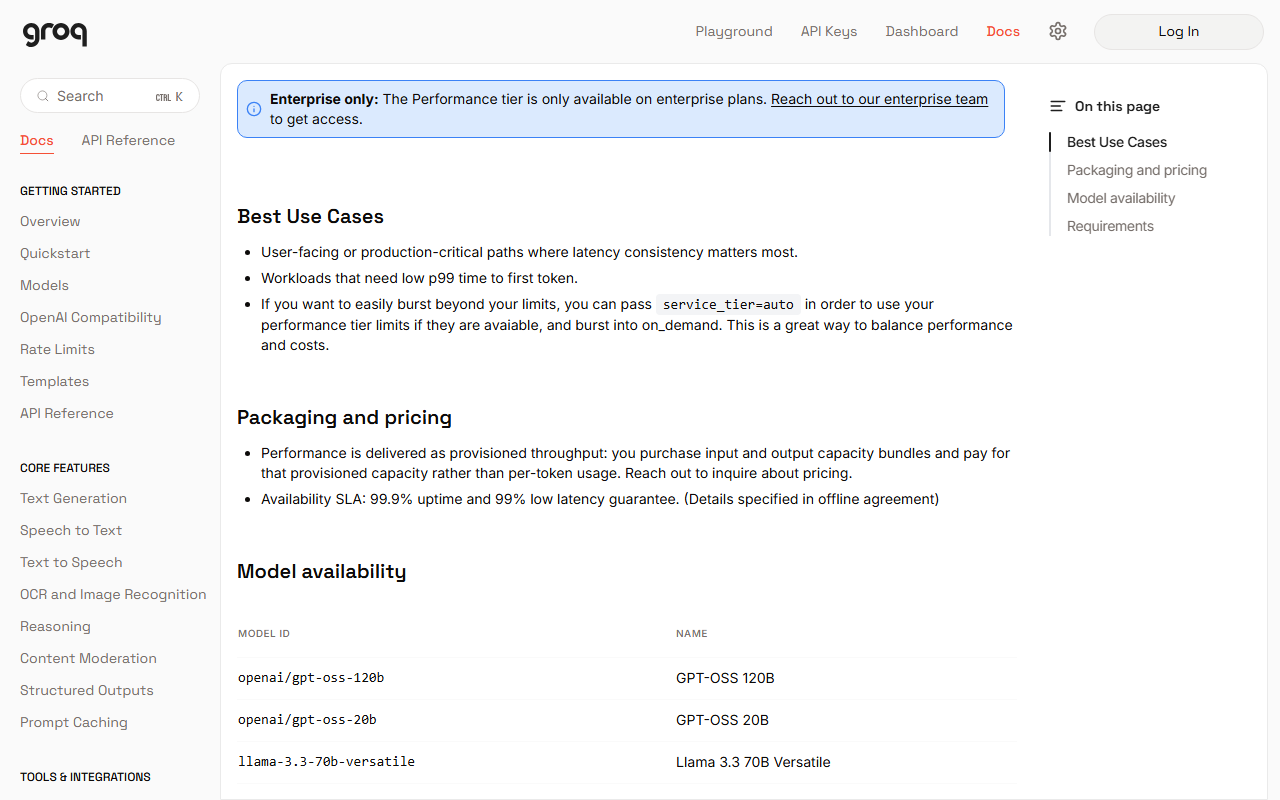
You point an OpenAI-style client at https://api.groq.com/openai/v1 with a Groq key and choose a model ID such as openai/gpt-oss-120b. Requests run on Groq's inference hardware in 13 data centers (LPUs today; Groq plans to add NVIDIA LPX and Vera Rubin systems; its platform page lists sites in the US, Canada, Finland, the UK, Australia and Saudi Arabia). A service_tier setting picks between on-demand (default), flex (paid accounts, higher limits, may fail fast when busy) and performance (Enterprise, provisioned capacity with an SLA). Usage is billed in arrears, with early invoices at $1, $10, $100, $500 and $1,000 of lifetime use.
Founder to Nvidia, new management, a $3.5B Series A: the Groq that runs GroqCloud is a different company from 2025.
Groq was founded in 2016 to build the LPU, a chip designed for inference. On Dec 24, 2025 it announced a non-exclusive licensing agreement with Nvidia for its inference technology; Jonathan Ross, Sunny Madra and other staff moved to Nvidia, Simon Edwards became CEO and Groq said it would stay independent. CNBC reported the deal at about $20 billion, citing Disruptive's Alex Davis; neither company published a figure. Nvidia then announced an LPX platform built on Groq's technology, which Groq itself plans to deploy alongside Vera Rubin systems (Aug 24, 2026 post).
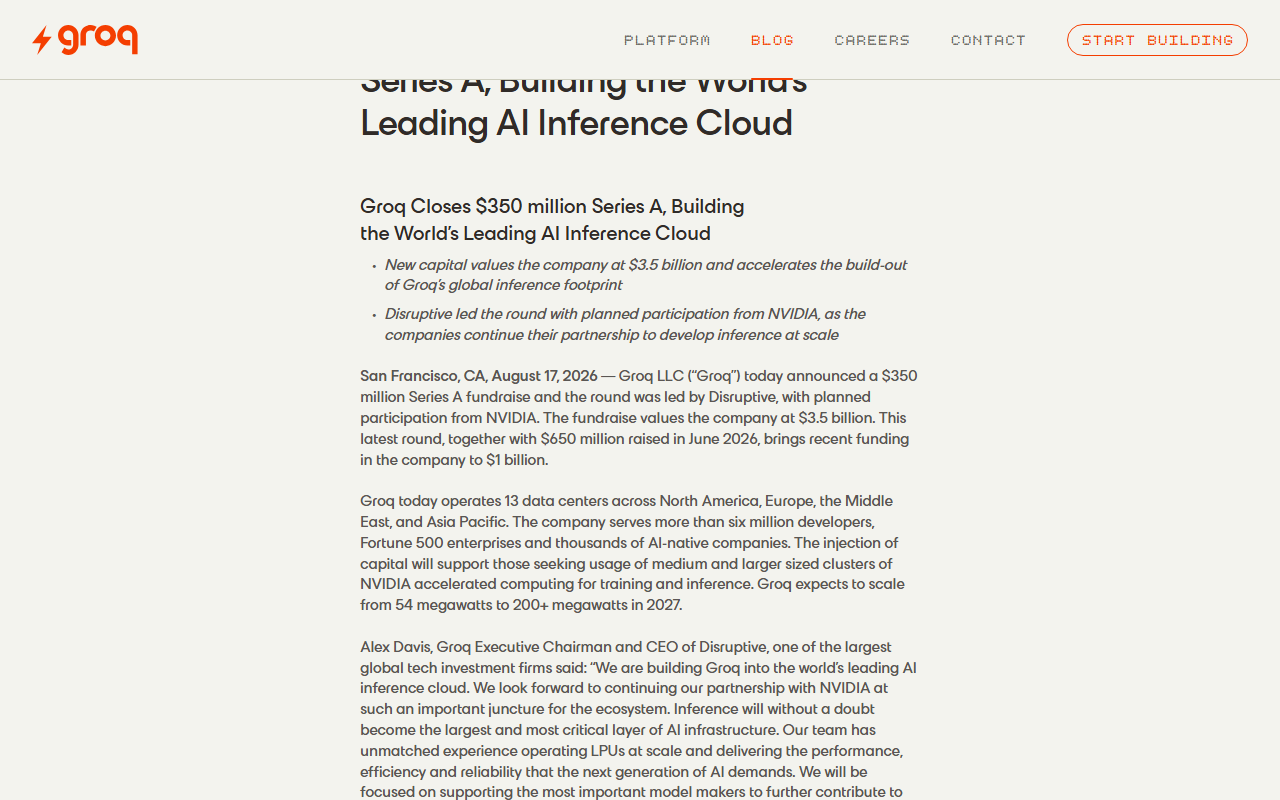
The remaining company refocused on running an inference cloud. Its Jun 22, 2026 post announced $650 million led by Disruptive and Infinitum and a new team: CEO Adam Winter, CFO Matt Eng, COO Alan Rice, with a CTO and CPO joining in July. On Aug 17, 2026 “Groq LLC” announced a $350 million Series A at a $3.5 billion valuation, led by Disruptive with planned Nvidia participation and “subject to customary closing conditions”. Bloomberg noted Groq had been valued at $6.9 billion at its peak in September 2025. Groq says it serves more than six million developers (3.5 million in February 2026, five million in June) and plans to grow from 54 megawatts to 200+ megawatts in 2027. Developer counts are sign-ups, not paying customers.
The deal is now in court. Two former Groq engineers filed a proposed class action against Groq's board in the Delaware Court of Chancery, in a case reported on Oct 2, 2026 (Serebrin v. Ross), arguing that holders were owed a vote; as reported, the complaint describes about $17 billion for the license and about $3 billion in Nvidia stock awards for staff who moved. Groq called it “meritless”. Nvidia is not a defendant. None of this has been decided, and none of it has interrupted the API, but it is the backdrop to any long contract.
Loved for speed, criticised for reliability and for retiring models quickly. The samples are small.
Groq's Trustpilot profile is unclaimed and has 6 reviews averaging 3.1 as of Oct 29, 2026 (two 5-star, one 4-star, one 2-star, two 1-star), too few to rate the service. The more useful evidence is Hacker News, where a Jun 2, 2026 thread asking how Groq was raising more money drew 69 comments. Claims below are individual accounts we cannot verify.
“The problem building on top of Groq.com is that they might decommission any of their models with just a few weeks notice; if you can, avoid!”
“Groq stopped serving Kimi K2 (1T params)” and “The largest model they serve now is the relatively minuscule gpt-oss-120b.” A later reply (48420371) says Kimi K2 is still served, “but only for enterprise customers”.
“My company had a really terrible experience trying to use Groq ... So many random errors, so many silly quirks.” Another user replied that they had not noticed special issues.
One user: “the performance is really poor for the token price.” Another answered with OpenRouter's throughput ranking for GPT-OSS 120B: “That doesn't match my experience or the numbers.”
A developer who ran Kimi K2 on Groq for a community chat bot: “the fast speed ... meant that chat users got a response instantly.”
A gateway builder: “Groq only gives you usage on streamed responses if you ask for it with stream_options, otherwise you're guessing.”
Free, Developer (pay as you go) and Enterprise; the price list lives in the docs, not on a pricing page.
As of Oct 29, 2026, groq.com/pricing opens the home page, and per-model prices are listed on console.groq.com/docs/models. The plans themselves are described across the billing FAQ and rate-limit pages:
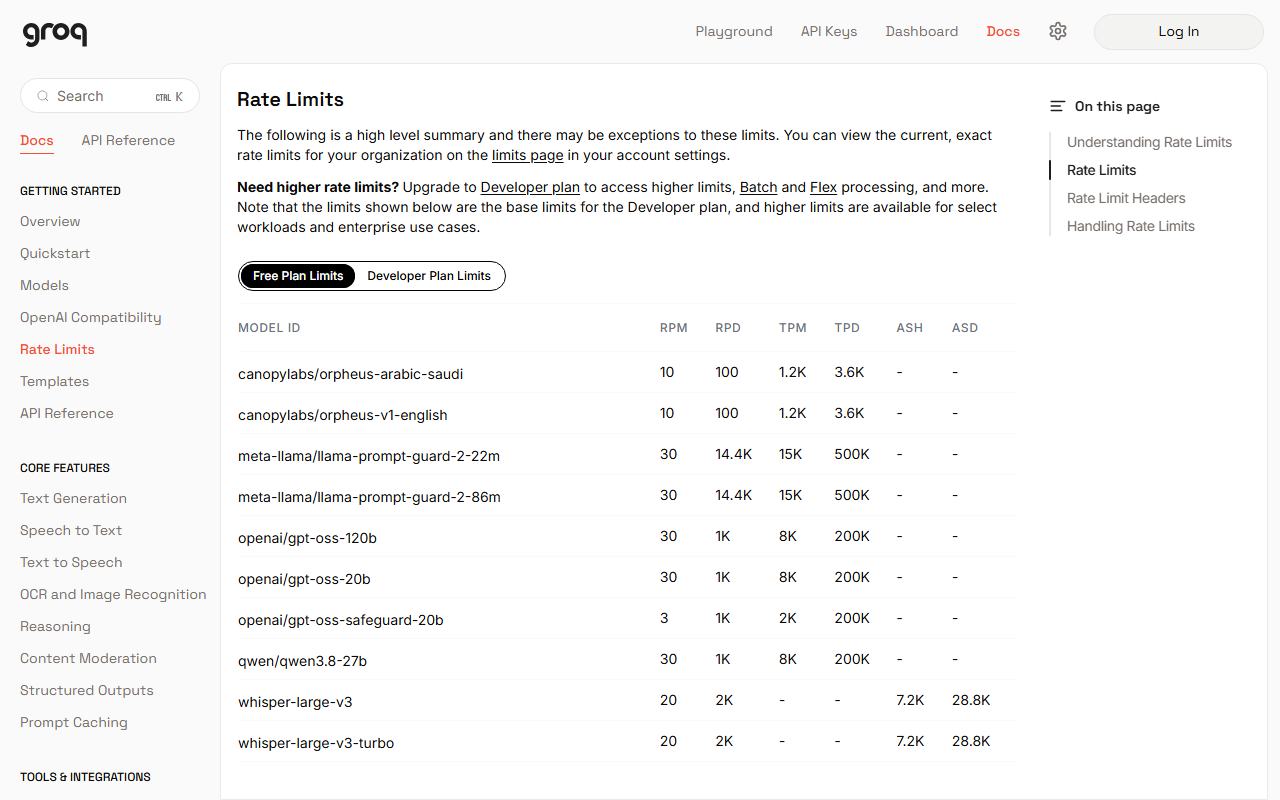
- Low per-model limits
- GPT-OSS 120B: 30 requests/min, 1,000/day, 8K tokens/min, 200K/day
- No Batch, Flex or spend limits
- Card, US bank account or SEPA debit
- GPT-OSS 120B: 1K requests/min, 250K tokens/min
- Batch (50% off), Flex, spend limits, chat support
- Llama 3.1 8B, Llama 3.3 70B, Muse Spark Open, MiniMax
- Performance tier: 99.9% availability SLA
- Provisioned throughput, committed spend
- Dedicated bare metal (Metal)
- Managed inference stack (Core)
- Governance and audit layer (Assured)
| Model (self-serve) | Input / output per 1M tokens | Listed speed |
|---|---|---|
| GPT-OSS 120B | $0.15 / $0.60 (cached input $0.075) | 500 t/s |
| GPT-OSS 20B | $0.075 / $0.30 | 1,000 t/s |
| Qwen 3.8 27B (preview) | $0.80 / $4.00 | 450 t/s |
| Safety GPT-OSS 20B (preview) | $0.075 / $0.30 | 1,000 t/s |
| Whisper Large V3 / V3 Turbo | $0.111 / $0.04 per audio hour | - |
| Orpheus TTS (preview) | $22 (English) or $40 (Arabic) per 1M characters | - |
From console.groq.com/docs/models and prompt-caching docs, Oct 29, 2026. Cached input is half price on the three GPT-OSS models only.
How you are billed
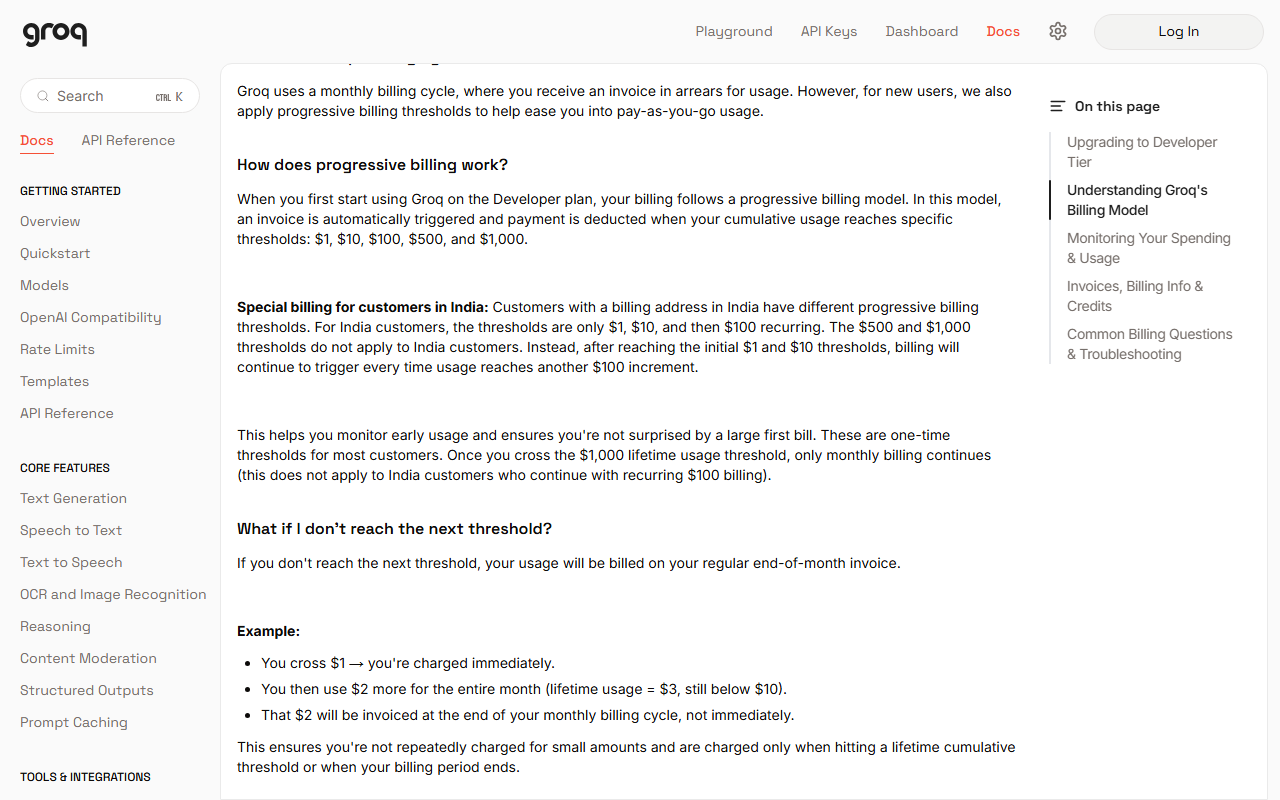
The billing FAQ says upgrading to Developer has “no immediate charge”. New accounts are invoiced and charged automatically when lifetime usage first crosses $1, $10, $100, $500 and $1,000 (in India: $1, $10, then every $100), and otherwise at month-end; nothing is charged until usage reaches $0.50. You can downgrade to Free at any time after paying a final invoice for unbilled usage. There are no prepaid credits to expire, which is friendlier than credit-based rivals, but it also means a runaway job is billed after the fact unless you set a spend limit.
Worked examples: cheap at small scale, mid-priced at volume, and you pay for speed.
These are invented workloads with the arithmetic shown, using Groq's list prices on Oct 29, 2026 and competitors' own pages the same day.
A solo developer prototyping on GPT-OSS 20B
20 million input and 4 million output tokens a month: 20 × $0.075 = $1.50 plus 4 × $0.30 = $1.20, so $2.70. At that size you would get only the first progressive invoices ($1, then at $10 of lifetime use). The free plan's 200,000 tokens a day on GPT-OSS 120B covers lighter testing.
A product chatbot on GPT-OSS 120B
1 billion input and 200 million output tokens a month: $150 + $120 = $270. If half the input hits the prompt cache (system prompts and tool definitions first), the cached half costs $37.50 instead of $75, so $232.50. Work that can wait up to 24 hours to 7 days can go through Batch at 50% off: $135. The same list price ($0.15 and $0.60) applies on Together, so the comparison there is speed and catalog, not cost.
What the speed costs
OpenRouter's provider table for GPT-OSS 120B on Oct 29, 2026 (median, Standard routing) put Groq at 290 tokens a second and 0.29 s latency, Cerebras at 678 tokens a second for $0.35 and $0.75, and the cheapest hosts at $0.03 and $0.15 with about 31 tokens a second. On the workload above that is $60 versus Groq's $270 (4.5 times as much) for roughly nine times the throughput. If a user waits on every token, as in chat, voice or agent loops, Groq's price buys real time; for overnight jobs it does not.
A heavier model, and audio
On Qwen 3.8 27B, 200 million input and 50 million output tokens cost $160 + $200 = $360 on Groq, against $198 + $74.50 = $272.50 on Cerebras's developer tier, because Groq's $4.00 output price is high for a 27B model. Transcribing 1,000 hours of audio costs $40 on Whisper Large V3 Turbo or $111 on Whisper Large V3; 10 million characters of English Orpheus speech cost $220.
Twelve model IDs retired for self-serve users between Dec 2025 and Sep 2026; check the deprecations page before you depend on one.
Groq's deprecations page is the most important document for a buyer. Since Dec 2025 it has retired PlayAI TTS (Dec 31, 2025), Llama Guard 4 (Mar 5, 2026), Llama 4 Maverick (Mar 9), Kimi K2 (Apr 15), Qwen 3 32B and Llama 4 Scout (Jul 17), Llama 3.1 8B and Llama 3.3 70B (Aug 16), Qwen 3.6 27B (Sep 14) and the Compound agent systems (Sep 21). That is twelve model IDs counting both PlayAI voices and both Compound systems. Notice ran from 8 days (PlayAI TTS, emailed Dec 23 for Dec 31, 2025) to 60 days (Llama 3.x, emailed Jun 17 for Aug 16, 2026); the Compound shutdown was announced on Aug 24 for Sep 21 with no recommended replacement. Several notices say the deprecation “applies to free and developer-tier usage; enterprise customers with a committed-spend contract are not affected”, which is how Llama 3.x now appears on the models page as “Enterprise, Contact Sales”.
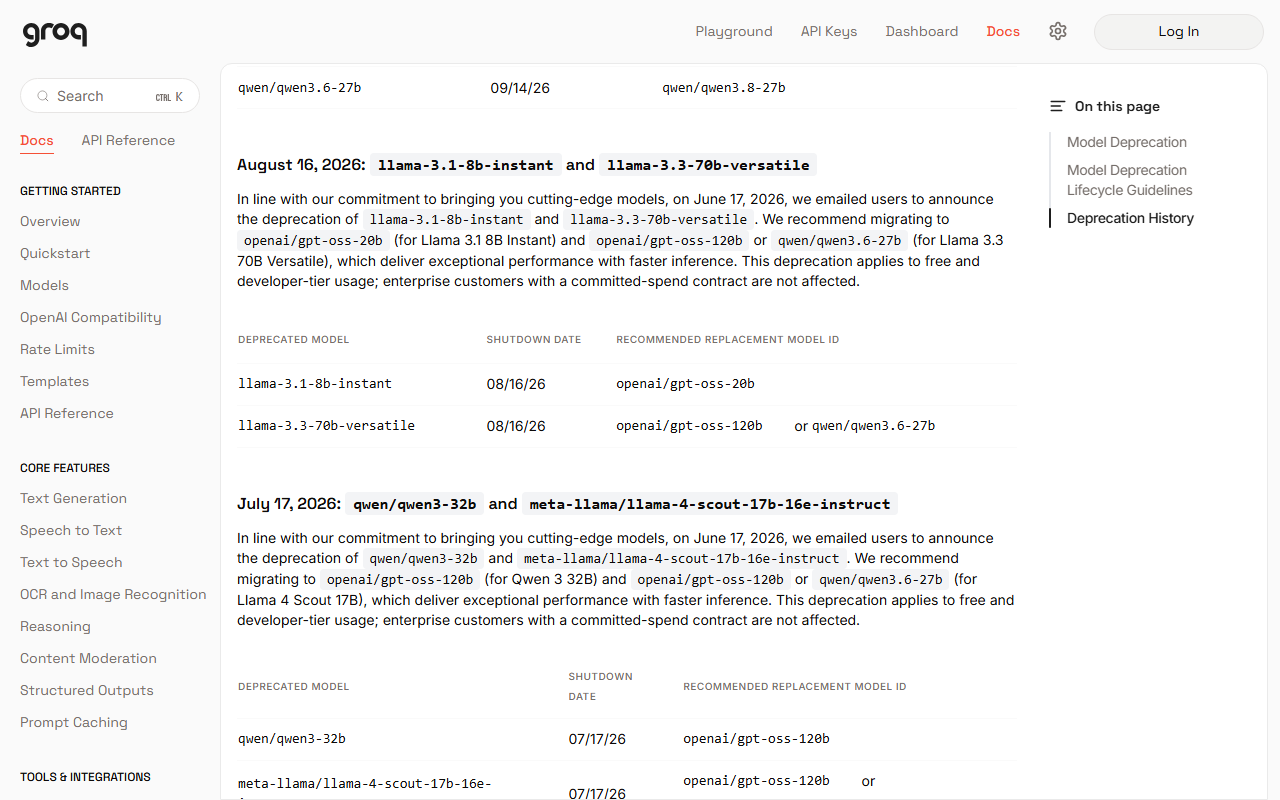
Two practical warnings follow. The docs are not always in step: the Batch page's model table still lists Llama 3.3 70B, Llama 3.1 8B and Llama Guard 4 as of Oct 29, 2026, while the deprecations page lists all three as shut down for self-serve use, so trust the models page. And newer launches tend to arrive as Enterprise-only: Muse Spark Open (Oct 15, 2026 preview, 350+ tokens a second per Groq) and MiniMax M2.7 are “Contact Sales” on the models page. If you need a specific open model for a year, ask for it in writing or plan for a fallback host.
Match your situation to one line.
Fast OpenAI-compatible inference with service tiers, batch, caching, tools and audio.
Chat completions and the Responses API, reasoning settings, tool use with built-in browser search and code execution on GPT-OSS, structured outputs, vision on Qwen 3.8, Whisper speech-to-text and Orpheus text-to-speech.
Flex tier with 10× rate limits at the same price (paid accounts, may fail fast with a capacity_exceeded error), Batch at 50% off with a 24-hour to 7-day window, automatic prompt caching at half price for cached input; LoRA adapter inference for Enterprise only.
MCP connectors in beta for Gmail, Google Calendar and Drive (Dec 1, 2025 changelog), remote MCP tools, official Python and TypeScript SDKs (622 and 268 GitHub stars), Prometheus metrics.
The Performance tier is the enterprise product: provisioned input and output capacity, bought as bundles rather than per token, with a 99.9% availability SLA and a 99% latency guarantee set in the contract, on GPT-OSS 120B, GPT-OSS 20B and Llama 3.3 70B with uncached context under 8,192 tokens.
Sign up, create a key, change one URL.
https://api.groq.com/openai/v1 and use a model ID from the models page, not an old tutorial (many still use the retired Llama IDs).Free-tier ceilings, enterprise gates and a few rough edges.
- Free plan: on GPT-OSS 120B, 30 requests a minute, 1,000 a day, 8,000 tokens a minute and 200,000 a day; Safety GPT-OSS 20B is capped at 3 requests a minute. Limits apply across the whole organization.
- Developer: base limits of 250,000 tokens and 1,000 requests a minute on GPT-OSS; some accounts also get separate input and output token caps. Flex and Batch need a paid account.
- Enterprise-only: Llama 3.1 8B and 3.3 70B, Muse Spark Open, MiniMax M2.7, LoRA adapters, the Performance tier and its SLA.
- Usage reporting: one gateway builder on Hacker News notes token usage on streamed responses needs
stream_options; plan for it in cost tracking. - Support: Developer accounts get chat support per the billing FAQ; Groq's docs describe no support SLA below Enterprise.
No retention of inference data by default, ZDR for everyone, US storage, SOC 2 Type II.
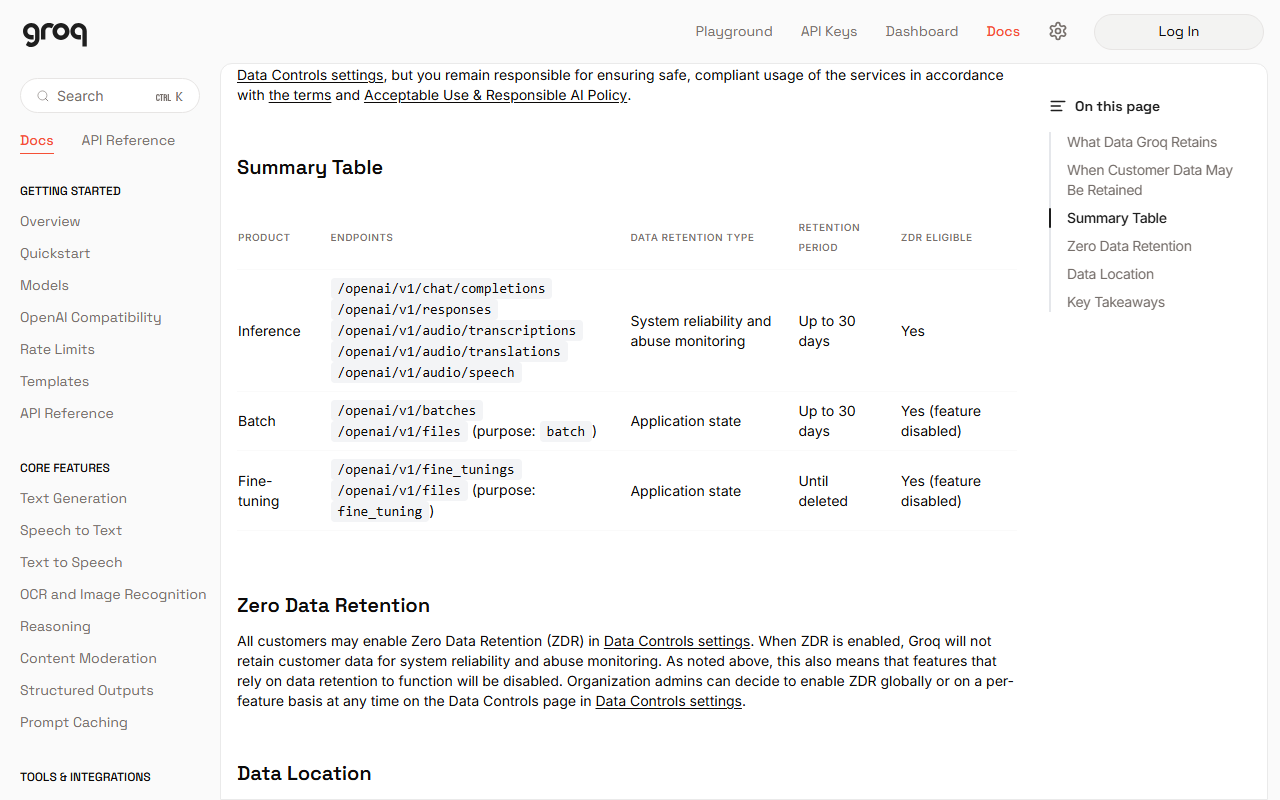
Groq's “Your Data” page says it does not retain inputs or outputs of inference requests by default. It may log them for up to 30 days to troubleshoot reliability problems or investigate abuse, unless the law requires longer, and you can opt out of that with Zero Data Retention in Data Controls, which also disables Batch and fine-tuning because those need stored files (batch files are kept 30 days; fine-tuning data until you delete it). Usage metadata is always collected. All retained customer data sits in Google Cloud buckets in the United States, with standard contractual clauses for transfers.
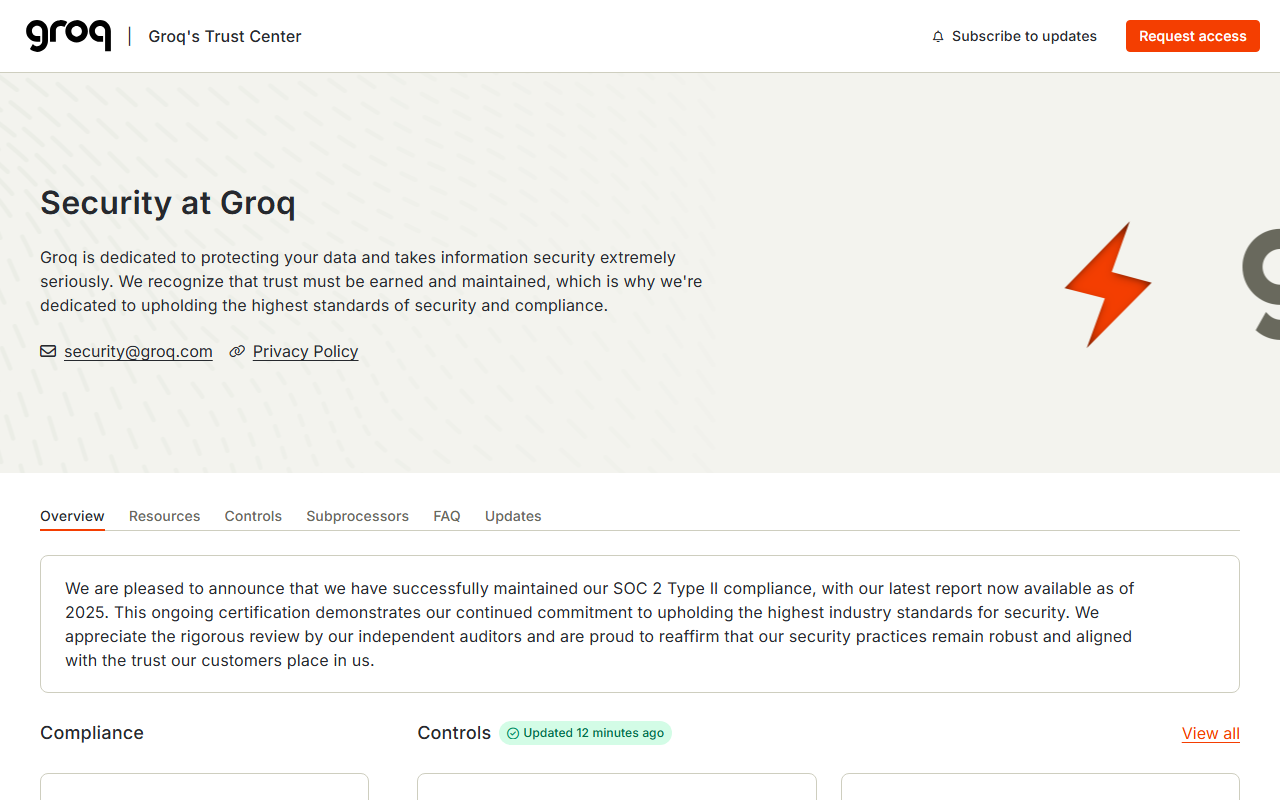
The trust center lists SOC 2 Type II (latest report dated 2025, plus a 2026 bridge letter), GDPR and HIPAA, with reports available on request, and names Stytch, Google Cloud, Stripe and Cloudflare as subprocessors. A Business Associate Addendum and a Data Processing Addendum are among Groq's policies (last modified Jun 22, 2026). We have not reviewed the SOC 2 report or the full Services Agreement; ask for both before sending regulated data.
Latency-sensitive apps that can live on GPT-OSS.
Voice agents, chat and coding or agent loops where each step waits on the last; prototypes that want a free tier; teams happy with GPT-OSS 120B or 20B, Qwen 3.8 27B or Whisper, who want no-retention defaults and US data storage.
Teams that need a broad or fast-changing open-model catalog self-serve; cost-first batch workloads; anyone who needs a model guaranteed for a year without an Enterprise contract; buyers who want EU data residency for stored data.
Seven things to check before you rely on it.
Three self-serve LLMs plus safety, audio and TTS models.
Twelve model IDs retired Dec 2025 to Sep 2026, 8 to 60 days' notice.
Llama 3.x and new launches need a sales contract.
GPT-OSS 120B at 5 times the cheapest host's input price.
New management, Series A subject to closing, lawsuit open.
Batch page lists retired models; no pricing page.
JAVIS did not send a request.
Priced from each vendor's own page on Oct 29, 2026; the products differ, so the plans are not like-for-like.
| Option and when to pick it | What its own page says | JAVIS review |
|---|---|---|
| Groq Fast GPT-OSS, free tier | GPT-OSS 120B $0.15 / $0.60 per 1M; 20B $0.075 / $0.30; Batch 50% off; Enterprise for Llama 3.x | This article |
| Cerebras Inference Fastest GPT-OSS 120B | Developer pay-as-you-go with a one-time $5 credit; GPT OSS 120B ~3,000 tokens/s at $0.35 / $0.75; developer tier not meant for production | No live review yet |
| Together AI Broad open-model catalog | gpt-oss-120B $0.15 / $0.60 serverless, plus many more open models, fine-tuning and GPU clusters | No live review yet |
| Fireworks AI Serverless plus dedicated GPUs | Prepaid per-token serverless, per-GPU-second on-demand deployments, fine-tuning | No live review yet |
| OpenRouter Switch hosts with one key | Routes GPT-OSS 120B to 20+ hosts from $0.03 / $0.15; 5.5% fee on credit purchases | OpenRouter review |
If you would rather run open models yourself, Ollama runs them locally, and Hugging Face lists Groq among its Inference Providers, so you can reach it through a Hugging Face token.
Five steps that keep cost and lock-in under control.
This review has no affiliate links, and Groq did not see it.
JAVIS has no approved Groq affiliate link, so every link goes straight to groq.com, the GroqCloud console or its documentation, without tracking parameters.
Hands-on status: JAVIS has not created a GroqCloud account or sent a request. Cost examples use invented workloads with the arithmetic shown, speed figures come from OpenRouter's public table, and independent review evidence is thin, as section 04 says.
Self-serve models, speeds and limits.
Open Groq models and pricesCreate a key on the free plan.
Open the GroqCloud consoleChoosing where to run open models? These reviews cover the nearest ground.
Each card opens a published JAVIS review.

Questions people ask before committing
Is Groq free?
There is a free plan, capped per model (for GPT-OSS 120B: 30 requests a minute, 1,000 a day, 200,000 tokens a day). Higher limits, Batch and Flex need the pay-as-you-go Developer plan.
How much does Groq cost?
Per token, billed in arrears: GPT-OSS 120B is $0.15 per million input and $0.60 per million output tokens, GPT-OSS 20B $0.075 and $0.30, Qwen 3.8 27B $0.80 and $4.00, Whisper Turbo $0.04 an audio hour, as of Oct 29, 2026.
Can I still use Llama on Groq?
Not on the free or Developer plans. Llama 3.1 8B and Llama 3.3 70B were shut down for those tiers on Aug 16, 2026 and are listed as Enterprise, Contact Sales.
Did Nvidia buy Groq?
Not formally. Groq licensed its inference technology to Nvidia on a non-exclusive basis in Dec 2025, and its founder and many staff moved to Nvidia. Groq LLC still runs GroqCloud independently and raised a $350 million Series A at a $3.5 billion valuation in Aug 2026. Former engineers are suing Groq's board over the deal.
Is Groq the same as Grok?
No. Grok is xAI's chatbot; Groq (with a q) is the inference company and API reviewed here.
Does Groq keep my prompts?
Not by default, per its docs; it may keep them up to 30 days for reliability or abuse investigations unless you turn on Zero Data Retention. Stored data is in Google Cloud in the US.
Is Groq the fastest?
Not on every model. On OpenRouter's Oct 29, 2026 table Groq served GPT-OSS 120B at about 290 tokens a second, behind Cerebras at 678 and ahead of most GPU hosts.
What are the alternatives?
Cerebras for raw speed, Together AI and Fireworks for breadth, OpenRouter to switch hosts; see section 15.
Where this came from, and when.
Pricing and product: console.groq.com/docs pages on models, rate limits, billing FAQs, service tiers, performance tier, flex, batch, prompt caching, spend limits, deprecations, changelog and overview; groq.com home and platform pages; groqstatus.com and github.com/groq, all Oct 29, 2026.
Data and legal: Groq's Your Data page, trust.groq.com and the policies list (last modified Jun 22, 2026). We have not reviewed the SOC 2 report, the Services Agreement in full or the privacy policy.
Company: Groq newsroom posts of Dec 24, 2025, Feb 16, Jun 22, Aug 12, Aug 17, Aug 24 and Oct 15, 2026; Bloomberg (Aug 17, 2026) on the $3.5B and $6.9B valuations; Constellation Research (Dec 24, 2025) on CNBC's $20B report; Bloomberg Law and IT Daily (Oct 2026) on the Delaware complaint.
Independent evidence: Trustpilot (6 reviews, 3.1); Hacker News story 48364620 and comments 48366834, 48420371, 48365674, 48365414, 48367404, 48368353, 48366068 and 50177023; story 46379183. OpenRouter's GPT-OSS 120B provider table for speeds and host prices.
Competitors: cerebras.ai/pricing, together.ai/pricing and fireworks.ai/pricing, Oct 29, 2026. Cost examples are arithmetic on those prices with invented workloads.
Images: screenshots of public pages taken Oct 29, 2026, Groq's social card and Groq's own YouTube video.
JAVIS Fit Score (66/100): editorial composite, 20 points each. Price clarity 14: clear per-token prices, but no pricing page and many models by quote. Capability breadth 10: three self-serve LLMs. Independent evidence 13: public speed data, small review samples. Security and data control 16: no retention by default, ZDR for all, SOC 2. Cost control and fit 13: spend limits, Batch and caching, offset by deprecations and company change. It is judgment, not a measurement.
What this review does not cover: our own latency or quality tests, Enterprise prices, the SOC 2 report, and the outcome of the Delaware lawsuit or the Series A closing.