
AssemblyAI Review 2026: Accurate Speech-to-Text from $0.15 an Hour, a New TTS Model, and a Lot of Change
AssemblyAI sells speech AI by the hour: transcription of recorded audio, real-time transcription for voice agents, and since Oct 27, 2026 its own text-to-speech. Prices are low and public. The catch is pace: in 2026 it launched and is now retiring a Voice Agent API, launched two new top-tier recorded-audio models within five months (Universal-3.5 Pro replaced Universal-3 Pro in July) and switched off several features. This review works out real costs and what that churn means for a build.

There are no affiliate links in this review. Every AssemblyAI link goes straight to assemblyai.com or its documentation.
| Made by | AssemblyAI, Inc. (founded 2017, YC S17) |
| What it is | Speech-to-text, speech understanding and TTS APIs, plus an LLM gateway |
| Pricing | $50 free credits; then per audio hour, per character or per token |
| Catch | Fast model and product churn; add-ons stack; session billing |
| Evidence | Official rate card and changelog; 1 Trustpilot review; Hacker News |
AssemblyAI is one of the cheapest accurate transcription APIs you can buy self-serve, but plan for change: what you build on in 2026 may be renamed or retired within months.
“The Voice Agent API is being retired. Don't quote it for new builds.” That line sits in AssemblyAI's own pricing reference, updated Oct 27, 2026, six months after the product launched.
AssemblyAI's core business is transcription. As of Oct 30, 2026, Universal-3.5 Pro costs $0.21 per audio hour for recorded audio in 18 languages and Universal-2 costs $0.15 across 99 languages; real-time transcription runs from $0.15 an hour (Universal-Streaming) to $0.45 (Universal-3.6 Pro Realtime, the model it recommends for voice agents). New accounts get $50 of credits with no card, the EU region costs the same as the US, and a HIPAA business associate agreement can be signed without a sales call. On Oct 27, 2026 it added AssemblyAI-TTS-1, text-to-speech at $15 per million characters, so one key now covers the listen, think and speak steps of a voice agent.
Three things deserve a decision before you commit. First, churn: the Voice Agent API launched on Apr 29, 2026 and is now listed as being retired; LeMUR was folded into an LLM Gateway; Universal-3 Pro (Feb 2026) was replaced by Universal-3.5 Pro (Jul 2026), and a change to the default model for unpinned requests, first announced for Aug 7, was rescheduled to Sep 2, 2026; legacy summarization and auto-chapters stopped working on Oct 20. Second, bills grow in layers: diarization, keyterms, medical mode and redaction each add a few cents an hour, stereo files bill per channel, and streaming bills for the time the connection is open, not the audio sent. Third, data: you can opt out of model training only on a paid plan, so audio sent on free credits can be used to improve models unless it goes through the EU region or a signed BAA.
Not a hands-on test: JAVIS has not created an AssemblyAI account or sent audio. This review is built from AssemblyAI's pricing page and published rate card, documentation, changelog, blog, security and status pages, its YouTube channel, competitors' pricing pages, Trustpilot and Hacker News, all dated Oct 30, 2026 unless stated. Accuracy figures are AssemblyAI's own or individual users' tests, not our measurements.
Transcribe, understand, speak: three product families behind one API key, billed by usage.
You send audio to an endpoint in the US or EU region and choose a model in the request. Recorded files go to the pre-recorded API (with a newer Sync API for short files in one call); live audio goes over a WebSocket to the streaming API. Speech Understanding and Guardrails add speaker names, translation, entities, redaction and moderation as priced add-ons, and the LLM Gateway runs models from OpenAI, Anthropic, Google, Alibaba and others over your transcripts at per-token rates. TTS-1 closes the loop for voice agents. Billing is monthly in arrears with no minimums.
A YC company that moved from transcription to the whole voice-agent stack.
AssemblyAI launched on Hacker News as part of Y Combinator's Summer 2017 batch and is led by founder and CEO Dylan Fox, who appears under that title in a video on the company's own YouTube channel dated Oct 28, 2026. The last funding round we can source is a $50 million Series C reported by TechCrunch on Dec 4, 2023; we found no 2026 round. Its homepage claims more than 120 million conversations a week and more than 2 billion requests a month; those are usage counters, not customer counts. An AssemblyAI blog post says G2 named it a Leader in its Spring 2026 Voice Recognition report; we have not checked that on G2 itself.
The 2026 product story is a push into voice agents: real-time models tuned on phone calls (Universal-3.5 Pro Realtime in June, Universal-3.6 Pro Realtime on Sep 29), a Voice Agent API in April, an LLM Gateway, and TTS-1 in October. AssemblyAI's own benchmark for Universal-3.6 Pro Realtime reports a 5.19% word error rate on 12,460 English voice-agent scenarios, against 7.78% for ElevenLabs Scribe v2 and 8.64% for Deepgram Nova-3. That is a vendor-run test; treat it as a claim to verify on your own audio.

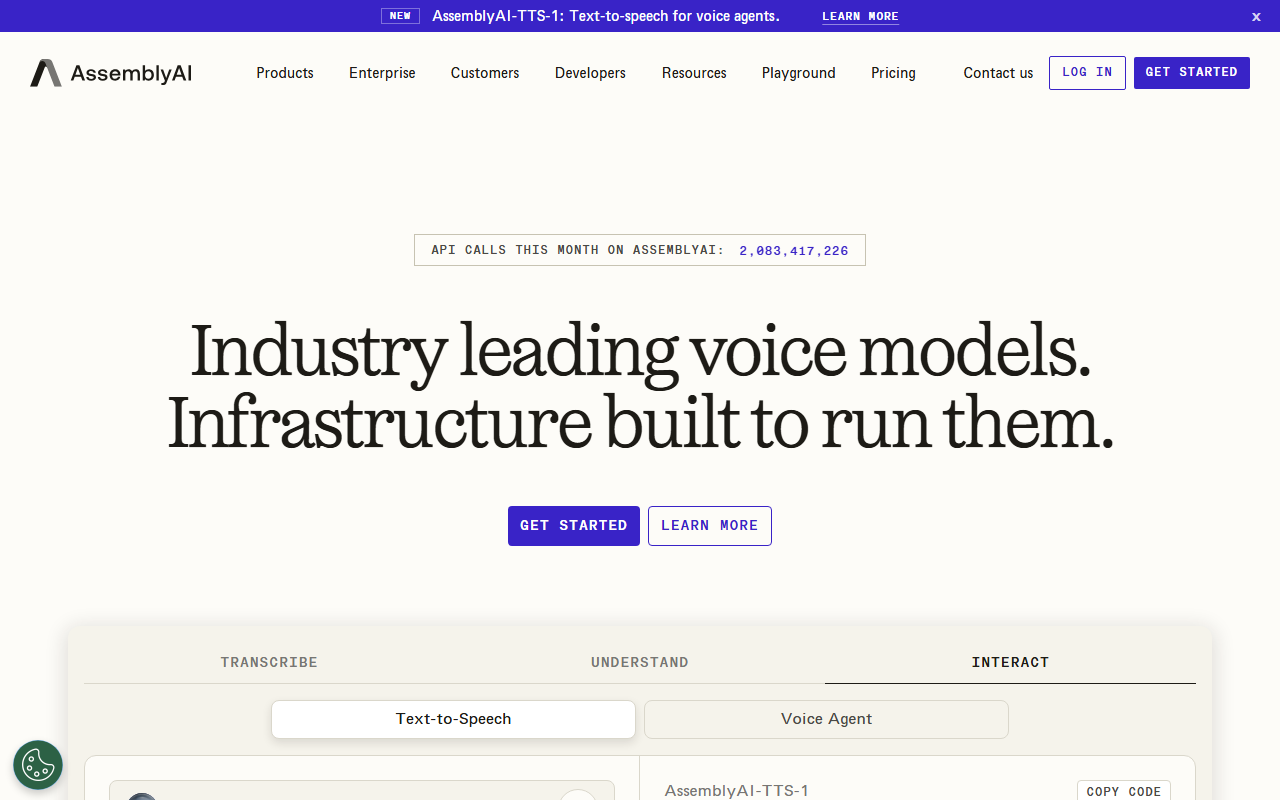
One inconsistency to note: the homepage calls its most accurate model for recorded audio “Universal-3.6 Pro” with 32 languages, while the pricing page and the published model reference both name Universal-3.5 Pro, with 18 languages, as the pre-recorded flagship and 3.6 Pro as the real-time model. Check model IDs in the docs before you code.
Developers praise accuracy for the price; ratings samples are tiny, and independent tests do not always put it first.
AssemblyAI's Trustpilot profile is claimed and has 1 review (5-star, Feb 4, 2025), shown with a 3.7 TrustScore as of Oct 30, 2026: not a usable rating. G2 is where AssemblyAI says it is rated a Leader, but we quote no G2 score. Hacker News carries more developer comment. Claims below are individual accounts we cannot verify, and we left out several comments posted by people who say they work at AssemblyAI.
“I did a bunch of testing and I found that Assembly AI's transcription models are significant better than Whisper and even ElevenLabs. I guess I now sound like an ad.”
One developer's test on 248 recordings of UK postcodes: Soniox 71.0%, ElevenLabs 68.5%, AssemblyAI Universal-3 Pro 66.9%, Deepgram Nova-3 63.7%, AssemblyAI Universal-2 59.7%.
“looks like assembyAI is still unbeatable here in terms of cost/performance”, followed by an edit praising a local open model: “parakeet is good”.
A developer building a private note app: “they have solid terms, 24hr retention and no training”. (The 24-48 hour window applies to uploaded files; transcripts default to 30 days, see section 13.)
On in-room recordings: “Models like AssemblyAI give you transcriptions with Speaker A and Speaker B, but you still have to mark yourself as the one who said X and not Y.”
A Salzburg job-board operator who uses the API for transcription: “Sent difficult question - got helpful response”.

No plans, just rates: per audio hour for speech-to-text, per character for TTS, per token for LLMs.
As of Oct 30, 2026, assemblyai.com/pricing and AssemblyAI's published pricing reference (updated Oct 27) list:
- Free credits, no card
- 5 new streams a minute
- No training opt-out
- No minimums, billed monthly
- 100 new streams a minute, auto-scaling
- Opt out of training
- Volume pricing
- Custom rate limits and concurrency
- Also via AWS Marketplace
- Models in your own environment
- Audio stays in your network
- Contact sales
| Model or service | Price | Best for |
|---|---|---|
| Universal-3.5 Pro (recorded) | $0.21 per hour | 18 languages, best accuracy |
| Universal-2 (recorded) | $0.15 per hour | 99 languages, lower cost |
| Universal-3.6 Pro Realtime | $0.45 per session hour | Voice agents, 32 languages |
| Universal-Streaming (English or multilingual) | $0.15 per session hour | Captions, cost-first live use |
| AssemblyAI-TTS-1 | $15 per 1M characters | Voice agent speech |
| LLM Gateway | Per 1M tokens, e.g. GPT-5 Mini $0.25 in, $2.00 out | Summaries, agents |
From assemblyai.com/pricing and AssemblyAI's pricing reference, Oct 30, 2026. LLM Gateway prices shown are for global routing; in-region (US or EU) routing is 10% higher.

Add-ons stack on the base rate
Each feature adds to the hourly price. Standard speaker diarization is +$0.02 an hour on recorded audio (+$0.065 for the experimental version) and +$0.12 on streaming; keyterm prompting +$0.05; medical mode +$0.15; speaker identification +$0.02; translation +$0.06; entity detection +$0.08; PII text redaction +$0.08; content moderation and topic detection +$0.15 each; Voice Focus noise isolation +$0.10 on Universal-3.6 Pro Realtime. AssemblyAI's own example: Universal-3.5 Pro with medical mode and diarization is $0.21 + $0.15 + $0.02 = $0.38 an hour.
Three billing rules that move the bill
Streaming bills for session time, “the time the WebSocket connection is open, not the duration of audio sent”, so idle minutes count; close connections when a call ends. Multichannel audio bills per channel: a one-hour stereo file is two billable hours. Defaults differ: AssemblyAI warns that default model selection “can differ between free-tier and paid accounts”, so pin the model in every request.
A small inconsistency: the pricing FAQ says the free tier covers “up to 185 hours of pre-recorded transcription”. $50 at today's $0.21 rate is 238 hours of Universal-3.5 Pro; 185 hours matches a $0.27 rate. The 333 streaming hours matches $0.15.
Worked examples: transcription is cheap, the LLM step is cheaper still, and voice agents cost about a cent and a half a minute.
These are invented workloads with the arithmetic shown, using list prices on Oct 30, 2026.
A meeting-notes product transcribing 5,000 hours a month
On Universal-3.5 Pro with standard diarization: 5,000 × ($0.21 + $0.02) = $1,150. On Universal-2 with diarization: 5,000 × $0.17 = $850. A summary per meeting through the LLM Gateway is small change: at about 150 spoken words a minute and the pricing page's 1.3 tokens per word, an hour is about 11,700 tokens, so 5,000 hours on GPT-5 Mini is roughly $15 of input plus $5 of output, about $20. If the recordings are stereo with one speaker per channel, the transcription cost doubles.
A phone voice agent handling 30,000 four-minute calls a month
That is 2,000 hours of audio. Real-time transcription on Universal-3.6 Pro Realtime: 2,000 × $0.45 = $900 (add $200 for Voice Focus). If each call leaves the connection open one extra idle minute, billed time rises to 2,500 hours and the cost to $1,125. Speech: if the agent talks for two minutes a call at about 150 words a minute, that is roughly 1,700 characters, or 51 million a month: 51 × $15 = $765. Thinking: eight turns a call on GPT-5 Mini at about 3,000 input and 80 output tokens each is about $180 + $38 = $218. Total about $1,883 a month, roughly 6 cents a call or 1.6 cents a minute, before telephony and orchestration hosting.
Swap the speech layer to ElevenLabs' cheapest listed API voices ($0.04 per 1,000 characters, so $40 per million) and the same 51 million characters cost $2,040 instead of $765. Price is AssemblyAI's strongest argument; voice quality and latency still need your own listening test.
Ten months, two new top models, one product launched and retired: build so you can switch.
The changelog tells the story. Universal-3 Pro launched on Feb 3, 2026; Universal-3.5 Pro replaced it as the recorded-audio flagship on Jul 7, the old model was deprecated for new and inactive accounts on Jul 10, and a switch of the default model for unpinned requests, announced for Aug 7, was rescheduled on Aug 1 to Sep 2, 2026; we found no later changelog entry confirming it took effect. LeMUR, the earlier LLM framework, was deprecated in favour of the LLM Gateway (the model reference dates the rename Mar 31, 2026). The Voice Agent API launched on Apr 29 and received updates as late as Sep 16; the Oct 27 pricing and model references now say it “is being retired” and point builders to Universal-3.6 Pro Realtime plus the LLM Gateway and TTS-1 inside LiveKit or Pipecat. As of Oct 30, 2026 the Voice Agent API documentation is still live with no retirement date on the page, and we found no changelog entry announcing it.

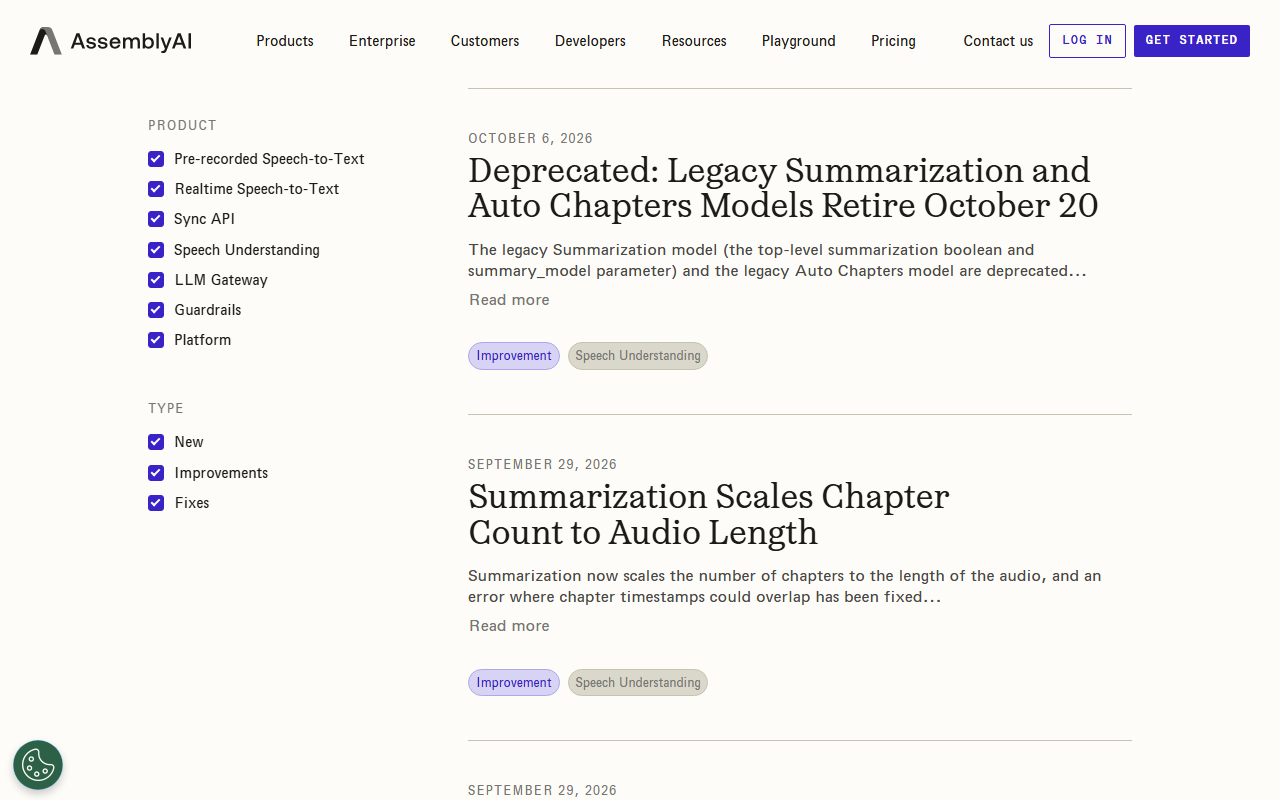
The rate card also flags traps: legacy auto-chapters and summarization “cause silent 500 errors on Universal-3.5 Pro”, and an old word_boost setting can silently route Universal-3 Pro requests to Universal-2. In practice: pin model IDs, watch the changelog, wrap the provider behind your own interface, and keep a second provider tested.
Match your situation to one line.
A deep speech-to-text API with understanding features, an LLM gateway and now speech output.
Pre-recorded, sync and streaming APIs with language detection, word timestamps, filler words, keyterm prompting (up to 1,000 terms on 3.5 Pro), natural-language prompting (beta), medical mode in four languages, and speaker diarization including inline labels on streaming.
Speaker identification by name, translation into 100+ languages, entity detection, sentiment, topics, LLM-powered summarization, PII redaction in text and audio, profanity filtering and content moderation.
Python and TypeScript SDKs (supported for production since Jun 12, 2026), an LLM Gateway with automatic provider fallback and prompt caching, a Dictation API, a playground, a docs MCP server, and Universal-3.5 Pro on OpenRouter since Sep 2026.
The recommended voice-agent stack is now three priced layers inside your own orchestrator.
AssemblyAI's guidance as of Oct 27, 2026 is to build voice agents from Universal-3.6 Pro Realtime for listening, the LLM Gateway for reasoning and TTS-1 for speaking, wired together in LiveKit, Pipecat or your own code. Each layer bills separately: session hours, tokens and characters. TTS-1's launch post claims a 47-millisecond median time to first audio in AssemblyAI's own tests, voice cloning at the same price, and “unlimited concurrency without an annual contract”; AssemblyAI's model reference, by contrast, tells writers not to say “unlimited concurrency” for TTS because limits on paid accounts “aren't published”. Ask for your limits in writing.


Works where voice developers already build.
AssemblyAI ships official SDKs for Python and TypeScript, reference voice agents for LiveKit and Pipecat, and integrations listed in its changelog over the years for tools such as Zapier, Make, Activepieces and Langflow. Universal-3.5 Pro has been available through OpenRouter since Sep 2026, and AssemblyAI can be bought through the AWS Marketplace. For coding agents there is a docs MCP server and an “AssemblyAI skill” (Mar 17, 2026); an older docs MCP server was switched off on Jul 16, 2026. Voice-agent platforms such as Vapi and Retell AI sit one level up: they orchestrate calls and let you pick a transcription provider.
Where the money goes, and how to keep it down.
- Pick the model per job. Universal-2 is 29% cheaper than Universal-3.5 Pro and covers 99 languages; 3.5 Pro covers 18.
- Count channels. Downmix stereo if you do not need per-channel transcripts.
- Close sockets. Streaming bills open time, and streaming add-ons such as diarization apply to the whole session.
- Use the LLM Gateway's global routing unless you need in-region processing, which costs 10% more.
- Watch concurrency. Streaming starts at 100 new sessions a minute on pay-as-you-go and grows 10% whenever you use 70% of the limit; the free tier allows 5.
Strong compliance paperwork; read the training and retention defaults carefully.
AssemblyAI's security page lists a SOC 2 Type 2 report audited annually, third-party penetration tests and encryption with TLS 1.2+ in transit and AES at rest; its changelog records ISO 27001:2022 certification (Dec 2024), PCI DSS v4.0 (Apr 2025) and dashboard single sign-on (Jul 21, 2026). The rate card says a HIPAA BAA is “signable in minutes without a sales call” at no premium, and the EU region costs the same as the US.
The defaults are where to look. Model-training opt-out is available “on any paid plan”; data under a signed BAA or sent to the EU servers is never used for training. That means audio sent on free credits through the US region may be used to improve models. Uploaded files are deleted within 24 to 48 hours and transcripts after 30 days by default (the docs described this as “indefinite” until a Jul 3, 2026 correction); you can set a time-to-live as short as one hour. Streaming keeps no audio or transcripts once you have opted out of training. Pre-recorded transcription has no zero-retention mode, and LLM Gateway zero retention applies to Anthropic and Google models under a BAA. A self-hosted deployment is offered for audio that must stay inside your network.

Reliability: the public status page shows 99.97% API uptime over the 90 days to Oct 30, 2026, with an Oct 28 incident in which a change to temporary tokens caused some real-time sessions to fail with 502 errors until it was rolled back.

Developers who want accurate, cheap transcription and can absorb product change.
Meeting-note, call-analytics and media products transcribing thousands of hours; voice-agent teams already using LiveKit or Pipecat; health or EU workloads that need a BAA or EU processing without a sales cycle; teams that want transcription, LLM and TTS on one bill.
Teams that need a turnkey hosted voice agent (the Voice Agent API is being retired); languages outside Universal-2's 99 where you need top accuracy; anyone prototyping with sensitive audio on free credits in the US region; buyers who need a stable API surface for a year without a contract.
Seven things to weigh before you rely on it.
Voice Agent API retiring six months after launch.
Universal-3.5 Pro replaced 3 Pro in five months; default change rescheduled.
Diarization, keyterms, medical and redaction each add cents an hour.
Idle streaming time and extra channels are billed.
No training opt-out until you pay (except EU or BAA).
Model names, free hours and TTS concurrency differ by page.
JAVIS did not send audio; accuracy figures are not ours.
Priced from each vendor's own page on Oct 30, 2026; the products differ, so the plans are not like-for-like.
| Option and when to pick it | What its own page says | JAVIS review |
|---|---|---|
| AssemblyAI Accurate, cheap, changing | Recorded $0.15 to $0.21/hr; streaming $0.15 to $0.45/hr; TTS $15 per 1M characters; $50 free credits | This article |
| Deepgram Speech plus a managed voice agent | $200 free credit; streaming Nova-3 or Flux monolingual $0.0077/min ($0.46/hr); Growth from $4,000 a year; page banner: “Daily + Pipecat are joining Deepgram” | Deepgram review |
| ElevenLabs Voice quality first | Scribe v2 $0.22/hr; Scribe v2 Realtime $0.39/hr; TTS from $0.04 per 1,000 characters | ElevenLabs review |
| OpenAI Already on OpenAI | gpt-4o-mini-transcribe $0.003/min; gpt-transcribe $0.0045/min; gpt-live-transcribe $0.017/min | No live review yet |
| Soniox Lowest per-hour price | Token-priced, “about $0.10/hour” async and $0.12/hour real-time | No live review yet |

The Deepgram banner matters to AssemblyAI buyers: Pipecat is one of the two open frameworks AssemblyAI now recommends for voice agents. We have not reviewed the terms of that announcement; if you build on Pipecat, keep an eye on how vendor-neutral it stays.
Five steps that keep cost, privacy and lock-in under control.
speech_models explicitly; defaults have changed and differ by account type.This review has no affiliate links, and AssemblyAI did not see it.
JAVIS has no approved AssemblyAI affiliate link, so every link goes straight to assemblyai.com, its pricing page or its documentation, without tracking parameters.
Hands-on status: JAVIS has not created an AssemblyAI account or sent audio. Cost examples use invented workloads with the arithmetic shown; accuracy figures are AssemblyAI's or individual users' own; independent review evidence is thin, as section 04 says.
Every model, add-on and billing rule.
Open AssemblyAI pricingModels, data retention and quickstarts.
Open AssemblyAI docsBuilding with voice AI? These reviews cover the nearest ground.
Each card opens a published JAVIS review.


Questions people ask before committing
Is AssemblyAI free?
New accounts get $50 of credits with no card. After that it is pay-as-you-go with no minimums. On free credits you cannot opt out of model training unless you use the EU region or sign a BAA.
How much does AssemblyAI cost per hour?
$0.21 an hour for Universal-3.5 Pro and $0.15 for Universal-2 on recorded audio; $0.15 (Universal-Streaming) to $0.45 (Universal-3.6 Pro Realtime) per session hour for live audio, plus any add-ons, as of Oct 30, 2026.
Is the Voice Agent API being discontinued?
AssemblyAI's pricing and model references (updated Oct 27, 2026) say it “is being retired” and recommend Universal-3.6 Pro Realtime with the LLM Gateway and TTS-1 instead. No retirement date was published as of Oct 30, 2026.
Does AssemblyAI do text-to-speech?
Yes, since Oct 27, 2026: AssemblyAI-TTS-1 at $15 per million characters, with voice cloning at the same price.
Is AssemblyAI HIPAA compliant?
It offers a BAA you can sign without a sales call and at no extra cost, and lists SOC 2 Type 2 and ISO 27001. Sign the BAA before sending health data.
How long does AssemblyAI keep my data?
Uploaded files 24 to 48 hours; recorded-audio transcripts 30 days by default, or as little as one hour with a time-to-live; streaming keeps nothing once you opt out of training on a paid plan.
What are the alternatives?
Deepgram for real-time and managed voice agents, ElevenLabs for voice quality, OpenAI if you are already on its API, and Soniox for the lowest per-hour price; see section 16.
Where this came from, and when.
Pricing and product: assemblyai.com/pricing; AssemblyAI's published pricing and model references (both updated Oct 27, 2026); docs on models, Universal-3.5 Pro, the Voice Agent API and the FAQ; the changelog (entries Nov 2025 to Oct 23, 2026); blog posts on the Voice Agent API (Apr 29), Universal-3.6 Pro Realtime (Sep 29) and TTS-1 (Oct 27, 2026), all Oct 30, 2026.
Data and security: assemblyai.com/security and its FAQ; status.assemblyai.com. We have not reviewed the SOC 2 report, the BAA or the full terms of service.
Company: Launch HN (2017), TechCrunch's Dec 4, 2023 report of the $50M Series C, AssemblyAI's YouTube channel and its G2 post.
Independent evidence: Trustpilot (1 review, 3.7); Hacker News comments 49204930, 47593226, 47147288, 49705436 and 49208831; stories 47963618 and 50277116. Comments by self-identified AssemblyAI staff were excluded.
Competitors: deepgram.com/pricing, elevenlabs.io/pricing/api, developers.openai.com API pricing and soniox.com/pricing, Oct 30, 2026. Cost examples are arithmetic on those prices with invented workloads.
Images and video: screenshots of public pages taken Oct 30, 2026, AssemblyAI's social card, and a tutorial from AssemblyAI's own YouTube channel.
JAVIS Fit Score (72/100): editorial composite, 20 points each. Price clarity 16: public per-hour, per-character and per-token rates with stacking rules spelled out, minus small inconsistencies. Capability 17: broad speech stack from transcription to TTS. Independent evidence 11: one Trustpilot review, vendor benchmarks, mixed single-user tests. Security and data control 15: SOC 2, ISO 27001, self-serve BAA, EU at no premium, but training on by default for free use. Cost control and stability 13: no minimums and clear pricing, offset by fast product and model retirements. It is judgment, not a measurement.
What this review does not cover: our own accuracy, latency or voice-quality tests; custom and self-hosted pricing; the Voice Agent API's retirement date.