
Vapi Review 2026: A Developer Voice Agent Platform at $0.05 a Minute Before the Models, and $2,000 a Month for HIPAA
Vapi is a developer platform for building voice agents that answer and place phone calls. Its pricing page, as of Oct 28, 2026, charges $0.05 a minute for hosting, passes through the cost of the transcriber, language model and voice, and adds optional packages (Core $29, Pro from $999 a month). This review works out what that means for a prototype, a small business and a scaled team, where the pages contradict each other, and who should look at Retell AI or Bland instead.
There are no affiliate links in this review. Every Vapi link goes straight to vapi.ai, its documentation or its trust center.
| Made by | Vapi, Inc.; $50M Series B reported May 12, 2026 |
| What it is | Developer platform for phone and web voice agents |
| Pricing | $0.05/min hosting + providers; Core $29; Pro $999 min |
| Catch | HIPAA +$2,000/month; SSO and EU only on Premier |
| Evidence | Hacker News comments; no star rating |
Vapi is a strong build-it-yourself voice agent layer, but the real bill is $0.05 a minute on top of every provider, and HIPAA costs $2,000 a month extra.
“Usage is your Vapi hosting fee ($0.05/min) plus the model costs for each minute your agents run.” That sentence, from Vapi's own pricing FAQ, is the whole pricing model in one line.
Vapi lets developers assemble a phone or web voice agent from a transcriber, a language model and a voice, then adds orchestration, telephony, tools, testing and monitoring. Its pricing page shows $0.05 a minute for hosting, provider costs passed through “with no markup”, and its own calculator puts a 1,000-minute month at $82 to $129 with Deepgram, OpenAI and ElevenLabs. Success Packages sit on top: Core $29 a month, Pro $999 a month minimum, Premier by quote.
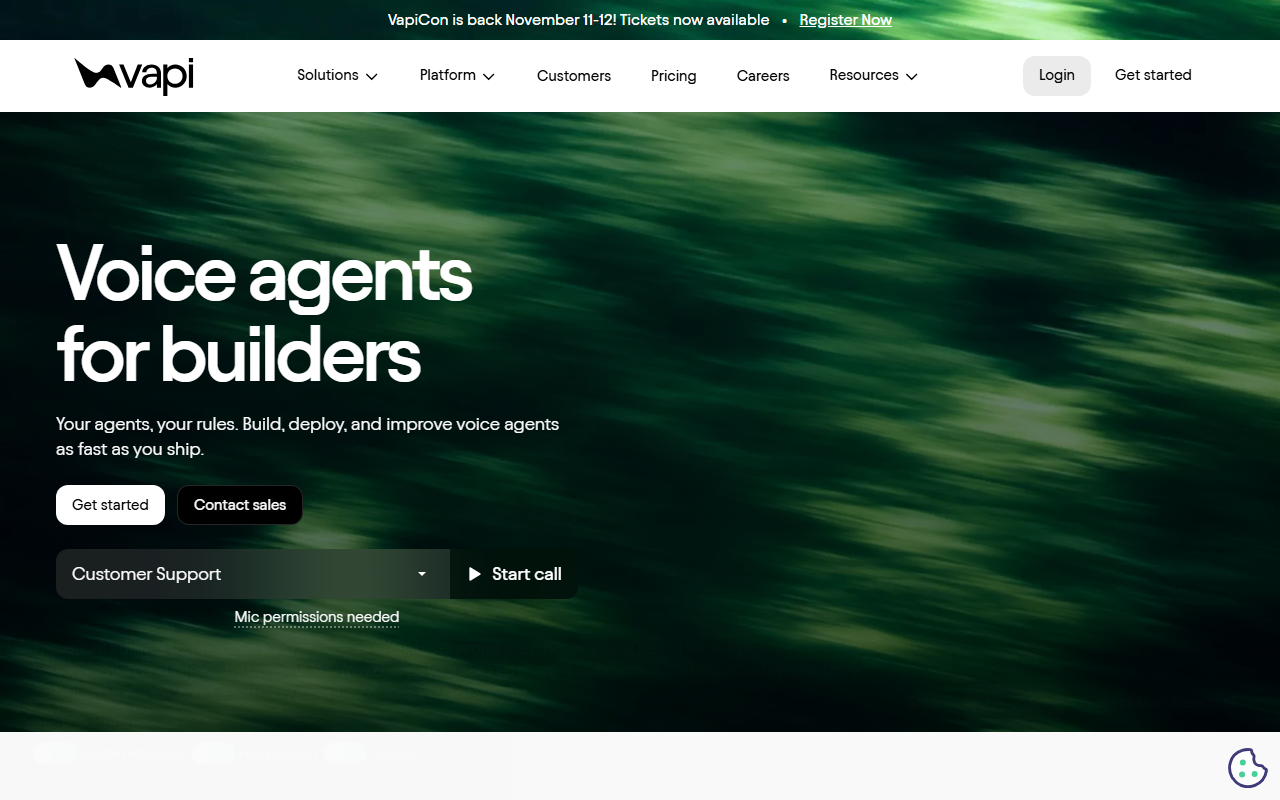
The catches are specific. HIPAA handling is a $2,000 a month add-on per organization, which at 10,000 minutes nearly triples the monthly bill (≈$2,818 to $3,289 against $818 to $1,289). SSO and the EU region are listed only for Premier in the docs. The pricing page says Core includes 2 organizations while the docs table says 5, and the home page says “sub-500ms” latency while the FAQ says “typically around 800 milliseconds”. Independent reviews are thin: no Trustpilot or G2 rating we can quote, and a handful of Hacker News comments, some from rival projects. Public GitHub issues add one serious item, covered below.
There is also a supply-chain incident to know about. Per Snyk (Jun 4, 2026), four versions of Vapi's official TypeScript server SDK on npm (0.11.1, 0.11.2, 1.2.1 and 1.2.2) were published with malicious code as part of a wider npm worm campaign. The npm registry no longer lists those versions, but Vapi's blog and changelog carry no notice about it, and a GitHub issue reporting it (#41, Jun 4, 2026) is still open with no replies. On Oct 28, 2026 Vapi merged pull request #51 in the same repository, “ci: isolate npm publishing credentials from package builds”, which per its description makes build and validation steps run without npm publishing credentials and publishes from a separate job with lifecycle scripts disabled; the description does not mention the June versions.
The company is well funded and moving fast. TechCrunch reported a $50M Series B on May 12, 2026 at a valuation of about $500M (per an unnamed source), and Vapi's changelog shows a release almost every week. For a team that wants to pick every component and has engineers to wire it, Vapi is a top contender. For a clinic that needs HIPAA on a small budget, or a team that wants one rate for model, transcription and voice, look at Retell AI or Bland first.
Not a hands-on test: JAVIS has not created a Vapi account, built an assistant or placed a call. This review is built from Vapi's pricing page, documentation, terms, trust center, status page and changelog, TechCrunch, Hacker News and the pricing pages of competitors, all dated Oct 28, 2026 unless stated. Latency, call quality and support response times are not measured here.
An orchestration layer between your phone line, three AI providers and your own server.
A Vapi assistant is a configuration: which transcriber turns speech into text, which language model decides what to say, which voice speaks it, plus prompts, tools and a phone number or web widget. Vapi runs the real-time pipeline, handles turn-taking and telephony, and sends call events to your server. Its docs call the three core components the transcriber, model and voice.
Fast growth, big enterprise names, and a funding round that more than tripled the money raised.
Vapi launched on Hacker News on Apr 18, 2024 with a demo that asked readers to convince its voice AI to reveal a secret code (155 points, 105 comments). A Vapi blog post announcing a $20M raise was shared on Hacker News on Dec 12, 2024. On May 12, 2026 TechCrunch reported a $50M Series B led by Peak XV Partners, with Microsoft's M12, Kleiner Perkins and Bessemer, bringing total funding to $72M at about a $500M valuation, a figure the article attributes to an unnamed person familiar with the deal.
TechCrunch also reports that Amazon Ring routes all of its inbound calls through Vapi, that Vapi has handled more than 1 billion calls, and that the platform has more than 1 million developers; named customers include Kavak, Instawork, New York Life, Intuit and others. Those are company or investor claims. The article names Sierra, Decagon, PolyAI, Bland, Retell and ElevenLabs as competitors. Vapi's home page repeats “1 Billion calls supported”, “2.5M+ agents launched” and “99.9% uptime for enterprise clients”.
No star rating to quote. The public record is Hacker News: warm on speed to a first demo, sharp on cost and the interface.
We quote no Trustpilot or G2 rating for Vapi. These Hacker News comments are the checkable public evidence, and several come from people who sell or build rival tools, which is noted where it applies.
“I don't like Vapi due to 1) extensive GUI driven experience, 2) cost”, from a developer asking for a serverless way to run the open-source Pipecat stack.
A team “experimenting with VAPI” said its newly launched workflow builder “has a lot of rough edges”. It was in open beta then; we have not tested the current version.
A user signed up and “was able to reproduce a similar proof of concept within your app very quickly”, adding a custom ElevenLabs voice and a phone number, “all of it in minutes”.
A commenter writing about the open-source Pipecat project: “The integrated developer experience is much better on Vapi, etc.” Pipecat is a rival approach, so read it as a competitor's concession.
A developer of the rival open-source Dograh project wrote that on earlier platforms 60 to 70% of their spend was the Vapi platform fee. This predates Vapi's current $0.05 hosting fee line and comes from a competitor.
A reader priced an hour-long AI therapist chat at “$18/hr” for Vapi plus Deepgram, GPT-4 and ElevenLabs. Today's calculator shows $4.91 to $7.73 an hour for a cheaper stack, so that figure is out of date.
Pay per minute from $0, then optional packages: Core $29 a month, Pro from $999, Premier by quote.
As of Oct 28, 2026, vapi.ai/pricing lists:
- Pre-paid, $0.05/min Vapi hosting
- $5 free credits
- 2 organizations, 1 Vapi number
- 4 concurrent calls, 14 days raw data
- Discord community; email without SLA
- Pre-paid, auto-renew
- 10 concurrent calls, 5 numbers
- 30 days raw data, ZDR included
- 2 business day email response SLA
- Page: 2 organizations; docs: 5
- 10% of Vapi hosting fee, $999/mo minimum
- 30 concurrent calls, 10 orgs, 10 numbers
- 180 days raw data, RBAC + ZDR
- Slack, 1 business day SLA, 99% uptime SLA
- Custom orgs, concurrency, retention
- Named support team, 1 hour P0 SLA
- 99.9% uptime SLA
- Custom RBAC + ZDR + SSO, dedicated SIP
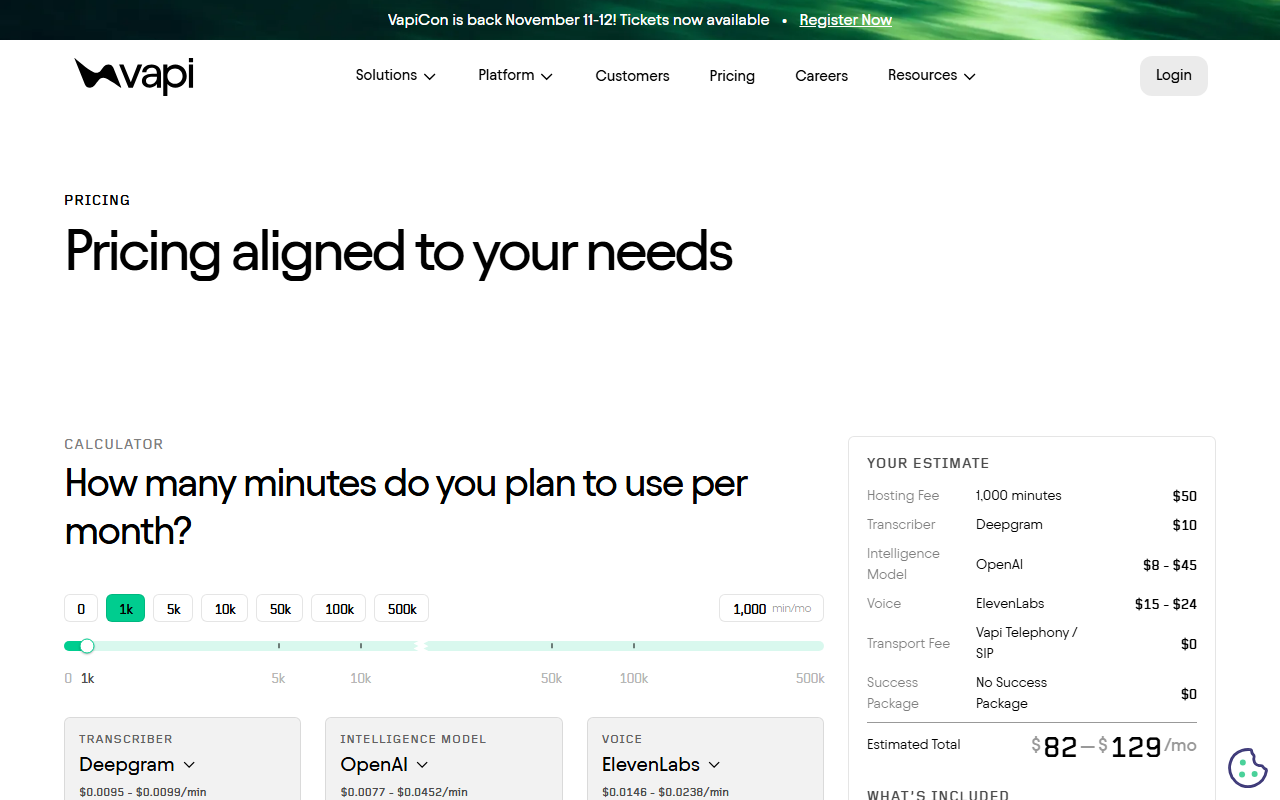

Transport, add-ons and what is included in every plan
Vapi Telephony / SIP, Vapi WebSockets and Daily WebRTC are listed as free. Twilio costs $0.008 a minute inbound and $0.014 outbound, Vonage $0.00814 and Telnyx $0.0055, and the page says the transport fee is “charged by provider, not Vapi”. Add-ons: HIPAA compliance $2,000 a month, additional concurrency $10 per line a month, additional organizations $20 per organization a month. Every plan lists unlimited agents, models at “provider costs with no markup”, testing and simulation, and critical monitoring.
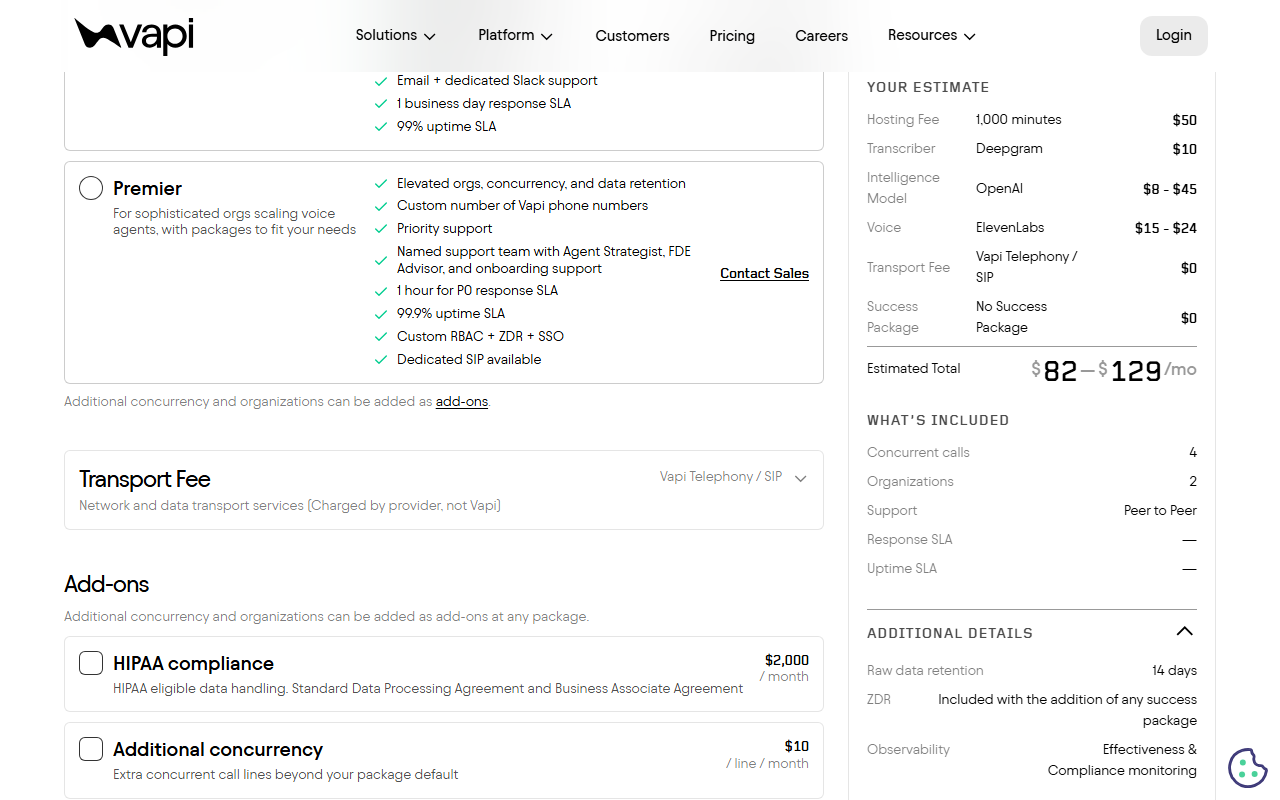
Worked examples: expect $0.08 to $0.13 a minute before telephony, and a package or add-on can move that a lot.
These are invented workloads with the arithmetic shown. Provider rates are the ranges on Vapi's own calculator (Deepgram $0.0095 to $0.0099, OpenAI $0.0077 to $0.0452, ElevenLabs $0.0146 to $0.0238 a minute), so every total is a range. Telephony is excluded unless stated.
Prototype: 1,000 minutes in a month
Vapi's own estimate: hosting $50 + transcriber $10 + model $8 to $45 + voice $15 to $24 = $82 to $129. The $5 free credits cover the first 100 minutes of hosting alone.
A small business: 10,000 minutes, Usage only
Hosting 10,000 × $0.05 = $500. Providers: $318 to $789. Total $818 to $1,289, or about $0.082 to $0.129 a minute. Using Twilio outbound instead of Vapi Telephony would add up to $140 (10,000 × $0.014). Adding Core for 10 concurrent lines costs $29 more.
The HIPAA surcharge at the same volume
Add $2,000 and the same 10,000 minutes cost $2,818 to $3,289 ($0.28 to $0.33 a minute). Retell AI's documentation says its BAA is self-signed at “no additional fee”; Retell's own calculator default of $0.150 a minute gives $1,500 at 10,000 minutes, though the two pricing models are not like-for-like.
A growing team: 50,000 minutes with Pro
Hosting $2,500; providers $1,590 to $3,945; Usage only $4,090 to $6,445. Pro adds a flat $999, so $5,089 to $7,444: Pro alone is about $0.020 a minute at this volume. It pays off for the SLA, Slack channel and 180-day retention, not for any price saving.
Where the 10% starts to bite: 200,000 minutes
Hosting is $10,000, so 10% is $1,000, just over the $999 minimum. The break-even is 199,800 minutes a month (999 ÷ 0.10 ÷ 0.05). Providers add $6,360 to $15,780, making $17,360 to $26,780 a month, about $0.087 to $0.134 a minute.
Concurrency: add-ons versus Pro
Need 30 simultaneous calls? Core's 10 lines plus 20 add-on lines is $29 + 20 × $10 = $229 a month; Pro includes 30 for at least $999. Pro is only the cheaper way to get lines at far higher counts, and buys SLAs, Slack and RBAC besides.
Terms dated Sep 14, 2026: usage fees are non-refundable, Vapi may suspend without notice, liability is capped.
Vapi's Terms of Service say “Last Updated: September 14, 2026”. Key clauses as of Oct 28, 2026:
Fees “set out on our website” can be revised, but your costs do not change until your current term ends, and Vapi says it will notify you of material pricing changes and give an option to cancel. Refunds on non-consumption fees are at Vapi's “sole discretion”, pro rata; per-minute and metered charges “are earned as incurred and are non-refundable except as required by law”.
Vapi may suspend “immediately and without notice” in listed cases such as security risk. Each party's liability is capped at the greater of $100 or the amount paid or payable in the prior 12 months. California law governs; disputes go to individual binding arbitration with a jury and class waiver.
Provider choices carry their own terms: for providers you connect, the terms say each acts as your third-party service provider and you are “solely responsible” for its agreements, privacy terms and cross-border transfer rules. If you route patient or customer data to a provider, check that provider's contract as well as Vapi's.
Match your situation to one line.
Assistants, multi-assistant squads, tools, outbound campaigns, simulation tests and weekly model updates.
Assistants and Squads (several assistants handing off in one call), custom keywords and voices, structured outputs, tools that call your server, and a visual prompt editor. Provider keys let you bring your own models.
Simulations with latency limits, eval run history, assistant versions with traffic splitting by percentage (Oct 12, 2026 changelog) and version-aware call logs.
Call, chat, webhook and API request logs, monitoring, outbound campaigns with concurrency control, and a model catalog with weekly refreshed latency and cost metrics.

The Oct 2026 changelog adds Claude Haiku 5.5 and Gemini 3.8 Flash as selectable models, a Cartesia Sonic-3.6 voice, ElevenLabs v4 Turbo, a Soniox confidence filter and GPT-6 Luna. A Vapi blog post of Oct 2, 2026 is titled “GPT-Live is now in beta for every Vapi customer”.
Minutes in the dashboard; a server URL once you need tools.
Vapi's FAQ says the dashboard “can take minutes” and that a client SDK can start a call with one line of code; for function calling you set up a Server URL that receives events and responds. The docs also list a command-line tool, an MCP server (open source, MIT, 58 GitHub stars on Oct 28, 2026) that exposes Vapi to AI coding tools, and a Composer assistant in alpha for building agents by chat.

Plan the data path early: by default Vapi records calls and stores logs and transcripts (HIPAA docs), keeps raw data 14 days on Usage only, and lists Zero Data Retention as included with a Success Package, not as a Usage-only add-on.
Four concurrent calls on the free tier, retention by tier, and options that need Premier.
- Concurrency: each call uses one slot; 4 lines on Usage only, 10 on Core, 30 on Pro. When all are busy, the docs say you cannot start an outbound call or accept an inbound one. Lines are shared by every organization in a subscription; extra lines cost $10 each a month.
- Retention: raw data 14, 30 or 180 days by tier; the docs also list a 60-day retention add-on.
- Compliance combinations: HIPAA mode and ZDR are “mutually exclusive”, HIPAA is organization-wide, cannot be enabled through the API, and limits you to compatible providers; the docs say it limits features such as reviewing call logs or transcripts.
- Premier-only items: SSO and the EU region are listed as Premier in the docs table; Pro has basic roles.
- Contradictions: Core organizations (2 on the pricing page, 5 in the docs) and latency (below).
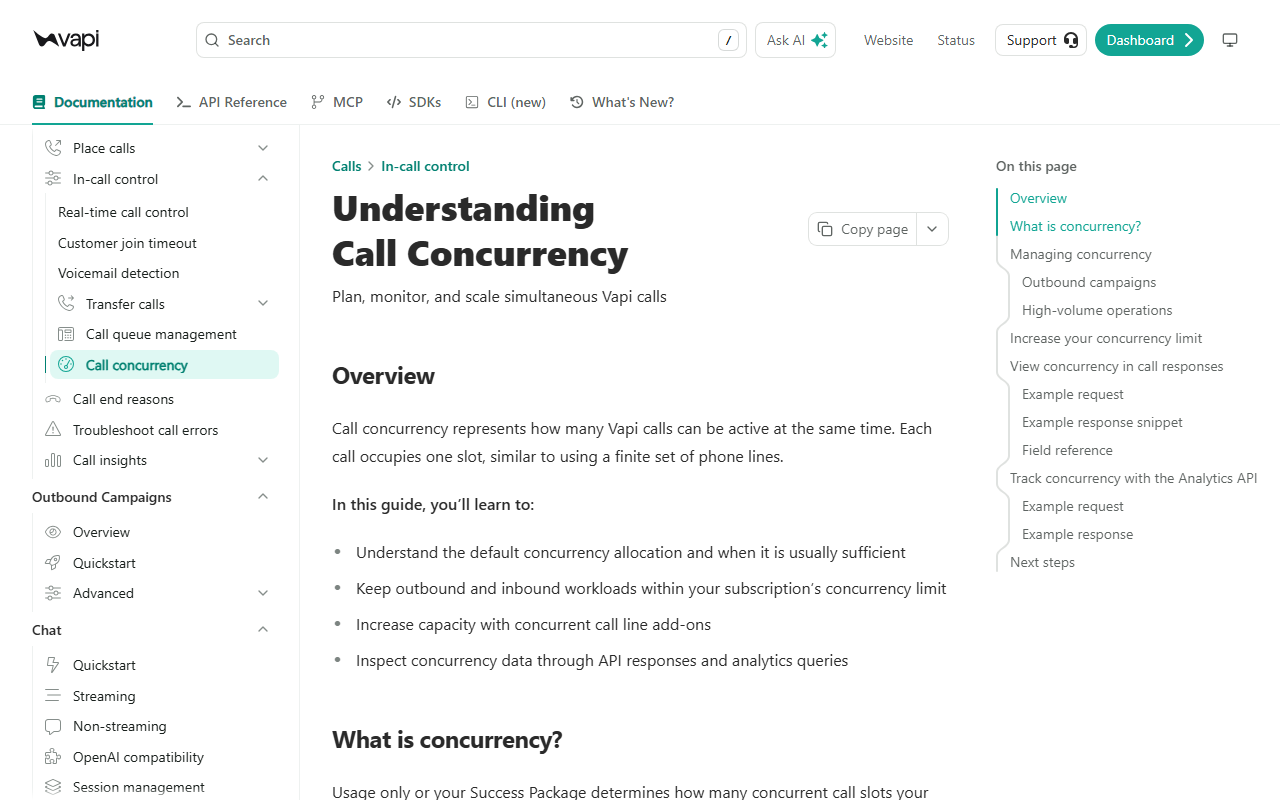
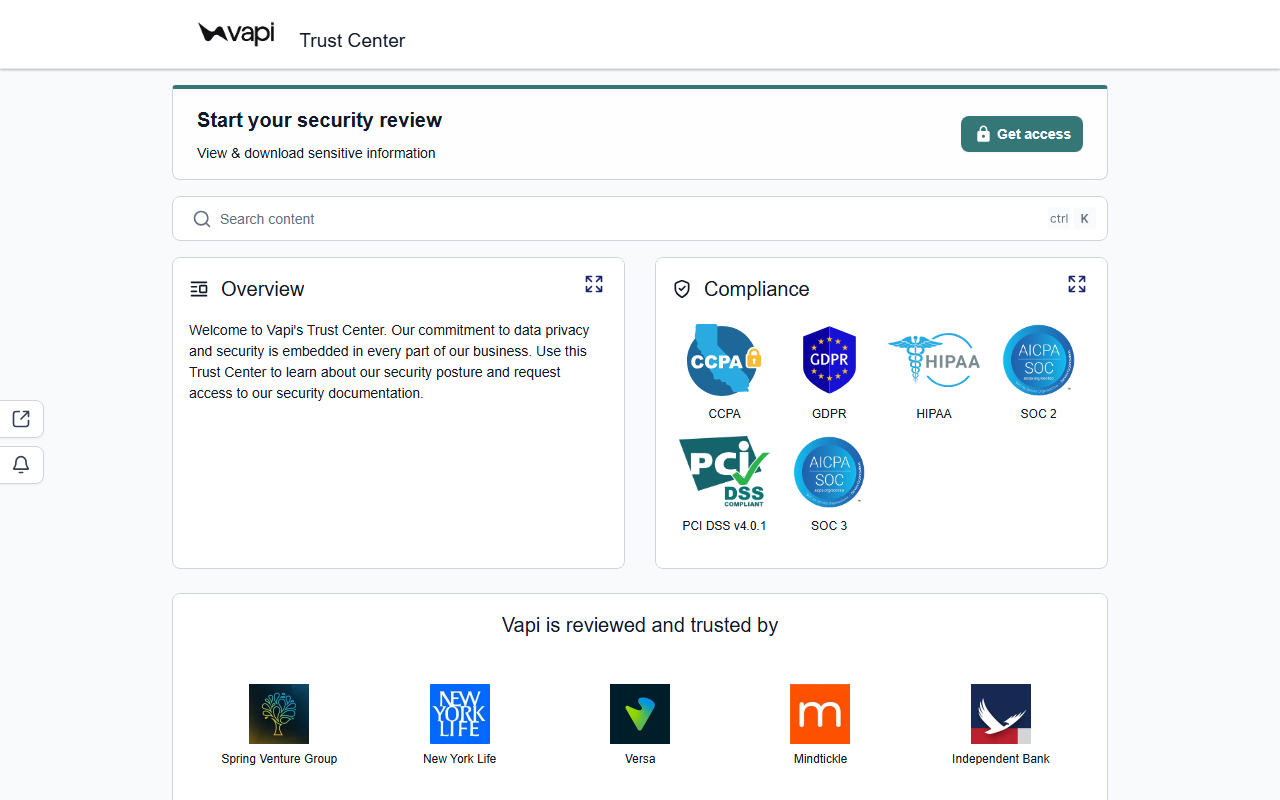
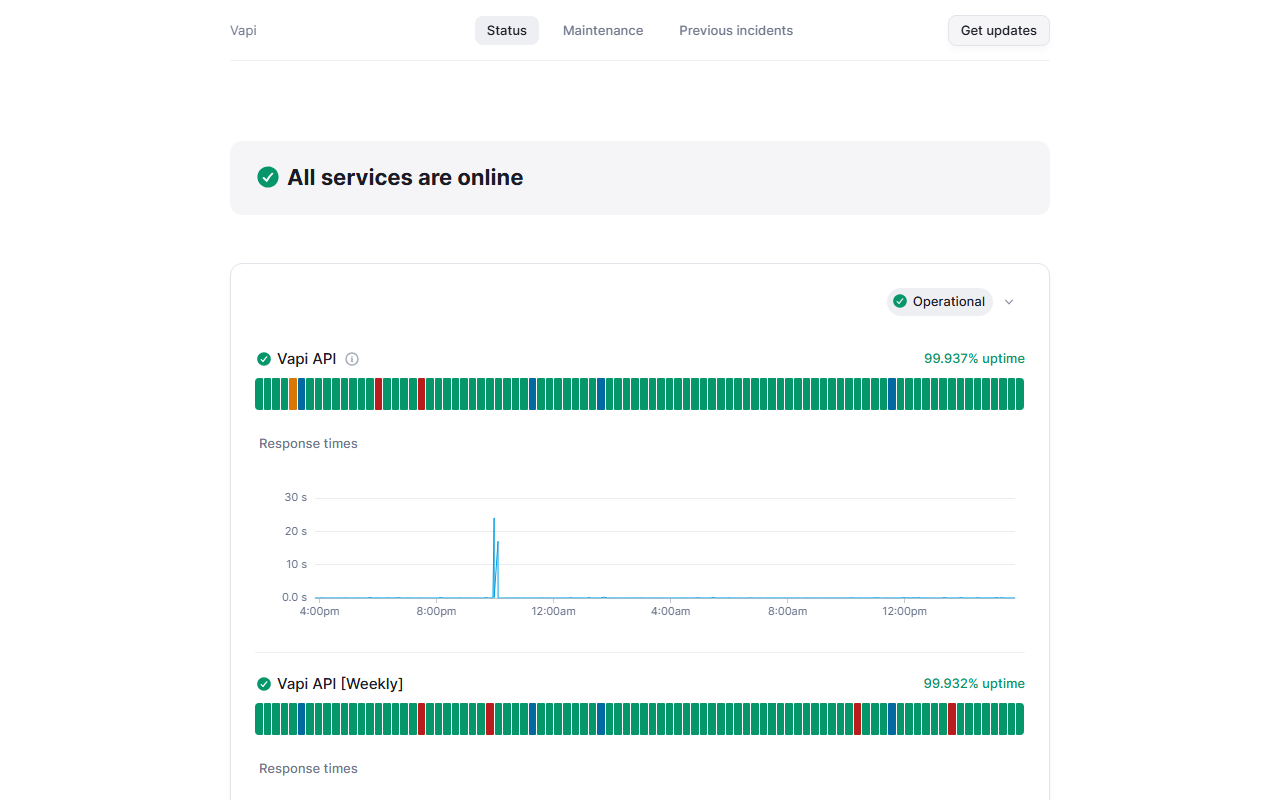
SOC 2 Type II, HIPAA, PCI and GDPR are listed, with a public trust center and a clean status page.
Vapi's docs say it is SOC 2 Type II attested for security, availability and confidentiality, with annual third-party audits, and that customers on any plan can request the report through the trust center. The trust center lists CCPA, GDPR, HIPAA, SOC 2, PCI DSS v4.0.1 and SOC 3, and names subprocessors including Groq, Supabase, Cloudflare and OpenAI with locations. We have not reviewed the SOC 2 report or the penetration test report.
The June 2026 npm incident
The npm registry shows four versions of @vapi-ai/server-sdk (0.11.1, 0.11.2, 1.2.1 and 1.2.2) published between 23:26 and 23:28 UTC on Jun 3, 2026, minutes apart, after the previous releases of Apr 22, 2026 and Nov 19, 2025. Snyk's Jun 4, 2026 write-up lists the package among victims of a self-spreading worm that ran code from a binding.gyp file at install time, and gives about 86,500 weekly downloads. Snyk describes the family as harvesting developer and CI credentials; it does not confirm what the payload did on this package. As of Oct 28, 2026 those four versions are no longer listed on npm, versions 2.0.1 (Sep 10, 2026) and 3.0.0 (Oct 9, 2026) are, and GitHub issue #41 on VapiAI/server-sdk-typescript is open with no comments. Vapi's blog index and changelog list no statement about it. If you installed the SDK on Jun 3 or 4, 2026, treat the machine and its CI secrets as exposed and rotate them; pin exact versions in lockfiles.
Latency is the number to test yourself. The home page says “<500ms average latency” and “sub-500ms”, while the docs FAQ says latency is “typically around 800 milliseconds for end-to-end voice processing”. A commenter who attended VapiCon wrote that real calls with modern voice agents run “500ms to 1s” (Hacker News 46382256). Under US recording and AI-calling rules, consent and disclosure remain your job; see the recording consent plan in the docs.
Engineering teams that want to compose their own stack.
Developers and agencies building custom voice agents; teams that want to swap models and voices weekly; enterprises that need an SLA package and can fund Pro or Premier; builders who will use the API and MCP tools.
Buyers who want a single predictable price; small clinics needing HIPAA at low volume; teams needing on-premise deployment (not offered); anyone needing SSO or an EU region without a Premier contract.
Eight things to check before you rely on it.
$0.05 hosting plus variable providers; the calculator itself returns $82 to $129 for one month.
$2,000 a month per organization, and exclusive with ZDR.
Core organizations 2 versus 5; latency under 500ms versus around 800ms.
SSO, EU region and custom RBAC need a sales contract.
No Trustpilot or G2 figures; a few comments, some from rivals.
The FAQ says Vapi does not support on-premise deployments.
Four malicious npm versions of the server SDK in June 2026; no notice on its blog or changelog; CI hardening merged Oct 28.
JAVIS did not run a call or measure quality.
Priced from each vendor's own page on Oct 28, 2026; the plans are not like-for-like.
| Option and when to pick it | What its own pricing page says | JAVIS review |
|---|---|---|
| Vapi Developers composing their own stack | Hosting $0.05/min + providers at list price; Core $29; Pro $999 min; HIPAA +$2,000; 4 free concurrent calls | This article |
| Retell AI Voice agents with credits and a no-fee BAA | Pay as you go $0.07 to $0.31/min, $10 free credits, 20 concurrent calls free, then $8 per line a month; Enterprise custom | No live review yet |
| Bland One per-minute rate for model, transcription and voice | Start $0.14/min, $0 platform fee, 10 concurrent, 100 calls a day; Build $0.12/min + $299/mo, 50 concurrent | No live review yet |
| ElevenLabs Voice provider with its own agents product | Listed as a Vapi voice option; see its review for plans | ElevenLabs review |
| Pipecat, LiveKit Open-source frameworks you host | Named in Hacker News threads as open alternatives; no price compared here | No live review yet |
Retell and Vapi charge a platform line of about the same size ($0.055 voice infrastructure against $0.05 hosting), but Retell adds voice and model per-minute lines in its calculator while Vapi passes provider costs through. Retell also lists 20 free concurrent calls against Vapi's 4.
Five steps that keep the bill and the risk predictable.
This review has no affiliate links, and Vapi did not see it.
JAVIS has no approved Vapi affiliate link, so every link goes straight to vapi.ai, its documentation, its pricing page or its trust center, without tracking parameters.
Hands-on status: JAVIS has not created a Vapi account, built an assistant or placed a call. Cost examples use invented workloads with the arithmetic shown, and independent review evidence is limited, as section 04 says.
Open the calculator and set your own minutes.
Open Vapi pricingThe trust center lists reports and subprocessors.
Open the trust centerBuilding a voice agent? These reviews cover the nearest ground.
Each card opens a published JAVIS review.


Questions people ask before committing
Is Vapi free?
You can start for $0 and get $5 in free credits, but every minute is billed: $0.05 a minute hosting plus provider costs. There is no free-minutes plan.
How much does Vapi cost per minute?
Hosting is $0.05. With Deepgram, OpenAI and ElevenLabs the page's calculator implies about $0.082 to $0.129 a minute before telephony: $82 to $129 for 1,000 minutes.
Does Vapi mark up models?
The pricing page says models are passed through at provider cost with no markup, and the FAQ says each component is billed at the provider's listed price with the $0.05 hosting fee added on top.
Is Vapi HIPAA compliant?
Vapi offers HIPAA-eligible handling with a signed BAA as a $2,000 a month add-on per organization. HIPAA mode and Zero Data Retention cannot be on together.
What is the difference between Pro and Core?
Core is $29 a month for 10 concurrent calls, 30 days of data and a two business day email response. Pro is 10% of hosting fees with a $999 minimum, for 30 calls, 180 days, Slack, a one business day response and a 99% uptime SLA.
Can I self-host Vapi?
No. The FAQ says Vapi does not support on-premise deployments. Open-source frameworks exist if you need that.
Is Vapi better than Retell AI?
They suit different buyers. Vapi gives more component choice and costs extra for HIPAA; Retell lists 20 free concurrent calls and a no-fee BAA. Compare on your own prompts and volumes.
Who owns Vapi?
Vapi, Inc. is independent and venture backed; TechCrunch reported a $50M Series B on May 12, 2026. No acquisition has been reported.
Where this came from, and when.
Pricing and product: vapi.ai/pricing (plans, add-ons, transport fees, calculator and opened FAQ answers), vapi.ai home and blog, docs.vapi.ai (Pricing and Success Packages, Call Concurrency, FAQ, HIPAA, Zero Data Retention, SOC 2, cost estimates, changelog), status.vapi.ai and security.vapi.ai, all Oct 28, 2026.
Legal: Vapi Terms of Service, last updated Sep 14, 2026, sections on fees, termination, liability and disputes. We have not reviewed the privacy policy in detail, the SOC 2 report or any BAA.
Company: TechCrunch, May 12, 2026 (Series B, traction claims); Hacker News items 40078195 and 42404297.
Security incident: npm registry entry for @vapi-ai/server-sdk (version publish times, versions listed, Oct 28, 2026); Snyk, “Node-gyp supply chain compromise”, Jun 4, 2026; GitHub issue VapiAI/server-sdk-typescript #41 (Jun 4, 2026).
Independent evidence: Hacker News comments 46385230, 43105172, 40095266, 46384843, 46189900, 40001548 and 46382256. No Trustpilot or G2 rating is quoted.
Competitors: retellai.com/pricing, docs.retellai.com (billing, compliance), bland.ai/pricing, Oct 28, 2026. Cost examples are arithmetic on those prices with invented traffic.
Images: screenshots of public pages taken Oct 28, 2026 and Vapi's logo card. No video is embedded.
JAVIS Fit Score (66/100): editorial composite, 20 points on each of five criteria. Price clarity 13: simple per-minute fee, but variable provider costs and conflicting pages. Capability breadth 18: orchestration, squads, tools, testing, campaigns. Independent evidence 10: few comments, no ratings. Security and data control 11: SOC 2 Type II and trust center, but HIPAA, SSO and EU gated and an SDK security incident with no notice on its blog or changelog. Cost control and fit 14: usable range, plus add-on surprises. It is judgment, not a measurement.
What this review does not cover: call quality, latency, reliability in production, support response, the SOC 2 report, any BAA text, and self-service sign-up behavior.