Pi Coding Agent Review 2026: A Free, Bare-Bones Harness That Trusts You to Bring Your Own Guardrails
Pi is an open-source terminal coding agent from Earendil Inc. that deliberately leaves out sub-agents, plan mode and permission prompts, and lets you build or install what you want. As of Nov 18, 2026 it is MIT licensed, free to download, and its repository shows 122.7k stars. The catch is stated in its own README: Pi has no built-in permission system. This review compares it with Claude Code and Cline and says who should run it, and inside what.
There are no affiliate links in this review. Every Pi link goes straight to pi.dev, its documentation or its GitHub repository.
| Made by | Earendil Inc. & Contributors |
| What it is | Minimal terminal coding agent and extensible harness |
| Pricing | $0 software (MIT); you pay your model provider |
| Catch | No permission system, no sandbox, few built-ins |
| Evidence | Docs, repository, Hacker News thread (833 points) |
Pi is the right pick for developers who want to own their coding agent and already run agents inside a container or VM; it is the wrong pick if you expect the tool to stop a bad command for you.
“Pi does not include a built-in permission system for restricting filesystem, process, network, or credential access.” That sentence from the project's own README is the whole trade: you get a small, hackable agent, and you take on the job of containing it.
Pi is a terminal coding agent. You open a project folder, type pi, describe a task, and it reads files, runs commands and edits code using the model you connect. Its home page calls it “a minimal agent harness” and lists what it leaves out on purpose: sub-agents, plan mode, permission popups, built-in to-dos and background bash. Each has a stated alternative, such as tmux, a TODO.md file, a container, or an extension you write in TypeScript. As of Nov 18, 2026 it is MIT licensed, installs with one command, and talks to more than 15 providers including Anthropic, OpenAI, Google, Bedrock, Mistral, Groq, OpenRouter and Ollama.
Three things deserve a decision before you adopt it. First, safety is your job: Pi's security page says its tools and extensions run with the permissions of your account, that it does not ask before each tool call, and that watching the transcript, using project trust and reviewing changes “do not create a security boundary”. Second, the minimalism is the product: if you want plan mode, sub-agents or approval prompts out of the box, Claude Code and Cline ship them. Third, much of the praise is one developer's opinion: the Hacker News post that sent attention to Pi (833 points) is a single developer's account of leaving Claude Code, and it is reported here as his view, not as a measured result.
Not a hands-on test: JAVIS has not installed or run Pi. This review is built from pi.dev, Pi's documentation, its GitHub repository, the Claude Code and Cline official pages and a Hacker News thread, all as of Nov 18, 2026 unless a date is given. JAVIS has no speed, cost or quality measurements of its own.
A small agent loop in your terminal, with everything else added by you through extensions, skills and packages.
Pi's documentation groups it into five parts: start using it, customize it, automate or embed it, reference and setup, and working safely. In use it is a terminal interface: start it in a folder, type a task, and use @ to pick a file. Sessions are stored as trees, so you can branch a conversation (/tree), export it to HTML (/export) or share it as a GitHub gist (/share). Instructions come from AGENTS.md and SYSTEM.md files, and long sessions are compacted automatically. Besides the interactive mode there are print and JSON modes, an RPC mode over stdin and stdout, and a TypeScript SDK for embedding Pi in your own app.
A fast-moving open-source project with a company behind it and a very large following for a terminal tool.
pi.dev names the maintainer as Earendil Inc. & Contributors. The code lives at github.com/earendil-works/pi, where on Nov 18, 2026 it showed about 122.7k stars, 15.8k forks, about 8,060 commits, 220 open issues, 40 open pull requests and 278 releases, under the MIT license. The repository describes itself as an “AI agent toolkit: unified LLM API, agent loop, TUI, coding agent CLI”, and it is a monorepo: besides the coding agent (@earendil-works/pi-coding-agent) it holds a multi-provider model API, an agent runtime, a terminal UI library, a durable conversation runtime and telemetry contracts. Star counts measure interest, not quality, and say nothing about how safe or good the tool is.
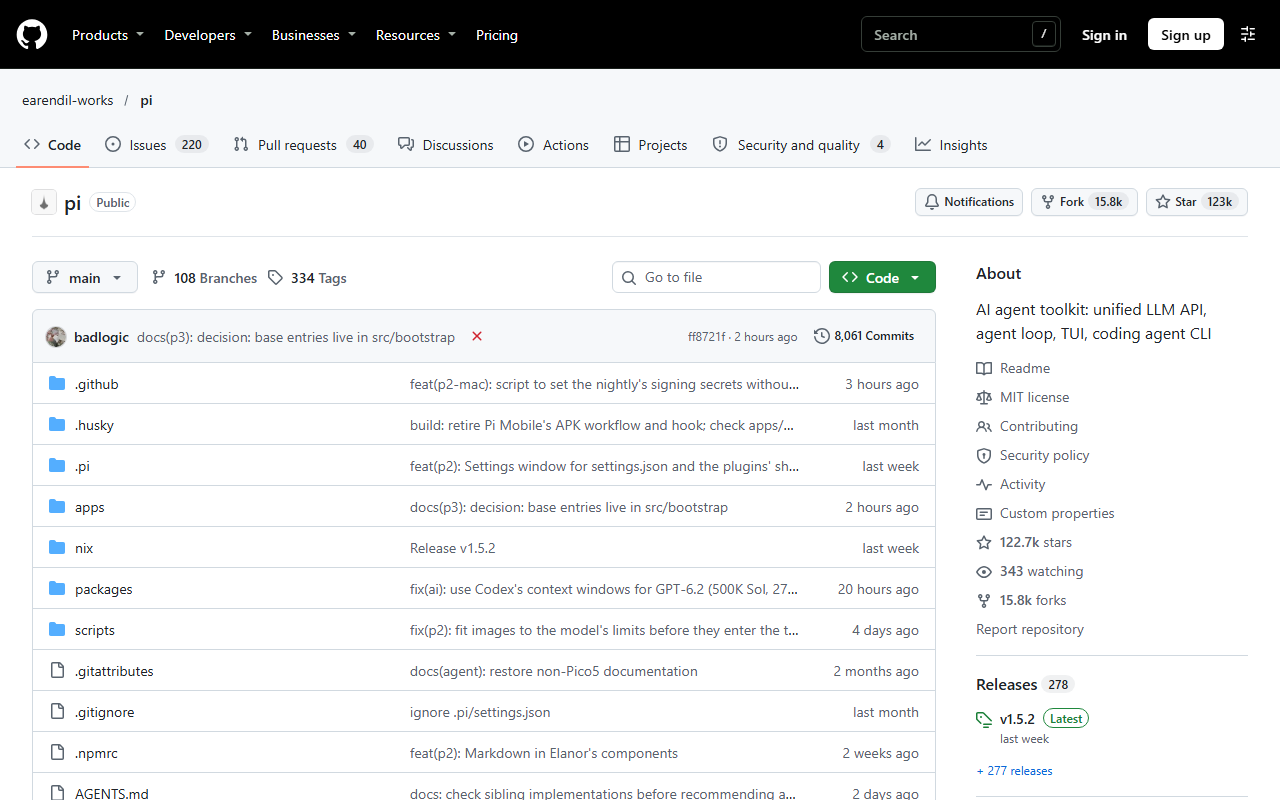
Pi 1.0.0 is dated Oct 1, 2026 on its changelog, and the releases listed here since then fall one to fourteen days apart. There is no published company funding, customer list or pricing to report, and no revenue figures are published.
Developers who like Pi talk about control and stability; the loudest worry is safety. The evidence is conversation, not a rating.
The evidence here is one blog post, its Hacker News discussion, an earlier Hacker News thread and public GitHub issues. As of Nov 18, 2026, Pi has no user-review profile on Trustpilot, G2 or AlternativeTo that could be cited, and the review articles that exist are blogs and directories. The post, “Goodbye Claude, hello Pi” on caleb.software, is dated Sep 21, 2026 and was submitted to Hacker News on Nov 8, 2026, where it reached 833 points and more than 490 comments. Everything below is individual opinion that cannot be verified, and the blog author's numbers are presented as his claims.
The author's case, in his words
The author says he has “finally decided to retire” Claude Code as his main coding harness. His reasons, as he states them: only one editor session can receive IDE text selections at a time; he counts “244 releases to Claude Code this year”, over three-quarters of which, he says, changed the system prompt or tool descriptions; and he puts the default Bash tool description at almost 3,000 tokens. He says he wrote an extension that makes IDE selection work across several open tabs in about 20 minutes, and closes: “I'm enjoying the stability, minimalist approach, and the extreme level of customizability.” The Claude Code changelog on code.claude.com lists 267 versions dated in 2026 through Nov 17, 2026, and 225 of them are dated on or before Sep 21, 2026, the blog post's date. That does not reproduce his 244 figure, but the changelog may not list every build, so this article does not call his count wrong. The claim that over three-quarters of releases changed the system prompt or tool descriptions is unverified, because the release notes do not label changes that way, and no public Anthropic page states the size of the Bash tool description, so the “almost 3,000 tokens” figure is unverified too. Treat both as his claims.
“Does Pi come with an auto mode that blocks dangerous actions? It didn't last time I checked, and these measures are critical to protect prod (and your personal files, etc) from a confused agent.”
“The thing that freaks me out about Pi is it seems to have zero sandboxing or security guardrails unless you explicitly add them.”
“Wrap your agent of choice in e.g. docker sandbox, nono.sh, Nvidia OpenShell, microsanbox or any other sandboxing tool and run it without any checks.”
A commenter says community packages such as pi-permission-system and the ai-guard authorizer “can do a lot here” and feel “very similar to cc auto mode”.
“For now things that I notably miss in Pi are plan mode and subtasks.” The same commenter says they do not see themselves dropping Claude Code for now.
“I get 150 tokens/sec on my coding agent” on an M1 MacBook, using Pi as the harness with a local inference engine, the commenter says.
More evidence: an earlier thread and the public issue tracker
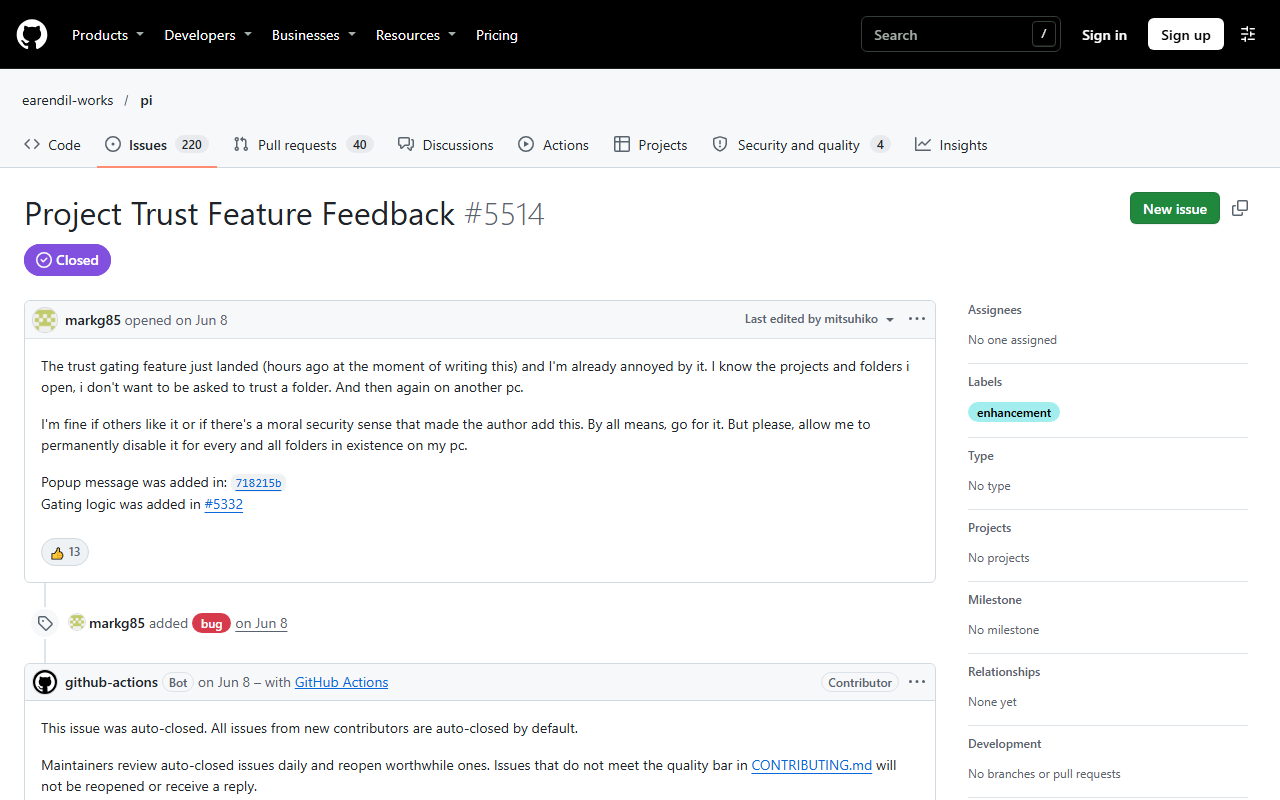
An earlier Hacker News thread, “Opinionated and easy Pi.dev configuration” (151 points, Jul 9, 2026), is about a community setup for Pi and shows both sides of the minimalism argument. On the project's GitHub tracker, users have filed bugs and feedback that give a different picture from a blog post: a request to disable the folder trust prompt, a high CPU report on macOS in long sessions, terminal UI freezes and a login hang under WSL. Titles and states below are as shown on Nov 18, 2026; the reporters' own descriptions are theirs and are not verified here.
“I want to use Pi, but I don't trust the npm ecosystem at all.”
“For me, the benefit of pi is what it doesn't do.”
“I know the projects and folders i open, i don't want to be asked to trust a folder.” Closed; labelled enhancement.
- #7730 “High CPU usage on Mac OS with long session”, filed Aug 6, 2026, open and labelled bug.
- #10031 “Pi sporadically stuck in ‘Working...’ when thinking is stopped with <esc>”, filed Sep 25, 2026, closed, labelled bug.
- #6187 “Pi login hangs in WSL after browser-based GitHub Copilot device authorization”, filed Jun 30, 2026, closed.
- #7547 “How do you use Pi on windows? What issues are you seeing?”, filed Aug 3, 2026, open, 97 comments: Windows setup is an active topic.
Pi itself costs nothing; the model bill depends on which provider you connect, and the alternatives price differently.
As of Nov 18, 2026 pi.dev states no price for Pi, and the repository is MIT licensed. The README and docs describe connecting a subscription, an API key or a local model, so the cost you actually pay is whatever that provider charges. The cards below show what the nearest alternatives list on their own pages; they are not like-for-like, because Pi sells no plan at all.
- MIT license, free to install
- Bring a subscription, API key or local model
- No price page; no paid tier listed
- You pay the model provider
- $17 a month billed annually ($200 up front)
- Claude Code included
- Terminal, IDE, desktop and web
- Claude Code included
- Team seats $25 (Standard) or $125 (Premium) a month when billed monthly
- Enterprise $20 per seat plus usage at API rates
- Open-source extension and CLI, free for individuals
- You pay only for model inference, or bring your own key
- Enterprise: custom, contact sales
Claude prices from claude.com/pricing and Cline from cline.bot/pricing, Nov 18, 2026. Cline's page gives no dollar figures for usage. Claude Code can also use an Anthropic Console account or third-party providers instead of a subscription, per its docs.
The software is free; the spend is tokens, and Pi's design choices change how many it uses.
No monthly figure is given for Pi, because it depends entirely on the provider, the model and how much you run. What the sources do tell you:
Pi's quickstart says you can connect a subscription through /login. Whether a provider lets you do that in a third-party tool differs; see the provider rules just below.
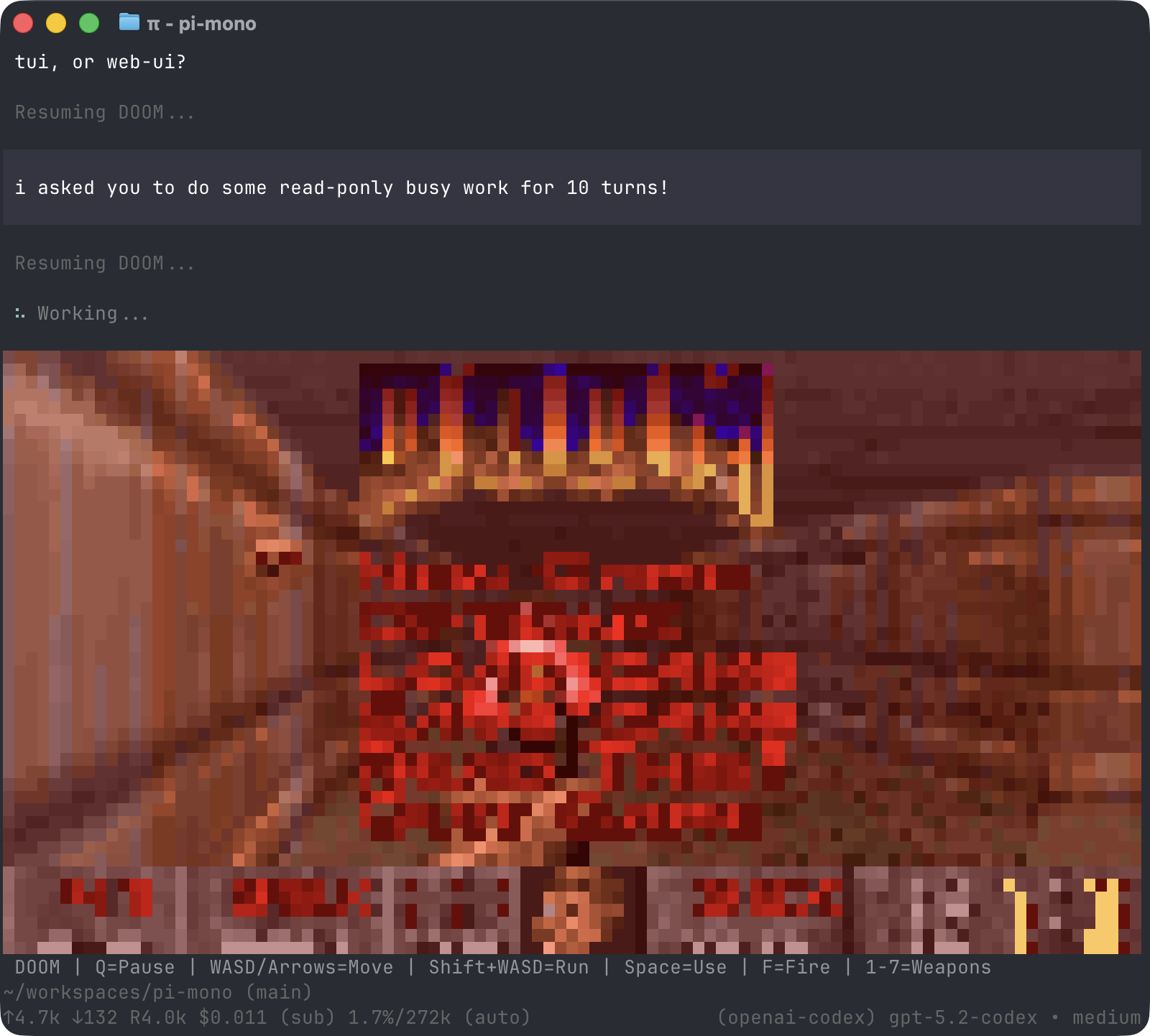
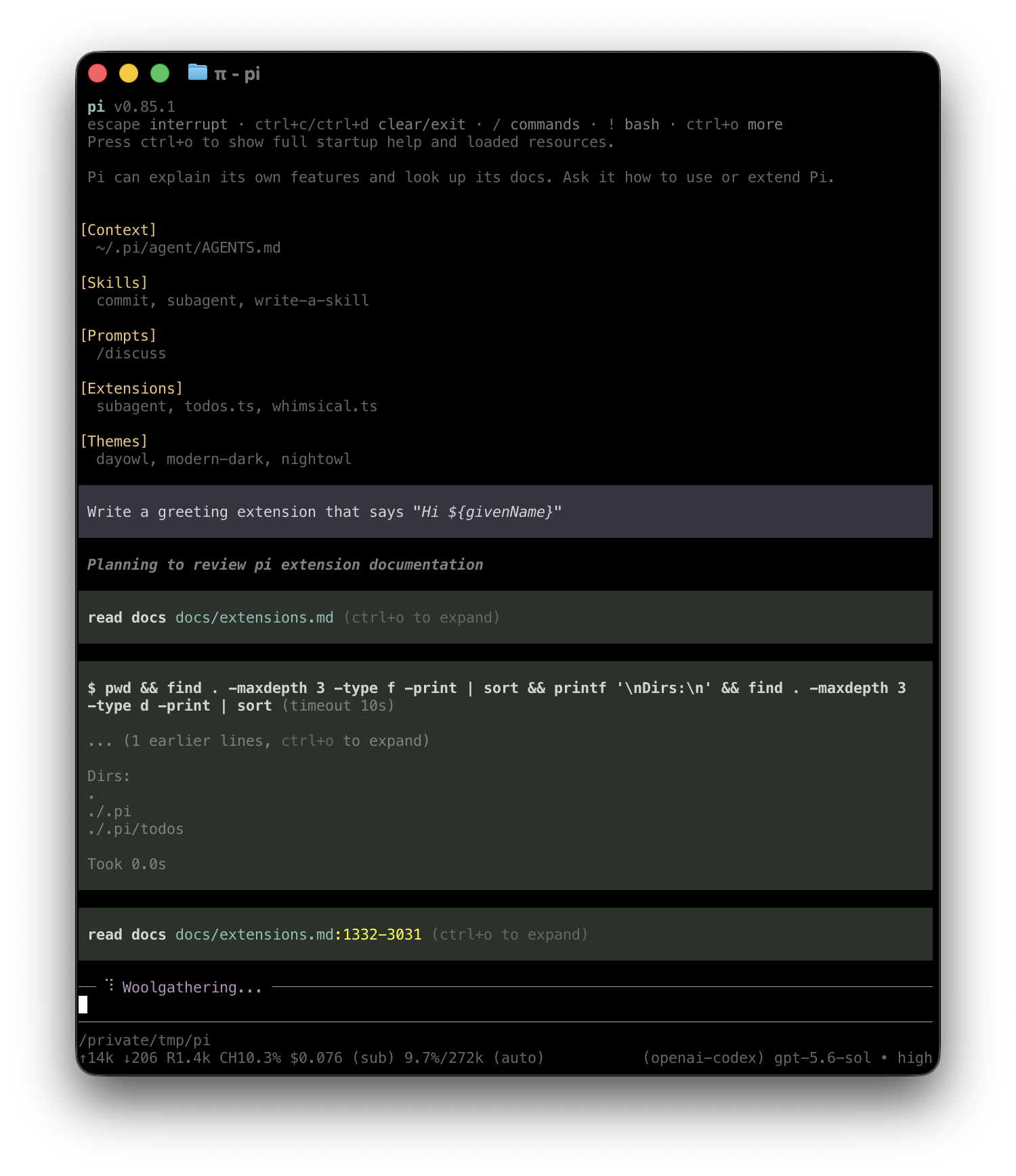
Pay-per-token at the provider's rates. Pi shows its own token and cost counter in the terminal footer, as in the screenshot above.
No token bill, but your own hardware. One Hacker News commenter reports about 150 tokens a second on an M1 Mac with a local engine (comment 50410531); that is one anecdote.
Subscription logins: what each provider's own pages say
Anthropic. The Claude Code legal page says OAuth sign-in “is intended exclusively for purchasers of Claude Free, Pro, Max, Ultra, Team, and Enterprise subscription plans and is designed to support ordinary use of Claude Code and other native Anthropic applications”. It tells developers building products to use API key authentication, and says Anthropic “does not permit third-party developers to offer Claude.ai login into their own applications, or to route requests through Free, Pro, Max, or Ultra plan credentials on behalf of their users”. It does not name Pi, and it is written for product developers, so this review does not rule on an individual using a personal plan in Pi. Pi's own isolation guide does document a Claude Pro or Max token setup, so read Anthropic's terms yourself before relying on it; an API key avoids the question.
OpenAI. OpenAI's developer docs describe “ChatGPT plan usage” as an optional capability of Sign in with ChatGPT, explained for “open-source and locally hosted apps”, with the user authorizing it during sign-in and no access to their ChatGPT conversations. The page names no tools, so OpenAI's own page does not say whether Pi takes part; some press reports say it does, and that is unconfirmed.
Google. The Gemini CLI terms page cites “using OpenClaw with Gemini CLI OAuth” as an example of accessing the services behind Gemini CLI through third-party software, calls it a violation of applicable terms and policies, and says such actions “may be grounds for suspension or termination of your account”. Pi's providers page lists API keys for Gemini.
Anthropic: code.claude.com/docs/en/legal-and-compliance; OpenAI: developers.openai.com/siwc/token-sharing-open-source; Google: geminicli.com/docs/resources/tos-privacy; Pi: docs.pi.dev/latest/providers and /containerization, all Nov 18, 2026. Terms change; check the current page before you sign in.
The blog author argues that a smaller system prompt and tool description saves tokens on every request. That is plausible, since the prompt is resent each turn, but there is no measurement, and he gives none of Pi's own beyond his estimates. Treat prompt size as a reason to look, not as proven savings.
Five questions decide whether Pi fits.
A terminal agent with model switching, tree sessions, extensions and several run modes.
More than 15 providers by API key or login, including Anthropic, OpenAI, Google, Azure, Bedrock, Mistral, Groq, Cerebras, xAI, Hugging Face, OpenRouter and Ollama. Switch mid-session with /model or Ctrl+L; add custom providers in models.json or an extension.
Sessions are trees you can branch and resume (/resume, pi --continue), export to HTML or share as a gist. AGENTS.md and SYSTEM.md shape behaviour; auto-compaction handles long runs. Enter sends a steering message and Alt+Enter a follow-up.
Extensions are TypeScript modules with access to tools, commands, shortcuts, events and the terminal UI. Skills, prompt templates and themes can be bundled as Pi packages shared through npm or git.
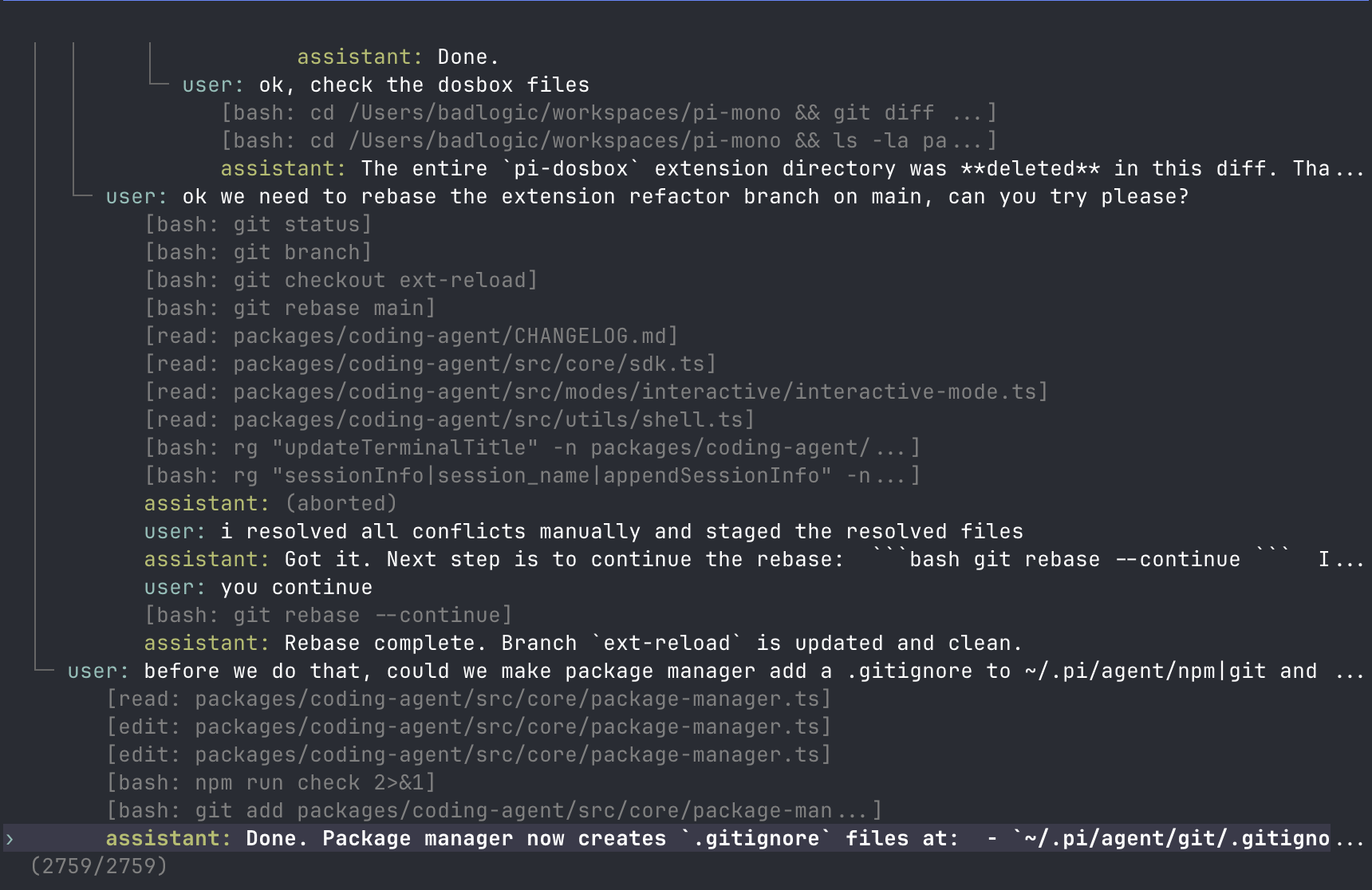
Pi also has MCP support built in, with a Codemode feature for composing tool calls in a JavaScript sandbox, and the docs list print, JSON, RPC and SDK modes for scripting. What is deliberately missing, per pi.dev: sub-agents (“Spawn Pi instances via tmux, or build your own with extensions”), permission popups (“Run in a container, or build your own confirmation flow”), plan mode, built-in to-dos and background bash. Pi's docs also say project context files such as AGENTS.md and CLAUDE.md are loaded, which eases moving a repository between agents.
Install, log in to a provider, run it in a folder you can afford to lose.
curl -fsSL https://pi.dev/install.sh | sh; on Windows, a PowerShell installer; or npm install -g --ignore-scripts @earendil-works/pi-coding-agent with Node.js 22.19 or newer. Piping a script to a shell runs it with your permissions, so read it first or prefer the npm route. Check with pi --version.pi, then /login to pick a provider and use a subscription or store an API key. /model changes model later. Use a key with a spending limit.pi, describe the task and use @ to point at a file. The docs say Pi shows each read, search, command and edit but does not ask before every tool call.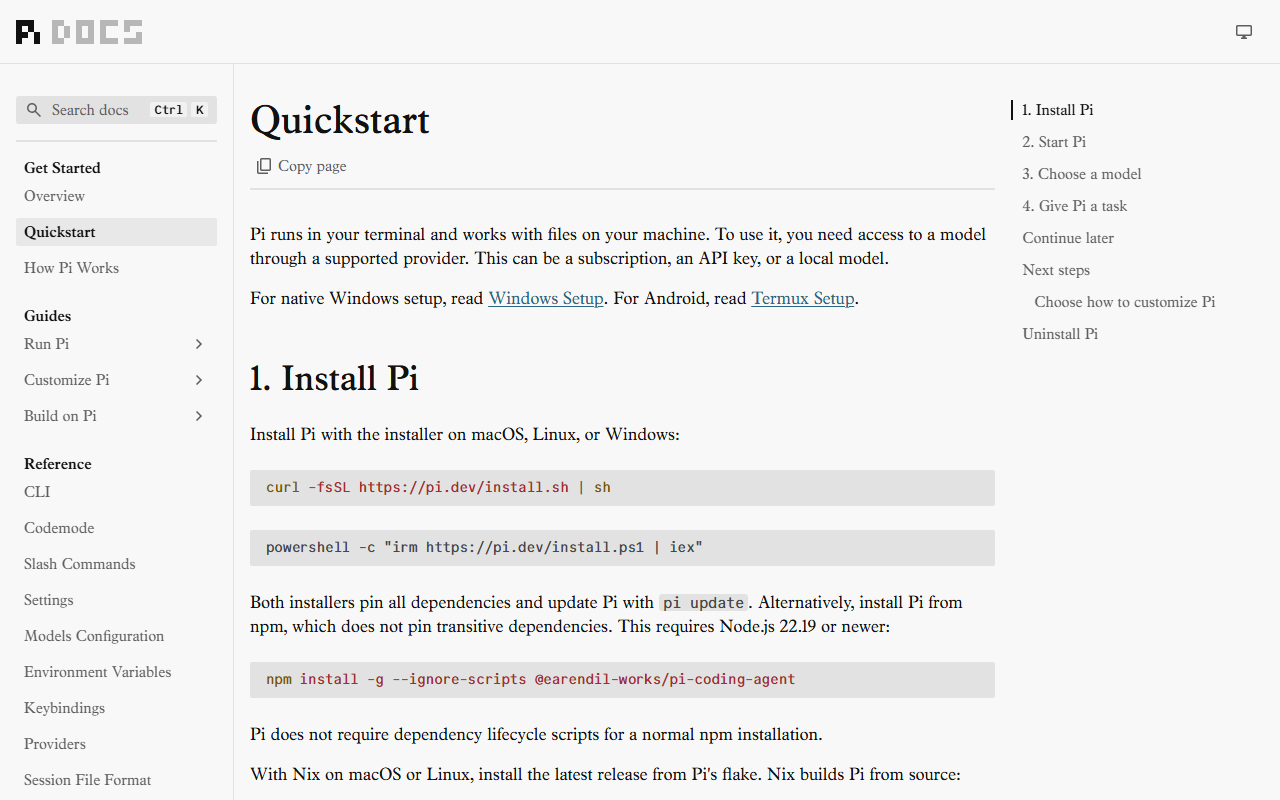
Frequent releases and active commits, with a fast-changing surface you will want to pin.
The repository shows its last push on Nov 18, 2026 and a published release, v1.5.2, on Nov 10, 2026. The changelog lists 1.5.0 on Nov 2, 1.4.0 on Oct 21, 1.3.0 on Oct 15 and 1.0.0 on Oct 1, 2026, so the releases listed fall one to fourteen days apart. That is good for fixes and bad for stability: the blog author's complaint about Claude Code changing its prompts often could in principle apply to any fast-moving harness. Pi's repository documents supply-chain precautions: exact-pinned direct dependencies, a minimum release age setting for new package versions (min-release-age=2), installs and updates with --ignore-scripts, CI runs with npm ci --ignore-scripts, and a scheduled npm audit. It also says the pi.dev installer pins transitive dependencies with a generated lock while the npm package does not.
There is no uptime figure to quote, since Pi is a local program; availability depends on your model provider. A commenter on Hacker News (50410830) also raised “no vetting process for popular 3rd party modules”, a concern that applies to any package ecosystem and that Pi's own docs echo by telling you to review extensions before loading them.
No built-in permission system and no built-in sandbox: Pi runs with your permissions, and the project says so plainly.
This is the most important section of the review. Pi's README says: “Pi does not include a built-in permission system for restricting filesystem, process, network, or credential access,” and that by default “it runs with the permissions of the user and process that launched it.” Pi's security page adds that extensions and child processes inherit the same access, that files, comments, command output and model responses can carry prompt injection, and that watching the transcript, using project trust and reviewing changes do not create a security boundary. In practice: a model that is tricked or simply wrong can read your files, run shell commands and use credentials that your account can reach, and Pi will not stop it.
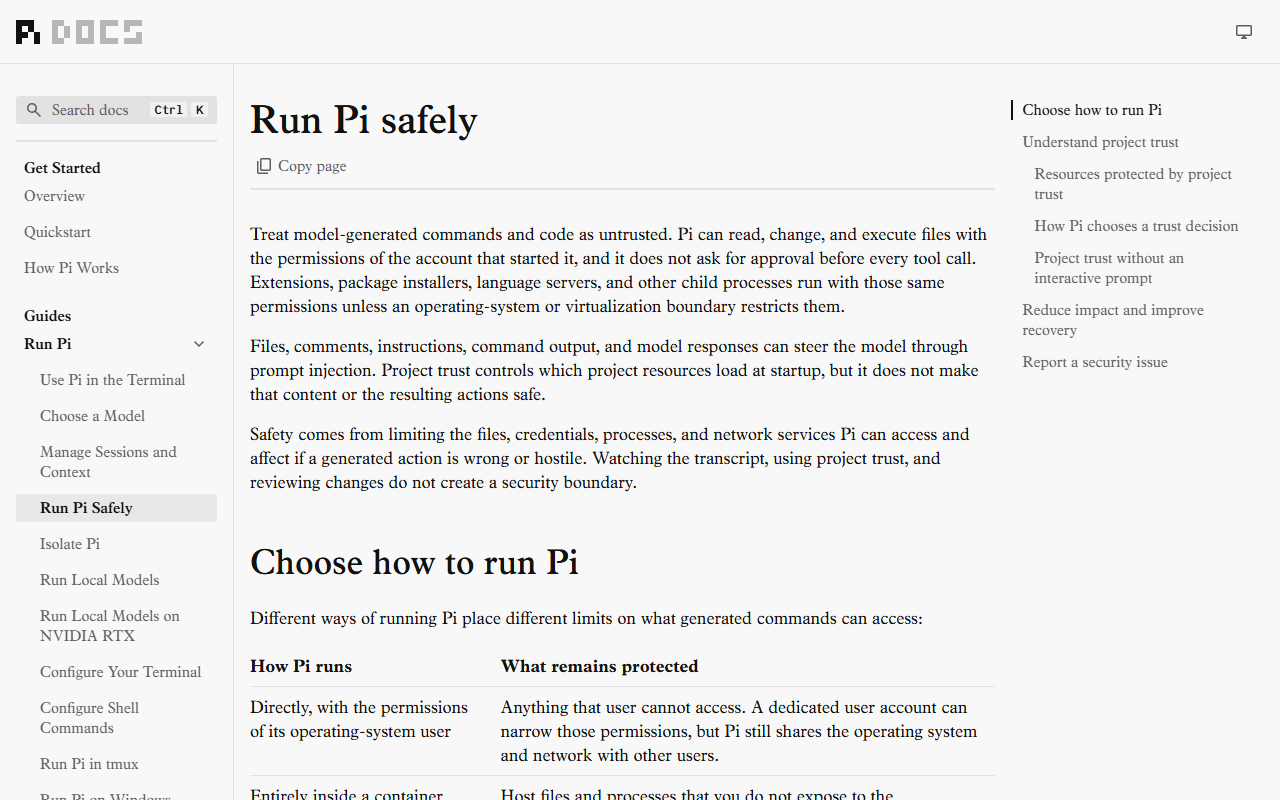
No built-in sandbox. No approval before each tool call. The docs say project trust controls which project settings, extensions, skills and prompts load, and “does not limit what tool calls can access or affect” after startup. Context files such as AGENTS.md and CLAUDE.md load either way and should be treated as untrusted input.
Run Pi fully inside a container, VM or sandbox, which they call “usually the strongest practical option”. The README names three patterns: the Gondolin extension (tools run in a local micro-VM), plain Docker, and OpenShell. Expose only needed files, keep credentials outside, use short-lived scoped credentials, and restrict the network.
Unattended use needs extra care: the docs say print, JSON and RPC modes cannot show the trust prompt, and with defaultProjectTrust set to always they load protected project resources automatically. Sessions can contain prompts, command output, file contents and exposed credentials, so review them before using /export or /share. The project treats the lack of a sandbox and prompt injection from untrusted content as out of scope for security reports.
Data handling depends on your provider: Pi sends your prompts and the file contents it reads to whichever model service you choose. Pi's privacy terms and each provider's retention policy are outside the scope of this review; Pi lists no hosted service of its own. Check each provider before you send private code.
How to run a tool with no permission system: contain it first, then limit what is inside.
Everything here comes from Pi's own isolation and security docs. Pi has no deny list to configure, so the practical way to say “never” is to not expose the file, credential or network route in the first place.
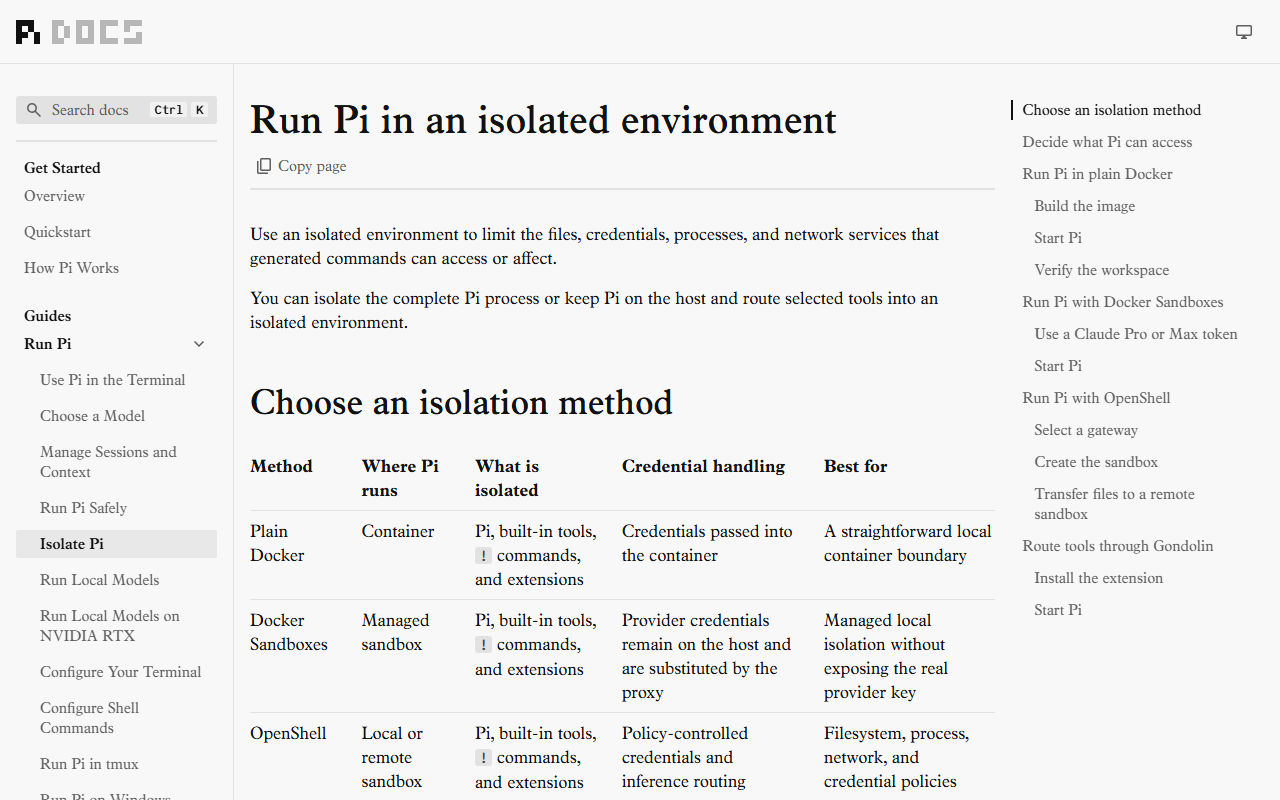
! commands and extensions inside one container. Gondolin isolates only the built-in tools and ! commands; the guide says other extension tools run on the host unless they delegate to the VM, and that tool-only isolation does not constrain the host Pi process./workspace and writes pass through to the host. The guide says read-write mounts let Pi modify those host files and suggests read-only mounts or copying files in and out when you need more protection. It warns against mounting the host's ~/.pi/agent, because that exposes credentials, settings and sessions./login inside the sandbox because that writes a real credential into it. In plain Docker the key is passed as an environment variable, so processes in the container can see it; the Gondolin guide says VM commands inherit host environment variables too. Use a scoped key with a spending limit.AGENTS.md and CLAUDE.md load whether or not you trust a folder, and that you should decline project trust for repositories you do not know. Print, JSON and RPC modes cannot show the trust prompt; use --approve or --no-approve for an explicit one-time decision./export or /share.--ignore-scripts as the docs show.From docs.pi.dev/latest/containerization and /security and the repository README, Nov 18, 2026. These setups were not run for this review.
Developers who want a hackable agent and can contain it.
Experienced developers; people who already run agents in containers or VMs; tinkerers who want to write TypeScript extensions; teams that need to embed an agent through the SDK or RPC; anyone who wants to switch between many model providers from one tool.
Beginners who want guardrails; anyone who runs agents directly on a machine holding production keys; teams that need plan mode, sub-agents and approval flows out of the box; buyers who need vendor support, compliance paperwork or a published SLA.
Seven things to check before you rely on it.
Runs as you; stated by the project.
You must supply container or VM isolation.
No sub-agents, plan mode, to-dos or background bash.
Third-party extensions run in-process with full access.
Releases one to fourteen days apart.
One post and a discussion, no measured comparison.
JAVIS did not install or run Pi.
Pi vs Claude Code vs Cline, from each project's own pages on Nov 18, 2026.
| Dimension | Pi | Claude Code | Cline |
|---|---|---|---|
| Maker | Earendil Inc. & Contributors; MIT | Anthropic | Cline Bot Inc.; Apache 2.0 |
| Where it runs | Terminal; print, JSON, RPC and SDK modes | Terminal, VS Code, JetBrains, desktop app, web | VS Code, JetBrains, CLI, desktop app, SDK, cloud agents |
| Cost | $0; you pay the model provider | Included with Claude Pro ($20/mo) and Max ($100/mo); Team and Enterprise seats | $0 open source; pay for inference or bring your own key |
| Default safety | No permission system; runs with your permissions | Auto mode (classifier) by default on v2.1.283+; Manual mode asks before most edits, commands and network actions; deny rules in every mode | Approval for every action by default; auto-approve toggles; YOLO mode |
| Sandbox | None built in; Docker, OpenShell or Gondolin recommended | OS sandbox for shell commands (macOS, Linux, WSL2), off by default; none on native Windows | Cloud agents run in a cloud sandbox; the docs describe no local sandbox |
| Plan, sub-agents | Both left out by design | Plan mode, sub-agents and background agents documented | Plan and Act modes; subagents in the CLI and desktop app only |
| Extending | TypeScript extensions, skills, packages | CLAUDE.md, skills, hooks, MCP, Agent SDK | Rules, plugins, hooks, MCP, SDK |
| Models | 15+ providers | Claude subscription or Console; third-party providers supported | Anthropic, OpenAI, Google, OpenRouter, Bedrock, local models and more |
Read our full reviews of Cline and Claude, plus the Claude Code setup guide, for details not repeated here. Other terminal agents reviewed on JAVIS are Aider and Gemini CLI.
Five steps that keep a free tool from becoming an expensive mistake.
AGENTS.md; keep project rules there so you can move between agents without rewriting them.This review has no affiliate links, and Pi's maintainers did not see it.
JAVIS has no approved affiliate link for Pi, so every link goes straight to pi.dev, its documentation or its GitHub repository, without tracking parameters.
Hands-on status: JAVIS has not installed or run Pi. Statements about behaviour come from the project's own pages and from named community comments, and independent review evidence is thin, as section 04 says.
Quickstart, settings and the security page.
Open Pi docsREADME, releases and issues.
Open GitHub repoChoosing a coding agent? These reviews cover the nearest ground.
Each card opens a published JAVIS review.

Questions people ask before trying Pi
Is Pi free?
The software is, under the MIT license; pi.dev lists no price. You still pay your model provider unless you run a local model.
Does Pi have a permission system or sandbox?
No. Its README says it has no built-in permission system and runs with the permissions of the user who launched it. The project recommends running it in a container, VM or sandbox.
Can I use my Claude, ChatGPT or Google subscription in Pi?
It depends on the provider, and the rules change. Anthropic's legal page says subscription OAuth is for Claude Code and other native Anthropic apps and bars third parties from routing requests through plan credentials; OpenAI's docs describe an opt-in way for open-source apps to use ChatGPT plan usage; Google's Gemini CLI terms call using its OAuth with third-party software a violation. See the cost section for the exact wording, and use an API key if in doubt.
Is Pi better than Claude Code?
It depends on what you value. Pi is smaller, free and customizable but ships no approval prompts, plan mode or sub-agents; Claude Code is a fuller product with approvals and more built-in features, and is included with paid Claude plans. Neither was run head to head for this review.
How is Pi different from Cline?
Cline lives mainly in the IDE (VS Code, JetBrains) and also has a CLI; it asks approval for each action by default; Pi is terminal-first and runs without prompts. Both are open source and let you bring your own model.
Which models does Pi support?
More than 15 providers, including Anthropic, OpenAI, Google, Azure, Bedrock, Mistral, Groq, Cerebras, xAI, Hugging Face, OpenRouter and Ollama, by API key or login.
What do I need to install it?
A model (subscription, API key or local) and, for the npm route, Node.js 22.19 or newer. There are also macOS and Linux and Windows installers.
Does Pi support MCP?
Yes, pi.dev lists built-in MCP support and MCP extensions.
Did a famous post prove Pi is better?
No. The 833-point Hacker News post is one developer's account of why he switched. It is useful as a view of what some users want, not as a measurement.
Where this came from, and when.
Product: pi.dev home page, changelog and press kit; docs.pi.dev (index, quickstart, security); github.com/earendil-works/pi (README, release list, repository counts), all Nov 18, 2026.
Comparisons: code.claude.com/docs overview, permissions, permission-modes, sandboxing, legal-and-compliance and changelog pages and claude.com/pricing; github.com/cline/cline, cline.bot/pricing and docs.cline.bot pages on auto-approve, checkpoints, subagents and customization; developers.openai.com/siwc/token-sharing-open-source; geminicli.com/docs/resources/tos-privacy, all Nov 18, 2026.
Community: the blog post at caleb.software/posts/claude-to-pi.html (dated Sep 21, 2026) and its Hacker News item 50410107 (Nov 8, 2026), including comments 50410830, 50412289, 50411345, 50410858, 50411243, 50410531 and 50410576; the earlier thread, item 48847407 (Jul 9, 2026), comments 48852249 and 48850590; and GitHub issues 5514, 7730, 10031, 6187 and 7547 in earendil-works/pi. These are individual opinions and reports that cannot be verified.
Images: Pi's social card, tree-view, extension and interactive-mode images from pi.dev and docs.pi.dev, JAVIS screenshots of public vendor pages dated Nov 18, 2026, and JAVIS review thumbnails.
JAVIS Fit Score (71/100): editorial composite, up to 20 points each. Price clarity 16: free MIT software with no plan, but the real cost sits with providers. Capability breadth 15: strong extension model and modes, with many standard features left to you. Independent evidence 13: large community discussion but no measured tests or review profiles. Security and data control 10: no permission system or sandbox, offset by honest documentation and supply-chain practices. Cost control and fit 17: free, any provider, local models possible. It is judgment, not a measurement.
What this review does not cover: our own speed, cost or quality tests, Pi's Windows and Android setup guides, third-party packages, any provider's privacy terms, the size of Claude Code's Bash tool description, and whether Pi's ChatGPT sign-in is an official OpenAI partnership.