
Mastra Factory Review 2026: An Open-Source Board That Turns Issues Into Pull Requests
Mastra Factory connects your repository and issue tracker to coding agents that plan, build and open pull requests, with people approving the plan and the merge. Here is how it works, what it costs, and where it is still young.

There are no affiliate links in this review.
| Made by | Mastra |
| Price | Free software; platform from $0 to $250 a month |
| Runs on | Node 22.19+, cloud sandboxes |
| Catch | Pre-1.0; self-reported results |
| Evidence | Docs, npm, GitHub, Hacker News |
Mastra Factory is a free, open-source board where coding agents turn issues into pull requests while people approve the plan and the merge. It is also four months old, pre-1.0, and not tested by us.
The team's own pitch: a configurable agentic kanban board that is @-taggable in Slack.
What it is. You create a Factory project with npm create factory@latest, connect a GitHub repository, a model provider and an issue source, and issues appear on a Work board (Intake, Planning, Building, Review, Done). An agent investigates, writes a plan, waits for you to approve it, implements the change in its own cloud sandbox, and opens a pull request that gets its own review card. You decide when to merge.
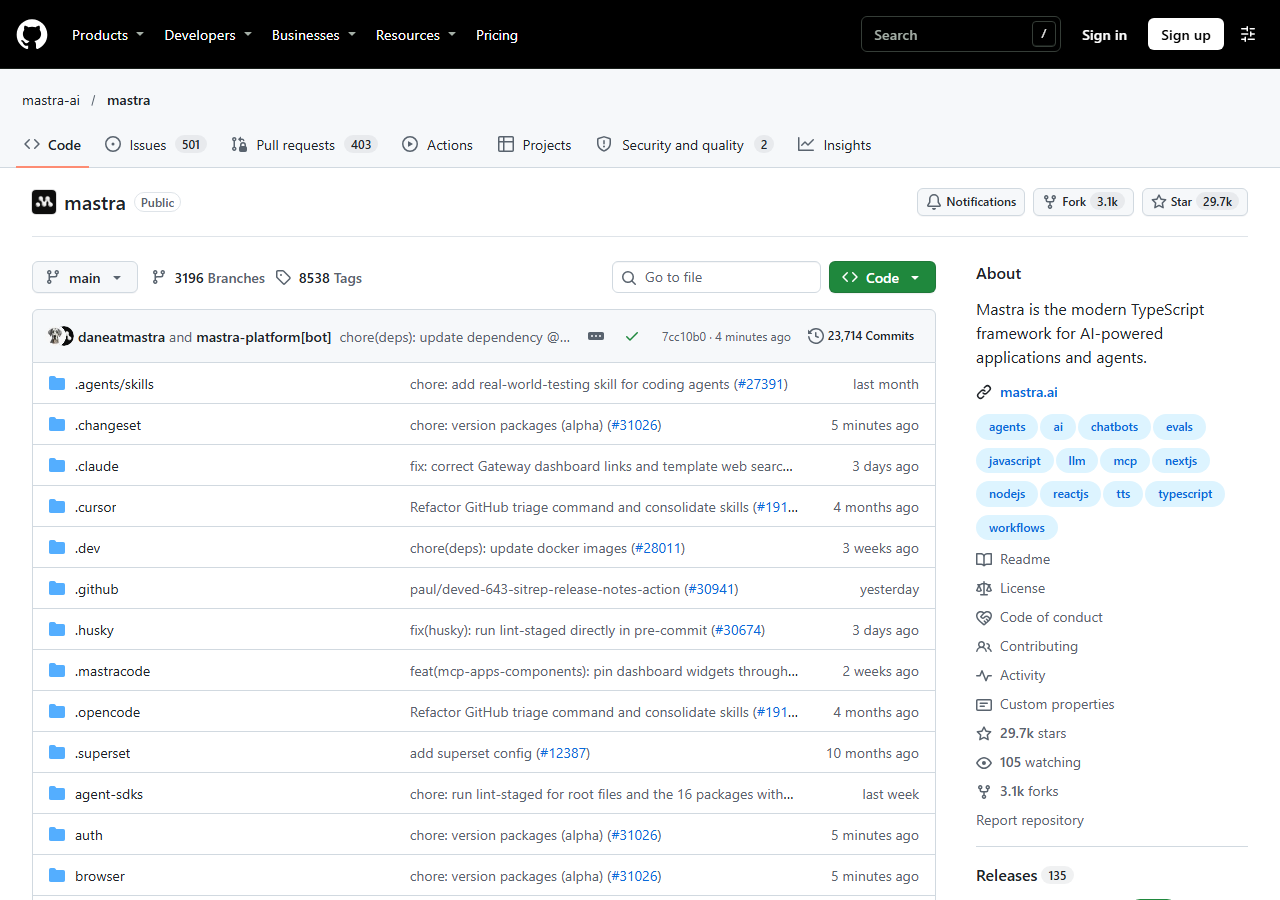
Why it matters now. Mastra, the TypeScript agent framework company, showed it on Hacker News on Nov 18, 2026 (story 50548660, 153 points on Nov 21) and said it uses Factory to build Mastra itself. Its core repository had about 29,700 GitHub stars on Nov 21, 2026.
The catch. The numbers that make it look good are self-reported: the authors say Factory opened and merged 238 pull requests in a week alongside 630 from humans, and that they closed their repository to outside contributors. The npm package is Apache-2.0, but the public template repository shows no license file. The default setup depends on Mastra platform, whose sandbox and model usage can be billed.
Not a hands-on test: JAVIS has not installed or run Mastra Factory. This review is built from the official docs, the npm registry, the GitHub repositories and the Hacker News thread, all dated Nov 21, 2026.
The facts in thirty seconds.

Five phases, and you set how much the agent does alone.
npm create factory@latest my-factory in a directory separate from the repository agents will change. The installer signs you in to Mastra platform and provisions auth, PostgreSQL and sandboxes, or you pass --no-platform and bring your own.submit_plan. The card waits until a person approves.Swipe sideways to see every column.
| Phase | What happens | Your next action |
|---|---|---|
| Intake | An issue is available for work | Read it, start a run, or accept it |
| Planning | Agent investigates and writes an approach | Review or revise the plan |
| Building | Agent changes the repository and runs checks | Inspect progress and the patch |
| Review | PR is ready; it has its own card | Inspect the PR, request changes or merge |
| Done | Task complete | Confirm acceptance criteria |
Table adapted from the Work items page of the docs.
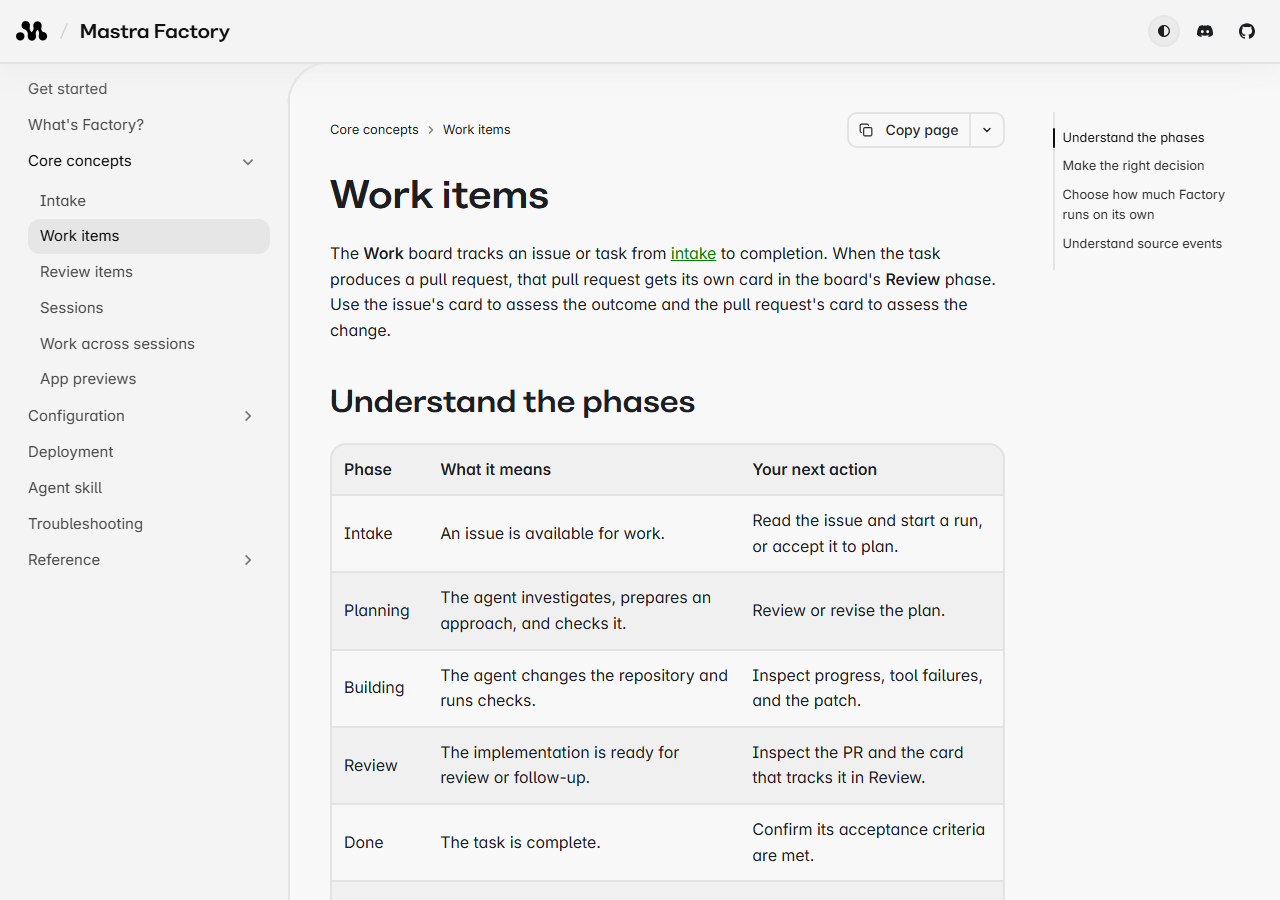
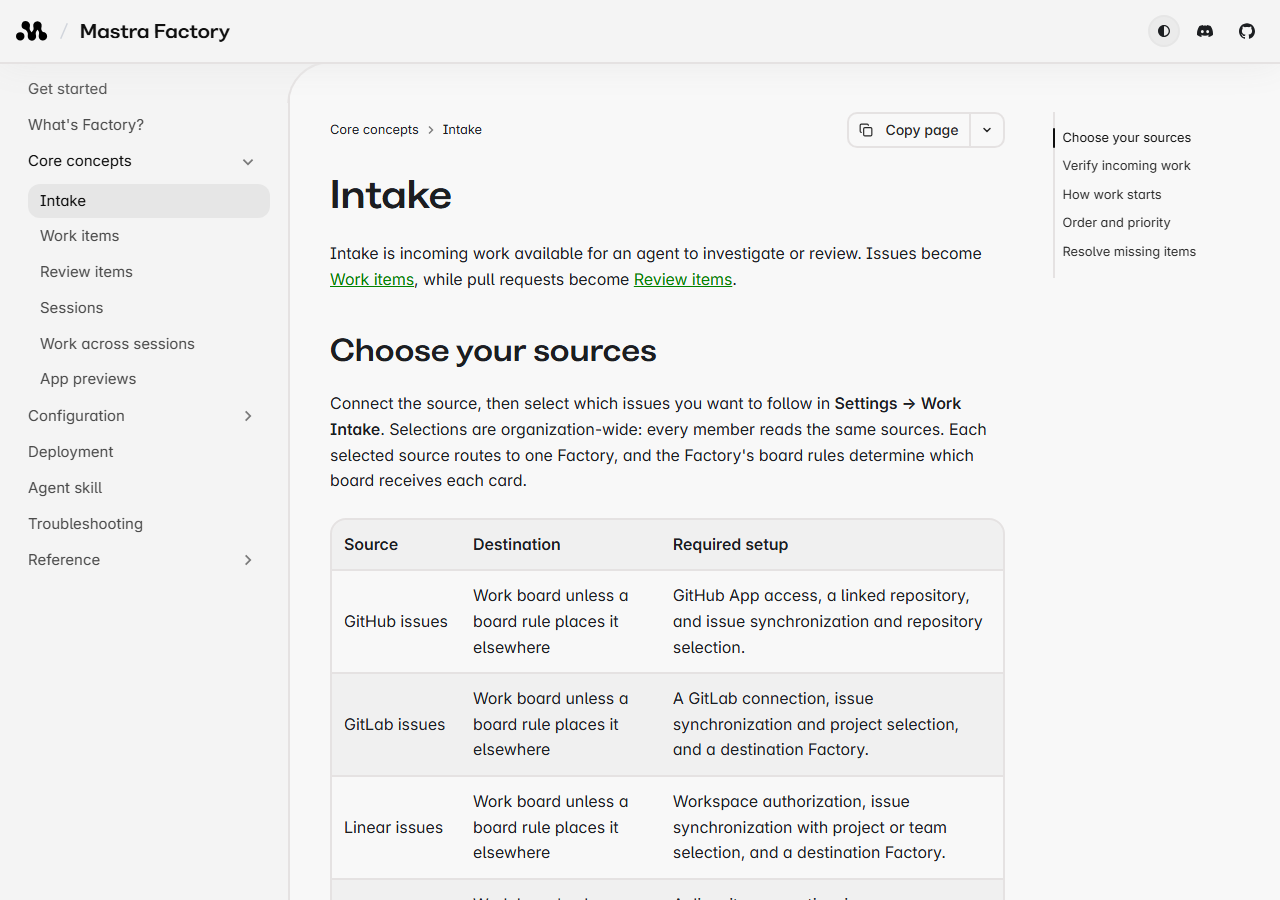

Autonomy is a per-phase setting, and the default board starts nothing by itself.
According to the docs, the Work board Factory installs starts nothing on its own: a run begins when you start it or accept a task, and plans always wait for a person. A working phase can be set to Start on its own, optionally limited by a condition, and the default GitHub rules allow an automatic run only for issues created after the Factory by an author with write or admin access. With every phase waiting for a person, the docs say Factory never starts agent work or spends model tokens on its own.
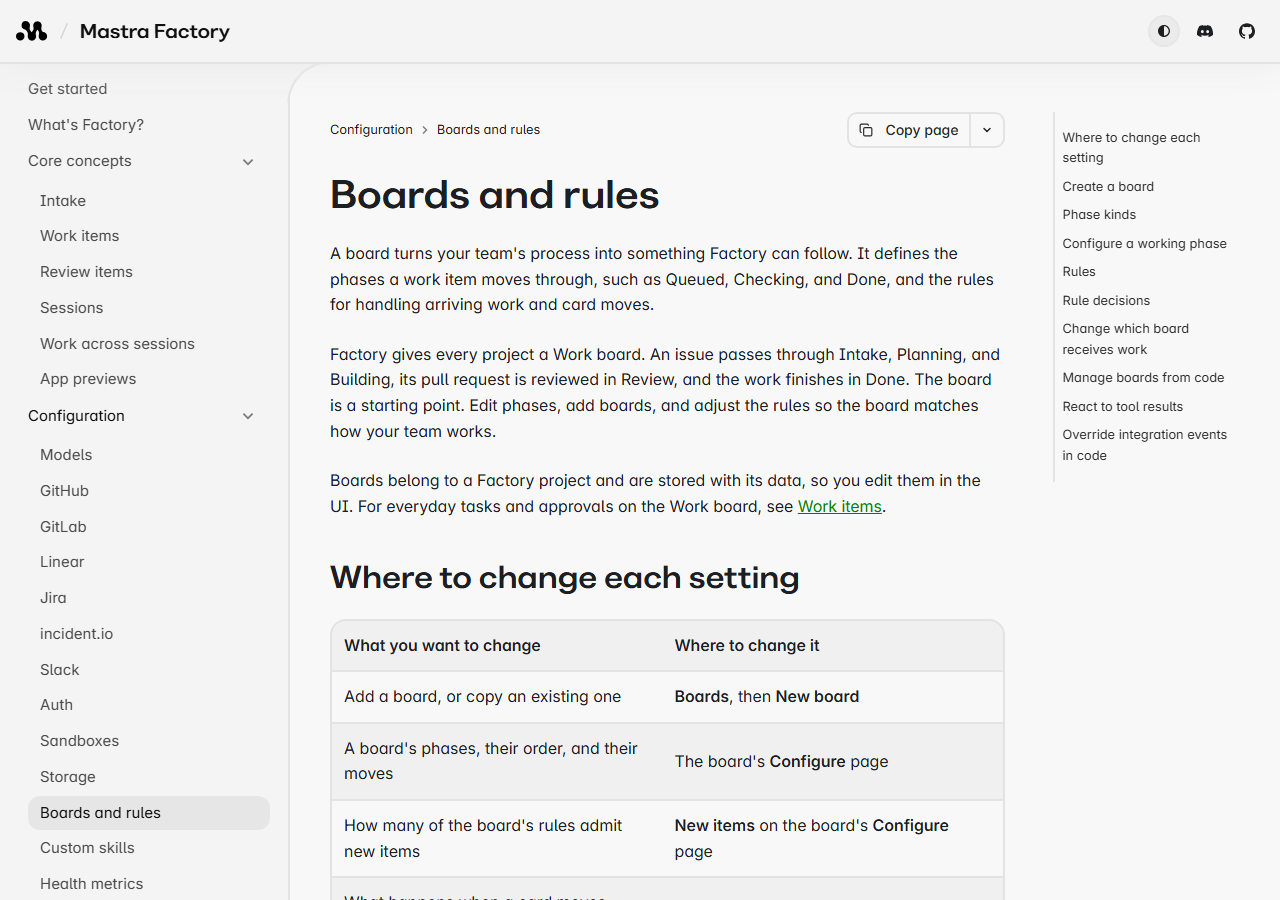
You can add boards, rename phases, attach skills to a phase, give a phase a goal that the agent keeps pursuing, and set an exit tool that ends the phase. In the HN thread an author said their own factory automates low-risk, low-complexity items and puts more human steps on risky ones, and another said they are moving from triage straight to build because the planning phase was overhead for them.
Swipe sideways to see every column.
| Setting | What it does |
|---|---|
| Skill | The instructions a phase starts with; without one the card waits for a person |
| Start on its own | Run starts without approval; limit with a Start only when condition |
| Goal | Objective the agent keeps working toward instead of stopping after one turn |
| Exit tool | Tool whose successful call ends the phase; approve on its own is optional |
Settings from the Boards and rules page, as of Nov 21, 2026.
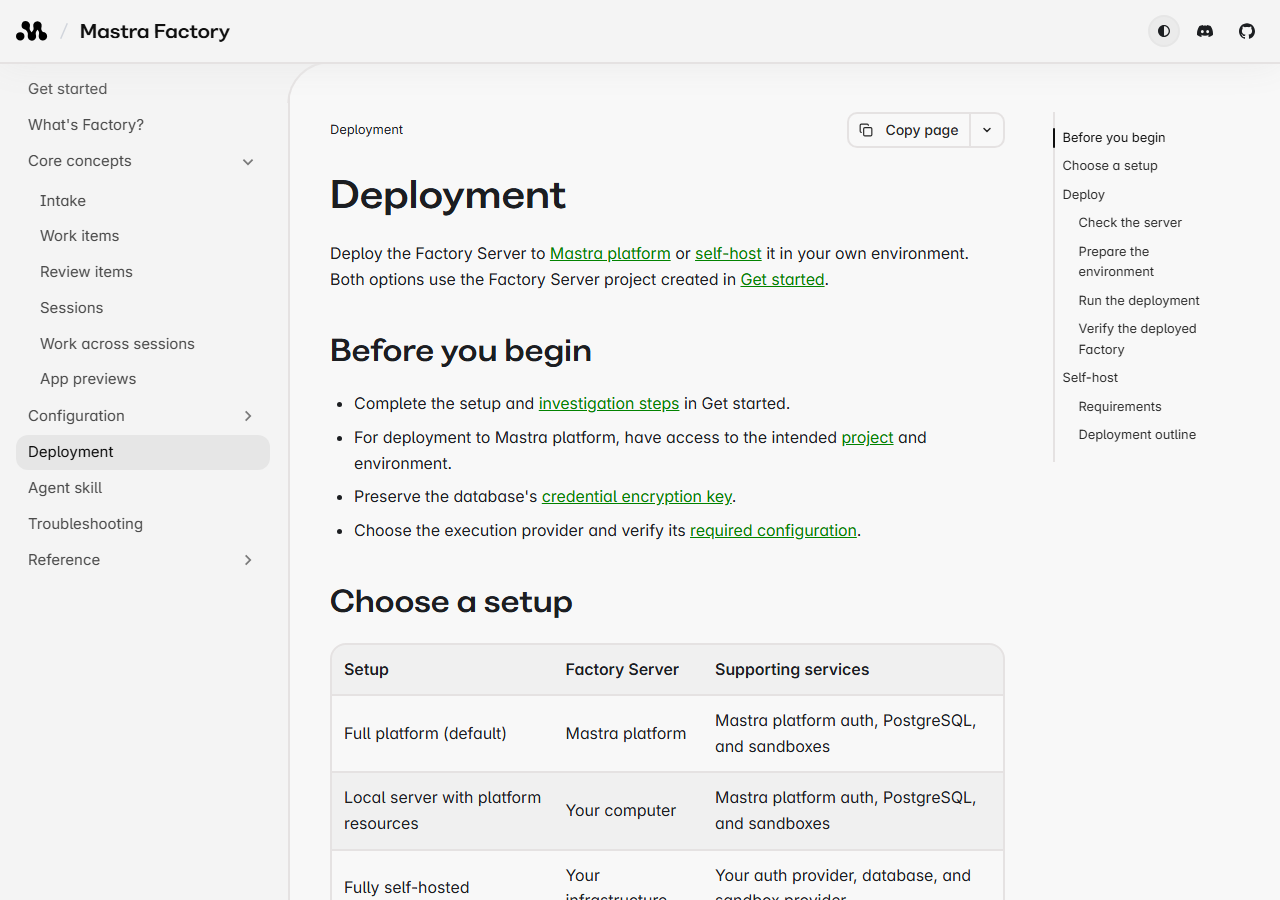
Three setups: all on Mastra platform, a local server with platform resources, or fully self-hosted.
Swipe sideways to see every column.
| Setup | Factory Server | Auth, database, sandboxes |
|---|---|---|
| Full platform (default) | Mastra platform | Mastra platform auth, PostgreSQL and sandboxes |
| Local server, platform resources | Your computer | Mastra platform |
| Fully self-hosted | Your infrastructure | Your auth provider, database and sandbox provider |
Table from the Deployment page of the docs.
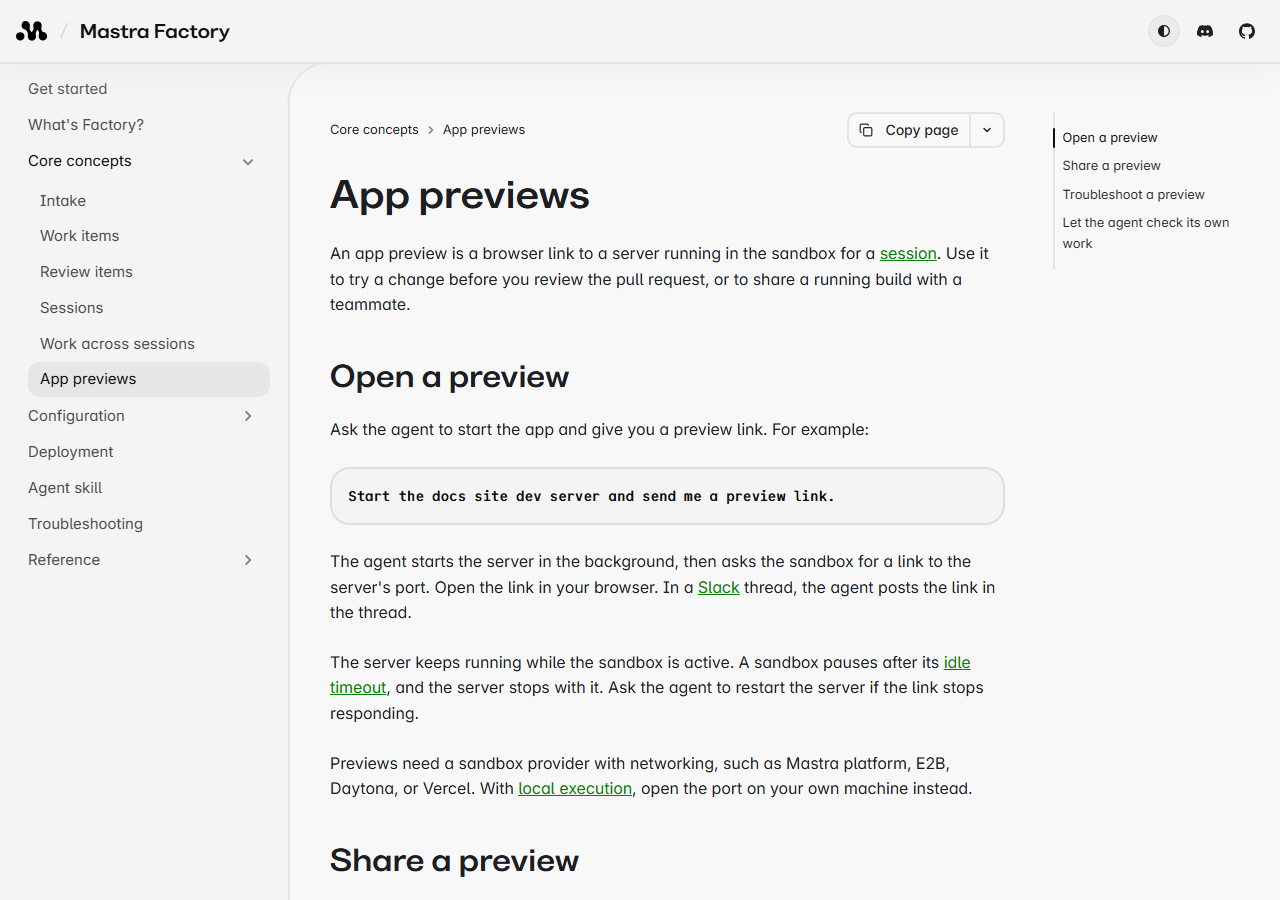
Self-hosting means a virtual machine, container or host with a persistent Node.js process, a database, and credential encryption: the docs say to generate a FACTORY_CREDENTIAL_ENCRYPTION_KEY and keep a protected backup, because losing it can stop Factory reading stored credentials. Sandboxes default to 2 vCPUs and 1 GB of memory on Mastra platform, pause after 5 idle minutes, and can be swapped for other providers; the previews docs name E2B, Daytona and Vercel, and a local execution mode runs commands on the server's own machine without VM isolation.
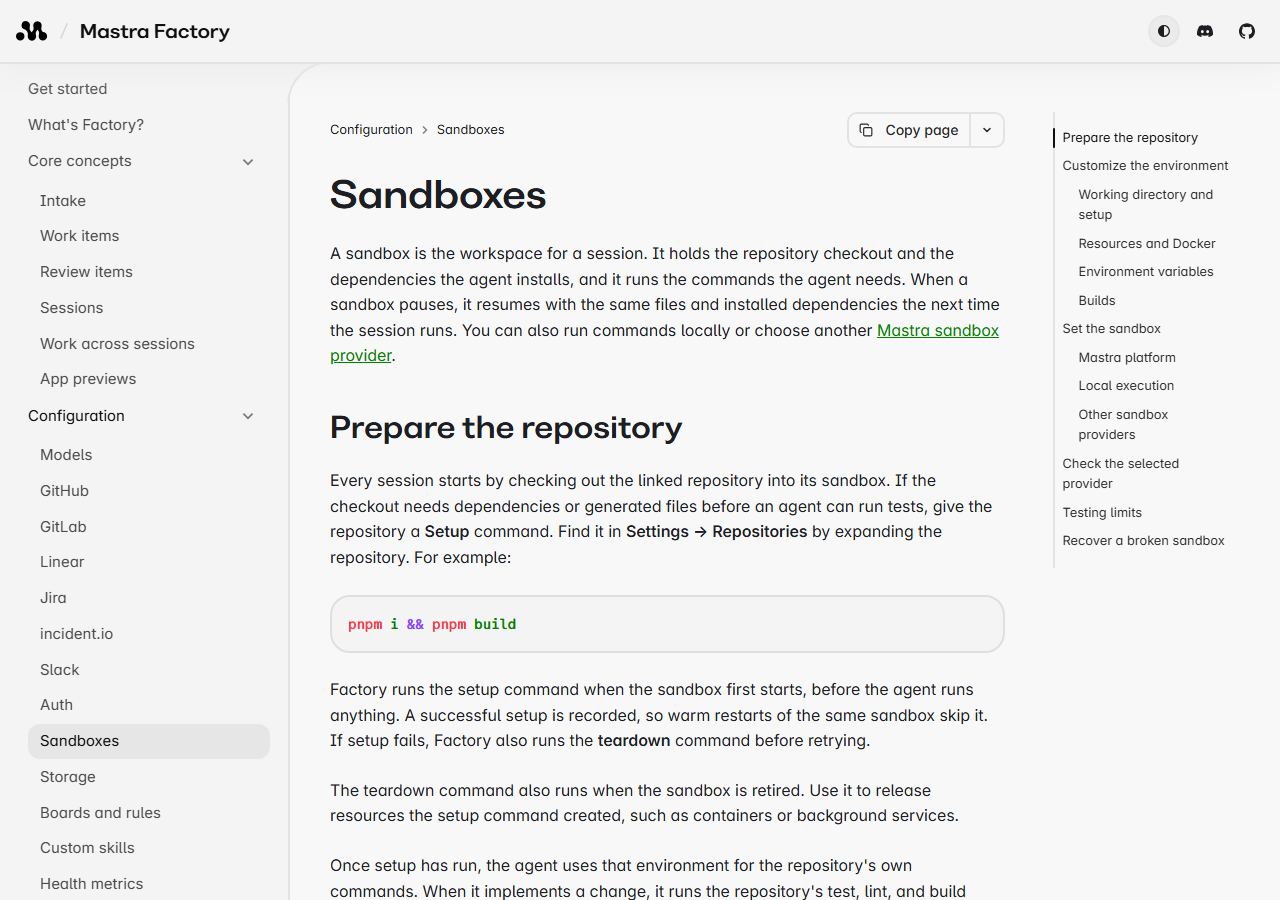
The software is free. The bill comes from sandbox hours, model usage and the platform plan.
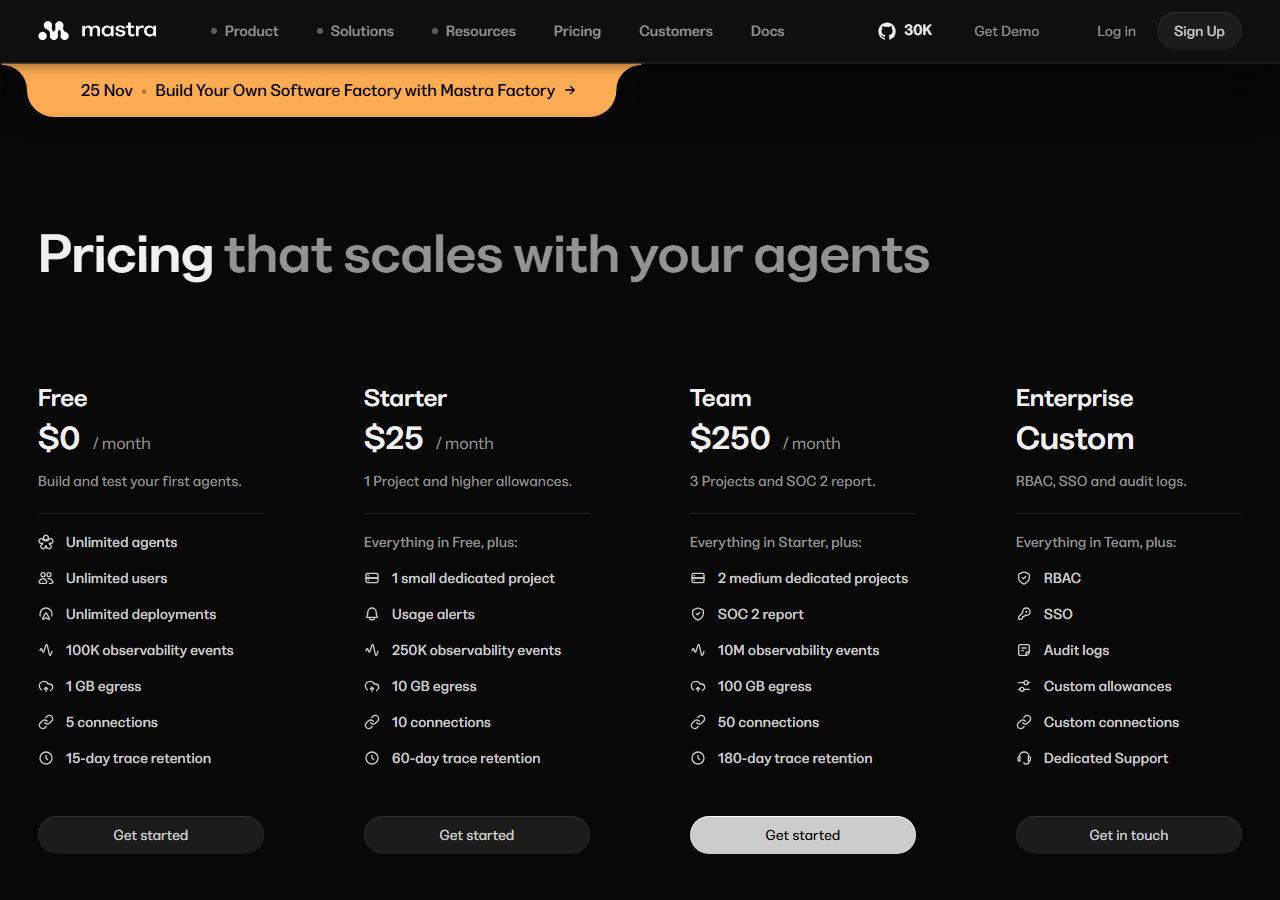
There is no separate Factory price list on the docs or the product page. The Factory product page repeats the Mastra platform plans: Free $0, Starter $25 a month, Team $250 a month, and Enterprise on request (RBAC, SSO and audit logs). Prices are per workspace each month, as of Nov 21, 2026.
Swipe sideways to see every column.
| Free | Starter | Team | |
|---|---|---|---|
| Price | $0 | $25 / month | $250 / month |
| Compute memory included | 100 GB-hours | 360 GB-hours | 3,600 GB-hours |
| Compute vCPU included | 40 vCPU-hours | 100 vCPU-hours | 400 vCPU-hours |
| Overage | $0.25 per GB-hour and per vCPU-hour | same | same |
| Observability events | 100K | 250K | 10M |
| Trace retention | 15 days | 60 days | 180 days |
| SOC 2 report | No | No | Yes |
From mastra.ai/pricing. The table lists compute "for Serverless projects and sandboxes"; the docs do not say how Factory sessions are metered, so the next scenarios are an estimate, not a quote.
Worked examples (model costs excluded)
Assumption: each session uses the default sandbox (2 vCPUs, 1 GB), so one active sandbox hour is 2 vCPU-hours and 1 GB-hour.
Swipe sideways to see every column.
| Scenario | Usage | Free plan | Starter | Team |
|---|---|---|---|---|
| Solo, light | 20 sandbox-hours a month = 40 vCPU-h, 20 GB-h | $0 | $25 | $250 |
| Small team, moderate | 100 sandbox-hours = 200 vCPU-h, 100 GB-h | $40 (160 vCPU-h over) | $50 ($25 plan + 100 over) | $250 |
| Busy team | 220 sandbox-hours = 440 vCPU-h, 220 GB-h | $130 ($100 vCPU + $30 memory) | $110 ($25 plan + $85) | $260 ($250 + $10) |
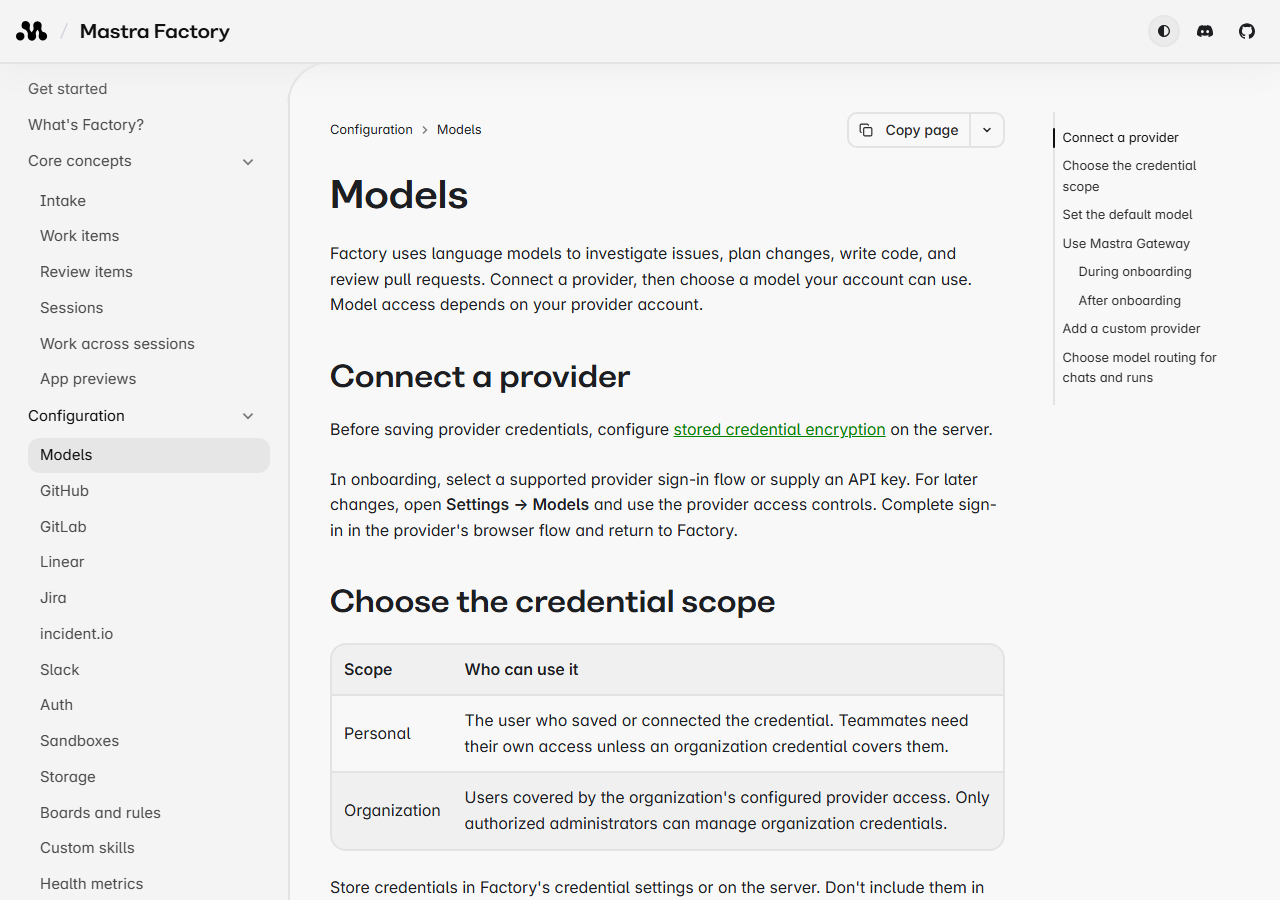
Model costs. Factory needs a model provider. With Mastra Gateway, usage is billed to your organization's Mastra credits; with your own keys you pay the provider. The Models page gives no price for the gateway credits. The pull-request volume the authors quote will cost far more in tokens than in sandbox time, but we cannot say how much.
Open source, with caveats you should know before you call it that in a procurement form.
Swipe sideways to see every column.
| Item | Status as of Nov 21, 2026 |
|---|---|
| @mastra/factory on npm | License field Apache-2.0; 429 versions; latest 0.30.0 published Nov 18, 2026; source folder mastracode/factory in the mastra-ai/mastra repository |
| template-factory repository | 71 stars, 2 forks, 4 commits, bot-maintained; package.json says Apache-2.0 but the repository has no LICENSE file and GitHub shows no license |
| mastra-ai/mastra repository | About 29,700 stars; its LICENSE.md says Apache-2.0 for most content, with directories named ee/ under a separate license; GitHub labels the license Other |
| Contributions | The authors say the repository is closed to outside contributors; they ask for detailed issue reproductions instead |
Each fact can be checked: the npm registry entry, the repository pages and the HN post. We did not audit the source code or the ee/ directories, so we cannot say whether any part of Factory itself falls under the separate license.

A friendly thread with real questions. Small, self-selected sample.
The Show HN had 153 points and 15 top-level comment threads on Nov 21, 2026. The authors answered most questions, so this is partly a conversation with the vendor.
Argued that software factories are not a real architecture, just agents on the same project with issues in and pull requests out.
Asked how verification works, especially for the user-facing result, and worried that a dark factory loses the feel of using the software. An author pointed to skills per board column and steering the agent while it runs.
Asked whose identity the agents use. An author said the default is the "Mastra Platform" GitHub App, and a personal access token lets agents open PRs on behalf of users.
Other points: one reader asked for a production Helm chart and a Kubernetes sandbox provider; another noted the product page needs more visuals; an author said they plan to support other harnesses such as Claude Code and Codex later, while sessions today run on Mastra's own coding harness. Several commenters discussed closed contribution models for AI-era open source, with the authors saying low-value pull requests have risen sharply. These are opinions, not a survey.

An established agent-framework company, with a short history for this product.
Mastra says it averages nearly 4 million downloads a week for the framework and is trusted by "10,000+ teams" on its pricing page; both are company statements we did not check independently. The pricing page also shows customer case studies for Translucent, Marsh and Range, which are about Mastra platform agents, not about Factory. A product page banner promotes a Nov 25 session called "Build Your Own Software Factory with Mastra Factory".
What to know before you rely on it.
Version 0.30.0 after 429 published versions in four months. Expect breaking changes and a lot of preview builds.
The 238 versus 630 merged pull request figures come from the authors. No outside data on quality, rework or cost per merged PR.
Sessions run a coding agent built on Mastra Code. Support for other harnesses is described as planned.
GitHub App access, an encryption key, a model provider, issue sync, and sandbox settings. A troubleshooting page covers cases where issues do not arrive.
By default PRs come from a GitHub App. Preview links are private by default, and public preview links should stay off for private work.
The docs show no per-PR cost. Start with phases that wait for a person.
Other ways to get issues to pull requests. Different designs, not drop-in swaps.
Swipe sideways to see every column.
| Option | Idea | What we know |
|---|---|---|
| Mastra Factory | Open-source board, sandboxes, approvals, Slack | Facts above |
| Issues, an agent and PRs on GitHub | No separate board; GitHub is the process | The view of HN commenter _pdp_; we have not tested it |
| factory.redbeardlab.com | Workflow language for chaining agent steps and CI | Shared by its author in the HN thread; we have not researched it |
| One agent in your terminal | You drive each task yourself | No board or approvals; see our Claude Code guides below |
No head-to-head test was run. If you try Factory, the safest first run is one small documentation issue with every phase set to wait for a person.
A short decision list.
A TypeScript-friendly team with a backlog of small, well-specified issues, a GitHub or Linear workflow, and appetite to review many plans and PRs.
You need a stable 1.0 product, a published license audit, a fixed per-seat price, or an agent other than Mastra's harness today.
Five actions.
No affiliate links.
JAVIS has no affiliate relationship with Mastra or any tool named here. Every outside link goes to the project, its documentation, GitHub, npm or Hacker News.
Running coding agents? Read these next.

Questions people ask about Mastra Factory.
Is Mastra Factory free?
The software is open source and the npm package lists Apache-2.0. Running it on Mastra platform uses plans from $0 to $250 a month plus usage, and you pay for a model provider.
Does it replace Claude Code or Codex?
No. Sessions run a coding agent built on Mastra Code. The authors say they plan to support other harnesses.
Will it merge code on its own?
Per the docs, merging is a step that waits for a person, as do plan approval and accepting a task.
Can I self-host it?
Yes. Create the project with --no-platform and configure your own auth, storage and sandbox provider.
Is the repository really open source?
The npm package says Apache-2.0, but the public template repository has no license file and the authors do not take outside pull requests.
Is it production ready?
It is at version 0.30.0 and about four months old on npm. JAVIS has not tested it.
Where this came from, and when.
Official: factory.mastra.ai docs (get started, what is Factory, intake, work items, reviews, models, sandboxes, auth, boards and rules, deployment, previews), mastra.ai/factory and mastra.ai/pricing, as of Nov 21, 2026.
Code and packages: mastra-ai/template-factory, mastra-ai/mastra, and the npm registry entries for @mastra/factory and create-factory (Nov 21, 2026).
Hacker News: story 50548660 (Nov 18, 2026; 153 points on Nov 21).
Images: screenshots taken by JAVIS on Nov 21, 2026; diagram, timeline and chart drawn by JAVIS. The JAVIS Fit Score is editorial judgment, not a benchmark.
Not covered: installing or running Factory, a code or license audit, measured cost per pull request, and any head-to-head comparison.