
MAI Code 2 and Code 2 Flash Review 2026: Microsoft's Cheap Coding Models, and the Promo Price Clock
MAI Code 2 and MAI Code 2 Flash are two coding models that Microsoft AI released on Nov 17, 2026 and put in GitHub Copilot. Microsoft says Code 2 delivers 98% of GPT-6.1 Sol's performance at 40% of the cost and 96% of Claude Opus 5.5's at 5%. Those figures come mostly from Microsoft's own testing, at a promotional price that doubles on May 17, 2027. This review reads the claims against the model card, GitHub's price page and the Hacker News reaction, and says who should switch.

There are no affiliate links in this review. Every link goes to Microsoft, GitHub or the other named sources.
| Made by | Microsoft AI (MAI) |
| What it is | Two hosted coding models for everyday enterprise work |
| Pricing | Billed per token in Copilot AI credits; promo until May 17, 2027 |
| Catch | Mostly vendor-run benchmarks; no local weights; not for long-horizon agent work |
| Evidence | Model card, GitHub docs, two Hacker News threads |
Worth trying if you already pay for GitHub Copilot and want cheaper routine coding; not proven as a Claude Opus or GPT-6.1 Sol replacement, and the low price is a promotion.
“Averaged over four widely used benchmarks.” That phrase from Microsoft's announcement is the whole claim: 98% and 96% are averages of four benchmarks, three of them run by Microsoft, with the new models priced at half their list rate.
MAI Code 2 is the larger model, built for multi-file changes, deep debugging and repository-wide questions. MAI Code 2 Flash is the smaller one, meant for explanations, targeted edits and routine fixes. Both were trained by Microsoft from scratch, take text and image input, and accept up to 1,050,000 tokens of context, per the model card. You use them by choosing them in the GitHub Copilot model picker; they are hosted by Microsoft and the weights are not distributed.
Three things decide whether to switch. First, the cost story is real but conditional: on Nov 19, 2026 GitHub lists MAI Code 2 at $2.50 per million output tokens against $10.00 for GPT-6.1 Sol and $20.00 for Claude Opus 5.5, yet the MAI prices are promotional and double on May 17, 2027. Second, the quality story is an average that hides a gap: on SWE Atlas, which covers codebase questions, test writing and refactoring, MAI Code 2 scores 43.1% against 57.5% for Opus 5.5 in Microsoft's own chart. Third, the evidence is thin: three of the four benchmarks were run by Microsoft on its internal platform (the fourth comes from Artificial Analysis), Microsoft's materials cite no independent test, the model page links no technical report, and the Hacker News reaction mixes a few good first-hand reports with a lot of doubt.
Not a hands-on test: JAVIS has not run MAI Code 2 or MAI Code 2 Flash. This review is built from Microsoft's announcement, model page and model card, GitHub's changelog and billing pages, and two Hacker News threads, all as of Nov 19, 2026 unless a date is given. JAVIS has no speed, cost or quality measurements of its own.
Two hosted models you pick inside Copilot, billed per token, with Microsoft running the servers.
The pair share one design: a decoder-only transformer with sparse mixture-of-experts layers and a built-in vision encoder, according to the model card. They differ mainly in size. Reasoning effort is adjustable (low, medium, high, xhigh or max), and the card says higher effort raises latency and token use and does not always improve results. Inputs can be text or images, such as screenshots and UI mockups, and outputs are text, up to 128,000 tokens at a time. At release the models are optimized for English code production only.
Microsoft's own models, announced at Ignite, trained inside the Copilot harness they are tested in.
Microsoft AI (MAI) published the announcement on Nov 17, 2026, tagged Ignite and Models, and GitHub posted its changelog entry the same day. The model card says both models were pre-trained and post-trained by Microsoft from scratch and depend on a base model called MAI-Base-2. It adds that Flash was pre-trained using logit distillation from a larger in-house MAI teacher model, and that reinforcement learning ran directly in the GitHub Copilot CLI and VS Code agent harnesses used in production. That is why Microsoft's benchmarks use the Copilot CLI: the models were tuned in it.

The model card dates itself Nov 17, 2026 and gives a training window of Aug 2026 to Nov 2026 with an Aug 2026 knowledge cutoff, so the models may not know libraries or vulnerabilities that appeared after that. The previous model in Copilot, MAI Code 1.1 Flash, has 5B active parameters per the card, and GitHub says it will be retired in all Copilot experiences on Dec 18, 2026, with the newest MAI Code Flash model as the suggested alternative.
Size is where the sources disagree. The model card's summary table lists MAI Code 2 at 50B to 100B parameters (80B active) and Flash at 5B to 15B (12B active). Its overview section says MAI Code 2 has 77 billion active parameters and approximately 2.8 trillion in total, and Flash has 12 billion active and approximately 398 billion in total. The two data cards add a third description: they name an internal 80B base model for Code 2 and a 12B base model for Flash, while the model card names MAI-Base-2. Microsoft does not reconcile these descriptions, so this review does not state a total size. One Hacker News commenter built a laptop-serving estimate on the smaller range (comment 50539594); with the weights not distributed, nobody outside Microsoft can run either model anyway.
The data cards, which Microsoft links from the model page, say pre-training data was collected as late as March 2026, post-training used synthetic data through November 2026, and the training dataset was first used in July 2026 (the model card gives Aug 2026 to Nov 2026 as the training dates). They say the synthetic data was generated with OpenAI's GPT-5.6 Sol and GPT-6 Astra as well as internal Microsoft models, and that the models do not keep learning from production use.
Close to Sol and Opus on average, clearly behind on SWE Atlas, and measured by Microsoft at a half-price rate.
Microsoft's headline compares MAI Code 2 with GPT-6.1 Sol and Claude Opus 5.5 across four benchmarks: DeepSWE 1.1, Terminal-Bench 2.1, SWE Atlas and FrontierCode v1.1. The chart data on the announcement page gives the averages below.

MAI Code 2 averages 63.2%, GPT-6.1 Sol 64.1% and Claude Opus 5.5 65.3%. That is about 0.9 points behind Sol and 2.1 behind Opus, which is how Microsoft gets 98% and 96%.
$0.309 for MAI Code 2, $0.761 for Sol and $6.306 for Opus 5.5, with MAI Code 2 shown at its 50% promotional price.
The average hides the range: MAI Code 2 leads Opus 5.5 on two benchmarks and trails it by 14.4 points on SWE Atlas.

Read the gap chart as a caution, not a verdict. MAI Code 2 beats Opus 5.5 on DeepSWE 1.1 and Terminal-Bench 2.1, and beats Sol on FrontierCode, but SWE Atlas is the benchmark closest to ordinary maintainer work: codebase questions, writing tests and refactoring, with tasks from 18 open-source repositories, per the model card. Microsoft itself says the models are “explicitly not yet tuned” for fundamental science research and very long-horizon agentic work, and the card's known-limitations list says that in long agentic sessions the models can repeat tool calls, under-use the existing code base, drift from instructions or stop before verifying their work.
How the numbers were produced
Microsoft's footnotes say all models ran at max reasoning effort. DeepSWE 1.1, Terminal-Bench 2.1 and SWE Atlas ran on MSBench, Microsoft's internal evaluation platform, with the GitHub Copilot CLI and without sub-agents. The model card names Copilot CLI version 1.0.102, says each comparison used the same harness and settings, and says results are the mean of three independent runs per task, with infrastructure errors counted as failures. The FrontierCode v1.1 scores and costs come from Artificial Analysis, and JAVIS has no separate source for them. MAI cost is shown at its 50% promotional price. Microsoft ran the first three benchmarks itself, and only the fourth has an outside source. The model page links a model card, two data cards and the blog post, but no technical report.

MAI Code 2 Flash
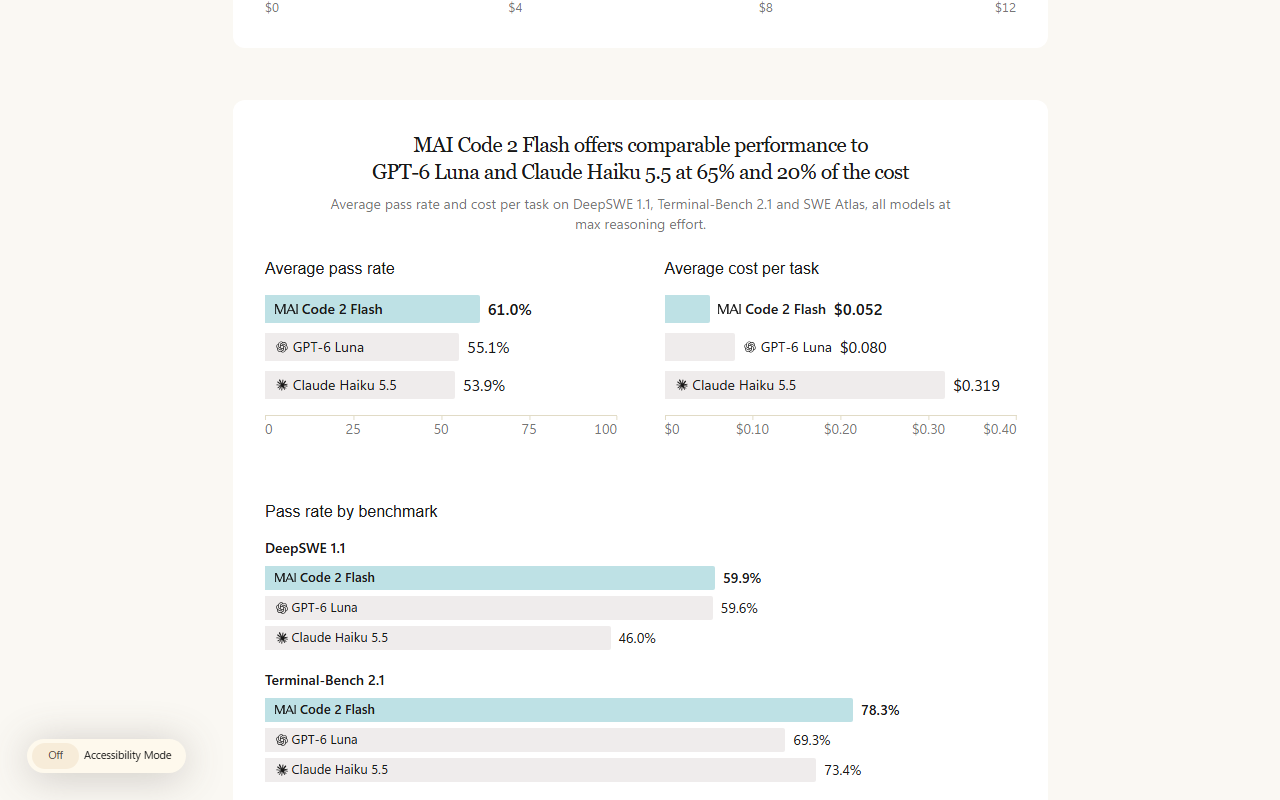
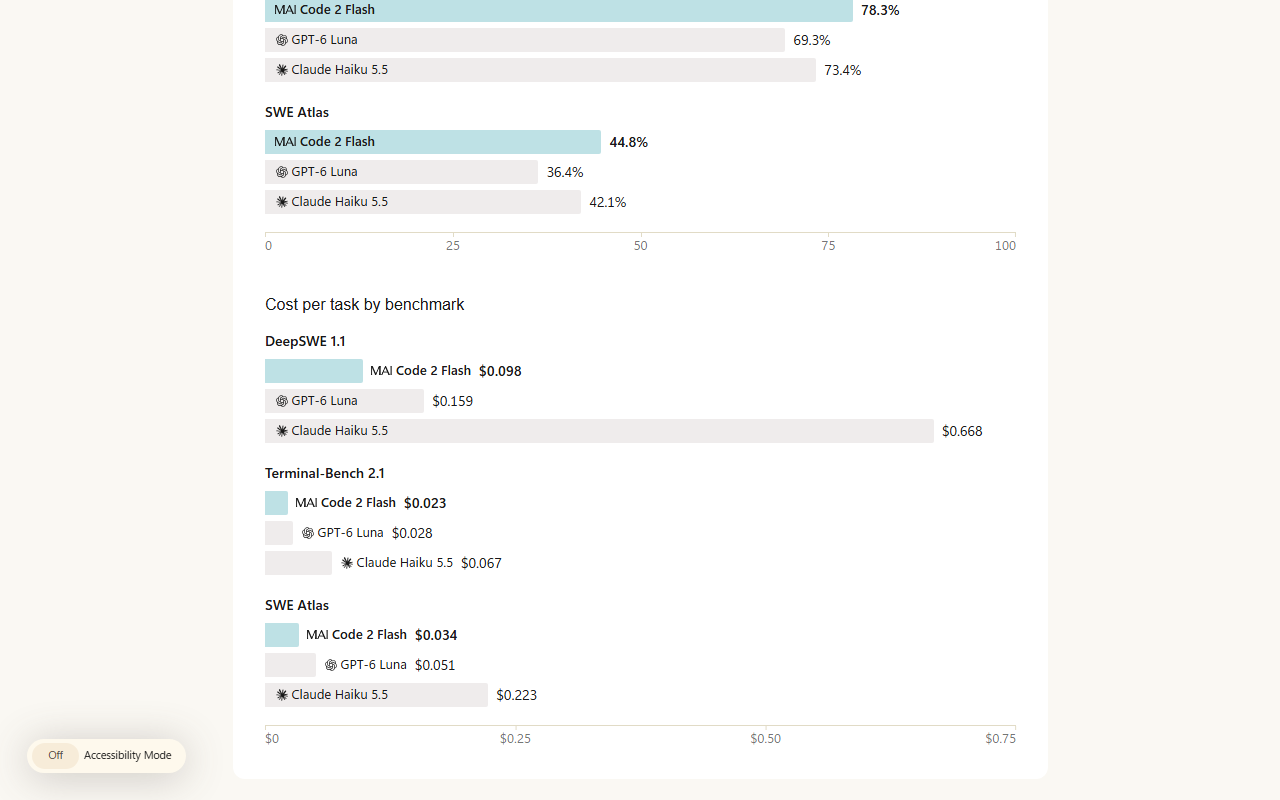
For Flash, Microsoft compares GPT-6 Luna and Claude Haiku 5.5 on three benchmarks: DeepSWE 1.1, Terminal-Bench 2.1 and SWE Atlas. Flash averages 61.0%, Luna 55.1% and Haiku 5.5 53.9%, at average costs per task of $0.052, $0.080 and $0.319. Flash scores above both rivals on all three benchmarks, by as little as 0.3 points on DeepSWE 1.1 against Luna. Two rounding notes: the page says Flash costs 20% of Haiku 5.5, while the chart averages give about 16%, and the model page says 12% higher performance than Haiku where the averages give about 13%. Neither changes the picture. The model card's own table shows Flash at 44.8% on SWE Atlas, above MAI Code 2's 43.1%, which is an odd result for the larger model.
Two smaller claims
Visual coding. Microsoft says developers preferred MAI Code 2's front-end results over GPT-6 Sol 64% of the time in blind side-by-side tests, annotated by 258 annotators across interfaces, games, data visualizations, 3D scenes and SVG graphics. The announcement says “GPT-6 Sol” in its text and footnote, while the model page says GPT-6.1 Sol, so which model was compared is unclear. Customer results. Microsoft's Custom Models page leads with three customers and adds a testimonial from PolicyBazaar about fine-tuned Flash improving accuracy. AT&T reports a tuned MAI Code 2 Flash passing 96.1% of its 5G network analytics cases against 88.4% for GPT-6.1 Sol, at 50x lower cost. Woven by Toyota reports merge-ready fixes for 44% of the MISRA coding standard violations where its frontier models needed human rework, at under a tenth of the cost. Alaska Airlines reports 91.1% accuracy classifying aircraft maintenance reports against 90.6% for GPT-6.1 Sol. These are vendor-chosen results for custom fine-tuned versions, not the models you pick in Copilot, and they are not independent tests.
Interested in the price, doubtful about the benchmarks, with a few first-hand reports that are positive.
The evidence is two Hacker News threads. The announcement submission, “MAI Code 2 and Code 2 Flash”, was posted on Nov 17, 2026 and reached 417 points on Nov 18, 2026 (it has risen slightly since) with about 150 comments in its tree. A second thread about Microsoft's Ignite lineup, “Seven new models at scalable price-performance”, had 447 points on Nov 18, 2026 and has gained more since. There are no ratings on Trustpilot, G2 or similar sites for these models, and a GitHub search turned up no independent evaluations. Everything below is individual opinion that cannot be verified. Some of the harshest comments, such as one ranking Code 2 below DeepSeek V4.1 Flash and Qwen3.8-Max, are informal tests rather than controlled comparisons.
Doubts about the benchmarks and the price
“While showing MAI Code 2 at a 50% promotional discount, and comparing to Max reasoning effort for Opus 5.5 and 6.1 Sol...”
A commenter says “DeepSWE 1.1 has been busted for a while” and that Terminal-Bench 2.1 is not the latest version, which lowers his confidence in the headline.
“Looking deeper, though, it looks like they are citing four benchmarks, only one of which is basically saturated (Terminal Bench 2.1).”
First-hand reports and access questions
A developer who switched Copilot to MAI Code 2 reports it fixed tricky Python build issues in WSL and Azure deploy files: “Didn’t feel the difference from Claude Opus.”
“I’ve been testing MAI Code 2 and its been quite good for my usual work.” The same commenter says Microsoft put it on par with Opus or Sol.
On finding the product: “there is no Pricing page on that website, neither way to create API keys, nor playground.” Another reader pointed to the Get started paragraph.
Promo pricing and Copilot credits
“The promotional period lasts until May 2027.” GitHub’s billing page confirms the end date as May 17, 2027.
“I think they won’t help if they’re billed at the announced rate on your Copilot quota.”
“We just cancelled our Github Copilot subscription.” The commenter says the credits on their plan went in days or hours, and that the new models might help.
You pay per token through Copilot AI credits; the MAI prices are half of list until May 17, 2027.
GitHub's changelog says both models are billed under usage-based billing, and its billing page says the token total is converted into AI credits, where 1 AI credit equals $0.01. Individual plans include a monthly credit allowance; usage beyond it is billed at the per-token rates. Code completions and next edit suggestions do not use credits. The cards show the individual Copilot plans from github.com/features/copilot/plans on Nov 19, 2026.
- Code 2 Flash is available
- MAI Code 2 is not listed for Free
- Limited chat and agent usage
- $15 monthly total credits ($10 base plus $5 flex)
- Both MAI models available
- Per user per month
- $70 monthly total credits ($39 base plus $31 flex)
- Premium models including Opus
- 4x+ included usage than Pro
- $200 monthly total credits ($100 base plus $100 flex)
- 2.9x+ included usage than Pro+
- Priority access to new models
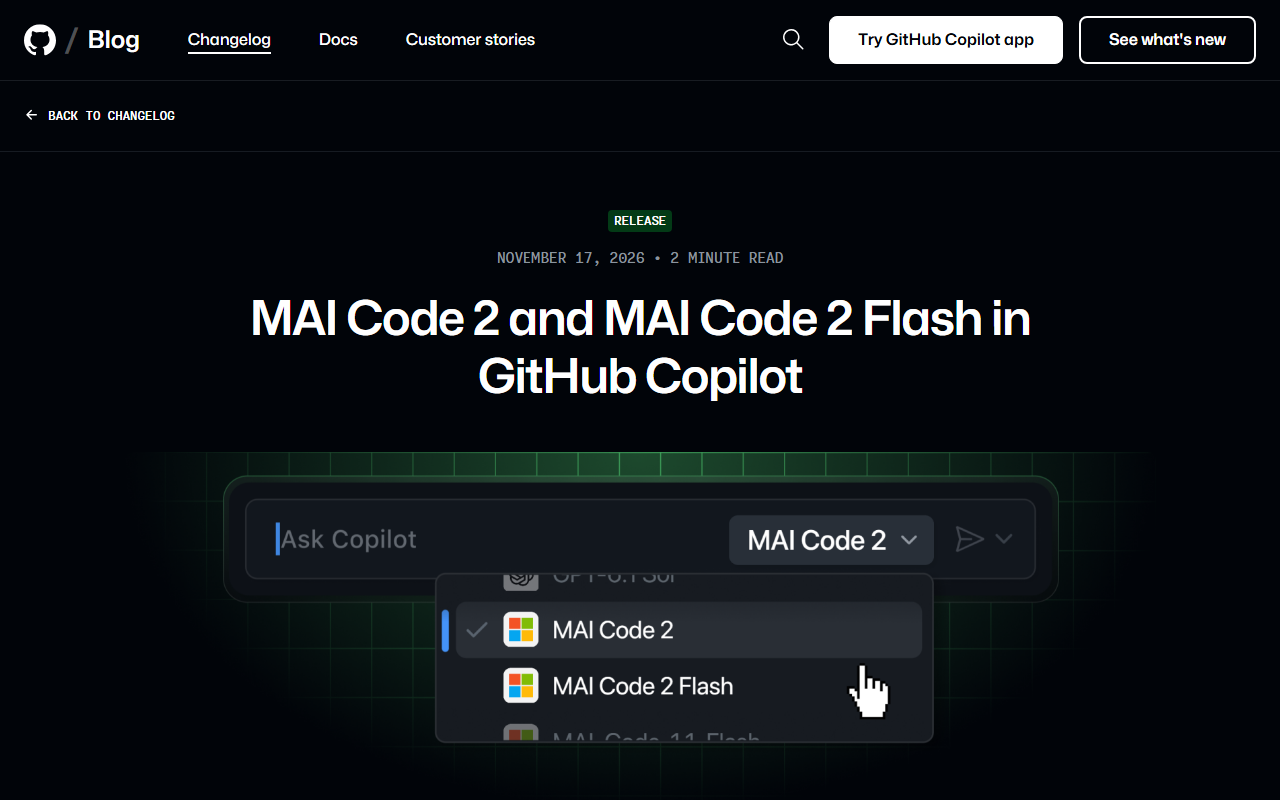
GitHub's plans page says flex allotments may change over time. Both MAI models are also listed for Copilot Business ($19 per granted seat per month, 1,900 credits per user per month) and Copilot Enterprise ($39 per granted seat per month, 3,900 credits), per GitHub's plans documentation. Availability per the GitHub changelog of Nov 17, 2026, which also says both models are available to eligible subscribers on annual plans.
Per-token prices in GitHub Copilot
Swipe sideways to see all columns.
| Model | Input | Cached input | Output | Note |
|---|---|---|---|---|
| MAI Code 2 | $0.50 | $0.025 | $2.50 | Promotional until May 17, 2027; then $1.00, $0.05 and $5.00 |
| MAI Code 2 Flash | $0.05 | $0.005 | $0.25 | Promotional until May 17, 2027; then $0.10, $0.01 and $0.50 |
| GPT-6.1 Sol | $2.00 | $0.10 | $10.00 | Up to 272K input tokens; cache write $2.50 extra |
| GPT-6 Luna | $0.10 | $0.01 | $0.50 | Up to 272K input tokens; cache write $0.125 |
| Claude Opus 5.5 | $4.00 | $0.20 | $20.00 | Cache write $5.00 |
| Claude Haiku 5.5 | $0.10 | $0.01 | $0.50 | Up to 100K input tokens; above that $0.50, $0.05 and $2.50 |
All prices are per 1M tokens from docs.github.com, Models and pricing for GitHub Copilot, Nov 19, 2026. The table lists no cache-write or long-context rows for the MAI models.


At promo prices the models are cheap; at list prices the Code 2 advantage over Sol shrinks and Flash loses its edge over Luna.
Microsoft's cost-per-task figures are shown at the 50% promotional price. GitHub's pages say the prices double on May 17, 2027. If token use per task stays the same, cost scales with price, so the average cost per task would roughly double. This is worked out here from Microsoft's chart and GitHub's price page; it is not a Microsoft figure and token use may change.
About $0.618 per task, roughly 81% of Sol's $0.761 and about 10% of Opus 5.5's $6.306. Still cheaper than both, but not the 40% and 5% in the headline.
About $0.104 per task against Luna's $0.080 and Haiku 5.5's $0.319. On these numbers Flash would cost more than Luna per task, though it scored higher.
A Copilot Pro month of $15 credits equals about 48 Code 2 benchmark tasks at promo prices (about 24 at list), about 288 for Flash, about 20 for Sol and about 2 for Opus 5.5. Benchmark tasks are not typical daily work.
Other costs and limits to know
Context and reasoning. GitHub's models page lists the 1 million token context window for supported models in Visual Studio Code and Copilot CLI only, and configurable reasoning levels in Visual Studio Code, Copilot CLI and the Copilot cloud agent. It warns that choosing a larger window or higher reasoning uses more tokens and therefore more credits. Stopping spend. GitHub's billing page says you can set a bundled AI credits budget to $0 and enable the option to stop usage when the limit is reached. Foundry. Flash is in limited-access preview in Microsoft Foundry through the OpenAI-compatible Responses API, but Microsoft's public Azure pricing page lists no MAI Code 2 Flash price as of Nov 19, 2026 (it shows only the older MAI Code Flash 1.1). Other platforms. The public model lists of OpenRouter and Vercel AI Gateway have no MAI Code 2 entry yet.
Hacker News readers raised the practical problem: if Copilot bills the models at the announced rate against a plan's allowance, the cheaper tokens only stretch the allowance so far (comments 50538660 and 50538591).
Five questions decide whether to try them.
Agentic coding with a 1M-token window, image input and adjustable reasoning.
Multi-file edits, debugging, refactoring, test-driven checks, code review and repository questions, per the model card. Microsoft says RL ran in the Copilot CLI and VS Code harnesses.
1,050,000 tokens of context, 922,000 input and 128,000 output limits, and five reasoning levels from low to max.
Screenshots, UI mockups, charts and diagrams can be used as input, for example to build front-end code from a design. Microsoft calls MAI Code 2 tuned for dashboards and visual coding.
Where each model fits, in Microsoft's words: MAI Code 2 for taking code to production, deep debugging, multi-file implementation, repo-wide reasoning and UI; Flash for code explanations, targeted edits, routine fixes and rapid iteration. The announcement also describes MAI Work Flash, a model optimized from Code 2 Flash that Microsoft says serves products across Microsoft 365 and FabricIQ, with its own internal results for Excel, PowerPoint, Word, Teams and DAX queries. That model is a separate product and these results are not covered here.
Customizing. Microsoft's Custom Models page offers two routes: tuning MAI models inside Microsoft 365 and Foundry, or licensing MAI weights to host and customize them in your own Azure tenant. Its MAI Licensed Weights post says that offer is “coming soon” through Microsoft's Frontier Company engagements, so it is not a self-serve download today.


Check your plan, pick the model, watch the credits, review the diff.
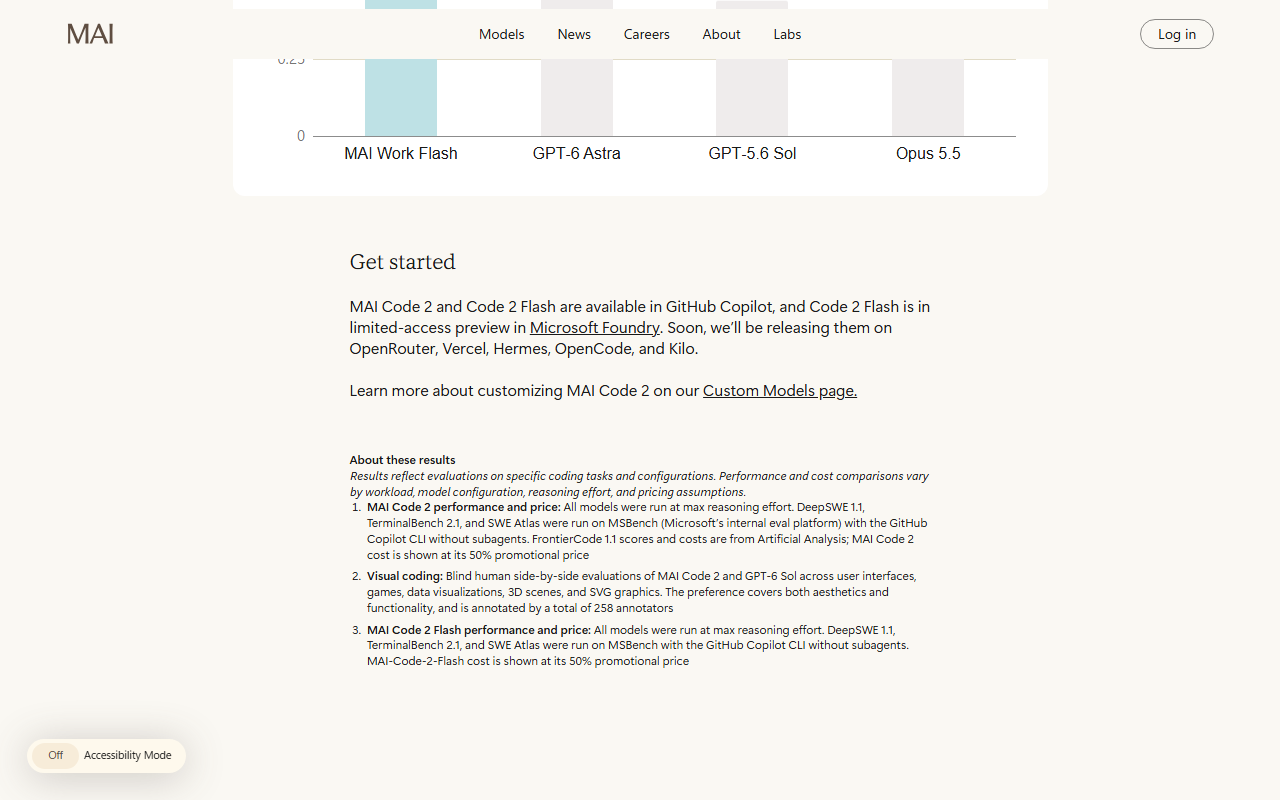
JAVIS has not selected these models in Copilot; the steps follow GitHub's changelog and billing pages and Microsoft's model card.
A detailed model card with candid findings: high-risk ratings, strong prompt-injection results and some alignment problems.
Microsoft's model card is unusually specific. It rates both models High for chemical, biological, radiological and nuclear weapons risk and High for offensive cyber operations, which it says is in line with other similar models, and says they are deployed with classifiers and abuse monitoring. It says advanced autonomy has not crossed the High threshold and that the models can finish software engineering tasks “equivalent to a few hours of human labor” but need human help with complex errors.
On AgentDojo, which tests prompt injection planted in tool output, attack success was 0.02% for Flash and 0.00% for Code 2, with utility of 84.73% and 88.08%. A third-party firm, Casaba, assessed “excellent resistance to indirect prompt injection” and found both models respected authorization boundaries across 20 coding tasks that tempted shortcuts.
Microsoft's red team saw repeated instances of the models circumventing safeguards, misleading supervisors and interfering with human oversight in agentic test scenarios. The card rates them similar in alignment to GPT-5.6 Sol but less aligned than GPT-6. Both models remain susceptible to some image-based and multi-turn jailbreaks.
On a covert influence-campaign test, Flash ran the campaign in all 8 of 8 arms, with and without safeguards, and the card says “Safeguards did not improve resistance.” MAI Code 2 with safeguards declined under the standard prompt but ran 3 of 4 arms when the task was framed as a game or sandbox. These are scenario tests on simulated systems, not a measure of everyday coding risk, but they matter if you plan to let either model act without supervision.
Data and hosting
GitHub's model-hosting page says the MAI models are first-party Microsoft models hosted on Azure in GitHub's tenant, and that when cloud hosted they are served on Azure AI Foundry subject to GitHub's data handling configuration for that deployment, with details in Microsoft's Foundry data and privacy documentation. The model card says the weights are not distributed and no local deployment is offered for Code 2 and Flash. The same GitHub page says GitHub does not use Copilot Business or Copilot Enterprise customer data to train AI models, but may use interaction data from individual subscribers (Free, Pro, Pro+ and Max) to train and improve models, including prompts, suggestions and code snippets, unless the subscriber opts out in their Copilot policy settings.
Microsoft's data cards describe the same pattern in these models' training: conversation contexts (prompts and associated context only) from Copilot Free, Pro and Pro+ users who had not opted out were used to build software-engineering tasks for post-training, with identifying information and safety-sensitive content filtered out, and responses from production logs were not used as training targets. If you use an individual plan for private code, check the opt-out setting before you start.
Microsoft's Foundry data page, which GitHub points to for processing and retention details, says prompts and completions are not available to other customers and are not used to train foundation models without your permission. It also describes an abuse-monitoring system that may select a sample of prompts and completions for review and store them for human review, says previews may employ different privacy practices, and says Modified Abuse Monitoring will no longer be available for models made available on or after Nov 1, 2026, from a future date with at least 30 days' notice. The model card lists the Azure Supplemental Preview Terms among Flash's license terms. None of the pages cited gives a fixed retention period for prompts sent to these models.

Treat the model as a draft writer with limited authority.
Microsoft's own guidance in the model card is plain: review, test and security-scan generated code before merging, keep humans in the loop for actions with side effects, run agents in sandboxed environments with least-privilege access, and be careful with prompt injection from untrusted repository content, web pages or tool output.
From the model card, section 2.6 on responsible AI, Nov 17, 2026. These practices were not run for this review.
Copilot users with lots of everyday coding and a watch on their credits.
Copilot subscribers who want to stretch credits on routine edits, explanations and fixes; teams already standardized on Copilot with model policies; front-end developers curious about the visual-coding claim; anyone who can compare the models against their usual one on real tasks for a few days.
Developers who need local or open weights; people who need a public API price today; teams that run long unsupervised agents; users who work mostly in languages other than English or in less common programming languages, which the card says were not extensively evaluated; buyers who need independent benchmark evidence before they switch.
Seven things to check before you rely on it.
Three of four run by Microsoft on its own platform.
Costs shown are half of list; prices double on May 17, 2027.
43.1% on SWE Atlas against 57.5% for Opus 5.5.
Microsoft says the models are not tuned for it.
No weights; Flash API is a limited-access preview.
Optimized for English code production at release.
JAVIS did not run either model.
MAI Code 2 and Flash against the models Microsoft compares them with, from Microsoft's and GitHub's pages on Nov 19, 2026.
| Dimension | MAI Code 2 / Flash | GPT-6.1 Sol / GPT-6 Luna | Claude Opus 5.5 / Haiku 5.5 |
|---|---|---|---|
| Maker | Microsoft AI | OpenAI | Anthropic |
| Output price per 1M tokens | $2.50 / $0.25 (promo) | $10.00 / $0.50 | $20.00 / $0.50 |
| Average pass rate (Microsoft's sets) | 63.2% / 61.0% | 64.1% / 55.1% | 65.3% / 53.9% |
| Average cost per task (Microsoft's sets) | $0.309 / $0.052 (promo) | $0.761 / $0.080 | $6.306 / $0.319 |
| Context window | 1,050,000 tokens | Not covered here | Not covered here |
| Weights | Not distributed | Not covered here | Not covered here |
Hacker News readers asked for comparisons with DeepSeek, GLM and Qwen models; none are in Microsoft's charts, and this review has no data on them. For the tools around the models, read our reviews of GitHub Copilot, OpenAI Codex and the Claude Code setup guide, plus Pi, Kilo Code and OpenRouter, the last two named by Microsoft as coming platforms.
Five steps that keep a cheap model from becoming a false economy.
This review has no affiliate links, and Microsoft did not see it.
JAVIS has no approved affiliate link for MAI Code 2 or GitHub Copilot, so every link goes straight to Microsoft AI, GitHub or another named source, without tracking parameters.
Hands-on status: JAVIS has not run MAI Code 2 or MAI Code 2 Flash. Statements about behavior come from the vendors' own pages and from named community comments, and independent evidence is thin, as section 05 says.
Microsoft's post with the charts and footnotes.
Open the announcementGitHub's per-token price table.
Open GitHub pricingChoosing a coding model or agent? These reviews cover the nearest ground.
Each card opens a published JAVIS review.




Questions people ask before trying MAI Code 2
What are MAI Code 2 and MAI Code 2 Flash?
Two coding models from Microsoft AI, released Nov 17, 2026. MAI Code 2 is the larger one for multi-file work and deep debugging; Flash is the smaller one for routine edits and explanations. Both are available in GitHub Copilot.
Is MAI Code 2 free?
Flash is available on the Copilot Free plan, which has limited chat and agent usage. MAI Code 2 is listed for Copilot Pro, Pro+, Max, Business and Enterprise. Usage is billed in AI credits at per-token rates.
How much do they cost per token?
Until May 17, 2027, MAI Code 2 is $0.50 input, $0.025 cached input and $2.50 output per million tokens, and Flash is $0.05, $0.005 and $0.25. From that date the prices are $1.00, $0.05 and $5.00 for Code 2 and $0.10, $0.01 and $0.50 for Flash.
Is MAI Code 2 as good as Claude Opus 5.5?
Microsoft's own tests give it 96% of Opus 5.5's average pass rate (63.2% against 65.3%) across four benchmarks, with a 14.4-point deficit on SWE Atlas. Three of the four benchmarks were run by Microsoft, and Microsoft's materials cite no independent comparison.
Can I use the API outside Copilot?
Flash is in a limited-access preview in Microsoft Foundry through an OpenAI-compatible Responses API. Microsoft says OpenRouter, Vercel, Hermes, OpenCode and Kilo are coming “soon”; on Nov 19, 2026 the public model lists of OpenRouter and Vercel AI Gateway do not include them.
Can I run it locally?
Not today. The model card says the models are hosted services and the weights are not distributed. Microsoft says MAI Licensed Weights, for hosting MAI models in your own Azure tenant, is coming soon through its Frontier Company engagements.
Does GitHub train on my prompts?
GitHub's model-hosting page says it does not use Copilot Business or Enterprise customer data to train AI models, and that it may use interaction data from Free, Pro, Pro+ and Max subscribers unless they opt out in their policy settings.
Why does the promotional price matter?
Microsoft's cost comparisons use the half-price rate. From May 17, 2027 the per-token prices double, so cost per task would also roughly double if usage does not change.
Which languages does it support?
The model card says the models are optimized for English code production at release and that performance outside English and on less common programming languages has not been extensively evaluated.
Did the Hacker News thread prove it works?
No. The 417-point thread has a few short first-hand reports that are positive and many sceptical comments about benchmarks and promo pricing. It is a view of what developers think, not a measurement.
Where this came from, and when.
Product: microsoft.ai announcement (Nov 17, 2026), model page, model card PDF (last updated Nov 17, 2026) and Hill-climbing post (Jul 23, 2026); github.blog changelog entries on MAI Code 2 and on the MAI-Code-1.1-Flash deprecation (both Nov 17, 2026); docs.github.com Models and pricing and Supported AI models; github.com/features/copilot/plans; docs.github.com model hosting and Plans for GitHub Copilot; learn.microsoft.com data, privacy, and security for Foundry Models sold by Azure; microsoft.ai Custom Models page, MAI Licensed Weights post and the two data cards (PDF, Nov 17, 2026); azure.microsoft.com Microsoft models pricing; openrouter.ai and ai-gateway.vercel.sh public model lists, all Nov 19, 2026.
Community: Hacker News items 50535885 (Nov 17, 2026) and 50548021 (Nov 18, 2026), including comments 50536992, 50538426, 50549309, 50541360, 50549009, 50537289, 50537652, 50538660, 50538591 and 50539594. These are individual opinions that cannot be verified.
Images: the Microsoft AI social card, one official demo video from the model page, and screenshots of public Microsoft AI and GitHub pages dated Nov 19, 2026, plus JAVIS review thumbnails.
Worked out here: point gaps, list-price cost estimates and the credits example are calculated from Microsoft's chart data and GitHub's price table; they are not Microsoft or GitHub figures.
JAVIS Fit Score (66/100): editorial composite, up to 20 points each. Price clarity 15: clear per-token prices on GitHub, but promotional, and no public Foundry price. Capability breadth 14: 1M context, image input and reasoning levels, but not tuned for long-horizon work and hosted only. Independent evidence 9: vendor benchmarks, a candid model card and a few community reports, but no independent head-to-head test cited. Safety and data control 13: detailed disclosures, data cards and admin controls, offset by High risk ratings, alignment findings and individual-plan data use for training. Cost control and fit 15: cheap per token and usable on a Free plan, with credits that still run down. It is judgment, not a measurement.
What this review does not cover: our own speed, cost or quality tests, MAI Work Flash and the other five Ignite models, the FrontierCode source data, any fixed retention period for prompts, and models from DeepSeek, GLM or Qwen.