Pinecone Review 2026: New CEO, New Pricing Model, New Agent Engine
Pinecone is still the name most people say first when they mean "managed vector database" -- but the company behind it looks different than it did a year ago. In September 2025, founder Edo Liberty stepped back from the CEO seat to become Chief Scientist, and outside operator Ash Ashutosh took over -- a change reported alongside a since-abandoned exploration of a sale, cited at the time to intensifying competition and the loss of Notion as a customer. None of that paused the roadmap: 2026 shipped Dedicated Read Nodes (a real second way to pay for query capacity), Pinecone Nexus (an agent-facing "knowledge engine" that goes past search), and a full-text/hybrid search GA that quietly closes a gap competitors used against it. This review covers what actually changed, what it costs today, and whether the fundamentals still hold up against Qdrant, Weaviate, and Chroma.
| Founded | 2019, by Edo Liberty |
| 2025 leadership change | New CEO (Ash Ashutosh); founder → Chief Scientist |
| 2026 architecture default | Serverless (pods now legacy) |
| Cheapest paid plan | Builder, $20/mo flat |
| Newest product | Nexus, agent knowledge engine (GA Aug 6, 2026) |
Pinecone spent 2025 answering "who's driving this thing," and 2026 answering "why does this still need to exist."
"In September 2025, Pinecone's own founder handed the CEO title to an outside operator and moved into a research role -- a change made public alongside reporting that the company had quietly explored a sale, cited at the time to intensifying category competition and the loss of Notion as a customer. The current CEO says an acquisition is 'definitely not on the table right now.' Whatever you make of the boardroom story, the product side didn't pause: Dedicated Read Nodes gave high-QPS customers a real fixed-cost alternative to per-query billing, and Pinecone Nexus arrived as a genuinely new bet -- an agent-facing knowledge layer that goes past 'store some vectors, get some back.' This review is about whether the fundamentals hold up once you look past the leadership headline."
That's not a hostile read -- Pinecone still created this category, still runs a real managed service at real scale, and its own CEO makes a fair point when he frames the more serious long-term threat as hyperscalers bolting vector search onto platforms customers already pay for, not a rival startup. But a named customer departure and a reported sale process are real facts worth stating plainly, not smoothing over.
One serverless vector database, now wrapped in two very different "do more for me" products.
Pinecone today is four things under one name. The Database is the original product: a fully managed, serverless vector index -- pod-based indexes are legacy technology now, unavailable to any Standard or Enterprise account created after August 18, 2025. Pinecone Assistant is a managed RAG layer that handles ingestion, chunking, embeddings, retrieval tuning, and citations for you. Pinecone Inference is hosted embedding and reranking models billed per token. And Pinecone Nexus, the newest and most ambitious piece (GA August 2026), compiles an organization's scattered data into a governed knowledge layer that AI agents query directly, instead of re-assembling context from raw documents on every call.
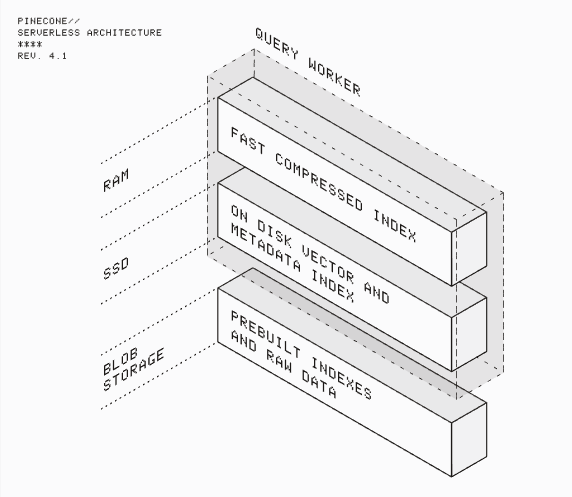
The one-sentence version: if your problem is "store and query vectors, I'll handle the rest," the Database alone is still the whole answer. If your problem is "build a grounded chat or agent app without hand-rolling RAG plumbing," that's now Assistant or Nexus's job to sell you on.
The customer count still points up. The leadership chart and the "who's the real threat" answer both changed.
Up from "5,000+" at the Sep 2025 CEO announcement.
Cumulative reach figure, homepage, Sep 2026.
Seed + Series A + Series B, no round disclosed since 2023.
Pod-based indexes: legacy since Aug 18, 2025.
| Date | Event | Result |
|---|---|---|
| 2021 | $10M seed, led by Wing Venture Capital | Company still pre-mainstream; vector search not yet a household developer term |
| Mar 29, 2022 | $28M Series A, led by Menlo Ventures | New investor Tiger Global joins; disclosed capital reaches $38M |
| Apr 27, 2023 | $100M Series B, led by a16z | Valuation reaches $750M (last disclosed figure); total disclosed capital reaches $138M |
| Aug 31, 2025 | Reported sale exploration (Calcalist, citing The Information) | Cited factors: category competition + loss of Notion as a customer; no transaction resulted |
| Sep 8, 2025 | Founder Edo Liberty → Chief Scientist; Ash Ashutosh named CEO | Company states 5,000+ customers, $138M raised at the time of this release |
| Aug 6, 2026 | Pinecone Nexus reaches general availability | Agent-facing knowledge-engine product; the new CEO's most visible bet so far |
Developers still call it easy and fast. The bill and one named departure are the parts worth reading closely.
Recurring praise for ease of use, fast integration, and low-latency similarity search at production scale, with high reported uptime stability. Recurring criticism: pricing climbs fast on larger projects, and some reviewers wanted more depth for complex retrieval scenarios.
The longest-running independent complaint about Pinecone: cost relative to a self-hosted alternative once workload size is predictable. A widely-referenced thread is literally titled "Pinecone is an expensive online vector database that can easily be replaced with..."
On hyperscalers bolting on vector search: "it's like extending data in a format built for human consumption to a vector database built for AI consumption." His argument: purpose-built beats bolt-on at real production scale.
Four plans, a real free tier, and a new $20/month rung between "free" and "$50 minimum."
Starter
Up to 2GB storage, 2M write / 1M read units per month.
- Single project, up to 2 users
- us-east-1 only
Builder
Up to 10GB, 5M write / 2M read units, 5 projects.
- Choose your cloud and region
- Prometheus/Datadog monitoring
Standard
Pay-as-you-go: $4–4.50/M write units, $16–18/M read units.
- Dedicated Read Nodes available
- Backup/restore, RBAC, SSO
Enterprise
$6–6.75/M write units, $24–27/M read units.
- BYOC, private endpoints, CMK
- 99.95% uptime SLA, HIPAA included
Your plan depends on query volume and how predictable it is, not just data size.
Starter is genuinely free -- 2GB storage, 1M read units/month is enough to build something real.
Builder, $20/month flat, is a real middle rung most competitors don't offer.
Standard, $50/month minimum, on-demand billing scales with actual usage.
Standard or Enterprise with Dedicated Read Nodes -- fixed hourly node pricing instead of per-query billing.
Enterprise, $500/month minimum.
The real 2026 story isn't a new database. It's a second way to pay for the one you already have.
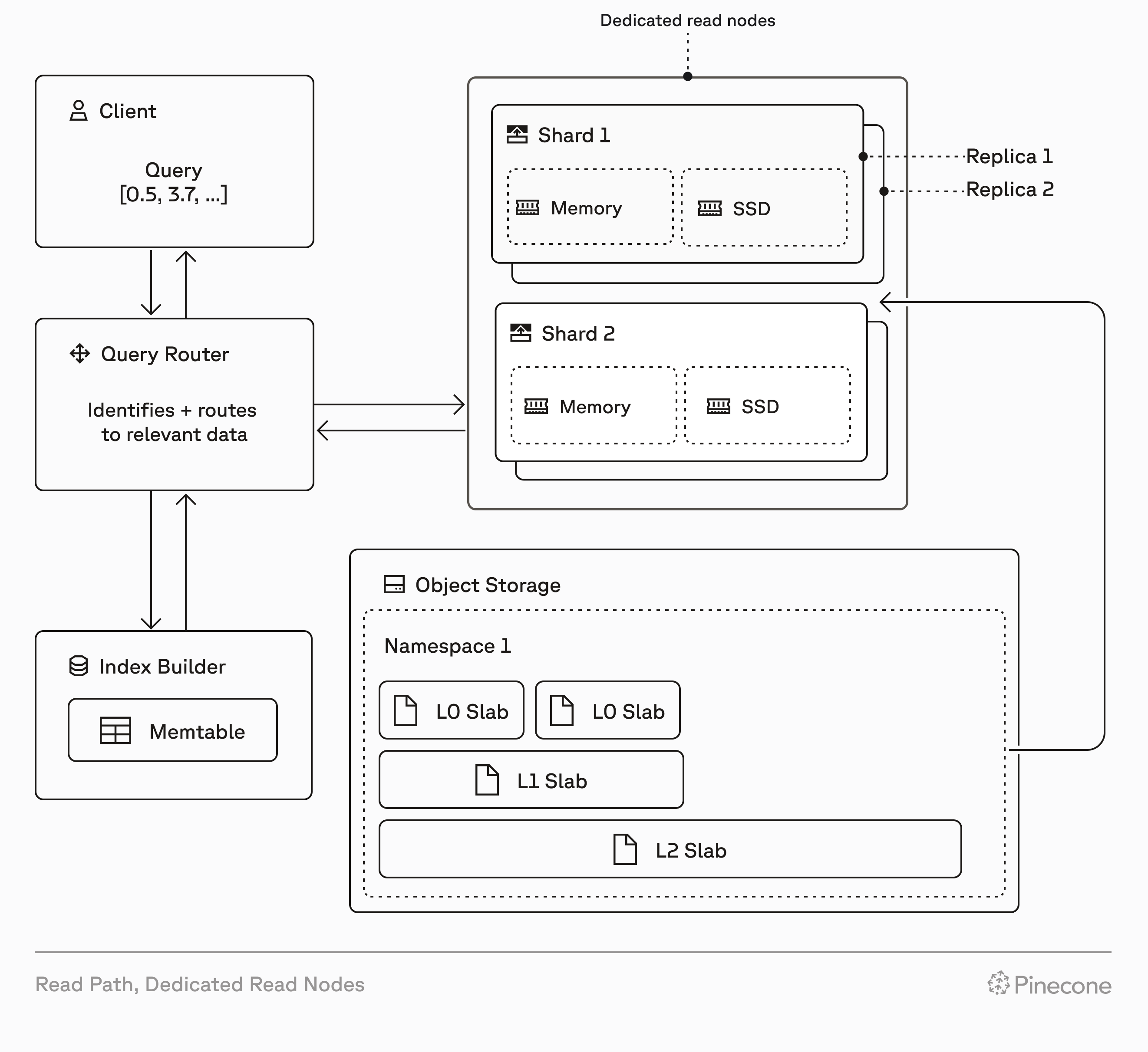
Dedicated Read Nodes (DRN) reached general availability on April 15, 2026, after a public preview. They give Standard and Enterprise customers a fixed-hardware alternative to per-request Read Unit billing: instead of paying per query, you provision b1 or t1 node types and pay a flat hourly rate -- calculated as node rate × shards × replicas -- plus the same usage-based storage, write, and egress costs as on-demand. Pinecone's own docs cite a b1 node on aws-us-east-1 at $0.46/hour (about $336/month); independent analysis (Orb) describes the t1 node as roughly 4x the compute/memory of b1 at about 3x the cost, though Pinecone's own docs don't publish a full side-by-side spec table.
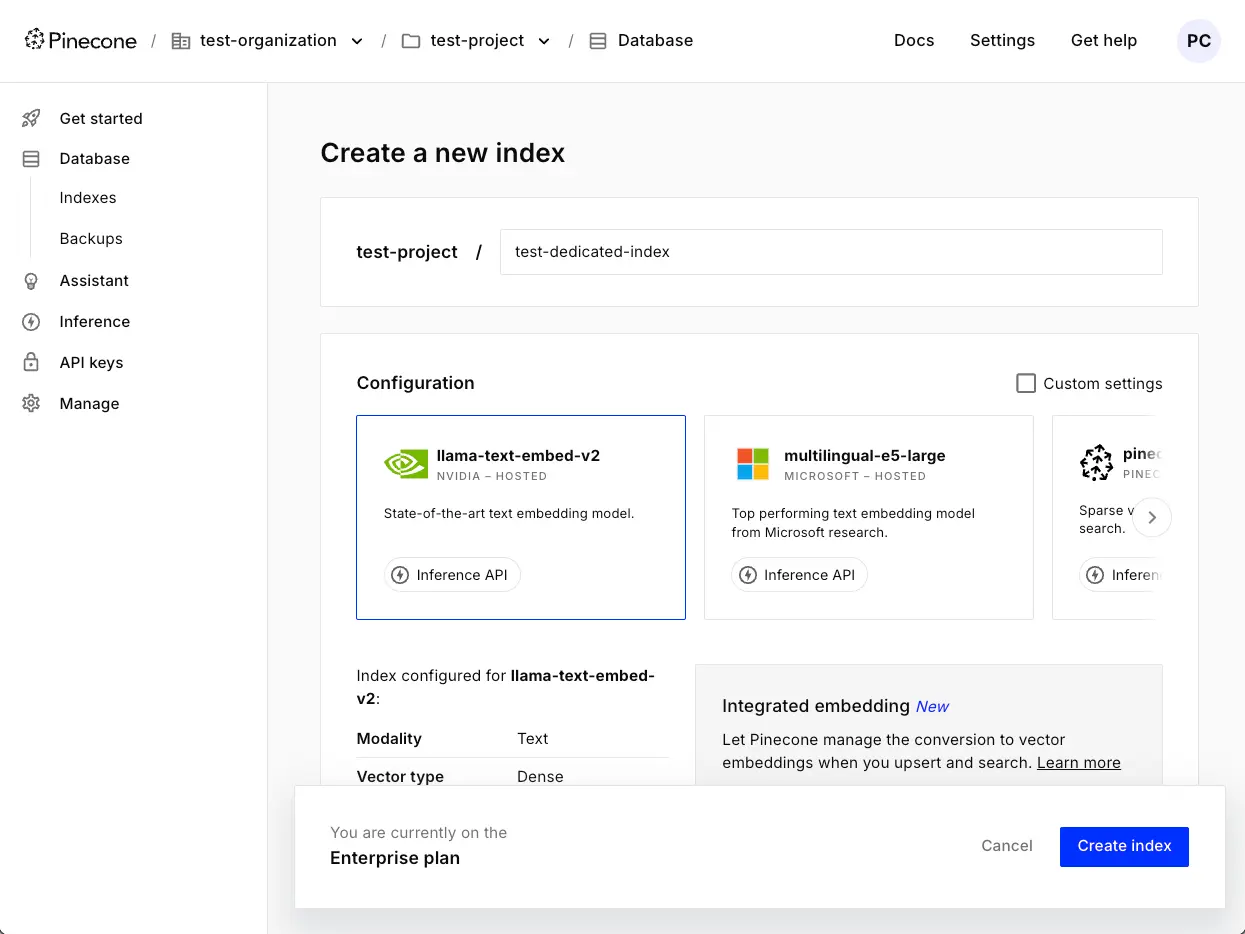
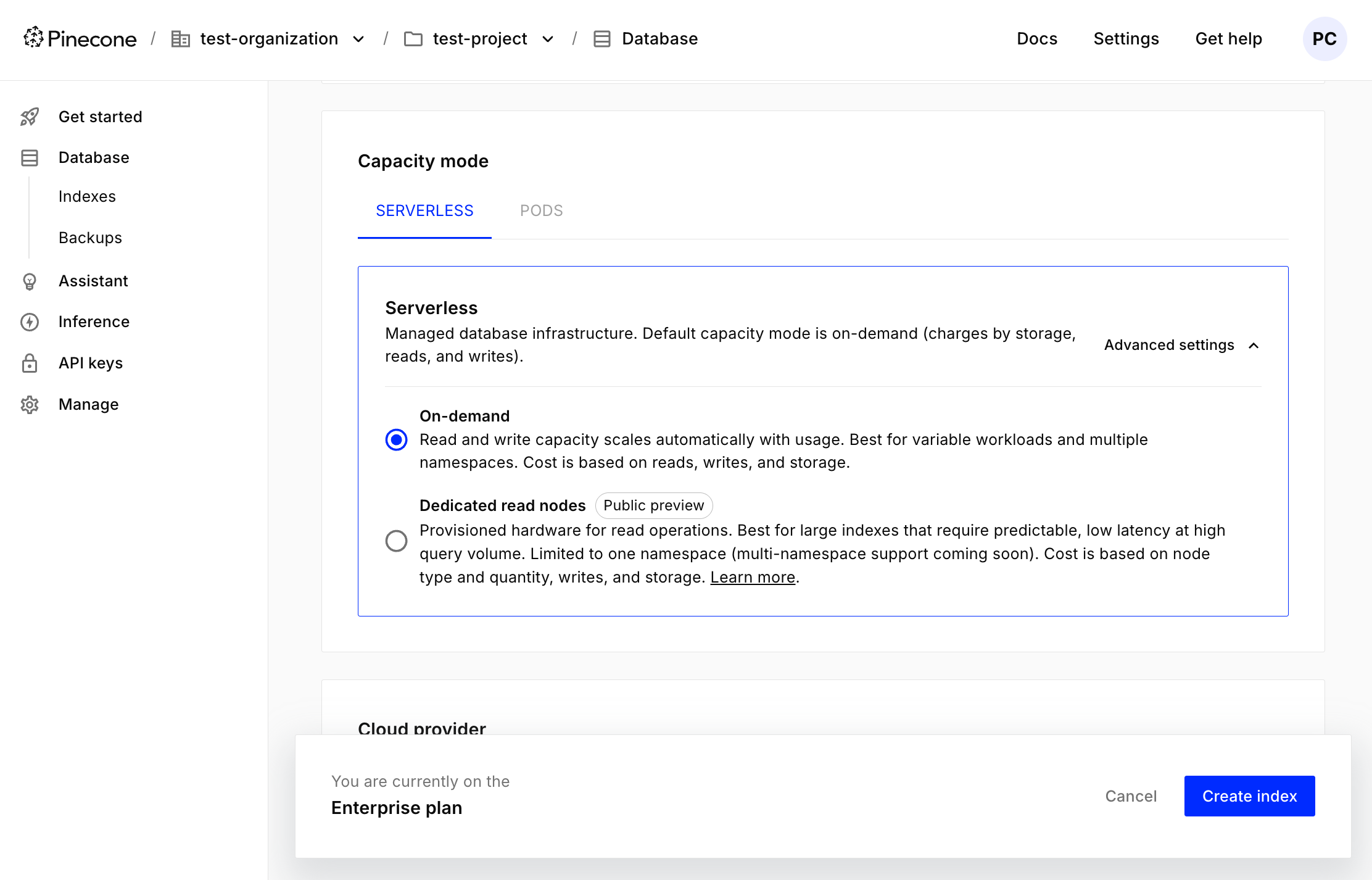
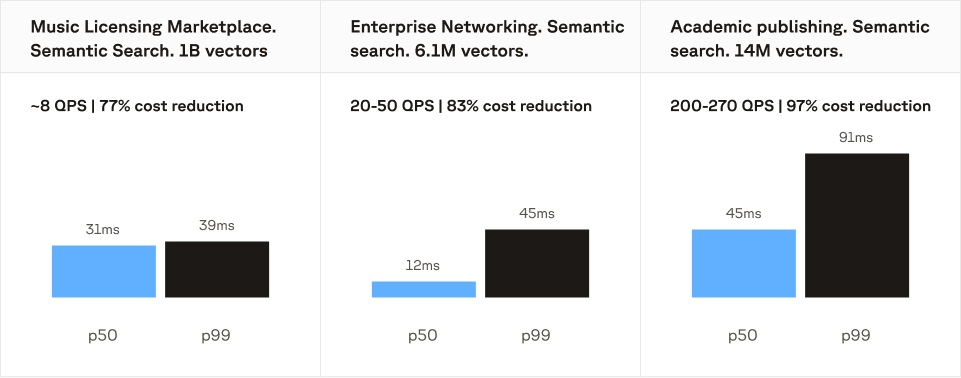
- Fixed hourly pricing genuinely removes the "surprise bill" risk for sustained, predictable high-QPS traffic.
- Pinecone's own docs recommend the switch specifically once a workload exceeds the 2,000 RU/second on-demand rate limit.
- Same durability/storage model underneath -- switching capacity mode isn't a data migration.
- DRN indexes support a single namespace today; multi-namespace needs Pinecone's early access program.
- The benchmark numbers above are Pinecone's own selected customer case studies, not an independent third-party audit.
- General availability is only months old (Apr 2026) — independent long-term production sentiment doesn't exist yet.
Create, choose a capacity mode, write, query — object storage does the heavy lifting underneath.
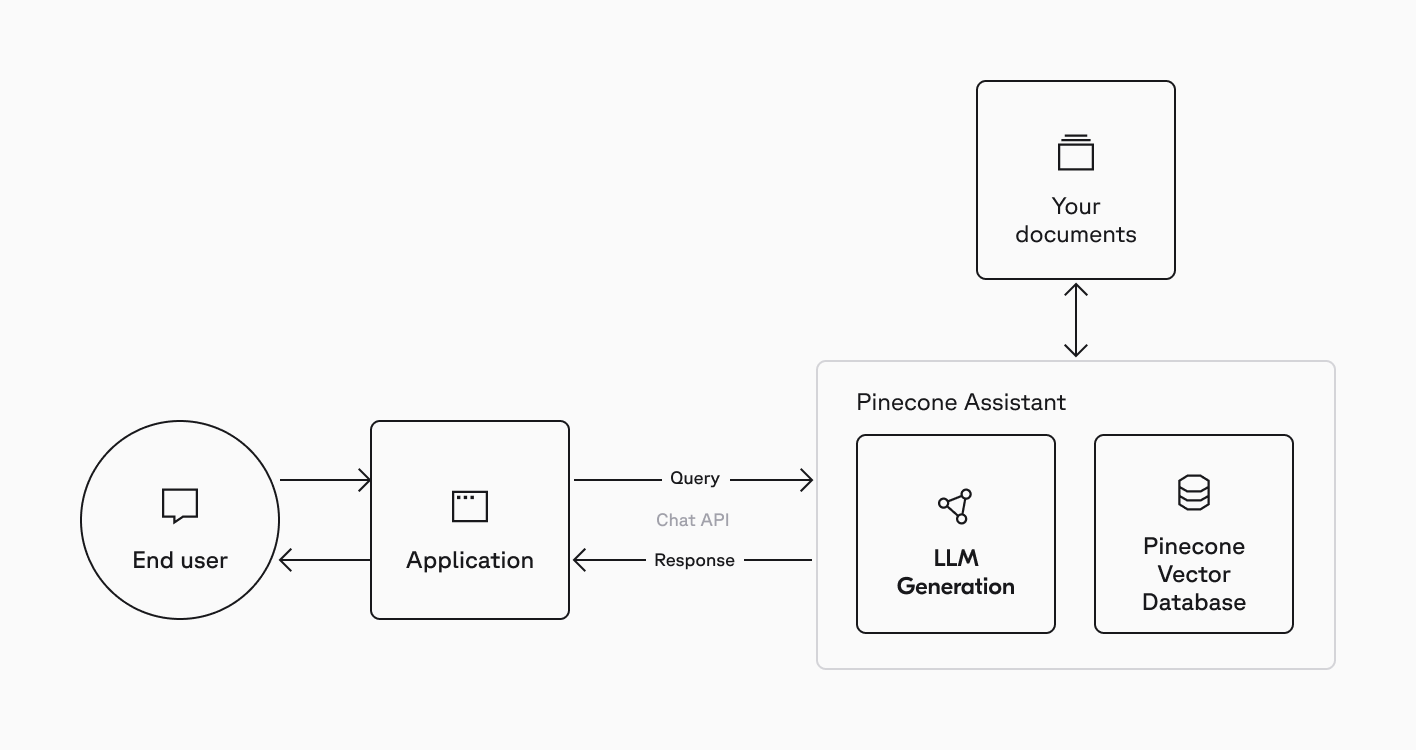
No browser automation here — but there is a second product doing the RAG plumbing for you.
Pinecone Assistant is a managed knowledge layer, not just a database: it handles document ingestion, chunking, embeddings, retrieval tuning, citations, orchestration, and evaluation as one API. On April 1, 2026, Assistant moved to fully usage-based pricing -- the earlier flat hourly per-assistant fee was removed, so Standard and Enterprise customers now pay only for ingestion, storage, and chat/context/evaluation tokens actually used.
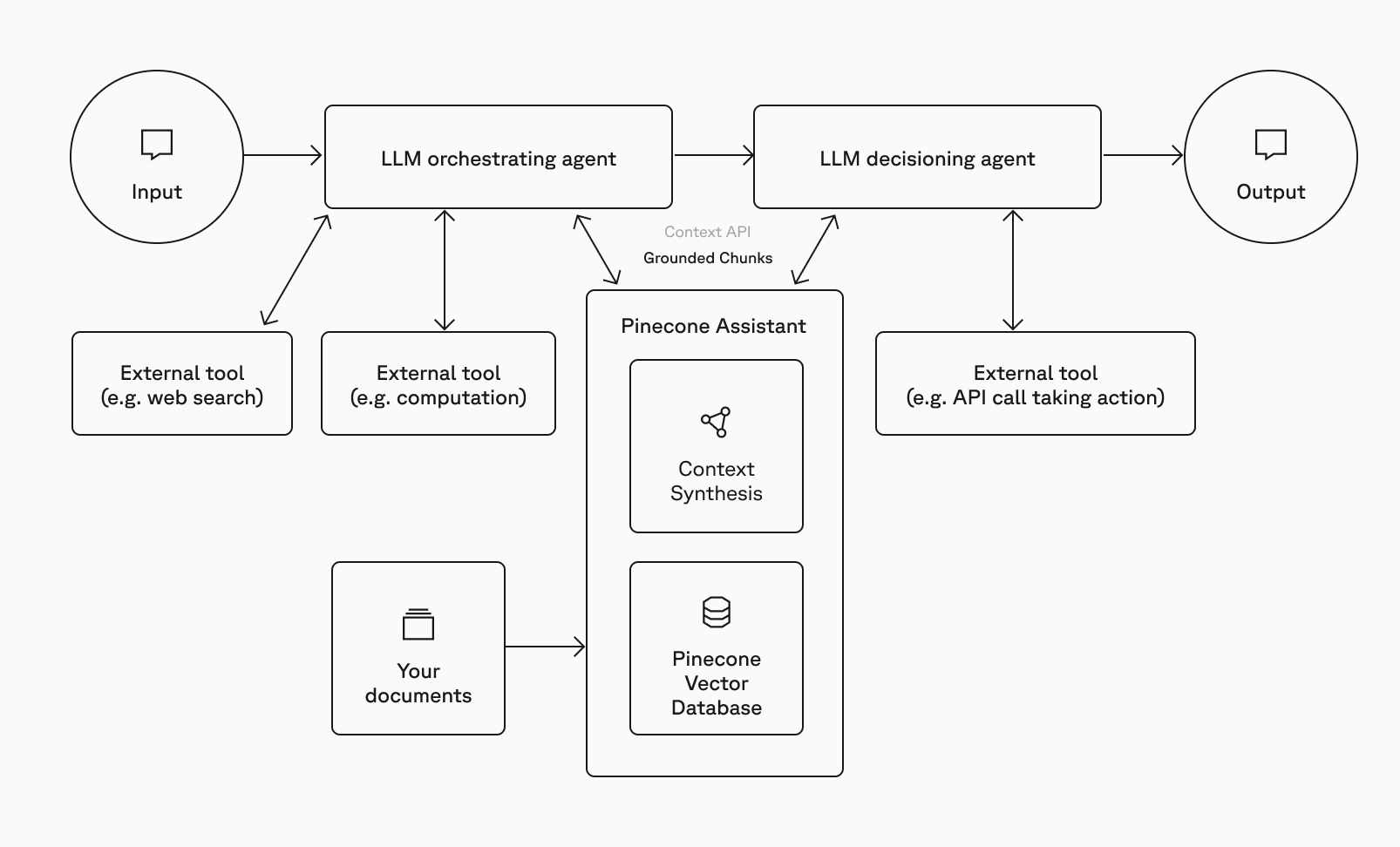
- Genuinely removes the boring RAG plumbing -- chunking strategy, retrieval tuning, and citation formatting are Pinecone's problem now, not yours.
- Usage-based pricing since April 2026 means no flat fee for an assistant sitting mostly idle.
- Assistant storage and token costs stack on top of whatever the underlying Database index already costs.
- Starter's free token allowance (500k input tokens/month) is modest -- fine for testing, not for production chat volume.
Nexus is Pinecone's bet that "search" isn't the endgame — a governed knowledge layer agents query directly is.
Pinecone Nexus opened in public preview on July 1, 2026 and reached general availability on August 6, 2026. It compiles an organization's scattered data -- docs, wikis, databases, code repos, and connectors into Google Drive, Box, Slack, GitHub, Notion, Confluence, and S3 -- into a structured, governed knowledge layer that agents query in a single call through KnowQL, instead of re-assembling context from raw documents on every request. It deploys inside the customer's own cloud (BYOC, on AWS, Google Cloud, or Azure) with no standing Pinecone access to the data. Independent trade press reports company-stated results of task-completion rates above 90%, time-to-completion up to 30x faster, and token spend cut by up to 90% -- figures this article treats as company-reported, not independently benchmarked by JAVIS.
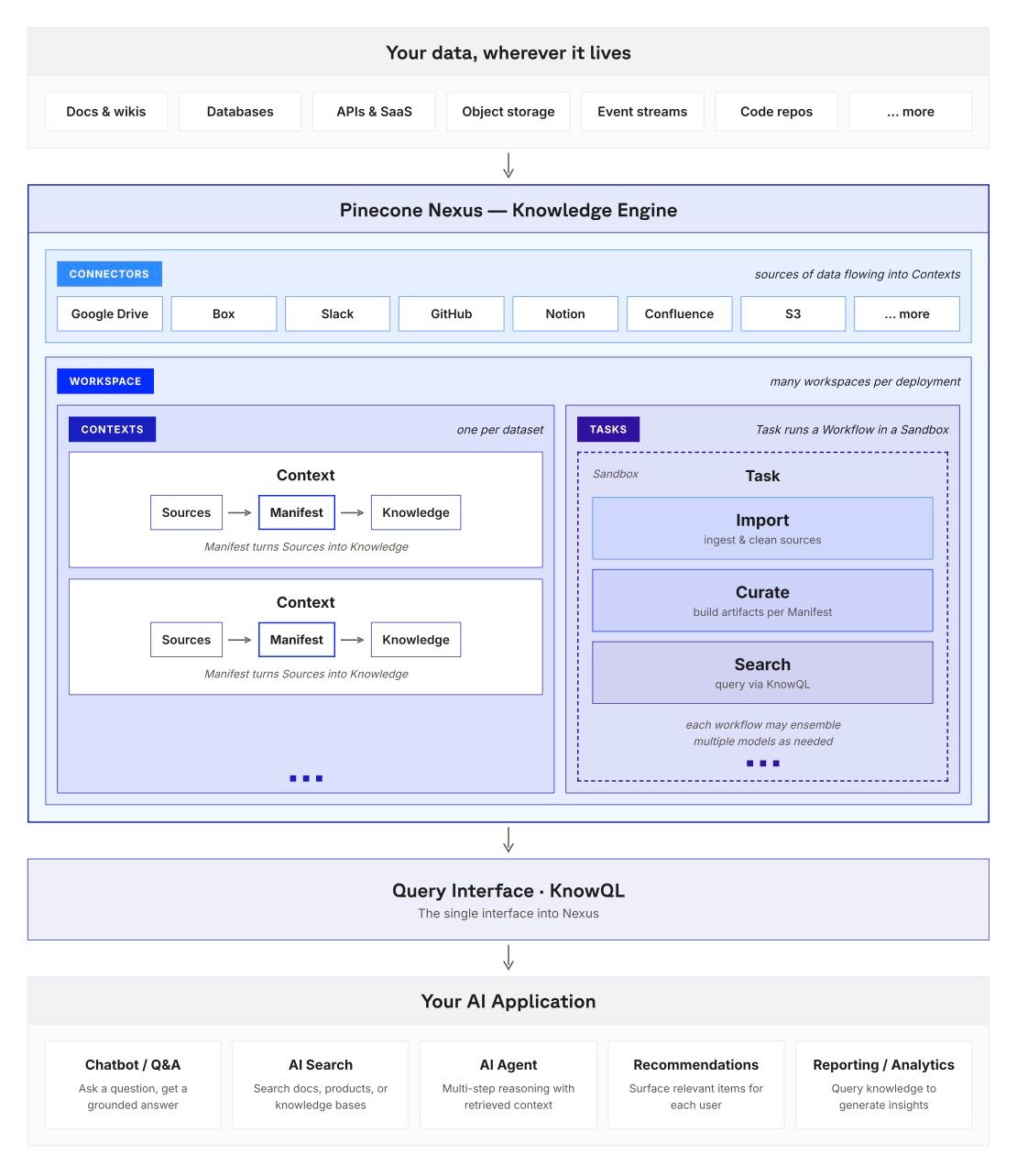
Published by the official "Pinecone" YouTube channel (youtube.com/@pinecone-io). Linked directly from Pinecone's own Nexus public-preview blog post.
MCP: three official servers, not one
Pinecone ships Model Context Protocol support as three distinct official servers: a remote Assistant MCP server, a local Assistant MCP server, and a local Developer MCP server for managing indexes and querying docs from inside an IDE. Configuration is documented for Claude Desktop, Claude Code, Cursor, and Antigravity.
You're billed on namespace size scanned and bytes written — not on how complicated your filter is.
| Dimension | Standard | Enterprise |
|---|---|---|
| Storage | $0.33/GB/mo | $0.33/GB/mo |
| Write Units | $4–4.50 per million | $6–6.75 per million |
| Read Units | $16–18 per million | $24–27 per million |
| Egress | 100GB/mo included, then $0.10/GB | 100GB/mo included, then $0.10/GB |
| Import from object storage | $0.25/GB | $0.25/GB |
| Dedicated Read Node (b1, aws-us-east-1) | $0.46/hour (~$336/mo) — cost = node rate × shards × replicas | |
top_k, include_metadata, and metadata filtering itself do not add extra RU cost. That directly contradicts some still-circulating 2023-era write-ups claiming filtered queries cost 5-10x more. Namespace size, not filter complexity, is what actually drives your bill.The certifications are real. Nexus adds a genuinely different data-access model on top.
The best fit depends on query pattern and appetite for operating your own infrastructure.
| Situation | Why Pinecone fits | Likely plan |
|---|---|---|
| Prototyping or a small side project | Genuinely free Starter tier, no card required | Starter |
| Solo developer or small team shipping something real | A real $20/mo flat middle rung | Builder |
| Production RAG/agent app with variable traffic | On-demand billing scales with real usage, zero ops | Standard |
| Sustained high-QPS production traffic (recommendations, search) | Dedicated Read Nodes give fixed, predictable cost | Standard or Enterprise + DRN |
| Regulated enterprise (finance, healthcare) needing BYOC/HIPAA | SOC2/HIPAA/GDPR/ISO27001, private endpoints, CMK | Enterprise |
| Team that wants to self-host or avoid any vendor lock-in by design | Pinecone has no self-hosted or open-source path at all | Consider Qdrant, Weaviate, or Milvus instead |
Five real gaps, not manufactured ones.
Every alternative in this category (Qdrant, Weaviate, Chroma, Milvus, pgvector) offers a self-hosted or open-source option. Pinecone offers none -- it's managed-only, which is either the whole appeal or a dealbreaker depending on your risk tolerance for vendor lock-in.
Even though the current RU billing model doesn't punish metadata filtering the way older write-ups claim, "cost climbs fast on larger projects" is the single most repeated theme across G2 and three years of Hacker News threads.
Notion's departure was cited, alongside category competition, as a factor behind Pinecone's own 2025 sale exploration -- a real, dated, sourced data point, not an anonymous forum complaint.
Dedicated Read Nodes (Apr 2026), Nexus (Aug 2026), and full-text search GA (Sep 2026) are all inside the last five months as of this review -- promising on paper, unproven in year-plus production stories yet.
Pinecone Marketplace entered public preview May 5, 2026 and reached end-of-life August 31, 2026 -- under four months. Worth knowing the company will kill an experiment quickly rather than let it linger, which cuts both ways.
If Pinecone's managed-only model doesn't match your problem, here's how to think about it.
| If you mostly need... | Compare Pinecone with... |
|---|---|
| Best price-performance if you're willing to self-host or manage your own cluster | Qdrant (JAVIS review) — Apache-2.0, 34,754 GitHub stars, Rust-based |
| Mature native hybrid (BM25 + vector) search and a broad module ecosystem | Weaviate (weaviate.io) — 16,837 GitHub stars, also reviewed by JAVIS |
| Fast local prototyping with a near-zero learning curve | Chroma (trychroma.com) — 29,355 GitHub stars, also reviewed by JAVIS |
| Very large-scale deployments with a managed option too | Milvus (milvus.io) — 46,217 GitHub stars, largest of this group |
| Vector search inside a Postgres stack you already run | pgvector (github.com/pgvector) — extension, not a dedicated database |
| "Good enough" vector search bundled into a platform you already pay for | Hyperscaler-native (AWS OpenSearch, Google Vertex AI, Databricks) — the threat Pinecone's own CEO names as most serious |
Pinecone does run public affiliate and referral programs — JAVIS is not currently enrolled in either.
Pinecone operates an application-gated Affiliate Program and Referral Program via PartnerStack (pinecone.io/partners/), unlike some products JAVIS has reviewed where no such program exists at all. JAVIS has not applied to or been approved for either program, so no tracking link exists for this review. Every CTA in this article points to Pinecone's official site, unmodified.
Go to the official product.
Open PineconeRead the comparison that matches your real question.
Choose the next articlePinecone sits inside the same vector-database category as two more JAVIS reviews, plus the model layer it's often paired with.




Questions people are actually searching right now
Is Pinecone still run by its founder?
No. On September 8, 2025, founder Edo Liberty moved from CEO to Chief Scientist, and Ash Ashutosh -- a three-time founder/CEO, most recently at Google -- became CEO. Liberty continues focusing on the company's technical/research direction.
Was Pinecone acquired, or is it for sale?
Pinecone reportedly explored a sale in mid-2025 (Calcalist, citing The Information), engaging bankers and naming Oracle, IBM, MongoDB, and Snowflake as possible acquirers, citing competition and the loss of Notion as a customer. No transaction resulted, and current CEO Ash Ashutosh has said acquisition is "definitely not on the table right now."
What is Pinecone Nexus?
An agent-facing "knowledge engine," GA since August 6, 2026. It compiles an organization's data into a structured, governed layer that AI agents query directly via KnowQL, instead of re-assembling context from raw documents on every call. It deploys inside the customer's own cloud (BYOC).
How much does Pinecone cost in 2026?
Starter is free. Builder is $20/month flat. Standard starts at a $50/month minimum (pay-as-you-go: ~$4-4.50/M write units, ~$16-18/M read units, $0.33/GB/mo storage). Enterprise starts at $500/month minimum with higher per-unit rates and full compliance features.
Are pod-based indexes still available?
Only for existing users. Any Standard or Enterprise account created on or after August 18, 2025 cannot create new pod-based indexes -- serverless is now the only path for new projects.
What are Dedicated Read Nodes and when should I use them?
A fixed-hourly-cost alternative to per-query Read Unit billing (GA since April 15, 2026), recommended once a workload exceeds the 2,000 RU/second on-demand rate limit or needs predictable cost at sustained high QPS. Currently limited to a single namespace per index.
Does Pinecone support hybrid or full-text search now?
Yes, as of September 2, 2026: full-text search and the new Documents API reached general availability, combining BM25, dense, and sparse ranking in one schema-based index. Some still-circulating 2026 comparison articles claiming Pinecone lacks hybrid search predate this GA.
Pinecone vs Qdrant vs Weaviate vs Chroma — which should I pick?
Pinecone: zero-ops managed, no self-hosting, priciest at scale. Qdrant: best self-hosted price-performance. Weaviate: most mature native hybrid search. Chroma: fastest to prototype locally. All three open-source options are reviewed separately by JAVIS.
Does Pinecone have an affiliate program?
Yes -- an application-gated Affiliate Program and Referral Program via PartnerStack. JAVIS is not currently enrolled in either; every link in this review points to Pinecone's official site unmodified.
Where this came from, and when it was checked.
Leadership change: pinecone.io/newsroom/next-chapter/ and pinecone.io/blog/growing-ai-ambitions/ (official, Sep 8, 2025).
2025 sale exploration: Calcalist, citing The Information, calcalistech.com/ctechnews/article/rz31q82b5 (Aug 31, 2025) -- named Notion as a departed customer and competition as cited factors; no transaction resulted.
CEO acquisition denial: citybiz.co Q&A with Ash Ashutosh -- the page could not be read directly; quote corroborated via search-result context, flagged as lower-confidence sourcing.
Pricing (all four plans, unit costs): pinecone.io/pricing, taken directly from the live page, Sep 22, 2026.
Read Unit / Write Unit billing mechanics: docs.pinecone.io/guides/manage-cost/understanding-cost, official, Sep 22, 2026.
Dedicated Read Nodes (node types, pricing formula, namespace limit): docs.pinecone.io/guides/index-data/dedicated-read-nodes, official; node-type performance comparison (4x/3x) attributed to independent analysis (Orb), not Pinecone's own docs.
Pod-based index legacy status: docs.pinecone.io/guides/indexes/pods/understanding-pod-based-indexes, official.
2026 release timeline: docs.pinecone.io/release-notes/2026, official.
Nexus (public preview, GA, architecture diagram, video): pinecone.io/blog/pinecone-nexus-public-preview/ and pinecone.io/blog/knowledge-infrastructure-for-agents/, official; GA date corroborated by unite.ai independent trade press.
Assistant (architecture diagrams, pricing shift): pinecone.io/blog/assistant-managed-knowledge-layer/ and pinecone.io/blog/pinecone-assistant-generally-available/, official.
MCP servers: github.com/pinecone-io/pinecone-mcp and docs.pinecone.io/guides/operations/mcp-server, official.
Full-text search GA: pinecone.io/blog/full-text-search-generally-available/, official, Sep 2, 2026.
Security/compliance: pinecone.io/security/, official.
Funding timeline: pinecone.io newsroom (Series A, Series B press releases), official.
Competitor GitHub stats: GitHub data for github.com/{org}/{repo}, Sep 22, 2026.
Real screenshots/diagrams: all sourced from cdn.sanity.io URLs embedded directly in Pinecone's own official blog posts.
Official video: youtube.com/watch?v=yT9PwyLsSxk, authorship confirmed on YouTube (author "Pinecone", @pinecone-io), linked directly from the official Nexus blog post.
User sentiment: G2 aggregate (g2.com/products/pinecone/reviews) and Hacker News (news.ycombinator.com/item?id=35633460) -- neither could be read directly, so both are reported as lower-confidence, search-corroborated secondary sources rather than verbatim quotation.