
Podia Review 2026: What It Costs After the 2026 Price Rise, What the “New Podia” Changed, and Who Should Still Buy It
Podia is a single subscription for selling online courses, digital downloads, coaching, events and paid community access from your own website, with email marketing built in. On Podia's pricing page on Oct 26, 2026, Mover costs $49 a month or $42 a month billed yearly and takes a 5% fee on every sale, Shaker costs $99 or $84 with no Podia fee, and the new Earthquaker plan costs $179 or $150. Those prices rose between the Internet Archive's copies of May 20 and Jun 13, 2026: yearly billing went from $33 to $42 a month on Mover and from $75 to $84 on Shaker (+$9), and monthly billing from $39 to $49 and from $89 to $99 (+$10), the monthly figures appearing in the plan data of the Jun 13 copy, which displayed yearly prices by default. In the same window Podia capped products and videos by plan, and on Jun 1, 2026 it rebuilt the platform around a community home feed and required every account to move to it in a one-way migration. In September and October 2026 it added a built-in AI agent and a connector for Claude and ChatGPT.

There are no affiliate links in this review. Every Podia link goes straight to podia.com, its help center or its legal pages.
| Made by | Podia Labs, Inc., New York; in business since 2014, per its about page |
| What it is | Hosted platform for courses, downloads, coaching, events, paid community, website, blog and email |
| Plans | Mover $49; Shaker $99; Earthquaker $179 a month, or $42, $84 and $150 billed yearly |
| Fees | 5% per sale on Mover; Stripe or PayPal fees on every plan |
| Best for | Solo creators selling a handful of products to a small or mid-size list who want one simple tool |
Podia is still a simple all-in-one tool for a solo creator, but it now costs more, caps what it used to leave open, and asks you to accept a community-first design you cannot switch off at the account level.
“This is a one-way migration and cannot be reversed.”
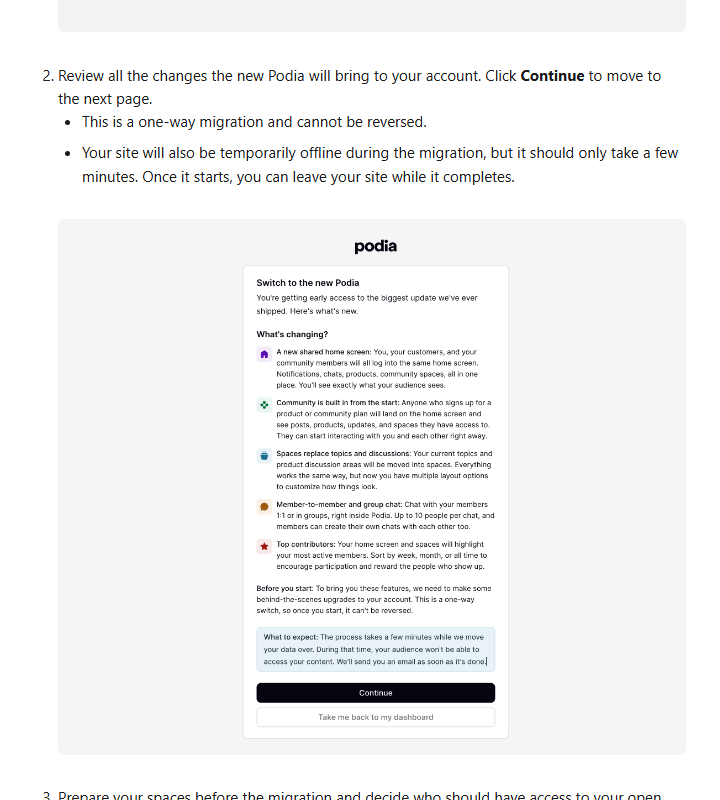
That line comes from Podia's own help article on moving to the “new Podia”, dated Jul 7, 2026. It sums up the year. Podia went live with a rebuilt platform on Jun 1, 2026, in which every buyer gets an account and lands on a shared home feed, community spaces are part of every site, and free community plans no longer exist. Podia said accounts that had not moved by early August would be migrated automatically. Between the archived pricing pages of May 20 and Jun 13, 2026, the two existing plans went up by $9 a month on yearly billing and $10 on monthly billing, a third plan arrived at $179 ($150 billed yearly), and plans that had listed unlimited products were given product and video caps.
None of that makes Podia a bad buy. It still bundles a website, blog, checkout, courses, downloads, coaching, events, paid community and email in one subscription with unlimited customers, and recent Trustpilot reviewers keep praising how easy it is to set up and how quickly support answers. For a creator with a handful of products and a list under a few thousand people, it remains a straightforward way to run the whole business in one place. The questions are narrower than before: whether the 5% Mover fee or the Shaker price is cheaper for your sales, whether 50 or 150 products is enough, whether your list fits the included email subscribers, and whether you are comfortable with members seeing each other by default.
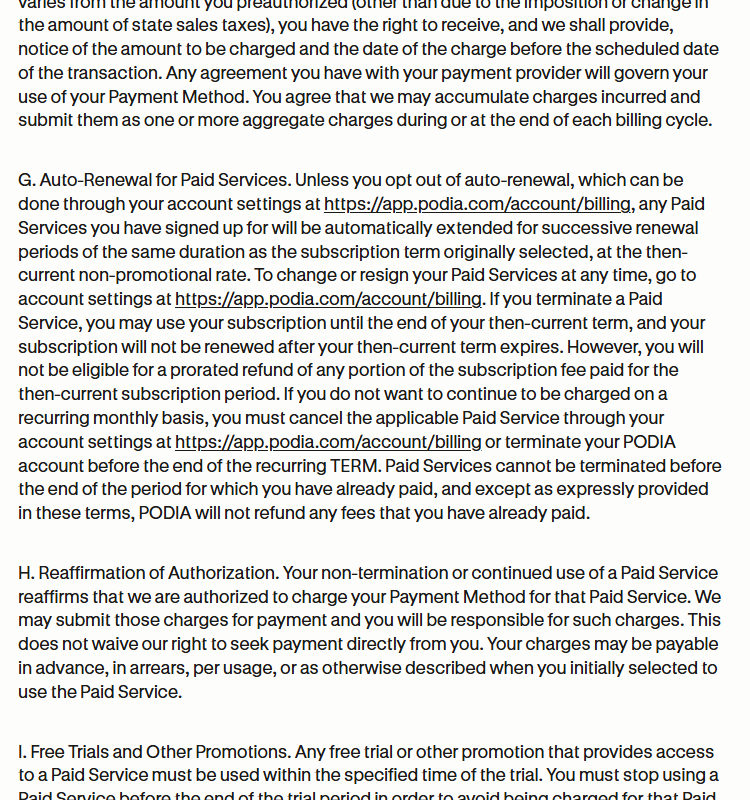
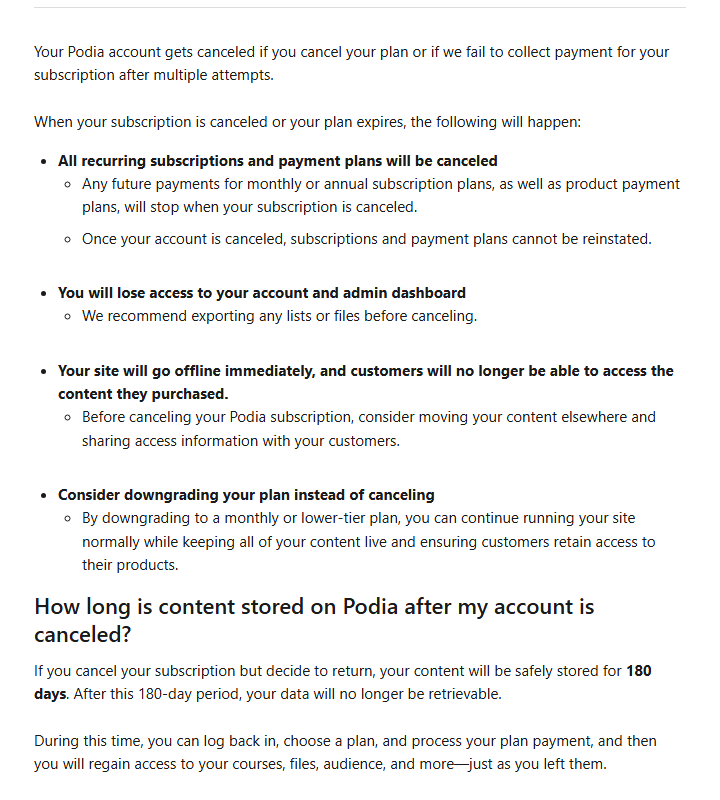
Two smaller risks matter at the edges. Refunds are tight: Podia refunds the most recent payment only if you ask within 72 hours of the charge, and its Terms of Service, effective Dec 12, 2024, say it will not refund fees already paid except as the Terms provide. And leaving is abrupt: when a plan ends, the site goes offline and customers lose access to what they bought, so you need your exports and a new home ready before you cancel.
One site, one checkout, one list: everything you sell lives behind the same login, and every buyer becomes a member of your community.
Podia is built around a single site per account. You create products (a course, a download, a coaching offer, an event, a bundle or a paid community plan), and each one gets a sales page and a checkout on your own domain. People who buy or sign up create an account and land on a home feed that shows their products, your announcements and any community spaces they can see. Email broadcasts and automated campaigns run from the same database, so the list knows who bought what. Payments go straight to your own Stripe account, or to PayPal on the two upper plans, and Podia keeps 5% of each sale only on Mover.

Podia's own 2026 demo, published on its official YouTube channel (@PodiaTV, linked from podia.com) on Jun 25, 2026, after the new Podia went live.
A rebuilt platform, higher prices with new caps, a shorter trial, and two AI features, all between late May and October 2026.
If you last looked at Podia in 2025, five things are different. The product changed shape: the “new Podia” announced on Jun 1, 2026 puts members, products and community in one home feed, removes free community plans and public topics, and lets members message each other. The migration was compulsory: Podia's help article of Jul 7, 2026 says you cannot reach your dashboard until you migrate, that the move cannot be reversed, and that remaining accounts would be migrated automatically in early August. Prices rose: the Internet Archive's copy of the pricing page from May 20, 2026 shows Mover at $39 a month ($33 billed yearly) and Shaker at $89 ($75), with “Unlimited products” on both; the copy from Jun 13, 2026 shows Mover at $42 billed yearly with 50 products, Shaker $84 with 150, and Earthquaker at $150, with monthly prices of $49, $99 and $179 in the page's plan data (the page displayed yearly billing by default). No copy exists between those two dates, so the change happened somewhere in that window. The trial shrank: the same archived pages offered 30 days in May and June, while the page and help center now offer 14. And AI arrived: Podia MCP on Sep 28, 2026 and Podia Agent on Oct 7, 2026, per Podia's changelog.



A small, private, self-funded company by its own account, with headline numbers that are all Podia's claims, and one of them changed by a factor of ten in 2026.
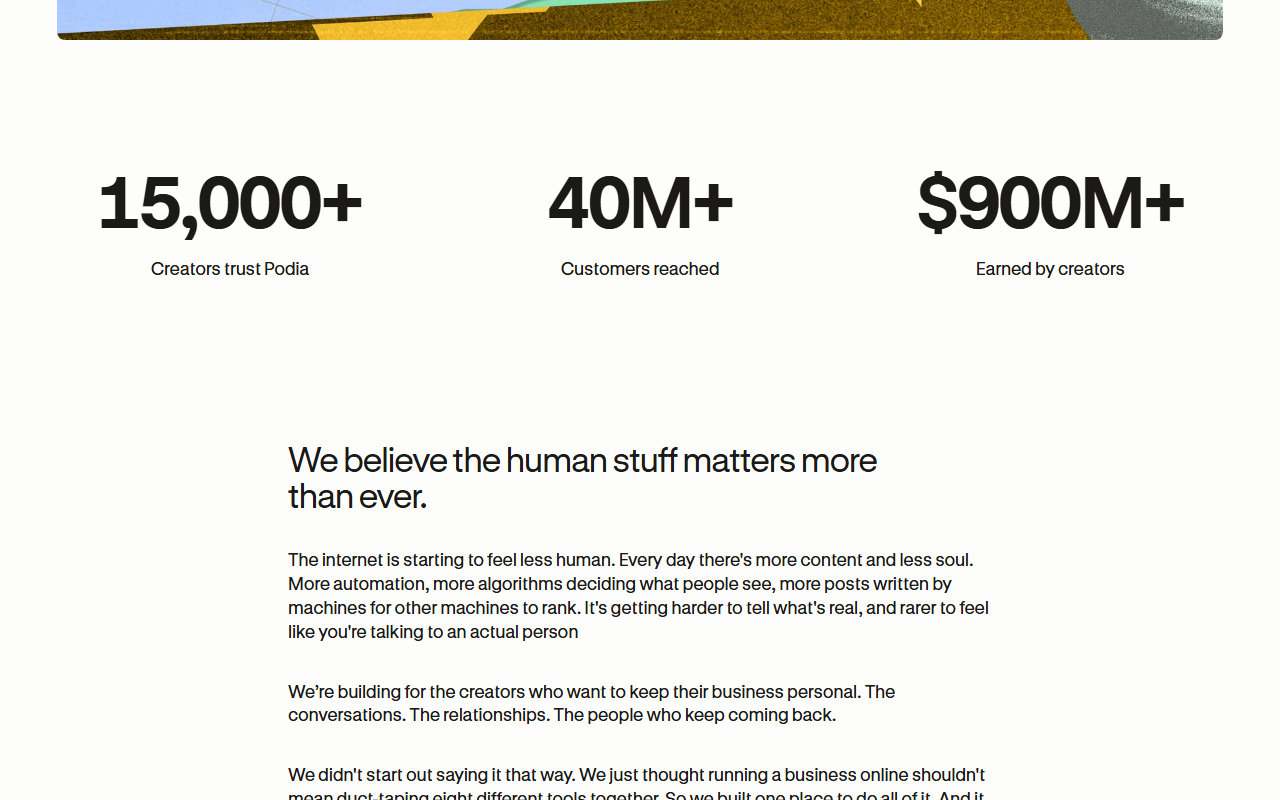
Podia does not publish audited figures, so everything about its size comes from Podia itself. Its about page says it has been operating since 2014, calls itself “a profitable, independent business”, and lists three numbers: 15,000+ creators, 40M+ customers reached and $900M+ earned by creators. Those measure different things. Creators are the people running sites on Podia; customers reached is the number of people who bought or signed up across all those sites, not Podia's own customers; and money earned by creators is sales volume, not Podia revenue.
Podia's figure, Oct 2026; was “Over 150,000 solo business owners” in May 2026
buyers and sign-ups across creators' sites, not Podia's customers
cumulative sales volume, not Podia revenue
“Great” from 153 reviews, Oct 26, 2026
The number to notice is the creator count. The Internet Archive's copy of Podia's pricing page from May 20, 2026 says “Over 150,000 solo business owners like you use Podia”. The about and pricing pages on Oct 26, 2026 say 15,000+ creators. Podia does not explain the difference, and the two may count different things (all accounts against active creators, for example), so we would not read it as a collapse. It does mean you should not compare the old figure with competitors' numbers.
| Signal | Figure | What it does and does not measure |
|---|---|---|
| Company | Podia Labs, Inc., New York; since 2014 | Private; its own description is “profitable, independent”. No funding or revenue figures published. |
| Accounts | 15,000+ creators (Oct 2026); over 150,000 solo business owners (May 2026) | Vendor claims with different wording; not a like-for-like series. |
| Free plan history | Removed Oct 14, 2024; “less than 0.5% of the sales volume” came from free accounts, per Podia | Explains why Podia now offers a 14-day trial only. |
| Reviews | Trustpilot 4.1 (“Great”) from 153 reviews | A small sample of self-selected reviewers; not market share or satisfaction across all users. |
| Mobile | No Podia app in a US App Store search (country=us), Oct 26, 2026 | Matches the help center's “No, we do not currently offer a mobile app.” Teachable and Kajabi list mobile apps on their pricing pages. |


Long-time creators praise the ease of setup and fast human support; the complaints are about the AI chatbot, email restrictions, and the community-first changes of 2026.
Independent evidence on Podia is thin. There is no Podia app in the US App Store to collect ratings, Hacker News mentions it mostly in passing, and we do not quote G2 or Capterra. The biggest sample among the sources in this review is Podia's Trustpilot page, which on Oct 26, 2026 showed a TrustScore of 4.1, rated “Great”, from 153 reviews. Trustpilot's own labels on the profile say Podia has “No recent history of asking for reviews” and has “Replied to 41% of negative reviews”. Its AI summary opens: “Considering 47 reviews, reviewers had a great experience with this company.” The topics it lists first are user experience, customer service and website. These figures change often.

Read together, the recent reviews describe two groups. Creators who have been on Podia for years, often coaches and course sellers with modest catalogs, describe setup as quick and support as unusually fast. A smaller group is unhappy, and their complaints cluster around three things: Podia's AI support bot (Podia calls it Penny) sending people the wrong way before a human steps in, restrictions on email sending, and the 2026 move to a shared, community-first experience.
“Podia sets the standard for customer service”
Review title. The reviewer adds that a person answers within a minute or two when the docs or AI do not.
“ease of set-up. It beats both Thinkific and Kajabi for both course and website set-up”
First of five reasons this reviewer gives for choosing Podia over Thinkific and Kajabi.
“my students get to grips with it very easily”
A course and community host of several years, on the member side of Podia.
“I chose Podia as a tool to run my own business, not as a social network.”
A long-time user leaving after the 2026 changes, who says “these major changes were imposed with no warning”.
“The backend is clunky and basic.”
About email limits during a launch. Podia replied that its team is “primarily staffed during U.S. East Coast business hours”.
“Got some problems with AI. Guess support needs to get better.”
Podia replied that its bot resolves “about 70% of support conversations on her own” and that a human is available on request.
“Leaving for a competitor and won't be coming back.”
After a launch where sales-page help and a Google Tag question went badly; Podia's reply disputes the account.
“gave me the chance to drop prices significantly since there's no platform cut anymore”
A programming course creator who moved from Podia to a self-built platform, with “all user accounts, subscriptions, and purchases carried over”.
“Typically replies within 48 hours”
Trustpilot's label for how Podia responds on the platform, next to “Replied to 41% of negative reviews”.
What this means for a buyer: the praise is consistent and specific (setup speed, sales pages generated for each product, a person on chat within minutes in US hours), and the complaints are the kind you can test in a 14-day trial. Write to support outside US East Coast hours and see how long a human takes; draft and schedule two emails a few hours apart to see the new-sender warm-up rule; and look at the member home feed from a test account before you decide whether your audience will welcome it.
Three plans from $42 to $150 a month billed yearly; the 5% Mover fee, the product and video caps and the email subscriber tier decide which one you really need.
All prices below are from podia.com/pricing on Oct 26, 2026, in US dollars (the page's product data lists USD). We viewed the page from Vietnam; the Internet Archive's copy from Oct 19, 2026 contains exactly the same plan prices, subscriber tiers and limits, so we take these to be the prices US visitors see. Sales tax is extra for US subscribers in nine states, per Podia's help center.
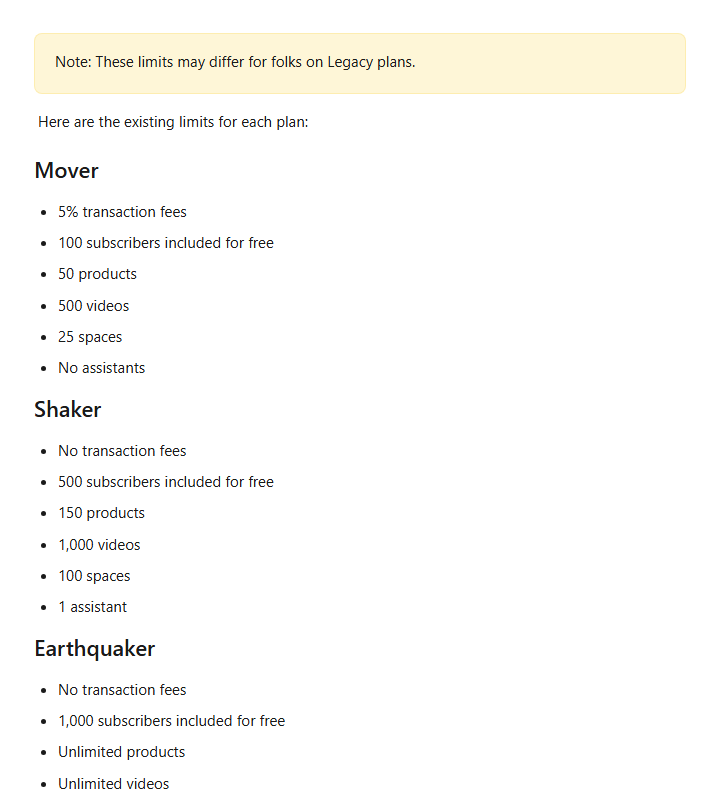
Mover
$42/mo billed yearly ($504)
- 5% Podia fee on every sale
- 100 email subscribers included
- 50 products, 500 videos, 25 spaces
- Podia Agent: 3 messages a day
- No assistants, no PayPal, no upsells, no Zapier
Shaker
$84/mo billed yearly ($1,008)
- No Podia fee
- 500 email subscribers included
- 150 products, 1,000 videos, 100 spaces
- Podia Agent: 15 messages a day, shared with your assistant
- 1 assistant, PayPal, upsells, Zapier
Earthquaker
$150/mo billed yearly ($1,800)
- No Podia fee
- 1,000 email subscribers included
- Unlimited products, videos and spaces
- Podia Agent: 30 messages a day
- Unlimited assistants
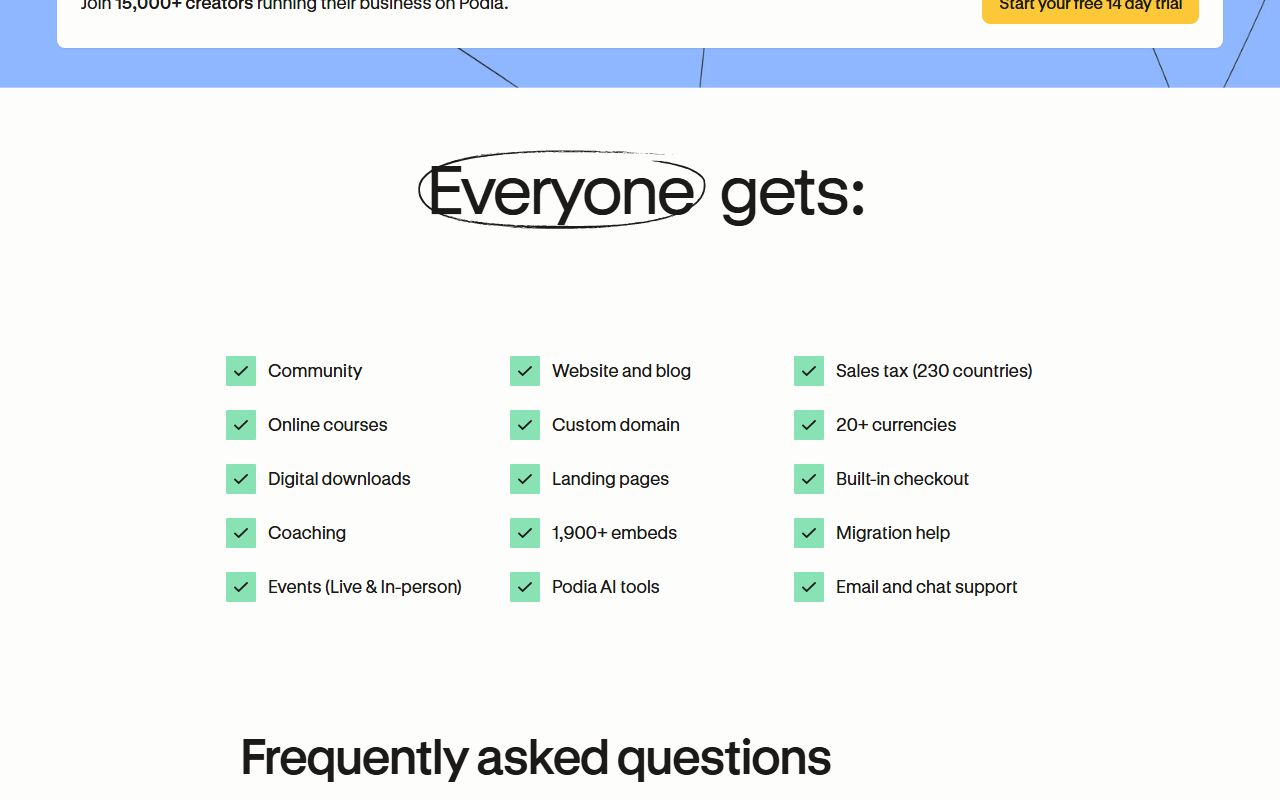
Every plan includes the same core tools: community, courses, downloads, coaching, live and in-person events, a website and blog, a custom domain, landing pages, embeds, checkout, sales tax calculation, more than 20 selling currencies, migration help, and email and chat support. Customers are unlimited on every plan. What changes is the money Podia takes per sale, how much you can store and sell, and how many email subscribers are included before the email add-on starts.

The email add-on is where the price climbs
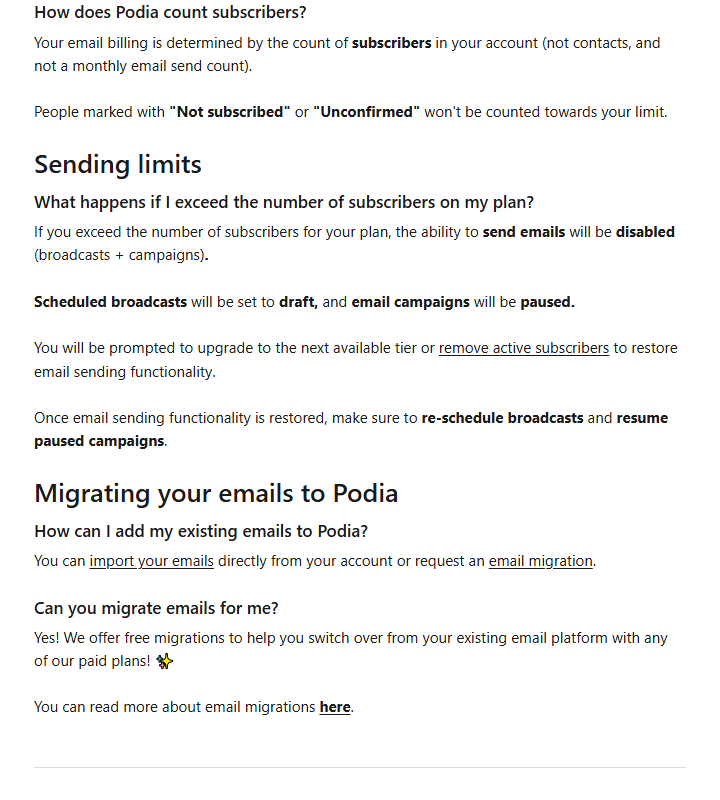
Each plan includes a fixed number of email subscribers. Above that, you choose a larger subscriber tier and the plan price rises. Podia counts only active subscribers (people marked as not subscribed or unconfirmed do not count), never upgrades you automatically, and switches off sending if you go over. Its help center gives the example that a list of 1,000 subscribers needs the 1,000-subscriber tier even if you only email a segment of under 100 people.
| Email subscribers | Mover | Shaker | Earthquaker |
|---|---|---|---|
| 100 | $42 ($49) | $84 ($99) | $150 ($179) |
| 500 | $50 ($59) | $84 ($99) | $150 ($179) |
| 1,000 | $56 ($67) | $98 ($117) | $150 ($179) |
| 2,500 | $64 ($77) | $106 ($127) | $172 ($207) |
| 5,000 | $78 ($94) | $120 ($144) | $186 ($224) |
| 10,000 | $98 ($119) | $140 ($169) | $206 ($249) |
| 25,000 | $150 ($184) | $192 ($234) | $258 ($314) |
| 100,000 | $362 ($449) | $404 ($499) | $470 ($579) |
Monthly cost billed yearly, with the monthly-billing price in brackets, from the subscriber tiers on podia.com/pricing, Oct 26, 2026. The add-on is the same on every plan for the same tier (for example $14 a month billed yearly for 1,000 subscribers); tiers continue to 500,000.


Podia's own walkthrough of the 2026 plans, published on @PodiaTV on Jun 25, 2026, after the 2026 price change.
The 5% Mover fee costs more than the Shaker upgrade once you sell about $840 a month, and Earthquaker was never the cheapest plan in our four setups.
Plan price is only part of the bill. On Mover, Podia deducts 5% of each sale before payout, and on every plan Stripe or PayPal takes its own fee. The arithmetic for Mover against Shaker is simple: on yearly billing Shaker costs $42 a month more, and 5% of $840 is $42, so above $840 of monthly sales Shaker is cheaper. On monthly billing the gap is $50, so the break-even is $1,000. If you also need 500 email subscribers, Mover rises to $50 a month billed yearly while Shaker stays at $84, and the break-even drops to $680.
Swipe sideways to see every column.
| Setup (yearly billing) | Stripe fees | Mover total | Shaker total | Earthquaker total |
|---|---|---|---|---|
| A. First product: $500 a month from 25 sales of $20; 100 subscribers | $22.00 | $89.00 (17.8%) | $106.00 (21.2%) | $172.00 (34.4%) |
| B. Growing: $2,000 a month from 40 sales of $50; 1,000 subscribers | $70.00 | $226.00 (11.3%) | $168.00 (8.4%) | $220.00 (11.0%) |
| C. Established: $5,000 a month from 50 sales of $100; 5,000 subscribers | $160.00 | $488.00 (9.8%) | $280.00 (5.6%) | $346.00 (6.9%) |
| D. Newsletter first: $300 a month from 10 sales of $30; 10,000 subscribers | $11.70 | $124.70 (41.6%) | $151.70 (50.6%) | $217.70 (72.6%) |
Monthly totals = plan price for the subscriber tier (billed yearly) + Podia's 5% fee on Mover + Stripe's US rate of 2.9% + 30¢ per domestic card sale. Percentages are the total as a share of monthly sales. Lowest total in bold. International cards add 1.5% and currency conversion 1% at Stripe, per its US pricing page on Oct 26, 2026. Sales tax, refunds and chargebacks excluded.
Two patterns stand out. First, Earthquaker never wins on price in these setups: its extra $66 a month over Shaker (billed yearly) buys capacity, not savings, so it only makes sense when you pass 150 products, 1,000 videos or one assistant. Second, for a newsletter-heavy business with little revenue (setup D), Podia becomes an expensive email tool: at 10,000 subscribers the cheapest Podia plan costs $98 a month billed yearly before any sales. Teachable lists built-in email marketing and Kajabi includes 2,500 contacts on its Basic plan, so compare on list size, not plan price.
Podia does not hold your money, but you pay Stripe or PayPal on every sale, and PayPal costs more than the 2.9% + 30¢ Podia's FAQ quotes.
Sales go directly to your own connected Stripe account, per Podia's help center, and PayPal (a business account) is available on Shaker and Earthquaker. On Mover, Podia's 5% is deducted from each sale before payout and is refunded if you refund the sale; Stripe's fee is not. Podia's pricing FAQ says your processor “will charge a standard transaction fee of 2.9% + 30¢, which may vary based on your location”. That matches Stripe's US rate for domestic cards. It does not match PayPal: PayPal's US business fee page, last updated Oct 1, 2026, lists PayPal Checkout at 3.49% plus a fixed fee of 0.49 USD.
| On a $50 sale (US) | Processor fee | Podia fee | You keep |
|---|---|---|---|
| Mover, Stripe card | $1.75 | $2.50 | $45.75 |
| Shaker, Stripe card | $1.75 | $0 | $48.25 |
| Shaker, PayPal Checkout | $2.24 | $0 | $47.76 |
| Shaker, Stripe, international card | $2.50 | $0 | $47.50 |
Stripe US: 2.9% + 30¢ for domestic cards, plus 1.5% for international cards (stripe.com/pricing). PayPal US: PayPal Checkout 3.49% + 0.49 USD (paypal.com, updated Oct 1, 2026). Podia: 5% on Mover only. Both pages as of Oct 26, 2026.
Three payment rules shape what you can sell. PayPal works for one-time payments only, so subscriptions, payment plans and paid community plans need Stripe. Each site sells in one currency, chosen from 37 in Podia's help center list, and customers are charged in that currency with their bank doing the conversion. And Podia calculates sales tax for the jurisdictions where you register, through a tax service called Quaderno, but in its own words “Podia doesn’t file or remit your sales taxes for you.” Since Sep 30, 2026 you can also offer Affirm, Klarna and Afterpay through Stripe for one-time purchases; Stripe's US page lists Klarna at 5.99% + 30¢.


Six rules to know before you pay, and five places where Podia's own pages do not quite agree.
| Topic | One Podia page says | Another says |
|---|---|---|
| Refunds | Pricing FAQ and help center: refund of the most recent payment within 72 hours | Terms of Service 8G: “PODIA will not refund any fees that you have already paid”, except as the Terms provide |
| Processor fees | Pricing FAQ: Stripe or PayPal charge 2.9% + 30¢ | PayPal's own US page: PayPal Checkout 3.49% + 0.49 USD |
| Tax coverage | Pricing page: “Sales tax (230 countries)” | Features page: 230 tax jurisdictions; help center: collection only where you register, and no filing or remitting |
| Trial | Pricing page: “full access to all of our features” | Trial FAQ: email limited to 100 subscribers, no custom tracking codes, branding cannot be removed |
| Changing plans | Pricing FAQ: upgrade, downgrade or switch billing “at any time” | Help center: no downgrade while over limits; annual to monthly only after the annual term ends |
From podia.com/pricing, podia.com/features, podia.com/terms and Podia's help center, Oct 26, 2026, and PayPal's US business fee page (updated Oct 1, 2026).



Answer four questions and you will know whether to start a Podia trial, and on which plan.
The course builder covers the standard tools a solo course seller looks for; the 2026 change is that every course now sits inside a members' home feed.
Podia's course tools are straightforward rather than deep. A lesson can hold video, audio, text, file downloads or embeds from services such as Loom, YouTube and Google Docs. Courses can drip lessons, lock lessons until earlier ones and quizzes are done, set a passing score, issue completion certificates, limit seats, open on a future date, expire access after a set period, run as a cohort, collect a waitlist before launch, and sell bulk licenses to teams. Since Oct 15, 2026 quizzes accept open-ended answers, and a redesigned course dashboard shows completion rates per lesson and quiz and each student's progress. Students are unlimited on every plan.
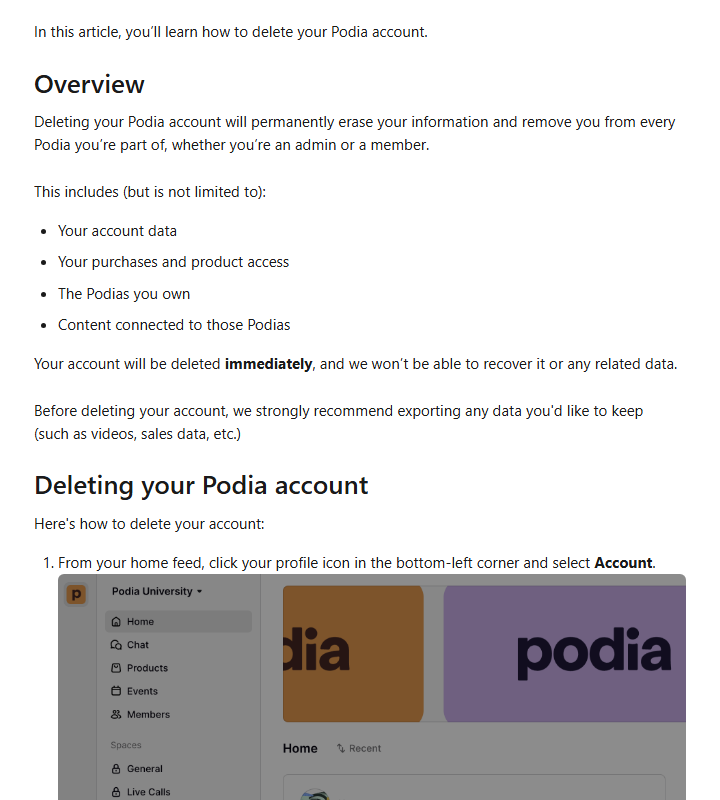
What changed is where the course lives. In the new Podia, a buyer does not land on a plain customer library; they land on a home feed that shows their products, your announcements, events and any community spaces open to them, with member-to-member chat and group chats of up to 10 people. Podia's help center says that if you create no spaces, members do not see a community experience and the site works much as before, and that you can hide all member profiles and the members list in settings. But the default is open: “By default, your members’ community profiles are public”, and member accounts are Podia accounts, so one login can belong to several creators' sites (deleting it removes the person “from every Podia you’re part of”, per the help center).
| Product type | What Podia offers | Watch for |
|---|---|---|
| Online courses | Drip, quizzes with passing scores, certificates, cohorts, bulk licenses, captions, progress dashboard | No SCORM or learning paths listed; quizzes are not part of standard migration |
| Digital downloads | Almost any file type, up to 5 GB per file, free email delivery for lead magnets | Video files count toward the plan's video limit |
| Coaching | Paid booking through Calendly, Squarespace Scheduling, YouCanBookMe or SavvyCal | Scheduling runs in the outside tool, not in Podia |
| Events | Live (Zoom, Google Meet, YouTube Live) and in-person tickets, reminders, replays | Live sessions run in Zoom, Google Meet or YouTube Live, not inside Podia |
| Community | Spaces, paid plans, group and member chat, profiles, badges, Discord roles | Profiles public by default; free community plans removed in 2026 |
| Website and blog | Ten themes, sections editor, blog, landing pages, custom domain, blog import | “Powered by Podia” stays on the login page and transactional emails |
From podia.com feature pages and Podia's help center, Oct 26, 2026.

Podia's own real-time course tutorial on the new version of the platform, published on @PodiaTV on Jul 22, 2026.
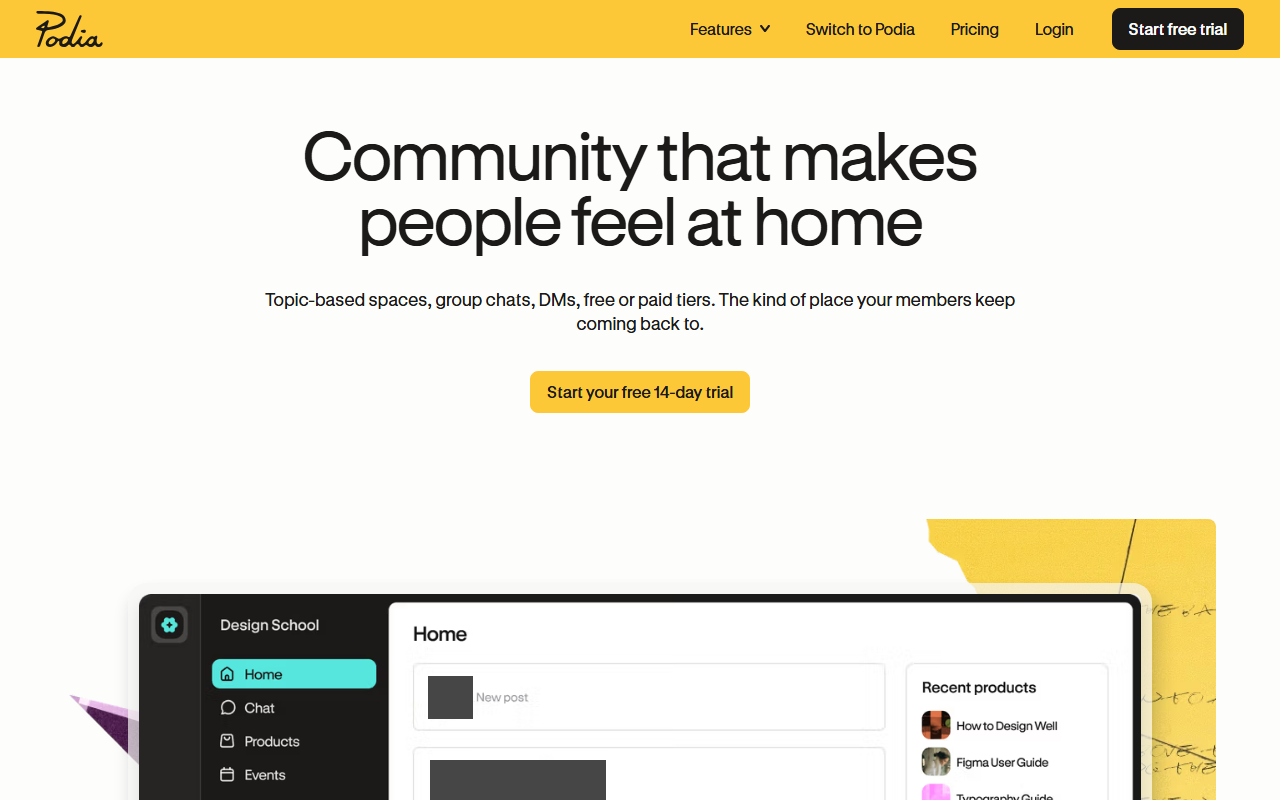

Podia's community tutorial, published on @PodiaTV on Aug 10, 2026.
Our reading: for a solo creator selling courses, the community layer is either a bonus or something to switch down, not a reason to choose or reject Podia. It matters more in two cases. If you sell to people who would not want other buyers to see them (health, finance, relationships, therapy-adjacent coaching), set profiles to hidden and consider whether member chat suits your audience. And if you were relying on free community plans or public topics, those are gone; Podia's help center points you to free products and blog posts instead.
From idea to first sale: five steps, and the checks a person should do at each one.
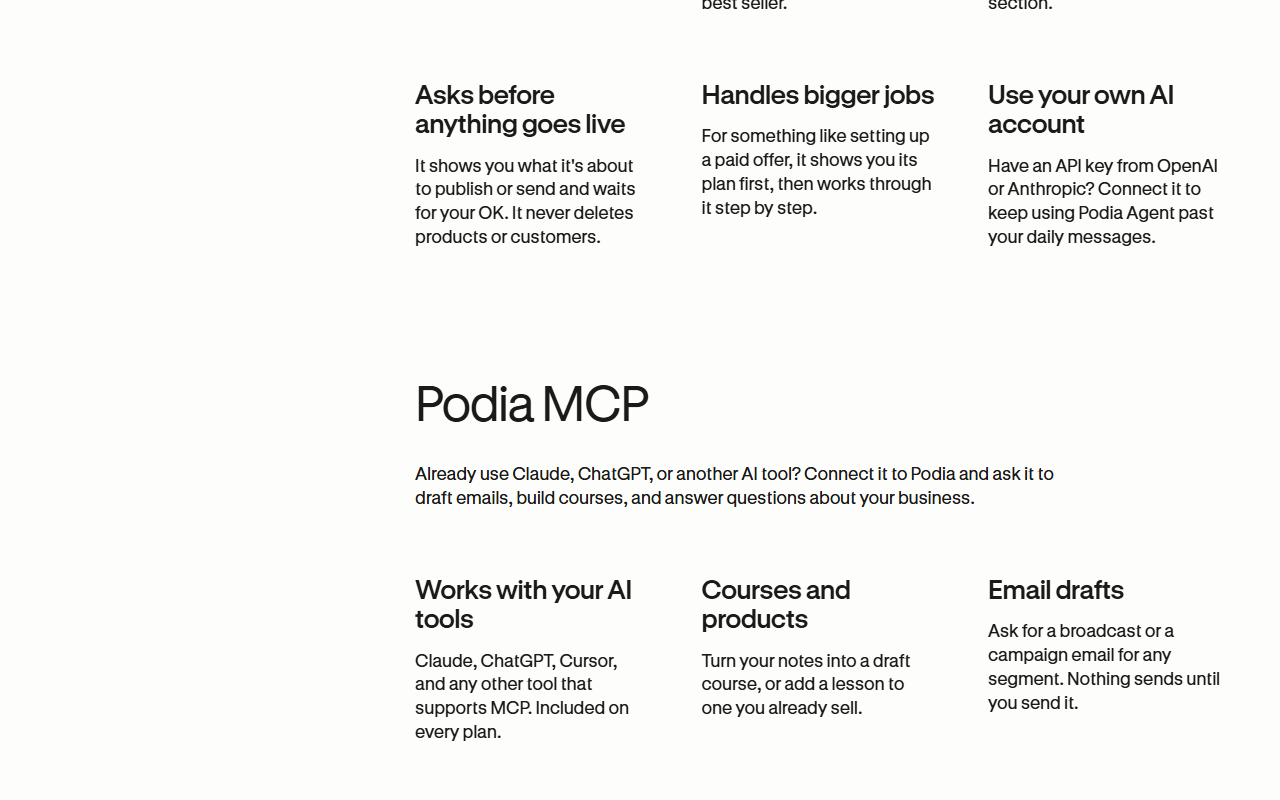
A built-in agent rationed by messages per day, and a connector that lets Claude, ChatGPT or Cursor work in your account with the permissions you grant.
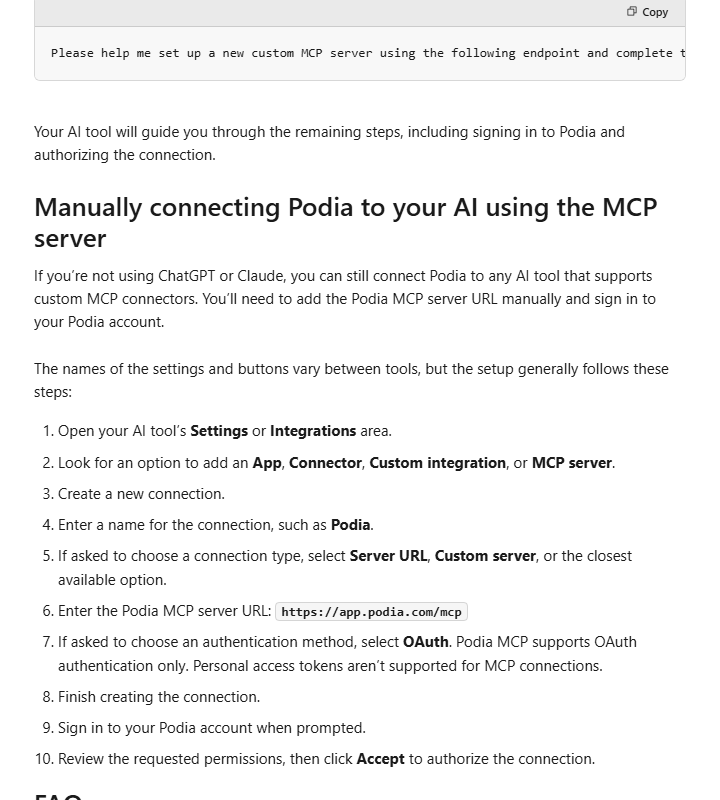
Podia added two AI features within ten days. Podia MCP (Sep 28, 2026, every plan) is a Model Context Protocol server at app.podia.com/mcp that you add to an AI tool as a custom connector. It signs in with OAuth only, starts read-only, and lets you grant write permissions one by one; Podia says permissions for sensitive actions such as editing your site or managing account users stay off unless you turn them on. Podia Agent (Oct 7, 2026) is a chat panel inside the Podia admin that can answer questions about your business, create products, draft emails and posts and change your website, asking for approval before it publishes or sends anything.
| Plan | Agent messages a day | About a month | With your own API key |
|---|---|---|---|
| 14-day trial | 3 | n/a | Provider's limits apply |
| Mover | 3 | about 90 | Provider's limits apply |
| Shaker | 15, shared with your assistant | about 450 | Provider's limits apply |
| Earthquaker | 30, shared with your assistants | about 900 | Provider's limits apply |
From Podia's help article on Podia Agent and the pricing page tooltips, Oct 26, 2026. Limits reset at midnight UTC and count every message, even in a new chat. Monthly figures are 30 days times the daily limit. Supported key providers: OpenAI, Anthropic, DeepSeek, Gemini and xAI; usage on your own key is billed by that provider.
Three messages a day on Mover is enough to try the agent, not to build a course with it. The practical route for heavier use is your own API key, in which case “the usage limits set by that AI provider will apply instead”, or Podia MCP from an AI subscription you already pay for. The agent has guard rails Podia lists itself: it cannot delete products or customers, import customers or grant product access. It also has one property worth knowing before you ask it to change things: “In most cases, actions completed by Podia Agent can’t be undone.” Website changes can be reverted by asking the agent to revert them.



Podia MCP: what the AI tool can and cannot reach
For readers already using Claude or ChatGPT, the connector is the more interesting half. Podia's changelog gives examples such as turning notes into a draft course, creating a 20% coupon and drafting the announcement email, or charting monthly sales. Drafts are saved in Podia for review. Podia's security article is careful about data: when your AI tool reads account information, “that information is shared with the AI provider you selected, such as Anthropic or OpenAI”, under that provider's terms, and you may need to list the provider in your own privacy disclosures if it processes customers' personal data. Unused connections expire, and you can see and disconnect every connection, including your assistants', from Admin, Settings, Integrations. Our guide to Claude MCP connectors explains how custom connectors work on the Claude side, and the Claude Code setup guide covers adding MCP servers from a terminal.


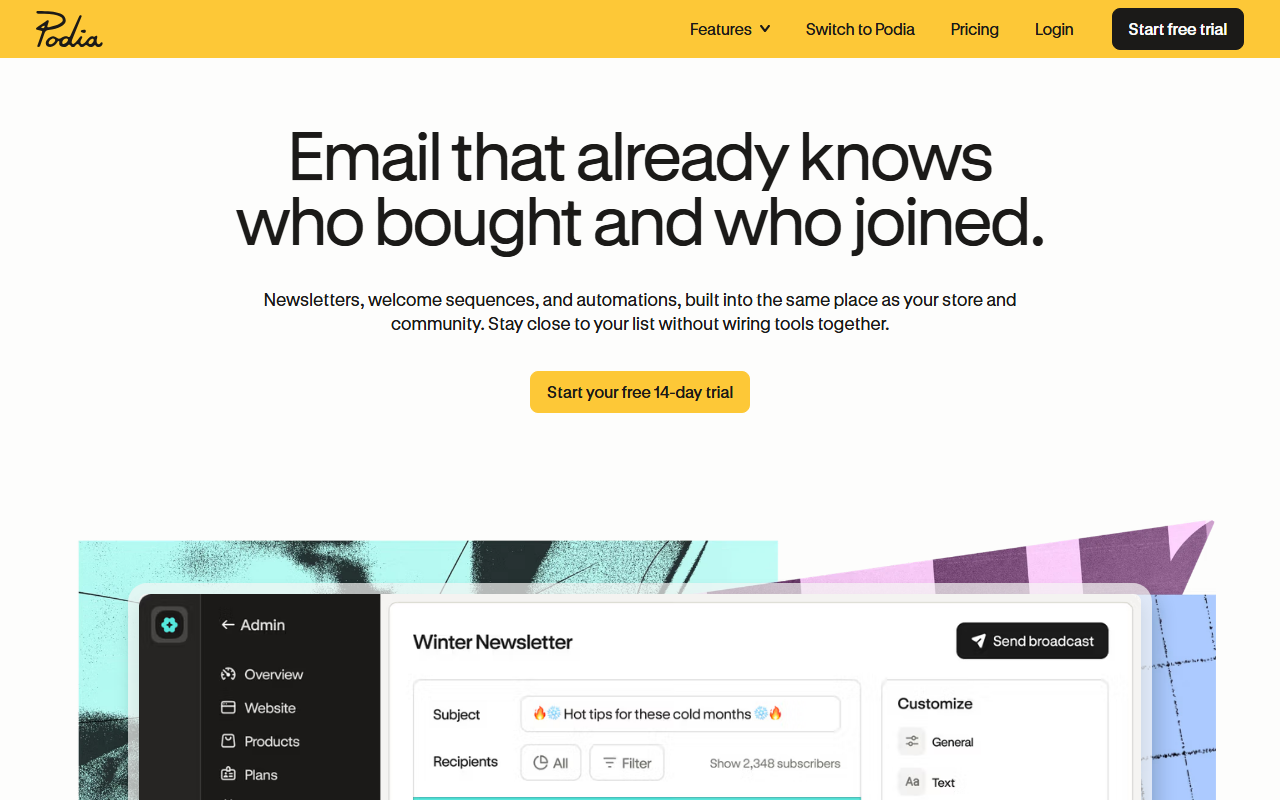
Email is built on the same list as your store, which is genuinely useful, but pricing by subscriber makes Podia an expensive newsletter tool for big lists with small sales.
Podia Email covers broadcasts, multi-step campaigns, automations triggered by purchases or sign-ups, tags and segments, sign-up forms, templates, a custom sending domain, editable links in sent emails, and revenue per email. Because the store and the list are the same database, you can target people by what they bought without a sync. Podia also connects to Kit, Mailchimp, AWeber, Drip, ActiveCampaign, MailerLite, GetResponse and Flodesk if you prefer to keep an outside email tool, and its help center says you do not need to pay for Podia Email if you send elsewhere.
The rules are strict, and they are the source of several complaints. Billing follows active subscribers, not emails sent. If you go over your tier, “the ability to send emails will be disabled (broadcasts + campaigns)”, scheduled broadcasts go back to draft and campaigns pause until you upgrade or remove subscribers. New accounts start in a warm-up period with sends at least 24 hours apart. Podia also says it watches bounce rates, spam complaints and sends to purchased lists, and that flags can lead to a manual review, suspension or termination, under its Acceptable Use Policy.
Podia's email tutorial, published on @PodiaTV on Aug 19, 2026.
Basic protections are in place, but two-factor sign-in is email-only and off by default, there is no bug bounty, and the Privacy Policy predates Podia's AI features.
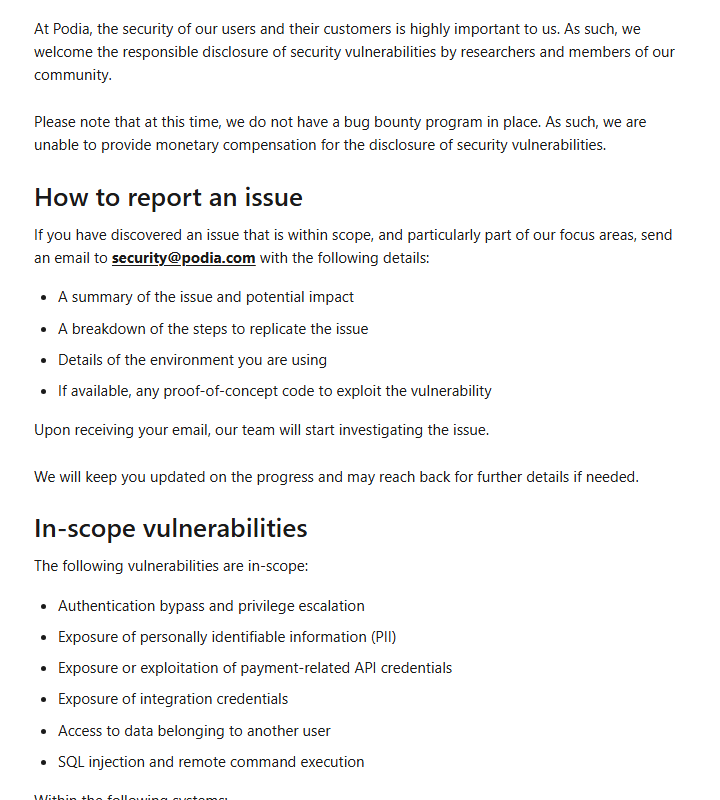
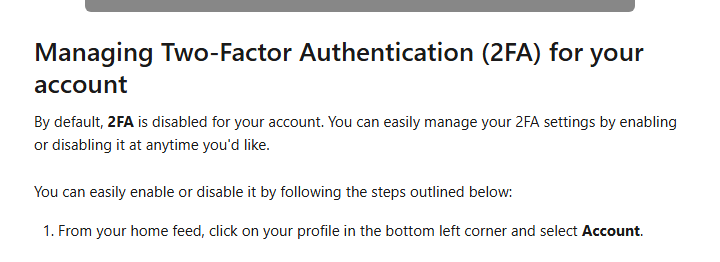
Podia publishes little about its security programme. Its help center has a responsible-disclosure policy (dated Jan 22, 2026) that names the app, creator sites and the Zapier integration as in scope, and states that “we do not have a bug bounty program in place”. Podia's pricing, features and legal pages list no security certification such as SOC 2. Two-factor authentication sends a code to your email address for unrecognised devices, and “By default, 2FA is disabled for your account.” Turn it on in Account, Security on day one.
| Area | What Podia's pages say | What it means for you |
|---|---|---|
| Sign-in | Email-code 2FA, off by default | Enable it; protect the email account behind it |
| Money | Sales go to your own Stripe or PayPal account | Podia does not hold your funds; Stripe's own rules on holds and disputes apply |
| Identity checks | Accounts can be put under review or locked, for example for unusual activity or risky networks, and unlocked with Stripe Identity | Expect an ID and selfie check if flagged; VPNs and public Wi-Fi can trigger it |
| Data location | Services hosted and operated in the United States | EU sellers should read the Data Processing Addendum |
| AI data | MCP shares requested data with the AI provider you choose | The Privacy Policy is effective Dec 12, 2024 and does not mention AI providers |
| Leaving | Site offline on cancellation; data kept 180 days; account deletion is immediate and permanent | Export products, contacts and sales before you cancel or delete |
| Liability | Capped at the greater of $500 or three months of fees | Keep your own backups of course files and lists |
From Podia's Terms of Service and Privacy Policy (both effective Dec 12, 2024), Acceptable Use Policy and help center, Oct 26, 2026.
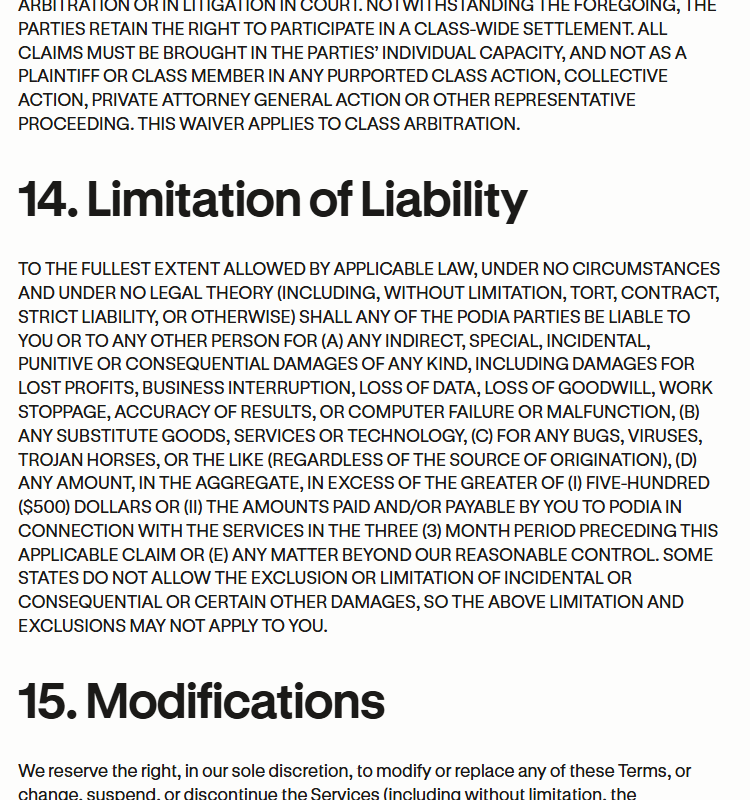
One clause in the Terms is worth knowing if you plan to automate your own work around Podia. Section 6C forbids using manual or automated software to “crawl,” “scrape” or “spider” any part of the Services, even though podia.com's robots file allows all crawlers, including AI crawlers. If you want to pull your own data, use the official exports, Zapier (Shaker and Earthquaker) or Podia MCP rather than a scraper.
Podia suits solo creators with a modest catalog and list who want one tool; it suits less well large lists, app-first audiences and anyone who needs strict privacy between members.
| Work pattern | Fit | Likely plan |
|---|---|---|
| First course or ebook, small audience, testing demand | Strong: no card for the trial, sales pages made for you | Mover, $42 billed yearly, until sales pass about $840 a month |
| Coach selling sessions plus a course and a paid group | Strong: coaching, community plans and email in one place | Shaker, $84 billed yearly |
| Membership with recurring billing | Good: paid community plans through Stripe | Shaker; PayPal cannot take subscriptions |
| Newsletter with tens of thousands of readers and few sales | Weak: the subscriber add-on dominates the bill | Compare with a dedicated email tool or Kajabi |
| School that needs a branded mobile app or SCORM | Weak: no mobile app; SCORM not listed | Teachable or Kajabi for apps; Thinkific Plus for SCORM |
| Agency or team with several admins | Mixed: one assistant on Shaker, unlimited only on Earthquaker | The top plan, Earthquaker, at $150 billed yearly |
| Creator who wants AI to do setup work | Good with your own AI: MCP on every plan | Any plan plus Claude or ChatGPT, or your own API key for the agent |
Who should not buy: anyone who needs a refund window longer than 72 hours before committing to a year, creators who cannot have their site go offline the day a plan ends, audiences that expect a phone app, and businesses that want buyers kept completely apart from each other without changing defaults.
Nine things to weigh before you commit.
Thinkific, Teachable and Kajabi each beat Podia on one thing; none of them is cheaper at every size.
Prices are list prices in US dollars from each vendor's own pricing page on Oct 26, 2026. We viewed them from Vietnam and checked them against the Internet Archive's most recent copies (Thinkific Oct 5, Teachable Oct 21 and Kajabi Oct 19, 2026), which show the same plan prices. We compared prices and published features only, not ease of use, deliverability or reliability.
Swipe sideways to see every column.
| Platform | Entry plan | Platform fee on sales | Trial and refund | Strongest point in comparison |
|---|---|---|---|---|
| Podia | Mover $49, or $42 yearly | 5% on Mover; 0% on Shaker ($99 / $84) and up | 14-day trial, no card; refund within 72 hours | (baseline) One subscription with email, community and website |
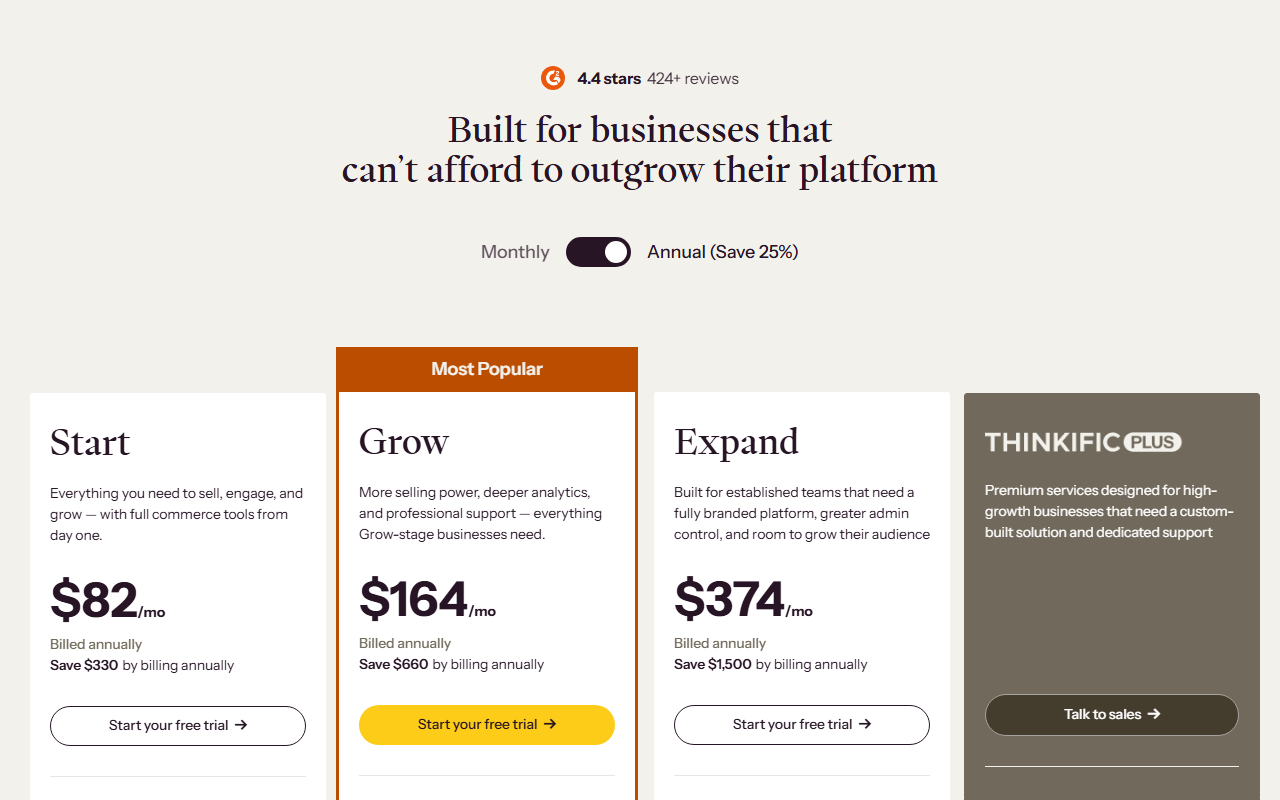
| Thinkific | Start $109, or $82 yearly | None listed with Thinkific Payments (2.9%); extra gateway fee with Stripe or PayPal in select countries | 30-day trial; no free plan | Course depth: exams and question banks on Grow, SCORM and learning paths on Plus; B2B invoicing |
| Teachable | Starter $39, or $29 yearly | 7.5% on Starter; 0% on Builder ($89 / $69) and up with Teachable Payments | 7-day trial; 30-day guarantee | Lower entry price, iOS and Android student apps, US tax, VAT and GST handling; but 5 products on Starter, 10 on Builder |
| Kajabi | Basic $179, or $143 yearly | No revenue share; Kajabi Payments from 2.9% + 30¢ (US) | 14 days free and a 30-day money-back guarantee, per the plan cards | 2,500 contacts included on Basic, 25,000 on Growth; customer and branded mobile apps; funnels |
From thinkific.com/pricing, teachable.com/pricing and kajabi.com/pricing, Oct 26, 2026. Teachable's 0% applies when you use Teachable Payments. Thinkific's pricing FAQ does not give the extra gateway fee on the page; it links to a separate article.
The comparison is closer than the plan prices suggest. At $2,000 a month in sales, Teachable Builder and Thinkific Start cost about the same as Podia Shaker, and Teachable's Starter plan becomes the most expensive of the six options because of its 7.5% fee. Kajabi costs more at the entry level but includes far more email contacts, which is the deciding factor for list-first businesses. Podia's advantages in this group are its 150-product allowance on a mid-priced plan and a single subscription that already includes a website, blog and community; its disadvantages are the missing mobile app and the subscriber-priced email.


Trustpilot's “People also looked at” list beside Podia also names Circle, Skool, Systeme.io, Payhip and Gumroad. They are not priced here, so check them on their own sites before deciding.
This review has no affiliate links.
Every Podia link here goes straight to podia.com, its pricing page, its Terms of Service or its help center, without tracking parameters. The score, the drawbacks and the alternatives would be the same either way.
How this review was put together: Podia's pricing page and the pricing data it contains, the Internet Archive's copies of the pricing page from Jan 12, May 20, Jun 13, Jun 22, Sep 25 and Oct 19, 2026, Podia's feature pages, about page, blog posts of Oct 14, 2024 and Jun 1, 2026, changelog, 47 help center articles, the Terms of Service, Privacy Policy and Acceptable Use Policy, six official Podia videos, Stripe's and PayPal's US fee pages, the Thinkific, Teachable and Kajabi pricing pages, the US App Store, Trustpilot and Hacker News, as of Oct 26, 2026. This review involved no Podia account of our own, no trial and no support contact, so nothing here describes speed, deliverability or support from our own use. Screenshots show public pages only.
Making the course, growing the audience, or wiring Podia to other tools? These reviews cover the work around a Podia site.
Each card opens a published JAVIS review, routed by where you are.




Questions people ask before committing
How much does Podia cost in 2026?
Per podia.com/pricing on Oct 26, 2026: Mover $49, Shaker $99 and Earthquaker $179 a month on monthly billing, or $42, $84 and $150 a month billed yearly ($504, $1,008 and $1,800 a year). Larger email lists cost more on every plan. There is a 14-day free trial with no card.
Does Podia still have a free plan?
No. Podia removed its free plan on Oct 14, 2024 and offers a 14-day trial instead. In 2026 it also removed free community plans inside creators' sites; free products replace them.
Does Podia take a cut of my sales?
Only on Mover, which charges 5% per sale. Shaker and Earthquaker have no Podia fee. Stripe or PayPal charge their own fees on every plan: 2.9% + 30¢ for US domestic cards at Stripe, and 3.49% + 0.49 USD for PayPal Checkout in the US.
Did Podia raise its prices?
Yes. Archived copies of the pricing page show Mover at $39 a month ($33 yearly) and Shaker at $89 ($75) on May 20, 2026, and $42 and $84 billed yearly (+$9), with Earthquaker added at $150, on Jun 13, 2026. The Jun 13 copy's plan data already lists monthly prices of $49 and $99 (+$10), the same as on Oct 26, 2026. There is no copy between May 20 and Jun 13, so the exact day is not known. Product and video caps arrived in the same window.
Can I get a refund?
Only if you ask within 72 hours of your most recent payment, renewal or upgrade, and only for that payment; there are no pro-rated refunds. If Podia's team has started migrating your products, the plan payment is not refundable.
Does Podia have a mobile app?
No. Podia's help center says, “No, we do not currently offer a mobile app.” Members use the browser.
Can I connect Claude or ChatGPT to Podia?
Yes. Podia MCP, launched Sep 28, 2026 on every plan, connects any tool that supports custom MCP connectors through app.podia.com/mcp with OAuth. It starts read-only, and you grant write permissions one at a time.
What happens to my site if I cancel?
It goes offline, customers lose access, and their subscriptions and payment plans are cancelled for good. Podia keeps your data for 180 days in case you resubscribe, then deletes it. Export everything first.
Where this came from, and when.
Every price, fee, rule and rating in this review comes from the pages below, as of Oct 26, 2026 unless another date is given. Expand for the full list, the scoring method and what the review does not cover.
Show sources, scoring method and scope
Pricing: podia.com/pricing on Oct 26, 2026, including the plan and subscriber-tier data on the page (USD) and the FAQ; the Internet Archive's copies of the same page from Jan 12, May 20, Jun 13, Jun 22, Sep 25 and Oct 19, 2026, the last of which matches the Oct 26, 2026 plans exactly.
Legal: Podia Terms of Service and Privacy Policy, both with an effective date of Dec 12, 2024 (sections 6C, 8, 9, 13 and 14 of the Terms); Acceptable Use Policy; podia.com/robots.txt.
Help center: articles on plan limits (Jul 31, 2026), transaction fees (May 18, 2026), plans and pricing FAQs, refunds, trial, cancelling and downgrading (Sep 22, 2026 and earlier), what happens on cancellation (Jun 2, 2026), the new Podia and migrating to it (Jul 7 and Aug 12, 2026), built-in community, member experience and profile visibility, Podia Agent and external API keys, Podia MCP connection, management and security, email FAQs, sending limits and warm-up, video limits, Stripe, PayPal, currency, sales tax collection and jurisdictions, sales tax on subscriptions, migrations, deleting an account, account review, two-factor authentication and the security policy (Jan 22, 2026).
Product and company: podia.com home, features, online courses, downloads, coaching, community, events, website, email, integrations and about pages; blog posts Why Podia is removing our free plan (Oct 14, 2024) and Meet the new Podia (Jun 1, 2026); changelog entries of Sep 28 to Oct 15, 2026.
Video: six videos from Podia's official YouTube channel, @PodiaTV, which podia.com links to: pswZZysx9Dc (Podia Demo 2026, Jun 25, 2026), Ocn3sqeDIJw (plans and pricing 2026, Jun 25, 2026), -C8FDtcWdmE (course tutorial, Jul 22, 2026), W7gS17hrFKg (community tutorial, Aug 10, 2026) and ERWSISde-io (email tutorial, Aug 19, 2026) are embedded; nf5Cz00J0bk (downloads tutorial, Sep 4, 2026) was consulted.
Payments: stripe.com/pricing (US) and PayPal's US business fees page (updated Oct 1, 2026), Oct 26, 2026.
Independent evidence: Podia's Trustpilot page (TrustScore 4.1, 153 reviews, profile labels and AI summary in a desktop screenshot of Oct 26, 2026, plus recent reviews and Podia's replies as listed that day); Hacker News item 47165820 (Feb 26, 2026); a US App Store search for Podia (country=us). G2, Capterra and Reddit are not quoted. Reviewers are identified by country only.
Competitors: thinkific.com/pricing, teachable.com/pricing and kajabi.com/pricing, Oct 26, 2026, with the Internet Archive's copies of Oct 5, Oct 21 and Oct 19, 2026.
Images: screenshots of public pages taken on Oct 26, 2026 at 1280 by 800 pixels; the archived pricing screenshot shows the Internet Archive's copy of Podia's page, with its toolbar. The Trustpilot screenshot is a desktop capture of Oct 26, 2026 at 1568 by 778 pixels. Illustrations inside them are the vendors' own. JAVIS charts and diagrams are labelled as such and computed from the figures above. Related cards use JAVIS's own featured images.
JAVIS Fit Score (65/100): an editorial composite scored out of 20 on five criteria. Price clarity 14: three plans with every subscriber tier published and the same prices in the archived copy, but a 2026 increase with new caps, an email add-on that changes the real price, and a processor-fee line that does not match PayPal's own rate. Capability 15: a broad all-in-one set for solo creators (courses, downloads, coaching, events, community, website, blog, email, agent and MCP) without a mobile app, SCORM or deep LMS features. Independent evidence 11: a 4.1 Trustpilot score from only 153 reviews, no app-store ratings, and size figures that are all Podia's own and changed wording in 2026. Terms, data and security 10: own Stripe payouts and read-only-first MCP, against email-only 2FA off by default, no bug bounty, a 2024 Privacy Policy, a 72-hour refund window, an abrupt exit and a one-way migration. Cost and fit 15: good value for a modest catalog and list, expensive for large lists or Mover above about $840 a month. It is judgment, not a measurement.
What this review does not cover: email deliverability, video playback quality, site speed, checkout conversion, support response times, the experience on legacy plans, the full Data Processing Addendum, and prices for platforms other than those listed.