
Replicate Review 2026: Thousands of AI Models Behind One API, Now Owned by Cloudflare
Replicate runs image, video, audio and language models through one API and bills per second of GPU time or per output. Cloudflare bought it on Dec 1, 2025. As of Oct 29, 2026 the API, prices and brand are unchanged, but credit is prepaid and expires after a year, the public blog and changelog have been quiet since April, and public complaints about support keep appearing. This review works out what images, video and GPUs cost, and what the contract says.
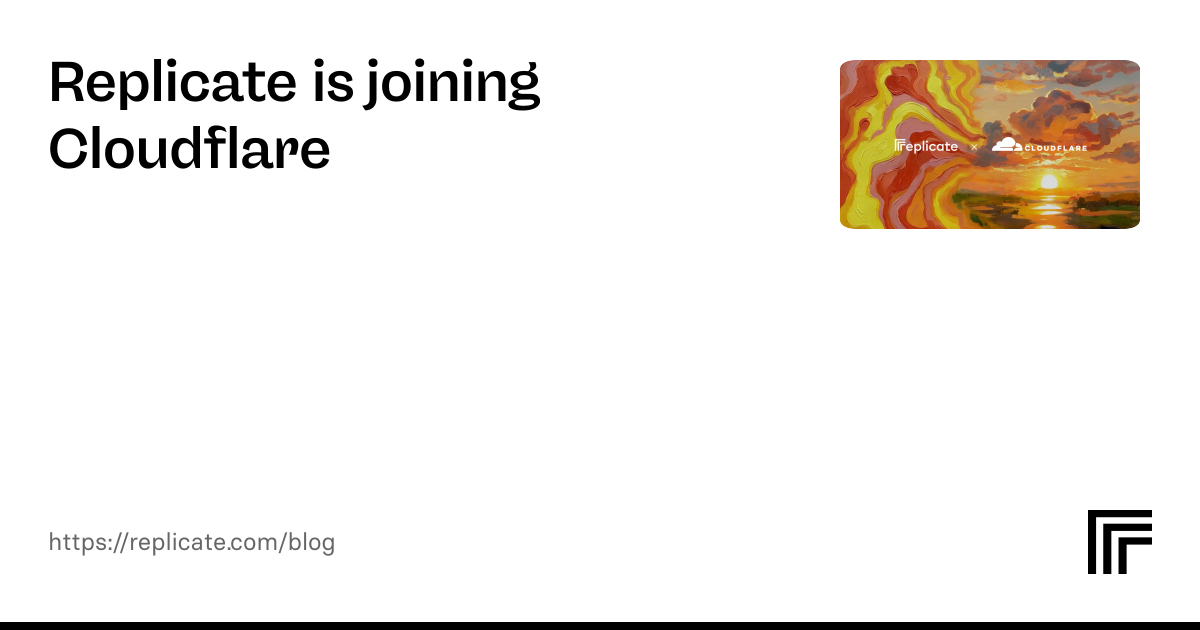
There are no affiliate links in this review. Every Replicate link goes straight to replicate.com or its documentation.
| Made by | Replicate, LLC, a Cloudflare company since Dec 1, 2025 |
| What it is | API to run, fine-tune and deploy AI models |
| Pricing | Per second of hardware or per output; prepaid credit |
| Catch | 12-month credit expiry; slow support; quiet roadmap |
| Evidence | Trustpilot 1.8 from 16 reviews; Hacker News threads |
Replicate is still the quickest way to try almost any open or proprietary model with one line of code. Under Cloudflare it works as before, but buy credit in small amounts and do not count on fast support.
“The API isn’t changing. The models you’re using today will keep working.” That is Replicate founder Ben Firshman's Nov 17, 2025 post announcing the move to Cloudflare. Cloudflare's quarterly filing says the purchase closed on Dec 1, 2025, for $57.4 million in total purchase cash consideration.
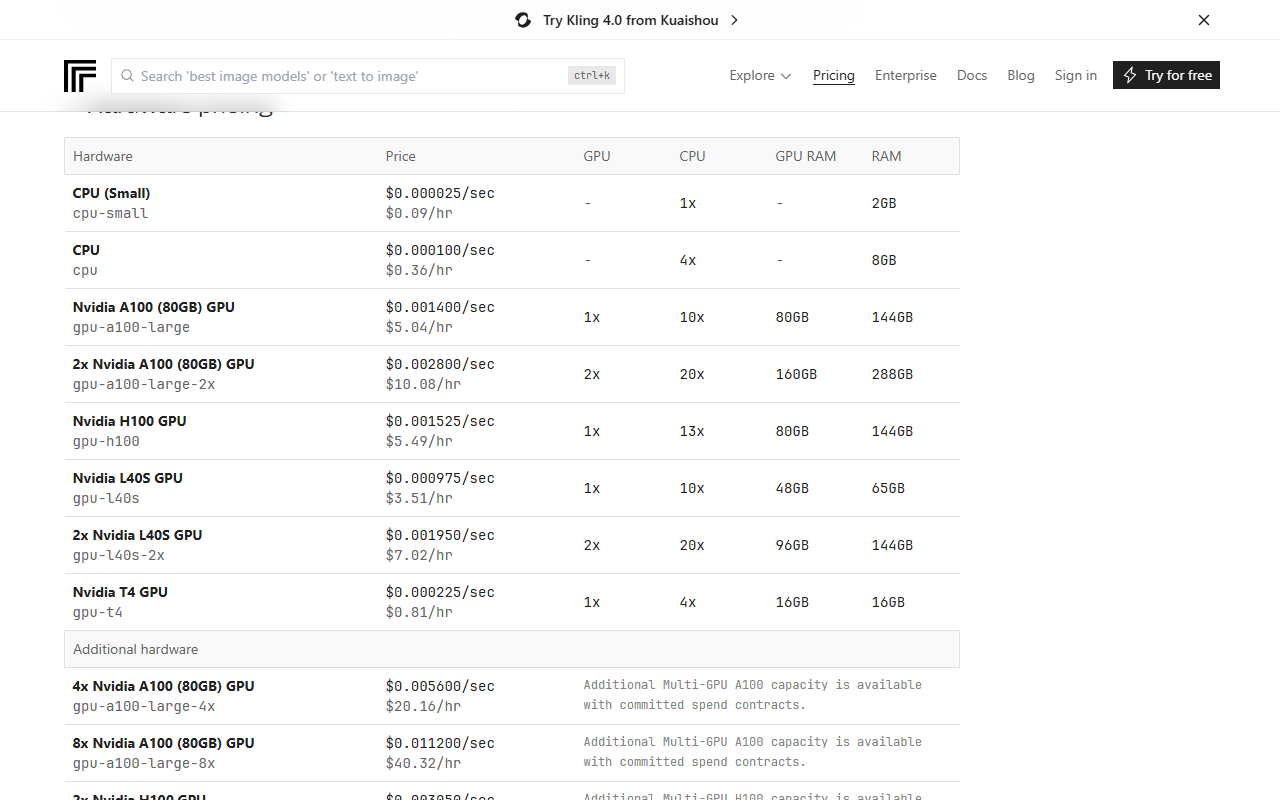
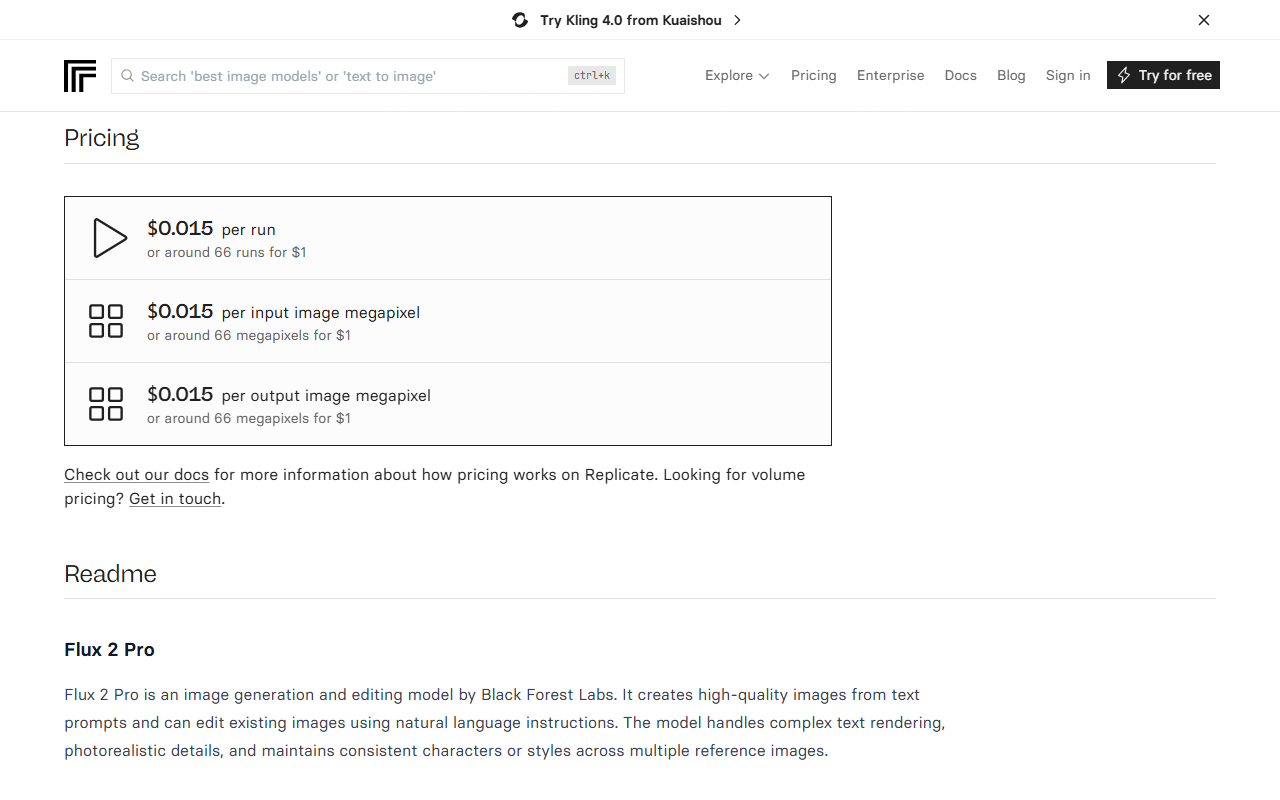
Replicate hosts a large public catalog (its enterprise page says 50,000+ models) and more than 100 “official” models that are always warm, keep a stable API and are priced per output: FLUX.2 [pro] at about $0.03 for a 1-megapixel image, Google's Nano Banana 2 at $0.067 an image, Claude Opus 4.7 at Anthropic's own list price. Community and private models are billed per second of hardware, from $0.81 an hour for a T4 to $5.49 for an H100. There is no subscription: you buy prepaid credit, and per the Terms (updated Apr 1, 2026) unused credit is forfeited at the end of the 12th month.
Three things to weigh. First, dedicated GPUs cost more here: an H100 is $5.49 an hour on Replicate against $4.50 at Hugging Face and about $3.95 of GPU time at Modal, so a model kept running all month costs hundreds of dollars more. Second, support and activity: Trustpilot shows 1.8 stars from 16 reviews, mostly about unanswered tickets and expired credit, an Aug 2026 Hacker News post asked whether a team is still behind the site, and the public blog and changelog have no entries after April 2026. On the other side, the open-source Cog tool shipped a release on Oct 20, 2026 and Replicate now appears on Cloudflare's status page. Third, the contract: liability is capped at the lower of six months of fees or $100.
Not a hands-on test: JAVIS has not created a Replicate account, bought credit or run a model. This review is built from Replicate's pricing page, model pages, documentation, Terms, privacy policy, blog and changelog, Cloudflare's blog, status page and SEC filing, Trustpilot, Hacker News and competitors' pricing pages, all dated Oct 29, 2026 unless stated. Latency, cold-boot times and output quality are not measured here.
Pick a model, send inputs, pay for seconds or outputs out of prepaid credit.
You call a model by its owner and name (for example black-forest-labs/flux-2-pro) from the Node or Python client or plain HTTP. Official models answer from warm capacity and charge per output. Community models share a hardware pool and bill only for active seconds, which is cheap but can mean cold boots. Your own models, packaged with the open-source Cog tool, and any “deployment” run on dedicated instances and bill for setup, idle and active time.
Bought by Cloudflare for $57.4 million in cash; the brand and API carry on.
Replicate announced on Nov 17, 2025 that it was “joining Cloudflare”. Cloudflare's own post the same day promised that existing users' “APIs and workflows will continue to work without interruption” and that Workers AI users would get the catalog and custom models. Cloudflare's Form 10-Q for the quarter ended Jun 30, 2026 records that on Dec 1, 2025 it acquired all shares of Replicate, Inc. for $57.4 million of total purchase cash consideration: $44.4 million paid at closing, $9.5 million of holdbacks and $3.5 million of assumed liabilities. Neither company published a price at the time.
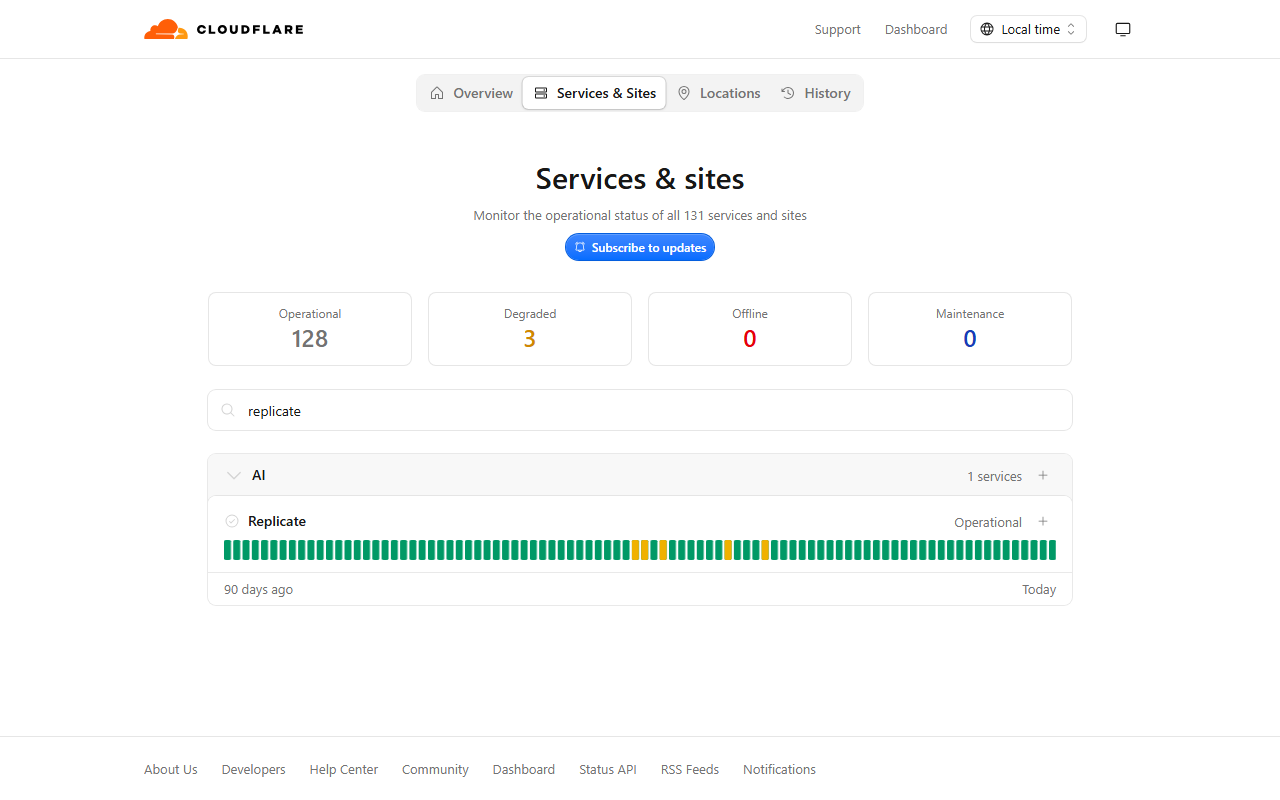
Signs of the new owner are visible on Replicate's own pages as of Oct 29, 2026: the Terms (last update Apr 1, 2026) now name Replicate, LLC, the footer's status link opens Cloudflare's status page, and the About page sends job seekers to Cloudflare's careers page. What is not visible yet is the promised integration: neither Replicate's blog and changelog nor Cloudflare's developer changelog announces Replicate models inside Workers AI.
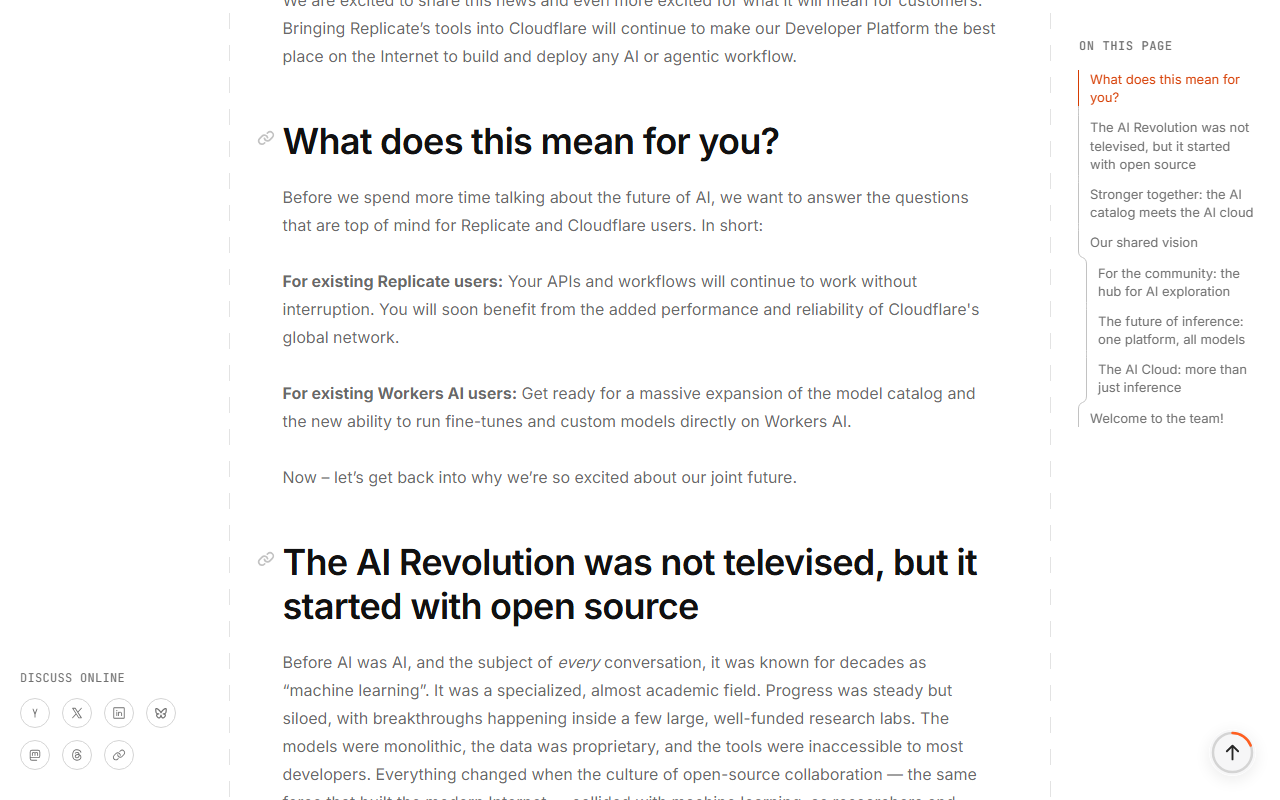
How big is it? Replicate publishes no user or revenue figures. Model pages show cumulative run counts, which measure predictions, not customers: 33.6 million runs for OpenAI's gpt-image-2, 21.7 million for Nano Banana 2 and 699.7 million for the older FLUX.1 [schnell]. On Hacker News the deal thread drew 288 points; a Modal engineer commented that “Replicate lost out to Fal.ai more than they lost to Together AI and Fireworks”, an opinion from a competitor, not a market-share figure.
Loved for breadth and ease; criticized for silent support, expiring credit and moderation rejections.
Trustpilot lists replicate.com at 1.8 out of 5 from 16 reviews (94% one-star) as of Oct 29, 2026. The profile is unclaimed, the company has never invited reviews, and one review is plainly about a different product, so treat it as a small, self-selected sample. The patterns repeat in Hacker News threads.
No reply from support: “you can spend hundreds of dollars a month on their API and they will not answer to a simple support request” (Feb 22, 2026); similar accounts on Mar 3, Jul 19 and Oct 9, 2026.
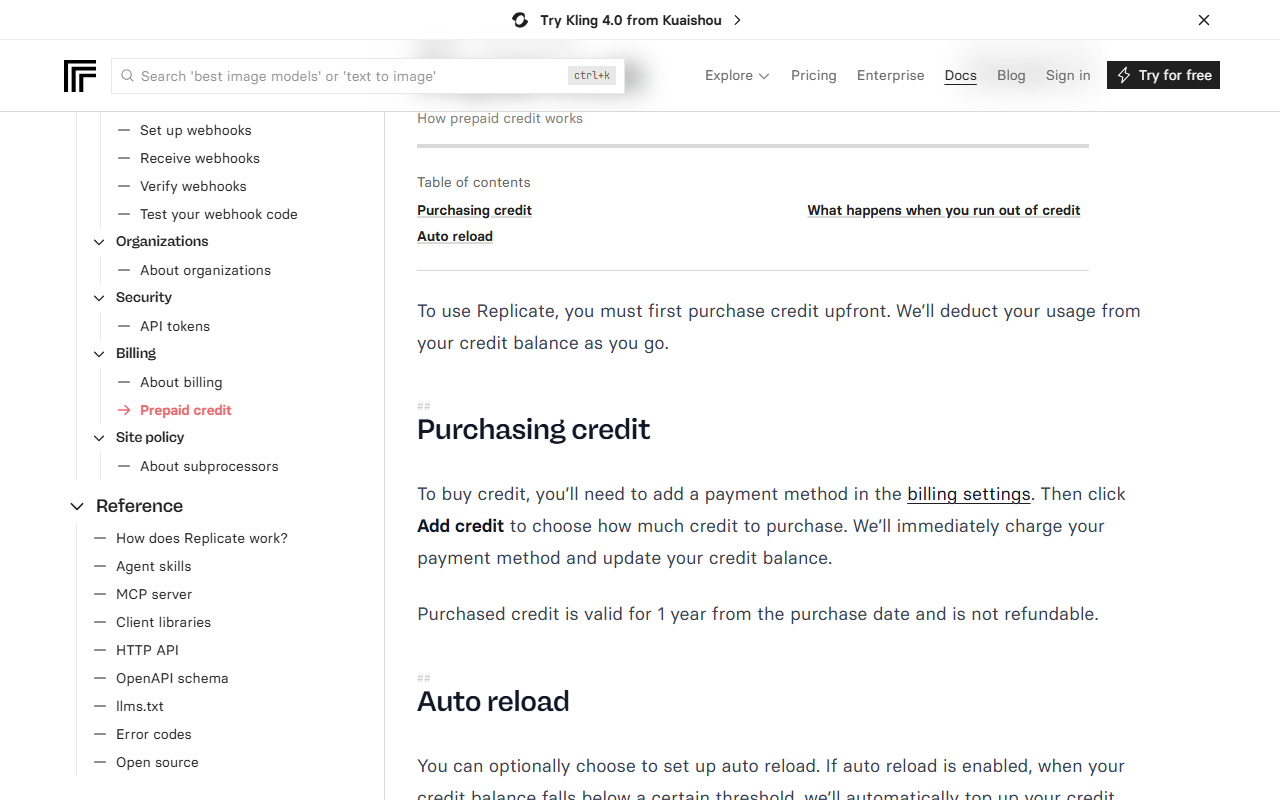
Two users object that unused prepaid credit was removed after a year. The Terms do say unused credit is forfeited at the end of the 12th month after payment.
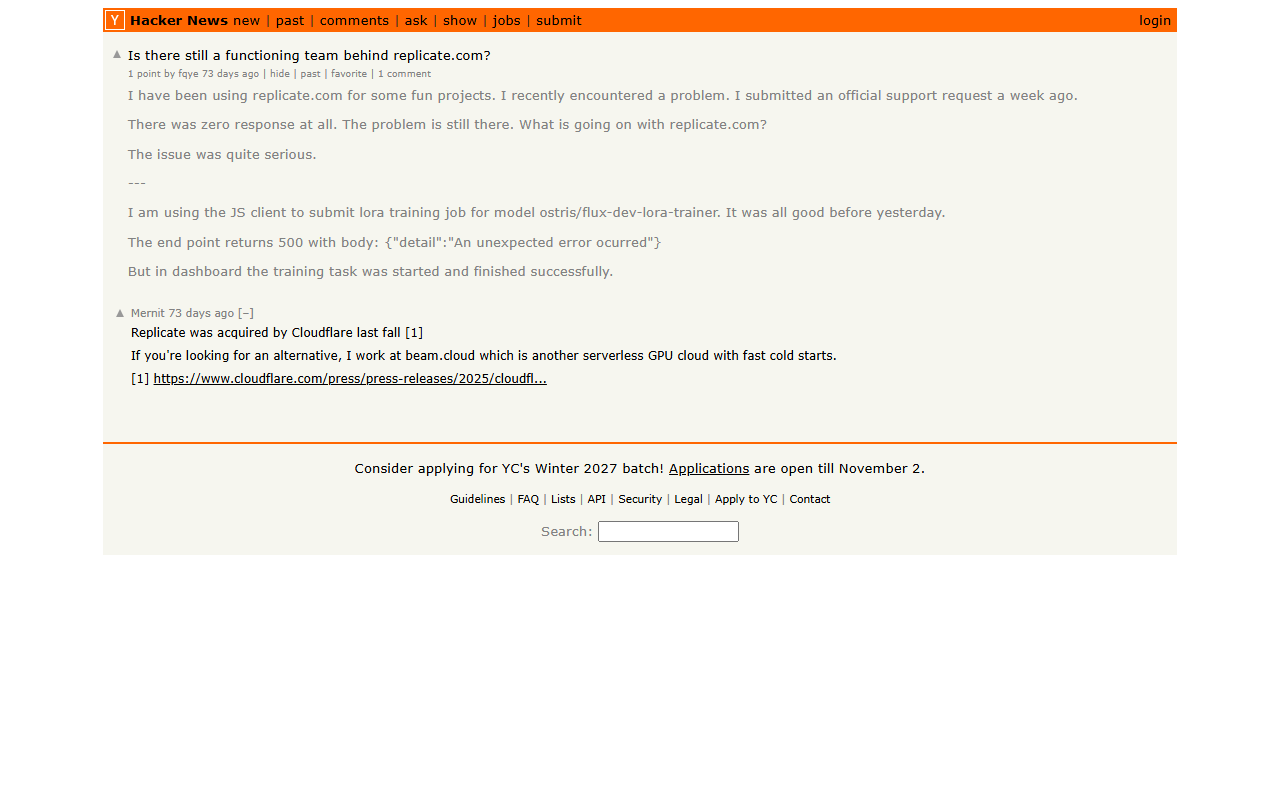
A user says every bytedance/seedance-2.5 request was rejected by moderation (“output may be related to copyright restrictions”, “E005”) and the credit stayed locked. One unverified account.“Is there still a functioning team behind replicate.com?” The poster says a support request got “zero response” after a week while a LoRA training job returned a server error. The only reply, from a competitor's employee, points to the Cloudflare deal.
“FAL's generation speed is consistently faster across every model I've tried” but “Replicate has a much bigger model selection.”
A user reported custom-model boots of “2/3 minutes if you are lucky”; the founder replied “Yeah, our cold boots suck” and pointed to fast-booting fine-tunes and always-on deployments. Older, but it explains why deployments exist.
No plans: per-second hardware or per-output prices, paid from prepaid credit.
As of Oct 29, 2026, replicate.com/pricing says “You only pay for what you use”. There are three ways a run is billed:
- Per image, per second of video or per token
- Always warm, stable API
- FLUX.2 [pro]: $0.015 a run + $0.015 per megapixel in and out
- Nano Banana 2: $0.067 (1K) to $0.151 (4K) an image
- Pay only active time
- Setup and idle are free
- Shared queue; cold boots possible
- Rate set by the model's hardware
- Dedicated instances
- Pay setup, idle and active time
- Fast-booting fine-tunes: active only
- T4 $0.81/h to H100 $5.49/h
- Volume discounts
- SLAs, higher GPU limits
- DPAs and indemnity in contract
- Multi-GPU A100/H100/H200 with committed spend
The rules behind the prices
The prepaid-credit doc says “To use Replicate, you must first purchase credit upfront” and that purchased credit “is valid for 1 year from the purchase date and is not refundable”. Auto reload is optional, with a minimum threshold of $5 and a minimum reload balance of $15. When the balance hits zero, Replicate stops new work and shuts down your infrastructure; the rate-limit doc adds that limits tighten as credit runs low and suggests keeping more than $20 in the account. Some select models can be tried free “after a bit you'll be asked to set up billing”, without a published allowance. Cancelled runs of official models may still be charged, and on the Nano Banana Pro fallback (changelog, Mar 2, 2026) you pay the backup model's price.
Worked examples: per-output models are fairly priced; always-on GPUs are where Replicate gets expensive.
These are invented workloads with the arithmetic shown, using each vendor's own page on Oct 29, 2026. Megapixel examples assume a 1024 × 1024 image counts as one megapixel, which fal states and Replicate's page does not define.
A solo developer making 1,000 product images
FLUX.2 [pro], text only: $0.015 + $0.015 = $0.03 an image, so $30. Add one 1-megapixel reference image and it is $0.045, so $45; fal's FLUX.2 [pro] page gives the same $0.03 and $0.045. Nano Banana 2 costs $67 at 1K, $101 at 2K and $151 at 4K; fal's pricing page lists it at $0.08 an image ($80). The budget end is FLUX.1 [schnell] at $3 per 1,000 images.
A marketing team making 100 ten-second videos
Seedance 2.5 text-to-video costs $0.2312 a second at 720p, so $2.312 a clip and $231.20 for 100; at 480p it is $102.80. Using a video as input roughly quadruples the rate ($0.9676 a second at 720p). Moderation rejections are the risk here: the Trustpilot reviewer above says no clip was produced.
An app on Claude Opus 4.7
One million input tokens and 200,000 output tokens cost $5 + $5 = $10 on Replicate, the same as Anthropic's own list price ($5 and $25 per million). Replicate adds no visible markup there; the reasons to route language models through it are one bill and one token, not price.
A custom model on a dedicated GPU
Deployments and private models bill every second the instance is online. An L40S kept up eight hours a day for 30 days is 240 hours: $842.40 on Replicate, $432 on a Hugging Face Inference Endpoint ($1.80 an hour) and about $468 of GPU time on Modal, which bills CPU and memory on top. An H100 running all month (720 hours) is $3,952.80 on Replicate, $3,240 on Hugging Face and about $2,843 of GPU time on Modal.
Credit you do not use
Buy $100, spend $40 within 12 months, and the remaining $60 is forfeited under section 4.2 of the Terms. Small, frequent top-ups or auto reload fit the rules better than a large annual purchase.
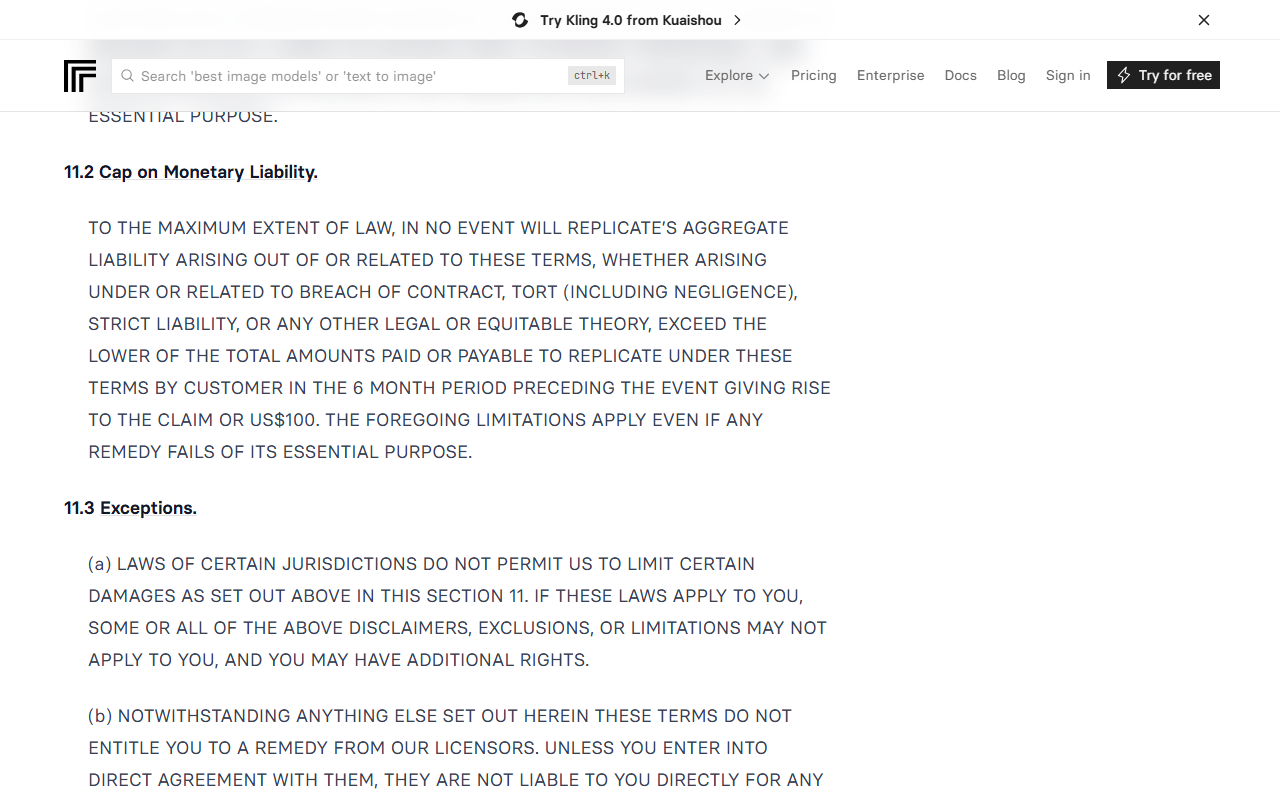
Terms updated Apr 1, 2026: credit forfeits after 12 months, liability is capped at $100 or less, disputes go to arbitration.
Replicate's Terms of Service carry “Last Update: April 1, 2026” and name Replicate, LLC (101 Townsend St, San Francisco). Key clauses as of Oct 29, 2026:
Prepaid credit is non-refundable “except as otherwise required by law”, and each payment “will expire at the end of twelfth (12th) month after the date of payment if not fully used”. Usage beyond the balance is invoiced the next month, and early charges may hit when usage first crosses a threshold. Replicate does not promise to keep any given model available or any processing rate.
Aggregate liability is capped at “the lower of” fees paid in the prior six months “or US$100”. California law applies, with individual arbitration and a class-action waiver. Replicate may assign the Terms; you may not without consent. Amended Terms take effect on the first day of the month after they are posted.
Third-party models carry their own terms on top: the Terms attach Black Forest Labs' and Stability AI's conditions, among others. Enterprise contracts can add DPAs, SLAs and indemnity, per the enterprise page.
Match your situation to one line.
Run models, fine-tune them, and push your own with Cog.
One API for image, video, speech, music and language models, with streaming output, webhooks and a web playground. Official models from Google, OpenAI, Anthropic, Black Forest Labs, ByteDance, Krea and others sit beside community uploads.
Train image models such as FLUX on your own pictures; trained versions that support it become fast-booting fine-tunes billed for active time only.
Package any model with Cog (open source, Apache-2.0) and push it, or create a deployment to pin hardware, set minimum and maximum instances and get your own queue.
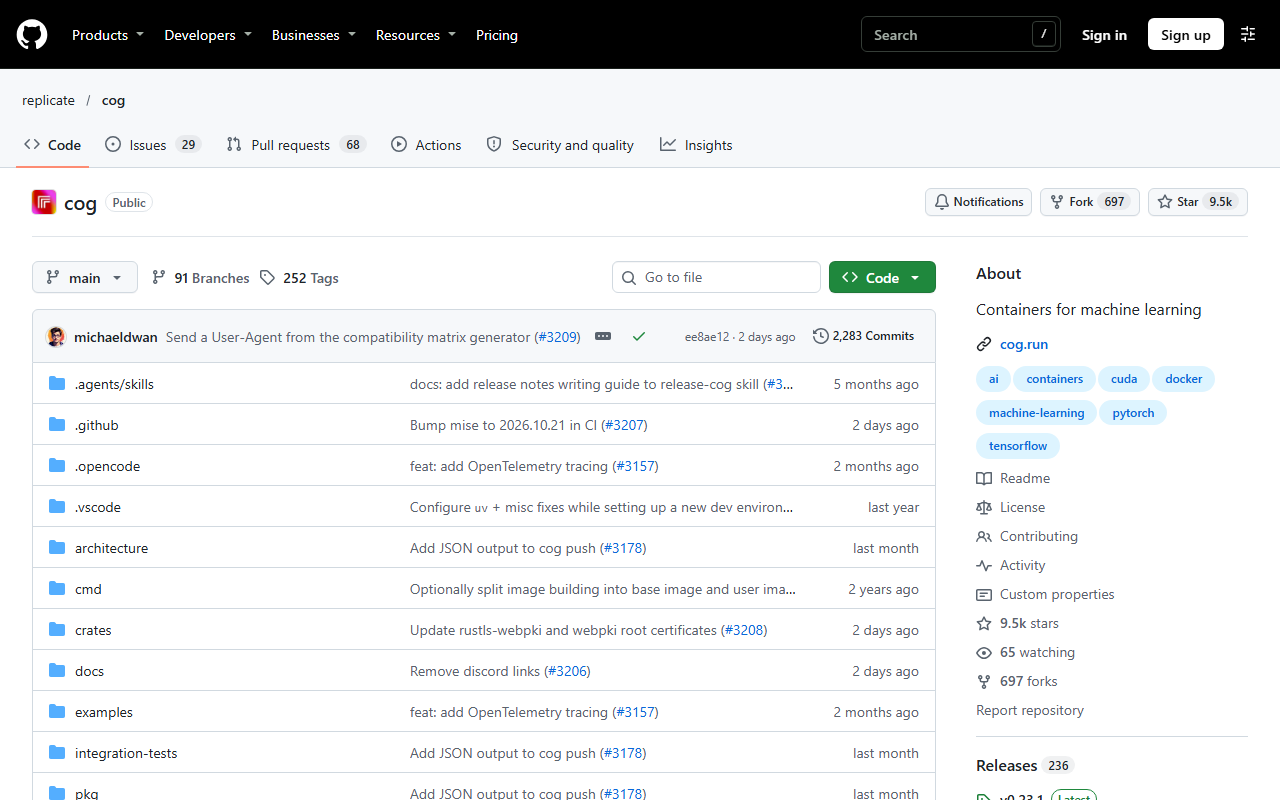
The official-models doc lists four promises for that tier: always on, a stable API, predictable per-output pricing and active maintenance. Everything else is a community model whose author decides the hardware, which is why two similar models can differ a lot in price and boot time. Cog is the most visibly active part of the company: 9,492 GitHub stars and release v0.23.1 on Oct 20, 2026.
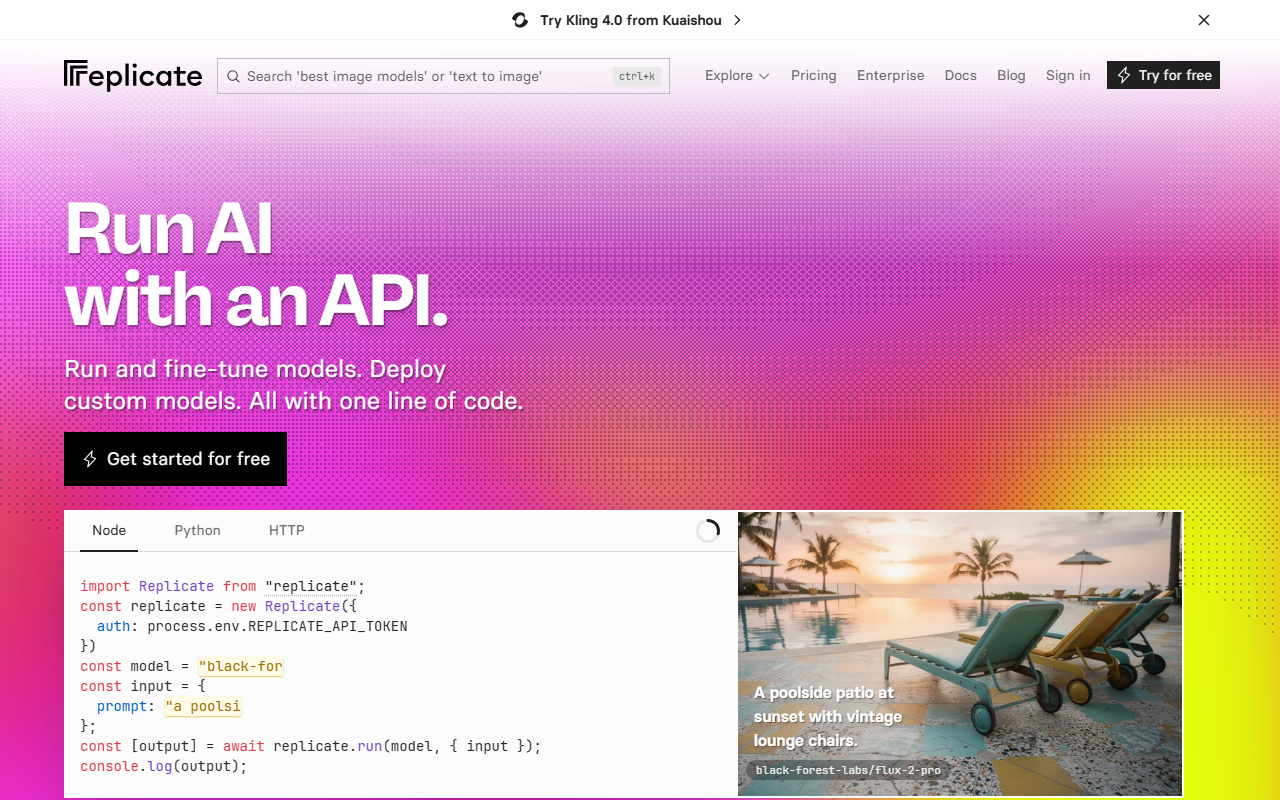
Sign in with GitHub, buy credit, copy a code sample.
Replicate's own video shows the path Cloudflare now owns end to end: calling Replicate models from a Cloudflare Worker.
An MCP server and agent skills let coding assistants find and run models.
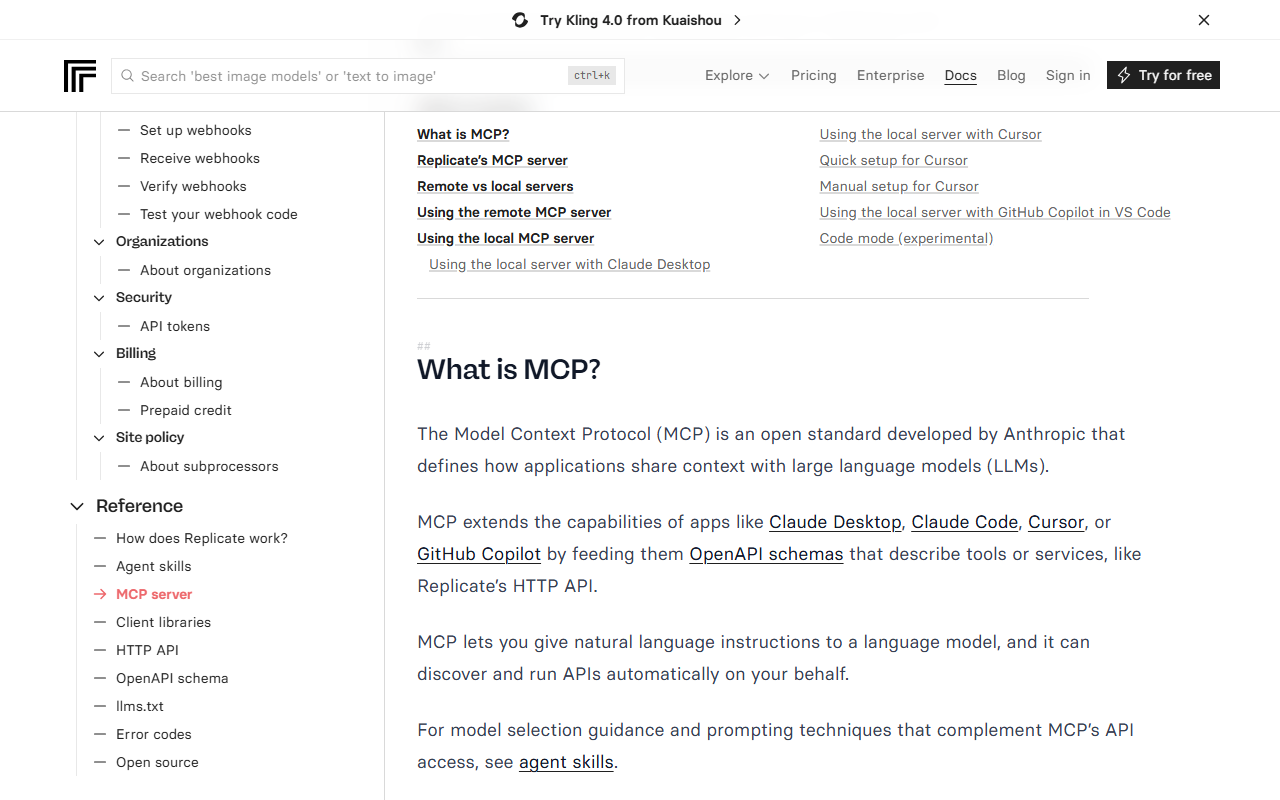
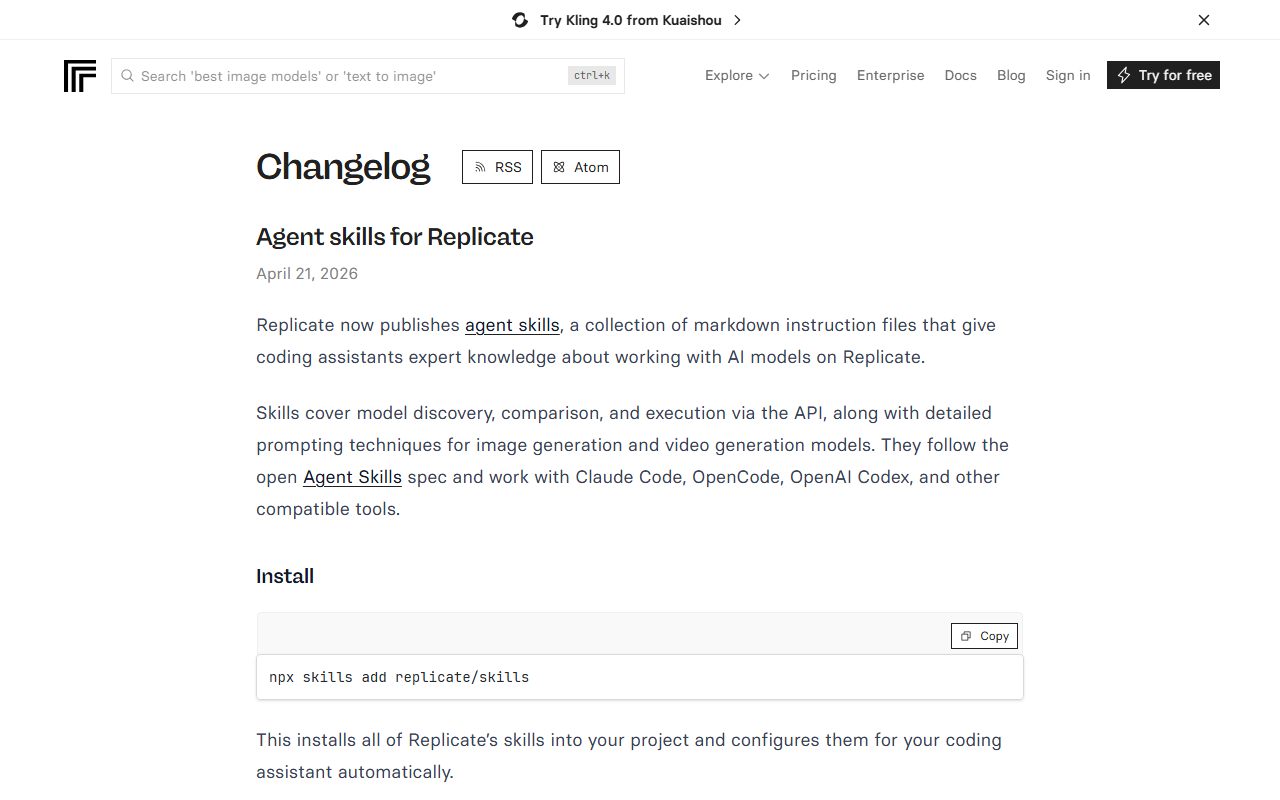
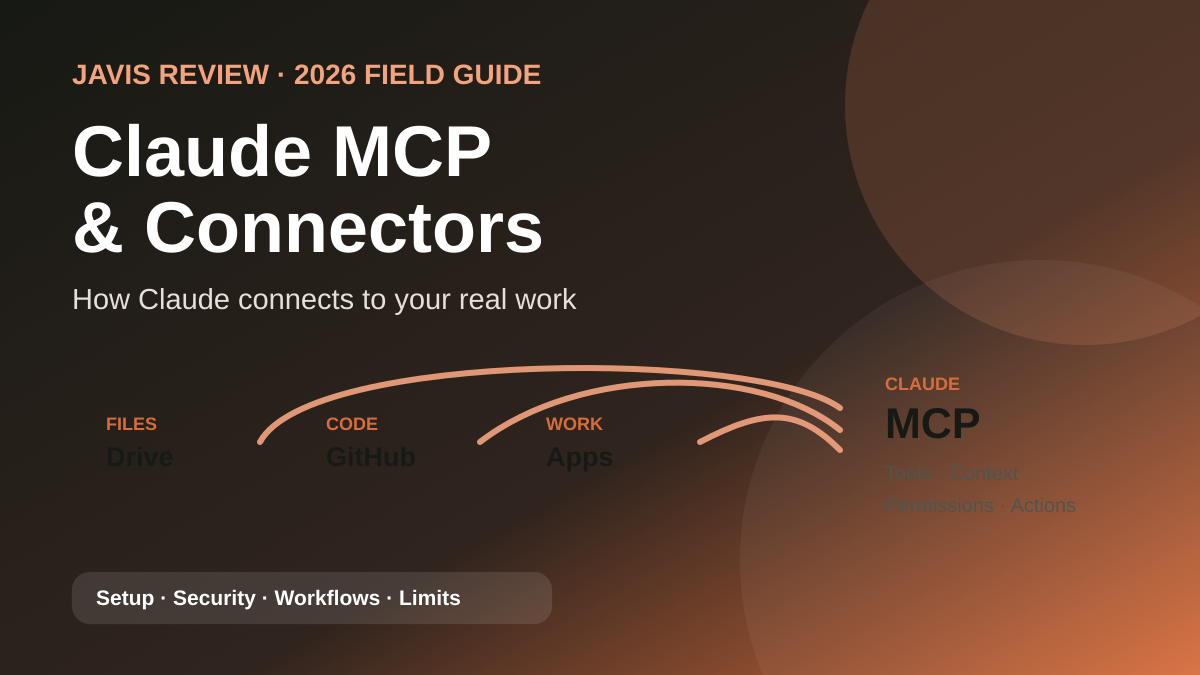
Replicate publishes an MCP server (remote, recommended, or local through the replicate-mcp npm package) that exposes its whole HTTP API to Claude Desktop, Claude Code, Cursor or GitHub Copilot, so you can ask an assistant to search, compare and run models. Since Feb 10, 2026 it is discoverable through the official MCP Registry, and on Apr 21, 2026 Replicate added agent skills (npx skills add replicate/skills) with prompting guidance for image and video models. If you use Claude, our Claude MCP connectors guide explains how such servers are added and what they can reach.
An MCP server that can run paid models spends your credit, so give it a separate API token and keep auto reload modest.
Rate limits, cold boots and a billing rule that contradicts itself.
- Rate limits: 600 prediction requests a minute and 3,000 for other endpoints; tighter as credit runs low; 1 request a second (6 a minute) if you were granted credit without a card on file.
- Cold boots: community and private models can take time to start; official models and deployments avoid this, deployments at the cost of idle time.
- Failed runs: the billing doc says “if a run fails, we don't charge you”, but its section on models that call other models says a failed run is billed “for the duration of the run, plus the cost of the downstream models”, and failures on private models and deployments are billed as normal.
- Per-model prices move: each model sets its price, and one Trustpilot reviewer reports a 3D model rising from $0.16 to $0.50 in Jun 2026.
- Activity: blog and changelog have no entries after Apr 21, 2026, and the replicate-python client was last updated in Aug 2025 (a beta client was updated in Jul 2026).
API data disappears after an hour; web data stays until you delete it.
Per the data-retention doc, inputs, outputs, files and logs of API predictions “are automatically removed after an hour, by default”, while predictions made on the website are “kept indefinitely” until you delete them. That is good for privacy and bad if you forget to save results. The Terms let Replicate use customer data to provide the service, train models you ask it to train and compile aggregated, anonymized “Resultant Data”; the privacy policy (updated Apr 1, 2026) says Replicate does not sell or share personal information and acts as a processor. Subprocessors include AWS, Google Cloud, CoreWeave, Fly.io and Cloudflare, all listed in the United States.
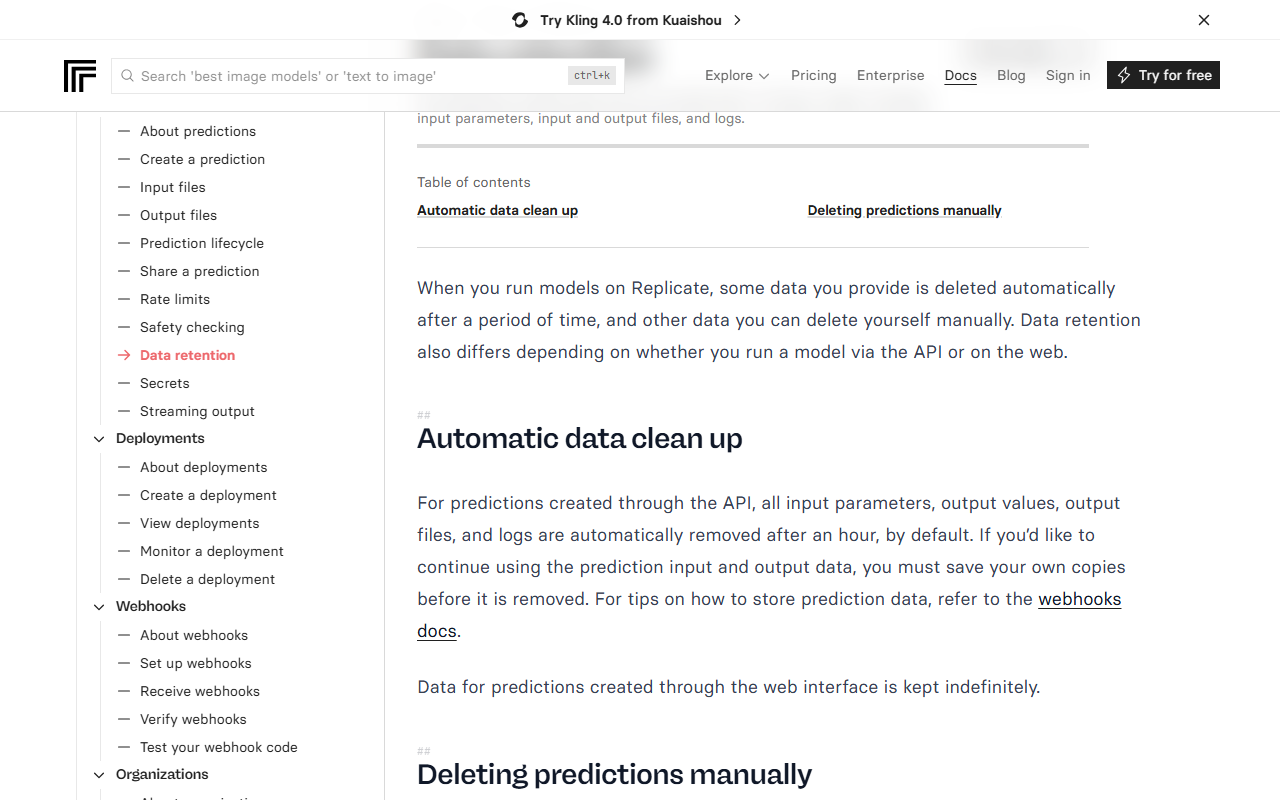
Image models such as SDXL and FLUX run a safety checker on web predictions; it can be switched off through the API, which puts content moderation on you. Replicate's public pages name no SOC 2 report or HIPAA program; the enterprise page offers DPAs and “strict controls for access, encryption, and incident response”. One Trustpilot reviewer reports unauthorised Veo 3 runs on a hacked account in 2025, a reminder to rotate and scope API tokens.
Developers prototyping across many models, and apps that use official models at modest volume.
Developers and small teams who want to try new image, video and language models the day they launch; apps with bursty traffic on official models; people who already package models with Cog.
Teams that keep GPUs busy all month (cheaper elsewhere); buyers who need responsive support without an enterprise contract; anyone who needs a published security certification today.
Seven things to check before you rely on it.
Unused credit is forfeited after 12 months.
Repeated public reports of unanswered tickets.
H100 $5.49 an hour vs $4.50 at Hugging Face.
Lower of six months of fees or $100.
No blog or changelog entries since April 2026.
No email or Google option.
JAVIS ran no model.
Priced from each vendor's own page on Oct 29, 2026; the products differ, so the plans are not like-for-like.
| Option and when to pick it | What its own page says | JAVIS review |
|---|---|---|
| Replicate Widest model catalog, Cog | Per second (H100 $5.49/h) or per output; prepaid credit | This article |
| fal Image and video speed | Nano Banana 2 $0.08 an image; FLUX.2 [pro] $0.03 first megapixel; H100 $4.50/h list, as low as $2.49 | No live review yet |
| Modal Your own code on serverless GPUs | H100 $0.001097 a second, plus CPU and memory; Starter $30 a month of free credit | No live review yet |
| Hugging Face Dedicated endpoints for open models | Inference Endpoints: L40S $1.80/h, H100 $4.50/h; PRO $9 a month | Hugging Face Hub review |
| Cloudflare Workers AI Same owner, edge inference | $0.011 per 1,000 Neurons; 10,000 Neurons a day free | No live review yet |
| OpenRouter Language models only | Provider list price plus a 5.5% credit fee (Oct 28, 2026) | OpenRouter review |
If you would rather run open models on your own machine, Ollama removes the per-run bill entirely, at the cost of your own hardware.
Five steps that keep cost and risk in check.
This review has no affiliate links, and Replicate did not see it.
JAVIS has no approved Replicate affiliate link, so every link goes straight to replicate.com, its pricing page, its documentation or its terms, without tracking parameters.
Hands-on status: JAVIS has not created a Replicate account, bought credit or run a model. Cost examples use invented workloads with the arithmetic shown, and independent review evidence is limited, as section 04 says.
Hardware rates and example model prices.
Open Replicate pricingPrepaid credit, auto reload and expiry.
Open the credit docsBuilding on hosted models? These reviews cover the nearest ground.
Each card opens a published JAVIS review.

Questions people ask before committing
Is Replicate free?
Some select models can be tried free, but the docs say you will be asked to set up billing “after a bit” and that you must buy credit upfront to use Replicate. There is no published free allowance.
How much does Replicate cost?
Official models are priced per output (for example $0.067 for a Nano Banana 2 image at 1K); other models are billed per second of hardware, from $0.81 an hour for a T4 to $5.49 for an H100, as of Oct 29, 2026.
Does Replicate credit expire?
Yes. Per the docs and Terms, purchased credit is valid for one year and is not refundable; unused amounts are forfeited.
Is Replicate owned by Cloudflare?
Yes. Cloudflare's 10-Q says it acquired Replicate, Inc. on Dec 1, 2025 for $57.4 million of total purchase cash consideration. Replicate still runs under its own brand and API.
Will my Replicate code keep working?
Both companies said existing APIs and workflows would continue without interruption, and as of Oct 29, 2026 the API and model pages are live and the service shows as operational.
Does Replicate keep my prompts and images?
API predictions, including outputs and logs, are deleted after an hour by default; predictions made on the website are kept until you delete them.
Is Replicate cheaper than fal?
On the models checked here it is equal or cheaper: a one-megapixel FLUX.2 [pro] image costs the same $0.03 on both, and Nano Banana 2 is $0.067 at 1K on Replicate against $0.08 on fal. Dedicated GPUs are cheaper on fal's list.
What are the alternatives?
fal, Modal, Hugging Face Inference Endpoints, Cloudflare Workers AI and, for language models, OpenRouter; see section 16.
Where this came from, and when.
Pricing and product: replicate.com/pricing, the home page, the enterprise page and model pages for flux-2-pro, flux-schnell, nano-banana-2, gpt-image-2, seedance-2.5, claude-opus-4.7 and krea-2-medium; documentation on billing, prepaid credit, rate limits, data retention, safety checking, official models, subprocessors and MCP; replicate.com/changelog and replicate.com/blog; all Oct 29, 2026.
Legal: Replicate Terms of Service (last update Apr 1, 2026), sections on prepaid credit, customer data, liability, arbitration and assignment; privacy policy (last updated Apr 1, 2026). We have not reviewed the acceptable use policy in detail or any audit report.
Company: Replicate's Nov 17, 2025 post; Cloudflare's Nov 17, 2025 blog post; Cloudflare's Form 10-Q for the quarter ended Jun 30, 2026 (SEC EDGAR); cloudflarestatus.com; github.com/replicate (Cog releases); Replicate's YouTube channel.
Independent evidence: Trustpilot page for replicate.com (16 reviews); Hacker News items 49327917, 45953702 and 46117993 and comments 45957788, 44130689, 39413466 and 39414222. No G2 rating is quoted.
Competitors: fal.ai/pricing and its FLUX.2 [pro] page, modal.com/pricing, huggingface.co/pricing and Cloudflare Workers AI pricing, Oct 29, 2026; openrouter.ai/pricing, Oct 28, 2026; Anthropic's API pricing page for the Claude comparison, Oct 29, 2026. Cost examples are arithmetic on those prices with invented workloads.
Images: screenshots of public pages taken Oct 29, 2026 and Replicate's blog social card. The two videos are from Replicate's own YouTube channel.
JAVIS Fit Score (70/100): editorial composite, 20 points each. Price clarity 15: per-output prices are clear, the free allowance and failed-run rules are not. Capability breadth 18: catalog, fine-tuning, Cog, MCP. Independent evidence 10: small, negative Trustpilot sample and a few HN threads. Security and data control 13: one-hour API deletion and processor role, offset by no published certification and a $100 liability cap. Cost control and fit 14: fair per-output prices, expensive dedicated GPUs, expiring credit. It is judgment, not a measurement.
What this review does not cover: latency and cold-boot times, output quality, what enterprise contracts actually include, how quickly support answers today, and when Replicate models will appear in Workers AI.