
Together AI Review 2026: The Biggest Open-Model Menu, Prepaid From $15, With Your Prompts Stored by Default
Together AI runs Kimi, GLM, DeepSeek, Qwen and other open models behind an OpenAI-compatible API, and rents the GPUs behind them. As of Oct 29, 2026 there is no free trial, billing is fully prepaid, and prompt storage is on until an admin turns it off. This review works out what it costs against cheaper hosts, what the data defaults mean and where it beats Groq.

There are no affiliate links in this review. Every Together AI link goes straight to together.ai or its documentation.
| Made by | Together AI (independent); $800M Series C Jul 2026 |
| What it is | Open-model inference, fine-tuning and GPU cloud |
| Pricing | Prepaid; $15 first purchase; per token or GPU hour |
| Catch | No trial; prompts stored by default; fast deprecations |
| Evidence | OpenRouter speed data; 8 Trustpilot reviews; HN |
Together AI is the broadest self-serve menu of new open models, often among the fastest hosts for them, but you prepay $15 before your first request and it stores your prompts unless you switch that off.
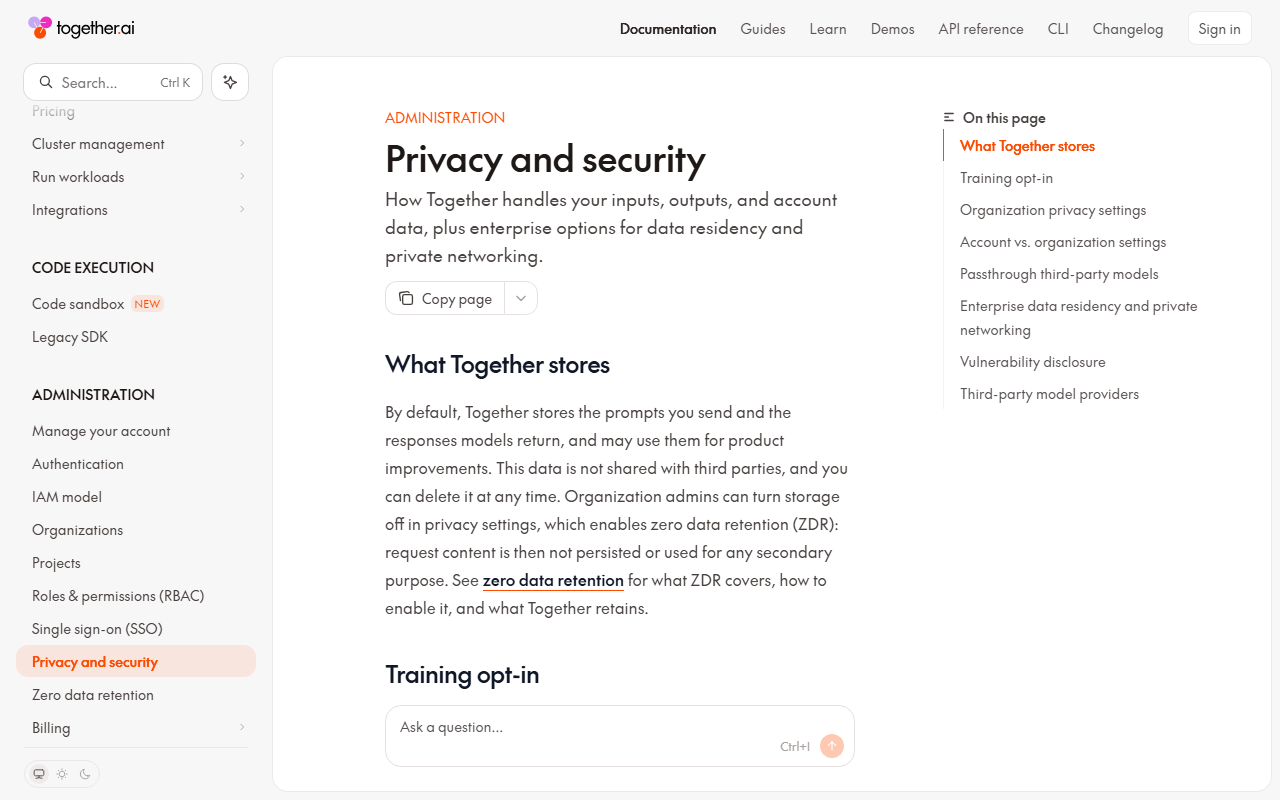
“By default, Together stores the prompts you send and the responses models return, and may use them for product improvements.” That sentence from Together's own privacy page is the first thing to act on: one admin toggle turns on zero data retention, but it is off when you sign up.
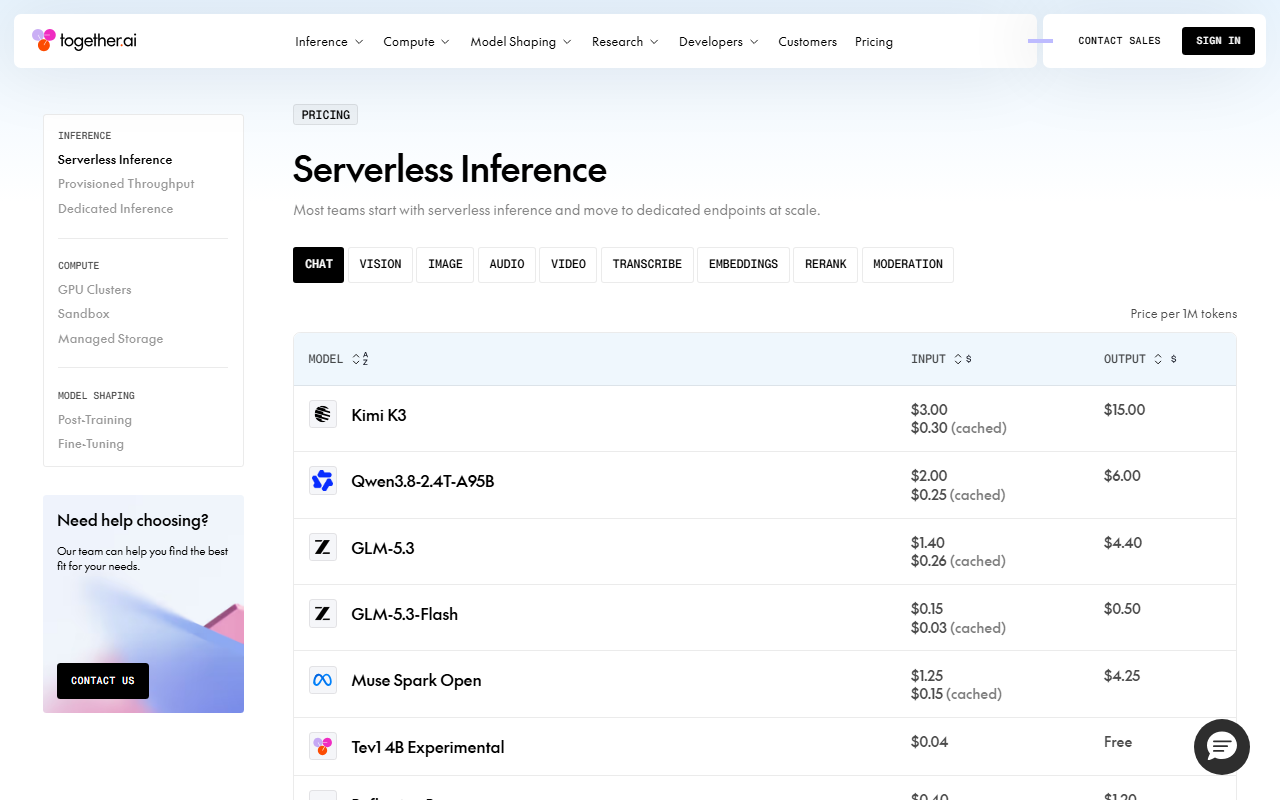
Together AI is an AI cloud that runs open-weight models behind an OpenAI-compatible API, plus dedicated GPU endpoints, GPU clusters, fine-tuning and code sandboxes. As of Oct 29, 2026 its pricing page lists about 30 serverless chat models, from Kimi K3 ($3.00 input and $15.00 output per million tokens) and GLM-5.3 ($1.40 and $4.40) down to DeepSeek V4.1 Flash ($0.30 and $1.20), GPT-OSS 120B ($0.15 and $0.60) and a free Ternary Bonsai 27B. New releases tend to land on day one; Together has a launch partnership with Moonshot for future Kimi models. On OpenRouter's public table on Oct 29, 2026, Together served DeepSeek V4.1 Flash at a median 239 tokens a second, the fastest of the hosts shown at that price.
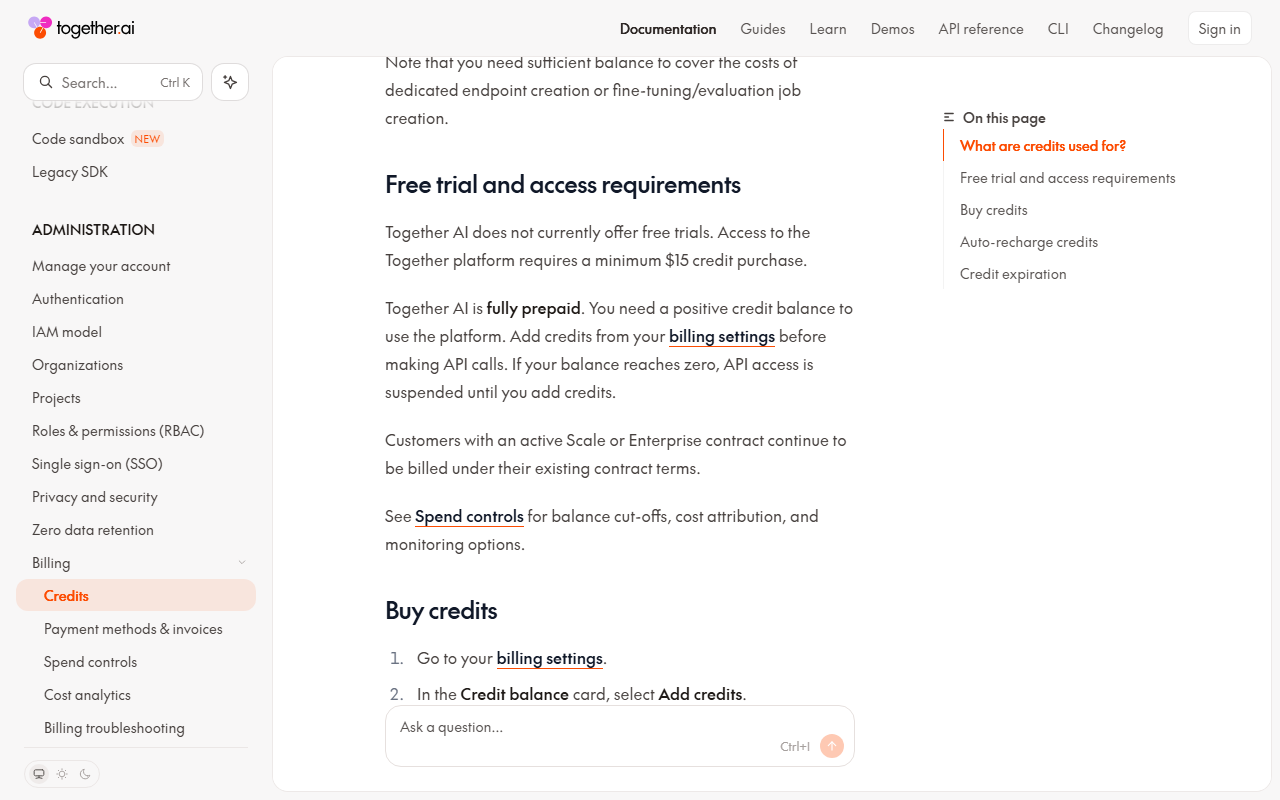
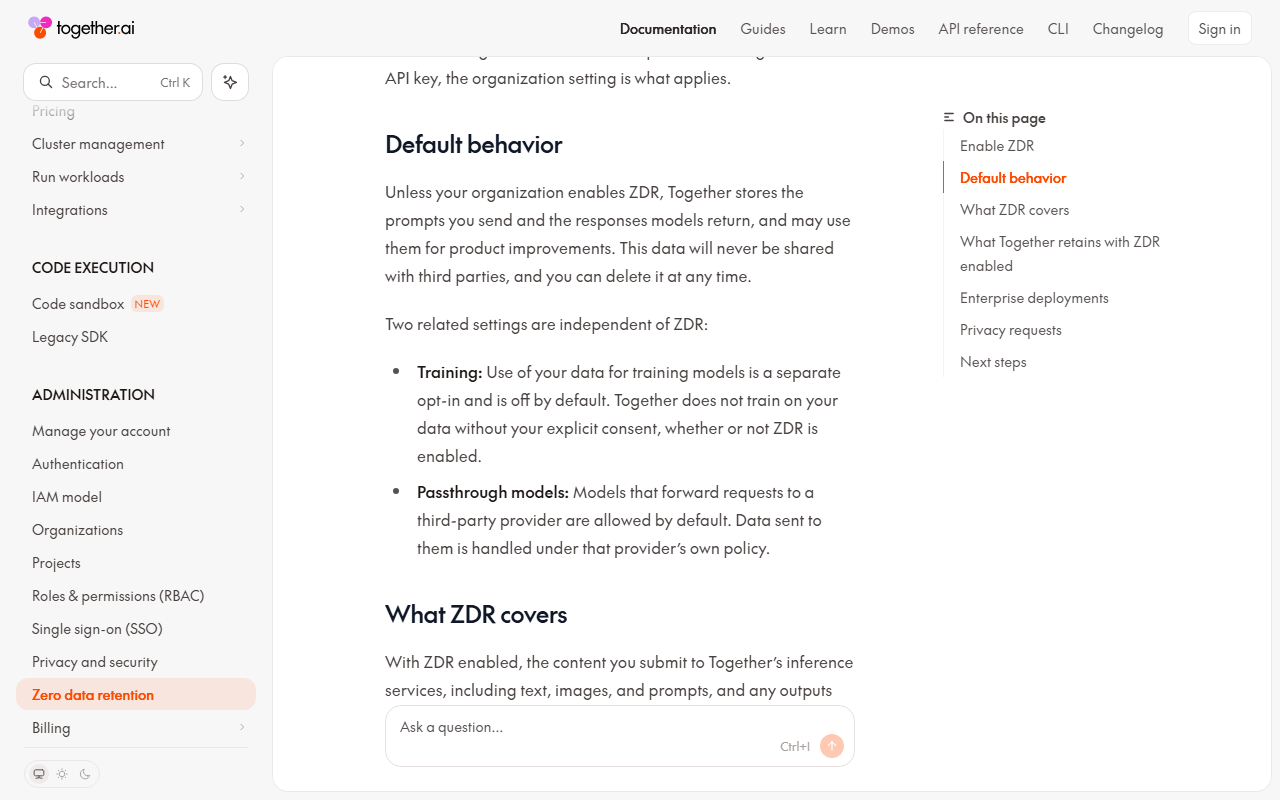
Three things deserve a decision before you commit. First, money up front: the docs say Together “does not currently offer free trials”; the first purchase is at least $15, the account is fully prepaid and stops at a zero balance, and budgets and spend alerts are still “coming soon”. Second, data defaults: prompts and outputs are stored by default and passthrough models send traffic to third-party providers unless an admin turns them off. Third, price and churn: Together usually charges the model maker's list price, while the cheapest hosts on OpenRouter offer the same DeepSeek model at about a seventh of the input price, and it removes serverless models on two to three weeks' notice (Llama 3.3 70B Turbo went on Oct 22, 2026), though most can move to a dedicated endpoint.
Not a hands-on test: JAVIS has not created a Together account, bought credits or sent a request. This review is built from Together's pricing page, documentation, changelog, blog, trust center and status page, TechCrunch, OpenRouter's public provider tables, Trustpilot and Hacker News, all dated Oct 29, 2026 unless stated. Speed figures are OpenRouter medians, not our measurement.
Prepay credits, call one OpenAI-style API, then move heavy traffic to reserved capacity.
You buy credits, create a key and point an OpenAI-style client at Together. Serverless requests are billed per token from your balance and are “best-effort”: under high demand they can be throttled with a 429 or 503. For guarantees there are three paid steps up: provisioned throughput (reserved capacity per model at $0.05 per unit per minute, one-month minimum, via sales), dedicated model inference on your own GPUs (H100 from $5.49 per GPU hour on demand) and full GPU clusters. Fine-tuning, post-training, evaluations and code sandboxes bill from the same balance.
An $800M Series C in July 2026 and a big push into inference capacity.
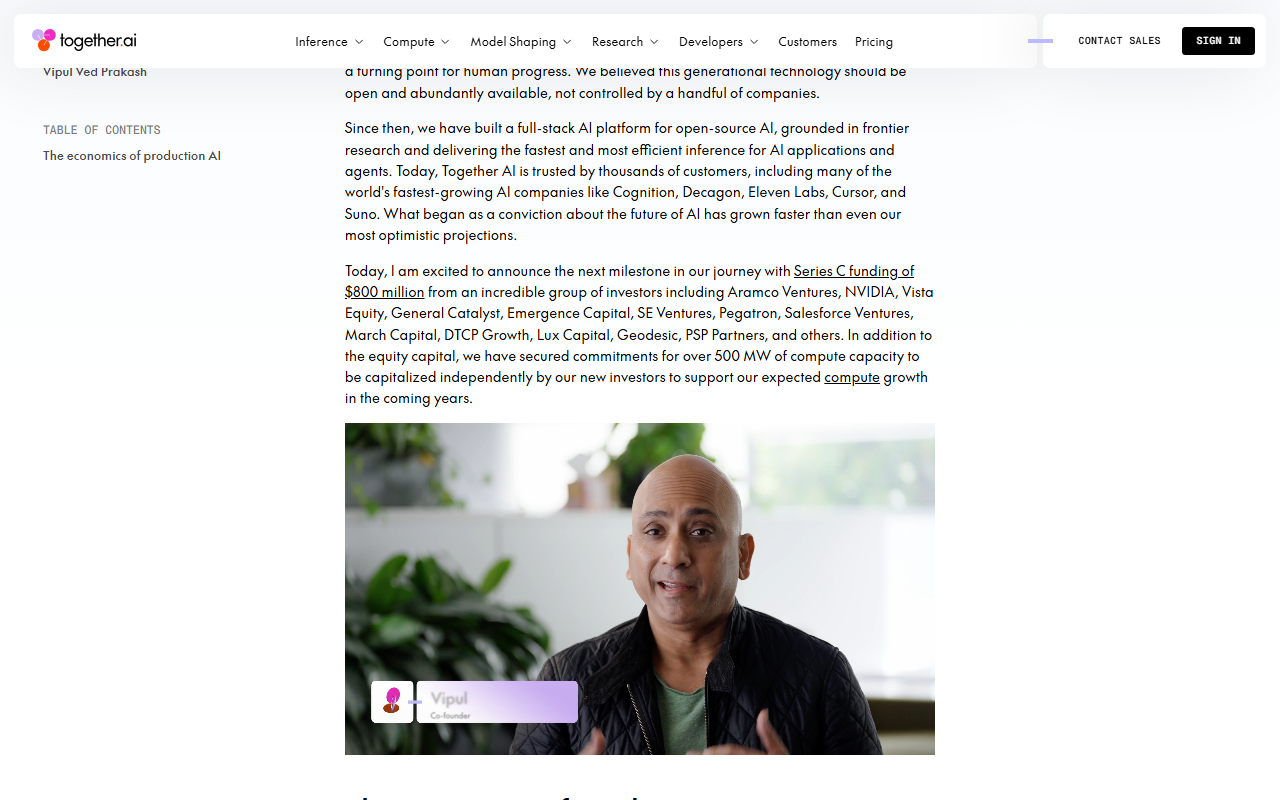
Together AI was founded in 2022 (its Series C post says “four years ago”) by a team including CEO Vipul Ved Prakash. On Jul 1, 2026 it announced an $800 million Series C from investors including Aramco Ventures, NVIDIA, Vista Equity and General Catalyst, plus commitments for over 500 MW of compute capacity financed separately by the new investors. TechCrunch reported the round at an $8.3 billion valuation, led by Aramco Ventures, up from $3.3 billion at the $305 million Series B, and quoted the company claiming “annual bookings of over $1.15 billion” (bookings are contracted value, not revenue). Together's own post names Cognition, Decagon, ElevenLabs, Cursor and Suno as customers.
Since then it has signed a launch partnership with Moonshot AI (Jul 29, 2026) to serve every future open Moonshot model, added a large NVIDIA B300 inference cluster on IBM Cloud (Oct 6, 2026, where it cites “over a million developers”), earned ISO 27001:2022 (Jun 10, 2026) and launched Together Link to plug open models into existing coding agents (Oct 5, 2026). The company remains independent, with no change of ownership.
Praised for speed and model choice, criticised for prepaying blind and for billing support. The samples are small.
Together's Trustpilot profile is unclaimed and has 8 reviews averaging 2.7 as of Oct 29, 2026; it is filed under “Card Processing Service” with an Anguilla contact, so it may not reflect Together's customers. Hacker News gives more texture. Claims below are individual accounts we cannot verify.
“Groq is fast but only has a few models, Together AI is cheap but slower, Fireworks is reliable but more expensive.” A builder explaining why they juggled three providers.
“Together.ai, Baseten, and others have already achieved higher throughput, lower latency ... for DeepSeek V4.1 Flash 1017 than DeepSeek's own inference service.”
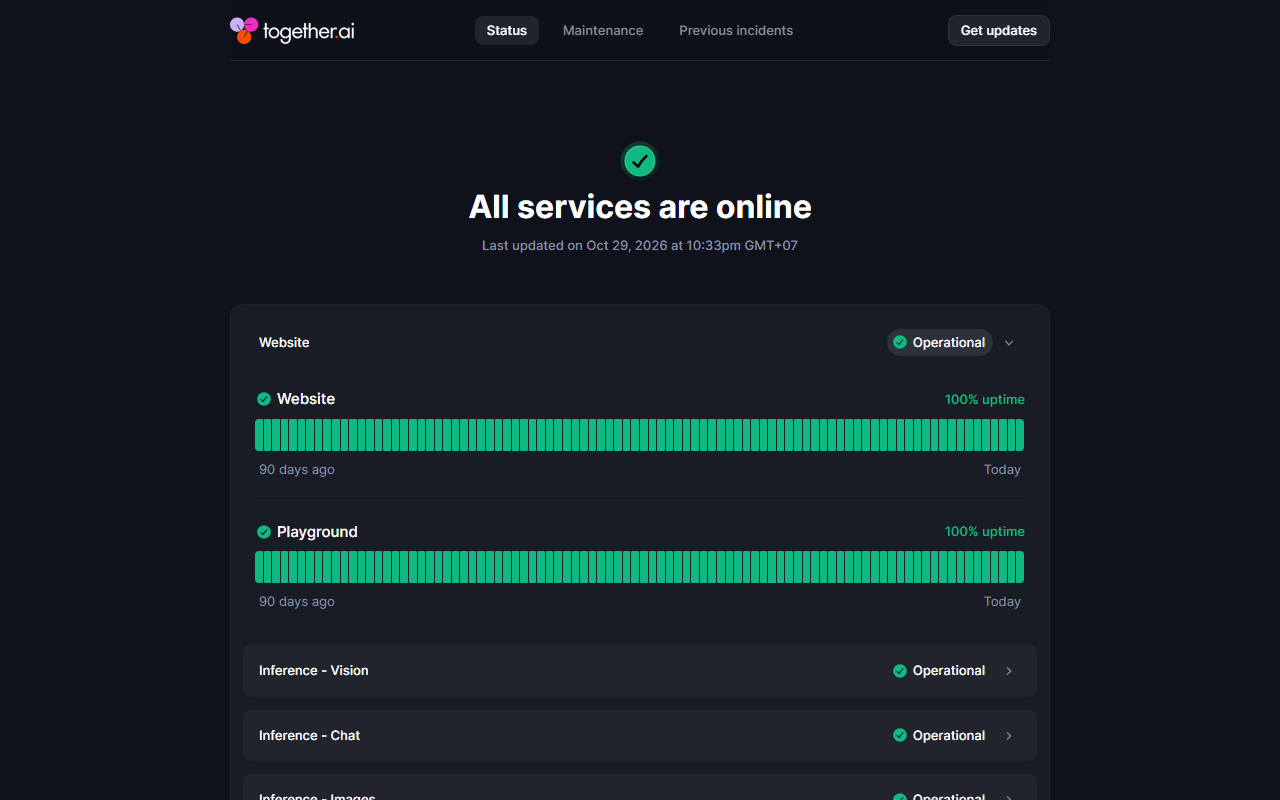
“they seem fairly unreliable with constant outages or higher than normal latency.” One account; the status page showed all services online on Oct 29, 2026.
“They make you pay before you can even try anything. Even before you pay no where does it state, latency or tps.”
A reviewer says they were charged “160USD per month and impossible to cancel it” after a small training experiment, with no reply from support.
Recommending DeepSeek V4.1 Flash on Together: DeepInfra “is cheaper for that but its noticeably slower”, and Together's output “feels like it might be better (not quantified; just vibes).”
No free tier: prepaid serverless tokens, reserved capacity by contract, and GPUs by the hour.
As of Oct 29, 2026 the pricing page groups products into serverless inference, provisioned throughput, dedicated inference, GPU clusters, sandbox, storage, post-training and fine-tuning. The page's own preview text still says “Start for free”, but the credits doc is explicit: no free trial, a $15 minimum first purchase, then $5 top-ups. Credits “do not currently have an expiration date”.
- About 30 chat models plus image, video, audio, embeddings
- Prepaid; best-effort speed
- US-only endpoint at 1.25× price
- Five models (GLM, DeepSeek, Kimi K3)
- One-month minimum, via sales
- 99% request-success SLA
- H100 on demand; B200 $8.99
- Your own GPUs, custom models
- Billed per minute of reserved hardware
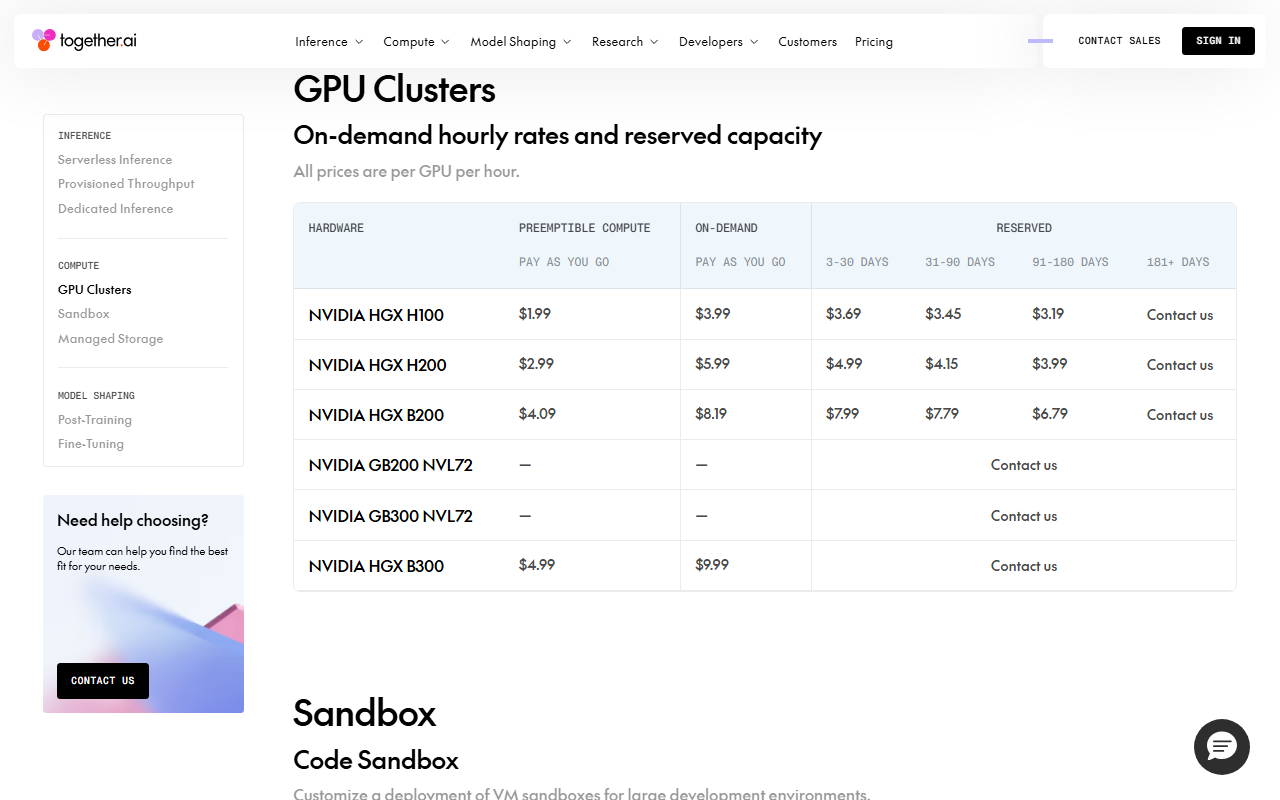
- H100 on demand; $1.99 preemptible
- Reserved from $3.19 (91 to 180 days)
- H200, B200, B300; GB200/GB300 by quote
| Serverless model | Input / output per 1M (cached input) | Note |
|---|---|---|
| Kimi K3 | $3.00 / $15.00 ($0.30) | Raised from $2.70 / $13.50 on Oct 14, 2026 |
| GLM-5.3 | $1.40 / $4.40 ($0.26) | Same as Z.ai's own price on OpenRouter |
| Muse Spark Open | $1.25 / $4.25 ($0.15) | Added Oct 15, 2026 |
| DeepSeek V4.1 Flash | $0.30 / $1.20 ($0.006) | 1M context, FP8 |
| GPT-OSS 120B | $0.15 / $0.60 | Same list price as Groq |
| Qwen3.5 9B | $0.17 / $0.25 | Small and cheap |
| Ternary Bonsai 27B | Free | Listed at $0.00 input and output |
From together.ai/pricing and the changelog, Oct 29, 2026.
Two pricing catches
Batch is not half price for most models. The batch docs headline “up to 50% lower cost”, but the discounted-models list names only Whisper Large V3, and “Models not listed run at standard rates.” The docs and pricing page disagree on some prices: Qwen3.7 Max shows $1.50 and $4.50 on the pricing page but $2.50 and $7.50 in the docs model table, so check the console before a big job. Prices can also rise: Kimi K3 went up about 11% on Oct 14, 2026.
Worked examples: list price is fair, but not the floor.
These are invented workloads with the arithmetic shown, using list prices on Oct 29, 2026.
A product on DeepSeek V4.1 Flash
1 billion input and 200 million output tokens a month: $300 + $240 = $540. If half the input is cached (stable system prompt first), that half costs $3 instead of $150, so $393. Routing through the US-only endpoint for data-processing reasons costs 1.25×: $675 uncached. The batch API would not lower this, since only Whisper is discounted.
What the premium buys
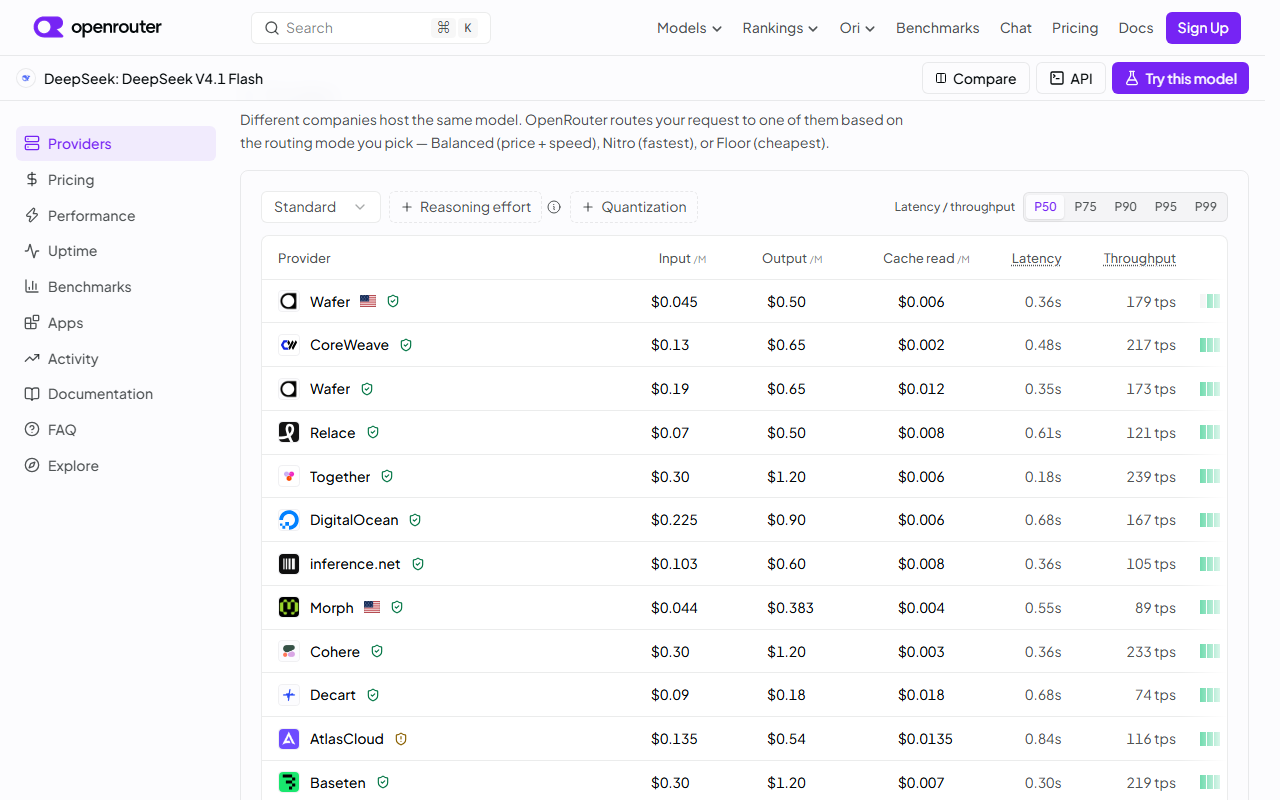
On OpenRouter's table for DeepSeek V4.1 Flash on Oct 29, 2026 (median), Together answered in 0.18 s at 239 tokens a second, among the quickest first tokens on the table, while the two cheapest hosts ran at 179 (Wafer) and 89 (Morph) tokens a second. Paying Together's list price buys speed and a big catalog; it does not buy the lowest bill. On GPT-OSS 120B the picture flips: Together charges the same $0.15 and $0.60 as Groq but served 91 tokens a second against Groq's 290.
A coding agent on GLM-5.3, and reserved hardware
An agent sending 300 million input tokens a month, 80% of them cache hits, and 30 million output: 60M × $1.40 = $84, 240M × $0.26 = $62.40, 30M × $4.40 = $132, so $278.40. Moving off the shared pool is a different scale of bill: one dedicated H100 running all month (730 hours at $5.49) is $4,007.70; an 8-GPU H100 cluster on demand is $23,301.60 a month, or $18,629.60 on a 91 to 180-day reservation; one provisioned-throughput unit for a 30-day month (43,800 minutes) is $2,190, and unused units are not refunded.
New models arrive fast and old ones leave fast; the dedicated endpoint is the escape hatch.
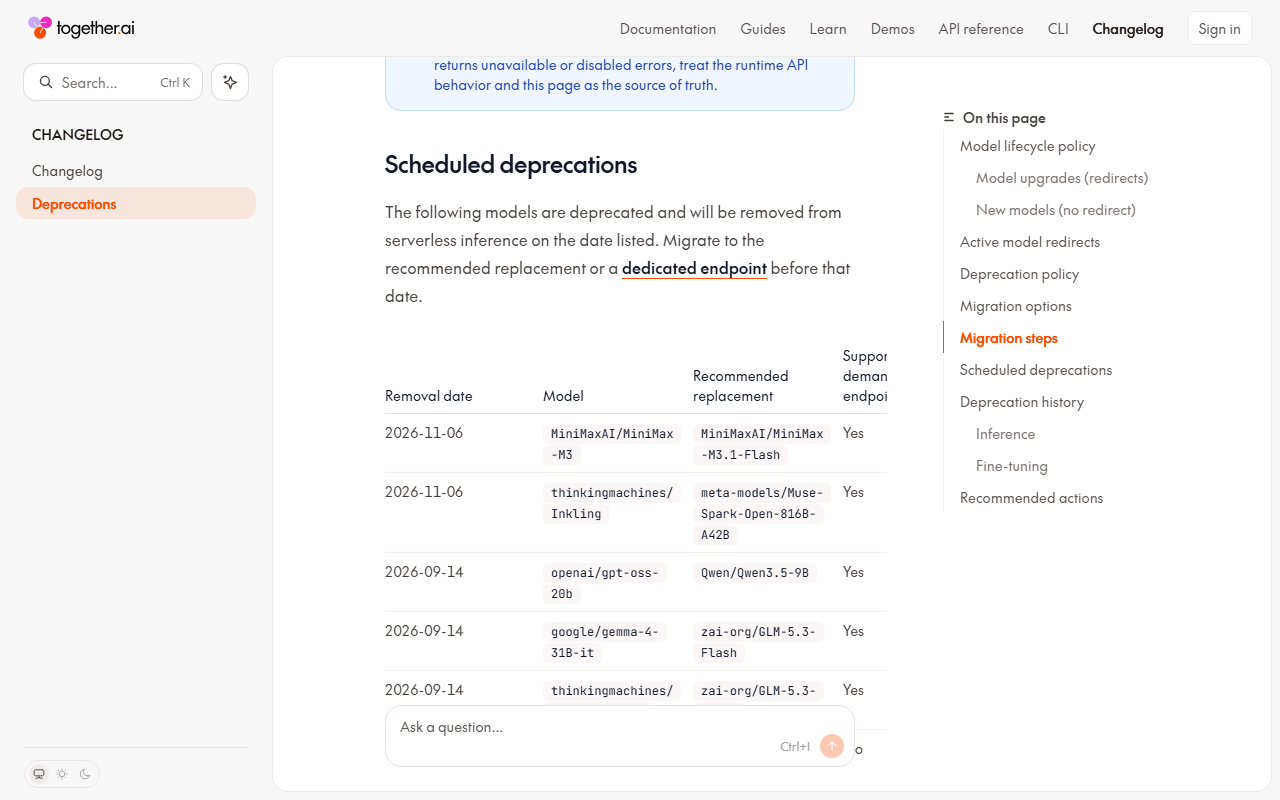
Together's deprecations page sets the rules: preview models can go with “<24 hours of notice, after 30 days”, serverless models get “2 or 3 weeks”, and same-lineage upgrades are redirected automatically after a 3-day notice (DeepSeek-V3 requests now go to DeepSeek-V3.1, for example). Recent removals from serverless include GPT-OSS 20B, Gemma 4 31B and Inkling Small (Sep 15, 2026) and Llama 3.3 70B Instruct Turbo and DeepSeek V4 Flash 0731 (Oct 22, 2026); MiniMax M3 and Inkling are scheduled for Nov 6, 2026. Unlike some rivals, most removed models can still run on an on-demand dedicated endpoint, at GPU-hour prices.
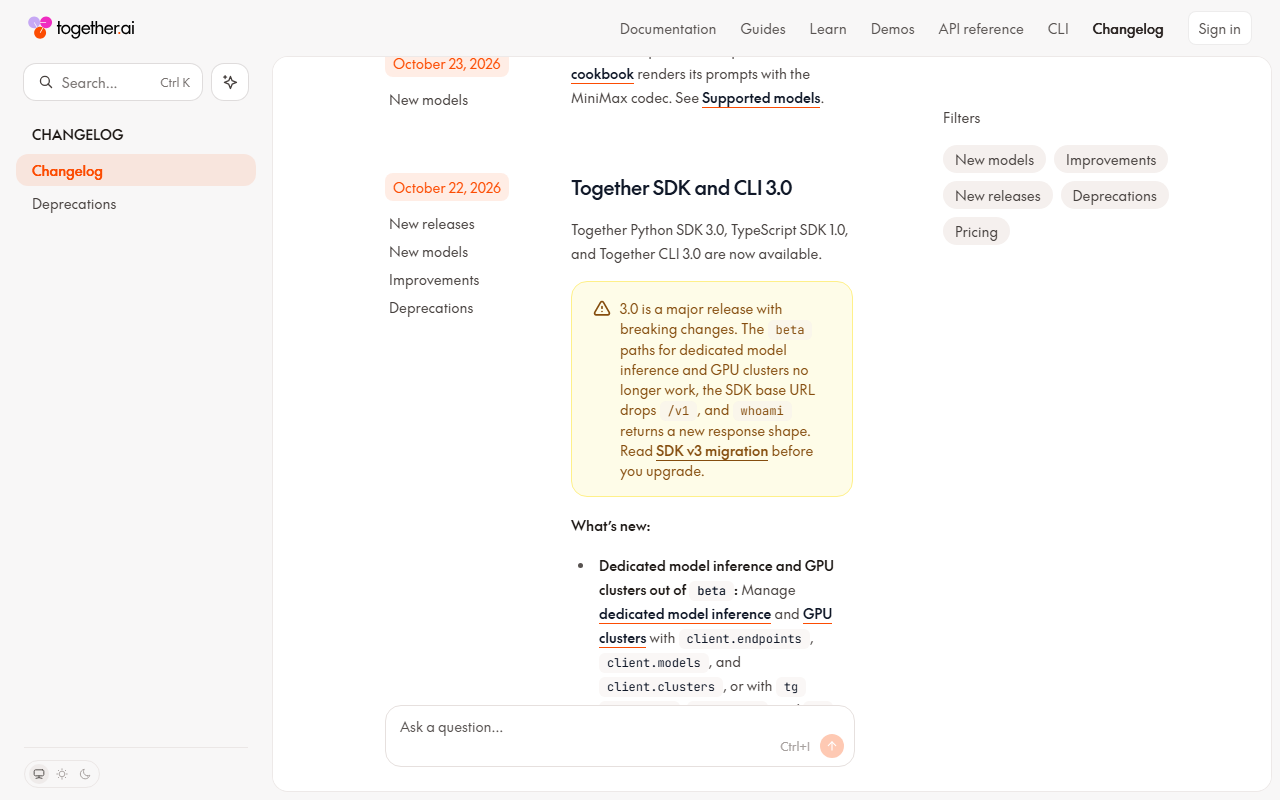
The platform itself also changes quickly. On Apr 22, 2026 Together retired its Build Tiers and moved all self-serve billing to prepaid; on Oct 2, 2026 it dropped dynamic rate limits for serverless; and on Oct 22, 2026 it shipped Python SDK 3.0 and CLI 3.0 with breaking changes (old beta paths stop working and the SDK base URL drops /v1).
Match your situation to one line.
Serverless inference, dedicated GPUs, fine-tuning and post-training, sandboxes and clusters on one balance.
OpenAI-compatible chat, vision, image, video, speech-to-text, text-to-speech, embeddings, rerank and moderation models; function calling and structured outputs on most chat models; batch jobs with a 24-hour window.
LoRA and full fine-tuning (for example GPT-OSS 120B LoRA SFT at $2.50 per million training tokens), post-training with SFT and GRPO, evaluations, and deployment of fine-tuned models to dedicated endpoints.
Dedicated model and container inference, GPU clusters from H100 to GB300, code sandboxes and a code interpreter at $0.03 per 60-minute session, shared storage at $0.16 per GiB a month.
Together Link (Oct 5, 2026) plugs these models into existing coding agents and claims over 50% lower spend than closed models; that is the vendor's estimate. The privacy page says third-party models such as DeepSeek run on Together's own hardware and the model author receives no traffic, with the exception of “passthrough” models that forward requests to another provider.
Fund the account, fix the privacy settings, then call the API.
Best-effort serverless, prepaid cut-offs and contract-only guarantees.
- No published rate limits, no guarantee: serverless “is best-effort”; Together “may limit requests” under high demand and may set custom limits on hot models.
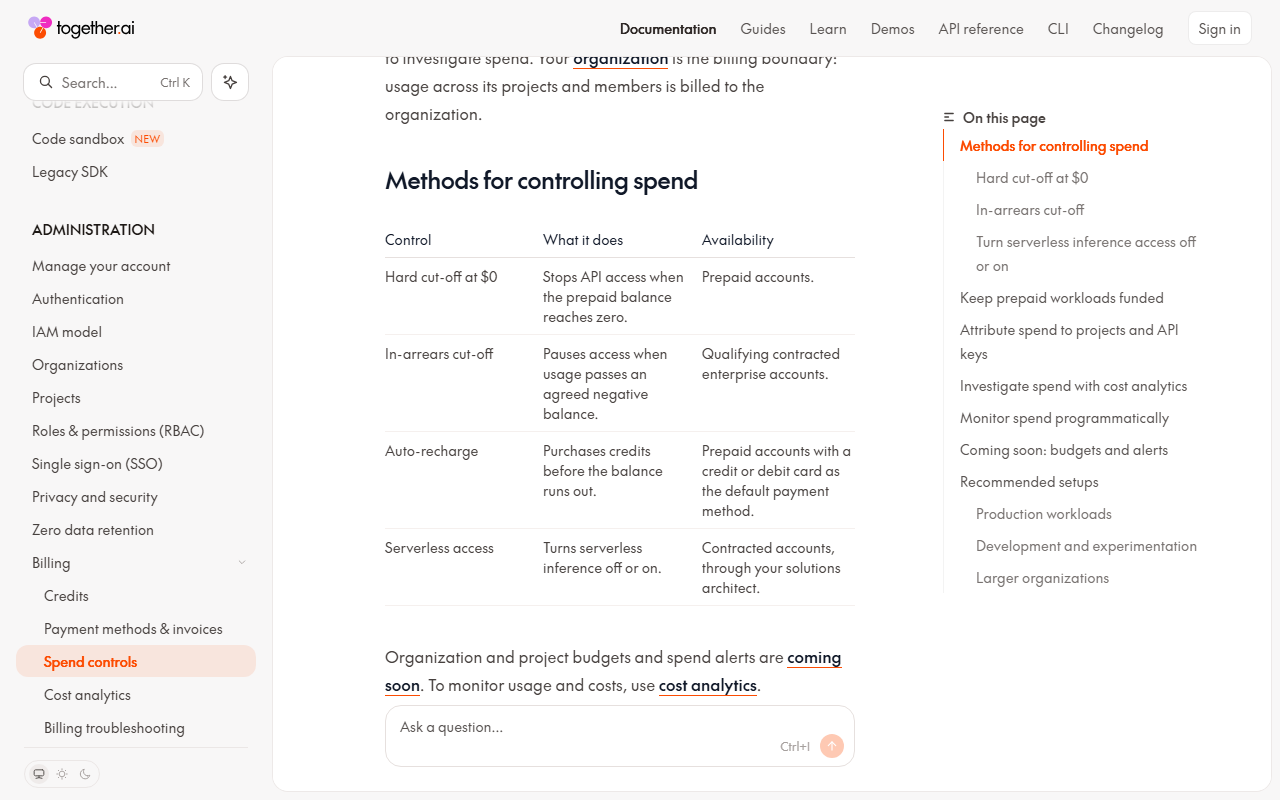
- Prepaid cut-off: access stops at $0; metering lags, so usage can arrive after zero and you still pay for it.
- No budgets or alerts yet: listed as “coming soon”; the billing usage API is in beta and must be enabled by support.
- Contract-only: provisioned throughput, in-arrears billing, EU VPC deployments.
- Batch files are kept 7 days; download results in time.
SOC 2 and ISO 27001, but prompts are stored by default and passthrough is on.
Together's privacy page says it stores prompts and responses by default and “may use them for product improvements”, does not share them with third parties, and lets you delete them. Training on your data is a separate opt-in that is off by default. Turning storage off enables zero data retention, which also switches off passthrough models; with ZDR on, Together still keeps usage metadata and any files you upload for fine-tuning or batch until you delete them.
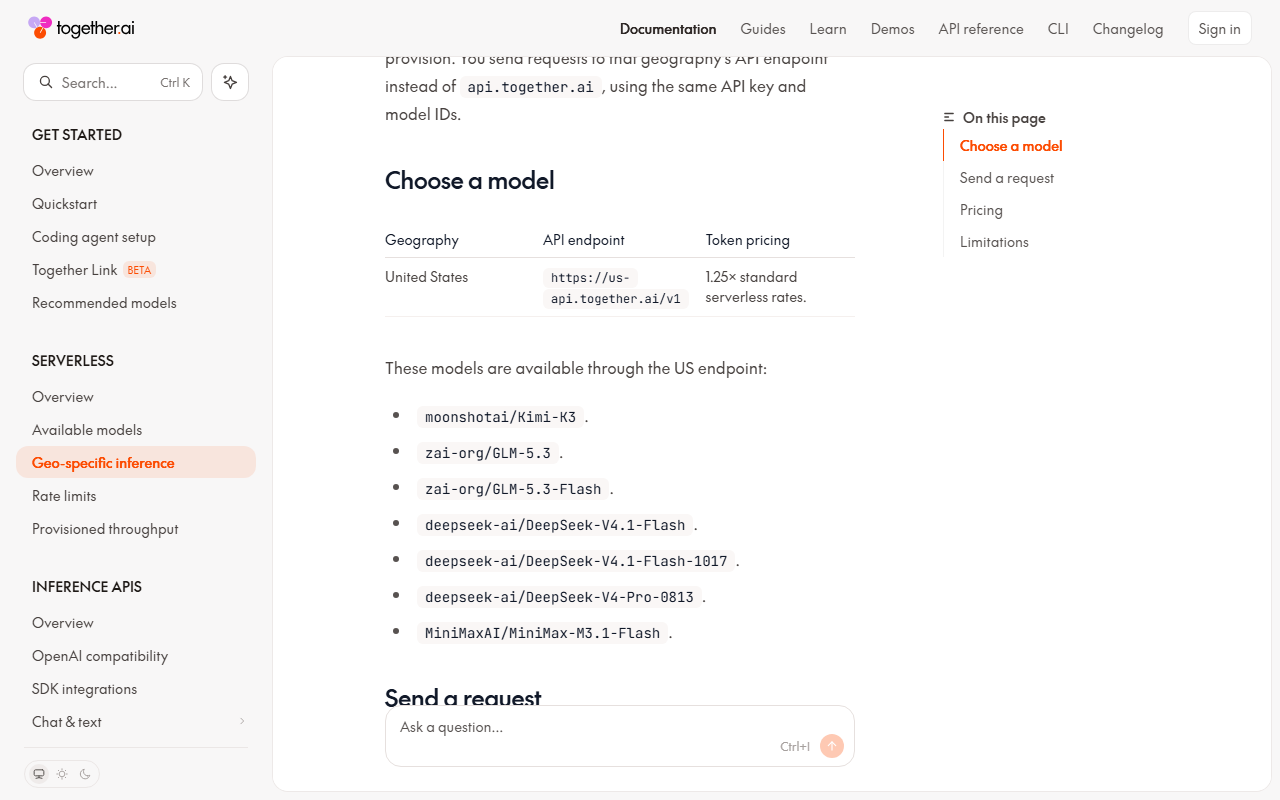
Residency and precision. A US-only endpoint keeps processing (not storage or logs) in the United States for seven models at 1.25× the price; EU residency needs a private networking or VPC deployment on dedicated endpoints. The same privacy page says models are “hosted at full precision”, yet the docs model table lists FP8, FP4 and NVFP4 quantization for many serverless models; check the quantization column for any model where precision matters.
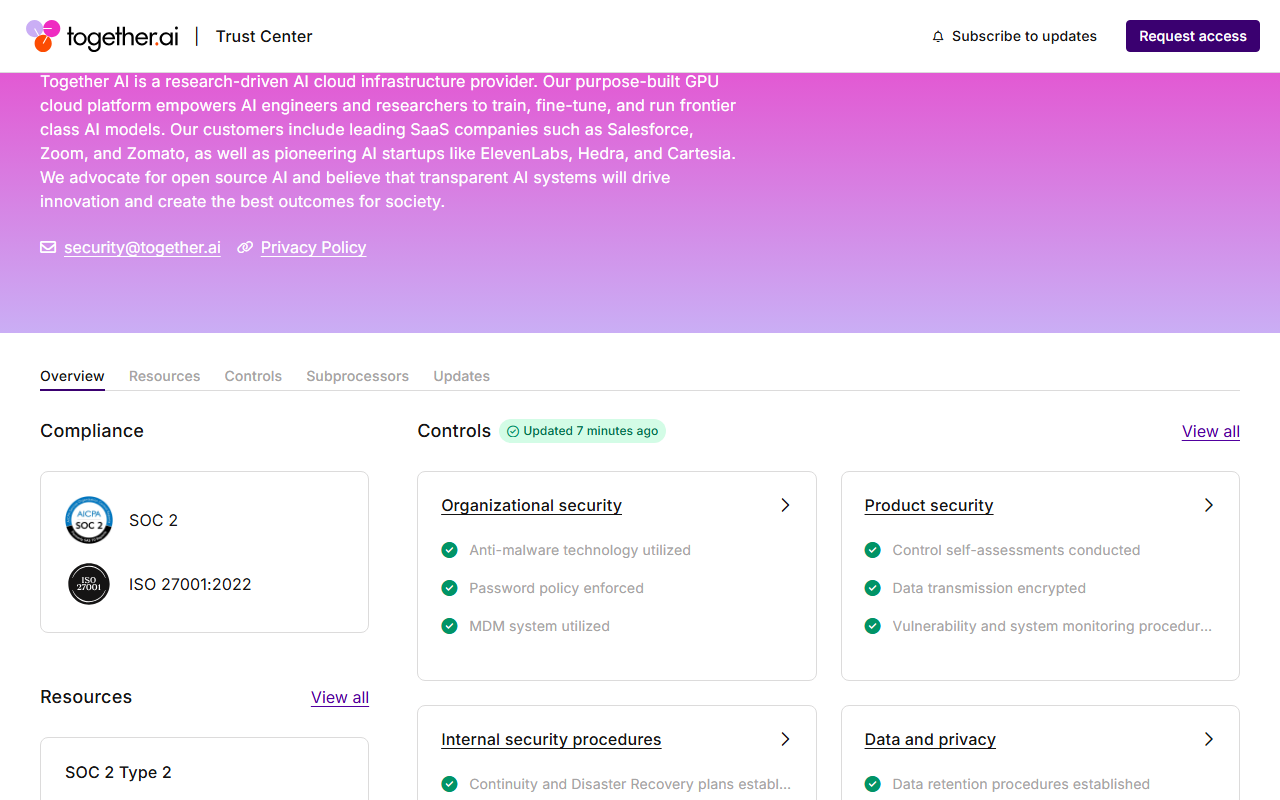
The trust center lists a SOC 2 Type 2 report, the ISO 27001:2022 certificate and a Data Processing Addendum (reports on request), and Together published how it patched the Linux “Copy Fail” kernel flaw (CVE-2026-31431) across its fleet within hours (Apr 30, 2026). We have not reviewed the SOC 2 report or the full privacy policy.
Teams that want many open models now and a path to reserved capacity later.
Startups and product teams moving off closed models to Kimi, GLM, DeepSeek or Qwen; teams that will fine-tune or post-train and serve the result; companies that expect to graduate to dedicated GPUs or provisioned throughput.
Anyone who wants a free tier to test; cost-first batch jobs (no batch discount on most models); teams that need hard budgets per project today; buyers who need EU data residency without a contract.
Seven things to check before you rely on it.
No free trial; $15 minimum first purchase.
ZDR and passthrough are admin settings.
Cheaper hosts list DeepSeek V4.1 Flash for a fraction.
2 to 3 weeks for serverless, under 24 hours for previews.
Budgets and alerts still coming soon.
Prices and precision claims differ between pages.
JAVIS did not send a request.
Priced from each vendor's own page on Oct 29, 2026; the products differ, so the plans are not like-for-like.
| Option and when to pick it | What its own page says | JAVIS review |
|---|---|---|
| Together AI Broad, fast open-model catalog | Prepaid, $15 minimum; DeepSeek V4.1 Flash $0.30 / $1.20; GPT-OSS 120B $0.15 / $0.60; GPUs from $1.99 an hour | This article |
| Groq Fastest GPT-OSS with a free plan | Free plan; GPT-OSS 120B $0.15 / $0.60 at about 290 tokens a second; few self-serve models | No live review yet |
| Fireworks AI Similar catalog, per-second GPUs | Prepaid serverless with an optional monthly spend limit; on-demand GPUs per second; fine-tuning | No live review yet |
| Cerebras Raw speed on a few models | One-time $5 credit; GPT OSS 120B $0.35 / $0.75 at about 3,000 tokens a second | No live review yet |
| OpenRouter Pick the cheapest or fastest host | Routes the same models to Together and cheaper hosts; 5.5% fee on credit purchases | OpenRouter review |
To run the same open models on your own machine, see Ollama; Hugging Face lists Together among its Inference Providers.
Five steps that keep cost, data and lock-in under control.
This review has no affiliate links, and Together AI did not see it.
JAVIS has no approved Together AI affiliate link, so every link goes straight to together.ai, its pricing page or its documentation, without tracking parameters.
Hands-on status: JAVIS has not created a Together account, bought credits or sent a request. Cost examples use invented workloads with the arithmetic shown, speed figures come from OpenRouter's public tables, and independent review evidence is thin, as section 04 says.
Serverless, reserved and GPU pricing.
Open Together AI pricingWhat is stored and how to switch it off.
Open privacy and security docsChoosing where to run open models? These reviews cover the nearest ground.
Each card opens a published JAVIS review.

Questions people ask before committing
Is Together AI free?
No free trial, per its credits docs: the first credit purchase is at least $15 (then $5). One serverless model, Ternary Bonsai 27B, is listed as free on the pricing page.
How much does Together AI cost?
Per token for serverless, from $0.15 and $0.60 per million for GPT-OSS 120B to $3.00 and $15.00 for Kimi K3; dedicated H100s from $5.49 an hour; GPU clusters from $1.99 (preemptible) or $3.99 (on demand) per H100 hour, as of Oct 29, 2026.
Does Together AI store my prompts?
Yes, by default, and it may use them for product improvements. An admin can turn storage off, which enables zero data retention and disables passthrough models. Training on your data is opt-in.
Do Together credits expire?
Not currently, per the credits docs, which say customers will be notified in advance of any change.
Is the batch API half price?
Only for the models on its discounted list, which named only Whisper Large V3 on Oct 29, 2026; other models run at standard rates.
Is Together faster than Groq?
It depends on the model. On OpenRouter's Oct 29, 2026 tables Together led on DeepSeek V4.1 Flash (239 tokens a second) but trailed Groq on GPT-OSS 120B (91 against 290).
Who owns Together AI?
It is an independent company that raised an $800 million Series C on Jul 1, 2026, reported by TechCrunch at an $8.3 billion valuation.
What are the alternatives?
Groq, Fireworks AI, Cerebras and OpenRouter; see section 15.
Where this came from, and when.
Pricing and product: together.ai/pricing and home page; docs.together.ai pages on credits, payment methods, spend controls, rate limits, serverless models, batch, provisioned throughput, geo-specific inference, deprecations and changelog, all Oct 29, 2026.
Data and legal: Together's privacy and security and zero data retention docs, terms of service, trust.together.ai and status.together.ai. We have not reviewed the SOC 2 report or the privacy policy in full.
Company: Together blog posts of Apr 30, Jun 10, Jul 1, Jul 29, Oct 5 and Oct 6, 2026; TechCrunch (Jul 1, 2026) for the $8.3B valuation and bookings claim.
Independent evidence: Trustpilot (8 reviews, 2.7); Hacker News comments 47137266, 50165101, 48200664, 50215603 and 49670526; OpenRouter provider tables for DeepSeek V4.1 Flash and GPT-OSS 120B.
Competitors: console.groq.com/docs/models, fireworks.ai/pricing, cerebras.ai/pricing and openrouter.ai/pricing, Oct 29, 2026. Cost examples are arithmetic on those prices with invented workloads.
Images: screenshots of public pages taken Oct 29, 2026 and Together's social card. No official Together product video is embedded.
JAVIS Fit Score (68/100): editorial composite, 20 points each. Price clarity 13: full price lists, but prepaid entry, page mismatches and a narrow batch discount. Capability breadth 18: models, fine-tuning, dedicated GPUs, clusters. Independent evidence 13: public speed data, small review samples. Security and data control 11: SOC 2 and ISO 27001, offset by storage and passthrough on by default. Cost control and fit 13: credits never expire, but no budgets yet and cheaper hosts exist. It is judgment, not a measurement.
What this review does not cover: our own latency or quality tests, Enterprise and provisioned-throughput quotes, the SOC 2 report, and output quality differences between hosts.