
Langfuse Review 2026: The Cheapest Serious Way to Trace an LLM App, Now Owned by ClickHouse and 24 Days From Its v4 Cutover
Langfuse records what your LLM application and agents actually do (every model call, tool call and retrieval step), scores the results and versions your prompts. The core is MIT-licensed and free to self-host; Langfuse Cloud starts at $0 and charges $29 a month for unlimited users. Two things changed this year that a buyer has to know: ClickHouse bought the company in January, and on 16 Nov 2026 Langfuse Cloud drops its v3 APIs, features and ingestion. The changelog says “Most projects need no migration”, but projects on older SDKs, the old read APIs or trace-level evaluators must change first. This review covers what it costs at three workloads, what self-hosting really costs, what breaks first, the contract you actually sign, and what developers say.
There are no affiliate links in this review. Every Langfuse link goes straight to langfuse.com, its docs, its GitHub repository or the ClickHouse legal pages it points to.
| Made by | Langfuse GmbH (Berlin, per its imprint), part of ClickHouse, Inc. since January 2026 |
| What it is | Open-source tracing, evaluation, prompt management and metrics for LLM apps and agents |
| Self-host | Free, MIT (except ee/ folders); latest server v4.69.0 (GitHub and Docker Hub, Oct 23, 2026) |
| Cloud | Hobby $0; Core $29 a month; Pro $199; Enterprise $2,499 |
| Usage | 100k units included on paid plans, then $8 per 100k, falling to $6 |
Langfuse is the value pick for LLM tracing in 2026. Pick Core at $29 for a team, self-host only if someone owns ClickHouse, and check the v4 Migration Assistant before 16 November.
“Trace, evaluate, and improve AI agents with one open platform.” That is the home-page promise, and on price it holds up better than its rivals.
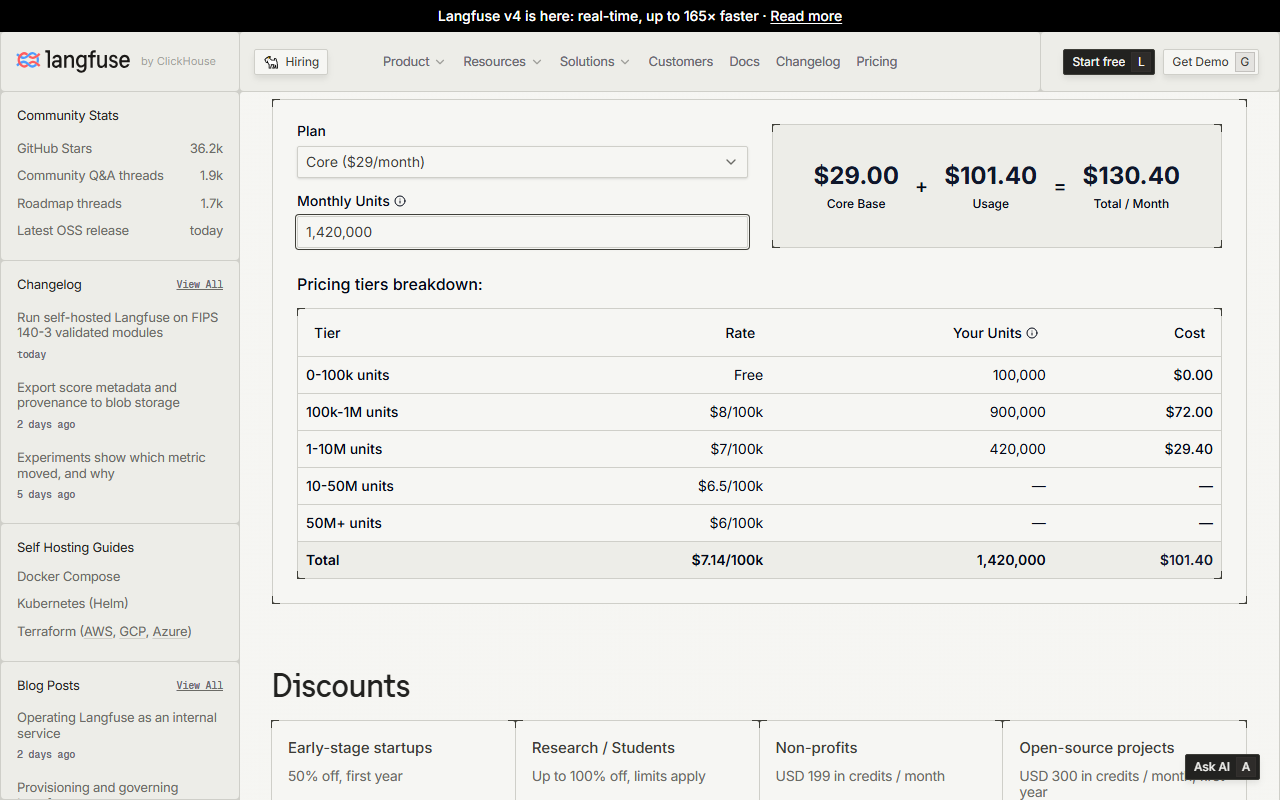
The numbers are the argument. A five-person team tracing 200,000 agent runs a month, at six steps each, lands at about 1.42 million Langfuse units. Langfuse's own calculator prices that at $130.40 a month on Core. The same 200,000 traces on LangSmith Plus with five seats cost $1,145 at the rates on LangChain's pricing page the same day, reading its “includes 10K traces total” as one allowance per organization ($945 if each seat brought its own 10,000). The plans are not identical (Langfuse counts every step, LangSmith counts whole traces and charges per seat), but the gap is wide enough to survive most assumptions. Langfuse's list prices are the same in every version of its pricing table we compared since October 2025, while LangSmith's trace price rose tenfold in the same year, as our LangChain review documents.
The catches are real. ClickHouse, Inc. now owns Langfuse: the Terms on langfuse.com open on ClickHouse's legal site, the privacy notice is ClickHouse's, and self-hosted Enterprise is now sold bundled with a ClickHouse commercial plan. The v4 changelog says “Most projects need no migration” and new projects already run v4, but Cloud customers have until 16 Nov 2026 to move off Python SDKs older than 4.7.0, JS/TS SDKs older than 5.4.0, the old read APIs and trace-level evaluators; after that date the vendor says legacy APIs, features and ingestion are removed. And the cheap plans have no way to delete old data on a schedule: retention policies start at Pro ($199) or a self-hosted Enterprise licence.
Developers who post about it are mostly positive about tracing and lukewarm about prompt management, with a minority who left over bugs, documentation or the US acquisition. There is no Trustpilot page and no independent star rating to quote.
Not a hands-on test: JAVIS has not run Langfuse, opened a Langfuse Cloud account or paid for a plan for this review. It is built from Langfuse's pricing pages and calculator, documentation, changelog, public handbook, security pages, the ClickHouse legal pages that langfuse.com links to, the GitHub repository and its issue tracker, Docker Hub, PyPI and npm download counters, Hacker News, the official YouTube channel and four competitors' pricing pages, all as of 23 Oct 2026.
Your code sends spans over OpenTelemetry; Langfuse stores every step and lets you score, compare and alert on it.
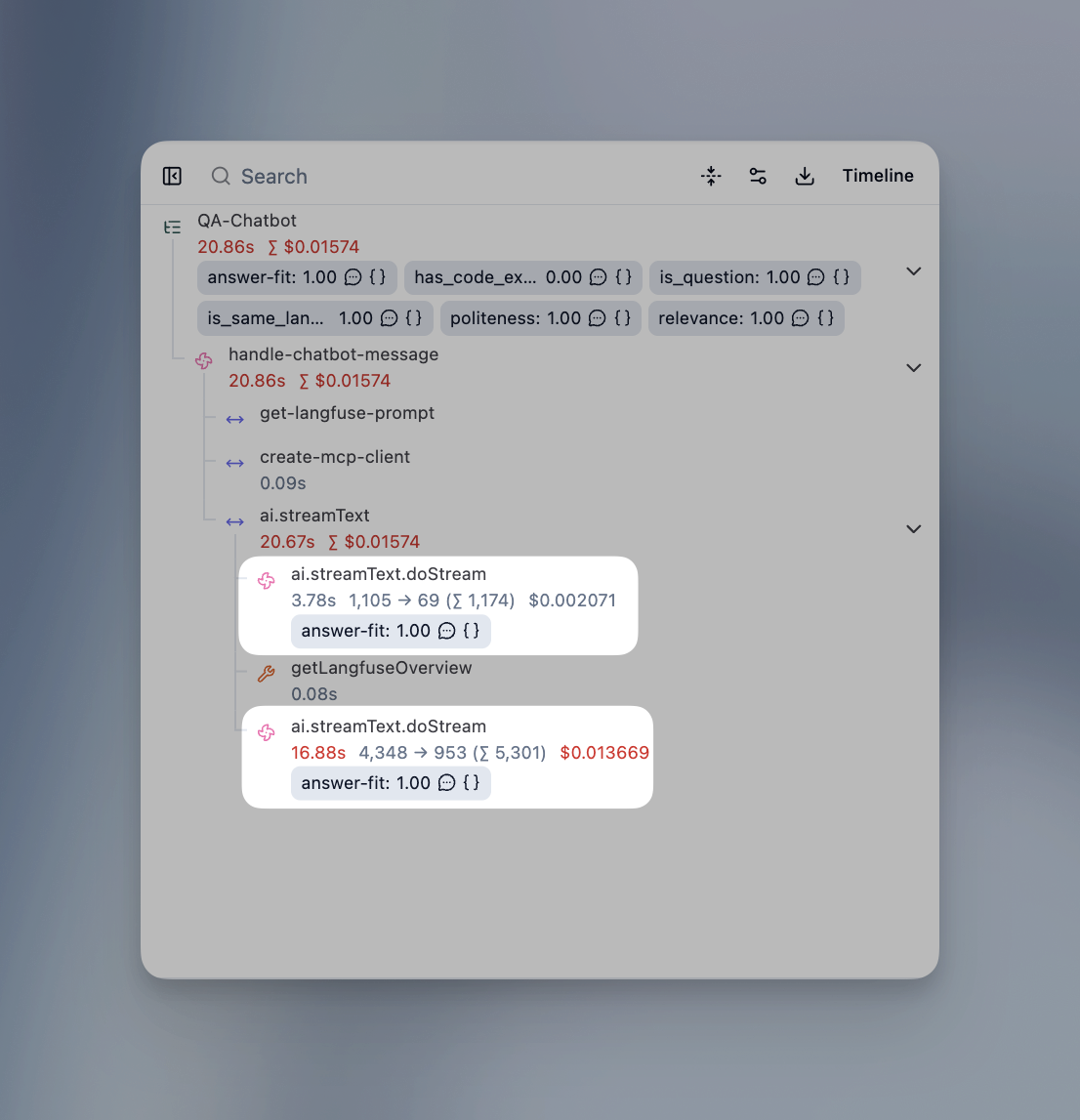
Langfuse is not an agent framework and does not run your agents; its own clarification page says so. You instrument your app with the Python or TypeScript SDK, one of 100+ integrations (LangChain, Vercel AI SDK, LiteLLM, Pydantic AI, CrewAI, OpenAI Agents SDK, Dify, n8n and others are listed on the home page), or plain OpenTelemetry from any language. Each request becomes a trace made of observations (LLM calls, tool calls, retrieval steps). On top of that data sit evaluations, datasets and experiments, prompt versioning, dashboards and alerts.
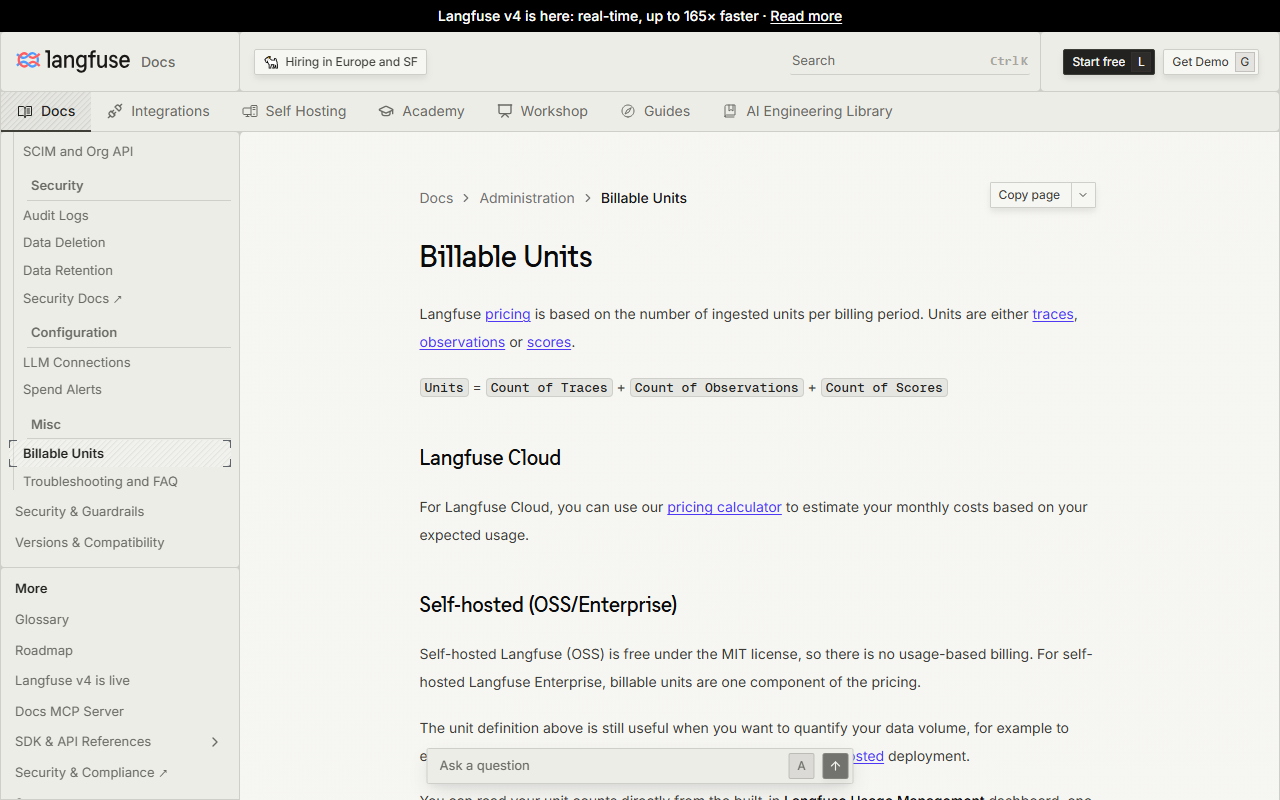
The most-starred open-source LLM tracer, a fraction of LangSmith's downloads, and a new owner.
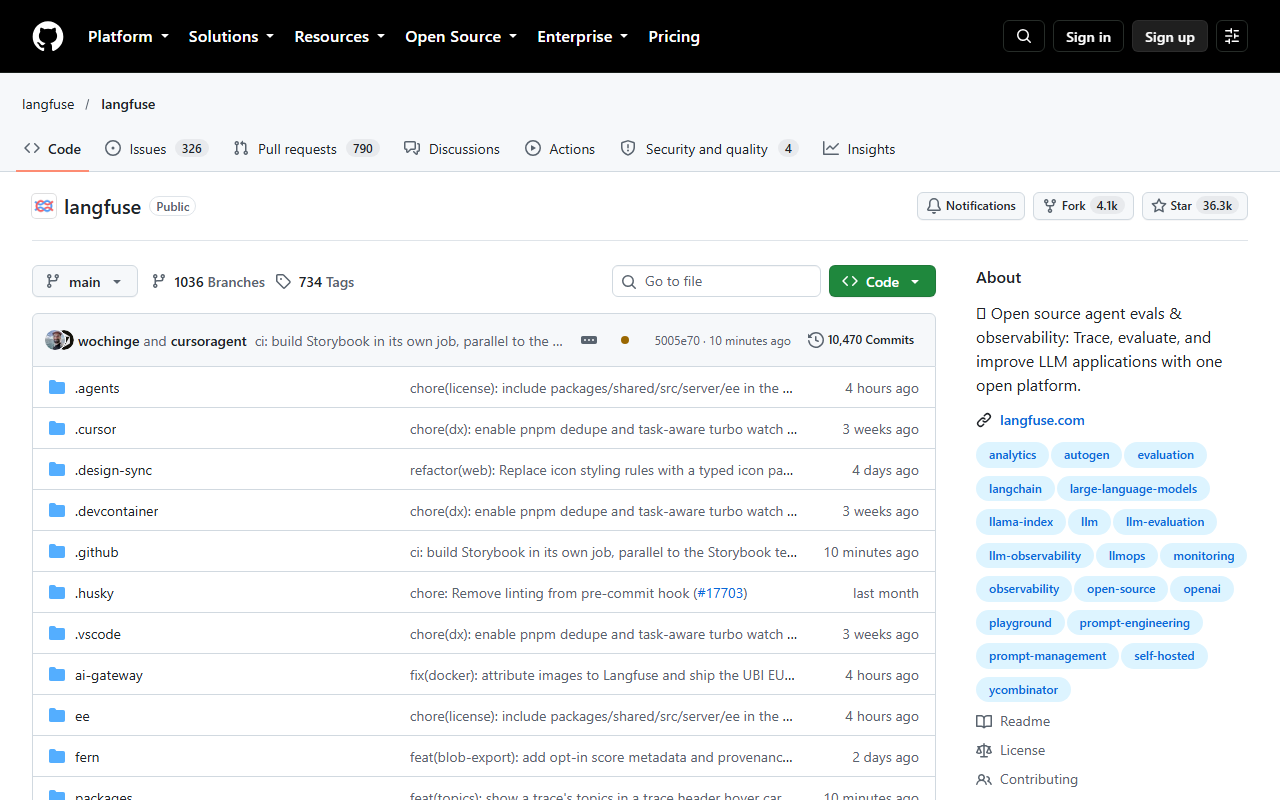
langfuse/langfuse, 23 Oct 2026, 14:43 UTC; 4,053 forks
langfuse, 23 Sep to 22 Oct 2026
web 20,088,588 + worker 10,017,316, 23 Oct 14:43 UTC
32 on v4, 3 v3 patches, to 23 Oct
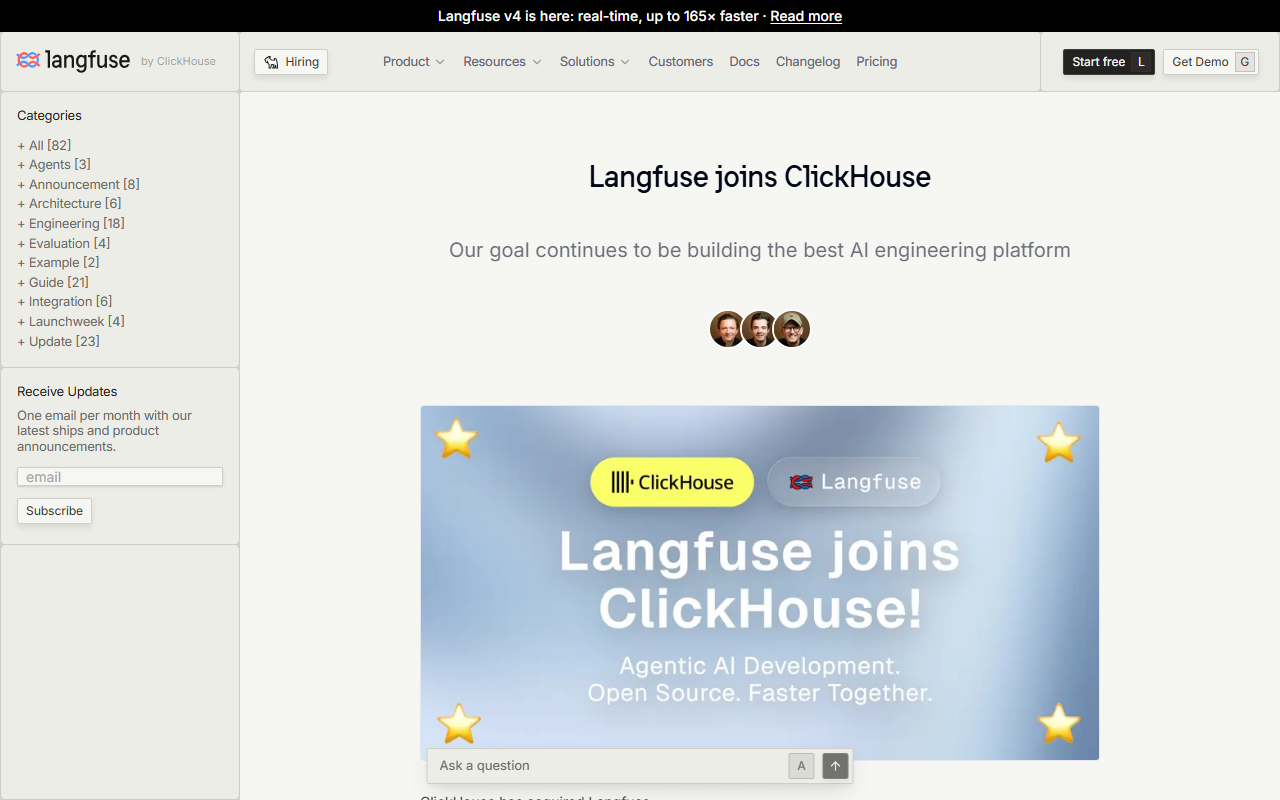
Langfuse started in Y Combinator's Winter 2023 batch; its Show HN (item 37310070, 29 Aug 2023) drew 143 points. On 16 Jan 2026 the founders announced that ClickHouse had acquired the company, saying they had term sheets for a Series A and that there were no planned licensing changes. No price was disclosed. The Hacker News thread (item 46656552, 220 points, 96 comments) split between congratulations and worry about a European tool moving under a US parent.
Downloads are the hardest adoption number available, with the usual warning that CI servers and dependency installs inflate them. Summing PyPI's daily counts (mirrors excluded) for 23 Sep to 22 Oct 2026 gives 28,250,806 for langfuse, against 84,694,366 for LangChain's langsmith SDK, 7,439,500 for braintrust and 655,004 for arize-phoenix. LangSmith's lead is partly structural: its SDK is a dependency of LangChain itself. On npm, @langfuse/core had 12,440,199 downloads and the older langfuse package 7,679,111 between 19 Sep and 18 Oct 2026, against 28,418,967 for langsmith.
The vendor's own counters are bigger and vaguer. The home page claims use by 21 of the Fortune 50, 90B+ observations a month and 100,000+ engineers; the security page adds 50,000+ companies, 129 of the Fortune 500, 65M+ SDK installs a month and 38M+ Docker pulls. None is audited. The two Docker Hub repositories we counted reach 30.1 million pulls together, so the 38M figure presumably includes other images, and an SDK install is not a customer.
No analyst market-share figure is cited. Stars, downloads and vendor counters measure attention and installs, not paying customers.
No star rating exists. Hacker News praises the tracing, doubts the prompt tooling, and argues about the new owner.
There is no Trustpilot page for langfuse.com as of 23 Oct 2026 (the address shows a not-found page and a search lists no Langfuse company), Langfuse has no mobile app, and no G2 or Product Hunt score is quoted here. On 23 Oct 2026 (14:43 UTC), Hacker News comment search for “langfuse” since 1 Jan 2026 shows 111 results counting exact spellings only (a typo-tolerant search returns more, and that count varies between runs); most real mentions are job posts and tool listings. The opinions below are the ones with substance, each one person's account with its comment id and date.
What people like
Calls Langfuse their favorite LLM observability tool so far and hopes the acquisition makes it better, not worse.
After briefly evaluating a different tool and finding its data model and UI cumbersome, went with Langfuse instead of their own tool and still uses it.
For a self-hosted setup with tracing, says Langfuse “should do the trick and cover like 90%” of the pain points.
Mixed: tracing yes, prompt management less so
“We like Langfuse for observability via OpenTelemetry. Prompt management is too basic for our needs.”
Chose PromptLayer for a git-like prompt API with tagging, Jinja2, release labels and rollback, while saying Langfuse “seemed way better at tracing”.
Runs evals with promptfoo and ad-hoc Python scripts plus Langfuse observability; not happy with it, but feels the field moves too fast to invest more.
Why some left
Struggled to implement it on the free version because of “numerous bugs/confusing AI driven documentation”; in a follow-up (46657025) still says it is worth trying.
Personally migrated away to Sentry and calls the software “honestly not that great”.
Says they will move away because US ownership brings the CLOUD Act and FISA into play, which in their view empties the GDPR assurances.
One self-hoster's joke is also a sizing warning: threecheese (11 Sep 2026, comment 49661637) runs “a terabyte-scale Clickhouse” only because Langfuse ran for a few months on a MacBook, adding that ClickHouse “does love disk space”.
What the issue tracker shows
GitHub is the other honest source. Of 326 open issues on 23 Oct 2026, 243 carry the bug label. Three open ones matter for buyers: issue 16077 (13 Aug 2026, 10 reactions, 19 comments) says the new v4 tracing table shows $0.00 cost on root span rows, so you cannot scan trace cost from the list any more; issue 18210 (5 Oct 2026) reports that a dashboard “Total cost” card summed only the top 20 users ($46.43 against $92.36 across 479 users on self-hosted 4.50.0); and issue 19003 (19 Oct 2026) describes a fresh self-hosted v4 Docker Compose install accepting OpenTelemetry data without it ever reaching ClickHouse. These are user reports, not confirmed defects, and the maintainers ship a release almost every day.
Read together: people who stay mostly praise tracing and OpenTelemetry support; the complaints are prompt management depth, rough edges and docs, and since January, the owner. That is a sample of vocal developers, not a satisfaction survey.
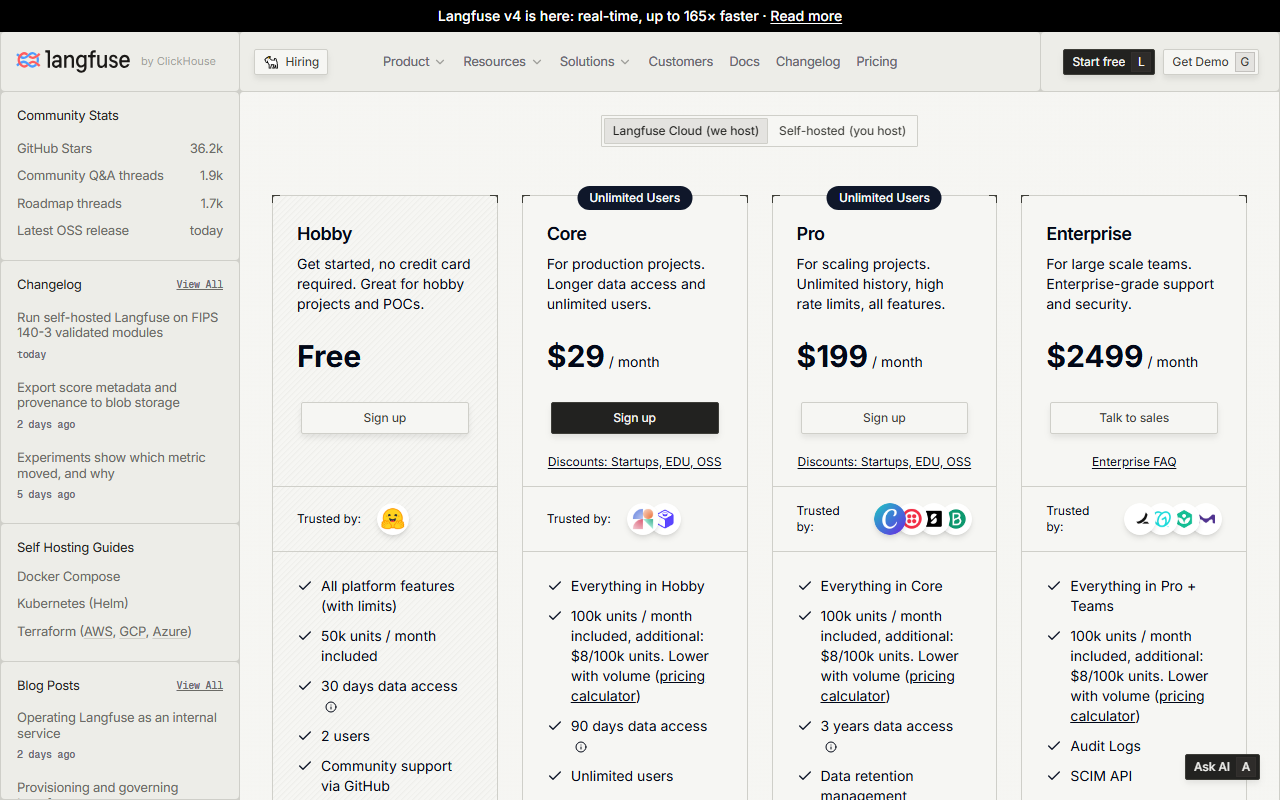
Free, then $29 a month for unlimited users, $199 for history and retention controls, and the same unit price on every paid plan.
Hobby
No card required
- 50k units a month
- 30 days of data access
- 2 users
- Community support on GitHub
Core
Unlimited users
- 100k units, then $8 per 100k
- 90 days of data access
- In-app support, 48h response target
- Spend alerts
Pro
Teams add-on $300/mo
- 3 years of data access
- Data retention management
- 20,000 tracing requests a minute
- SOC 2 and ISO 27001 reports
Enterprise
Includes Pro + Teams
- Audit logs, SCIM
- Uptime and support SLA
- Yearly commitment options
- AWS Marketplace or invoice
Swipe sideways to see all plan columns.
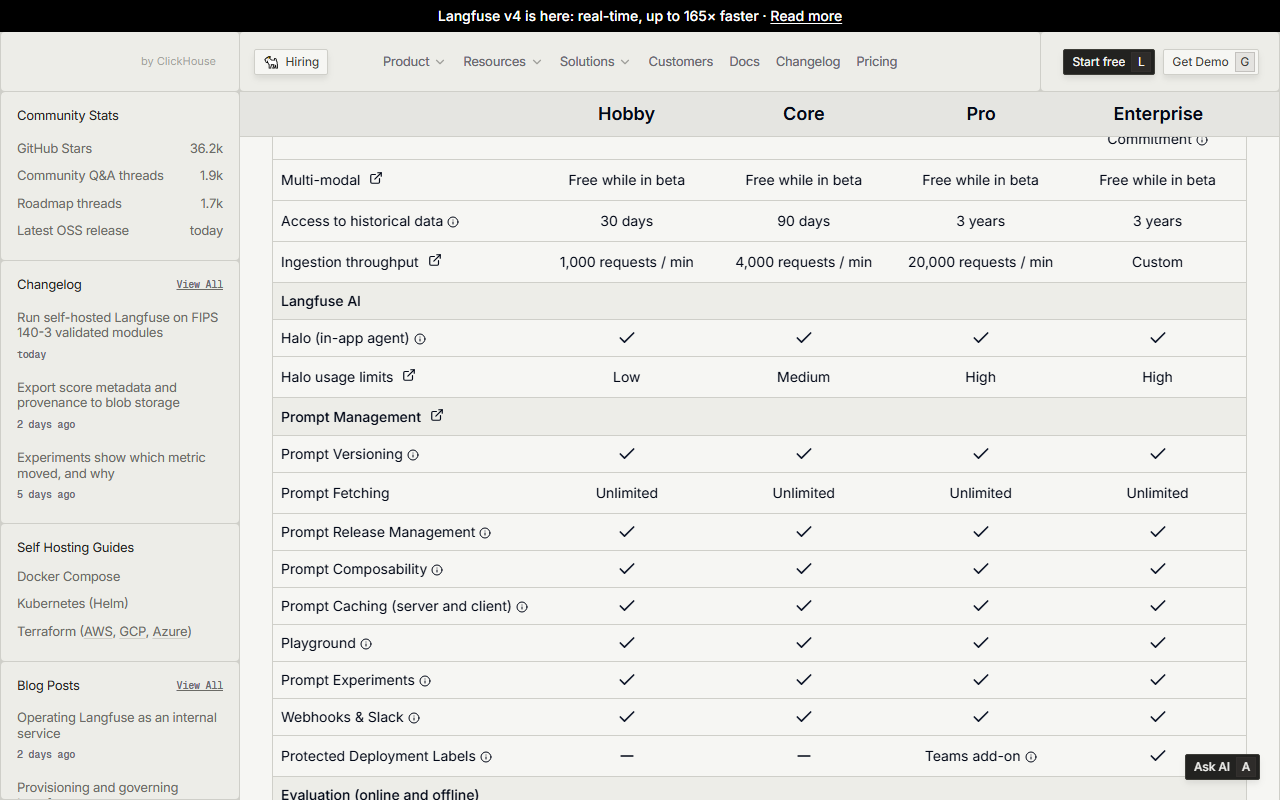
| Limit | Hobby | Core | Pro | Enterprise |
|---|---|---|---|---|
| Users | 2 | Unlimited | Unlimited | Unlimited |
| Data access | 30 days | 90 days | 3 years | 3 years |
| Tracing requests | 1,000/min | 4,000/min | 20,000/min | Custom |
| General API | 30/min | 100/min | 1,000/min | Custom |
| Annotation queues | 1 | 3 | Unlimited | Unlimited |
| Alerts | 2 | 20 | 50 | 100 |
| Retention policies | No | No | Yes | Yes |
| Enterprise SSO | No | No | Teams add-on | Yes |
| Region | US, EU, JP | US, EU, JP | + HIPAA | + HIPAA |
How the price has moved
Unlike most of this category, it has not. The pricing table is kept in Langfuse's public documentation repository on GitHub, and the versions from 7 Oct 2025, 5 Jan 2026, 13 Feb 2026 and 17 Oct 2026 all carry the same $29, $199, $300 add-on, $2,499 and $8 per 100,000 units. One thing did shrink: on 13 Feb 2026 Pro's “Unlimited data access” became “3 years data access”. The Pro card's tagline still says “Unlimited history”, one line above the 3-year limit.
Discounts on the same page: early-stage startups 50% off for the first year, research and students up to 100%, non-profits $199 of credits a month, and open-source projects $300 of credits a month for the first year, on application to support.
Not an affiliate link. It opens Langfuse's official website.
Three workloads, priced on both calculators: the per-step unit is cheap enough to beat per-trace pricing by a wide margin.
Everything below is arithmetic on the published rates with invented but plausible traffic. We count each LLM-as-a-judge score as one unit; the billable-units docs say data that Langfuse's features create counts, so if an evaluator also stores its own trace, your number will be higher. LangSmith is priced from langchain.com/pricing on the same day: Developer $0 for one seat with 5,000 base traces, Plus $39 a seat with 10,000, and 0.005 LSU ($0.005) per extra base trace. Retention is not equal: Langfuse Core shows 90 days, LangSmith's base traces are kept 14 days.
$7 per 100,000 units
Core, inside the 100k included
Core, worked example 2
break-even, section 05C
Worked example 1: a solo developer
A chatbot handles 500 conversations a day; each trace has four observations, so 5 units. At 10,000 traces a month that is exactly 50,000 units and fits Hobby for $0. At 15,000 traces it is 75,000 units, over Hobby's limit but inside Core's included 100,000: $29 a month for the whole team. On LangSmith Developer the 15,000 traces cost 10,000 × $0.005 = $50 with a card on file. The pricing page does not say what happens when a Hobby organization passes 50,000 units, so plan to move to Core before that point rather than find out.
Worked example 2: a five-person team in production
An agent produces 200,000 traces a month with six observations each (1.4 million units), and an LLM judge scores 10% of them (20,000 scores): 1,420,000 units. On Core: 100,000 included, 900,000 × $8 per 100,000 = $72, 420,000 × $7 per 100,000 = $29.40. Total $29 + $72 + $29.40 = $130.40 a month, which is what Langfuse's own calculator shows for that input. The same team on Pro pays $300.40, or $600.40 with the Teams add-on for SSO. On LangSmith Plus: 5 × $39 = $195 in seats plus 190,000 × $0.005 = $950, so $1,145. That assumes the 10,000 included traces are one allowance for the organization: the pricing calculator says “$39 / seat / mo · includes 10K traces total”, while the plan card just says “Up to 10k base traces / mo”. If the allowance were per seat (50,000 for five people), the bill would be $195 + 150,000 × $0.005 = $945. Either way it is seven to nine times the Langfuse figure.
Worked example 3: a heavy month with deep agents
500,000 traces with 20 observations each plus 50,000 scores is 10,550,000 units. Core: $72 for the second tier, 9,000,000 × $7 per 100,000 = $630, and 550,000 × $6.50 per 100,000 = $35.75, so $29 + $737.75 = $766.75 a month, about $1.53 per 1,000 traces. LangSmith Plus with five seats: $195 + 490,000 × $0.005 = $2,645 ($2,445 if the 10,000 included traces were per seat). Deep traces narrow the gap, because Langfuse charges for every step: at 60 observations per trace the Langfuse bill would roughly triple while LangSmith's would not move.

What decides your bill
Observations per trace, not traces. Langfuse's own guide to cutting the bill says most spikes come from too many traces or overly verbose observations, and recommends filtering spans you do not need (the OpenTelemetry-based SDKs export every span by default) or sampling. Spend alerts on Core and above email owners and admins when the expected invoice crosses a threshold; the docs say usage is checked every 60 to 90 minutes and each alert fires at most once per billing cycle. They are alerts, not a hard cap: nothing on the pricing page or in the spend-alert docs stops ingestion at a limit.
A single server costs about what Core costs at a million units, and the cheap version has no high availability and no retention rules.
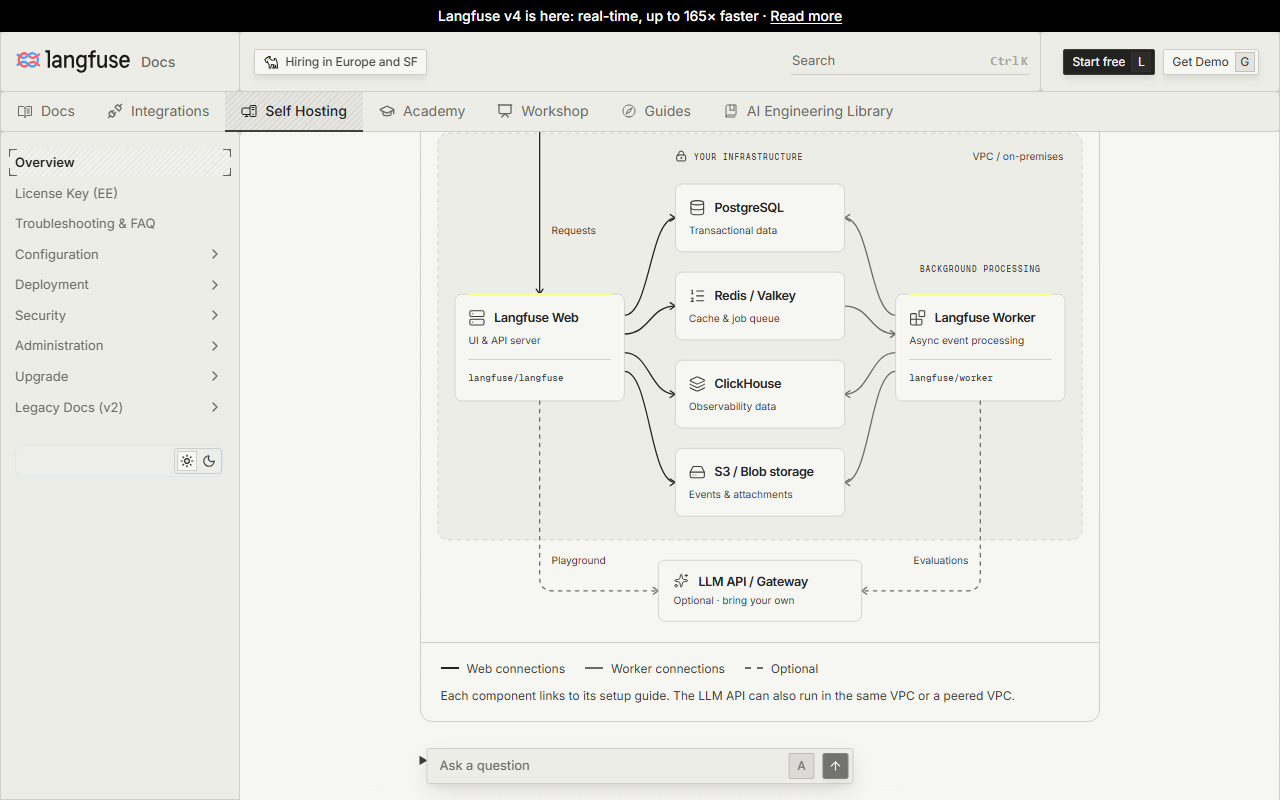
The open-source edition is the same code as Langfuse Cloud and has no usage fee or feature limits on the core product, per the self-hosted pricing page. What you run is six pieces: the Langfuse web and worker containers, PostgreSQL, ClickHouse, Redis or Valkey, and S3-compatible storage. The Docker Compose guide asks for a VM with at least 4 cores and 16 GiB of memory (it names an AWS t3.xlarge) and suggests around 100 GiB of storage, and says to use another deployment option when you need high availability. For Kubernetes, the ClickHouse guide recommends at least three ClickHouse replicas in production.
Worked example 4: one VM against Core
DigitalOcean's pricing page lists a Basic droplet with 16 GiB, 8 vCPUs and 320 GiB of SSD at $96 a month on 23 Oct 2026, which meets the Docker Compose minimum. Core costs $29 plus $8 per 100,000 units above the first 100,000, so it reaches $96 at 100,000 + ($96 − $29) ÷ $8 × 100,000 = 937,500 units a month. Below that, Cloud is cheaper even before you count backups, upgrades and someone's time. Above it, self-hosting starts to pay, but only on one unreplicated server.
What the free edition does not include
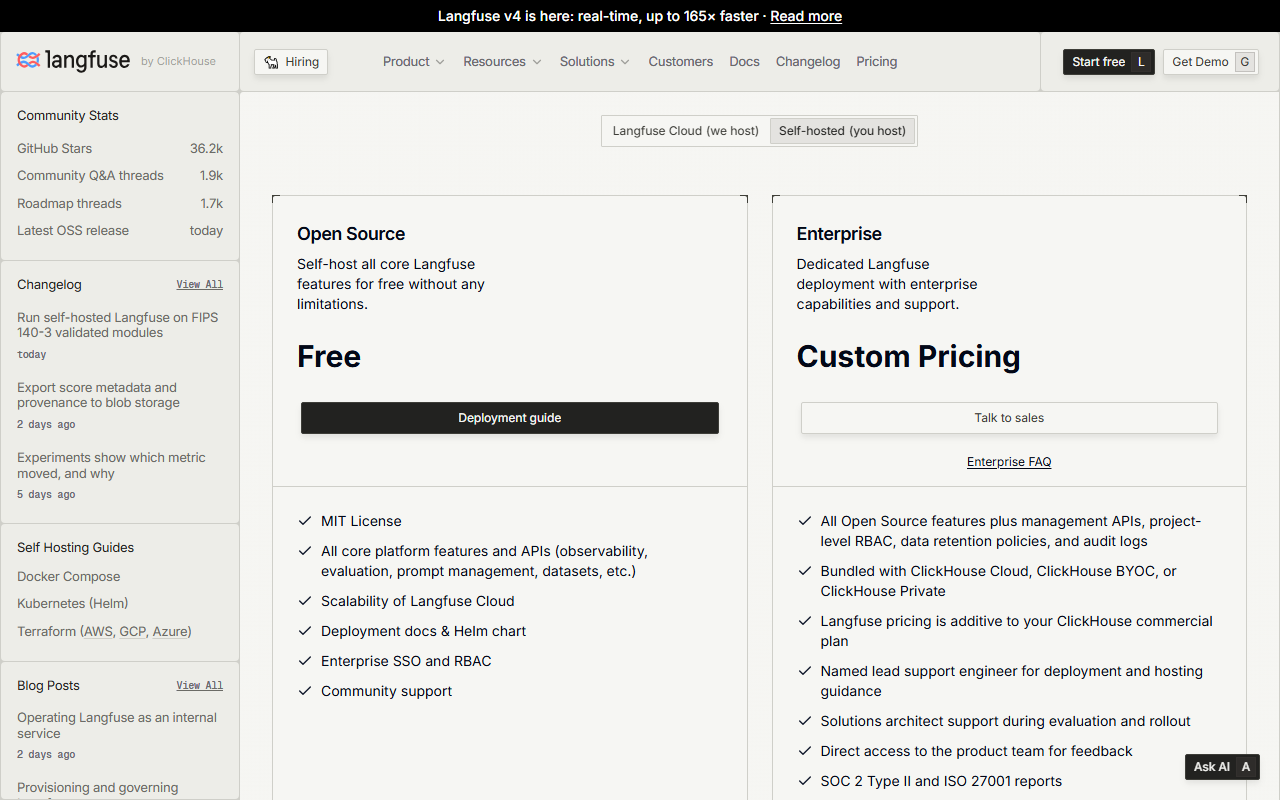
The Enterprise licence-key page lists the features that need a paid key on self-hosted installs: project-level roles, protected prompt labels, data retention policies, audit logs, server-side masking, SCIM and the organization and instance management APIs, UI customization and FIPS mode. Two of those bite early. Without retention policies, the data-retention docs say self-hosted data is stored indefinitely by default, so the ClickHouse disk only grows. Without audit logs, a security review may stop the deployment. The licence-key page also says Enterprise installs send limited telemetry for licence compliance.
Self-hosted Enterprise changed shape this year. The 5 Jan 2026 version of the self-hosted pricing card offered Enterprise as an add-on at custom pricing; since late March 2026 the card says it is “Bundled with ClickHouse Cloud, ClickHouse BYOC, or ClickHouse Private” and that “Langfuse pricing is additive to your ClickHouse commercial plan”. The billable-units page adds that for self-hosted Enterprise, units are “one component of the pricing”. No price is published. And Langfuse's public support handbook warns that removing the licence key from your containers does not cancel an Enterprise contract; a written cancellation is needed.
Match your situation to one line.
Every step is a row you can query, score and alert on; that is what v4 changed, and it is why it is faster.
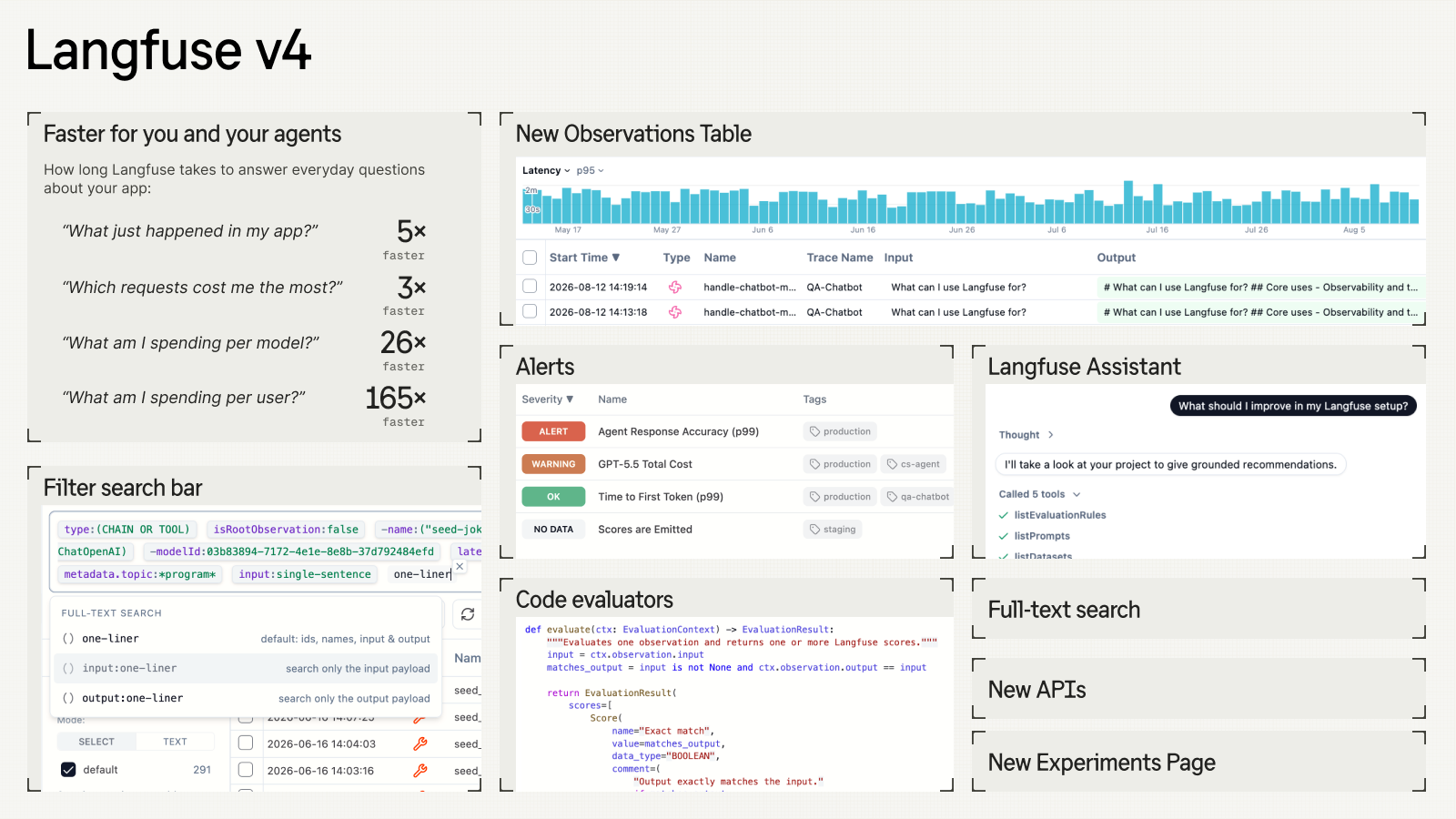
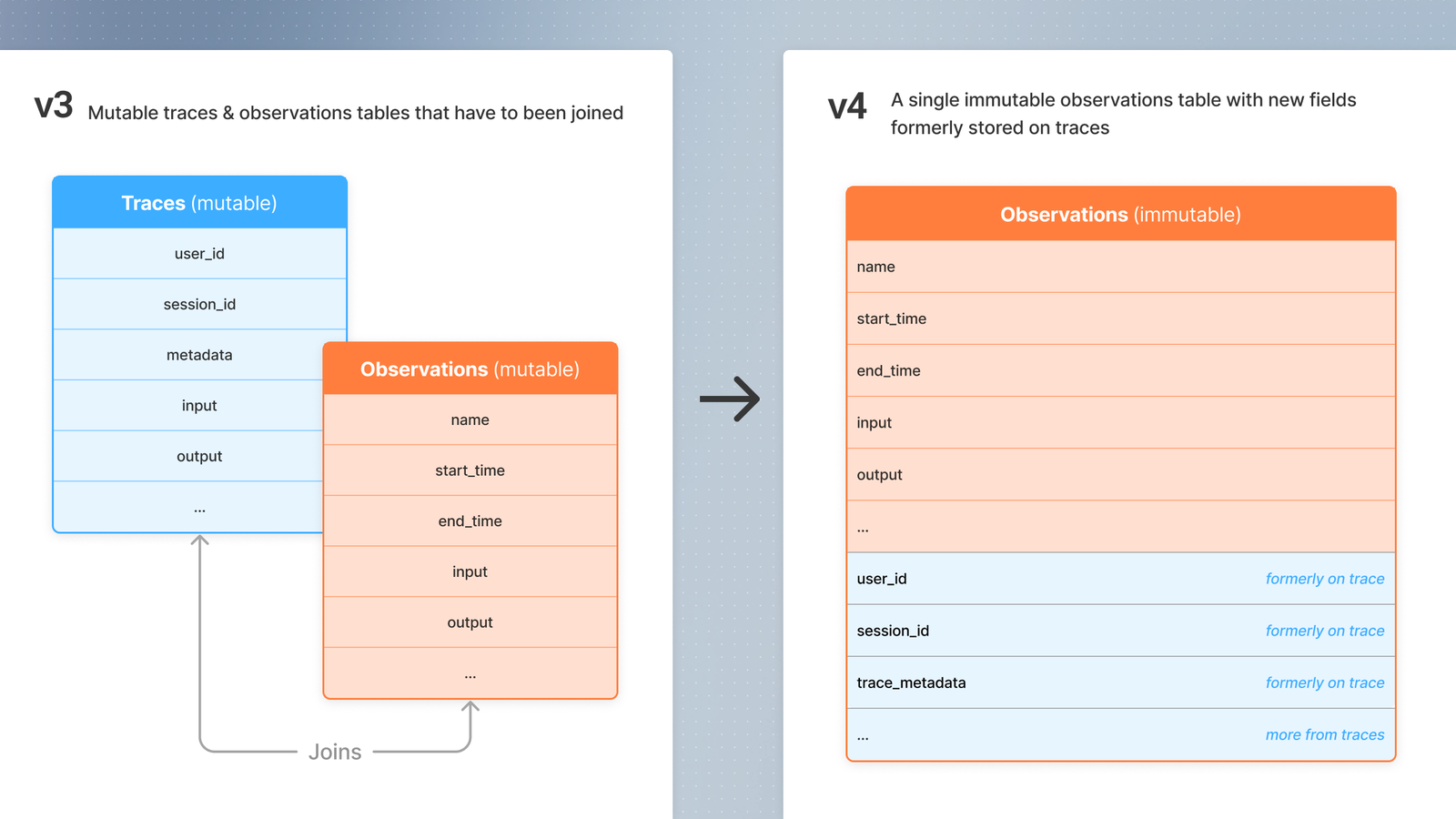
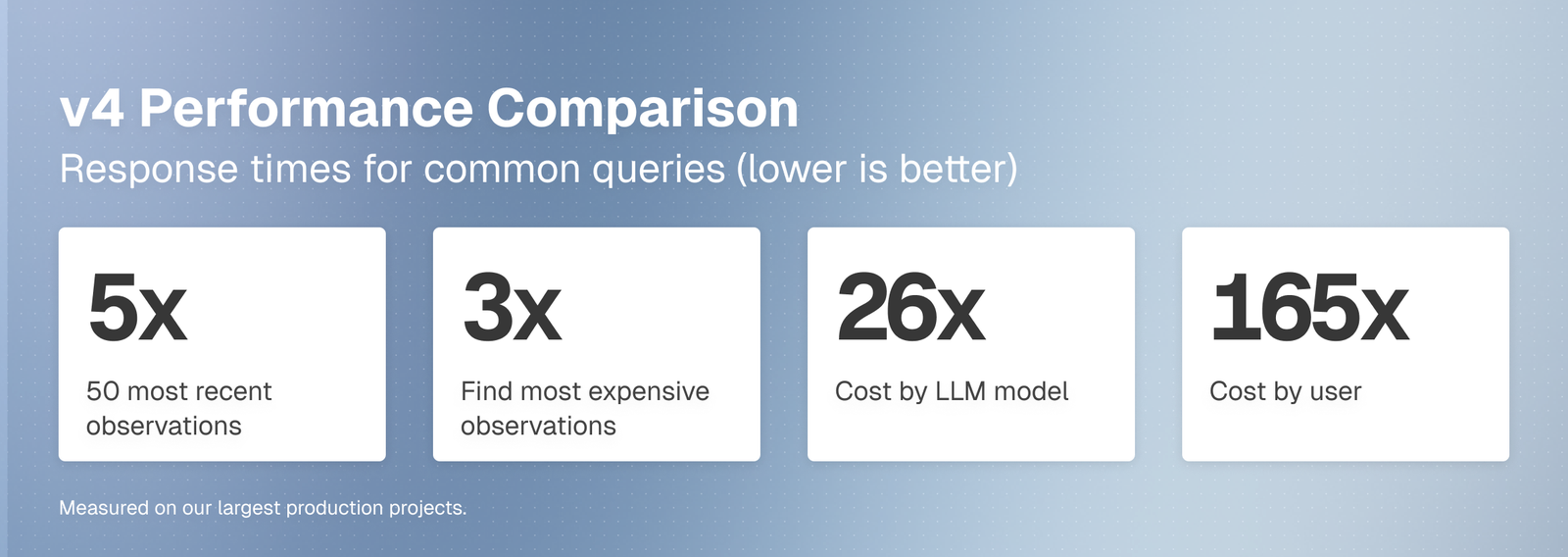
Langfuse v4 went live on Cloud and became generally available for self-hosting on 17 Aug 2026, per the changelog (the v4.0.0 server release on GitHub is dated 29 Jul 2026). Under the hood it replaced two mutable tables, traces and observations, which had to be joined and de-duplicated on every read, with one immutable observations table that carries trace-level fields such as user and session on every row. The changelog says initial table loads over large datasets drop from seconds to milliseconds and dashboards load at least 10 times faster in large projects. Those are vendor measurements on its largest projects; we have not measured them.
What you can do with the data
The v4 release lists monitors (cost, quality and latency thresholds sent to Slack, webhooks or GitHub Actions; the feature is now called Alerts in the docs), code evaluators in Python or TypeScript that run on live observations and experiments, full-text search across inputs, outputs and metadata, a combined filter bar, an in-app assistant now called Halo, and faster Observations and Metrics APIs. Evaluations can be LLM-as-a-judge, deterministic code, user feedback or human annotation queues; experiments run a prompt or app version over a dataset and compare scores side by side.

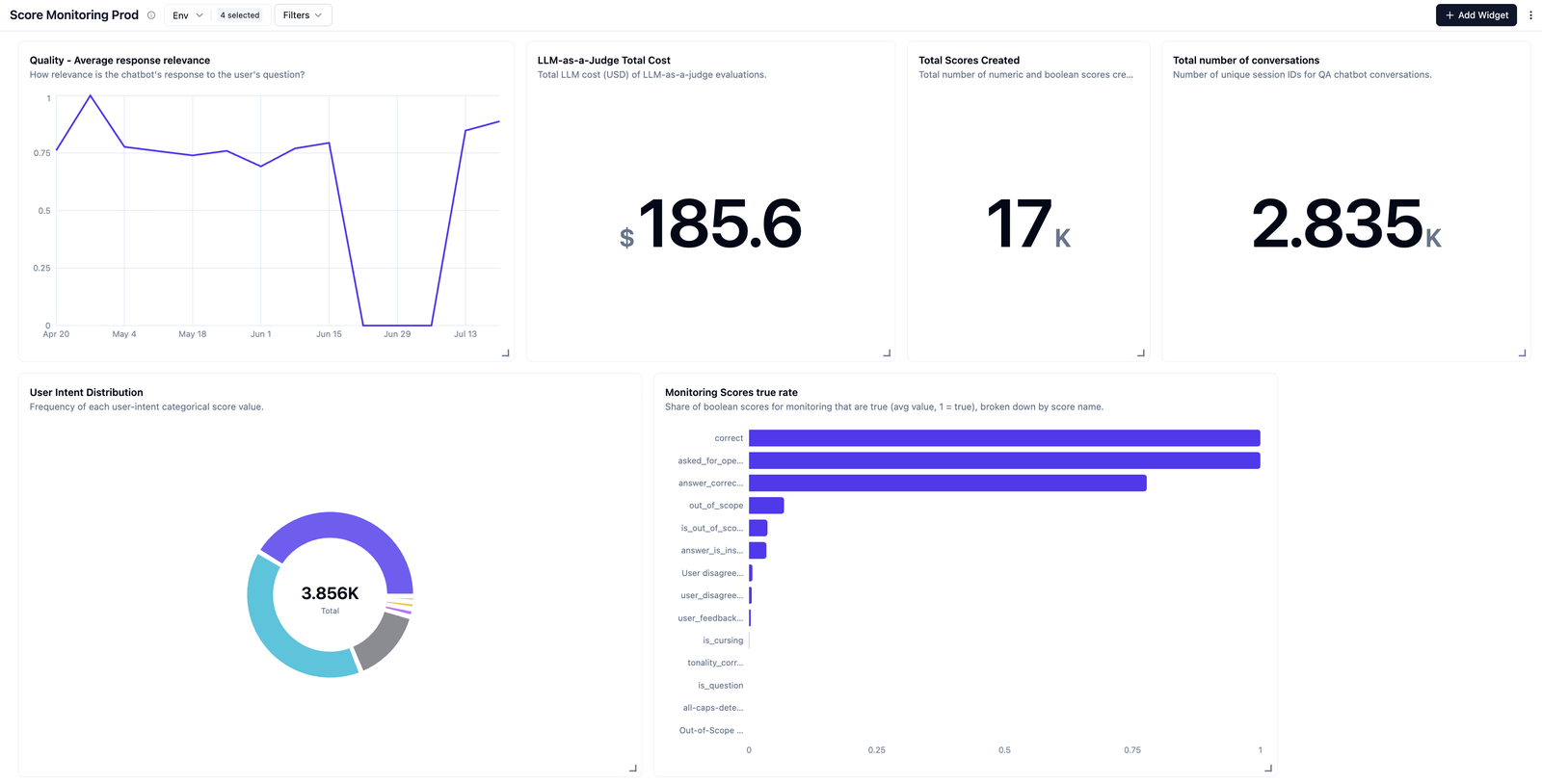
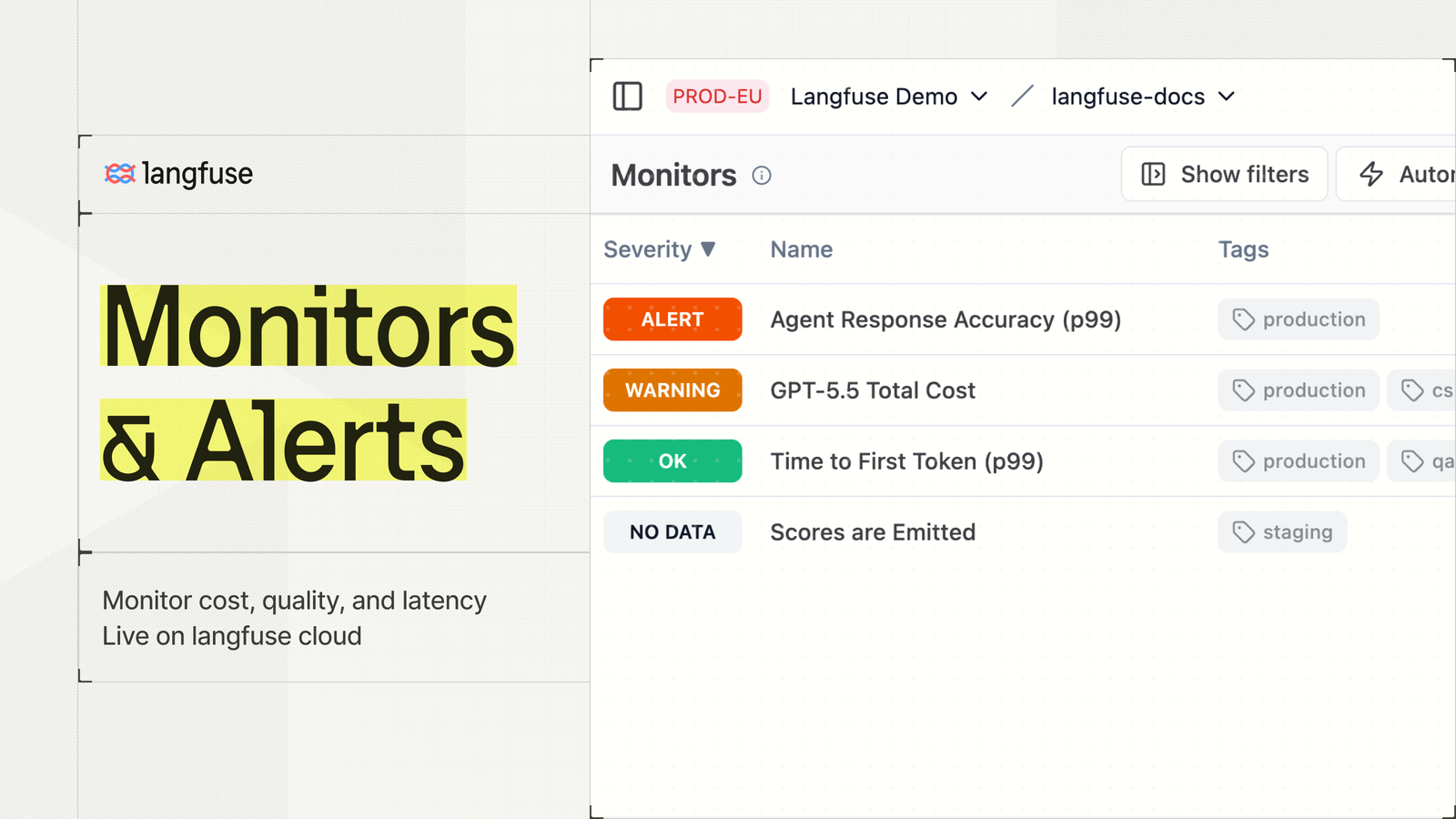
Instrument, trim, score, then gate releases on experiments.
An illustrative workflow built from Langfuse's documentation, 23 Oct 2026, not a record of a JAVIS run.
The 16 November cutover, the cheap plans' API limits, and a self-hosted disk that never shrinks.
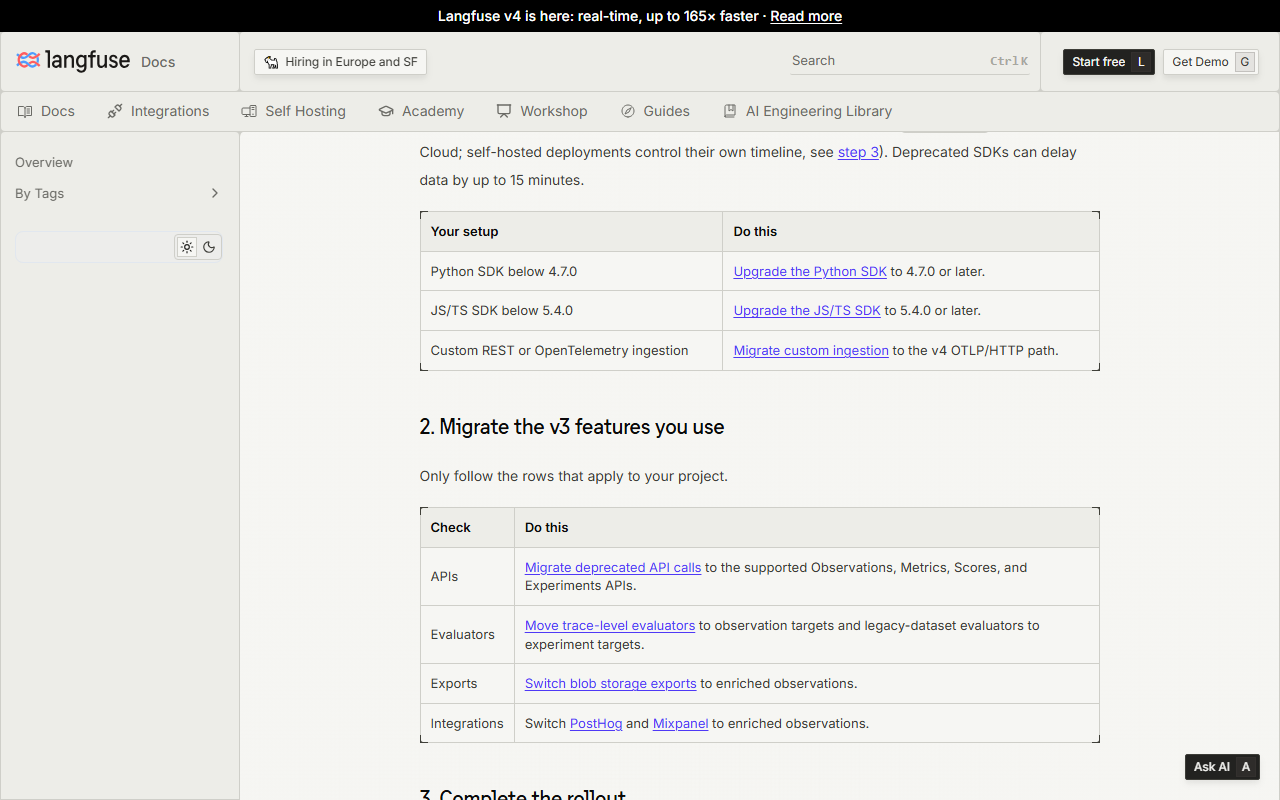
Langfuse Cloud deprecates its v3 endpoints and features on 16 Nov 2026, per the v4 changelog and upgrade guide; the timeline marks that date “Legacy APIs, features, and ingestion removed”. New projects already run v4. Older ones get a Migration Assistant and an email listing what each project must change. Self-hosted installs have no forced date, and v3 receives security patches through January 2027. Here is what fails, in roughly the order teams hit it.
| Trigger | What happens | Fix |
|---|---|---|
| Old SDK on Cloud (Python <4.7.0, JS/TS <5.4.0) or custom REST ingestion | Data already arrives up to 15 minutes late; legacy ingestion is removed on 16 Nov 2026 | Upgrade the SDK or move to the v4 OTLP/HTTP path |
| Scripts using the old trace, observation and session read endpoints | Already limited to 5, 15 or 40 requests a minute by plan; removed in v4 (the self-hosting guide lists them as not found) | Observations API v2, Metrics API v2, Scores API v3 |
| Trace-level LLM-as-a-judge evaluators | Marked Legacy; stop running after the cutover | Recreate as observation-level evaluators |
| Blob storage, PostHog or Mixpanel exports on the legacy source | Stop producing data after the cutover | Switch the export source to enriched observations |
| Cost per trace in the list view | Root span rows can show $0.00 in the v4 table (open issue 16077) | Open the trace, or query the Metrics API |
| Third person joins a Hobby org | Hobby allows 2 users | Core, $29 |
| Agents and dashboards pulling metrics on Hobby | Metrics API v2 allows 100 requests a day; the MCP server shares the 30-a-minute General API bucket | Core or Pro, or cache results |
| Deleting old traces on Hobby or Core | No retention policies; manual deletion is capped at 50 or 200 requests a day, with 30 to 50 trace ids advised per request | Pro, or plan what you send |
| Self-hosted v3 server and the newest SDKs | Python SDK v5 (5.0.1 on PyPI from 14 Oct 2026) and JS/TS SDK v6 (6.0.0 on npm the same day) require a v4 server, per the self-hosted upgrade guide; Python 4.x and JS/TS 5.x still work with v3 | Pin Python SDK 4.x and JS/TS 5.x until the server is on v4 |
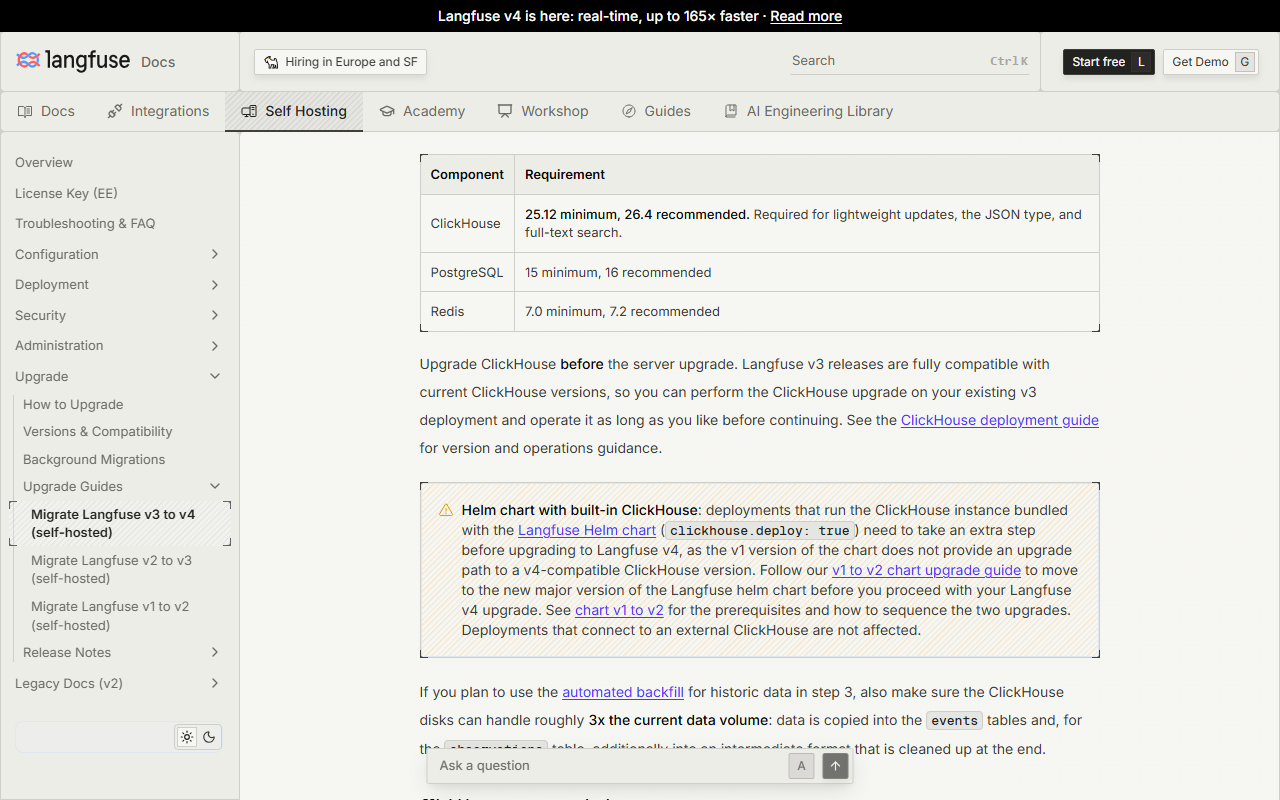
| Self-hosted upgrade to v4 | Needs ClickHouse 25.12+, PostgreSQL 15+, Redis 7+, about 3× disk for the backfill; no automatic downgrade; Helm chart v1 users must move to chart v2 first | Back up both databases, follow the v3 to v4 guide |
A cutover checklist for the next 24 days
- Open the Migration Assistant sidebar or the Migration status page as an organization owner; the guide says to complete only the checks it detects.
- Upgrade producers to Python SDK 4.7.0+ or JS/TS SDK 5.4.0+; send custom ingestion to the v4 OTLP/HTTP path.
- Move readers off the old trace, observation, session, score and metrics endpoints to Observations API v2, Metrics API v2, Scores API v3 and the experiments API.
- Recreate trace-level and legacy-dataset LLM-as-a-judge evaluators on observation or experiment targets.
- Switch blob storage, PostHog and Mixpanel exports to “enriched observations”.
- Expect the email summary to project owners and admins; organizations created on or after 14 Apr 2026 (14:00 UTC) already run v4.
- Upgrade ClickHouse to 25.12+ (26.4 recommended), PostgreSQL to 15+ and Redis to 7.0+ on v3 first; v3 runs on them.
- Helm users with the bundled ClickHouse: move the chart from v1 to v2 before anything else.
- Apply the extra ClickHouse grants the guide lists, or schema migrations fail with “Not enough privileges”.
- On the latest v3, confirm zero unfinished background migrations, then back up PostgreSQL and ClickHouse: there is no automatic downgrade.
- Start in legacy or dual write mode unless every producer is already on compatible SDKs; plan about 3× ClickHouse disk for the backfill.
- Keep Python SDK 4.x and JS/TS SDK 5.x until the server runs v4; Python 5.x and JS/TS 6.x require it.
Compiled from the v4 changelog, the upgrade FAQ (last edited 7 Sep 2026) and the self-hosted v3 to v4 guide, 23 Oct 2026. A checklist from the docs, not a JAVIS migration run.
Self-hosters are asking exactly these questions in public. Langfuse's v4 rollout discussion on GitHub (discussion 12518, opened 11 Mar 2026, 20 upvotes and 18 comments on 23 Oct 2026) includes requests for a zero-downtime upgrade sequence (14 Aug 2026), a timeline for the Helm chart with bundled ClickHouse (14 Aug 2026), and a v3.225.7 user puzzled by the “zero unfinished background migrations” precondition (10 Sep 2026). A June comment asked whether v4 removes trace look-up functionality they relied on. None of these is a reported data loss; they show the upgrade takes planning.

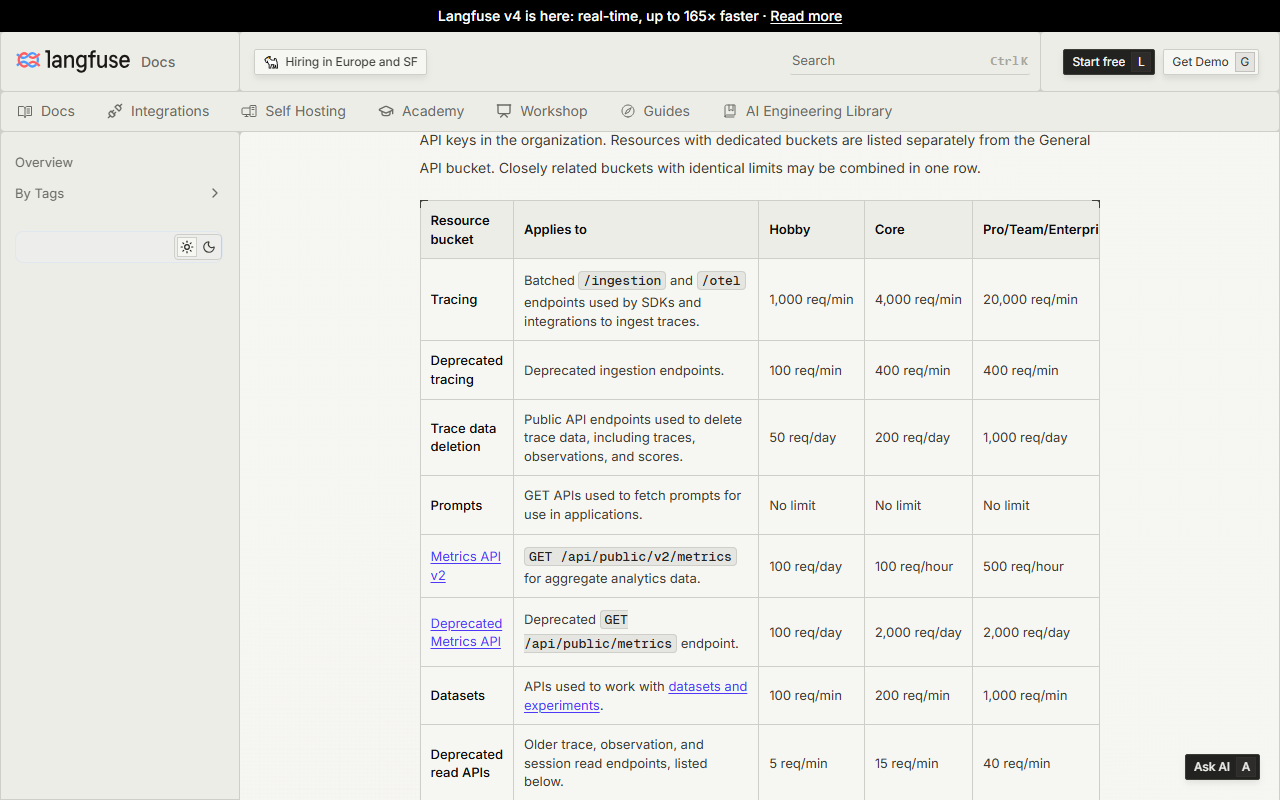
OpenTelemetry in, a public API and an MCP server out, with per-organization rate limits that matter on the cheap plans.
Langfuse is built on OpenTelemetry, so any language with an OTel exporter can send traces; native SDKs exist for Python and TypeScript. The integrations page groups frameworks, model providers, gateways (LiteLLM, OpenRouter), no-code builders (Dify, Langflow, n8n) and ClickHouse products. Prompts are pulled from the API with no rate limit and cached on the client and server. Browser automation is not a Langfuse feature; it only traces what your agents do.
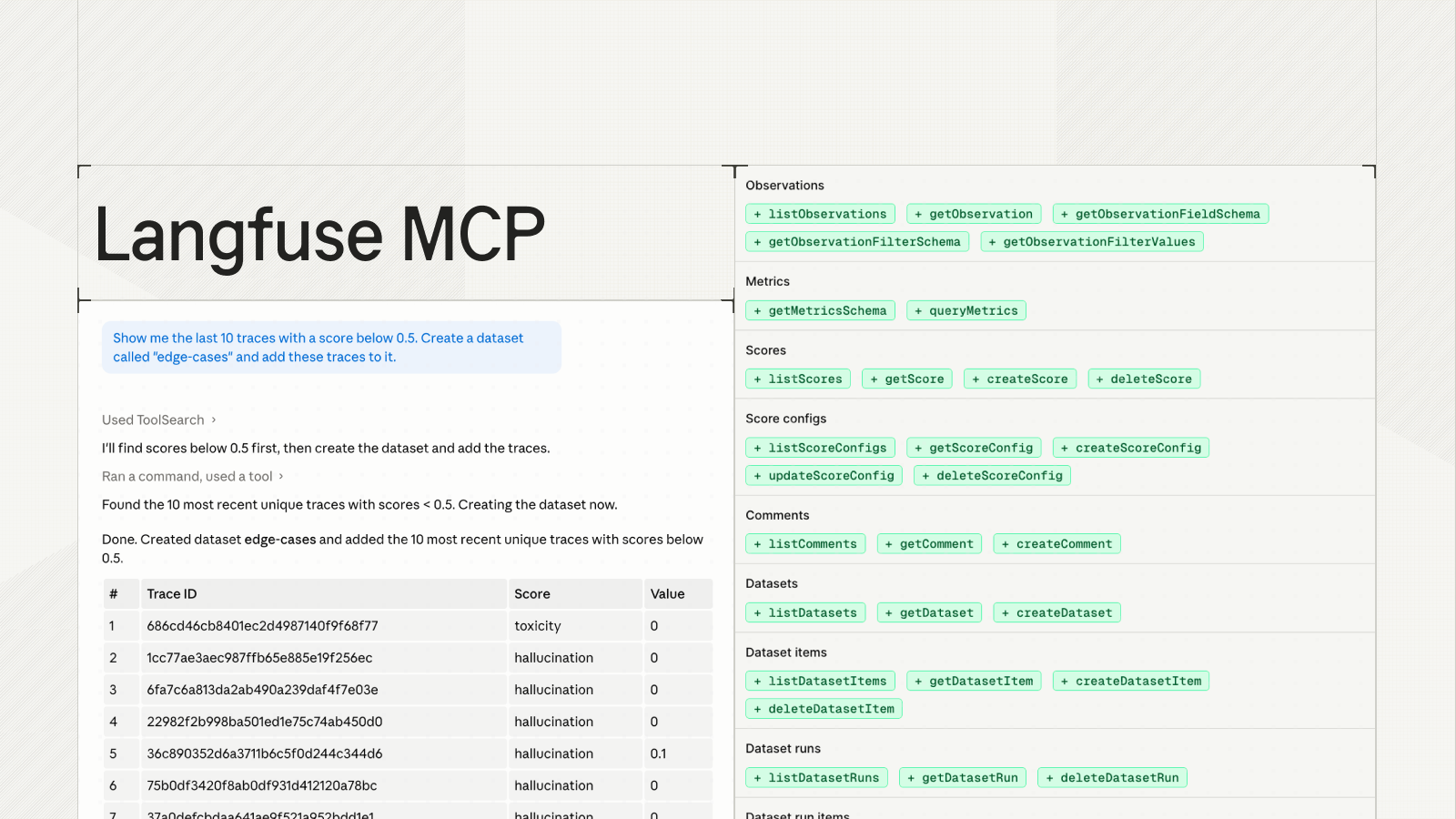
An MCP server at /api/public/mcp lets an MCP client list and query observations, metrics, scores, score configs, comments, datasets and dataset runs, going by the tool list in Langfuse's May 2026 changelog image. An open feature request (issue 12738, 44 comments) describes the server as accepting only static project API key pairs and asks for SSO or OIDC instead; treat those keys like any other production secret. All MCP requests count against the General API bucket.
| Bucket | Hobby | Core | Pro and up |
|---|---|---|---|
| Tracing ingestion | 1,000/min | 4,000/min | 20,000/min |
| General API and MCP | 30/min | 100/min | 1,000/min |
| Metrics API v2 | 100/day | 100/hour | 500/hour |
| Datasets | 100/min | 200/min | 1,000/min |
| Trace deletion | 50/day | 200/day | 1,000/day |
| Prompt fetching | No limit | No limit | No limit |
Good paperwork and a short advisory list, but cheap plans keep your data until you delete it.
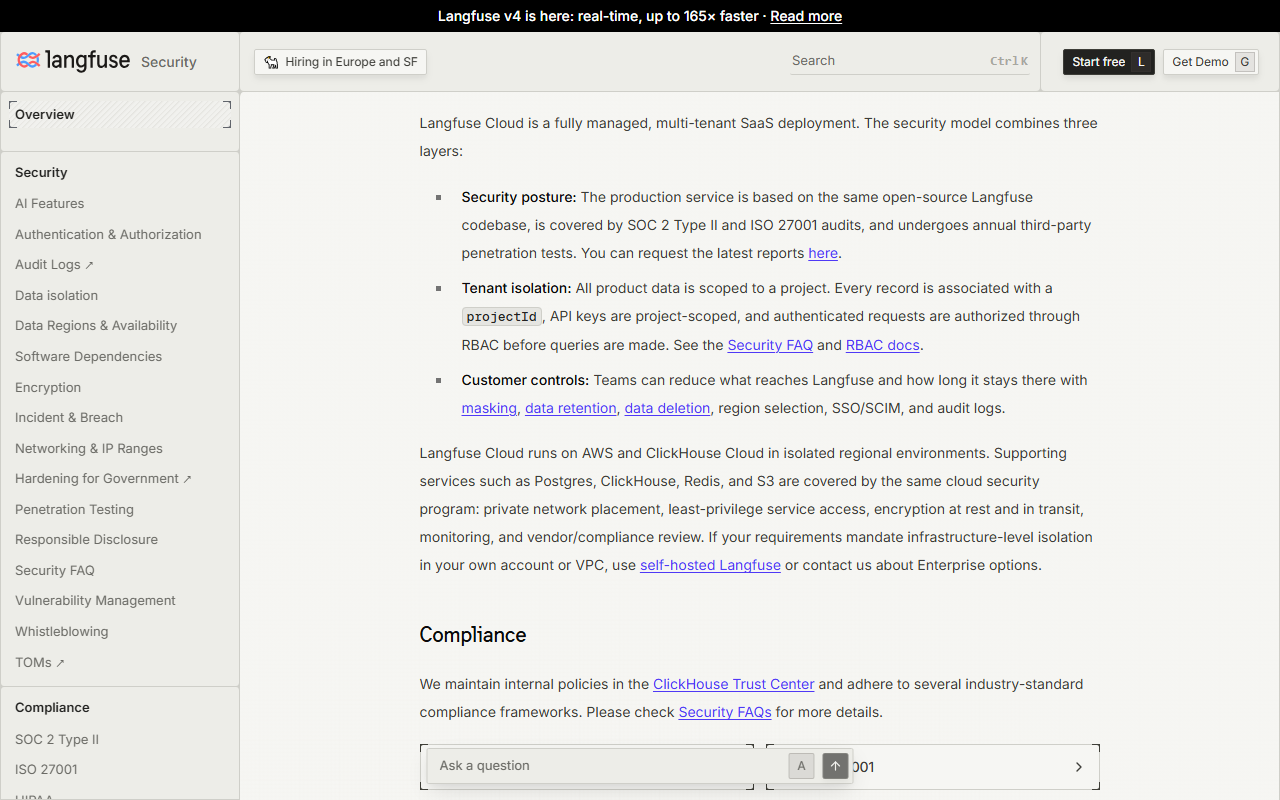
The security overview says Langfuse Cloud is a multi-tenant service on AWS and ClickHouse Cloud, covered by SOC 2 Type II and ISO 27001 audits and annual third-party penetration tests, with reports on request. Regions are US and HIPAA in us-west-2 (Oregon), EU in eu-west-1 (Ireland) and Japan in ap-northeast-1. The HIPAA page says the HIPAA region needs “Pro plan or higher”, a fresh account created in that region and a signed BAA, and that self-hosted users implement HIPAA safeguards themselves because Langfuse never receives their data. Every record is scoped to a project, API keys are project-scoped and requests pass role checks before queries run. Security, privacy and legal contacts are now ClickHouse addresses.
Nov 2025 to Apr 2026
none rated high or critical
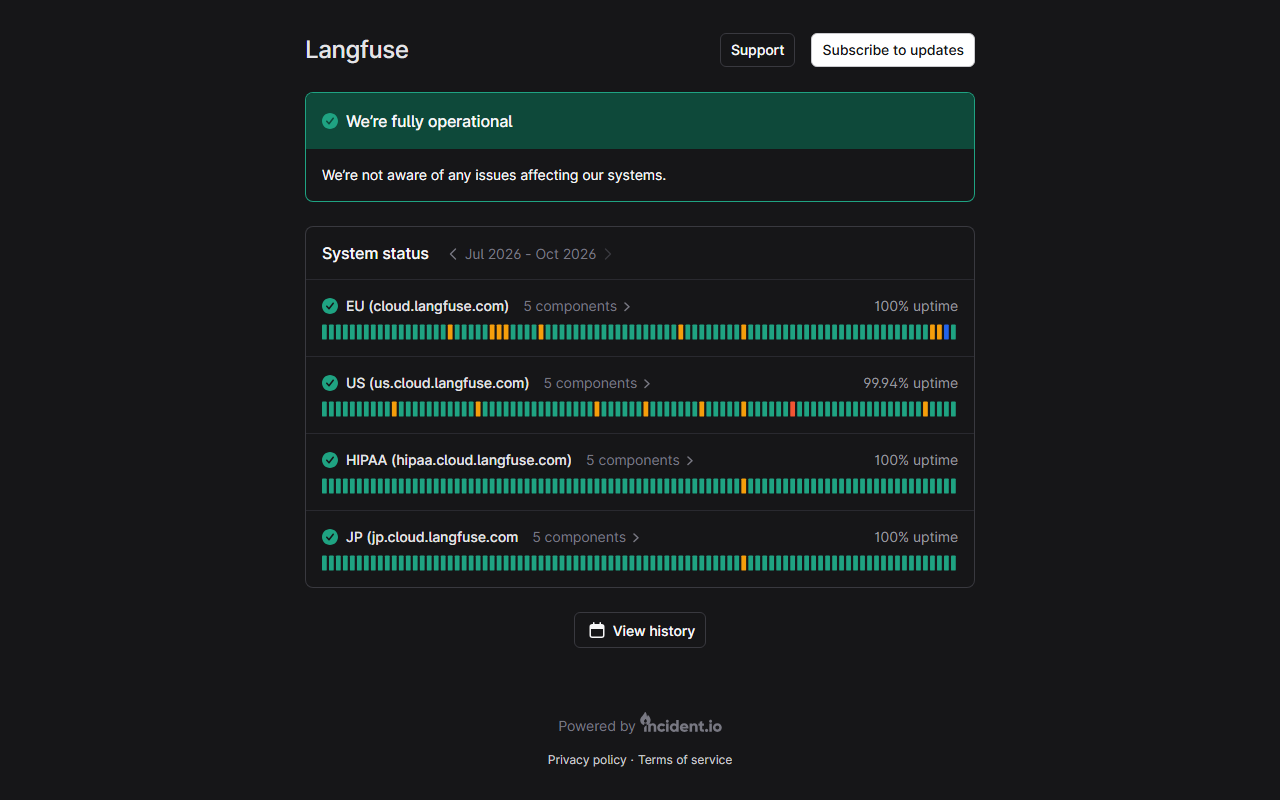
US lowest; EU, HIPAA, JP 100%
self-host: Enterprise licence
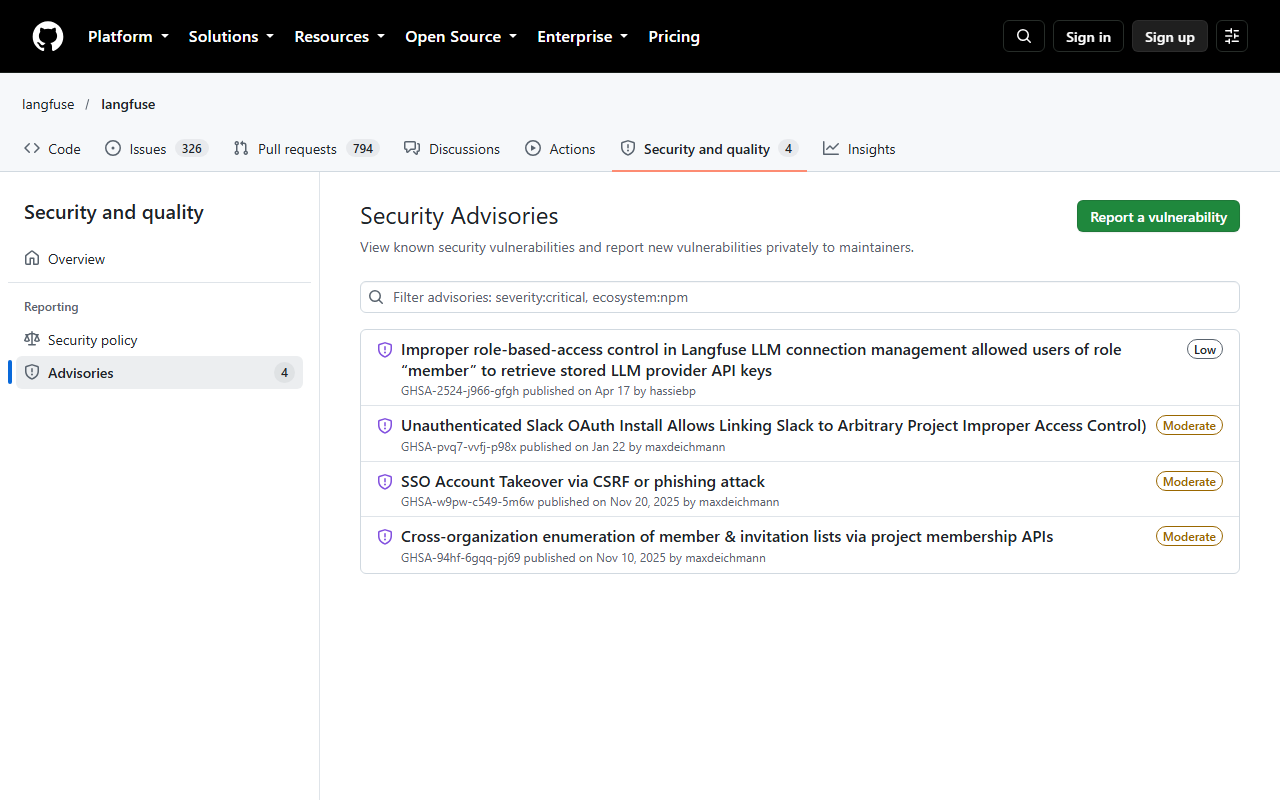
The repository lists four published advisories, all fixed: cross-organization enumeration of member and invitation lists (CVE-2025-64504, 9 Nov 2025, fixed in 3.124.1), SSO account takeover through CSRF or phishing (CVE-2025-65107, 19 Nov 2025, fixed in 3.131.0), an unauthenticated Slack OAuth install that could link Slack to an arbitrary project (CVE-2026-24055, 21 Jan 2026, fixed in 3.147.0), and members being able to retrieve stored LLM provider keys (CVE-2026-41487, 17 Apr 2026, low, fixed in 3.167.0). Dates are UTC from GitHub. Separately, a security vendor, Kolega, said in a February 2026 Hacker News thread (story 46975123, comment 47153046) that Langfuse accepted two of its findings and called two acceptable risks; we have not reviewed that report.
The data-retention catch
Each Cloud plan has a data access window (30 days, 90 days or 3 years), but the retention docs are explicit: the window limits what you can view, it does not delete anything, and without a retention policy Langfuse does not automatically delete traces, observations, scores or media. Retention policies exist only on Pro and Enterprise, and on self-hosted installs only with an Enterprise licence. A Hobby or Core project that ingested customer prompts in March therefore still stores them, out of view, unless you delete them through the API within the daily limits above. The same page is inconsistent on the minimum: the text says 3 days, the embedded settings image says the value must be larger than 7.

ClickHouse's terms, Delaware law, monthly self-serve, credits instead of refunds.
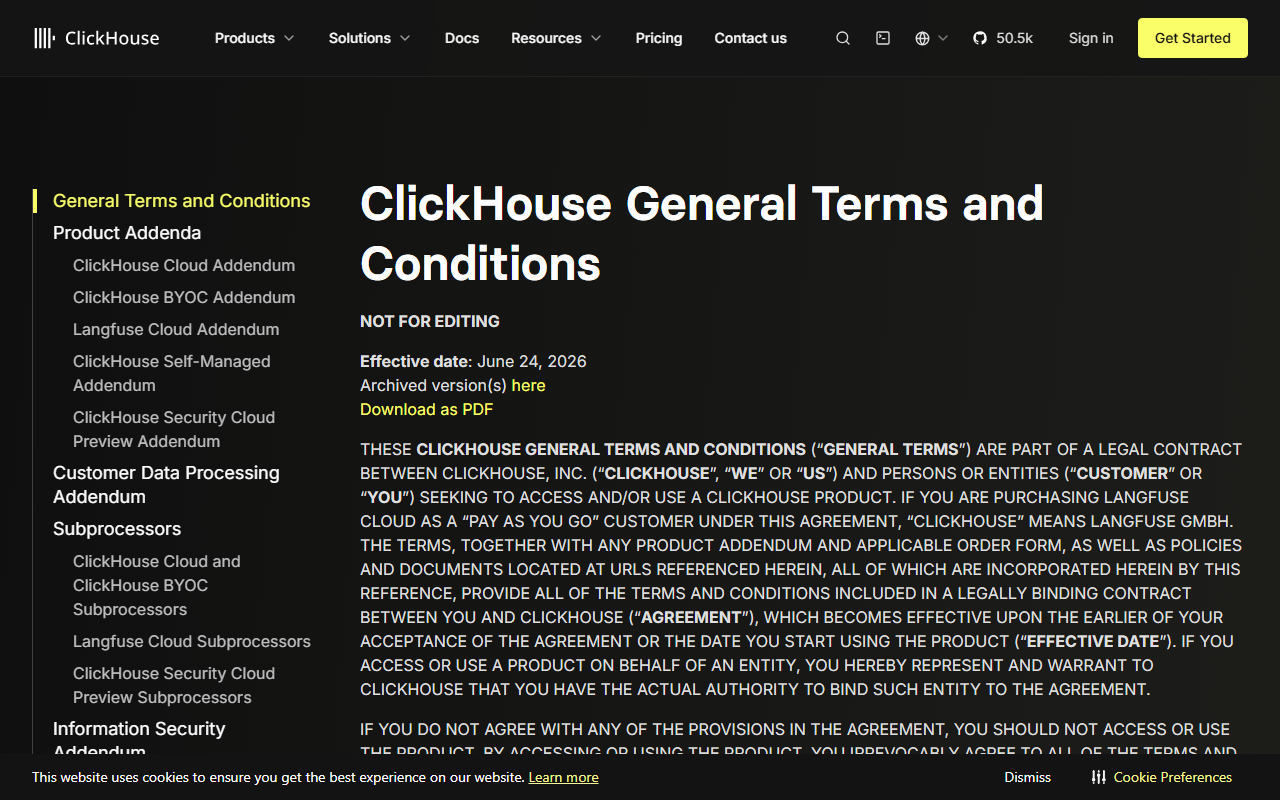
The Terms link on langfuse.com now opens the ClickHouse General Terms and Conditions (effective 24 Jun 2026), with a Langfuse Cloud Addendum, a DPA and a Langfuse Cloud SLA (all effective 10 Apr 2026). The details a buyer should know, quoted or paraphrased closely from those pages:
ClickHouse, Inc., except that for Langfuse Cloud pay-as-you-go customers “CLICKHOUSE” MEANS LANGFUSE GMBH. The privacy notice (updated 21 Aug 2026) is ClickHouse, Inc.'s.
Pay-as-you-go runs month to month and either party can end it at any time; usage is billed monthly in arrears at “then-prevailing rates”; payments are “non-refundable” except as the agreement provides, and section 10.3 refunds “any prepaid, unused fees” if you terminate for ClickHouse's material breach left uncured for 30 days.
Delaware law; suits only in federal or state courts in Delaware.
Capped at 12 months of fees; data incidents at the greater of $100,000 or twice that; free or beta use at $10,000.
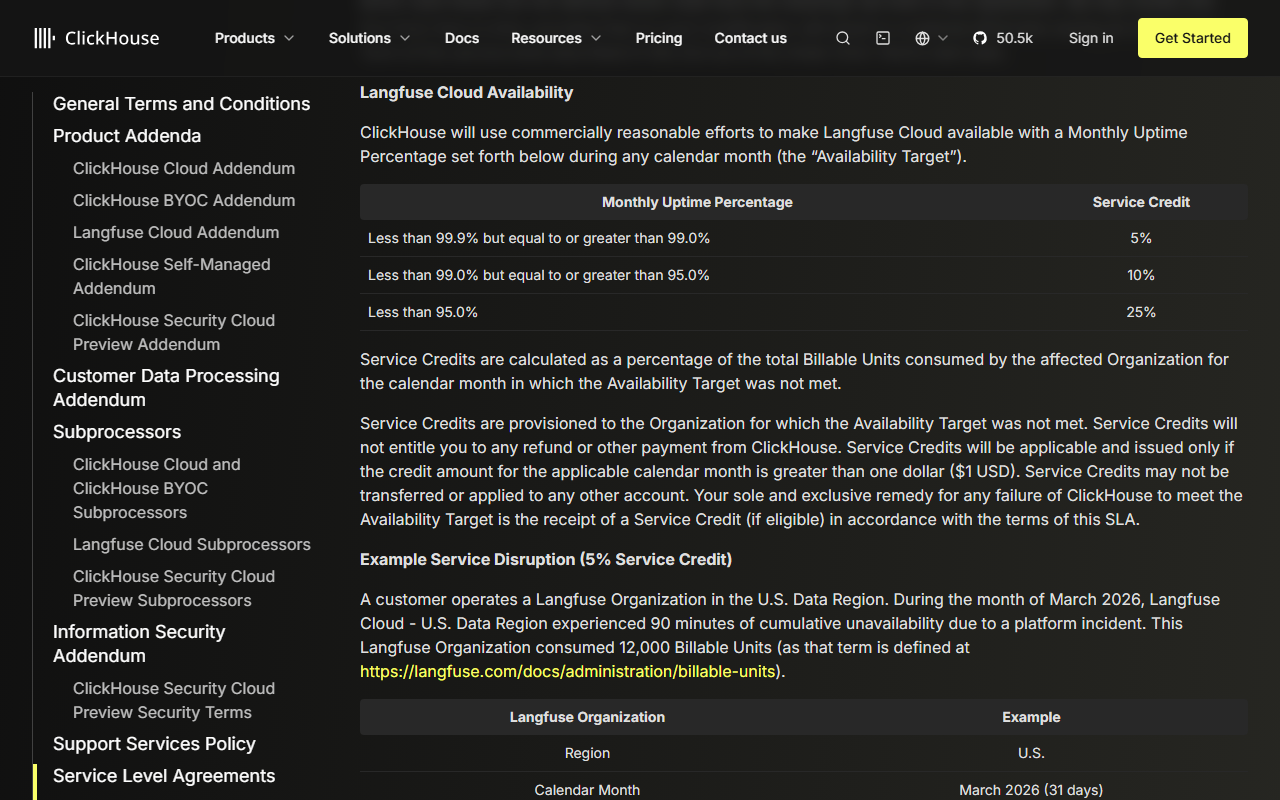
The SLA applies to the Enterprise tier: below 99.9% earns a 5% credit, below 99% 10%, below 95% 25%, as credits only, never refunds.
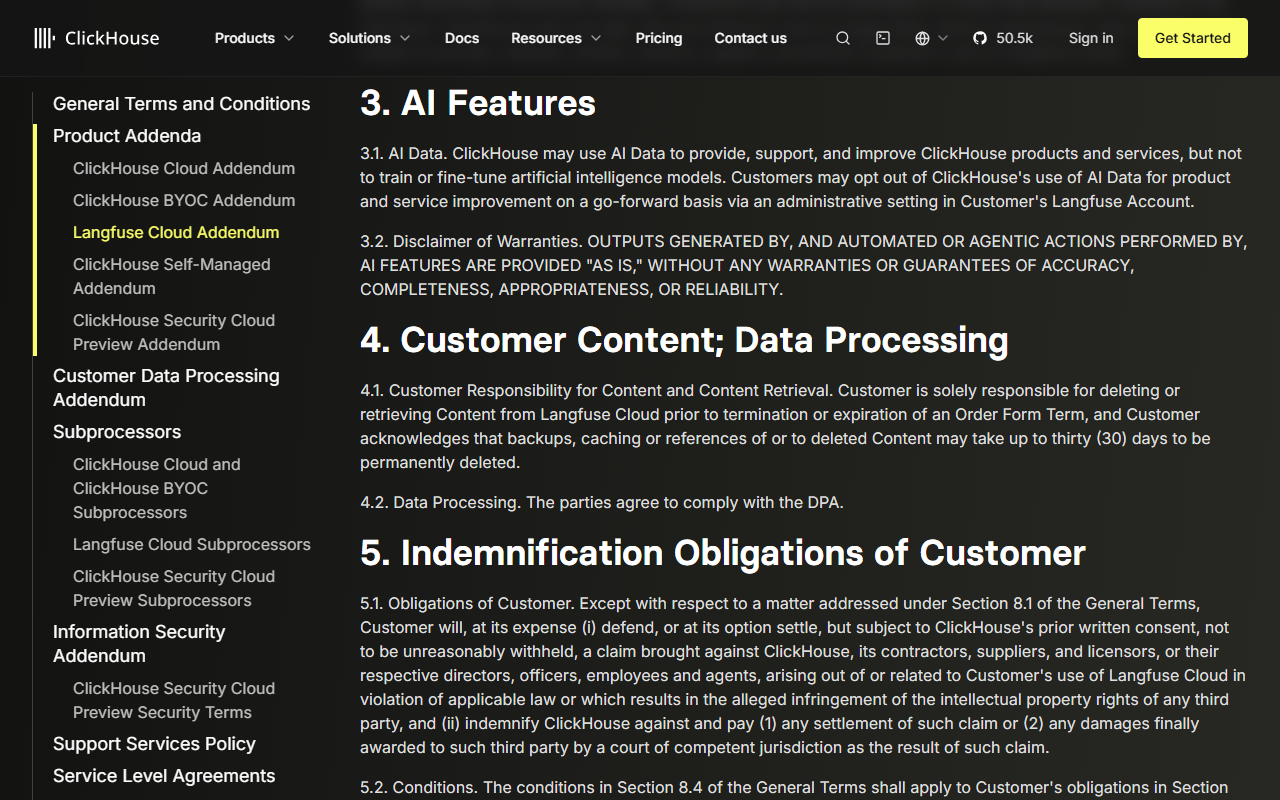
Retrieve it before the term ends; deleted content can take up to 30 days to purge from backups. AI feature data may improve products but not train models, with an opt-out setting. No health data without a BAA.
The DPA says ClickHouse hosts personal data only in the region you select, except as reasonably necessary to provide the service or required by law; gives you 10 calendar days to object to a new sub-processor; and promises to “promptly notify” you of a security incident, without an hour count. The Langfuse Cloud sub-processor list (effective 10 Aug 2026) names AWS for hosting, AWS Bedrock for AI features, and Salesforce (Slack), Pylon, Google Workspace, Waypoint, GitHub and kapa.ai for support, plus ClickHouse affiliates in the US, Australia, the Netherlands, Germany, India, Japan, Singapore and the UK. For EU buyers, that list is the practical answer to the Hacker News worry about US ownership: data stays in the EU region, but a US-headquartered group and US support tools are in the chain.

We have read these pages as a buyer would, not as lawyers. Have your counsel review the order form, DPA and any BAA before tracing personal, health or confidential data.
Teams that want full tracing and evals for many people without per-seat fees, and teams that must keep traces in their own network.
- Startups and small teams: unlimited users on Core at $29
- Framework-agnostic stacks using OpenTelemetry, LiteLLM, Vercel AI SDK, Pydantic AI or LangChain
- High trace volumes with shallow traces, where per-step units stay cheap
- Regulated or privacy-sensitive teams able to run ClickHouse themselves
- EU or Japan data residency on Cloud
- Teams that need deep, git-style prompt management first
- Very deep agent traces (dozens of steps each), where unit counts climb fast
- Buyers who need scheduled deletion on a small budget
- Organizations that rule out US-owned vendors
- Anyone without time to finish the v4 migration before 16 Nov 2026
Nine things to check before you rely on it.
Cloud drops legacy APIs, features and ingestion on 16 Nov 2026; projects on old SDKs or APIs must change first.
Every observation and score is a unit, including ones Langfuse's own features create.
Spend alerts email you once per cycle; they do not stop ingestion.
Hobby and Core keep data until you delete it; self-host needs an Enterprise licence.
Hobby: 2 users, 30 requests a minute on the General API, 100 Metrics requests a day.
ClickHouse terms, Delaware law, self-hosted Enterprise tied to a ClickHouse plan.
Six components, 16 GiB minimum, 3× disk for the v4 backfill, no automatic downgrade.
243 open bug-labelled issues; open reports on v4 cost display and dashboard totals.
No Trustpilot page; no G2 or Product Hunt score quoted. JAVIS did not test it hands-on.
Priced from each vendor's page on 23 Oct 2026; the units differ, so the plans are not like-for-like.
| Product and when to pick it | What the pricing page says | JAVIS review |
|---|---|---|
| Langfuse Open-source tracing and evals, self-hostable | Hobby $0 (50k units); Core $29 (100k units, then $8 per 100k); Pro $199; Enterprise $2,499; self-host free under MIT | This article |
| LangSmith Deepest fit for LangChain and LangGraph users | Developer $0 (1 seat, 5k base traces); Plus $39 a seat (10k base traces); then 0.005 LSU ($0.005) per base trace | LangChain review |
| Braintrust Eval-first teams | Starter $0 (1 GB processed, 10k scores, 14-day retention); Pro $249 a month (5 GB, 50k scores, 30 days); unlimited users | Not reviewed yet |
| Arize AX Observability with an open-source sibling, Phoenix | AX Free (25k spans, 15 days); AX Pro $50 a month (50k spans, 10 GB, 30 days); Enterprise on request | Not reviewed yet |
| Helicone Gateway-style request logging | Hobby free (10,000 requests); Pro $79 a month plus usage; Team $799 plus usage | Not reviewed yet |
The comparison that matters most is with LangSmith, because both price tracing directly. Worked example 2 put the gap at $130.40 against $1,145 a month for a five-person team ($945 if LangSmith's included traces are counted per seat). LangSmith is the better choice if you live inside LangGraph and want its deployment and agent-improvement products from the same vendor; Langfuse if you want any framework, unlimited users and the option to host it yourself. Braintrust prices by data volume and scores, which makes a fair comparison depend on payload size we cannot know for you.
Consolidation is the common thread. ClickHouse bought Langfuse in January; on 23 Oct 2026 Helicone's pricing page carries the banner “Helicone is no longer part of Mintlify. Details to come soon.” Vendor stability is worth a question for every tracer, not only this one.
If you are still choosing what to build with, our reviews of Dify and RAGFlow cover two of the platforms Langfuse can trace.
This review has no affiliate links, and Langfuse did not see it.
JAVIS has no approved Langfuse affiliate link, so every Langfuse link here goes straight to langfuse.com, its documentation, the GitHub repository or the ClickHouse legal pages langfuse.com links to (General Terms, Langfuse Cloud Addendum, DPA), without tracking parameters.
Hands-on status: JAVIS has not run Langfuse, opened an account or paid for a plan for this review. Facts come from Langfuse's pricing pages and calculator, docs, changelog, public handbook and documentation repository, security pages, the ClickHouse legal pages, the GitHub repository, Docker Hub, PyPI and npm counters, Hacker News, the official YouTube channel, DigitalOcean's droplet pricing and the LangSmith, Braintrust, Arize and Helicone pricing pages, as of 23 Oct 2026. Independent review evidence is limited, as described above.
Hobby is free without a card; start with the tracing quickstart in the docs.
Open the Langfuse docsEnter your own unit count in the calculator before you add a card.
Open the pricing pageBuilding with LLMs? These reviews cover the nearest ground.
Each card opens a published JAVIS review.


Questions people ask before committing
Is Langfuse free?
Yes, two ways: the open-source edition is MIT-licensed (except the ee/ folders) and free to self-host without usage limits, and Langfuse Cloud's Hobby plan is free for 50,000 units a month and two users, no card required.
How much does Langfuse Cloud cost in October 2026?
Per langfuse.com/pricing on 23 Oct 2026: Core $29 a month, Pro $199, Teams add-on $300, Enterprise $2,499. Paid plans include 100,000 units, then $8 per 100,000 to 1 million, $7 to 10 million, $6.50 to 50 million and $6 beyond.
What is a unit?
One trace, one observation (a step such as an LLM call, tool call or span) or one score. A trace with six steps and one score counts as eight units.
What changes on 16 November 2026?
Langfuse Cloud becomes v4-only: the changelog says legacy APIs, features and ingestion are removed. Upgrade to Python SDK 4.7.0+ or JS/TS SDK 5.4.0+, move off the old read APIs and trace-level evaluators, and switch exports to enriched observations. Self-hosted v3 gets security patches through January 2027.
Who owns Langfuse?
ClickHouse, Inc., which acquired it in January 2026. Self-serve Cloud customers contract with Langfuse GmbH under ClickHouse's general terms, governed by Delaware law.
Does Langfuse delete old data?
Only if you set a retention policy, which needs Pro, Enterprise or a self-hosted Enterprise licence. The data access window on Hobby and Core hides older data but does not delete it.
Is Langfuse better than LangSmith?
Cheaper for most workloads we priced, framework-agnostic and self-hostable; LangSmith is tighter with LangChain, LangGraph and its own deployment products. See the alternatives section and our LangChain review.
Is Langfuse an affiliate product here?
No. This review has no affiliate links.
Where this came from, and when.
Pricing: langfuse.com/pricing (cards, comparison table, FAQ, calculator with 1,420,000 and 10,550,000 units entered), langfuse.com/pricing-self-host, the billable-units, spend-alert and data-retention docs, and the API limits FAQ, 23 Oct 2026. Price history from the pricing-table file in the langfuse/langfuse-docs repository at its 7 Oct 2025, 5 Jan 2026, 13 Feb 2026 and 17 Oct 2026 versions.
Product and v4: Langfuse home, docs, integrations and self-hosting pages, the v4 changelog (17 Aug 2026), the v4 upgrade FAQ, the self-hosted v3 to v4 guide, the Docker Compose, container and ClickHouse sizing guides, the Enterprise licence-key page, the public support handbook, and changelog images from February to September 2026, all as of 23 Oct 2026.
Security and legal: langfuse.com/security, status.langfuse.com, the ClickHouse General Terms (effective 24 Jun 2026), Langfuse Cloud Addendum, DPA and SLA (10 Apr 2026), Langfuse Cloud sub-processors (10 Aug 2026) and the privacy notice (21 Aug 2026), 23 Oct 2026.
Repository and market: langfuse/langfuse on GitHub, 23 Oct 2026: 36,254 stars at 14:43 UTC, 4,053 forks, 326 open issues (243 bug-labelled), 790 to 794 open pull requests during the day, 2,855 closed issues, 35 releases from 23 Sep to 23 Oct 2026 (32 v4, 3 v3), four security advisories, licence file. Docker Hub pulls for langfuse/langfuse (20,088,588) and langfuse/langfuse-worker (10,017,316) at 14:43 UTC; GitHub discussion 12518 (v4 rollout, 20 upvotes, 18 comments); PyPI daily counts without mirrors summed for 23 Sep to 22 Oct 2026; npm counts for 19 Sep to 18 Oct 2026.
Independent evidence: Hacker News stories 37310070 (29 Aug 2023), 42441258 (17 Dec 2024), 46656552 (17 Jan 2026) and 46975123 (11 Feb 2026); comments 46656961, 46657025, 46657787, 46659277 and 46660289 (17 Jan 2026), 46663717 and 46668124 (18 Jan 2026), 47153046 (25 Feb 2026), 47244932 (4 Mar 2026), 47330325 (11 Mar 2026), 48517832 (13 Jun 2026) and 49661637 (11 Sep 2026). GitHub issues 12738, 16077, 18210 and 19003. Trustpilot: no page for langfuse.com, 23 Oct 2026. G2 and Product Hunt scores are not quoted.
Images: twenty-one screenshots of public pages taken on 23 Oct 2026 (Langfuse pricing, calculator, docs, changelog, blog, security and status pages, two GitHub pages and four ClickHouse legal pages), and eight official images from langfuse.com's changelog and blog, each labelled as vendor material. Related cards use JAVIS's own featured images.
Video: two videos from the official Langfuse YouTube channel (@langfuse).
Competitors: LangSmith, Braintrust, Arize and Helicone pricing pages, and DigitalOcean's droplet pricing, 23 Oct 2026. Cost examples are arithmetic on published rates with invented traffic.
Store ratings: none; Langfuse has no mobile app.
JAVIS Fit Score (76/100): an editorial composite scored out of 20 on five criteria. Price clarity 17: public rates, a calculator that matches the arithmetic and no price change in a year, but no stated Hobby overage rule and unpublished self-hosted Enterprise pricing. Capability breadth 17: tracing, evals, experiments, prompts, dashboards, alerts, API and MCP, with prompt management judged basic by some users. Independent evidence 13: strong stars and downloads, no star rating, mixed Hacker News comments and many open bug reports. Security and data control 15: SOC 2 Type II, ISO 27001, three regions plus HIPAA, self-hosting, four moderate or low advisories, but retention rules only on Pro and a US parent. Cost control and fit 14: cheap units and unlimited users, but alerts instead of caps and a fixed cutover date for projects still on v3 features. It is judgment, not a measurement.
What this review does not cover: real ingestion speed or query performance under your workload, what happens when a Hobby organization exceeds 50,000 units, self-hosted Enterprise prices, the order form and any BAA, and a technical security review.