
Haystack Review 2026: Free to Run, a Quote to Buy, and a Library That Breaks on Purpose Every Few Weeks
Haystack is deepset's open-source Python framework for retrieval-augmented generation (RAG), search and tool-using agents. The framework is Apache-2.0 and costs nothing. Around it, deepset sells three things: a free Studio trial, the Haystack Enterprise Platform (renamed in December 2025 from the deepset AI Platform, which a deepset news post of 25 Jun 2024 describes as formerly known as deepset Cloud) at a custom price, and an Enterprise Starter support package with no published price. Haystack 3.0 arrived on 20 Jul 2026 with breaking changes, and four minor releases followed in 87 days. This review works out what a self-hosted Haystack app really costs, what the platform contract says, what breaks between 1.x, 2.x and 3.4, and what developers say.
There are no affiliate links in this review. Every Haystack link goes straight to haystack.deepset.ai, deepset.ai, the documentation or the GitHub repository.
| Made by | deepset GmbH, Berlin; Deepset, Inc. contracts with US customers |
| What it is | Python pipelines and agents for RAG, search and tool use |
| Framework | Free, Apache-2.0; v3.4.1 on PyPI, GitHub and Docker Hub (21 Oct 2026); Python 3.11+ |
| Paid | Studio $0 trial; Enterprise Platform custom; Enterprise Starter on request |
| Pace | 3.0 plus four minor releases in 87 days (20 Jul to 15 Oct 2026) |
Use the free framework if you want readable, swappable RAG and agent pipelines and can absorb a minor-version upgrade most months. Treat the platform as a sales conversation, and read the renewal clause first.
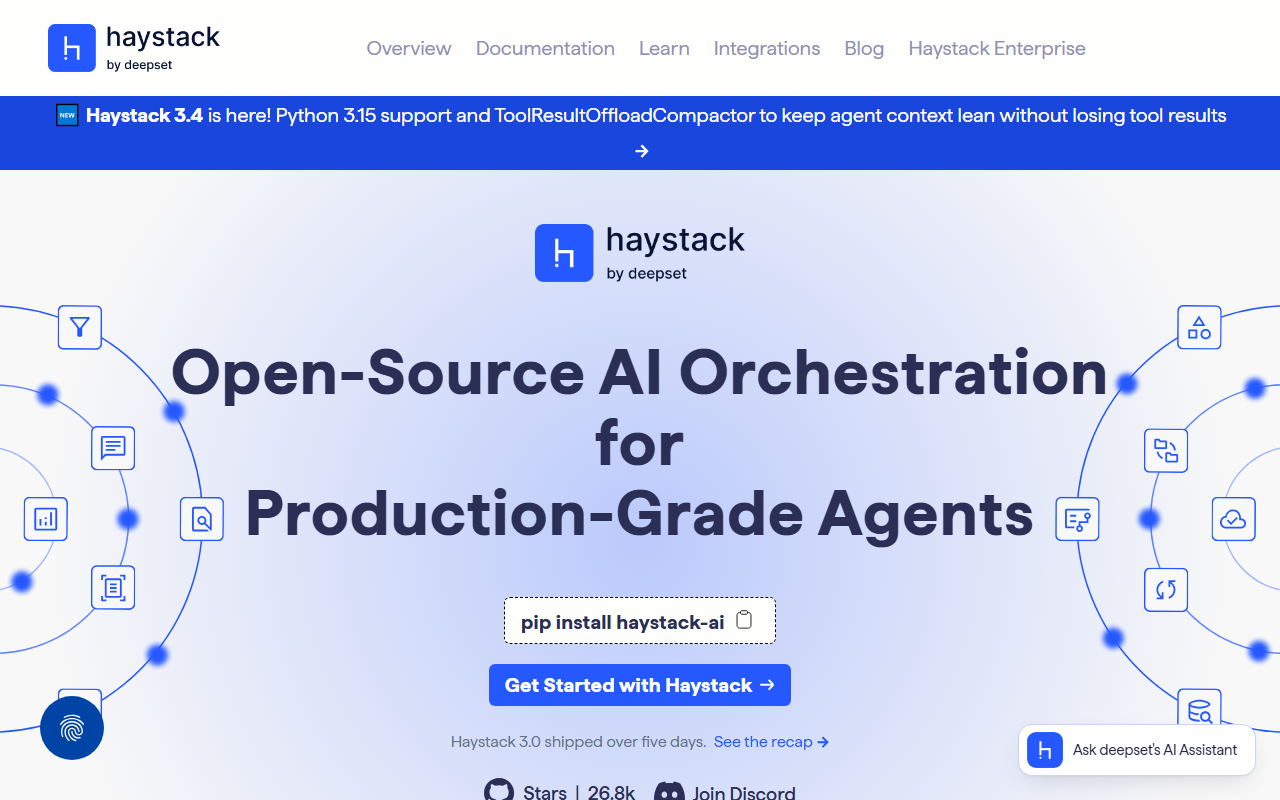
“Open-Source AI Orchestration for Production-Grade Agents.” The home-page line is fair for the library. The paid side is where the numbers disappear.
The library side is easy to like. Haystack is Apache-2.0, has no seat or usage fee, and its design is explicit: you connect components (converters, splitters, embedders, retrievers, chat generators, tools) into a pipeline you can read, test with mock components and serialize to YAML. In our worked example a five-person support team answering 30,000 questions a month spends about $192 a month, and Haystack is $0 of it: $144 is model tokens and $48 is one cloud server. Haystack 3.0 gave the Agent hooks around every model and tool call, built-in token and step counters, and one Pipeline class for sync, async and streaming.
The catches are change and paper. Haystack's own policy says it does not follow semantic versioning and removes a deprecated feature in the next minor release, “roughly a month” later; the gap between 3.2.0 and 3.3.0 was 7 days, and combining Toolsets with + went from deprecated to removed in 31 days, taking saved pipelines that used it with it. On money, deepset's pricing page lists Studio at $0 and Enterprise as “Custom”; Enterprise Starter has only a contact form. The terms you would sign renew automatically, raise fees by an inflation index plus 3% at each renewal, and need three months' written notice to stop.
Developer opinion is thin: one 90-point Hacker News thread from June 2026 credits the EU maintainer, questions telemetry being on by default, and includes a camp that thinks no framework is needed; the warmest praise for the pipeline design dates from the 2.0 launch in 2024. There is no Trustpilot page and no star rating we can verify.
Not a hands-on test: JAVIS has not installed Haystack, built a pipeline, opened a Studio account or asked deepset for a quote. This review is built from deepset's pricing, product, legal and blog pages, the Haystack documentation and release notes, GitHub, PyPI and Docker Hub records, Hacker News, the official Haystack YouTube channel, and the pricing pages of the competitors and infrastructure providers named in the cost examples, all as of 24 Oct 2026.
A free library you import, a free server that exposes it, and three paid or gated layers on top.
Haystack itself is code that runs inside your application. At indexing time, converters read files, splitters cut them into chunks, an embedder turns chunks into vectors and a writer stores them in a document store (the integrations list includes Qdrant, Weaviate, Pinecone, Elasticsearch, OpenSearch, pgvector and others). At question time, a retriever pulls the relevant chunks and a chat generator answers from them. An Agent component loops between a chat model and the tools you give it. To serve any of that over the network, deepset's separate open-source Hayhooks server wraps pipelines and agents as REST, OpenAI-compatible and MCP endpoints.
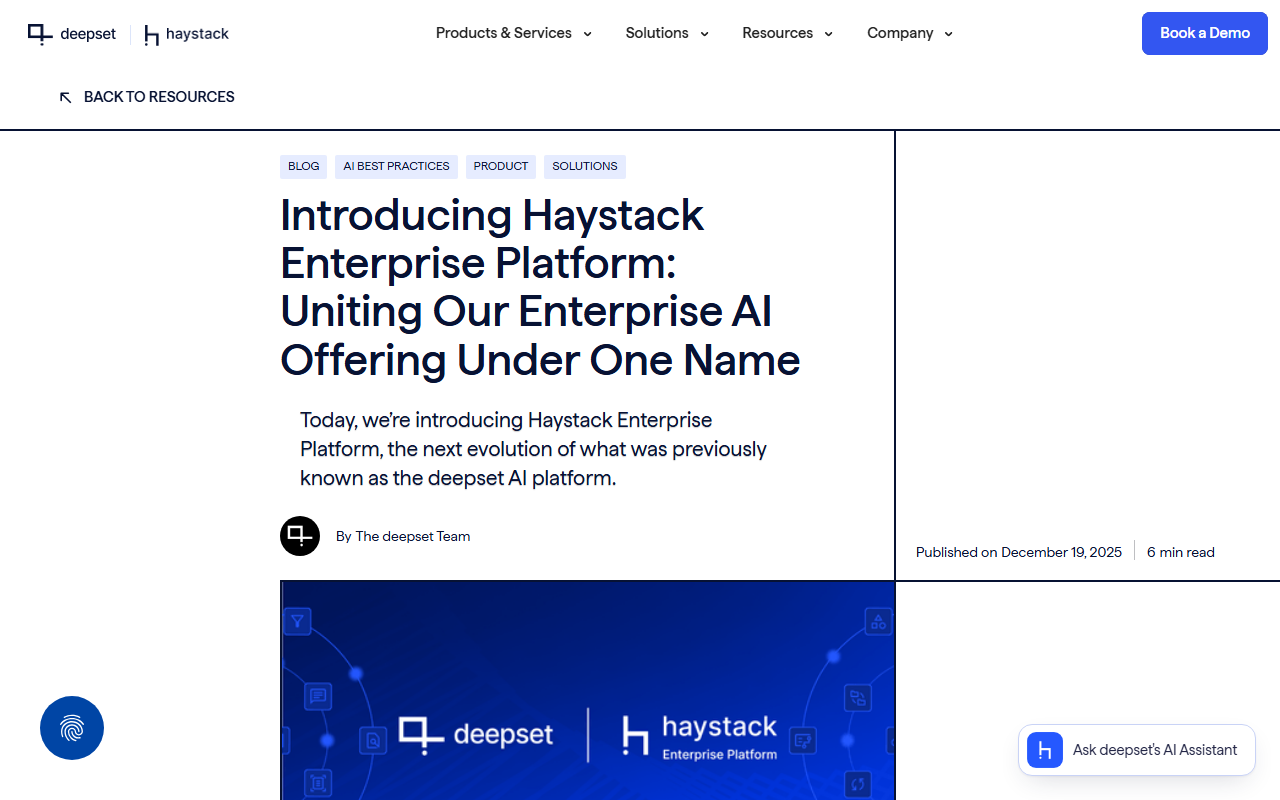
The name change most buyers miss
If you remember “deepset Cloud” or the “deepset AI Platform”, it still exists under a new name. deepset's blog post of 19 Dec 2025 introduced the Haystack Enterprise Platform as “the next evolution of what was previously known as the deepset AI platform”, and says Haystack Enterprise Starter “was formerly known as Haystack Enterprise”. The chain is deepset Cloud, then “deepset's AI Platform (formerly known as deepset Cloud)” in a deepset news post of 25 Jun 2024, then Haystack Enterprise Platform; the platform documentation's Release 2025.2 note, described there as the January release, now reads “deepset Cloud is now Haystack Enterprise Platform, or deepset for short” and warns that old references may remain. Its wording uses the December 2025 name, so that note has likely been edited since it first appeared. The naming is still settling: the pricing page calls the free tier “Studio”, the Studio sign-up page is titled “Haystack Enterprise Platform Trial”, and the Terms and Conditions describe “deepset Studio” as a free product.
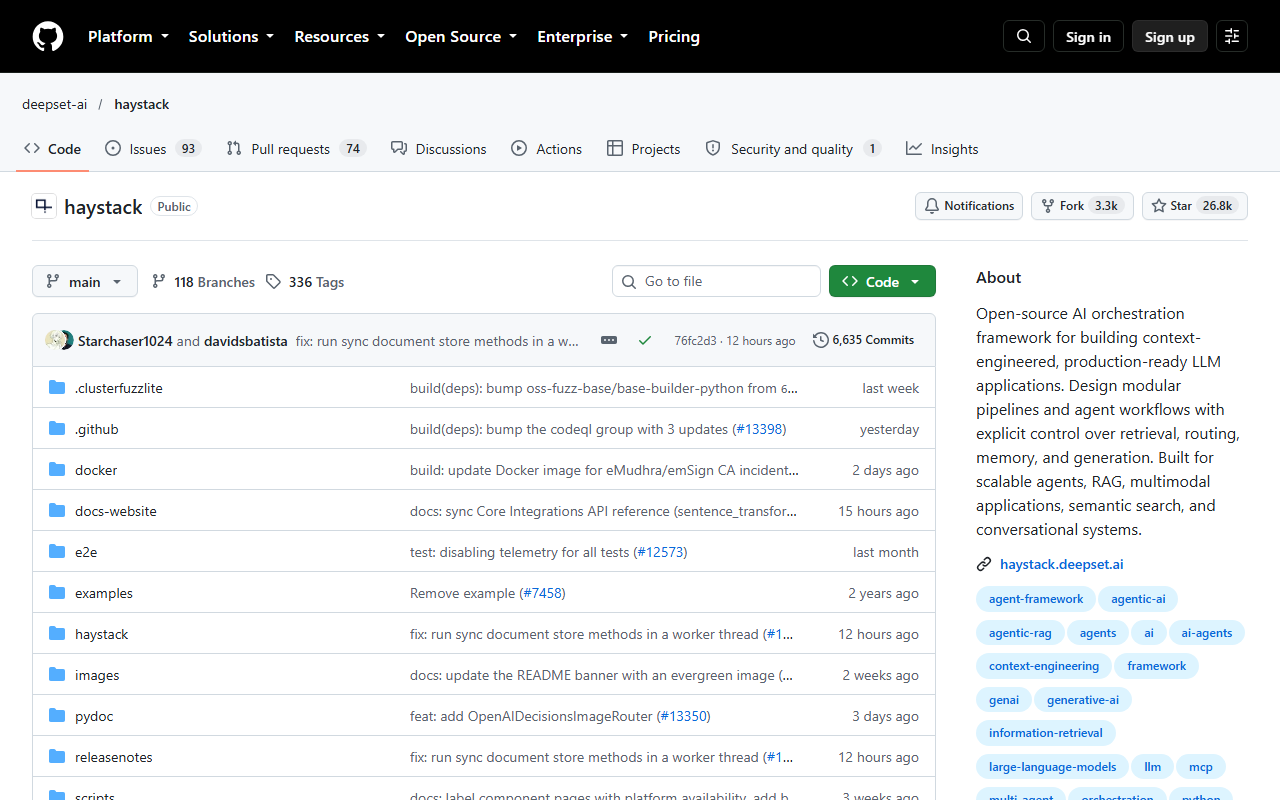
An active, mid-sized project: a fifth of LlamaIndex's downloads, a third of a percent of LangChain's.
deepset-ai/haystack, 24 Oct 2026, 00:55 UTC; 3,332 forks
haystack-ai, mirrors excluded
20 Jul to 24 Oct 2026
repository created 14 Nov 2019
deepset's About page dates the company's start to 2018 and Haystack to 2020; the GitHub repository was created in November 2019. On 24 Oct 2026 the repository showed 93 open issues and 74 open pull requests against 4,505 closed issues. Since the 3.0 release on 20 Jul 2026, 209 issues were opened and 165 of them are already closed, and 828 pull requests were merged. That is a project under heavy, active maintenance, which is good for bug fixes and is also why upgrades come so often.
Downloads tell the adoption story, with the usual warning that CI servers and dependency installs inflate them and that a download is not a user. For the 30 days to 22 Oct 2026, pypistats counts 566,454 downloads of haystack-ai, against 2,937,852 for llama-index, 2,442,764 for crewai and 170,457,766 for langchain: about 19% of LlamaIndex and 0.3% of LangChain. On GitHub stars the same day, LlamaIndex had 52,640, RAGFlow 92,765, LangChain 148,334 and Dify 159,380.
Two readings from that chart. First, the September drop is not Haystack-specific: from August to September haystack-ai fell 29.5%, langchain 30.4% and llama-index 54.9% on the same counter, so treat it as a market-wide or counting effect rather than a verdict on Haystack. Second, the end-of-life 1.x package farm-haystack, last released on 3 Apr 2025, still drew 35,790 downloads in September, about 6.4% of the current package. Somebody is still installing 1.x; section 10 explains why that is a security question, not just a nostalgia one.
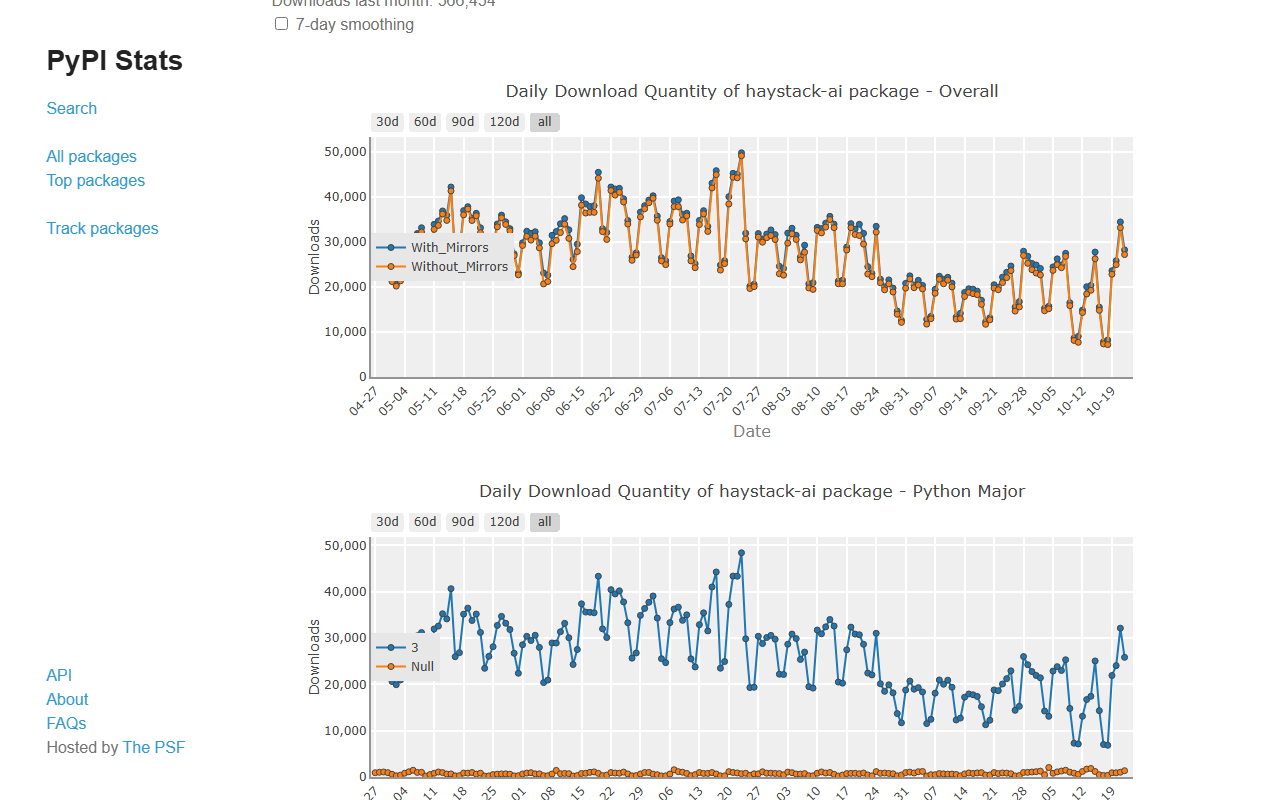
haystack-ai, 24 Oct 2026. The peak sits around the 3.0 release on 20 Jul 2026.
haystack-ai page on PyPI, 24 Oct 2026. Version 3.4.1 was uploaded on 21 Oct 2026 (19:10 UTC) and requires Python 3.11 or newer.deepset's own claims are bigger and unaudited. The Enterprise Starter page says Haystack is “trusted by thousands of leading organizations”; the blog footer names Airbus, The Economist and OakNorth; and the platform page says the European Commission's AI@EC platform, built on Haystack, gives 68 builders across 29 departments access, with 316 pipelines in staging or production. These are vendor statements. Recent company news points the same way: on 15 Oct 2026 the Enterprise Platform became available on STACKIT, a German sovereign cloud, for public-sector buyers, and on 21 Oct 2026 deepset announced cost reporting by model, agent, service and team inside the platform, plus custom model services for government, defense and industry.
No analyst market-share figure is cited. Stars, downloads and pulls measure attention and installs, not paying customers.
No star rating exists. One Hacker News thread likes the design and the EU maintainer, doubts telemetry, and argues about frameworks in general.
deepset has no Trustpilot page (the address shows a not-found page on 24 Oct 2026), the library has no app-store listing, and G2 scores are not quoted here. The independent voice is Hacker News, which skews toward developers and is a handful of comments, not a survey. The 2026 thread with substance is the 24 Jun 2026 submission of the Haystack site (story 48658095: 90 points and 22 comments as of 24 Oct 2026, 01:00 UTC). The Haystack 3.0 announcement (story 48979705, 20 Jul 2026) drew 8 points and one comment, “nice!”, so there is almost no public record yet of how 3.0 upgrades went. Each card is one person's account, paraphrased from that comment only.
What people like
Has used it with clients on several small to large projects, sees advantages and disadvantages “as every framework”, and says clients choose it because it is an EU-based company.
Built a company-internal RAG platform on it and found it more comfortable than LangChain or LlamaIndex, which felt “too bleeding edge” with “too many breaking changes”. Written at the 2.0 launch, before 3.0.
Calls the pipeline model a game changer for hobby projects: swapping document stores and models is a small change.
What worries them
Quotes Haystack's notice that it collects anonymous usage statistics every time components are initialized, and says that for an EU-based company “this stands out”.
Remembers Haystack as “completely unusable for extractive QA” two years earlier and wonders if it is the same package; a second user replies “Likewise” (48662619).
Argues that agent frameworks all share one trait, that they “suck”, and that you do not need an AI framework at all.
Smaller notes
Points to raghilda, a deliberately narrower, RAG-only library that leaves ingestion, chunking and retrieval visible and replaceable, and discloses being one of its authors.
Warns that “Haystack” is an overloaded name shared by thousands of unrelated products, which makes searching for help harder.
Asks the EU-client commenter whether they would have used something else without that constraint. The thread has no answer.
What the issue tracker says about 3.x upgrades
Public signs of 3.0 migration trouble are scarce, which is evidence of a small, quiet user base as much as of a smooth upgrade. GitHub searches on 24 Oct 2026 for issues opened in deepset-ai/haystack since 20 Jul 2026 return 1 result for “migration” (a dependency proposal), 0 for “AsyncPipeline”, 3 for “ToolInvoker” and 5 for “breaking change”; none of them reports a failed 3.0 upgrade. The repository's Discussions show 16 threads started since 20 Jul 2026, mostly show-and-tell posts; the Haystack 3.0 launch-week announcement (discussion 12081) has 1 comment and 2 upvotes. The open issues that do touch 3.x behaviour are narrow; issue 12625 (5 Sep 2026, 3 comments, OutputAdapter coercing a string to another type) is not tied to 3.0 in the issue itself.
The pattern: the pipeline model and the European maintainer win friends; telemetry and the old 1.x reputation draw suspicion; and the loudest objection is to frameworks in general, not Haystack in particular. Treat the 2024 praise for stability as history, because the 3.x release pace below is very different. One commenter (48658699) dismissed deepset with a pun and no reason; we leave that out of the pattern.
The framework and Hayhooks are free. Studio is a free trial with no production pipelines. Everything else is a quote.
Haystack
Apache-2.0, pip install haystack-ai
- No seat or usage fee
- Hayhooks server, also free
- Community help on Discord and GitHub
- You host, patch and monitor it
Studio
Sign-up form
- 1 workspace, 1 user
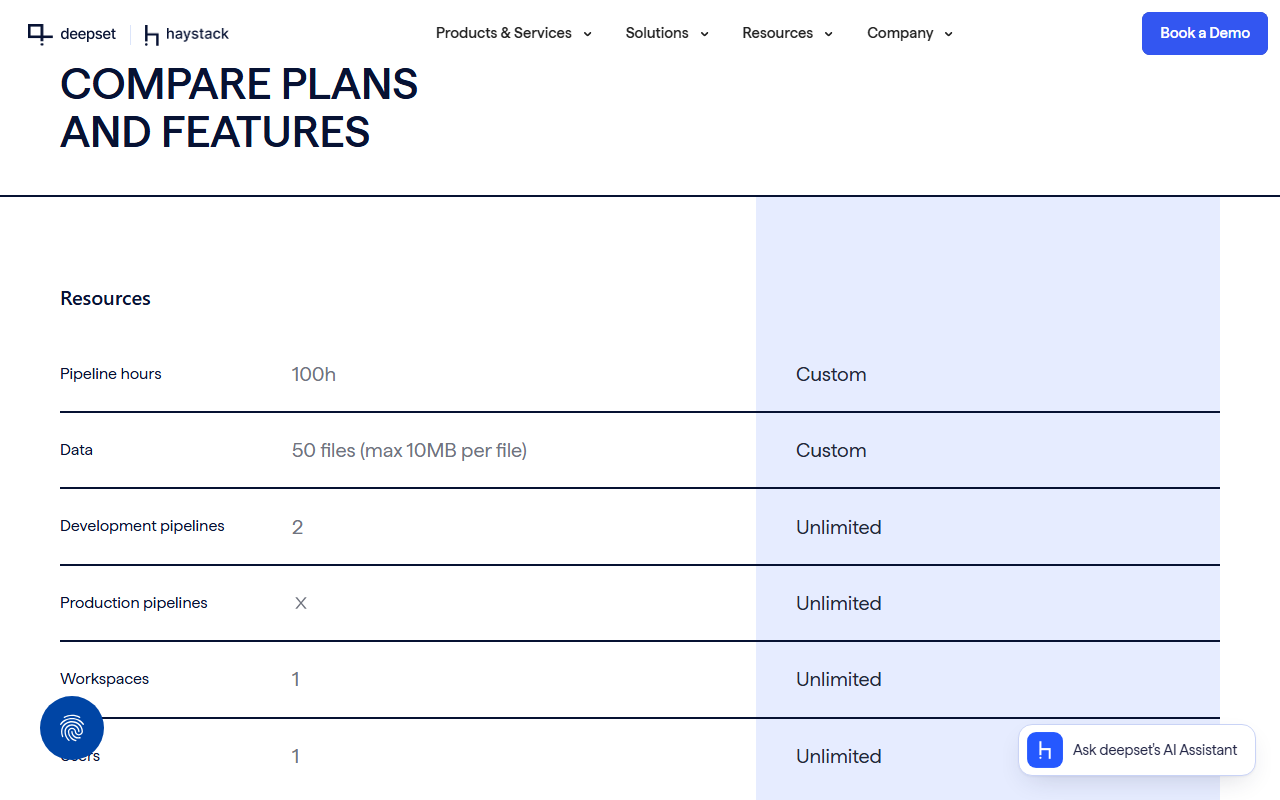
- 100 pipeline hours
- 50 files, 10 MB each
- 2 development pipelines, no production
- 14 days of logs and search history
Enterprise Platform
Contact us
- Unlimited workspaces and users
- Production pipelines, high availability
- SSO and role-based access
- Cloud or self-hosted deployment
Enterprise Starter
Contact form
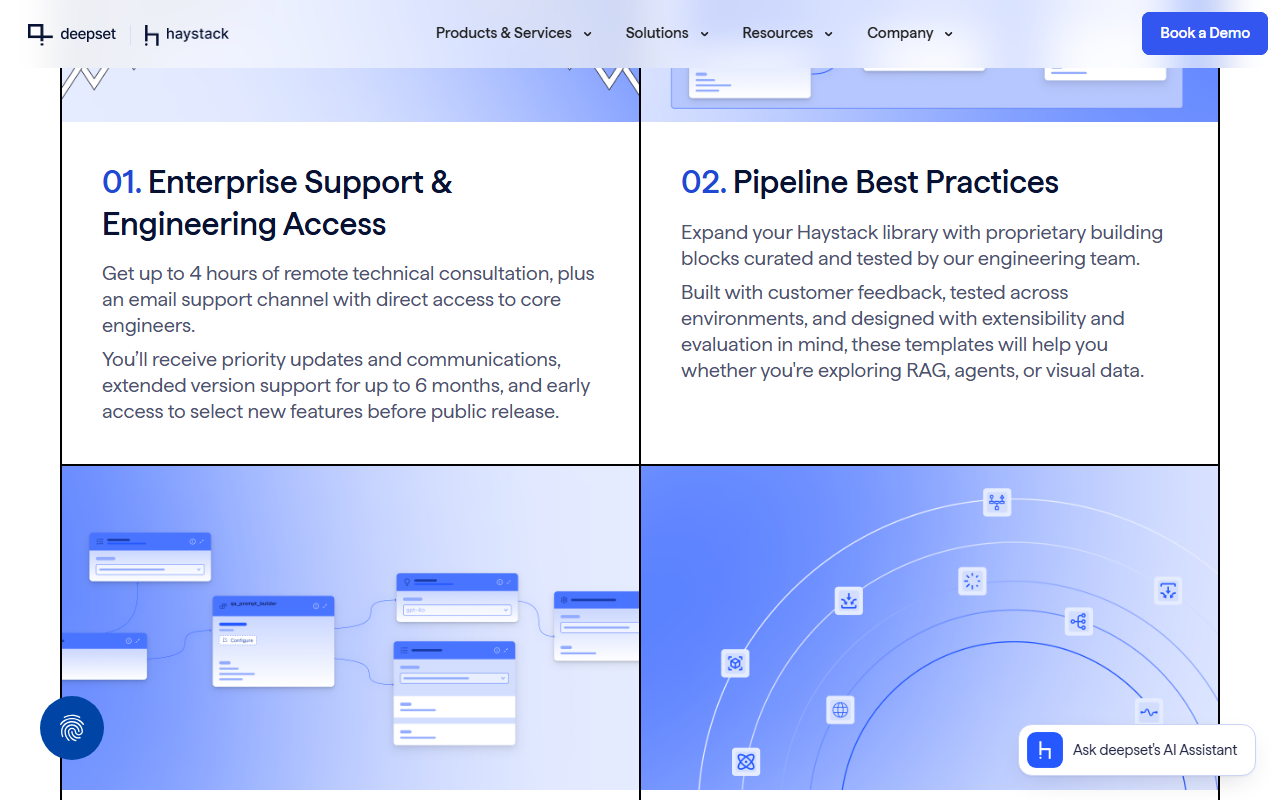
- Up to 4 hours of remote consultation
- Email channel to core engineers
- Extended version support up to 6 months
- Private templates, Helm charts

Where Studio stops
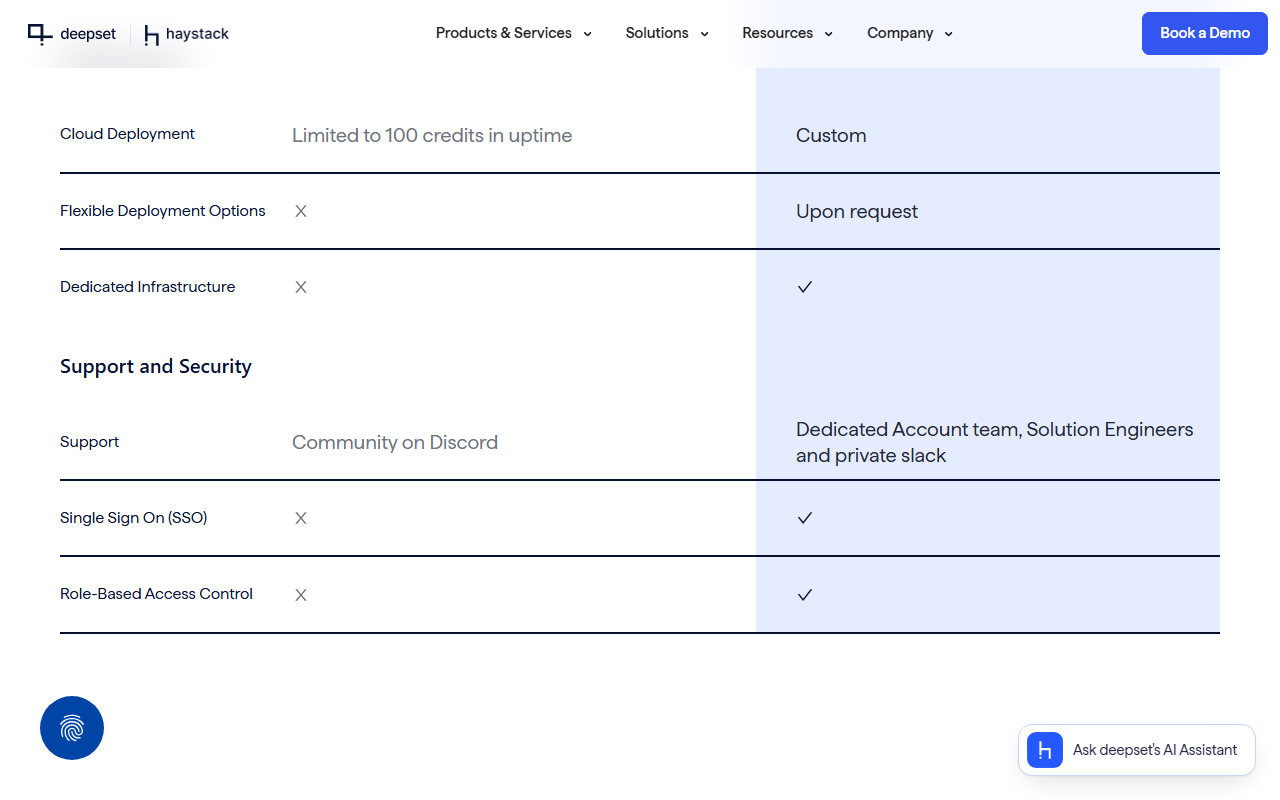
The comparison table on the same page is blunt. Studio has no production pipelines (the cell shows an X), no flexible deployment, no dedicated infrastructure, no single sign-on and no role-based access control, and its support is the community Discord. Two cells contradict each other in units: the Resources block gives Studio “100h” of pipeline hours, while the Cloud Deployment row says “Limited to 100 credits in uptime”. Neither the page nor the Studio sign-up page defines a pipeline hour or a credit, or says whether they renew monthly. deepset's terms add that Studio has no on-premises deployment support, no simultaneous editing by several users and no customer support, and that its pipelines “can be deployed with limited uptime or exported as Python or YAML files”. Treat it as a trial and a design tool, not a host.
Not an affiliate link. It opens deepset's official website.
Three worked examples: the framework line is $0, and the model bill is three quarters of a small deployment.
Everything below is arithmetic on prices published by each provider on 24 Oct 2026, with invented but plausible traffic. Haystack does not resell model access, so the model prices come from OpenAI's own API pricing page (standard tier, per 1 million tokens) and the server from DigitalOcean's own droplet pricing page. Swap in your own provider; the structure of the bill stays the same.
Apache-2.0, any team size
30,000 questions, 5 people
about two thirds of a cent
$144.02 of $192.02
Worked example 1: a self-hosted support bot for a five-person team
Indexing. 10,000 help-center and policy documents of about 2,000 tokens each are 20,000,000 tokens. Embedded once with text-embedding-3-small at $0.02 per million tokens, that is 20 × $0.02 = $0.40, one time. Cut into 500-token chunks it is 40,000 vectors of 1,536 dimensions; at 4 bytes per number that is 40,000 × 1,536 × 4 = 245,760,000 bytes, about 246 MB, small enough for an open-source Qdrant container on the same server.
Answering. 30,000 questions a month, each sending about 4,000 input tokens (the question plus retrieved chunks) and receiving 400 output tokens, on gpt-5.4-mini at $0.75 per million input and $4.50 per million output tokens: 120 million input tokens cost 120 × $0.75 = $90.00, and 12 million output tokens cost 12 × $4.50 = $54.00. Embedding the questions adds 30,000 × 30 = 900,000 tokens, or $0.018. Model total: $144.02.
Hosting. One DigitalOcean Basic droplet with 8 GiB of memory, 4 vCPUs and 160 GiB of SSD is $48 a month, running the Haystack pipeline behind Hayhooks and Qdrant in Docker (our sizing assumption, not a tested figure). Monthly total: $48 + $144.02 = $192.02 ($192.42 in the first month with indexing), or $192.02 ÷ 30,000 = $0.0064 per answer. Haystack's line on that bill is $0. If the same team used gpt-5.4 ($2.50 and $15.00 per million) instead, the model line would be $300 + $180 = $480, which shows where the real cost lever sits: the model and the prompt size, not the framework.
Worked example 2: the same five people, priced as a platform fee
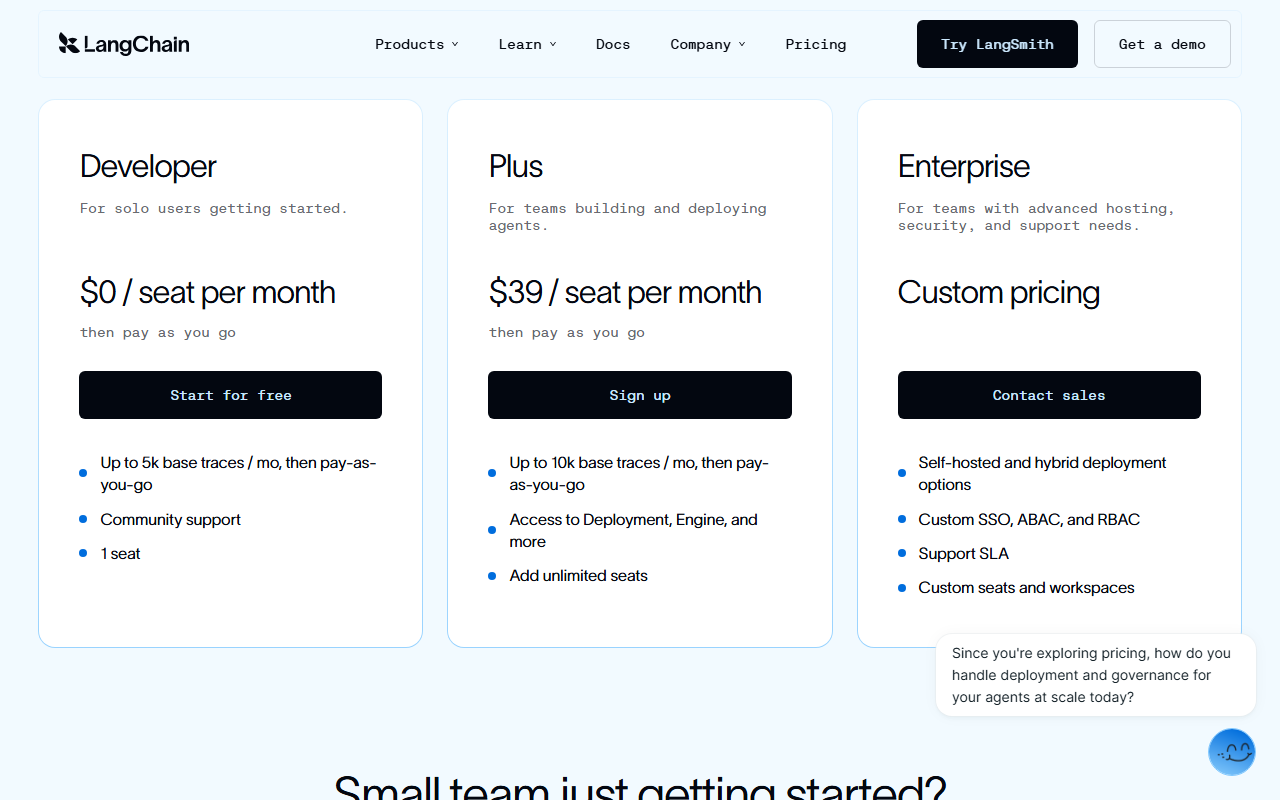
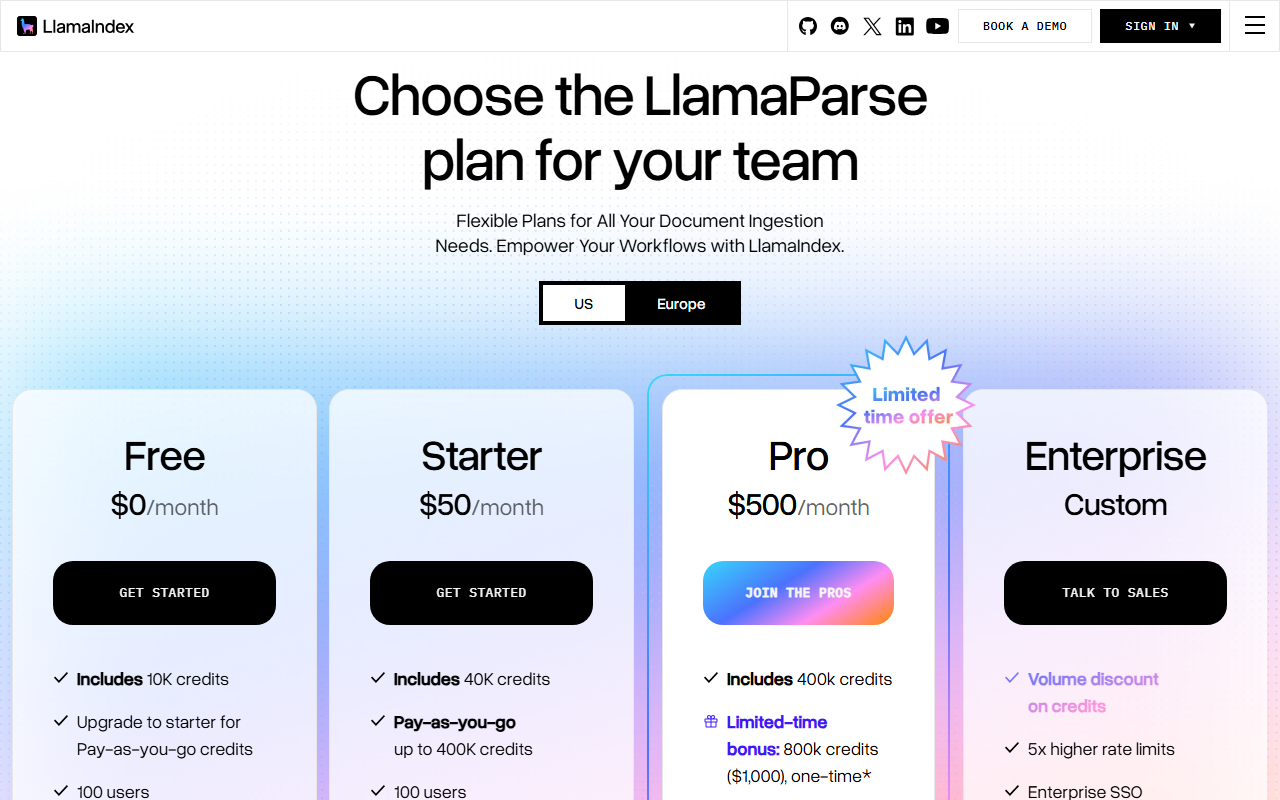
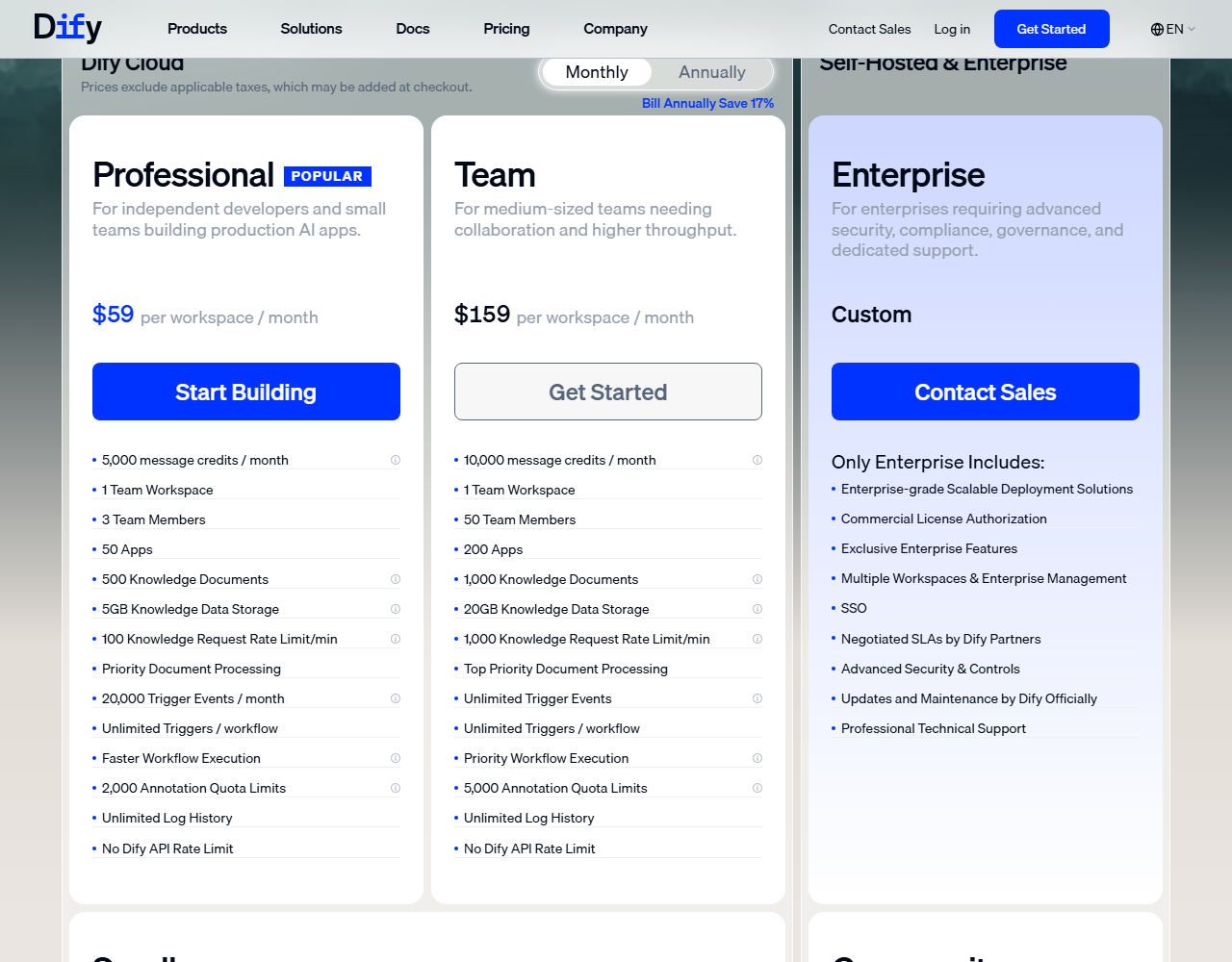
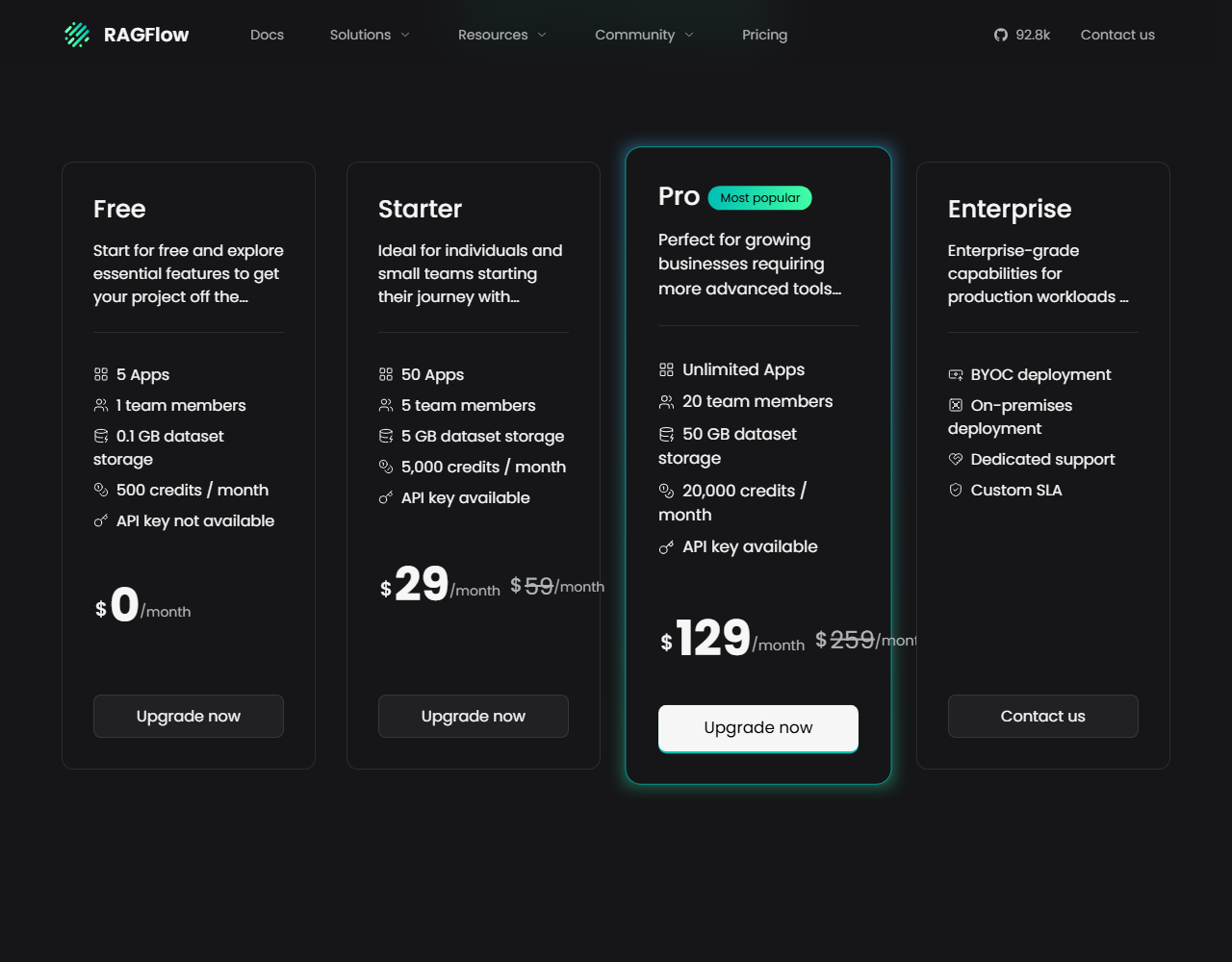
What does a team pay before a single model token, for the layer that Haystack gives away? On each vendor's own pricing page on 24 Oct 2026: Haystack alone is $0, or $29 a month if you add Langfuse Core for tracing (unlimited users), or 5 × $39 = $195 with five LangSmith Plus seats. Dify Cloud's Professional plan ($59 per workspace a month) allows 3 team members, so five people need Team at $159. RAGFlow's cloud Starter is $29 a month for 5 team members (shown next to a struck-through $59), and LlamaParse Starter, which parses documents but does not run your app, is $50. The Haystack Enterprise Platform has no number to put on the chart.
The comparison is deliberately rough. A Dify or RAGFlow plan bundles a hosted app builder and some model credits; Haystack gives you code and makes you host it. If your team has nobody who wants to run a Python service, the hosted plans may be cheaper in practice, and our Dify review and RAGFlow review price those paths in detail.
Worked example 3: how far Studio's free tier goes
Studio allows 50 files of up to 10 MB, so at most 50 × 10 = 500 MB of source documents, and 100 pipeline hours. If a deployed pipeline counted every hour it stays up, which the page does not confirm, 100 hours would keep one pipeline online for 100 ÷ 24 = 4.2 days, or 13.9% of a 720-hour month. Whatever the unit means, Studio has no production pipelines and one user, so the safe reading is: design and test there, then export the pipeline to Python or YAML and run it yourself or under a platform contract.
Automatic renewal with an inflation-plus-3% increase, three months' notice to leave, no refunds, and no benchmarking.
Anyone buying the Enterprise Platform, Starter or services signs deepset's Terms and Conditions (marked “Updated July 24 2025” on 24 Oct 2026) plus an Order Form. The open-source library is not covered by them; it stays under Apache-2.0. These are the clauses a buyer should read twice, quoted or paraphrased closely:
Deepset, Inc., a Delaware corporation in New York, if you are in the US; deepset GmbH in Berlin otherwise (preamble).
The term “will automatically renew” for equal periods, with fees increased by the change in the Index (German VPI in the EEA, UK RPI, US CPI-U elsewhere) “plus three percent (3%)”, unless either side gives written notice “at least three ( 3 ) months prior” to the end of the term (10.1).
Charges are “non-cancellable and non-pro-ratable” and “non-refundable, except as expressly set forth”, due 30 days from invoice (3.1); overdue amounts carry 1.5% interest a month, compounded monthly (3.3); excess usage is billed on demand (3.2).
deepset may terminate “at any time” with six months' written notice (10.2), and may withdraw a service it stops offering generally, with reasonable efforts to give six months' notice (2.12).
Under English or New York law, total liability per contract year is capped at the amounts paid under the Order Form that year (8.4). Law and courts follow your location: Germany and Berlin for the EEA, England and London for the UK, New York elsewhere (11.9).
You may not use the services to “engage in competitive analysis or benchmarking” against similar third-party products (2.4.7), and must keep its own requests compatible as deepset changes or deprecates its programming interfaces (2.5.3).
Worked example 4: what the renewal clause does to a price
Take a hypothetical platform contract of 60,000 a year (deepset publishes no price; the figure only shows the mechanism) and assume the relevant index rose 2% over the preceding 12 months. The renewal increase is 2% + 3% = 5%: year two costs 63,000, year three 66,150, and year four 69,457.50 if the index stays at 2%. That is a 15.8% rise over three renewals with no change in usage. For a term ending on 31 December, the non-renewal notice must arrive by 30 September. Negotiate the cap and the notice period in the Order Form, or calendar the date on signing.

Data: your content, deepset's statistics
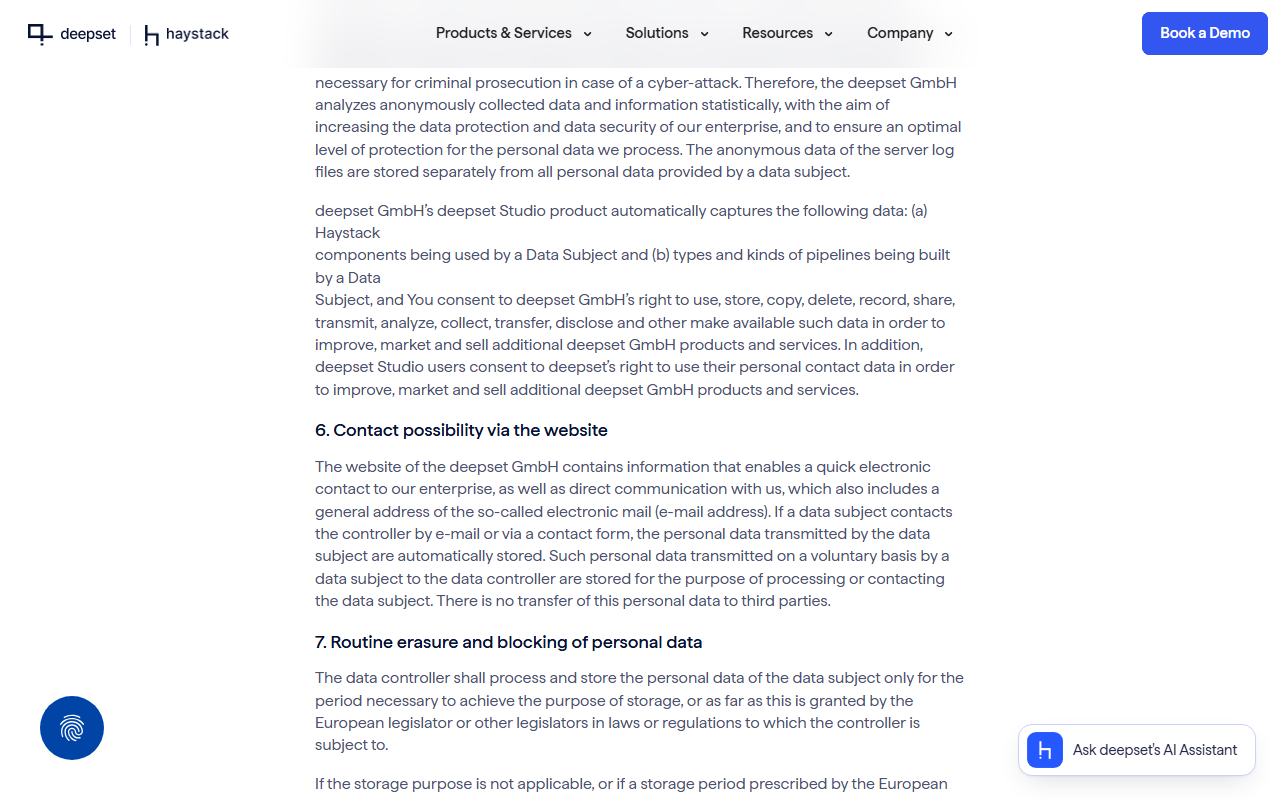
The terms say you own your Customer Data, AI applications and any models or pipeline configurations fine-tuned for you (4.1), and give deepset a licence to use Customer Data to provide the services and to create “System Data” (4.5). The two clauses that govern this pull in different directions: the definitions section defines System Data as “anonymised or aggregated Customer Data and other data collected by deepset regarding the Services”, while 4.5 says “System Data shall not include any Customer Data”, and deepset owns System Data outright (4.1). Ask counsel how the two read together, and ask deepset to settle it in the Order Form if your data is sensitive. The privacy policy (updated Sept 26 2025) is broader for the free Studio: it says Studio automatically captures the Haystack components you use and the types of pipelines you build, and that Studio users consent to deepset using that data, and their contact data, to “improve, market and sell” deepset products. We found no separate data processing agreement or sub-processor list on the pages linked from deepset's footer (Trust Center, Privacy, Imprint, Terms), and we have not reviewed the Trust Center's documents; ask for both, plus the SOC 2 and ISO 27001 reports, before sending personal data.
We have read these pages as a buyer would, not as lawyers. Have counsel review the Order Form, any data processing agreement and the governing-law clause for your location before signing.
Match your situation to one line.
haystack-ai to one minor version, read every release note, and budget a short upgrade task most months.farm-haystack)? It is end of life, with no release since April 2025, so new vulnerabilities will not be fixed; plan a port to 3.x, not a patch (section 10).Hooks around every model and tool call, token budgets, one Pipeline class, and mock components for tests.
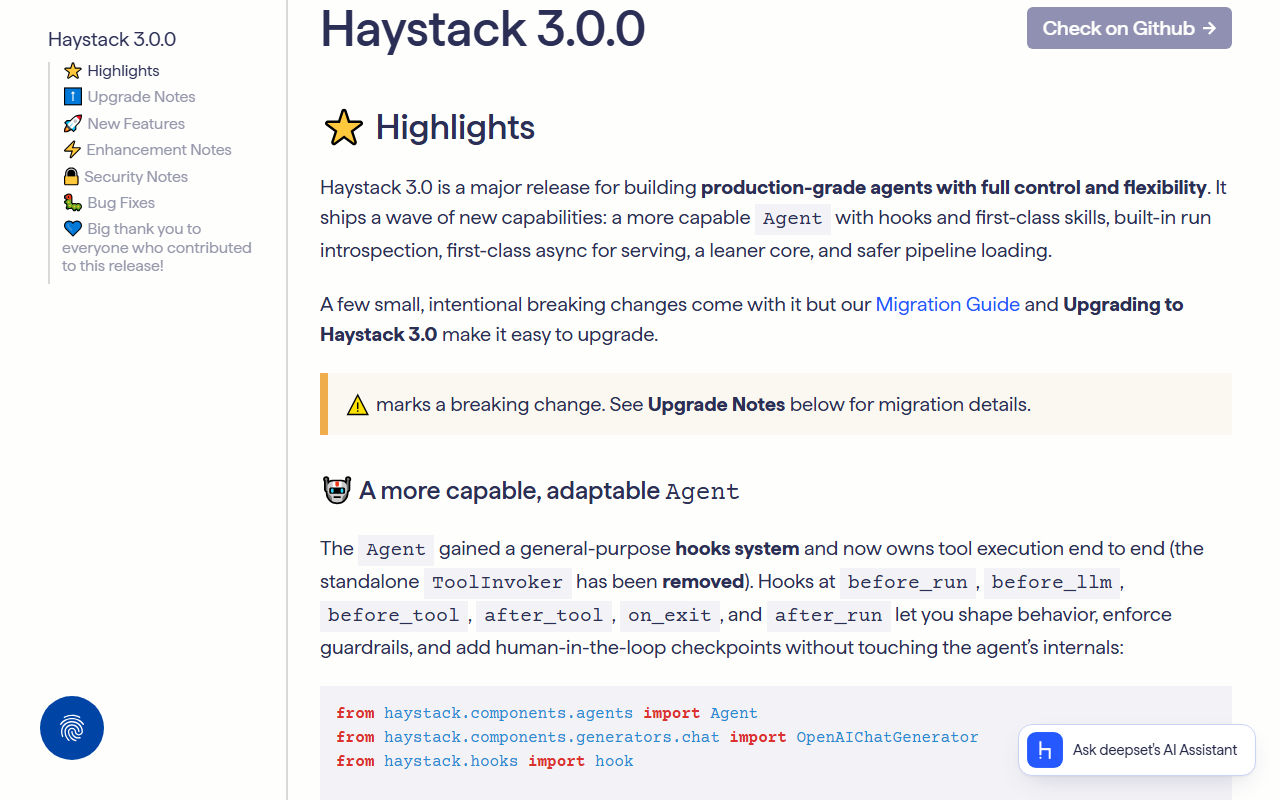
The 3.0.0 release notes describe the Agent as owning tool execution end to end, with hooks at before_run, before_llm, before_tool, after_tool, on_exit and after_run for guardrails and human approval steps. Agents now expose step_count, token_usage and tool_call_counts as built-in state, tracing emits step-level spans, and one Pipeline class offers run, run_async, run_async_generator and stream. Mock chat generators and embedders let a test suite run without keys or network.
Since then, 3.1.0 (24 Aug) added experimental context compaction and an AgentTool for multi-agent setups, 3.2.0 (24 Sep) added an experimental TokenBudgetHook that stops a run before its next model call once a token cap is spent, and 3.4.0 (15 Oct) added an experimental compactor that moves old tool results to a store and leaves a pointer. The release notes call the compaction strategies (3.1.0, 3.2.0 and 3.4.0) and TokenBudgetHook (3.2.0) experimental, so expect those interfaces to move; AgentTool (3.1.0) carries no such label. JAVIS has not run any of them.
before_llm hook; it was Day 2 of the Haystack 3.0 launch week. Vendor material.What the paid platform adds on top
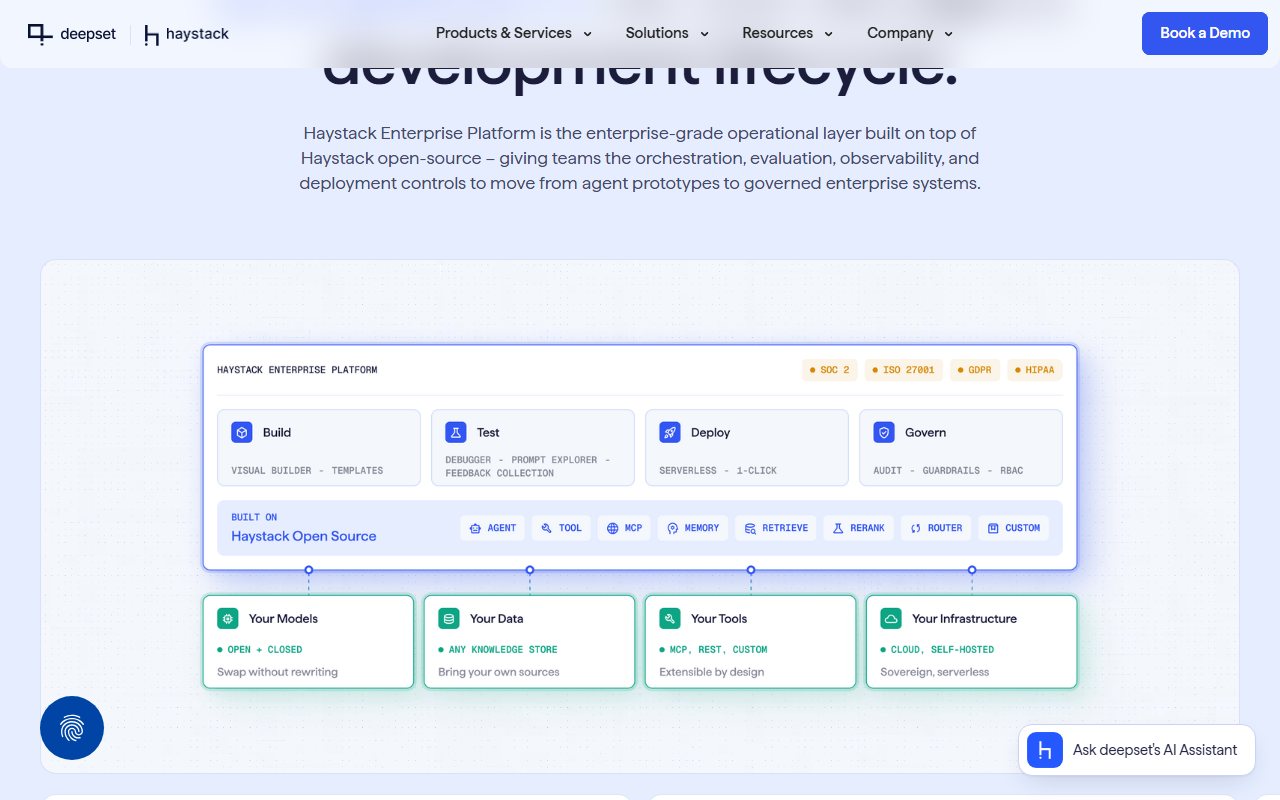
deepset's platform page describes four layers built on the open-source core: Build (visual builder, debugger, templates, data indexing, MCP, export to Python or YAML), Test (playground, prompt explorer, prototype sharing, feedback collection), Deploy (one-click, serverless autoscaling, cloud or self-hosted, REST API) and Govern (role-based access, unified run history, traces, usage reports, guardrails). The 21 Oct 2026 announcement adds spend reporting by model, agent, service and team. None of that is in the free library; most of it you can assemble yourself from Hayhooks, a tracing tool and your own CI.
Pin, build, test without keys, trace, serve, then upgrade on purpose.
haystack-ai pinned to one minor version in your lock file; pin each integration package too, since 30 components now ship separately.HAYSTACK_TELEMETRY_ENABLED=False if you do not want anonymous usage events sent to deepset.before_tool confirmation hook for actions a human must approve.An illustrative workflow built from the Haystack docs, release notes and the Hayhooks README, 24 Oct 2026, not a record of a JAVIS run.
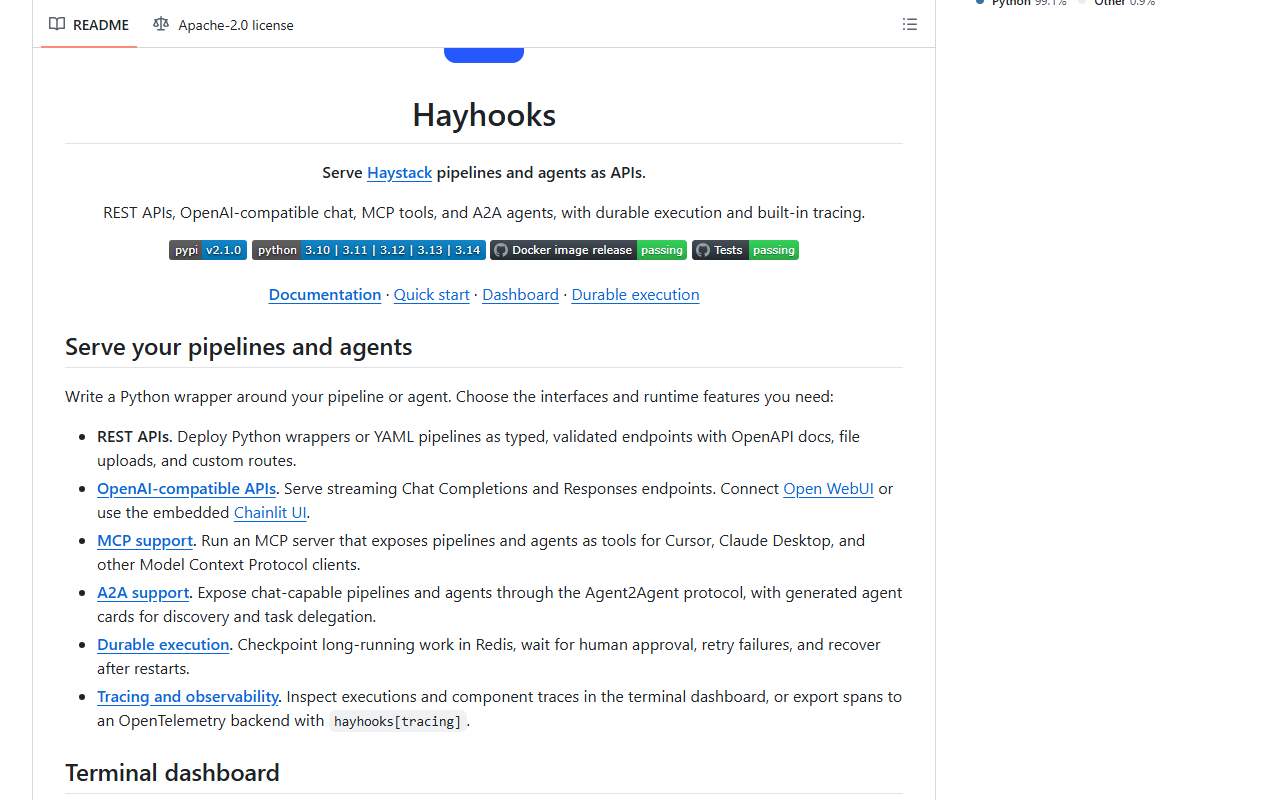
before_tool confirmation hook until a person approves in Open WebUI. Day 5 of the 3.0 launch week. Vendor material.Saved YAML, document IDs, page numbers and BM25 scores: the 3.x changes that fail quietly or loudly.
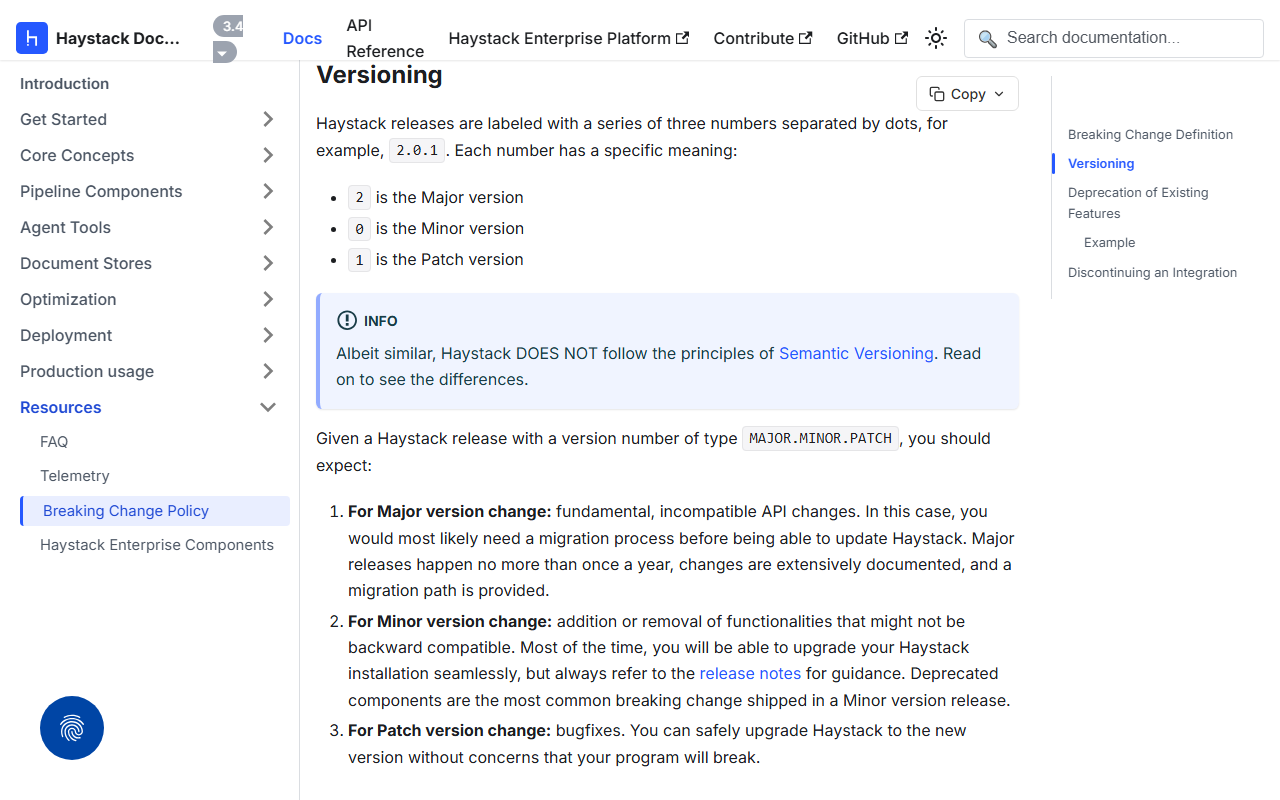
Haystack's Breaking Change Policy states it plainly: Haystack “DOES NOT follow the principles of Semantic Versioning”, majors come no more than once a year, a minor release may add or remove functionality that is not backward compatible, and a feature deprecated in X.Y is removed in X.Y+1, “giving affected users a timeframe of roughly a month”. Here is what that has meant since 3.0, in roughly the order teams would hit it.
Swipe sideways to see all columns.
| Trigger | Version | What happens | Fails how | Fix |
|---|---|---|---|---|
| Saved pipelines with custom components or callables | 3.0.0 | Loading is gated by a trusted-module allowlist | Loudly: DeserializationError | Pass allowed_modules or set HAYSTACK_DESERIALIZATION_ALLOWLIST |
| Documents with metadata written by 2.x | 3.0.0 | Auto-generated Document.id differs when meta is non-empty | Quietly: duplicates or missed updates | Re-ingest, pass old ids, or migrate ids with the script in MIGRATION.md |
| Prompt templates with optional variables | 3.0.0 | Every Jinja2 variable required by default | Loudly at run time | required_variables=None or list the required ones |
Code using AsyncPipeline | 3.0.0 | Class removed; haystack 3.4.1 exports Pipeline and no AsyncPipeline | Loudly: ImportError. Quiet only if renamed to Pipeline and still called with run(): components then run one at a time, and inside a running event loop run() blocks the loop instead of raising | await pipeline.run_async(...), or asyncio.run(...) from sync code |
| Spans you relied on | 3.0.0 | Tracing no longer auto-enabled | Quietly: no traces | Add a tracing connector |
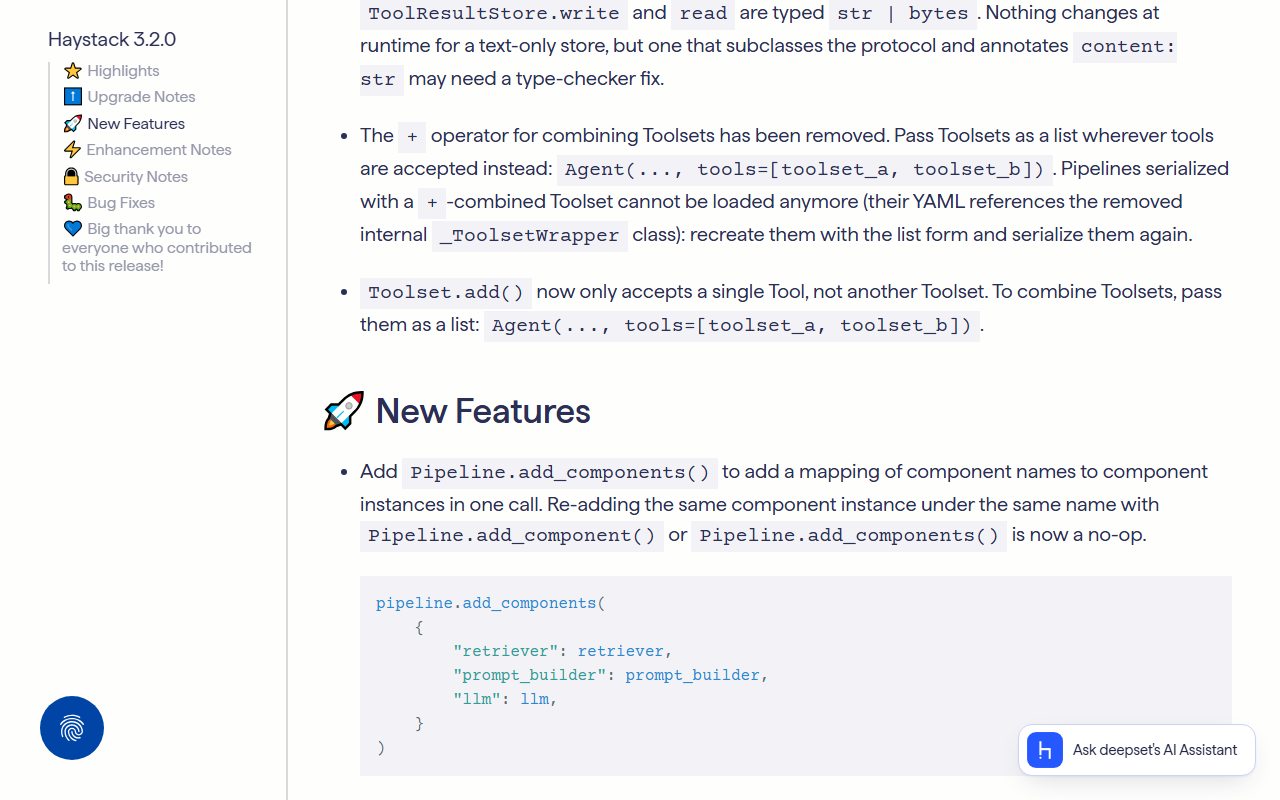
Toolsets combined with + | 3.1.0 to 3.2.0 | Deprecated 24 Aug, removed 24 Sep 2026 | Loudly: saved YAML cannot load | Pass Toolsets as a list and re-serialize |
| Score thresholds on in-memory BM25 | 3.3.0 | Only documents with a query term return; scores lower | Quietly: fewer results | Re-check thresholds |
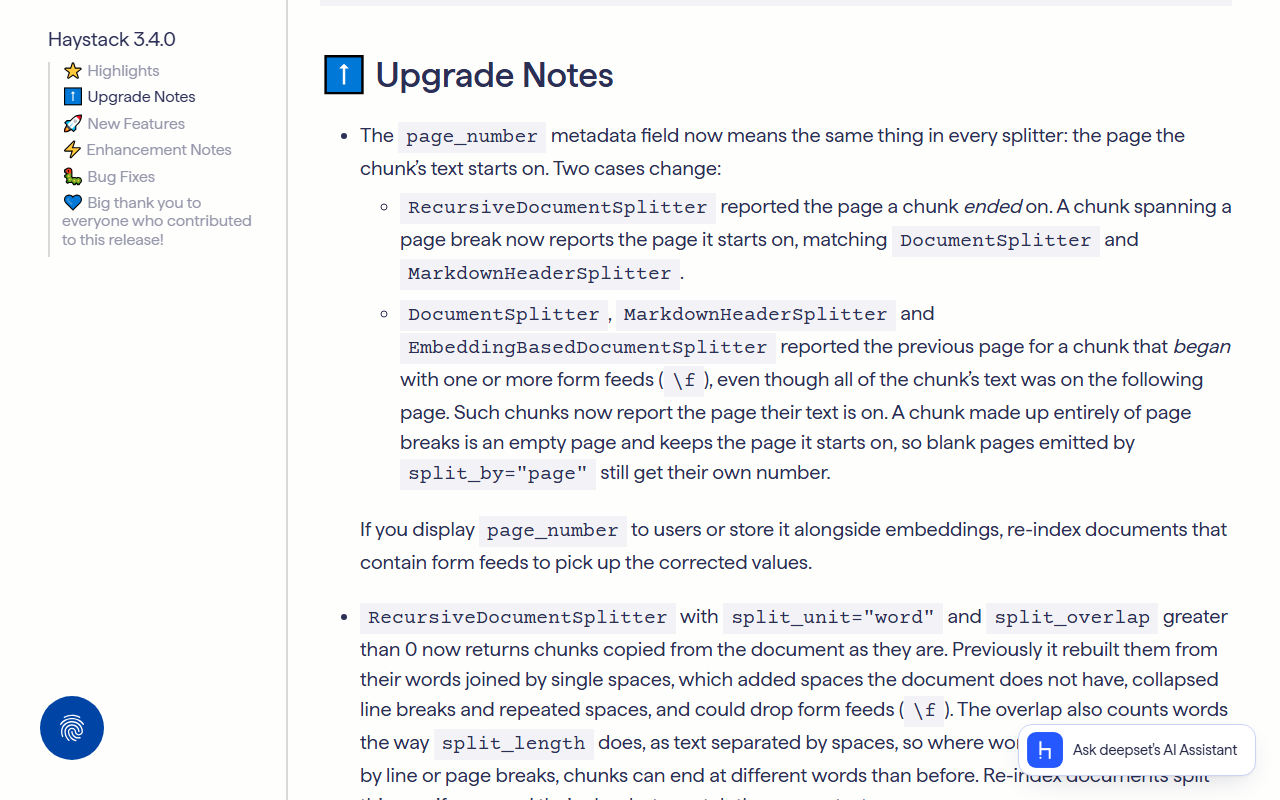
Displayed or stored page_number | 3.4.0 | Splitters now report the page a chunk starts on | Quietly: different citations | Re-index documents with form feeds |
| Python 3.10 runtime | 3.4.0 | Minimum is now 3.11 | Loudly at install | Upgrade Python first |
The pace in numbers
Minor releases since 3.0 arrived 35, 31, 7 and 14 days apart, an average of 21.75 days, against the policy's “roughly a month”. The Toolset change is the clearest example of the policy at work: deprecated in 3.1.0 on 24 Aug, removed in 3.2.0 on 24 Sep, 31 days later, and the 3.2.0 note warns that pipelines serialized with a +-combined Toolset “cannot be loaded anymore”. At the average pace, the six months of extended version support in Enterprise Starter would span about eight minor releases (180 ÷ 21.75 = 8.3), which is the honest way to value it.
Document.id can leave old and new copies of the same chunk in your store, and a changed page_number can make citations point at the wrong page without any error. Both are fixed by re-indexing, which is cheap for the 246 MB corpus in example 1 ($0.40 of embeddings) and expensive for a large one.1.x is end of life, 2.x has had no release since July, and 3.x moves monthly. Here is the path for each.
| Line | Package, last release | Status on 24 Oct 2026 |
|---|---|---|
| 1.x | farm-haystack 1.26.4.post0, 3 Apr 2025 | End of life per the migration guide; 35,790 downloads in Sep 2026 |
| 2.x | haystack-ai 2.31.0, 8 Jul 2026 | No later 2.x release; a v2.31.x branch was last updated 5 Aug 2026; no published end-of-support date |
| 3.x | haystack-ai 3.4.1, 21 Oct 2026 | Current; same version on PyPI, GitHub and the Docker image deepset/haystack:base-v3.4.1 |
base-v3.5.0-rc0 image tag was pushed on 14 Oct 2026, so 3.5 is in preparation.From 1.x
The migration guide says Haystack 1.x “reached its end of life long before 3.0” and that 1.x users should move to the haystack-ai package first; the old 1.x to 2.x guide survives only in the repository history. The 2.0 launch post on Hacker News (comment 39667570, 11 Mar 2024) called 2.0 “a major rewrite of the package” built on components and pipelines, so moving from 1.x is a port, not a version bump. Security adds pressure, though not from an old bug: the GitHub Advisory Database lists CVE-2023-1712 (hard-coded security-relevant constants, CVSS 9.8, Critical) for farm-haystack 1.15.0 and earlier, published 30 Mar 2023 with a link to the upstream patch commit; the 1.x line kept shipping until 1.26.4.post0 in April 2025. The real risk is the future: an end-of-life line will not receive fixes for anything found from now on.
From 2.x to 3.x
deepset calls 3.x “an evolution of Haystack 2.x, not a rewrite” and says most applications need only import updates and small mechanical changes. A checklist from the migration guide:
- Move to Python 3.11+ (needed from 3.4.0).
- Install the integration packages for moved components (for example
sentence-transformers-haystack,transformers-haystack,opentelemetry-haystack) and update imports. - If you import
haystack_experimental, pinhaystack-experimental==0.19.0.post1: the package is archived and that is its final release. - Replace legacy Generators with Chat Generators and remove
llm.metaconnections. - Replace ToolInvoker loops with an Agent; move confirmation strategies into a
before_toolConfirmationHook.
- Load every saved YAML pipeline; add allowed modules where it raises DeserializationError.
- Check prompts for optional variables now required.
- Decide what to do about
Document.idfor stored documents with metadata. - Re-enable tracing with a connector;
HAYSTACK_AUTO_TRACE_ENABLEDno longer has any effect. - Expect missing API keys to fail at warm-up rather than at construction.
- Re-run your retrieval evaluation set before shipping.
Compiled from haystack.deepset.ai/docs/migration and the 3.0.0 to 3.4.0 release notes, 24 Oct 2026. A checklist from the docs, not a JAVIS migration run. deepset also offers a migration skill for coding agents through a form on the same page.
Migration-safety checklist: what raises and what stays quiet
The useful question for a 2.x codebase is which changes announce themselves. Loud changes fail at import or start-up, so CI catches them; quiet ones change results, traces or logs without an error and need a test or an evaluation run to find. Each row below is taken from MIGRATION.md at tag v3.4.1 or from the release notes named.
| 2.x code or data | What 3.x does, and how it fails |
|---|---|
from haystack import Async | Removed; methods moved to Pipeline. Loud (ImportError) |
ToolInvoker from haystack. | Removed; the Agent runs tools. Loud (ImportError) |
OpenAIGenerator, Azure, Hugging, Hugging | Removed; use Chat Generators. Loud (ImportError) |
Transformers | Removed, not moved; use Sentence. Loud (ImportError) |
DALLEImage | Renamed Open. Loud (ImportError) |
30 moved components, e.g. Sentence | Need the integration package and a new import path. Loud (ImportError) |
haystack_ imports | No longer installed with haystack-ai. Loud (module not found) |
AgentBreakpoint, ToolBreakpoint, AgentSnapshot | No longer exported; no pausing inside an Agent. Loud (ImportError) |
state_schema keys such as step_count or token_usage | Reserved names. Loud (ValueError) |
| Saved YAML with your own modules | Allowlist on load. Loud (DeserializationError) |
| Prompts with unset variables | All variables required by default. Loud at run time (was a silent empty string) |
| Missing API key | Reported at warm_up() or first run, not at construction. Loud, but later |
Tools filled from State by matching parameter names | Needs an explicit inputs_ mapping. Quiet (value no longer injected) |
| Stored documents with metadata | New Document.id hash. Quiet (duplicates or missed updates) |
| Traces you relied on | Not auto-enabled; HAYSTACK_ ignored. Quiet (no spans) |
Custom span handlers keyed on ToolInvoker | Agent spans renamed to haystack. and children. Quiet (spans misclassified) |
| Log formatting | Scoped to Haystack loggers, not the whole process. Quiet (log output changes) |
Code reading Generated | Flat dictionary, no init_parameters. Quiet (code reading init_parameters with .get() sees nothing; indexing it raises KeyError; old format still loads) |
| Confirmation UIs showing state-injected arguments | See only model-requested arguments. Quiet (values no longer shown) |
Toolsets combined with + (3.1.0 deprecation) | Removed in 3.2.0. Loud (saved YAML cannot load) |
In-memory BM25 thresholds (3.3.0) and page_number (3.4.0) | Fewer results; start-page numbering. Quiet (different results and citations) |
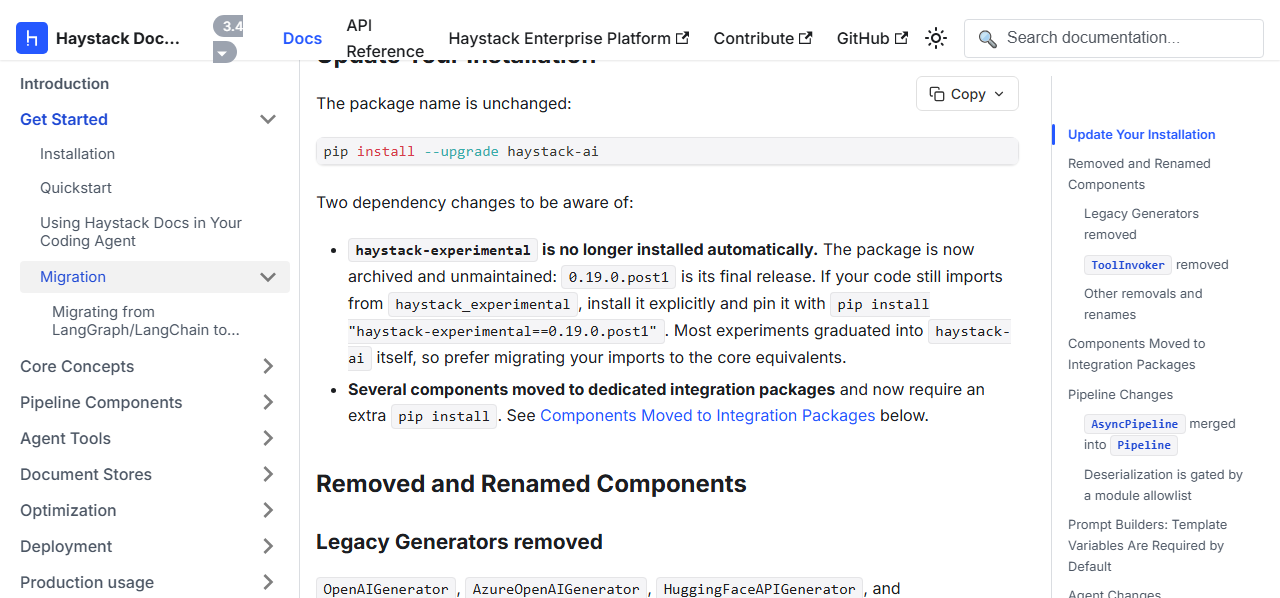
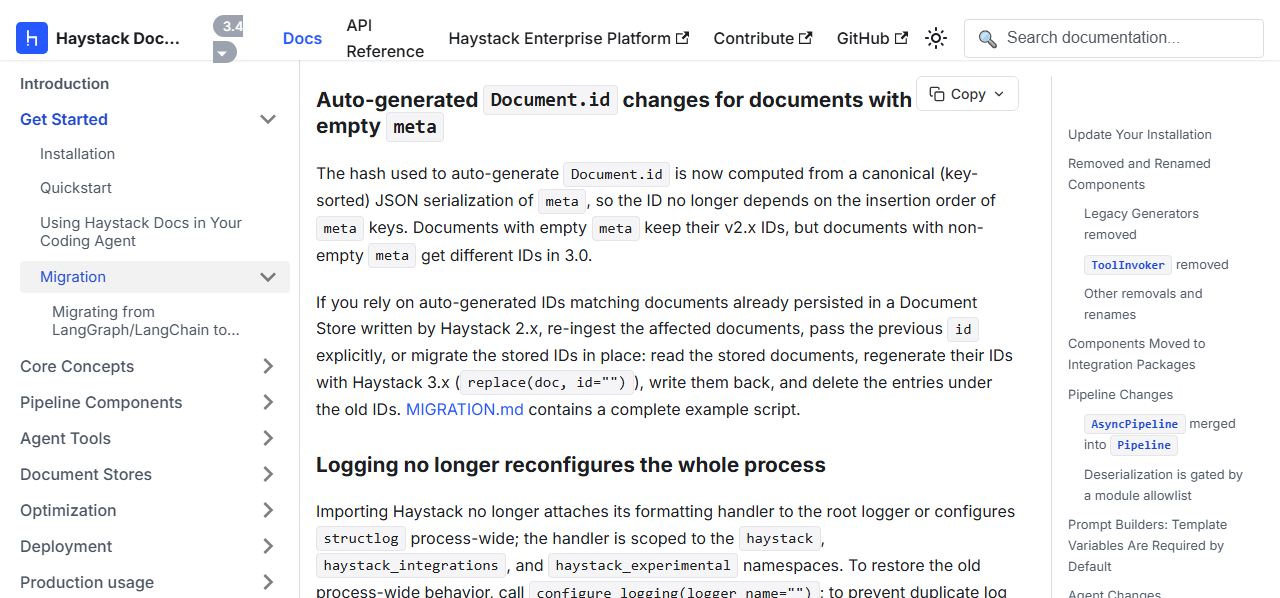
Document.id change in the migration guide, 24 Oct 2026.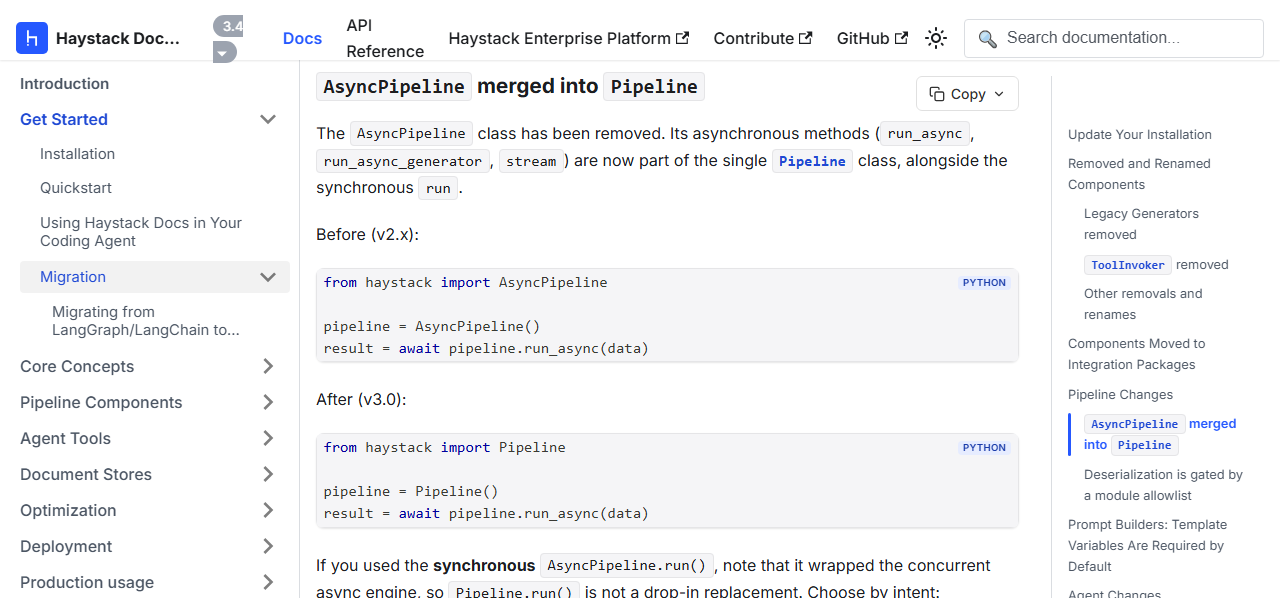
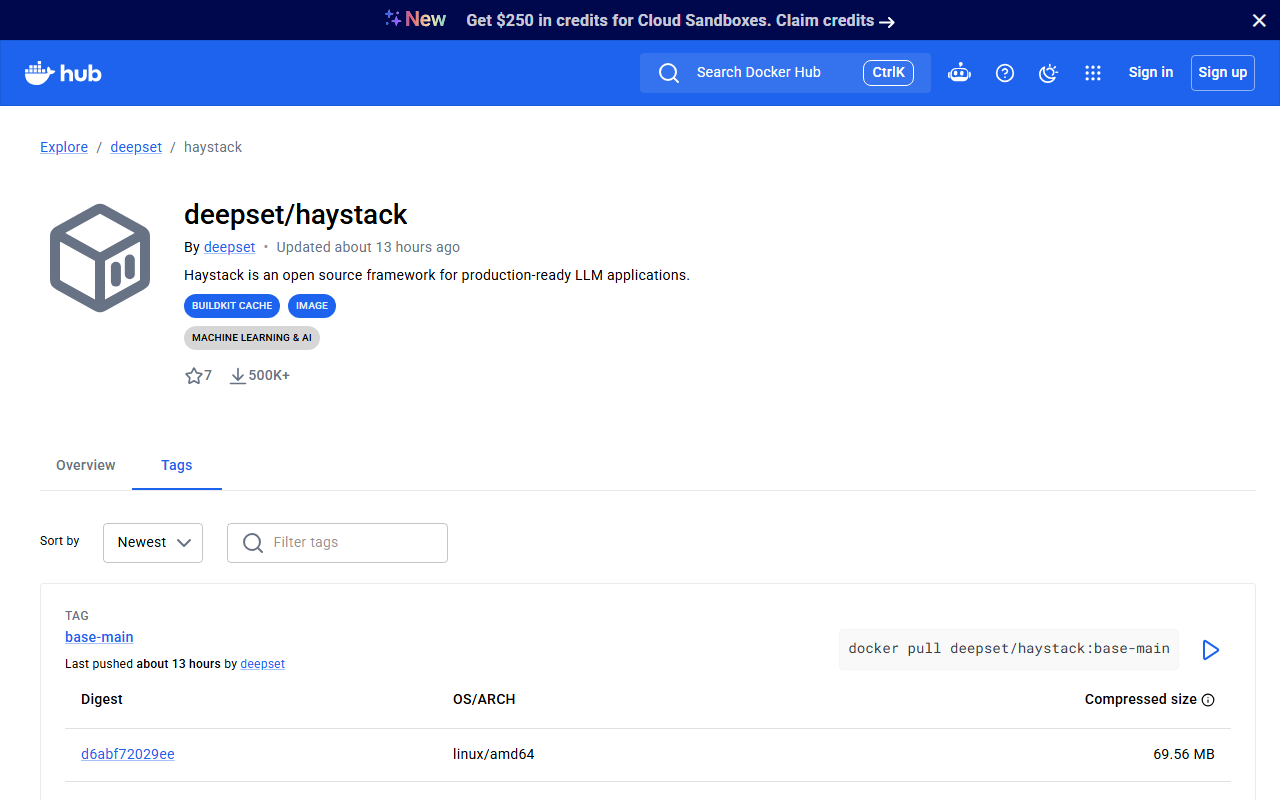
base-v3.4.1 and stable, both pushed on 21 Oct 2026.For 2.x users who cannot move yet: we found no published end date for 2.x security fixes on the docs, release notes or repository. Ask deepset in writing before assuming one.
191 listed integrations, MCP in both directions, and no vendor API limits on the open-source side.
The integrations page counted 191 on 24 Oct 2026, maintained by deepset or the community: model providers, vector stores, monitoring tools and custom components. The platform page names, among others, Anthropic, OpenAI, Mistral, Ollama, Groq and Gemini for models; PostgreSQL, OpenSearch, Qdrant, Weaviate, Pinecone, Elastic, MongoDB, Chroma, Neo4j and Milvus for data; and Langfuse, Arize, Datadog and LiteLLM for tooling. Note the two counts on deepset's own sites differ: 191 on the integrations page, “100+” on the platform page.
MCP works both ways. Agents can call MCP tools through the integrations, and Hayhooks can expose your pipelines and agents as an MCP server for clients such as Cursor or Claude Desktop, per its README; our guide to Claude MCP connectors covers the client side. There is no deepset API, rate limit or usage meter in the free library: your limits are your model provider's and your document store's. deepset also publishes a migration page for teams moving from LangGraph or LangChain to Haystack.
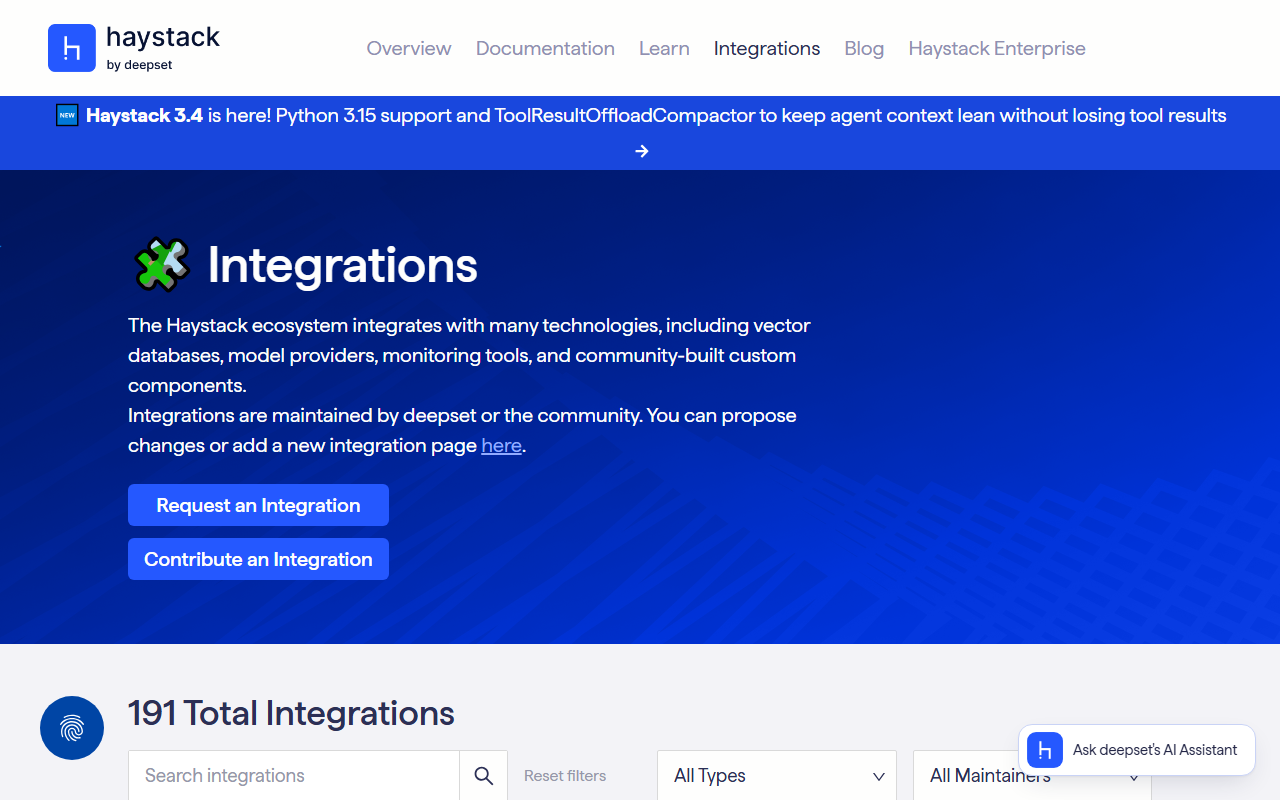
Browser automation is not a Haystack feature; an agent can only drive a browser through a tool or integration you add.
One historical advisory, safer pipeline loading, dependency fixes in recent patches, and telemetry that is on until you switch it off.
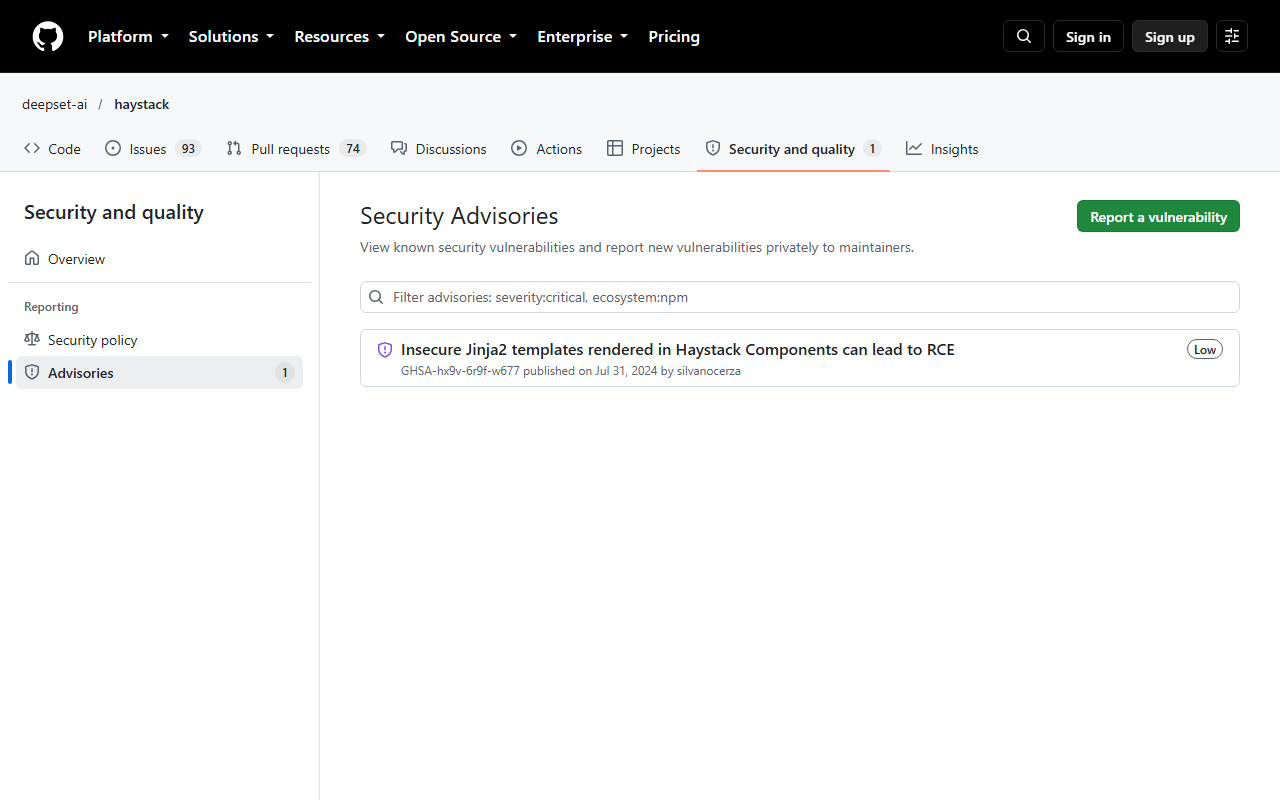
The repository lists one security advisory, GHSA-hx9v-6r9f-w677 (CVE-2024-41950), published 31 Jul 2024: Jinja2 templates rendered in Haystack components could lead to remote code execution, fixed in haystack-ai 2.3.1. The repository page labels it Low, while the GitHub Advisory Database and the US National Vulnerability Database list a CVSS 3.1 score of 7.5, High, for the same CVE. Anyone still below 2.3.1 should read it as High. Since then the project has hardened defaults: 3.0 gates pipeline loading behind an allowlist, the 3.1.0 and 3.2.0 notes require unsafe=True to load serialized Jinja custom filters, 3.3.0 raised the minimum anyio version for a published vulnerability, and 3.4.1 raised certifi after certificate-authority private keys were compromised. Patch releases are partly security work, which is one more reason to keep up.
31 Jul 2024, fixed in 2.3.1
same CVE-2024-41950
last release Apr 2025; no future fixes
one variable turns it off

The telemetry default
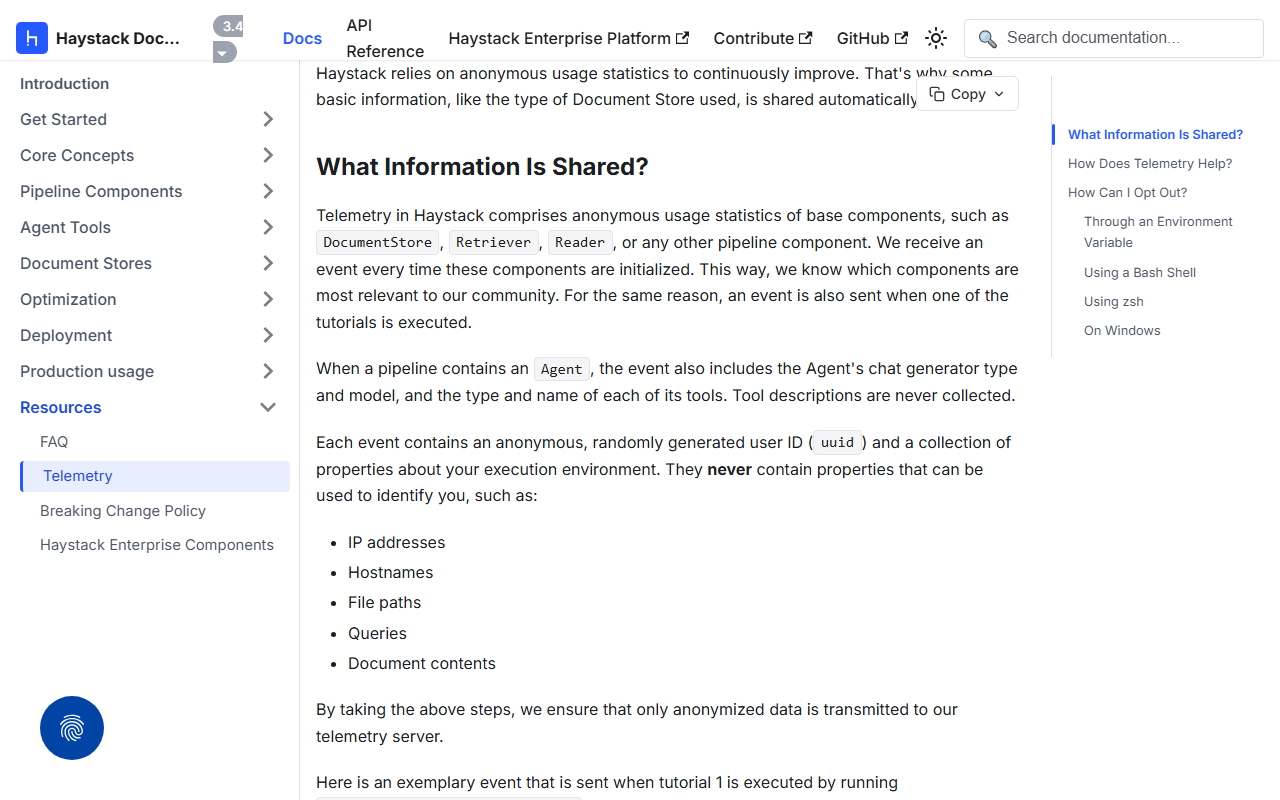
The Telemetry page says Haystack sends anonymous usage statistics whenever base components are initialized and when a tutorial runs; for a pipeline with an Agent, the event also includes the chat generator type and model and the type and name of each tool, never tool descriptions. Each event carries a random user ID and environment properties, and the page says events never contain IP addresses, hostnames, file paths, queries or document contents. Opt out with HAYSTACK_TELEMETRY_ENABLED=False. One oddity: the 3.4 page still shows a sample event from tutorial 1 with haystack_version 1.0.0.
Compliance claims
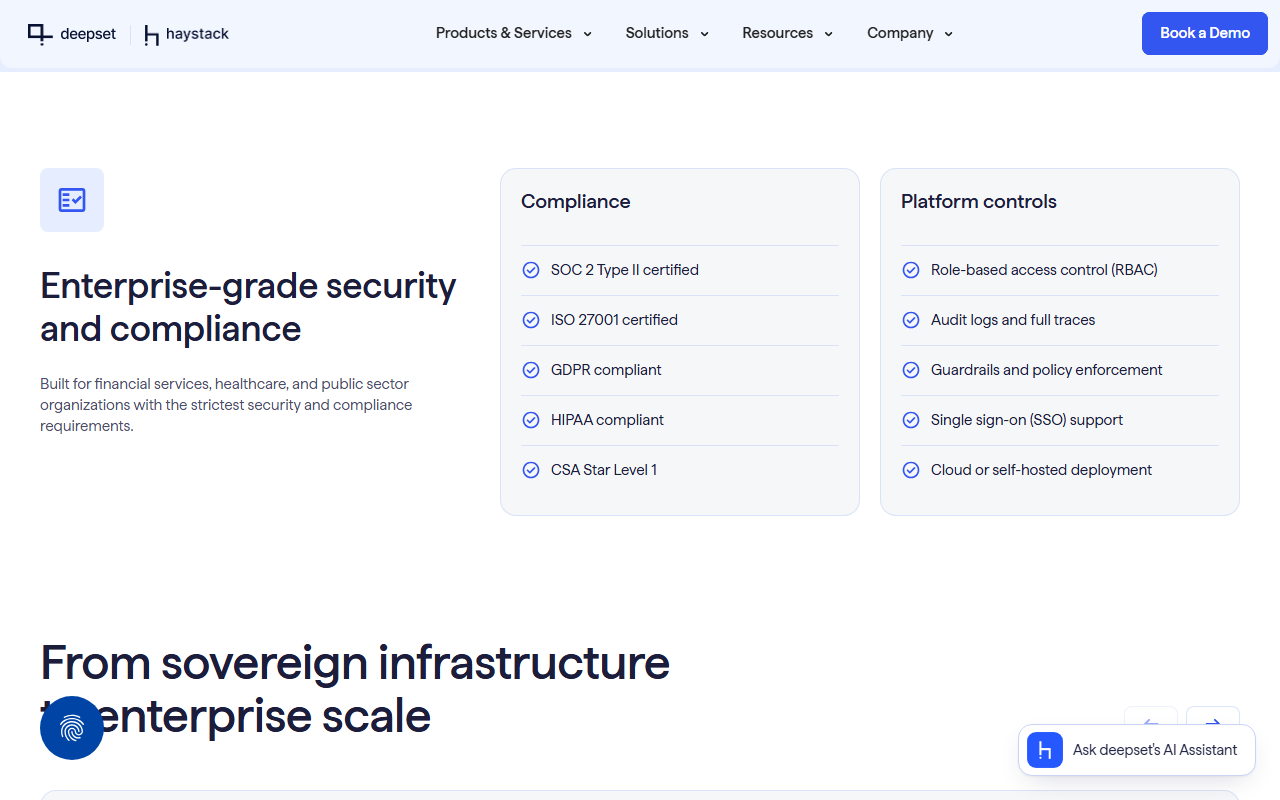
The Enterprise Platform page lists SOC 2 Type II certified, ISO 27001 certified, GDPR compliant, HIPAA compliant and CSA Star Level 1, plus role-based access, audit logs, guardrails, SSO and cloud or self-hosted deployment. These apply to the paid platform; the open-source library runs in your environment and carries no certification of its own. The page gives no report dates or scope, and we have not reviewed the reports in deepset's Trust Center. Ask for them, under NDA if needed.
Python teams that want to own their RAG code, and buyers who prefer a European maintainer and a support contract to a seat fee.
- Python teams building RAG, search or tool-using agents with their own model keys
- Teams that want pipelines as serializable, testable graphs rather than hidden chains
- Organisations that prefer an EU-based maintainer and an Apache-2.0 licence
- Public-sector or regulated buyers who want a self-hosted or sovereign-cloud platform and will negotiate a contract
- Larger teams, since no part of the free stack charges per seat
- Teams that cannot spare time for an upgrade most months
- Anyone needing a published, comparable platform price today
- Non-developers who want a hosted visual builder with a monthly price
- Developers who want the biggest community and the most third-party tutorials
- Single fixed workflows where a direct model call is enough
Nine things to check before you rely on it.
Deprecated in X.Y, removed in X.Y+1; minors arrived 7 to 35 days apart since 3.0.
Document IDs, BM25 results and page numbers changed in 3.x without raising errors.
No published price for the platform or Starter; “pipeline hours” and “uptime credits” undefined.
Auto-renewal, index plus 3% increase, three months' notice, non-refundable fees.
One user, no production pipelines, 14 days of logs, no customer support; usage data used for marketing.
No 2.x release since 8 Jul 2026 and no published end date; 1.x is end of life.
About 19% of LlamaIndex's and 0.3% of LangChain's monthly downloads.
Anonymous, but on until you set one environment variable.
No Trustpilot page, no verifiable star rating, one 2026 HN thread; JAVIS did not test it.
Priced from each vendor's own page on 24 Oct 2026; the products differ, so the plans are not like-for-like.
| Option and when to pick it | What the pricing page says | JAVIS review |
|---|---|---|
| Haystack Explicit pipelines, EU maintainer, Apache-2.0 | Framework free; Studio $0 trial; Enterprise Platform custom; Starter on request | This article |
| LangChain and LangSmith Largest ecosystem; tracing and deployment from one vendor | Framework MIT; LangSmith Developer $0 (1 seat, 5k base traces); Plus $39 a seat a month (10k base traces); Enterprise custom | LangChain review |
| LlamaIndex Data and document-heavy retrieval | Framework MIT; LlamaParse Free (10K credits), Starter $50 a month (40K), Pro $500 (400K); 1,000 credits = $1.25 | LlamaIndex review |
| RAGFlow Self-hosted RAG engine with a UI and deep document parsing | Apache-2.0; cloud Free $0, Starter $29 a month (5 members), Pro $129 (20 members), Enterprise on request | RAGFlow review |
| Dify Hosted visual app builder for mixed teams | Sandbox free; Professional $59 per workspace a month (3 members); Team $159 (50 members); Enterprise custom | Dify review |
The choice is mostly about who runs what. Haystack and LangChain are libraries you host; LangChain wins on ecosystem size, Haystack on explicitness and, per its 3.0 release notes, fewer transitive dependencies since 30 components moved out of core. LlamaIndex is the pick when parsing messy documents is the hard part, and its paid LlamaParse has published tiers where Haystack's platform has none. RAGFlow and Dify are applications with a UI; they suit teams that want a working assistant this week more than a codebase. For graph-shaped agents see our LangGraph review, for a visual builder on top of LangChain components our Langflow review, and for the vector store under any of them our Qdrant and Weaviate reviews. JAVIS has not tested any pairing with Haystack.
This review has no affiliate links, and deepset did not see it.
JAVIS has no approved Haystack or deepset affiliate link, so every link here goes straight to haystack.deepset.ai, deepset.ai, the documentation, the GitHub repository or deepset's Terms and Conditions, without tracking parameters.
Hands-on status: JAVIS has not installed Haystack, built a pipeline, opened a Studio account or asked deepset for a quote for this review. Where a number comes from an invented workload, the text says so and shows the arithmetic. Independent review evidence is limited, as described in section 04.
Install the library and start with the quickstart in the docs; it costs nothing.
Open haystack.deepset.aiAsk for the Order Form term, renewal cap and notice date in writing.
Open deepset's pricing pageBuilding retrieval or agents? These reviews cover the nearest ground.
Each card opens a published JAVIS review.

Questions people ask before committing
Is Haystack free?
The framework is: haystack-ai is Apache-2.0 with no seat or usage fee, and the Hayhooks server is free too. deepset's Studio is a $0 trial with one user and no production pipelines.
What happened to deepset Cloud?
deepset's hosted product was called the deepset AI platform and was renamed the Haystack Enterprise Platform on 19 Dec 2025, per deepset's blog. A deepset news post of 25 Jun 2024 called that product “formerly known as deepset Cloud”, and the platform's Release 2025.2 note now reads “deepset Cloud is now Haystack Enterprise Platform”. It is priced as “Custom” on deepset.ai/pricing and, per deepset's 21 Oct 2026 announcement, can run in public cloud, sovereign clouds such as STACKIT, or self-hosted infrastructure.
How much does the Haystack Enterprise Platform cost?
No price is published as of 24 Oct 2026; the pricing page says “Custom”, and Enterprise Starter uses a contact form. Read the renewal clause in deepset's terms before signing: renewals add the change in an inflation index plus 3%.
What is the latest Haystack version?
3.4.1, published on 21 Oct 2026 on PyPI, GitHub and Docker Hub. It needs Python 3.11 or newer. 3.0 shipped on 20 Jul 2026.
Is Haystack stable between versions?
Not in the semantic-versioning sense. The docs say minor releases can remove functionality and deprecated features go in the next minor, roughly a month later; since 3.0 minors came 7 to 35 days apart.
Is Haystack 2.x still supported?
The last 2.x release is 2.31.0 from 8 Jul 2026 and we found no published end-of-support date. 1.x (farm-haystack) is end of life. Plan the move to 3.x with the migration guide.
Does Haystack collect telemetry?
Yes, anonymous usage statistics by default. Set HAYSTACK_TELEMETRY_ENABLED=False to turn it off.
Is Haystack better than LangChain or LlamaIndex?
Different trade-offs. Haystack is smaller (566,454 downloads in 30 days against 2.9 million and 170 million) and favours explicit, serializable pipelines; the others have larger ecosystems. JAVIS has not benchmarked them.
Where this came from, and when.
Pricing and product: deepset.ai/pricing (plan cards and comparison table), the Haystack Enterprise Platform, Enterprise Starter and Studio sign-up pages, deepset's blog post of 19 Dec 2025 on the rename, deepset.ai/news and the 21 Oct 2026 PR Newswire release, and haystack.deepset.ai, all 24 Oct 2026.
Legal: deepset Terms and Conditions (updated July 24 2025) sections 2.4, 2.5, 2.12, 2.15, 3.1 to 3.4, 4.1, 4.5, 4.6, 8.4, 10.1 to 10.3 and 11.9; deepset privacy policy (updated Sept 26 2025), section 5; 24 Oct 2026. We have not reviewed the documents in deepset's Trust Center.
Versions and behaviour: Haystack 3.0.0 to 3.4.1 release notes on GitHub and haystack.deepset.ai, the 2.x to 3.x migration guide, the Breaking Change Policy and Telemetry pages of the 3.4 docs, the integrations page (191 total), PyPI metadata for haystack-ai, farm-haystack, haystack-experimental and hayhooks, the Hayhooks README and its 2.0.0 release, and Docker Hub tags for deepset/haystack, all 24 Oct 2026. The release-notes index on haystack.deepset.ai dates 3.1.0 to 25 Aug 2026; GitHub dates it 24 Aug 2026 (UTC); we use GitHub's dates.
Repository and market: deepset-ai/haystack on GitHub, 24 Oct 2026, 00:55 UTC: 26,818 stars, 3,332 forks, 93 open issues, 74 open pull requests, 4,505 closed issues, 449 named contributors, 209 issues opened and 165 closed since 20 Jul 2026, 828 pull requests merged since 20 Jul 2026, one security advisory. Stars of run-llama/llama_index (52,640), infiniflow/ragflow (92,765), langchain-ai/langchain (148,334) and langgenius/dify (159,380) the same morning. PyPI downloads without mirrors from pypistats.org, read 24 Oct 2026: last 30 days to 22 Oct and calendar-month sums for May to September 2026. Docker Hub: 728,952 pulls of deepset/haystack. Advisory severities from the GitHub Advisory Database and NVD record for CVE-2024-41950.
Independent evidence: Hacker News stories 48658095 (24 Jun 2026), 48979705 (20 Jul 2026), 39667569 (11 Mar 2024); comments 48659829, 48660817, 48661349, 48661995, 48662619, 48664222, 48664681, 48661006, 48658699 (24 Jun 2026), 39668567 and 39670073 (11 Mar 2024). Counts as of 24 Oct 2026, 01:00 UTC. Trustpilot: no page for deepset.ai. G2 is not quoted; the library has no app-store listing.
Competitors and infrastructure: langchain.com/pricing, llamaindex.ai/pricing, ragflow.io, dify.ai/pricing (monthly), langfuse.com/pricing, developers.openai.com/api/docs/pricing, digitalocean.com/pricing/droplets and qdrant.tech/pricing, 24 Oct 2026. Cost examples are arithmetic on those published prices with invented traffic.
Images and video: screenshots of public pages taken on 24 Oct 2026 (deepset and Haystack pages, GitHub, PyPI, pypistats, Docker Hub and four competitor pricing pages), one official banner and one official platform diagram from deepset, each labelled; two videos from the official Haystack YouTube channel (@haystack_ai), dated 22 and 24 Jul 2026. Related cards use JAVIS's own featured images.
JAVIS Fit Score (69/100): an editorial composite scored out of 20 on five criteria. Price clarity 12: the framework is clearly free and Studio's limits are published, but the platform and Starter are quote-only, Studio's units are undefined and contradictory, and renewals rise by index plus 3%. Capability breadth 17: pipelines, agents with hooks and budgets, async and streaming, 191 integrations and Hayhooks, with the newest agent features experimental. Independent evidence 11: strong repository activity, but no star rating, one 2026 HN thread and downloads far below the main rivals. Security and data control 14: Apache-2.0, run anywhere, one historical advisory and hardened loading, but telemetry on by default, Studio data used for marketing and compliance reports not reviewed. Cost control and fit 15: no seat fee and full code ownership, offset by a fast breaking-change cadence. It is judgment, not a measurement.
What this review does not cover: real-world answer quality or speed, whether Studio works as described, what a pipeline hour or uptime credit is, platform and Starter prices, the content of deepset's compliance reports or any data processing agreement, and a technical security audit.