
FlutterFlow Review 2026: The Visual Flutter Builder That Now Lets Your Own AI Agent Work Inside It
Correction, Oct 3, 2026: an earlier version described Growth and Business AI requests as per seat; FlutterFlow's pricing page lists them per month (200 and 500).
FlutterFlow is a visual builder for native mobile, web and desktop apps built on Flutter, with Firebase or Supabase behind it and code you can download or push to GitHub. In 2026 it added a desktop AI Agent Panel that runs on your own Claude or Codex account, official plugins and an MCP server for coding agents, and Test Pilot for plain-English testing. Plans are $0, $39, $80 and $150 per month before seats. This review checks all of that against FlutterFlow’s own pricing, AI page and docs, and sets it beside Trustpilot, Capterra, G2 and Hacker News.

| Free plan | Yes -- 2 projects, no code export |
| Paid | From $39/mo (Basic); $80 / $150 first seat |
| AI | Agent Panel (beta) on your own account |
| Capterra | 4.4/5 (85 reviews) |
| Trustpilot | 2.6/5 (23 reviews) |
FlutterFlow is the visual builder for people who want a real Flutter app they can eventually take with them — and in 2026 it quietly became a host for your own AI agents.
“Most no-code tools keep your app inside their runtime. FlutterFlow builds a Flutter project, lets you download the code, push it to GitHub, or drive the whole thing from Claude Code or Codex through a CLI and an MCP server. The bill is modest ($0, $39, $80, $150) but the AI part runs on your own agent subscription, support gets rough reviews, and a visual-plus-code workflow only works if you respect its branch rules.”
This is a VERIFIED EDITORIAL REVIEW: FlutterFlow’s pricing page, AI page, documentation, a keynote description on its YouTube channel, Trustpilot, Capterra, G2 and Hacker News, all read on October 3, 2026. I did not build an app in FlutterFlow for this article, so I won’t claim to have timed builds or judged generated-code quality.
If you want a native iOS/Android app with a proper backend (Firebase or Supabase) and a way out, FlutterFlow is the most direct fit I know of. If you want a working demo from one sentence tonight, a prompt-first builder will be faster. If you hate paying per seat, note that collaboration pricing climbs quickly on Growth and Business.
A visual editor on top of Flutter, with your backend, your agents and your code around it.
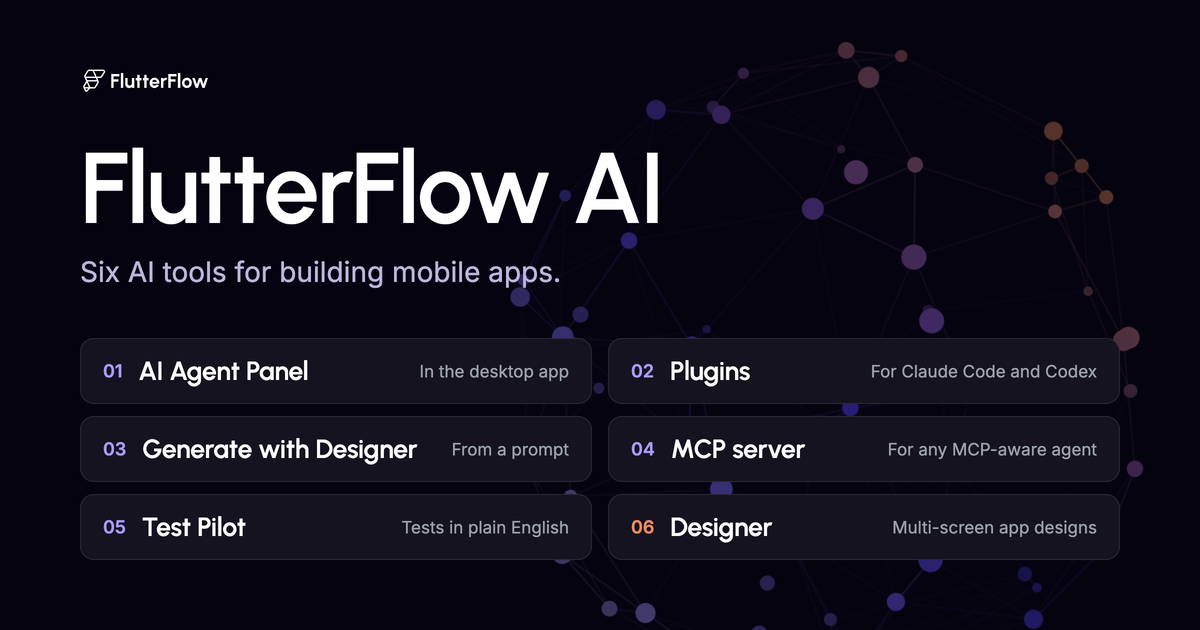
FlutterFlow describes itself as a visual development platform for mobile, web and desktop apps. In practice you drag widgets onto a canvas, wire actions and state visually, connect Firebase, Supabase or your own APIs for data, add custom Dart code where the visual layer runs out, and deploy to the app stores or the web. Around that core, FlutterFlow now lists “six AI tools” on its AI page: an AI Agent Panel in the desktop app, plugins for Claude Code and Codex, Generate with Designer, an MCP server in the CLI, Test Pilot for AI testing, and a standalone product called Designer.
One thing to hold onto: FlutterFlow is mostly a front-end and logic builder. The database, auth and server logic live in Firebase, Supabase or your own service, and those providers bill you separately. That is my reading of FlutterFlow’s integrations docs, not a quote from the pricing page.
A YC-backed company with a $25.5M Series A, a claimed 3.3M users, and a Flutter ecosystem bigger than itself.
Announced Jan 2024, led by GV with Gradient Ventures, Xoogler Ventures and Y Combinator (TechCrunch coverage). Press reports a roughly $170M valuation.
Stated on flutterflow.io/pricing. Registered accounts, self-reported, not paying customers.
flutter/flutter, BSD-3-Clause, live API Oct 3, 2026. Stars measure interest in Flutter, not FlutterFlow users.
Launch HN: FlutterFlow (YC W21), Dec 20, 2021, 62 comments. Votes on a post, not adoption.
| Date | Event | Source |
|---|---|---|
| Dec 2021 | Launch HN: FlutterFlow (YC W21) | Hacker News |
| Jan 11, 2024 | $25.5M Series A led by GV announced | TechCrunch |
| 2025 | Dreamflow, a separate Flutter-first AI builder from the FlutterFlow team, launched earlier in the year; code is the source of truth | HN Show HN, Sep 4, 2025 |
| Aug 18, 2025 | New plan structure: Free, Basic, Growth, Business, Enterprise; legacy Standard, Pro and Teams plans retired | FlutterFlow docs |
| Jun 8, 2026 | FlutterFlow 7.0 keynote: Test Pilot, Live Sessions, Supabase Edge Functions, expanded AI agents, Designer 1.0 | FlutterFlow YouTube description |
| Jul 23–24, 2026 | Native AI agents in the macOS desktop app, plus Claude Code and Codex plugins | FlutterFlow YouTube |
Builders praise speed and control. The harshest feedback is about support and AI-era relevance.
Category scores: ease of use 4.4, support 4.0, value 4.4, features 4.4. Reviewers praise the drag-and-drop builder, custom code, frequent updates and docs; they flag concurrency limits behind the paywall, a learning curve on complex logic, and occasional runtime bugs. One reviewer wrote that it “makes it possible for anyone with enough tenacity to build pretty much any kind of app.”
TrustScore 2.6 from only 23 reviews (35% five-star, 39% one-star; company has not replied to negatives). A reviewer wrote that they “wrote them an email 5 days ago and still haven’t heard back,” and complaints name debugging limits on free, missing Bluetooth support and difficult version control and merging. A positive review says “time savings are insane versus manually writing code.”
A commenter noted a team “moving away from FlutterFlow” and wrote that “FlutterFlow is going to have a tough time versus agent assisted coding in Antigravity.” Another wrote that “all low-code/no-code tools are competing against vibecoding.” Earlier, a 2025 commenter wrote “I tried FlutterFlow but found I actually preferred writing everything in code.”
Free to build, $39 to ship, and seats are where the bill grows.
Verified live on flutterflow.io/pricing and in FlutterFlow’s plan docs on October 3, 2026. FlutterFlow’s docs say the plan structure changed on August 18, 2025 (Standard, Pro and Teams were retired) and that annual billing gives “typically around 25%” off. The prices below are the monthly-billing figures shown on the pricing page.
Free
Visual builder, 1,000+ templates, up to 2 projects, 10 Lite credits, 5 AI generation requests (lifetime), up to 2 free subdomains. No code or APK download.
Basic
Unlimited projects, code and APK download, one-click app store deployment, custom-domain web publishing, Test Pilot, 100 Lite credits and 50 AI generation requests a month. One editor.
Growth
Everything in Basic plus GitHub push, VS Code extension, real-time collaboration for 2, 2 open branches, OpenAPI import, 200 Lite credits a month per seat and 200 AI generation requests a month.
Business
Everything in Growth plus up to 5 editors, 5 open branches, up to 3 automated tests, Figma frame import, CLI access, 400 Lite credits a month per seat and 500 AI generation requests a month.
Enterprise
Custom pricing, dedicated support and features; contact FlutterFlow. Agencies can add seats beyond 5 at $85 per seat per month per the docs.
Passes
Test Pilot Credits Pass starts at $5 a month for 100 credits (5 free runs per project); a Single Project Collaborator pass is $15 a month (docs).
| If you are... | What verified pricing means | Cheapest sensible path |
|---|---|---|
| Learning FlutterFlow | Free works for 2 projects but cannot download code or APK | Free ($0) |
| A solo founder shipping an app | Basic unlocks code download, APK and one-click store deployment | Basic, $39/month monthly; about 25% less annually |
| Two people with GitHub in the loop | Growth adds GitHub, VS Code extension and 2 branches | Growth, $80 + $55 = $135/month for two seats (monthly billing) |
| A 3-5 person team | Business adds 5 branches, tests, CLI and Figma import | Business, $150 + 3 x $85 = $405/month for four seats (monthly billing) |
| Heavy AI coding | The AI Agent Panel runs on your own Claude or Codex account, per FlutterFlow docs | Any paid plan, plus your agent subscription |
Pricing verified Oct 3, 2026. No affiliate link or discount is implied. “Lite credits” appear on every plan card but I could not find the meter defined in FlutterFlow’s docs, so I do not explain what they buy. Third-party coverage says Basic was $30 and Growth $70 before the 2025 restructure; treat that as unverified.
Where FlutterFlow fits in 2026.
FlutterFlow plus Firebase or Supabase is the core use case. Budget for Basic ($39) at minimum, since code download is not on Free.
The new plugins and MCP server let your agent edit a FlutterFlow project. See our Claude Code setup guide.
Trustpilot support complaints and an Enterprise page that states no certifications mean you should ask sales for specifics first.
The pitch is that nothing is a black box: you can look at, download or hand the project to an agent.
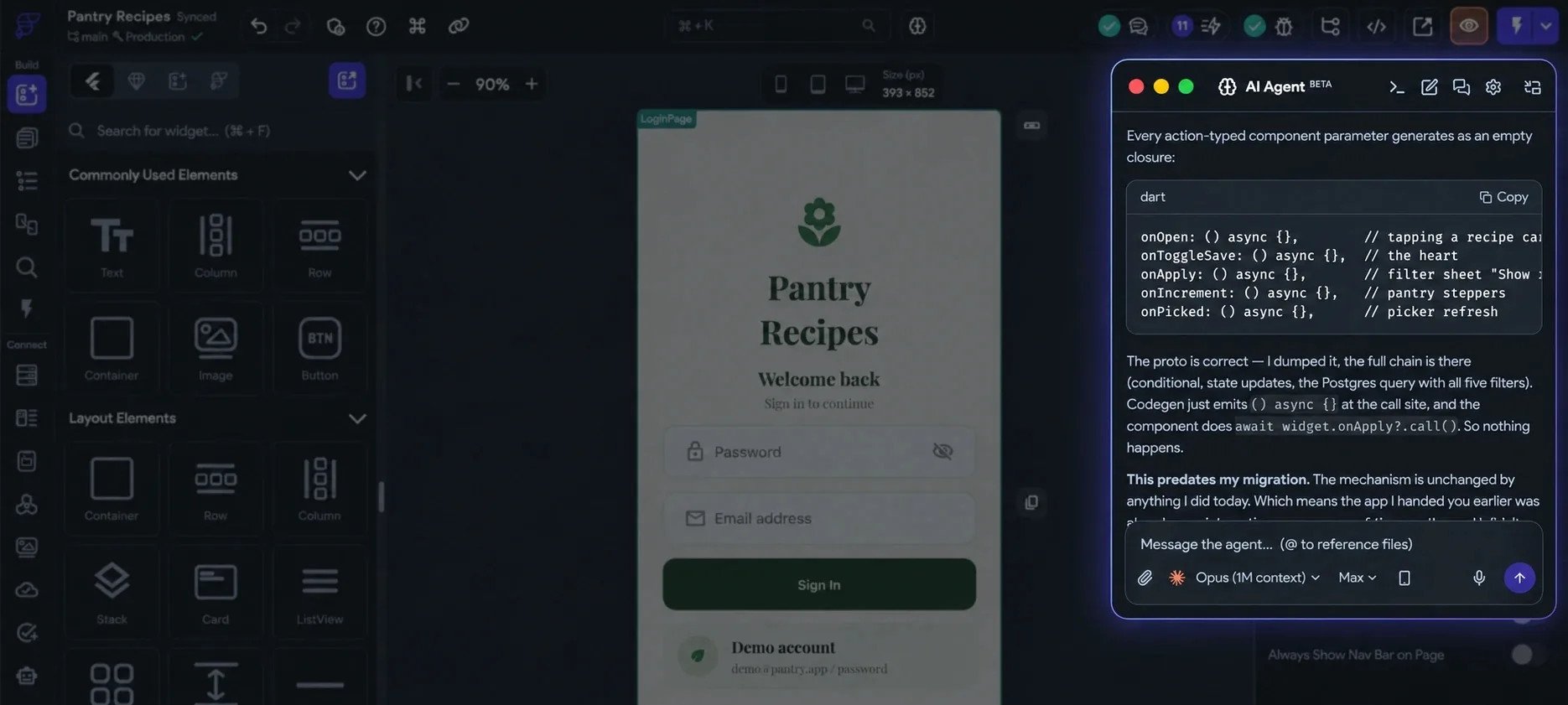
The part of FlutterFlow I find most interesting in 2026 is the AI Agent Panel. The docs describe it as a way to work with AI coding agents directly from the FlutterFlow desktop app: pick Claude or Codex, let FlutterFlow check and install the CLI, Flutter SDK and local workspace, register the MCP server and guide sign-in, then describe a change, review the agent’s plan and apply it. It is desktop only, labeled beta on the AI page, and runs “on your own account and follows that account’s usage and limits.” FlutterFlow’s marketing page also lists Antigravity and Gemini accounts; the docs setup panel I read lists Claude and Codex, so check which are live for you.
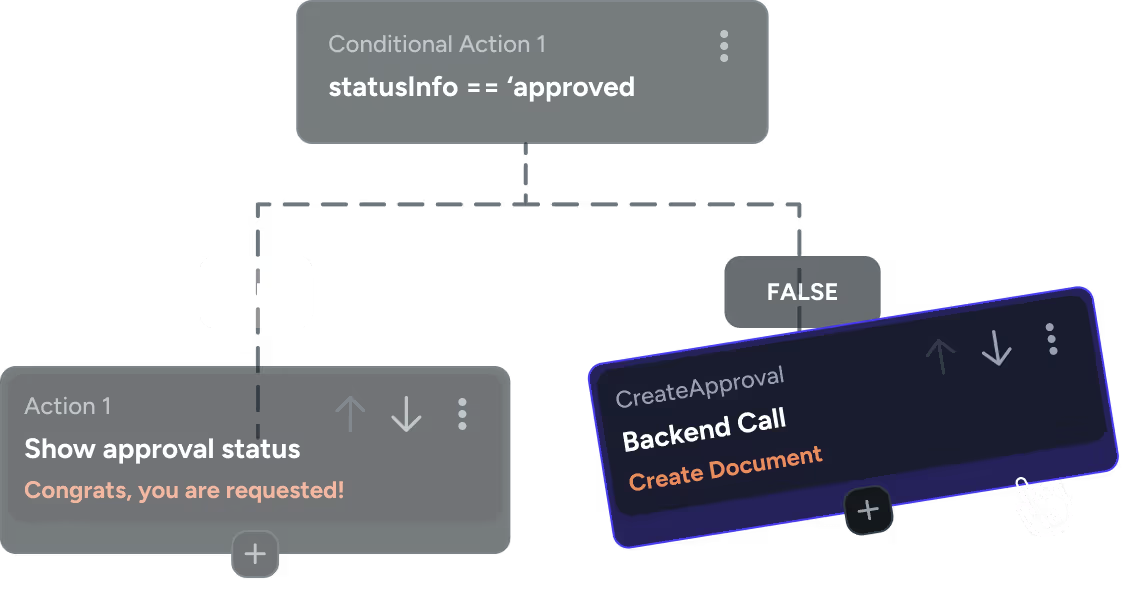
Scope matters. The docs say an agent can edit pages, components, app state, theme, navigation, action blocks, custom functions and widgets, API endpoints and dependencies, but not run or deploy the app, create Firebase projects, manage secrets or handle App Store submissions.
| Capability | What FlutterFlow documents | What I could not verify |
|---|---|---|
| Agent in the desktop app | Claude or Codex via the AI Agent setup panel; runs on your account; FlutterFlow says it does not receive or store conversations | Whether Antigravity and Gemini are live; quality of results |
| CLI and MCP server | Ships inside the FlutterFlow CLI; roughly fifty tools to inspect, validate, patch, search and branch; secrets never returned | Which paid tier includes CLI: the pricing card lists it under Business, the AI FAQ says CLI and MCP need a paid plan |
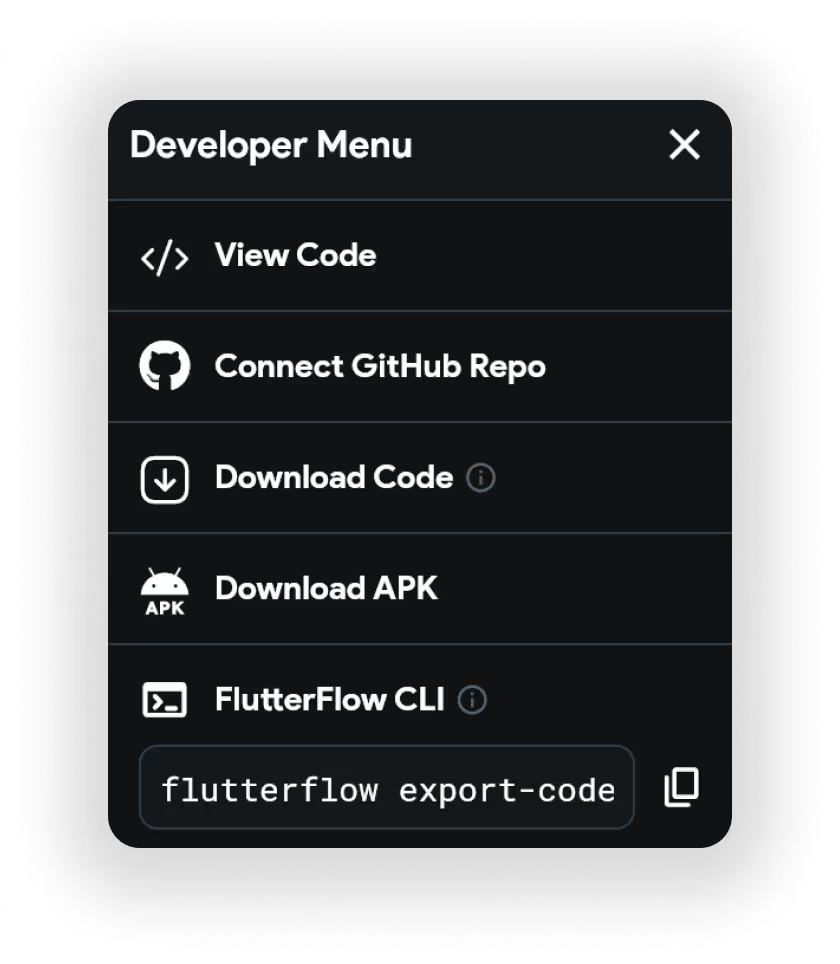
| Code export | Download code or APK on Basic and up; push to a GitHub branch named flutterflow; .flutterflowignore for protected files | Quality and maintainability of generated code |
| Branching | Growth and above can create branches; docs warn merges apply diffs and can delete content | How often merges go wrong in practice |
| Test Pilot | Plain-English tests run by an agent on a web build; 5 free credits per project, passes from $5 for 100 | Reliability on complex apps |
- Real Flutter code you can download or push to GitHub, with a documented protect-your-edits process
- Open, agent-agnostic direction: your own Claude or Codex plan, MCP for other agents
- Docs are candid about scope and merge hazards
- Pushing code out and back in needs branch discipline or FlutterFlow will overwrite the flutterflow branch
- Agent use stacks a second subscription on top
- AI Agent Panel is desktop-only beta
Design it, build it visually, let an agent help, test, branch, ship.
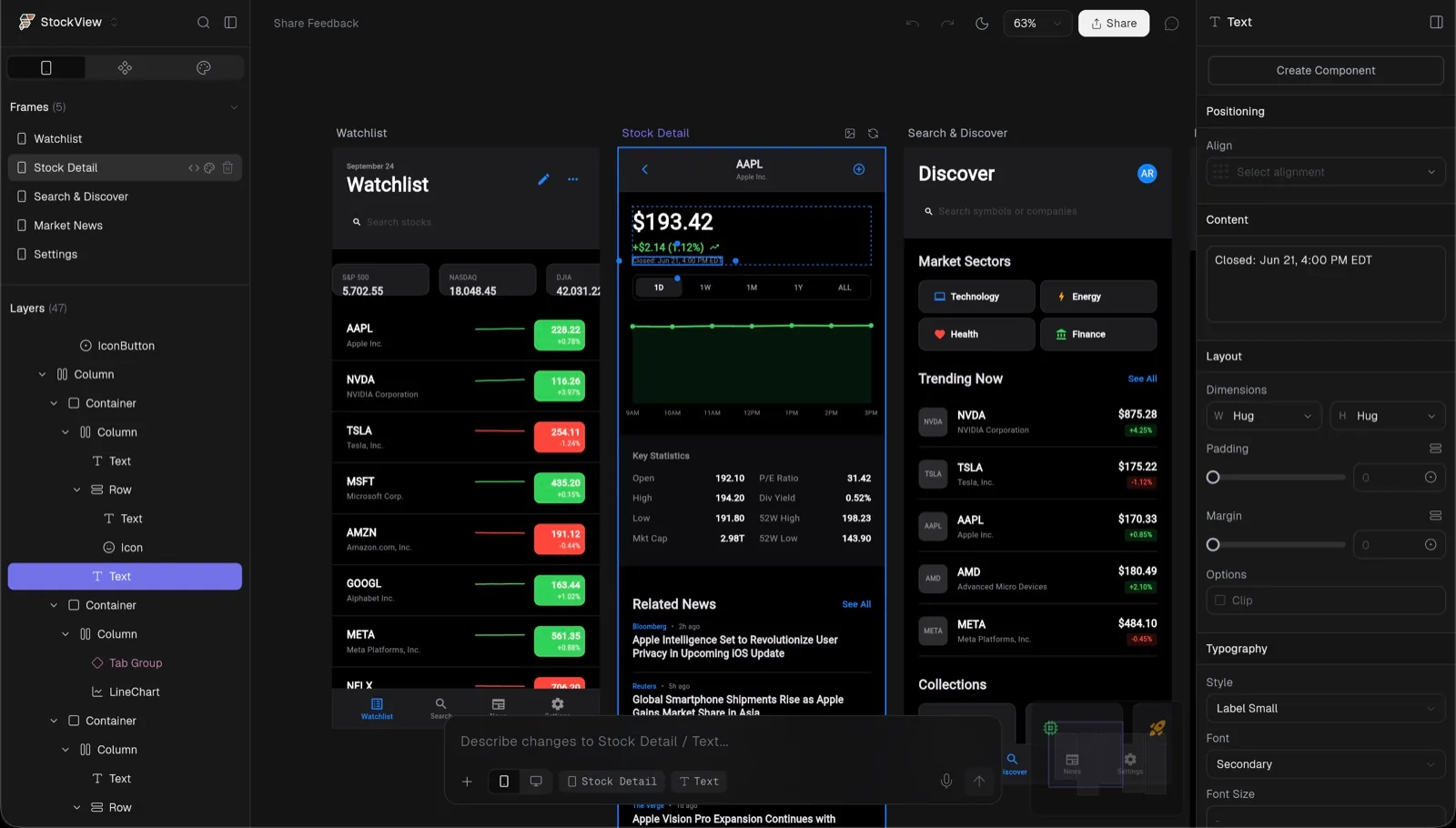
FlutterFlow’s own materials describe a loop that starts in Designer (describe an app, get an editable multi-screen design with shared theme), imports into the Builder, uses the agent or visual logic to wire actions and state, tests in Test Pilot, and ships through one-click store deployment or code export. Live Sessions, highlighted in the 7.0 keynote, let an agent apply changes to a running app on a connected device.
See it in FlutterFlow’s own words
Official video from FlutterFlow’s own YouTube channel (channel UC5LueiosDVInA6yXE_38i9Q, channel name “FlutterFlow”), published Jul 23, 2026, about 2 minutes 37 seconds. It shows connecting Claude Code and Codex inside the macOS desktop app and building an app UI from a prompt, which is the AI Agent Panel described above. A longer FlutterFlow 7.0 keynote (about 62 minutes, Jun 8, 2026) is on the same channel.
Testing is the most concrete AI feature outside code generation.
Test Pilot lets you write natural-language tests, group them, and have an agent drive a browser build of your app like a QA tester. After a run you get pass/fail status, per-test summaries, screenshots, playback, actions and credit usage. Credits are metered: 5 free per project, then a pass from $5 a month for 100 credits, and one credit is one test on one device in one brightness mode, so 3 tests on 2 devices in light and dark costs 12 credits. FlutterFlow shows the credit cost before you click Run.
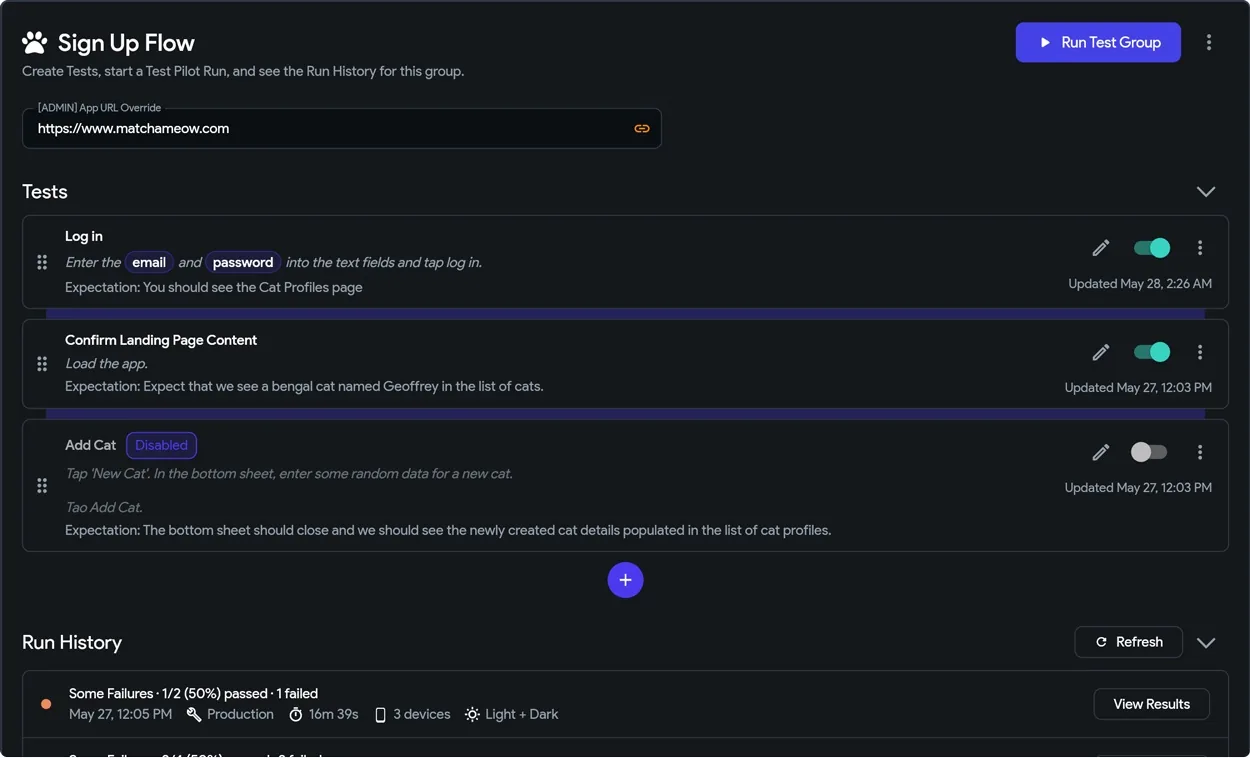
Per FlutterFlow, the agent “reports. Fixing is yours, or the Agent Panel’s.” Treat Test Pilot as a way to catch broken flows, not as a replacement for device testing.
Firebase and Supabase for data, GitHub for code, and MCP for agents.
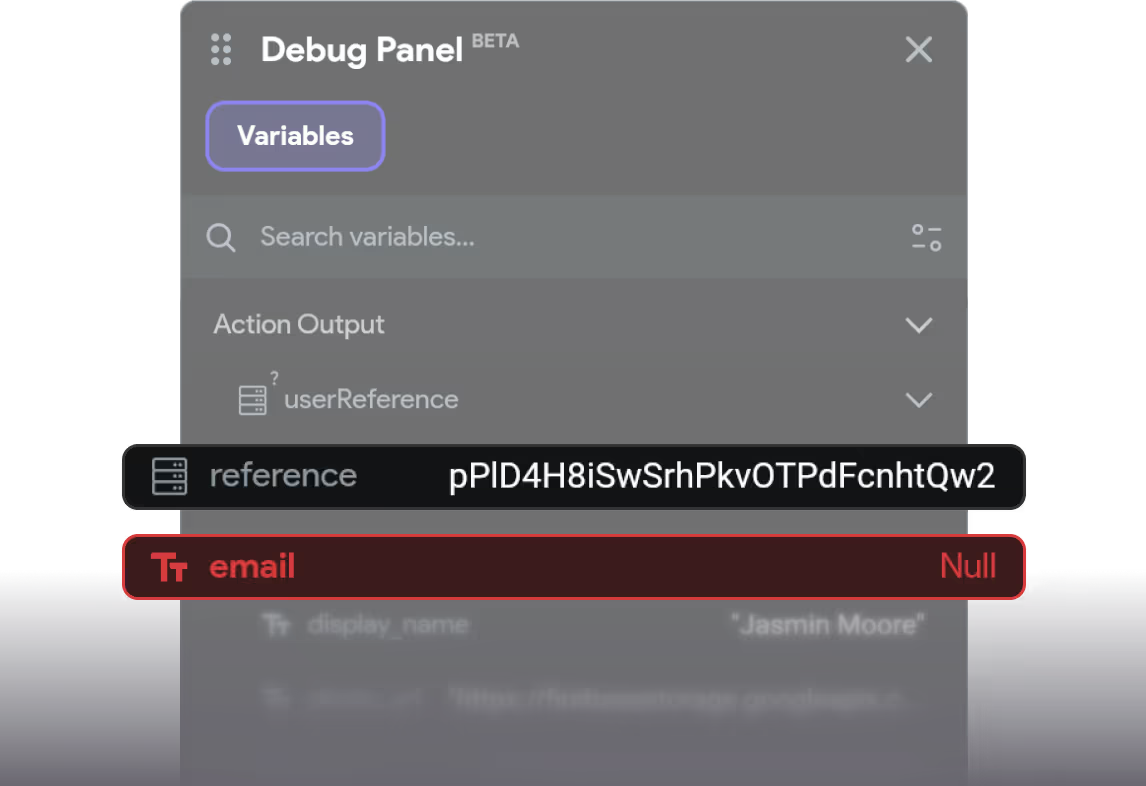
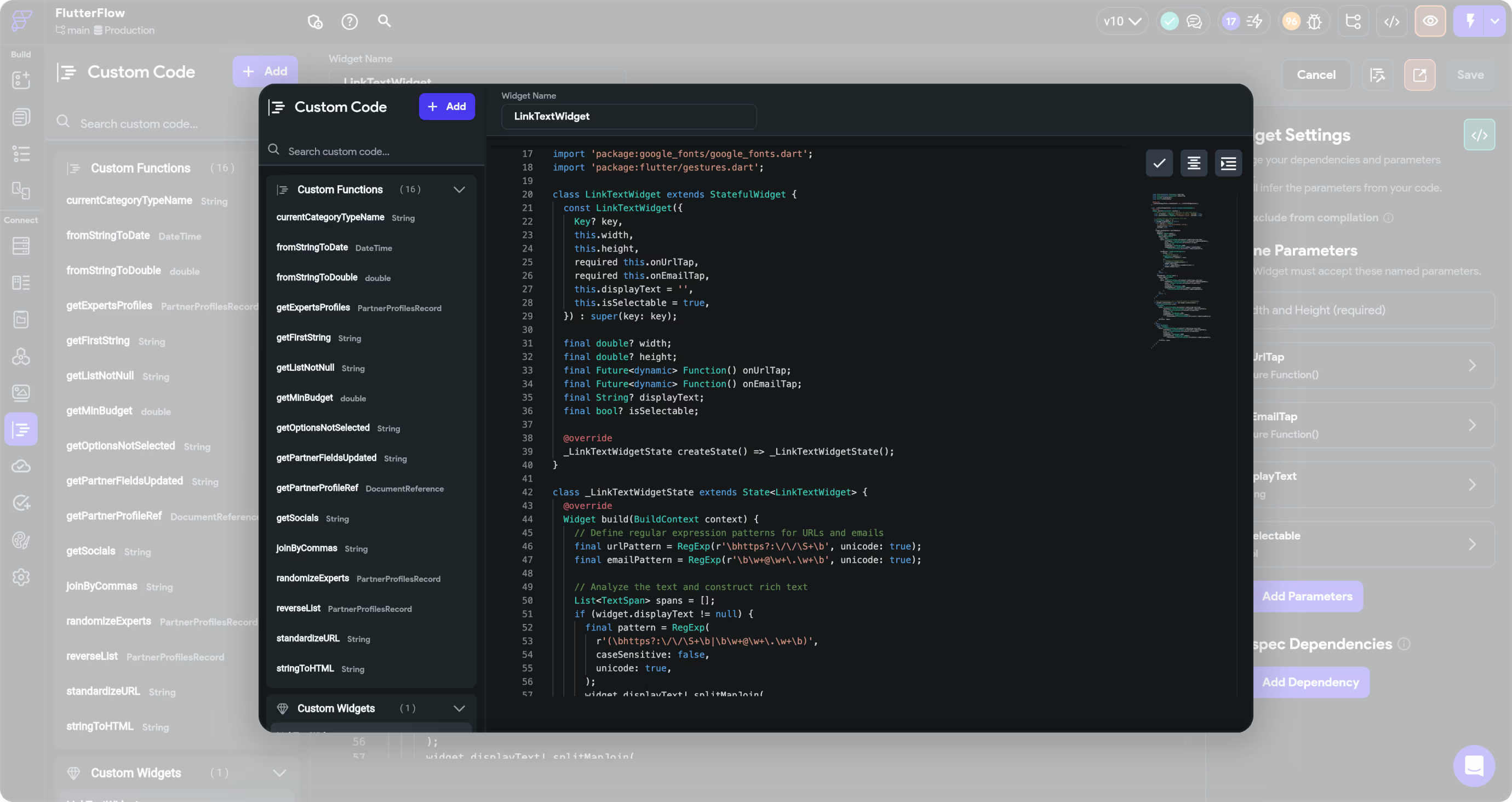
FlutterFlow’s docs cover Firebase Auth and Firestore (including deploying Firestore rules), Supabase auth and database actions, API endpoints with OpenAPI import, Figma frame import, GitHub push, and a VS Code extension. The newer layer is the CLI’s MCP server, which the AI page says registers with Claude Code, Codex, Gemini CLI, Antigravity, Amazon Q Developer and Kiro, and exposes roughly fifty tools plus branches with a three-way merge verifier. That is the first time I have seen a visual builder publish an agent-facing toolset this explicitly; I have not tested it.
| Integration path | Detail | Source |
|---|---|---|
| Firebase | Auth, Firestore, Storage; Firestore rules deployable from FlutterFlow | FlutterFlow docs |
| Supabase | Auth and database actions; Edge Functions called out in the 7.0 keynote | Docs; YouTube |
| GitHub | Push to a flutterflow branch (Growth and up); VS Code extension | Docs; pricing page |
| Claude Code and Codex | Official plugins on GitHub: FlutterFlow/flutterflow-claude and flutterflow-codex | flutterflow.io/ai |
| MCP | Server ships inside the FlutterFlow CLI; works with other MCP-aware agents | flutterflow.io/ai |
| Figma | Frame import on Business; Designer can start from a Figma file | Pricing page; AI page |
For how MCP connectors work in practice, see our Claude MCP & Connectors guide.
Seats, credits and a backend bill: three meters to model.
FlutterFlow’s fees are simple: a seat price and monthly AI generation and Lite credit allowances that rise by tier (50, 200 and 500 AI generation requests on Basic, Growth and Business). The costs that surprise people sit outside the card: the agent subscription you bring, Test Pilot credit passes, collaborator passes, and the Firebase or Supabase bill. Seats compound: on monthly billing, Growth for two is $135 and Business for four is $405 before any of that.
| Meter | Free | Basic | Growth | Business |
|---|---|---|---|---|
| Price (monthly billing) | $0 | $39 | $80 first seat, $55 second | $150 first seat, $85 seats 2-5 |
| AI generation requests | 5 lifetime | 50 / month | 200 / month | 500 / month |
| Lite credits | 10 | 100 / month | 200 / seat / month | 400 / seat / month |
| Editors / branches | 1 / main only | 1 / main only | up to 2 / 2 + main | up to 5 / 5 + main |
| Code and APK download | No | Yes | Yes | Yes |
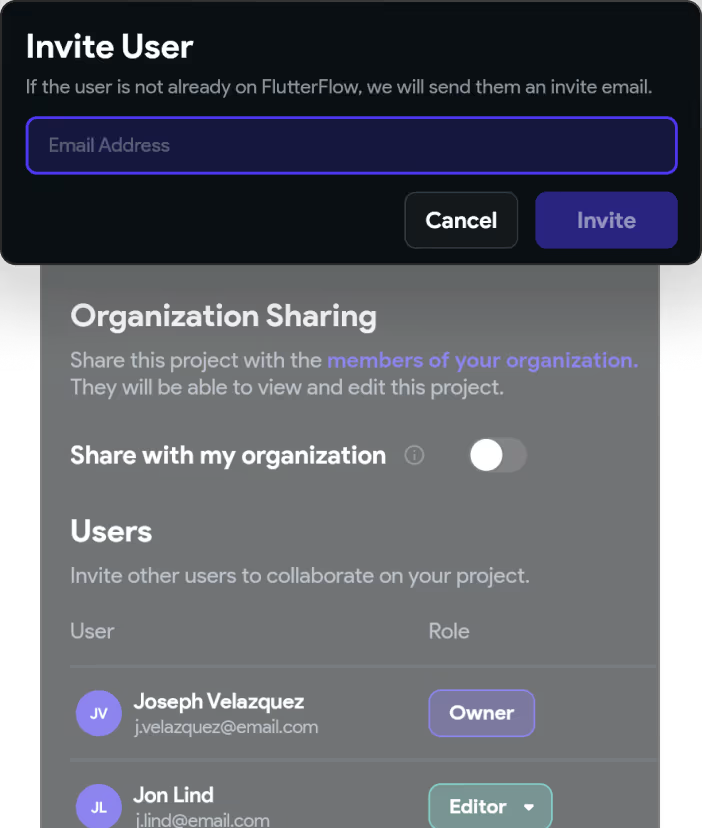
Good docs on agent scope and secrets; no certifications stated where I looked.
For the AI Agent, FlutterFlow’s docs say the coding CLI runs locally and sends prompts, project context and model responses through your agent provider, that data handling follows your provider’s policies, and that “FlutterFlow does not receive or store your conversations.” The AI page adds that the MCP server never returns secrets (integration tools report present or absent only), and that merges go through a no-loss verifier. Growth and Business give you branches and automated snapshot backups (up to 3 and 7 days prior, per the plan comparison).
What I could not find: the Enterprise page I read did not mention SOC 2, GDPR, HIPAA, SSO, audit logs or self-hosting, and I did not find a public trust center. That does not mean they do not exist; it means a regulated buyer should ask FlutterFlow directly. Your Firebase or Supabase security rules are still your responsibility.
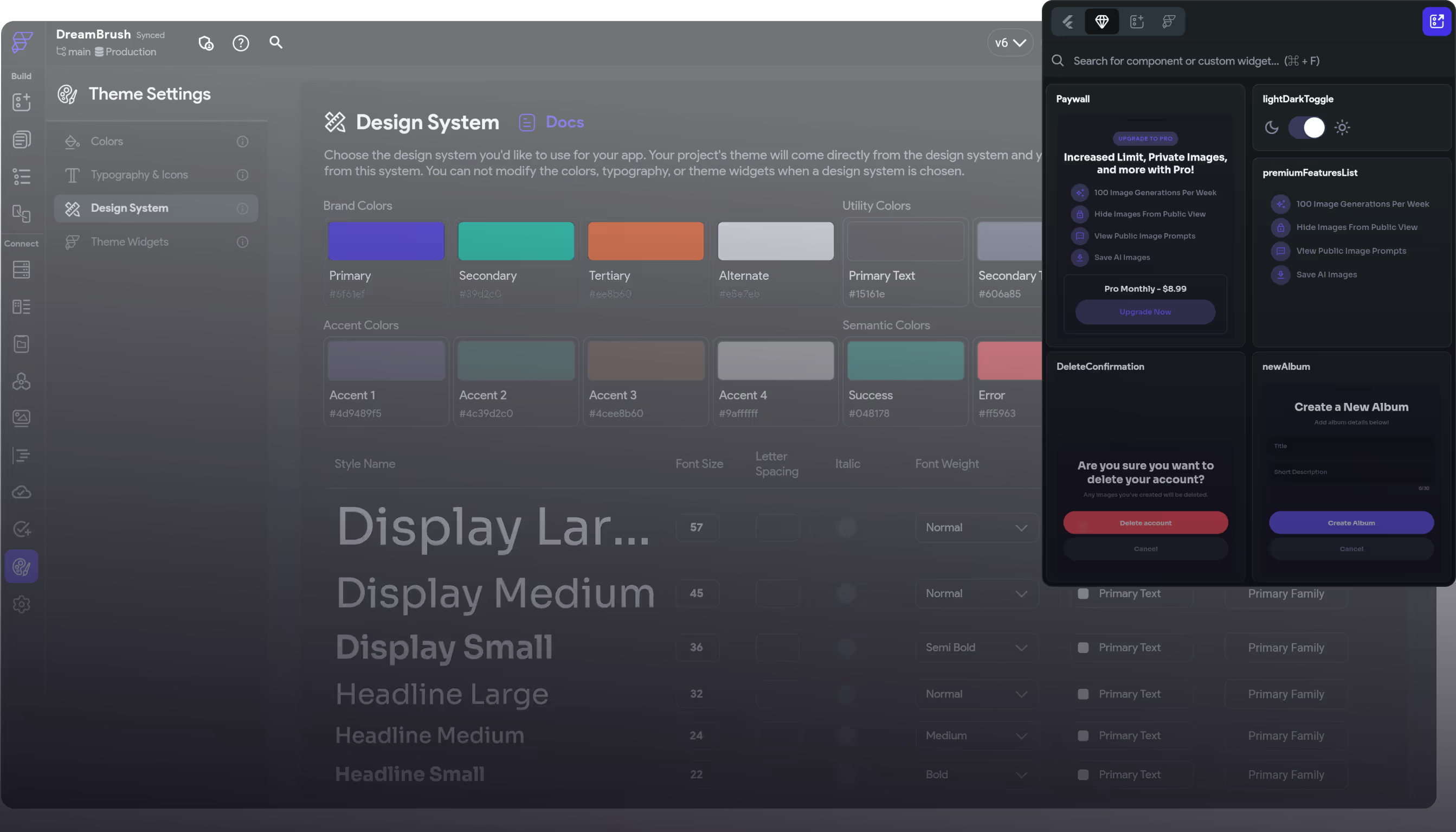
Mobile-first builders who want code they can keep.
| Your situation | Fit | Likely plan |
|---|---|---|
| Solo founder building a native iOS and Android MVP | Strong | Basic |
| Agency or two-person team using GitHub | Strong | Growth |
| Developer who already uses Claude Code or Codex | Good, via plugins and MCP | Basic or Growth |
| Product team of 3-5 needing branches and tests | Good | Business |
| Wants a web SaaS with built-in database and auth | Weaker, backend is separate | Look at all-in-one builders |
| Needs vendor with strong support SLAs | Check first | Enterprise conversation |
Seven real, current limitations.
Trustpilot is 2.6 from 23 reviews with email-only support complaints; the company has not replied to negatives. Small sample, but consistent.
FlutterFlow overwrites the flutterflow branch on push; custom code must live in a separate branch and be merged by pull request.
Docs warn that merges apply diffs and can delete content; Trustpilot reviewers call merging problematic.
The AI Agent Panel runs on your Claude or Codex account and is desktop-only beta; you pay for two things.
Lite credits are on every plan but undefined in docs; the CLI tier is described inconsistently between pricing card and AI page.
Growth is $80 + $55 and Business $150 + $85 each, on monthly billing; collaborator passes are extra.
Code and APK download start at Basic ($39).
Map your reason for looking elsewhere to a tool.
| If you mostly need... | Compare with... |
|---|---|
| Prompt-to-app builder, web-first | Lovable — Lovable review; Bolt.new — Bolt.new review |
| All-in-one hosted builder with backend | Base44 — Base44 review |
| A coding agent and cloud IDE | Replit — Replit review |
| An AI code editor for hand-written Flutter | Cursor — Cursor review |
| A terminal agent that can drive FlutterFlow | Claude Code — setup guide |
| Flutter-first AI builder from the same team | Dreamflow — dreamflow.com (official site; separate product, code is the source of truth) |
No affiliate relationship shapes this review.
JAVIS has no affiliate arrangement with FlutterFlow. Every CTA points to flutterflow.io or a live JAVIS review. This is a VERIFIED EDITORIAL REVIEW: I read official docs, pricing, the AI page and community threads; I did not build an app or run a controlled test.
Start free; code download begins on Basic.
Start free on FlutterFlowFlutterFlow’s own pricing page.
flutterflow.io/pricingFlutterFlow makes most sense next to the agents that now plug into it.
If you’re deciding between building visually and building with an agent, these are the six reviews I’d read next.

Questions people are actually searching right now
Is FlutterFlow free?
There is a $0 plan with up to 2 projects, 10 Lite credits and 5 AI generation requests (lifetime). It cannot download code or APKs.
How much does FlutterFlow cost?
Basic $39/month, Growth $80 for the first seat and $55 for the second, Business $150 for the first seat and $85 for seats 2-5 (monthly billing). Annual billing is typically about 25% less, per FlutterFlow’s docs. Enterprise is custom.
Can I export FlutterFlow code?
Yes, on Basic and above: download the code or APK, push to GitHub (Growth and up) or use the CLI. Keep custom code on a separate branch because FlutterFlow overwrites the flutterflow branch on push.
Does FlutterFlow have AI?
Yes. FlutterFlow lists six AI tools: an AI Agent Panel in the desktop app (beta), Claude Code and Codex plugins, Generate with Designer, an MCP server, Test Pilot and Designer.
Do I need my own AI subscription?
For the AI Agent Panel, yes: per the docs it runs on your own Claude or Codex account and follows that account’s usage limits.
What is Dreamflow?
A separate Flutter-first AI builder from the FlutterFlow team where code is the source of truth. It has its own site, dreamflow.com.
Is FlutterFlow only for mobile?
No. It builds mobile, web and desktop apps, though native mobile is its strongest pitch.
Is FlutterFlow secure?
Docs describe scoped agent access and secrets that are never returned by the MCP server. I did not find SOC 2 or similar certifications on the pages I read; ask sales.
Where this came from, and when it was checked.
Pricing and plans: flutterflow.io/pricing (Oct 3, 2026); docs.flutterflow.io plan-pricing (plans effective Aug 18, 2025; ~25% annual discount) and plan-comparison; docs test-pilot page for credit pass pricing.
Product and AI: flutterflow.io/ai; docs.flutterflow.io AI Agent, Build with AI Agents (agent edit scope, live sessions), exporting and branching pages; flutterflow.io homepage assets.
Videos: FlutterFlow YouTube channel UC5LueiosDVInA6yXE_38i9Q: zK8neqREUHc (Jul 23, 2026) embedded; 7Cc2BNGpLpc (FlutterFlow 7.0 keynote, Jun 8, 2026) used for release facts from its description.
Funding and users: TechCrunch, Jan 11, 2024 (via search coverage); users figure from flutterflow.io/pricing; Flutter stars from GitHub.
Community: trustpilot.com/review/flutterflow.io (2.6, 23 reviews, read directly); capterra.co.uk/software/249489/flutterflow (4.4, 85 reviews, read directly); G2 4.5 from 30 reviews with a 73/20/3/0/3 distribution from a search listing, because G2 could not be read directly; Hacker News (Launch HN 29628716, Dreamflow Show HN 45130588, comments Jun 2026).
Fit score method: JAVIS editorial composite of five 20-point criteria — native app capability and code ownership 17, AI workflow openness 15, price and value 14, backend independence and learning curve 12, support and trust 10 = 68. It is an opinion, not a benchmark.