
Mem0 Review 2026: A Popular Open-Source Memory Layer, a Steep Jump from $19 to $249, and Benchmarks Mostly Run by Mem0
Mem0 gives AI agents long-term memory: it pulls facts out of conversations, stores them, and returns the relevant ones later. It comes as an Apache-2.0 open-source library and as a hosted platform. This review covers what each plan costs, how the open-source and hosted versions differ, what public users report, what the vendor's own benchmarks do and do not show, and what is still unverified.
There are no affiliate links in this review. Every Mem0 link goes straight to mem0.ai or its documentation.
| Made by | Mem0, operated by Embedchain Inc. |
| What it is | Memory layer for AI agents: open-source library, self-hosted server, hosted platform |
| Paid plans | Starter $19/mo; Pro $249/mo |
| Enterprise | Custom |
| Free | $0, 10,000 add and 1,000 retrieval requests a month |
A widely used, genuinely open-source memory layer with a clear free tier, but the paid ladder is steep, the best-known accuracy numbers come from Mem0 itself, and the first-hand user evidence is mixed.
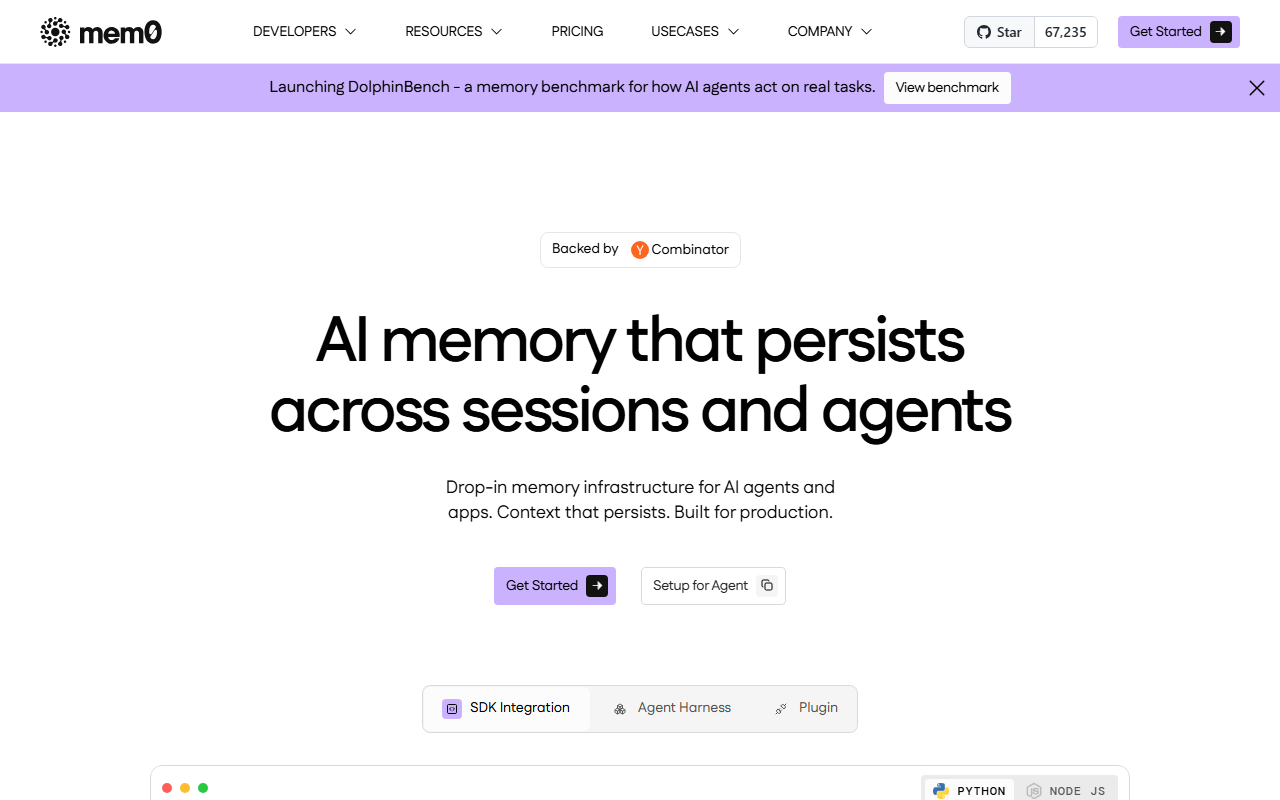
“AI memory that persists across sessions and agents.” That is the current home-page headline for a product that grew out of the open-source Embedchain project and whose repository now shows 67,235 GitHub stars.
Mem0 sits between your agent and your model. You send it conversation messages with add, it extracts facts and stores them, and later you call search to get the relevant memories back so you do not have to resend the whole chat. You can run it yourself as a Python or Node library and a Docker server, or pay for the hosted platform with a dashboard, analytics and managed infrastructure.
Four things temper the pitch. First, the paid ladder jumps from Starter at $19 a month to Pro at $249 a month, and several features (graph memory, Dream consolidation, advanced analytics, private Slack) appear only from Pro. Second, the accuracy figures on Mem0's site and README, and the newer DolphinBench ranking, are run or published by Mem0, and a competitor disputes the earlier comparison. Third, public user evidence is thin and split: a 2024 Hacker News launch thread with praise and questions, 2025 and 2026 comments from people who stopped using it or measured it as costly, and open GitHub issues about contradictory memories. Fourth, the company's own pages disagree on small things such as developer counts and whether audit logs are a paid feature.
Not a hands-on test: JAVIS has not signed up for, installed or paid for Mem0 for this review. It is built from Mem0's own site, pricing page, documentation, Trust Center and GitHub repository, plus Hacker News, TechCrunch and a competitor's pricing pages, all as of 16 Oct 2026. Trustpilot has no page for mem0.ai, and no G2 or Capterra score is quoted, so there is no independent star rating.
Three ways to run it, one add and search loop, one hosted-only feature set.
Mem0's documentation describes two products that share one core memory loop: Mem0 Platform (managed) and Mem0 Open Source (self-hosted). The README adds a middle option, a self-hosted server run with docker compose that includes a dashboard and API keys. The pricing page sells only the Platform.
Swipe sideways to read the full diagram.
A young, venture-backed vendor with large adoption numbers, and several pages that do not agree with each other.
Repository page, 16 Oct 2026. About page says 66,000+.
pypistats for mem0ai. Downloads include automated installs.
TechCrunch, 28 Oct 2025: $3.9M seed and $20M Series A.
393 issues and 444 pull requests on GitHub, 16 Oct 2026.
TechCrunch reported on 28 Oct 2025 that the company launched in January 2024, grew out of the open-source Embedchain project, and had raised $24 million, led by Basis Set Ventures with Y Combinator, Peak XV Partners and the GitHub Fund among investors. The Trust Center says Mem0 is operated by Embedchain Inc.
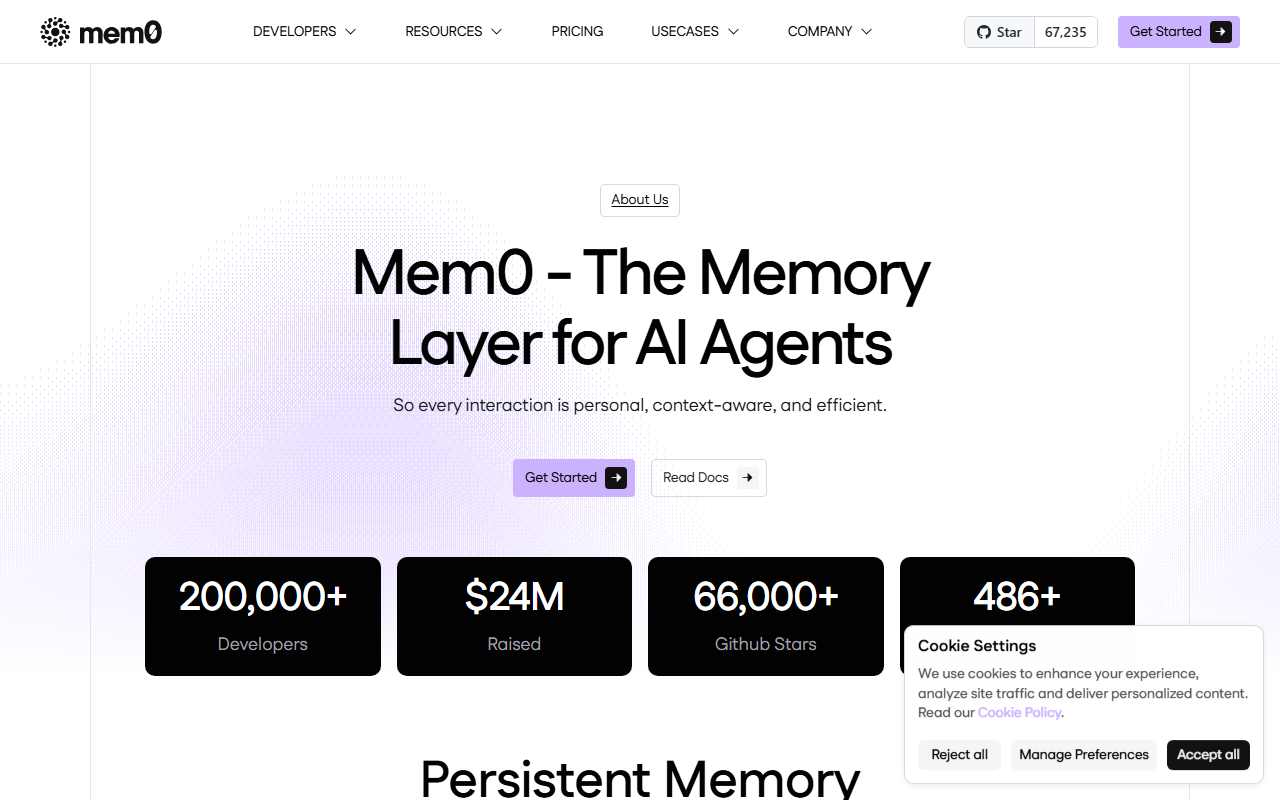
Mem0's own pages do not agree on how many developers use it. TechCrunch reported on 28 Oct 2025 that more than 80,000 developers had signed up for the cloud service. The Trust Center says 100,000+ developers, the home page says 150,000+ and the About page says 200,000+. The figures measure different things at different dates and none is independently audited, so read them as an order of magnitude and nothing more.
Package downloads are a harder number than a marketing counter, although they include automated installs and build servers. In the last 30 days shown by pypistats on 16 Oct 2026, the Python package mem0ai had 2,020,516 downloads, against 292,185 for zep-cloud, Zep's Python SDK. On npm, for 13 Sep to 12 Oct 2026, mem0ai had 657,480 downloads against 598,872 for @getzep/zep-cloud. Mem0 leads clearly on Python and only narrowly on npm.
pypistats, 16 Oct 2026
pypistats, 16 Oct 2026
npm download counter
npm download counter
The timeline is short. The GitHub repository was created on 20 Jun 2023, and the company launched Mem0 in January 2024 after the Embedchain project, per TechCrunch. The Show HN launch thread of 4 Sep 2024 drew 201 points and 61 comments. Python SDK v1.0.0 followed on 16 Oct 2025 and the $24M round was reported on 28 Oct 2025. On 16 Apr 2026 Python v2.0.0 and Node ts-v3.0.0 shipped a new extraction approach and entity linking that replaced external graph stores. The latest tagged releases are Python v2.2.1 and Node ts-v3.3.1 from 25 Sep 2026, and in Sep 2026 Mem0 published its DolphinBench benchmark (sources: GitHub, TechCrunch, Hacker News and the Mem0 blog, as of 16 Oct 2026).
No analyst market-size figure is cited.
There is no star rating to quote, and the public comments are split between early praise and later disappointment.
Trustpilot has no page for mem0.ai as of 16 Oct 2026, and no G2 or Capterra score is quoted here, so there is no independent star rating. The evidence below is Hacker News comments with their dates, GitHub issues and discussions, and one independent source-level write-up. Every item is one person's account or one author's reading, not a verified finding.
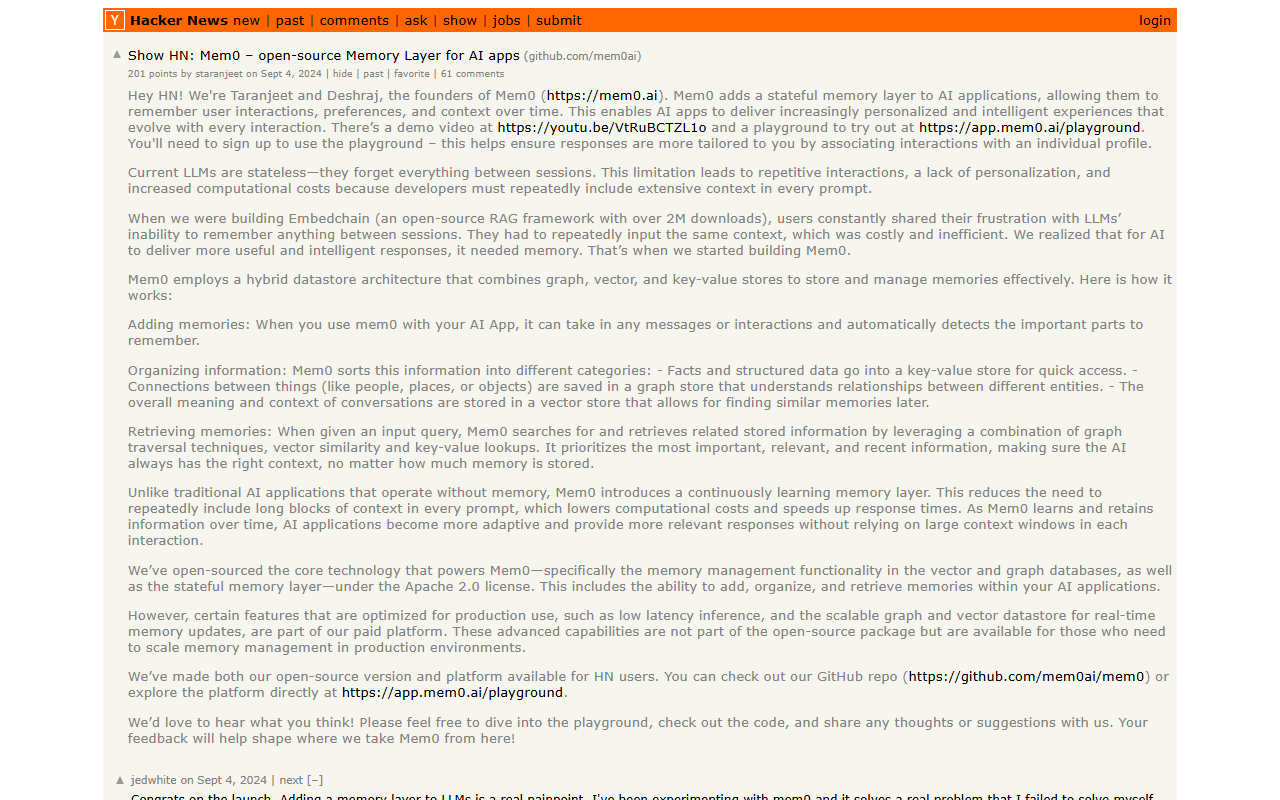
Hacker News comments, paraphrased with date and name as shown on the page:
Had been experimenting with Mem0, said it solved a problem they had failed to solve themselves and that they planned to use it in production, then asked how committed the company is to the open-source version long term.
Used it for a hackathon project and called it probably the best designed and easiest way to add memory, while saying the line between structured and unstructured memory still needs thought.
Tried Mem0 for an OpenClaw setup and stopped soon after: the extracted facts became a mess of incomplete or wrong sentences, and they went back to summaries. Written two days before Python v2.0.0, so it may describe the old algorithm.
In the same 4 Sep 2024 thread a Hacker News moderator (dang, comment 41451183) wrote that he had flagged some of the comments as booster comments, presumably from friends of the submitters. Another reader asked about data location; a Mem0 co-founder answered on 5 Sep 2024 (comment 41452729) that data was processed in the US and the company was not yet fully GDPR-compliant. Mem0's pages now say GDPR Ready.
Later comments are mostly measurements by people with a competing idea or their own test, so treat them as leads:
Author of a post that benchmarked Mem0 and Zep on one test set against passing the full history: the memory systems were 14 to 77 times more expensive and 31 to 33 percent less accurate in that setup. The author calls the scope narrow, and it predates Python v2.0.0.
In a small schema-change test, reported Mem0 (open-source) at 3 of 15 tasks, versus 40 of 40 for a simple latest-wins rule. A personal test with the configuration not described.
A user reports that after the single-pass add-only change, old and new versions of a changing fact (an employer, a city) both stay stored, and retrieval can rank the old one first. Mem0's own migration guide says memories now accumulate and nothing is overwritten.
A second open issue (5867, opened 25 Jun 2026) describes the same kind of conflicting memories, and issue 5245 (opened 24 May 2026) reports that a failed embedding inside a batch could drop an extracted memory without an error. The 25 Sep 2026 Python release notes describe a fix so that add() stops reporting rejected records as stored; whether it covers issue 5245 is not confirmed here. These are user reports, not confirmed defects.
More independent sources, with their dates
Beyond Hacker News and the open issues, four further items are worth reading, each with limits that are stated next to it:
A source-level comparison of eight memory systems that calls Mem0 the simplest architecture of the eight. It describes add() as two model calls (extract facts, then decide what to add, update, delete or ignore), no schema on the stored facts, and updates that overwrite the old version. It credits Mem0 with low adoption friction: 19 vector stores, 15 model providers and 10 embedding providers at that version. It predates v2.0.0, which replaced overwriting with add-only storage, so read it as a description of the design bet, not of today's code.
A user who self-hosted Mem0 with Qdrant for an OpenClaw agent reports that 26 imported memories grew to 95 after a few exchanges, including throwaway items such as the current time and date. Asking the agent to prune brought it back to 19. Switching the extraction model to a larger one reportedly doubled response times, to roughly two minutes for a simple question, without a clear gain in what was kept. The first post is from 10 Mar 2026, before Python v2.0.0, but the same user kept posting until 10 Sep 2026, said they had switched Mem0 off and gone back to the default OpenClaw memory, and reported that a model judged only two of hundreds of stored memories worth keeping. One user's OpenClaw setup, not a general measurement.
Two commenters that GitHub labels as contributors, not as members of the Mem0 organization, describe the current add-only path: nearby memories are passed to the extraction prompt, new facts are added with links to related older ones, and only exact hash matches are removed. In their reading, a reworded fact usually stays as a separate row and contradictory facts are both kept by design. This matches the issue reports above, and it is a community reading of the code, not an official statement.
On the Show HN thread of a competing memory project, a commenter said their team would stay with Mem0 for now and look again once that project supports TypeScript. One line, with no detail on scale or satisfaction, but it is a user choosing to stay.
Read together, the independent evidence points one way on design and is mixed on experience. The design is deliberately light: let the model decide what to store, keep everything, and rank at search time. Users who tried it before v2.0.0 describe too much stored and facts that were wrong or trivial; users after v2.0.0 describe old and new versions of a fact living side by side. The positive items are early launch praise and one team staying put. None of this is a rating, and none of it measures your workload.
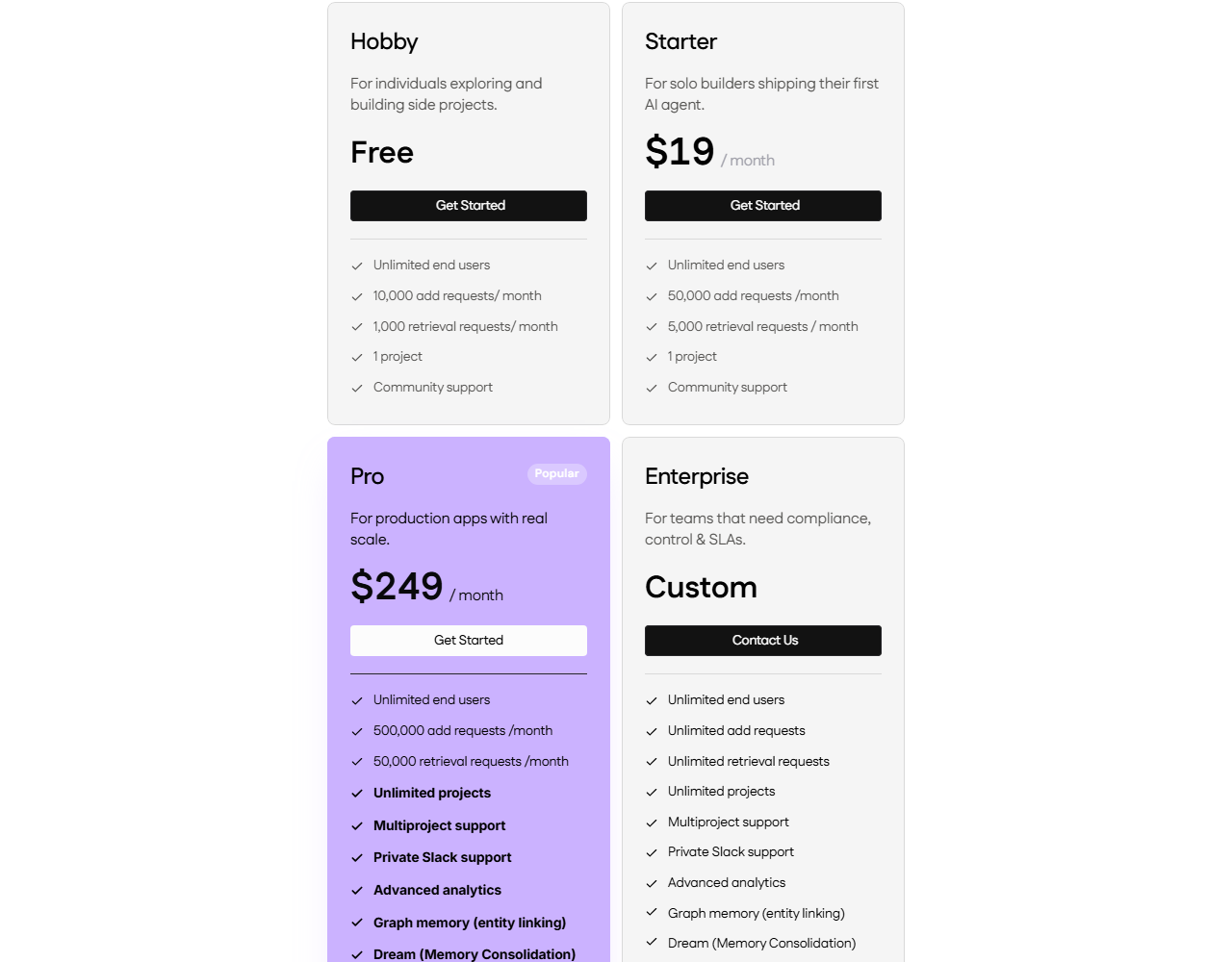
Free, then Starter at $19 and Pro at $249 a month, then Enterprise on request.
Hobby
No card; permanently free
- 10,000 add requests a month
- 1,000 retrieval requests
- 1 project, unlimited end users
- Community support
Starter
Monthly price shown
- 50,000 add requests
- 5,000 retrieval requests
- 1 project
- Community support
Pro
Marked Popular
- 500,000 add requests
- 50,000 retrieval requests
- Unlimited projects
- Graph memory, Dream, advanced analytics
- Private Slack support
Enterprise
Contact sales
- Unlimited add and retrieval
- SLA support, on-prem deployment
- Audit logs, SSO
- Custom integrations
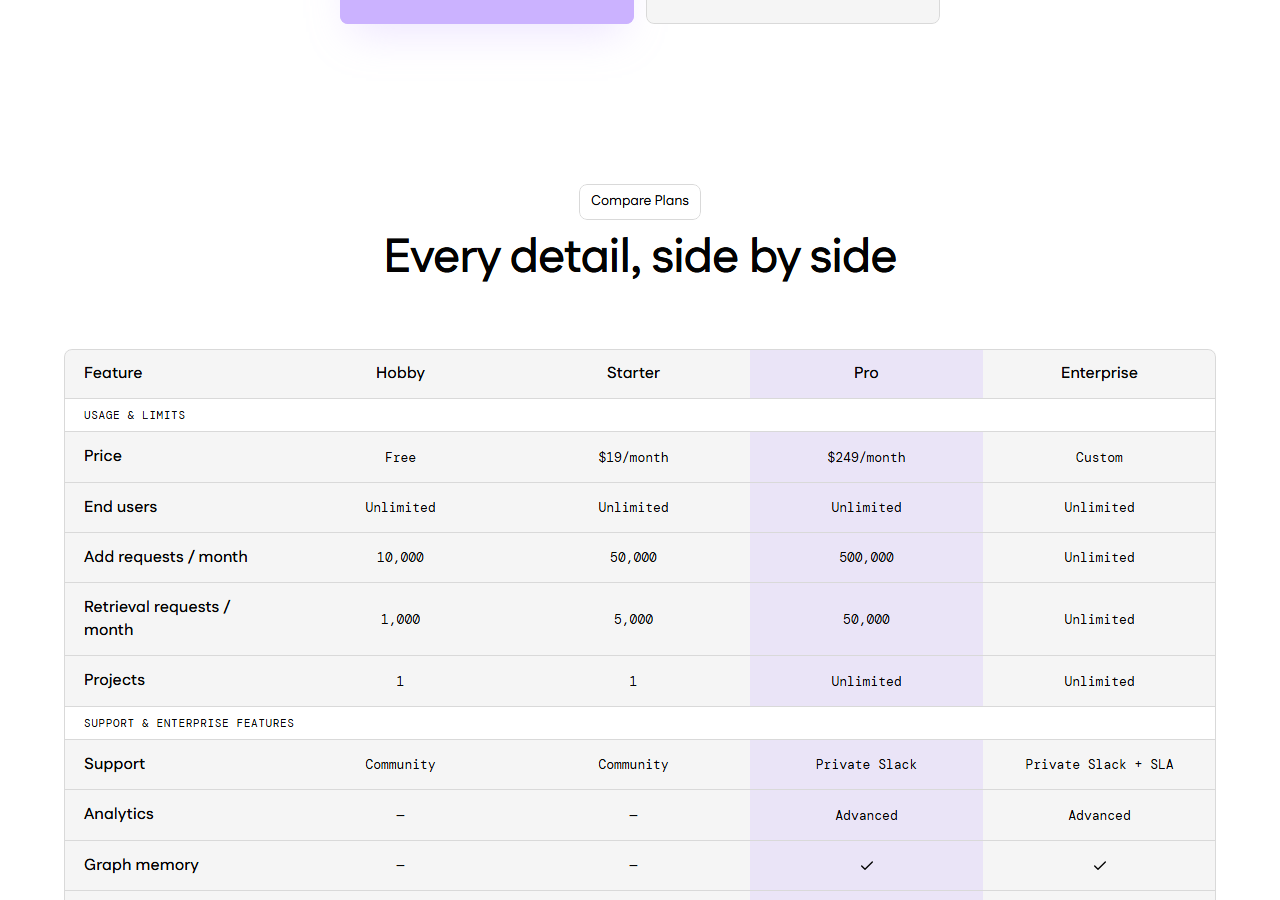
Swipe the table sideways to see every column.
| Feature | Hobby | Starter | Pro | Enterprise |
|---|---|---|---|---|
| Price | Free | $19/month | $249/month | Custom |
| End users | Unlimited | Unlimited | Unlimited | Unlimited |
| Add requests a month | 10,000 | 50,000 | 500,000 | Unlimited |
| Retrieval requests a month | 1,000 | 5,000 | 50,000 | Unlimited |
| Projects | 1 | 1 | Unlimited | Unlimited |
| Support | Community | Community | Private Slack | Private Slack and SLA |
| Analytics | None | None | Advanced | Advanced |
| Graph memory | None | None | Included | Included |
| Dream (memory consolidation) | None | None | Included | Included |
| On-prem, audit logs, SSO | None | None | None | Included |
Not an affiliate link. It opens Mem0's official website.
The plans meter two kinds of requests, and the cost per request rises when you move up to Pro.
The pricing FAQ explains that an add request is when Mem0 processes and stores a new memory, a retrieval request is when your agent queries Mem0 for relevant memories, and both are counted separately against plan limits. Two things are not stated on the page: what happens when you exceed a limit, and whether there is an annual discount. Ask before you rely on either.
The useful way to read the plan limits is to notice their shape. Every capped plan allows ten times as many add requests as retrieval requests (10,000 to 1,000 on Hobby, 50,000 to 5,000 on Starter, 500,000 to 50,000 on Pro). A chat agent that stores after every message and also searches before every reply uses the two at a one-to-one ratio, so the retrieval limit runs out first and the add limit is mostly unused. Everything below is arithmetic on the published limits at 30 days a month, using invented but plausible traffic. It is an illustration, not a measurement of any real product.
1,000 retrievals / 30 days
5,000 retrievals / 30 days
50,000 retrievals / 30 days
$249 / $19, for 10x the requests
Worked example 1: a support chatbot that fits Starter
Say a support bot handles 150 customer messages a day and, for each one, calls search once before replying and add once afterwards. Over 30 days that is 4,500 searches and 4,500 adds. On Hobby the adds fit (45% of 10,000) but the searches are 4.5 times the 1,000 allowed. On Starter the adds use 9% of 50,000 and the searches use 90% of 5,000, so it fits with room for about 500 more searches a month. The effective price is $19 / 4,500, about $0.0042 per customer message. On Pro the same 4,500 messages would cost $249 / 4,500, about $0.0553 each.
Worked example 2: the same bot after it grows
At 200 messages a day the same pattern needs 6,000 searches a month, 20% over Starter's 5,000. The pricing page publishes no overage rate, so there are only two documented routes: move to Pro at $249 a month, an extra $230, or ask Mem0 for the usage-based arrangement its FAQ mentions. On Pro the bot would use 12% of the 50,000 searches, and the effective price becomes $249 / 6,000, about $0.0415 per message, roughly thirteen times what Starter would cost per message at that traffic ($19 / 6,000, about $0.0032) and about ten times the $0.0042 of the 4,500-message bot above. You are not buying volume at that point; you are buying Pro's feature set (unlimited projects, graph memory, Dream, advanced analytics, private Slack support) and headroom. The marginal price of the extra 45,000 searches alone works out to about $0.0051 each.
Worked example 3: change the design instead of the plan
If the bot only searches on every third message, 200 messages a day gives about 2,000 searches and still 6,000 adds a month. Starter then holds both, with 40% of the retrieval limit used, at $19 / 6,000, about $0.0032 per message. Whether skipping searches hurts answer quality is something this review cannot tell you; it is a trade you would test with your own conversations.
Worked example 4: a coding agent over MCP
Now take a developer who uses Mem0 through a coding agent and, on 22 working days, triggers 20 searches and 5 adds a day. That is 440 searches and 110 adds a month, 44% of Hobby's retrieval limit, so one person fits the free plan. A team of three with the same habits makes 1,320 searches, which is over Hobby but only 26% of Starter's 5,000, and Starter allows one project. One caution: the MCP page lists eleven tools (add, search, get, list, update, delete and event tools) but does not say whether each tool call counts as one add or retrieval request, or whether listing memories counts at all. Ask Mem0 before you size a team plan.
Worked example 5: the open-source library has no Mem0 fee, but it has other costs
If the 4,500 messages above ran on the open-source library, Mem0 would charge nothing, and you would pay for at least 4,500 extraction model calls (the Python v2.0.0 notes describe extraction as a single model call per add), the embedding calls to store each fact and run each search, and the machine that hosts it. The docs list OpenAI gpt-5-mini and text-embedding-3-small as the defaults, so multiply the call counts by those models' prices or by whatever model you configure. If you point the library at a hosted vector database instead of the default local one, that is a further bill: on its pricing page of 16 Oct 2026, Pinecone, which Mem0's docs list as a supported store, shows a free Starter plan, Builder at $20 a month flat, Standard at a $50 a month minimum and Enterprise at a $500 a month minimum. Those plans store vectors only; the extraction calls are still yours to pay for.
The open-source version keeps the core loop; the hosted version keeps several features to itself.
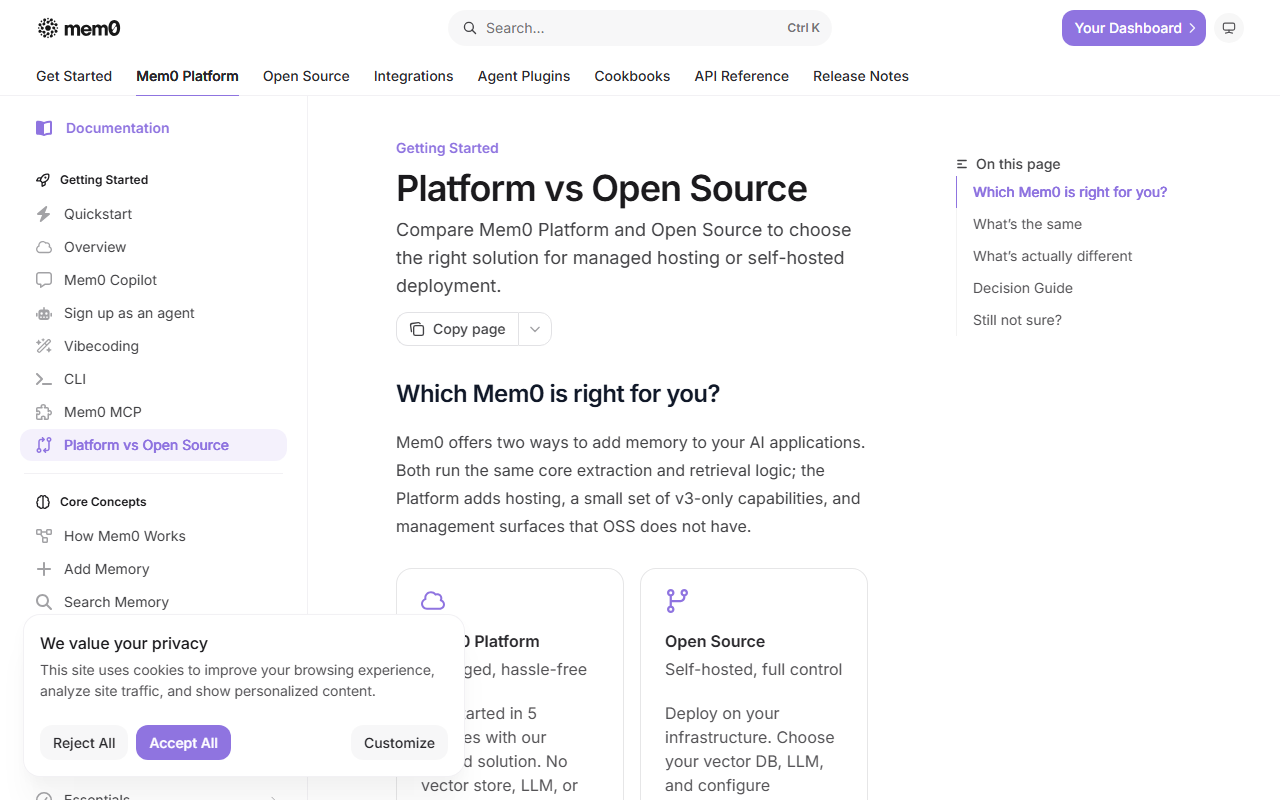
Mem0's own comparison page says both run the same core extraction and retrieval logic, and that the Platform adds hosting and a set of capabilities the open-source SDK does not have. The library is Apache-2.0 licensed per the repository.
The core memory loop is identical on both sides: add, search, get, get all, update, delete, delete all and per-memory history exist on the self-hosted Memory classes and on the hosted MemoryClient. Both scope memories by user, agent and run IDs, both use entities found in the memory text to boost related results at search time, and both accept multimodal input, expiration dates, reranking and custom extraction instructions. Both have Python and JavaScript SDKs and a REST API.
What changes is who runs it and what you can switch on. With the library or the self-hosted server you provision, configure and pay for the model, the embedder and the vector store; on the Platform Mem0 runs and tunes all three. The web dashboard at app.mem0.ai is a Platform feature, although the self-hosted server ships its own dashboard. The features the docs mark as Platform-only are graph memory (native, and it feeds ranking), memory decay, temporal reasoning (in the open-source library, passing the parameter raises an error), Dream consolidation, webhooks, memory export, custom categories, and multi-organization, multi-project roles instead of a single local configuration. Entity boosts still work in the open-source version, but there is no queryable graph. Community channels are the stated support on both sides, and an SLA is not documented as a Platform benefit. The pricing page lists graph memory and Dream under Pro only, while this page describes graph memory as native to the Platform; ask which plan includes it (docs.mem0.ai Platform vs Open Source page, 16 Oct 2026).
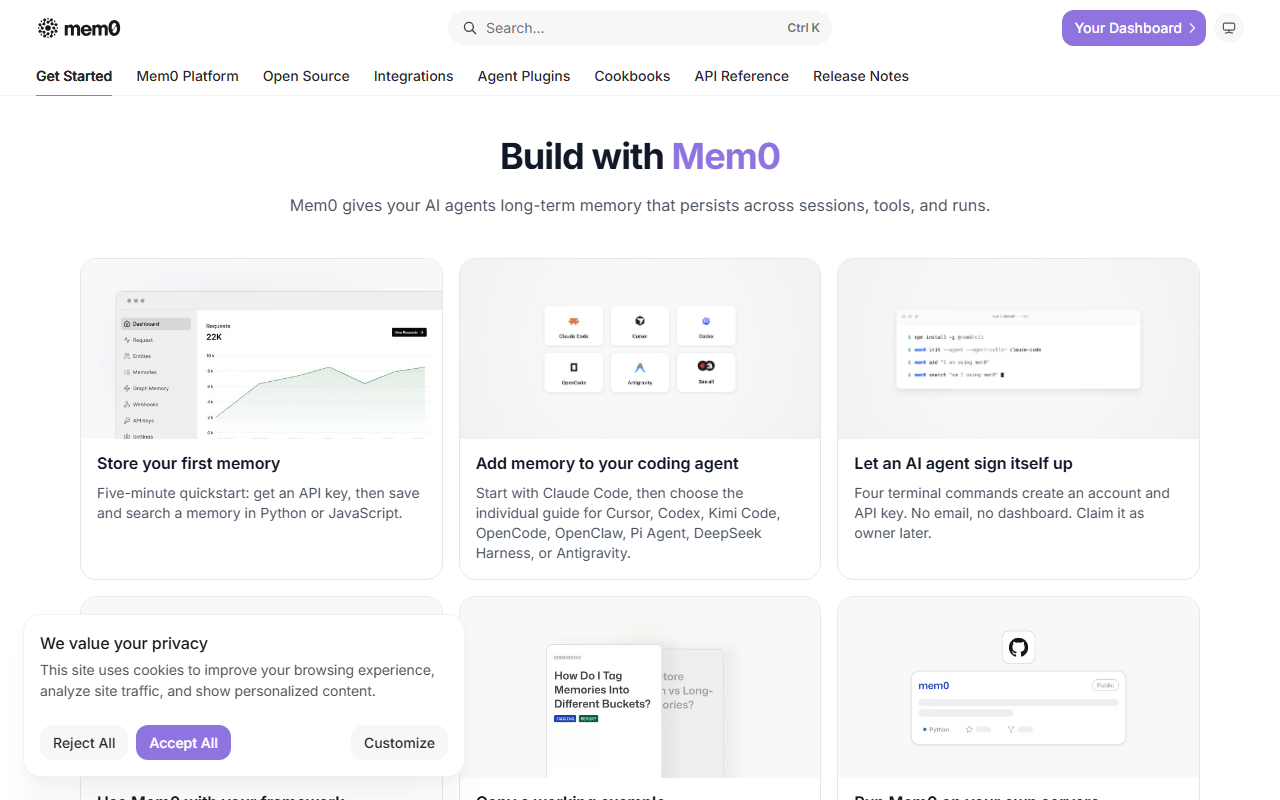
The docs give the open-source side its own reasons to exist: full data control, a choice of 25 vector stores, 18 LLM providers and 11 embedders at the time of writing, local models through Ollama, a codebase you can modify, and no usage-based billing.
Scenario: starting on your own machine
pip install mem0ai for Python or npm install mem0ai for Node.OPENAI_API_KEY; the default model is gpt-5-mini and the default embedder is text-embedding-3-small./tmp/qdrant, a SQLite history file at ~/.mem0/history.db, and no reranker until you configure one. A temporary folder is a poor home for data you want to keep, so set a persistent path first; that last point is JAVIS's reading, not a docs statement.Memory.from_config to change the model, embedder, vector store or reranker, for example to a local Ollama model.server/ folder is started with make bootstrap; its defaults use Postgres with pgvector and bundle OpenAI, Anthropic and Gemini providers.Built from the Open Source Overview page of docs.mem0.ai, 16 Oct 2026. An illustration of the documented steps, not a record of a JAVIS run.
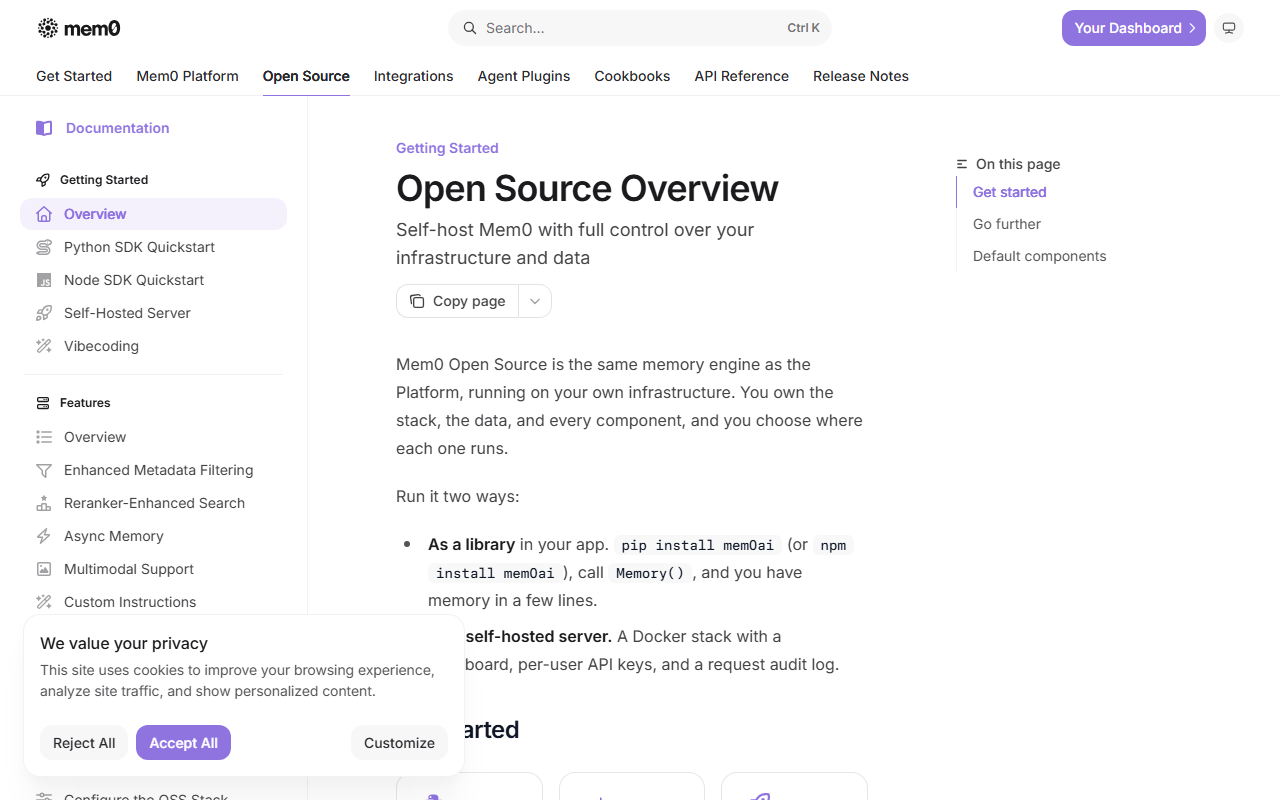
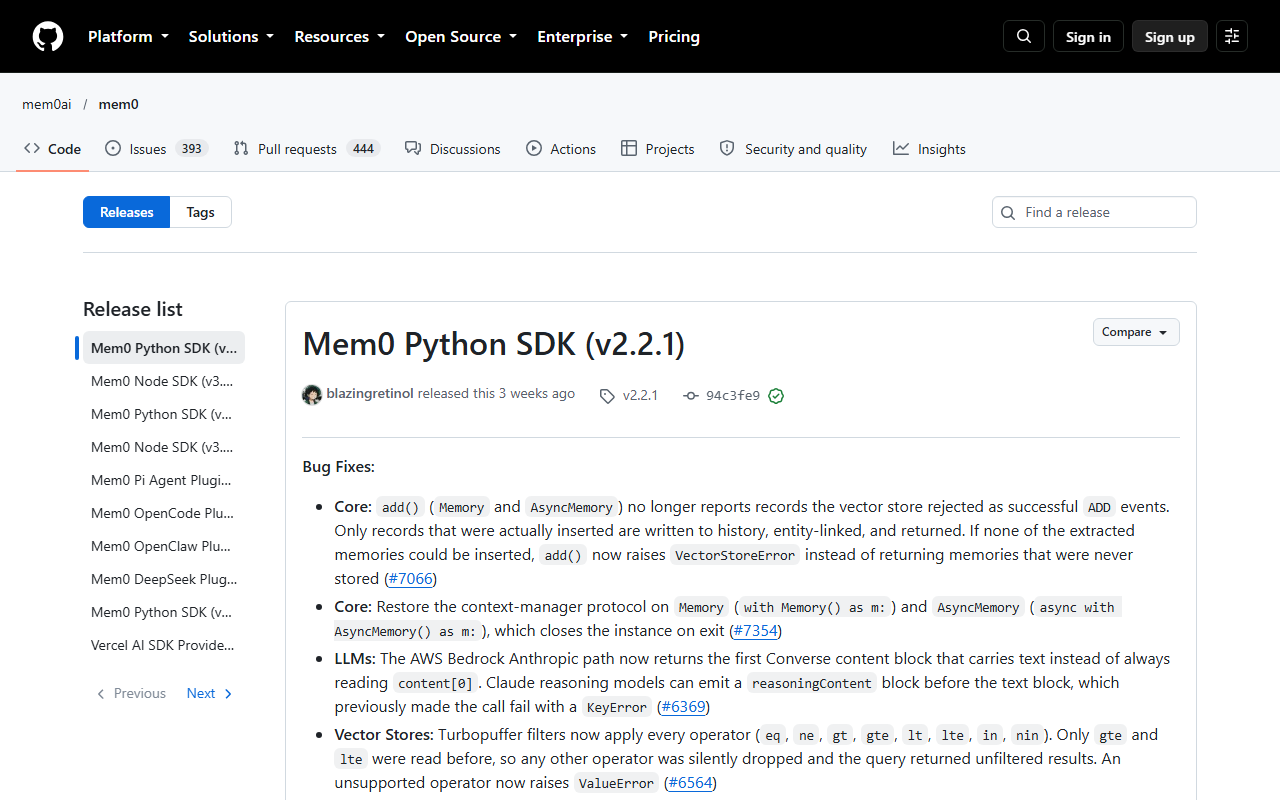
One more change to know about: Python v2.0.0 (16 Apr 2026) removed support for external graph stores such as Neo4j and replaced it with built-in entity linking. The release notes say about 4,000 lines of graph driver code were removed. If you built on the old graph option, the migration guides for open source and the Platform describe the upgrade; the project shipped 23 Python v2 releases between 16 Apr and 25 Sep 2026, which is active but also means frequent change.
Prototype on the free tier or the library, move to the hosted plans only for the features you can name, and price your retrieval volume first.
One call to store, one call to search, with entity linking and hybrid retrieval doing the ranking.
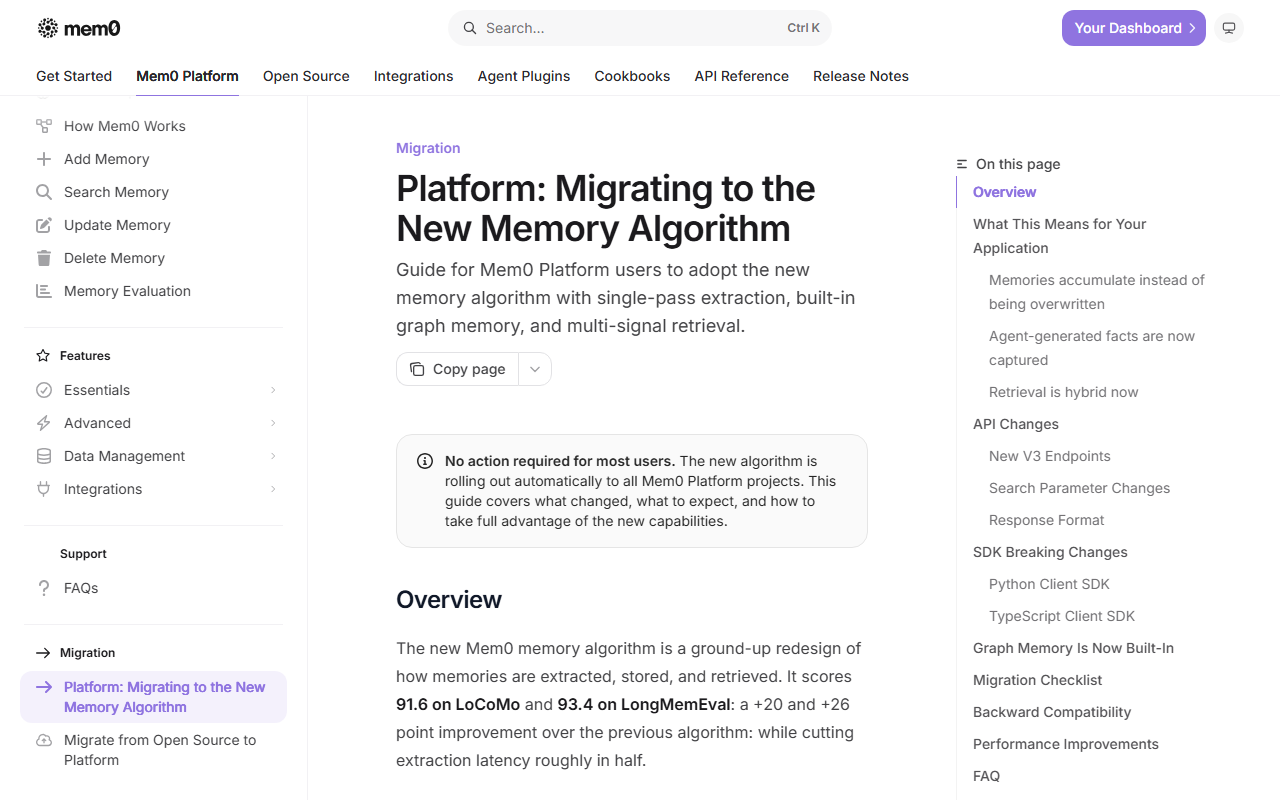
The home-page example is four lines: create a MemoryClient, add a short exchange for a user ID, then search with that user ID as a filter. Per the Python v2.0.0 release notes, extraction is a single LLM call that only adds, so facts are not overwritten; agent-generated facts such as a confirmed booking are stored too; and search fuses semantic similarity, BM25 keyword matching and entity matching into one score.
The same notes say hash-based deduplication prevents exact duplicates, and that ranking at retrieval time handles the rest. That design choice explains both the claimed gains and the user reports above: nothing is lost, but old and new versions of a changing fact can sit side by side.

Add after each exchange, search before each reply, and review what was stored.
An illustrative workflow built from the documented features, not a record of a JAVIS run.
A hosted MCP server and plugins for Claude Code, Cursor and other coding agents.
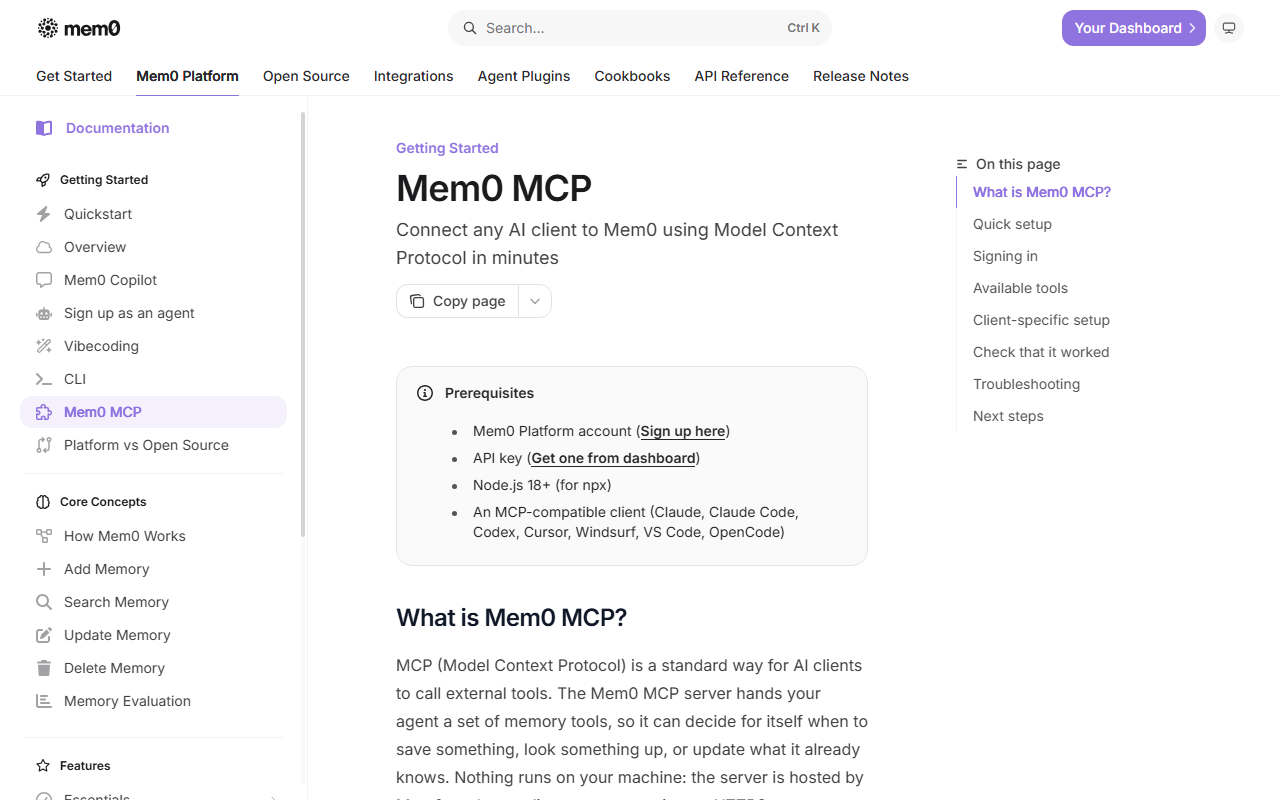
Mem0's docs describe a hosted MCP server at mcp.mem0.ai that gives an AI client memory tools; it needs a Mem0 Platform account and API key, and memories live in your Mem0 account, not on your computer. The docs list Claude, Claude Code, Codex, Cursor, Windsurf, VS Code and OpenCode as supported clients. They also describe guides for LangChain, CrewAI, LlamaIndex and the Vercel AI SDK, and a flow where an AI agent can sign itself up from the terminal.
Scenario: giving Claude Code and Cursor a memory over MCP
npx, and an MCP-capable client such as Claude, Claude Code, Codex, Cursor, Windsurf, VS Code or OpenCode.npx mcp-add --name mem0-mcp --type http --url "https://mcp.mem0.ai/mcp" --clients "claude code,cursor". The helper writes the server into each named client's own config file; list only the clients you use. Claude Desktop rejects this command and is added through its Settings instead.Built from the Mem0 MCP page in docs.mem0.ai, 16 Oct 2026. An illustration of the documented steps, not a record of a JAVIS run.
The server exposes eleven tools: add, search, get one, get many, update, delete one, delete all, delete entities, list entities, list events and check an event's status. Two of those can erase a lot at once, delete_all_memories and delete_entities, so check what your client lets the agent call without asking. The data lives in your Mem0 account, not on your computer.
The plugin route is different. The docs describe a Claude Code plugin (version 0.3.1) that captures evidence locally through lifecycle hooks, extracts memories in a background worker, and exposes one local search tool plus six slash-command skills; the portable plugin package provides search and skills but no automatic capture.
Scenario: wiring memory into an agent framework
For code you own, the docs list integration guides rather than a single path. The guides for LangGraph, CrewAI, AutoGen and the OpenAI Agents SDK are marked Platform-only, while LlamaIndex, n8n, Zapier and the Vercel AI SDK are marked for both. In a LangGraph app you would call search inside a node before the model call and add after it, keyed by user ID; the same pattern applies in the other frameworks, only the hook point changes. If you are choosing a framework at the same time, JAVIS has reviewed LangGraph, CrewAI, the OpenAI Agents SDK and n8n.
Where the data lives is the other thing to settle. With the Python or Node library it is your vector store and your history database; with the self-hosted server it is your own infrastructure; with the hosted API and SDK it is Mem0's platform; with the hosted MCP server it is your Mem0 account (docs.mem0.ai, the Mem0 README and the MCP page, 16 Oct 2026).
Large gains on Mem0's own tests, and a newer ranking that Mem0 built and that does not always favor Mem0.
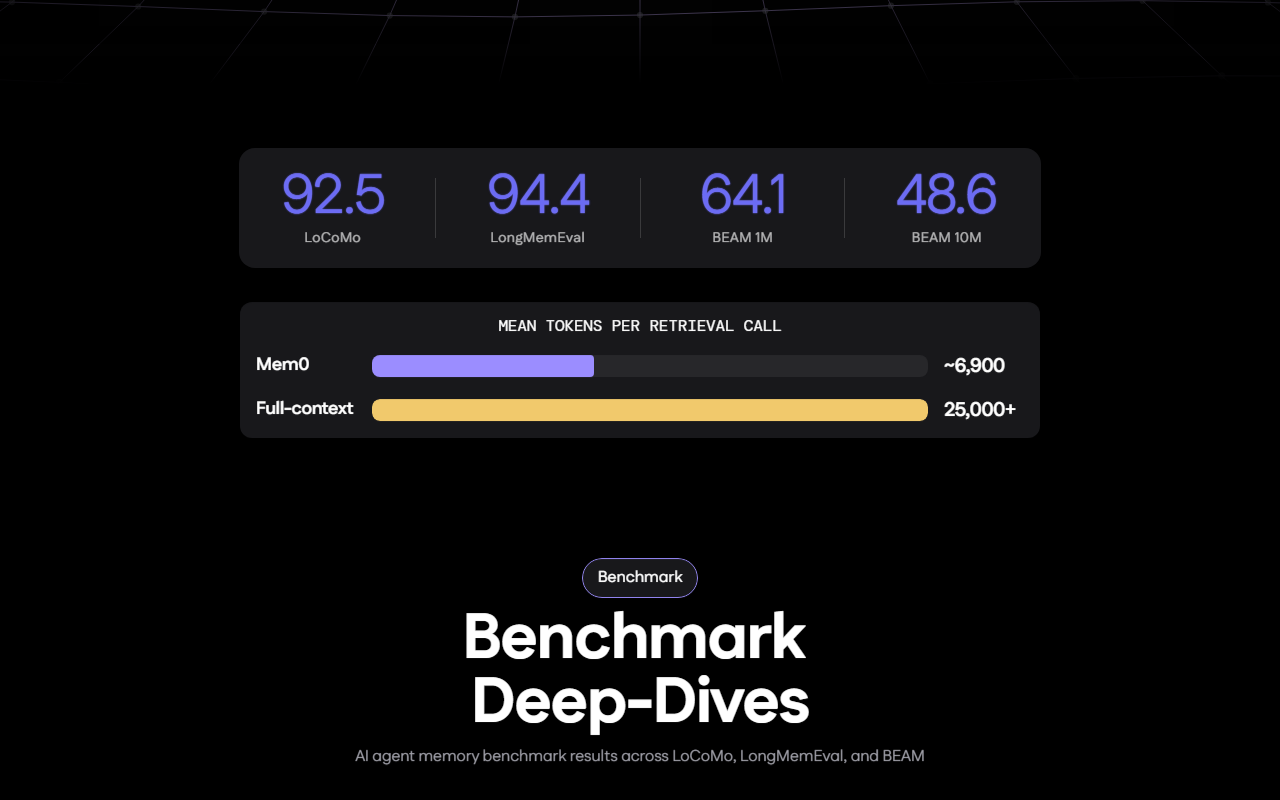
The README and the research page report a new algorithm from April 2026 scoring 92.5 on LoCoMo and 94.4 on LongMemEval, up from 71.4 and 67.8, at about 6,900 tokens per retrieval against 25,000 or more for passing the full history. The README adds that the scores reflect Mem0's managed platform, which includes optimizations not available in the open-source SDK, and links an open evaluation framework. The platform migration guide still quotes 91.6 and 93.4 for the same two tests, so the pages do not agree either.
README and research page; vendor-run, up from 71.4
README; vendor-run, up from 67.8
README; vendor-run
Research page, versus 25,000+ full history
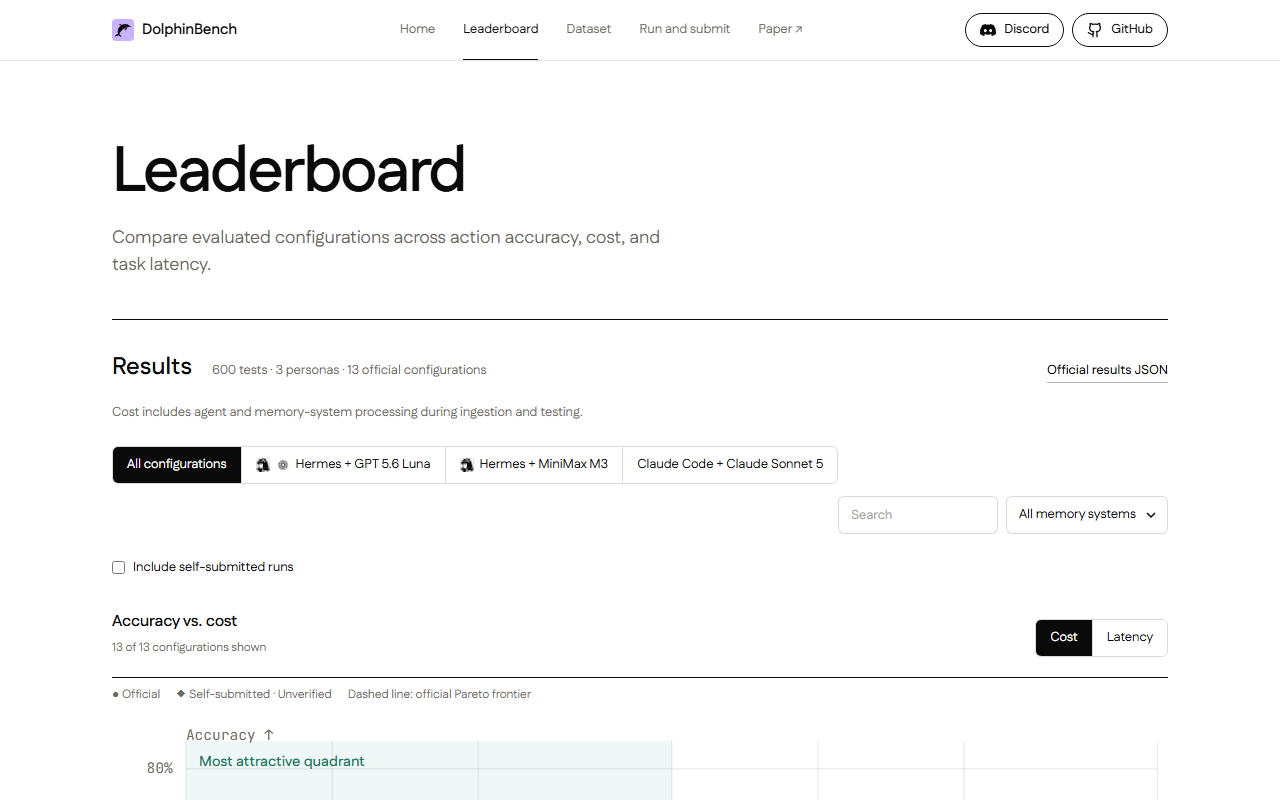
Zep, a competitor, published a post on 6 May 2025 (updated 3 Jun 2026) arguing that Mem0's earlier published comparison misconfigured Zep and that Zep scores higher on LoCoMo. Both sides are vendors and neither is independently reproduced here. A 2026 Mem0 announcement adds DolphinBench, a 600-task benchmark where agents must act on remembered facts, with results for five memory options across three agent setups. Mem0 authored it, and its official results page lists accuracy, total cost and median latency:
Swipe the table sideways to see every column.
| Setup | Memory | Accuracy | Total cost | Median latency |
|---|---|---|---|---|
| Hermes + GPT 5.6 Luna | Built-in | 65.67% | $61.48 | 44.35 s |
| Mem0 | 70.67% | $96.21 | 37.69 s | |
| Hindsight | 69.50% | $84.65 | 55.31 s | |
| Honcho | 68.50% | $142.85 | 44.66 s | |
| Supermemory | 59.17% | $345.64 | 52.68 s | |
| Hermes + MiniMax M3 | Built-in | 26.50% | $107.03 | 51.40 s |
| Mem0 | 47.83% | $148.02 | 46.95 s | |
| Honcho | 47.33% | $211.85 | 80.33 s | |
| Hindsight | 41.00% | $158.33 | 144.28 s | |
| Supermemory | 20.00% | $497.70 | 137.5 s | |
| Claude Code + Sonnet 5 | Built-in | 26.33% | $1,132.75 | 32.19 s |
| Mem0 | 32.33% | $1,830.57 | 42.30 s | |
| Honcho | 35.83% | $1,565.82 | 37.92 s |
Read it for the cost columns as much as the accuracy. In the Hermes with GPT 5.6 Luna setup Mem0 scored 5 points above the agent's built-in memory and cost about 56% more in total ($96.21 against $61.48). In the Claude Code setup Mem0 scored 6 points higher than built-in memory, cost about 62% more ($1,830.57 against $1,132.75), and was behind Honcho on accuracy. In the Hermes with MiniMax M3 setup Mem0 scored 47.83% against 26.50% for built-in memory, about 21 points more, at $148.02 against $107.03, about 38% more. A memory layer can raise accuracy, but in Mem0's own table it also raises the bill, and the winner depends on the model and harness.
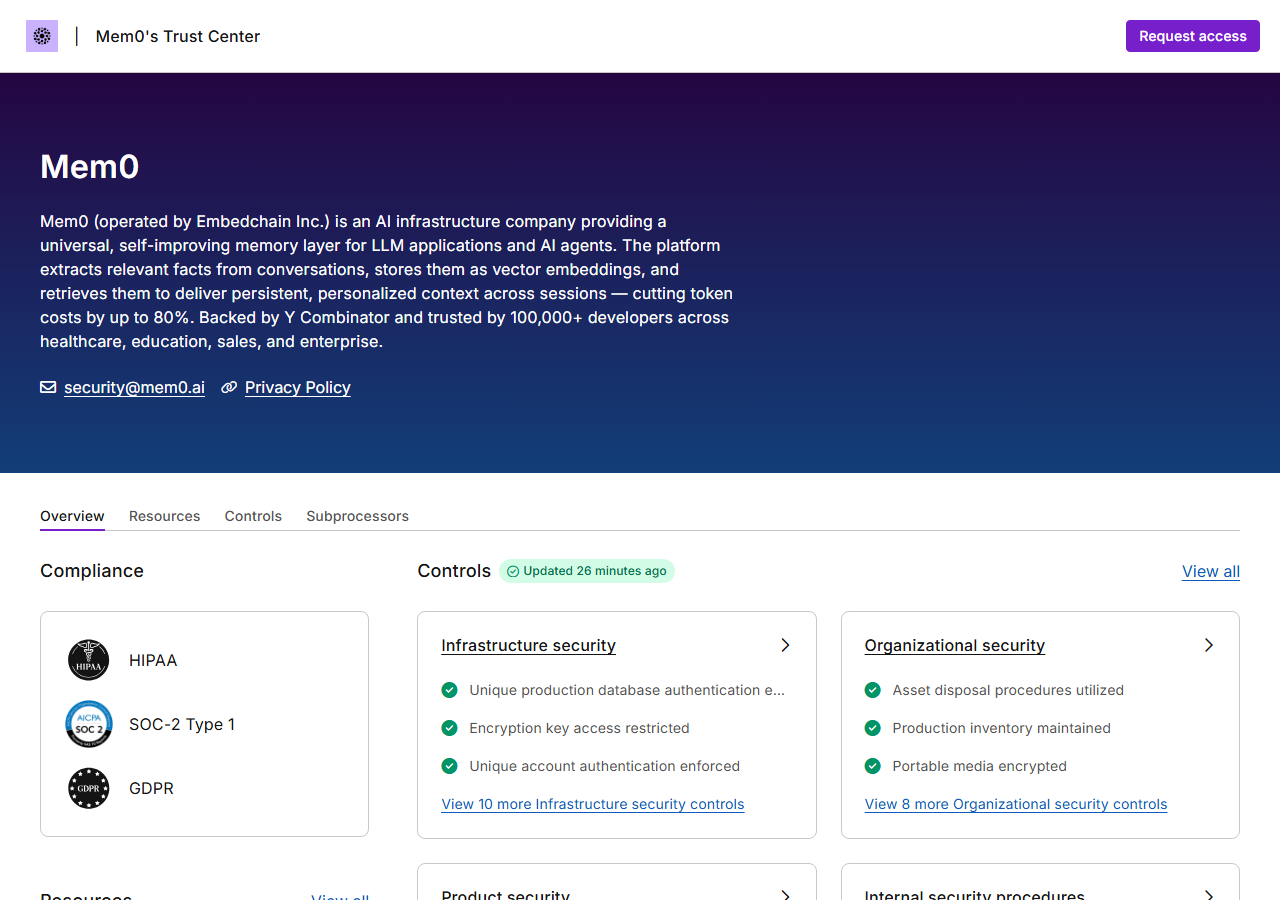
SOC 2 Type I and HIPAA and GDPR claims on the Trust Center, US hosting on AWS, and a wording gap between “compliant” and “ready”.
Mem0's Trust Center lists HIPAA, SOC-2 Type 1 and GDPR, with documents such as a SOC-2 Type-1 report, a HIPAA self-attestation, a penetration test summary and a data processing agreement available through the site, some on request. It names Amazon Web Services (US) as infrastructure hosting and lists Vercel, Slack and Linear among subprocessors. The home page says Mem0 is “SOC 2 (Type 1), HIPAA, and GDPR compliant”, while its footer says “HIPAA Ready”, “SOC 2 Type I” and “GDPR Ready”. Zep's pricing page, by comparison, lists SOC 2 Type II and a HIPAA BAA for its Enterprise tier; Type I describes controls at a point in time and Type II tests them over a period.
Here is what the sources say, question by question, and what to do about each one.
Which SOC 2 report? Type 1 on the Trust Center and in the footer. Ask for the report if you need Type II.
Where is data hosted? On AWS in the US, per the Trust Center subprocessor list. Ask about regions if you need the EU.
Are there audit logs? The pricing page lists audit logs under Enterprise only, while the Platform overview docs say they ship by default. Confirm for your plan.
Can it run on-premises or air-gapped? The pricing page lists on-prem under Enterprise; the home page mentions Kubernetes, private cloud or air-gapped deployment. Ask sales for specifics.
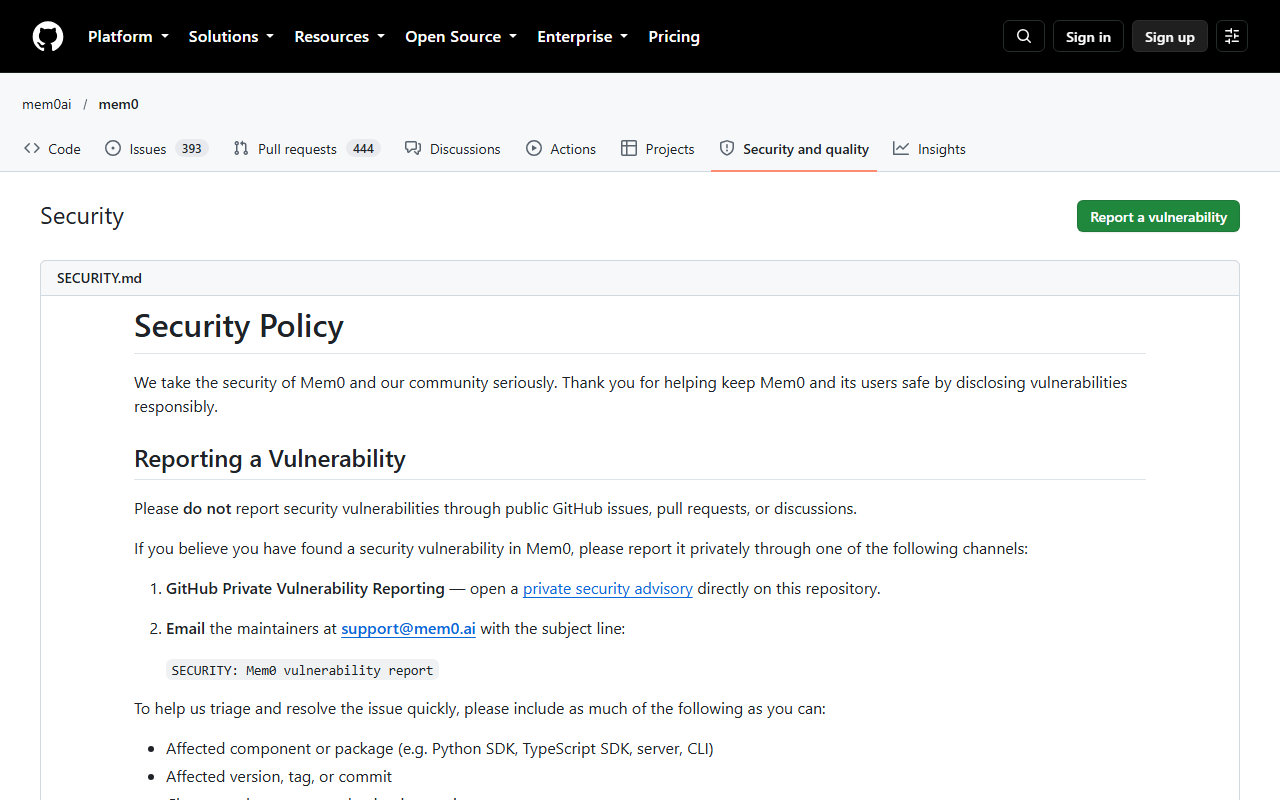
Are vulnerabilities published? GitHub shows no published security advisories, and SECURITY.md promises a reply within 72 hours. No advisories is not proof of no flaws.
Is the service up? The status page showed all systems operational on 16 Oct 2026, with uptime of 99.98% to 100.00% over the window it displays. Check it again before you rely on it.
Sources: Mem0 Trust Center, home page, pricing page, docs, GitHub security page and status page, as of 16 Oct 2026.
We have not reviewed Mem0's privacy policy, terms or data processing agreement, and we have not audited any control. Check them yourself before sending personal, health or confidential data. In the 2024 launch thread a Mem0 co-founder said the company was not yet fully GDPR-compliant; the current pages say otherwise, and the difference is worth asking about directly.
Developers who want a ready memory layer they can start free and, if needed, host themselves.
- Developers adding user memory to a chatbot or agent who want an open-source starting point
- Teams that want to prototype free and decide on hosting later
- Coding-agent users who want memory through MCP or plugins
- Buyers who value an Apache-2.0 license
- Teams that need an independent star rating or customer reviews before buying
- Anyone who needs SOC 2 Type II or an EU data region confirmed today
- Apps where a stale fact is costly and memories must be overwritten cleanly
- Buyers who want a gradual price ladder between $19 and $249
A steep ladder, vendor-run numbers, mixed user reports and pages that disagree.
$19 to $249 a month, with graph memory, Dream, analytics and Slack only from Pro.
The pricing page gives no rate for going over a limit and no annual price.
LoCoMo, LongMemEval, BEAM and DolphinBench figures are published by Mem0.
Open GitHub issues report old and new facts coexisting after the add-only change.
Developer counts, benchmark scores and audit-log availability differ between Mem0's own pages.
SOC 2 Type I, and “compliant” on one page versus “ready” on another.
No Trustpilot page, no verified G2 or Capterra score, and few dated user accounts.
23 Python v2 releases in about five months and a graph-store removal.
JAVIS did not run it for this review.
Zep and Letta on price, Pinecone as a store, and two frameworks with memory built in.
| Product and when to pick it | What the source says (16 Oct 2026) | JAVIS review |
|---|---|---|
| Mem0 A drop-in memory layer, open source or hosted | Free; $19 and $249 a month; Enterprise custom; Apache-2.0 library | This article |
| Zep Memory with a context graph and credit-based billing | 10,000 free credits a month; Flex $125 a month billed monthly with 50,000 credits, then $25 per 10,000; Flex Plus $375 a month; page also shows an annual option labelled 17% off | Not reviewed yet |
| Letta A stateful agent platform with memory built in | Free with limited agents (up to 3 stateful agents); Pro $20 a month with up to 20; developer plans usage-based | Not reviewed yet |
| Pinecone A managed vector database under your own memory logic | Mem0 docs list it as a supported store. Pinecone's pricing page: Starter free, Builder $20 a month flat, Standard $50 a month minimum, Enterprise $500 a month minimum | Pinecone review |
| LangGraph Memory inside the agent framework you already run | Its docs show a long-term store (in-memory for development; Postgres, MongoDB, Redis and Oracle examples) with optional semantic search; your node code decides what to save | LangGraph review |
| CrewAI Memory inside a multi-agent crew | Its docs describe a built-in Memory class where a model infers scope, categories and importance. Its hosted platform page lists a free Basic plan with 50 workflow executions a month and custom Enterprise pricing; that pricing is for running workflows, not for memory | CrewAI review |
| Other vector stores Roll your own memory on a database | Mem0 docs list Qdrant, Chroma, Pinecone and Weaviate among supported stores | Qdrant, Chroma, Weaviate |
| LlamaIndex A retrieval framework that Mem0 integrates with | Mem0 docs include a LlamaIndex integration guide | LlamaIndex review |
How they differ on price: Mem0 meters add and retrieval requests with a $19 and $249 ladder, Zep meters credits per stored episode starting at $125 a month on its paid tier, Letta sells agent seats and usage rather than a memory API, and Pinecone sells storage and queries with no extraction at all. Other names in the category, including Honcho, Hindsight, Supermemory, Cognee and LangMem, are not reviewed by JAVIS and their prices are not verified here.
Which one when: three short cases
You already run LangGraph or CrewAI and want the least new infrastructure. Start with the framework's own memory. LangGraph's docs show the pattern of compiling a graph with a store, saving items under a namespace such as a user ID plus the word memories, and searching them; the code that decides what is worth saving is yours. Add Mem0 only if you want a service to do that extraction for you, which the Mem0 docs support through their LangGraph and CrewAI guides (both marked Platform-only).
You want a free start with nothing to host. Mem0's Hobby plan or Zep's 10,000 free credits a month. Count your searches first: Mem0's 1,000 free retrievals are the tighter limit, as the worked examples above show.
You want to own the whole stack. The Mem0 library with a store you choose (Qdrant by default; Pinecone, Chroma and Weaviate are listed), or a vector database plus your own extraction code. You then budget the model calls and hosting yourself.
This review has no affiliate links, and Mem0 did not see it.
JAVIS has no approved Mem0 affiliate link, so every Mem0 link in this article goes straight to mem0.ai, with no tracking parameters.
Hands-on status: JAVIS has not signed up for, installed or paid for Mem0 for this review. Facts come from Mem0's own pages, its documentation, Trust Center and GitHub repository, plus TechCrunch, Hacker News, GitHub discussions, an independent source-level analysis, the Zep, Letta, Pinecone and CrewAI pricing pages and the LangGraph and CrewAI memory docs, as of 16 Oct 2026. Independent review evidence is limited, as described above.
Start on the free plan or the library with one small agent.
Open mem0.aiThe plan tables above come from the pricing page.
Open the pricing pageBuilding with memory and retrieval? These reviews cover the nearest ground.
Each card opens a published JAVIS review.

Questions people actually ask before paying
How much does Mem0 cost in October 2026?
Per mem0.ai/pricing on 16 Oct 2026: Hobby free, Starter $19 a month, Pro $249 a month, Enterprise custom. No annual price or overage rate is shown.
Is there a free plan?
Yes: Hobby is permanently free with no card, 10,000 add requests and 1,000 retrieval requests a month, 1 project, unlimited end users and community support.
Is Mem0 open source?
The library is Apache-2.0 licensed per its GitHub repository. Some features, including memory decay, temporal reasoning and Dream, are documented as Platform-only.
What counts as an add or retrieval request?
Per the pricing FAQ, an add request is when Mem0 processes and stores a new memory; a retrieval request is when your agent queries Mem0 for relevant memories. Both are counted separately.
Does it work with Claude and Cursor?
Yes, through a hosted MCP server and agent plugins, per the Mem0 docs. A Mem0 Platform account and API key are needed for the MCP server.
What do users say?
There is no Trustpilot page and no verified G2 or Capterra score. Hacker News comments from 2024 to 2026 are mixed, and several GitHub issues about contradictory memories are open.
Is it SOC 2 certified?
The Trust Center lists SOC-2 Type 1, HIPAA and GDPR. It does not list SOC 2 Type II.
Is Mem0 an affiliate product here?
No. This review has no affiliate links.
Where this came from, and when.
Pricing and plans: mem0.ai/pricing and its FAQ, 16 Oct 2026.
Product and claims: mem0.ai home, About and research pages, the DolphinBench blog post and leaderboard, the Mem0 docs (introduction, Platform vs Open Source, Open Source overview, Platform overview, MCP page, migration guide), the Trust Center and the status page, 16 Oct 2026.
Repository facts: the mem0ai/mem0 GitHub repository, its releases and its security page, 16 Oct 2026: 67,235 stars, 7,918 forks, 393 open issues and 444 open pull requests, Apache-2.0, 23 Python v2 releases from 16 Apr to 25 Sep 2026. Download counts are from pypistats and npm.
Independent evidence: Hacker News, comments dated 4 Sep 2024 (comments 41451230, 41449118, 41451183), 5 Sep 2024 (41452729), 24 Nov 2025 (46032522), 27 Nov 2025 (46067975), 14 Apr 2026 (47770220) and 30 Sep 2026 (49910693), and the Show HN launch thread of 4 Sep 2024 (item 41447317); GitHub issues 4956, 5867 and 5245; GitHub discussions 4289 and 4787; the Synix article "Agent Memory Systems: A Source-Level Analysis of Eight Architectures" by Mark Lubin, 16 Feb 2026; pypistats and npm download counters; TechCrunch, 28 Oct 2025; Zep's blog post of 6 May 2025, updated 3 Jun 2026. Trustpilot has no page for mem0.ai, and G2 and Capterra scores are not quoted.
Images: sixteen photographs of public pages taken by JAVIS on 16 Oct 2026 (Mem0 home, About, pricing twice, research and Trust Center pages, five docs pages, the DolphinBench leaderboard, three GitHub pages and the Hacker News launch thread), plus Mem0's own social image, labelled as vendor material. Related cards use JAVIS's own featured images.
Video: one video from the official Mem0 YouTube channel, linked from the 2024 launch post.
Competitors and neighbours: Zep prices from getzep.com/pricing, Letta prices from docs.letta.com/pricing, Pinecone prices from pinecone.io/pricing and CrewAI platform prices from crewai.com/pricing, as of 16 Oct 2026; LangGraph and CrewAI memory details from their documentation. The usage examples in the Real cost section are arithmetic on the published plan limits with invented traffic.
Store ratings: none included; Mem0 has no mobile app.
JAVIS Fit Score (67/100): an editorial composite scored out of 20 on five criteria. Price clarity 14: a clear public ladder, but no overage or annual price and a steep $19 to $249 step. Capability breadth 16: library, server, hosted API, MCP, plugins and many integrations. Independent evidence 11: mixed dated comments, no star rating, mostly vendor-run benchmarks. Security and data control 13: SOC 2 Type I, self-hosting and no published advisories, but US hosting and wording gaps. Cost control and fit 13: a real free tier and open source, but a steep ladder. It is judgment, not a measurement.
What this review does not cover: real extraction quality, latency or cost under your workload, the privacy policy and data processing agreement, a technical security review, and the other memory vendors beyond the Zep, Letta, Pinecone and CrewAI prices quoted.