
Modal Review 2026: Per-Second GPUs and Fast Sandboxes, With Fine Print on Idle Time and Multipliers
Modal lets a Python developer put a decorator on a function and run it on an H100, a fleet of sandboxes or an inference endpoint, paying by the second. As of Oct 30, 2026 the Starter plan is $0 with $30 of compute a month, Team is $250 a month, and the company has just raised $750 million. This review works out what a real month costs, where the multipliers hide and who should build on it.

There are no affiliate links in this review. Every Modal link goes straight to modal.com or its documentation.
| Made by | Modal Labs (CEO Erik Bernhardsson); team in NY, SF, Stockholm |
| What it is | Python-first serverless cloud for GPUs, sandboxes, inference and training |
| Pricing | Starter $0 + compute ($30 credit); Team $250/mo; H100 $3.95/hr |
| Catch | Idle window billed; multipliers; cold starts; tokens outside credit |
| Evidence | Status page; 8 Trustpilot reviews (2.8); Hacker News |
Modal is the most developer-friendly way to rent GPUs and sandboxes by the second, as long as your traffic is bursty and you read the multipliers before you pin a region.
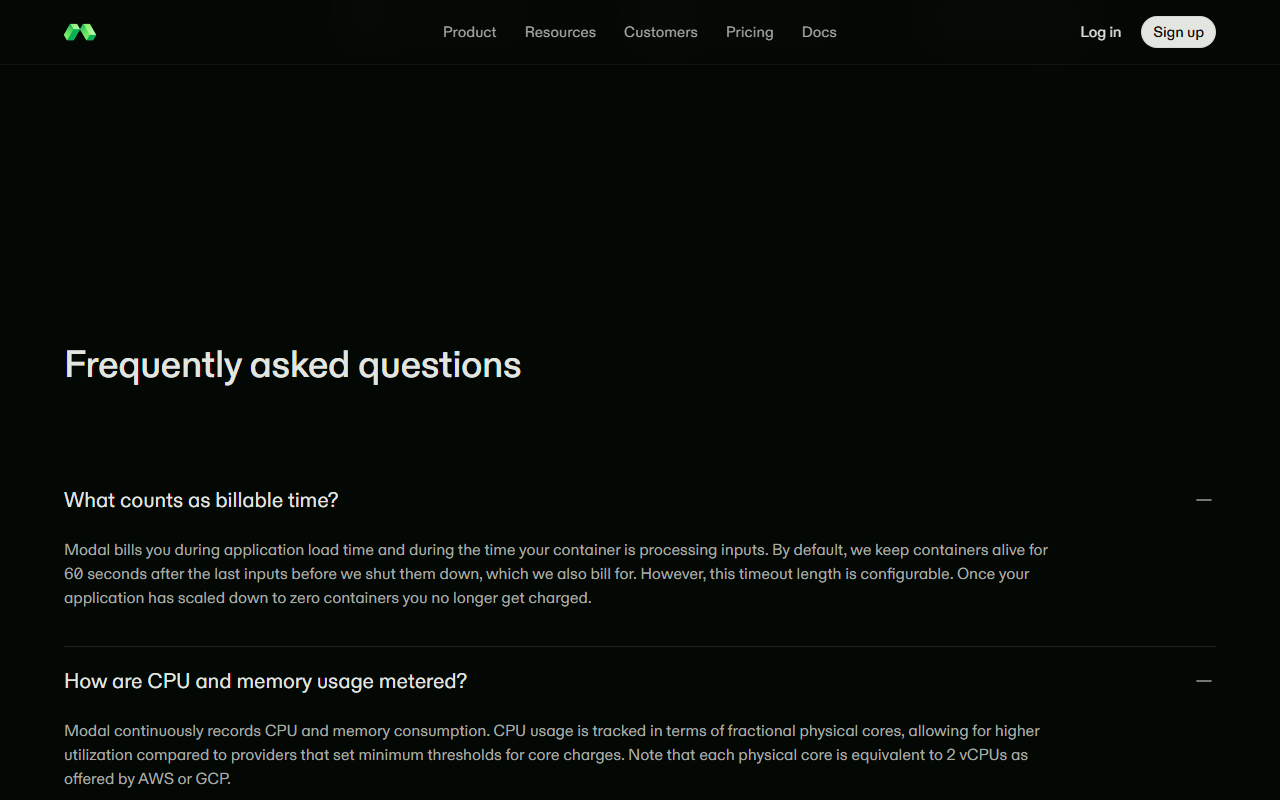
“Once your application has scaled down to zero containers you no longer get charged.” That line from Modal's pricing FAQ is the whole pitch, and the sentence before it is the whole catch: containers stay alive, and billed, for 60 seconds after the last input by default.
Modal is a serverless cloud you drive from Python. You decorate a function with the hardware it needs (@app.function(gpu="H100")), run modal deploy, and Modal builds the container, finds a GPU in a capacity pool it says spans more than 20 clouds, and bills per second: $3.95 an hour for an H100, $1.95 for an L40S, $0.59 for a T4, plus CPU at $0.0473 per physical core-hour and memory at $0.0080 per GiB-hour, all as of Oct 30, 2026. On top of plain functions it now sells Sandboxes for agent and untrusted code, Shared and Dedicated inference Endpoints, multi-node Clusters and, since Oct 22, 2026, Spindle, an open-source training server.
Three things deserve a decision before you commit. First, the list price is not the whole price: pinning a region multiplies the bill by 1.15x (broad, such as us) or 1.75x (narrow, such as us-west); Sandboxes and other non-preemptible work pay 3x the CPU and memory rate; and idle time after each burst is billed. Second, the free credit is narrower than it was: since Sep 1, 2026 per-token Shared Endpoints are billed from the first request and cannot use the $30 Starter or $100 Team credit. Third, cold starts are fast for the industry but not instant: Modal's docs say containers boot in about a second, yet users on Hacker News describe 20 to 30 second spinners and multi-minute boots when big models load, which you either engineer around or pay to keep warm.
Not a hands-on test: JAVIS has not created a Modal account or run a workload. This review is built from Modal's pricing page, docs, blog, status page and trust center, competitors' pricing pages, Trustpilot and Hacker News, all as of Oct 30, 2026 unless a date is given. Cost examples are invented workloads with the arithmetic shown.
Write Python, name the hardware, deploy; Modal finds the GPU, scales to zero and bills by the second.
Everything starts in code. A function, class or web endpoint declares its image, GPU type and count (up to eight GPUs per container, four for A10), and Modal runs it in containers that scale up with requests and back down to zero when idle. Inputs route through Modal's servers in Virginia (us-east) by default; you can route through us-west or eu-west instead, or pin where containers run, for a price. The same primitives power Sandboxes (isolated containers or, since Oct 1, 2026, full Linux VMs for agents), Endpoints (OpenAI-compatible model serving) and Clusters (multi-node training with RDMA).
From a reported $1.1 billion valuation in 2025 to $15.75 billion in Oct 2026, with Sandboxes as the surprise growth engine.
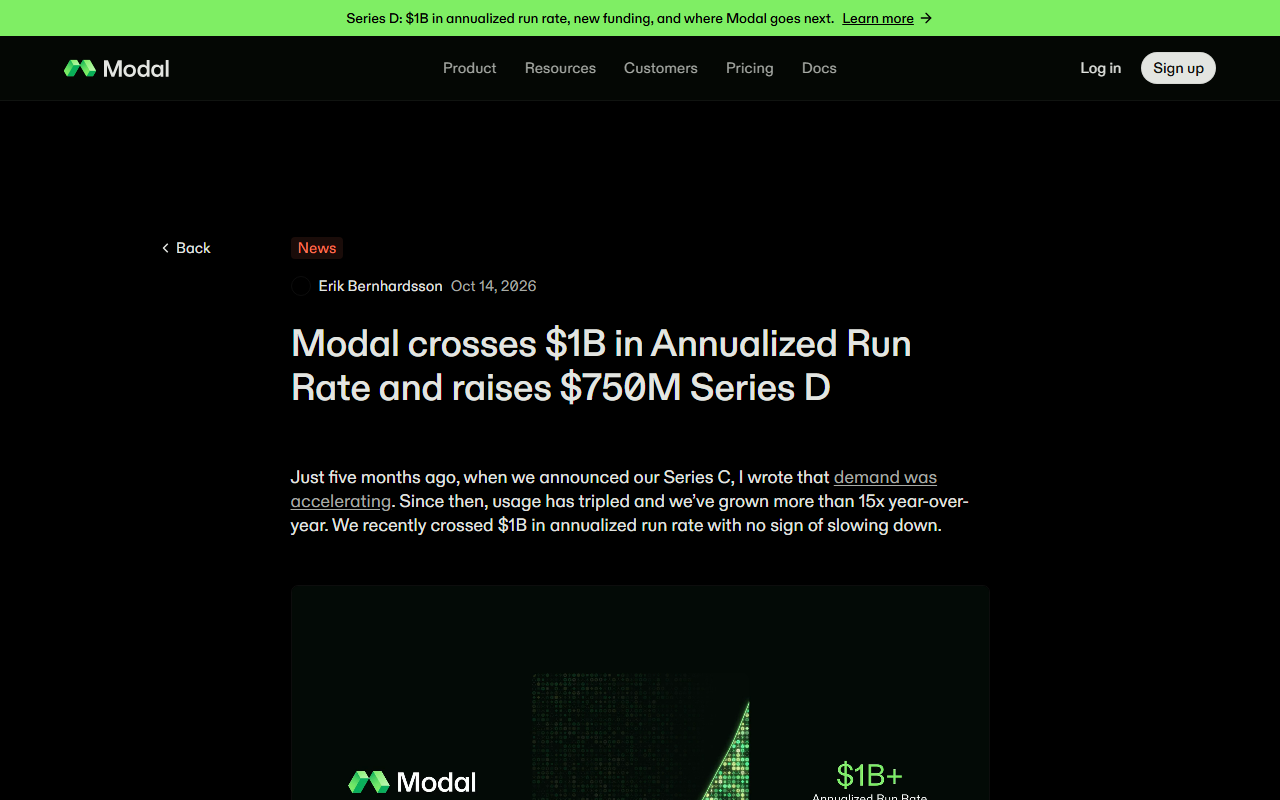
Modal was started about five years ago by CEO Erik Bernhardsson. Its pitch has stayed the same: replace YAML, Kubernetes and GPU procurement with a Python SDK and its own file system, container runtime and scheduler. On Oct 14, 2026 Bernhardsson wrote that Modal had crossed $1 billion in annualized run rate, that usage had tripled in the five months since its Series C, and that growth was more than 15 times year over year. The same post announced a $750 million Series D at a $15.75 billion post-money valuation, led by Accel with Kleiner Perkins joining. The Series C in May 2026 was reported at $355 million and a $4.65 billion valuation. Run rate is the company's own annualized figure, not audited revenue.
Sandboxes are the surprise. Modal says the product, launched in 2023 when it noticed people running LLM-generated code, is now a $300 million run-rate business on its own, with close to 3 billion sandboxes created. Customers named in the post include Cognition, Ramp, Linear and Hebbia for background agents, Runway for video, Suno for music, and 1X and Physical Intelligence for robotics. The team was 200+ people across New York, San Francisco and Stockholm, and Modal announced a London office on Sep 2, 2026. Press reports put its Sep 2025 Series B valuation at $1.1 billion.
Developers praise the speed and the Python ergonomics; complaints are about billing surprises, support and cold starts. The samples are small.
Modal's Trustpilot profile is unclaimed and has 8 reviews averaging 2.8 as of Oct 30, 2026 (two 5-star, one 4-star, one 3-star, four 1-star), too few to rate the service; Modal has not invited reviews there. Hacker News has more developer comments, mostly short asides in threads about GPUs. Claims below are individual accounts we cannot verify.
“Modal has the fastest cold-start I've seen for 10GB+ models.”
“cold start was what eventually pushed me off modal for a request-response use case. the user is staring at a spinner for 20-30s on first invocation”
A student team that moved a GPU demo from Azure: “In just two days, we spent over $250 on GPU compute”, then on Modal “the same workloads for under $100”.
“They give us GPUs on-demand ... Pricing is about $2/hr per GPU (as a baseline of the costs). Long story short, things get VERY expensive quickly.”
“they spam me with ‘billing cycle spend limit reached’, when i spent 0.01$. Support doesnt exist, Slack is full of just bot replies”
“Overall a very good product. I just wish I could detach a run after it was submitted.” (The reviewer refers to the CLI's --detach flag.)Three plans that differ in credit, limits and governance; the compute rates are the same on all of them.
As of Oct 30, 2026, modal.com/pricing lists one per-second rate card for everyone and three plans layered on top. You never pre-buy credits; usage is pay as you go and invoiced, with the plan's included credit taken off first.
- $30 of compute a month
- 3 seats, 100 containers, 10 GPUs at once
- 1-day log retention, 5 cron jobs
- Community Slack support
- $100 of compute a month
- Unlimited seats, 5,000 containers, 50 GPUs
- 30-day logs, rollbacks, custom domains, RBAC
- Static IP proxy, environment budgets
- Volume discounts, higher GPU concurrency
- HIPAA, audit logs, Okta and SAML SSO
- Private Slack, embedded ML engineers
- Pay through AWS or GCP marketplace
- CPU $0.00003942 per core a second
- Memory $0.00000667 per GiB a second
- GPU at the standard rate
- Non-preemptible by design


The multipliers in the comparison table
The rate card is the base. The plan comparison adds two multipliers that apply on every plan: region selection at 1.15x to 1.75x of base prices, and non-preemptible execution at 3x. Modal's region docs spell out the first: a broad region such as us or eu costs 1.15x, a narrow one such as us-west or uk costs 1.75x, applied to GPU, CPU and memory together. The pricing FAQ explains the second: Functions can be preempted by default, while Sandboxes cannot, so Sandboxes pay three times the CPU and memory list price. Leave the region unset if you can; it is also the bigger pool, so cold starts are shorter.


What counts as billable time
The FAQ is precise: Modal bills while your application loads and while a container processes inputs, and by default keeps each container alive 60 seconds after the last input, which is also billed. The window is configurable from 2 seconds to 20 minutes. CPU and memory are billed on whichever is higher, what you request or what you use, with a floor of 0.125 cores and 128 MiB per container. AWS, GCP and Azure credits cannot be spent on Modal, though Enterprise customers can pay through the AWS and GCP marketplaces.
Token-billed endpoints sit outside the credit
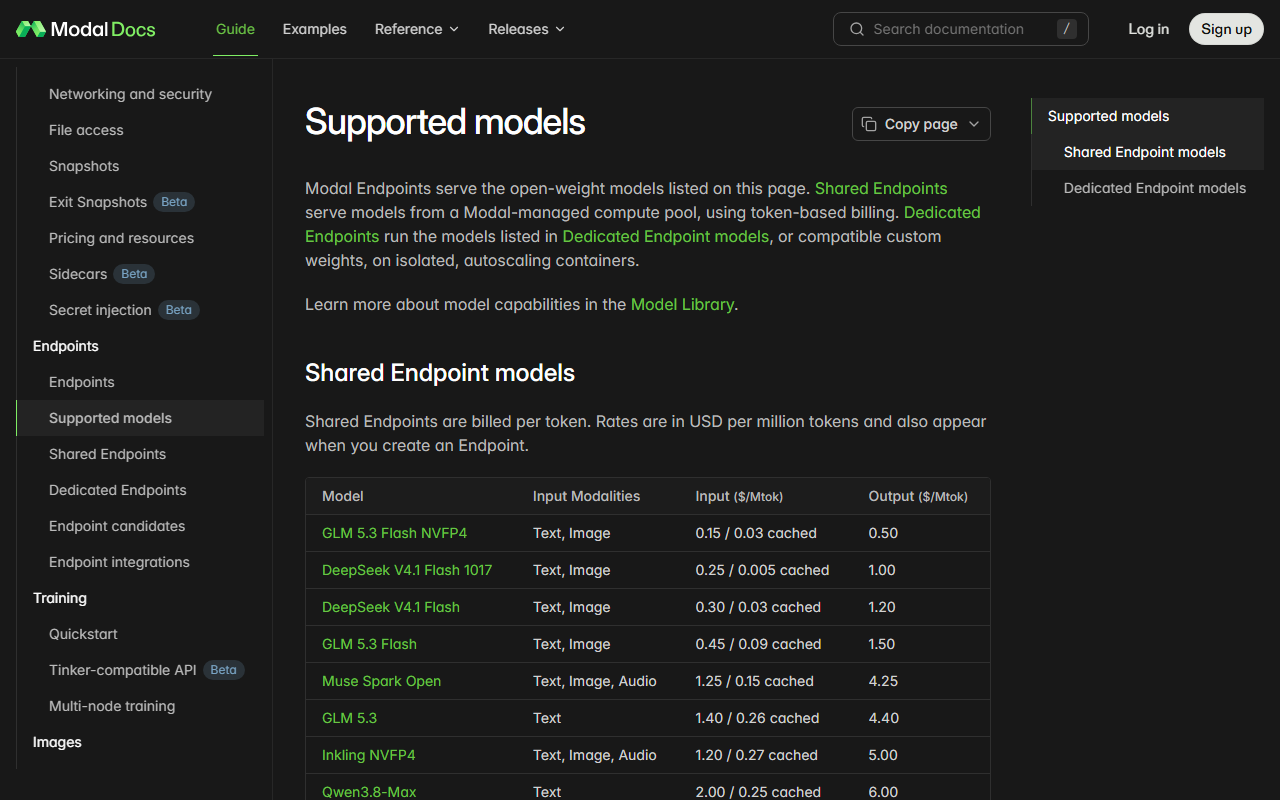
Shared Endpoints are Modal's newest pricing model: you call an open model on Modal-managed GPUs and pay per million tokens, like an LLM API. The FAQ says this changed on Sep 1, 2026: tokens are billed from your first request and appear on the invoice even if you have not used your $30 of included compute, and the Shared Endpoints docs say plan credits cannot be used for them at all. Rates on the supported-models page run from $0.15 in and $0.50 out per million tokens (GLM 5.3 Flash NVFP4) to $3.00 in and $15.00 out (Kimi K3). Dedicated Endpoints, by contrast, bill ordinary GPU, CPU and memory seconds and cost nothing when scaled to zero. Modal's model endpoints also reach other products: on Sep 29, 2026 the Manus agent named Modal, with OpenRouter and Fireworks, as a launch inference partner for its bring-your-own-key Flex mode.
Worked examples: cheap when idle most of the day, ordinary when a GPU never sleeps.
These are invented workloads with the arithmetic shown, using Modal's per-second rates on Oct 30, 2026 and competitors' own pages the same day. Modal bills CPU and memory separately from the GPU; most competitors fold them into one GPU price, so we show both.
A side project that serves a model two hours a day
One L40S active 2 hours a day for 30 days is 216,000 seconds. GPU: 216,000 × $0.000542 = $117.07. Two physical cores: 216,000 × 2 × $0.0000131 = $5.66. 16 GiB: 216,000 × 16 × $0.00000222 = $7.67. Total $130.40, or $100.40 after the Starter credit. If those two hours come as 20 separate bursts a day, the default 60-second idle window adds 36,000 billed seconds, about $21.73 more; shorten scaledown_window if the cold start is acceptable.
An API that must never cold-start
Keeping one H100 warm all month (min_containers=1, 730 hours) costs $2,882.92 for the GPU, $137.71 for 4 cores and $186.69 for 32 GiB: $3,207.32. Pin it to us-west and the 1.75x multiplier makes it $5,612.80; a broad us pin makes it $3,688.41. For a GPU that is busy 24 hours a day, serverless billing gives you nothing back, and you should price reserved capacity too.
A coding-agent product on Sandboxes
10,000 agent sessions a month, each 5 minutes on 1 physical core (2 vCPUs) and 2 GiB: 300 × $0.00003942 = $0.01183 of CPU plus 300 × 2 × $0.00000667 = $0.00400 of memory, about $0.0158 a session and $158.28 a month. On CPU alone that is $118.26 against $84 on E2B, whose rate card lists its default 2 vCPUs at $0.000028 a second (E2B prices RAM separately too, and its Pro plan is $150 a month). Modal's case is scale: it says it runs up to a million sandboxes at once and now offers full VM sandboxes.
Calling a model by the token
100 million input and 20 million output tokens on the Kimi K3 Shared Endpoint cost $300 + $300 = $600, none of it covered by plan credit; the same volume on DeepSeek V4.1 Flash costs $30 + $24 = $54. If you would rather pay for GPU time, a Dedicated Endpoint bills per second and scales to zero, which wins when traffic is low and loses when you cannot keep the GPU busy.
Five questions decide whether Modal's model saves you money.
Functions, Sandboxes, Endpoints and Training on one runtime, all driven from code.
Decorate Python to run on CPU or GPU, fan out with .map, spawn background jobs, schedule crons, and expose any function as an HTTPS endpoint that idles at zero. Volumes, Dicts and Queues hold state; memory snapshots cut cold starts.
Isolated containers for code an agent or user wrote, with inbound and outbound network controls. Since Oct 1, 2026: VM Sandboxes with a full Linux kernel, and Sidecars (in beta) that hold credentials where the agent cannot reach them.
Shared Endpoints (per token) and Dedicated Endpoints (per second, custom weights from Hugging Face or a Volume) for open models; multi-node Clusters via @modal.clustered; the open-source Spindle training server.
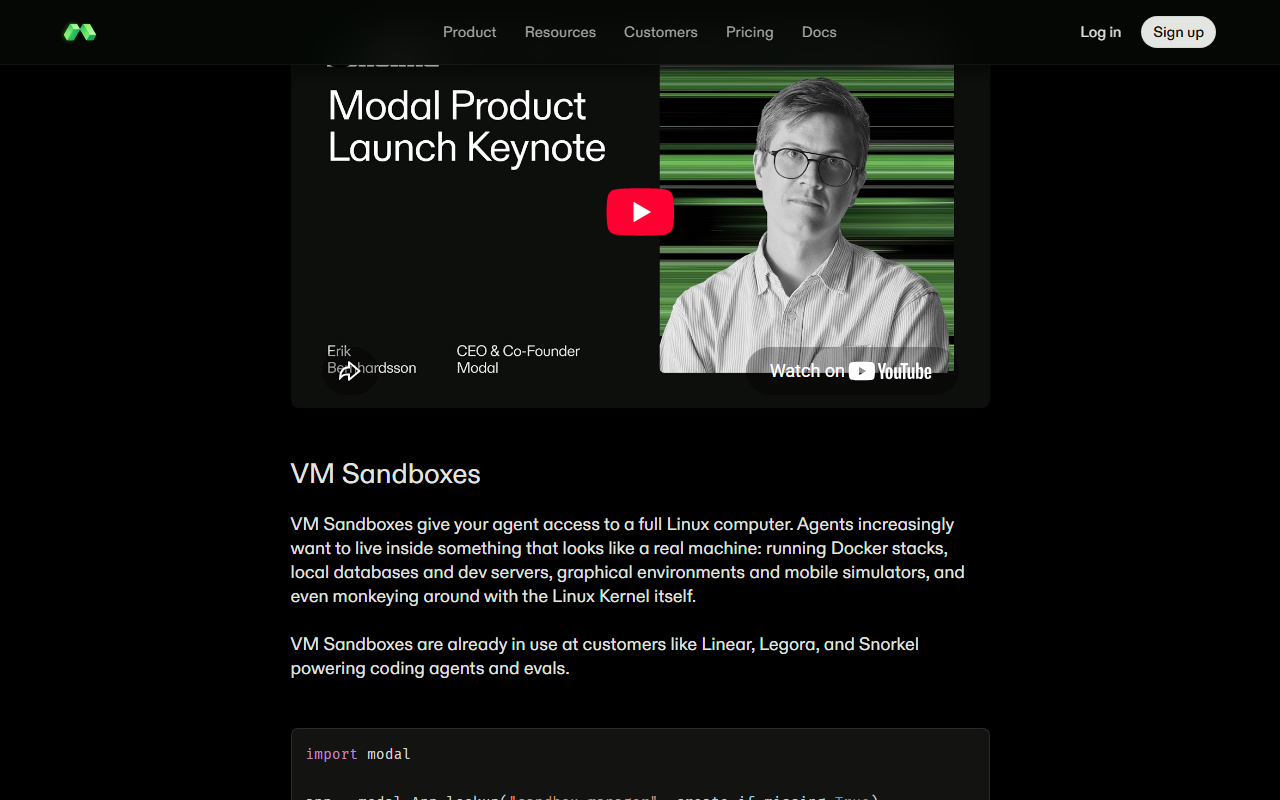
Modal's first Runtime conference on Oct 1, 2026 brought a cluster of launches: VM Sandboxes (already used by Linear, Legora and Snorkel, per Modal), Sandbox Sidecars (in beta), generally available Clusters, Sticky Sessions that route a client back to the same container (useful for voice agents), and Endpoint Candidates, which mirror production traffic to a different serving recipe so you can compare latency and cost before switching; that last one is in private beta. The keynote below is the clearest tour of what the platform now covers.

On training, Modal's Oct 22, 2026 post introduced Spindle, an open-source server compatible with Thinking Machines' Tinker API that runs in your own workspace, so you pay GPU time instead of tokens. Modal's own table claims 20% to 80% lower cost per million output tokens than Tinker on its test workloads, best when several experiments share the same GPUs; treat that as a vendor benchmark.
Install, authenticate, decorate, deploy.
pip install modal then modal setup. The Python package was at version 1.6.3 on Oct 27, 2026; JavaScript and Go SDKs are in beta.@app.function(gpu="L40S"), which Modal itself suggests as the starting point for inference.scaledown_window, min_containers and buffer_containers trade cold starts for billed idle time; load weights from a Volume or the image, not at request time.
Strong 90-day uptime, nine incidents in three months, and cold starts that depend on your model.
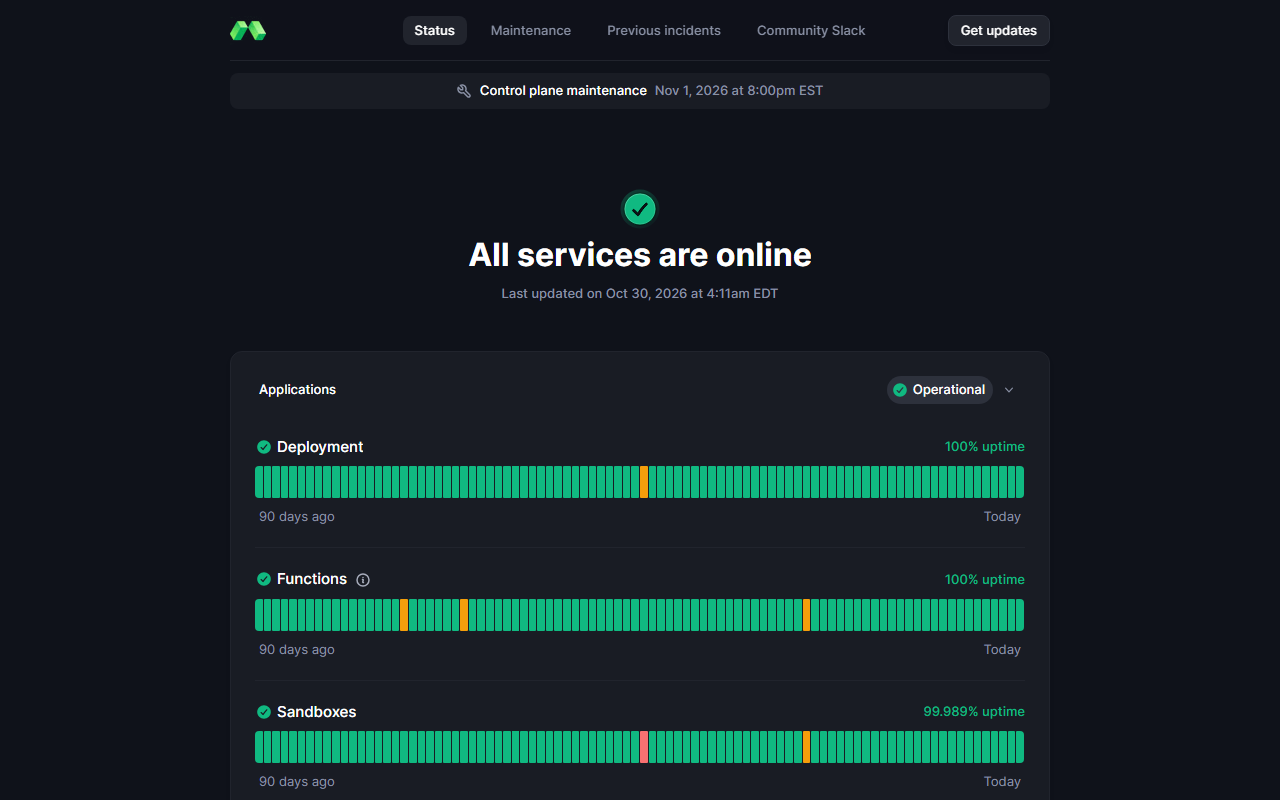
On Oct 30, 2026 Modal's status page showed 100% 90-day uptime for Functions, Web Functions, Servers and Deployment and 99.989% for Sandboxes, with control-plane maintenance scheduled for Nov 1, 2026 at 8 pm EST. Its incident history lists nine incidents between Aug 19 and Oct 19, 2026, including a Sep 16 dashboard and sandbox outage, degraded function and sandbox execution on Oct 5, two Kimi K3 Shared Endpoint incidents on Oct 14 and degraded web functions on Oct 19. All are marked resolved.

Cold starts are where the marketing and the user reports meet halfway. Modal's docs say containers boot in about a second, and a May 12, 2026 engineering post describes cutting inference replica start-up from thousands of seconds to tens of seconds with idle GPU buffers, a custom file system and CPU and GPU checkpoint/restore. Users still report the cost of loading big models: 20 to 30 seconds on a first request (comment 47758193), about a minute even when Modal was the fastest option tried (48186578), and around five minutes for an H100 cold boot in one setup (47192388). The fix is engineering (snapshots, weights in the image) or money (warm containers).
SOC 2 Type II, zero retention on inference endpoints, function inputs kept up to 7 days, and HIPAA only on Enterprise.
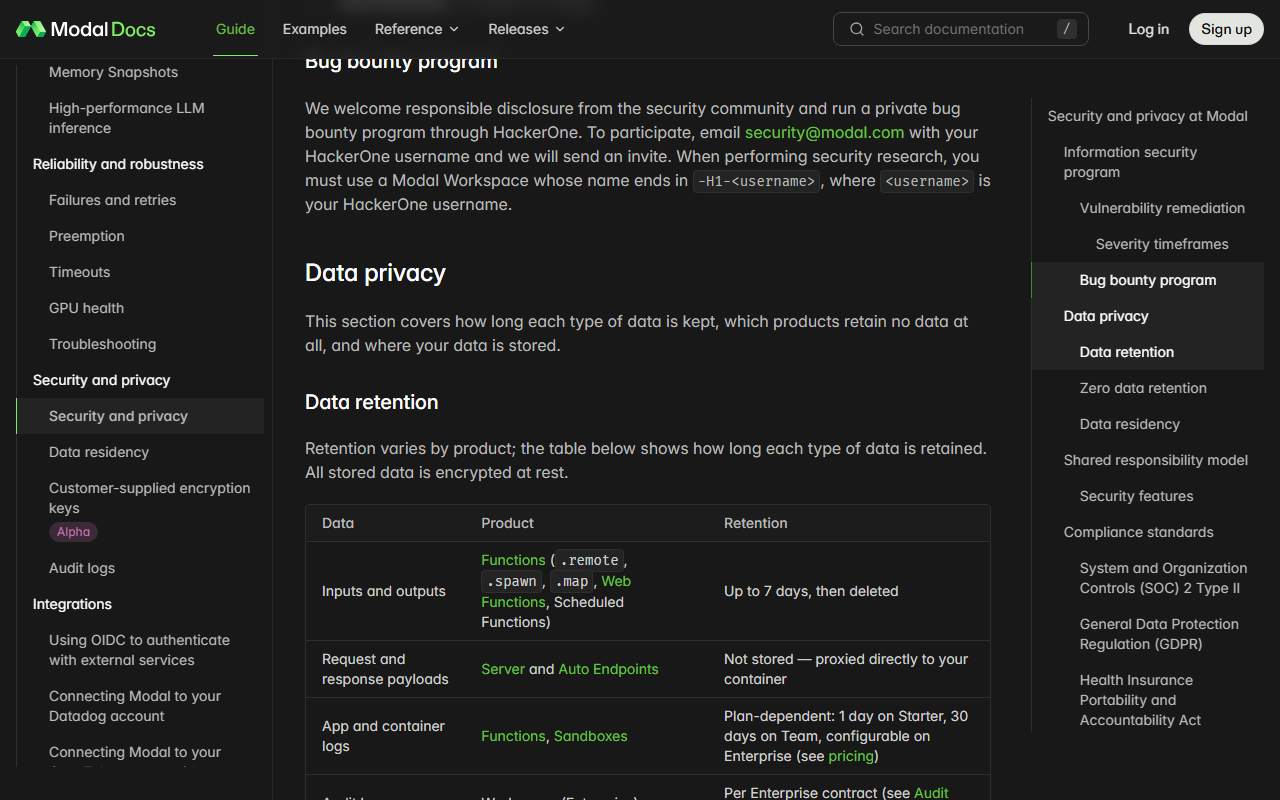
Modal's security page lists what it keeps: Function inputs and outputs for up to 7 days, logs for 1 day on Starter and 30 days on Team, Function memory snapshots for 30 days, and app metadata for the life of the account. Dedicated and Shared inference endpoints have zero data retention; payloads pass through only in transit. Data is encrypted with TLS 1.3 in transit and at rest, critical vulnerabilities are patched within 24 hours of a fix being available, and a private HackerOne bug bounty runs on invitation.
The trust center offers SOC 2 Type II reports for 2024 and 2025, a bridge letter and a Q3 2025 penetration test on request, plus a Data Processing Addendum. Governance is plan-gated: RBAC and static egress IPs start on Team, while SSO, audit logs and HIPAA (arranged through sales) are Enterprise-only, and some products are out of scope for health data. We have not reviewed the SOC 2 report or the full terms.

The July 2026 agent intrusion
On Jul 27, 2026 Hugging Face published a timeline of an intrusion, from Jul 9 to Jul 13, 2026, which it attributes to an agent running an internal OpenAI cyber-capability evaluation. It says the agent used “an unsecured, user-hosted public endpoint” on Modal as a launchpad, and that “Modal's infrastructure was not compromised in any way.” Modal's own note of Jul 29 says the same: the app was a customer's, deployed without authentication and built to run code from anyone, and no other customers were affected. The lesson is the shared-responsibility line in Modal's docs: anything exposed to the internet needs authentication and egress limits, and that is your job.

Python teams with spiky GPU work or many short-lived sandboxes.
ML and AI product teams in Python; inference whose traffic rises and falls; batch jobs, evals and fine-tunes; agent products that need thousands of sandboxes, some with GPUs; researchers who can use the $30 monthly credit or academic grants of up to $10,000.
Steady 24/7 GPU workloads that a reserved instance serves cheaper; teams outside Python who want a mature non-Python SDK today; regulated teams that cannot buy Enterprise; anyone who needs instant first replies from big models and will not pay for warm GPUs.
Seven things to check before you rely on it.
60 seconds after each burst by default, plus model load time.
1.15x to 1.75x for a pinned region; 3x CPU and memory for Sandboxes.
Seconds to minutes for large models unless you snapshot or keep warm.
Shared Endpoint tokens billed from the first request since Sep 1, 2026.
Community Slack only; Trustpilot complaints cite slow help.
SSO, audit logs and HIPAA need Enterprise.
JAVIS did not run a workload.
Priced from each vendor's own page on Oct 30, 2026; bundles differ, so the plans are not like-for-like.
| Option and when to pick it | What its own page says | JAVIS review |
|---|---|---|
| Modal Python-first serverless GPUs and sandboxes | H100 $3.95/hr plus CPU and memory, per second; Starter $0 with $30 credit; Team $250/mo | This article |
| RunPod Cheap pods and serverless GPUs | Serverless H100 $5.39/hr, L40S class $1.75/hr; pods also sold by the hour | No live review yet |
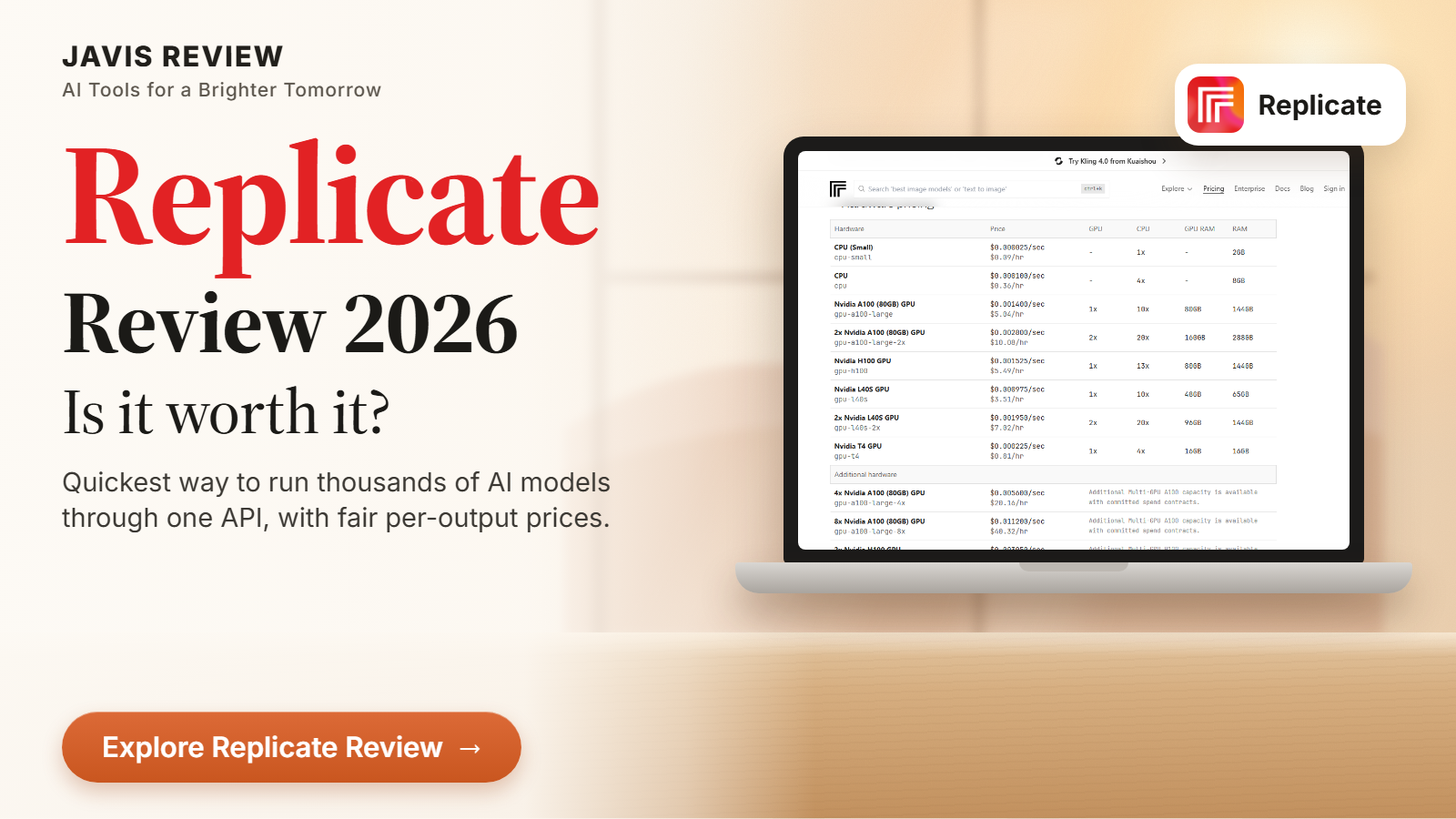
| Replicate Run public models by output or by second | gpu-h100 $0.001525/sec ($5.49/hr) with CPU and RAM included; many models priced per image or token | Replicate review |
| Baseten Managed dedicated inference | Basic $0 pay as you go; H100 $0.10833 a minute; Model APIs such as GPT OSS 120B | No live review yet |
| E2B CPU sandboxes for agents | Hobby free with a one-time $100 credit; Pro $150/mo; 2 vCPUs $0.000028 a second | No live review yet |
| Together AI Open-model API and GPU clusters | Serverless per-token API, fine-tuning and clusters | Together AI review |
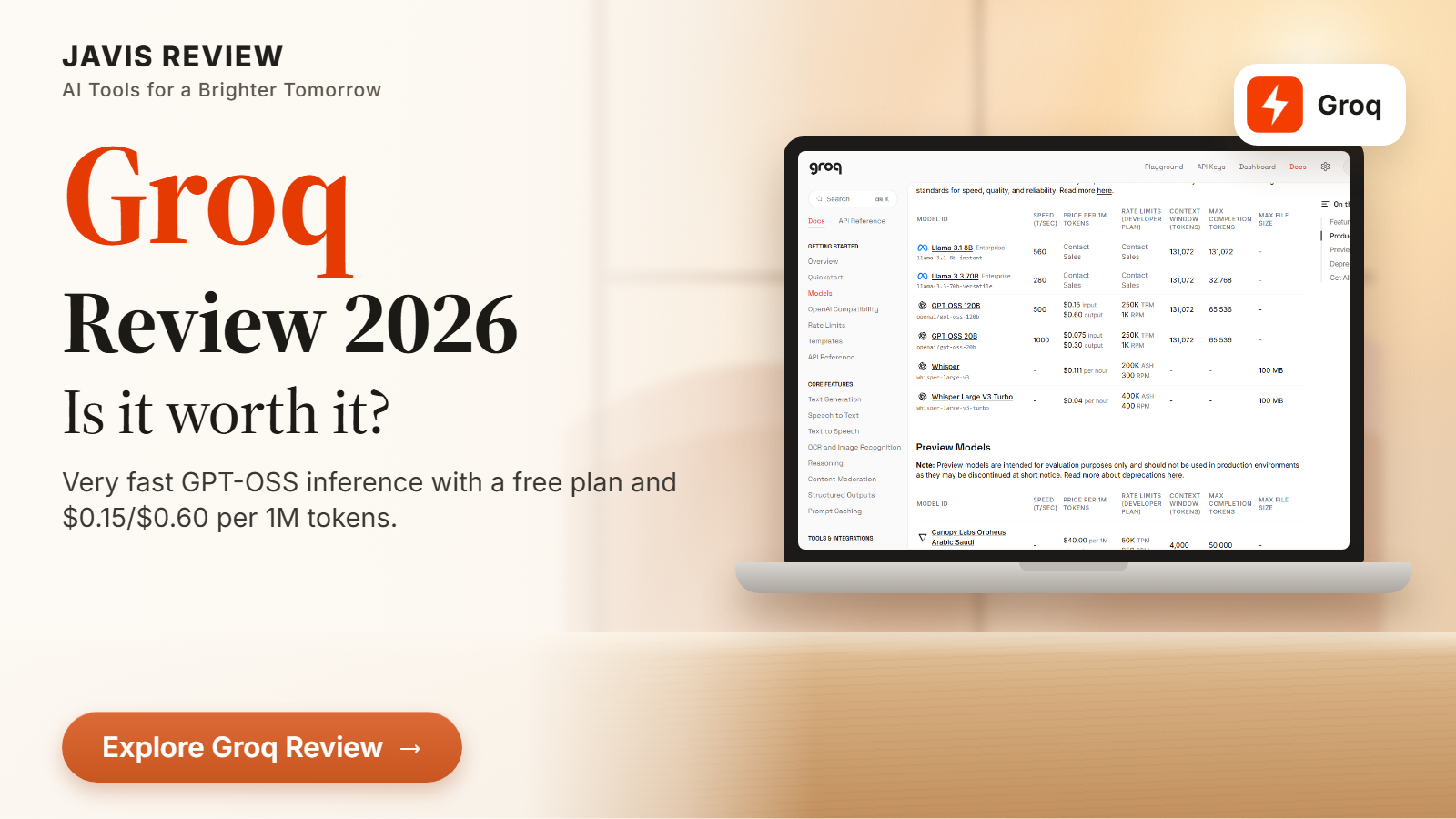
If you only need a fast hosted model rather than your own containers, Groq and OpenRouter are simpler, and Hugging Face is where most of the weights you would deploy on Modal come from.
Five steps that keep cost and lock-in under control.
This review has no affiliate links, and Modal did not see it.
JAVIS has no approved Modal affiliate link, so every link goes straight to modal.com, its pricing page or its documentation, without tracking parameters.
Hands-on status: JAVIS has not created a Modal account or run a workload. Cost examples use invented workloads with the arithmetic shown, uptime figures are Modal's own status page, and independent review evidence is thin, as section 04 says.
GPU, CPU, memory and plan limits.
Open Modal pricingGuides, examples and the SDK reference.
Open Modal docsChoosing where to run models and agents? These reviews cover the nearest ground.
Each card opens a published JAVIS review.


Questions people ask before committing
Is Modal free?
The Starter plan has no monthly fee and includes $30 of compute a month, enough for light GPU experiments. Any GPU use needs a payment method on file, usage beyond $30 is billed, and Shared Endpoint tokens are billed from the first request.
How much does an H100 cost on Modal?
$3.95 an hour for the GPU ($0.001097 a second), plus CPU at $0.0473 per physical core-hour and memory at $0.0080 per GiB-hour, as of Oct 30, 2026. Pinning a region multiplies the total by 1.15x or 1.75x.
What does the Team plan add?
For $250 a month: $100 of compute, unlimited seats, up to 5,000 containers and 50 GPUs at once, 30-day logs, rollbacks, custom domains, RBAC, a static IP proxy and environment budgets.
Why are Sandboxes more expensive than Functions?
Sandboxes are never preempted, and Modal charges 3x the CPU and memory list price for non-preemptible compute. GPUs in Sandboxes use the standard GPU rate.
Was Modal hacked in July 2026?
No, according to both Modal and Hugging Face. An agent in an OpenAI evaluation used a Modal customer's unauthenticated public endpoint, which ran code from anyone; both companies say Modal's infrastructure was not compromised.
Does Modal keep my data?
Function inputs and outputs for up to 7 days, logs for 1 day (Starter) or 30 days (Team); inference endpoints keep no request data. SOC 2 Type II covers all plans; HIPAA is Enterprise-only.
Can I use my AWS or GCP credits?
No. Enterprise customers can pay through the AWS or GCP marketplace with committed spend, and AWS Activate startups can apply for extra Modal credits.
What are the alternatives?
RunPod for cheaper raw GPUs, Replicate and Baseten for managed inference, E2B for CPU sandboxes, Together AI for an open-model API; see section 14.
Where this came from, and when.
Pricing and product: modal.com/pricing (rate card, plans, comparison, Sandbox pricing and FAQ); modal.com/docs guides on GPUs, cold starts, region selection, budgets, Shared Endpoints, Dedicated Endpoints and supported models; the Python SDK release notes; github.com/modal-labs (modal-client, 530 stars; modal-examples, 1,288 stars), all Oct 30, 2026.
Data and security: modal.com/docs/guide/security and trust.modal.com. We have not reviewed the SOC 2 report, the DPA or the terms of service in full.
Company: Modal blog posts of May 12, Jul 29, Sep 2, Oct 1, Oct 14 and Oct 22, 2026; Dealroom (May 21, 2026) on the Series C; the Hugging Face blog (Jul 27, 2026) on the agent intrusion; status.modal.com and its incident history.
Independent evidence: Trustpilot (8 reviews, 2.8); Hacker News comments 44182130, 47758193, 45476543, 43787933, 47192388, 48186578 and 49103838, and story 49089500.
Competitors: runpod.io/pricing, replicate.com/pricing, baseten.co/pricing and e2b.dev/pricing, Oct 30, 2026. Cost examples are arithmetic on those prices with invented workloads.
Images: screenshots of public pages taken Oct 30, 2026, Modal's social card and Modal's own YouTube video.
JAVIS Fit Score (76/100): editorial composite, 20 points each. Price clarity 15: one public per-second rate card, offset by region and non-preemptible multipliers and token billing outside the credit. Capability breadth 18: GPUs from T4 to B300, sandboxes, endpoints, clusters and training. Independent evidence 11: small review samples, anecdotal cold-start reports. Security and data control 16: SOC 2 Type II, zero retention on endpoints, governance gated to Enterprise. Cost control and fit 16: scale to zero, budgets and spend limits, offset by billed idle time. It is judgment, not a measurement.
What this review does not cover: our own cold-start or throughput tests, Enterprise prices, the SOC 2 report, and output quality of Shared Endpoint models.