
Firecrawl Review 2026: A Free Tier, Credits That Stack, and an Open-Source Core You Can Self-Host
Firecrawl is a web data API for AI agents: it searches, scrapes, maps and crawls pages and hands back clean markdown or JSON, with an open-source core and a hosted cloud. This review covers what a credit buys, which plan fits which workload, what changes when you self-host, what the vendor claims about coverage and speed, and what public evidence exists beyond its own marketing.

There are no affiliate links in this review. Every Firecrawl link goes straight to firecrawl.dev.
| Made by | Firecrawl; the open-source repository was created in Apr 2024 |
| What it is | Web data API for search, scrape, crawl, map and browser interaction |
| Paid plans | Hobby $16/mo; Standard $83; Growth $333; Scale $599 (billed yearly) |
| Enterprise | Custom, with SSO, ZDR and SLA |
| Free | $0, 1,000 credits a month |
An open-source web data API with a real free tier, adoption numbers you can partly verify, and a credit meter that gets expensive the moment you go past your plan.
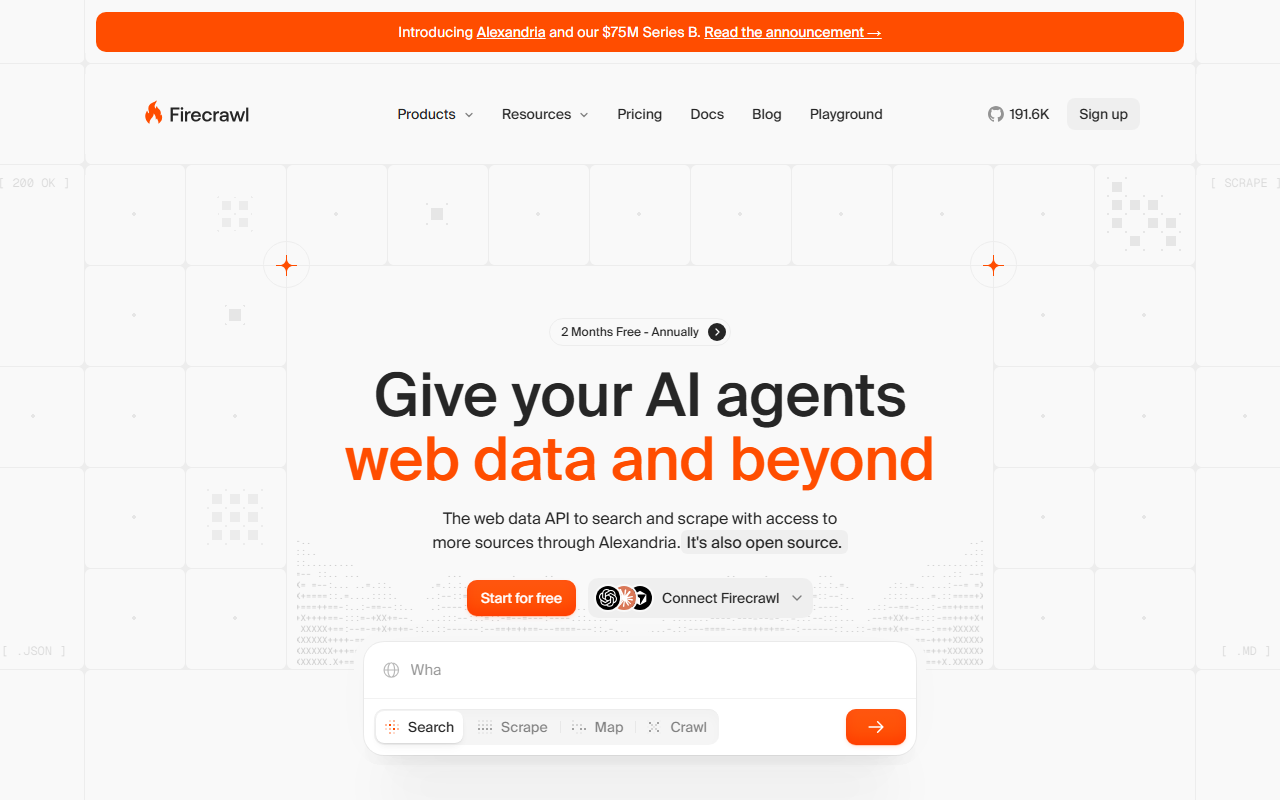
“Give your AI agents web data and beyond.” That is the home-page headline, and the product behind it is a credit-metered API for search, scrape, crawl, map and browser interaction.
Firecrawl turns web pages into clean markdown or structured JSON that language models can use. You call one API (or a CLI, SDK or MCP server), and it handles JavaScript rendering, PDFs and documents, and the awkward parts of crawling. The code is open source under AGPL-3.0, and a hosted cloud version adds the proprietary parts. The plans are easy to read: Free (1,000 credits a month), then Hobby, Standard, Growth and Scale, with Enterprise on request.
Three things temper the pitch. First, the credit is a page, but modifiers stack: a structured JSON extraction costs 5 credits per page, not 1, and the pricing page and the billing docs disagree on what a browser minute costs. Second, going past your allowance is the expensive path: extra credits cost about three times the plan rate on Standard and Growth. Third, the self-hosted version is real but is not the cloud product, because the managed anti-bot layer, screenshots, page actions and the browser agent are not in it. This review quotes no review-site rating, so the user evidence below comes from Hacker News and from public download and star counts.
Not a hands-on test: JAVIS has not signed up for, used or paid for Firecrawl for this review. It is built from Firecrawl's home, pricing and documentation pages, its public GitHub repository and public package download counts, as of 15 and 16 Oct 2026.
Search, scrape, map and crawl find and read pages; interact and agent handle the hard cases; one credit balance pays for all of it.
The home page splits the product into Search, Scrape, Map, Crawl and Interact, with an autonomous Agent endpoint behind them. This is how the pieces fit and where the meters run.
Swipe sideways to read the full diagram.

One of the most-starred repositories in its category, with adoption numbers that are partly public and partly the vendor's word.
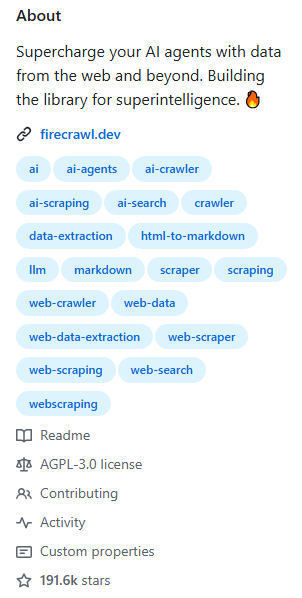
Repository data, 16 Oct 2026. The pricing page shows 191.9K.
Repository data, 16 Oct 2026.
firecrawl-py, pypistats.org. Downloads are not users.
GitHub license data for the open-source repo.
Firecrawl's home page says 150,000+ companies and 1.25M developers build with it and that it has served more than 5 billion requests; it also says teams at Apple, Canva and Lovable use it. Those are the vendor's numbers and no independent audit is quoted here. What can be checked: the repository was created on 15 Apr 2024 and was pushed to on 16 Oct 2026. npm and PyPI counts add up to roughly 3.3 million weekly downloads across three packages (1,170,490 for @mendable/firecrawl-js, 811,349 for firecrawl and 1,317,482 for firecrawl-py), though a download counts a CI install as much as a person. The home page also announces a $75M Series B.
| When | What happened | Source |
|---|---|---|
| 15 Apr 2024 | Open-source repository created | GitHub |
| Nov 2024 | A community fork aimed at easier self-hosting appears on Hacker News | Hacker News |
| 13 Jan 2026 | Date of the vendor's 1,000-URL coverage test | Home page |
| 4 Sep 2026 | Effective date shown on the current credit rules | Pricing page |
| 22 Sep 2026 | Alexandria and the $75M Series B announced | Home page, Hacker News |
| 16 Oct 2026 | Latest repository push (02:03 UTC) | GitHub |
This review quotes no analyst market-size figure, because no published figure from a checkable source exists.
No review-site rating is quoted here, and the public discussion is split between happy builders and people who switched or are annoyed.
This review quotes no Trustpilot, G2 or Capterra score. The vendor's own site shows testimonials from people on X, which are chosen by the vendor. What is public and independent: star and download counts, and Hacker News threads. Four Hacker News posts and comments from 2026 are worth reading, paraphrased here with the date and the author's handle.
Used paid credits (obtained free at an event), then self-hosted an instance, said it works well for their agents, and measured failures below 2%, while noting some features are missing that they do not use.
Said they paid about $190 a month, found the CLI awkward and the product in flux, and replaced it with their own roughly 3,000-line Elixir tool.
A site owner wrote that Firecrawl customers were responsible for 95% of an unexpected traffic bill, in a thread about which crawlers get verified-bot status. One unverified claim, but it is the site owner's side of the story.
Pattern, from four comments only: the one self-hoster is positive about reliability, the one paying user left over cost and polish, and the other two are about crawler load on site owners and hidden text aimed at AI agents.
Pointed out that a Firecrawl blog page contained hidden text addressed to AI agents, steering them to Firecrawl's sign-up and onboarding files. The commenter called it marketing aimed at machines.
The home page lists customer stories (Aemon, Sierra, Lovable, Gamma and Cognism are named) and testimonials from X users. One reads that an internal agent's web tool moved from Apify to Firecrawl because it benchmarked 50x faster with AgentOps. These are selected by Firecrawl and are not independent measurements.
| Where to look | Why it matters | What to check |
|---|---|---|
| Review directories (Trustpilot, G2, Capterra) | Verified-buyer reviews carry the most weight | Count and dates after 2025, and whether the vendor invited the reviewers |
| The Free plan and the keyless tier | The only evidence you control | Run your ten hardest target sites and count failures |
| Hacker News and GitHub issues | Candid, sometimes harsh, often technical | Open issues that match your target sites or your stack |
| Your own bill after one week | Credit stacking is the surprise | Compare credits used with pages returned |
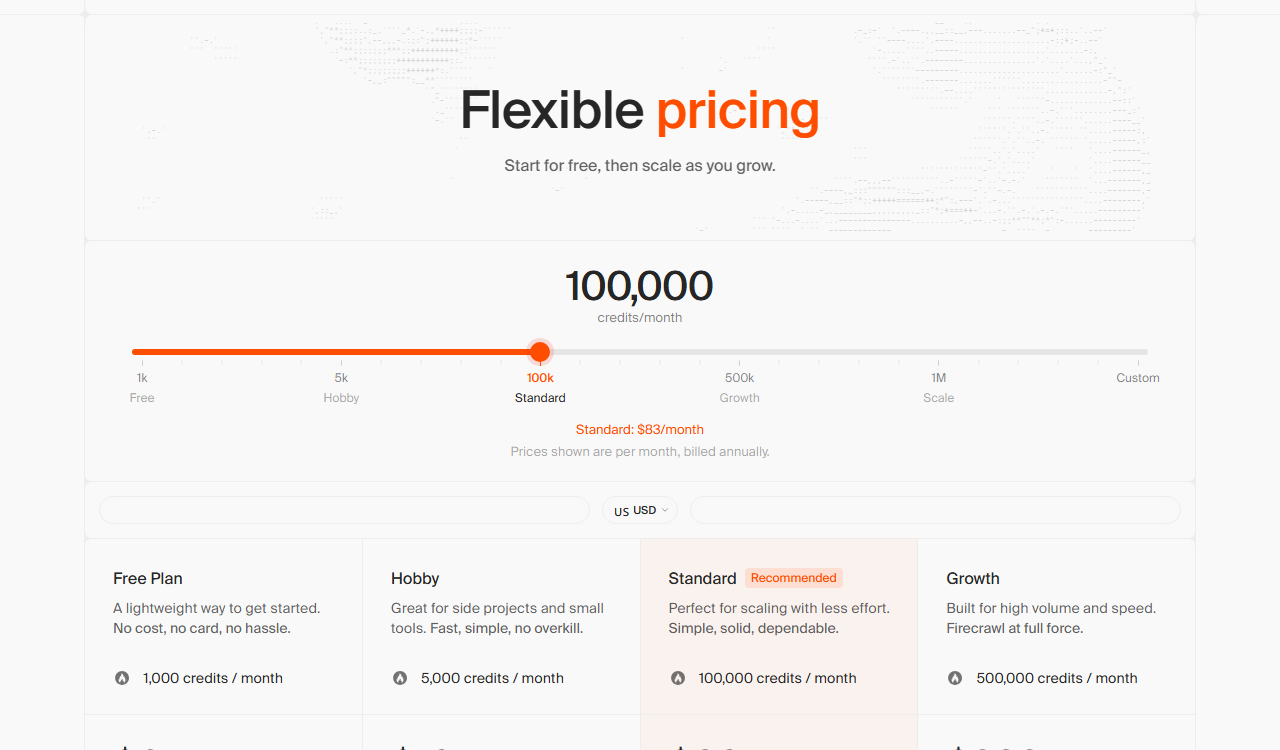
Five self-serve plans from free to $599 a month billed yearly, plus Enterprise, all sold in credits.
Free
No card, refreshed monthly
- 1,000 credits
- 2 concurrent requests
- Community support
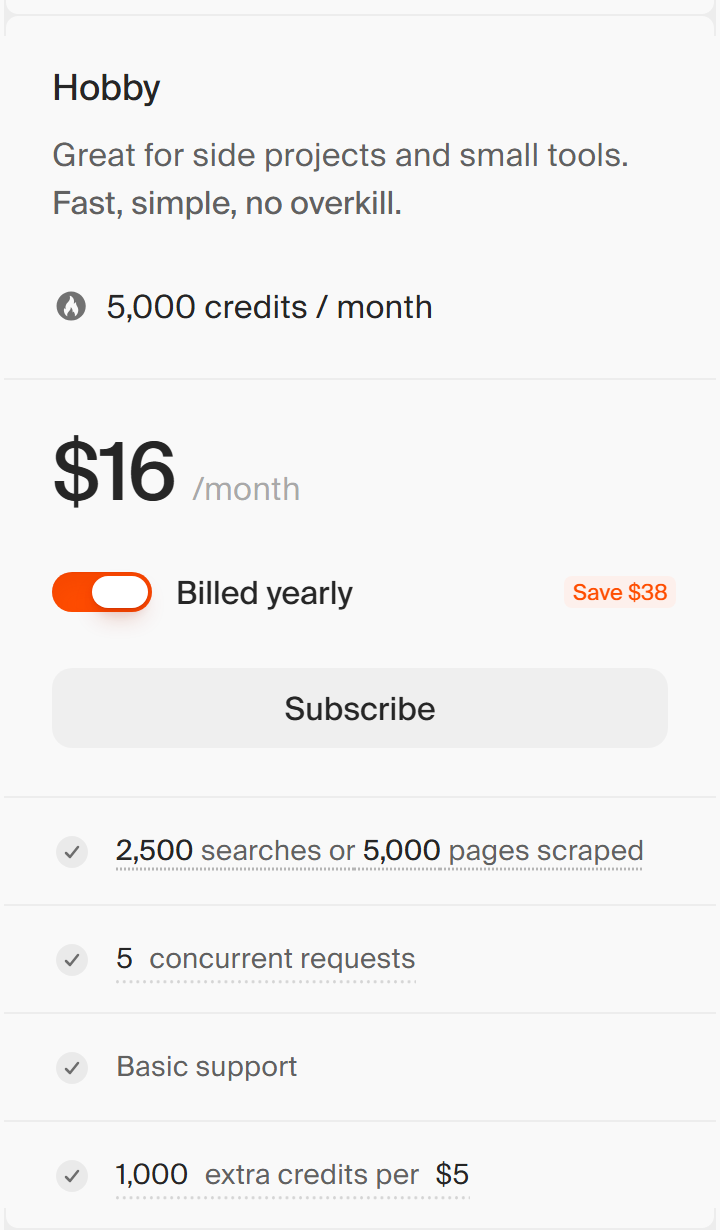
Hobby
$19 billed monthly; annual saves $38
- 5,000 credits
- 5 concurrent
- 1,000 extra credits per $5
Standard
Billed yearly; saves $198
- 100,000 credits
- 25 concurrent
- 2,000 extra credits per $5
Growth
Billed yearly; saves $798
- 500,000 credits
- 50 concurrent
- Priority support, Slack
Scale
Billed yearly; saves $1,798
- 1,000,000 credits
- 100 concurrent
- One month credit rollover
Enterprise
Contact sales
- Custom credits and limits
- SSO, SCIM, ZDR, SLA
- Invoiced billing
| Plan | Per month (billed yearly) | Credits a month |
|---|---|---|
| Free | $0 | 1,000 |
| Hobby | $16 ($19 monthly) | 5,000 |
| Standard | $83 | 100,000 |
| Growth | $333 | 500,000 |
| Scale | $599 | 1,000,000 |
| Enterprise | Custom | Custom |
| Plan | Concurrent browsers | Extra credits per $5 | Support |
|---|---|---|---|
| Free | 2 | Not available | Community |
| Hobby | 5 | 1,000 | Basic |
| Standard | 25 | 2,000 | Standard |
| Growth | 50 | 2,500 | Priority |
| Scale | 100 | 5,000 | Priority |
| Enterprise | Custom | Custom | Dedicated, SLA |
| Feature | Which plans have it |
|---|---|
| SOC 2 Type II, MFA, PII redaction | Yes on every plan, Free to Enterprise |
| Data Processing Agreement | No on Free and Hobby; Standard on Standard, Growth and Scale; Custom on Enterprise |
| Slack support | No on Free, Hobby and Standard; Yes on Growth, Scale and Enterprise |
| Credit rollover | No on Free, Hobby, Standard and Growth; One month on Scale; Custom on Enterprise |
| Single sign-on, SCIM | No on every self-serve plan; Yes on Enterprise |
| Zero Data Retention, static egress IPs | No on every self-serve plan; Yes on Enterprise |
| Invoiced billing | No on Free, Hobby, Standard and Growth; Yes on Scale and Enterprise |
Not an affiliate link. It opens Firecrawl's official website.
One credit is one page on a basic scrape, and the extras stack on top.
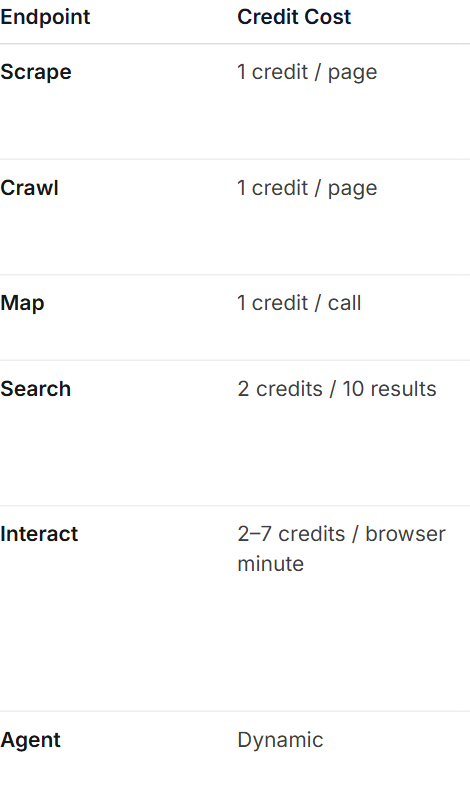
The billing docs are clear about the base rule: a scrape, a crawled page and a map each cost 1 credit, search costs 2 credits per 10 results, and every credit is shared by all endpoints. Everything else is a modifier. The docs add that these modifiers stack, so a page with JSON extraction and Zero Data Retention costs 1 + 4 + 1 = 6 credits.
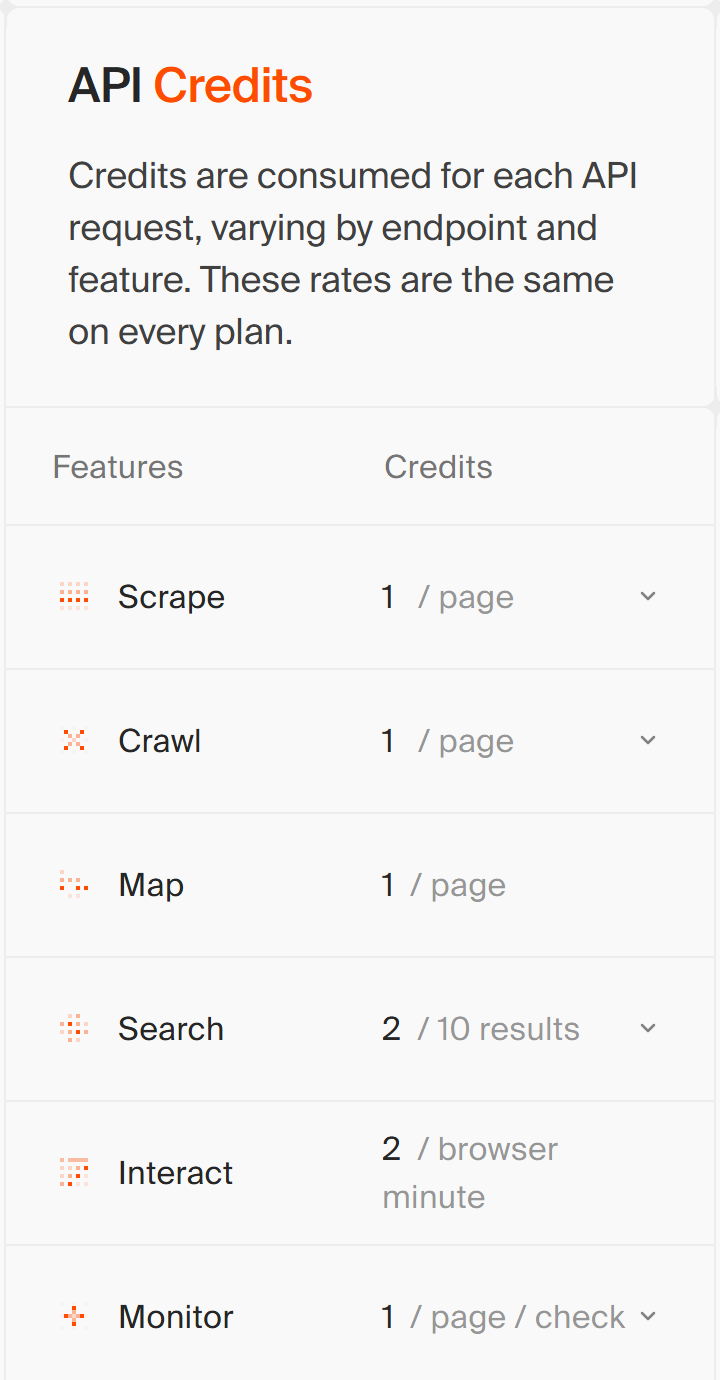
The base unit. A scrape, a crawled page and a monitored page cost 1 credit each. The billing docs say a map costs 1 credit per call, but the pricing page lists Map as 1 per page; budget the higher number until the two agree. Search costs 2 credits per 10 results, rounded up per 10, so 11 results cost 4 credits; if you also scrape the results, each result you also read in full adds its own page cost. Agent runs are free for 5 a day and usage-based after that.
What stacks on top. The JSON, question and highlights formats add 4 credits per page, which makes a JSON page 5 credits in total. PDF parsing adds 1 credit per PDF page. PII redaction, audio, video and the prompt-injection check each add 4 credits per page. Zero Data Retention adds 1 credit per page and is an Enterprise feature on the pricing page.
The quickest way to see how this behaves is to price the same page several ways. Every line below uses the rules in the billing docs, and the sizes are JAVIS examples.
Worked examples from the billing docs, 16 Oct 2026. They are arithmetic on published rates, not measurements of real usage.
The two vendor pages disagree on Map, and here are both, side by side.
Monitor, the newest line on the pricing page. Monitor runs recurring checks and tells you when a page changes. The docs describe three kinds: page monitoring for known URLs, website monitoring that crawls a site on a schedule, and entire web-scale monitoring that runs a search on a schedule and alerts on new matching results. Alerts go out by webhook, email or Slack. A monitor takes 1 to 50 targets and keeps history for 30 days by default, up to 365. There is no separate monitor fee: each check pays for the scrape, crawl or search it performs. A scrape monitor costs 1 credit per URL per check, a crawl monitor 1 credit per discovered page per check, and a web monitor 2 credits per 10 results per check. If you turn on AI judging with a plain-language goal, on a page or website monitor each changed page the judge validates costs 1 more credit, and on a web monitor judging costs 1 credit per result judged. A page that errors during a check still bills the base 1 credit.
Here is the arithmetic for a realistic job. Say you watch 20 competitor pricing pages once a day. That is 20 URLs x 30 checks = 600 credits a month, plus up to 1 credit for each page that changed and was judged, so it fits inside the Free allowance of 1,000 credits. The docs show an estimate of 2,880 credits a month for a much heavier example: one page checked every 30 minutes with judging on. That is 48 checks a day x 30 days = 1,440 checks, so the estimate counts up to 2 credits per check; the docs call it an upper bound. The pricing page adds one rule that is easy to miss: Monitor's deterministic-extraction engine bills a flat 7 credits per page per check instead of the add-on rates above. If you use that engine, the same 20 pages a day would cost 20 x 30 x 7 = 4,200 credits a month, more than four times the Free allowance and most of a Hobby month (5,000 credits). Check which engine your monitor uses before you schedule it.
A page that errors still bills. The pricing page says a request that produces no result is not charged, but a page that responds with an error status such as 403 or 404 is still delivered to you and costs 1 credit. Unused plan credits do not roll over, except one month on annual Scale and two months on annual Enterprise per the billing docs.
Concurrency, not request rate, is the real ceiling, and pay-as-you-go is the expensive way to go over.
The rate-limits page says requests per minute exist mainly to prevent abuse, and that your real bottleneck will be concurrent browsers, the number of pages rendered at the same time. Jobs beyond that wait in a queue: 50,000 jobs on Free, Hobby and Standard, 100,000 on Growth and 200,000 or more on Scale (custom plans get 2,000 times their concurrency, up to 2,000,000). Limits are shared by every API key on the same team.
| Plan | /scrape, /map, /search | /crawl, /agent |
|---|---|---|
| Free | 10 a minute | 2 a minute |
| Hobby | 100 | 20 |
| Standard | 500 | 100 |
| Growth | 5,000 | 1,000 |
| Scale | 10,000 | 2,000 |
| Plan | /interact | Concurrent browsers |
|---|---|---|
| Free | 2 a minute | 2 |
| Hobby | 20 | 5 |
| Standard | 100 | 25 |
| Growth | 1,000 | 50 |
| Scale | 1,500 | 100 |
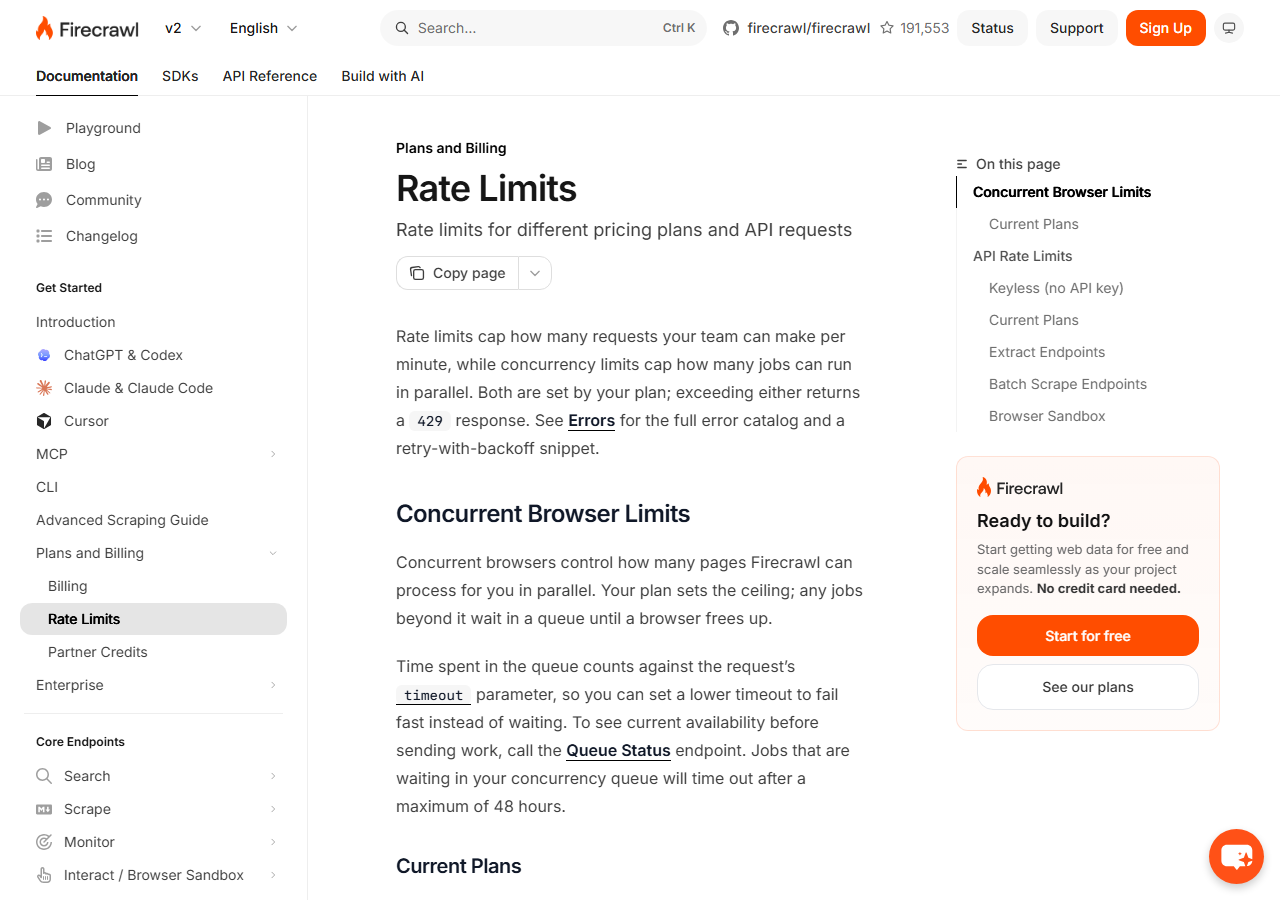
Keyless use. You can try Firecrawl with no account at all. The hosted MCP server exposes exactly Search, Scrape and Parse without a key; in the CLI, the SDKs and the REST API, keyless use also includes Interact. Keyless use is free and capped per IP address per day by two limits, a number of requests and a number of credits, so heavier calls such as JSON extraction reach the credit cap sooner. Exceeding either returns a rate-limit error. A free key raises the limits and gives 1,000 credits. Good for a first try, not for a pipeline.
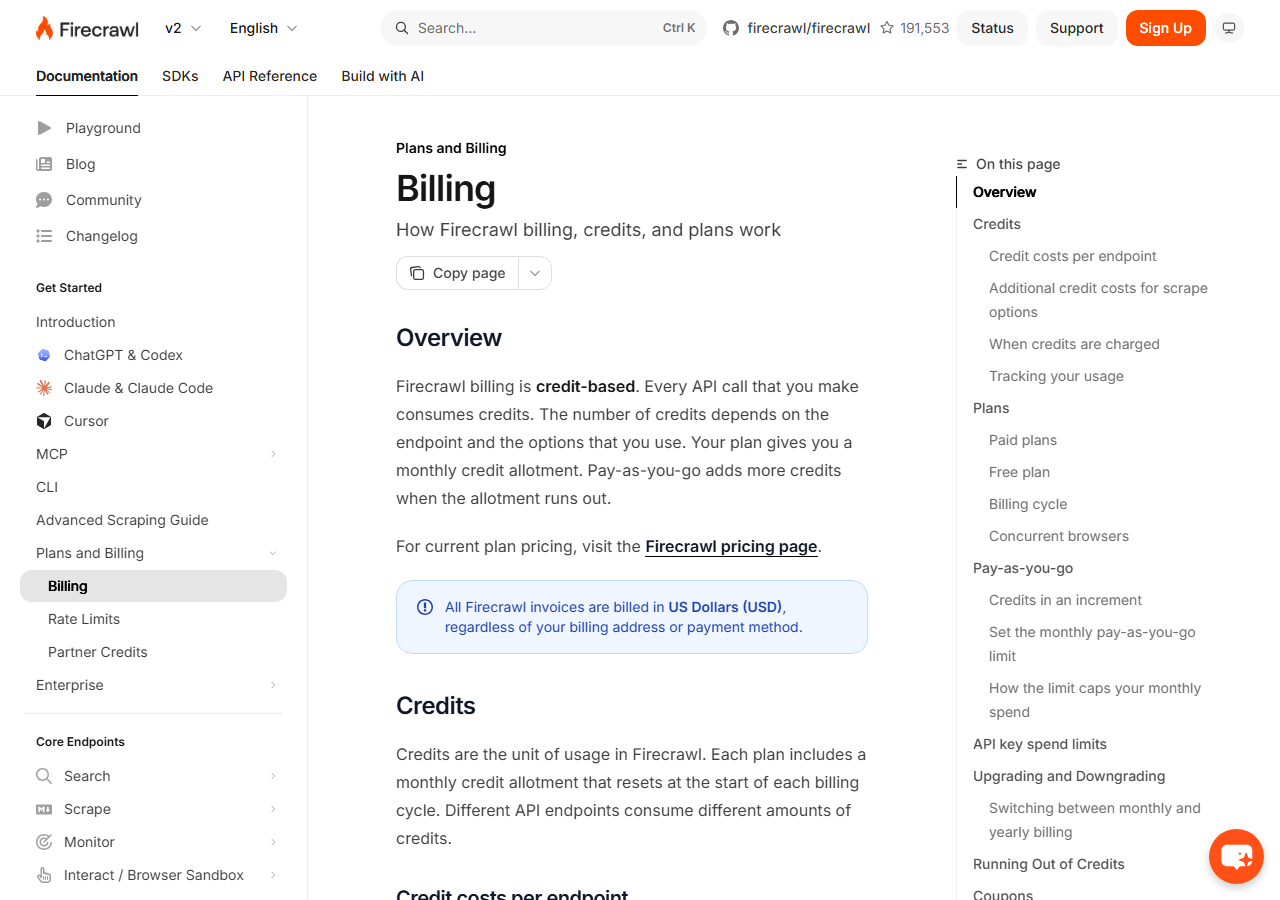
What happens when credits run out. It depends on the plan. On Free there is no pay-as-you-go, so requests that need credits are refused until the monthly reset. On a paid plan with pay-as-you-go switched off, they are refused too and your card is not charged. With it switched on, Firecrawl charges your card for one $5 increment, adds its credits and carries on, and it repeats this each time the balance reaches zero until your monthly limit is reached. The limit rounds down to whole $5 steps: $25 allows five increments, $22 allows four. A burst keeps running while a top-up settles because each plan has an overage allowance (1,500 credits on Hobby, 30,000 on Standard, 150,000 on Growth, 600,000 on Scale); the billing docs call it headroom, not extra credits you keep.
That is the rule. Here is what it means in dollars, using the yearly per-month prices from the plan table.
Break-even points are calculated by JAVIS from the published prices (yearly billing) and the billing docs, 16 Oct 2026. Monthly billing on Hobby ($19) moves the first break-even slightly.
Concurrency in practice. Say you have 100 URLs to scrape. On Free, the rate limit is 10 scrape requests a minute, so sending them as individual calls takes at least 10 minutes, and only 2 pages render at the same time while the rest wait in a queue that holds up to 50,000 jobs. On Standard the same 100 calls fit inside one minute of the 500-a-minute limit, and 25 pages render at once. Your credits are the same in both cases; only the waiting changes.
Other billing rules. All invoices are in US dollars, whatever your billing address or payment method. Yearly plans are billed once a year, but credits still reset every month, so unused monthly credits do not pile up. API keys can have their own spend limit, set as a number of credits per day, week or month; a limit of 1 means one credit in that period. A good habit is to give each agent its own key with a limit.
The plan credits are cheap per page; the extra credits are not.
These numbers use the published prices and credit rules. They are arithmetic on the vendor's figures, not a measurement of real usage.
| Plan | Price a month (yearly) and credits | Cost per 1,000 plan credits |
|---|---|---|
| Hobby | $16 for 5,000 credits | $3.20 |
| Standard | $83 for 100,000 credits | $0.83 |
| Growth | $333 for 500,000 credits | $0.67 |
| Scale | $599 for 1,000,000 credits | $0.60 |
| Plan | Extra credits per 1,000 | Extra vs plan |
|---|---|---|
| Hobby | $5.00 | 1.56 times |
| Standard | $2.50 | 3.01 times |
| Growth | $2.00 | 3.00 times |
| Scale | $1.00 | 1.67 times |
| Scenario | Credits needed | Which plan covers it |
|---|---|---|
| 1,000 basic page scrapes a month | 1,000 | Free (exactly the allowance) |
| Re-crawl a 400-page documentation site once a month | 400 | Free |
| 3,000 pages a month with JSON extraction (5 credits each) | 15,000 | Hobby plus about 10,000 extra credits (about $66) is cheaper than Standard ($83) at this size; Standard adds headroom |
| An agent running 200 searches a day with full content for 10 results each (12 credits a search, 30 days) | 72,000 | Standard |
| Monitor 20 competitor pricing pages once a day (1 credit per URL per check, 30 days) | 600 | Free, before any judging credits |
| A Hobby user who needs 8,000 credits | 8,000 | Hobby plus 3 increments of $5, about $31 with the yearly price |
The two charts below draw the same break-even points. Left to right is how many credits you use in a month; the line shows what that month costs.
The takeaway is the Standard row: if you will use more than 100,000 credits only occasionally, the plan price is a bargain; if you regularly overshoot, buy the next plan instead of paying 3 times the rate per credit.
Start free, go self-hosted only if you will operate it, and pick the plan by the heaviest option you use.
Scrape is the base; crawl, map and search are the same pipeline pointed at more pages.
The docs describe crawl as submitting a URL and recursively discovering and scraping every reachable subpage, using sitemaps and link traversal, with path filters, depth limits and results by polling, WebSocket or webhook. Map lists a site's URLs quickly from its sitemap, supplemented with search results and previously crawled pages. Search returns titles, descriptions and URLs, and with scrape options also the full-page markdown. Each crawled page goes through the same scrape pipeline, so anything scrape can do, crawl can do to every page.
- Scrape turns one URL into markdown, HTML, JSON or a screenshot. It costs 1 credit plus any extras, and suits a page you already know.
- Crawl follows links and scrapes every page it finds, at 1 credit per page. It suits ingesting a docs site. The default crawl limit is 10,000 pages, so pass your own limit; the billing docs use 100 as their example.
- Map lists the URLs on a site and is meant as the cheap way to choose pages before you pay to scrape them. The billing docs price it at 1 credit per call; the pricing page says 1 per page.
- Search searches the web, optionally with full content, at 2 credits per 10 results plus scrape costs. It is the endpoint research agents use.
- Interact clicks, types and scrolls in a live browser session, billed per browser minute (2 to 7 credits, see the credit section). It suits logins and dynamic pages.
- Monitor re-checks pages, a whole site or a web search on a schedule and notifies you of changes. It costs the underlying scrape, crawl or search per check, plus 1 credit per changed page if judging is on, and 1 credit per result judged on a web monitor.
- Agent takes a description of the data you want, then finds and extracts it. It has 5 free runs a day and usage-based pricing after that. The older extract endpoint is now described as superseded by agent.
To see how the choice changes the bill, take a documentation site of 400 pages where your agent only needs the 120 pages about one product (sizes are an example). Crawling the whole site with a limit of 400 costs 400 credits. Mapping it first (1 credit by the billing docs) and scraping just the 120 matching pages (120 credits) costs 121. If the pricing page's per-page reading of Map is the right one, the map alone could cost up to 400 credits and the saving disappears, so try a map on a small site first. If those 120 pages also need JSON extraction, the second route costs 1 + 120 x 5 = 601 credits, while crawling all 400 pages with JSON would cost 2,000. Forgetting the limit on a large site is the other trap: the default allows up to 10,000 pages, and every one bills.
Sources: Firecrawl documentation pages for each endpoint, the Monitor page and the billing docs, as of 16 Oct 2026. Page counts are JAVIS examples.
Map the site, scrape only the pages you need, and watch the credit counter.
An illustrative workflow built from the documented endpoints and credit rules, not a record of a JAVIS run.
The open-source repo is a real product, but it is a smaller product than the cloud.
The self-hosting guide pins release v2.11.162, starts the API on localhost with Docker Compose and verifies a scrape. It says plainly that the quickstart disables authentication and is not a production architecture: it starts without durable storage, TLS or high availability. You own upgrades, secrets, storage, monitoring and recovery. The guide's own recommendation is to self-host when source or infrastructure control is worth the operational work, and to use Cloud for the fastest supported path to production.
| If you need | What the self-hosting guide says |
|---|---|
| Scrape, crawl, map and search routes | Included in the default stack |
| LLM-backed extraction | Connect an OpenAI-compatible provider or Ollama and test it separately |
| Fire-engine and its anti-bot behavior | Not included; run and configure it separately |
| Screenshots or page actions | Not available in the default stack |
| Agent, browser, interact | Use Firecrawl Cloud, or verify the external service requirements |
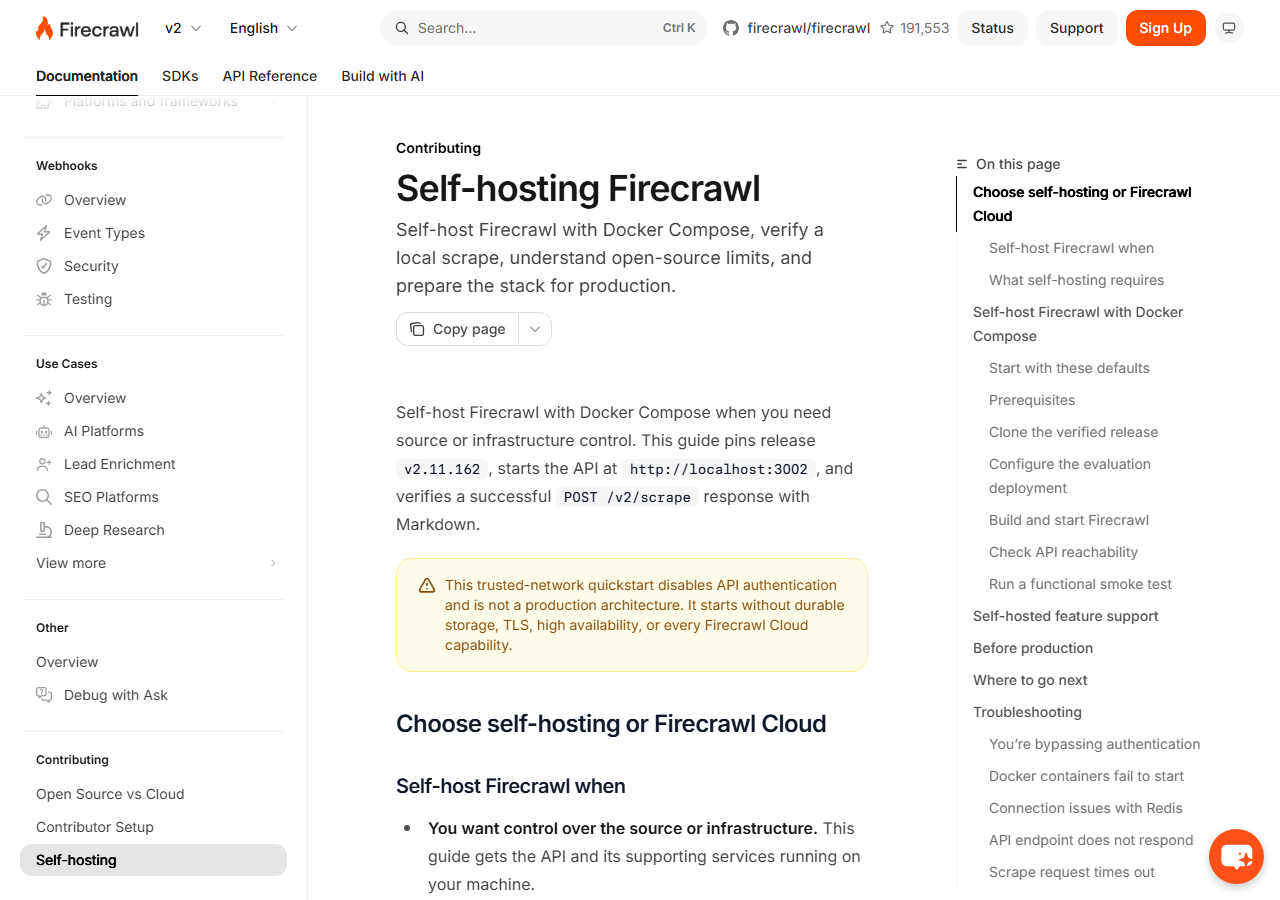
The core repository is primarily licensed AGPL-3.0 (the SDKs and some UI components are MIT), and AGPL-3.0 can require you to publish the source of modified network services. If you plan to embed or modify it in a commercial product, have the license reviewed before you build on it.
Built to be called by AI agents, and it advertises that heavily.
Firecrawl offers a hosted MCP server, a CLI, agent skills for Claude Code and Codex, and SDKs for Python, Node and several other languages. The MCP page lists three ways in: keyless (Search, Scrape and Parse within daily limits), browser sign-in through OAuth, or an API key. Native one-click connectors exist for ChatGPT, Codex and Claude. The home page claims over 400,000 MCP servers installed and SDKs at 2.5M+ weekly downloads, both vendor figures.
The easiest way to understand the options is to follow a team that starts small and tightens control as it goes.
Based on the MCP and rate-limits pages and the billing docs, docs.firecrawl.dev, as of 16 Oct 2026. The sequence is a JAVIS illustration, not a record of a JAVIS run.
A coverage benchmark run by the vendor, and a token-saving claim that depends on your pages.
Vendor test, 1,000 URLs
Same vendor test
Same vendor test
Same vendor test
The home page also claims 93% fewer input tokens for your model than raw HTML, and a testimonial says it benchmarked 50x faster than Apify for one team. Treat these as claims. A coverage test on the vendor's own dataset tells you how it does on that dataset, and the sites that matter to you may be the hard ones. The best check is the free plan and your ten worst URLs.
SOC 2 Type II is listed on every plan; the controls enterprises ask for sit on Enterprise.
The pricing page splits security into what every plan has and what you must pay up for. On every plan, including Free, it lists SOC 2 Type II (a vendor statement; the audit report is not public here), penetration testing, multi-factor sign-in, signed webhooks and PII redaction. Redaction is not free in credits: it adds 4 per page.
Everything else depends on the plan, and three situations show how. A company that must sign a Data Processing Agreement before any customer data is processed cannot do it on Free or Hobby, where the page marks the agreement as not available; the cheapest plan that lists a standard agreement is Standard at $83 a month billed yearly. A team that wants personal data stripped from the page content it receives has it on every plan, but a page with redaction and JSON extraction costs 1 + 4 + 4 = 9 credits, so 10,000 such pages is 90,000 credits, most of a Standard month. A company whose policy requires single sign-on, SCIM, Zero Data Retention (approved use cases only), API key restrictions or IP allow-lists, or static egress IPs has to talk to sales: the pricing page lists all of them under Enterprise only.
Source: the Compare plans section of firecrawl.dev/pricing, read 16 Oct 2026, and the billing docs for the credit costs. The plan feature table above shows the same controls side by side.
Scraping sends requests to other people's websites, and a site owner on Hacker News described being hit hard by crawlers from Firecrawl's customer base. Whether you may collect and reuse a given site's content is your responsibility: check robots.txt, terms of service and local law. The home page says content is licensed through Firecrawl Alexandria, a catalog it describes as 113M+ indexed sources, 93 providers and 640 capabilities; those are vendor numbers.
Builders of AI agents and RAG pipelines who need clean pages fast.
- Developers who want one API for search, scrape and crawl
- Agent builders using MCP, Claude Code or Codex
- Teams that would rather pay than run proxies and browsers
- Teams that need an open-source fallback
- Very low volume users who need JSON on every page (5 credits each)
- Teams that need screenshots or actions on a self-hosted setup
- Buyers who need an independent rating before they commit
- Anyone who expects unlimited use for one flat price
The cost surprises and the cloud-only features.
JSON extraction is 5 credits a page, and other formats add 4 each. A plan sized for page counts can run out early.
Extra credits cost about 3 times the plan rate on Standard and Growth.
Interact is 2 credits a minute on the pricing page and 2 to 7 in the billing docs. Map is 1 per page on the pricing page and 1 per call in the billing docs.
Anti-bot, screenshots, actions, interact and agent are not in the default self-hosted stack.
Unused credits expire monthly except on annual Scale and Enterprise.
This review quotes no review-site rating; the evidence is star counts and forum threads.
Modified network services may have to publish source.
A page that answers with 403 or 404 still costs 1 credit.
JAVIS did not run it for this review.
Ready-made scrapers, no-code monitors and browser-control tools.
Swipe the table sideways to see every column.
| Product | Best when you need | What the source says (16 Oct 2026) | JAVIS review |
|---|---|---|---|
| Firecrawl | One API for search, scrape, crawl and agents; open core | Free to $599 a month in credits, Enterprise custom | This article |
| Apify | A marketplace of ready-made scrapers (Actors) | Free $0 with $5 of monthly platform credit; Starter $19, Scale $199 and Business $999 a month plus pay as you go; $0.20 per compute unit on Free and Starter | Apify review |
| Browse AI | No-code scraping and monitoring | Free with 50 credits a month (up to 50 pages and/or 500 rows); Personal $19 and Professional $69 a month billed annually ($228 and $828 a year); unlimited robots on every plan | Browse AI review |
| Octoparse | A no-code scraper with a desktop app and cloud runs | Free plan with the desktop app (10 tasks, local runs only); Standard $83 a month or $829 a year; Professional $299 a month or $2,999 a year | Octoparse review |
| Browser Use | An open-source agent that drives a browser | See the JAVIS review | Browser Use review |
| Playwright MCP | Browser control for agents through MCP | See the JAVIS review | Playwright MCP review |
How they differ on price: Firecrawl sells credits for search, scrape and crawl calls. Apify charges for compute on top of a platform plan listed from $19 a month (the page also offers 10% off for annual billing). Browse AI sells credits from $19 a month billed annually, where its pricing page describes 50 credits as up to 50 pages and/or 500 rows. Octoparse sells plans by number of tasks and concurrent cloud runs: its Standard plan allows 100 tasks and up to 3 concurrent cloud processes, and Professional allows 250 tasks and up to 20, while the free plan runs locally only. Firecrawl is also open source (AGPL-3.0), so you can self-host it.
A rough way to choose: if you write code and want pages as clean text for a model, Firecrawl is the closest fit. If you want ready-made scrapers for a specific site, look at Apify. If nobody on your team writes code, look at Browse AI or Octoparse. If you want an agent to drive a real browser, read the Browser Use and Playwright MCP reviews. Once pages are markdown, a RAG project usually continues with indexing and storage, which the JAVIS reviews of LlamaIndex, Pinecone, Qdrant, Chroma and Weaviate cover, and agent orchestration, covered in the LangGraph and CrewAI reviews.
Hacker News also shows a steady stream of small open-source projects pitched as lighter Firecrawl alternatives. They are the authors' own descriptions and were not evaluated here. No JAVIS review exists yet for Jina, Crawl4AI, ScrapingBee or Bright Data.
This review has no affiliate links, and Firecrawl did not see it.
Every Firecrawl link in this article goes straight to firecrawl.dev, with no tracking parameters from JAVIS. The limits, the credit math and the unverified claims are written for the reader.
Hands-on status: JAVIS has not signed up for, used or paid for Firecrawl for this review. Facts come from Firecrawl's own pages and documentation, its public repository, public package download counts and Hacker News, as of 15 and 16 Oct 2026.
Start on the Free plan, or the keyless tier, with your ten hardest pages.
Open firecrawl.devThe plan tables above come from the pricing page and the billing docs.
Open the billing docsComparing scraping and agent tools? These reviews cover the nearest ground.
Each card opens a published JAVIS review.



Questions people actually ask before paying
How much does Firecrawl cost in October 2026?
Per firecrawl.dev/pricing on 16 Oct 2026: Free $0, Hobby $16 a month billed yearly ($19 monthly), Standard $83, Growth $333 and Scale $599 a month billed yearly, with Enterprise custom. Credits are 1,000, 5,000, 100,000, 500,000 and 1,000,000 a month.
Is there a free plan?
Yes: 1,000 credits a month, 2 concurrent requests and no credit card. Search and Scrape also work with no key (Parse too on the hosted MCP server), capped per IP address per day.
What is a credit?
One page on a basic scrape, crawl, map or monitor check. Search is 2 credits per 10 results. JSON extraction adds 4 credits a page, so it is 5 in total.
Can Firecrawl watch a page for changes?
Yes, through its Monitor feature, which re-checks a page, a site or a web search on a schedule and notifies you by webhook, email or Slack. You pay the normal credits for each check, so 20 pages checked daily is 600 credits a month, plus 1 credit per changed page if AI judging is on.
What happens when credits run out?
On a paid plan, pay-as-you-go can add credits in $5 increments up to a limit you set. Extra credits cost more than plan credits, about 3 times as much on Standard and Growth.
Is Firecrawl open source?
Yes, under AGPL-3.0, with 191,933 GitHub stars on 16 Oct 2026. The cloud version adds proprietary parts such as the Fire-engine anti-bot layer, and the self-hosted default stack has no screenshots, actions or agent.
Does it work with Claude, ChatGPT or Cursor?
Yes, through a hosted MCP server, native connectors for ChatGPT, Codex and Claude, a CLI and agent skills.
Is the 96% coverage figure proven?
It is the vendor's result on its own 1,000-URL dataset, run on 13 Jan 2026. No independent reproduction is quoted here.
Is Firecrawl an affiliate product here?
No. This review has no affiliate links.
Where this came from, and when.
Pricing and plans: firecrawl.dev/pricing and the billing docs, 16 Oct 2026; the rate-limits page, 15 Oct 2026.
Product and claims: firecrawl.dev home page and the documentation pages for scrape, crawl, map, search, extract, MCP, Alexandria, introduction and self-hosting, 15 Oct 2026.
Open source: the firecrawl/firecrawl repository on GitHub: stars, forks, open issues and pull requests, license, creation date and latest push, 16 Oct 2026.
Adoption: npm and PyPI weekly download counts for 6 to 12 Oct 2026. A download is not a user.
Images: nine captures of public pages made by JAVIS: six on 15 Oct 2026 (the Firecrawl home and pricing pages, the GitHub repository and three documentation pages) and three phone-width crops on 16 Oct 2026 (the Hobby plan card, the pricing page API Credits list and the billing docs credit-cost table), and two illustrations published by Firecrawl, labelled as such. Related cards use JAVIS's own featured images.
Video: one video on the official Firecrawl YouTube channel, linked from its documentation.
User evidence: Hacker News comments from 18 Sep, 30 Mar and 5 Oct 2026. No Trustpilot, G2 or Capterra rating is quoted. Firecrawl's own testimonials are labelled as vendor material.
Competitors: described in their own JAVIS reviews; entry plans for Apify, Browse AI and Octoparse read from each vendor's pricing page on 16 Oct 2026.
Monitor and credit rules: firecrawl.dev/pricing, the billing docs and the Monitor documentation page, re-read on 16 Oct 2026.
Store ratings: none included; Firecrawl has no consumer app.
JAVIS Fit Score (74/100): an editorial composite scored out of 20 on five criteria. Price clarity 15: a clear public ladder, but stacking credits and a pricing-page versus billing-docs mismatch. Capability breadth 18: search, scrape, crawl, map, interact, agent, MCP and open source. Independent evidence 12: strong public adoption counts, mixed forum threads, no review-site rating. Security and data control 14: SOC 2 Type II stated on all plans, but DPA, ZDR and SSO sit higher. Cost control and fit 15: a real free tier, but expensive overage. It is judgment, not a measurement.
What this review does not cover: real scrape success rates, performance under load, a technical security review, the Alexandria catalog in depth and competitor prices beyond the entry plans.