LangChain Review 2026: A Free, Hugely Popular Agent Framework, and a LangSmith Bill Whose Trace Price Rose Tenfold in Under a Year
LangChain is two things that are easy to confuse. The framework (langchain, with LangGraph underneath) is MIT-licensed and free. LangSmith, the company's commercial platform for tracing, evaluating and deploying agents, is where the money is, and its pricing changed three times between December 2025 and October 2026. This review covers what each part costs today, what the price history means for your budget, what developers say in public, the security record, and what is still unknown.
There are no affiliate links in this review. Every LangChain link goes straight to langchain.com, its docs or its GitHub repository.
| Made by | LangChain, Inc., San Francisco |
| What it is | Open-source agent framework plus LangSmith, a paid platform for tracing, evals and deployment |
| Framework | Free, MIT; latest langchain 1.4.6 (Oct 14, 2026) |
| LangSmith | Developer $0 (1 seat); Plus $39 a seat a month; Enterprise custom |
| Usage | Billed in LSUs at $1 each; extra base traces 0.005 LSU each |
Use the framework if its abstractions save you time; budget LangSmith by trace volume and seats, and re-check the pricing page every quarter, because it has kept moving.
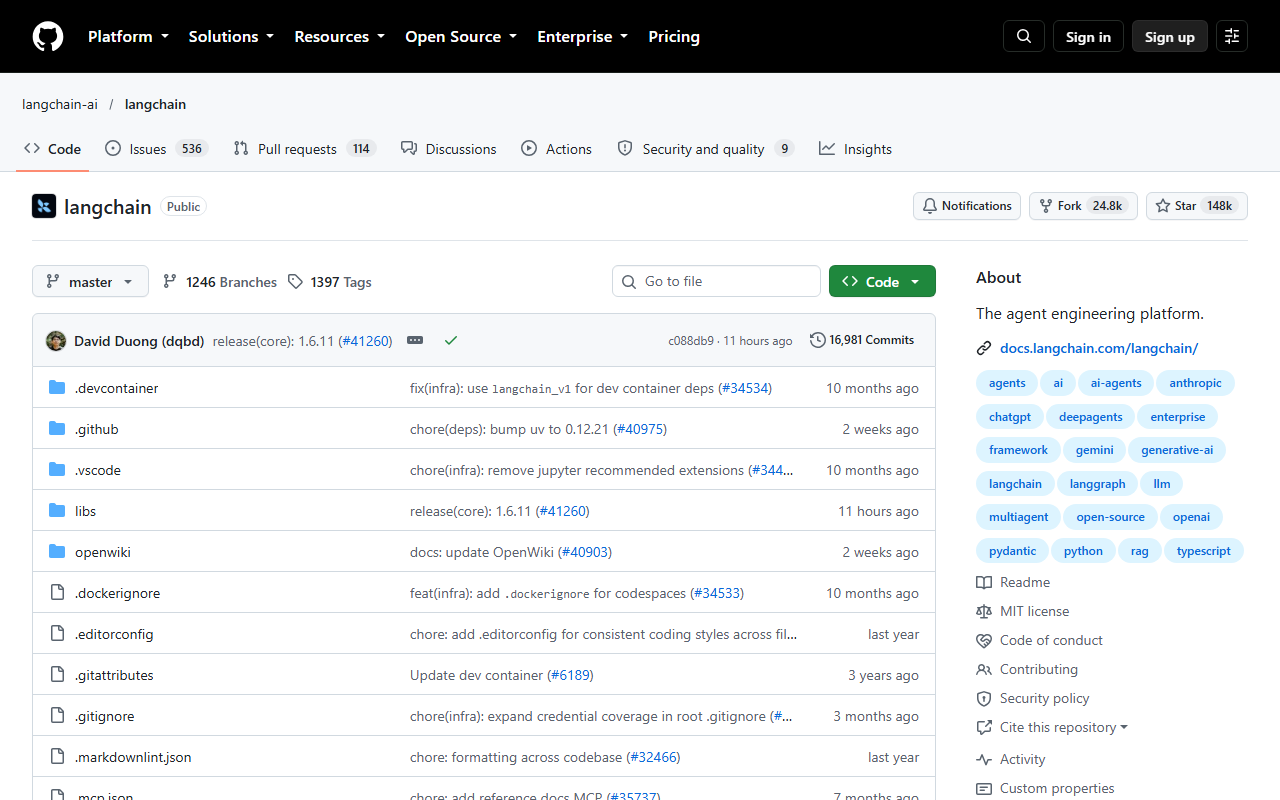
“Own your intelligence.” That is LangChain's current slogan, and it sits on top of a library with 147,899 GitHub stars and, per PyPI download counters, about 170 million downloads of the langchain package in the last 30 days.
The open-source side is in better shape than its reputation. Since version 1.0 shipped on 17 Oct 2025, the project follows semantic versioning, promises no breaking changes until 2.0, and has collapsed its sprawl into one agent entry point, create_agent, with middleware for things like PII redaction, conversation summarization and human approval. The old chains and retrievers moved to a separate langchain-classic package.
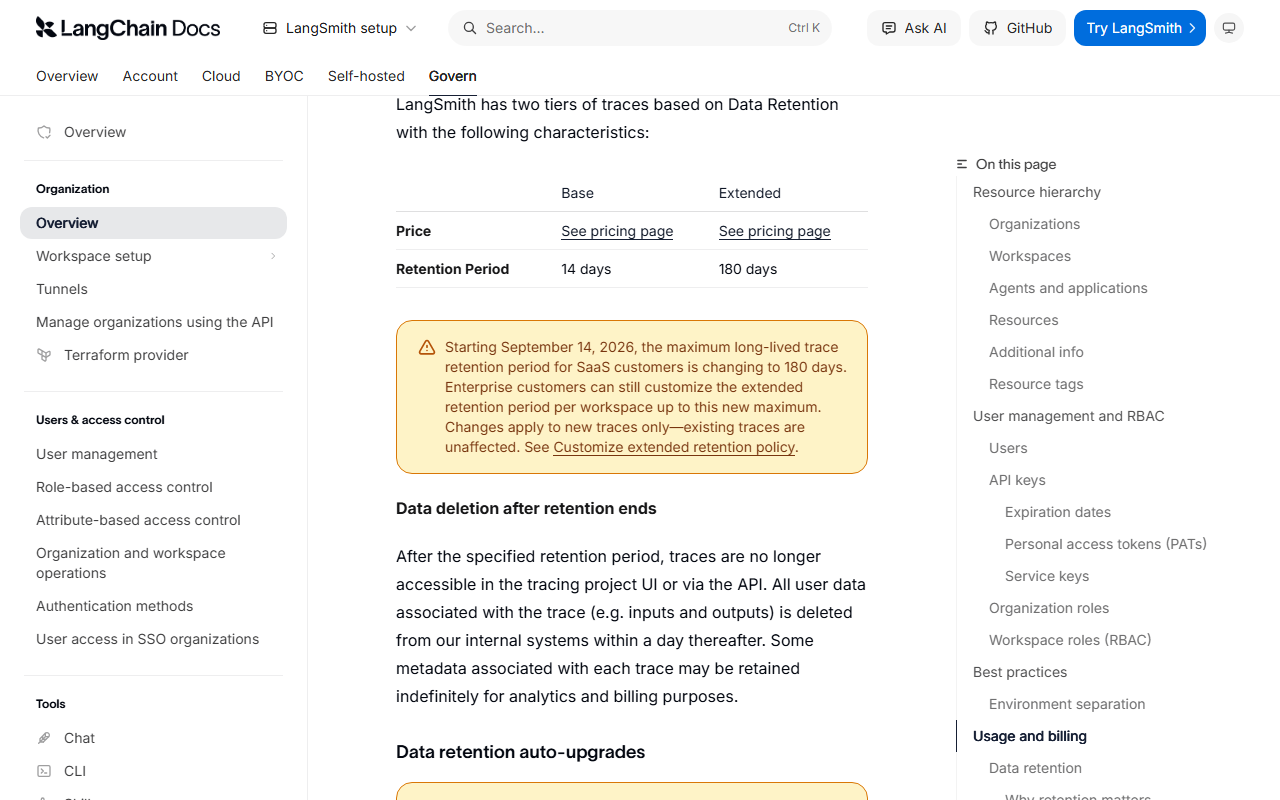
The commercial side is where a buyer needs care. LangSmith's per-seat prices have stayed put ($0 Developer, $39 a seat on Plus), but the price of each trace beyond the included allowance went from $0.50 per 1,000 in the December 2025 version of the pricing page to $2.50 by January 2026 and to $5.00 (0.005 LSU) by late July 2026. In the same period the maximum retention for long-lived traces fell from 400 to 180 days, LangChain merged two billing units into one LangChain Standard Unit, and it moved existing self-serve customers onto the new “October 2026” plans. Newer products (Engine, Fleet, Sandboxes, Deployment) each meter in LSUs on top of seats.
Public sentiment is split in a familiar way: the framework is everywhere in job posts and tutorials, while Hacker News threads from 2023 to September 2026 keep repeating the same complaints about heavy abstractions, painful debugging and churn. LangSmith gets short praise and recurring complaints about cost and lock-in.
Not a hands-on test: JAVIS has not installed LangChain, opened a LangSmith account or paid for a plan for this review. It is built from LangChain's website, pricing page, documentation, changelog, Trust Center, status page and GitHub repository, Internet Archive copies of the pricing page, Hacker News, TechCrunch, and competitors' pricing pages, all as of 16 Oct 2026. There is no independent star rating to quote: Trustpilot shows an unclaimed profile with no reviews.
Three free frameworks, one paid platform, and one environment variable connecting them.
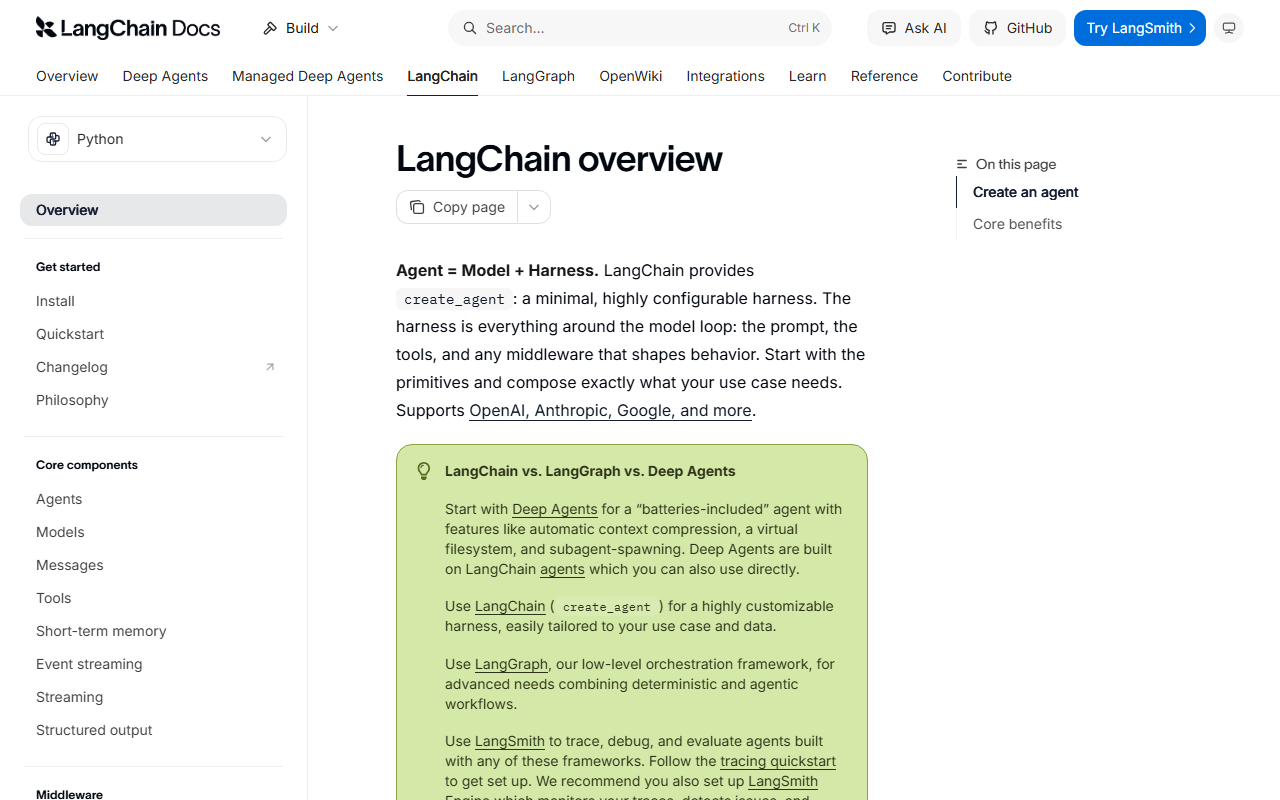
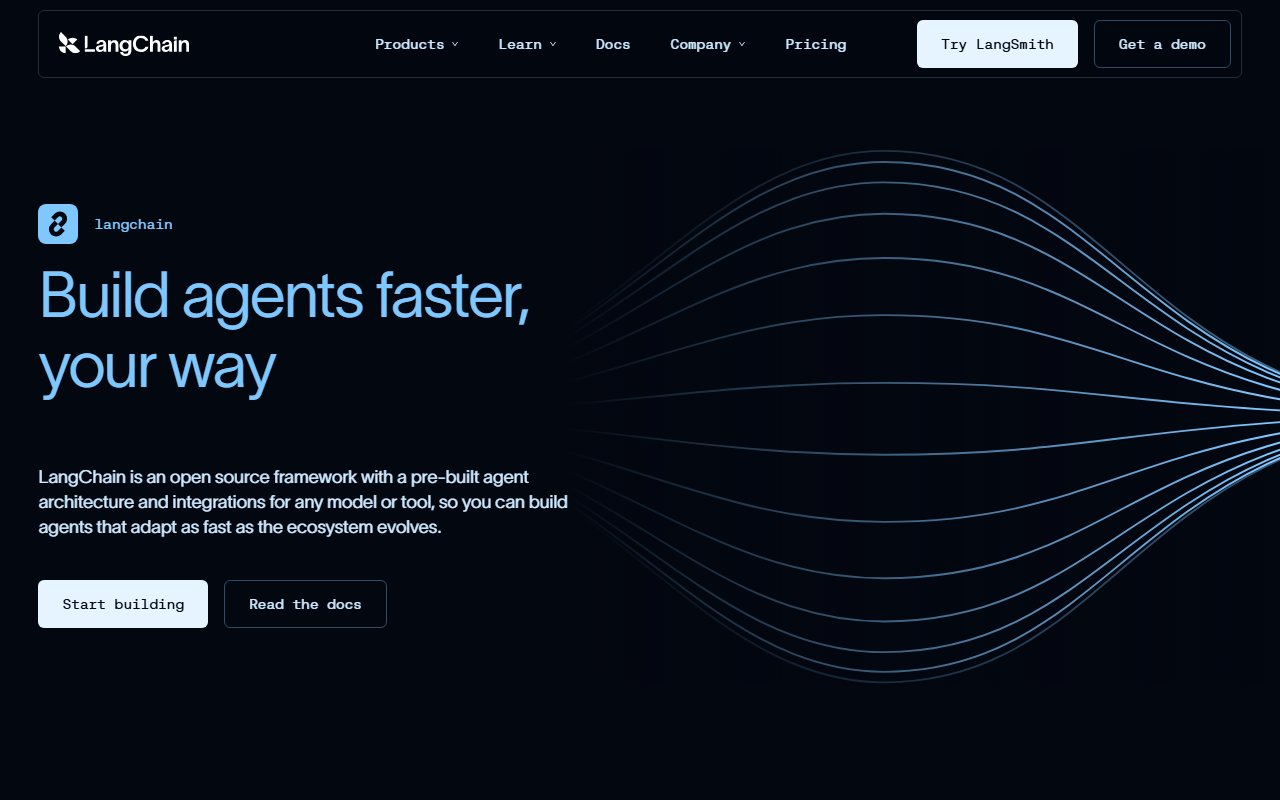
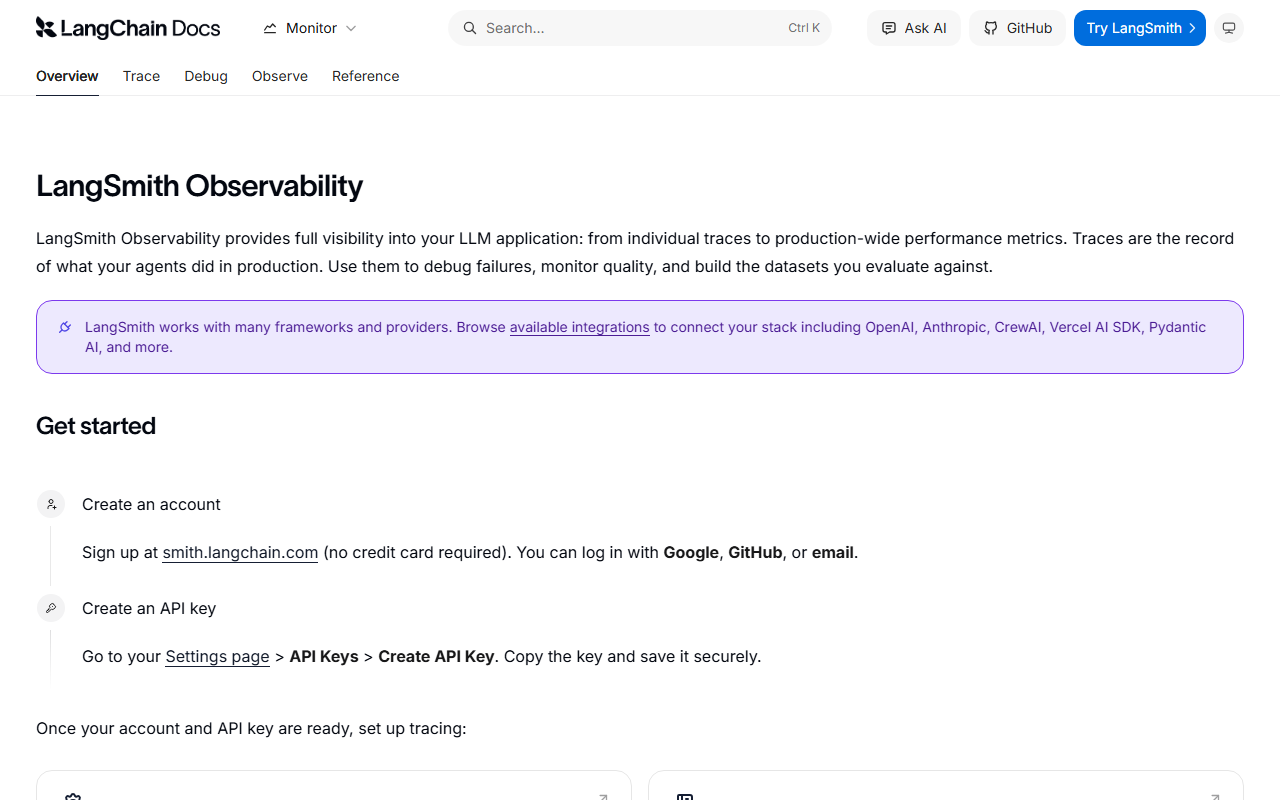
LangChain's own overview page draws the line clearly: Deep Agents for a “batteries-included” agent, LangChain's create_agent for a customizable harness, LangGraph for low-level orchestration, and LangSmith to trace, debug and evaluate agents built with any of them. All three frameworks are MIT-licensed. LangSmith is the commercial product, and the docs say it also works with stacks such as OpenAI, Anthropic, CrewAI, the Vercel AI SDK and Pydantic AI.
Swipe sideways to read the full diagram.
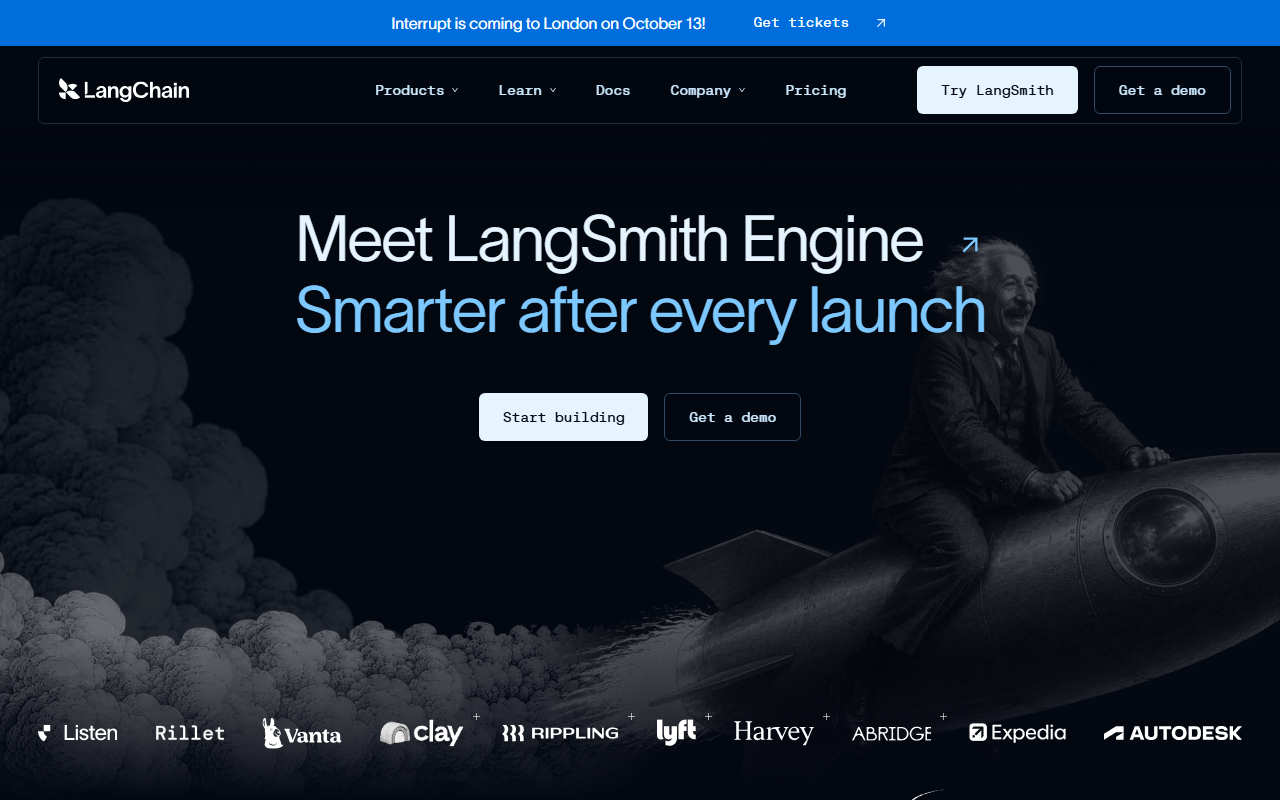
The most-downloaded agent framework by a wide margin, a unicorn valuation, and vendor counters that measure different things.
langchain-ai/langchain, 16 Oct 2026; 24,821 forks
pypistats, 16 Oct 2026; includes automated installs
at a $1.25B valuation, led by IVP (TechCrunch, 21 Oct 2025)
GitHub, 16 Oct 2026
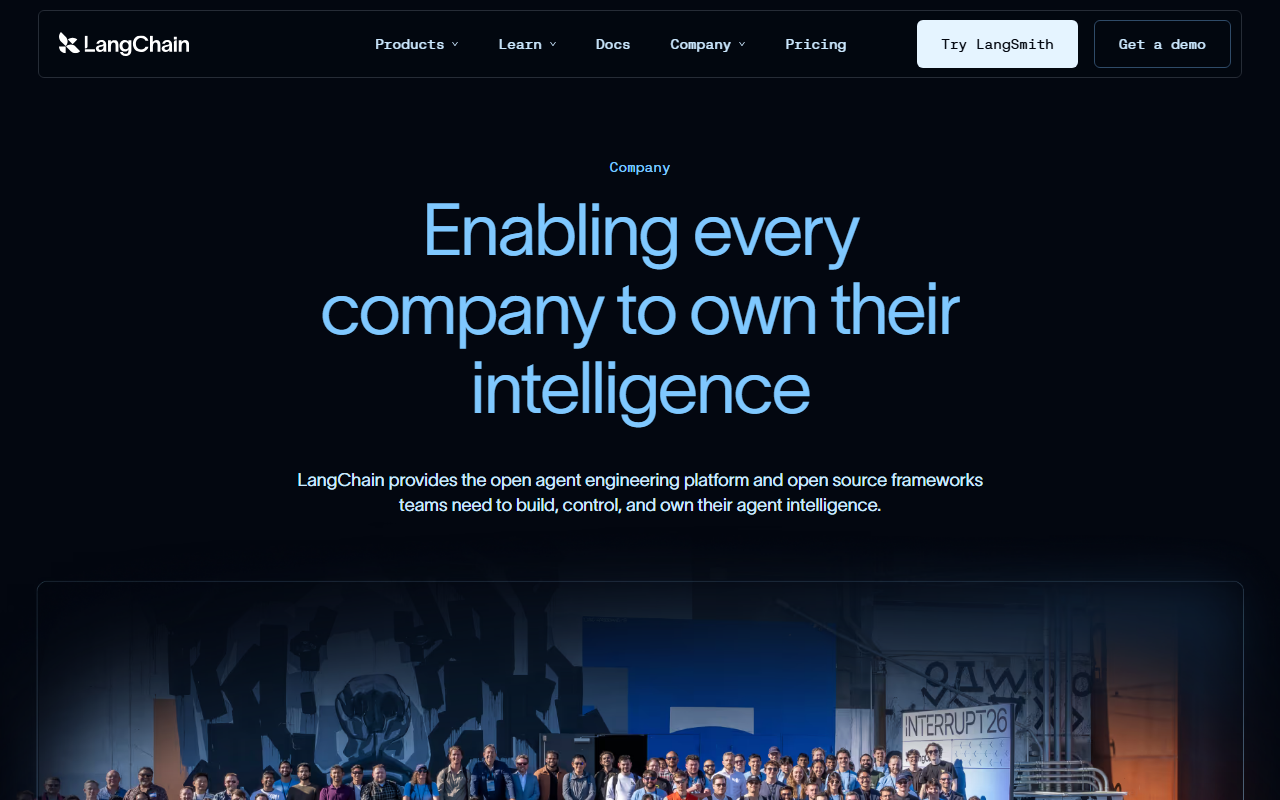
LangChain started as Harrison Chase's side project in late 2022, and the company was formed with co-founder Ankush Gola in early 2023, per its About page. TechCrunch reported on 21 Oct 2025 that it raised $125 million at a $1.25 billion valuation, led by IVP with CapitalG and Sapphire Ventures joining existing investors including Sequoia and Benchmark.
Package downloads are the hardest adoption number available, with the usual caveat that CI servers and dependency installs inflate them and that LangChain packages are often pulled in by other tools. In the 30 days to 16 Oct 2026, pypistats counts 170,457,766 downloads for langchain, 144,826,657 for langchain-core, 77,233,437 for the langsmith SDK and 44,769,952 for langgraph. For comparison, pydantic-ai had 5,383,780, llama-index 2,937,852 and crewai 2,442,764. On npm, langchain had 13,538,783 downloads between 13 Sep and 12 Oct 2026, a fraction of the 126,450,236 for Vercel's ai package, so in JavaScript LangChain is not the default it is in Python.
LangChain's own counters are bigger and vaguer, and they do not agree with each other in kind. The home page claims 350M+ monthly open-source downloads (across all its packages), 7K+ active LangSmith customers and 5 of the Fortune 10 as LangSmith customers. The About page says LangChain works with 35% of the Fortune 500, has crossed 1 billion open-source downloads and ingests over 1 billion events a day on LangSmith. None of these is audited. “Customers” and “works with” are not the same claim, and a download is not a user.
No analyst market-share figure is cited. Stars, downloads and vendor counters measure attention and installs, not paying customers.
No star rating exists, and the public record is a long-running argument about abstractions.
Trustpilot shows an unclaimed LangChain profile with 0 reviews as of 16 Oct 2026, LangChain has no mobile app to rate, and no G2 or Capterra score is quoted here. The evidence below is Hacker News, with each comment's id, date and author, read as one person's account each, not a verified finding.
Two of the most-discussed LangChain stories set the tone years ago: “Langchain Is Pointless” (item 36645575, 8 Jul 2023, 386 points) and “Why we no longer use LangChain for building our AI agents” (item 40739982, 20 Jun 2024, 480 points, 297 comments). Both predate LangChain 1.0, which rewrote the agent API, so what matters is whether the complaints continue after October 2025. They do.
Says debugging is the biggest problem: stepping through takes many jumps before reaching the code that matters, and the code branches on versions. Calls it “hopelessly spaghettied” and says their current choice is Pydantic AI.
Says there are many LangChain alternatives and none are good; they use Apache Burr but say it is “not as good as LangChain”, and object to a library having a pricing page when it is not a SaaS product.
Warns that coding assistants may reach for LangChain, which has had multiple breaking changes since their training cutoff, so the generated code needs many fixes and gets messy.
Those three come from a 23 Sep 2026 thread under a Stripe story (item 49815982) where one commenter (49816901) called LangChain bad since day one, another asked why (49817020), and a third (ramraj07, 49817324) said most frameworks “abstract the wrong concepts” and recommended plain Pydantic and your own code. The pattern is not new, but it is still current.
About a year and a half earlier, their developer spent roughly six weeks struggling with LangChain to approximate what Claude plus an MCP server now does; the MCP server took about two days to build and three more to make production-ready.
Somewhat frustrated with LangChain tooling and would not recommend it, but thinks the concepts are worth understanding and points readers to LangChain's trajectory-evals documentation.
A co-founder of a firm that sells growth services to dev-tool companies reports, from about 17,000 coding-agent sessions, that LangChain is among the names agents almost always mention in its category but never choose. Vendor-adjacent research; read it as a lead.
What people say about LangSmith specifically
Feels LangSmith is “creeping further and further” into LangChain and LangGraph, with “AWS-like gentle but firm lock-in vibes”, while liking LangGraph workflows and the Django-like middleware approach.
Calls LangSmith's prompt-engineering workflow “okay-ish”, a lot of work and expensive fast, and limited to one-turn prompts; prefers PydanticAI as lighter.
Prefers Langfuse: open source, fewer breakages than LangChain products, and cheaper than LangSmith, which charges for seats and per trace and more to keep traces past 14 days.
The positive notes are short. One commenter simply wrote “LangSmith is good” (dewolfe1037a, 9 Jan 2026, comment 46559212). Another (MickeyShmueli, 4 Mar 2026, comment 47248766) used LangSmith enough to note that each turn of a conversation looked fine in it while the overall flow was broken, which is an argument for the session-level views LangChain added later (Trajectories, announced 24 Sep 2026).
Read together: adoption is real and broad, the complaints are consistent (abstractions, debugging, churn, lock-in, cost), and almost nobody posts detailed praise. That is a sample of vocal developers, not a satisfaction survey.
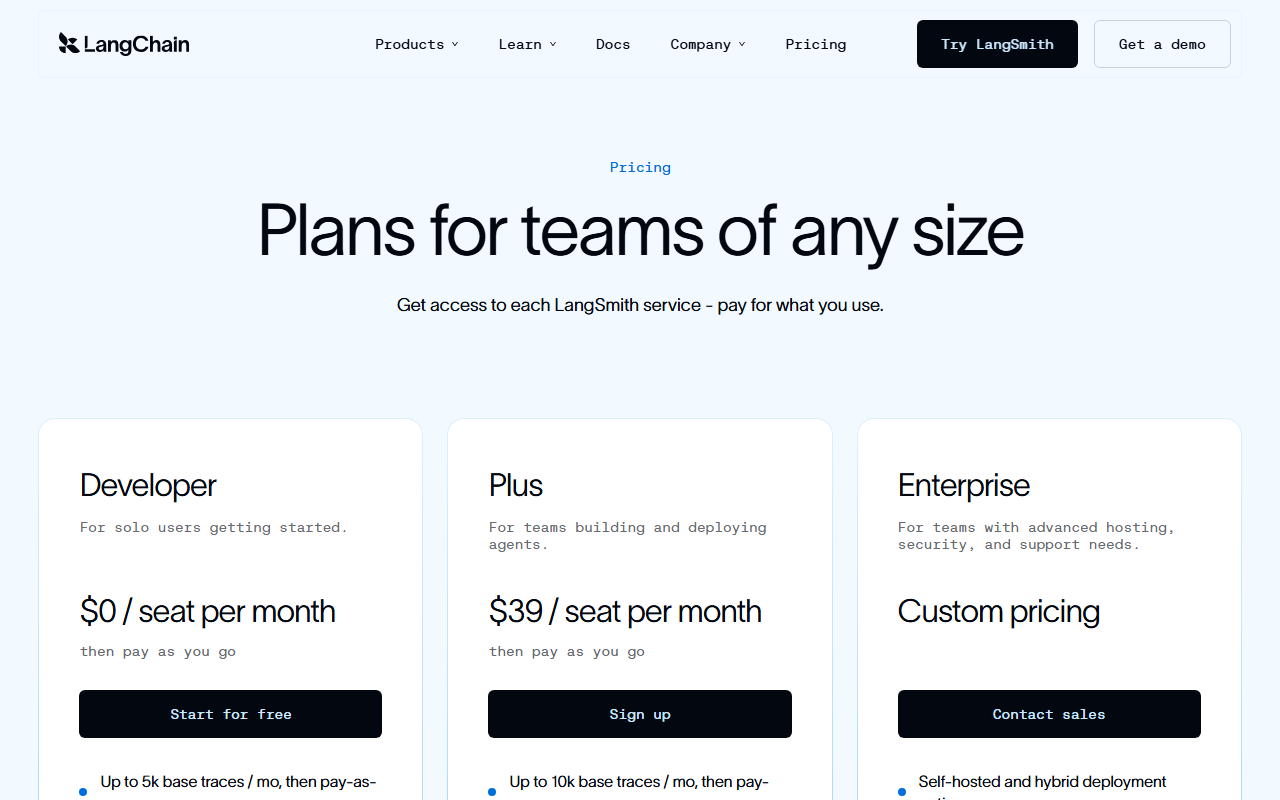
The framework is free. LangSmith is $0 for one person, $39 a seat on Plus, then usage in LangChain Standard Units.
Developer
Maximum 1 seat
- 5,000 base traces a month included
- Capped at 5,000 until a card is added, then pay as you go
- Fleet 7 LSU and Sandboxes 8 LSU included
- No Deployment, no Engine
- Community support
Plus
Unlimited seats
- 10,000 base traces a month included
- 1 free Serverless (Small) deployment
- Engine metered in LSUs
- Fleet 37 LSU included
- Data in LangChain's cloud, US or EU
Enterprise
Annual invoice
- Cloud, Hybrid or Self-Hosted
- Custom SSO, ABAC and RBAC
- Support SLA, deployed engineers
- Traces at a flat 0.0075 LSU unless the contract says otherwise
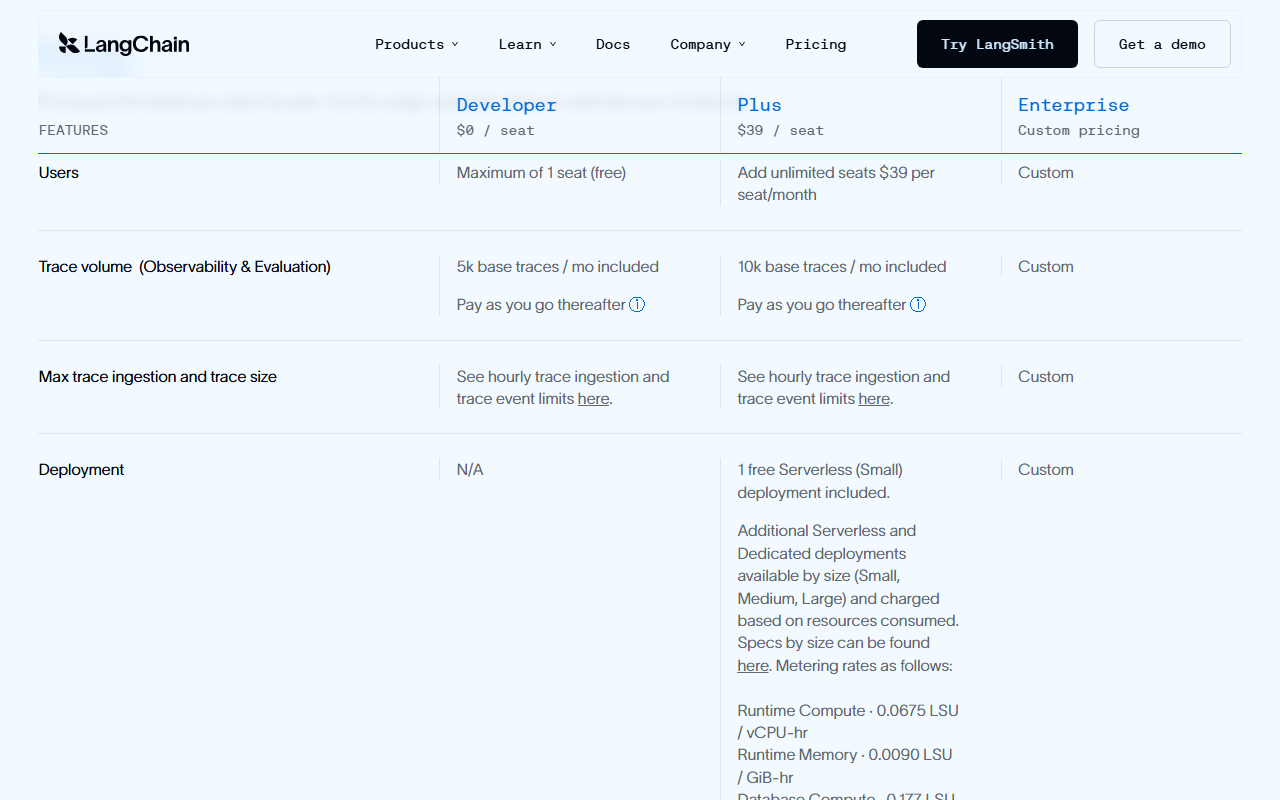
| Metered item | Developer | Plus | Enterprise |
|---|---|---|---|
| Seat | $0, 1 only | $39 a month each | Custom |
| Base trace beyond allowance | 0.005 LSU | 0.005 LSU | 0.0075 LSU flat |
| Extended retention upgrade | 0.0025 LSU | 0.0025 LSU | None (flat rate) |
| Deployment runtime | Not available | 0.0675 LSU per vCPU-hr, 0.0090 per GiB-hr | Custom |
| Deployment database | Not available | 0.177 LSU per vCPU-hr, 0.025 per GiB-hr | Custom |
| Engine | Not available | About 7 to 45 LSU per run | Custom |
| Sandboxes | 8 LSU included, 10 max | 0.0576 LSU per vCPU-hr and more | Custom |
| Tuned Evaluators | Not available | 0.015 LSU per run (US cloud) | Custom |
Not an affiliate link. It opens LangChain's official website.
Seats are the small part. Traces, retention upgrades and the newer LSU products decide the bill.
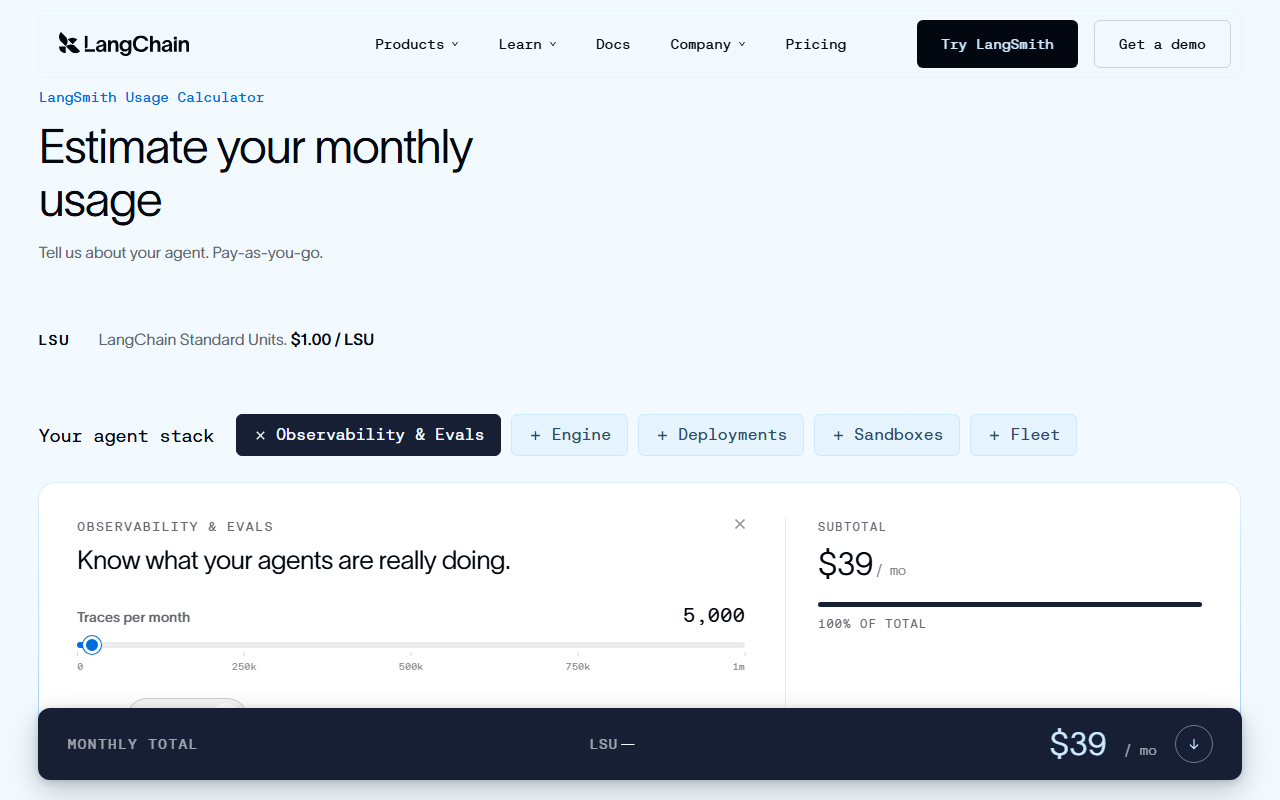
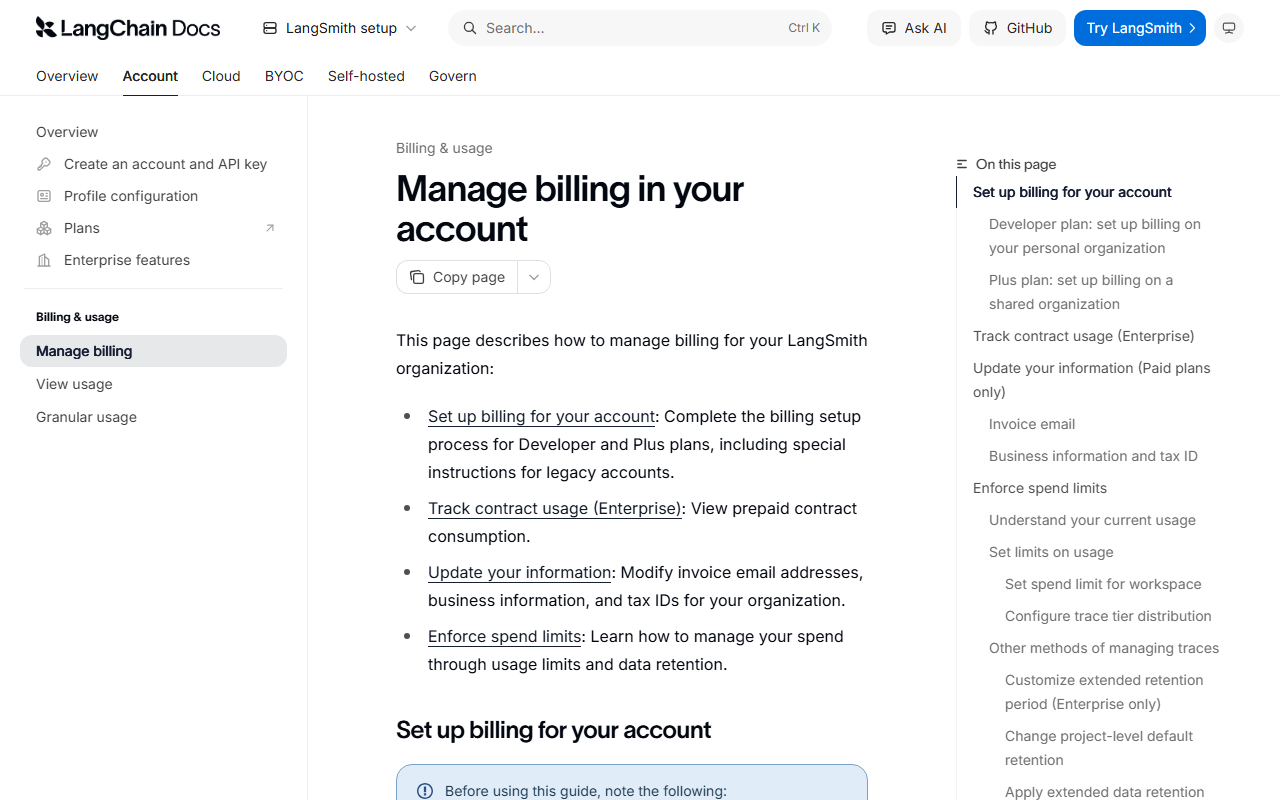
Three definitions from the pricing FAQ matter before any arithmetic. A trace is one execution of your application, which can contain many LLM calls and tool steps. Base traces are kept 14 days. Extended traces are kept 180 days and cost more, and the docs warn that online evaluators and automation rules upgrade traces to extended retention by default unless you opt out per evaluator or rule. Everything below is arithmetic on the published rates (0.005 LSU per extra base trace, 0.0025 LSU per upgrade, $39 per Plus seat) with invented but plausible traffic. It is an illustration, not a measurement.
0.005 LSU each
base + 0.0025 LSU upgrade
above 10,000 traces
worked example 3
Worked example 1: a solo developer
Someone tracing a side project at 3,000 traces a month stays inside the Developer plan's 5,000 and pays $0. Without a card on file the account simply stops at 5,000 traces a month, per the billing docs. At 20,000 traces with a card added, the 15,000 extra traces cost 15,000 × $0.005 = $75 a month.
Worked example 2: is Plus worth it for one person?
Plus includes 10,000 traces instead of 5,000, so the extra 5,000 included traces are worth 5,000 × $0.005 = $25. The seat costs $39. Above 10,000 traces a month, one person on Plus therefore always pays $39 − $25 = $14 more than on Developer: $89 against $75 at 20,000 traces, $239 against $225 at 50,000. You are not buying cheaper tracing with Plus; you are buying Deployment, Engine, the bigger Fleet allowance and the ability to add teammates.
Worked example 3: a five-person team in production
Five engineers on Plus pay 5 × $39 = $195 in seats. Their agent produces 200,000 traces a month, and an online evaluator upgrades 10% of them to extended retention. The 190,000 traces beyond the included 10,000 cost $950, and 20,000 upgrades cost 20,000 × $0.0025 = $50. Total: $1,195 a month, or about $5.98 per 1,000 traces. If the evaluator had been left on its default and upgraded every trace it scored, a 100% upgrade rate would add $500 instead of $50.
Worked example 4: switching on Engine
Engine, LangSmith's agent that reads your traces and proposes fixes, is available on Plus and metered in LSUs. The pricing FAQ says it is “scheduled to run once every 6 hours” and that a run “can consume ~7-45 LSUs”. The vendor calls that range an estimate that depends on trace volume, agent complexity and the issues and fixes found. If every scheduled run happened at that range, four runs a day for 30 days is 120 runs, or 840 to 5,400 LSU ($840 to $5,400) a month; the page does not say whether runs are skipped when there is nothing new to analyze, so read that as arithmetic on the vendor's estimate, not a quote. The controls are documented: per the LangSmith Cloud changelog, an admin enables Engine per tracing project (15 to 19 Jun 2026 and 3 to 10 Aug 2026), scheduled scanning can be paused and resumed (13 to 17 Jul and 20 to 24 Jul 2026), and each Engine project has a monthly spend limit at which new runs pause, though runs already in progress may finish and add to the bill (13 to 17 Jul and 3 to 10 Aug 2026). The pricing FAQ adds that an admin can turn Engine off in Settings.
Worked example 5: one always-on deployment
The pricing page meters Deployment by resources, not by run. Take a hypothetical dedicated deployment that keeps 1 vCPU and 2 GiB for the runtime and 1 vCPU and 2 GiB for its database live for a 730-hour month (the docs publish Small, Medium and Large specs separately, so these sizes are invented). Runtime compute is 0.0675 × 730 = $49.28, runtime memory 0.009 × 2 × 730 = $13.14, database compute 0.177 × 730 = $129.21 and database memory 0.025 × 2 × 730 = $36.50: about $228 a month, more than half of it database compute. A Serverless deployment can scale to zero when idle, so the same agent used a few hours a day costs far less; Plus includes one small Serverless deployment for free.
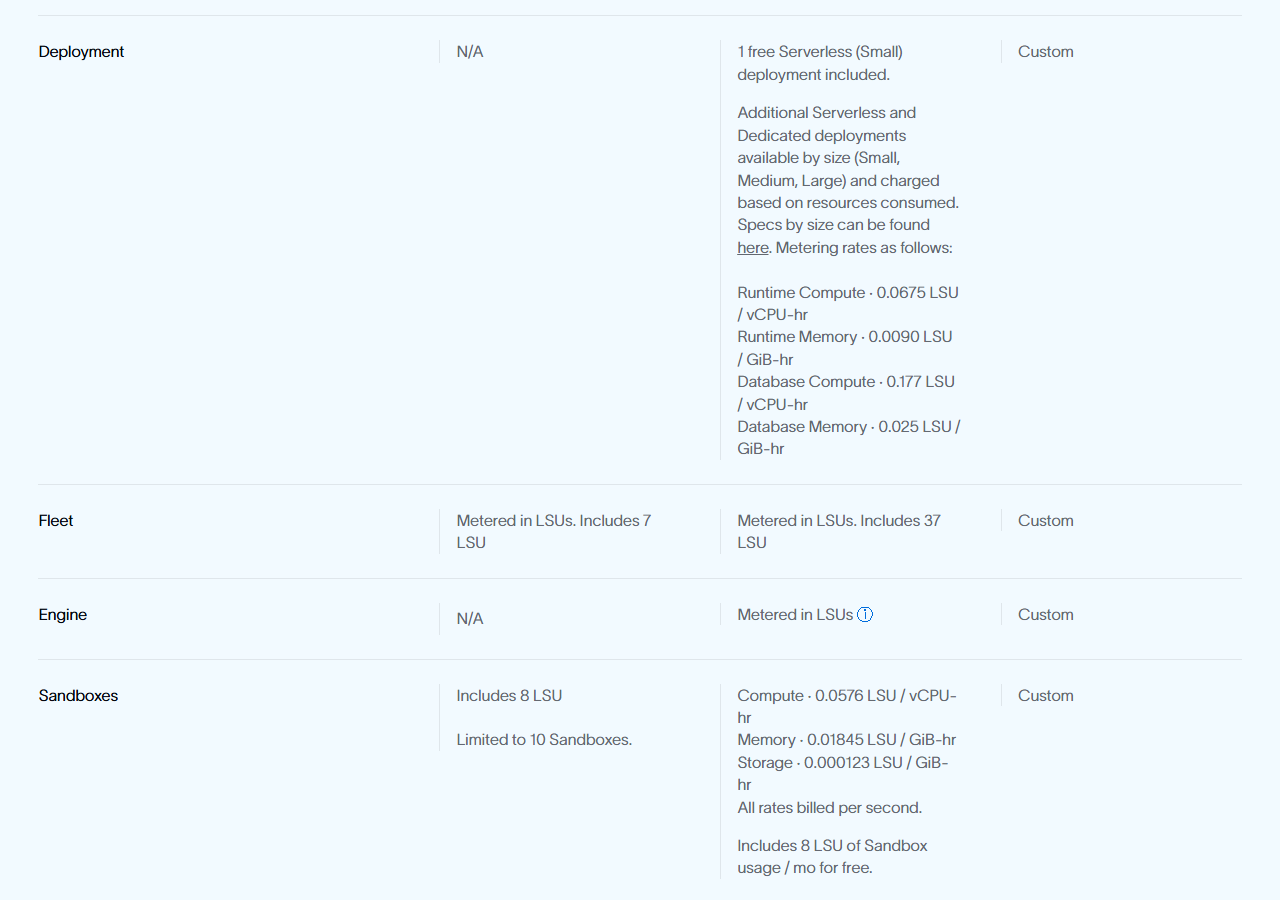
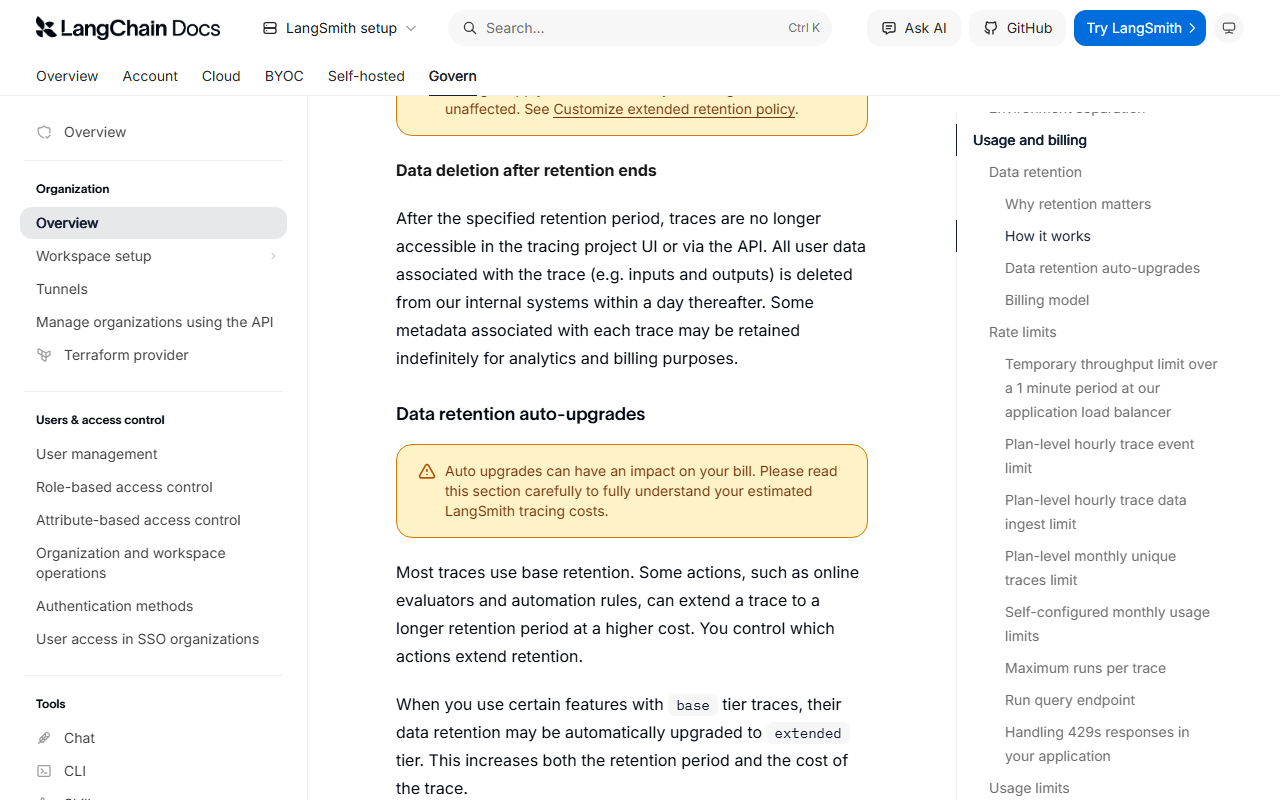
Base trace overage went from $0.50 to $5.00 per 1,000 in under a year, while retention got shorter.
Internet Archive copies of langchain.com/pricing show how the per-trace rate changed. The December 2025 copy listed base traces from $0.50 per 1,000 (“starting at”), extended traces at $5.00 per 1,000 and 400 days of extended retention. The FAQ on the January 2026 copies and on every copy through early July 2026 gives $2.50 per 1,000 base traces and $5.00 per 1,000 extended. The page did not agree with itself at first: on the 24 Jan and 2 Feb 2026 copies the plan cards still read “starting at $0.50 per 1k base traces” while the FAQ on the same pages said $2.50; from the March 2026 copy on, only the $2.50 rate appears. By the 31 Jul 2026 copy the tooltip reads 0.005 LSU per base trace and 0.0025 LSU per extended upgrade, with an LSU priced at $1.00: $5.00 per 1,000 base traces and $7.50 per 1,000 for a trace kept long term.
Other changes in the same window, each from LangChain's own pages:
Sources: LangSmith Cloud changelog, billing docs and pricing page, and Internet Archive copies of the pricing page, as of 16 Oct 2026.
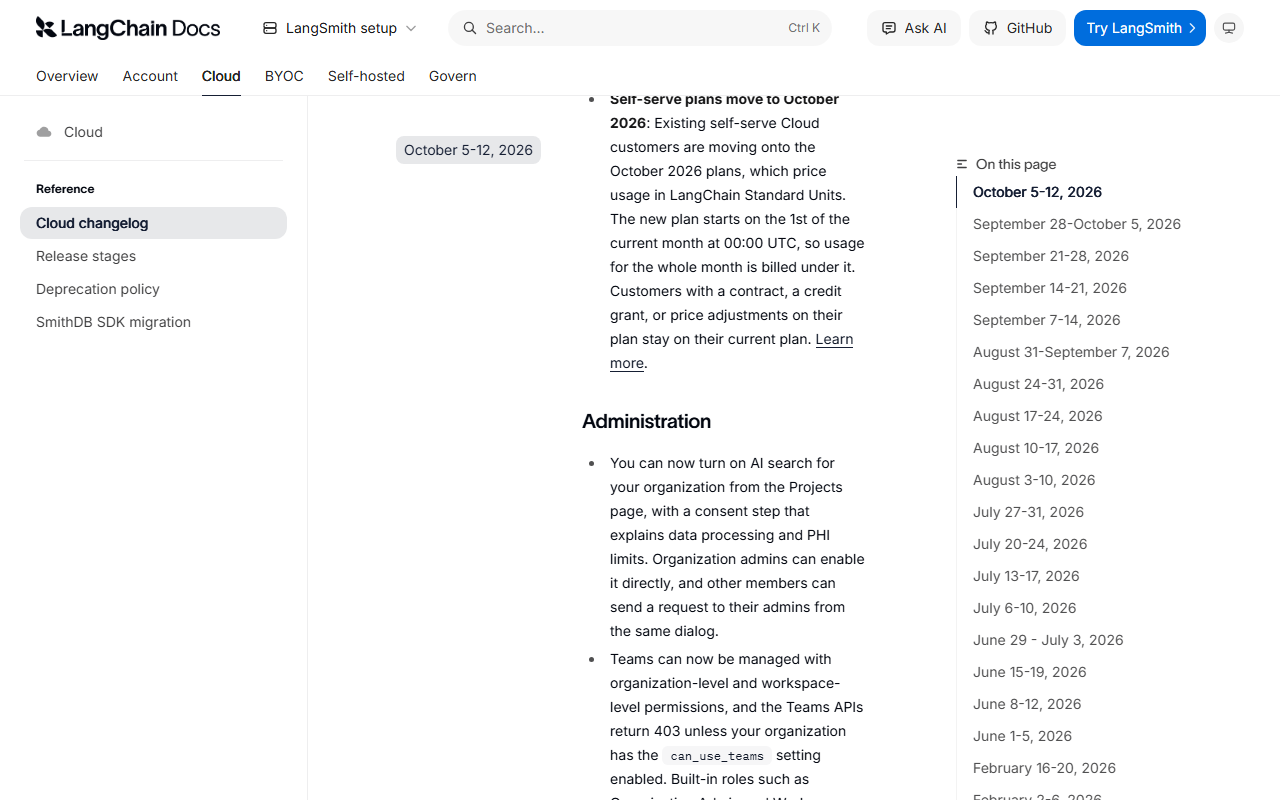
Framework and LangSmith are separate decisions. Make them separately.
One agent constructor, middleware for the hard parts, and a promise of stability.
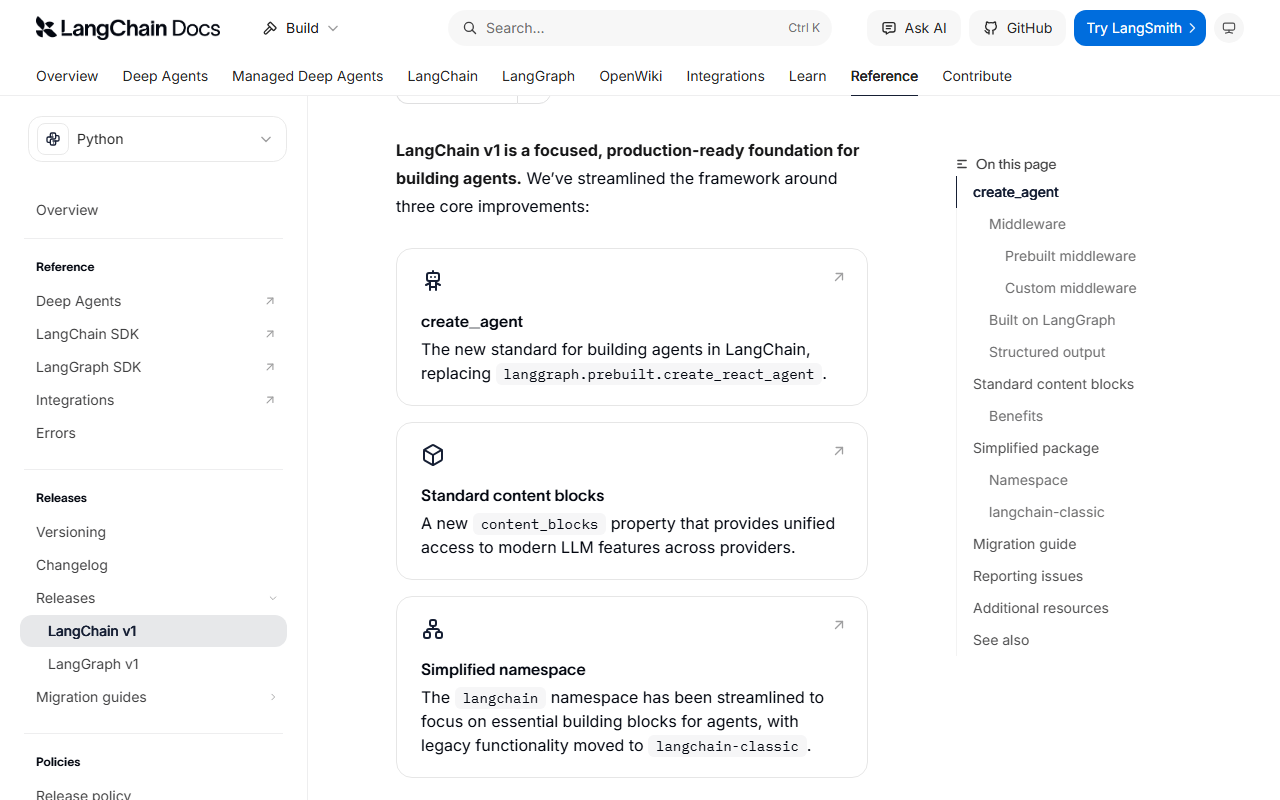
LangChain 1.0 (released 17 Oct 2025 on PyPI) narrowed the library to building agents. Per the v1 release notes, create_agent replaces langgraph.prebuilt.create_react_agent and runs on LangGraph's runtime, so persistence, streaming, human-in-the-loop and “time travel” come without learning LangGraph. Middleware is the main extension point: prebuilt PII redaction, conversation summarization and human approval for chosen tool calls, plus hooks such as before_model, wrap_tool_call and after_agent for custom logic. A new content_blocks property gives one representation of reasoning, text and tool calls across providers, though the notes list only Anthropic, AWS, OpenAI, Google GenAI and Ollama integrations as supported so far.
The housekeeping matters as much as the features. Legacy chains, the old retrievers module, the indexing API, the prompt hub module and community exports moved to langchain-classic, so old tutorials and some generated code will not import cleanly from langchain any more. That is exactly the churn Hacker News users complain about, and it is also why the 1.x API is smaller than what they remember.
How stable is it now?
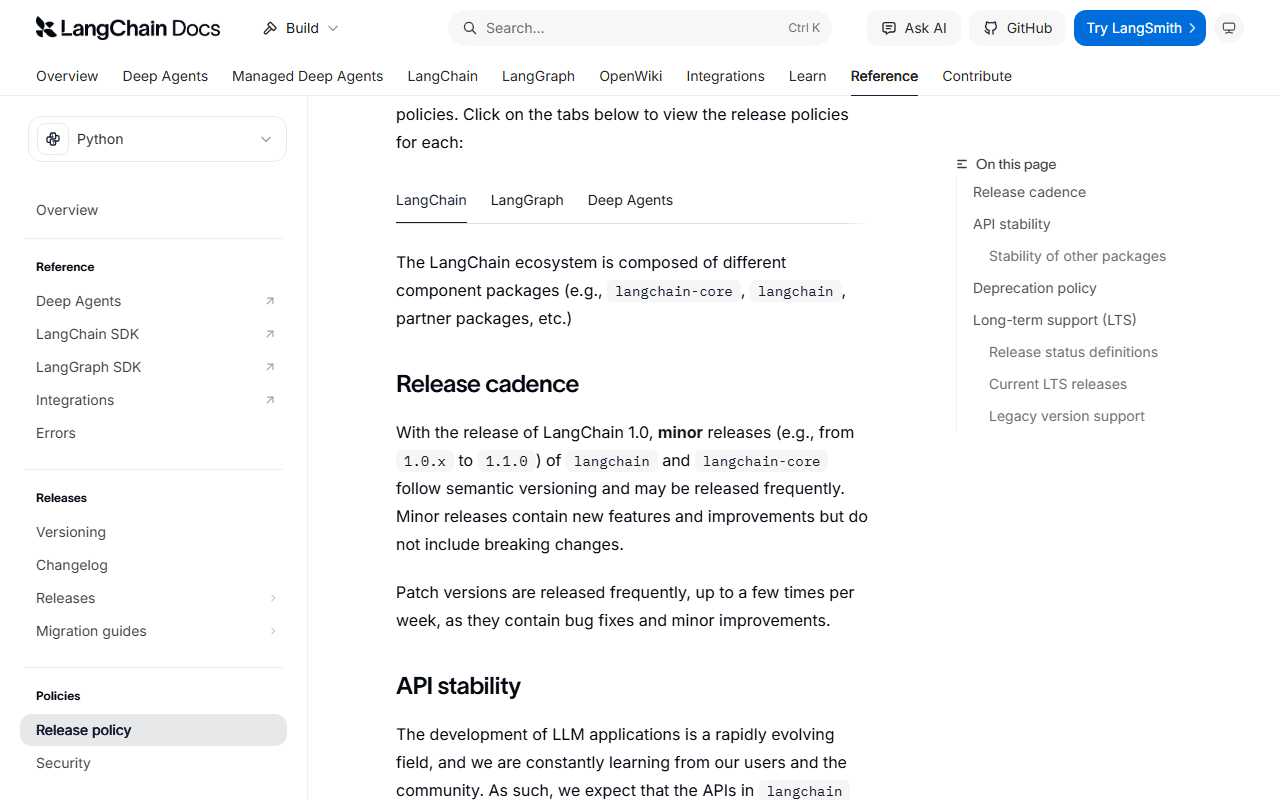
The release policy says minor releases of langchain and langchain-core add features without breaking changes, breaking changes wait for 2.0, deprecated features keep working through all of 1.x, and 1.x gets at least a year of maintenance after 2.0 ships. Patches can land “up to a few times per week”. The GitHub releases bear that out: langchain 1.4.0 on 3 Sep 2026 and 1.4.6 on 14 Oct 2026, and langchain-core from 1.6.0 on 19 Aug 2026 to 1.6.11 on 15 Oct 2026. The 1.4.0 release added FastMCP support through a langchain.mcp namespace, per the October 2026 newsletter.
Build with the free framework, turn on tracing with one variable, and decide on paid features last.
pip install -U langchain plus the provider package, then create_agent(model=..., tools=[...]). Python 3.10 or newer, per PyPI.LANGSMITH_TRACING=true.An illustrative workflow built from LangChain's documentation, 16 Oct 2026, not a record of a JAVIS run.
A broad platform that works without the framework, with SDKs in four languages and a fast release pace.
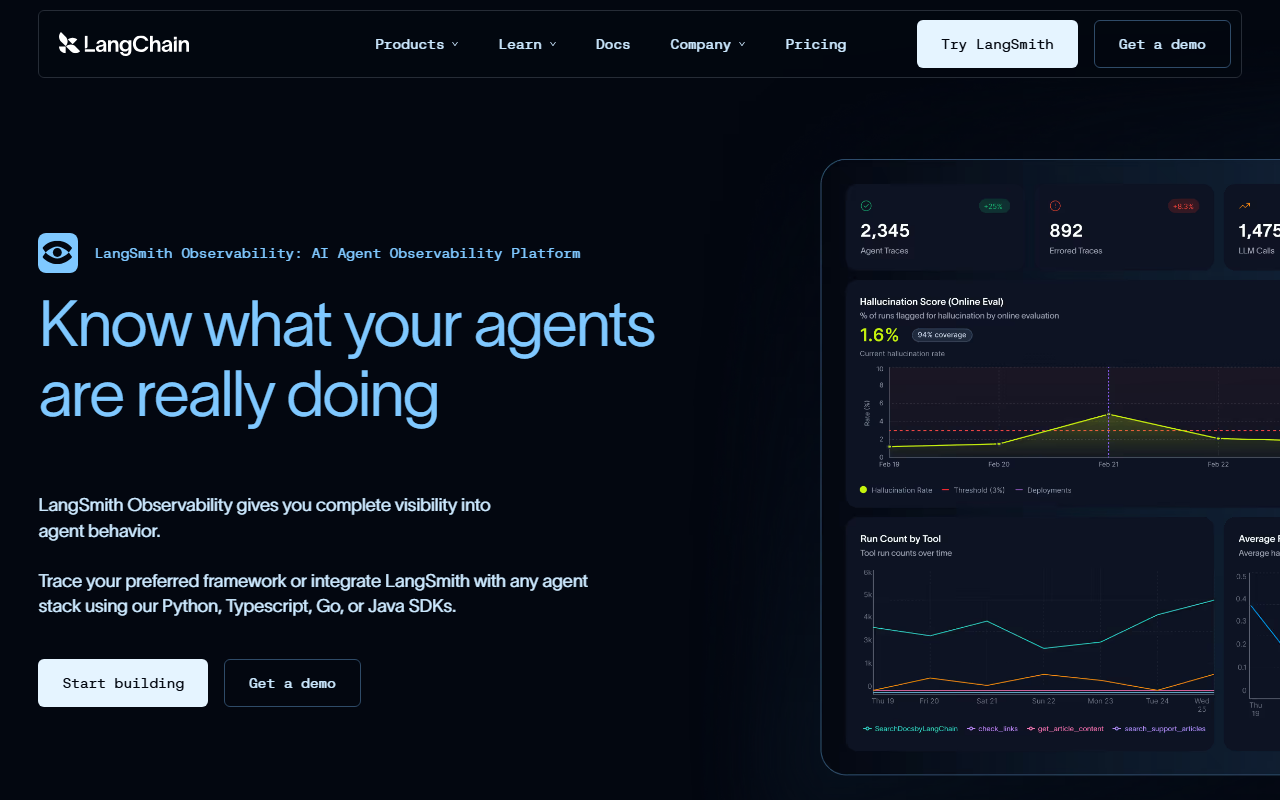
LangSmith's observability page says it can trace any agent stack through Python, TypeScript, Go or Java SDKs, not only LangChain. The pricing page lists what each part includes: tracing, monitoring, online and offline evals, annotation queues, a prompt hub and playground and bulk export under Observability and Evaluation; Studio, an Assistants API, cron scheduling, scale-to-zero and the option to expose an agent as an MCP server under Deployment; a no-code agent builder called Fleet; isolated Sandboxes for agent-generated code; an LLM Gateway with cost controls, fallbacks and PII redaction; and Engine, which monitors traces, clusters failures and proposes fixes.
The pace is high. In the two weeks before this review the blog announced AI search across traces (13 Oct 2026), Trajectories for following a whole agent session, Engine v2 with red teaming and LangSmith Fine-Tuning (all 24 Sep 2026), and the changelog added granular organization permissions. That is useful if you want the features, and it is also why the pricing page keeps changing.
MCP and integrations
Three MCP touchpoints are documented: the framework's langchain.mcp namespace for FastMCP tools (1.4.0), Deployment's option to expose a deployed agent as an MCP server, and a hosted LangSmith MCP server that agents can use to read traces, prompts and sandbox files (changelog, September and October 2026). Fleet accepts remote MCP servers for third-party tools, whose fees are billed by those providers. If you connect any of these to Claude, the same caution applies as for every MCP server: give the narrowest access that works.
Limits that bite before the bill does
The administration docs publish hourly caps; past them, LangSmith rejects new trace data with rate-limit errors until the hour resets: 50,000 trace events an hour on Developer without a card, 250,000 with a card, and 500,000 on Plus, with data-ingest caps of 500 MB, 2.5 GB and 5.0 GB an hour. An event is each creation or update of a run, so a busy multi-step agent reaches the event cap long before the trace count looks large. The SDK batches up to 100 runs per request to soften this.
Strong paperwork for LangSmith; a real but patched vulnerability record for the framework.
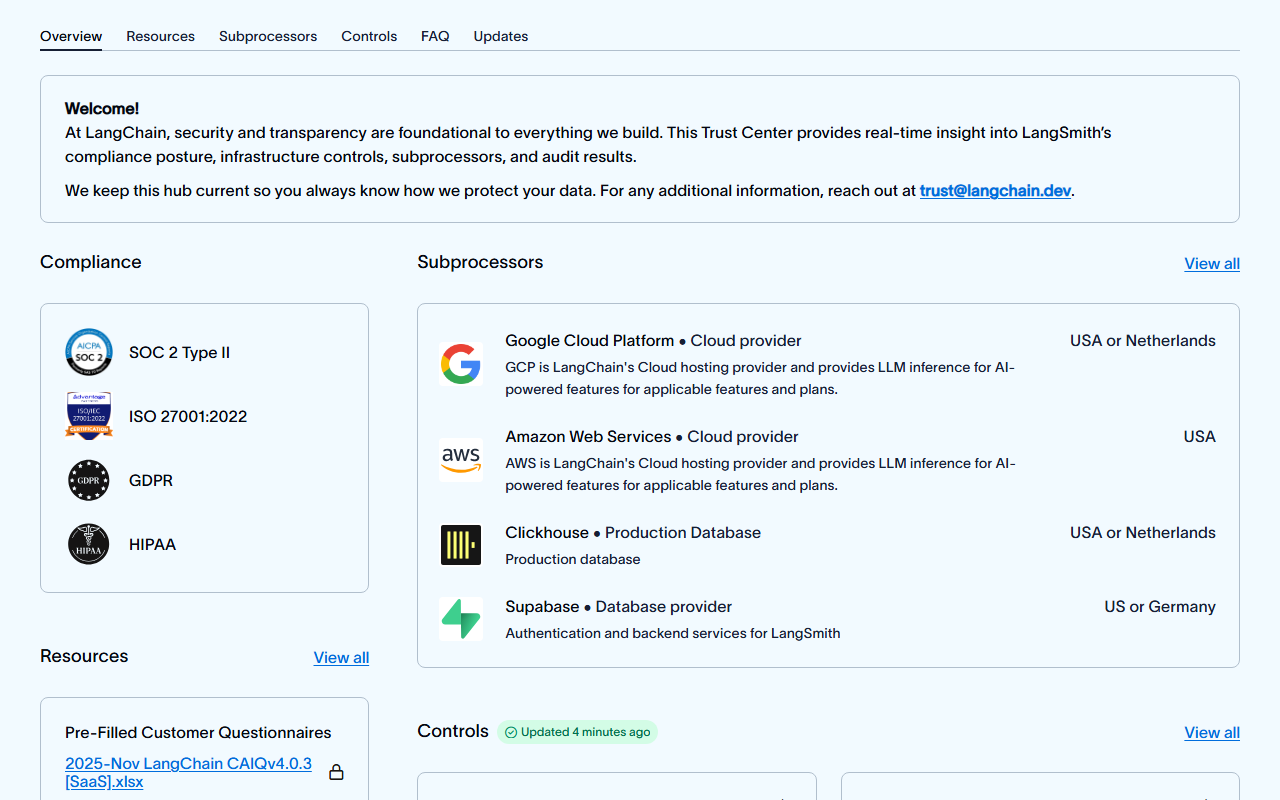
The LangSmith Trust Center lists SOC 2 Type II, ISO 27001:2022, GDPR and HIPAA. Its 3 Sep 2026 update says the latest SOC 2 Type II report covers 1 Jul 2025 to 30 Jun 2026, spans all of LangSmith, adds Availability and Confidentiality to Security, and received an unqualified opinion. Named subprocessors include Google Cloud (USA or Netherlands), AWS (USA), ClickHouse and Supabase, and a 28 Sep 2026 notice adds Typesafe and Modal for opt-in AI features from 27 Oct 2026. The pricing FAQ states that LangSmith does not use customer data to train models.
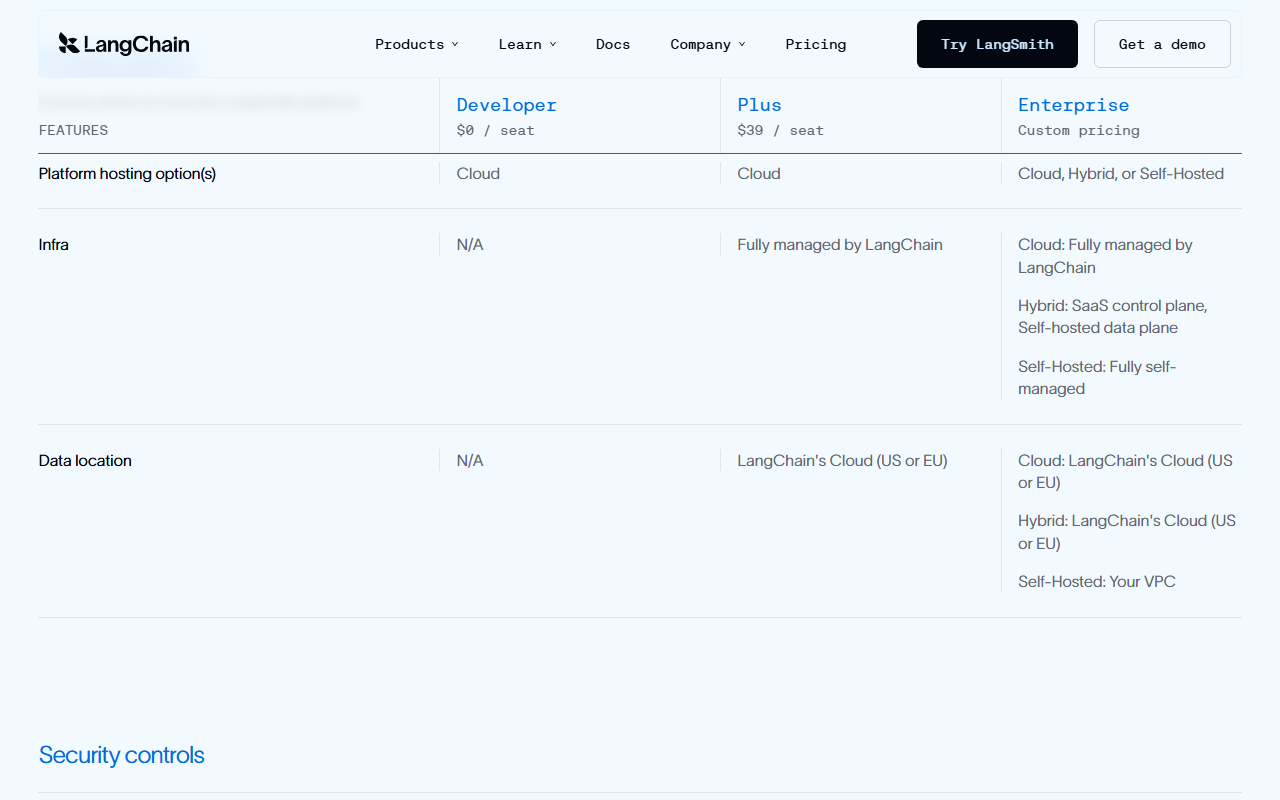
Where data lives depends on the plan: the pricing table puts Plus data in LangChain's cloud in the US or EU, while Hybrid (your data plane) and Self-Hosted (your VPC) are Enterprise only. After retention ends, the docs say trace inputs and outputs are deleted within a day, but “some metadata associated with each trace may be retained indefinitely for analytics and billing purposes”. Data protection controls in the LLM Gateway are excluded from Plus, per a pricing tooltip.
The framework's advisories
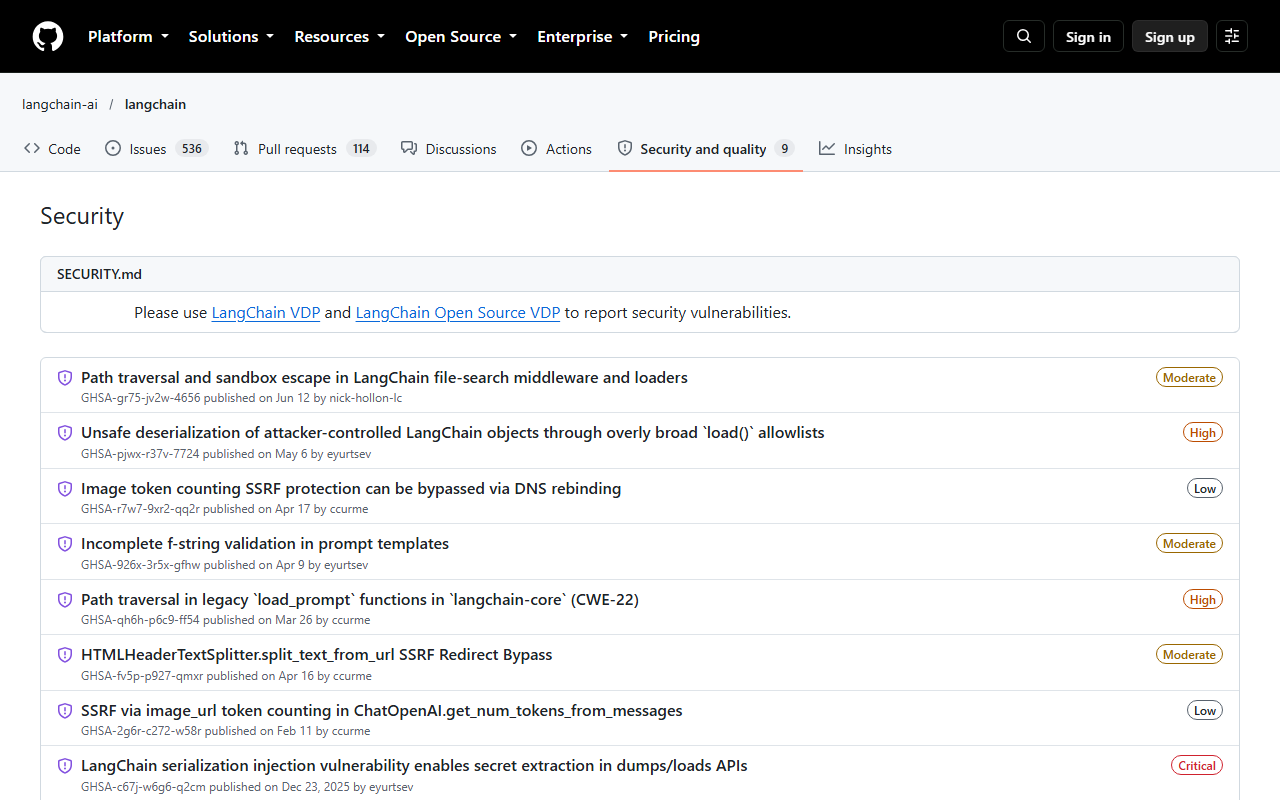
The langchain-ai/langchain repository lists nine published security advisories as of 16 Oct 2026. The most serious, CVE-2025-68664 (23 Dec 2025, critical), was a serialization injection in the dumps and loads APIs that could expose secrets, fixed in langchain-core 1.2.5 and 0.3.81. Three advisories are rated high: a prompt-template injection through attribute access (CVE-2025-65106, 19 Nov 2025, fixed in langchain-core 1.0.7 and 0.3.80), path traversal in the legacy load_prompt functions (CVE-2026-34070, March 2026), and unsafe deserialization through overly broad load() allowlists (CVE-2026-44843, May 2026, fixed in 1.3.3 and 0.3.85). The remaining five are rated medium or low: SSRF issues in token counting and an HTML splitter, incomplete f-string validation in prompt templates, and, in June 2026, a path traversal and sandbox escape in the file-search middleware and loaders, fixed in langchain 1.3.9.
GitHub, Nov 2025 to Jun 2026
CVE-2025-68664, secret extraction
CVE-2025-65106, CVE-2026-34070, CVE-2026-44843
SSRF, f-string validation, file-search path traversal
A practical order: pin and patch langchain-core, never pass untrusted input to load or loads, keep file-search middleware pointed at a narrow directory, and move off 0.3 before its maintenance ends in December 2026. On LangSmith, ask for the SOC 2 report, confirm the region, decide how long traces should live, and keep secrets out of traced inputs.
We have not reviewed LangChain's privacy policy, terms of service or data processing agreement, and we have not audited any control. Check them before tracing personal, health or confidential data.
Python teams that want breadth of integrations, and teams that want one vendor for tracing, evals and deployment.
- Python developers who want many model, tool and vector-store integrations behind one interface
- Teams already on LangGraph who want managed deployment and tracing from the same vendor
- Companies that need SOC 2 Type II, ISO 27001 and an EU region from an observability vendor
- Solo developers who want free tracing for a few thousand runs a month
- Small projects where a provider SDK would be shorter and easier to debug
- Teams that need flat, predictable pricing on self-serve plans
- High-volume tracing on a budget, where self-hosted open-source tracers cost less
- Anyone needing more than 180 days of trace history on LangSmith SaaS
- JavaScript-first teams, where Vercel's AI SDK is far more downloaded
A moving price list, metered extras, shorter retention and a framework many developers still resent.
$0.50 to $2.50 to $5.00 per 1,000 extra base traces between December 2025 and late July 2026.
Extended traces now kept 180 days on SaaS, down from 400, since 14 Sep 2026.
Deployment, Engine, Fleet, Sandboxes, Gateway and Tuned Evaluators all bill in LSUs on top of seats.
About 7 to 45 LSU per run by the vendor's estimate, every 6 hours; set the per-project spend limit before enabling it.
Hacker News criticism of debugging, churn and wrong abstractions continues into September 2026.
Nine framework advisories, one critical, between November 2025 and June 2026, all with fixes published.
Security and critical fixes for LangChain 0.3 end in December 2026.
Trustpilot has 0 reviews; no G2 or Capterra score is quoted.
JAVIS did not run the framework or LangSmith for this review.
Other frameworks are free too; the price comparison that matters is LangSmith against other tracing tools.
| Product and when to pick it | What the source says (16 Oct 2026) | JAVIS review |
|---|---|---|
| LangSmith Tracing, evals and deployment from the LangChain team | Developer $0 (5k traces); Plus $39 a seat (10k traces); then $5 per 1,000 base traces | This article |
| Langfuse Open-source tracing you can self-host | Hobby free (50k units); Core $29 a month (100k units, then $8 per 100k); Pro $199; Enterprise $2,499; self-hosted free under MIT. Units count traces, observations and scores | Not reviewed yet |
| Braintrust Eval-first platform | Starter $0 (1 GB processed, 10k scores, 14-day retention); Pro $249 a month (5 GB, 50k scores, 30 days) | Not reviewed yet |
| Arize AX Observability with an open-source sibling, Phoenix | AX Free (25k spans, 15 days); AX Pro $50 a month (50k spans, 30 days); Enterprise SaaS or self-hosted | Not reviewed yet |
| LangGraph Lower-level control from the same company | Free, MIT; LangChain's create_agent runs on it | LangGraph review |
| LlamaIndex Retrieval-heavy apps over your documents | Open-source framework | LlamaIndex review |
| CrewAI Role-based multi-agent crews | Open-source framework with a hosted platform | CrewAI review |
| OpenAI Agents SDK, Google ADK, Microsoft Agent Framework A vendor's own agent toolkit | Open-source SDKs from the model vendors | OpenAI Agents SDK, Google ADK, Microsoft Agent Framework |
One like-for-unlike comparison, with the assumption shown
LangSmith bills per trace; Langfuse bills per unit, where one trace with six LLM or tool steps (observations) counts as seven units. Assume 200,000 traces a month at that shape: 1.4 million Langfuse units. On Langfuse Core the first 100,000 units are included, the next 900,000 cost $8 per 100,000 ($72) and the last 400,000 cost $7 per 100,000 ($28): $29 + $72 + $28 = $129 a month. On LangSmith Plus with one seat the same 200,000 base traces cost $989. With deeper traces the gap narrows: at 30 observations per trace, Langfuse would bill 6.2 million units, about $465 on Core ($29 + $72 for the second tier + $364 for the next 5.2 million units at $7 per 100,000). Retention differs too (90 days of data access on Langfuse Core against 14 days for base traces on LangSmith), and self-hosting Langfuse costs no license fee but costs your own infrastructure. Treat this as a reason to price your own trace shape on both calculators, not as a verdict.
Two more facts from the same day: the Langfuse site says Langfuse has joined ClickHouse, and the Helicone pricing page says Helicone has joined Mintlify. Consolidation is happening across this category, so vendor stability is worth a question for every tracer, not only LangSmith.
This review has no affiliate links, and LangChain did not see it.
JAVIS has no approved LangChain affiliate link, so every LangChain link here goes straight to langchain.com, its documentation or GitHub, with no tracking parameters.
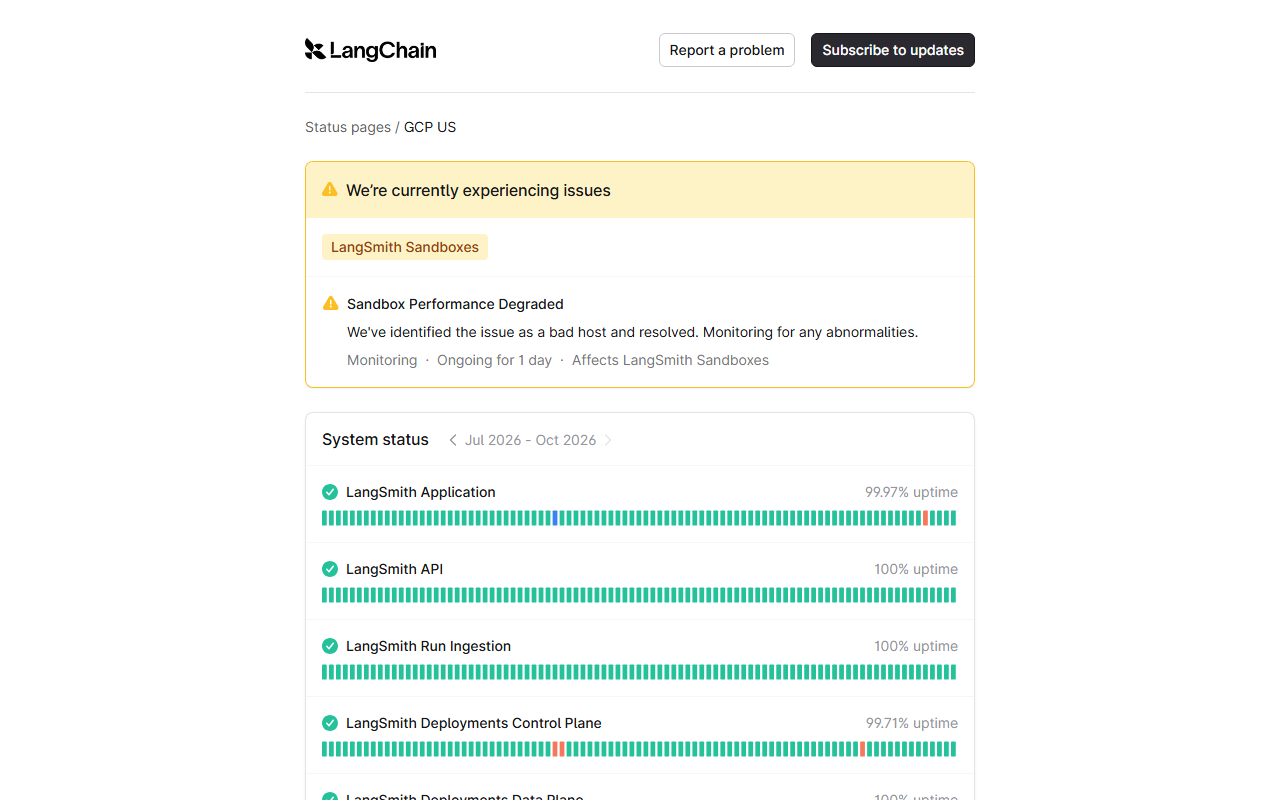
Hands-on status: JAVIS has not installed the framework, opened a LangSmith account or paid for a plan for this review. Facts come from LangChain's pricing page, product pages, documentation, changelog, Trust Center, status page and GitHub repository, Internet Archive copies of the pricing page, PyPI and npm download counters, Hacker News, TechCrunch and the Langfuse, Braintrust, Arize and Helicone pricing pages, as of 16 Oct 2026. Independent review evidence is limited, as described above.
It is free and MIT-licensed; start with the overview docs.
Open the LangChain docsCheck the rates and calculator yourself before you add a card.
Open the pricing pageChoosing an agent stack? These reviews cover the nearest ground.
Each card opens a published JAVIS review.


Questions people actually ask before committing
Is LangChain free?
Yes. The langchain framework, LangGraph and Deep Agents are MIT-licensed. Only LangSmith, the commercial platform, costs money.
How much does LangSmith cost in October 2026?
Per langchain.com/pricing on 16 Oct 2026: Developer $0 for one seat with 5,000 base traces a month, Plus $39 a seat a month with 10,000, Enterprise custom. Extra base traces cost 0.005 LSU ($5 per 1,000), extended upgrades 0.0025 LSU, and Deployment, Engine, Fleet and Sandboxes are metered in LSUs at $1 each.
Do I need LangSmith to use LangChain?
No. Tracing is switched on with an environment variable and an API key; without them the framework runs on its own.
Does LangSmith work without LangChain?
Yes. Its docs describe Python, TypeScript, Go and Java SDKs and integrations with other frameworks and providers.
How long are traces kept?
Base traces 14 days; extended traces 180 days on SaaS since 14 Sep 2026 (previously up to 400). Datasets you create from traces are kept indefinitely.
Is LangChain 1.x stable?
The release policy promises no breaking changes until 2.0, and at least a year of maintenance for 1.x after 2.0 ships. LangChain 0.3 receives security and critical fixes only until December 2026.
Is LangSmith SOC 2 compliant?
The Trust Center lists SOC 2 Type II (report period 1 Jul 2025 to 30 Jun 2026), ISO 27001:2022, GDPR and HIPAA.
Is LangChain an affiliate product here?
No. This review has no affiliate links.
Where this came from, and when.
Pricing and plans: langchain.com/pricing, its plan-table tooltips and FAQ, 16 Oct 2026; LangSmith billing and administration docs, 16 Oct 2026.
Price history: Internet Archive copies of langchain.com/pricing dated 1 Dec 2025, January to early July 2026 (24 Jan, 2 Feb, 4 Mar, 1 May, 7 Jun and 6 Jul), 31 Jul, 10 Aug and 14 Sep 2026; LangSmith Cloud changelog entries for 7 to 14 Sep, 28 Sep to 5 Oct and 5 to 12 Oct 2026.
Product and claims: LangChain home, About, LangChain and LangSmith Observability pages, the LangChain overview, v1 release notes and release policy in the docs, the LangChain blog and October 2026 newsletter, the Trust Center and the status page, 16 Oct 2026.
Repository facts: langchain-ai/langchain on GitHub, 16 Oct 2026: 147,899 stars, 24,821 forks, 536 open issues, 114 open pull requests, MIT license, nine published security advisories; release dates from GitHub and PyPI.
Market: pypistats (30 days to 16 Oct 2026) and npm (13 Sep to 12 Oct 2026) download counters; TechCrunch, 21 Oct 2025.
Independent evidence: Hacker News stories 36645575 (8 Jul 2023), 40739982 (20 Jun 2024), 49815982 (23 Sep 2026) and 49557206 (3 Sep 2026); comments 44865484 (11 Aug 2025), 46239236 (12 Dec 2025), 46398376 (27 Dec 2025), 46559212 (9 Jan 2026), 47248766 (4 Mar 2026), 49099594 (29 Jul 2026), 49254284 (11 Aug 2026), 49542930 (2 Sep 2026), 49557233 (3 Sep 2026), 49816901, 49817020, 49817162, 49817324 and 49820007 (all 23 Sep 2026). Trustpilot profile for langchain.com: unclaimed, 0 reviews, 16 Oct 2026. G2 and Capterra scores are not quoted.
Images: twenty-one screenshots of public pages captured on 16 Oct 2026 (LangChain home, About, product, LangSmith and pricing pages, docs, changelog, Trust Center, status page and two GitHub pages), plus LangChain's own social image, labelled as vendor material. Related cards use JAVIS's own featured images.
Video: one video from the official LangChain YouTube channel.
Competitors: Langfuse (pricing page and billable-units docs), Braintrust, Arize and Helicone pricing pages, 16 Oct 2026. The cost examples are arithmetic on published rates with invented traffic and, for deployment, invented sizes.
Store ratings: none; LangChain has no mobile app.
JAVIS Fit Score (69/100): an editorial composite scored out of 20 on five criteria. Price clarity 11: public rates and a calculator, but three trace-price changes in a year, a unit merger and an Engine run cost given only as a range. Capability breadth 18: free frameworks with very wide integrations plus tracing, evals, deployment, sandboxes, gateway and Engine. Independent evidence 12: huge download and star counts, but no star rating and persistent public criticism. Security and data control 16: SOC 2 Type II, ISO 27001, US or EU region, self-hosting on Enterprise, but nine framework advisories between November 2025 and June 2026. Cost control and fit 12: free framework and free tier, spend limits, but rising trace prices and metered extras. It is judgment, not a measurement.
What this review does not cover: real tracing or agent performance under your workload, the size specs of Deployment tiers, how often Engine runs are skipped, the privacy policy, terms and data processing agreement, and a technical security review.