Cohere Review 2026: Cheap, Strong Search Models, a Free Open Flagship With a Catch, and a Company Built for Sovereign AI
Cohere sells retrieval models (Embed 5, Rerank 5, Parse 5) by the token, gives its flagship Command A+ away as open weights, and sells the same models through OpenRouter, rents dedicated GPUs and charges real money for its North agent platform. As of Nov 4, 2026 it is also merging with Germany's Aleph Alpha, buying the security firm AISLE and closing a Series E backed by Canada's government. This review sorts out what is free, what is cheap and what needs a sales call.
Correction, Nov 4, 2026: an earlier version said Command A+ was not sold per token. OpenRouter has listed it since Sep 22, 2026 at $0.30 per 1M input and $1.50 per 1M output tokens, served by Cohere. Updated Nov 4, 2026: Model Vault now charges per GPU-hour instead of per model instance; the prices below reflect the change.

There are no affiliate links in this review. Every Cohere link goes straight to cohere.com or docs.cohere.com.
| Made by | Cohere Inc., Toronto (founded 2019) |
| What it is | Enterprise models and API: Command, Embed, Rerank, Parse, plus the North platform |
| Pricing | Free trial key; retrieval from $0.02 per 1M tokens; dedicated GPUs from $3 an hour ($1 on promotion) |
| Catch | Command A+ is capped on Cohere's own API; production runs via OpenRouter, Model Vault or your GPUs |
| Evidence | Official docs; a handful of developer accounts on Hacker News |
Cohere is the easy pick for the search half of a RAG system and a serious pick for regulated companies that want models inside their own walls. It is a weaker pick if you just want a cheap, scalable chat API.
“For both trial keys and production keys, Command A+ is free until rate limits are reached.” That line on Cohere's own model page is the most important sentence in its pricing, and it cuts both ways.
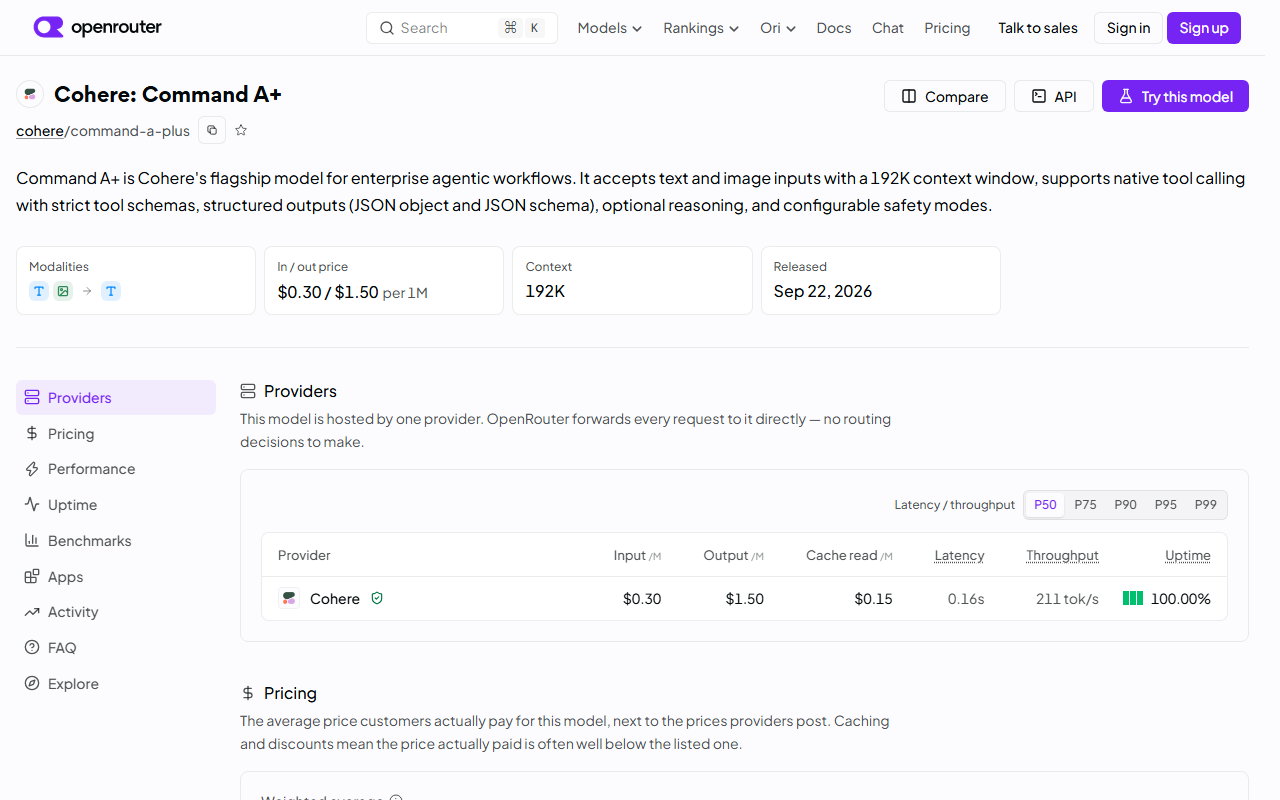
Cohere is a Toronto company that builds models for businesses rather than consumers. As of Nov 4, 2026 its self-serve API sells Embed 5 at $0.08 (Fast) or $0.12 (Pro) per million tokens, Rerank 5 at $0.02 or $0.05 per million tokens, and Parse 5 at $1.50 per 1,000 pages. On the chat side, Command R costs $0.15 in and $0.60 out per million tokens and the older flagship Command A costs $2.50 and $10. The newest flagship, Command A+, is open weights under Apache 2.0 and listed at “$0 / Free” on the pricing page; OpenRouter sells it at $0.30 in and $1.50 out per million tokens, with Cohere as the only provider.
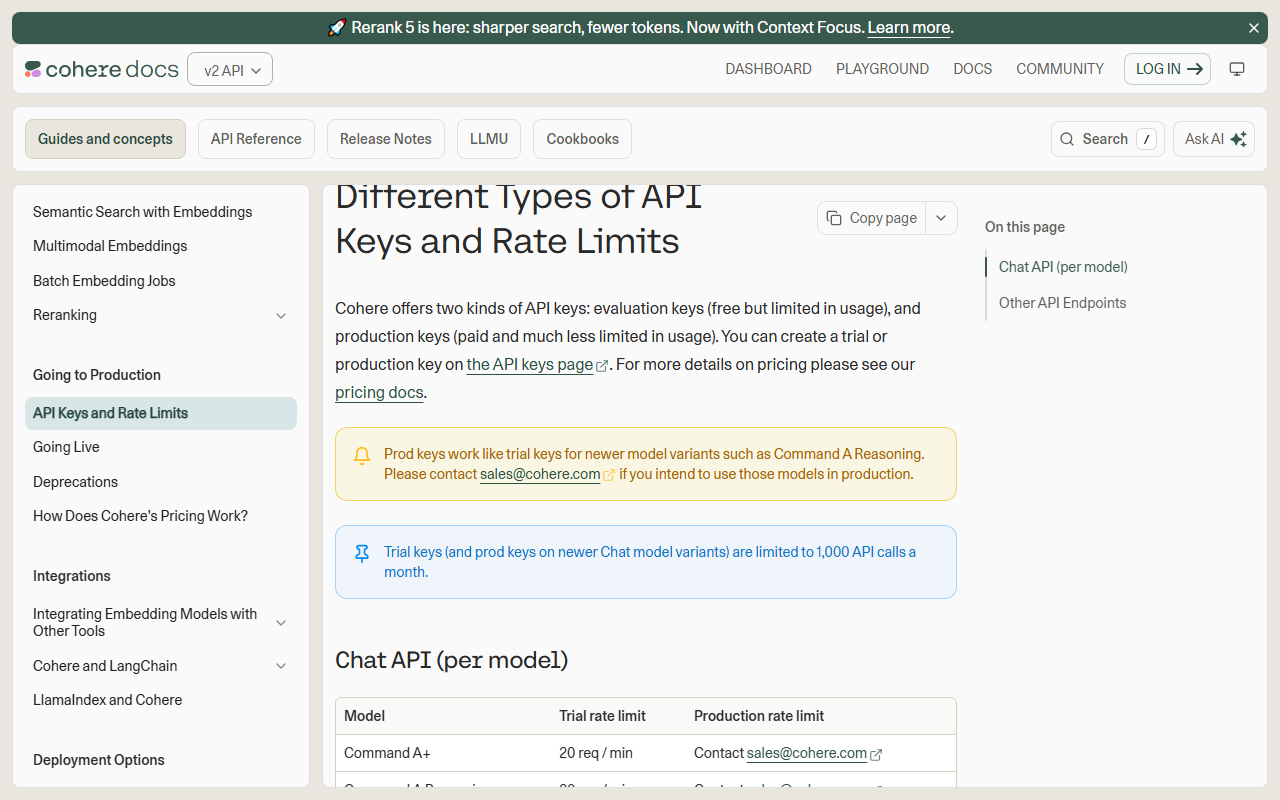
Three things should shape your decision. First, “free” Command A+ is an evaluation tier: Cohere's rate-limit page says production keys on newer chat models “work like trial keys”, which means 20 requests a minute and 1,000 calls a month. Real production use goes through OpenRouter at $0.30 and $1.50 per million tokens, through Model Vault, which now rents dedicated GPUs by the hour (an H100 is $6.25, or $4.25 on a promotion through Mar 31, 2027, and Command A+ needs two), or through your own GPUs. Second, the retrieval models are priced right at the market: Embed 5 Pro and Rerank 5 Pro match Voyage AI's list prices to the cent, so you are choosing on quality and deployment options, not price. Third, the company is changing shape: a definitive agreement to combine with Aleph Alpha (Sep 16, 2026, awaiting regulatory approval), a planned purchase of AISLE (Oct 15) and a Series E targeting up to CAD $7 billion (Oct 29) all point Cohere at governments and regulated industries.
Not a hands-on test: JAVIS has not created a Cohere account, sent a request or run Command A+. This review is built from cohere.com, Cohere's documentation, blog and status page, Hugging Face, OpenRouter, competitors' pricing pages, press coverage and Hacker News, all dated Nov 4, 2026 unless stated (Voyage AI's prices are from Oct 30).
Four ways in: a free trial key, a pay-as-you-go key (Cohere's or OpenRouter's), a dedicated Model Vault, or a private deployment.
Every account starts with a trial key. Trial calls are free but rate limited and, per the pricing FAQ, “not permitted to be used for production or commercial purposes”. A production key is pay as you go and needs an organization owner to complete a go-to-production form; you are billed at the end of each calendar month or when your outstanding balance reaches $250. Cohere's models are also on OpenRouter, where Cohere is the provider and you pay OpenRouter per token. Model Vault is Cohere-managed, single-tenant hosting billed per GPU-hour; since Nov 4, 2026 it also runs open models such as DeepSeek, Gemma and GPT-OSS, with zero data retention by default and regions in the United States, the European Union and Canada. Above that sit private deployments in your VPC or data center and Cohere's models on Microsoft Foundry, Amazon SageMaker, Amazon Bedrock and Oracle, which Cohere's docs list as supported platforms.
A Canadian lab turning into a transatlantic “sovereign AI” company, with Germany's Schwarz Group and Canada's government as backers.
Cohere was founded in 2019 by Aidan Gomez, Ivan Zhang and Nick Frosst and is based in Toronto; Cohere notes that one co-founder was a University of Toronto undergraduate among the eight authors of the 2017 Transformer paper. It has always sold to companies rather than consumers, and in 2026 it has leaned hard into what it calls sovereign AI: models a government or bank can run inside its own environment, under laws it trusts.
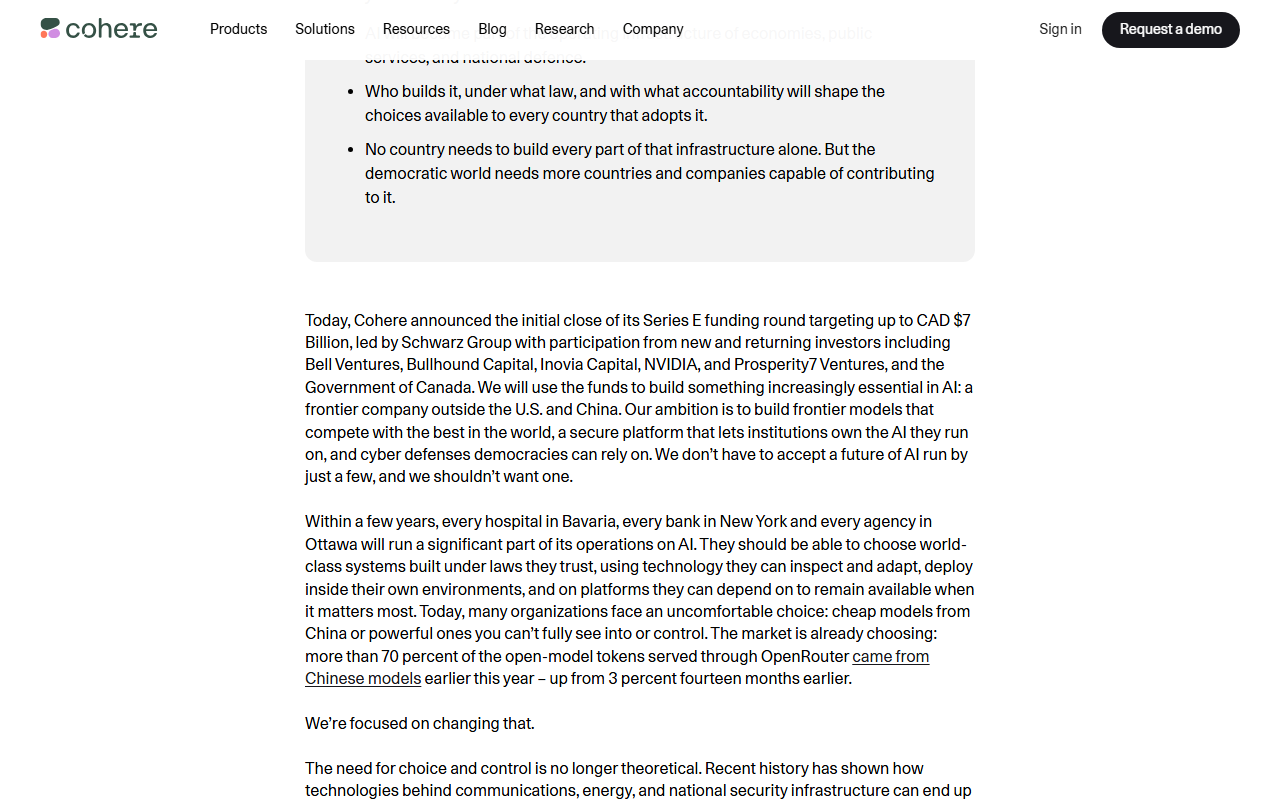
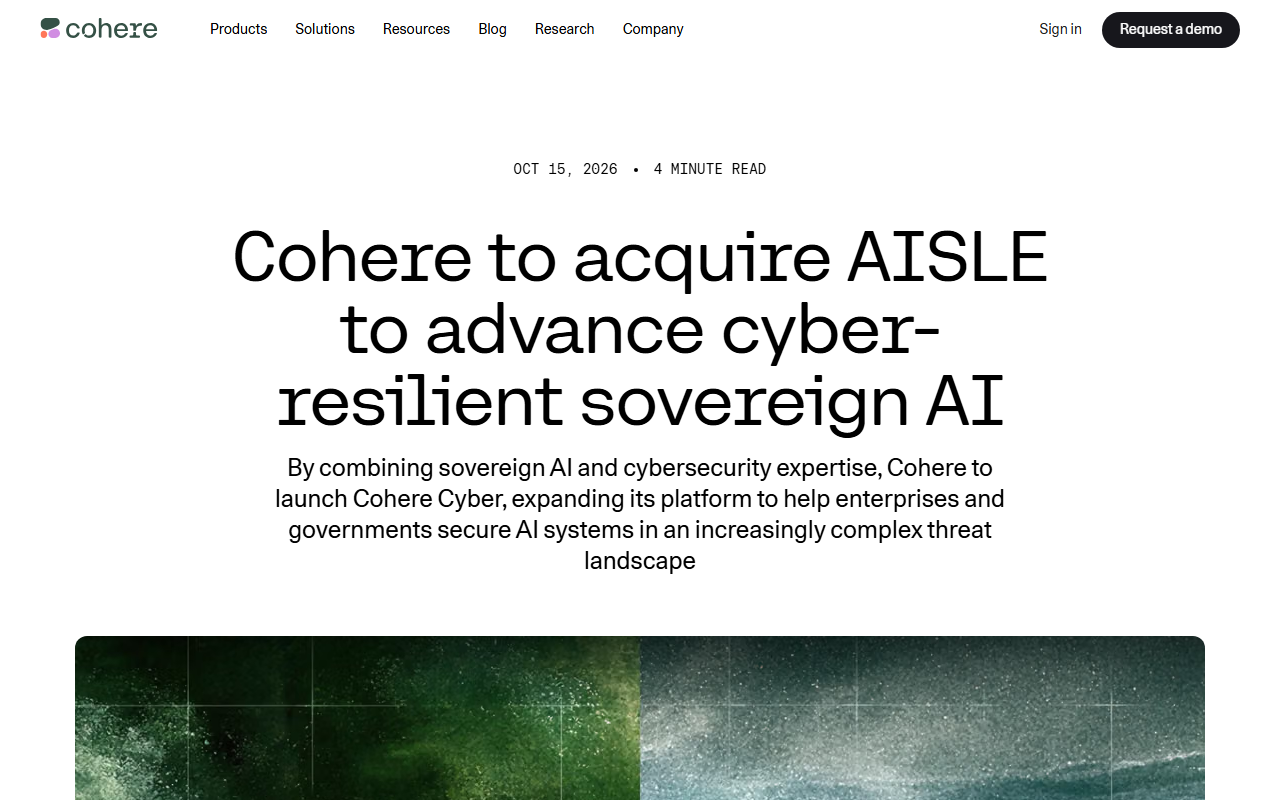
Three company events matter for a buyer. On Sep 16, 2026 Cohere signed a definitive business combination agreement with Aleph Alpha, the Heidelberg model maker. The combined company will operate as Cohere with headquarters in Berlin and Toronto and more than 1,000 staff; the deal “remains subject to final regulatory approvals” and was expected to close later in 2026. On Oct 15 Cohere announced a proposed agreement to acquire AISLE, a security start-up founded in 2024, to launch a unit called Cohere Cyber. On Oct 29 it announced the initial close of a Series E “targeting up to CAD $7 Billion”, led by Schwarz Group (the owner of Lidl and Kaufland, whose STACKIT cloud Cohere also partners with), with NVIDIA, Inovia, Prosperity7, Bell Ventures, Bullhound and the Government of Canada.
Cohere's post does not state a valuation or how much has been committed. Trending Topics reported a valuation of about CAD $35.7 billion and, citing the company, annual recurring revenue up 165% in the year to September with 300 customers; CBC reported that Canada will invest up to $1.6 billion. For comparison, BetaKit reported a US $6.8 billion valuation in Aug 2025 and $7 billion after an extension that September. Treat the press figures as reported, not disclosed. On Oct 30, 2026 Cohere also said it expects to invest more than C$4 billion in R&D and AI infrastructure in Canada between 2024 and 2031 and add more than 1,500 Canadian jobs, including a C$309 million GPU cloud partnership with Bell AI Fabric.

Open-weight interest is real but modest: the Command A+ BF16 weights showed 17,450 downloads in the last month on Hugging Face on Nov 4, 2026, plus 4,692 for the 4-bit build. Cohere Transcribe drew 97,660. Downloads are not users or customers.
Developers praise the embedding and rerank models as dependable. Skeptics question the sovereign-AI marketing. The evidence is thin.
There is no large review dataset for Cohere's API. Its Trustpilot profile is unclaimed with one review (1 star, Aug 2026), and that review describes a WhatsApp “task” job scheme paying in crypto that used the Cohere name; it says nothing about the product, but it is a useful warning that the brand is being used in job scams. The useful evidence is Hacker News, where developers mention Cohere in passing. Claims below are individual accounts we cannot verify.
“I migrated over to their embedding model a few months ago for clip-style embeddings and it's been fantastic. It has the most crisp, steady P50 of any external service I've used in a long time.”
“My experience with Cohere and interacting with their sales engineers has been boring, I say that is the most flattering way possible.” The same user had moved after reliability problems at another provider.
“Cohere's embed-v4.0 is my daily driver as far as a high performance model is concerned.” The user likes the separate clustering input type.
A builder of a retrieval system called adding a Cohere reranker “one of the bigger quality wins”.
A team tuned for self-hosted open models: swapping in “Claude Haiku+Cohere Embed” made their results worse. A tuned pipeline beats a brand name.
Cohere's post alleging a Qwen model tried to send a file to a Beijing server drew 331 points. One reply: it “feels like a marketing article for, probably, their sovereign AI product.” Another found it did not “overcook their claim”.
Retrieval models per token, chat models per token, the new flagship free but capped on Cohere's API, and dedicated hosting per GPU-hour.
Cohere's pricing page splits into four tabs. North (the agent workspace) and Compass (search) are custom enterprise pricing. The model tabs list these prices as of Nov 4, 2026:
- All models, rate limited
- 20 chat requests a minute; 1,000 calls a month
- Not for production or commercial use
- Embed 5, Rerank 5, Parse 5
- Command A, Command R, Command R7B
- Billed monthly or at $250 owed
- L4 $3.00, H100 $6.25 an hour on demand
- Promotional rates through Mar 31, 2027
- Cohere and open models; zero retention by default
- North agent platform, Compass
- VPC, on-premises, air-gapped
- Customization by contract
| Model | Price | Notes |
|---|---|---|
| Command A+ | $0 on Cohere's API (capped); $0.30 / $1.50 per 1M on OpenRouter | Cohere's API: trial limits; OpenRouter: served by Cohere |
| Command A | $2.50 / $10 per 1M in / out | 256K context; on its model page, not the pricing page |
| Command R | $0.15 / $0.60 per 1M | 128K context, 4K output |
| Command R7B | $0.0375 / $0.15 per 1M | Smallest chat model |
| Embed 5 Fast / Pro | $0.08 / $0.12 per 1M tokens | 128K context, text and images, shared index |
| Rerank 5 Fast / Pro | $0.02 / $0.05 per 1M tokens | 32K context, Context Focus |
| Parse 5 | $1.50 per 1,000 pages | OCR, tables, forms, handwriting |
| North Mini Code | $0 on the API, $0 to download | 30B total, 3B active coding model |
From cohere.com/pricing, docs.cohere.com/docs/command-a and openrouter.ai/cohere/command-a-plus, Nov 4, 2026. Aya Expanse is listed at $0.50 / $1.50 per 1M in the pricing FAQ.


The billing rules worth knowing
Production calls are billed “at the end of every calendar month or when you reach $250 in outstanding balances”. Billing is in arrears, so there are no prepaid credits to expire, but also no hard stop unless you watch usage. Responses report billed_units separately from total tokens, and Cohere says you are not charged for tokens it adds under the hood. Getting a production key is quick, with one exception from the going-live page: if you say your use is in a sensitive category, your production key “may be rate limited the same as a trial key” until Cohere's safety team approves it, which it says takes no longer than 72 business hours.

Worked examples: retrieval is cheap, per-token chat is mid-priced, and dedicated hosting starts at four figures a month.
These are invented workloads with the arithmetic shown, using list prices on Nov 4, 2026 (Voyage AI's as of Oct 30, 2026). Embed and Rerank are where most Cohere API money goes in a typical RAG stack, so start there.
Indexing a document library
Embedding 500 million tokens of documents once costs 500 × $0.12 = $60 on Embed 5 Pro or $40 on Embed 5 Fast. Because Pro and Fast share one embedding space, you can index with Pro and embed live queries with Fast without rebuilding the index. For comparison, Voyage AI's voyage-4-large has the same $0.12 list price but gives every account its first 200 million tokens free, so the same job is $36 there; OpenAI's text-embedding-3-large is $65.
Reranking an internal search engine
Take 200,000 searches a month, each reranking 50 candidates of about 300 tokens with a 20-token query. If every query and document token is billed per candidate (the rule Voyage publishes), that is 200,000 × 50 × 320 = 3.2 billion tokens: $160 on Rerank 5 Pro or $64 on Rerank 5 Fast. Embedding the 200,000 queries themselves adds under $0.50. Cohere's pages do not yet spell out how Rerank 5 tokens are counted, and its pricing FAQ still describes the older per-search unit, so check a few billed_units values before you budget. Rerank cost grows with the number of candidates, so sending 20 instead of 50 cuts it by more than half.
A chat assistant on per-token models
100 million input and 20 million output tokens a month cost 100 × $2.50 + 20 × $10 = $450 on Command A, $27 on Command R and $6.75 on Command R7B. Command A is now the expensive option in Cohere's own lineup: its newer and stronger sibling Command A+ costs $0.30 in and $1.50 out per million on OpenRouter, where Cohere serves it, so the same workload is 100 × $0.30 + 20 × $1.50 = $60.
When dedicated retrieval capacity pays off
Model Vault also hosts Embed and Rerank self-serve, now priced per GPU-hour rather than per model. One L4 GPU running a 730-hour month costs $2,190 on demand, or $730 at the $1.00 promotional rate that runs through Mar 31, 2027. At $0.12 per million tokens, $2,190 buys about 18 billion Embed 5 Pro tokens. Cohere's pricing page does not say which GPU or how many replicas each retrieval model needs, so treat that as a floor. The internal-search example above uses 3.2 billion rerank tokens, so it should stay on pay-per-token unless you need single-tenant hosting for compliance. Cohere's own Oct 10, 2026 guidance says the same: dedicated capacity suits sustained, predictable load, per-token suits bursty traffic.

Parsing scanned documents
Parse 5 turns PDFs and scans into structured text with tables and bounding boxes for $1.50 per 1,000 pages, so 100,000 pages cost $150.
“Free” means free to evaluate and free to download. In production you pay OpenRouter per token, rent Model Vault GPUs by the hour, or run your own.
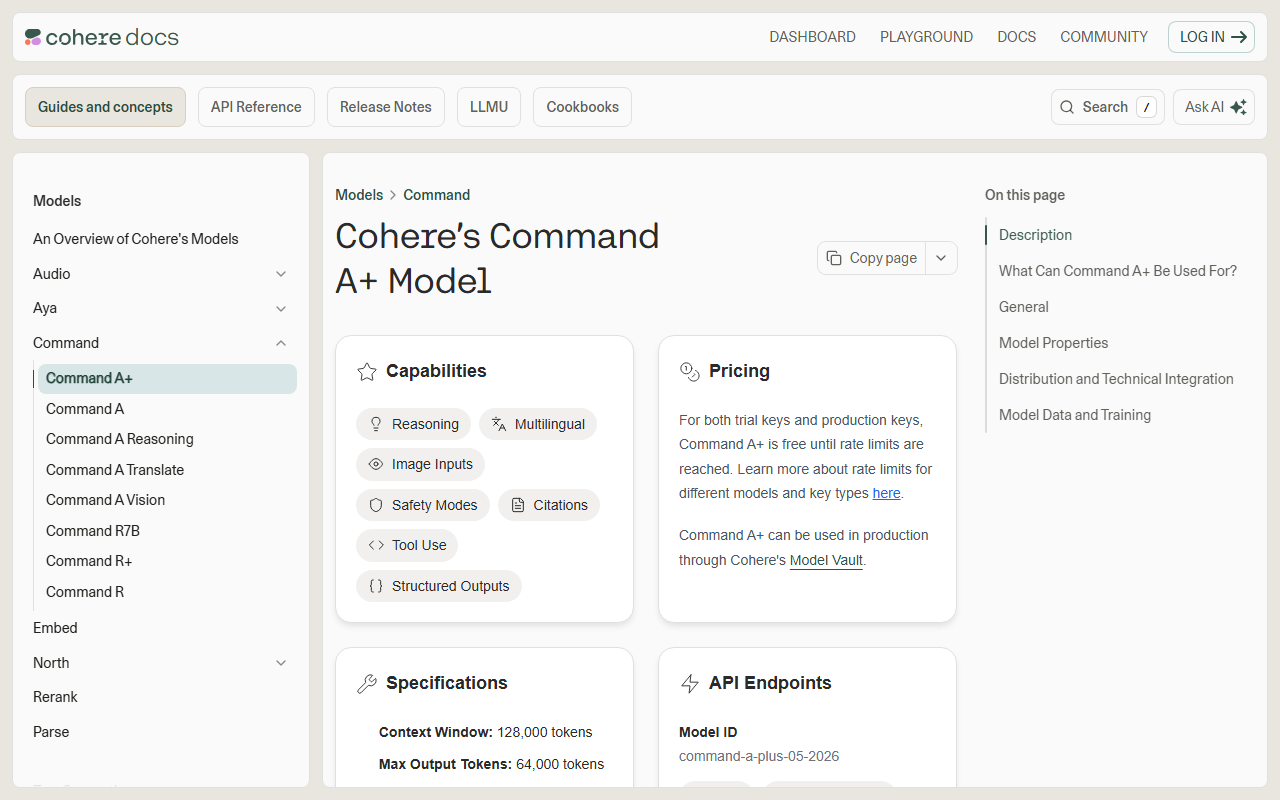
Command A+ arrived on May 20, 2026 as Cohere's first mixture-of-experts model: 218 billion parameters in total, 25 billion active, text and image input, 48 languages, 128K context and up to 64K output tokens. Cohere released the weights under Apache 2.0 and says they run on two NVIDIA H100s or a single B200 at 4-bit precision. That is a genuinely open flagship from an enterprise vendor.
The API route is narrower than the pricing card suggests. The rate-limit page says “Prod keys work like trial keys for newer model variants” and that trial keys, and production keys on newer chat models, are limited to 1,000 calls a month, with Command A+ at 20 requests a minute and production limits by contacting sales. Cohere's Command A+ page adds that it “can be used in production through Cohere's Model Vault”.
The page does not mention the per-token route. Cohere's own “Cohere on OpenRouter” docs page lists Command A+ among its OpenRouter models and says “Cohere is the provider for its models on OpenRouter”. OpenRouter shows Command A+ at $0.30 per million input and $1.50 per million output tokens ($0.15 for cached input), released there on Sep 22, 2026, with a 192K context window. OpenRouter's APIs support only a subset of Cohere's parameters; Context Focus for Rerank, for example, needs Cohere's own API.

Model Vault, the dedicated route, changed its pricing on Nov 4, 2026: instead of a price per model instance, you now pay for each GPU your model runs on, multiplied by replicas, with Cohere's models and open models on the same rate card. Generative models “may require a waitlist”. As of Nov 4, 2026:
| GPU | Per GPU-hour, on demand / promo | 730-hour month, on demand |
|---|---|---|
| L4 24GB | $3.00 / $1.00 | $2,190 |
| A100 80GB | $3.50 / $2.25 | $2,555 |
| H100 80GB | $6.25 / $4.25 | $4,562.50 |
| H100 80GB, Encrypted | $9.00 / $4.25 | $6,570 |
| B200 192GB | $9.75 / $8.00 | $7,117.50 |
From the Model Vault Pricing table on cohere.com/pricing, Nov 4, 2026. Promotional prices run through Mar 31, 2027; reserved capacity and monthly or annual commitments are by quote. The 730-hour figures multiply the hourly rate by 730.
Put differently: Cohere says Command A+ runs on two H100s, so the smallest setup would be about $12.50 an hour, or $9,125 for a 730-hour month on demand ($6,205 at the promotional rate). That buys about 15 billion input and 3 billion output tokens a month at OpenRouter's $0.30 and $1.50 ($9,125 divided by $0.60 for each million input tokens with 200,000 output). Below that volume, OpenRouter is cheaper; above it, or if you need single-tenant hosting, zero retention by default or a specific region, the Vault starts to make sense. The Vault app shows the GPU options actually offered for each model, so confirm before you budget. The third route is the weights themselves on your own or rented H100s, with your own engineers carrying the serving work.

Match your situation to one line.
A full retrieval stack (parse, embed, rerank), a family of chat models, and North on top.
Cohere's strongest story is the search pipeline. Parse 5 turns documents into structured text. Embed 5 handles text, images and mixed PDFs, 100+ languages and 128K-token inputs, with output sizes from 256 to 2,048 dimensions so you can trade accuracy for storage. Rerank 5 reorders whatever your search returns, and its new Context Focus option returns the most relevant character spans inside each document in the same call, so you can send only those passages to your LLM. Upgrading Rerank needs no re-indexing; you change the model name.
Cohere's benchmark claims for these models are its own. For Rerank 5 Pro it reports first place on 39 of 46 datasets, scored with a metric Cohere developed (RCP-nDCG@10), and an 82.2 on the BRIGHT reasoning benchmark against Voyage's Rerank 3. Test on your own queries before believing any leaderboard, including this one.
Command A+ (open, multimodal, reasoning), Command A, Command R and R7B, Aya multilingual models, North Small Translate and North Mini Code for agentic coding. Chat Completions compatibility is listed among the endpoints.
Embed 5, Rerank 5 with Context Focus and calibrated scores, Parse 5, batch embedding jobs, and Transcribe for speech (Vault-priced).
Cohere API, OpenRouter, Model Vault (with an Encrypted, confidential-computing option), Microsoft Foundry, SageMaker, Bedrock, Oracle, VPC and on-premises.
North 2, the workspace on top
North is Cohere's agent platform for employees. North 2 (Oct 5, 2026) added a redesigned agent harness, memory across sessions, shared skills and libraries, app and document creation, automations, admin cost controls and connectors including Slack, SharePoint, OneDrive, Outlook, Jira, Linear, Notion and GitHub. It is model-agnostic, so you can plug in other vendors' models, and it runs in Cohere's cloud, yours, or air-gapped. Pricing is by quote.

Sign up, test on a trial key, request a production key, and decide early whether you need dedicated capacity.
billed_units in each response to learn your real token counts, especially for Rerank.Rate caps, waitlists and a few documents that disagree with each other.
- Trial key: 20 chat requests a minute per model, 10 rerank requests a minute, 1,000 calls a month, no production or commercial use.
- Production key: 500 chat requests a minute on Command A, Command R, Command R7B and North Mini Code; 1,000 rerank requests a minute; 2,000 embed inputs a minute. Command A+, A Reasoning, A Vision and A Translate stay at trial limits unless sales agrees otherwise.
- Vault waitlists: Embed and Rerank are self-serve on Model Vault; generative, speech and custom models “may require a waitlist”.
- Pricing documents disagree: the pricing page bills Rerank 5 per million tokens, but the “How does Cohere's pricing work” page says Rerank is priced “based on the quantity of searches”, and the pricing FAQ still defines a search unit (one query with up to 100 documents).
- No fine-tuning API: Cohere retired self-serve fine-tuning in Sep 2025; customization is now an enterprise contract.
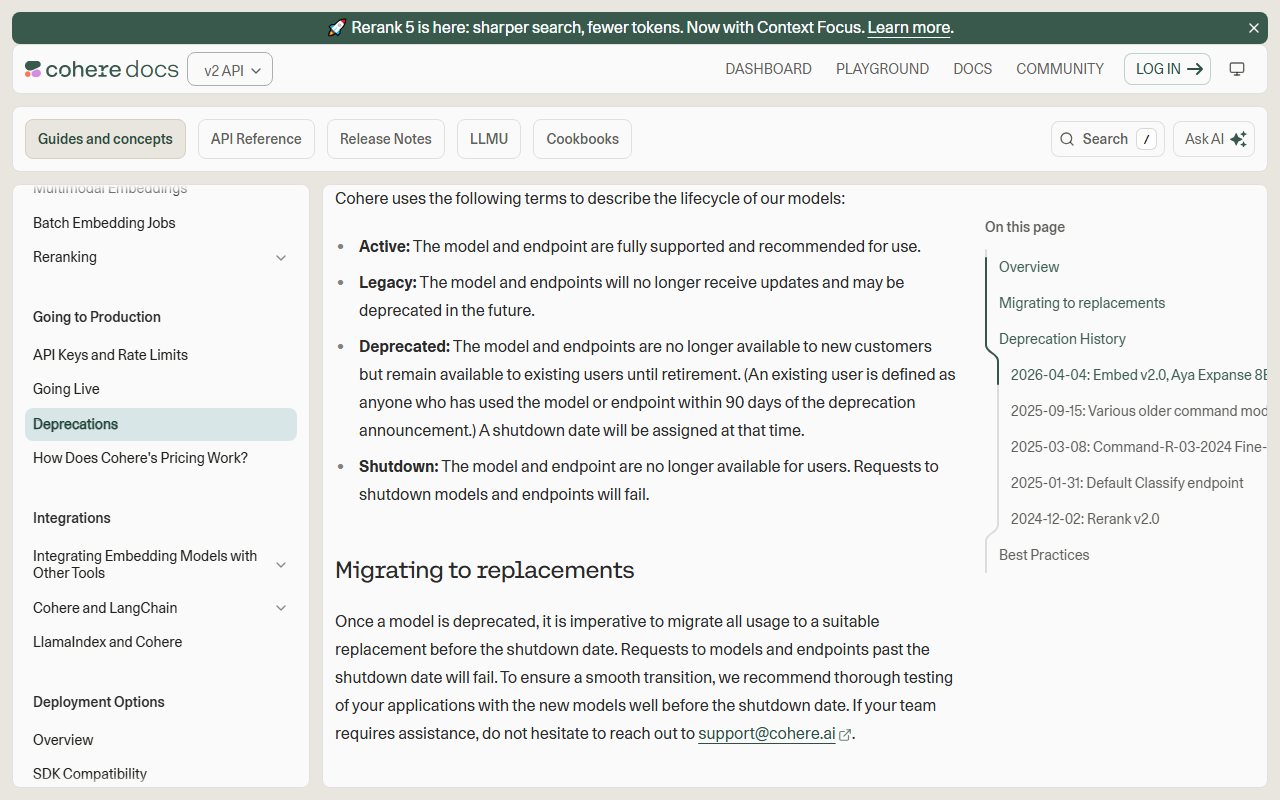
- Model retirements: Cohere's deprecation policy lets existing users keep a deprecated model until a shutdown date, but only if they used it within 90 days of the notice. Embed v2.0 and the 8B Aya models were retired on Apr 4, 2026.

Strong deployment options and certifications, but on the hosted API your data can train Cohere's models unless you switch it off.
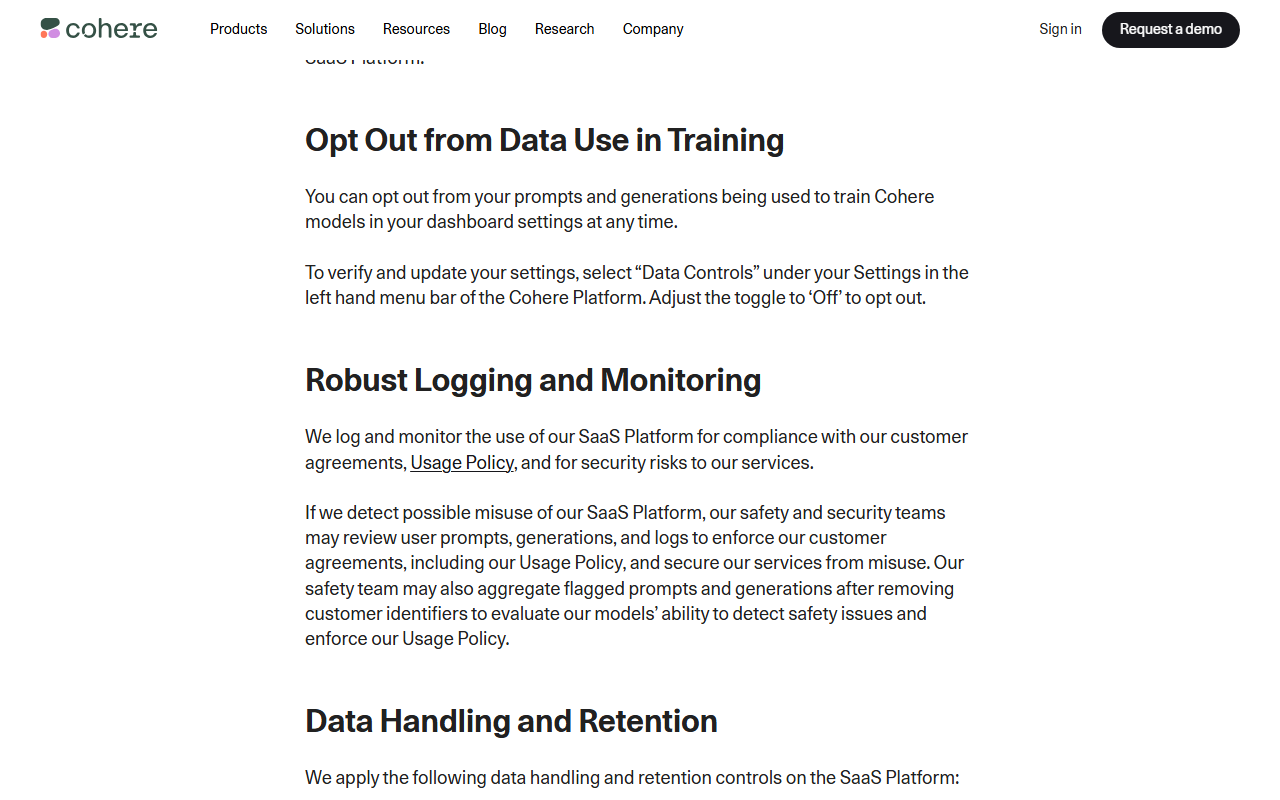
Cohere's Enterprise Data Commitments page says you “can opt out from your prompts and generations being used to train Cohere models” with a Data Controls toggle, which tells you training use is allowed until you do. Logged prompts and generations on the hosted platform are deleted after 30 days, unless law, a contract or a flagged policy violation requires longer. Zero data retention exists, but only for enterprise customers who make additional commitments about their use. These commitments cover paying customers (a card on file); trial users are covered by the general terms and privacy policy instead.
The stronger story is deployment. For private and third-party cloud deployments, Cohere says it “does not receive any customer inputs (prompts) or outputs (generations)”. The security page says the API platform is SOC 2 Type II compliant, and the data commitments page says customers can request ISO 27001 and ISO 42001 certificates and the SOC 2 report from the trust center. Model Vault keeps zero data retention on by default, and Model Vault Encrypted adds confidential-computing hardware with remote attestation; it now has public prices (an encrypted H100 is $9.00 an hour on demand) and runs in the United States, with the EU and Canada listed as coming soon. We have not reviewed the SOC 2 report, the DPA or the SaaS agreement; ask for them before sending regulated data.
Search-heavy builders and regulated organizations that want control.
Teams building RAG, enterprise search or agents that need strong embeddings and reranking; banks, insurers, public bodies and telecoms that want models in their own VPC or air-gapped; multilingual work across 48 to 100+ languages; buyers who prefer a vendor that does not sell to consumers.
Solo developers who want a cheap, high-volume frontier chat API; anyone expecting free Command A+ to carry production traffic; teams that need a self-serve fine-tuning API; buyers who want public prices for the agent platform.
Seven things to check before you rely on it.
1,000 calls a month on Cohere's key; production via OpenRouter, Vault or GPUs.
Two H100s about $9,125 a month on demand.
Switch Data Controls off on the hosted API.
Rerank per token on one page, per search on two others.
Aleph Alpha and AISLE deals pending; new owners on the cap table.
North, Compass and Vault generative models by quote or waitlist.
JAVIS did not send a request or run the weights.
Priced from each vendor's own page on Nov 4, 2026 (Voyage on Oct 30); the products differ, so the plans are not like-for-like.
| Option and when to pick it | What its own page says | JAVIS review |
|---|---|---|
| Cohere Retrieval stack, private deployment | Embed 5 $0.08 to $0.12, Rerank 5 $0.02 to $0.05 per 1M tokens; Command A+ open weights, $0.30 / $1.50 on OpenRouter | This article |
| Voyage AI Same-price retrieval with free tokens | voyage-4-large $0.12, rerank-3 $0.05, rerank-3-lite $0.02 per 1M; first 200M tokens free; Batch 33% off (as of Oct 30, 2026) | No live review yet |
| OpenAI embeddings One vendor for chat and embeddings | text-embedding-3-large $0.13 per 1M tokens | No live review yet |
| Mistral AI European sovereign alternative | Enterprise plan with private deployments and custom models, by quote | No live review yet |
| Together AI or OpenRouter Open models per token | Many open-weight chat models per token; OpenRouter also resells Cohere's own models, served by Cohere | Together AI, OpenRouter |
Cohere's embeddings end up in a vector database; if you are choosing one, see our Pinecone and Qdrant reviews, and LlamaIndex for wiring the pipeline together.
Five steps that keep cost and lock-in under control.
billed_units on real traffic and cap the number of candidates you send.This review has no affiliate links, and Cohere did not see it.
JAVIS has no approved Cohere affiliate link, so every link goes straight to cohere.com, its pricing page or its documentation, without tracking parameters.
Hands-on status: JAVIS has not created a Cohere account, sent a request or run the open weights. Cost examples use invented workloads with the arithmetic shown, benchmark figures are Cohere's own, and independent user evidence is thin, as section 04 says.
Model, retrieval and Vault prices.
Open Cohere pricingRate limits, models and Vault.
Open Cohere docsBuilding search or RAG? These reviews cover the pieces around Cohere.
Each card opens a published JAVIS review.



Questions people ask before committing
Is Cohere free?
Every account gets a free trial key for testing, limited to 1,000 calls a month and not for production. Command A+ and North Mini Code are listed at $0 on the API and as free downloads, but on Cohere's API they stay under trial-style limits; OpenRouter lists North Mini Code as a free model and Command A+ at $0.30 / $1.50 per million tokens.
How much does Cohere cost?
As of Nov 4, 2026: Embed 5 $0.08 or $0.12 per million tokens, Rerank 5 $0.02 or $0.05, Parse 5 $1.50 per 1,000 pages, Command R $0.15 in and $0.60 out, Command A $2.50 and $10; Command A+ $0.30 and $1.50 on OpenRouter. Model Vault GPUs run from $3.00 an hour on demand ($1.00 on a promotion through Mar 31, 2027); North is by quote.
Is Command A+ really open source?
The weights are released under Apache 2.0 on Hugging Face, and Cohere says they run on two H100s or one B200 at 4-bit precision.
Does Cohere train on my data?
On the hosted platform it can, unless you turn the Data Controls toggle off. For private and third-party cloud deployments Cohere says it receives no prompts or outputs.
Is Cohere merging with Aleph Alpha?
Cohere and Aleph Alpha signed a definitive business combination agreement on Sep 16, 2026. The combined company will operate as Cohere; the deal was subject to regulatory approval as of that announcement.
Who owns Cohere?
It is privately held. Its Oct 29, 2026 Series E was led by Schwarz Group, with NVIDIA, Inovia, Prosperity7 and the Government of Canada among investors.
What are the alternatives?
Voyage AI for same-price retrieval with free tokens, OpenAI embeddings, Mistral for a European vendor, and Together AI or OpenRouter for per-token open chat models; see section 15.
Where this came from, and when.
Pricing and product: cohere.com/pricing (all four tabs and FAQ); docs.cohere.com pages on models, rate limits, going live, pricing, deprecations, Command A, Command A+, Model Vault overview and supported models, and Cohere on OpenRouter; the release notes; openrouter.ai/cohere/command-a-plus; status.cohere.com, all Nov 4, 2026.
Data and legal: cohere.com/enterprise-data-commitments and cohere.com/security. We have not reviewed the SOC 2 report, ISO certificates, DPA or SaaS agreement.
Company: Cohere blog posts of May 20 (Command A+), Sep 16 (Aleph Alpha), Sep 30 (Embed 5), Oct 5 (North 2), Oct 10 (shared or dedicated inference), Oct 15 (AISLE), Oct 21 (Rerank 5), Oct 26 (Qwen), Oct 29 (Series E), Oct 30 (Canada commitment) and Nov 4, 2026 (Embed 5 and Rerank 5 on OpenRouter; open models on Model Vault); Trending Topics (Oct 29, 2026) and CBC (Oct 29, 2026) on the Series E; BetaKit (Aug and Sep 2025) on earlier valuations.
Independent evidence: Trustpilot (1 review, not about the product); Hacker News comments 47590069, 47591958, 48024266, 46875906, 48116822, 48550391, 50248162 and 50248139 and story 50246658; Hugging Face download counters and GitHub stars for Cohere's SDKs.
Competitors: OpenAI's text-embedding-3-large model page and mistral.ai/pricing (Nov 4, 2026); docs.voyageai.com/docs/pricing (prices as of Oct 30, 2026). Cost examples are arithmetic on those prices with invented workloads.
Images: screenshots of public pages taken Nov 4, 2026, Cohere's social card and Cohere's own YouTube video.
JAVIS Fit Score (68/100): editorial composite, 20 points each. Price clarity 13: clear per-token retrieval prices, but the flagship's per-token price lives on OpenRouter, Vault is priced per GPU without per-model sizing, and pages disagree on Rerank. Capability breadth 16: chat, retrieval, parsing, speech, an agent platform and open weights. Independent evidence 9: a few developer accounts, vendor benchmarks. Security and data control 17: private and air-gapped deployment, SOC 2 and ISO certificates, offset by training opt-out on the hosted API. Cost control and fit 13: cheap retrieval and no expiring credits, offset by four-figure dedicated GPU hosting. It is judgment, not a measurement.
What this review does not cover: our own quality or latency tests, North prices, Vault commitment prices and GPU sizing per model, Cohere's private-deployment terms, and whether the Aleph Alpha and AISLE deals close as announced.